Gianni Infantino’s divisive plan to sell stakes in the World Cup appears to be dead after the Asian Football Confederation (AFC) joined UEFA and CONCACAF in opposing the plot – while two senior FIFA figures turned against him.
Carlos Cordeiro, a retired American investment banker and senior adviser to Infantino, has resigned from his role at FIFA – becoming the first internal figure to do so.
It comes after UEFA, CONCACAF and the AFC all opposed FIFA’s plans to generate £3.1billion in private investment in FIFA tournaments.
135 FIFA members are now publicly opposed to the FIFA Forward Enterprise, bringing the dissidents above the required 106 threshold to block the plans with dignitaries now joining the calls for Infantino to scrap his plans.
Releasing a statement, Cordeiro – who served on the White House task force for the 2026 World Cup – distanced himself from Infantino’s plans and ripped into the proposals.
Cordeiro urged his now former FIFA colleagues to follow suit and speak out against the plans, which he describes as a bad deal for football. Infantino had promised member associations a £30million incentive to force the deal through.
‘As a Senior Advisor to the FIFA President, a former banker, and a lifelong football fan, I cannot stand by while FIFA considers selling a stake in the World Cup,’ Cordeiro said.
‘Let me be clear: I had no involvement in this proposal, and I oppose it unequivocally. It is a bad deal for FIFA’s Member Associations, a bad deal for football, and a bad deal for the long-term future of the game.
‘It has been the privilege of a lifetime to serve FIFA for more than five years and to work alongside dedicated, principled people who care deeply about the game. I hope they, too, will speak up, because decisions of this magnitude should be made in the interests of football, not those who stand to profit from it.’
FIFA’s chief operating officer Kevin Lamour responded to Cordeiro’s call to action and publicly turned against Infantino.
While Lamour stopped short of resigning as chief operating officer, a post he has held for two years, the Frenchman has put his job at risk by speaking out against FIFA’s chief.
In a statement to the Associated Press, Lamour said: ‘It is the project of one person. Not only must this project not go ahead, but the time has now come for football political leaders to ask themselves the right questions and make the right decisions.
‘If that means I lose my job, then so be it. I will understand and respect that decision. At least I’ll sleep well tonight.’
Overnight, FIFA issued a statement, doubling down on plans to sell £3.1 billion in shares for FIFA tournaments after UEFA announced a boycott of competitions and CONCACAF – the North, Central, American and Caribbean federation – opposed the plans.
But the AFC has now chosen to stand with their intercontinental counterparts, leaving Infantino’s project – and potentially his FIFA presidency – facing a terminal threat.
In a statement, the AFC said: ‘The AFC stands in solidarity with UEFA and CONCACAF in expressing serious concerns over FIFA’s proposal to introduce private investment into FIFA’s flagship competitions and the decision-making process around FFE.
‘The fact that the situation has reached the point where the real possibility of a FIFA World Cup boycott has entered public discourse should concern everyone who cares about the future of our game. Football should never have been placed in such a position.
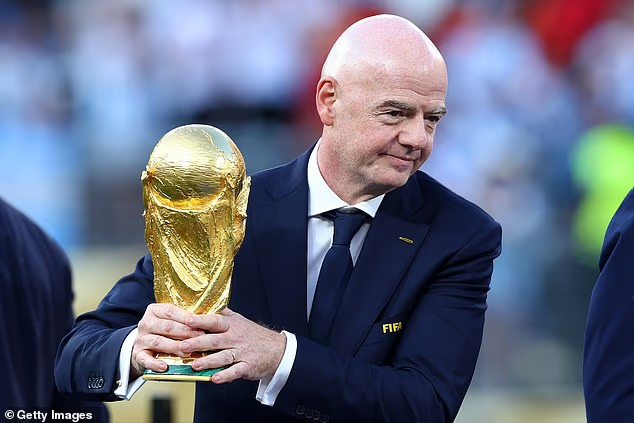
Gianni Infantino’s controversial plan to sell off the World Cup appears to be dead in the water after the Asian Football Confederation (AFC) joined UEFA and CONCACAF in opposing the plot
Infantino’s senior adviser Carlos Cordeiro (right) has also now resigned in protest at the plans
‘Against this backdrop, and in light of the clear positions expressed by UEFA and CONCACAF, as well as the unprecedented divisions that have emerged across the football world, the AFC believes that the proposed FFE cannot realistically achieve the necessary broad consensus and unity required to move forward.
‘The FIFA World Cup is the pinnacle of global football and derives its strength from the participation of all Confederations and the world’s leading football nations.
‘Any proposal that risks undermining the unity and universal character of the competition must be reconsidered.
‘While the immediate debate centres on FFE, the AFC considers this issue extends far beyond a single proposal.
‘Rather, it has exposed fundamental weaknesses in FIFA’s consultation and decision-making processes that must now be addressed.
‘While the AFC notes FIFA’s latest clarification on the proposal, the central concerns surrounding governance, institutional process and meaningful consultation remain unanswered.
‘A proposal of such significance, with the potential to affect the commercial, sporting and strategic future of world football, must not emerge through processes that leave Confederations, Member Associations (MAs) and even FIFA’s own governing bodies, including the FIFA Council, feeling sidelined.
‘The primary objective for world football must be to ensure that decisions of such magnitude are being developed through processes that are anchored on transparency and command the confidence of the football community.
‘This is not the first occasion where major stakeholders have been confronted with significant initiatives after the direction of travel appears to have already been determined.
‘Such an approach undermines confidence in FIFA’s governance framework and diminishes the authority of its statutory bodies.
Join the discussion
Should the World Cup ever be used as a tool for private profit, or does selling stakes betray the spirit of the game?
FIFA issued a late-night response to furious backlash over the controversial plan to sell World Cup stakes to private investors by blaming the media for the uproar
‘No subsequent consultation process, however well-intentioned, can replace early engagement with the appropriate FIFA bodies and the football family.
‘The AFC believes this moment must become a catalyst for strengthening institutional reform. While every FIFA MA must have the opportunity to consider and determine proposals affecting the future of world football, meaningful democracy is not measured solely by the opportunity to vote.
‘It begins with transparent governance, timely consultation, informed deliberation and genuine participation throughout the decision-making process.
‘Accordingly, the AFC calls upon FIFA to undertake an urgent review of its governance and decision-making framework to ensure that proposals of global significance are developed through proper consultation, meaningful engagement and appropriate oversight by FIFA’s statutory bodies.
‘The FIFA World Cup, and the game itself, belong to the entire global football family. Their future must always be shaped collectively, through institutions that reflect the voices of all Confederations and MAs.’
The AFC’s statement criticises FIFA’s clarification of their proposals released on Friday morning, where they blamed the media for misconstruing their plans and made a dig at UEFA for holding FIFA to account.
FIFA said: ‘We have heard the feedback provided by the respective confederations in relation to the proposed establishment of FIFA Forward Enterprise (FFE) and would like to address the issues that have surfaced since the initial media reporting on Tuesday.
‘We respect the feedback and concern aired in public and reaffirm our commitment to an open and democratic consultation.
’Our planned consultation process was disrupted by incorrect media reports. We will proceed with this consultation process to ensure that each MA has the ability to express its vote based on facts.
‘FFE has been proposed solely to ensure that all FIFA Member Associations (MAs) have the opportunity to take meaningful ownership of the commercial opportunity of football in their respective countries, and that this does not come at the cost of either the spirit or the governance of FIFA or football itself.
Infantino has been widely criticised for his decision to put the World Cup ‘up for sale’
The core investor would be a New York investment firm created by Joshua Kushner (pictured earliere this month in California), the brother of Donald Trump’s son-in-law Jared Kushner
‘Nobody is selling football. This is not something FIFA would ever entertain.
‘Everyone has the right to express their opposition and to seek further clarification but no single entity can claim to represent all 211 MAs around the world. Each MA should be allowed to review the proposal and have a say in shaping their own future. These are the democratic principles of FIFA.’
They continued by outlining the plans, subject to consultation with member nations.
There is frustration across the international football landscape, however, that such proposals have been unilaterally developed – with proposed investors already lined up – in complete secrecy despite an eventual ‘consultation’.
UEFA nations are boycotting all FIFA competitions so long as the proposals remain on the table. All 55 UEFA nations met virtually on Thursday, with more than 40 federations providing testimony.
Daily Mail Sport were told associations expressed ‘outrage’ on the call with ‘total unanimity’ against the proposal, before deciding to abstain from FIFA competitions.
Daily Mail Sport also understands there is growing opposition to Infantino’s presidency, with CONCACAF nations losing – or having already lost – confidence in the Swiss football administrator.
UEFA and their member associations are yet to be drawn on that matter. Infantino is seeking a fourth term as FIFA president next year.
One international football insider told Daily Mail Sport: ‘UEFA’s response is at the nuclear button end of the spectrum, which is impressive. We thought Infantino would survive the Trump refereeing intervention – but he has overreached this time.’
In a statement, UEFA said: ‘UEFA and its 55 member associations stand as one. We unanimously and unequivocally reject FIFA’s proposal to transfer ownership interests in the World Cup and other FIFA competitions to private investors.
‘The World Cup cannot be treated as an investment product. It is one of football’s greatest sporting legacies. It has been built over generations by players, national teams and supporters across every continent. No part of it should ever be surrendered to private investors. The World Cup is not for sale.
‘It is both irresponsible and indefensible that a proposal of such significance for football was conceived in secret and brought to the brink of approval without any meaningful consultation with those entrusted with stewarding the game. This is not merely a profound failure of leadership, but an abdication of FIFA’s duty as the custodian of world football.
‘National associations around the world are now presented with an ultimatum: accept the irreversible capture of football’s greatest competitions or bear the consequences. This is not a ‘democratic decision’, but governance by intimidation – an act of coercion unworthy of an institution entrusted with the stewardship of the global game.
‘But our opposition goes far beyond process.
‘The moment external investors acquire ownership interests in FIFA competitions, football changes forever. Commercial return becomes a permanent obligation. Investor expectations become a daily pressure. From that moment onwards, every decision on the international calendar, every decision on competition formats and every decision shaping the future of football is no longer driven by what best serves the game, but by what best serves shareholders.
‘This model has no place in world football. Football’s future cannot be dictated by the expectations of those whose first duty is to maximise financial return. Nor can the interests of national associations, leagues, clubs, players and supporters become subordinate to investor returns. Football cannot mortgage its future for financial gain.
‘Europe’s position is clear. We will never lend this model our legitimacy. No one has the moral authority to sell what they merely hold in trust for the next generation.
‘As a result of today’s discussion, no UEFA national teams will participate in any FIFA competition for so long as these proposals remain alive, unless this proposal has been abandoned in its entirety and binding assurances have been given that FIFA will never again open its governance or competitions to private ownership.
‘Nobody should be in any doubt: UEFA and its national associations will oppose these plans with absolute determination.
‘There are moments when institutions are judged not by what they are prepared to accept, but by what they refuse to compromise. This is one of those moments.
‘Some things are simply too important to sell. The FIFA World Cup belongs to football. It always will. And so long as Europe has a voice, it will never be for sale.’
An FA spokeswoman added: ‘We stand shoulder to shoulder with our European colleagues and fully support the collective view. We oppose FIFA’s plans – the FIFA World Cup belongs to football and always will.’
Concacaf later added: ‘Concacaf is a confederation united by the love of our game, where football comes first. Guided by this philosophy over the past ten years we have built, from the ground up, an organisation founded on service, transparent governance, and the long-term stewardship of football.
‘History has shown FIFA and the football family what happens when the custodians of the game lose sight of these values.
‘With this in mind, Concacaf today convened a meeting of the presidents of its 41 Member Associations, together with its President, Council members, and its FIFA Council members, to discuss a proposal developed and presented by the FIFA President to establish ‘FIFA Forward Enterprise’ and sell interests in the FIFA World Cup to private investors.
‘During the meeting, the membership expressed deep concerns about the lack of due process surrounding the proposal, the artificially short deadline imposed, and the absence of any review or approval by the relevant FIFA governance bodies. In addition, the need for private equity investment to fund new and existing FIFA Forward programs following the most profitable FIFA World Cup in history was questioned.
‘The discussion reinforced the need for greater transparency and proper governance.
‘For these reasons, Concacaf and its 41 Member Associations have: Rejected the proposal; Tasked their FIFA Council Members with engaging FIFA to determine how existing FIFA reserves could be used to increase FIFA Forward funding for football development across our region; and Tasked their FIFA Council Members with instructing the FIFA President to ensure that any matter follows the proper governance processes via staff and FIFA Council, in accordance with the FIFA Statutes.
‘Through these actions, Concacaf reaffirms that football’s future – and its greatest asset – must remain in the hands of our football family.’
Sepp Blatter, the FIFA president before Infantino, took to social media to renew his attacks on his successor by writing on Friday evening: ‘The FIFA is not a private equity fund. It is an association with statutes, regulations, and a fiduciary responsibility to protect the global game. If you sell football’s crown jewels to private investors, you also sell part of the game – especially its soul. Money matters, but it must never become everything.’
And Prime Minister Andy Burnham added his voice to those condemning Infantino, telling GiveMeSport: ‘It’s a feeling I’ve had for a while and it’s clearly not a sustainable situation. When UEFA and CONCACAF can’t have confidence, that is a large chunk of world football saying that this is not acceptable.
‘I had some concerns about the 2022 World Cup, on the pitch and all the rest of it. It didn’t feel right. It hasn’t felt right. And after everything that FIFA have been through before, I was prepared to give his [Infantino’s] era the benefit of the doubt, and I did give it the benefit of the doubt until this point.’



























































You must be logged in to post a comment Login