
Crypto World
RWAs Outpace DeFi as Tokenized Assets Find New Uses: CoinShares

Real-world assets (RWAs) are gaining momentum as tokenized versions of traditional investments move beyond issuance and become active parts of onchain financial markets.
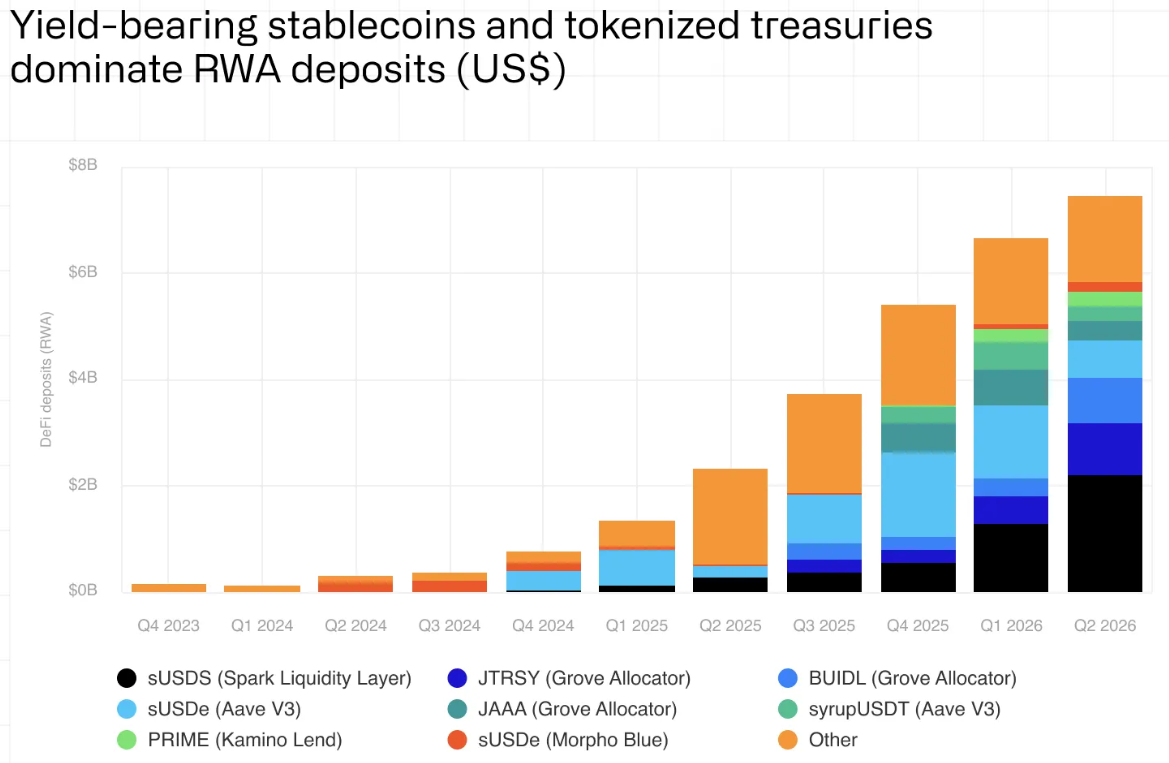
RWA deposits across decentralized finance platforms more than tripled year over year to $7.4 billion in the second quarter of 2026, while total DeFi deposits fell about 15%, according to a joint report by CoinShares and Token Terminal published Thursday.
CoinShares CEO Jean-Marie Mognetti said the divergence shows that RWA demand is being driven by practical use cases rather than broader market conditions.
“When an asset class grows through a downturn in its host ecosystem, demand is being driven by financial utility, not by market cycles,” he said.
The report suggested that the RWA market is entering a new phase, with investors using them as collateral, yield-generating instruments and trading products across onchain markets.
Yield-bearing stablecoins and Treasuries lead RWA deposits
Yield-bearing stablecoins and tokenized Treasury products have emerged as the largest categories of RWA assets used across DeFi, according to the report.
In Q2, Sky Protocol’s sUSDS led the category, giving holders exposure to a yield-generating version of its USDS stablecoin.
Tokenized Treasury funds, including BlackRock’s USD Institutional Digital Liquidity Fund (BUIDL), have also become a major source of onchain collateral, as investors use yield-bearing assets in decentralized lending markets.
Source: CoinShares, Token Terminal
The report said that RWA products currently offer yields ranging from about 3.2% to 5.5%, with lower-risk Treasury products at the bottom of the range and higher-yield strategies carrying additional risks.
Gold and yield-bearing dollars drive RWA volumes
Gold-backed tokens and yield-bearing dollar products accounted for much of the RWA trading activity on decentralized exchanges (DEXs).
CoinShares classified gold-backed stablecoins such as Tether Gold (XAUt) and Paxos Gold (PAXG) as tokenized gold products within its broader RWA category.
Related: Gold hits 6-week highs on China demand as Bitcoin ignores fresh S&P 500 record
These assets generated significant trading volume as investors traded around gold price swings, while yield-bearing dollar products such as Ethena’s sUSDe also contributed to RWA spot activity.
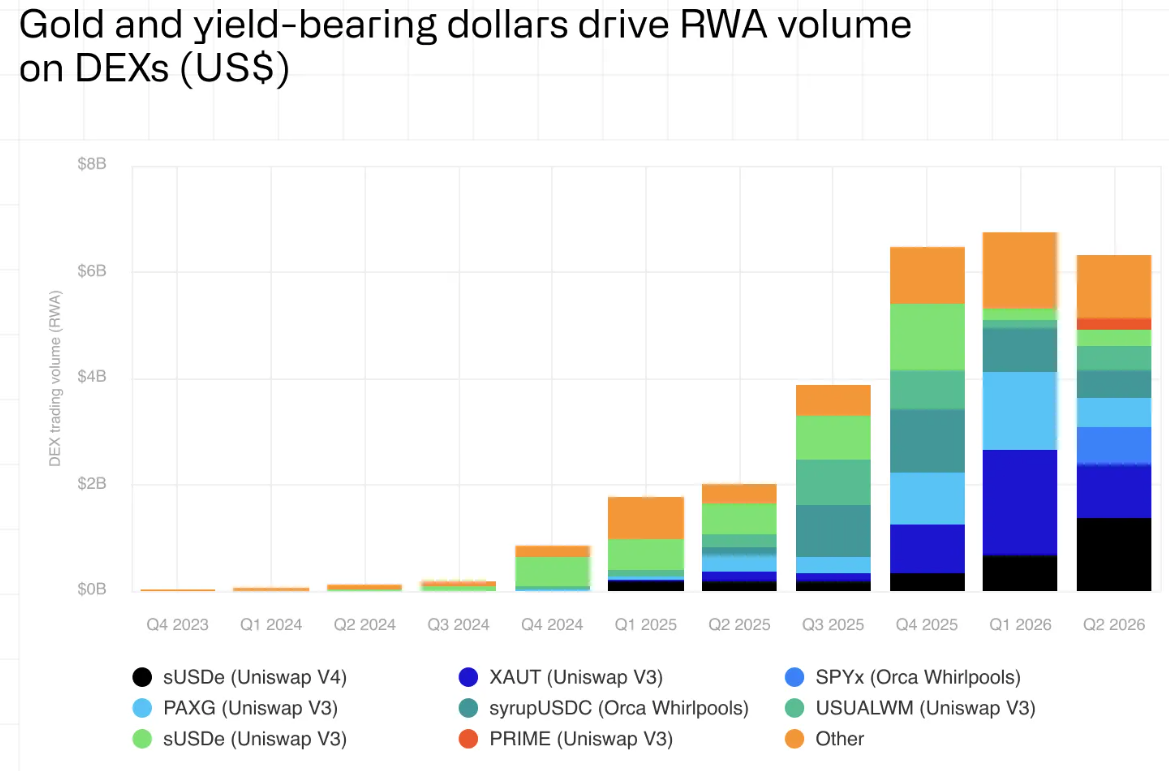
Source: CoinShares, Token Terminal
RWA spot trading volumes rose roughly 220% year over year, even as overall DEX volumes fell about 70%. The divergence suggests tokenized assets are gaining traction as secondary markets, allowing investors to trade ownership rather than only buy assets directly from issuers.
RWAs expand into leveraged markets
Onchain exposure to RWAs is also expanding into derivatives markets, where traders can take leveraged positions without owning the underlying assets.
RWA perpetual futures trading has continued growing despite a broader slowdown in crypto-native derivatives markets. On tradeXYZ, an RWA-focused perpetual futures platform built on Hyperliquid, trading volume has increased roughly 20 times since launch, the report said.
Activity has concentrated around commodities, equity indexes such as the S&P 500 and Nasdaq-100, and technology stocks, while open interest has also continued rising.
Magazine: How Fake World Assets and onchain gacha became crypto’s latest craze

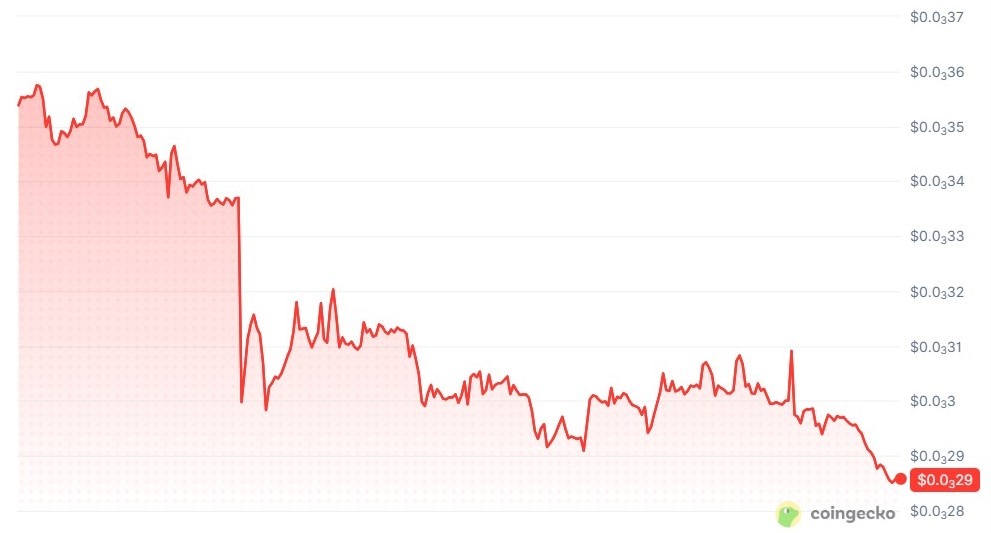
ElizaOS fell 19% over 24 hours to an all-time low after Eliza Labs founder Shaw Walters said the token was “dead” and that the Eliza Foundation was winding down.
CoinGecko data showed the token trading at $0.000285 at the time of writing after touching a record low of $0.000284 on Thursday with a market capitalization of $2.1 million.
The drop came after an announcement from Walters that the foundation was winding down. “The token is dead. Completely,” Walters said, adding that he no longer owned or supported the token. He said the development of the open-source Eliza software would continue without the token or the foundation.
The decline represents a stark reversal for one of the AI-agent sector’s former breakout tokens. Before the project rebranded as ElizaOS, the token, then known as AI16Z, reached a peak market capitalization of $2.5 billion in January 2025, according to CoinGecko.
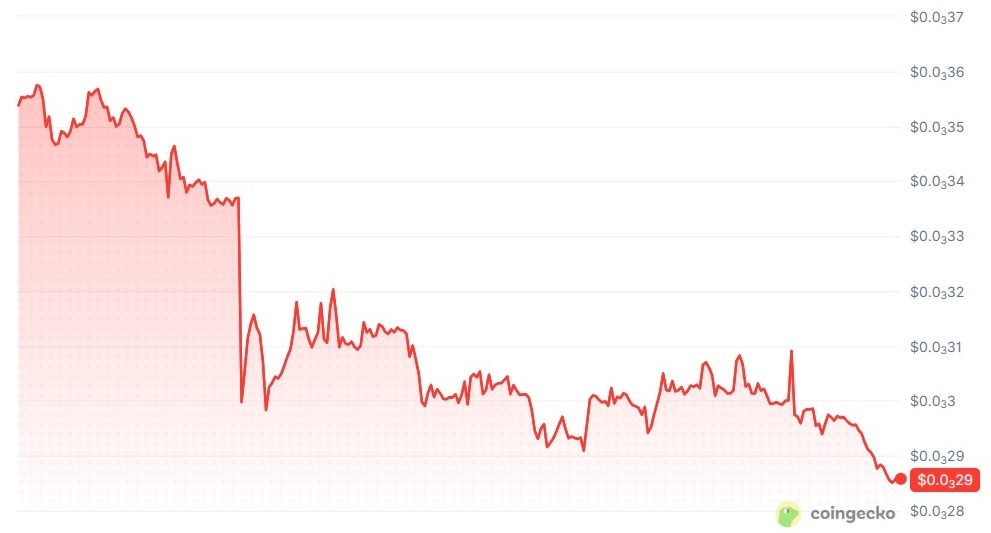
ElizaOS’ 24-hour price chart. Source: CoinGecko
Founder blames lawsuit and token culture
Walters said Eliza Labs privately settled with a group of tokenholders represented by Burwick Law by agreeing to give them its remaining treasury and funds.
He called the suit “ridiculous” but said the project lacked the capital to continue fighting it.
The lawsuit, filed in April, named Eliza Labs, Walters, Sebastian Quinn-Watson and the AI16Z DAO as defendants. It alleged false advertising, deceptive practices, negligent misrepresentation and unjust enrichment.
Court records show the named plaintiff’s claims were dismissed with prejudice by stipulation on July 8, while the proposed class’s claims were dismissed without prejudice.
Cointelegraph contacted Walters and Burwick Law founder Max Burwick for comment but had not received a response by the time of publication.
Related: Not every AI agent needs its own cryptocurrency: CZ
Walters said there were no more funds for token buybacks and no foundation or future supply intervention to support the token.
He also said he would not allow another token to be associated with Eliza while continuing to build its underlying operating system.
“I am starting over, since I own the IP, and I am never letting a token come close to Eliza again […] I’m never going to support an Eliza token,” he wrote.
ElizaOS is an open-source framework for building and managing AI agents. The project launched in October 2024 as ai16z with an initial goal of raising $75,000 to build an autonomous investor.
In January 2025, it rebranded to ElizaOS after Andreessen Horowitz raised concerns about confusion with its a16z brand. The token was also later migrated.
Magazine: Do the Coldcard attacks mean all hardware wallets are now insecure?
Crypto World
Wall Street optimism fuels new market momentum as XRP ETF inflows expected to surpass $1.51 billion

Disclosure: This article does not represent investment advice. The content and materials featured on this page are for educational purposes only.
XRP ETF inflows have surpassed $1.51 billion as investors increasingly explore UE Crypto’s cloud mining and yield strategies for long-term participation.
Summary
- XRP ETF inflows top $1.51B as institutional demand grows and UE Crypto gains attention from yield seekers.
- Institutional inflows push XRP ETFs past $1.51B while investors explore long-term income strategies with UE Crypto.
- Institutional demand continues to drive XRP ETF growth, while UE Crypto focuses on providing users with long-term and sustainable crypto income solutions.
Wall Street’s increasingly bullish outlook on XRP ETFs is fueling a new wave of market optimism, with total inflows expected to exceed $1.51 billion.
At the same time, a growing number of investors are exploring alternative digital asset strategies, including cloud mining and crypto yield platforms, in pursuit of more stable long-term returns while continuing to hold digital assets. This trend is also driving greater interest in XRP ETFs.
ETF products backed by XRP have recently reached another significant milestone in capital inflows, further strengthening institutional confidence in the asset.

Meanwhile, more investors are turning their attention to the crypto market, seeking long-term income opportunities beyond simply waiting for the price of XRP to appreciate.
The continued inflow of capital into XRP ETFs highlights the growing institutional demand for XRP. Although many retail investors remain cautious due to market volatility and price uncertainty, institutional funds continue allocating capital to XRP through regulated financial products, making it one of the most closely watched mainstream digital assets.
As the regulatory environment continues to improve and financing conditions become more favorable, more investors are asking an important question: Is there a more efficient and sustainable way to benefit from XRP beyond simply waiting for its price to rise?
XRP ETF inflows surpass $1.51 billion, reaching a major milestone
Since the close of trading on August 1, cumulative inflows into XRP-related exchange-traded funds (ETFs) have exceeded $1.51 billion, according to data released by market analysis platform uToday, marking another significant milestone driven by sustained net inflows.
At the same time, overall market liquidity continues to improve. Although trading activity in the secondary market has slowed somewhat and retail investor sentiment remains relatively cautious, institutional demand has stayed strong, resulting in net inflows on most trading days.
A new opportunity for XRP investors: UE crypto’s long-term income strategy
Against this backdrop, an increasing number of XRP investors are turning to UE Crypto, leveraging its cloud mining and yield aggregation mechanisms to pursue a more stable and sustainable digital asset income model.
Compared with highly volatile futures trading or ETF investing, UE Crypto offers a more straightforward and accessible way to participate in the digital asset market while improving the efficiency of digital asset utilization as users benefit from the continued growth of the XRP ecosystem.
For investors with a certain level of capital, this model offers the potential to generate more consistent daily returns, providing an alternative approach to long-term digital asset allocation.
About UE Crypto
Headquartered in the United Kingdom, UE Crypto operates under European regulatory frameworks such as MiCA and MiFID II, continuously enhancing platform transparency, operational standards, and user protection.
The platform employs a multi-layer security architecture, including:
- Annual financial and security compliance audits by PwC;
- Digital asset custody insurance provided by Lloyd’s of London;
- Enterprise-grade cybersecurity protection from Cloudflare and McAfee® security systems;
- Bank-grade encryption technology combined with professional security infrastructure to comprehensively safeguard user assets and accounts.
UE Crypto currently supports a wide range of mainstream digital assets, including XRP, BTC, ETH, USDT, USDC, DOGE, LTC, and SOL, providing users with a flexible and efficient digital asset service experience.
Start earning daily rewards in three simple steps
Step 1: Register an account
Step 2: Choose a mining plan
Select a cloud mining contract that best fits a particular investment budget and objectives, then start mining with just one click.
Step 3: Start earning
Once a contract is activated, computing power is automatically allocated, and rewards are settled every 24 hours. Users can withdraw earnings at any time or continue participating to benefit from long-term compound growth.
Popular cloud mining contract examples
BTC (beginner trial plan)
- Investment: $100
- Contract Term: 2 Days
- Daily Reward: $4
- Total Return: $100 + $8
DOGE (digital intelligent system plan)
- Investment: $500
- Contract Term: 5 Days
- Daily Reward: $6.25
- Total Return: $500 + $31.25
BTC (super computing system plan)
- Investment: $1,000
- Contract Term: 10 Days
- Daily Reward: $13.10
- Total Return: $1,000 + $131
LTC (algorithm-driven system plan)
- Investment: $5,000
- Contract Term: 25 Days
- Daily Reward: $72
- Total Return: $5,000 + $1,800
BTC (quantitative intelligent system plan)
- Investment: $10,000
- Contract Term: 35 Days
- Daily Reward: $158
- Total Return: $10,000 + $5,530
For more information about available contracts, please visit the official UE Crypto website.
Conclusion
The continued inflow of capital into XRP ETFs, together with ongoing improvements in the regulatory environment, reflects XRP’s steady integration into the mainstream financial system.
At the same time, UE Crypto offers XRP investors a more diversified way to participate in the digital asset economy, shifting from relying solely on price appreciation toward a strategy that combines capital growth with continuous passive income.
As the next market cycle unfolds, investors are increasingly focusing not only on price movements but also on more stable and sustainable wealth management strategies. This trend reflects the continued maturation of the digital asset investment landscape.
Join UE Crypto today and start earning passive daily income through digital assets.
Disclosure: This content is provided by a third party. Neither crypto.news nor the author of this article endorses any product mentioned on this page. Users should conduct their own research before taking any action related to the company.


The U.S. Treasury's Office of Foreign Assets Control sanctioned two Iranian firms on Wednesday — HormuzSafe Marine Services Authority and the Persian Gulf Marine Insurance Company — that it says force commercial vessels to buy mandatory "insurance" to transit the Strait of Hormuz, with HormuzSafe… Read the full story at The Defiant
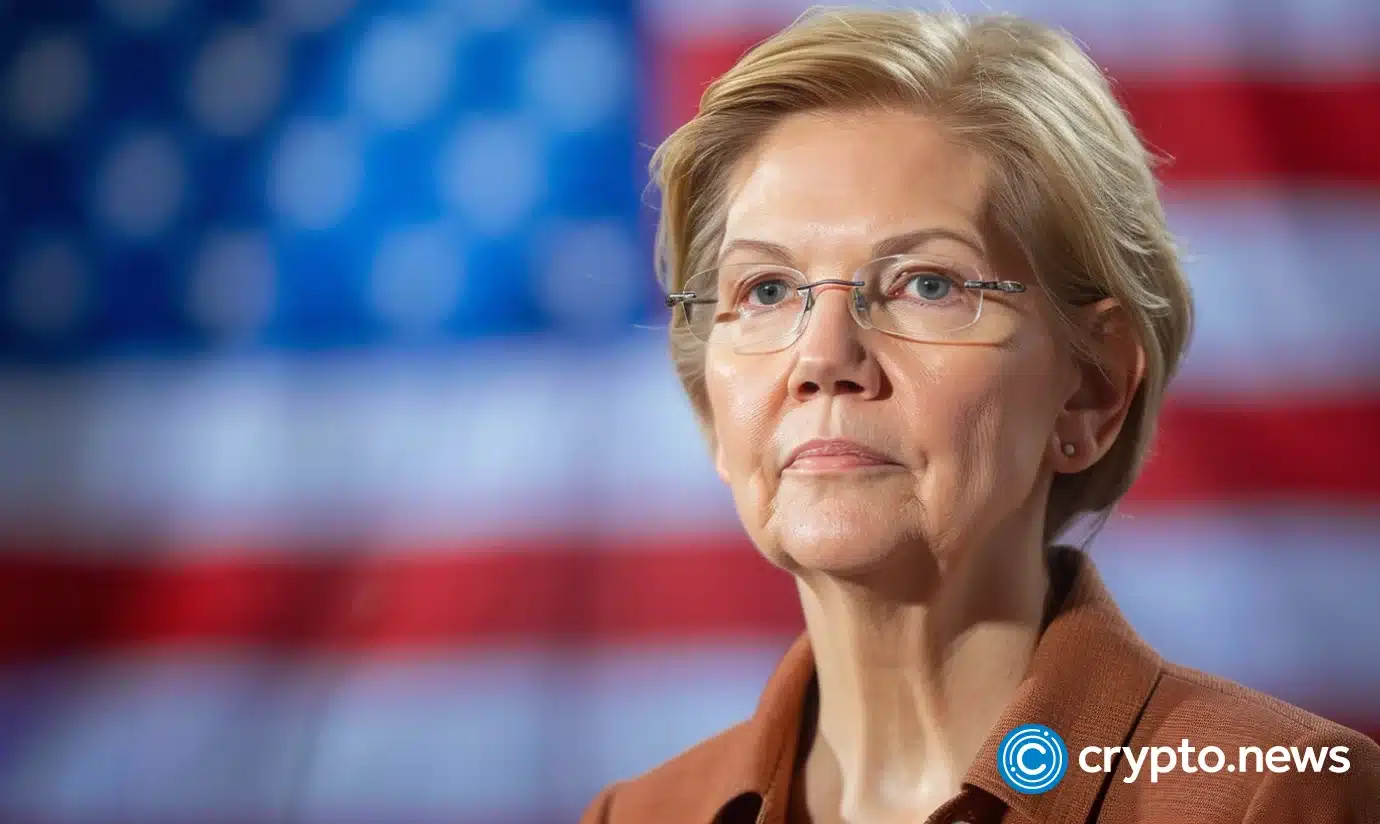
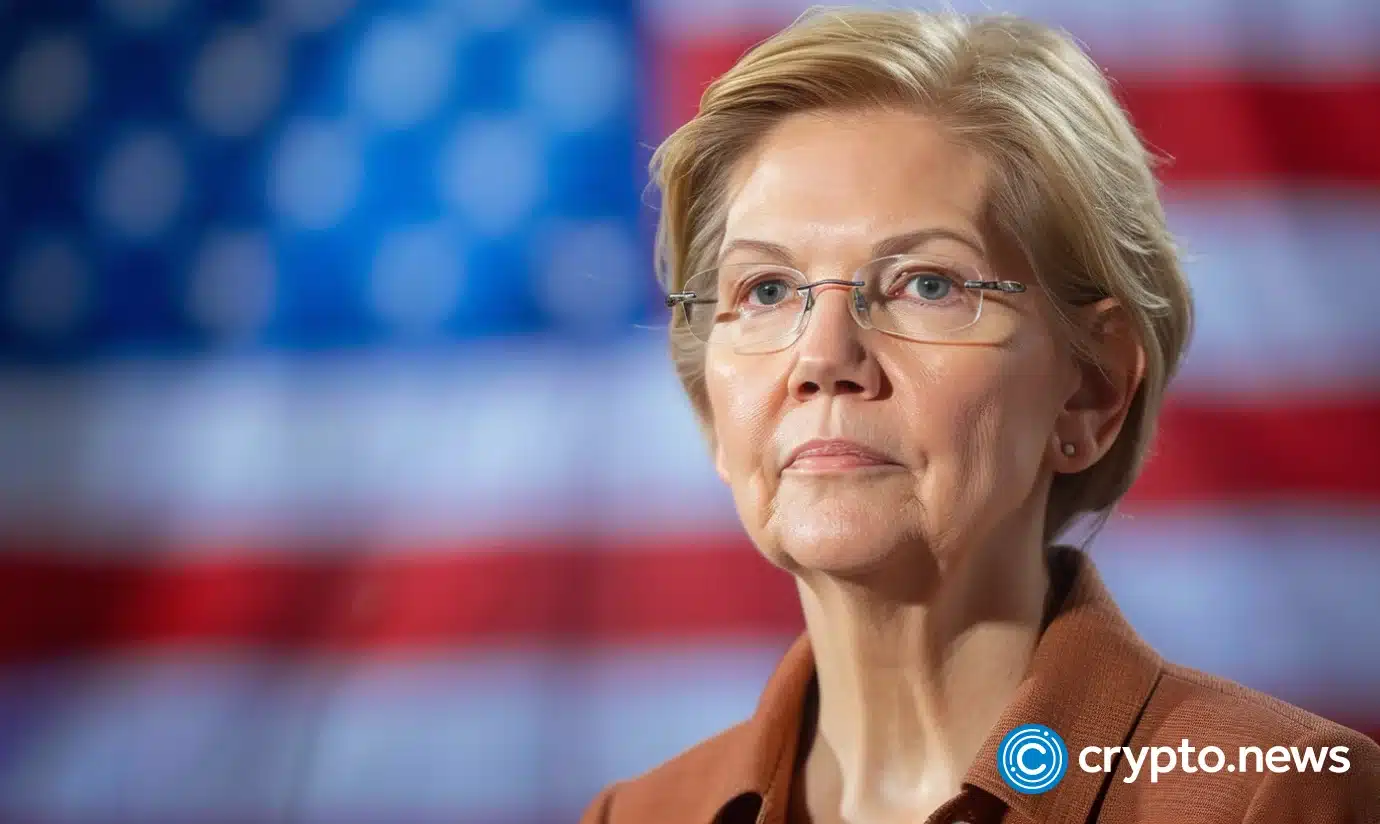
Senator Elizabeth Warren supports establishing federal rules for digital assets but has rejected the CLARITY Act in its current form, citing unresolved concerns over corruption, consumer protection, national security and financial stability.
Summary
- Warren supports crypto legislation but said the CLARITY Act lacks necessary safeguards.
- Her objections cover conflicts of interest, consumer risks, national security and regulatory arbitrage.
- Senate leaders took no procedural action to move the bill toward a weekend vote.
- Polymarket traders placed its chance of becoming law in 2026 at approximately 17%.
Warren says CLARITY Act falls short
According to CoinDesk, Warren said the U.S. crypto industry needs a clear regulatory framework but argued that the current proposal does not adequately protect investors or the wider financial system.
The Massachusetts Democrat identified several areas where she believes the legislation remains insufficient. These include safeguards against political corruption, protections for consumers and measures intended to limit national security and economic risks.
Warren has also warned that poorly designed crypto legislation could weaken regulators and allow large digital asset companies to exploit gaps between federal agencies. Her opposition therefore focuses on the terms of the CLARITY Act rather than rejecting crypto regulation altogether.
The bill seeks to establish clearer federal oversight of digital asset issuance, trading platforms and other market participants. It would also define how responsibilities are divided among agencies, including the Commodity Futures Trading Commission and the Securities and Exchange Commission.
Supporters argue that those rules would reduce legal uncertainty for U.S. crypto businesses. Warren, however, maintains that regulatory clarity must not come at the expense of consumer safeguards or financial stability.
Trump’s crypto income adds to ethics dispute
Warren’s position follows her earlier scrutiny of President Donald Trump’s digital asset interests while lawmakers considered the market structure bill.
As crypto.news reported in July, Warren asked Trump to disclose his crypto earnings between Jan. 1 and July 15, 2026. The request followed a federal financial filing that showed approximately $1.4 billion in income from digital asset ventures during 2025.
Trump’s disclosure, filed June 30 under Office of Government Ethics rules, listed income connected to Official Trump and World Liberty Financial, the Trump family’s crypto business.
Warren argued that those holdings raised questions about whether senior elected officials could influence legislation that affects the value of their own assets. She asked Trump to provide the additional information voluntarily by July 23.
Conflict-of-interest restrictions involving senior federal officials have since remained among the largest obstacles in CLARITY Act negotiations. Lawmakers have also discussed illicit finance provisions, decentralized finance oversight, stablecoin rewards and the scope of the CFTC’s authority.
CLARITY Act misses path to weekend vote
Prospects for an immediate Senate vote faded Thursday after Majority Leader John Thune did not file cloture on a motion to proceed to the bill.
A cloture filing would begin the procedural countdown needed to limit debate and bring the legislation toward floor consideration. Without it, a weekend vote became increasingly difficult even if senators remained in Washington beyond Friday.
Thune instead filed cloture on a substitute amendment to H.R. 6500, the motion to proceed to the Protect College Sports Act of 2026 and Todd Blanche’s nomination to be attorney general.
The CLARITY Act was absent from the list despite continued negotiations among Republicans, Democrats and the White House.
Prediction markets cut 2026 passage odds
Prediction-market traders have become increasingly doubtful that Congress will approve the legislation this year.
Polymarket placed the probability of the CLARITY Act being signed into law in 2026 at approximately 17% on Thursday, representing a 48% decline over the measured period.
Warren’s opposition adds to the challenge facing Senate leaders, who need Democratic support to overcome the chamber’s 60-vote threshold. Further movement will depend on whether negotiators can reach agreements on ethics, consumer protection, illicit finance and agency authority before lawmakers leave for the August recess.
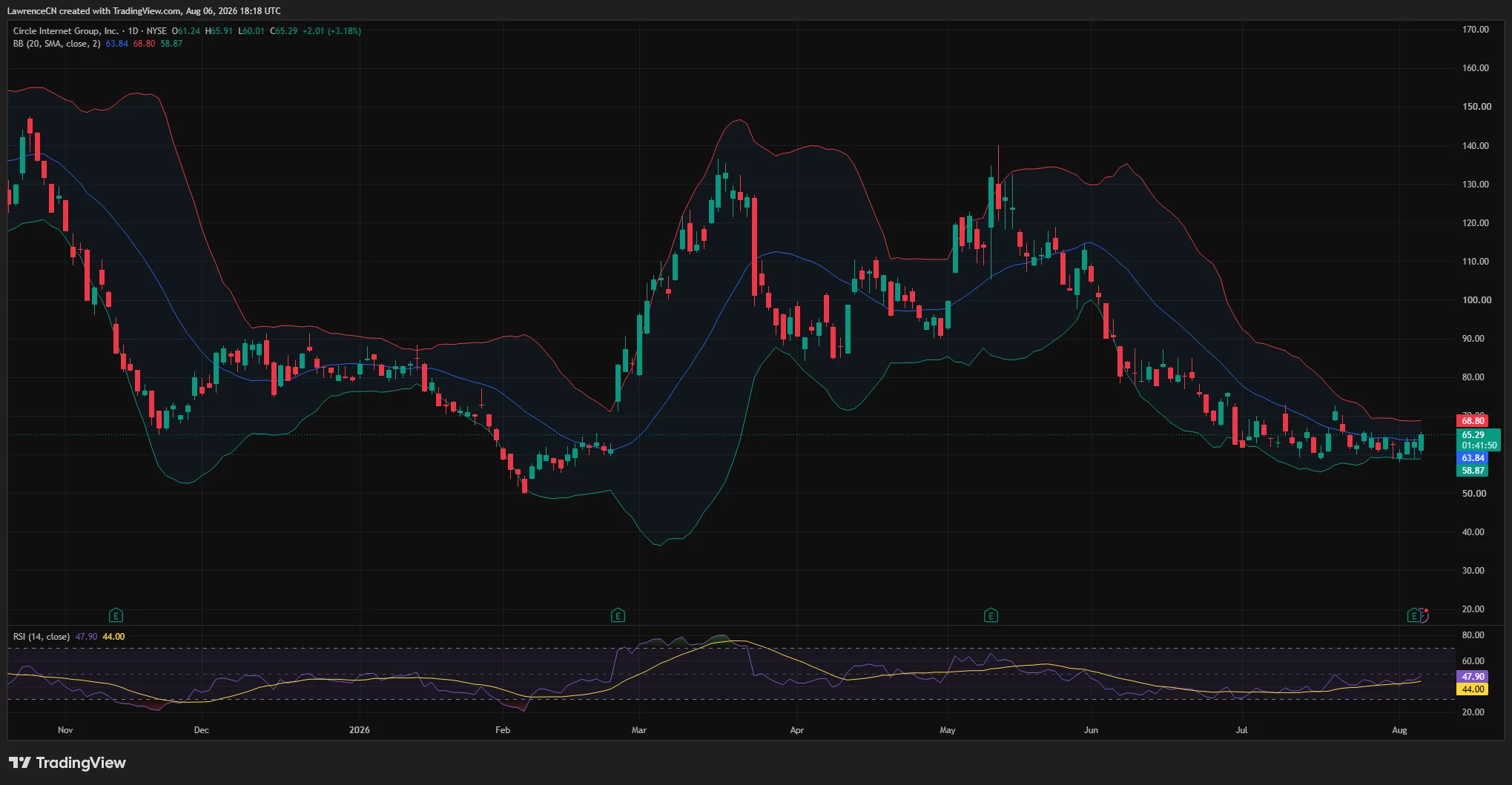
Circle stock gained on Thursday after Bernstein reiterated its Outperform rating and $140 target, arguing that the stablecoin issuer’s mixed second-quarter results challenged the bearish case against the company.
Summary
- Circle generated $701 million in Q2 revenue, up 7% but about 2% below estimates.
- Bernstein’s $140 target implies roughly 114% upside from CRCL’s latest price.
- USDC circulation reached $73.3 billion, up 19% year over year but down 5% quarterly.
- Circle expects the Arc public mainnet to launch Sept. 16 with 11 institutional validators.
Bernstein argues Circle’s results challenge bears
Bernstein analysts led by Gautam Chhugani described Circle’s second-quarter report as a “counter thesis to the bears,” according to a Thursday note to clients.
The brokerage retained its Outperform rating and $140 price target. The target is more than double Circle’s Thursday price of $65.29, although Bernstein had previously lowered it from $190 in late July.
Circle reported $701 million in total revenue and reserve income, a 7% increase from the same period last year. The figure missed consensus estimates by about 2%, contributing to the mixed assessment of the quarter.
Profitability was stronger. Adjusted EBITDA rose 8% year over year to $143 million, while basic earnings per share of $0.19 exceeded expectations. Net income from continuing operations reached $48 million, improving by $530 million from the previous year’s loss, which included expenses tied to Circle’s initial public offering.
Reserve income still generated roughly 95% of total revenue, leaving Circle exposed to changes in US interest rates. A lower federal funds rate would reduce the returns the company earns on assets backing USDC.
USDC growth supports the long-term thesis
USDC circulation ended the quarter at $73.3 billion. That represented 19% annual growth but a 5% decline from the $77 billion reported at the end of the first quarter.
Onchain transaction volume reached $14.8 trillion during the quarter, up 151% year over year, according to Circle’s earnings report. The figures suggest network activity grew faster than the amount of USDC in circulation.
Bernstein argued that concerns about stablecoin competition underestimate Circle’s distribution, liquidity, and regulatory advantages. The analysts expect USDC adoption to expand beyond cryptocurrency trading into payments, tokenized real-world assets, and institutional financial infrastructure.
Circle also received final approval from the US Office of the Comptroller of the Currency to establish Circle National Trust. The federal trust bank charter places part of the company’s infrastructure under direct US oversight and could eventually allow the entity to manage USDC reserves.
Arc could reduce Circle’s reliance on reserve income
Bernstein identified Circle’s Arc blockchain and payments partnerships as possible sources of revenue outside interest earned on USDC reserves.
Circle plans to launch Arc’s public mainnet on Sept. 16. BlackRock, DTCC, Galaxy, Global Payments, ICE, Mastercard, MoneyGram, SBI Group, Standard Chartered, Sumitomo Corporation, and Visa will serve as founding validators, according to Circle’s announcement.
Management raised its 2026 forecast for other revenue and its revenue-less-distribution-cost margin. The revised outlook includes the expected recognition of $180 million from an Arc token presale.
Bernstein said current forward estimates may not fully account for prospective Arc staking income, gas fees, transaction revenue, and partnership activity. Those sources could help diversify Circle’s business, but their contribution will depend on adoption after the mainnet launch.
Circle stock faces resistance near $70
CRCL rose 3.18% to $65.29 on Thursday after trading between $60.01 and $65.91. The stock moved above the midpoint of its daily Bollinger Bands at $63.84, indicating that short-term momentum had improved.
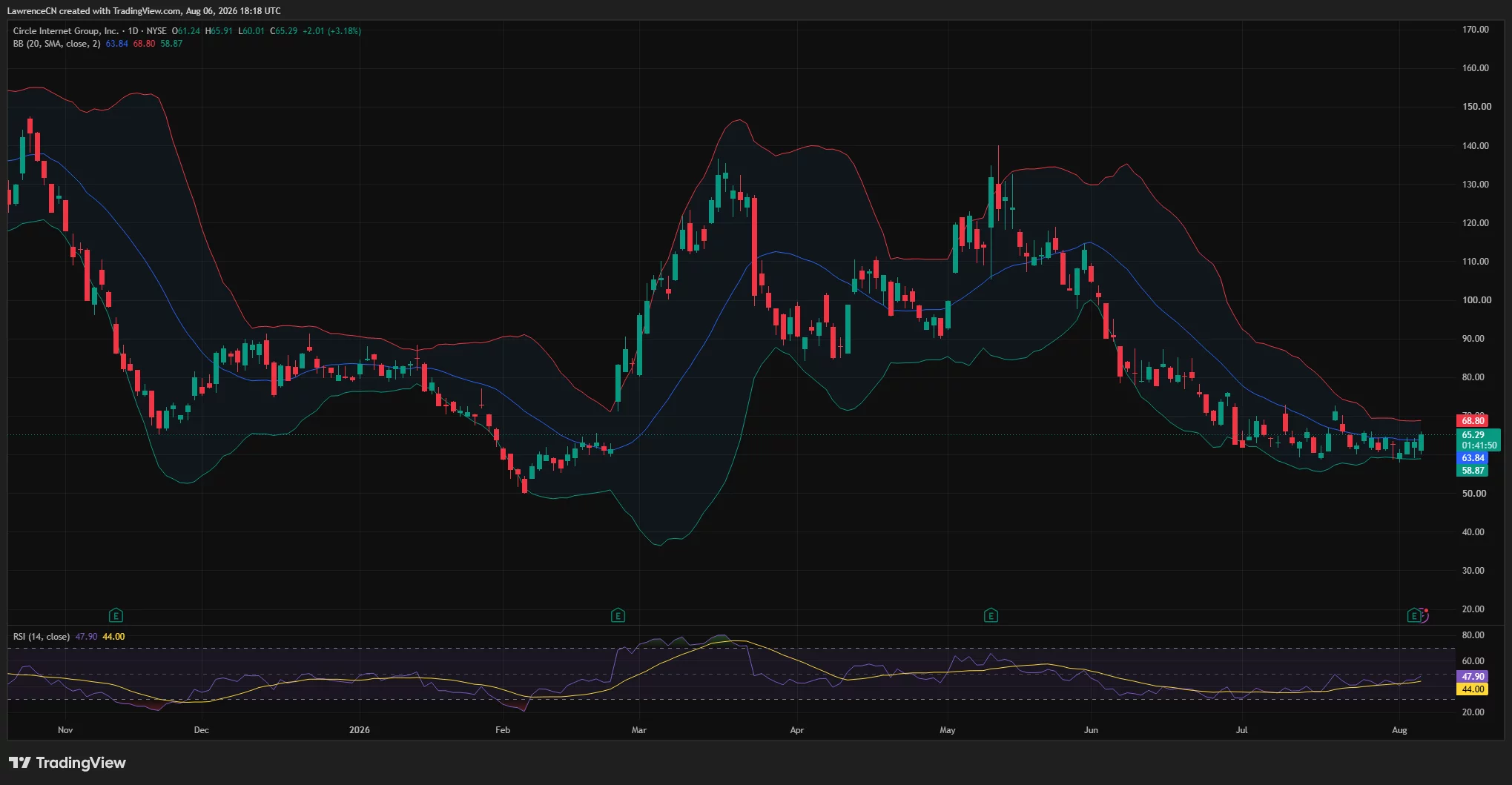
The relative strength index rose to 47.9, up from its moving average of 44. The reading remains below the neutral 50 level, meaning buyers have not yet established firm control.
Immediate resistance sits between $68.80 and $70. A daily close above that range could support a broader recovery, while failure to hold $60 would expose the lower Bollinger Band near $58.87.
Despite Thursday’s advance, Circle remains in a broader downtrend after falling from above $130 in May. Bernstein’s $140 target therefore depends on Circle restoring USDC growth, launching Arc successfully, and developing revenue sources less sensitive to US interest rates.


Basis trading is a market-neutral strategy that profits from the price gap between spot Bitcoin and its futures contracts. It is the reason hedge funds hold billions in Bitcoin ETFs without betting on the price going up.
Summary
- Basis trading, also called cash-and-carry arbitrage, involves buying an asset in the spot market and simultaneously selling a futures contract on the same asset, locking in the price difference as profit regardless of which direction the market moves.
- The strategy became the dominant institutional play in crypto after spot Bitcoin ETFs launched in January 2024, with hedge funds using ETF shares as the spot leg and CME futures as the short leg to capture annualized yields that have ranged from 5% to more than 20%.
- The “basis” is the difference between the futures price and the spot price. In crypto markets, futures almost always trade at a premium to spot because leveraged traders are willing to pay more for exposure without holding the underlying asset. That premium is what basis traders harvest.
- Basis trading is not directional. The trader does not profit from Bitcoin going up or down. The profit comes exclusively from the convergence of the futures price and the spot price as the contract approaches expiration, a mathematical certainty barring exchange default.
- The strategy carries risks including margin calls on the short futures leg during sharp rallies, counterparty risk on the futures exchange, liquidity risk if the ETF shares cannot be sold quickly, and opportunity cost if Bitcoin rallies significantly while the position is locked.
The most widely repeated misunderstanding about Bitcoin ETF inflows is that they represent bullish bets on the price. Many of them do. But a significant share of the billions flowing into spot Bitcoin ETFs comes from hedge funds and trading firms that are completely indifferent to whether Bitcoin goes up or down. They are running basis trades, and the only number they care about is the spread between spot and futures.
This guide explains how the trade works mechanically, why crypto markets offer higher basis yields than traditional commodities, what risks the strategy carries, and how to evaluate whether the current basis is worth capturing. Understanding the basis trade is also essential for interpreting ETF flow data, futures open interest, and funding rate charts, because each of these metrics is heavily influenced by basis trading activity that is often misread as directional conviction.
How the basis trade works step by step
The mechanics are straightforward once the terminology is clear. A basis trade requires two simultaneous positions: a long position in the spot market and a short position in the futures market for the same asset and the same notional amount.
Step one: the trader buys $1 million worth of Bitcoin at the current spot price. In the ETF era, this typically means purchasing shares of a spot Bitcoin ETF such as BlackRock IBIT or Fidelity FBTC, which track Bitcoin’s price through direct holdings of the asset. The spot ETF creation and redemption mechanism ensures that ETF shares trade close to the net asset value of the underlying Bitcoin.
Step two: the trader simultaneously sells $1 million worth of Bitcoin futures on a regulated exchange, most commonly the CME. The futures contract will expire on a set date, typically monthly or quarterly.
Step three: the trader holds both positions until the futures contract expires. At expiration, the futures price converges with the spot price by definition, because the contract settles against the actual spot price. The difference between the price at which the futures were sold and the price at which they converge is the trader’s profit.
If Bitcoin was trading at $100,000 spot and the one-month futures contract was trading at $101,500, the basis is $1,500 or 1.5% for one month. Annualized, that is approximately 18%. The trader collects that 1.5% regardless of whether Bitcoin finishes the month at $80,000 or $120,000, because the gains on one leg offset the losses on the other.
Why crypto basis is higher than traditional markets
In traditional commodity markets, the basis on oil, gold, or agricultural futures typically runs between 1% and 5% annualized. In crypto markets, the annualized basis has historically ranged from 5% to more than 25%, with spikes above 40% during periods of extreme bullish sentiment. During the bull run of late 2024 and early 2025, the CME Bitcoin front-month basis routinely exceeded 15% annualized, a yield that no comparable fixed-income instrument could match at the time.
The reason is structural. Crypto futures markets are dominated by leveraged speculators who want long exposure without holding the underlying asset. This persistent demand for long futures pushes the futures price above the spot price, creating what traders call contango. The steeper the contango, the wider the basis, and the more profitable the cash-and-carry trade becomes.
Three factors keep crypto basis elevated compared to traditional markets. First, crypto markets trade around the clock every day of the year, which means funding costs and leverage demand never pause. The New York Mercantile Exchange closes on weekends. Binance and Bybit do not. Continuous trading means continuous demand for leverage, which translates to a persistently elevated premium on futures.
Second, the margining requirements on crypto futures are higher than on traditional commodity futures, which means the cost of maintaining leveraged positions is higher, and that cost gets priced into the futures premium. CME Bitcoin futures require initial margin around 40%, compared to roughly 5% to 10% for crude oil or gold. The higher the margin requirement, the more capital a leveraged long must deploy, and the more premium they are willing to accept.
Third, retail participation in crypto futures is proportionally larger than in traditional markets, and retail traders tend to be net long and willing to pay higher premiums for leveraged upside. On offshore exchanges, it is common to see 50x or 100x leverage on Bitcoin perpetual contracts. These highly leveraged longs create enormous demand for the other side of the trade, and the basis is the price the market pays to satisfy that demand.
The perpetual futures funding rate is a related concept. Perpetual contracts do not expire, so there is no natural convergence date. Instead, exchanges use a funding rate mechanism where longs pay shorts (or vice versa) every eight hours to keep the perp price anchored to spot. When funding rates are positive and elevated, it signals the same demand imbalance that drives the basis on dated futures. During sustained bull markets, cumulative funding payments can exceed 30% annualized, making the perp funding trade even more lucrative than the dated futures version.
The ETF basis trade: how institutions do it
Before spot Bitcoin ETFs launched in January 2024, running a basis trade required holding actual Bitcoin on an exchange or with a custodian. This introduced counterparty risk, custody complexity, and regulatory ambiguity that kept most institutional capital away.
The ETF changed the calculation entirely. A hedge fund can now buy IBIT shares through a prime broker, short CME Bitcoin futures through the same prime broker, and report both positions on a single balance sheet with no direct crypto custody. The trade settles in dollars, clears through regulated infrastructure, and fits within existing risk frameworks.
SEC 13F filings have revealed the scale of this activity. Millennium Management, Citadel, Point72, and dozens of other multi-strategy hedge funds disclosed large IBIT positions alongside corresponding CME futures shorts. These are not Bitcoin bulls. They are arbitrageurs harvesting the basis, and their ETF flow activity creates the paradox of billions in ETF inflows that carry zero directional conviction.
The institutional version of the trade typically targets annualized returns of 8% to 15% with minimal drawdown risk. For a fund that can borrow at 5%, a 12% annualized basis produces 7% of alpha on what is effectively a market-neutral position. At institutional scale, that is an attractive risk-adjusted return.
The scale of institutional basis trading explains a pattern that confuses many retail observers. ETF inflows can surge on a day when Bitcoin’s price barely moves, and they can remain strong during periods of sideways trading. This happens because basis traders are responding to futures premium levels, not to price direction. A widening basis attracts more capital into the trade regardless of whether Bitcoin is trending up, down, or sideways. Conversely, when the basis compresses below the cost of capital, institutional ETF flows can dry up even during a rally, because the arbitrage no longer pays.
The perpetual funding rate trade
The dated futures basis trade has a cousin: the perpetual funding rate trade. Instead of buying spot and shorting a dated future, the trader buys spot and shorts a perpetual contract on a crypto exchange such as Binance, Bybit, or Hyperliquid.
The profit mechanism is different. There is no expiration date and no convergence event. Instead, the trader collects funding payments every eight hours when the funding rate is positive. Positive funding means longs are paying shorts, which means the trader holding the short perp leg receives payments continuously.
The advantage of the funding rate trade is flexibility. The trader can enter and exit at any time without waiting for contract expiration. The disadvantage is unpredictability. Funding rates can turn negative during bearish periods, at which point the short leg starts costing money instead of earning it. The trader must monitor rates actively and be prepared to unwind when the trade stops paying.
The funding rate version also carries higher counterparty risk because it typically involves unregulated offshore exchanges. The CME basis trade, by contrast, clears through a regulated clearinghouse, which is why institutional capital overwhelmingly prefers the dated futures version.
A hybrid approach exists for traders who want the flexibility of perpetuals with reduced counterparty risk. Some traders hold their spot leg in a self-custodied wallet or on a regulated exchange and run the short perp leg on a decentralized perpetual exchange such as Hyperliquid or dYdX. The smart contract handles margin and settlement without an intermediary, which removes the centralized exchange failure risk. The tradeoff is that decentralized perp venues sometimes have lower liquidity and wider spreads than their centralized counterparts, which increases execution costs.
The arithmetic: when the trade pays and when it does not
The profitability of a basis trade depends on four numbers: the current basis spread, the cost of capital, the margin requirements, and the holding period.
Consider a concrete example. Bitcoin spot is at $100,000. The three-month CME futures contract trades at $104,000. The annualized basis is approximately 16%. The trader buys $10 million in IBIT shares and shorts $10 million in CME futures.
If the trader’s cost of capital is 5% (prime broker financing), the net yield is 11% annualized. Over three months, that produces approximately $275,000 in profit on $10 million of notional, with near-zero directional risk.
But the arithmetic changes if the basis compresses. If Bitcoin enters a bearish period and futures flip to backwardation (futures below spot), there is no basis to capture and the trade produces a loss. Historically, crypto futures have been in contango approximately 85% of the time, which is why the trade has been consistently profitable over multi-year periods.
The arithmetic also changes with margin. CME Bitcoin futures require initial margin of roughly 40% of notional. If Bitcoin rallies sharply, the short futures leg generates unrealized losses that require additional margin. A 20% rally on a $10 million short futures position creates $2 million in margin calls. The trader must have sufficient liquidity to meet those calls without unwinding the position, because unwinding the short leg while keeping the long leg converts a market-neutral trade into a directional long that may then reverse.
This margin dynamic is the single most common cause of basis trade failure. During the rally from $60,000 to $73,000 in March 2024, several smaller funds were forced to close their short futures legs because they could not meet margin calls. Their IBIT positions, no longer hedged, became naked longs at exactly the moment the rally paused and reversed. The trade that was designed to be market neutral became a directional loss because the fund did not hold enough reserve capital to survive the short-term drawdown on the short leg.
Roll cost is another factor that reduces realized returns. When a dated futures contract approaches expiration, the trader must close the expiring short and open a new short in the next contract month. This roll carries transaction costs, including commissions, the bid-ask spread on both the closing and opening legs, and potential slippage if the roll happens during a volatile session. For quarterly rolls on CME Bitcoin futures, these costs typically consume 0.1% to 0.3% of notional per roll, which can reduce the annualized yield by one to two percentage points.
What this does not cover
This guide does not cover crypto arbitrage strategies beyond the cash-and-carry trade, such as triangular arbitrage, cross-exchange arbitrage, or statistical arbitrage. It does not cover options-based strategies that use the basis as an input, such as calendar spreads or volatility arbitrage. It does not cover the tax treatment of basis trades, which varies significantly by jurisdiction and depends on whether the spot leg is held as a security (ETF shares) or as property (direct cryptocurrency). It does not explain how to execute the trade on specific platforms, because execution details vary by exchange and broker and change frequently.
Practical checks before entering a basis trade
Check the current annualized basis. Platforms such as Coinglass, Laevitas, and The Block publish real-time annualized basis for CME and major exchange futures. If the annualized basis is below your cost of capital, the trade does not pay.
Check open interest on the contract you plan to short. Low open interest means the contract is illiquid, which widens the bid-ask spread and increases the cost of entry and exit. CME Bitcoin front-month contracts typically have sufficient liquidity for institutional-sized trades. Back-month contracts may not.
Check your margin buffer. Calculate the maximum drawdown your short leg can sustain before triggering a margin call. A common rule of thumb is to hold enough reserve capital to absorb a 30% to 40% rally without needing to unwind. If you cannot meet margin calls in a rally, the trade can turn from market-neutral to forced liquidation.
Check the funding rate if using perpetual contracts. Look at the 30-day average funding rate, not the current snapshot. A single elevated snapshot can be an anomaly. The 30-day average tells you whether the trade is structurally paying.
Check counterparty risk. On CME, your counterparty risk is the clearinghouse. On an offshore exchange, your counterparty risk is the exchange itself. If the exchange goes down, your short leg disappears and you are left with a naked long position in a potentially falling market.
Is basis trading risk free?
No. Basis trading is often described as low risk, not zero risk. The primary risks are margin calls on the short leg during sharp rallies, counterparty default on the futures exchange, liquidity risk if positions cannot be unwound at expected prices, and the possibility that the basis turns negative during bearish periods. The “risk free” label comes from the mathematical certainty that futures converge to spot at expiration, but the path between entry and expiration can involve significant mark-to-market losses on one leg that must be financed.
How much capital do I need to start a basis trade?
The minimum depends on the venue. CME Bitcoin futures have a contract size of five Bitcoin (approximately $500,000 at $100,000 per coin), which makes the standard contract unsuitable for retail traders. CME Micro Bitcoin futures (one-tenth of one Bitcoin) have lower notional requirements. On crypto-native exchanges, perpetual contracts can be opened with as little as a few hundred dollars, though the counterparty risk is correspondingly higher.
Why do hedge funds buy Bitcoin ETFs if they are not bullish?
Because the ETF is the cheapest and most operationally simple way to hold the spot leg of a basis trade. The hedge fund profits from the spread between the ETF price and the futures price, not from Bitcoin appreciation. The ETF position is fully hedged by the short futures position.
What happens to the basis trade when Bitcoin crashes?
The spot leg loses value, but the short futures leg gains an approximately equal amount. The net profit or loss is determined by the basis, not by the direction of Bitcoin. However, if the crash is severe enough to push futures into backwardation, the basis turns negative and the trade loses money until contango resumes.
Can I run a basis trade with Ethereum or other cryptocurrencies?
Yes. Basis trades can be executed on any asset with liquid spot and futures markets. Ethereum has an active basis on CME futures, and the launch of spot Ethereum ETFs created the same institutional playbook that IBIT enabled for Bitcoin. Solana, XRP, and other major cryptocurrencies have basis on offshore exchanges, though liquidity is lower and counterparty risk is higher. The general rule is that the more liquid the spot and futures markets, the tighter the execution costs and the more reliable the basis capture.
What is the difference between basis trading and funding rate farming?
Basis trading uses dated futures that expire on a set date, and the profit comes from the convergence of futures to spot at expiration. Funding rate farming uses perpetual contracts that never expire, and the profit comes from collecting funding payments every eight hours. The economic logic is similar, but the risk profiles differ because perpetual funding rates can fluctuate rapidly.
How do I calculate the annualized basis?
Take the futures premium as a percentage of the spot price, then multiply by (365 divided by the number of days until expiration). If spot is $100,000, futures are $102,000, and the contract expires in 60 days, the premium is 2% and the annualized basis is 2% multiplied by (365/60), which equals approximately 12.2%.
Does basis trading affect Bitcoin’s price?
Not directly, because basis trades are market neutral. The spot buying and futures selling roughly offset each other in terms of price impact. However, large-scale basis trading can increase liquidity in both spot and futures markets, which can reduce volatility. The ETF inflows driven by basis traders also increase the total assets under management of Bitcoin ETFs, which some analysts interpret as a demand signal even though the underlying motivation is arbitrage. The unwinding of basis trades can have a more noticeable effect. If basis traders close their positions in bulk during a period of low liquidity, the simultaneous selling of ETF shares and buying back of futures can create short-term price dislocations.
Disclaimer
This article is for informational purposes only and does not constitute financial, investment, or trading advice. Basis trading involves risks including margin calls, counterparty default, and potential loss of capital. Past performance of basis spreads does not guarantee future results. Always conduct your own research and consult a qualified financial advisor before making investment decisions. Information accurate as of August 6, 2026.

Russia has moved closer to a state-regulated cryptocurrency regime after President Vladimir Putin signed a new law establishing rules for how crypto markets may operate in the country. The legislation, Bill No. 1194918-8, titled “On Digital Currencies and Digital Rights,” was adopted following parliamentary approval, according to official records from the State Duma.
The framework is designed to bring major crypto services—such as exchanges, brokers, custodians, and other intermediaries—under regulatory oversight, while also setting distinct limits on what retail users can access. It also preserves Russia’s existing prohibition on using crypto for everyday payments within the country.
Key takeaways
- Putin signed Bill No. 1194918-8 (“On Digital Currencies and Digital Rights”) into law, creating a regulated structure for Russia’s crypto market.
- Crypto exchanges must meet regulatory requirements and join a financial market self-regulatory organization.
- Retail participation is constrained to approved crypto assets purchased via intermediaries, with a per-intermediary annual cap of 300,000 rubles (about $3,700).
- Qualified investors are not subject to the same buying restrictions and may access a broader set of cryptocurrencies.
- Crypto payment for goods and services in Russia remains banned, and the law’s main provisions begin on Sept. 1, 2026.
What the law changes for Russia’s crypto market
The law creates a legal basis for crypto market participants operating in Russia, explicitly covering entities such as exchanges, brokers, custodians, and other crypto service providers. In practice, this signals that regulators intend to treat parts of the crypto ecosystem as a formal, supervised market rather than an unregulated activity.
One of the central operational requirements applies to exchanges: operators must comply with regulatory standards and become members of a financial market self-regulatory organization. That combination—direct oversight paired with industry self-regulation—can shape how firms apply for authorization, manage customer processes, and handle compliance obligations.
Retail access capped; qualified investors get more freedom
While the framework opens the door to regulated crypto trading, it does so with a clear split between retail and qualified investors. Under the law, retail users are limited to buying approved crypto assets through intermediaries. The annual purchase cap is set at 300,000 rubles per intermediary (roughly $3,700).
Qualified investors, by contrast, are allowed to purchase any cryptocurrency without the same restrictions. This carve-out matters because it effectively defines who can access the widest range of crypto assets once intermediaries begin operating under the new rules. For consumers and smaller participants, the practical effect will likely be narrower product availability and stricter purchasing limits, at least initially.
Russia’s central bank takes the lead
Oversight under the new legal framework is assigned to the Bank of Russia, which is expected to supervise the regulated crypto market, issue related rules, and determine which crypto assets licensed intermediaries may offer. That structure is important for investors and market operators because it indicates that the “approved assets” list—along with the operating rules that intermediaries must follow—will be established through regulations rather than solely through the law itself.
The exact timing of these implementing measures will influence how quickly licensed providers can offer services to users. Until the Bank of Russia sets the asset and operational parameters, the market’s day-to-day mechanics may remain constrained even after the law is formally signed.
When the rules begin—and what stays prohibited
Timing is a major element of the new legislation. The core provisions take effect on Sept. 1, 2026. Some measures, including rules related to non-resident digital depositories, are scheduled to take effect later, on July 1, 2027.
The law also maintains a ban on using crypto assets to pay for goods and services inside Russia. That means the new regulation focuses on market participation and intermediary activity rather than normalizing crypto payments in retail commerce.
For the industry, this sequencing suggests a phased transition: major compliance changes for licensed intermediaries are likely to be planned well ahead of Sept. 2026, while non-resident depository rules will come later. Traders and users should expect that access and service offerings may change gradually rather than all at once.
Parliament’s role and the path to final approval
Before being signed into law, the bill was approved by the State Duma after final readings in late July, according to coverage referenced through official parliamentary records. The Duma’s approval followed the legislative process that resulted in Bill No. 1194918-8 being signed by Putin.
Earlier reporting highlighted Russia’s broader push to regulate or restrict aspects of crypto activity. The new framework fits that pattern: it does not broadly legalize crypto payments, but it does establish a regulated market structure under central bank supervision and sets explicit boundaries for who can buy what.
Going forward, the key unknowns for market participants are how the Bank of Russia will define “approved” assets, the specific licensing and operational requirements for intermediaries, and how the retail cap will be applied in practice through intermediaries. Those details—scheduled to emerge through implementing rules before the main effective date—will largely determine how usable the regulated crypto market becomes for everyday participants ahead of Sept. 1, 2026.

“That kind of argument just makes it hard, especially in a period where the parties are so polarized, where, for most voters, even if they don’t like either party, they really dislike one party a lot more,” Schickler says. “In that context, it’s a lot harder for a third party to find a way to situate itself.”
Schickler says it’s more likely that a third party would put pressure on one of the two major parties that it’s more politically aligned with to appeal to dissatisfied voters, rather than to actually run candidates that get elected.
Nolan McCarty, a professor of politics and public affairs at Princeton University, agrees. If Carlson launches a third party, and it generates enough traction, then that might force the Republican Party to accommodate some of those candidates’ platforms to regain the favor of conservative voters, McCarty says.


A Bitcoin strategic reserve is a government-held stockpile of Bitcoin treated as a national asset alongside gold, oil, and foreign currency reserves. The United States signed an executive order creating one in March 2025, and at least a dozen other countries are now exploring the same idea.
Summary
- A Bitcoin strategic reserve is a nationally held stockpile of Bitcoin managed by a government entity and treated as a sovereign asset, similar in concept to the Strategic Petroleum Reserve or the gold held at Fort Knox.
- President Trump signed Executive Order 14178 on March 6, 2025, directing the creation of a US Strategic Bitcoin Reserve seeded with approximately 200,000 BTC already held by federal agencies from criminal forfeitures and civil seizures, valued at roughly $17 billion at the time of signing.
- The executive order prohibits selling Bitcoin from the reserve and directs the Treasury and Commerce departments to develop budget-neutral strategies for acquiring additional Bitcoin, meaning the government must find ways to buy more without drawing on taxpayer funds.
- At least 12 countries and several US states have introduced legislation or executive proposals to create their own Bitcoin reserves, including Brazil, the Czech Republic, Poland, Japan, and the US states of Texas, Arizona, New Hampshire, and Oklahoma.
- Critics argue that Bitcoin is too volatile to serve as a reserve asset, that government holdings concentrate systemic risk, and that taxpayer exposure to a speculative asset violates fiduciary principles. Proponents counter that Bitcoin is the only reserve asset with a fixed supply, that it is uncorrelated with traditional reserve assets over long horizons, and that early adoption creates a strategic advantage that late movers cannot replicate.
Every country holds reserves. The composition of those reserves has changed slowly over centuries, from silver to gold, from gold to dollars, from dollars to a basket of currencies and sovereign debt. The question that the Bitcoin strategic reserve forces into the open is whether digital scarcity belongs in that basket, and whether a government that ignores it risks falling behind those that do not.
This guide explains what a Bitcoin strategic reserve is, how the US version was created, what other governments are doing, what the reserve actually holds, and what the strongest arguments for and against it look like. It does not advocate for or against the policy. The facts are contentious enough without opinion.
How the US strategic Bitcoin reserve was created
The US Strategic Bitcoin Reserve exists because of Executive Order 14178, signed by President Trump on March 6, 2025. The order directed the Secretary of the Treasury to create a reserve capitalized with Bitcoin already in government possession. It also created a separate entity called the US Digital Asset Stockpile for non-Bitcoin digital assets held by the government.
The initial reserve was seeded with approximately 200,000 BTC, most of which came from criminal forfeitures and civil asset seizures conducted by the Department of Justice, the Internal Revenue Service, and the Department of Homeland Security. The largest single source was the Silk Road seizure, which yielded roughly 69,000 BTC in November 2020 and an additional 50,676 BTC in January 2022. Smaller quantities came from dozens of other federal cases involving fraud, money laundering, and sanctions evasion.
The executive order included two provisions that distinguish it from a simple accounting reclassification. First, the order prohibits selling any Bitcoin held in the reserve. This is a break from prior practice, where seized crypto was routinely auctioned by the US Marshals Service. The government had already sold an estimated 195,000 BTC before the order was signed, at prices far below current market value. The no-sale provision is designed to prevent that from happening again.
Second, the order directs the Treasury and Commerce departments to develop “budget-neutral strategies” for acquiring additional Bitcoin. Budget-neutral means the acquisition cannot come from new appropriations or increased taxes. The mechanisms under discussion include revaluing the gold certificates held by the Federal Reserve, which are currently booked at the statutory rate of $42.22 per ounce, and using the difference between that rate and the market price to fund Bitcoin purchases.
What the reserve actually holds
As of mid-2026, the US government holds approximately 198,000 BTC in the Strategic Bitcoin Reserve. The exact figure fluctuates slightly as new forfeiture proceedings conclude and transfer seized assets into the reserve. At current prices, the reserve is valued at roughly $13 billion, making it the largest known government Bitcoin holding in the world.
The Bitcoin is held in cold storage wallets managed by the Treasury Department in coordination with custody providers. The specific custody arrangement has not been fully disclosed for security reasons, though the Treasury has confirmed that the holdings are verifiable through proof of reserves audits conducted quarterly.
The separate Digital Asset Stockpile holds non-Bitcoin digital assets seized in federal cases, including Ethereum, stablecoins, and various altcoins. The executive order treats this stockpile differently from the Bitcoin reserve. While Bitcoin cannot be sold, the non-Bitcoin assets may be liquidated at the government’s discretion, and the proceeds can be used to acquire additional Bitcoin for the reserve.
El Salvador remains the only other country with a confirmed, operational Bitcoin reserve at the national level. President Nayib Bukele began purchasing Bitcoin in September 2021 when the country adopted it as legal tender. El Salvador holds approximately 6,100 BTC, though the country’s purchases have slowed since the International Monetary Fund conditioned a $1.4 billion loan agreement on limiting new Bitcoin acquisitions.
Why governments are interested
The argument for a Bitcoin strategic reserve rests on three pillars: supply scarcity, sovereignty, and diversification.
Supply scarcity is the simplest argument. Bitcoin has a fixed supply cap of 21 million coins, enforced by code that no single entity controls. Approximately 19.7 million of those coins have already been mined, and the issuance rate halves every four years through a mechanism called the halving. Gold has a finite but unknown total supply that increases by roughly 1.5% per year through mining. The US dollar has no supply cap and has expanded its monetary base by more than 40% since 2020. For governments concerned about long-term purchasing power preservation, an asset with a mathematically fixed supply offers a guarantee that no fiat currency or commodity can match. The scarcity argument gains additional force when measured against sovereign debt levels. Global government debt exceeded $100 trillion in 2024. Every dollar, euro, or yen of that debt represents a future claim on currency that does not yet exist. Bitcoin cannot be inflated to service debt, which is precisely why some governments view it as a hedge against the monetary expansion that their own fiscal policies require.
Sovereignty is the geopolitical argument. US dollar reserves held in foreign central banks are ultimately claims on the US financial system. Those claims can be frozen, as the US demonstrated by immobilizing approximately $300 billion in Russian central bank reserves after the 2022 invasion of Ukraine. Bitcoin held in self-custody cannot be frozen by any foreign government. For countries seeking to reduce dependence on dollar-denominated reserves, Bitcoin offers a form of sovereign insurance that no other asset provides.
Diversification is the portfolio argument. Central bank reserves are typically concentrated in US Treasuries, gold, and a small number of foreign currencies. Adding an uncorrelated asset to a reserve portfolio reduces overall portfolio risk, even if that asset is individually volatile. Research from ARK Invest and Fidelity Digital Assets has argued that a 1% to 5% Bitcoin allocation in a sovereign reserve portfolio would have improved risk-adjusted returns over every five-year period since 2014. The diversification case does not require Bitcoin to outperform every year. It requires Bitcoin to behave differently from existing reserve assets during the periods that matter most. During the banking stress of March 2023, Bitcoin rallied while regional bank stocks collapsed. During periods of dollar weakness, Bitcoin has historically appreciated in dollar terms. These correlation properties are what portfolio theory says a reserve manager should want, even if the asset itself is more volatile than any single holding in the existing portfolio.
The legislation wave: who else is moving
The US executive order triggered a wave of similar proposals around the world. The dynamics vary by country, but the pattern is consistent: one branch of government introduces a Bitcoin reserve proposal, public debate follows, and the proposal either advances or stalls depending on the political environment.
Brazil introduced a bill in November 2024 to create a Sovereign Strategic Bitcoin Reserve holding up to 5% of the country’s international reserves. The Czech National Bank governor stated publicly that the institution was considering a Bitcoin allocation. Poland’s presidential candidate included a strategic reserve proposal in his campaign platform.
In Asia, Japan’s parliament debated a Bitcoin reserve proposal in late 2024, though the government initially declined to pursue it. Hong Kong legislators have proposed adding Bitcoin to the Exchange Fund, the territory’s sovereign wealth vehicle.
In the United States, the action at the state level has moved faster than at the federal level in some cases. Texas introduced legislation to create a state-level Bitcoin reserve funded through voluntary Bitcoin donations and seized assets. New Hampshire signed a Bitcoin reserve bill into law, becoming the first US state to do so, authorizing the state treasurer to allocate up to 5% of certain public funds to Bitcoin and other digital assets with a market capitalization above $500 billion. Arizona and Oklahoma have advanced similar proposals. The state-level reserves are typically smaller in scope and funded through existing investment authorities, but they represent a parallel adoption track that does not require Congressional approval.
The competitive dynamic between countries is worth understanding. Game theory suggests that if one major economy builds a Bitcoin reserve, others face a choice between accumulating at current prices or potentially accumulating at higher prices later, after the first mover has already captured the advantage. This is the logic behind what Bitcoin proponents call “the Nash equilibrium argument”: once one sovereign begins accumulating, rational self-interest pushes others to follow. Whether this dynamic plays out in practice depends on whether government decision-makers treat Bitcoin as a legitimate reserve asset or as a speculative experiment that carries more political risk than strategic benefit.
The connection between Bitcoin treasury companies and government reserves is worth noting. Companies such as MicroStrategy (now Strategy) demonstrated the corporate treasury model starting in 2020, accumulating more than 200,000 BTC on their balance sheet. The corporate adoption provided a proof of concept that governments are now adapting to a sovereign context.
What the reserve does not do
The strategic reserve does not make Bitcoin legal tender in the United States. Legal tender status would require separate legislation and would mean that merchants would be required to accept Bitcoin as payment, which the executive order does not contemplate.
The reserve does not directly affect the Bitcoin ETF market. The government’s holdings are in cold storage, not in ETF wrappers, and the no-sale provision means the reserve Bitcoin will not enter the open market through government liquidation. However, the reserve’s existence has been cited by institutional analysts as a signal of legitimacy that supports long-term ETF demand.
The reserve does not generate yield. Unlike Treasury bonds or even gold leasing arrangements, Bitcoin held in cold storage produces no income. The opportunity cost of holding a non-yielding asset is a recurring criticism, particularly from economists who argue that the same capital deployed in Treasury securities would generate billions in annual interest income. At current interest rates, $13 billion in Treasury securities would generate roughly $500 million to $600 million per year. The Bitcoin reserve generates zero. Proponents respond that gold also generates no yield in vault storage, yet no serious economist argues that the US should liquidate its gold reserves to buy Treasuries. The yield argument, they contend, misunderstands the purpose of a reserve asset, which is to preserve value across decades, not to produce income in any given year.
The reserve does not protect against Bitcoin price declines. If Bitcoin drops 50%, the reserve loses 50% of its value. There is no insurance, no backstop, and no rebalancing mechanism described in the executive order. The implicit assumption is that Bitcoin’s long-term trajectory will be upward, but the order does not address what happens to the reserve in a prolonged bear market.
The opposing case at full strength
The strongest arguments against a Bitcoin strategic reserve deserve their full weight.
Volatility is the most immediate objection. Bitcoin has experienced drawdowns exceeding 50% four times in its history. A reserve asset that can lose half its value in months introduces a form of balance sheet risk that gold and Treasuries do not carry. The counterargument that Bitcoin recovers from every drawdown is true historically but is not a guarantee, and it does not address the political consequences of a reserve losing billions in value during a single quarter.
Concentration risk is the systemic concern. If the US government holds 200,000 BTC and the no-sale provision is ever reversed, the mere possibility of government selling could depress the market. The government becomes both a holder and a potential source of supply overhang, which creates a reflexive dynamic where the reserve’s existence affects the value of what it holds. The same dynamic exists with gold, where central bank sales have historically moved the gold price, but Bitcoin’s market is far smaller and more sensitive to large holders. The US reserve represents roughly 1% of all Bitcoin that will ever exist. Any change in the no-sale policy would be a market moving event before a single coin was transferred.
Fiduciary duty is the governance objection. Government reserves are ultimately public assets. Allocating public assets to a volatile, speculative instrument raises questions about whether officials are meeting their fiduciary obligations to taxpayers. The budget-neutral acquisition strategy partly addresses this, since it avoids direct taxpayer funding, but the opportunity cost argument remains.
Environmental concerns, while less prominent in 2026 than in prior years due to Bitcoin mining’s increasing renewable energy share, are still raised by critics who argue that government endorsement of Bitcoin implicitly endorses the energy consumption of proof of work mining. The Cambridge Bitcoin Electricity Consumption Index estimates that the Bitcoin network consumes roughly 150 terawatt hours per year, comparable to the energy consumption of some mid-sized countries. Proponents counter that an increasing share of that energy comes from renewable or stranded sources, and that the network’s energy consumption is the cost of maintaining a decentralized monetary system that no government can shut down.
What this does not cover
This guide does not cover the mechanics of Bitcoin mining or the proof of work consensus mechanism that secures the network. It does not cover the tax treatment of government-held Bitcoin or the accounting standards that apply to sovereign digital asset holdings. It does not cover the separate question of central bank digital currencies, which are government-issued digital currencies that are conceptually distinct from holding Bitcoin as a reserve asset.
Practical checks for tracking the reserve
Check on-chain holdings. The US government’s known Bitcoin addresses are tracked by blockchain analytics firms including Arkham Intelligence and Glassnode. Movements from these addresses are published in real time and can signal policy changes before official announcements.
Check legislative status. The executive order created the reserve, but Congressional legislation could modify, expand, or eliminate it. Track bills related to the Strategic Bitcoin Reserve through Congress.gov or crypto policy trackers such as the Blockchain Association’s legislative dashboard.
Check other countries. Government Bitcoin adoption is a competitive dynamic. If major economies begin accumulating, the game-theory pressure on non-holders increases. Monitor central bank announcements, parliamentary debates, and presidential campaigns in major economies for reserve-related proposals.
Check the gold certificate revaluation debate. The budget-neutral acquisition strategy most discussed involves revaluing the Fed’s gold certificates from $42.22 per ounce to market price. This would release hundreds of billions in paper value that could theoretically be used to purchase Bitcoin. The revaluation requires legislative action and faces significant opposition, but it remains the most plausible path to expanding the reserve beyond seized assets.
How much Bitcoin does the US government hold?
Approximately 198,000 BTC as of mid-2026, valued at roughly $13 billion at current prices. The holdings come primarily from criminal forfeitures and civil seizures, including the Silk Road cases, the Bitfinex hack recovery, and numerous smaller enforcement actions.
Can the government sell the Bitcoin in the reserve?
The executive order prohibits selling Bitcoin from the Strategic Bitcoin Reserve. However, executive orders can be revoked or modified by any sitting president. Permanent protection would require Congressional legislation, which has been proposed but not yet enacted.
How does the Bitcoin reserve compare to the gold reserve?
The US holds approximately 8,133 metric tons of gold, valued at roughly $700 billion at current market prices. The Bitcoin reserve at $13 billion represents less than 2% of the gold reserve’s value. Gold has served as a reserve asset for centuries with lower volatility, but its supply increases through mining while Bitcoin’s supply is fixed.
Does the reserve affect Bitcoin’s price?
The creation of the reserve was initially bullish for Bitcoin’s price because it signaled government legitimacy and removed approximately 200,000 BTC from potential market supply. The no-sale provision is the key mechanism: those coins will not be sold, which permanently reduces the available supply. Long-term price effects depend on whether other governments follow with their own reserves.
Which US states have Bitcoin reserves?
New Hampshire was the first state to sign a Bitcoin reserve bill into law. Texas, Arizona, and Oklahoma have advanced similar legislation at various stages. State reserves are typically smaller and operate under existing state investment authority, and they do not require federal approval.
What is the Digital Asset Stockpile?
The Digital Asset Stockpile is a separate entity created by the same executive order. It holds non-Bitcoin digital assets seized by federal agencies. Unlike the Bitcoin reserve, assets in the stockpile may be sold, and proceeds can be used to acquire additional Bitcoin for the Strategic Bitcoin Reserve.
Could a future president eliminate the reserve?
Yes. An executive order can be revoked by a subsequent executive order. A future president could direct the Treasury to liquidate the reserve and convert the proceeds to dollars or other assets. This is one reason proponents have pushed for Congressional legislation to codify the reserve into law, which would require an act of Congress to undo.
What happens if Bitcoin goes to zero?
The reserve would be worthless, and the US government would have foregone the interest income it could have earned by holding equivalent value in Treasury securities. Proponents argue that Bitcoin going to zero is extraordinarily unlikely given its network effects, adoption trajectory, and 15-year track record. Critics argue that unlikely is not impossible, and that reserve assets should not carry existential risk.
Disclaimer
This article is for informational purposes only and does not constitute financial, investment, or policy advice. Government reserve policies are subject to change through executive action, legislation, or judicial review. Bitcoin is a volatile asset and past performance does not guarantee future results. Always conduct your own research before making investment decisions. Information accurate as of August 6, 2026.

Blockchain security firm CertiK says it has observed early laundering behavior tied to the ongoing Coldcard hardware wallet exploit: about 64 Bitcoin (valued at roughly $4.17 million) and 200 Ether (about $380,000) were reportedly sent to crypto mixing services after the theft began.
CertiK-linked onchain movements include a transfer of the 64 BTC from a source address labeled by CertiK to the Wasabi mixing protocol on Tuesday, while the 200 ETH was reportedly moved to Tornado Cash on Wednesday, according to CertiK’s X updates and address-level data shared by the firm.
Key takeaways
- CertiK reports 64 BTC and 200 ETH connected to the Coldcard exploit were routed through Wasabi and Tornado Cash, respectively.
- Mixing services pool funds and obscure transaction linkages, which can reduce recovery odds for stolen assets.
- TRM Labs’ analysis suggests most victim funds remain concentrated in a limited set of attacker-controlled addresses with relatively few mixing attempts so far.
- Galaxy Digital previously estimated losses from the Coldcard incident are at least $100 million in BTC, with a possible larger figure if additional attack waves are confirmed.
Laundering signals after the Coldcard theft
According to blockchain security platform CertiK, a portion of the stolen funds has already been processed through privacy-focused tooling designed to break onchain traceability. The Bitcoin leg involved approximately 64 BTC moving to Wasabi, a well-known mixing protocol that pools deposits and then redistributes funds in ways that make sender-recipient matching significantly harder.
On the Ethereum side, CertiK said 200 ETH was transferred to Tornado Cash. As with other mixers, Tornado Cash works by combining deposits and obfuscating the direct onchain relationship between the address that initiated a transaction and the eventual withdrawal target.
CertiK also suggested the behavior may not reflect only a single actor. “We think it might be a smaller exploiter. There’s likely a few copycats after the initial exploit,” a CertiK spokesperson told Cointelegraph. That aligns with broader incident reporting that has described multiple parties attempting to monetize the same underlying vulnerability.
Why mixers matter for recovery efforts
When stolen assets are transferred into mixers, investigators often lose the clean “paper trail” that typically helps identify where funds end up. Mixing protocols generally work by aggregating multiple users’ funds and then redistributing in a way that disrupts public linkage between deposits and withdrawals.
That structural design can lower the probability of timely asset recovery, especially when stolen funds are quickly moved and there is limited opportunity for authorities and compliance teams to intervene. Even so, blockchain analysis is not rendered useless—large-scale monitoring can still sometimes detect patterns, track high-level flows, and correlate timing and fund sources, depending on how thoroughly attackers operationalize the mixing step.
The wider context also underscores the stakes: earlier this year, the Kelp DAO hack saw an attacker launder nearly all of roughly 75,700 ETH—then valued around $175 million—primarily through THORChain, with additional use of the Umbra privacy protocol. That precedent illustrates how quickly adversaries can shift stolen funds across multiple privacy and liquidity layers.
Coldcard losses still mounting, with wave-by-wave tracking
The Coldcard exploit has already grown into one of the largest crypto hacks reported for 2026. Galaxy Digital previously stated the incident drained at least $100 million worth of Bitcoin across three confirmed attack waves sourced from around 7,300 victim wallets.
Galaxy also identified a suspected fourth wave, which—if confirmed—could lift projected losses to approximately $130 million in BTC. This “wave” framing matters to traders, holders, and incident responders because it implies the attacker activity may not be confined to a single moment, and that additional funds could be moving even after initial reports.
In parallel, CertiK’s observations of mixer usage offer a practical marker of how quickly some stolen funds are being processed. While the amounts highlighted by CertiK are not the full scale of the event, they signal that at least some attackers appear to be prioritizing trace obfuscation early in the lifecycle of the theft.
TRM Labs: most funds remain concentrated, suggesting limited follow-through
Further insight comes from onchain tracing by TRM Labs, which—according to a Thursday report—found that the majority of victim funds were still pooled in a relatively small number of attacker-controlled addresses, with limited mixing activity so far.
TRM Labs also said that differences in transaction construction across each attack wave suggest multiple attackers behind the exploit. This is consistent with Galaxy’s earlier findings that at least 15 different attackers may have exploited the Coldcard vulnerability.
TRM Labs attributed the underlying issue to a firmware bug from March 2021 that weakened seed randomness on some Coldcard wallets. The company said that the reduced key strength made the affected keys brute-forceable without physical access, highlighting why the exploit could be rapidly replicated once the vulnerability’s practical impact became known.
On the broader theme of prevention, Dragonfly managing partner Haseeb Qureshi argued on social media that comparatively small improvements could have mitigated the risk. He referenced “$2 of AI hardening” as a shorthand for strengthening defenses, citing reports that some AI models rediscovered the vulnerability leading to the attack in less than 20 minutes.
What to watch next
As the Coldcard case continues to evolve, the key variable is whether additional funds keep flowing into mixers and whether concentration patterns change across wallets and attacker clusters. Investors and incident-trackers should watch for confirmation of further attack waves, and for whether laundering activity expands beyond the early examples highlighted by CertiK and the limited mixing behavior observed by TRM Labs.

INSANE $100 FOUND!!! #banknote #currency #cash #money

Rail passengers across Greater Manchester set for another day of train chaos after power failure
Alibaba plans revenue-sharing for commercial users of next Qwen AI model – Reuters


-

 Fashion6 days ago
Weekend Open Thread: Wit & Wisdom
-

 Politics6 days ago
Meta enters AI-training agreement with far-right ‘propaganda rag’ Newsmax
-

 Politics4 days ago
Zack Polanski: an incitement to murder Nigel Farage?
-

 Crypto World5 days ago
MicroStrategy Post-Earnings CLARITY Act Push Could Add New Catalyst for Its Stock
-

 Crypto World6 days ago
XRP Ledger v3.3.0 brings five institutional features
-

 Crypto World6 days ago
New York sues Kalshi over prediction market gambling
-

 Crypto World5 days ago
Crypto PAC spending tops $2M in Michigan House race
-

 Business4 days ago
DTCR: Deleveraging And A Hedge Fund Collapse Point To A Possible AI Bottom
-

 Business7 days ago
Trump Announces Hamas Disarmament Agreement as Iran Strikes Kuwait Air Base and US Attacks Pause Overnight
-
 Crypto World6 days ago
3 Fed Officials Just Explained Their Rate Hike Vote: Is Inflation Winning?
-

 Tech5 days ago
ESET tracks rise in malicious AI skills and adaptable malware
-
Crypto World4 days ago
XRP Ledger urges node upgrade after manifest flood
-

 Tech7 days ago
Gemini Spark can now use Chrome logins and saved passwords to run errands on your behalf
-

 Tech7 days ago
Building A Reproduction PlayStation Motherboard
-

 Sports6 days ago
France Cricket implodes: letters hidden in a drawer and a board at war
-

 Crypto World6 days ago
Moneyflip CEO charged in $40K murder-for-hire plot
-
 Sports6 days ago
Bruno Fernandes decision made as Man United ‘discuss’ striker transfer option
-

 News Videos5 days ago
Financial Crash Expert: The 90-Day Collapse Timeline They Are Desperately Hiding.
-

 NewsBeat7 days ago
Spain sending troops as thousands enter enclave of Ceuta from Morocco
-

 Sports6 days ago
Commonwealth Games 2026 Live Updates | Day 9 CWG 2026: Lovlina Borgohain, Sachin Siwach Enter Final After Indian Judokas Script History
You must be logged in to post a comment Login