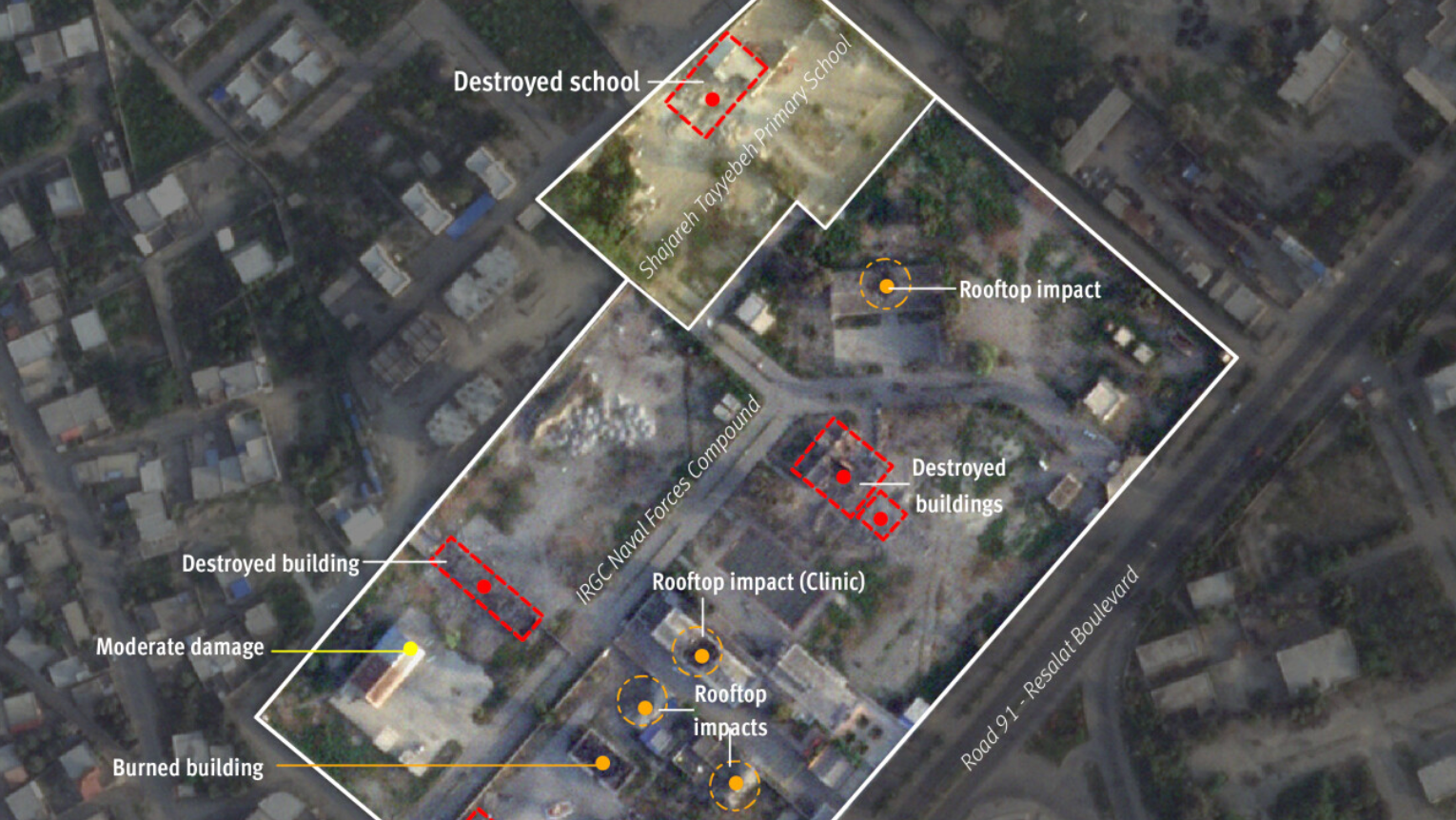
When reports emerged that hundreds of people had been killed in an attack on a primary school in southern Iran, a small team of investigators rushed to social media.
It was the first day of the joint US-Israeli strikes, and misinformation began to spread online. Restrictions imposed by Iranian authorities made it dangerous for people who witnessed the strike to speak out.
That left the Human Rights Watch’s digital investigation team with the critical task of uncovering the facts and establishing the truth surrounding the attack.
The team of eight, which investigates war crimes worldwide, immediately got to work, painstakingly analysing every piece of digital evidence to reconstruct the events of what has been one of the deadliest incidents in the ongoing war in the Middle East.
Advertisement
From their offices in London, Berlin, Geneva, and California, they scoured social media for any footage or information they could find.
The digital investigations team analysed the attack on a primary school in southern Iran (Human Rights Watch)
Over the next week, they spent hours verifying and analysing scores of videos and photographs recorded immediately after the strike or during search-and-rescue operations, as well as from funerals.
Satellite images from the past 25 years were reviewed by the team and compared to those captured following the attack. They showed both the site and the nearby cemetery where victims were apparently buried.
They revealed that at least eight structures across the compound had been directly struck by munitions, including at least one that had been hit and severely damaged the school.
Sophia Jones, who is part of the team, said: “A prompt and thorough investigation is needed into this attack, including if those responsible should have known that a school was there and that it would be full of children and their teachers before midday.”
Advertisement
A report was published a week later, which called for the US and Israel to immediately assess their responsibility and prosecute anyone responsible for war crimes.
The team investigated Israel’s displacement of Palestinians in the West Bank (Human Rights Watch)
What is the digital investigations lab?
The case is one of many for the team, whose work ranges from tracking down suspected criminals to analysing immigrant deportation patterns, using technology to investigate conflict violations and human rights abuses worldwide.
Dubbed the team’s digital investigations lab, the team uses social media, artificial intelligence, and satellite imagery to identify and hold perpetrators to account by documenting crimes and abuses.
Their work spans protests in Europe and conflicts in the Middle East to deaths in custody in El Salvador, as well as violence in countries including Burkina Faso, Sudan, and Myanmar.
Advertisement
The team was established a decade ago and investigations can take anywhere from days to years. Their findings are published reports, which expose wrongdoing and aim to put pressure on governments and policymakers to act.
Sam Dubberley, who directs the organisation’s technology, rights and investigations division, said the work is essential at a time of rapid misinformation.
“It’s definitely becoming a much faster space where human rights defenders are under a lot more pressure than they ever used to be,” he told The Independent.
3D model of likely Saudi border guard posts and patrol roads near fences identified with satellite imagery (Human Rights Watch)
How are they using technology?
The team is constantly across social media platforms, hunting for photos, videos, or audio of attacks, which they verify and fact-check.
Advertisement
They investigate military units, alleged perpetrators, or victims to determine who they are, what they have posted online, and whether there is evidence they were involved in a crime.
“People post videos that you think they never would, often in spaces where they think it’s not so public, like smaller Telegram groups,” Mr Dubberley explained.
One of their main tools is satellite imagery analysis, which is used to track the destruction of villages or sites. They painstrakingly reconstruct areas of attacks using 3D models to provide clear evidence of the before-and-after effects.
Artificial Intelligence is an essential part of their operations, helping them gather data from foreign government websites or mine data sets for patterns in arrest rates.
Advertisement
Earlier this month, they published a two-year-long report into civilian killings in Burkina Faso. The team used AI to uncover essential information and analyse nearly 40,000 posts, which exposed the activities of perpetrators at a scale that would have been impossible to cover otherwise.
Where are they working?
Digital tools have made it possible for the team to investigate alleged crimes everywhere, including in countries where they can’t enter, such as Russia, Iran, or Myanmar.
Advertisement
Mr Dubberley said: “Technology allows us to look over those walls that are being built, even in places like China. Looking over the Great Firewall, it’s very hard, it’s very difficult, it requires brave people, but it’s possible.”
Iran’s internet blackout has made it difficult for them to obtain and verify information, but they are still able to reach sources via WhatsApp, Telegram, and other social media. “People know technology is key for them to have their stories told,” Mr Dubberley added.
“We know that capturing their stories and verifying them is a really important way for us to do our work, and for us to achieve accountability and prevention.
“It’s important, of course, to investigate what’s going on in the Middle East right now. It’s important to investigate what’s going on in Ukraine, and we do that.
Advertisement
“But it’s also really important to make sure that we have the resources to investigate situations that are forgotten.”
What have they achieved?
One of their biggest achievements, Mr Dubberley said, was a 2023 report that found that Saudi border guards had killed hundreds of Ethiopian migrants and asylum seekers who tried to cross the Yemen-Saudi border between 2022 and 2023.
The organisation was able to map the route used to cross the border thanks to geospatial and open-source researchers from the digital investigations team, who verified videos and images recorded by migrants and border residents.
Advertisement
Analysis of satellite imagery allowed them to assess the development of security infrastructure on the border and identify burial sites near migrant camps, which had grown considerably.
Following the report, the German Justice Ministry suspended its training programme for Saudi Arabian border guards.
“We got so many media hits, that was part of the strategy, to embarrass Saudi Arabia as much as anything else, to see if we could get the killings to at least slow down, and for a while at least, they did,” Mr Dubberley concluded.
The disease is typically found in animals but health officials believe it could be emerging as a sexually transmitted infection (Picture: Getty/Metro)
Catching diseases from animals is rare, but not impossible; you only have to look as far as the Hantavirus outbreak for confirmation of that.
But in an equally unlikely turn of events, cases of ‘rain rot‘ have been increasing among a small number of sexually active men, despite normally occurring in sheep, horses and cows.
Otherwise known as dermatophilosis, the skin condition has caught the attention of the US Centre for Disease Control and Prevention (CDC), after it reported on nine cases of men with the disease diagnosed in Barcelona.
All men who presented with rain rot reported they’d been having sex with other men, suggesting this possible STD is disproportionately affecting the gay community. Cases have also been reported in Lyon, Paris, and Germany.
Advertisement
But what on earth is rain rot, and can it actually be labelled a sexually transmitted disease? And what are the symptoms if you’re worried you could be affected?
We asked a doctor to find out…
What is ‘rain rot’ and what are the symptoms?
It’s medical name is dermatophilosis, and it’s a skin infection which Dr Lawrence Cunningham tells Metro is caused by a bacteria called Dermatophilus congolensis.
This condition has earned the name rain rot because of its prevalence in more tropical regions and how closely the infection tracks with damp weather.
Advertisement
‘But what makes this bacterium unusual is its ability to survive in both wet and dry conditions,’ Dr Cunningham, for UK Care Guide, explains.
The red bumps are found on the face as well as the genitals (Picture: CDC)
In terms of symptoms, they aren’t hugely serious, however they can cause discomfort.
‘What rain rot does is create crusty, scabby patches on the skin that can get quite uncomfortable if left alone,’ Dr Cunningham says.
In the men diagnosed in Europe, they experienced an itchy folliculitis-like rash characterised by papules (solid raised bumps), vesicles (small fluid-filled sacs or blisters), pustules (puss-filled pimples), scabs, nodules (abnormal lumps), or even scaly lesions.
Of course, these are unpleasant but this is often as serious as the condition gets, with complications being few and far between.
Advertisement
‘The main concern is a secondary bacterial infections if the skin gets badly damaged, particularly from scratching the affected areas,’ the doctor adds.
‘Left untreated, there’s a small risk of the infection reaching deeper tissues, but with proper medical attention, serious complications are rare.
How does it transfer from human to human?
Usually infection of humans will happen due to direct contact with an infected animal, known as a zoonotic infection, according to health officials.
This means people working with livestock are particularly vulnerable, with Dr Cunningham noting: ‘People handling animals without gloves, grooming them, treating wounds, are the ones most at risk.’
Advertisement
The red bumps can be itchy but it’s important not to scratch (Picture: CDC)
But the bacteria can also survive on surfaces like contaminated brushes, grooming tools and horse tack, so you could pick it up there, too.
‘From what I’ve seen, it’s almost always farm workers or vets who pick it up, and usually after repeated or prolonged contact rather than a single brief touch,’ the doctor explains.
‘But most clinicians could go their entire career without seeing a confirmed case. I’ve only come across a small handful myself.’
However, none of the human cases reported by the CDC involve animal exposure, with the government body pointing to the infection being ‘sexually acquired’.
A human catching rain rot from another human is even rarer, although Dr Cunningham says this could happen though direct skin-to-skin contact.
Advertisement
‘Given these recent reports about transmission in certain communities, I’dpoint to intimate contact. Prolonged skin-to-skin exposure where the bacteria has enough time to transfer and take hold.’
All men in the study had high exposure to STIs, several patients reported partners with similar symptoms, and lesions were commonly located in sites exposed during sexual contact.
Attendance at a sexual venue could also be a factor in this outbreak with eight patients reporting visiting a sauna, where humid conditions would favour the bacteria.
This means it could technically fall under the STI umbrella, although this doesn’t mean it behaves like the likes of chlamydia or gonorrhoea.
Advertisement
What’s the treatment and should you be worried?
The incubation period for rain rot is typically one to four weeks after exposure, with people seeing symptoms within the first two weeks. In the case of the outbreak, symptoms typically occurred around the six day mark.
But Dr Cunningham stresses that it’s important not to panic, because this disease isn’t anything you need to be worried about.
‘Doctors can diagnose it through skin samples or bacterial cultures,’ he says. ‘It’s straightforward testing, and most labs can identify the bacteria without difficulty.
‘Antibiotics are the best way to treat this initially, and they work well when you catch it early.
Advertisement
‘Depending on how widespread the infection is, that could mean topical antibiotic creams for localised patches or oral antibiotics for more extensive cases.’
Ultimately, Dr Cunnginham wants you to know that Dermatophilosis is very treatable and still quite rare, and public awareness means just means you’re more likely to seek help early, which is exactly what makes the difference.
LOS ANGELES (AP) — The wide-ranging prosecution in the death of “Friends” star Matthew Perry is coming to a close. Five people have pleaded guilty for various roles in supplying the actor with ketamine, the drug that killed him at age 54 in 2023. Four of them have been sentenced. The last person will be sentenced in the coming days.
Here’s a look at each person.
Kenneth Iwamasa
Perry’s 60-year-old longtime live-in personal assistant Kenneth Iwamasa was intimately involved in the actor’s illegal ketamine use, acting as his drug messenger and personally giving him injections — six to eight per day in the last days of his life — according to his plea agreement.
“Shoot me up with a big one,” Iwamasa told authorities Perry said to him on Oct. 23, 2023. After several injections, the assistant left him at his home in the Pacific Palisades neighborhood of Los Angeles and returned to find Perry dead in his hot tub. An autopsy found the primary cause of death was the acute effects of ketamine, with drowning as a secondary cause.
Advertisement
Iwamasa made nearly all of the illegal drug buys on Perry’s behalf, working in coordination with his co-defendants. One of them, Dr. Salvador Plasencia, taught him how to give Perry the injections.
Iwamasa was quick to participate with police and prosecutors, becoming the first to reach a plea deal as they sought to use him as a key witness against other defendants.
PLEADED GUILTY TO: One count of conspiracy to distribute ketamine causing death.
SENTENCE: He’s scheduled to become the final defendant sentenced on May 27.
Advertisement
WHAT THEY SAID: Iwamasa is the only defendant who has yet to give public comment.
Jasveen Sangha
Prosecutors say she was known as “The Ketamine Queen,” because of her jet-setting, drug dealing lifestyle. Her lawyers say authorities made up that nickname to feed a media frenzy.
Jasveen Sangha did admit to running a serious drug operation, selling Perry the dose of ketamine that he took on the day he died, and causing the death of another man, 33-year-old Cody McLaury, in 2019.
Like the other defendants, Sangha had no previous convictions.
Advertisement
But, prosecutors said, and a judge agreed, that unlike the other defendants whose actions were atypical, she had been dealing drugs including ketamine, methamphetamine and cocaine for at least five years from her home.
Sangha is a 42-year-old who was born in Britain, raised in the United States and has dual citizenship. Her social media accounts showed her in posh spaces alongside rich-and-famous faces in Spain, Japan and Dubai, London and Los Angeles.
Sangha went to high school in Calabasas, California — perhaps best known as home to the Kardashians — and went to college at the University of California, Irvine, graduating in 2005 and going to work at Merrill Lynch. She later got an MBA from the Hult International Business School in London.
Her lawyers presented that personal history as evidence that she was an otherwise upstanding citizen, but prosecutors used the same facts to argue she didn’t need to sell drugs but did so for greed and glamour.
Advertisement
PLEADED GUILTY TO: Three counts of distribution of ketamine, one count of distribution of ketamine resulting in death or serious bodily injury, and one count of using her home for drug distribution.
SENTENCE: She was sentenced to 15 years in prison, the longest so far.
WHAT THEY SAID: “These were not mistakes. They were horrible decisions,” Sangha said at sentencing, adding that her choices had “shattered people’s lives and the lives of their family and friends.”
Erik Fleming
Fleming, 56, was working as a drug addiction counselor when a mutual friend he had with Perry told him that the actor was seeking ketamine, according to filings from prosecutors.
Advertisement
Fleming’s lawyers said he was a former television and film producer whose career had been ravaged by substance abuse, and that after gaining hard-won sobriety he became a counselor.
But he had badly relapsed when approached about Perry, and connected the actor with Sangha to buy her product.
In all, prosecutors say, Fleming delivered 50 vials of Sangha’s ketamine for Perry’s use, marking up the price to make a profit, including 25 vials sold for $6,000 to the actor four days before his death.
Authorities found him early in the investigation and lawyers on both sides agreed he was immediately and extraordinarily cooperative. He gave up Sangha, and became the first to appear in court and enter a guilty plea.
Advertisement
PLEADED GUILTY TO: One count of distribution of ketamine resulting in death.
SENTENCING: He was sentenced Wednesday to two years in prison and three years of probation.
WHAT THEY SAID: “This grievous failure will haunt me forever,” Fleming wrote in a letter to the court. After he was sentenced, he said: “I want to do everything I can to make sure a tragedy like this never happens again. I don’t want anyone to die from ketamine.”
Dr. Salvador Plasencia
“I wonder how much this moron will pay?”
Advertisement
That was a text message Plasencia sent to a fellow doctor when he learned Perry was looking for illegal, off-the-books ketamine, according to a plea agreement where the doctor admitted to selling 20 vials of the drug to the actor in the weeks before his death.
Plasencia, a 44-year-old Los Angeles-area doctor known to patients as “Dr. P,” was one of the main targets of the prosecution and had been headed for a joint trial with Sangha when he reached the plea agreement last year.
Perry was connected to Plasencia through another patient. The actor had been getting ketamine legally from his regular doctor as treatment for depression, an off-label but increasingly common use of the surgical anesthetic. But he wanted more than that doctor would prescribe.
Plasencia admitted to injecting Perry with some of the initial vials he provided, and left more for Iwamasa to inject, despite the fact that Perry froze up and his blood pressure spiked after a dose.
Advertisement
Plasencia graduated from UCLA’s medical school in 2010 and had not been subject to any medical disciplinary actions before the Perry case.
PLEADED GUILTY TO: Four counts of distribution of ketamine.
SENTENCE: 2 1/2 years in prison, two years of probation and a $5,600 fine.
WHAT THEY SAID: Plasencia cried at his sentencing as he imagined the day he would have to tell his 2-year-old son “about the time I didn’t protect another mother’s son. It hurts me so much.”
Advertisement
Dr. Mark Chavez
Chavez, a San Diego doctor who ran a ketamine clinic, was the source of the doses that Plasencia sold to Perry.
Chavez admitted to obtaining the ketamine from a wholesale distributor on false pretenses and passing it along.
Chavez, 55, graduated from UCLA’s medical school in 2004. He has surrendered his medical license.
CHARGE: One count of conspiracy to distribute ketamine.
Advertisement
SENTENCING: Eight months of home confinement and three years of supervised release.
WHAT THEY SAID: “I just want to say my heart goes out to the Perry family,” Chavez said at sentencing.
___
Versions of this story previously ran on Aug. 15, 2024, and Sept. 3, 2025.
Everywhere I look right now, people are talking about screen time.
It’s by no means a new conversation (parents have been having it for years), but increasingly, experts are saying there’s a whole lot more to the ‘how much is too much’ screen time debate than simply sticking a number on it.
Screen time recommendations for under-fives were recently shared by the UK government, while much has been said of the mental health impact of teens spending hours scrolling social media each day.
Some schools, nurseries and colleges have taken matters into their own hands, issuing a list of screen time recommendations for children aged 0-18 years old. The list suggested 2- to 5-year-olds could have up to two hours on screens per day, for instance, while 10- to 14-year-olds could have up to four hours.
All children are different and what might work for one child, may not work for the next. So, is there a better way to help parents understand whether their kids are having too much screen time (especially when it can be pretty tricky to know just how much they’re consuming as they get older)?
Questions to ask when considering if your child’s screen time is too high
We all know we should limit screen time, but sometimes we have to work or get things done and screens keep our children still and entertained.
Advertisement
Recently, integrative paediatrician Dr Joel Warsh, aka Dr Gator on social media, shared in his newsletter that he tells parents to ask four questions when it comes to the impact of screen time on their kids.
Is my child sleeping well?
Are they able to focus without screens?
Do they play independently?
And how do they behave when the screen is taken away?
If their sleep, focus and ability to play independently is on track, and they don’t have meltdowns or angry outbursts when screens are taken away, this is a positive sign.
The paediatrician noted that “sometimes it’s not about the number of hours” but rather the effect on our kids.
Not all content is equal in terms of impact. Watching screens with an engaged adult where parents talk and ask questions is linked to better development than solo use, while slow-paced content is considered better than fast-paced, social media-style videos.
On this, Dr Warsh noted he’d seen kids who had watched 30 minutes of intense content and had a meltdown, while others had watched 1-2 hours of structured, calm content and been “totally fine”.
Dr Amir Khan has warned that this sign should not be ignored
A GP has warned that anyone experiencing a particular symptom should not delay seeking medical attention. Persistent bloating lasting three weeks or longer requires investigation.
Advertisement
During a recent episode of his No Appointment Necessary podcast, Dr Amir Khan discussed how to recognise the signs of ovarian cancer. The disease, as its name indicates, begins in the ovaries. Consequently, anyone with ovaries is at risk. Even those who have undergone ovary removal can develop ovarian cancer, as it may affect the fallopian tubes or the peritoneum (the lining inside the abdomen).
The condition is most commonly diagnosed in women aged over 50. Data from Cancer Research UK shows it ranks as the sixth most frequent cancer affecting women in Britain, claiming more than 4,000 lives annually.
Content cannot be displayed without consent
During his discussion with co-host Cherry Healey, Dr Amir – familiar to viewers from his ITV appearances, explained that the warning signs can be “easily” overlooked. Cherry said: “Ovarian cancer – cancer of the ovaries, which is called the ‘silent cancer’ because there aren’t that many warning signs. “
Dr Amir responded: “Yeah, I’m not sure I quite like that term the ‘silent cancer’. There are symptoms but the symptoms are not very specific to the ovaries so they feel like they could be coming from somewhere else.
Advertisement
“But also they’re easily dismiss, not just by the the lady, but also by doctors as well.”
He particularly emphasised that individuals should arrange a medical appointment if they notice unexplained bloating. “If you’ve got unexplained gas or a feeling of being bloated, for three weeks or more and you are, the official guidance is 40 in Europe – I would say 35 or above anything, that is unexplained or persistent, and by that, I mean there’s no other obvious cause, it’s been going on for three weeks or more, go and get that checked out.”
A caption accompanying a clip from the podcast posted on Instagram stated: “There’s no such thing as ‘just bloating’ when symptoms persist. Ovarian cancer is often called the ‘silent cancer’, but as Dr Amir & Cherry discuss, there are symptoms. The problem is they’re easy to dismiss.
“If you’ve had unexplained bloating, gas, or discomfort for three weeks or more, don’t ignore it. Get it checked.”
Advertisement
Other symptoms
On its website, the NHS warns that the signs of ovarian cancer are “not always obvious”. This means the disease is often treated “late”. The main symptoms of ovarian cancer include frequently (roughly 12 or more times a month) having:
A swollen tummy or feeling bloated
Pain or tenderness in your tummy or the area between the hips (pelvis)
No appetite or feeling full quickly after eating
An urgent need to pee or needing to pee more often
Other symptoms of ovarian cancer can include:
Indigestion
Constipation or diarrhoea
Back pain
Feeling tired all the time
Losing weight without trying
Bleeding from the vagina after the menopause
You should see a GP if you experience any of these symptoms. The NHS continues: “These symptoms are very common and can be caused by many different conditions.
“But it’s still important to get them checked by a GP. This is because if they’re caused by cancer, finding it early can mean it’s more treatable.”
Advertisement
It adds: “It’s important to get any symptoms of ovarian cancer checked as soon as possible. Finding it early can mean it’s more treatable.”
A strong end to the season will ensure Liverpool return to the Champions League but it still looks like being a summer of change
Liverpool have a chance to finally clinch Champions League qualification this week, after which attention will soon turn to the summer transfer window. Three points against Aston Villa would guarantee a top-five finish but anything less than that and the door would be left open to the chasing pack.
Advertisement
Regardless of what happens with manager Arne Slot – and there had been plenty of speculation over the Dutchman’s future – the Reds may well feel they need to bolster their squad in the summer. Mohamed Salah and Andy Robertson will leave in the summer and they might not be the only ones.
Alisson has missed the bulk of the run-in through injury and questions remain over the goalkeeper’s longer-term Anfield future. Even if the Brazilian stays, there’s likely to be a need for experienced additions to make up for the loss of some big characters.
There has already been plenty of chatter about what might be in store for the 2024/25 Premier League champions this summer. We’ve taken a look at some of the latest Liverpool lines.
Juventus and Liverpool have been in touch with a view to discussing a potential move to Turin for goalkeeper Alisson, according to reports in Italy. The situation has developed, however, with murmurings that Michele Di Gregorio might move in the opposite direction.
Juve keeper Di Gregorio, 28, has played in 29 of his team’s 36 league games this season. He is said to be keen to be an undisputed first choice at a team next season – whether that’s in his current surroundings or elsewhere – and the Bianconeri signing Alisson would make the former unlikely.
Sky Sports, HBO Max, Netflix and Disney+ with Ultimate TV package
Advertisement
This article contains affiliate links, we will receive a commission on any sales we generate from it. Learn more
Sky has upgraded its Ultimate TV and Sky Sports bundle to now include HBO Max, Netflix, Disney+, discovery+ and Hayu, as well as 135 channels and full Sky coverage of the Premier League and EFL.
Sky broadcasts more than 1,400 live matches across the Premier League, EFL and more with at least 215 live from the top flight alongside Formula 1, darts and golf.
The same reports suggest he might not get such an opportunity at Liverpool either, with Giorgi Mamardashvili expected to start the new campaign as No.1 if Alisson moves on. Another potential option for Di Gregorio would be to move to Tottenham if the London side avoid relegation, with Guglielmo Vicario linked with a summer return to Serie A.
Elliott handed future warning
Harvey Elliott is one of the Liverpool players whose future could hinge on whether manager Slot stays or goes. According to former Reds midfielder Danny Murphy, the 23-year-old needs to prepare for an exit if the Dutchman remains in the dugout next term.
Elliott has spent the current season on loan at Aston Villa but has failed to make a dent on the first team under Unai Emery. He is due to return to Anfield in the summer after failing to reach the threshold of appearances needed to trigger a permanent Villa move.
Advertisement
“For Harvey Elliott, if Arne Slot stays in charge, he needs a new home,” Murphy told Aceodds.com. “I felt for him this year at Villa, what’s gone on. It’s my understanding that it’s not down to him.”
He added: “The reality is he’s a super player. He’s very creative, brave on the ball. He’s a Premier League level player for sure and he’ll be desperately open to a change of manager because another manager might really like that type of player.”
Join our LFC WhatsApp community and get all the latest LFC news, views, transfer gossip and more, as it happens We also treat our community members to special offers, promotions, and adverts from us and our partners. If you don’t like our community, you can check out any time you like. If you’re curious, you can read our Privacy Notice.
Robins are one of the UK’s favourite birds and are often spotted in gardens across the country. They can be more noticeable in spring, and there are certain plants, foods and shrubs that could help attract them to your garden
Birds need help throughout the year, whether that means offering them nutritious food to feed on or water for bathing. This becomes crucial during the spring months when British birds are building nests, laying eggs and nurturing their young.
Advertisement
Robins are one of Britain’s most beloved birds, and while they’re a delightful presence all year, they tend to be more visible during spring. This occurs because their dietary habits change and they depend more heavily on insects, worms and spiders, typically discovered in lawns. According to one expert, enticing them into your garden is straightforward.
James Ewen, gardening specialist at Green Feathers, explained: “Robins are a favourite of mine, and it’s always a pleasure when one pays you a visit.
“People think luring robins is an impossible task, and while they can be a rare sighting, when you know, you know.
“Considering their basic needs and comfort- food, drink, nesting opportunities, shelter and their most-loved plants and shrubs can go a long way.”
Advertisement
Shrubs
If you’re hoping to attract robins, supplying dense shrubs, hedges and climbing plants is ideal. They provide refuge from severe weather and safety from larger birds.
The gardening specialist noted: “A top choice for attracting robins and other songbirds is a serviceberry tree, known by many names, including juneberry.”
Their fruit matures from late spring through summer, supplying robins with a consistent source of soft, energy-rich berries, reports the Express.
Advertisement
Food
Understanding what robins enjoy eating is vital. They are enthusiastic feeders, and offering mealworms and earthworms is an excellent starting point. According to the expert, providing these will have robins “keep coming back”.
Fruits such as apples and pears can also be a brilliant source of fibre and vitamins for robins, helping to support digestion as well as healthy feathers and eyesight.
Water
Much like other birds, robins need water for both hydration and bathing. Keep a shallow bird bath topped up throughout the year, or position a small dish close to some shrubs.
Advertisement
The expert said: “Robins prioritise safety, so positioning water by shrub shelters them from predators. Never underestimate how important water is for robins to bathe in.
“Providing a place for robins to bathe keeps their feathers clean and free from parasites, and they also make their feathers more pliable when they bathe, allowing them to fight more efficiently, thus getting away from predators more effectively.”
Holmesterne began in 1986 and operated from two sites in Richmond.
However, James Clark and Howard Smith from Interpath were appointed joint administrators on Monday.
A statement from the administrators says that over 2024 and 2025, the company came under sustained margin pressure in the wake of high input costs across ingredients, packaging and factory costs, which were further exacerbated by increases in employment taxes.
The business launched a turnaround programme in July 2025 to put the business on a more sustainable financial platform. Unfortunately, however, sales continued to fall below expectations, which impacted cashflow, and in turn, caused creditor pressure to mount.
Consequently, after all available options had been explored by the company and its stakeholders, the decision was taken to seek the appointment of administrators.
The joint administrators have commenced an orderly wind-down of operations, the statement continued.
Advertisement
Regrettably, the majority of the company’s 130 staff have been made redundant, with a small number of employees retained by the administrators to assist them with the wind-down process.
James Clark, managing director at Interpath and joint administrator, said: “It is a real shame to see Holmesterne enter administration, particularly after the sale of the business last year and the renewed optimism that followed.
“Despite the best efforts of both the management team and the new owners, the headwinds facing the business sadly proved too challenging to overcome.
“Our immediate priority is to support employees through this difficult period, and we will be doing all we can to assist them in the days and weeks ahead.”
For five hours, the 11 survivors of a plane crash off the coast of Florida floated on a life raft, with no means of calling for help and no idea if anyone was coming to save them. As a thunderstorm approached, they gathered under a tarp for whatever protection it might offer.
Then, search and rescue crews from the U.S. military appeared overhead, members of those crews recounted during a news conference Wednesday.
“You could tell just by looking at them that they were in distress — physically, mentally and emotionally,” said Air Force Capt. Rory Whipple, a combat rescue specialist who jumped into the water and swam to the survivors. “You have to imagine the emotional injuries that they sustained out there, not knowing if someone was going to rescue them.”
The plane, a Beechcraft 300 King Air turboprop, was on its way from Marsh Harbour, on the Bahamian island of Great Abaco, to Grand Bahama International Airport in Freeport when it suffered engine failure Tuesday, authorities said. The pilot ditched the plane in the water about 50 miles (80 km) off Vero Beach, Florida, and managed to get its 10 passengers, three with minor injuries, onto a yellow life raft.
Advertisement
Air Force Reserve Maj. Elizabeth Piowaty credited those efforts, saying the pilot would have been concerned about ocean swells and slowing the plane as much as safely possible before impact.
“I’ve not known anyone to survive a ditching in the ocean,” said Piowaty, who commanded a HC-130J Combat King II plane that assisted with the rescue. “From what I’ve seen, for all those people to survive is pretty miraculous.”
The downed plane’s emergency beacon alerted the U.S. Coast Guard to its location. At the time, the Air Force Reserve’s 920th Rescue Wing had a crew already airborne conducting a training mission in a HH-60W Jolly Green II helicopter. The crew was redirected to help with the search.
Piowaty said that after locating the survivors, her aircraft passed overhead and dropped a survival kit that included two additional rafts, food and water. The survivors were then able to spread out, and the crew of the HH-60W, including Whipple, was able to hoist them to safety amid 3- to 5-foot (1- to 1.5-m) swells, raising the last survivor just a few minutes before the helicopter would have been forced to refuel.
Advertisement
There was no sign of the downed aircraft, Piowaty said.
All 11 survivors were flown to awaiting emergency medical services at Melbourne Orlando International Airport, authorities said. All were reported to be in stable condition.
The U.S. Federal Aviation Administration said it would investigate the crash.
HM Inspectorate of Probation’s latest inspection of the region’s probation service found that long-standing issues with staffing “continued to undermine capacity and confidence”.
The Ministry of Justice said it inherited a “criminal justice system in crisis” which it is addressing by increasing funding for the probation service and recruiting more probation officers.
Martin Jones, chief inspector of probation, said the inspectors were “encouraged to find signs of increasing stability” across Yorkshire and the Humber’s probation service after 90 of its cases were inspected.
Advertisement
However, Mr Jones said the probation service, which is the second largest after London, continued to face “longstanding issues with vacancies, sickness and attrition”.
He said these issues, “combined with high levels of practitioner and middle manager inexperience, continued to undermine capacity and confidence”.
Mr Jones urged leaders to “strengthen practitioners’ skills and confidence and ensure there is meaningful management oversight and consistent delivery of interventions”.
Inspectors found that workforce pressures remained a “significant challenge” for the Yorkshire and the Humber probation service in some probation delivery units, but said “encouragingly, there were signs of increasing stability”.
Advertisement
“Despite this, longstanding issues with vacancies, sickness and attrition, combined with high levels of practitioner and middle manager inexperience, continued to undermine capacity and confidence,” inspectors said in their report.
They found that staff retention levels were being affected by “long vetting delays, concerns about pay, and excessive workloads”.
Inspectors also found that “leaders felt national recruitment campaigns had not properly reflected the public protection responsibilities of the role, leaving new staff unprepared”.
“Inspectors noted constant organisational change, driven by national policies, and crisis-driven working, which meant that staff were encouraged to focus on transactional tasks rather than reflective, analytical decision-making,” they added.
Advertisement
Probation service faced delays in accessing information from police, inspectors find
Inspectors said access to critical risk information from the probation service’s partners – such as the police and children’s services – had improved, but practitioners “still faced delays and received incomplete information”. They said leaders “stressed that national action was required to fully resolve this”.
The report recommended that the probation service develops practitioners’ confidence and skills in the use of “professional curiosity and challenging conversations”.
They also said the probation service should ensure senior probation officers have “sufficient capacity and resources to undertake effective management oversight of casework”.
Recommended reading:
Advertisement
Inspectors recommended that the government develops a national strategy to improve information service from the probation service to the police and children’s services.
They also urged the government to “reduce vetting delays and address workforce instability by implementing streamlined and more regionally responsive recruitment processes”.
A Ministry of Justice spokesperson said: “The government inherited a criminal justice system in crisis, placing significant strain on the probation service.
“We are addressing this by boosting probation funding by up to £700 million extra by 2028, recruiting another 1,300 probation officers on top of the 2,300 we already committed to and delivering the biggest expansions of tagging in British history to ensure robust supervision of offenders and protect the public.”
United have explored other options but Carrick has long been considered the front-runner for a job that he has been publicly backed for by a number of players. The former Middlesbrough boss has overseen a marked improvement in mood and results, with Champions League qualification secured with three matches to spare.
Ahead of the final two matches of the season – at home to Nottingham Forest on Sunday and away to Brighton – United are also on the brink of securing a comfortable third spot ahead of Liverpool and Aston Villa.
It’s sure to be a fascinating summer at Old Trafford, with arrivals and departures expected as Carrick, assuming he lands the job, puts his stamp on the side. Here’s a round-up of the latest United news…
Carrick has made no secret of the fact he wants the job full-time, saying after a recent game that it feels like a “natural” fit. However, he expects to be backed during what could be a hectic summer.
In key talks with top bosses next week, Carrick will want assurances the club will do whatever it can to land their leading transfer targets. His expected appointment as permanent boss will have the knock-on effect of sewing up Bruno Fernandes’s long-term future.
The Portuguese playmaker was close to leaving the club last summer before being persuaded to stay by Amorim. His countryman’s dismissal raised more questions about his future amid suggestions he had grown tired of the club’s constant cycle of upheaval. However, with Carrick at the helm, Fernandes is ready to commit his long-term future to the club.
Advertisement
Casemiro’s advice
Outgoing midfielder Casemiro has been dishing out advice to Kobbie Mainoo, calling him the “present and the future of the club.” The fortunes of both players have been transformed under Carrick.
Mainoo has come in from the cold after struggling to force his way into Amorim’s plans, while Casemiro has been a key player over the second half of the season, with calls for him to reverse his decision to leave this summer.
The Brazilian has been key off the pitch too, offering guidance to younger players like Mainoo. Speaking on Rio Ferdinand’s podcast, he discussed the challenge of getting through to younger players in the age of social media.
Advertisement
When Ferdinand put to him that you can’t be as strong with young players [these days], he said: “I try, I try, but the phone, the social media is very difficult because everyone sees on the phone, ‘Nah, you play good.’ You think, ah, you play good. Yeah, it’s top, it’s top.’
“And I try every day about this with Kobbie. He’s an unbelievable player. But he needs to train, train, train. He needs fear – I play, I don’t play. I need to push the training because this guy is the present and the future of the club.”
Join our new MAN UTD WhatsApp community and receive your daily dose of Manchester United content from Mirror Football. We also treat our community members to special offers, promotions, and adverts from us and our partners. If you don’t like our community, you can check out any time you like. If you’re curious, you can read ourPrivacy Notice.
Advertisement
Sky Sports, HBO Max, Netflix and Disney+ with Ultimate TV package
This article contains affiliate links, we will receive a commission on any sales we generate from it. Learn more
Sky has upgraded its Ultimate TV and Sky Sports bundle to now include HBO Max, Netflix, Disney+, discovery+ and Hayu, as well as 135 channels and full Sky coverage of the Premier League and EFL.
Sky broadcasts more than 1,400 live matches across the Premier League, EFL and more with at least 215 live from the top flight alongside Formula 1, darts and golf.

























































You must be logged in to post a comment Login