Locals say that “finding something unique on your travels is guaranteed”
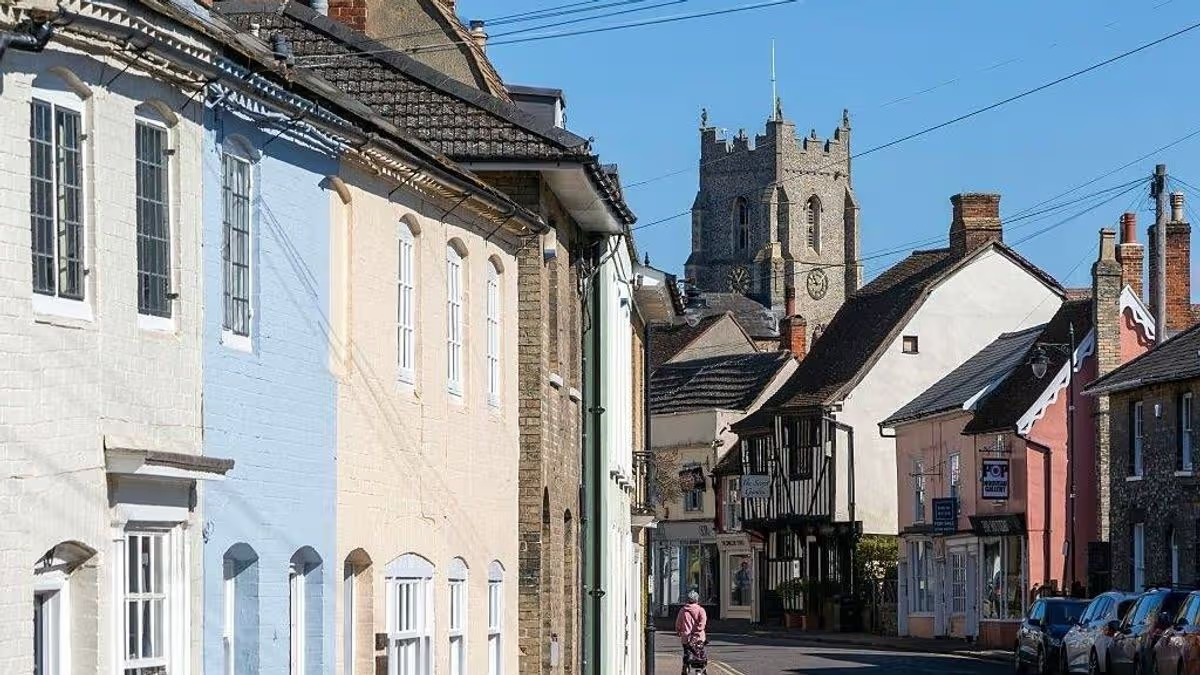
An historic market town just a short drive away from Cambridgeshire has been named as one of the UK’s “destinations of the summer” this year by Expedia. The Suffolk town of Sudbury is most famous for its market, which dates all the way back to 1009.
Advertisement
Sudbury was also mentioned in the Domesday Book in 1086 and the town still has the echoes of a silk industry that was woven into the fabric of the local community.
The market is held each Thursday and Saturday at Market Hill and the Old Market Place between 8am and 3pm. Locals say it’s a must-visit when in the area and shoppers can find an array of stalls at the award-winning market. They include the likes of Munro’s fishmonger, Sudbury Plants, and Coleman’s Butchers among others.
The independent businesses are not just restricted to the market though. The local council boastss that “over 70 per cent of the town centre shops and businesses” are independent. They say that this means “finding something unique on your travels is guaranteed”.
Among the stand-outs are Alvita’s Boutique for ladies’ clothing, jewellery, and accessories, and the traditional Clarke’s Bakery. Ray’s Retro is also worth checking out too.
Advertisement
There is plenty to do in and around Sudbury. There are even guided tours of the town which unveil tales of the area’s fascinating history from Saxon settlements and artistic inspiration, to peasant revolts and Sudbury Silk.
The Tourist Trail also suggest Belle Vue Park as a spot to relax with lawns and floral displays. The Grade II-listed Quay Theatre offers plenty of entertainment too.
Sudbury is around an hour’s drive from Cambridge, making it a great spot to consider for a day trip. Expedia also picked out Bishop’s Stortford, Reading, Nottinghamshire, and Scarborough as trending destinations.
England’s winning run at the T20 World Cup continued with a rampant nine-wicket victory over New Zealand in their final group game at The Oval.
Already assured of top spot in Group 2, and with it a place in next week’s semi-finals, England built on the momentum of their four previous wins by cruising a chase of 164 with 16 balls to spare.
Danni Wyatt-Hodge, now the tournament’s leading run-scorer, kept up her superb form by crashing 89 not out. She was supported by Sophia Dunkley, who made 49 not out in their unbroken partnership of 128.
Advertisement
Defending champions New Zealand, who are now eliminated, are a shadow of the side that won this title in 2024 but the dominant nature of England’s win only added to the sense of momentum around this side.
After limiting New Zealand early on, they took three wickets in four balls without conceding a run in limiting the White Ferns to 163-6.
Sophie Devine hit three sixes in a 14-ball 30 on her final international appearance but otherwise England were always in control.
Their semi-final opponents will be confirmed on Sunday, with India or South Africa appearing the most likely.
Advertisement
That match will take place on Tuesday afternoon or Thursday evening back at The Oval, where England’s women’s side have never lost any of their 11 matches.
Win that and they will return to Lord’s for the final on Sunday for a chance to win their first World Cup title since 2017.
Traffic and crowds can sometimes hinder the search operations. Soldiers and Mexican volunteers have repeatedly called for silence, so they can listen for signs of life under the debris.
People are helping however they can. Those who have drones are using them to search for survivors or the deceased in hard-to-reach places.
Families huddle around drone video feeds searching for anything familiar. A piece of clothing, a strand of hair, a belonging. Anything that might bring news of a loved one.
As time passes, the unofficial death toll rises – and so do the consequences.
Advertisement
“There’s a smell… the dead are already being felt. That’s going to make us and the children sick,” says Glendys Delgado.
Two buildings near where Delgado lives are collapsed, but there has been no official help, she says. “No one from the government has come here, but I thank God that people from Caracas have come to support us with food.”
Deiyer Gabril, 27, says every area has been affected, “Macuto, Caribe… everything over there is bad. And we can all feel the odour.”
Authorities reported on Friday that 861 volunteers from Mexico, the US, El Salvador, Switzerland, Colombia, and other countries were in Venezuela, with more arriving.
Advertisement
Interim President Rodríguez said she spoke with US President Donald Trump and US Secretary of State Marco Rubio on Friday, and that they reaffirmed their commitment to send rescue teams and aid supplies.
The BBC have reportedly found Giant’s replacement on Gladiators, months after his girlfriend’s racy job led to his own axing from Bradley and Barney Walsh’s Saturday night series
22:08, 27 Jun 2026Updated 22:08, 27 Jun 2026
The BBC have reportedly found Giant’s replacement on Gladiators. Earlier this year, Giant, 40, whose real name is Jamie Bigg, departed the hit BBC show amid much controversy when he went public with then-girlfriend Taylor Ryan, 28, and it emerged that she worked as a model on OnlyFans.
Execs were quick to air their disapproval, and the athlete said that he was “shocked and disappointed” by the move, which he directly linked to his partner’s racy work. Now, it’s been revealed that body builder and fitness instructor Ahmad Rabus, 37, has now been cast on the Bradley and Barney Walsh’s hit programme, with just weeks to go until cameras roll at the Utilita Arena in Sheffield.
A source told The Sun: “Gladiators bosses loved Ahmad’s energy and positivity, they think he will be a great addition to the team. There are also rumours there could be a few other newbies joining the gang.” A BBC spokesperson declined to comment.
Advertisement
According to the outlet, Ahmad is a dad of one and previously went into detail about his fitness journey on his social media.
He wrote on Instagram: “My passion with fitness started at a young age. I started training at the age of 17 and have undergone my own transformation and dedicated myself to training for 17 years.
Advertisement
It comes after Jamie hinted that he and Taylor had decided to call time on their relationship. Writing on Instagram, he said: “Lately, I’ve spent a lot of time reflecting. Not on what I’ve achieved, but on who I want to become. Right now, I’m doing what I find the hardest… I’m taking the time I need to work on myself.”
At the time, insiders claimed to the Daily Mail, he had taken himself off to Spain for some space. “They haven’t ruled out getting back together in the future but Jamie knows he needs to work on himself right now,” a source told the publication.
Jamie’s Instagram post continued: “I’m spending time in my own busy brain trying to unpack and make sense of all the thoughts. I’m rebuilding routines, strengthening my mindset, improving my health, and gaining clarity on the man I want to be.
Advertisement
“One thing I know for certain is that I have a genuine passion for helping others. And if being honest, raw, real and transparent about my own journey helps even one person find their direction, purpose, or confidence again, then it’s worth sharing. “Growth isn’t always pretty. Self-reflection isn’t always comfortable. But both are necessary if you truly want to become the best version of yourself. The work continues.”
Giant, who has two children with ex-wife Katie, was furious at being axed for Gladiators and made his feelings very clear as it all unfolded.
He said in April: “After three incredible seasons on Gladiators, I was shocked and disappointed to learn that I wouldn’t be returning to the show for season four. This news followed shortly after I had shared plans to go public with my relationship.
“My partner, Taylor, is someone I’m incredibly proud of. While she is known for her work on OnlyFans, that is just one part of what she does, a business-minded entrepreneur, someone who dedicates her time to fostering dogs and genuinely one of the kindest people I’ve ever met. Her values align closely with my own.
Advertisement
“During conversations with the BBC, ‘child safeguarding’ was raised, something I take extremely seriously, especially as a father and role model. I want to be clear that I have always upheld the standards expected of me, both professionally and personally. Being a positive role model has always been central to who I am, on and off screen. I stand by my values, and I stand by the people I love.”
A Gladiators spokesperson had previously said: “After three formidable series, Giant is leaving Gladiators. We’d like to thank him for everything he has contributed to the show and wish him well for the future.”
WASHINGTON (AP) — Holiday gatherings and major life events have come with an empty seat. Certain dates on the calendar meant time at a cemetery, standing before granite stones.
They are a relatively small group of people, scattered across different states, but they share a common bond that stretches back decades: Each had a family member die violently in the struggle for voting and civil rights, victims on a long and difficult path marked by blood that ended when the country seemed to mature into the nation of its creed.
But 61 years later, and as the country approaches its 250th anniversary, those sacrifices are in question. In a series of decisions over the past dozen years, including one in April, the Supreme Court has effectively dismantled the law that their family members died to see enacted, the Voting Rights Act of 1965.
“My mother’s blood is on that bill. We were always proud of that, and now it’s gone,” said Anthony Liuzzo, whose mother, Viola Liuzzo, died on an Alabama highway between Selma and Montgomery while driving marchers in 1965.
Advertisement
Critics of the law argue that times have changed, a point Chief Justice John Roberts made in a 2013 decision that was the first major step in rolling back the law.
Survivors of lost loved ones disagree, pointing to the speed with which Republican-led state legislatureseliminated majority-Black congressional districts after the court’s April ruling, which severely weakened a section of the law that had protected voting rights for minority communities. They feel anger and sadness that a milestone political victory decades ago has been reversed, but they are committed to keep fighting.
A church bombing and a chunk of concrete
Lisa McNair was born Sept. 19, 1964. Her older sister, Denise, died in the Sept 15, 1963, bombing of the 16th Street Baptist Church in Birmingham, Alabama. The church had been a central organizing point for civil rights protest.
Advertisement
Lisa McNair poses for a photo inside 16th Street Baptist Church, the site of the Sept. 15, 1963 terrorist bombing of the church, Monday, June 1, 2026, in Birmingham, Ala. (AP Photo/Mike Stewart)
Advertisement
Lisa McNair poses for a photo inside 16th Street Baptist Church, the site of the Sept. 15, 1963 terrorist bombing of the church, Monday, June 1, 2026, in Birmingham, Ala. (AP Photo/Mike Stewart)
Advertisement
Advertisement
Advertisement
The explosion killed Denise McNair, 11, Addie Mae Collins, 14, Carole Robertson, 14, and Cynthia Morris Wesley, 14. Nearly two dozen others were injured. Three Klansmen were convicted years later.
Advertisement
One of Lisa McNair’s early memories of her sister was of the box that their grandmother kept from the funeral home. It included Denise McNair’s shoes, a purse and a rock-sized piece of concrete that had been embedded in her skull.
The crime brought the civil rights struggle onto the national stage and outraged Democratic President John F. Kennedy.
The times were tumultuous, McNair said, but it seemed the nation was heading in the right direction. Most of her life, “I’ve seen advances” on television, in commercials, with interracial marriages, civil rights and voting rights, “a plethora of rights that we got over the greater part of my lifetime.” But that has changed, she said.
McNair, 61, said she is “physically sick” about the Supreme Court decision and subsequent actions by lower courts and legislatures.
Advertisement
“I am constantly working to pray my way through it, so I can get up and go to work in the morning and do what I need to do. But I just want to ask every white person I see, What more do you want?” she said. “Why do you hate us so?”
Lisa McNair arranges flowers on the grave of her late sister, Carol Denise McNair, Monday, June 1, 2026, in Birmingham, Ala. (AP Photo/Mike Stewart)
Advertisement
Lisa McNair arranges flowers on the grave of her late sister, Carol Denise McNair, Monday, June 1, 2026, in Birmingham, Ala. (AP Photo/Mike Stewart)
Advertisement
Advertisement
Advertisement
Advertisement
They left for Freedom Summer and never came home
Michael Schwerner, known as Mickey, came from a family in which human rights activism and challenging social norms were expected. He was in Mississippi in 1964 as part of Freedom Summer when he, Andrew Goodman and James Chaney vanished one day in June while investigating a bombing at a Black church.
In this file photo civil rights leader Dr. Martin Luther King displays pictures of three civil rights workers, who were slain in Mississippi the summer before, from left Michael Schwerner, James Chaney, and Andrew Goodman, at a news conference in New York, Dec. 4, 1964, where he commended the FBI for its arrests in Mississippi in connection with the slayings. (AP Photo/JL, File)
Advertisement
In this file photo civil rights leader Dr. Martin Luther King displays pictures of three civil rights workers, who were slain in Mississippi the summer before, from left Michael Schwerner, James Chaney, and Andrew Goodman, at a news conference in New York, Dec. 4, 1964, where he commended the FBI for its arrests in Mississippi in connection with the slayings. (AP Photo/JL, File)
Advertisement
Advertisement
Advertisement
Advertisement
Their bodies were found weeks later, buried in an earthen dam in a rural area of Neshoba County. Schwerner, 24, and Goodman, 20, were white; Chaney, 21, was Black.
Stephen Schwerner, who died earlier this year and was a social activist in his own right, told The Associated Press in a 2023 interview that as soon as the family heard his younger brother and the other men were missing, they knew they were dead.
“Our family was very out front in the media that the only reason there was international attention was two of the young men were white,” said Stephen’s daughter, Cassie Schwerner. “Had all three of those young men been Black, they would have ended up absent from our history and our narrative.”
The executive director of Morningside Center for Teaching Social Responsibility, Cassie Schwerner, said her family has followed voting rights through their ups and downs. That includes the 2013 Supreme Court decision that allowed states and counties with a history of discriminatory voting rules to make changes without prior approval from the Department of Justice.
Advertisement
The court’s April decision, she said, brought rage “and a good deal of sadness — not for me and my family, but for this country.” There is, she said, work to be done on multiple fronts.
Rights paid for in blood turned out to be fragile
Tamara Orange said among her many thoughts when she heard of the Supreme Court decision in this year’s Voting Rights Act case, there was relief — “relief that my dad is not here to see that; that Jimmie Lee Jackson is not here to see it; that Viola Liuzzo is not here to see it,” she said. “I’m relieved for them because to me, it’s as though the sacrifices that were made were done in vain.”
Her father, James Orange, was working with the Southern Christian Leadership Conference to organize voting rights protests in Marion and Perry County, Alabama, in 1965. When juveniles joined the effort, he was arrested for contributing to the delinquency of minors. Concern arose that Orange was going to be taken out of the jail and lynched.
Advertisement
The Rev. James Orange, right, and Obang Metho pray after helping to lay a wreath at the tombs of the Rev. Martin Luther King Jr. and his wife Coretta Scott King at the King Center for non-violent Social Change in Atlanta, Jan. 12, 2007. (AP Photo/John Bazemore, File)
Advertisement
The Rev. James Orange, right, and Obang Metho pray after helping to lay a wreath at the tombs of the Rev. Martin Luther King Jr. and his wife Coretta Scott King at the King Center for non-violent Social Change in Atlanta, Jan. 12, 2007. (AP Photo/John Bazemore, File)
Advertisement
Advertisement
A protest to intervene ended with Jackson, a 26-year-old Black church deacon, being shot in the stomach by a state trooper while Jackson tried to shield his mother and grandfather.
His death was the catalyst for what became the Selma to Montgomery march and “Bloody Sunday.”
Advertisement
Orange stayed in the movement all his life and died in 2008, Tamara Orange said. But even after the Voting Rights Act passed, “He would say, be careful or we’re going to lose it.”
‘We got bad news for you’
Anthony Liuzzo had just turned 10 when his mother, 39, left their middle-class neighborhood in Michigan and headed for Selma, Alabama. She had cried as she watched scenes from “Bloody Sunday” on television.
Viola Liuzzo participated in a portion of the second march and then helped drive other civil rights protesters around the Black Belt region of the state. On March 25, 1965, she was driving one protester between Selma and Montgomery when a vehicle pulled alongside and fired into the car.
Advertisement
This combination image shows an undated file photo of white civil rights activist from Detroit, Viola Liuzzo, left, who was helping to shuttle black demonstrators between Selma and Montgomery, Ala., and at right, a March 26, 1965, file photo of an Alabama state trooper’s car, parked near Liuzzo’s car, after she was shot to death in it near Lownsboro, Miss., on route to Montgomery. (AP Photo/Jack Thornell, File)
Advertisement
This combination image shows an undated file photo of white civil rights activist from Detroit, Viola Liuzzo, left, who was helping to shuttle black demonstrators between Selma and Montgomery, Ala., and at right, a March 26, 1965, file photo of an Alabama state trooper’s car, parked near Liuzzo’s car, after she was shot to death in it near Lownsboro, Miss., on route to Montgomery. (AP Photo/Jack Thornell, File)
Advertisement
Advertisement
The phone call came around midnight. Anthony Liuzzo remembers the caller asking his dad, “Is your wife Viola? We got bad news for you. She’s been shot.” When his father asked whether she was all right, the caller said “No, she’s dead,” and then hung up.
An informant for the FBI quickly identified members of the Ku Klux Klan as her killers. The three men charged would escape conviction on state charges but be convicted in federal court.
Advertisement
An iron fence surrounds the memorial to civil rights activist Viola Liuzzo on Friday, July 7, 2000, near Lowndesboro, Ala., on U.S. 80. (AP Photo/Dave Martin, File)
Advertisement
An iron fence surrounds the memorial to civil rights activist Viola Liuzzo on Friday, July 7, 2000, near Lowndesboro, Ala., on U.S. 80. (AP Photo/Dave Martin, File)
Advertisement
Advertisement
Advertisement
Anthony Liuzzo and his siblings lived with the lost birthdays and other missed milestones. His comfort was that the voting rights she had died for had become a reality. But the April ruling by the Supreme Court and the subsequent rush by Republican-led legislatures in several Southern states to eliminate congressional districts represented by Black lawmakers left him angry and distraught.
Advertisement
Even so, he said he is still proud his mother had the courage to go to Selma “when others sat in their pretty little houses.”
One morning, the Klan returned
The inscription at the bottom of Vernon Dahmer Sr.’s tombstone reads simply: “If you don’t vote, you don’t count.”
It is a message that embodies his life’s work and the story behind his death.
Even after Democratic President Lyndon Johnson signed the Voting Rights Act, not every state was eager to implement the new law. In Mississippi, it came with a “poll tax.” The amount was $2, but in a world where a farmworker’s wages might only be $5 a day, that was substantial, said Dahmer’s son, Dennis Dahmer Sr.
Advertisement
Dennis Dahmer stands next to a statue of his father, Vernon Dahmer, Sr. who was killed when the Ku Klux Klan firebombed the family home 1966, outside the Forrest County Courthouse in Hattiesburg, Miss., Wednesday, June 3, 2026. (AP Photo/Gerald Herbert)
Advertisement
Dennis Dahmer stands next to a statue of his father, Vernon Dahmer, Sr. who was killed when the Ku Klux Klan firebombed the family home 1966, outside the Forrest County Courthouse in Hattiesburg, Miss., Wednesday, June 3, 2026. (AP Photo/Gerald Herbert)
Advertisement
Advertisement
Advertisement
The elder Dahmer, 57 at the time of his death, was a successful businessman who owned a store, sawmill and farm near Hattiesburg. He also was a civil rights leader and NAACP president in Ford County. He offered to pay the $2 for Black residents who wanted to register to vote.
Advertisement
He had already been under scrutiny by the local Ku Klux Klan. There was harassment and there were threatening phone calls. The windows were shot out of his store, but no one challenged him directly because his sons were always present and armed.
That seemed to trail off after Johnson signed the law.
“The Klan quit calling,” Dennis Dahmer said. “They quit shooting out the windows, so my family thought that all of this was behind us.”
Advertisement
Dennis Dahmer, whose father Vernon Dahmer, Sr. was killed when the Ku Klux Klan firebombed the family home 1966, holds a photo of his brothers as they overlook the destroyed home after, after retiring home from military service, in Hattiesburg, Miss., Wednesday, June 3, 2026. (AP Photo/Gerald Herbert)
Advertisement
Advertisement
Advertisement
A copy of a poll tax receipt sits in the old schoolhouse meeting place, as part of the legacy of Vernon Dahmer, Sr., who was killed when the Ku Klux Klan firebombed the family home 1966, in Hattiesburg, Miss., Wednesday, June 3, 2026. (AP Photo/Gerald Herbert)
Advertisement
Advertisement
Advertisement
That changed in the early hours of Jan. 10, 1966, when two carloads of Klansmen showed up. They firebombed the house and adjacent grocery store and began shooting at the house. The elder Dahmer shot back, using his ample arsenal to fight off the attack.
His wife and the three children who were home survived, but he suffered severe injuries from inhaling the smoke and fumes from the flames. He died later that day.
Dennis Dahmer was 12 as he stood next to his dad’s hospital bed. He wondered why some people wanted his father dead just for trying to help Black people vote.
Advertisement
Dennis Dahmer, whose father Vernon Dahmer, Sr. was killed when the Ku Klux Klan firebombed the family home 1966, speaks about seeing his father dying in the hospital, in Hattiesburg, Miss., Wednesday, June 3, 2026. (AP Photo/Gerald Herbert)
Advertisement
Dennis Dahmer, whose father Vernon Dahmer, Sr. was killed when the Ku Klux Klan firebombed the family home 1966, speaks about seeing his father dying in the hospital, in Hattiesburg, Miss., Wednesday, June 3, 2026. (AP Photo/Gerald Herbert)
Advertisement
Advertisement
Advertisement
A former Imperial Wizard of the Ku Klux Klan, Sam Bowers, was convicted in 1998 for the attack and sentenced to life.
Advertisement
Like the families of other survivors, Dennis Dahmer’s family has witnessed the methodical dismantling of the Voting Rights Act.
“Finally, they basically turned it into a relic,” he said.
His plan now is activism, to speak out and promote the need for a massive voter turnout. He also wants to remind people of the price that certain families paid for everyone to have the right to vote and be represented by someone of their choosing.
“We’re living in a time when America has a lot of the same characteristics of the 1960s that I grew up in,” he said. “People say, are we going back? Hell, we’re already there.”
A total of 484 inbound and outbound flights were delayed across Gatwick and Heathrow airports by the evening, according to the FlightAware tracker.
Heathrow had 42 per cent of its flights delayed and Gatwick 50 per cent, it said.
NATS, the UK’s air traffic control service, said disruption could continue overnight into Sunday.
Advertisement
A NATS spokesperson told The Independent: “Severe thunderstorms across the South East of England and Europe continue to impact flights, and this is expected to continue for the remainder of today and overnight.
“To ensure the safety of the travelling public, aircraft need to avoid affected areas and be spaced further apart, which limits the number of flights that can operate safely.
Gatwick saw a number of flights delayed (AFP/Getty)
“We understand disruption is frustrating, but we’re working closely with airlines and airports to reduce disruption as much as possible. Passengers should continue to contact their airline for the latest information on their flight.”
Gatwick and Heathrow advised passengers to check the status of their flights with airlines before travelling, the BBC reported.
The warning covering the East and South East now runs until 9am on Sunday.
The UK broke the record for a June temperature for the third day in a row on Friday (AFP/Getty)
Friday was confirmed by the Met Office as the UK’s hottest June day on record, with a provisional temperature of 37.3C recorded in Santon Downham, Suffolk, surpassing the high of 36.7C recorded in Merryfield, Somerset, on Thursday.
These smashed the long-standing record for June heat, which dates back to the summer of 1976, by more than 1C, which is significant given such records were usually broken only by a fraction of a degree in the past.
Scientists warned that the heatwave would have been virtually impossible 50 years ago, with human-driven climate change fuelling more intense and frequent extreme heat events.
The Met Office said the third consecutive day of June’s record-breaking temperatures came as parts of the UK were transitioning to more of a westerly influence, bringing the risk of thunderstorms.
Advertisement
Thundery showers with gusty winds, lightning and hail are now forecast to move into the South East on Saturday evening.
Attendees marched through the streets of Leith during the ‘Reclaim Our Streets’ rally on Saturday afternoon.
Thousands of people gathered in Edinburgh for an anti-racism demonstration one week after an alleged ‘anti-Muslim knife attack‘.
Advertisement
Protesters marched through the streets of Leith for a ‘Reclaim Our Streets’ rally on Saturday afternoon, organised by Stand Up to Racism.
Attendees included Scottish comedian Frankie Boyle, politicians, trade unions, local people and community groups. The event was organised after five people were injured in a series of alleged knife attacks at various locations on Friday, June 19.
Two men, both aged 22, were taken to hospital after being stabbed “multiple times” following prayers at Broomhouse Mosque. A further three people, aged 24, 27 and 29, were attacked on Leith Walk, while a taxi and a petrol station were also targeted.
Lewis Hawkes, 36, has since appeared at Edinburgh Sheriff Court charged with five counts of attempted murder aggravated by reason of having a terrorist connection. Hawkes made no plea and was remanded in custody.
Advertisement
The demonstration paused on the road in Leith Walk, at the spot where one of the alleged attacks took place. One minute of silence then commenced before the march resumed.
Trams and traffic were stopped by the thousands who gathered.
As the crowds moved, chants of “say it loud, say it clear, refugees are welcome here” were echoed throughout the area as groups held signs reading ‘Leith is for everyone’ and ‘stop Islamophobia, stop the hate’.
Advertisement
A statement from Stand Up to Racism reads: “From Belfast to Glasgow, and now Edinburgh, people have been targeted because of who they are, what they look like, or what they believe. Many people in our Black, Asian, Muslim, migrant and refugee communities are scared, angry and understandably concerned about what comes next. Some are questioning whether it is safe to walk their own streets, travel home at night, or go about their daily lives without fear of abuse or attack.
“That is exactly what the far right wants. They want to spread fear. They want communities to retreat into silence. They want people to feel isolated and alone. We refuse to let them succeed. The overwhelming majority of people in Edinburgh reject racism and hate. Our city belongs to all of us, and we will not allow a small number of violent bigots to terrorise our communities or dictate who feels safe in our streets.”
Two students stabbed during the rampage last weekend bravely spoke to the Record about their heartbreaking ordeal.
The young men, who arrived in the capital from India to study masters degrees just four weeks ago, say they are now too scared to leave their homes.
One suffered seven stab wounds across his body and face and required 35 stitches, while the other sustained five stab wounds and needed 17 stitches. Battling with their trauma, they told how they have now been left unable to sleep, eat or speak to loved ones.
One of the students, who asked not to be named, said: “It’s hard to comprehend what happened. Coming to Scotland is the worst decision I have ever made.
Advertisement
“Before we arrived, I’d heard a lot about this being a safe country and a beautiful place. That’s why I picked Edinburgh when I was deciding where to study. Now I am thinking, is this what happens here?”
The second student added: “I’m traumatised and I don’t want to leave my room. I’m so afraid. I could never have expected that a terrible incident like this would happen here.”
Counter-terrorism cops were called to the streets of Leith after the terrifying attacks unfolded last weekend.
Footage posted online showed a bare-chested white man roaming the streets of the capital wielding a large weapon.
Advertisement
Another video appeared to show a topless man on the ground shouting that he was “protecting the country” as he was held down by an officer.
A 55-year-old woman was pronounced dead at the scene after reports of a person in trouble in the water at a country park. Emergency services were called to Swan Pool, West Bromwich around 4.45pm on Saturday, June 27 evening after a woman got into trouble in the water.
Advertisement
Crews, including specialist water rescue firefighters at from the West Midland Fire Service Technical Rescue Unit, Handsworth, Tipton and West Bromwich Fire Stations attended the scene with first crews on the scene in around 5 minutes.
Despite the best efforts of West Midlands Fire Service and West Midlands Police and West Midlands Ambulance Service, the 55-year-old woman died at the scene.
A statement from the fire service reads: “At 4.45pm on Saturday 27 June, West Midlands Fire Service were called to reports of a person in trouble in the water at Swan Pool, West Bromwich.
“Crews, including from our specialist water rescue firefighters at our Technical Rescue Unit, Handsworth, Tipton and West Bromwich Fire Stations attended, with first crews on the scene in around 5 minutes.
Advertisement
“Very sadly, despite the very best efforts of West Midlands Fire Service and our partners at West Midlands Police and West Midlands Ambulance Service, a 55-year-old woman died at the scene. Our thoughts are with the family and friends of the woman who died.”
Get daily breaking news updates on your phone by joining our WhatsApp community here. We occasionally treat members to special offers, promotions and ads from us and our partners. See our Privacy Notice
The 27-year-old is currently representing Holland at the World Cup, while Noa is in the United States supporting the Reds attacker. Back in May, the couple shared a touching Instagram post announcing they were expecting a second baby, due in October, following the birth of their son Samuel in 2024.
In a devastating update, Noa posted two Instagram stories on Saturday confirming the couple had suffered a miscarriage. Noa shared a poignant image of the pair holding hands over a blanket and a knitted hat, accompanied by the caption: “With broken hearts, we share the devastating news that our baby boy passed away during pregnancy. Thank you for your love and support. Elijah Raphael Gakpo Forever loved. Forever our son.”
Advertisement
In a subsequent story, she shared a photograph of a candle burning inside a church, with the caption: “We went to church to light a candle. Afterward, we walked to the church playground with our son Samuel. There was only one other child there. His name was Elijah.
“There could not have been a more beautiful sign from God He reminded us that our little boy is never far away.”
The exact timing of their loss remains unknown, as Gakpo’s partner had continued to post on social media throughout the summer following the conclusion of Liverpool’s season. At the start of June, she shared a series of photographs on Instagram, resting a drink on her bump, followed by images from Texas and during Oranje’s World Cup opening match against Japan, reports the Mirror.
Advertisement
Dutch publication De Telegraaf reported that Gakpo did not get off the team bus for training four days ago but was subsequently transported by car. The Dutch football federation, KNVB, stated at the time he wasn’t late but there was a valid reason for it.
Liverpool fans on social media quickly rallied around the forward and his partner following the tragic news. One account posted: “Sending our thoughts, love and condolences to Cody Gakpo and his family following the heartbreaking news of the loss of their baby boy. YNWA.”
The post, which has been viewed more than 213,000 times on X, attracted a flood of condolences and messages of support in the replies. Another user commented: “No words for this. Just so, so sorry for Cody and his family. This is the kind of pain that puts everything else into perspective.
“We’re with you, Cody. All the love in the world. Take all the time you need. YNWA.”
Advertisement
Holland’s next World Cup fixture is on June 30 (3am BST) when they face Morocco at the Monterrey Stadium in Mexico. The winners will meet the victors of South Africa and co-host Canada in Houston, Texas on July 4 (6pm BST).
Gakpo has netted twice in the competition thus far as he seeks to maintain his strong international showing under Ronald Koeman’s management. The 27-year-old shone for the Dutch at the 2022 World Cup in Qatar, with his displays earning him a transfer to Liverpool.
Ensure our latest stories always appear at the top of your Google Search by making us a Preferred Source. Click here to activate or add us as your Preferred Source in your Google search settings.
Writing for Belfast Live, Sinn Féin’s South Down MLA Cathy Mason hits out at the Education Minister for failing to properly deal with this issue through his own school uniform legislation
On Tuesday the Assembly will debate a simple but important piece of legislation. Legislation that will guarantee every pupil the right to wear trousers as part of their school uniform.
Advertisement
It is remarkable that in 2026 this debate is even necessary.
Across the North, many girls still do not have an automatic right to wear trousers to school. Instead, they can find themselves in the position of having to seek permission, request exemptions or rely on the goodwill of individual schools. That is not equality. It is not dignity. And it is certainly not what most people would expect in a modern education system.
The origins of this Bill lie in the failure of the Education Minister to properly deal with this issue through his own school uniforms legislation. While the Minister has repeatedly claimed the matter was dealt with, the reality is that his legislation stopped far short of guaranteeing a right for girls to wear trousers.
The result is that pupils can still face barriers where a straightforward legal entitlement would have resolved the issue once and for all.
Advertisement
The truth is that Paul Givan could sort this out today. With the stroke of a pen, he could issue clear statutory guidance guaranteeing every pupil the right to wear trousers. He has chosen not to do so.
In the absence of leadership and action from him and the DUP, Sinn Féin MLAs have worked alongside MLAs from other parties to deliver the change that so many have been calling for.
This is about common sense. It’s about dignity and equality. It’s about ensuring that pupils can wear a school uniform that is comfortable and practical.
A girl should not have to ask permission to wear trousers. Nor should her family have to overcome obstacles and navigate unnecessary bureaucracy to secure what should already be a basic right for their child.
Advertisement
We now have an opportunity to put this issue beyond doubt and bring our school uniform policies into line with the 21 st century.
Sinn Féin is proud to support that change and to work with others across the Assembly to make it happen.
You must be logged in to post a comment Login