Connect with us

NewsBeat

the Trump administration’s frontal assault on the free press

Published

on

the Trump administration’s frontal assault on the free press

When the billionaire owner of Amazon, Jeff Bezos, bought the Washington Post from the Graham family in 2013, he promised a “golden era to come”. In February 2017, one month into Donald Trump’s first term as US president, the paper adopted the motto: “Democracy Dies in Darkness”, reflecting the perceived threat posed by Trump’s authoritarian leanings and the suggestion that Moscow had interfered in the 2016 election.

That motto was turned against Bezos last week when it was announced that the Post was laying off one-third of its editorial staff, including its sports section and several of its foreign bureaus. The news was greeted with dismay in America’s journalistic circles. Marty Baron, a celebrated former executive editor of the Post, called the layoffs “among the darkest days in the history of one of the world’s greatest news organisations”.

But in the years since Bezos acquired the Post it has become a symbol of a global wave of democratic backsliding in the US which accelerated as the prospect of a second Trump presidency grew through 2024. After an initial period of investing in the Post and hiring more reporters, he has now overseen a long period of decline.

Political concerns began seriously to mount in 2024 when, in the run up to that year’s presidential election, the newspaper broke a 36-year precedent by refusing to endorse a candidate (which most readers, given the paper’s traditionally liberal leanings, had assumed would be Democrat Kamala Harris).

Advertisement

Since Trump has returned to the White House further evidence of this backsliding at the Post includes suppression of a cartoon critical of Trump’s relationship with US tech oligarchs by the Pulitzer Prize winning artist Ann Telnaes and a refocusing of the opinion pages to centre them on “personal liberties and free markets”. The changes have reportedly cost the Post many thousands of subscribers.

The cartoon that led to Ann Telnaes quitting the Washington Post.
Facebook

But the malaise in US journalism is a much broader story than just the travails of the Washington Post. There’s a sustained campaign of cultural and structural violence against a profession that is under economic and political strain, yet essential to democracy.

Trump’s hostility toward certain sections of the press is not new. During his first term he used non-journalistic platforms to brand mainstream media outlets “the enemy of the people”. His hostility was directed at both institutional and personal level, launching attacks against individual journalists and their employers (the “failing New York Times”, his clash with CNN’s Jim Acosta, etc).

Advertisement

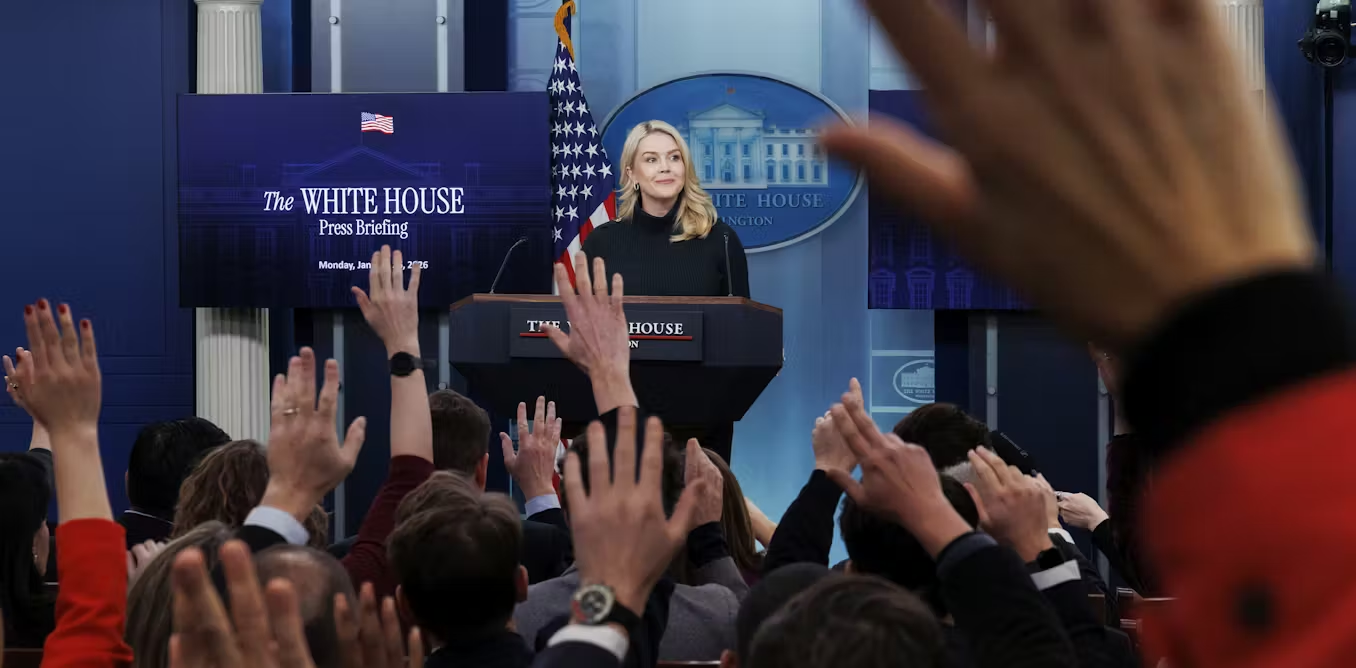
In his second term this hostility has intensified, its impact often obscured by the rapid pace of news emanating from the White House. We’re seeing press freedom in the US under attack on three distinct fronts: restricted access to information, threats to the safety of journalists and use of legal pressure to discourage dissenting voices.

Controlling the message

Restrictions began as soon as Trump was inaugurated for his second term in January 2025. Within a month, the Associated Press lost access to the Oval Office and Air Force One (in other words, to direct contact with the president) after refusing to adopt an executive order renaming the Gulf of Mexico the “Gulf of America”.

Accreditation rules soon tightened. In October, the newly minted secretary of war Pete Hegseth announced that henceforth journalists reporting from inside the Pentagon would be allowed to only report official government pronouncements. Many mainstream reporters handed back their Pentagon accreditation in protest. In response, Hegseth announced what he called the “next generation of the Pentagon press corps”, mainly comprising journalist from far-right outlets.

Meanwhile the president’s verbal attacks on journalists have escalated, particularly targeting women and especially women of colour. Incidents such as the “quiet Piggy” remark (directed at Bloomberg journalist Catherine Lucey) exemplify a broader pattern of public humiliation of female journalists. Research suggests that such conduct contributes to the normalisation of hostility toward female journalists, who were already disproportionately quitting journalism.

Advertisement

‘Quiet piggy’: Donald Trump targets a female reporter on Air Force One.

Journalists covering protests also face heightened risks. During the “no kings” demonstrations in October 2025, multiple incidents were reported in which police used force against accredited reporters. In November 2025 the White House escalated the pressure, launching a “Hall of Shame” site naming journalists and outlets it said had misrepresented the administration.

‘Lawfare’

The Trump administration has also brought considerable legal pressure to bear on the news media over the first year of its second term. The US president has filed multiple lawsuits alleging bias on the part of one or another media organisation that had attracted his disfavour.

In July, Paramount reached a US$16 million (£11.69 million) settlement over a 60 Minutes interview with Kamala Harris in 2024 that the president accused of bias. At stake was a US$8.4 billion merger that required approval from the Federal Communications Commission, a public body headed by Trump loyalist Brendan Carr.

Advertisement

The president also has active suits against the Wall Street Journal and the BBC (an episode which led to the resignation of director general, Tim Davie, and its head of news, Deborah Turness). By the middle of 2025, Axios reported that Trump-related media and defamation suits had already matched the annual historical record.


À lire aussi :
Why has the BBC’s director general resigned and what could happen next?


Democratic backsliding

Taken together, these developments reflect a broader pattern of institutional stress affecting US democratic structures. The pressure on these established media organisations has created a situation in which they manage to survive with their independence eroded.

Comparative research consistently demonstrates that journalists are among the first actors targeted in such processes because of their frontline work. Control over information remains central to the success of an authoritarian government.

Advertisement

What, then, should journalists and media organisations do? Standing together matters. We saw that in 2018, when about 350 American newspapers jointly defended press independence against Trump’s “fake news” attacks. This prompted the US Senate to adopt a resolution supporting a free press and declaring that “the press is not the enemy of the people”.

But the danger is that this structural violence against the news media and its attempt to hold power to account becomes normalised. If the Trump administration’s contempt for the fourth estate continues to percolate through to the public at large, a population already struggling to tell truth from lies will be further blindfolded and darkness will fall over American democracy.

Source link

Advertisement
Continue Reading
Click to comment

Leave a Reply

Your email address will not be published. Required fields are marked *

NewsBeat

Holiday tax would drive jump in cost of holidays in England, say industry bosses

Published

on

Holiday tax would drive jump in cost of holidays in England, say industry bosses

“For many, this tax will make their holiday unaffordable, meaning families will shorten trips, forgo a break altogether, reduce their spending with pubs, restaurants, events, leisure activities and local attractions, or travel overseas – spending their money and creating jobs elsewhere.”

Source link

Continue Reading

NewsBeat

‘Unique’ thriller leaving fans ‘questioning own sanity’ is a must-watch

Published

on

Daily Mirror

Downton Abbey’s Dan Stevens stars in a very different series that has been highly praised by fans

Superhero enthusiasts are set for a treat as a thriller dubbed a “visual masterpiece” is currently available to stream.

Advertisement

The series, which first broadcast in 2017, features Downton Abbey star Dan Stevens as David Haller, a mutant who received a schizophrenia diagnosis during childhood.

Whilst attempting to manage his psychic abilities, he must battle sinister forces seeking to control him.

The programme in question is Legion, adapted from the Marvel Comics character of the same name.

All three seasons of Legion received critical acclaim, with reviewers praising the show’s experimental visual aesthetic and distinctive take on the superhero genre.

Advertisement

Filmmaker Noah Hawley developed an interest in Legion due to his own mental health struggles and was determined to portray the character’s unique perspective on screen.

The review aggregation website Rotten Tomatoes reported a 90 per cent approval rating for the first season, with Ben Travers from IndieWire describing it as “the most intricate, intimate superhero story to date”.

Viewers also flocked to IMDb reviews to express their opinions on the series, which is now streaming on Amazon Prime Video and Disney Plus.

Advertisement

Get Disney+ from £5.99

This article contains affiliate links, we will receive a commission on any sales we generate from it. Learn more
Content Image

£5.99

Disney+

Get Disney+ here

A Disney+ subscription is now available from £5.99 per month, offering hit shows like Andor, The Bear and Alien: Earth, plus countless titles from Star Wars and Marvel.

Sublimeintentions praised it as “one of the best series ever made”, continuing: “A visual masterpiece and an incredibly compelling narrative. It’s a hallucinogenic mind trip that you’ll remember.”

Advertisement

Zachary-10857 enthused: “I rarely ever give higher than a nine and this show deserves the rare award of a 10 from me. I mean, this show is everything I want in a show. Forget that it’s Marvel or superhero-based. It feels nothing like a regular superhero show we know. It throws that formula out of the water. Off a bridge. Hell, it is so different than any show for that matter.”

He continued: “The visuals, cinematography – 10/10 – Some of the most impressive visuals in any tv show ever. Real eye candy.”

Glormmartin chimed in: “This is a very different show. It’s unique, well-acted and the pacing is great. The writing and story development is intelligent and sophisticated.”

Advertisement

He added: “You’re not spoon-fed, but required to think about what plays out and motivated to discover the depths of the characters. A fun ride and worth the watch! Wish there was more quality programming like this.”

Itschris-48462 shared his thoughts: “I’m now beginning to question my own sanity! This show is absolute brilliance, the creators should be proud.”

He elaborated: “It’s fresh, fun and so on the edge of ‘What the heck is going on?’ Yet I don’t get completely lost, a feat not easy to pull off in film, I’m sure. The layers, the sets, the music, the acting, the craziness, brilliant!”

Legion can be streamed on Amazon Prime Video and Disney Plus.

Advertisement

**For the latest showbiz, TV, movie and streaming news, go to the new Everything Gossip website**

Source link

Continue Reading

NewsBeat

Latest vetting row raises fresh concerns over Starmer’s judgement

Published

on

Latest vetting row raises fresh concerns over Starmer's judgement

Tim Allan, who was in charge of Sir Keir Starmer’s communications until he resigned on Monday, has issued a statement, first published by The Times, in which he says he spoke to Lord Matthew Doyle about his connections to a sex offender before the now peer was offered seat in the Upper House.

Source link

Continue Reading

NewsBeat

UK weather: Snow and ice warnings issued after relentless rain and flooding

Published

on

Picture of an open farm gate with a quad bike pulling a trailer of hay.  Sheepdog is sitting on quad bike, made to look like it is the driver.  Snow covers the ground and fields around.

After relentless wet and gloomy conditions, wintry weather is set to return to parts of the UK with snow and ice in the forecast for many.

Arctic air will accompany the change in conditions, dropping temperatures as many as six degrees below average.

The Met Office has issued yellow warnings for snow and ice across Scotland and northern England from 16:00 GMT Thursday to 12:00 Friday.

Rain will fall as snow initially over higher ground before reaching to lower levels through Thursday night.

Advertisement

Settling snow will mostly be seen above 200m with as much as 10cm possible.

The rain and snow are expected to clear south during the early hours of Friday, though temperatures will fall quickly to around 3 to 6C below the average.

This will lead to ice on untreated surfaces and dangerous road conditions in some places.

Source link

Advertisement
Continue Reading

NewsBeat

how hormone therapy could help protect against Alzheimer’s

Published

on

how hormone therapy could help protect against Alzheimer’s

As dementia and other neurodegenerative diseases become more common worldwide, researchers are searching urgently for ways to protect the brain as we age. One area attracting growing attention is hormones, particularly the role of hormone therapy during and after menopause.

This interest is partly driven by the fact that women develop Alzheimer’s disease more often than men, especially after midlife, suggesting that hormonal changes around menopause may influence long-term brain health.

Our research has focused on tibolone, a synthetic form of hormone therapy prescribed to relieve menopausal symptoms such as hot flashes and poor sleep. While it is commonly prescribed to ease menopausal symptoms, our findings suggest tibolone may also offer important protection for the brain.

In laboratory studies, tibolone helped brain cells survive under stressful conditions. These included reduced glucose use (glucose is the brain’s main fuel) and the build-up of saturated fats such as palmitic acid, which is often higher in people with obesity. Both reduced glucose use and excess saturated fat are known risk factors for cognitive decline and neurological diseases.

Advertisement

Tibolone appears to protect brain cells in several ways. It activates protective proteins, reduces inflammation and limits damage from free radicals. Free radicals are unstable molecules produced during normal energy production or when the body is exposed to pollution or cigarette smoke. They behave like tiny sparks inside cells, damaging structures unless neutralised.

Why women are at higher risk

Alzheimer’s disease affects women far more than men, by roughly three to one. Even after accounting for women’s longer life expectancy, their risk remains around 12% higher.

This gap likely reflects a combination of genetic, hormonal and social factors. Certain genes, including the APOE ε4 variant, a version of a gene linked to how the brain processes fats and clears harmful proteins, are associated with a higher risk of Alzheimer’s. Other genes on the second X chromosome may also contribute. Differences in reproductive history, number of pregnancies and access to education and healthcare also play a role, because these factors influence lifelong brain health, cardiovascular risk and how early cognitive problems are detected and treated.

Advertisement

However, hormonal changes around menopause appear to be especially important. When menstruation ends, levels of estradiol (the main form of oestrogen) fall sharply, while follicle-stimulating hormone rises. Both changes are linked to cognitive decline and Alzheimer’s disease.

Many women experience the everyday effects of these shifts: forgetfulness, difficulty concentrating, slower thinking, low mood, poor sleep and reduced motivation. Estradiol normally helps brain cells use energy efficiently. When levels drop, the brain uses glucose less effectively, producing a metabolic pattern similar to that seen in early Alzheimer’s.


À lire aussi :
Horrific, bizarre, lonely: how women going through the menopause describe their experiences


Estradiol also helps regulate fat distribution and cholesterol. When it declines, women often gain visceral fat around the abdomen. This type of fat releases inflammatory chemicals that can damage blood vessels and the brain. The loss of estradiol’s natural anti-inflammatory effects further increases the risk of metabolic syndrome (a cluster of conditions including high blood pressure and insulin resistance), cognitive decline and dementia.

Advertisement

Can hormone therapy help?

These findings have led researchers to ask whether hormone therapy might offset some of this risk.

Hormone therapy usually combines oestrogen and progesterone and is widely prescribed to relieve hot flashes, insomnia and mood changes. It can also improve mood and reduce depression, which indirectly supports cognitive health.

Until the early 2000s, millions of women used hormone therapy and reported benefits. Then, in 2002, the Women’s Health Initiative (WHI) trial reported a higher risk of breast cancer and cardiovascular events in women taking combined hormones. Headlines warning that hormone therapy “increases cancer risk” led many women to stop treatment or avoid it altogether.


À lire aussi :
Busting brain myths: The evolving story of menopause hormone therapy and cognitive health

Advertisement

The WHI memory studies also found that starting hormone therapy at age 65 or older did not protect cognition and was linked to a higher risk of dementia. Later analyses revealed an important nuance: timing matters.

Lower lifetime exposure to oestrogen is linked to faster cognitive decline and greater build-up of Alzheimer’s-related changes in the brain. Women who enter menopause early (before about age 45 to 50) face higher risks of Alzheimer’s and more pronounced memory loss. Surgical menopause, caused by removal of both ovaries, leads to a sudden drop in oestrogen and can trigger noticeable problems with memory and attention, particularly in younger women.

Growing awareness of the link between menopause and brain health is beginning to shape public policy.

Advertisement

In a landmark move, Ireland introduced a programme in June 2025 providing hormone therapy free of charge. Removing cost barriers allows women to start treatment earlier and continue it consistently, conditions that may maximise its benefits.

Elsewhere in Europe, access varies. In England, women who do not qualify for free NHS prescriptions can purchase an annual hormone therapy prepayment certificate for £19.80. Prescriptions are free in Scotland, Wales and Northern Ireland, while France and Spain partially reimburse costs through national insurance.


À lire aussi :
Menopause: our study revealed how it affects the brain, cognition and mental health


Given tibolone’s protective profile, reducing financial barriers could improve access and support larger clinical trials to test its effects on brain health.

Advertisement

Hormone therapy is not a guaranteed way to prevent dementia. The strongest protection still comes from a broad approach: managing menopausal symptoms effectively, possibly with hormone therapy, while also controlling blood pressure, cholesterol and diabetes, staying physically active, sleeping well and avoiding smoking.

Women face a higher lifetime risk of Alzheimer’s because of intertwined genetic, hormonal and social factors. Hormone therapy, particularly when started around menopause, may help protect cognitive function as well as relieve symptoms. Alongside a healthy lifestyle, it offers one promising tool for supporting brain health and narrowing the gender gap in dementia risk.

Source link

Advertisement
Continue Reading

NewsBeat

Locals say Cambridgeshire high street is ‘essentially dying’ amid major regeneration

Published

on

Cambridgeshire Live

One local man said March is “the most marvellous town anyone could live in”

Residents in a Cambridgeshire town have mixed views when it comes to the state of their high street. As shop closures hit March High Street like many others in the country, some say the town is “dying” while others say the town is “the most marvellous anyone could live in”.

Advertisement

March has seen a few business closures over the last few years for various reasons, including Clarks shoe shop and Tesco Express which closed in 2024. Meanwhile, a multi-million pound regeneration project has been taking place to spruce up the town centre.

This project includes works on the Market Place, with new paving, a Broad Street transformation which began in 2023, and more recently a new toilet block expected by April 2026 in the town centre. CambridgeshireLive visited the town to find out what residents think about the high street amid the regeneration works.

Barrie Crawford, 76, has lived in March since he was a child. He said: “They have done a good job with the regeneration.”

However, he said he believes that “with online shopping, they ought to turn them [closing businesses] into houses and flats instead of more shops that aren’t going to do well”.

Advertisement

Kyrie Calderbank, 37, from Chatteris, is looking to move to March. She said that the town reminds her of Chorley, in Lancashire, where she previously lived. She is looking to move to March because of the ideal transport links and things to do. She also said that the town offers opportunities for children.

Kyrie said: “The high street is dying essentially,” but added “I love the charity shops, I always have and that’s the most consistent”.

Another resident, Sandra Cumbridge, 79, who has lived in March all her life, said: “It used to be a lovely town when I was growing up, lovely, and now just horrendous,” adding “we have no good shops”.

Advertisement

Susana Sanchez, 40, has been living in March for over two years. She said: “Everything is online, for shops, for clothing, for shoes, everything is better to buy online.” She believes this may be “the main reason shops are closing”.

Susana explained how she believes renting a local place in March is “expensive, so they [businesses] cannot cope” but emphasised that she still enjoys and spends time in the town.

While Susana is a relative newcomer to the town, Peter Jackman, 95, who has lived in March his whole life, says he thinks it is “the most marvellous town anyone could live in”, and that “compared to other towns, we are very lucky.”

Peter added: “We have got a wonderful park, a wonderful town centre, and the atmosphere and friendship in March is wonderful.”

Advertisement

Elizabeth, who did not wish to share her full name, said: “I love the coffee shops. Sadly, the shops have all gone so we have no place to shop, but they have made the town so welcoming.”

Source link

Continue Reading

NewsBeat

Man pushing baby in pram battered by yobs in vicious street attack

Published

on

Daily Record

The horror incident unfolded outside Broomie Brunch on Broomfield Road in Barmulloch, Glasgow.

Man pushing pram assaulted in street

A man walking with a baby in a pram has been viciously attacked by two yobs in Glasgow.

The horror incident unfolded outside Broomie Brunch on Broomfield Road in Barmulloch at around 11.40am on Tuesday.

In a CCTV clip, the man can be seen slowly walking past the breakfast takeaway shop with the pram.

Two men, dressed all in black, then appear as they walk around the corner towards him. There is a short discussion before one of the thugs begins throwing punches and grabbing the man as he holds onto the pram.

Advertisement

The brute continues to lay blows into the victim as the pram can be seen rocking back and forth during the rammy. Dozens of punches are thrown before the victim eventually hits the floor.

The yobs continue the brutal attack as the pram rolls a short distance down the car park while the man is kicked on the ground. A man on an e-scooter could be seen passing by in the clip as two bystanders watched on from the car park area.

One of the eyewitnesses, who was dressed all in grey, eventually appeared to try to stop the attack before he is pushed away by the thugs. As the sickening clip comes to an end, the man is booted in the head.

It’s believed that there was a baby in the pram at the time of the attack and local residents were left horrified by the incident.

One person said: “The guy was out with his newborn in a pram when he got attacked. It’s horrible. The video has been circulated around. I think its terrible doing that to someone with a newborn in the pram.”

Another added: “Two people assaulted a man pushing a baby in a pram. It is a shocking, distressing video – especially someone pushing a pram.”

Advertisement

Officers from Police Scotland have since confirmed that one man was issued with a recorded police warning following the incident. It is not known what sparked the brutal attack, but it’s understood the man did not suffer any serious injuries as a result.

A Police Scotland spokesperson said: “Around 11.40am on Tuesday, February 10, 2026, we received a report of an assault on Broomfield Road, Glasgow. There were no reported injuries. One man was issued with a recorded police warning.”

The incident comes following a number of horrifying attacks across the country in recent days. Shortly after 7pm on Tuesday, a man was rushed to hospital after being stabbed on a footpath in Clackmannanshire.

Advertisement

Emergency services were called to Holton Crescent in Sauchie, near Alloa, following reports that a 63-year-old man had been stabbed. Ambulance crews attended and the man was taken to Forth Valley Royal Hospital for treatment. His injuries are described as “serious”.

Meanwhile, in Perth, a man was taken to hospital following an alleged stabbing on a street in the city. Emergency services were called to Canal Street after receiving reports of a serious assault at 2.15pm on Sunday, February 8. Crews attended and a 52-year-old man was found injured.

He was raced to Ninewells University Hospital in Dundee for treatment, where his current condition is unknown. A 37-year-old man and a 40-year-old woman have since been arrested and charged in connection.

Advertisement

Source link

Continue Reading

NewsBeat

Constance Marten says social services gave ‘ultimatums’ not ‘true assistance’

Published

on

Constance Marten says social services gave ‘ultimatums’ not ‘true assistance’

Marten and Gordon, who had five children together, four of whom were removed into care before Victoria’s birth, noted the couple’s “persistent reluctance to engage” with authorities, having moved around the country between 2017 and 2023, “with each move coinciding with escalating safeguarding concerns”.

Source link

Continue Reading

NewsBeat

Met Office issues snow and ice weather warnings near Bolton

Published

on

Met Office issues snow and ice weather warnings near Bolton

The Met Office has issued the yellow weather warning indicating snow and ice on Thursday 12 and Friday 13 of February.

Although not covering Bolton specifically, the warning indicates there may be snow and ice in several surrounding areas, such as Bury and much of Manchester.

The temperature in Bolton is expected to reach around one degree on Thursday, before falling on Friday to minus two.

Advertisement

A Met Office spokesperson said: “Outbreaks of rain will fall as snow over higher hills initially, before the snow starts to fall to lower levels through Thursday evening.

“The rain and snow are expected to clear south during the early hours of Friday, with temperatures expected to fall quickly as skies clear, leading to ice on untreated surfaces.”

Motorists travelling into Bolton from affected areas should be careful on the roads, which may be slippery due to ice and snow.

Drivers travelling out of Bolton should also be aware that the areas they are driving into may be in worse condition than where their journeys began.

Advertisement

Provisions such as warm clothing, ice scrapers, de-icer, hi-vis jackets, and emergency gear should be considered.

Source link

Advertisement
Continue Reading

NewsBeat

One taken to hospital after A1(M) crash near Darlington

Published

on

One taken to hospital after A1(M) crash near Darlington

Emergency services were called to a single-vehicle collision on the southbound carriageway between Junction 58 (A68, Burtree) and Junction 57 (A66(M), Darlington) at around 11.50am.

The North East Ambulance Service (NEAS) confirmed it dispatched an ambulance and a rapid response paramedic to the scene.

Traffic on the A1(M) on Wednesday (February 11) (Image: NORTHERN ECHO)

A spokesperson said: “We were called to a one vehicle road traffic incident at 11.50am on February 11.

“We dispatched a double-crewed ambulance and a rapid response paramedic.

Advertisement

“One patient was taken to Darlington Memorial Hospital.”


National Highways said traffic was initially stopped while emergency services dealt with the incident.

A spokesperson for National Highways said: “This was a single-vehicle collision. The lane closure was put in place to facilitate recovery of the vehicle and to clear mud and debris created by the incident.”

At its peak, there were around three to three-and-a-half miles of congestion on the approach, with traffic reported to be slow-moving throughout the early afternoon.

Advertisement

Images from the scene show slow-moving traffic stuck southbound, which saw cars stuck in both lanes of the A-road.

Source link

Advertisement
Continue Reading

Trending

Copyright © 2025