Connect with us

NewsBeat

The unassuming Cambridge cafe where laptops and phones are banned

Published

on

Cambridgeshire Live

It has received rave reviews from customers

A hidden gem in Cambridge offers the opposite of modern hospitality and transports customers back to a time where only cash was accepted and devices weren’t used.

Advertisement

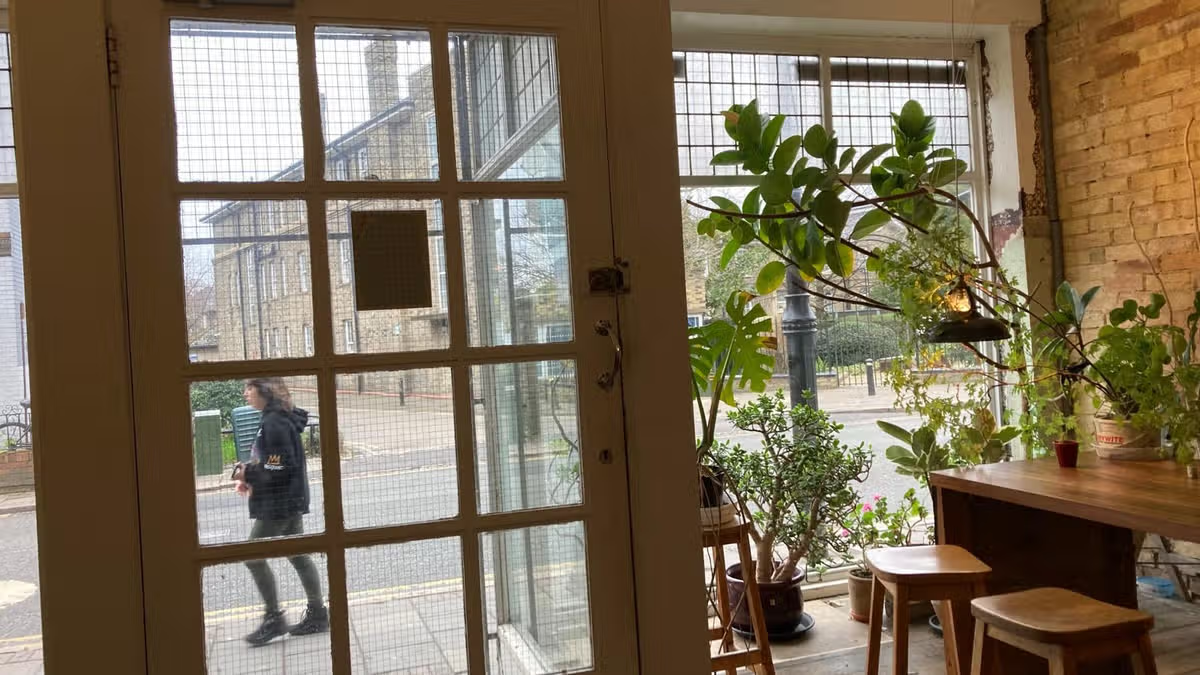
Dom’s Coffee on Mill Road is hidden in plain sight in a spot which hundreds of people walk past every day not knowing of its existence. There are no signs outside, and you’d be forgiven for thinking it’s a plant shop with all the different plants in the window.

Inside, the quaint shop has basic decor along with its many plants. No laptops or phones are allowed to be used inside, so that people can be present in the moment and enjoy their drinks.

It’s a cash only cafe, and operates on a ‘trust bowl’ payment system. Whilst your drink is being made, you pay for it by placing your money in the bowl of coins and notes, taking out any change that you need.

Dom’s Coffee has been raved about in reviews and has managed to attain an almost perfect rating of 4.9 stars out of five on Google.

Advertisement

One person wrote on Google: “Really cute place, the plants are wild and it’s very homely and comfortable inside. No devices are permitted in the café which is a very cute idea, definitely keeps you in the moment and allows you to appreciate the coffee and take in the relaxed vibe.

“The coffee was perfect. Do bring cash though, they do not take card payments- I’m assuming as part of the analogue experience. The owner was friendly and a kind person.”

Another pleased customer said: “Believe the hype! More than just coffee, a friendly escape where there are no phones used or photos taken, just enjoy the coffee and chat.

Advertisement

“Had a delicious espresso and chatted about coffee and travels. Loved watching the preparation of the various coffees.”

Source link

Continue Reading
Click to comment

You must be logged in to post a comment Login

Leave a Reply

NewsBeat

Man charged with murder after Irish mum-of-three found dead in Australia

Published

on

Daily Mirror

Annmarie O’Reilly, 30, originally from Clonmel in Co Tipperary, died after being found injured at her home in Ferntree Gully, a Melbourne suburb in Victoria, Australia

A man has been charged with murder in Australia after an Irish mum-of-three was found fatally injured at her home in a Melbourne suburb.

Annmarie O’Reilly, 30, who was originally from Clonmel in Co Tipperary, was found in a critical condition by emergency services at a property in Ferntree Gully on Friday morning local time.

Paramedics tried to save Ms O’Reilly, but she was pronounced dead at the scene a short time later, the Irish Mirror reports.

Advertisement

Patrick Stokes, 45, who is understood to have known Ms O’Reilly, was arrested nearby later that day and taken into custody. Stokes, who is reported to be from Ireland, was charged with one count of murder on Saturday, Victoria Police said.

Ms O’Reilly’s brother, Jimmy O’Reilly, paid tribute to her in a post on Facebook. “Rest in peace to my beautiful sister Annmarie, the nicest woman you’d meet, the best mother to her kids,” he wrote. “May you get the best bed in heaven … love you so much.”

Stokes appeared before Melbourne Magistrates’ Court and was remanded in custody to appear again on February 23, 2027.

Advertisement

In a statement, Victoria Police said: “Homicide Squad detectives have charged a man with murder after a woman was located deceased inside a residential property in Ferntree Gully yesterday morning.

“Emergency services were called to the residence on Ferntree Gully Road just before 10am on 21 August and located an injured woman.

“Despite efforts to revive the 30-year-old Ferntree Gully woman, she was declared deceased at the scene. A 45-year-old Ferntree Gully man was arrested nearby and taken into custody. The man has since been charged with one count of murder.

“He appeared at Melbourne Magistrates’ Court this evening via audio visual link where he was remanded in custody to appear on 23 February 2027. It is alleged the parties were known to each other.”

Advertisement

The Irish Department of Foreign Affairs said it is aware of the death of an Irish woman and is providing consular assistance.

Source link

Continue Reading

NewsBeat

Funerals of two killed in M9 horror crash to be held as teens laid to rest

Published

on

Belfast Live

Five teenage boys died following a collision on the M9 after the vehicle they were travelling in struck a family heading to Dublin Airport in the early hours of Sunday, August 16

The funerals of two young victims of the devastating M9 crash last weekend are set to take place.

Five teenage boys lost their lives after a high-powered BMW they were travelling in drove the wrong way along the M9, colliding with a family en route to Dublin Airport in the early hours of Sunday, August 16.

The BMW is believed to have been travelling at speeds exceeding 120km/h (75mph) when it struck the Hyundai near Junction 3 of the M9 in Co Kildare at approximately 3am.

Advertisement

Four individuals travelling in the Hyundai – sisters Niamh and Alma Kinsella and Ella Hendricken, along with a young boy – suffered catastrophic injuries and continue to receive hospital treatment.

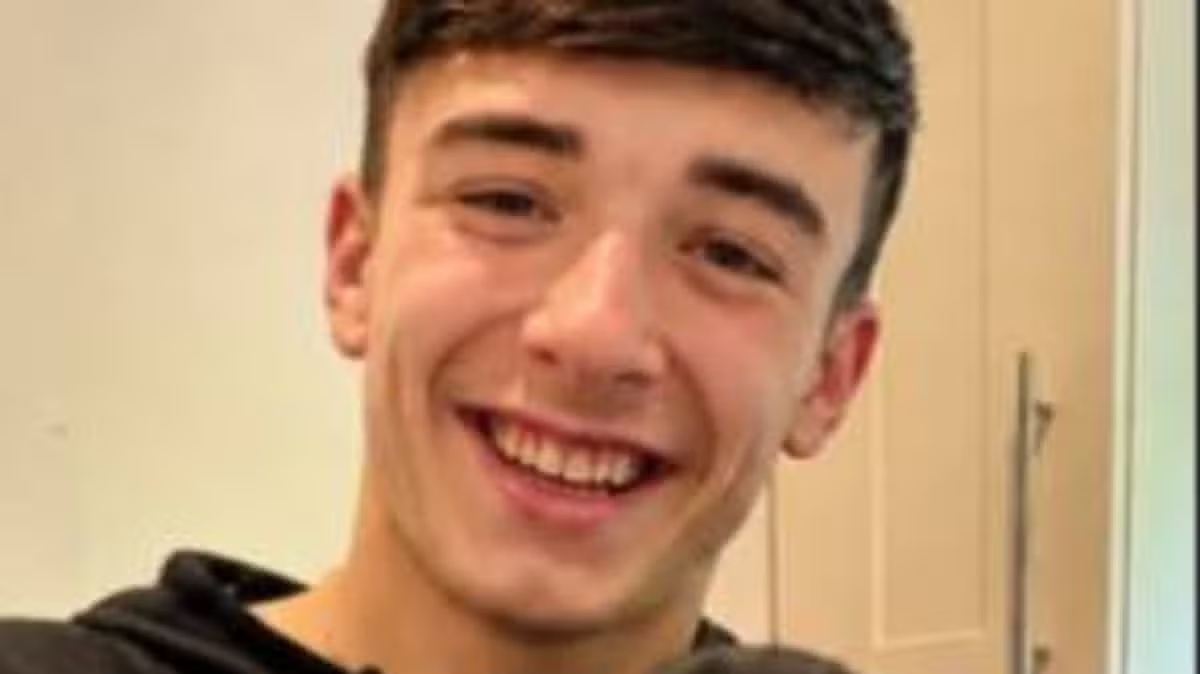
Jeremy O’Brien, 18, from Carlow, Alex McCarthy, 16, from Carlow, Joey Carthy, 15, from Athy, Kildare, Jack Kennedy, 17, also from Athy, and Kamil Pustkowski, 17, from Limerick, all lost their lives in the collision, reports the Irish Mirror.

Three of the teenagers have already been laid to rest, with 15-year-old Joe Carthy becoming the first of the five to be buried on Friday.

Advertisement

His funeral was held at St Michael’s Church in Athy just before 11.30am, while Alex McCarthy’s service took place in Askea, Carlow, on Friday afternoon.

A small gathering of mourners also assembled in Limerick on Friday to pay their final respects to Kamil Pustkowski, who lay in repose at a local funeral home before a cremation ceremony was held.

A funeral mass for Jeremy ‘Bobbles’ O’Brien will be held on Monday at 11am at the Church of the Holy Family, Askea, followed by burial at St. Mary’s Cemetery, Carlow.

Jack Kennedy’s funeral mass will take place on Tuesday at 11am at St. Michael’s Parish Church, Athy, ahead of a private cremation later that afternoon.

Advertisement

Want to see more of the stories you love from Belfast Live? Making us your preferred source on Google means you’ll get more of our exclusives… To add Belfast Live as a preferred source, simply click here.

Source link

Continue Reading

NewsBeat

DUNCAN BARKES: Music Matters: Calling all soul brothers and sisters!

Published

on

DUNCAN BARKES: Music Matters: Calling all soul brothers and sisters!

Soul and R&B legends The Drifters play Portsmouth Guildhall on 26 September. The band was originally created in 1953 by George Treadwell and Clyde McPhatter. George managed the group which saw them begin a career that spawned many chart hits throughout the 1950s, 1960s and 1970s on both sides of the Atlantic.

Source link

Continue Reading

NewsBeat

Motorcyclist who lost leg when his Harley-Davidson flipped in the air as firetruck hit him wins staggering $28m payout

Published

on

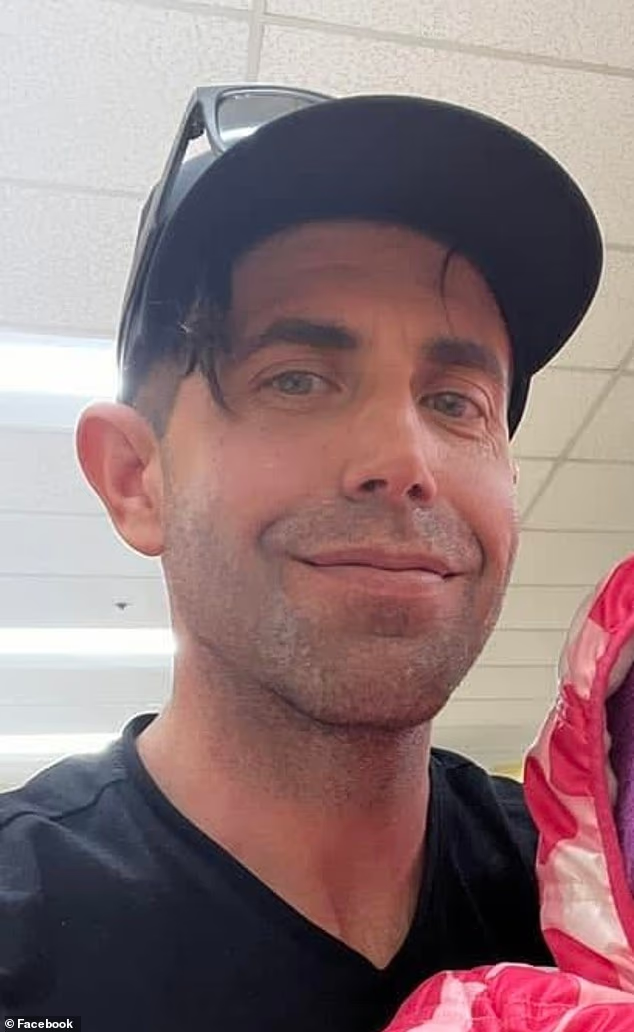
Sitting on his 2005 Harley Roadster, Danbom was proceeding through a green light when, according to his lawsuit, he had just moments to react before the devastating crash

A motorcyclist who lost his leg after he was crushed by a firetruck in Los Angeles was awarded an astonishing $28 million.

Robert Danbom was headed through an intersection in East Hollywood on September 2, 2021, when firefighters in a 65,000-pound truck were traveling across it.

Sitting on his 2005 Harley Roadster, Danbom was proceeding through a green light when, according to his lawsuit, he had just moments to react before the devastating crash, the Los Angeles Times reported.

The bike flew into the air while he was crushed beneath the truck’s wheels.

Advertisement

According to the outlet, he dislocated his shoulder, and his leg was so badly damaged that it later had to be amputated below the knee.

The lawsuit claimed that the first responders failed to stop and check for cross traffic.

‘LAFD’s massive fire tender failed to follow basic safety standards by failing to stop, or even slow, the massive vehicle before entering a very busy intersection,’ the lawsuit alleged.

At the time of the crash, the firetruck was en route to Kaiser Permanente in response to a call that was later determined to be a false alarm.

Advertisement

Sitting on his 2005 Harley Roadster, Danbom was proceeding through a green light when, according to his lawsuit, he had just moments to react before the devastating crash

Robert Danbom won $28 million after he was crushed by a firetruck while headed through an intersection in East Hollywood on September 2, 2021. The accident left this leg so disfigured it needed to be amputated from the knee down

Robert Danbom won $28 million after he was crushed by a firetruck while headed through an intersection in East Hollywood on September 2, 2021. The accident left this leg so disfigured it needed to be amputated from the knee down 

Advertisement

Filippo Marchino, Danbom’s attorney, said he believed the $28 million payout was the largest ever awarded in a case involving a below-the-knee amputation.

However, Marchino criticized the city attorney’s office and claimed his client would have been satisfied with half that amount.

‘But there was zero engagement with the city attorney’s office,’ the attorney told the outlet.

‘These people don’t realize it’s not their money, it’s the city’s money, it’s the taxpayers’ money. It’s offensive because cases like ours could have been settled for significantly less than what the verdict is.’

Advertisement

Footage uploaded to YouTube by Marchino appeared to have been captured by a surveillance camera on the day of the accident.

The video appeared to show the firetruck entering the intersection without stopping moments before Danbom was seen sliding beneath the vehicle.

LAFD Apparatus Operator Vincent Leong claimed the truck stopped at the intersection and made sure it was clear before proceeding, according to a transcript of an interview from the scene cited by the outlet.

Filippo Marchino, Danbom's attorney, said that the defendants maintained that they stopped before entering the intersection (Stock Image)

Filippo Marchino, Danbom’s attorney, said that the defendants maintained that they stopped before entering the intersection (Stock Image)

Advertisement
LAFD Apparatus Operator Vincent Leong claimed the truck stopped at the intersection and made sure it was clear before proceeding, according to a transcript of an interview from the scene cited by the Los Angeles Times (Stock Image)

LAFD Apparatus Operator Vincent Leong claimed the truck stopped at the intersection and made sure it was clear before proceeding, according to a transcript of an interview from the scene cited by the Los Angeles Times (Stock Image) 

 ‘This is a blind intersection, you know, so I slowed down,’ he said, according to the transcript, which was later presented as evidence in court.

‘I started creeping forward. … I didn’t see anybody.’

Advertisement

Marchino told the outlet that the defendants maintained that position throughout the trial.

‘If you sat through our trial, you’d be like, ‘These guys are high,’ Marchino said. ‘They kept saying, ‘They stopped,’ and we had video showing they didn’t stop.’

Los Angeles settlement and jury-verdict payouts have spiked by more than 350 percent over the past decade, rising from nearly $64 million to $289 million last year, according to the outlet.

The Daily Mail has reached out to the Los Angeles Fire Department for comment.  

Advertisement

Source link

Continue Reading

NewsBeat

What was YOUR best holiday ever? We share the trips people say they’ve loved most, from a 1980s Pontin’s break to an Arctic adventure – and one family’s emotional journey into their past

Published

on

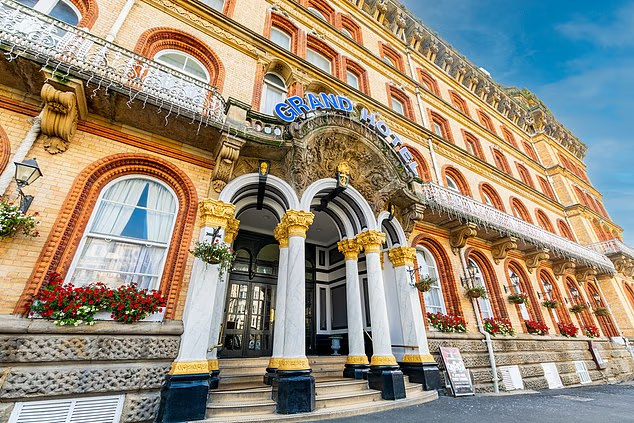
Recent reviews of The Grand in Scarborough have been less than glowing – but Marti Stelling visited in the property's erstwhile heyday

What makes the perfect holiday? A glossy travel company might tell you it’s five-star facilities, personalised service and a Michelin-starred banquet every night. 

For most of us though, the most memorable holidays are a delicate balance of lots of things – and often it’s definitely not about how much your getaway has cost. 

If you’re with the right group of family or friends, then a £15-a-night camping trip can be heaven on earth. Childhood holidays stay etched in our memories, possibly glorified by nostalgia, in a way that many trips in adulthood don’t. 

Likewise with coming-of-age travel, taking on a big adventure in a foreign destination can be truly transformative.   

Advertisement

We’d love to hear about your ‘best holiday ever’. Here, we asked Daily Mail writers and those who work in the travel industry to recall their favourite trips and tell us why they meant so much…

A seaside grand dame 

Recent reviews of The Grand in Scarborough have been less than glowing – but Marti Stelling visited in the property’s erstwhile heyday

My most memorable holiday was when we stayed in one of the iconic Victorian turrets of the Grand Hotel in Scarborough around 2011, when I was ten. They once housed original water towers and are set high above the historic building on Saint Nicholas Cliff. 

Advertisement

I used to love getting the little tram up the hill to the hotel and the huge round windows, offering panoramic views of the South Bay promenade. While I’ve stayed at much ‘posher’ hotels since, I still remember it as one of my favourite – and most memorable – holidays. 

Marti Stelling, Health Writer 

A real-life Who Do You Think You Are? in snowy Latvia 

Erin Waks took her grandmother Marlene (known as 'Moen') on a journey of discovery to trace her family roots in Riga, Latvia earlier this year

Erin Waks took her grandmother Marlene (known as ‘Moen’) on a journey of discovery to trace her family roots in Riga, Latvia earlier this year

Erin and Moen went on the trail of finding out more about Vera Trembatzki, Erin's great-grandmother, who grew up in Riga

Erin and Moen went on the trail of finding out more about Vera Trembatzki, Erin’s great-grandmother, who grew up in Riga

Advertisement

No trip could come close to the adventure I took with my granny in January of this year to Latvia. 

Spurred on by a DNA test confirming my ancestral roots hail from this part of the world, I convinced my 80-year-old grandmother to embark on an adventure back in time, tracing our family back more than 100 years across the Baltic state.

In line with the rising trend of heritage travel, we attempted to learn more about where our ancestors came from. 

My family, of Jewish eastern European origins, fled to South Africa before the Second World War, largely evading the Nazis. 

Advertisement

Family memories were at best hazy for her, and photographic evidence and information anecdotal at best, so attempting to find even a whiff of our ancestors was a real challenge.

But we managed to find the apartment in which her mother, my great-grandmother, grew up, as well as a cemetery with the graves of her predecessors.

The most off-beat trip of my life, yes – a far cry from the beach and city break holidays I usually favour – but my granny and I both agreed the opportunity for us to travel alone together would never arise again. That, coupled with the intense significance of the trip, means it is the one I will never forget. 

Erin Waks, Travel Writer 

Advertisement

Read the full account of Erin’s trip here   

No menu, no matter in Crete 

Greece is the word: A childhood trip to Greece proved truly memorable for Poppy Atkinson-Gibson

Greece is the word: A childhood trip to Greece proved truly memorable for Poppy Atkinson-Gibson

Join the discussion

What’s YOUR best holiday ever? Tell us!

Advertisement

The best holiday I ever went on was in the summer of 2008 – my first holiday abroad. We went to Crete to visit my grandad, who’d recently moved out there. I remember the intense heat hitting as we disembarked the plane and the spectacular coastal views as we drove to his house. 

In the mountains, we tasted fresh honey and I remember eating at a small taverna where no English was spoken but it didn’t matter. 

Instead of a menu, we were beckoned into a kitchen and shown the various pots bubbling away. Water was handed to us in a jug, filled up from a fresh spring running down the side of the road.

In the shade of a terrace, hundreds of feet above sea level, I felt such a sense of adventure as we feasted on what was delivered to our table… amazing gigantes beans in tomato sauce, lamb chops, green beans and great dollops of tzatziki and bread.

Advertisement

Poppy Atkinson-Gibson, Features Writer

Sign me up for the Crocodile Club 

Pontin's forever: The holiday brand rivalled Butlin's in the 1980s...with its Crocodile Club a funhouse for young tourists

Pontin’s forever: The holiday brand rivalled Butlin’s in the 1980s…with its Crocodile Club a funhouse for young tourists  

I remember vividly the moment one of the Bluecoats (Pontin’s answer to Butlin’s Redcoats) uttered the words to the 50 or so children sat on the dancefloor before him: ‘And for the last prize of the day, the first person to hand me anything white gets a t-shirt.’ 

In slow motion, I glanced down at my feet, ripped the white plastic sandal from my foot and lobbed it forwards with all the force of an Olympic shot putter. It hit him on the shoulder and I walked away with the prize.

Advertisement

Clearly in my Hi-de-Hi era, a week at this, sadly long gone, Pontins South Devon Holiday Camp in Paignton, was bliss. 

It was the late 80s, I was about seven, and I spent the week as an enthusiastic member of the Crocodile Club kids’ club, lapping up everything from badminton tournaments to disco dancing competitions. I ate Devon fudge at breakfast too. 

Thrillingly for my dad, ex World Snooker champion Ray Reardon, who I’d never heard of and who famously looked like Dracula, even made an appearance, showing off trick shots. 

There’s been holidays of every kind since, almost all of them more expensive and adventurous, but for a week’s out-and-out holiday joy, that one’s still hard to top. 

Advertisement

Jo Tweedy, Travel Writer 

‘Ice caps the size of cathedrals’: A spontaneous trip to the frozen north

A photo taken by Daily Mail producer Emily Cooper during a trip to Arctic archipelago Svalbard

A photo taken by Daily Mail producer Emily Cooper during a trip to Arctic archipelago Svalbard

Deafening silence of nature: Emily describes Svalbard as 'the most unique holiday destination I have ever been to'

Deafening silence of nature: Emily describes Svalbard as ‘the most unique holiday destination I have ever been to’

Having studied geography at university, I was well acquainted with Svalbard – the world’s northernmost settlement and home to the Global Seed Vault – but I had never considered going on holiday there. 

Advertisement

When my partner and I were planning a holiday to Norway, we soon realised that flights from Oslo to Longyearbyen were relatively cheap so, at the last minute, we changed our itinerary to include Svalbard – and it ended up being the most extraordinary place we have ever been.

Svalbard itself is small and worth only a few hours of exploration, with the highlight being the free-roaming reindeer that graze on whatever grass they can find. But it’s what lies just beyond the town limits that made this trip so spectacular – although you are cautioned not to wander far without a firearm in case you run into a polar bear.

To venture beyond Svalbard safely, we opted for dogsledding. After meeting the huskies at the kennel, we were immediately told to take the reins (literally). 

Driving the dogs was easy and we only had to travel for five minutes before we lost all signs of human influence. We were surrounded entirely by mountains and snow. It was beautiful and so, so quiet.

Advertisement

We also went on a speed boat tour to see some nearby glaciers. I may have been freezing and my lips may have turned blue but it was worth it to see the true magnitude of the rugged landscape that surrounds Svalbard. Think ice caps the size of cathedrals.

Svalbard is without doubt the most unique holiday destination I have ever been to and therefore the most memorable. Need I mention that it is also the only inhabited place on Earth where you can see the Northern Lights 24 hours a day?

Emily Cooper, Producer 

Malaysia’s delicious menu had us hooked 

Malaysian reunion: Genie Harrison and boyfriend Will pictured on holiday in Malaysia three years ago

Malaysian reunion: Genie Harrison and boyfriend Will pictured on holiday in Malaysia three years ago

Advertisement

In 2023, I travelled from Tokyo, where I was living at the time, to meet my boyfriend in Malaysia. 

We spent ten days exploring this beautiful melting pot country, travelling from the lively capital Kuala Lumpur, to the island of Langkawi and the country’s food capital, Penang.

Given its diverse population – you’ll meet people in Malaysia with Chinese, Singaporean, Indian and indigenous heritage – there are no shortages of cuisines to try here, and I loved trying oyster omelettes, flaky Roti Canai, even the notoriously smelly durian fruit in the night markets.

Coming from Japan, where folks tend to keep to themselves, I was also amazed by how friendly everyone we met was, keen to tell us about the best hikes to do, or the top restaurants to visit. 

Advertisement

Bar a rather close encounter with some – shall we say overfriendly – monkeys, it’s a holiday I’ve since found difficult to beat.

Genie Harrison, Travel Writer 

The Canary Isle trip that gave a new perspective on Travel 

Dad-ventures in the Canary Islands: Ben with his son Theo enjoying the beaches of Lanzarote

Dad-ventures in the Canary Islands: Ben with his son Theo enjoying the beaches of Lanzarote

I loved the jungles of Borneo and Oahu’s North Shore surf towns in Hawaii, but they were not my best-ever holiday. That was a week in Lanzarote.

Advertisement

I know, I know – how could a dry, volcanic Canary Island possibly compete? Yet away from the busy resorts and familiar tourist trails, it is surprisingly easy to slip gently off the map without travelling very far from home. 

We – me, my wife and our then 18-month-old son – rented a villa on the island’s southern coast, close to broad stretches of pale sand but far enough away that, if we wanted, we could spend much of the day seeing only a handful of people. 

Slow mornings began with pan con tomate, days were spent doing little under a brilliant blue sky, and evenings slipped by with the help of Spanish wine. The private pool became the centre of our day, and I watched our son transform from tentative in the shallows to a remarkable water baby. 

For once, there was nowhere else I wanted to be.

Advertisement

Ben Parker, Acting Travel Editor

Falling in love with Colombia 

Jessica during her three-week trip around Colombia

Jessica during her three-week trip around Colombia

After visiting Colombia for the first time in my mid-twenties, I’ve yearned to go back. 

It’s a country that has everything – tropical landscapes, a fascinating history and some of the kindest and most hospitable people I’ve ever met.

Advertisement

In the three weeks I spent there, my travel pal and I visited the UNESCO World Heritage site of Cartagena, hiked through Tayrona National Park (where we had a near-miss with a crocodile), and soaked up the culture in Medellín and Bogotá.

We’d been warned by other travellers that Colombian food leaves much to be desired but we embraced the meat and carb-heavy cuisine (fuel for the hiking).

We also made friends with a girl from Bogotá who took us around the city, showed us the nightlife and invited us for Sunday lunch with her father and sister, at a restaurant full of locals with not a tourist in sight.

It was impossible not to fall in love with Colombia after being welcomed so warmly by its people. I hope I manage to visit again one day. 

Advertisement

Jessica Taylor, Commercial Partners Editor 

An unforgettable family holiday in Iceland  

Karla with one of Iceland's many beautiful waterfalls, Seljalandsfoss

Karla with one of Iceland’s many beautiful waterfalls, Seljalandsfoss

Iceland was the gift that wouldn’t stop giving. In June 2023, my family and I arrived in Reykjavík, but decided to save the capital for the final days of our 12-day road trip. After picking up our rental car, we made our way down the southern coast and stopped in the fishing town of Grindavík. 

As it was our first proper opportunity to stretch our legs, we had a little wander around. However, the town seemed almost entirely abandoned, giving it an apocalyptic feel. It made us all question what kind of holiday we had booked by choosing to explore some of the lesser-known areas of the country. 

Advertisement

We then headed east to our Airbnb, which sat between Selfoss and Hella along the southern coast, and once again found ourselves surrounded by what looked like the middle of nowhere.

The Nordic-style wooden cabin was the perfect base for chasing waterfalls and spectacular hilltop views, including Skógafoss and the famous Svartifoss in the Vatnajökull National Park. 

After a few days, we got back on the road and made our way to Borgarnes, crossing paths with the capital once again, but this time continuing north along the western coastal roads overlooking the North Atlantic. 

One of the best parts of the trip was our day trip to the beautiful National Park at the western tip of the Snæfellsnes Peninsula. There, we got to see the infamous stratovolcano Snæfellsjökull from Jules Verne’s 1864 novel Journey To The Centre Of The Earth.

Advertisement

There are only a handful of things that could top that experience, which made returning to Reykjavík bittersweet. For our final two days in Iceland, we toured the city and took in sights such as Hallgrímskirkja church and the Perlan museum. 

But something we hadn’t expected at all was to wake up on the morning of our flight back to Manchester on July 10 to a news notification on our phones: the Fagradalsfjall volcano had erupted. If only that had meant we had to stay for an extra couple of days.

Karla Hallett, Weekend Magazine Sub-Editor and TV Previews

Cruising for the first time  

First-timer cruiser: Alesia on board Tui's Marella Voyager ready to explore six destinations

First-timer cruiser: Alesia on board Tui’s Marella Voyager ready to explore six destinations 

Advertisement

Cruising around the Mediterranean and exploring six different destinations in one week has to be my favourite-ever holiday. 

Earlier this summer I went on a week-long cruise on Tui’s Marella Voyager with my fiancé, and finished the break off with two relaxing nights in a hotel afterwards. 

I managed to tick off bucket-list spots like the Acropolis in Athens and had the best time. 

One of my favourite stops was Santorini where we started the day trekking up 600 steps from the port all the way to Fira before then hopping on a bus to Oia – another bucket-list destination for myself. 

Advertisement

We took photographs with blue domes and white-washed buildings, and even had time to fuel up on some classic Greek souvlaki before returning to the ship. 

It was my first time on a cruise and before the trip I was sceptical whether there would be much for younger cruisers like myself to do on board. 

Fortunately I was not disappointed and found this type of holiday can appeal to all ages. In between the ports we made the most of the cruise ship’s endless food offerings, entertainment and spent plenty of time in the whirlpools – there wasn’t a moment of boredom.

Of course, we also got involved with lots of bingo and quizzes – though we didn’t manage to win! 

Advertisement

Alesia Fiddler, Travel Writer

Source link

Continue Reading

NewsBeat

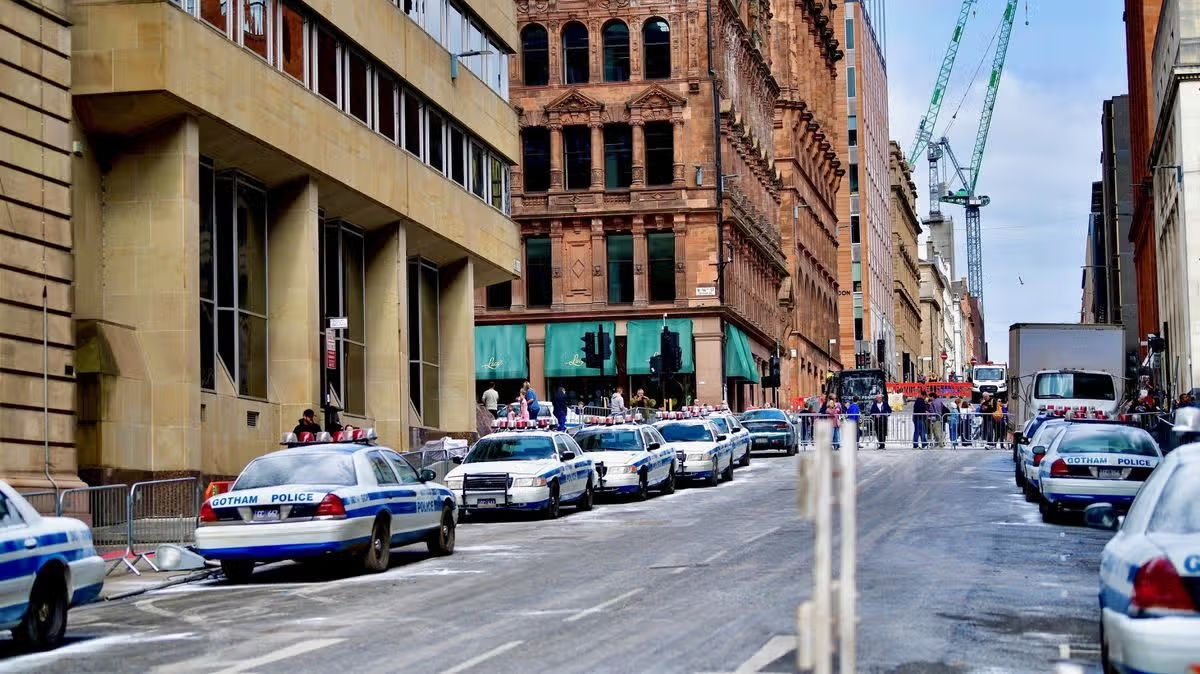
Glasgow transformed into Gotham again as filming for The Batman: Part II begins

Published

on

Daily Record

New footage shows a group of men firing weapons at the Bat-mobile as the vehicle appears to attempt to escape

Filming for upcoming movie, The Batman: Part II is now underway in Glasgow. Batfans have been out in force hoping to catch a glimpse of big name stars set to appear in the film including Robert Pattinson as the caped crusader, Andy Serkis, Jeffrey Wright, Colin Farrell, Barry Keoghan, Scarlett Johansson, Sebastian Stan and Charles Dance.

Advertisement

Glasgow has once again been transformed into Gotham City with SWAT cars, American street signs and US flags spotted around the city centre. Now footage has shown crews have added a glazing of snow sits in the middle of the junction between Bothwell and Wellington Street as the Bat-mobile can be seen alongside Christmas wreaths and a tree can be seen in the windows and in front of a Gotham City building.

Further footage shows a group of men firing weapons at the Bat-mobile as the vehicle appears to attempt to escape.

A SWAT car was also captured smashing into a vehicle as it appears to chase Batman.

Advertisement

Glasgow Live previously told how the Bavaria Brauhaus on the corner of Wellington Street has temporarily been transformed into the Office of the City Clerk of the City of Gotham, and the bus stop just in front of it has fake timetables for Batman’s fictional city.

Filming will take place in a number of locations around the city this month, with road closures expected in the Newton Street and North Street area.

Directed by Matt Reeves, the movie is the follow-up to the 2022 film The Batman, which took more than 772 million US dollars (£570 million) at the global box office. It is due to be released in cinemas on February 18 2028.

Glasgow has doubled as the fictional Gotham City a number of times previously, including in Christopher Nolan’s 2012 film The Dark Knight Rises, The Batman (2022) and The Flash (2023).

Get more Daily Record exclusives by signing up for free to Google’s preferred sources. Click HERE.

Source link

Advertisement
Continue Reading

NewsBeat

The National Grid collapses, Britain goes dark… chaos is unleashed: Nightmare scenario that Britain’s Net Zero obsession is pushing us ever closer to, by energy expert KATHRYN PORTER

Published

on

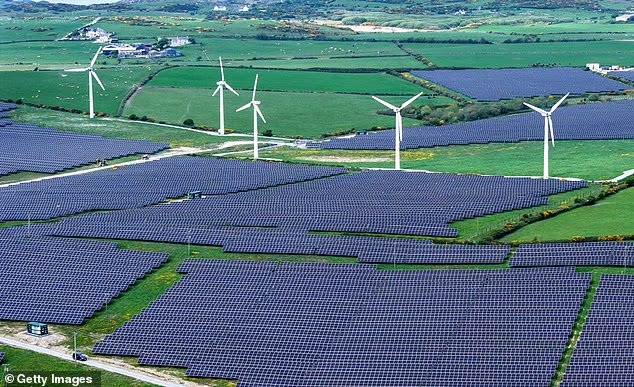
Wind turbines stand next to a solar farm near the Anglesey village of Rhosgoch in Wales

Imagine this. At 8.37pm tonight, as one section of the national grid is hit by a sharp imbalance between electricity supply and demand, the entire network starts to go down. One piece topples the next, like dominoes.

The country goes dark. The lights switch off in every home and business. Airports, hospitals and other essential utilities scramble to switch to back-up generators.

Trains and lifts judder to a halt. Mobile phone transmitter towers switch to battery and back-up power, but networks rapidly become congested and coverage progressively deteriorates.

Firefighters struggling to contain wildfires across the country face catastrophic disruption as computer systems and terrestrial communications fail or become overloaded.

Advertisement

Emergency service radio networks and satellite phones continue to function at first, but communications become increasingly difficult as back-up systems are stretched, batteries run down and generators exhaust their fuel.

With the blazes spreading, the services find it harder to establish which towns and villages are most in danger. Orderly evacuation becomes impossible, with confusion and panic spreading in the worst-affected areas.

By 10pm, with millions of homes in complete darkness, the risk of house fires begins to rise as people turn to candles, camping stoves, barbecues, portable generators and improvised methods of cooking and lighting.

Because fire crews are already stretched beyond capacity, some fires cannot be reached quickly and spread rapidly.

Advertisement

Wind turbines stand next to a solar farm near the Anglesey village of Rhosgoch in Wales

Road accidents increase as traffic lights, street lighting and electronic road signs fail. Police and safety crews are slower to respond because communications are degraded and roads obstructed, meaning some minor incidents develop into more serious collisions and create congestion.

With roads blocked and petrol stations unable to supply fuel because the pumps need electricity, thousands of drivers are stranded, spending the night in their cars or at the roadside, many without water, unable to tell loved ones what is happening.

Advertisement

By morning, the streets are crowded with people demanding to know what’s going on. The absence of internet, wifi and reliable phone signals stokes the confusion. Sporadic rioting breaks out, forcing the government to consider deploying the Army.

And this is just the first 12 hours.

Recent warnings from whistleblowers inside the National Energy System Operator (Neso) – which is responsible for the operation of the national grid – suggest that restoring the system after a total shutdown like this would be neither quick nor straightforward.

Although parts of the country might be ‘re-energised’ quickly, a complete restoration could take days, with some areas potentially without power for much longer.

Advertisement

Of course, all this hasn’t happened – yet. But the truth is that the national grid is more fragile than at any time since privatisation in 1990.

On Monday, it emerged that Neso would like to operate the grid with reduced levels of ‘inertia’, the kinetic energy stored in the spinning components of generators that carry on revolving even in the event of them losing power.

This move is designed to save £96million a year and help the government hit its Net Zero targets. But I consider this to be a very dangerous proposal as it will increase the possibility of blackouts – and I wrote to Ofgem last year to object to it.

The national grid is already under strain thanks to the ongoing heatwave. It was last month forced to halt exports to certain European neighbours via four of its ten interconnector cables for several hours.

Advertisement

This incident followed an even more serious event the month before. The gravity of the situation was highlighted by Conservative shadow energy secretary Claire Coutinho, who told MPs in early July that whistleblowers claimed Britain had narrowly avoided a ‘blackout’ on June 23 as temperatures reached 34C (93F).

Kathryn Porter, an energy consultant and founder of Watt-Logic, says she wrote to Ofgem last year to oppose the plan to operate the grid with reduced levels of ¿inertia¿

Kathryn Porter, an energy consultant and founder of Watt-Logic, says she wrote to Ofgem last year to oppose the plan to operate the grid with reduced levels of ‘inertia’

Dawn breaks over a dark London skyline in 2021 ¿ Kathryn says if millions of homes were in complete darkness due to a blackout, 'the risk of house fires' would rise

Dawn breaks over a dark London skyline in 2021 – Kathryn says if millions of homes were in complete darkness due to a blackout, ‘the risk of house fires’ would rise

No one in a senior post at Neso wants to admit the scale of the looming crisis. Doing so would invite hard questions about senior management decisions and the adequacy of the systems on which the country relies.

Advertisement

Thanks to successive governments’ obsession with Net Zero, Britain’s approach to power generation has been transformed out of all recognition in a few short years.

When the Climate Change Act was passed in 2008, around four-fifths of our electricity came from fossil fuels. Fast forward 18 years and we have no coal-fired power stations at all, with the closure of the final plant – Ratcliffe-on-Soar Power Station in Nottinghamshire – bringing to an end 140 years of coal-fired electricity generation on September 30, 2024.

But while renewables are now responsible for 47 per cent of our domestic electricity production, gas remains a vital power source as it is impossible to predict with any great accuracy when the sun will shine and the wind will blow.

Indeed, Neso missed its target of running the electricity network for at least 30 minutes in 2025 without any fossil fuels. Yes, you read that correctly: renewables are incapable of meeting our power needs for even half an hour in a single year.

Advertisement

Our supply difficulties were made worse last year by the fact that, after years of decline, there was a 1 per cent rise in UK electricity demand in 2025, driven by cold weather and some recovery from the demand destruction caused by the 2022-23 energy crisis.

We also import far more of our electricity than at any time in our history – 14 per cent in 2025 compared with around 1 per cent in 2008.

And therein lies the problem. Our biggest sources of imported electricity are two countries experiencing generation problems of their own.

France, which has more nuclear power stations than any other European country, faces shutdowns due to age-related defects, with the French nuclear regulator warning of further risks as time goes on.

Advertisement

Meanwhile, Norway – which relies on a network of 1,100 reservoirs and 1,700 hydroelectric power stations to produce 90 per cent of its power – is suffering from a shortage of water.

As a result, both may be forced to restrict exports.

An electricity pylon surrounded by dark clouds – Britain's towns and cities are linked by 4,500 miles of overhead power lines supported by pylons

An electricity pylon surrounded by dark clouds – Britain’s towns and cities are linked by 4,500 miles of overhead power lines supported by pylons

The other countries which export to us rely, as we do, on wind and solar and – as we share similar weather – can experience shortages when we do. With low European gas stocks heading into this winter, there are real concerns about the availability of electricity for export in these countries.

Advertisement

When Claire Coutinho attempted to raise the alarm in Parliament last month, the then Energy Secretary Ed Miliband accused her of scaremongering.

The reality is that, if anything, she was understating the peril we face. It’s no exaggeration to say our electricity system increasingly runs on hope and blind optimism.

This is because Neso’s engineers have no way of knowing how much solar energy is entering the system at any one time.

Britain’s towns and cities are linked by 4,500 miles of overhead power lines supported by pylons and around 900 miles of underground cables, and this high-voltage grid moves electricity at tens or hundreds of thousands of volts.

Advertisement

It’s a highly efficient way of sending electricity across country but impractical and dangerous for use in the home, where most appliances require a 230-volt supply.

And so the power first passes through a series of substations where transformers reduce the voltage to standard household levels.

However, electricity from most solar panels flows directly into the low voltage grid that feeds homes and businesses, which makes it very difficult for Neso engineers – who operate the high-voltage grid – to plan around it.

In effect, they have to guess how much is entering the system. To make matters worse, the software the engineers use to balance the grid was written back in the 1980s and is increasingly unreliable.

Advertisement

Just this week the entire balancing software failed, forcing engineers to revert to the use of spreadsheets and telephone instructions to hundreds of power stations in order to keep the grid running.

Because, absurdly, the software they use to balance the grid was written back in the 1980s.

The Houses of Parliament in central London sit in darkness after the lights were switched off for Earth Hour on March 29, 2014

The Houses of Parliament in central London sit in darkness after the lights were switched off for Earth Hour on March 29, 2014

To the casual eye it looks more like Ceefax, the BBC’s long-discontinued precursor to online news, than a modern operating system for a crucial national resource.

Advertisement

Unable to see where demand is rising or falling, they are – as one whistleblower told The Mail on Sunday recently – ‘flying blind’.

It also emerged this week that hundreds of power stations had their meters installed backwards, so they look as if they are using electricity instead of generating it. That Neso didn’t identify these problems during commissioning testing is astonishing.

In a fundamentally flawed system, this Heath Robinson approach goes only so far. Sometimes more drastic measures are called for. And on June 23 this year, as we have seen, the grid reached a crisis point.

Leaked reports from Neso insiders revealed that, as the summer heatwave pushed temperatures above 34C (93F), a spike in demand to power fans and air conditioning systems created a perfect storm.

Advertisement

As solar generation dropped steeply in the early evening and wind generation slumped to near zero, several gas-fired power stations suffered unexpected outages.

This led to grid conditions that exceeded safe operating limits for extended periods and NESO went into panic mode.

At the time, it was exporting electricity to the Netherlands through its cross-border cable but, in its desperation to bring the grid back into balance, Neso fell back on emergency protocols and abruptly halted those exports.

This was done without warning and without the prior agreement of the Dutch operator TenneT. And it still wasn’t enough to rectify the problem.

Advertisement

And so Neso decided it needed to stop sending electricity to the French, too. Given France’s status as a net exporter of power to this country, however, they had the sense to ask nicely before flicking the ‘off’ switch.

Such disruptions of service are far from ideal in a world where the exchange of energy between nations is vital to maintain a constant supply of electricity.

All this indicates that Neso didn’t see this crisis coming. It’s clear that they weren’t prepared for a shortfall of such proportions until it hit them – and then they started making increasingly drastic decisions.

Incredibly, inside sources say these decisions were influenced by Neso’s corporate affairs team, which was apparently keen to avoid any grid-stabilising actions that might involve rationing, with all the reputational damage that would involve.

Advertisement

Neso has since confirmed that its PR team was present in the control room as the events of June 23 unfolded but says it was just one source of ‘input’ into operational decisions.

Despite the accounts given by whistleblowers, Neso now claims there was no real crisis on June 23. Such a reaction does not instil confidence. If Neso flatly refuses to admit the problem exists, it’s bound to re-occur.

And next time we might not be so lucky. Nationwide blackouts could become a familiar reality.

Two of our European neighbours know just how calamitous a full electricity shutdown can be. In April last year, both Spain and Portugal lost power, with the outage lasting for 16 hours in some regions.

Advertisement

Officially, the incident caused eight deaths, including several people who suffocated after their mechanical ventilators shut off.

Three other victims died from carbon-monoxide poisoning as faulty generators pumped out the lethal gas, and one person perished in a house fire caused by a candle.

However, a subsequent study estimated that the toll was far higher, with 165 ‘excess deaths’ over two days attributed to the blackout, most likely from falls, delays to treatment and other causes.

The European regulator ENTSO-E described it as ‘the most severe and unprecedented blackout that had occurred in Europe in the past 20 years’.

Advertisement

Fortunately, the blackout occurred during benign weather. Many more people could have died if it had happened in the middle of winter or during a heatwave because – without electricity – heating and cooling systems generally won’t function.

And a resumption of power supply is not straightforward. In Britain, getting the lights back on once power is restored is a major undertaking, as it involves using a seat-of-the-pants method known as a ‘black start’ that has never been fully tested.

When a power station has been offline for maintenance, it is usually restarted using power from the national grid. But this isn’t an option when the whole grid is down.

In a black-start situation, some large power stations use diesel generators to get going. They then have to trickle just enough power to the grid to energise other power stations until enough generation is available on the high-voltage grid to meet expected demand on the low-voltage grids.

Advertisement

But if that demand is not estimated correctly, not only would the grid immediately trip off, but some equipment could be overloaded and break.

For that to happen after the country has already been in a nationwide blackout for days would be catastrophic.

Little wonder that the mood among national grid engineers is close to despair. In a letter to The Mail on Sunday last month they literally begged the public for help in persuading Ofgem to investigate their fears over grid security.

Given that almost every aspect of modern life is reliant on electricity, maintaining a safe, robust national grid ought to be a top priority. Instead, we have become dangerously complacent.

Advertisement

Britain is living with an unimaginable risk, yet most people know nothing about it, and the government doesn’t seem to want to know.

When we are finally forced to face reality, it will be too late.

Kathryn Porter is an energy consultant and founder of Watt-Logic

Source link

Advertisement
Continue Reading

NewsBeat

Sugary treats could fuel bowel, liver and lung cancers, major study suggests

Published

on

Toddlers who eat more sugar could be at greater risk of five major types of cancer in later life, a study has suggested

Toddlers who eat sugary treats could be at greater risk of five major types of cancer in later life, a study has suggested.

Researchers found children born during wartime, when sugar rationing was in place, were 69 per cent less likely to develop liver cancer, and 40 per cent less likely to get bowel cancer, compared to those born after restrictions were lifted.

They also went on to have healthier diets, which could protect against conditions like obesity, and a younger biological age – the term for damage to the body over time.

‘Children may not remember what they ate before age two,’ Dr Weilong Zhang, a professor of economics at the University of Cambridge and a co-author of the study, wrote in The Conversation.  

Advertisement

‘But their later health, their bodies and even their taste preferences may still carry the imprint of those very early-life experiences.’

With scientists from China Agricultural University, Dr Zhang analysed data from 64,000 Britons born between 1951 and 1956 – either side of the rationing which ended in September 1953.

During the restrictions Britons consumed around 41g of sugar per day – around as much as is found in a 330ml can of Coca Cola. 

After rationing, however, intake doubled to 80g.

Advertisement

Toddlers who eat more sugar could be at greater risk of five major types of cancer in later life, a study has suggested

This acted as what researchers dubbed a rare ‘natural experiment’, as kids born just months apart may have had vastly different sugar intakes during their early years.

Dr Zhang told the Daily Mail that, while they could not measure exactly how much sugar children consumed after rationing ended, it would have been ‘substantially more’ than before.

Advertisement

The researchers focused on the 1,000 days from conception until a child’s second birthday, as this is when organs and the immune system are developing, and when food preferences begin to form.

Their findings – published in the Proceedings of the National Academy of Sciences journal – found that those who spent longer under the rationing were at lower risk of breast, prostate, liver, rectal and lung cancer decades later.

Liver cancer risk – including intrahepatic bile duct cancer – was found to be 69 per cent lower for the rationed group.

Around 7,000 people are diagnosed with liver cancer each year, which kills more than 90 per cent of its patients within a decade.

Advertisement

The study found that those who consumed less sugar were also at a 52 per cent lower risk of prostate cancer, the most common type of the disease among men, with 64,000 diagnoses every year – around one in every eight.

Prostate cancer kills more than 12,000 every year.

There was a 41 per cent lower risk of lung cancer for the group who ate less sugar, the researchers also found.

Lung cancer is the deadliest in the UK, causing around 33,000 deaths every year. 

Advertisement

Meanwhile, rectal cancer – a type of bowel cancer that starts in the rectum – was at a 40 per cent lower risk.

The findings come amid a backdrop of soaring rates of bowel cancer in the UK, particularly among under 50s.

There are more than 48,200 cases of the disease in Britain every year, and it is being diagnosed among 25 to 49-year-olds at a 50 per cent higher rate than in the mid 1990s.

Dr Zhang said that the findings do not mean higher sugar intake is behind this rise.

Advertisement

But, he says the findings ‘suggest dietary exposure very early in life may be one factor that influences bowel, and particularly rectal, cancer risk many decades later’.

Breast cancer was found to be at a 36 per cent lower rate in the new study, which was the smallest among the five but a result Dr Zhang said was ‘still substantial’.

There are around 60,000 new breast cancer diagnoses every year in the UK, and 11,200 deaths. 

The researchers said the differences in cancer risk were only discovered decades after sugar rationing had ended, suggesting the health consequences of early-life sugar intake may take years to become clear.

Advertisement

Dr Zhang said their study also found that those exposed to more sugar in early life were at a higher risk of biological ageing. 

Biological age is important because it shows the so-called ‘wear and tear’ to the body.

Two people may look visibly similar at 60, for example, but their cells and immune systems can show different signs of ageing.

The study found that those who consumed less sugar had around 2.2 fewer years of biological ageing.

Advertisement

This means their body was younger than the people who ate more sugar, and suggests they could be better-protected against diseases that come with age. 

Furthermore, the researchers discovered that early sugar intake affected people’s diet choices even decades later.

‘We found that people who experienced sugar rationing early in life still consumed less sugar in adulthood, around age 50,’ Dr Zhang said.

‘They also ate less overall, and their diets were healthier and more diverse. This suggests that the level of sweetness people are exposed to very early in life may shape their taste preferences for a long time.’

Advertisement

A healthier diet has been linked to fewer complications such as obesity, which can increase the risk of dangerous conditions like type 2 diabetes, heart disease and stroke.

The findings follow separate research that linked low early-life sugar intake to lower risks of conditions like diabetes, high blood pressure, cardiovascular disease and dementia.

Source link

Advertisement
Continue Reading

NewsBeat

All the things you didn’t know about cult classic John Tucker Must Die – from a cheating scandal that rocked the cast to plans for a sequel – as film marks its 20th anniversary

Published

on

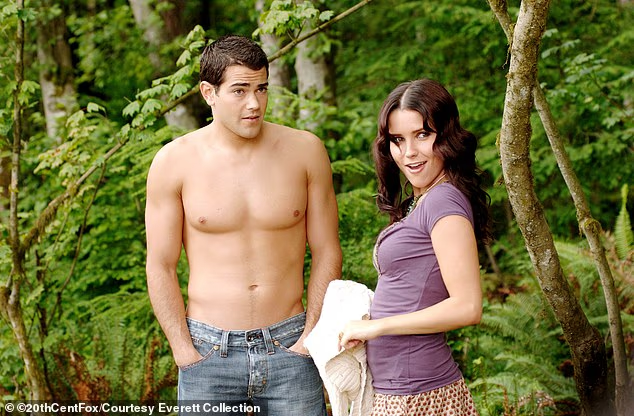
It's one of the great American teen comedy films. And this August marks 20 years since John Tucker Must Die was released (Jesse Metcalfe and Sophia Bush seen in the movie)

It’s one of the great American teen comedy films.

And this August marks 20 years since John Tucker Must Die was released and we fell in love with characters Heather (Ashanti), Beth (Sophia Bush) Carrie (Arielle Kebbel) and Kate (Brittany Snow).

The story follows three ex-girlfriends – played by Kebbel, Bush and Ashanti – who set up the title character John (Jesse Metcalfe), a serial cheater, to fall for the new girl in town, played by Brittany Snow, so they can show him how it feels to have his heart broken.

In spite of lacklustre reviews, the romcom made nearly $70million worldwide at the box office and has become a cult classic. 

Advertisement

But there’s plenty of facts from the film that you might not know:

It’s one of the great American teen comedy films. And this August marks 20 years since John Tucker Must Die was released (Jesse Metcalfe and Sophia Bush seen in the movie)

Viewers fell in love with characters Heather (Ashanti), Beth (Sophia Bush) Carrie (Arielle Kebbel) and Kate (Brittany Snow)

Viewers fell in love with characters Heather (Ashanti), Beth (Sophia Bush) Carrie (Arielle Kebbel) and Kate (Brittany Snow)

Advertisement

First up – Jesse was actually cast in the film before any of the women were and they then worked around him.

‘I had a little bit of input as to who they cast – not a lot, but a little bit,’ the actor shared with E! News in 2006.

‘It was tough to cut anybody. I mean, I didn’t really have that much power where I could say, “No, I don’t want her in the movie,” but they definitely took my suggestions into consideration.’

For the final casting decision, he said, ‘I think they really did a great job putting together a really all-star young, hot cast.’

Advertisement

Desperate Housewives star Jesse, now 47, watched teen comedies Ferris Bueller’s Day Off and Can’t Buy Me Love in order to prepare for his role as John.

But he has said in the past that when he was at high school he was nothing like his popular lothario character in the film – noting that he was a bit of a ‘loner’. 

He added that he actually related more to his brother’s character in the film – played by Penn Badgley – who was quieter and went under the radar. 

Penn went on to star as Dan in Gossip Girl and become a huge Hollywood actor, recently appearing as protagonist Joe Goldberg in Netflix series You.

Advertisement

In terms of the four main girls – the actresses have all spoken over the years about how close they became during filming and remained friends.

Sophia said after filming: ‘These girls, I couldn’t get through a month without talking to them if I tried.

‘And we all, whether it was amazing things or not-so-great things, we all had a lot going last summer and we all pulled each other through a lot. And I knew that there was something to it when, at 4am, if one of us was having a problem we could call the other and we’d all end up sleeping in each other’s beds all the time. 

Back in 2024 it was reported that John Tucker Must Die may be getting a sequel (Sophia, Jesse and Arielle reuniting at Epics Con in Chicago)

Back in 2024 it was reported that John Tucker Must Die may be getting a sequel (Sophia, Jesse and Arielle reuniting at Epics Con in Chicago)

Advertisement
In spite of lacklustre reviews, the romcom made nearly $70million worldwide at the box office and has become a cult classic

In spite of lacklustre reviews, the romcom made nearly $70million worldwide at the box office and has become a cult classic

Penn (seen left with Brittany) went on to star as Dan in Gossip Girl and become a huge Hollywood actor, recently appearing as protagonist Joe Goldberg in Netflix series You

Penn (seen left with Brittany) went on to star as Dan in Gossip Girl and become a huge Hollywood actor, recently appearing as protagonist Joe Goldberg in Netflix series You

‘It was sleep-away camp, it was slumber party time, it was incredible and fun.’

She recalled one night during filming where they all hung out in Brittany’s room. 

Advertisement

Sophia said: ‘Brittany and I were on the couch and we’d ordered food and we’re chowing down, and Arielle’s over in the armchair and we’re all writing and she’s putting together a package, and Ashanti’s over sitting at the desk and she’s got her headphones on and she’s working on her new song.

‘And we’re jamming and we’re at that point where we weren’t even talking, we just wanted to be together. And I was like, this is what I have with my best girlfriends, and this is amazing.’

And mirroring the film’s storyline, Brittany actually found out that her boyfriend of two years had been cheating on her while they were filming and found support from her co-stars.

It was a busy time in all the women’s lives as during the filming of John Tucker Must Die, Sophia was also working on One Tree Hill and Ashanti was writing new music.

Advertisement

Another surprising fact from the film is that its director Betty Thomas is actually a famous actress herself.

She is famous for playing Phyllis Nefler’s archnemesis, Velda Plendor, in the 1989 classic Troop Beverly Hills. 

Her other filmmaking credits include The Brady Bunch Movie, Private Parts, Dr. Dolittle and 28 Days. 

Another star who made their film debut in John Tucker Must Die would go on to have an impressive career: Taylor Kitsch. 

Advertisement

He has a brief role in the film playing a neighbour who brings Kate’s hot mum Lori a moving-in gift.

Less than three months later, Friday Night Lights premiered and he became a global star. 

It’s clear that the cast have fond memories of their time filming the movie and some of them even kept certain bits from set.

Brittany kept the flowers that were in her hair during the romantic scene where John kissed Kate on a boat. 

Advertisement

She said of that day’s filming: ‘I told the hair and makeup lady that I wanted a fun up-do on the boat so it didn’t get messed up when it was windy,’ she told Us Weekly.

‘And she did this elaborate updo that’s so ridiculous! If you go back and watch the movie it’s like, “Why would Kate ever have that elaborate of a hairdo?” And she put flowers in my hair… so I think I still have those flowers somewhere.’

Back in 2024 it was reported that John Tucker Must Die may be getting a sequel.

At the time all the main stars said that they were up for the challenge.

Advertisement

‘I’ve heard rumors of this script – there’s a script,’ Jesse revealed during their panel at Epics Con in Chicago, according to People. ‘Apparently it’s amazing.’

‘I’d definitely love to be a part of it,’ the Divine Influencer actor added. ‘Can’t wait to read it.’

However, the project was shelved by the studio and is currently on pause. 

Source link

Advertisement
Continue Reading

NewsBeat

German politician dubbed ‘craziest councillor’ wants to turn city of Mannheim into ‘swinger’s paradise’ by hosting sex party at council building

Published

on

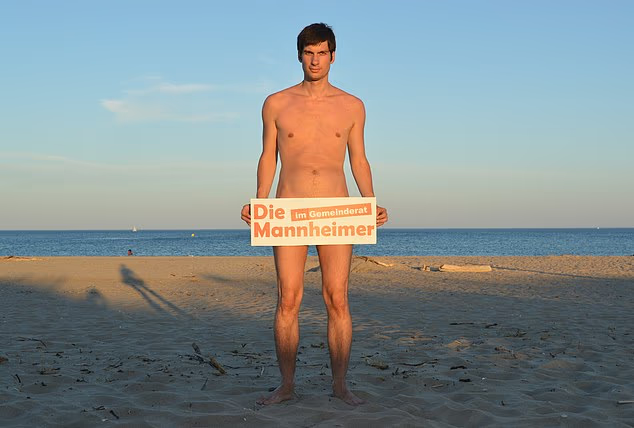
Julien Ferrat, 35, is the leader of the liberal Die Mannheimer (Citizens of Mannheim) party

Advertisement

A politician dubbed Germany‘s ‘craziest councillor’ has announced plans to host a sex party in his local City Hall. 

While most councillors are focused on fixing problems with traffic lights or bin collections, Julien Ferrat wants to turn the city of Mannheim into a ‘swinger’s paradise’.

But Mr Ferrat, the leader of the liberal Die Mannheimer (Citizens of Mannheim) party, is facing pushback from the local government, in which the largest party is the socially conservative Christian Democratic Union.

The 35-year-old is an eager swinger and nudist, who previously invited German citizens on an eight-day fact-finding trip to the naturist village in Cap d’Agde, southern France to spread the word about non-monogamy. 

Advertisement

That visit inspired him to try and turn his own city into a stopover destination for wife-swappers on their way to Cap d’Agde. 

‘For people in northern Germany or Scandinavia, Cap d’Agde is too far to reach in one day,’ he told The Metro. 

‘If they are looking for somewhere to stay, we can attract them to Mannheim. If we can attract more nudists and swingers it would be a good way to create more income for the city of Mannheim.’

Mr Ferrat says the town hall is ‘perfectly suited’ to a sex party and has so far secured 50 potential attendees to the saucy soiree. He plans to speak to them all individually to make sure they are genuine in their intentions. 

Advertisement

Julien Ferrat, 35, is the leader of the liberal Die Mannheimer (Citizens of Mannheim) party 

Ferrat was elected as a member of the city council in 2024, having previously served between 2014 and 2019

Ferrat was elected as a member of the city council in 2024, having previously served between 2014 and 2019

‘At the moment, the focus is on determining which of the citizens who contacted me are seriously interested,’ Mr Ferrat told The Telegraph.

Advertisement

‘Some of the 50 people who contacted me are part of the local swingers community, so they are ‘legit’. Some are people I don’t know yet. This week, I will start meeting the ‘unknown’ people in person.’

Home to around 330,000 people, Mannheim is a major industrial and university city in south-west Germany – and the birthplace of both the first gasoline-powered automobile and the precursor to the bicycle. 

There are an estimated 128,000 swingers in Germany and Mr Ferrat believes becoming a mecca for kinky travellers could provide the city with an economic boost.

His other goal in hosting the sex party is to challenge the taboos against swinging, he told the newspaper.   

Advertisement

However, his free love approach has not been warmly embraced by local civic leaders.  

‘Based on the rudimentary information available so far, there are considerable doubts about the admissibility and feasibility of the plans,’ a Mannheim city hall spokesman told German news outlet SWR. 

The city’s administration said he had not specified a date or a room, or explained how the proposed event related to his role as a member of the municipal council.  

Mr Ferrat was elected as a member of the city council in 2024, having previously served between 2014 and 2019. 

Advertisement

He was dubbed Germany’s ‘craziest councillor’ by the newspaper Die Zeit in 2017. On the party’s website he lists his key priorities as ‘combating rising rents, increasing security, and ensuring good healthcare’.

Advertisement

Source link

Advertisement
Continue Reading

Trending

Copyright © 2025