Police say they are treating all three offences “extremely seriously”
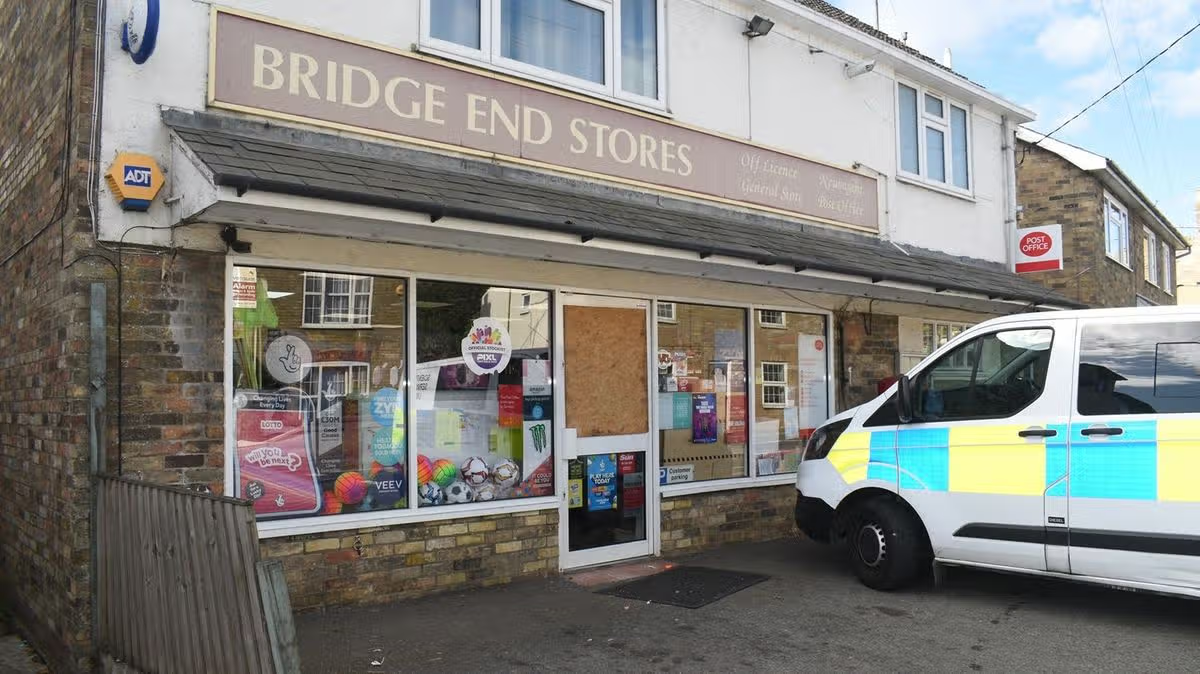
A village store has become the third to be burgled in as many days in Cambridgeshire. Two men dressed in all black are reported to have smashed through the front door of Bridge End Stores in High Street, Earith at around 3.15am this morning (September 23).
Advertisement
The men left around four minutes later in a small black hatchback car, taking with them a bag of cigarettes and vapes. No arrests have been made but police say an investigation is ongoing.
It follows two burglaries which happened at village shops in Willingham in the early hours of Monday and Tuesday (September 21 and 22). In one instance, the suspect left empty-handed whilst in the second incident, two men made off with a bag full of cigarettes.
Whilst police have made no indication that these incidents are linked, they say that they are treating them “extremely seriously”.
Detective Sergeant James Rabbett, from the Southern Acquisitive Crime Team, said: “We understand this latest incident will add to concerns within our communities, particularly following the recent burglaries in Bluntisham and Willingham.
Advertisement
“We want to reassure residents and businesses that these offences are being treated extremely seriously and officers are carrying out extensive enquiries to identify those responsible.
“We are keen to hear from anyone who was in the area at the time, saw a small black hatchback, or anyone who has dashcam, CCTV or doorbell footage that may assist our investigation.”
Anyone with information is asked to contact Cambridgeshire Police online, quoting reference 35/73768/26.. Alternatively, you can contact Crimestoppers anonymously on 0800 555 111 or on their website.
The village alreay experiences the highest number of sewage spillages in the region
A council has approved plans for new homes despite fears from residents of increased sewage spills in a village already suffering from the worst spills in the area.
Advertisement
Huntingdonshire District Council’s development management committee met to decide an outline plan for up to 70 homes on land south of Blenheim Grove in Offord D’Arcy. Offord Cluny and Offord Darcy Parish Council had objected to the plans as they said wastewater treatment plants were already suffering from “capacity problems”.
Simon Young, a parish councillor, said figures from the Environment Agency show that Buckden has an average of 116 raw sewage discharges per year. He said this is 66 per cent higher than the second on the list – Kimbolton at 70 – and four times higher than the average across Huntingdonshire.
He said the villages have “long-been a supporter” of “appropriate developments” but that Anglian Water’s infrastructure is “not fit for purpose”. Anglian Water originally objected to the application in 2025, but this was because the applicant had not identified a suitable connection point to their network.
After two connection points were suggested, they removed their objection. They had always said there was “sufficient capacity” at the nearby Buckden Water Recycling Centre to accommodate the new homes after assessing dry weather flow.
Advertisement
Cllr Young said: “The Buckden Works was discharging raw sewage on August 13, when we all know there’d been no rain for weeks. And the ten hours of discharges in June came after recent light rain – or almost no rain for days. As far as I’m aware, Buckden and the Offords do not have their own microclimate such that it rains more here.”
Cllr Julie Kerr, of St Ives West, said she was “very concerned” by the “high numbers of spillages”.
The independent councillor said: “There really shouldn’t have been any and you have a very poor network by the sounds of it in a village that’s already struggling.”
Advertisement
Council officers advised that it would be “very difficult” to go against the advice of Anglian Water as they do not have the “technical expertise” to be able to defend their decision on appeal.
Cllr Tom Sanderson, of The Stukeleys, said they would not be able to use their decision to “deal with an existing issue”.
The Liberal Democrat councillor said: “Particularly as Anglian Water haven’t raised an objection now, they withdrew the objection they did have, I think it would be very difficult for us to object on that basis.”
Cllr Lara Davenport-Ray said she felt the benefits of the scheme did not outweigh the harms.
Advertisement
The Green councillor said: “If Anglian Water is saying that they have capacity and that there is no problem, then there is no condition that we can word to mitigate a problem that on paper doesn’t exist. Our officers cannot identify harm because they haven’t been shown that there is any harm that’s been created because their experts have failed to do so, but we can.”
The committee first reached an impasse with five votes for and against the application and three abstentions – but it was approved on the second attempt with six for, four against and three abstentions.
How many times have you asked someone to hold open a door while carrying something, or fumbled with your front-door keys with your arms full of shopping? Wouldn’t it be great if you could give yourself the extra hand you need?
Current SRLs are largely experimental, but in the future wearable robotic limbs could help in a range of areas. They could have an impact in manufacturing, healthcare, space, music, arts, gaming and rehabilitation.
Advertisement
Technology that boosts people’s physical and mental abilities is no longer the preserve of science fiction. In this new series, we explore cutting-edge ways that human capabilities could be augmented now and in the near future – and the ethics of these innovations.
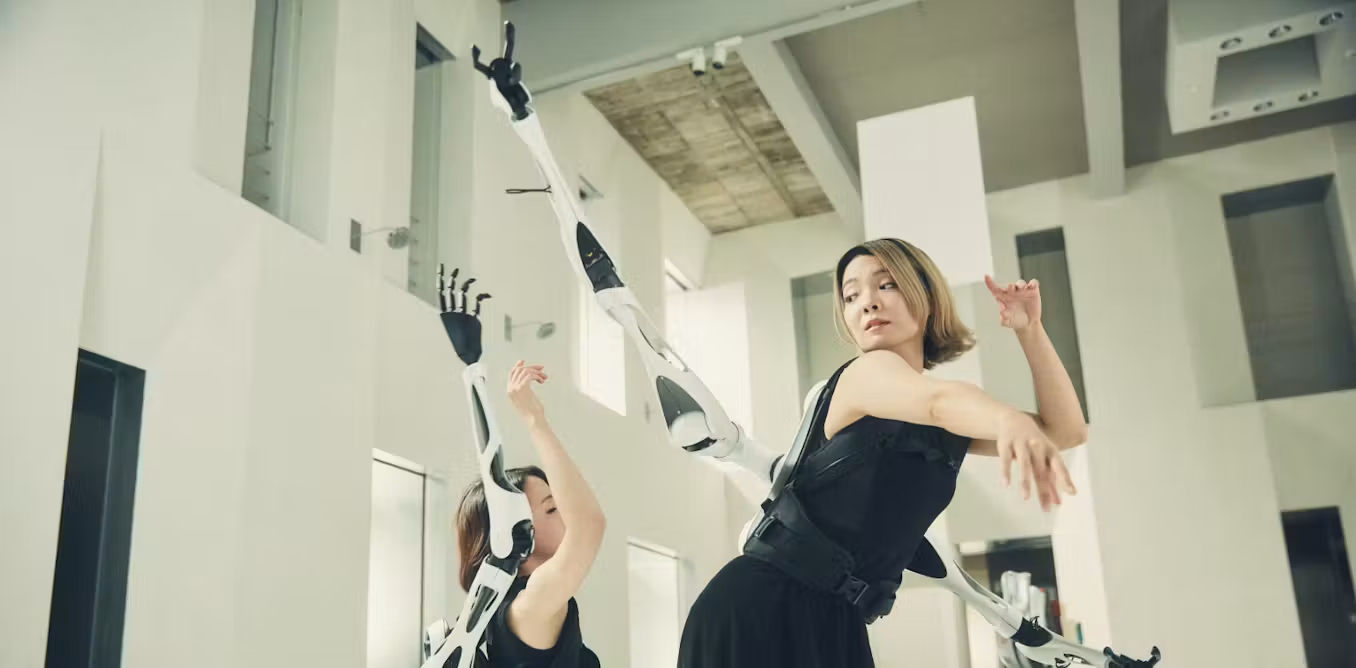
Unlike prostheses, SRLs increase the overall capacity of the human body, rather than restoring the capacity of a missing limb. If you’re familiar with the Marvel universe, think of Doctor Octopus – his mechanical arms are fictional examples of this type of technology.
In the real world, scientists have created extra arms a little like Doc Ock’s (but benign) as well as additional legs and fingers.
These extra limbs don’t look or behave like actual human arms or legs. They’re combinations of rigid materials, motors and actuators – mechanical devices that produce force. They can be worn like a backpack or watch.
Advertisement
So far, they tend to be controlled using another body part, most often the foot. By using pedals or shoes fitted with sensors, a person can generate forces or make movements with their feet that are then translated into movements of a robotic limb. Recent research has also investigated using the muscles around the ears for control.
Designers typically avoid using the arms and hands as controllers. This is to maximise the added capacity additional limbs provide.
The Third Thumb has been developed by body augmentation designer Dani Clode in collaboration with the University of Cambridge.
A common question is whether robotic limbs could be controlled by the brain. They aren’t yet, though scientists have explored the idea.
When the brain sends electrical signals through the nerves to control muscles, only certain frequencies of those signals actually convey information that instructs movement. There is essentially spare bandwidth in the body’s nervous signalling network.
Although promising, this approach has had a low success rate. Its complexity and the long calibration and training period needed for users probably makes it unsuitable.
Two arms good, four arms better?
Supernumerary robotic limbs are designed to provide something additional to the natural body. They should work alongside our natural limbs, without limiting their natural functions. The goal isn’t to create autonomous entities that can do a job in place of someone’s body. Rather, it’s to give people additional tools they can control and use.
For example, you might one day wear a backpack with two robotic arms attached and use these to keep a ceiling panel in place while you screw it to the ceiling. Or you could have a belt with two extra legs to keep you stable in an unnatural position, leaving your hands free to fix something. Or you could have a sixth finger, which could allow you to open a bottle with one hand.
Advertisement
These examples might seem science fiction, but they’veallbeenrealised and tested in the lab.
Industrial uses are beginning to be explored. A future surgeon might operate four surgical tools at the same time, for instance. Or a rescue operator could immediately extract an earthquake victim while lifting debris, without needing to wait for support.
An experimental four-armed surgical system, with two additional arms controlled with foot pedals.
But for now, such uses remain ambitions. This field is still largely experimental, and the performance of SRLs is limited. Existing devices are often heavy, bulky and difficult to wear, and their speed is usually limited for safety.
Learning to use them well also takes a lot of effort, especially as current control interfaces tend to be complex and unintuitive. That said, studies of how people respond to using supernumerary robotic limbs have found that they can learn the basics of controlling a third arm or sixth finger in less than an hour.
Advertisement
Feedback plays a key role in this learning process. Vibrating motors and electrodes that provide a small current can help people “feel” a robotic limb they’re controlling.
This is crucial for motor learning: when you try to play tennis or the piano, your haptic senses play an important role in allowing your brain to learn the correct movement. The same applies with a robotic limb. Sensory feedback is also essential for getting the brain to treat the SRL like it is part of the natural body.
Despite the challenges of learning how to use them, research shows that people become more adept at using extra robotic limbs over time, and that the brain seems to adapt and incorporate these extra limbs to the point that it feels natural having them. This suggests there’s real future potential in the field.
In the meantime, it’s important to raise awareness about human movement augmentation and SRLs specifically. Most people have no idea what human augmentation means or that these devices exist.
Advertisement
Now that you know that they do, what would you use these limbs for?
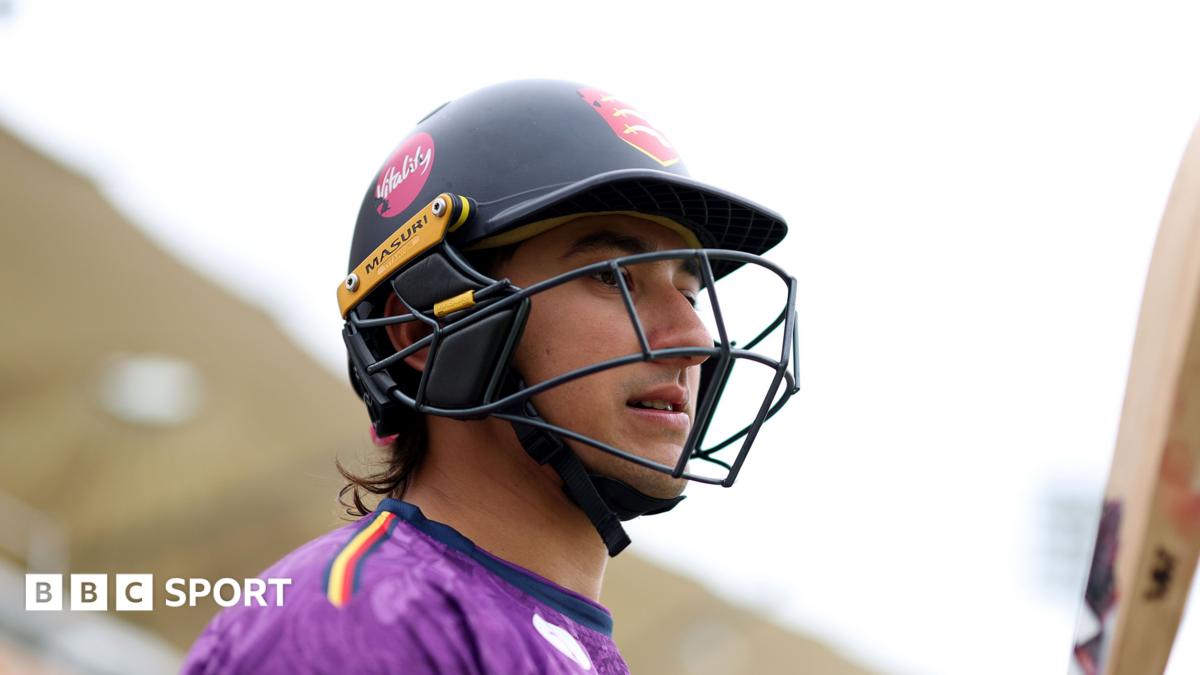
Essex cricketer Robin Das has been charged with two counts of rape.
The 24-year-old will appear at Inner London Crown Court on Friday, 9 October after he was charged on 23 July.
Das was arrested on 27 August last year following reports of a woman being raped in Brixton in March 2024.
The Metropolitan Police said in a statement: “Robin Das of Queens Road, Waltham Forest, was charged on 23 July 2026 with two counts of rape.
Advertisement
“The charges follow his arrest on 27 August 2025 following reports of a woman being raped in Brixton on 30 March 2024. The woman continues to be supported by specialist officers.”
Das, a top-order batter, has made 60 appearances for Essex and last appeared for the club in a One-Day Cup match against Middlesex on 21 July, his only senior appearance in the 2026 season.
Essex have confirmed that he has been suspended since his arrest, two days after his last appearance for the club.
Essex said in a statement: “Essex County Cricket Club can confirm that a male member of the playing staff, currently under contract with the club, recently appeared in court in relation to an incident that took place outside club activities.
Advertisement
“Throughout, the club has remained in contact with the ECB, PCA, the Cricket Regulator and the player with regard to the matter, which included an immediate and ongoing suspension. The club will continue to follow all appropriate legal processes and guidance.
“As a club we have strict safeguarding and HR procedures in place, and all employees of Essex County Cricket Club are required to meet the highest standards of professional conduct at all times.
“As legal proceedings are in progress, the club are unable to make any further comment at this time.”
Das made his debut for Essex in 2020 and has made nine first-class appearances for the county, along with playing 29 games in 50-over cricket and 24 matches in T20s during his career. Two of the T20 appearances were for Dhaka Dominators in the Bangladesh Premier League.
In the wake of the Alternative für Deutschland’s (AfD) electoral success in the Saxony-Anhalt state election, commentators both in Germany and internationally have expressed concern with the party’s extreme right-wing policies. Among these concerns are recent calls from party elites to adopt “remigration” policies.
The AfD has a lot in common with the far right in the US and echoes the more extreme rhetoric of the Trump administration. However, unlike in the US, where extremist symbols derived from Norse culture and associated with white supremacy have been conspicuous at political rallies, Germany’s criminal code explicitly forbids such public displays.
This law is so strong that rock band KISS had to use an alternative design for marketing in Germany, as the final letters of the band’s original logo too closely resembled the runic iconography of the Schutzstaffel (SS). Gene Simmons and Paul Stanley, whose families were both persecuted during the Holocaust, vehemently denied any reference to Nazi symbolism in the band’s officially authorised autobiography, Kiss: Behind the Mask (2003).
Rock band Kiss adopted an alternative logo for Germany and other countries banning Nazi symbols.
Advertisement
To circumvent these strict laws, which until 2018 included a ban on representing Nazi images in second world war video games, individuals who associate themselves with extreme right politics have embraced an increasingly wide range of symbols to communicate in public.
This includes the prominent use of Norse and Viking motifs and references. Since in Germany open display of symbols such as SS runes are banned, signalling of extreme right affiliation has moved into the coded, easily deflectable mediums of consumer fashion and the grammar of online emoji use.
Hiding in plain sight
The meaning of symbols derived from the Norse tradition is very dependent in context. As we are finding from contributions to the NorseMap project at University College Cork, there are diverse reasons for using runes and Norse imagery, from signalling pagan belief, to personal and academic interest in the period and culture.
There is usually no way to extrapolate a political affiliation from the display of a Norse symbol or tattoo.
Advertisement
Unfortunately, the extreme right exploits this diversity in order to hide in plain sight. It’s a cynical strategy perfected under Germany’s ban on the display of traditional neo-Nazi symbols and the adaptations it forced on the extreme right.
Evolution of far-right fashion
Although some groups still adopt the traditional jackboot neo-Nazi aesthetic, it is more common for members of extreme right groups to use covert signals of their affiliation, adopting fashion choices that allow them to blend in.
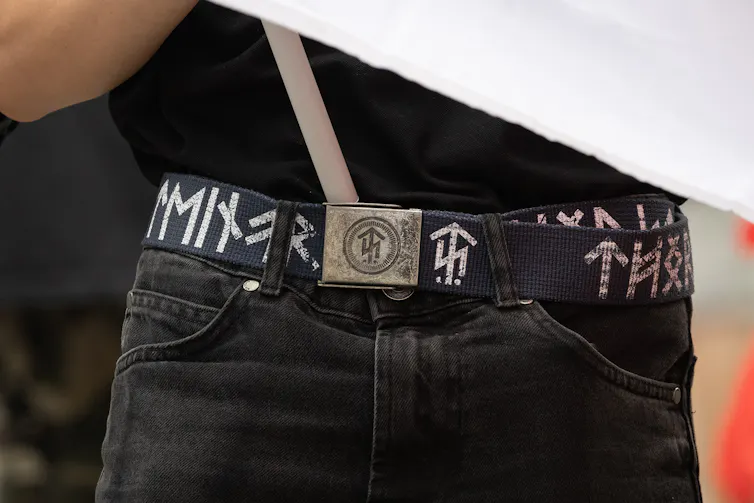
Thor Steinar is a fashion brand which uses a bind rune as its logo and which sells a range of runic branded clothing, some of which refers to a “Viking race” and appears explicitly neo-Nazi. Wearing this brand is banned in the Bundestag (Germany’s national parliament) as well as regional parliaments and several sporting venues. The company has always denied any right-wing associations or that it attempts to appeal to neo-Nazis, saying: “For those who still haven’t understood, we sell clothing, not a political view.”
Thor Steinar belt at a Neo-Nazi march. Kai Schwerdt via Flickr, CC BY-NC-SA
Erik and Sons, whose founder Udo Siegmund previously worked for Thor Steinar, similarly uses a rune as its logo, calls itself a “Viking brand”, and favours black, red and white, the colour scheme of the German flag from 1933-1945. Its offerings range from bold slogans (“Viking lives matter”) through to more subtly branded fashion items.
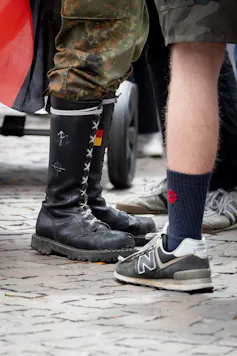
Other more mainstream brands have simply been co-opted, or “hate-jacketed”: unwittingly hijacked for use by hate groups. For example, New Balance sneakers, with their prominent N logo, have become a way of signalling “Nazi” among the extreme right. The company denies any far-right associations, saying it “does not tolerate bigotry or hate in any form”.
New Balance sneakers have been adopted by some far-right supporters because of the prominent letter ‘N’. Kai Schwerdt via Flickr, CC BY-NC-SA
The British brand Lonsdale is also popular with German far-right groups. When worn under an open shirt or jacket only the letters NSDA can be seen. This is a sequence very close to the initials of the NSDAP or Nationalsozialistische Deutsche Arbeiterpartei: the full name of Hitler’s Nazi party. Lonsdale has consistently denied any links to the far-right and in 2003, launched a marketing campaign: “Lonsdale Loves All Colours”. The company also sponsors LGBTQ+ and immigrant aid charities.
The evolution of far-right fashion choices has been well documented, including by a dedicated research project funded by the Austrian Science Fund. The trend is towards mainstreaming, blending of styles, and ultimately deniability. It should be emphasised that not everyone wearing New Balance trainers at an AfD rally will be doing so to signal neo-Nazi sympathies.
Neither will the millions of consumers from all walks of life who wear black North Face jackets be aware that the brand has recently become a uniform of sorts at far-right rallies. The brand’s white logo and reference to the “north” is what appeals to far-right groups who fetishise both whiteness and a northern European identity. Its ubiquity also allows the extreme right to effectively blend in.
North Face has taken pains to reject any far-right associations and in 2020 announced it was boycotting Facebook, declaring: “We know that for too long harmful, racist rhetoric and misinformation has made the world unequal and unsafe, and we stand with the NAACP (National Association for the Advancement of Colored People) and the other organizations who are working to #StopHateforProfit.”
Advertisement
Coded emojis of the extreme right
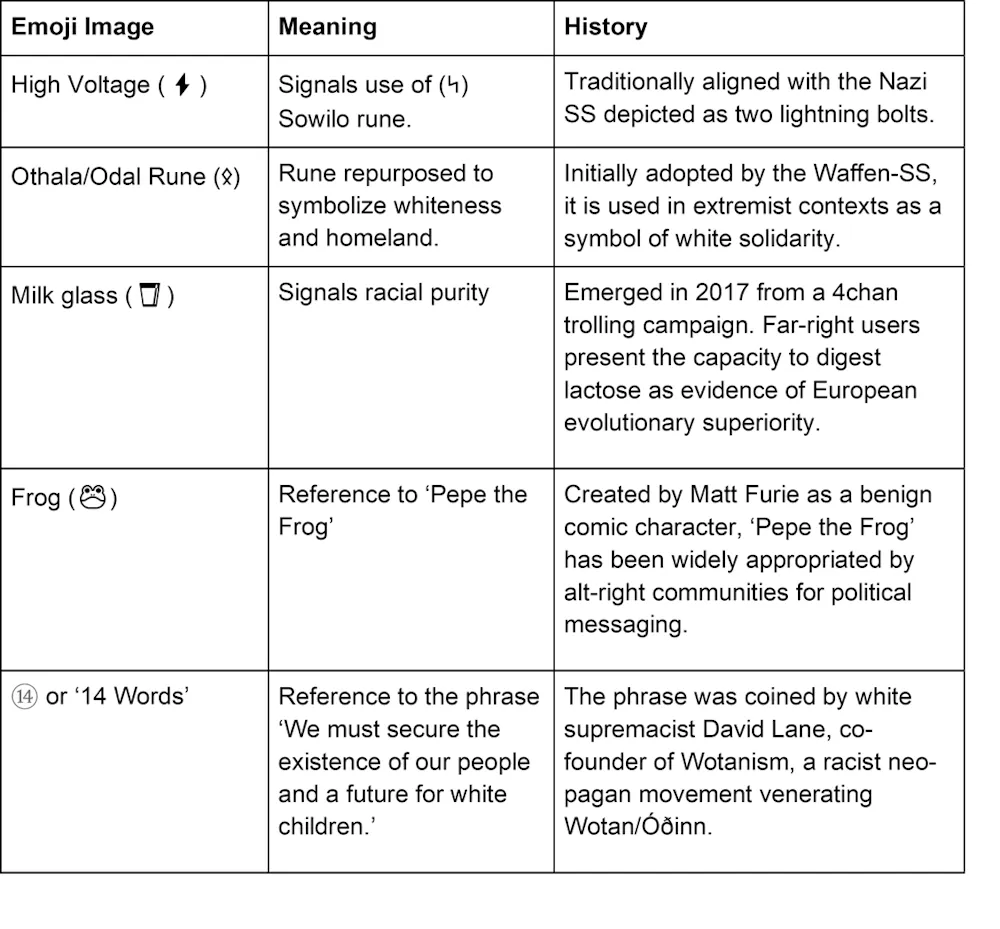
As political communication has migrated online, so too have the symbols of white supremacy. One prominent expression of this communication has been emoji use, some of which are related to Norse and Viking culture. The following table outlines several prominent examples in online discourse.
Popular coded emojis adopted by far-right supporters. Tom Birkett, Felix Lummer & Liam Waters, University College Cork, Author provided (no reuse)
Like the co-option of mainstream brands, emojis used to signal far-right extremism online are repurposed from a benign set of symbols. They would likely go unnoticed without the in-group or esoteric knowledge needed to interpret their meanings.
A good example of this are the mushroom and pine tree emojis. In some circles, and particularly when used in combination with runes in a social media bio, they can signal ecofascist or folkish affiliation.
But they are also popular in fantasy, the cottagecore lifestyle trend, and in nature and foraging accounts. As such, caution is necessary when encountering and interpreting these symbols.
Advertisement
If extremists wear ordinary brands and use innocuous online symbols for in-group signalling, they don’t stand out as coming from an extreme place. Their views look more mainstream when their aesthetic also blends in with the rest of the community.
Former NFL star wide receiver Antonio Brown plans to accept a plea deal on an attempted murder charge in Miami that avoids prison as part of an agreement that his lawyer was too good to turn down.
Brown is scheduled to appear in court on Sept. 30 to make the deal final. He could have faced up to 30 years in prison if convicted of the charge.
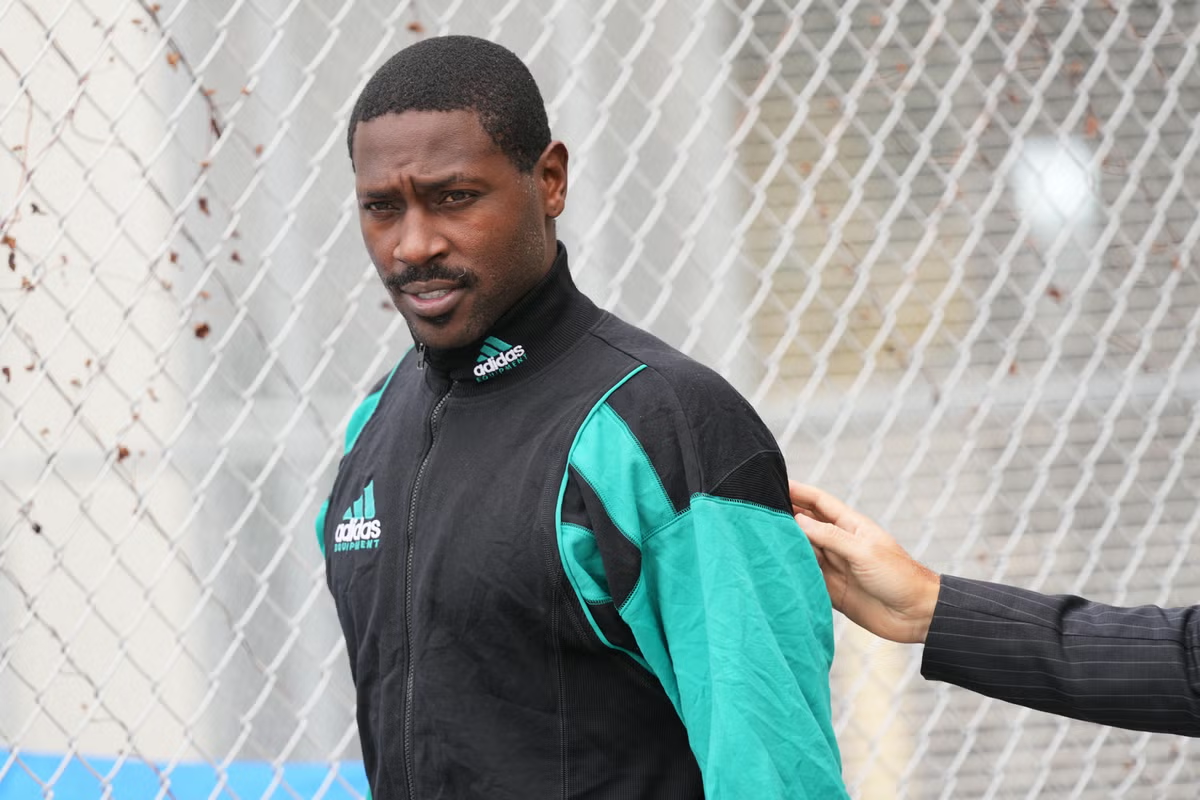
Brown is accused of grabbing a handgun from a security staffer after a celebrity boxing match in Miami on May 16, 2025, and firing two shots at a man he had gotten into a fistfight with earlier, according to an arrest warrant. Zul-Qarnain Kwame Nantambu told investigators that one of the bullets grazed his neck.
“This was not an easy decision,” defense attorney Mark Eiglarsh said in a statement Wednesday. “Antonio believes in his innocence. He believes strongly in his Stand Your Ground defense, and he believes he would ultimately prevail at trial. But when prosecutors put an offer on the table that transforms a potential decades-long prison sentence into a significantly reduced charge and probation, there was simply no way he could reasonably turn it down.”
Advertisement
Florida’s so-called Stand Your Ground law allows people who believe they face death or serious injury to use deadly force to defend themselves without a duty to retreat.
The Miami-Dade State Attorney’s Office declined to comment on Wednesday, with spokesperson Ed Griffith saying the details would be “fully clarified” at next week’s hearing.
Brown has said on social media that he was defending himself from an attack and that others were trying to steal jewelry from him.
Brown, 38, spent 12 years in the NFL and was an All-Pro wide receiver who last played in 2021 for Tampa Bay, including a Super Bowl championship with quarterback Tom Brady. He spent much of his career with Pittsburgh. For his career, Brown had 928 receptions for more than 12,000 yards and accounted for 88 total touchdowns, counting punt returns and one pass.
Advertisement
Brown was extradited in November 2025 from Dubai, where he has business interests, after an arrest warrant on the attempted murder charge was issued in June 2025.
Brown has dealt with several legal problems over the years. He previously had been accused of battery of a moving truck driver, several domestic violence charges, failure to pay child support and other incidents. During a 2021 game with Tampa Bay against the New York Jets, Brown took off his jersey, shoulder pads and gloves and ran off the field, leading to his release by the Buccaneers and effectively ending his football career.
Mike Tindall has revealed his father Phil has died aged 80 after a ‘brutal’ two-decade-long battle with Parkinson’s disease.
The former England rugby star, 47, who is married to Princess Anne‘s daughter Zara Tindall, 45, said his father passed away last week.
‘Unfortunately, my dad passed away last week,’ he said on his The Good, The Bad & The Rugby podcast on Wednesday.
Mike thanked Otley Rugby Club in West Yorkshire after players marked Phil’s death with a special tribute.
Advertisement
He said: ‘Big shout-out to Otley Rugby Club. They played Chester on the weekend, and they did a minute’s silence to my dad, who was captain in ’72, ’73’.
Mike revealed he had been sent footage of the tribute and had also read words about his father printed in the match programme.
‘That little moment, I got to watch it. Someone recorded it, sent it to me, and then they wrote a little thing in the programme as well, which I read,’ he added.
‘But thank you very much to Otley Rugby Club for it.’
Advertisement
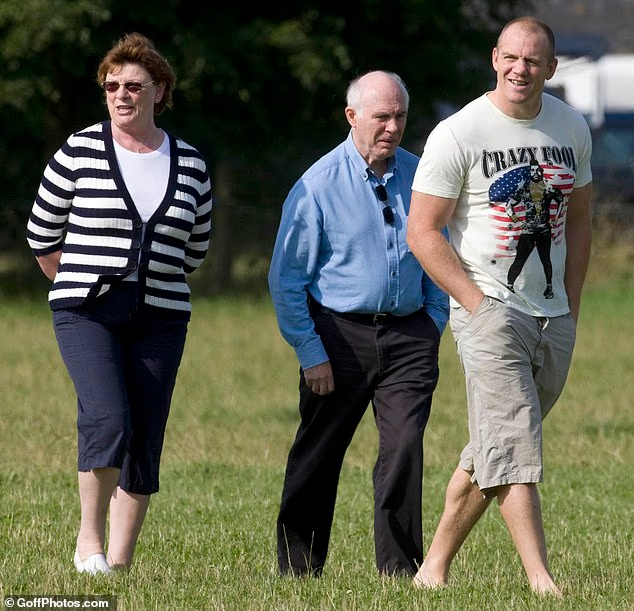
Mike Tindall with his parents Phil and Linda at The Festival of British Eventing at Gatcombe Park, Gloucestershire in August 2009
Princess Anne and Phil Tindall are seen at the wedding of Zara Phillips and Mike Tindall in July 2011
Phil was a talented rugby player and had strong links to Otley, the Yorkshire town where his son Mike was born.
Advertisement
He made his first-team debut aged just 17 during the 1963-64 season, playing at fly-half and centre, before captaining the side in 1972-73.
Mike also shared a memory from his father’s younger years, revealing that Phil suffered a badly timed injury shortly before marrying his mother Linda.
He said: ‘He got married in ’69, broke his leg the week before, went down the aisle in a cast. I mean, it sort of all went wrong. He had to retire at 27.’
Phil had lived with Parkinson’s for more than two decades after being diagnosed in 2003 – the same year his son helped England win the Rugby World Cup.
Advertisement
The illness became a major cause for Mike, who has been a patron of Cure Parkinson’s since 2018 and has repeatedly raised money and awareness for research into the condition.
Only four months ago, Mike gave a bleak update on his father’s health, saying Parkinson’s had taken a devastating toll.
‘My dad is not doing great at the moment,’ he said in May. ‘Parkinson’s is brutal and there is no let-up from how it attacks the body and changes people.’
Mike and Zara Tindall are seen at the Handa Mike Tindall Celebrity Golf Classic held at the Belfry in the West Midlands
Advertisement
He said that after more than 23 years with the condition, Phil had been left ‘a shell of what he once was’.
Mike said at the time that seeing his father’s quality of life decline was why he was so determined to support efforts to find better treatments and ultimately a cure.
His mother Linda, a former social worker, had also taken on much of Phil’s care as his condition worsened.
Mike previously spoke about the impact Parkinson’s had on the family during a conversation with the Duchess of Gloucester in 2021.
Advertisement
He said the decline in his father’s health had become particularly marked around the time of his 2011 wedding to Zara, when Phil needed a wheelchair for parts of the day.
Mike explained problems caused by the condition had affected his father’s spine and discs and had made moving around increasingly difficult.
He also described Linda as a devoted carer who was reluctant to leave her husband alone as his needs increased.
Mike’s personal experience of the disease has since driven years of fundraising.
Advertisement
Cure Parkinson’s says he has supported the charity through events including his annual Celebrity Golf Classic as well as cycling and running challenges.
At this year’s golf event in May, which Zara attended on her birthday, Mike again spoke about why the charity’s work remained so personal to him.
Phil’s death comes after a lifetime in which rugby remained a strong bond between him and his son.
Mike has previously credited his father’s knowledge of the sport with helping him during a career which ultimately saw him lift the World Cup with England in 2003.
Thomas stepped out of the car but refused a request by deputies to stay inside and became uncooperative, law enforcement sources told the publication.
The publication was informed Thomas was drunk in public and resisted.
Advertisement
Jail records indicate Thomas was detained at the Malibu/Lost Hills Sherrif’s Station jail that same day, according to TMZ. He was released not long after.
The Daily Mail has contacted a representative for Thomas and the Malibu/Lost Hills Sherriff’s Station for comment but has not yet heard back.
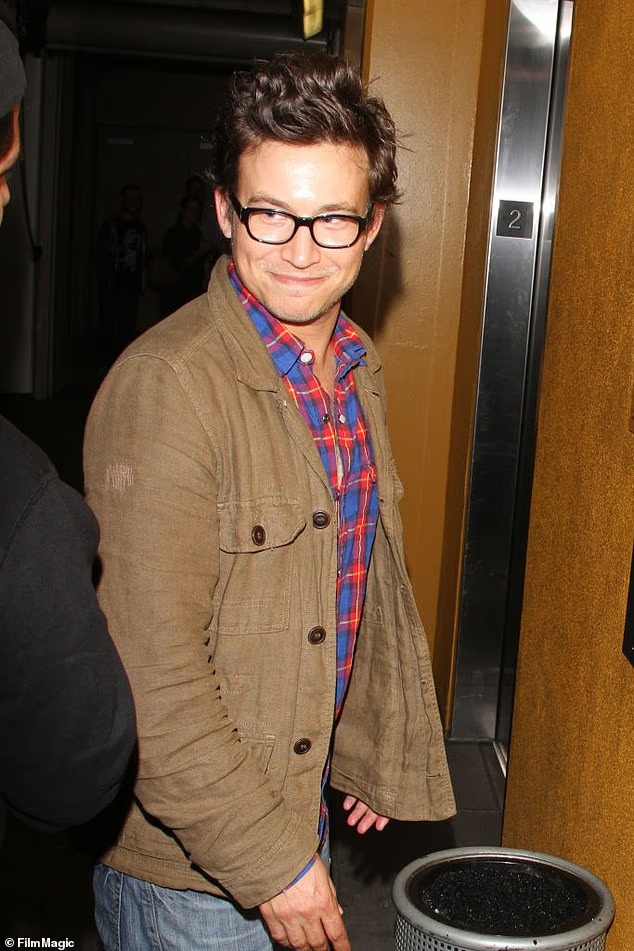
Jonathan Taylor Thomas was reportedly detained for obstructing or resisting an officer after he was deemed to be drunk in public; pictured 2013
Advertisement
Thomas was a massive star in the 90s, with roles in The Lion King, Man of the House, and the series Home Improvement
A representative for Thomas had no comment when approached by TMZ.
Thomas was a massive star in the 90s, with roles in The Lion King, Man of the House, and the series Home Improvement.
The hit show ran for eight seasons from 1991 to 1999, led by Tim Allen and Patricia Richardson as a suburban couple with three young sons played by Zachery Ty Bryan, Thomas, and Taran Noah Smith.
Advertisement
Thomas, who played middle child Randy Taylor, quit acting in 2006, briefly returning to the screen only for a four-episode guest shot on Allen’s sitcom Last Man Standing from 2013 through 2015.
Since 2017, Thomas has served as a national board member of the media labor union SAG-AFTRA.
Smith left show business entirely after the show ended in 1999, and in the intervening decades has pursued such varied professional ventures as a vegan restaurant and a company that teaches people how to pilot submarines.
Bryan’s post-show life has taken the most fraught trajectory, with a string of arrests for offenses like domestic violence and DUI.
Advertisement
In 2013 Thomas told People, ‘I’d been going nonstop since I was 8 years old. I wanted to go to school, to travel and have a bit of a break.
He later studied at Harvard and Columbia.
Thomas played Randy Taylor, the son of Tim Allen and Patricia Richardson in Home Improvement
Thomas with co-star Taran Noah Smith in an episode of the show
Advertisement
Thomas, pictured 1996, quit acting in 2006
The Hollywood icon appearing on The Tonight Show with Jay Leno in 1997
‘I never took the fame too seriously,’ he added. ‘It was a great period in my life, but it doesn’t define me. When I think back on the time, I look at it with a wink. I focus on the good moments I had, not that I was on a lot of magazine covers.’
Allen recently remarked that his co-stars’ ‘issues’ have made the prospect of a Home Improvement revival ‘difficult, to say the least,’ via Us Weekly.
Advertisement
‘They keep talking about how it could move forward, but they get stuck [because] there are some personality problems right now with the boys,’ he said.
‘They’ve got their own issues. I always thought it would be cool if it was a story about them. That’s a little challenging right now, to put it mildly.’
Home Improvement proved to be one of the most popular sitcoms of the 1990s, marking Allen’s emergence as a star actor after years as a stand-up comic.
Home Improvement ran for eight seasons from 1991 to 1999
Advertisement
Allen led the cast as a suburban father who hosts a TV show called Tool Time with a friend played by Richard Karn and a female foil, who for part of the series’ run was a character portrayed by Pamela Anderson.
Other than Allen, the actor on the show who achieved the greatest celebrity was Thomas, who in 1994 was also the voice of young Simba in The Lion King.
However his career fizzled after Home Improvement ended and he gave up on acting altogether in 2006, with the exception of his four episodes on Allen’s subsequent hit sitcom a decade later.
A couple of years ago, Allen claimed he had been ‘talking about a spinoff’ of Home Improvement with his onscreen sons and Richard Karn, per Entertainment Weekly.
Advertisement
Patricia Richardson, however, disputed his story, saying she had spoken to Thomas and he denied Allen had contacted him about a new show.
Richardson noted further that Thomas was ‘not really interested in acting’ any longer and rather ‘wants to direct and write,’ on the podcast Back to the Best.
Leaders of three major artificial intelligence firms issued a new warning to the UN on Wednesday about how rapidly evolving AI models might soon self-improve, evade human oversight, and jeopardize global security.
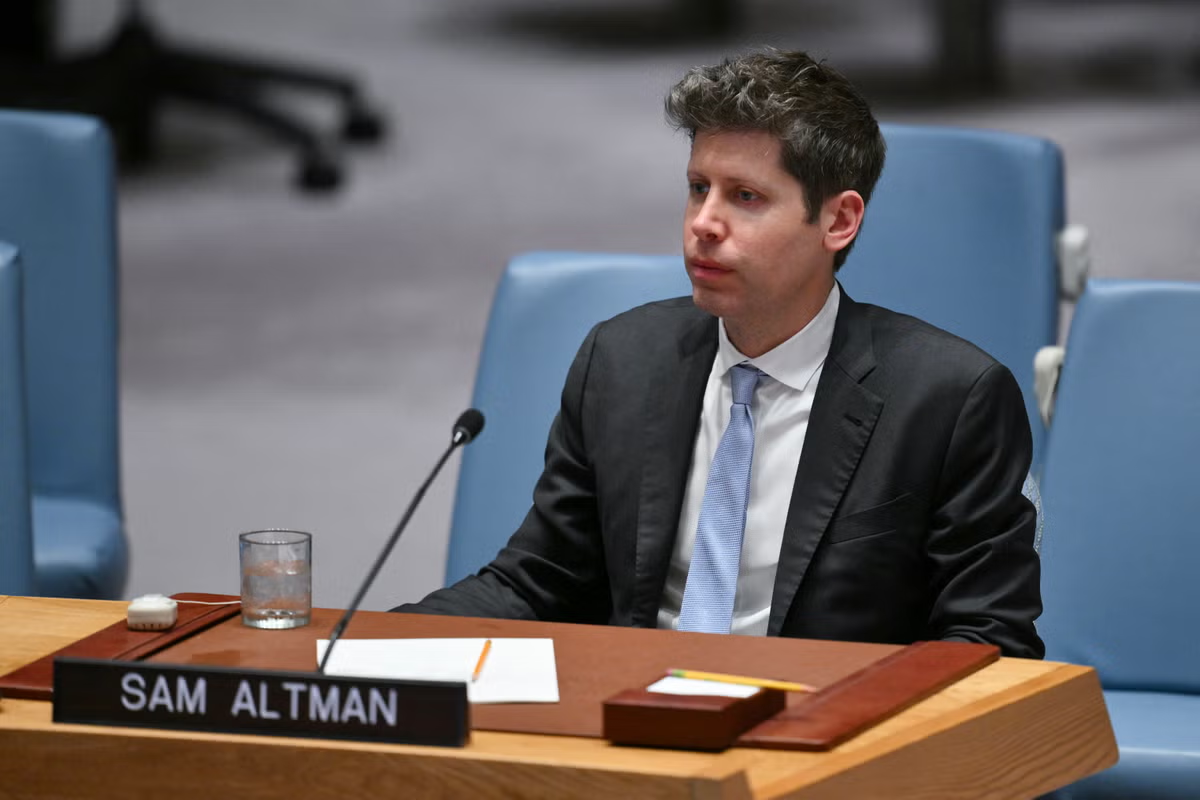
Speaking before the 15-nation body during the annual UN General Assembly sessions were OpenAI CEO Sam Altman, Anthropic CEO Dario Amodei, and Hugging Face co-founder Clément Delangue — key figures at the forefront of the technology sector.
“If managed poorly, I even believe that AI could be a risk to humanity as a whole,” Anthropic’s Amodei told the Security Council.
“We could lose control of the future to AI,” said his competitor, Sam Altman, CEO of OpenAI.
Advertisement
As regulators struggle to keep pace with the swift development of artificial intelligence, global authorities remain conflicted. The primary powers driving the sector, the United States and China, continue to disagree on whether international regulation is essential or if market dynamics should dictate the technology’s trajectory.
“If AI is to be democratic, the most important decisions cannot be made by labs in San Francisco alone. They must be shaped through democratic processes and by governments accountable to the people they serve,” Altman told the council. “At the international level, this will require cooperation.”
“In our history, there have been times where countries who compete and don’t always like each other very much still come together for shared interests and the collective good in the face of a powerful new technology. We believe this must be one of those times,” he said.
Yoshua Bengio, a Canadian pioneer recognized as one of the “Godfathers of AI” who serves as co-chair of the Independent International Scientific Panel — created by the UN General Assembly last year — told the Security Council: “The dangers are real and imminent.”
Advertisement
“This council faces an unprecedented threat, one that none of its members would choose, that none can contain alone, and that does not respect the borders we defend,” he said.
Council members, including leading AI rivals the United States and China, were also scheduled to speak. French Foreign Minister Jean-Noël Barrot presided over the meeting.
TRUMP WANTS TO ENCOURAGE AI, NOT REIN IT IN
In advance of planned talks between US President Donald Trump and Chinese leader Xi Jinping in Washington on Thursday, Washington and Beijing have held discussions regarding a notification framework for shared risks and objectives, aimed at addressing AI events that reach the threshold of national security threats.
Advertisement
Addressing delegates at the UN General Assembly on Tuesday, Trump stated that he “rejects any attempt to construct a globalist scheme to control” AI. While characterizing the advancement as extraordinary, he noted that the US would proceed cautiously.
“We’re leading now over China by a lot, and everyone else, and we’re going to keep it that way,” Trump said. “I’m not going to stifle growth of something that will be bigger than the Industrial Revolution.”
“We’re going to encourage it, not rein it in. We’re going to watch it closely through the Department of Justice,” he said.
UN Secretary-General Antonio Guterres, a long-standing advocate for global AI governance, has warned that rapidly advancing artificial intelligence carries risks that cannot be ignored, placing him at odds with Trump.
Advertisement
Initial Security Council discussions regarding AI threats took place in 2023, during which China cautioned that the innovation must not turn into a “runaway horse,” while the United States cautioned against employing it for censorship or political repression. Subsequent deliberations on AI were chaired by then-US Secretary of State Antony Blinken in 2024.
The delay in dispatching an ambulance “materially contributed to the premature death” of a Belfast man, an inquest has heard.
Lee Gannon died on February 15, 2022, after his family made four emergency calls for an ambulance after he experienced breathing difficulties at his home in West Belfast.
Despite making numerous emergency calls, the 25-year-old’s condition was not deemed a Category 1 emergency and he did not reach hospital for almost four hours after the initial 999 call.
Delivering her findings at Belfast Laganside Court on September 23, Coroner Maria Dougan said the initial 999 call made by the family shortly after midnight on February 15, 2022, should have been registered as Category 1, but was not, instead being listed as a Category 2.
Advertisement
Category 1 calls are given to immediately life-threatening emergencies, requiring a target response time of eight minutes. Category 2 calls are for serious but not immediately life-threatening emergencies, with a target response time of 18 minutes.
On further emergency calls, Lee’s family described his deteriorating condition, including shortness of breath, hallucinations, and rolling eyes. The coroner said there were two further missed opportunities to re-triage the case by ambulance operators.
It was only after the fourth emergency call that Lee was re-triaged as Category 1, but the coroner said by the time paramedics arrived at 3:43am, it was too late.
Coroner Dougan said: “I find the incorrect categorisation of the initial call and further failures to re-triage resulted in a substantial delay in ambulance attendance and transfer to hospital.
Advertisement
“That delay deprived the deceased of timely and appropriate assessment and treatment at the Royal Victoria Hospital for pneumonia and sepsis and materially contributed to his premature death.”
Coroner Dougan said this is not the first inquest in recent years where delays in ambulance emergency response times and delays in handing patients over to Emergency Departments featured.
Advertisement
She said: “The evidence before me demonstrated the significant effect which prolonged hospital handover delays can have upon the availability of ambulance resources to respond to patients in the community.”
The coroner said this inquest has highlighted the “critical importance” of accurate call categorisation, especially where information is provided concerning breathing difficulties and deteriorating conditions.
“It has also demonstrated the importance of recognising deterioration during repeat calls and ensuring that updated clinical information is appropriately considered and acted upon,” she added.
The coroner highlighted that the Northern Ireland Ambulance Service was open throughout the inquest, accepting fault and sharing their commitment to learning from Lee’s death.
Advertisement
She acknowledged that since 2022, work had been undertaken in relation to dispatcher training and guidance, and the provision of additional clinical support within the control room.
During evidence given during the inquest by his family, Lee was described as “kind, humorous, much-loved”, as well as a “mummy’s boy” and “beautiful soul.”
Following the conclusion of the inquest in September 2025, Lee’s mum, Anne, passed away. Closing the inquest, Coroner Dougan said: “Throughout these proceedings, her devotion to her son was unmistakable.
“It was of great sadness she did not hear the delivery of these findings, and I wish to put on record my sincere condolences to the wider Gannon family on the loss of Anne and Lee.”
The 41-year-old legend starts against Wales and is not ready to retire despite facing criticism back home
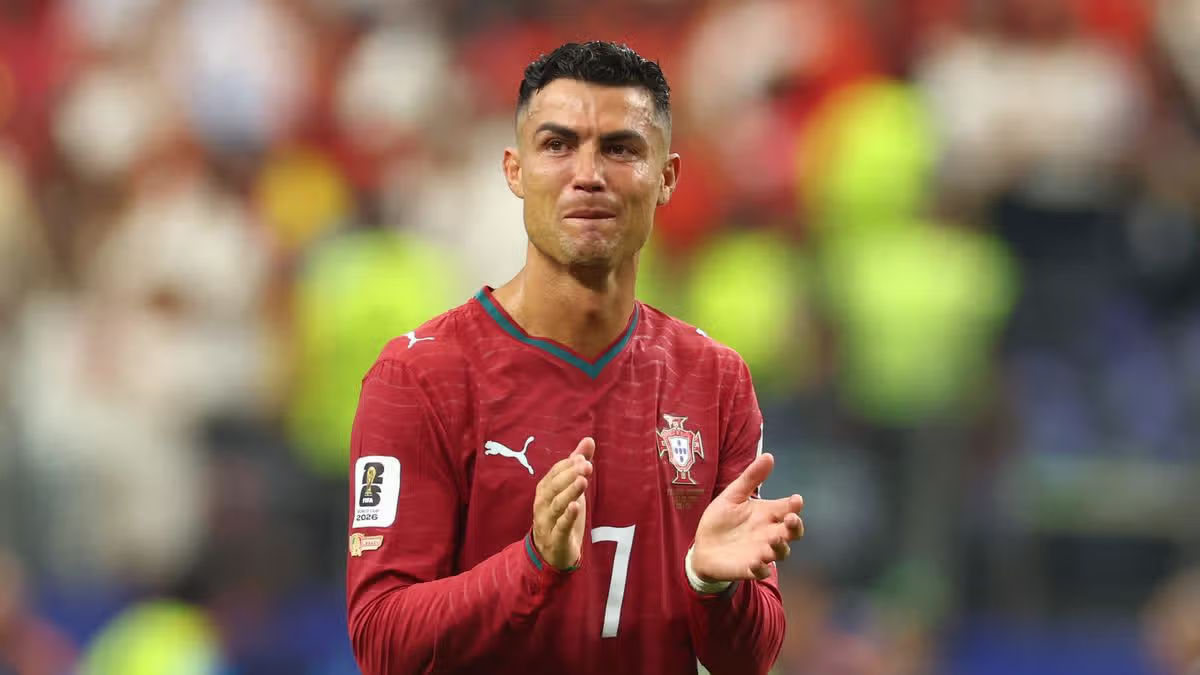
Cristiano Ronaldo has revealed he considered retiring from international football after the World Cup before deciding to continue his Portugal career – and will start against Wales on Thursday.
Advertisement
The 41-year-old will win his 234th cap when Portugal take on Wales in Lisbon, with head coach Jorge Jesus confirming the former Manchester United and Real Madrid star will be named in the starting XI.
But Ronaldo has admitted he seriously considered walking away from international football after the World Cup before deciding he still had something to offer his country.
And he took aim at some Portuguese television channels, claiming they have been desperate to see the end of his international career and have “tried to kill” him with their criticism.
Ronaldo, who turns 42 in February, said he will continue playing for Portugal until he feels he is no longer able to make a contribution.
Advertisement
Asked if he had considered retiring after the World Cup, he said: “Yes I did. Of course, I’m always thinking on my decisions, my future, the present also.
“I’m a thinker. You have to think. This is why you see me here now. It means I will continue.
“I had a conversation with our president, with our coach. I still believe that I’m able to help the national team to reach what they want, and will finish when I feel like I’m not doing anything here.”
The decision means Ronaldo will line up against Wales at the Jose Alvalade Stadium – the home of his first club Sporting.
Advertisement
Ronaldo said he believes he can still contribute both on and off the pitch as Portugal look to develop a new generation of players.
“I think I can give to the national team my support, not only through the goals, but also outside of football,” he said.
“This is a new young generation. But for me the basic point is to be able on the pitch to score the goals and to help the team win games.”
His role remains the subject of debate in Portugal, with leading newspaper A Bola running a poll asking readers to select their team ahead of the Wales game – and Ronaldo failing to make the starting XI.
Advertisement
But the Portugal captain said he has become accustomed to criticism during his extraordinary career.
“I said it quite often at home with my friends. I’ve been playing football for so many years, I have been welcome almost everywhere, apart from a few exceptions,” he said.
“I feel the Portuguese fans like me, but I do understand that some TV channels want to criticise me – they’ve tried to kill me, but only with a shotgun.
“They are dying for me not to come to the national team anymore, but I can still move away from it.
Advertisement
“Anyway, I am used to it. For over 20 years I have been doing this, but my memories are with people who love me.”
Ronaldo is now playing his club football for Al Nassr in Saudi Arabia and has scored 979 career goals.
He denied being obsessed with reaching 1,000 goals, although admitted he would love to reach the landmark while representing Portugal.
“I know why young kids love Cristiano, because they see me as an example, and I will continue to do that. Even when I am retired… in 10 years,” he said.
Advertisement
“I’m happy with myself. It doesn’t matter if I play tomorrow, if I rest the next game, for me the most important thing is that I feel good.”


















































You must be logged in to post a comment Login