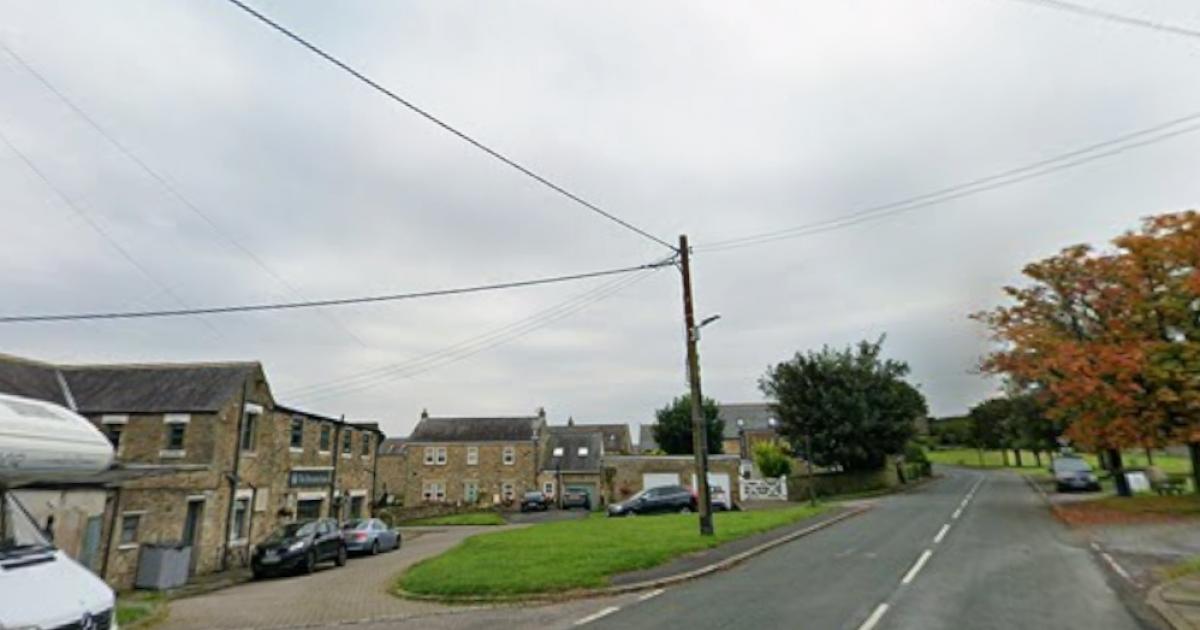
Edmundbyers sits a few miles west of Consett on the edge of the North Pennines, just inside the County Durham border with Northumberland, and with a population of fewer than 200 people it has the feel, in the words of one visitor, of a place that has resisted the modern world almost entirely.
“It is in a wonderful location,” wrote one cyclist who stopped here on the Coast to Coast route, describing it simply as “a small village surrounded by moorland.”
That understatement does it justice.
Edmundbyers has evidence of prehistoric settlement from the Neolithic era, a 12th-century church that hid its stone altar from the Archbishop of Canterbury, a pub whose regulars have been coming for 40 years, and what is believed to be the oldest continuously running youth hostel in the North of England.
A name with roots in Old English
The village name itself tells a story. Edmundbyers derives from the Old English “Eādmund’s bur,” meaning Edmund’s dwellings, a combination of the personal name Edmund and “bur,” the dialect form of bower, meaning a dwelling or shelter.
An early record of the name lists the village as simply “Edminber.”
The first written mention of Edmundbyers appears in the Boldon Book, the survey commissioned by the Bishop of Durham in 1183, where it is recorded that “Alan Bruntoft holds Edmundbires for his service in the forest.”
By around 1382, the land had passed to Durham Cathedral, held by the Prior.
The church that hid its altar
The oldest building in the village is St Edmund’s Church, tucked into the western edge of the settlement with views over the fells.
Built around 1150, possibly on the site of an earlier pre-Norman structure, it is Grade II listed and contains evidence of Saxon architecture in its walls.
Inside, one of the church’s most remarkable features is its stone altar, hidden from authorities when such Catholic furnishings were banned by Archbishop Grindal in 1571 during the Reformation, and only rediscovered and reinstated when the building was restored in the 1850s.
Two Saxon-type grave covers are built into the walls of the porch, and the list of rectors displayed inside the church begins with Richard de Kirkeby in 1275.
Edmundbyers Cross, visible near the village, is one of only three wayside crosses remaining in its original position in County Durham, and the only known example on the ancient route between Stanhope and Edmundbyers.
The last witch of County Durham
One grave in the churchyard of St Edmund’s draws more curious visitors than any other.
Elizabeth Lee, who died in 1792 at the age of 87, is reputed to have been the last in a long line of witches said to have lived in and around Edmundbyers. She appears to have lived a full life, born around 1705, married to a John Lee who died in 1771, and regarded with deep suspicion by her neighbours for decades.
In death, she remained a figure of fascination.
Her grave has been visited for generations by those interested in the darker threads of Durham’s history, and in 2021, she was the subject of a commissioned poem for Durham Literary Festival.
![]() (Image: Getty)
(Image: Getty)
The ghost at Low House
A few steps from the church stands Low House, the building that has served as Edmundbyers Youth Hostel since it opened on April 1, 1933, making it one of the oldest continuously operating hostels in the North of England.
The building itself is far older, dating back to around 1600, when it was built as the Miners’ Arms to serve workers in local pits and mineral workings.
Today it is independently run, sleeping up to 31 guests across six rooms, with a bar serving locally brewed beer, a self-catering kitchen and a campsite in a walled garden.
It also reportedly comes with a ghost.
Ann Elliot, who was murdered on the moor and buried at St Edmund’s in 1785, is said to haunt the building. Visitors report nothing more alarming than a sound night’s sleep.
Derwent Reservoir
Two miles south of the village, Derwent Reservoir stretches across 1,000 acres of moorland and woodland on the Durham-Northumberland border.
Opened in 1967, it is one of the larger inland bodies of water in England and the main water supplier for much of Tyne and Wear.
The reservoir is a country park managed by Northumbrian Water and is free to visit, with a circular walk of around nine miles covering the full perimeter.
Red squirrels have been spotted in the surrounding trees, and the resident birdlife includes goldeneye, goosander, great crested grebe and, in winter, visiting flocks of teal and widgeon.
![]() (Image: Sarah Caldecott)
(Image: Sarah Caldecott)
One Tripadvisor reviewer described the circular walk as outstanding, writing: “The paths are well defined and you can soon lose the crowds. Parking is free of charge, and there is a cafe. Well worth a visit.”
Edmundbyers also sits on the Coast to Coast cycle route, and the 18-mile Derwent Reservoir cycling circuit, taking in the reservoir, Blanchland and the surrounding moors, starts and ends in the village.
The Derwent Arms
The village pub, the Derwent Arms on the village green, holds a Tripadvisor rating of 4.5 from 124 reviews, with visitors praising the home-cooked food, local real ales and six en-suite bedrooms.
One recent reviewer wrote: “Such a welcoming pub in a beautiful setting. The food was superb, freshly cooked, generous portions and reasonably priced.”
Another added: “Lovely warm atmosphere, great beer, fantastic food. Exactly what you want when you come off the moors.”
The pub is open for food throughout the week, and the six rooms make it a practical overnight base for walkers and cyclists exploring the wider Derwent Valley.
![]() (Image: Inn Hospitality Group)
(Image: Inn Hospitality Group)
Getting there
Edmundbyers is on the B6306, approximately eight miles west of Consett and 17 miles south west of Newcastle.
The village is also served by a bus route between Shotley Bridge and Blanchland.
The nearest postcode for the village centre is DH8 9NL.





















































You must be logged in to post a comment Login