NEW YORK (AP) — A jury found Wednesday that entertainment giant Live Nation, which hosts tens of thousands of concerts a year, and its Ticketmaster subsidiary had a harmful monopoly over big venues.
The ruling, in a lawsuit brought by dozens of states, won’t immediately bring relief for concertgoers who have long complained about high ticket prices. But it could cost Live Nation hundreds of millions of dollars and perhaps force the company to sell some of its concert venues when the judge hands out penalties later.
Among other things, the jury found Ticketmaster’s anticompetitive practices led to people in 22 states paying an extra $1.72 per ticket, which the judge could order the companies to pay back.
A jury in New York deliberated for four days before reaching its decision. State attorneys general who sued Live Nation said the verdict could potentially lead to lower ticket prices for music fans.
Advertisement
AP AUDIO: Jury finds that Ticketmaster and Live Nation had an anticompetitive monopoly over big concert venues
Advertisement
AP correspondent Julie Walker reports Ticketmaster and Live Nation lose their antitrust trial in New York.
Live Nation said in a statement that the verdict “is not the last word on this matter.”
The company predicted that once a remedy phase of the litigation is completed before the judge and all appeals are resolved, the outcome likely won’t be much different from what the federal government achieved with a settlement it reached with the company just after the trial began.
That deal included a cap on service fees at some amphitheaters, plus some new ticket-selling options for promoters and venues — potentially allowing, but not requiring, them to open doors to Ticketmaster competitors such as SeatGeek or AXS.
Advertisement
The trial was a backstage pass
The trial gave fans the equivalent of a backstage pass to a business that dominates live entertainment in the U.S. and beyond.
Jurors also got to see a Live Nation employee’s internal messages to another employee declaring some prices “outrageous,” calling customers “so stupid” and boasting that the company was “robbing them blind, baby.” The employee, Benjamin Baker, who has since been promoted to a position as a ticketing executive, apologetically testified that the messages were “very immature and unacceptable.”
Live Nation Entertainment owns, operates, controls booking for or has an equity interest in hundreds of venues. Its subsidiary Ticketmaster is widely considered to be the world’s largest ticket-seller for live events.
Advertisement
Sign up for Morning Wire:
Our flagship newsletter breaks down the biggest headlines of the day.
Advertisement
The verdict could cost Live Nation and Ticketmaster hundreds of millions of dollars, based on the jury’s estimate that customers paid an extra $1.72 per ticket. The companies could also be assessed penalties. In addition, sanctions could result in court orders that they divest themselves of some entities, including venues such as amphitheaters that they own.
Advertisement
Michael Rapino, chief executive officer and president of Live Nation Entertainment Inc., arrives at Manhattan Federal court, Thursday, March 19, 2026 in New York. (AP Photo/Adam Gray)
Advertisement
Michael Rapino, chief executive officer and president of Live Nation Entertainment Inc., arrives at Manhattan Federal court, Thursday, March 19, 2026 in New York. (AP Photo/Adam Gray)
Advertisement
Advertisement
Advertisement
In its statement, Live Nation said the jury’s award of $1.72 per ticket applied to “a limited number of tickets” sold at 257 venues and representing about 20% of total tickets sold. The company estimated the aggregate single damages figure would be below $150 million, though it would be trebled.
Advertisement
The civil case, initially led by the U.S. government, accused Live Nation of using its reach to smother competition — by blocking venues from using multiple ticket sellers, for example.
Live Nation denies it is a monopoly
Live Nation insisted it is not a monopoly, saying that artists, sports teams and venues decide prices and ticketing practices. A company lawyer said its size was simply a function of excellence and effort.
“Success is not against the antitrust laws in the United States,” attorney David Marriott said in his summation.
Ticketmaster was established in 1976 and merged with Live Nation in 2010. The company now controls of 86% of the market for concerts and 73% of the overall market when sports events are included, according to an attorney for the states, Jeffrey Kessler.
Advertisement
Ticketmaster has long drawn ire from fans and some artists. Grunge rock titans Pearl Jam battled the business in the 1990s, even filing an anti-monopoly complaint with the U.S. Department of Justice, which declined to bring a case then.
Decades later, the Justice Department, joined by dozens of states, brought the current lawsuit during Democratic former President Joe Biden’s administration.
Days into the trial, Republican President Donald Trump’s administration announced it was settling its claims against Live Nation.
A handful of the states joined the settlement. But more than 30 pressed ahead with the trial, saying the federal government hadn’t gotten enough concessions.
Advertisement
Attorneys hail verdict
New Jersey Attorney General Jennifer Davenport said in a release after the verdict that Live Nation’s “illegal, anti-competitive practices” had driven up ticket prices and made it harder for fans to see their favorite acts.
New York Attorney General Letitia James called the verdict “a landmark victory.”
After the victory, Kessler would not say specifically what the states will seek in the next phase of the litigation, which was expected to involve another lengthy legal proceeding before penalties are decided.
Scarlett Moffatt opened up about the pain of losing a baby on I’m A Celebrity… South Africa
Mark Jefferies Showbiz Editor and Sara Baalla Screen Time TV Reporter
13:37, 18 Apr 2026Updated 13:40, 18 Apr 2026
I’m A Celebrity… South Africa star Scarlett Moffatt has opened up in camp about the heartbreak of losing a baby while she and her partner were trying to have a second child.
The former Gogglebox star is engaged to ex-police officer Scott Dobinson. Together they share one son, Jude, who arrived in June 2023. However, their hopes of expanding the family have faced difficulties.
Advertisement
Speaking to Sinitta during Friday’s (April 17) episode, Scarlett said: “We tried for a long time and had some losses, and it’s not nice, is it? And because no one talks about it, you think something is wrong with you. You’re like, why is it not happening? It’s a hard one.
“After Jude was born, we tried again and got quite far on and miscarried, and I remembered Scott’s mum and dad took Jude for the day, and me and Scott just laid in bed crying. It was awful. Because in our head, we were like, ‘Oh, like, imagine them running downstairs at Christmas together’.
“You imagine it. When you lose a baby in that way, you’re sort of mourning a life that you imagined. It’s just really sad. We just have to be so grateful we have got ours,” reports the Mirror.
Speaking in the Bush Telegraph after the conversation, Scarlett reflected on her ability to confide in her fellow campmates.
She said: “I feel like we’re really open in camp. You’re so far away from your normal world you can almost talk about anything. We’ve all listened and spoken with such care to each other that I really believe that we’ve got friendships for life.
“When all you want is a family. It’s really hard when that doesn’t just come naturally and easily. You know, you question yourself. You question, why is it not happening? Is it ever going to happen? And it’s just really hard, like it just makes life feel heavier.”
Scarlett, 35, won the I’m A Celebrity crown in Australia in 2016. Her relatable and genuine manner on the current series has endeared her to countless additional viewers.
Advertisement
She’s also proved popular amongst her fellow campmates, forging friendships with the likes of Sinitta and Ashley Roberts, and tackling a challenge alongside Ashley last week.
In an interview with Heat Magazine earlier this month, she quipped that her postponed nuptials might mirror her parents’ 27-year engagement, ensuring they were certain about each other.
Scarlett said: “I’m not stressed about it, and I think that’s the problem. I got engaged three years ago. I think me and Scott are so laidback that nothing gets done.
Advertisement
“We need an intervention where someone comes in and physically books everything for us because we just keep going, ‘We’ll sort it next year.’”
However, she confirmed she wants it arranged before reaching her landmark birthday in 2030. She added: “We’re in no rush, but I’ve definitely said before I’m 40, ideally. But then you might ask us that question at 40, and I’ll say 50.”
I’m A Celebrity… South Africa is available to stream on ITVX
The Sands National Helpline provides a safe, confidential place for anyone who has been affected by the loss of a baby. You can call the Sands Helpline on 0808 164 3332 or visit www.sands.org.uk
Hollywood A-lister, Alec Baldwin, was found not guilty of manslaughter following the fatal shooting on the set of his film, Rust – however he now faces a civil trial
13:16, 18 Apr 2026Updated 13:16, 18 Apr 2026
Alec Baldwin is due back in court following the tragic death of Halyna Hutchins. The cinematographer and mum-of-one, 42, died on the set of the actor’s film, Rust, in 2021 when a live round was discharged from a revolver that Baldwin, 68, was using as a prop.
The Santa Fe County Sheriff’s Office in New Mexico stated that neither Baldwin nor first assistant director David Halls knew that the gun in question was loaded.
On January 31, 2023, the district attorney charged Baldwin and armorer Hannah Gutierrez-Reed with one count each of involuntary manslaughter. Halls agreed to plead guilty to the charge of the negligent use of a deadly weapon.
Advertisement
On February 23, 2023, Baldwin pleaded not guilty, and on April 20, it was reported that prosecutors had indicated that the charges against him were being dropped.
However, on Friday, April 17, a Los Angeles judge ruled that a lawsuit filed by Rust crew member Serge Svetnoy against the actor will proceed.
Los Angeles Superior Court Judge Maurice Leiter ruled that a lawsuit brought by Svetnoy will proceed to determine if Baldwin negligently fired a loaded revolver on the film set at the Bonanza Creek Ranch near Santa Fe, New Mexico, which struck and killed the mother, according to Mail Online.
Back in October, manslaughter charges were dismissed by a New Mexico judge after she determined that prosecutors allegedly withheld evidence.
Now, Svetnoy is suing the film’s star and production company for emotional distress suffered due to alleged negligence on set.
Prior to the shooting, several crew members reportedly walked off set, citing safety concerns, including two previous accidental discharges of prop guns.
Advertisement
Baldwin, who fired the fatal shot from a prop revolver, has always maintained that he had no idea the gun was loaded with live rounds and denied ever pulling the trigger. The film’s director, Joel Souza, was also injured in the shooting.
In a statement to the Daily Mail, Svetnoy’s attorney, John M. Upton, said they were ‘pleased with the Court’s decision to deny the motions for summary judgment brought by Rust Movie Productions and Alex Baldwin.
‘These rulings enable our client to present his case at a jury trial, now scheduled for October of this year,’ he added. ‘He looks forward to finally having his day in court on this long-pending matter. ‘
The Mirror has contacted Baldwin’s rep for comment.
Emergency crews raced to the M90 late on Friday night.
A major Scottish motorway has been locked down for more than 12 hours following a reported “fatal” crash. Emergency services were called to a serious collision on the M90 near Kinross at around 10.30pm on Friday.
Amey North East Trunk Roads, which maintains roads on behalf of Transport Scotland, has been sharing updates since the initial crash. Posting on X, formerly Twitter, at 11.40pm, the transport agency said the motorway was “closed in both directions between Kinross and Arlary” with a diversion in place.
Advertisement
In an update shortly after 1am, Amey reported that the crash had claimed someone’s life. Amey wrote: “The M90 remains closed in both directions due to a fatal RTC. Northbound Lane 1 will be opened shortly. Police and Amey crews are on site. No delays in the area.”
The northbound carriageway had one lane reopened before 3am on Saturday, with fire crews departing the scene in the same period.
Crash investigations reportedly completed at around 10.30am, and vehicle recovery was completed around an hour later but only one lane was open northbound by 1pm, with the southbound carriageway still fully closed.
A Police Scotland spokesperson said: “The M90 southbound is still closed at Kinross, between junctions 6 and 9, following a two-car crash.
Advertisement
“We were made aware around 10.30pm yesterday and emergency services remain at the scene. A local diversion is in place. Please avoid the area.”
Advertisement
A spokesperson for the Scottish Fire and Rescue Service said: “We received the call at 10.40pm to a two-vehicle crash on the M90. Three appliances were dispatched, with the last one leaving the scene at 2.36am.”
The latest Amey update at 12.40pm read: “M90 Southbound remains closed due to an RTC, with lane 2 remaining closed Northbound. Crash investigations have been completed. Recovery has been completed; the debris clean-up has now commenced. Standard diversion remains in place. No delays showing in the area.”
Get more Daily Record exclusives by signing up for free to Google’s preferred sources. Click HERE
The village was also a filming location for a much-loved TV series
If you are looking for somewhere to visit this spring, then a Cambridgeshire village home to thatched cottages, a historic church, and highly-rated pubs should be on your list. Those who have lived in the county for many years may often find themselves looking for somewhere a little bit different to explore.
Advertisement
Grantchester can be found just two miles south of Cambridge, known best for its tranquil riverside meadows, historical ties to poet Rupert Brooke, and for being a filming location for a popular TV series. You can reach it by taking a peaceful walk from Cambridge, perfect for a warm day.
Grantchester has also been picked out as one of the UK’s best villages to visit in spring by London North East Railway (LNER). LNER has highlighted the best spring villages to visit by train, looking at everything from walking trails and nearby gardens to the variety of flowering plants.
The company said: “We also considered how each village comes to life in spring, from bursts of colour to those picture-perfect moments you’ll want to linger a little longer.”
Grantchester was included among these places in the East of England region. Explaining the reasons for choosing Grantchester, LNER said: “Grantchester is a landscape of thatched cottages and wildflower meadows that feels like it’s been plucked straight from a Sunday night drama.”
The train operator also encouraged those who are adventurous to follow the river to Byron’s Pool, a wooden nature reserve where Lord Byron himself used to swim. LNER said it is a “peaceful, shaded escape that feels worlds away from the academic hustle of the city nearby”.
It is no wonder why the beautiful village of Grantchester has been chosen. Set in beautiful countryside but within walking or cycling distance to Cambridge’s city centre, the village makes for the ideal day visit out, or even a forever home.
Arguably the most notable feature in the village is the Orchard Tea Garden, a top-notch spot that has even been a favourite of illustrious characters over the years. From Virginia Woolf and Alan Turing to Stephen Hawking and King Charles, many people have a special place in their hearts for the tea rooms.
Advertisement
Offering delectable items including scones and homemade cakes, “there’s nothing quite like having a scone under the blossoming apple trees to mark the start of the season”, LNER added.
Grantchester was once home to one of the best-known English poets, Rupert Brooke, who studied at Cambridge University in the early 20th-century before moving to the village. He lived at The Orchard from 1901-1911 and at The Old Vicarage between 1911-1912.
Equally as fascinating, the village was featured in ITV’s much loved detective drama, Grantchester. Key filming spots include the Church of St Andrew and St Mary, the village centre, and Grantchester meadows.
Advertisement
Home to several pubs including The Red Lion and The Grantchester Green Man, this village has a spot that everyone can enjoy. Additionally, the picturesque village has Grantchester Church, featuring some Norman stonework but primarily of 14th and 15th-century construction.
This is the text from The Conversation UK’s World Affairs Briefing email. Sign up here to receive weekly analysis of the latest developments in international relations, direct to your inbox.
The US is reported to be greatly expanding the scope of its naval blockade of Iran, asserting the right to board and seize any ships it believes to be carrying “contraband” or “conditional contraband” bound for Iran from anywhere on the open seas. Respected maritime news and intelligence agency, Lloyd’s List, says this means that “almost any industrial cargo bound for Iran could plausibly be intercepted”. This will considerably raise the stakes in an already fraught situation.
Opinions are already divided as to how effective this “blockade of a blockade” is likely to be. The US president made the decision on April 12 to “seek and interdict every vessel in International Waters that has paid a toll to Iran. No one who pays an illegal toll will have safe passage on the high seas.” The intention was to make clear to Tehran that they were ultimately not in control of the strait and certainly wouldn’t be allowed to profit by imposing a charge on ships it allowed to pass through.
The problem for the US is that traffic through the strait remains largely at a standstill. Reuters’ live tracker of traffic in the strait suggests a considerable gathering of vessels on either side of the waterway, with very little evidence of ships actually transiting the strait.
Advertisement
It is, writes maritime strategy expert Basil Germond, of Lancaster University, a question of who can withstand more pain from the economic fallout. So the US plan to seek and seize ships wherever they are on suspicion of carrying almost any sort of industrial cargo is clearly aimed at increasing that pain for Iran.
But one of the dangers is how far and how fast the situation might escalate. There was a fraught moment on April 14 when it appeared as if a Chinese-linked tanker had transited the strait. The Rich Starry, registered in landlocked Malawi, is Chinese owned and crewed. Would the US try to board the boat? How would China react if it did?
China buys about 90% of Iranian oil and is one of the few countries whose tankers were getting in and out of Iranian ports unchallenged, writes Tom Harper, an expert in Xino-US relations at the University of East London. US seizure of any Chinese tankers would be bound to considerably ratchet up tensions between the two superpowers.
Advertisement
As it turned out, the Rich Starry turned back in the Gulf of Oman and re-entered the strait without being stopped or challenged by the US. But the new US operating instructions could well make a confrontation more likely. Harper explores the implications of the US-Iran conflict for relations between Washington and Beijing in the run-up to Donald Trump’s planned state visit to the Chinese capital next month.
Meanwhile the conflict between Israel and Hezbollah in Lebanon continues unabated. Ambassadors from the two countries met in Washington this week, where they resolved to hold direct, high-level talks. The US president has said that the leadership of the two countries would also speak, “for the first time in 34 years”, but the office of Lebanon’s president Joseph Aoun denied any knowledge of the arrangement, saying that a ceasefire would need to be in place before any talks could take place.
Whether the US president has the leverage over Israeli prime minister, Benjamin Netanyahu, to make that happen is another matter. The US and Israel certainly have one of the strongest partnerships of any two countries, write Bamo Nouri and Inderjeet Parmar of City St George’s, University of London. The US was the first country to formally recognise the state of Israel in 1948 and Washington has since provided the Jewish state with more than US$300 billion (£220 billion).
Advertisement
Wars against Soviet-aligned Arab states in the 1970s showed how Israel could be an important cold war bulwark against the spread of communism in the Middle East.
Israel’s influence in the US is often put down to the strength of the Jewish lobby there. But it is the perceived strategic value of the relationship, Nouri and Parmar believe, that is the key factor: “When core US strategic interests have been at stake, US policy has overridden lobbying pressure”.
To Hungary, where the 16-year prime ministership of Viktor Orbán came to a close in a landslide election on April 12. The two-thirds majority won by Orbán’s opponent, Péter Magyar, gives the incoming PM the power – if he so chooses – to reverse some of the more illiberal measures implemented by the authoritarian Orbán.
Advertisement
Out with the old, in with the new. Outgoing Hungarian prime minister,Viktor Orbán, lost a landslisde election to his old ally, Péter Magyar. EPA/Tibor Illyes, photocosmos1/Shutterstock
It was a resounding victory: 138 seats to Magyar’s Tisza party to just 55 for Orbán’s Fidesz. All the more remarkable when you consider how the comprehensive state capture of Hungary’s media over Orbán’s tenure and the ferocious propaganda campaign the outgoing prime minister waged, using every organ of state to boost his chances.
Alexander Bor, an expert in propaganda and election manipulation at Central European University, explains that Orbán’s campaign hit two snags: the people’s disillusionment at Hungary’s parlous economy and a well-run campaign by a credible challenger in Magyar.
Magyar’s victory went down well in Brussels, writes Michael Toomey, an expert in EU democracy at the University of Glasgow. Orbán’s warm relationship with Russian president, Vladimir Putin, was no secret. He did all he could to block EU aid packages for the defence of Ukraine and at one point was even revealed to be passing on information from closed EU ministerial meetings with his Russian friends.
Advertisement
“Had Orbán managed to prevail in the recent elections, the relationship between the EU and Hungary is likely to have reached a breaking point”, Toomey concludes.
One relationship which appears to be under a degree of strain is that between the US president and Pope Leo XIV. Leo, the first pope born in the US, has been a highly visible and vehement opponent of the US war with Iran, calling for peace and condemning “those who wage war”, whose hands he said, quoting scripture, “are full of blood”.
Trump replied, not quoting scripture, that the pope was “weak on crime” and “terrible for Foreign Policy,” adding that he was only elected to the papacy because he is American and the Catholic church “thought that would be the best way to deal with President Donald J. Trump.”
Advertisement
Massimo D’Angelo, an expert in the Catholic church’s diplomacy, explains why the US president is likely to come off worse in this particular contretemps.
Sign up to receive our weekly World Affairs Briefing newsletter from The Conversation UK. Every Thursday we’ll bring you expert analysis of the big stories in international relations.
The actor, best known for his role as PC Ryan Power in the popular BBC crime series, was diagnosed with Stage Three skin cancer, which spread to his neck.
His family said in a statement: “Hi everyone. We’re absolutely heartbroken to announce that Finnian passed away yesterday after a sudden decline in his condition.
Advertisement
“He passed peacefully at home, as he wished, surrounded by his family.”
Finnian was diagnosed with cancer four years ago after his barber found a lump behind his ear, which he initially thought was an ingrown hair. He underwent surgery to remove the cancer in 2022, but it had sadly spread.
He shared the news of his end of life diagnosis in a heartbreaking update just a few weeks ago and a crowdfunding page was set up to support his wife Louise and daughter Saoirse, writes the Mirror.
His loved ones said: “We want to thank everyone for their support, their kind words, and for being with us during this really difficult time. And thank you also to everyone who donated to our GoFundMe page. The peace of mind you all gave Finn during his last days made his passing so much easier to bear.
“We will always love and miss you, Finn. You were the greatest husband, father, son, brother, and friend we could ever ask for, and knowing that you’re no longer in pain gives us all comfort, despite our own immense pain at losing you.
“We will soon be announcing details of his funeral. In the meantime, we ask that our family’s privacy be respected at this really difficult time. Thank you so much, and with all the love in the world, Louise, Luke & the family xxx.”
Finnian revealed his tragic news in March, writing on his Instagram: “Over the last month or so I’ve been having quite a bit of pain in my back and hip. My cancer team admitted me the other day for observations and to do a few scans.
Advertisement
“Unfortunately the scans have shown that the cancer has progressed rapidly in my body and I am now entering the last stages of my life.”
He added: “I’m putting this out there as it is really difficult to tell people individually and I hope now it’s in the open then I can enjoy the time with my amazing family and friends.”
Finnian also added that since his diagnosis four years ago, he had “achieved so many of my life goals – 30 episodes in a TV show, being the lead in a movie (that should be out soon), buying my own house, marrying my best friend and becoming a father to the most incredible baby girl who never fails to make me smile”.
Advertisement
He ended the statement by thanking those who had reached out throughout his cancer journey, and added: “If anyone wants to meet up for a pint, coffee or general bit of craic please reach out and we can try and make it work.”
Tributes have since poured in for the star, with Cameron Cuffe saying: “Finnian brought so much joy to so many and his memory will be cherished forever. My deepest condolences to all the family at this time.”
Luke Delaney added: “I’ll raise a glass to you tonight Finn. A remarkable man who’ll be deeply missed. Sending all my love to your family during this heartbreaking time. Rest in peace mate.”
Finnian received floods of support and the GoFundMe page saw people flock to make donations and share tributes and supportive messages. One supporter wrote: “I’m heartbroken for this brave young man and his beautiful little family. I hope my donation helps to give him some peace knowing that his family will be taken care of.”
Another added: “You are some man. Love to you and your beautiful family”. And a third said: “We look forward each week to watch Hope Street here in America. You have been a great addition to the cast and we were devastated to hear of your diagnosis. Sending you and your family strength to see this through.”
Advertisement
The actor’s go fund me has so far raised more than £100,000, with a flood of donations in the hours since his death was announced.
In a message of thanks to donors before his death, Finnian wrote: “You are all incredible people and I am so blessed that you have helped me in so many ways over the last few weeks. My family will benefit so much which is such a tremendous weight off my shoulders. Thank you, Finnian x”.
Get more Daily Record exclusives by signing up for free to Google’s preferred sources. Click HERE
Whether you are getting together with friends for a catch up, are looking for an early morning treat or even a hangover cure, there is nothing that beats a good fry up
Abigail Nicholson Content Editor
12:16, 17 Apr 2026
Ely locals have all come to the same conclusion after being asked where to get the best fry up in the city. There are some mornings that can only be remedied by a delicious English breakfast.
Whether you’re celebrating the start of the weekend, some time off work, or are trying to cure a hangover, a fry-up is one of the most perfect ways to start the day. The dish often includes pork sausages, bacon, fried eggs, fried or grilled tomatoes, mushrooms, and baked beans.
Advertisement
It is commonly served with black pudding, hash browns, fried bread or buttered toast, and served with tea or coffee.
But when one visitor to Ely asked locals on the R/Ely community where the best place in the city to get a fry up was, everyone couldn’t help but come to the same conclusion.
The user asked: “Hey everyone. I am currently on a quest to visit every Anglican cathedral in England, to try and find my favorite and to explore my faith, and Ely is next on the list.
“But equally important is my quest to find the diocese with the best fry up! Where I know people in the area, I will ask them, but Cambridgeshire is uncharted territory for me – so what’s your favourite place for a fried breakfast?”
Advertisement
From the outside, the café may just look like another average place to get food, but some have argued that the location has the best breakfast in the city.
Streetcafe on Ely high street offers the ‘best’ cooked breakfast with the option of tables outside next to the Cathedral under the trees.
However, one of the main draws for people visiting the greasy spoon, is that the breakfast menu includes bubble and squeak, pan-fried vegetables, primarily potatoes and cabbage.
The cafe has a four out of five star rating on Trip Advisor, with one person claiming it was the “best cooked breakfast” they had eaten in decades.
Advertisement
They said: “Possibly the best cooked breakfast I’ve eaten out in decades, with properly cooked black pudding, eggs over easy still runny in the yolk and a portion of “bubble” that was the most interesting and delicious brekky side I think I’ve ever tasted.
“Great atmosphere and amazing efficient service l. such that no other cafe option for miles around is even worth trying.”
A second said: “Great venue, very well presented and a friendly atmosphere, but no airs and graces. It is what it says on the tin. Excellent, efficient and friendly service and great food, what else could you ask for..”
A third added: “Great breakfast for 3 hungry guys. Portions were huge and the had everything in god quality for a full English!”
Advertisement
Other recommendations included The Yard, Market Cafe, Ely Griddle Bar and Meat house, and Tamarin Bay.
There’s nothing like comfort food to really make you feel better – and there’s one spot in Cambridge that has really nailed it. The Grill Plug, which can be found in a tiny unit on the Barnwell Business Park in Cambridge, has perfected indulgent dishes such as smash burgers and loaded fries.
Advertisement
Loved by many people on TikTok, I knew I had to try out the Grill Plug after its videos kept popping up on my feed. The food spot has its own van for hire and offers delivery as well as collections from its kitchen. I decided to trek through the business park to pick up my order and was surprised to find the thriving business in such a small unit when it had orders flying from its kitchen.
One of the best things about the Grill Plug has to be its combo meals where you can pick from a range of things from its menu to create your perfect night in. I picked the midweek comfort deal that allows you to choose from any two dishes out of the loaded fries, hot dogs, rice bowls or mac and cheese for just £15.
I chose the classic hot dog and buttermilk chicken loaded box for the ultimate indulgent meal. While waiting for my order, I could hear how bustling the little kitchen was with people cooking and packing the many deliveries going out.
Advertisement
After heading home, I took out the loaded fries first and was pleasantly surprised to see how packed the box was with toppings and fillings. To get to the fries, I had to dig through the layers of buttermilk chicken, cheese sauce, jalapenos, crispy onions, ranch, and chives.
The crispy fried chicken was spiced perfectly and was complemented by the strong garlic taste of the ranch. Despite the copious toppings, the fries were still crispy on the outside and fluffy in the middle.
With so many flavours going on thanks to the powerful chives and aromatic onions, somehow they all worked really well together to create a warming and comforting dish to get you through any midweek slump. The jalapenos added a lovely little kick but could easily be removed for those who don’t love spice.
Advertisement
The hot dog might not be the prettiest meal to look at but for those craving an American classic, this should be your go-to. It was definitely big enough to feed two people and was topped with melted American cheese, grilled onions, and plenty of ketchup and mustard.
The all-beef hot dog worked well with the classic combination of condiments that would transport anyone back to simpler days walking around a theme park. However, I would’ve liked more grilled onions to give the dish a bit more of a punchy flavour.
On their own, the loaded fries cost £10.99 and the hot dog cost £8.50, which meant I saved £4.49 by using the deal. However, the Grill Plug’s menu features plenty of dishes that cost £15 or under to test out, including its popular smash burgers and a range of desserts.
If you are looking for a takeaway to help you through the long work week or something special for the weekend, the Grill Plug should be a go-to for anyone in Cambridge, especially if you love loaded fries. The Grill Plug can be found on Barnwell Drive and is available for both collections and deliveries.
The Grill Plug is open from 4pm to 10pm on Sundays to Thursdays, from 4pm to 11pm on Fridays and Saturdays.
CamBites is a series that sees our reporters go around Cambridgeshire in search of the best food at a reasonable price. All of our food reviews are paid for by the writer. The establishments do not know we will be reviewing their food, allowing us to make fair judgements on each place.
Topping the table with essentially the same squad highlights Lampard’s powers of recovery. It has allowed him to finally feel like a manager first, rather than player, for the first time when he has been speaking with staff.
To observers Lampard seems more comfortable in his skin at Coventry, not carrying the weight of expectation and his legend at Stamford Bridge, where he is Chelsea’s 211-goal record scorer.
His move to the Sky Blues has also been viewed as smart, being allowed to repair any possible scars from Everton and Chelsea away from the Premier League glare.
Some inside Coventry feel the club needed him, and Lampard needed the club, a statement which is hard to disagree with given the end result.
Advertisement
Forward Jack Rudoni is one who has flourished under Lampard, having joined Coventry from Huddersfield for £5m five months before the head coach arrived.
He has scored five goals in his past seven gamesand 15 of his 17 strikes for the Sky Blues have come under Lampard.
“People just see him as a gaffer because they don’t know him as a person but he’s more than just a gaffer,” he told BBC Sport. “He has a great relationship with everyone – he’s a good person as well.
“You can come to him with anything and he will sit there and talk to you and give you advice whether it’s football or not. There’s no-one better to learn from – he’s been brilliant with me on and off the pitch.
Advertisement
“He and I have a good relationship, and we talk closely. He’s always helping me with little bits and pieces, timing of runs, areas to get into, even down to shooting techniques and stuff we spoke about.
“He’s been brilliant, and it’s great to have someone of that quality that can guide me and give me tips, and I’m just happy it’s worked out for me on the pitch, which then kind of repays him working with me with the results.”
Now Lampard’s attention will turn to building a Coventry squad that is capable of competing in the Premier League, ensuring the Sky Blues’ return to the top flight for the first time in a quarter of a century is not short-lived.
Wolfgang Amadeus Mozart is arguably the most celebrated child prodigy in history, composing his first pieces of music aged five, his first symphony at eight and his first opera at 11. After a study in 1993 found that listening to Mozart could improve spatial IQ – prompting headlines such as “Mozart makes your brain hum” – he became a symbol for intelligence and brain training.
The study was no doubt interesting. The scientists found that performance on spatial ability tests was improved when their study participants had listened to a Mozart sonata, compared with a relaxation tape or silence. The increase in performance translated to an astounding difference of up to nine spatial IQ points.
Although the effects were temporary, lasting less than 15 minutes, the idea exploded in popular culture. The “Mozart Effect” ignited a lucrative empire of parenting books, self-help manuals and CDs promising to harness the power of Mozart’s music to foster children’s cognitive development. That was despite the fact that the study had been carried out in adults and the evidence for the effect was later overtuned.
The hard fall for the Mozart Effect ultimately highlights the value that society places on intelligence as measured by cognitive tests (like the IQ test). The global market for cognitive assessment and training was valued at about $6.87 billion in 2024 (£5.18bn) but is projected to rise to $35.30 billion by 2032.
Advertisement
Mozart went on to compose over 600 outstanding works in his brief lifetime. But can we reliably predict future success from a child’s performance? Today, IQ tests are often used to spot early academic talent. But are they a good measure? A growing number of scientific studies suggest that IQ measured in childhood might tell us less than we think. Scientists are discovering that children’s IQ scores aren’t as stable as adults’ – they fluctuate substantially.
So why are schools using cognitive assessments? And what other factors can help predict children’s future success?
The rise of cognitive tests to identify potential
Fostering talent is central to human progress. Exceptionally talented individuals drive scientific and cultural innovation and push the boundaries of human knowledge. For over a century, scientists have therefore sought to understand and measure intelligence. This has been partly driven by countries gradually shifting away from mass production and towards becoming knowledge economies.
Advertisement
The Insights section is committed to high-quality longform journalism. Our editors work with academics from many different backgrounds who are tackling a wide range of societal and scientific challenges.
One of the largest and longest running studies of giftedness, the Study of Mathematically Precocious Youth, has followed the lives of intellectually gifted people for over half a century. Over 1,600 talented 13-year-olds were invited to take part in the study if they had scored in the top 1% of ability on a standardised test, the SAT, widely used for US college admission. And indeed, four decades later, many of these young talents had achieved outstanding accomplishments. Some 4.1% had achieved tenure at a major university and 2.3% were top executives at Fortune 500 companies. They had published 85 books and secured 681 patents.
However, it is worth noting that these children were fairly old, already teenagers – and at the absolute top end of achievement. Cognitive tests, however, are taken by a much wider range of children today. Since the 1980s, cognitive ability tests have gradually replaced traditional academic subject exams as school entrance screeners. This was motivated by the idea that a cognitive test could be a more objective assessment of aptitude and potential than a child’s knowledge of the curriculum. Performance on cognitive tests is viewed by many as independent of external influences, such as a more resourceful school or a nurturing home environment.
Schools worldwide, from the US and the UK to Singapore and Vietnam now use standardised tests of cognitive abilities to select students at intake. Admission to many prestigious independent and selective high schools in the UK is often at least partly based on a cognitive ability test, such as the infamous CAT4, that hopeful ten-year-olds sit in the autumn term of their last year of primary school. The CAT4 test is also used in many state secondary schools to help determine sets, predict grades and allocate support and provisions.
Advertisement
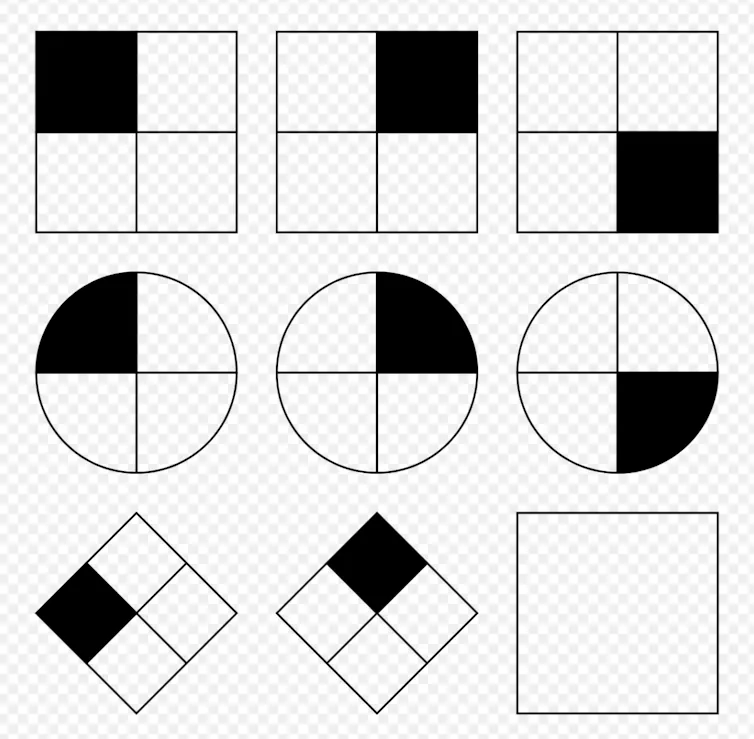
One kind of IQ test item, modelled after items in the Raven’s Progressive Matrices test. wikipedia, CC BY-SA
The CAT4 takes around 2.5 hours to complete and is divided into four sections. There is verbal reasoning (thinking with words), non-verbal reasoning (thinking with shapes), quantitative reasoning (thinking with numbers) and spatial ability (thinking with shapes and space). Children who score exactly as expected for their age group would be given a score of 100. Scoring between 89 and 111 is considered to reflect “average” performance, while scores of 112 and above or 88 and below indicate above and below average performance, respectively.
Child IQ fluctuates
We know that the human brain is plastic, or changeable, particularly in childhood. It is the only organ in our body that isn’t fully developed when we are born. A newborn’s brain is about a quarter of the size of an adult brain, doubling in the first year of life. By age seven, it reaches 90% of its adult size. Beyond physical growth, our brains refine and consolidate the network of connections between neurons during this time.
Refining and whittling these connections is key to supporting cognitive and behavioural developmental milestones. Recent research shows that it’s possible to identify key “eras” of brain structural change over the life course. The first milestone – the transition from childhood to adolescence – happens at around age nine. From a brain perspective, adolescence lasts for a little over two decades and is defined by greater efficiency of connections across regions. This coincides with a steady increase in cognitive functions, including vocabulary, complex reasoning and learning.
We’ve known for some time that there is a link between intelligence, as measured by cognitive tests, and school achievement. Research from 2015 that combined data from over 100,000 students across 240 different studies did find a substantial association between intelligence and school grades. However, the magnitude of the link differed depending on children’s age. Intelligence was a much better predictor of school performance in secondary school than it was in primary school. This suggests that cognitive abilities might not be stable during the first decades of life, but vary significantly.
A 2024 analysis that combined data from 205 different studies including over 85,000 participants across 29 countries supports this view. The researchers set out to investigate how stable cognitive abilities are (whether they fluctuate) across the human lifespan and whether stability changes with age.
Advertisement
They discovered that the stability of cognitive abilities increased exponentially with age – and was low in the first decade of life. This means that each child’s positioning compared to their peers changes significantly in childhood. So a child’s IQ score might indeed change substantially during this time. The stability, however, increased throughout childhood and adolescence, plateauing around age 20 and remaining high throughout adulthood and old age.
But even when IQ starts stabilising, in adolescence, it can still fluctuate by up to 20 points. Somebody increasing their IQ score from 100 to 120 would move from the 50th percentile to about the 91st percentile – a 41% improvement. Indeed, one study, albeit with a small sample of students, could link such fluctuations to physical changes in the brain over time.
This means that it can be tricky to infer long-term consequences, such as later grades, from cognitive tests. Basing school intake, or more broadly selection into educational programmes on a single, unstable metric is likely to lead to systematic errors and unreliable decisions.
Worryingly, it may also result in attempts to manipulate the metric, potentially perpetuating systemic inequalities. This may be true of other tests too, but IQ tests are often seen as an exception. But research shows that you can actually train yourself to boost your IQ test score by roughly eight IQ points, for example by retaking the test. Parents with a lot of resources might be better placed to help prepare their children.
Advertisement
The myth of the child prodigy
Recent research has backed all this up by questioning the widely accepted myth of the child prodigy as someone destined for greatness, like Mozart. One 2025 study, which combined data from over 34,000 elite performers, from Nobel laureates and chess players to music composers and athletes, found that exceptional performance in childhood was a limited predictor of elite performance in adulthood.
In fact, about 90% of those who achieved elite performance in youth did not achieve equivalent adult status. Similarly, 90% of top performing secondary school students were no longer top performers at university. And even more strikingly, several Nobel laureates and elite athletes actually had lower childhood performance than their peers.
Mozart might have gone from strength to strength, but research shows that is unusual. neurobit/Shutterstock
The routes leading children and adults, respectively, to world-class performance also differed. Exceptional talent early in development was associated with intensive, discipline-specific progress at a young age. But adult world-class performance was more often achieved through extensive multi-faceted practice and gradual advancements.
This means that educational and talent programmes that prioritise early identification of intelligence may overlook a large proportion of future world-class innovators.
Advertisement
Environmental exposure
The idea behind identifying talent as early as possible so that it can be nurtured is founded on the belief that exposure to an enriched environment can impact ability and vice versa. Half a century of scientific discovery supports this proposition. Perhaps the most famous example is a study published in 1979 by paediatrician Herbert Needleman and his colleagues. This study provided the first robust evidence that exposure to the metal lead, even at levels previously considered negligible, could significantly impair a child’s cognitive performance.
By comparing children with high and low lead levels in baby teeth, while controlling for potentially confounding factors – such as the mother’s IQ and socio-economic status – the study showed that children with higher lead levels scored roughly four points lower on IQ tests. The evidence presented influenced major public health policies, including the removal of lead from gasoline and interior paint in the US.
A large number of other environmental exposures have been positively linked with cognitive development, from walking in nature to exercise and nutrition, albeit with mixed results. However, arguably the most successful environmental intervention to improve cognitive ability is administered every year to more than 85% of children worldwide: education.
Advertisement
By combining data collected across multiple studies from over 600,000 individuals, researchers found that education has a direct effect on the development of cognitive abilities. The study found that each year of education results in a gain of about one to five IQ points. These effects were remarkably robust, appearing across different cognitive domains and persisting throughout the lifespan. In fact, significant benefits were still measurable into people’s 80s and 90s. While a few IQ points per year may seem small, their cumulative impact at a societal level has been shown to be of great consequence.
Environmental factors that shift population IQ even modestly — like lead exposure, nutrition or education — carry enormous economic consequences. Economists have calculated that each gained IQ point is associated with roughly a 2% increase in lifetime earnings.
In the year 2000, a single IQ point gained or lost across the US population translated to between $110 and $319 billion in aggregate economic output. More recent analysis of the global economic impact of lead exposure on childhood IQ estimated the total cost of IQ loss at US$1.4 trillion globally in 2019, mainly affecting low and middle-income countries.
The role of parents
From the moment a child is born, parents invest vast amounts of energy, time and resources to promote their children’s physical and cognitive development. Not all parenting practices are supported by scientific evidence, nor is the Mozart Effect the sole parenting myth that has been busted. However, research has shown that parenting can nevertheless have profound effects on children’s early cognitive development.
Advertisement
Studies have found that the environment that parents provide for their children by reading to them, engaging them in stimulating activities and conversation, and maintaining a warm and organised household, has a significant positive effect on early cognitive development. This is particularly the case for the first five years of life. What makes early investment especially powerful seems to be that the benefits compound. Fostering a child’s early cognitive competence makes it easier for children to acquire new skills down the line.
However, the pathways to parental investment are complex. Reflecting on my own childhood illustrates this point. I was born in the mid-80s to parents in their early twenties. At the time, my mother was in medical school and my father designed and produced bespoke furniture. As a child, I had several ear infections which meant that I had to have regular checks with a specialist. One warm, sunny morning in early April, my mum and I set off for my otolaryngologist appointment, just the two of us. As the eldest of four children, this was a rare and special occasion.
After my check-up, we took a tram to Milan’s State University, where we attended a conference on HIV infections in vulnerable populations – the topic of my mother’s thesis. I remember sitting in the beautiful auditorium, admiring the frescos on the ceiling, and slowly adjusting a pair of disposable headphones to listen to the real-time translation of the talks. The panel of female scientists discussed the topic so eloquently and clearly that even a ten-year-old girl could grasp their main message.
I was hooked. It must be the best job in the world, I thought. It was only a quiet thought then, one that I never had the courage to privately contemplate or publicly share. That came much later, when I found the confidence to admit that a career in scientific research was for me. But this specific episode in my childhood was not an isolated peak. It was the pinnacle of many simpler, everyday moments when my parents invested time and effort to provide us with a nurturing and stimulating environment.
Advertisement
However, seeing these as merely environmental exposures would only provide part of the picture. Perhaps, the science-enriched environment that my mother created for us depended, at least in part, on her own, partly genetically driven, scientific aptitude.
The nature of nurture
Scientists have named this amalgamation of nature and nurture gene-environment correlation, or more intuitively, the nature of nurture. Parents who provide their children with intellectually stimulating environments may also pass on a greater disposition to doing well in school or performing well in cognitive tasks. Research has shown that accounting for genetic effects shared between mothers and children resulted in a reduction in the effect of parenting on educational attainment.
However, cognitively stimulating parenting remained a significant predictor of children’s educational outcomes beyond direct genetic inheritance and socio-economic status. It ultimately contributes to channelling children’s dispositions and translating them into academic outcomes.
Randomised control trials have demonstrated that early interventions are likely to lead to the greatest returns. Investing in children early — through parenting, stimulating environments and good nutrition — pays back far more than trying to catch up later. Every year of delay makes it harder to close the gap.
Interventions created to bridge this gap in groups of disadvantaged children through high-quality preschool education, such as the Perry Preschool Project, can lead to meaningful gains in cognitive performance. Interestingly, while the benefits on children’s cognitive performance faded over time, their long-term educational, economic and social benefits were remarkably far-reaching. So a high quality school education could indeed lead to better job prospects and higher salaries, regardless of IQ.
It follows that boosting cognitive ability may not be the only way to lasting educational, economic and health benefits. Non-cognitive skills — such as motivation, curiosity, self-regulation and social skills — are equally important.
What IQ tests fail to capture
Cognitive tests have never been viewed as instruments to capture the entire set of skills necessary for succeeding in school and life. In 1916, Alfred Binet and Theodore Simon, the inventors of the first IQ test, wrote that things other than intelligence also mattered to academic success, arguing “one must have qualities which depend especially on attention, will and character”.
Decades of research have shown that children who are emotionally stable, motivated and capable of regulating their attention and impulses do better at school, regardless of their level of cognitive ability. These important characteristics have been broadly described as “non-cognitive skills”.
Advertisement
Recent research by my own team shows that the importance of non-cognitive skills for learning also changes over the school years. We analysed data collected from over 10,000 children born in England and Wales who were followed throughout compulsory education, from age seven to 16. Non-cognitive skills not only predicted academic achievement at every developmental stage, but their role increased as the children got older. Still, at all ages, skills such as curiosity, creativity, motivation and self-efficacy predicted success in school in addition to what was predicted by cognitive abilities.
Similar to cognitive ability and learning, differences in non-cognitive skills are a complex product of nature and nurture. Partly based on their genetic dispositions, children encounter and select environmental experiences that contribute to the development of their motivation and curiosity. This in turn leads to differences in school achievement.
Ultimately, cognitive tests are thought to offer an objective measure of a child’s natural ability, one that is largely unaffected by upbringing or circumstances. But research shows that a range of factors, from environmental exposures to toxic agents, nutrition, differences in parenting and educational interventions, can change cognitive performance, particularly as the brain develops.
During childhood, when the brain is rapidly growing, cognitive test scores can fluctuate considerably from one year to the next. This means that a single test taken on a single day in primary school is not a reliable enough indicator for decisions as consequential as which school a child attends or which academic track they are placed on. These are decisions that can shape the entire course of their education.
Advertisement
Even later on, cognitive tests only capture part of what it takes to do well in school and in life. Curiosity, motivation and the belief that you can improve with effort are crucial to educational success, yet most education systems pay them little attention. Rather than treating a test score as a fixed marker of a child’s future, mounting evidence invites us to treat it as one factor among many. The best approach would be to invest in all children’s cognitive and non-cognitive development alike.
So don’t read too much into Mozart’s journey. He may have been a child prodigy destined for greatness, but chances are he was an exception rather than the rule.
To hear about new Insights articles, join the hundreds of thousands of people who value The Conversation’s evidence-based news. Subscribe to our newsletter.


















































You must be logged in to post a comment Login