Connect with us

NewsBeat

Transfer news LIVE: Alvarez to Arsenal FC twist; Man Utd eye striker deal; double Liverpool boost; Chelsea latest

Published

on

Transfer news LIVE: Alvarez to Arsenal FC twist; Man Utd eye striker deal; double Liverpool boost; Chelsea latest

The summer window is edging towards a dramatic conclusion as Arsenal, Chelsea, Manchester United, Liverpool and Tottenham push for more signings ahead of the deadline. Arsenal are still in pursuit of Julian Alvarez and have held talks over Victor Osimhen, while the Gunners are stepping up their move for Ezri Konsa amid shock links to Jarell Quansah and Jack Hinshelwood. Arsenal are also said to be keen on Christian Kofane as Gabriel Martinelli, Ethan Nwaneri and Gabriel Jesus head for the exit.

Source link

Continue Reading
Click to comment

You must be logged in to post a comment Login

Leave a Reply

NewsBeat

Too hot to think? Why extreme heat can affect how well our brain works

Published

on

Too hot to think? Why extreme heat can affect how well our brain works

Ever feel that the arrival of summer sun makes you feel a bit dopey? You wouldn’t be the only one. Soaring temperatures are known for their ability to slow our thought processes, making even everyday tasks seem like a baffling ordeal.

But what is actually happening inside our heads when the heat is on? The explanation appears to lie in the extra work our brain and body have to do to keep us cool.

The brain and body are in constant conversation. When outdoor temperatures change, thermoreceptors which sit near the surface of the skin send signals to the hypothalamus – the brain’s temperature regulation centre.

When things become too hot or cold, the hypothalamus co-ordinates a series of responses to bring body temperature back towards normal (around 37°C). Keeping the core temperature at this level is critical for metabolism, activity of enzymes and many other essential body functions.

Advertisement

Being commander-in-chief of temperature regulation means that the brain becomes rather occupied when having to consistently regulate your temperature.

In hot weather, this means cooling the body down by switching on mechanisms that allow heat to radiate from the surface. This includes diverting blood to the skin, flattening skin hairs and sweating.

These responses are governed by nervous pathways that link the brain to blood vessels and sweat glands. This allows it to fine-tune the amount of heat the body sheds.

But the additional demand that keeping cool places on the brain may therefore leave less capacity for it to perform cognitive tasks which require sustained thought and attention.

Advertisement

This becomes particularly noticeable if you’re also exercising or exerting yourself at the same time. This is because working muscles and metabolism generate heat, which places additional strain on the body and brain’s cooling mechanisms.

Our neurons (nerve cells) may also start to function differently with rising heat. Neurons rely on the flow of electrical currents and the release of chemical neurotransmitters to function. These processes depend upon enzymes, proteins and the movement of charged ions in and out of the neuron – all of which are sensitive to temperature.

Although the brain is normally able to compensate and keep up with these demands, past a certain point the finely controlled balance becomes disrupted. This alters the way neurons fire and communicate with each other, which can affect processes such as memory, decision-making and concentration.

Another potential complication to consider is dehydration, which commonly occurs in hot weather as we lose more fluid in sweat. Failing to replace fluid losses adequately means additional strain is placed on the cardiovascular system as it tries to supply the skin and organs – including the brain – with blood.

Advertisement

Like many other organs, the brain is over 70% water. Even modest dehydration can result in impairment to attention, reaction times and short-term memory.

Dehydration can affect brain function.
Girts Ragelis/ Shutterstock

This is because dehydration can affect the brain in several ways. It can reduce cerebral blood flow, alter the way that neurons function and even affect the delicate balance of electrolytes needed for normal activity – all of which impact how well our brain works.

Another important consideration is not just how brain and body respond to heat in the moment, but also in the aftermath when they rest and recuperate – namely, through sleep. In hotter weather, it can become increasingly difficult to sleep. And, if you do manage to doze off, the time spent in deeper, restorative sleep may also be short-lived.

In disrupting sleep, hot weather adds another contribution to brain fog: inadequate sleep impairs attention, memory and thinking – furthering the effects of heat on cognitive performance.

Advertisement

Keeping cool

The degree to which the heat affects our thinking will probably vary between people. Some may cope well, whereas others may find difficulty in doing complex cognitive tasks or simple, everyday activities. This will be due in part to individual differences in physiology and heat tolerance.

Perception matters, too. Even a relatively small dip in attention or processing speed can feel much more dramatic when we notice ourselves struggling with something that would usually come easily.

Try not to be hard on yourself if this happens. Take a moment to chill, rehydrate and reclaim your thoughts.

You can fend off some of this summer brain fog by keeping yourself cool as best as you can. Simple measures such as cool clothing, bedding and taking regular breaks from heat exposure do work wonders. Good fluid intake is also paramount to making sure both body and brain stay hydrated.

Advertisement

While it’s frustrating when our brains just don’t feel like they’re firing on all cylinders on hot days, just remember that it’s only a temporary blip. And one that should start to ease off as we cool down.

Source link

Advertisement
Continue Reading

NewsBeat

M6 crash – live: Motorway shut down after ‘very serious’ crash involving three lorries

Published

on

Daily Mirror

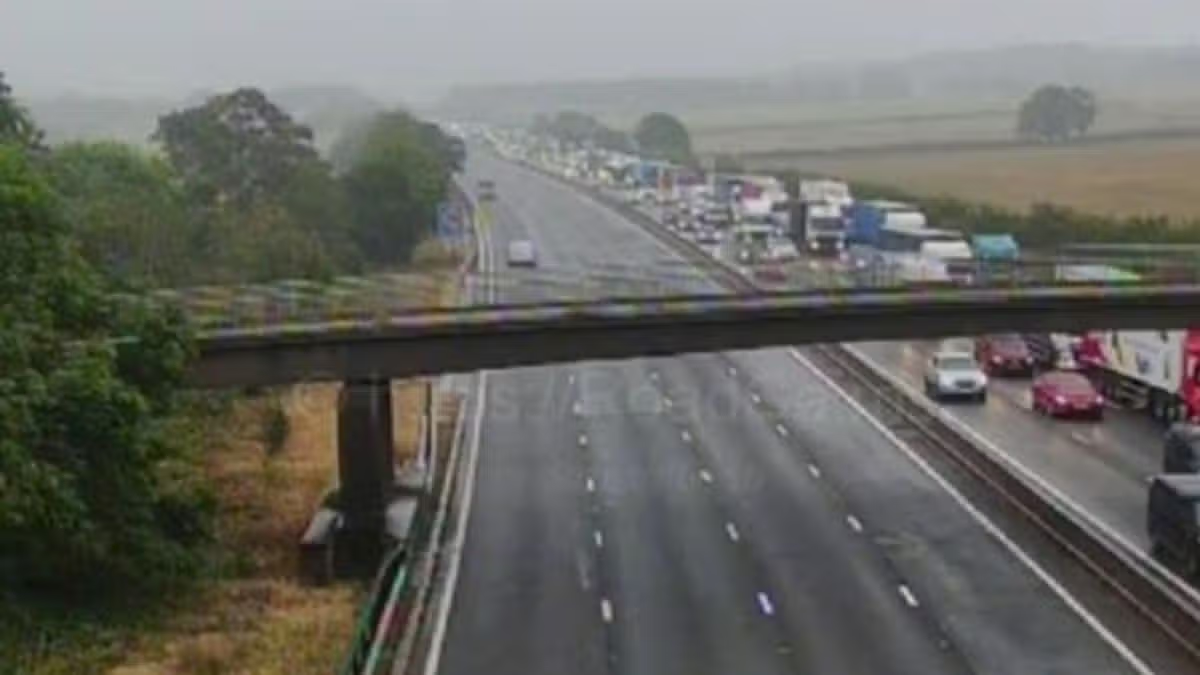
A statement from National Highways reads: “The M6 in Staffordshire is closed in both directions between J15 Hanchurch Interchange (Stoke-on-Trent, Newcastle-under-Lyme A500) and J16 Barthomley Interchange (Stoke-on-Trent, Crewe, Nantwich, Chester A500).

“This is due to a serious collision which occurred at approximately 04:10 on the morning of Monday 17th August involving 3 heavy goods vehicles and a car on the northbound carriageway.

“Staffordshire Police, West Midlands Ambulance Service, Staffordshire Fire & Rescue and National Highways units attended the incident promptly and confirmed this is a very serious collision and the closure will be protracted.”

Advertisement

Source link

Continue Reading

NewsBeat

At least 14 killed in temple stampede and hotel fire in eastern India

Published

on

Shootings at school and home in northeastern British Columbia leave 10 dead, including shooter

PATNA, India (AP) — A deadly stampede broke out at a Hindu temple in eastern India’s Bihar state Monday, hours after a fire swept through a hotel housing pilgrims in West Bengal state.

Seven people were killed and more than a dozen injured in the stampede, while the blaze left at least seven people dead and several others critically injured, police said.

Stampede may have been caused by snapped wire

The incident in Bihar occurred near Ashok Dham Temple in Lakhisarai district, as thousands of devotees gathered to offer prayers on the third Monday of Shravan, one of the holiest months in the Hindu calendar. The period, which usually falls between July and August, is dedicated to the worship of Hindu god Lord Shiva and is marked by fasting, prayers and colorful monsoon festivals across India.

More than a dozen people were taken to a government hospital for treatment, said Shailendra Kumar, a civil official. Kumar said the cause of the stampede was still being investigated.

Advertisement

According to preliminary reports, an electric wire snapped outside the temple premises around 6:30 a.m., sparking panic as devotees rushed to escape what they feared was a risk of electrocution.

A section of the barricades collapsed under the weight of the surging crowd, leading to a crush in which people fell over one another, said Kumar, according to the Press Trust of India news agency.

Many guests at hotel that caught fire were pilgrims

In Tarapith, a temple town in West Bengal’s Birbhum district, a fire broke out around 4:30 a.m. on the ground floor of a four-story hotel while most guests were asleep, the Press Trust of India reported.

Many of the guests were pilgrims visiting Tarapith to offer prayers where a major temple complex also includes a shrine dedicated to Lord Shiva. Firefighters brought the blaze under control and the injured were taken to a hospital where some were being treated for burn injuries while others suffered from smoke inhalation and asphyxiation, the report said.

Advertisement

Hotel management told the news agency that the blaze may have originated near the reception area after an electrical component in the hotel’s power supply system caught fire. Authorities are investigating the incident and have not yet established the exact cause.

Crowd crushes are relatively common in India during religious festivals, as large crowds, sometimes in the millions, gather in confined areas with few safety or crowd control measures. Last year in January, at least 30 people were killed as tens of thousands of Hindus rushed to bathe in a sacred river during the Maha Kumbh festival, the world’s largest religious gathering.

In 2013, pilgrims attending a Hindu festival at a temple in the central state of Madhya Pradesh panicked amid fears that a bridge would collapse. At least 115 people were crushed to death or drowned in the river below.

Advertisement

Source link

Continue Reading

NewsBeat

Occupants of high-powered car involved in M9 tragedy were wearing balaclavas or masks

Published

on

Belfast Live

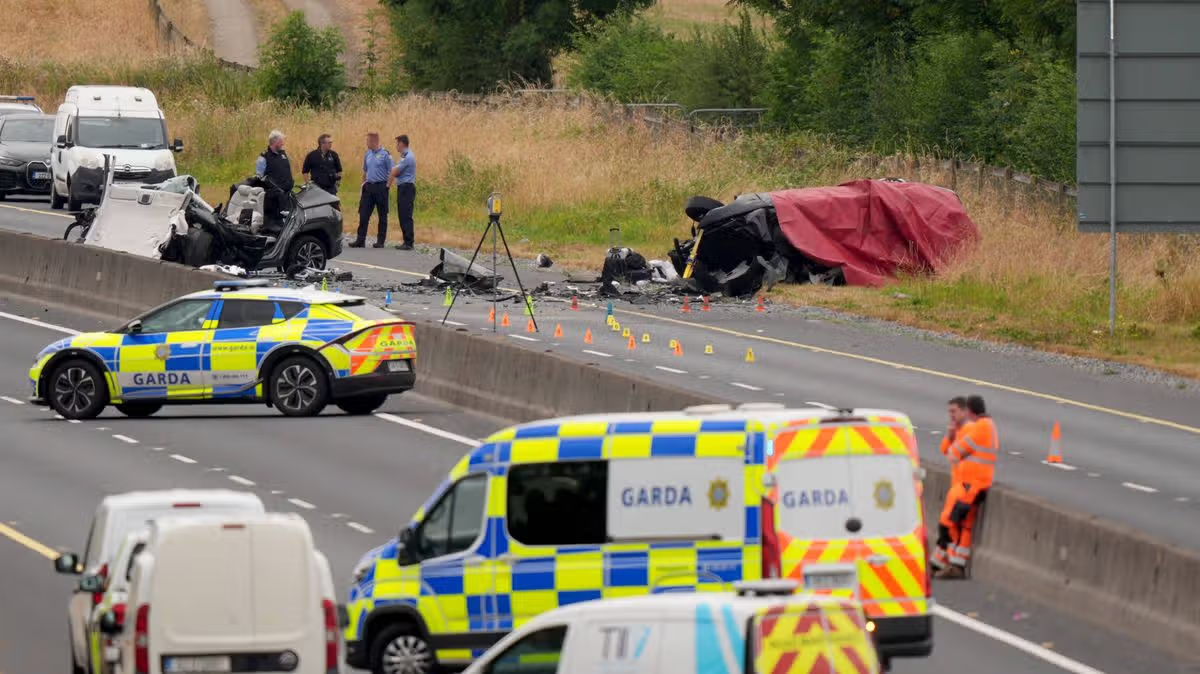
The vehicle in which five teenagers died this morning was being driven on the wrong side of the motorway twice in a matter of minutes, the Irish Mirror understands

The car in which five teenagers died in an early-morning horror smash was driven on the wrong side of the motorway twice in a matter of minutes, it has emerged.

Advertisement

Sources told the Irish Mirror gardai did not pursue the car on either occasion, but officers were aware of its movements on the M9 in rural Co Kildare in the run-up to the tragedy.

“Members disengaged the first time it went down the road the wrong way – and didn’t get a chance to engage the second time,” a source said this evening.

It’s also understood that the occupants of the high-powered BMW were all wearing balaclavas or masks when it ploughed head-on into an innocent family’s car in the crash on the M9 in Co Kildare early on Sunday morning.

And sources say the scene of the crash was so bad that gardai initially believed that only four teenagers had died in the collision as they were visible in the wreckage of the BMW.

Advertisement

It was only late in the afternoon that specialists moved the car from the scene that gardai discovered the fifth body under the vehicle.

Sources also told the paper that gardai are working on the theory that the car the teens were travelling in had been stolen in Athy, Co Kildare earlier in the morning.

Officers were alerted to a gang of teenagers trying to break into cars and houses in the town in the early hours of the morning – some time before the fatal crash.

Garda Commissioner Justin Kelly last night issued a strongly worded statement about the crash – as two separate investigations began into the tragedy.

Advertisement

One probe into the crash itself is being carried out by An Garda Siochana – while independent policing watchdog Fiosrù is also investigating.

That probe is in relation to any possible interactions gardai may have had with the vehicle in the run-up to crash, which happened near the exit for Moone and Athy on the motorway at around 3am.

The crash came a week after a similar incident on Dublin’s M50 when a stolen car ploughed into an innocent man’s vehicle in the early hours of the morning.

Like this weekend’s tragic crash, that car was again on the wrong side of the road.

Advertisement

Mr Kelly said the crashes showed just how irresponsible it was to drive on the wrong side of the road – something young criminals are increasingly doing as they know gardai will not follow them.

Mr Kelly said: “My thoughts are with those injured in this morning’s collision on the M9. These family members were travelling innocently when they were struck by a vehicle being driven the wrong way down the motorway.

“This horrific incident, following the recent collision on the M50, shows how irresponsible and dangerous driving on the wrong-side of the motorway is.

Advertisement

“That, of course, should be self-evident, but what makes this reckless behaviour even more appalling is that in some cases it is being done for social media likes regardless of the potentially devastating impact it might have on innocent people and themselves.

“As this particular incident has been referred to Fiosrú, the Police Ombudsman, I am constrained in what I can say in detail about this incident, but I know that Gardaí do what they can to stop such vehicles while also taking into consideration all other road users.

“Gardaí are put in a really challenging situation dealing with such incidents. As always, An Garda Síochána will fully cooperate with the Police Ombudsman investigation which I hope is completed as expeditiously as possible.

“My thoughts are also with all members of An Garda Síochána and the emergency services who had to deal with this awful incident this morning. Such incidents show the difficult work we ask our Gardaí to undertake every day to keep our communities safe.”

Advertisement

The Irish Mirror has learned that the horror incident began around 30 minutes before the crash when gardai first became aware the BMW was acting suspiciously.

Gardai saw the vehicle and tried to stop it but it quickly drove onto the motorway, where it travelled against traffic – which meant the officers immediately disengaged.

It’s understood the car then did a U-turn – went back the M9, but this time in the proper direction.

It then went off the motorway at Junction 2A – a filling station and food area.

Advertisement

Gardai were preparing an operation to deploy a stinger on the motorway to take out the car’s tyres when the occupants saw one of the force’s vehicles – and sped off.

It drove the wrong way down the exit ramp – and sped along the motorway, again against traffic. Gardai did not pursue the car.

But within a few minutes the BMW slammed into a Hyundai car going the right way on the motorway with horrific consequences.

The five teenagers in the BMW all died instantly, while the four innocent occupants were all injured.

Advertisement

It’s understood they were an extended family from Carlow heading off to Dublin Airport for a break.

The family included a seven-year-old child, a woman in her 20s and two in their 30s. They were all injured.

“The female driver and front passenger, both aged in her 30s of the second car have been removed from the scene to Tallaght University Hospital and both remain in critical condition,” gardai said in a statement.

It added: “A female rear seat passenger, aged in her 20s was taken to St. Luke’s General Hospital and is in a serious condition. The third passenger, a child has been removed to Children’s Health Ireland (CHI) at Crumlin and is in a serious condition.”

Advertisement

It’s understood the child sustained a broken leg.

Gardai sealed off the area all day and began a full investigation. They have appealed for witnesses to come forward.

The force said: “Gardaí are appealing for any persons who may have witnessed this collision to come forward.

“Gardaí are appealing to road users who were travelling on the M9 northbound or southbound between 2:00am and 3:00am this morning Sunday 16th August, 2026 and who may have dashcam footage of the incident or surrounding area to make this footage available to investigating Gardaí.

Advertisement

“Anyone with information is asked to contact Athy Garda Station on 01 666 6000, the Garda Confidential Line on 1800 666 111, or any Garda station.”

Meanwhile, Fiosrù also issued a statement in which it said it was carrying out its own investigation.

A spokesman said the matter had been referred to the organisation by gardai.

It said: “The referral was made following a Fatal Road Traffic Collision on the M9.

Advertisement

“One of Fiosrú’s on call team of investigators attended the scene and its independent investigation is ongoing.

“In line with its statutory remit, Fiosrú’s investigation relates to incidents involving contact with gardaí where a member of the public has died or been seriously injured.

“A referral does not necessarily mean a garda or gardaí have been accused of wrongdoing. Instead, it means that Fiosrú should independently investigate the incident to ascertain whether or not the act or omission of a garda or gardaí may have resulted in the death of, or serious harm to, a person.

“As the matter is now under investigation, pursuant to section 208(1)(b) of the Policing, Security and Community Safety Act 2024, Fiosrú cannot make any further comment.”

Advertisement

Tributes have been paid to the victims throughout the day. Their names had not been released by gardai, but were being circulated on social media.

Most were from the Midlands, but one was from Limerick and was living in Dublin.

One tribute read: “A Mortal sin. The Nicest Boy you ever could have come across, so many memories we have together and I’ll make sure cherish every one. God help your poor mother and family get Best Bed In Heaven. You Will be truly missed.”

Another said: “Rest easy, bro. Always be in my heart and thoughts. Gonna miss u so much.”

Advertisement

Gardai confirmed this evening that five teenagers died in the crash.

The force said: “The bodies of 5 teenage males, all occupants of one vehicle, have now been removed from the scene and taken to Naas General Hospital where post mortems will take place.

“The occupants of the second vehicle, three women (two aged in their 30s, one in her 20s) and a male child all remain in hospital continuing to receive treatment for serious injuries.

“Forensic Collision Investigators have completed their examination of the scene. The road is expected to reopen shortly.

Advertisement

“Family Liaison Officers have been appointed to relatives of the occupants of both vehicles.”

For all the latest news, visit the Belfast Live homepage here and sign up to our daily newsletter here.

Source link

Advertisement
Continue Reading

NewsBeat

UK’s biker wars: Hells Angels, Bandidos and the Vikings battle for supremacy on streets of Britain as family man is murdered in terrifying street fight

Published

on

Anthony Jones, 56, known as Tony, died after being found face down in an alleyway following the fight in Pontnewynydd, near Pontypool, south Wales on August 6

Rival biker gangs are fighting for supremacy on streets all across the UK – with the latest tragedy being the killing of a 56-year-old family man rider in a mass brawl.

Groups with names such as the Hells Angels, the Bandidos and the Vikings have been fiercely at odds with each other in Britain’s equivalent of similar clashes in the US – with recent clashes in places including south Wales, Surrey and Sussex.

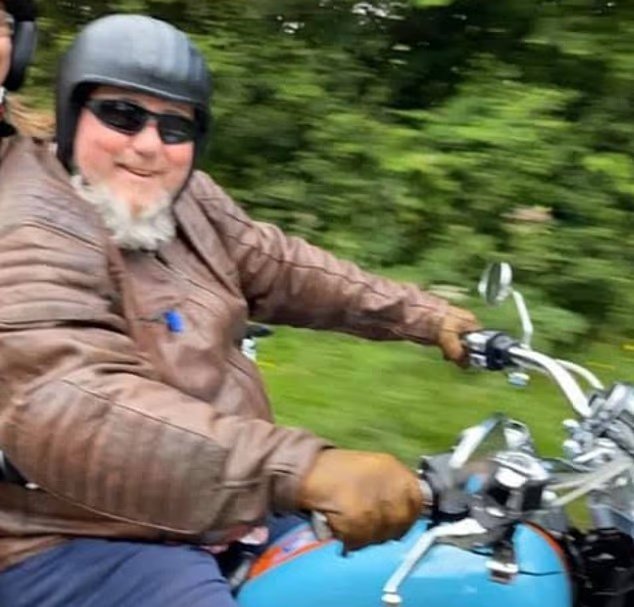
Anthony Jones, 56, known as Tony, died after being found face down in an alleyway following the fight in Pontnewynydd, near Pontypool, south Wales on August 6 – and police have said they believe a row between rival biker gangs was involved.

Two other people were taken to hospital after the carnage, said to have involved about 20 people armed with machetes and other weapons. 

Advertisement

A total of 25 men, aged between 18 and 73, have now been arrested in connection with the incident.

Police had previously appealed for information over the whereabouts of Anthony Paul Jones, 40, thought to have been driving a blue Ford Transit van, in connection with the murder.

They said on Friday the van had now been located and a 40-year-old man arrested on suspicion of murder.

Gwent Police believe the ‘violent disorder’ was a result of a rivalry between motorcycle clubs Hells Angels and the Vikings.

Advertisement

Anthony Jones, 56, known as Tony, died after being found face down in an alleyway following the fight in Pontnewynydd, near Pontypool, south Wales on August 6 

The brawl is thought to have been the result of a turf war between Hells Angels and Vikings motorcycle clubs (Pictured: Hells Angels members in England)

The brawl is thought to have been the result of a turf war between Hells Angels and Vikings motorcycle clubs (Pictured: Hells Angels members in England)

Red Chiefs biker and grandfather David Crawford, 59, was hit by a van and dragged for nearly one mile in May 2022

Red Chiefs biker and grandfather David Crawford, 59, was hit by a van and dragged for nearly one mile in May 2022

Advertisement

The two organisations have a longstanding history of violence and attacks on one another across Britain – while a series of other groups have also been waging war. 

A Facebook account believed to belong to the deceased Mr Jones shared posts referring to Hells Angels and its nickname, 81. 

Alongside family photos are pictures showing he had the initials ‘AFFA’ tattooed across one hand – recognised as standing for ‘Angels forever, forever angels’.

I know why Jack the Ripper was protected for so long
Advertisement


Hi, I’m Alex Matthews, Editor of The Crime Desk.

In 2014, we revealed the bombshell evidence identifying Aaron Kosminski as the fabled Jack the Ripper. Now, we can reveal his astonishing connection to the Freemasons and claims this motivated his killings and protected him from life in prison. 

Advertisement

Sign up here to get our exclusive piece for free.

<!- – ad: https://mads.dailymail.co.uk/v8/de/truecrimeuk/none/article/other/mpu_factbox.html?id=mpu_factbox_1 – ->

The fight, which took place at about 7.15pm last Thursday outside the British Legion Club in the village, saw one group ‘tool up’ with machetes, axes and hammers, residents have said.

Advertisement

Around 20 people across the two groups were said to have been involved as they clashed opposite a children’s playground.

Locals claimed some of the men had taped machetes to their hands to stop them from losing their grip.

Mr Jones, who lived some 30 miles away in Brecon according to social media, was found on the ground with a head wound and was given CPR, witnesses said.

Armed police, a police helicopter and multiple ambulances rushed to the scene. 

Advertisement

It is thought the violence erupted due to a turf war between the two clubs.

Vikings and Hells Angels are not the only clubs to have a presence in south Wales – others include the Celtic Wolves and Valley Commandos.

The Hells Angels are reported to have a global membership of more than 6,000 bikers, across almost 60 nations – and with 16 regional chapters across Britain.

The Vikings used to be called the Hells Angels Vikings, after forming in 1969, before becoming known simply as the Vikings six years later.

Advertisement

There have been previous violent scenes in recent years across the UK between branches of Hells Angels and the Vikings.

In October 2022, a mob of three Hells Angels members ambushed a group of Vikings on the A24 in Findon, West Sussex, in a revenge attack.

Tony Jones, 56, was killed during a mass brawl in Pontnewynydd, near Pontypool, Wales last Thursday

Tony Jones, 56, was killed during a mass brawl in Pontnewynydd, near Pontypool, Wales last Thursday

Shown is clothing worn by David Crawford, ripped following a crash that killed him in Plymouth in May 2022. Mr Crawford belonged to the Red Devils club, affiliated with Hells Angels

Shown is clothing worn by David Crawford, ripped following a crash that killed him in Plymouth in May 2022. Mr Crawford belonged to the Red Devils club, affiliated with Hells Angels

Advertisement
Forensic officers examine the scene outside Pontnewynydd Sports and Social Club, which also serves as a British Legion club, following the mass brawl

Forensic officers examine the scene outside Pontnewynydd Sports and Social Club, which also serves as a British Legion club, following the mass brawl

They left a man fighting for his life after stabbing him, stamping on him and hitting him with a baton.

Callum Shaw was jailed for 17 years while Barry Brown and Daniel Kent were jailed for three years, with a further 12 months for Kent for committing a burglary at a Vikings clubhouse.

Four years earlier, seven men linked to Hells Angels and Red Devils clubs were jailed for an attack on members of the Vikings and Wargs Brotherhood clubs – each sentenced to 14 years in prison. 

Advertisement

And in May 2022, David Crawford, of the Red Devils club – affiliated with Hells Angels – was killed after being knocked from his bike by three members of rivals Bandidos.

Benjamin Parry, Thomas Pawley and Chad Brading were in a Ford Transit which knocked Crawford from his vehicle and dragged him along the road for a mile in Plymouth.

Parry was sentenced to 12 years in prison, which was later appealed and increased to 15, while Pawley and Brading were both sentenced to four years.

And in 2024 biker Daniel Laponder left a pipe bomb under a van during a biker feud in Scotland. 

Advertisement

Laponder targeted David Rollo because his son was a member of the Blue Angels Motorcycle Club.

Laponder, who formed a breakaway biker faction, was jailed for nine years in 2024.

The High Court in Glasgow heard Laponder planted a viable pipe bomb under a BT Open Reach van which was used by Mr Rollo. 

Laponder drenched the van in petrol and then used a remote device to set off the bomb, which contained ball bearings.

Advertisement

On sentencing, Judge Lord Arthurson told Laponder: ‘The background circumstances of the index offending are somewhat bizarre, stemming as they appear to from a feud between the Blue Angels Motorcycle Club and the Mad Dogs Motorcycle Club, a rival gang which was set up by you after you left the Blue Angels.

‘That said, the crimes committed by you were of considerable gravity.’

A hardened criminal previously told the Daily Mail that a ‘fragile truce’ between warring UK biker gangs had been hanging by a thread and ‘could go either way’.

The construction worker from Merseyside has been a member of a notorious biker club for the last decade, and has served out a raft of prison sentences for violence.

Advertisement

The father, who asked not to be named, said although violence between rival clubs had calmed, things could change quickly.

He said: ‘I would describe it as a fragile truce right now. Moving forward things could go either way, which is interesting.’

The biker admitted that serious violence could break out between rival British biker clubs.

The latest victim Tony Jones' Facebook profile is peppered with references to Hells Angels, featuring this image of their moniker, 81

The latest victim Tony Jones’ Facebook profile is peppered with references to Hells Angels, featuring this image of their moniker, 81

Advertisement
Biker Daniel Laponder left a pipe bomb under a van during a biker feud in Scotland in 2024

Biker Daniel Laponder left a pipe bomb under a van during a biker feud in Scotland in 2024

Daniel Laponder, former leader of the Blue Angels outlaw motorcycle gang, was caught with sawn off shotguns and improvised explosive devices before being jailed in 2024

Daniel Laponder, former leader of the Blue Angels outlaw motorcycle gang, was caught with sawn off shotguns and improvised explosive devices before being jailed in 2024

The Merseyside-based bike rider who spoke to the Daily Mail last year said some biker clubs attracted recruits for the wrong reasons.

He said: ‘Yes, you get the mid-life crisis blokes. They wake up one day and realise they have done nothing with their lives and want some danger.

Advertisement

‘I can spot them a mile off. And before you know it they are roaring around on bikes and partying with strippers.

‘Then they are back in the office the next morning with a shirt and tie on. I just found all that really odd and quite funny.

‘And then you get the blokes you have bullied all their lives. They want to be around bikers for protection and to feel safe.’

A street brawl broke out in 2024 between two rival factions in Sheffield. A passing driver filmed the pitched battle, when bikers could be seen brandishing baseball bats and fighting in the street. 

Advertisement

The biker said: ‘So the Satan’s Slaves attacked the Mongols, who were in their clubhouse. 

‘I was told that the Slaves came second best, and couple of their lads were badly hurt. One of them only recently came out of hospital.’

Last year a street brawl broke out between two rival factions in Sheffield. A passing driver filmed the battle, when bikers were seen brandishing baseball bats and fighting in the street

Last year a street brawl broke out between two rival factions in Sheffield. A passing driver filmed the battle, when bikers were seen brandishing baseball bats and fighting in the street

Other UK biker gang feuds have included the Hells Angels’ Wolverhampton chapter and the Derby-based Road Tramps, over a control of an annual motorcycle festival founded by the latter group in 1983.

Advertisement

The Wolverhampton group also brawled in the early 1990s with neighbouring Birmingham’s Cycle Ramps gang.

Seven prospective members of the Hells Angels were jailed in October 2019 for a total of 98 years over a ‘turf war’ attack on a rival gang in a sleepy Home Counties village.

Six people were stabbed at the Forman Institute in Blindley Heath, Surrey, on November 7 2018.

A group of masked men, believed to number 13 in total, stormed the venue armed with knives, baseball bats, and other weapons including an industrial cable.

Advertisement

The Vikings Motorcycle Club and its support group, the Wargs Brotherhood, had been at an outbuilding known as ‘The Shud’ for a meeting.

Six people were stabbed and one assaulted there, leaving the site as a ‘scene of bloody carnage’.

Seven of the attackers were convicted in July following a seven-week trial at Kingston-upon-Thames Crown Court.

Passing sentence, Judge John described the nighttime attack as an ‘appalling piece of gratuitous planned violence’, noting that each defendant had continued to protest their innocence despite conviction.

Advertisement
Benjamin Parry
Chad Brading
Thomas Pawley

Benjamin Parry, Chad Brading and Thomas Pawley were convicted following David Crawford’s death – they claimed they wanted to speak to him as he wore a Red Chief jacket on their patch

Bandidos clothing
Bandidos clothing

Plymouth Crown Court heard the three men were members of Plymouth Bandidos, while Mr Crawford was affiliated to the Red Chiefs. Pictured: Bandidos clothing

The trial heard defendants wanted to ‘deal with’ the Vikings so the Hells Angels could set up a new chapter in Surrey.

This was said to have initially been done through an attempt to entice to Wargs to switch their affiliation from the Vikings to the Hells Angels.

Advertisement

Elsewhere, a gang on motorbikes were accused of killing a young man in a ‘targeted execution’ which led to scenes of a ‘bloodbath’ in a village, according to locals.

Horrified neighbours said the victim was ‘ambushed’ outside the Spring Tavern pub in Ewell, Surrey, before collapsing outside The Wheatsheaf, just a few hundred yards away.

Locals said ‘at least two men’ were responsible and arrived and fled the scene on bikes. 

Alfonso Sibley, 23, was allegedly ambushed by the duo as he went to sell some cannabis one afternoon, almost a fortnight before Christmas last year.

Advertisement

Mr Sibley stumbled to a nearby pub where staff and customers tried to save his life but died from his injuries in a pool of blood a short time later. 

A teenager accused of the killing, 15 at the time but since turning 16, was acquitted at Kingston Crown Court last month of murder, manslaughter and conspiracy to commit robbery

Alfonso Sibley, 23, was stabbed to death in Ewell in Surrey on December 9 last year

Alfonso Sibley, 23, was stabbed to death in Ewell in Surrey on December 9 last year

Horrified neighbours said the victim was 'ambushed' outside the Spring Tavern pub in Ewell, before collapsing outside The Wheatsheaf, just a few hundred yards away

Horrified neighbours said the victim was ‘ambushed’ outside the Spring Tavern pub in Ewell, before collapsing outside The Wheatsheaf, just a few hundred yards away

Advertisement

Two other boys, 15 and 17, were cleared of conspiracy to commit robbery.

Senior investigating officer Laura Bartley, who is leading the probe into Anthony Jones’s death last week, said on Friday: ‘Firstly our thoughts remain with the family of Anthony “Tony” Jones at this difficult time for them.

‘We have since launched a murder investigation, resulting in a significant number of arrests for people who we believe are connected to the initial report of violent disorder.

‘We can now also provide an update on our earlier appeals where we asked the public to assist our enquires regarding the whereabouts of a Ford Transit van and a man from the Blaenavon area.

Advertisement

‘The Ford Transit van was located outside of the Gwent area and we’re currently assessing the van to establish how it relates to our investigation.

‘Officers have also located Anthony Paul Jones and we will be speaking to him in connection with our enquiries.

‘We understand that this complex investigation has caused substantial disruption within our communities since it was reported to us.

‘We are extremely grateful for the patience, support and co-operation shown by our communities while this work continues.’

Advertisement

She had previously stated: ‘At this stage of our enquiries, we believe the violent disorder involved members of two rival outlaw motorcycle clubs, the Vikings and the Hells Angels.

‘Establishing the extent of involvement of those connected to the incident remains a key focus of the investigation.

‘We understand this incident will cause significant concern within the community. I would like to reassure the public that officers and staff are working around the clock to progress this investigation, identify everyone involved and bring those responsible before the courts.

‘We are extremely grateful for the patience, support and co-operation shown by our communities while this work continues.

Advertisement

‘Our thoughts remain with the family of the victim, who continue to be supported by specially trained officers.’

Mr Jones’s family issued a statement in tribute to him on Thursday afternoon, describing him as ‘first and foremost, a much-loved husband and devoted dad’.

They added: ‘To us, he wasn’t a name in a news story – he was our Anthony and the hole he has left in our family is impossible to put into words.

‘He was incredibly hardworking and always made sure his family was provided for.’

Advertisement

They told how his wife Sarah and their children were ‘at the centre of his world and he absolutely doted on them’, while he was also affectionately known to his grandchild with the name ‘Grumpy’.

The statement issued via Gwent Police went on to say: ‘Anthony was always up for a laugh and loved nothing more than spending time with his family.

‘We have so many happy memories of days out together, but some of our most treasured memories are the simplest ones – at home, music playing, laughing and dancing together during one of our many kitchen discos.

‘Our lives have changed forever. Sarah has lost her husband and the children have lost their dad, and they are trying to comprehend a future they never imagined having to face.

Advertisement

‘We understand there will be public interest surrounding Anthony’s death, but we ask people to remember that behind everything being written and spoken about is a grieving family.

‘Whatever else may be said, nothing changes the husband, father and Grumpy Anthony was to his family or how deeply he was loved.

‘Anthony will be loved and missed more than words can ever express.

‘We will hold onto the laughter, the family days out, the kitchen discos and all the memories we were lucky enough to make together.’

Advertisement

Anyone with information is asked to contact police quoting log reference 2600255536, by calling 101, visiting Gwent Police’s website or reaching out via social media.

Information can also be passed on anonymously through Crimestoppers by calling 0800 555 111.

Source link

Advertisement
Continue Reading

NewsBeat

Hayden Panettiere’s tragic last social media post before her sudden death at 36

Published

on

Manchester Evening News

US actress Hayden Panettiere was seen laughing and smiling in her last social media post before her tragic passing

Hayden Panettiere was seen laughing and smiling in her last social media post shared just weeks before her tragic death was announced.

Advertisement

It was confirmed on Monday (August 17) that the US actress, best known for her roles in Heroes and Nashville, had passed away at the age of 36 on Sunday (August 16).

A representative confirmed the tragic news, saying her family would remember her as an “incredible light” who brought “immeasurable love and joy to all who knew her”.

Click here to get the biggest stories straight to your inbox in our Daily Newsletter

The statement from her father Skip read: “It is with profound sadness that we share the tragic passing of our beloved Hayden. She was an incredible light and a force of nature who brought immeasurable love and joy to all who knew her — and to the millions who watched her onscreen.”

Advertisement

Her father also asked that her family be given privacy as they “take time to process this unimaginable loss”. At the time of writing, no cause of death has been announced.

Following the devastating news, fans have been seen rushing to pay tribute on social media, including underneath the star’s final Instagram post, shared just three weeks ago.

She had shared a photo on July 27 in which she could be seen smiling alongside her photographer, Randall Slavin. Panettiere gave a cheeky wink for the camera as her pal looked on at her with glee. “Good times and good friends,” she simply captioned the post.

Advertisement

Actress Selma Blair is among those to have commented on the post, writing: “I love you. Don’t be gone. Don’t be gone. Please. Please.” She added: “I love you whale tail my friend.”

Panettiere began acting as a child, appearing in soap operas before gaining wider recognition for her role in the 2000 sports drama Remember The Titans alongside Denzel Washington, and as the voice of Dot in Pixar’s 1998 film A Bug’s Life.

Panettiere later found fame playing cheerleader Claire Bennet in the superhero drama Heroes before going on to star as up-and-coming country singer Juliette Barnes for six seasons on the hit TV series Nashville. Her performances in Nashville earned her two Golden Globe nominations for best supporting actress, while her singing on the show produced 11 entries on the US Billboard Hot Country Songs charts.

Advertisement

Following her rapid rise to fame, the pressure of the industry began to weigh on Panettiere – with the actress previously revealing that she had struggled with addiction throughout her 20s.

In a memoir published earlier this year, Panettiere opened up about her struggles with mental health, the loss of her younger brother, Jansen, and her decision to give full custody of her daughter Kaya to her former partner, Ukrainian boxer Wladimir Klitschko, in 2018. She said her daughter had lived with her father full-time from a young age amid the actress’s struggles with addiction and mental health.

Source link

Advertisement
Continue Reading

NewsBeat

Girl, 3, kidnapped but didn’t realise truth until chance conversation with neighbour

Published

on

Daily Record

Juana Ramirez was just three when she was allegedly snatched from her mother Lorena in broad daylight in a Mexico City park, given a new identity by her captors, before being reunited 27 years later

One little girl was abducted in broad daylight aged just three and was brought up believing her kidnappers were her real family before one photo changed everything.

Advertisement

Juana went missing in the middle of the day in a park in Mexico City. Her mother Lorena Ramirez never gave up hope of finding her little girl again for 24 years.

Lorena had taken her three children to Bosque de Chapultepec, one of the largest parks in the city, with her husband and sister-in-law when Juana was snatched from them.

The family were saying their goodbyes when little Juana suddenly disappeared. Juana, who renamed herself as Rocio, has since said she felt someone grab her by the waist as her parents momentarily let go of her hand, and later woke up in a stranger’s house, according to Vox.

At the time of her abduction, Juana was given a new identity and age by her kidnappers, who told her her birthday was the day she was taken, October 1, 1995, instead of June 16 three years earlier.

Advertisement

Years after Juana’s abduction, the neighbours of her captors told the then-young girl the people she lived with were not her biological parents.

Following a confrontation, her “mother” told Juana she had adopted her after seeing her wandering alone in Mexico City’s Bosque de Chapultepec park.

Juana said the people who took her from her mother treated her “badly”, leading her to flee the house at just 17 to live with her now husband.

Advertisement

Rocio’s husband later persuaded her to research missing girls in the area in an attempt to find her real family.

She then saw a photo that chilled her to the bone. Whilst on a missing persons register she came across a photo of a girl who looked remarkably similar to her younger self.

“There was such a strong physical resemblance I said to myself ‘I’m that girl’,” she stated. However, without any contact information, she said “It took me another eight years before deciding to look for my family.”

Advertisement

Taking her fate into her own hands, finally one day Rocio decided to post an image on herself online to see if she could find her real family. Lorena’s daughter, Maria Jose, one of her other daughters, spotted a picture on social media of their long-lost Juana.

The photo had been posted by the then 30-year-old Rocio. When she did post the photo of her younger self, one of Lorena’s daughters, Maria Jose, saw the picture on social media and made contact.

After chatting online, the family arranged for Rocio to reunite with her long-lost mother.

Advertisement

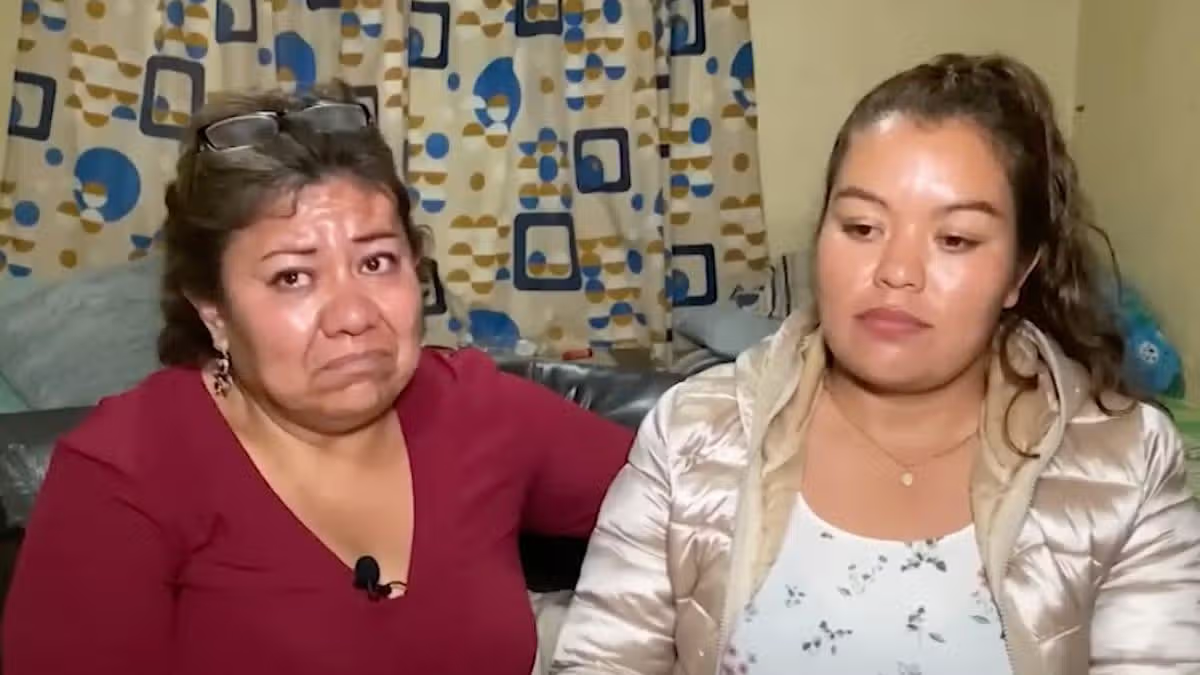
Following their reunion, Lorena said: “I lost a three-year-old child and found a 30-year-old woman. I did not experience those stages of her life, it is a part of her that was stolen from me.”

Overcome with emotion, she added: “Just imagine, I suffered terribly for 27 years.” Lorena later told local press: “I couldn’t believe it. When I opened the door, I stopped and she walked in. That hug after 27 years.”

“She saw me and said ‘you are my mother’. I replied ‘yes, and you are my daughter’. ‘Thank you for the opportunity to see you again’.”

Advertisement

Source link

Continue Reading

NewsBeat

‘Realistic’ war film hailed ‘one of the best ever made’ on Netflix now

Published

on

Manchester Evening News

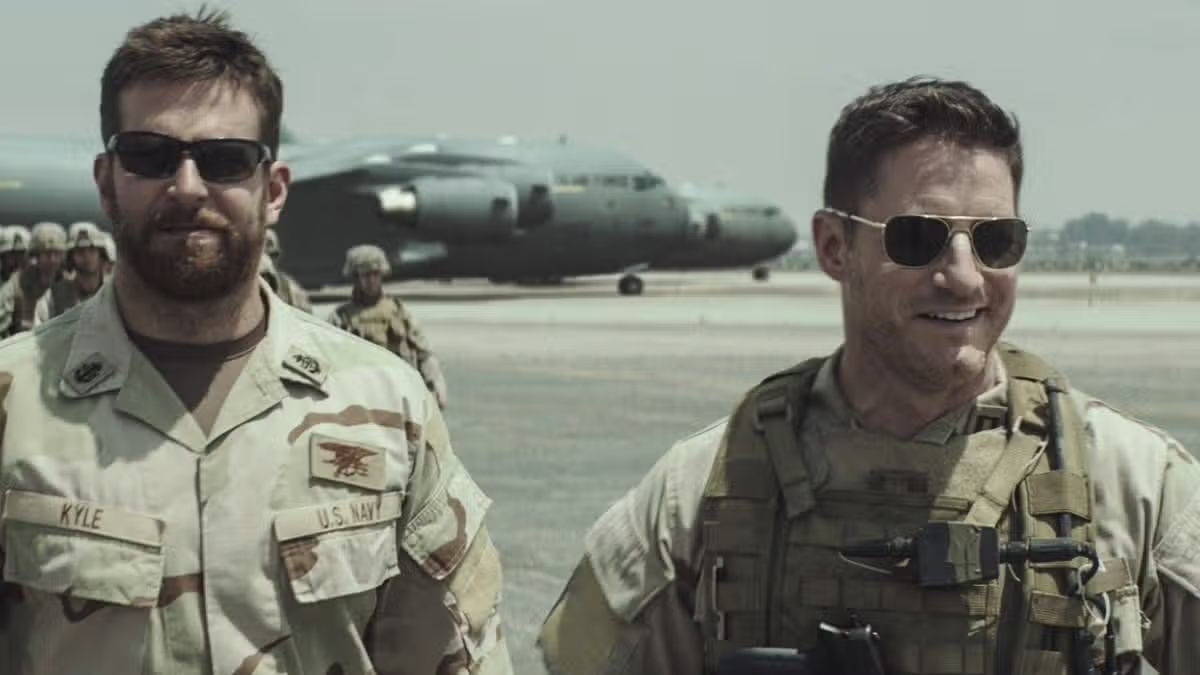
The 2014 Clint Eastwood biographical drama stars Bradley Cooper as Chris Kyle, a US Navy SEAL sniper, and is now available to stream on Netflix

War films are frequently lauded for being firmly grounded in history, and one of the most compelling, authentic war films ever produced is currently available on Netflix.

Advertisement

The 2014 biographical drama, directed by Clint Eastwood, recounts the true story of Chris Kyle, played by Bradley Cooper, who became the most lethal marksman in US military history with 255 kills across four tours of the Iraq War.

Based on Kyle’s own memoir, American Sniper chronicles his transformation from a Texas ranch hand and rodeo cowboy to a US Navy SEAL sniper, documenting both his remarkable military record and the strain his service placed on his marriage to wife Taya, played by Sienna Miller.

The film opened to a limited release on Christmas Day 2014 before expanding the following January, ultimately earning over $547 million worldwide – making it Clint Eastwood’s highest-grossing film as director, and the 13th highest-grossing film of that year.

It went on to receive six Academy Award nominations, including Best Picture, Best Adapted Screenplay, and Best Actor for Cooper, and won Best Sound Editing, reports the Express.

Advertisement

Audiences on Rotten Tomatoes appear to agree with the awards, with one reviewer calling it “one of the best military movies ever made based on the legendary sniper Chris Kyle.”

Another described the tension as almost unbearable, writing: “Extremely tense. Give me anxiety to watch. Very well acted directed amazing true story. Have a glass of whiskey while you watch it for your nerves.”

Cooper’s portrayal in particular has resonated with viewers, with one simply arguing: “Cooper should have won the Oscar.”

Advertisement

Another reflected on the film’s emotional impact: “Its a great movie, sad, gnarly and very realistic. Rest in peace, Chris Kyle.”

The film is not without its detractors, and its depiction of both Kyle and the Iraq War more broadly ignited considerable debate upon release, with some applauding its authenticity while others questioned its portrayal of the conflict.

Nevertheless, reviews feature descriptions such as “peak cinema,” or highlight the film’s more human, grounded approach to portraying military life. One fan noted it’s “a movie that humanizes our soldiers and the struggles they face.”

Advertisement

American Sniper is currently available to stream on Netflix.

Source link

Continue Reading

NewsBeat

Met Office latest on August 31 bank holiday weather forecast for Northern Ireland

Published

on

Belfast Live

The long-range weather forecast has been released

As the summer holidays begin to wind down, many of us are looking forward to the August Bank Holiday, which is the final official break before the Christmas period.

Advertisement

The three-day weekend is often seen as a last hurrah before heading back to school or work, but what people get up to often depends on the weather. With a number of heatwaves in Northern Ireland already this summer, some are asking whether another is on the way for August 31.

According to the Met Office, while it is still too early to tell for sure, there could be a chance of another heatwave later this month. However, it looks like there will be a split in conditions between northern and southern parts of the UK.

The long-range forecast from Thursday, August 20 until Saturday, August 29, the forecaster said conditions will be “changeable”, with many parts of the UK seeing showers or longer spells of rain.

Following this, high pressure will become increasingly probable over the north and west, including in Northern Ireland, with low pressure to the south of the UK.

Advertisement

The Met Office added: “This will lead to further spells of showers and longer spells of rain, but the north may see more in the way of drier conditions.

“Within this broad pattern, there is potential for Atlantic lows to spread across the UK at times, which would bring more widespread rain and perhaps strong winds. Temperatures are more likely to be above normal than below overall, though the possibility of widespread or exceptional heat is perhaps a little lower than in recent weeks.”

What will the weather be like for August Bank Holiday?

The Met Office said temperatures from Sunday, August 30 to Sunday, September 13 are likely to be “close to the climatological norm.”

The forecaster said this means a “broad northwest-southeast split in conditions, with the high becoming centred further to the south than in the latter part of August and with more changeable conditions developing towards the north and northwest. Meanwhile, drier, more settled weather is slightly more likely towards the south and east.”

Advertisement

It is expected that temperatures will “likely be near to or above average overall,” with a chance of “late season hot spells or heatwaves developing, especially in the south” of the UK.

For all the latest news, visit the Belfast Live homepage here and sign up to our daily newsletter here.

Source link

Advertisement
Continue Reading

NewsBeat

AI-designed viruses are a test of whether biosecurity can keep pace

Published

on

AI-designed viruses are a test of whether biosecurity can keep pace

Scientists have crossed an important line in biological engineering. In a recent study, researchers used artificial intelligence to design complete sets of genetic instructions for bacteriophages, viruses that infect bacteria. Some of those computer-generated designs produced working viruses when they were built and tested in the laboratory.

These viruses were designed to infect bacteria rather than people. The researchers worked with bacteriophages that target E. coli, and one of the AI models they used, Evo 2, was developed with safety restrictions. Its developers excluded viruses that infect organisms such as animals, plants and humans from the data used to train it.

Even so, the experiment raises an important question: if AI becomes increasingly able to help design biological systems, are our safeguards developing fast enough?

As engineers working in vaccine manufacturing and public health security, we see good reasons to continue this research. Bacteriophages could potentially be used to treat bacterial infections, including those that are becoming harder to treat with antibiotics. But advances in biological design also create new challenges for biosecurity.

Advertisement

Genome language models work in a broadly similar way to AI language models that learn patterns in text. Instead of learning from words and sentences, they learn patterns in genetic code. Evo 2, for example, was trained on trillions of DNA building blocks taken from many different forms of life.

This gives researchers a powerful new way to study biology and generate possible DNA sequences. It also means that part of biological design can now happen on a computer, before anything has been made in a laboratory.

An AI-generated DNA sequence is still several steps away from becoming a real biological threat. A digital design has to be turned into physical genetic material, assembled correctly and tested under the right laboratory conditions. Each of those stages also creates an opportunity to reduce risk.

Advertisement

One safeguard can be built into the AI model itself. The developers of Evo 2 deliberately removed viruses that infect humans and other similar organisms from its training data for safety reasons. Their research found that the model performed poorly when tested on proteins from viruses that infect humans.

Such precautions will need to be tested and strengthened as AI tools for biology become more capable. Researchers have already argued that AI and biosecurity need to be considered together, so that safeguards develop alongside new capabilities.

Another checkpoint comes when digital DNA is turned into physical DNA. Companies that manufacture DNA to order can check both the requested genetic sequence and the person or organisation ordering it for potential security concerns. Researchers working on DNA synthesis screening have argued for common international approaches as this technology becomes more widely available.

Screening may also need to become more sophisticated. A system designed mainly to recognise DNA that resembles known dangerous pathogens may struggle if AI produces something genuinely new. Recent research on identifying “sequences of concern” has therefore considered what a genetic sequence might do, as well as whether it resembles one already linked to a dangerous organism.

Advertisement

Laboratories and research institutions provide another layer of protection. Potentially risky research can be assessed before experiments begin, including questions about how biological material will be contained, who will have access to it and whether the expected benefits justify the risks.

Research funders can also influence how security risks are managed. UK Research and Innovation (UKRI), for example, has established a Trusted Research and Innovation team to help researchers and institutions identify and manage security risks in collaborative research.

Public health preparedness belongs in this discussion too. If biological design becomes faster and more accessible, health authorities will need to be able to detect and investigate unusual outbreaks quickly. The Metagenomics Surveillance Collaboration and Analysis Programme (mSCAPE), led by the UK Health Security Agency, analyses genetic material from samples to help detect and track emerging pathogens.

The programme is not specifically designed to find AI-created viruses. But its approach is relevant because scientists do not have to know exactly which pathogen they are looking for in advance. Systems capable of detecting unusual or previously unseen organisms could become increasingly valuable as biological technologies develop. Preparedness also means being able to develop diagnostic tests, treatments and vaccines quickly when a new threat appears.

Advertisement

In our view, one of the biggest weaknesses in global biosecurity is that countries are not equally prepared. Some already have established systems for identifying and responding to biological risks, while others are still developing them. We see a similar gap in vaccine regulation, where countries vary considerably in their ability to assess new products. Biological threats can cross borders, so effective preparedness will depend on strengthening these capabilities internationally.

There are difficult trade-offs. Heavy restrictions can slow useful research, including work aimed at understanding disease or developing treatments. Weak safeguards can allow scientific capability to develop faster than the systems intended to prevent misuse.

Open science makes this harder. Evo 2 was released openly, including the code and technical information needed for other researchers to use and develop it. Openness can accelerate discovery and widen access to powerful research tools. But once such tools are widely distributed, controlling how they are used becomes harder.

Advertisement

No single safeguard can deal with all of these risks. Biosecurity will need to operate at several stages, from how biological AI models are developed and released to DNA screening, laboratory oversight and public health preparedness.

The recent bacteriophage study does not show that AI can design a pandemic virus. What it shows is significant enough: AI can already help design complete viral genomes that work when they are physically created.

We have an opportunity to decide what responsible safeguards should look like while this technology is still developing. Waiting for more dangerous capabilities to emerge would leave scientists, governments and public health systems trying to develop protections after they are already needed.

AI is beginning to change what humans can design in biology. Our ability to govern that power needs to develop alongside it.

Advertisement

Source link

Continue Reading

Trending

Copyright © 2025