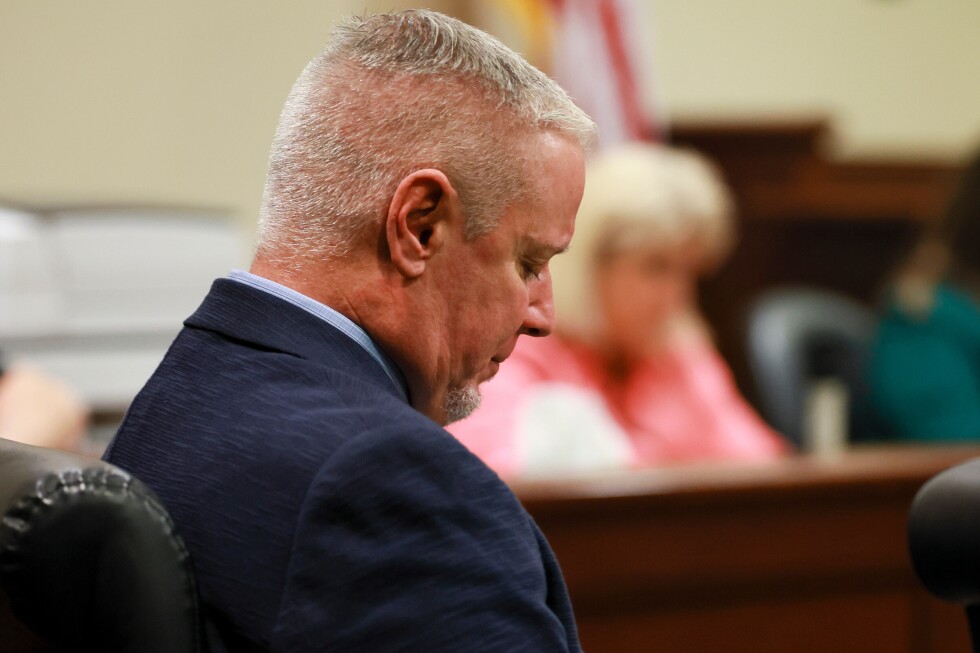



A man whose teenage son is accused of killing two students and two teachers at a Georgia high school should be held responsible for providing the weapon despite warnings about alleged threats his son made, a prosecutor said Monday.
The trial of Colin Gray began Monday in one of several cases around the country where prosecutors are trying to hold parents responsible after their children are accused in fatal shootings.

Gray faces 29 counts, including two counts of second-degree murder, two counts of involuntary manslaughter and numerous counts of second-degree cruelty to children related to the September 2024 shooting at Apalachee High School in Winder.
“This is not a case about holding parents accountable for what their children do,” Barrow County District Attorney Brad Smith said in his opening statement. “This case is about this defendant and his actions in allowing a child that he has custody over access to a firearm and ammunition after being warned that that child was going to harm others.”
Advertisement
Prosecutors argue that amounts to cruelty to children, and second-degree murder is defined in Georgia law as causing the death of a child by committing the crime of cruelty to children.
Investigators have said Colt Gray, who was 14 at the time, carefully planned the Sept. 4, 2024, shooting at the school northeast of Atlanta that is attended by 1,900 students.
But Brian Hobbs, an attorney for Colin Gray, said the shooting’s planning and timing “were hidden by Colt Gray from his father. That’s the difference between tragedy and criminal liability. You cannot hold someone criminally responsible for failing to predict what was intentionally hidden from them.”
With a semiautomatic rifle in his book bag, the barrel sticking out and wrapped in poster board, Colt Gray boarded the school bus, investigators said. He left his second-period class and emerged from a bathroom with the gun and then shot people in a classroom and hallways, they said.
Advertisement
Smith told the jury that Colin Gray’s daughter was in lockdown at her middle school and texted her father that there had been a shooting at the high school. When law enforcement arrived at Gray’s home, he met them in the garage and “without any prompting, he blurts out, ‘I knew it,’” Smith said.
Smith said that in September 2021, Colt Gray used a school computer to search the phrase, “how to kill your dad.” School resource officers were then sent to the home, but it was determined to be a “misunderstanding,” Smith said.
Sixteen months before the shooting, in May 2023, law enforcement acted on a tip from the FBI after a shooting threat was made online concerning an elementary school. The threat was traced to a computer at Gray’s home, Smith said.
Colin Gray was told about the threat and was asked whether his son had access to guns. Gray replied that he and his son “take this school shooting stuff very seriously,” according to Smith. Colt Gray denied that he made the threat and said that his online account had been hacked, Smith said.
Advertisement
That Christmas, Colin Gray gave his son the gun as a gift and continued to buy accessories after that, including “a lot of ammunition,” Smith said.
Colin Gray knew his son was obsessed with school shooters, even having a shrine in his bedroom to Nikolas Cruz, the shooter in the 2018 massacre at Marjory Stoneman Douglas High School in Parkland, Florida, prosecutors have said. A Georgia Bureau of Investigation agent had testified that the teen’s parents had discussed their son’s fascination with school shooters but decided that it was in a joking context and not a serious issue.
Three weeks before the shooting, Gray received a chilling text from his son: “Whenever something happens, just know the blood is on your hands,” according to Smith.
Colin Gray was also aware his son’s mental health had deteriorated and had sought help from a counseling service weeks before the shooting, an investigator testified.
Advertisement
“We have had a very difficult past couple of years and he needs help. Anger, anxiety, quick to be volatile. I don’t know what to do,” Colin Gray wrote about his son.
But Smith said Colin Gray never followed through on concerns about getting his son admitted to an in-patient facility.
The trial is being held in Winder, in Barrow County, where the shooting happened. The defense asked for a change of venue because of pretrial publicity, and prosecutors agreed. The judge kept the trial in Winder but decided to bring in jurors from nearby Hall County to hear the case. Jurors were selected last week.
Bill Clinton was acquainted with Epstein, who died in prison in 2019, but has denied knowledge of his sex offending at the time and says he cut off contact two decades ago. Neither Clinton has been accused of wrongdoing by survivors of Epstein’s abuse, and they have denied knowledge of his sex offending at the time.
A moped rider has died after being hit by a car. Emergency services were called to the B1102 Swaffham Road, Lode, Cambridge at about 5.20pm on Sunday (February 15).
Advertisement
The crash involved a white Kia Venga, a red Toyota Corolla and a black Honda moped, with the Kia colliding with the moped. The moped rider, a 20-year-old man, died at the scene.
The driver of the Kia, an 18-year-old woman, was arrested on suspicion of causing death by dangerous driving. She has since been bailed.
Cambridgeshire Police said: “Anyone who saw what happened, has dashcam footage of the collision, was in the area at the time or the moments leading up to it, can report it through the force website or by calling 101, quoting incident 325 of 15 February.”
For years, big tech companies have placed the burden of managing screen time squarely on individuals and parents, operating on the assumption that capturing human attention is fair game.
But the social media sands may slowly be shifting. A test-case jury trial in Los Angeles is accusing big tech companies of creating “addiction machines”. While TikTok and Snapchat have already settled with the 20-year-old plaintiff, Meta’s CEO, Mark Zuckerberg, is due to give evidence in the courtroom this week.
The European Commission recently issued a preliminary ruling against TikTok, stating that the app’s design – with features such as infinite scroll and autoplay – breaches the EU Digital Services Act. One industry expert told the BBC that the problem is “no longer just about toxic content, it’s about toxic design”.
Meta and other defendants have historically argued that their platforms are communication tools, not traps, and that “addiction” is a mischaracterisation of high engagement.
Advertisement
“I think it’s important to differentiate between clinical addiction and problematic use,” Instagram chief Adam Mosseri testified in the LA court. He noted that the field of psychology does not classify social media addiction as an official diagnosis.
Tech giants maintain that users and parents have the agency and tools to manage screen time. However, a growing body of academic research suggests features like infinite scrolling, autoplay and push notifications are engineered to override human self-control.
Video: CBS News.
A state of ‘automated attachment’
My research with colleagues on digital consumption behaviour also challenges the idea that excessive social media use is a failure of personal willpower. Through interviews with 32 self-identified excessive users and an analysis of online discussions dedicated to heavy digital use, we found that consumers frequently enter a state of “automated attachment”.
Advertisement
This is when connection to the device becomes purely reflexive, as conscious decision-making is effectively suspended by the platform’s design.
We found that the impulse to use these platforms sometimes occurs before the user is even fully conscious. One participant admitted: “I’m waking up, I’m not even totally conscious, and I’m already doing things on the device.”
Another described this loss of agency vividly: “I found myself mindlessly opening the [TikTok] app every time I felt even the tiniest bit bored … My thumb was reaching to its old spot on reflex, without a conscious thought.”
Social media proponents argue that “screen addiction” isn’t the same as substance abuse. However, new neurophysiological evidence suggests that frequent engagement with these algorithms alters dopamine pathways, fostering a dependency that is “analogous to substance addiction”.
Advertisement
Strategies that keep users engaged
The argument that users should simply exercise willpower also needs to be understood in the context of the sophisticated strategies platforms employ to keep users engaged. These include:
1. Removing stopping cues
Features like infinite scroll, autoplay and push notifications create a continuous flow of content. By eliminating natural end-points, the design effectively shifts users into autopilot mode, making stopping a viewing session more difficult.
Bereaved parents hold a vigil for their children outside LA’s Superior Court on February 5 2026, ahead of the social media addiction trial. Jordan Strauss/AP/Alamy
Vulnerability in children
The issue of social media addiction is of particular concern when it comes to children, whose impulse control mechanisms are still developing. The US trial’s plaintiff says she began using social media at the age of six, and that her early exposure to these platforms led to a spiral into addiction.
Lawyers in the US trial have pointed to internal documents, known as “Project Myst”, which allegedly show that Meta knew parental controls were ineffective against these engagement loops. Meta’s attorney, Paul Schmidt, countered that the plaintiff’s struggles stemmed from pre-existing childhood trauma rather than platform design.
Our study heard from many adults (mainly in their 20s) who described the near-impossibility of controlling levels of use, despite their best efforts. If these adults cannot stop opening apps on reflex, expecting a child to exercise restraint with apps that affect human neurophysiology seems even more unrealistic.
Potential harms of overuse
The consequences of social media overuse can be significant. Our research and recent studies have identified a wide range of potential harms.
Excessive exposure to rapidly changing, highly stimulating content can fracture the user’s attention span, making it harder to focus on complex real-world tasks.
Advertisement
And many users describe feeling “defeated” by the technology. Social media’s erosion of autonomy can leave people unable to align their online actions – such as overlong sessions – with their intentions.
A ruling against social media companies in the LA court case, or enforced redesign of their apps in the EU, could have profound implications for the way these platforms are operated in future.
But while big tech companies have grown at dizzying rates over the past two decades, attempts to rein in their products on both sides of the Atlantic remain slow and painstaking. In this era of “use first, legislate later”, people all over the world, of all ages, are the laboratory mice.
MILAN (AP) — Small margins decided gold medals at the Milan Cortina Olympics as Eileen Gu had to settle for another silver in defense of her big air ski freestyle title and Elana Meyers Taylor of the U.S. finally won bobsled gold in her fifth Olympics.
Also on Day 10 of the Winter Games, a Norwegian contender’s emotional reaction overshadowed the last men’s Alpine ski event, and the U.S. and Canada advanced to another gold medal showdown in women’s hockey after winning their semifinal games.
Silver again for Gu in big air
Gu came to Italy to fight for gold medals in three different freestyle ski events. She has two silvers and still has her best event, the halfpipe, to go.
After a long delay because of heavy snow, it was Canada’s Megan Oldham who soared to victory with a combined score of 180.75 to Gu’s 179.
Advertisement
It was still a remarkable performance from Gu, the San Francisco-born skier for China who hadn’t competed in big air in the four years since winning gold at the 2022 Olympics.
The athlete who beat Gu to the gold in slopestyle last week, Switzerland’s Mathilde Gremaud, was ruled out of the big air final when she injured her hip in practice hours before.
The wait is over for Meyers Taylor
Vancouver, Sochi, Pyeongchang, Beijing. Meyers Taylor won at least one medal at each of her first four Olympics, but the gold always eluded her.
No longer.
Advertisement
The 41-year-old American won that long-awaited medal by just four hundredths of a second in women’s monobob when the last competitor, Germany’s Laura Nolte, made a small but costly mistake on her final run.
Meyers Taylor’s sixth career medal extends her record as the most decorated Black athlete at the Winter Olympics. She’s also the oldest American woman to win gold at the Winter Games.
Meyers Taylor’s U.S. teammate Kaillie Armbruster Humphries was third, 0.08 off Nolte’s time.
McGrath’s moment alone in the forest
The men’s slalom race had a finish like no other.
Advertisement
Norway’s Atle Lie McGrath was leading the race and skiing last on the second run but straddled a gate and was out. He stopped, threw his ski poles over a fence and then started walking through deep snow to the forest for some time alone.
“I thought that I would get some peace and quiet, which I didn’t,” said McGrath, who said photographers and police tracked him down.
The dramatic finish overshadowed Loic Meillard of Switzerland winning gold, and an earlier fall for giant slalom winner and South American history maker Lucas Pinheiro Braathen.
It’s been an especially tough Olympics for McGrath, whose grandfather died on the day of the opening ceremony. McGrath was racing with an armband as a tribute.
Advertisement
US-Canada again for women’s hockey gold
The U.S. and Canada will play for the gold medal on Thursday after the U.S. routed Sweden 5-0 and Canada struggled past Switzerland 2-1 in Monday’s semifinal games.
U.S. goaltender Aerin Frankel preserved a shutout streak which now stands at 331 minutes. The U.S. team is unbeaten and has allowed just one goal all tournament as it seeks a first gold medal since 2018.
Riku Miura and Ryuichi Kihara needed something special after placing fifth in the pairs figure skating short program. They delivered.
Advertisement
Miura and Kihara produced a world record score in the free skate to win Japan’s first-ever pairs gold.
Georgia got its first medal in any Winter Olympic sport with Anastasiia Metelkina and Luka Berulava in second. Short-program leaders Minerva Fabienne Hase and Nikita Volodin of Germany dropped to the bronze medal position.
Xandra Velzeboer won her second gold medal of the Olympics in the women’s 1,000-meter short track speedskating to match her Dutch teammate Jens van ’t Wout with two gold medals for the games. Italy’s Arianna Fontana was chasing what would have been her 14th career Olympic medal but placed fourth.
Austria won the first-ever Olympic gold in men’s super team ski jumping. The Austrians were leading when the competition was cut short due to heavy snow and wind.
All members of Nancy Guthrie’s family, including NBC News‘ Savannah Guthrie, her siblings, and their spouses, have been cleared as possible suspects, according to the Pima County Sheriff’s Office.
Pima County Sheriff Chris Nanos made the announcement on Monday afternoon, saying in a statement that the Guthrie family has been “nothing but cooperative and gracious and are victims in this case.”
“To suggest otherwise is not only wrong, it is cruel,” he said. “The Guthrie family are victims plain and simple.”
The sheriff’s department said in an earlier statement that there are no scheduled news conferences regarding the case today.
Advertisement
The memo issued by the department does not appear to have been in response to any new evidence or breakthroughs, but rather as a general statement on the status of the Guthrie family.
Today show host Savannah Guthrie and her siblings have been ruled out as possible suspects in the disappearance of their mother, Nancy Guthrie, by Pima County Sheriff Chris Nano (instagram/savannahguthrie)
Nancy Guthrie, 84, was reported missing from her home in Arizona on February 1. Local investigators and the FBI have been searching for her for more than two weeks.
While law enforcement has been busy running down leads, Savannah Guthrie and her siblings have been making emotional pleas on social media asking the supposed kidnapper to reach out and provide proof of life and further instructions for how they can get their mother back.
Advertisement
Earlier on Monday, TMZ founder Harvey Levin announced that his publication had received a fourth letter from an individual claiming to have knowledge of who kidnapped Nancy Guthrie. The individual is reportedly refusing to reveal the information until payment is made.
Nancy Guthrie, left, and a masked man who police believe may have abducted the 84-year-old from her home in Arizona. On February 16, the Pima County Sheriff’s Office said it had ruled out all of Guthrie’s family — including her children and their spouses — as possible suspects in her apparent kidnapping (FBI)
Levin said he had been in contact with the FBI, posted a video telling the tipster to provide the information to him, and that he would work with the FBI to secure payment. The TMZ founder believes that the individual who sent Monday’s letter is the same one who has sent three previous letters demanding payment for information about Nancy Guthrie’s whereabouts.
“A fourth letter from the same person who says he knows where Nancy Guthrie is, and he wants money in return for the information,” Levin said. “Essentially, he wants the reward.”
Advertisement
During his address, Levin also read a chilling line from the letter.
”‘I know what I saw five days ago south of the border, and I was told to shut up, so I know who he is, and that was definitely Nancy with them,’” he read.
Meanwhile, the Pima County Sheriff’s Office is reportedly working with Walmart after it discovered the brand of backpack the suspected kidnapper wore on the night Nancy Guthrie disappeared was sold exclusively at the retailer.
The backpack is a 25-liter “Ozark Trail Hiker Pack.” The “Ozark Trail” brand is a private, Walmart-owned outdoor brand that is only sold in its stores and on its website. However, it is possible the individual bought the pack from a private seller or from a second-hand sports retailer.
Advertisement
“This backpack is exclusive to Walmart and we are working with Walmart management to develop further leads,” Nanos said.
The clothing the suspect was wearing the night of the alleged abduction may also have been purchased at Walmart, but investigators noted that the clothing isn’t exclusively offered by Walmart.
“This remains a possibility only,” the sheriff’s office said in a statement on Monday.
Advertisement
A Pima County Sheriff’s Office deputy remains on guard outside Nancy Guthrie’s home near Tucson, Arizona. On Monday, Pima County Sheriff’ Chris Nanos said that all of Guthrie’s family — including her children and her siblings — were cleared as suspects
Investigators searching near Guthrie’s home have collected several gloves and have sent them to a forensics lab for testing, according to the Pima County Sheriff’s Office. Deputies noted that many of the gloves found in the area were from volunteers who were searching for Guthrie. It’s unclear what kind of gloves were sent for further analysis.
The FBI and the sheriff’s office are also still collecting tips about the case. According to the FBI, it has collected more than 13,000 calls about Guthrie since February 1, and the sheriff’s department said it has taken at least 18,000 calls.
Investigators have not said whether any of those calls have proven helpful to the search.
Guthrie has been missing for more than two weeks, resulting in some criticism of the investigation. Pima County Sheriff Chris Nanos told the Daily Mail on Sunday that he doesn’t care about the “haters” who say the department released the crime scene too early.
Advertisement
“My officers were there for almost 20 hours, and they processed their scene, got it done, and brought in all the evidence,” he told the outlet. “Then the FBI came and did their thing.”
He also told the publication that claims he was blocking the FBI from accessing important evidence were wrong.
“Why would I do that?” he said. “It makes no sense.”
An explosion does not need to strike the head to injure the brain. When a blast occurs, it generates a sudden pressure wave that can pass through the body and skull in milliseconds, potentially deforming brain tissue and blood vessels along the way.
For soldiers exposed to improvised explosive devices or other blasts, and civilians caught in industrial accidents or explosions in conflict zones, the neurological effects can be long-lasting – even when brain scans appear normal.
Blast injuries can trigger changes in the brain and its blood vessels that standard medical scans do not always detect. When these injuries go unrecognised, people may receive the wrong care or be left without an explanation for symptoms that persist for years.
Most people are familiar with traumatic brain injuries caused by impacts such as falls, road traffic collisions or sports injuries. In these situations, the brain moves suddenly within the skull, leading to bruising or localised damage that can often be seen on scans.
Advertisement
Blast injury works differently. The rapid rise and fall in pressure created by an explosion can travel through the skull and the fluid that surrounds and cushions the brain. This generates complex mechanical forces that stretch and strain brain tissue. As a result, someone can sustain a brain injury even without any direct blow to the head.
Rather than producing one clearly visible injury, blast exposure tends to cause widespread microscopic damage. These tiny injuries can disrupt how brain cells communicate with each other, and can also damage the blood vessels that keep brain tissue healthy.
Although blast injury is often associated with military settings, it is not confined to war zones. Civilians may be exposed through industrial explosions, terrorist attacks or demolition work. In all these situations, the underlying mechanisms of brain injury are similar.
Advertisement
Despite these differences, blast injuries are often managed in the same way as concussions or other head injuries. When damage to blood vessels is overlooked, the severity of the injury and its long-term impact can be underestimated.
More sensitive diagnostic tools, including advanced imaging and specialised blood tests, could improve detection of subtle blood vessel damage. This would allow for more targeted treatment aimed at reducing inflammation, protecting the brain’s circulation, and ensuring patients receive appropriate long-term care.
Blast-related brain injury can also disrupt the brain’s waste-clearance system. This system normally removes harmful proteins and metabolic waste. When it is impaired, vulnerability to long-term post-concussion symptoms and neurodegenerative diseases may increase.
Common causes of blast brain injury. Author provided, Author provided (no reuse)
Brain blood vessels are especially vulnerable
One of the most important, and often overlooked, consequences of blast injury is damage to the brain’s blood vessels.
Blood vessels are thin-walled and flexible, allowing them to cope with normal changes in blood flow and pressure. During a blast, however, the rapid pressure shifts can stretch these vessels beyond their limits. This can cause tiny tears and weaken the protective barrier that normally prevents harmful substances in the bloodstream from entering brain tissue.
This protective layer, often called the blood–brain barrier, plays a crucial role in controlling what passes from the blood into the brain. When it is damaged, inflammatory cells and proteins can leak into brain tissue.
The resulting inflammation may persist long after the initial injury, interfering with normal brain function. Over time, this can contribute to symptoms such as headaches, memory problems, difficulty concentrating, slowed thinking, mood changes and fatigue.
Advertisement
Damage to the blood–brain barrier may help explain why some people experience ongoing symptoms months or even years after blast exposure.
Symptoms Associated with Brain Injury. Author provided, Author provided (no reuse)
Why scans can appear normal
One of the most frustrating experiences for people with blast-related brain injury is being told that their CT or MRI scan is normal, despite persistent symptoms.
Standard imaging techniques are very good at detecting fractures, bleeding or large areas of tissue damage. Blast injuries, however, often involve microscopic changes such as small vessel damage, disruption to communication between brain cells, and ongoing inflammation. These changes are usually too subtle to be seen on routine scans.
This mismatch between symptoms and imaging can delay diagnosis, complicate rehabilitation and, in some cases, affect access to appropriate support or compensation.
Advertisement
Microscopic damage from blast brain injury. Author provided, Author provided (no reuse)
Progress will require close collaboration between neuroscientists, clinicians, emergency services and policymakers. Blast injury is not only a military concern. It offers broader insights into how pressure-related forces damage the brain, and how these injuries might be prevented or treated.
Recognising blast injury as a distinct form of brain trauma, particularly one that affects the brain’s blood vessels, is a crucial step towards improving care for those affected.
Welcome to our live coverage of the Winter Olympics, where Britain’s Kirsty Muir is in action in the women’s freeski big air final.
Medal hope Muir qualified in fourth place for tonight’s final after narrowly missing out on making the podium last week in the slopestyle.
The 21-year-old was denied a bronze medal by just 0.41 points, recovering after errors on her first two runs to land an excellent third, but it wasn’t enough. The Scottish skier was tearful after coming so close, but will have a shot at redemption this evening in the big air.
Advertisement
“Obviously missing out on an Olympic medal, being that close is hard and it’s going to be hard for anyone, no matter what competition. Fourth is such a hard place to be in, but even more so at the Olympics,” she said.
“All my friends, family, supporters from home have all been like, fourth at the Olympics, fourth in the world, congrats, and I feel that as well, but it’s just hard because you want that podium. But at the same time I’m very proud of my skiing.”
The softly spoken Scot has vowed to leave everything out on the slopes as she targets a medal. After Team GB’s gold rush over the weekend – which began with Matt Weston’s heroics in the individual men’s skeleton on Friday night – Muir will not be lacking in inspiration.
Former Pakistani prime minister Imran Khan has not received adequate medical treatment in prison after suffering partial vision loss in one eye, his spokesman claims.
Speaking to Sky News’ The World with Yalda Hakim, Zulfi Bukhari said Mr Khan’s personal doctor has not been allowed to examine the imprisoned former leader, who is said to have lost 85% of vision in his right eye.
On Sunday, a “fully equipped ambulance” carrying a team of doctors was sent to the prison, but Mr Bukhari questioned why Mr Khan, who has been in prison since August 2023, was not taken to “an appropriate hospital with the appropriate equipment”.
The team of doctors then relayed information to Mr Khan’s personal physician, but “this all still remains in hearsay”, Mr Bukhari said.
Advertisement
Image: Imran Khan. File pic: AP
“Why are we getting phone calls and just being told reports? Why is his personal doctor not allowed to be present? Or at the very least, see him now after they’ve done the check-up? The same goes for any family member,” he questioned.
Mr Khan, 73, has been in isolation at the Adiala prison for about 90 days and has not been able to see his family, Mr Bukhari claimed.
“Why is he being kept in secrecy in isolation? And why is this whole procedure being done in this big secret format, which no one else is allowed to take part in?” he said, demanding that Mr Khan’s personal physician and one family member be allowed to see him.
Jailed Imran Khan suffers severe vision loss
Advertisement
‘Family not informed of surgery’
In January, the Pakistani government announced Mr Khan underwent a brief procedure at a hospital in Islamabad for his eye condition.
Mr Khan’s family or his legal team were never informed of his eye conditions, Mr Bukhari said, adding this was “a basic right for a prisoner”.
Pakistan’s Supreme Court allowed his lawyer, Salman Safdar, to see him in prison, after which Mr Safdar told the court about Mr Khan’s vision loss, resulting in the court ordering a medical assessment by a panel of doctors.
Advertisement
Supporters of Mr Khan’s Pakistan Tehreek-e-Insaf party (PTI) have staged protests in Islamabad and other cities, demanding that the former prime minister be moved from prison to a hospital for specialised treatment for his eye condition.
Cabinet minister Tariq Fazal Chaudhry wrote on X on Monday that a detailed medical examination of Khan was performed inside the prison, and doctors concluded Mr Khan’s eyesight had improved and “no major complications have emerged”.
Dr Aasim Yusuf, Mr Khan’s personal physician, said on X that the team of eye specialists treating Mr Khan had told him about an “improvement” in his eyesight, but he could not confirm or deny this assessment as he has not been allowed to see or examine Mr Khan himself.
Image: Supporters of Imran Khan protest outside the Islamabad High Court, in Islamabad, Pakistan, in December. Pic: AP
‘Inhumane to stop family from seeing him’
The Supreme Court also ordered a phone call between Mr Khan and his sons.
Advertisement
Sulaiman and Kasim Khan told Yalda Hakimin December that they had not spoken to their father for months and fear they might never see their father again, as he is being “psychologically tortured” in a “death cell”.
They were allowed to speak to him for 20 minutes over the weekend, Mr Bukhari said. Mr Khan’s sister, Aleema Khan, wrote on X on Saturday that her brother was “extremely happy” to hear his sons’ voices after a long gap.
‘He’s being held in a death cell’
But his sons’ visas to visit their father in the Pakistani prison keep being delayed.
Advertisement
“I mean, not granting them a visa is, is ridiculous. It’s an online system. The basic things are there, whose kids they are, where they were, why they’re coming, where they’re staying, all of that,” Mr Bukhari claimed.
“So denying them a visa to go see their father, who’s been in prison and they haven’t seen him for probably three odd years, is just inhumane. They haven’t outright rejected it, but they keep saying there’s some technical issue.”
Imran Khan’s son accuses Pakistan over visa
‘It is ripping the country apart’
Advertisement
While Mr Khan is in prison, Pakistan was “deteriorating”, Mr Bukhari said, “but the focus is just on how do we keep Imran Khan caged away, so no one can see him, no one can hear him, and no one can speak to him, and he should not be able to get anything out in the public”.
The former leader was convicted in a string of cases that he says were politically driven following his ousting in a 2022 parliamentary vote.
When asked whether Mr Khan believed that he would be released from jail someday, Mr Bukhari replied: “He would be thinking that he is not only going to come out of jail one day, he is also going to come out and lead the country the way it’s supposed to be led one day.”
He added he did not think Mr Khan was delusional, as “he’s always succeeded in whatever he put his vision towards”.
Advertisement
Mr Khan said: “He’s always made it, he’s always done it against all odds, and I don’t see how this is going to be any different.”
Sky News has contacted the Pakistani government for comment.
Before launching his political career, Mr Khan was best known as a star of international cricket and for leading Pakistan to Cricket World Cup victory in 1992.
“I really couldn’t be prouder of the team. For us to go toe-to-toe with two Premier League teams and to only lose by an own goal is something I’m incredibly proud of.
“All the lads are down and Sam’s the same obviously, having scored an own goal. It’s natural, but every player knows what they have achieved for this club on this journey, so we should all be so proud.
“We now go back to our bread and butter in the league. We train twice a week and we’ve put that performance on against a Premier League side. How can you not be proud of that achievement?
“I started my football career at this club and I’ve started my managerial career at this club. We want to go on and get promoted. We want to try and get in the play-offs.”
Advertisement
Macclesfield’s fans arrived in a blizzard of optimism, the rainbow that arced over this compact, atmospheric stadium after a storm two hours before kick-off offering up an omen that they could claim another pot of gold.
And how they revelled in another visit from a Premier League team, chanting “West Ham away” after hearing the fifth round draw, then “are you Palace in disguise” as they tore into Brentford – both physically and with their football – in the opening exchanges.
Macclesfield captain Paul Dawson, a goal hero in the 2-1 win against Palace, was inches away from a repeat with a 20-yard shot that was just off target.
Every classic FA Cup ingredient was in this mix. The non-league side with a collection of PE teachers, podcasters and property developers in their squad shaking up elite opposition, with the added factor of Moss Rose’s 4G artificial surface.
Advertisement
There was nothing artificial about the atmosphere as every Macclesfield fan scented another shock in the cold night air.
Few other competitions can offer up such a spectacle and the FA Cup delivered again.
In some respects, the half-time whistle came at a bad time for Macclesfield as it disturbed their momentum and allowed Brentford to take a breath and regroup.
Brentford head coach Andrews made seven changes, leaving his big attacking weapons Igor Thiago and Kevin Schade out altogether. It was a high-risk strategy and there were moments in the first 45 minutes when it looked like it might backfire.
Advertisement
And even after suffering the devastating blow of Heathcote’s own goal, Macclesfield refused to allow Brentford to simply shut the game down, forcing several desperate clearances in the area before referee Darren England sounded the final whistle on this FA Cup odyssey.
Macclesfield will now return to their real world against King’s Lynn Town on Saturday – but they have created FA Cup memories that will live forever with players and fans of a club on the rise.
California was walloped Monday by a powerful winter storm carrying treacherous thunderstorms, high winds and heavy snow in mountain areas.
Millions of Los Angeles County residents faced flash flood warnings as rain pounded the region and people in some areas scarred by last year’s devastating wildfires were under an evacuation warning through Tuesday because of the potential for mud and debris flows.
Los Angeles Mayor Karen Bass ordered emergency crews and city departments to be ready to respond to any problems.
The storm wreaked havoc on roadways spanning from Sonoma County to the Sierra Nevada. Traffic was halted temporarily in both directions on I-80 near the Nevada state line due to spinouts and crashes, the California Department of Transportation reported. In Santa Barbara County, a large tree toppled onto US-101, shutting down southbound lanes.
Advertisement
Forecasters said the western slope of the Sierra Nevada, northern Shasta County — including portions of Interstate 5 — and parts of the state’s Coast Range could see up to 8 feet (2.4 meters) of snow before the storm moves through late Wednesday. The heavy snow, wind and low visibility could also make travel conditions dangerous to near impossible, forecasters added.
“It has seemed ‘springlike’ for a large part of 2026, but winter is set to show it’s not quite done yet,” the Shasta County Sheriff’s Office said in a social media post urging residents to stay aware of the storm.
California’s Office of Emergency Services said it was placing fire and rescue personnel and resources in areas most at risk for flooding, mud and debris flows.
In Southern California, Six Flags Magic Mountain was closed Monday due to the storm, and Knotts Berry Farm amusement park shut its doors early. But the winter weather was celebrated by local ski resorts that have waited weeks for snow.
Advertisement
Other states on Monday braced for different threatening weather events. Residents in parts of eastern Colorado received warnings that they could be in fire danger due to a combination of abnormally high temperatures, gusty winds and dry conditions. The risks were expected to continue further into the week as gusts up to 60 mph (96 kph) are likely to hit the Colorado eastern plains on Tuesday. Parts of Texas, New Mexico and Kansas were also under red flag warnings.
The latest storm comes amid a snow drought across much of the American West, with snow cover and depth measuring at the lowest levels scientists have seen in decades. Most states saw half their average precipitation or less in January, though California fared better others due to heavy rains in December.
It was the first of several days of stormy weather forecast for California. A coastal flood advisory was in effect for San Francisco until Tuesday afternoon, with cooler showers and a chance of hail on Tuesday, while nearby mountains were expecting snow, the National Weather Service in Monterey reported.
Kashawna McInerny, a Realtor in the mountain community of Wrightwood, about 80 miles (130 kilometers) northeast of Los Angeles, on Monday said she was still dealing with several tons of rock and debris on her property from Christmas and New Year’s storms that pummeled the community. After the last one, she said she got help trenching part of her side yard to direct stormwater down the street and placed a barrier of metal and wood by a door in hopes of keeping out mud and debris.
Advertisement
“We’re not panicking yet. At least I’m not,” she said with a laugh.
___
Associated Press writers Amy Taxin from Santa Ana, California, and Dorany Pineda in Los Angeles contributed to this report.