




Hedge-fund billionaire Chris Rokos is Britain’s third top taxpayer. He reportedly paid £330million in tax in Britain in 2025.
Unfortunately for the Treasury, Mr Rokos has decided to shift his residency from Britain to Greece. Rokos, who runs Rokos Capital Management, plans to open an office in Athens.
A government spokesman said: ‘The UK remains an attractive destination for talent and investment.’
In Britain, Chancellor John Healey has not ruled out tax hikes in his Budget on October 28. A wealth tax has also not been ruled out.
Recent increases in government borrowing costs have piled pressure on the public finances.
And you can see the appeal of Greece for a high-flyer like Mr Rokos.
In June, Henley & Partners placed Greece among the world’s most competitive jurisdictions for the wealthy, giving the country a score of 70.5 out of 100 in its Wealth Mobility Competitiveness report.
So, should you, particularly if you have deeper pockets, consider quitting Britain and moving to Greece?
This is Money examines considerations like tax, residency rules, housing and the climate in Greece.
What to know: Residency rules and visa routes need to be factored in before moving to Greece
Do you need residency to buy in Greece?
You do not need residency in Greece to buy a home in the country. Buying property in Greece does not automatically make you a tax resident in Greece.
Mark Harvey, a partner and head of international residential at Knight Frank, told This is Money average property prices in Greece had risen by about 7 per cent a year since the Covid-19 pandemic.
Buyers should factor in a 10 per cent buffer to cover their purchase costs.
He added: ‘Locations such as Athens and its Riviera, Porto Heli, Corfu, Mykonos and other key island destinations continue to attract the well-heeled, while larger islands like Crete and Rhodes along with the mainland also attract those seeking to benefit from the Golden visa program and Greek residency.
‘Financial barriers to entry have changed and vary dramatically from region to region.
‘British buyers should remain aware of the 90 day rule cumulative (across Europe) over a rolling 180 day period.
‘Those seeking to rent out their homes will have to apply for a license which require them to meet certain safety norms.’
George Ioannou, private office adviser at Engel & Volkers, said: ‘The most premium part of Athens at the moment is the Athens Riviera, particularly Vouliagmeni, Voula and Glyfada.
‘This area is benefiting significantly from the development of The Ellinikon, one of the largest urban regeneration projects in Europe.’
He added: ‘We are seeing a growing number of British buyers looking at Greece, primarily for tax-related reasons.
‘Many are under some time pressure, particularly those looking to establish their tax residency before the end of October.’
Thomas Hardy Tsakas, owner of Greek Real Estate Consultant, said: ‘A house of 200 sqm in Halkidiki close to the seaside can cost from and between €400,000 to €700,000, while a house with the same space in Larisa or Trikala can cost from €70,000 to €250,000.
Prices for new-build flats in Greece were up 6 per cent year-on-year in the first quarter of 2026 compared to the same point a year ago, experts at The Ellinikon said.
Contact an English-speaking solicitor if you are considering buying property or land in Greece.

Making the switch: Billionaire Chris Rokos is moving his residency from Britain to Greece
Tax traps and benefits to look out for
One of the top reasons many wealthy Britons move to Greece is because of the tax benefits.
The country has generous tax rules for wealthy foreigners earning overseas income.
In June, Greece introduced new tax breaks specifically targeting venture capital firms and hedge funds as part of a drive to get more wealthy people from Britain, Switzerland and the United Arab Emirates to move there.
Greece’s tax on bonuses and dividends in the financial sector has been cut to 5 per cent, from 15 per cent.
One condition is that the company has operating expenses of at least €3million per year in the country.
Separately, Greece introduced its high-net-worth individual non-domicile tax regime in 2019.
It is designed to attract wealthy foreign investors, entrepreneurs and internationally mobile households.
Under the regime, qualifying individuals who transfer their tax residence to Greece can opt to pay a fixed annual tax of €100,000 on their foreign-source income, irrespective of the sum earned.
The regime is available for up to 15 years and can be extended to certain family members for an additional annual fee.
Peter Ferrigno, director of tax services at Henley & Partners, said: ‘The Greek non-domicile rules were based on the old UK non-domicile ones.
‘The UK used to have similar programs to this. The abolition of non-dom status and removal of the Investor Visa means that, even where equivalent investors wish to move to the UK, there is no route for them to do so.’
Income tax is payable by anyone earning income in Greece, regardless of citizenship or place of permanent residence.
Permanent residents are taxed on their worldwide income. Personal income tax rates in Greece are progressive, ranging from 9 per cent to 44 per cent.
Additional rate taxpayers in Britain pay 45 per cent in income tax on the proportion of their income over £125,140.
Excluding a few exceptions, for a private individual, the 15 per cent capital gains tax on the sale of Greek real estate is currently suspended.
The suspension runs until December 31, 2026. The temporary suspension means the effective rate of capital gains tax on the sale of property is zero for now.
Residency rules explained
You cannot apply for residency in Greece until you are in Greece.
Within 90 days of your arrival, you must register your address in person with the regional branch of the Hellenic police and apply for a temporary residence permit.
You can apply for permanent residency in Greece if you have lived there for five years with a temporary residence permit.
You would need to renew your permanent residence permit every 10 years.
Greece recognises dual citizenship with Britain. This means that you would not have to give up your British citizenship to become a Greek citizen.
What about Golden Visas?
Greece’s Golden Visa Programme is a residence by investment programme launched in 2013 that enables non-EU nationals and their family to obtain permanent residence permits in Greece.
Ferrigno said: ‘Greece has two specific programs for people who have not been tax resident of Greece for the previous several years, which provide for a preferential regime.
‘One option is a flat tax of €100,000 on all foreign source savings and investment income.
‘This would cover, for example, dividend income and capital gains from assets abroad.
‘This is for people who have not lived in Greece for at least seven of the past eight years.
‘The other is a preferential rate of 7 per cent for pensioners relocating to Greece which covers not only pensions but also investment income.
‘The requirement here is not being resident for at least five of the past six years.
‘Both of these apply for up to 15 years, and do require an investment to be made into the Greek economy, either a property purchase with the price varying by location, or a financial investment into a Greek company or Greek government bonds.
‘Amounts are between €250,000 and €800,000 depending on which type of investment.’
Climate in Greece… it does get cold!
Greece has a Mediterranean climate and summers can be very hot and dry.
Heatwaves can push temperatures above 38°C, but sea breezes in some locations can help ease the temperature.
In summer, the days are long and there is often plenty of sunshine. There’s often little or no rainfall in July and August.
Winters can be cool, but generally not as cold as they are in Britain. Tui said the average temperature in Greece in January was between 15°C and 17°C, though it could get to as low as 1°C.
You are still likely to get between four to six hours of sunshine a day, even in winter.
The best time to visit Greece is between April and October, when temperatures are comfortable, rainfall is low and conditions are ideal for exploring, experts at Tui said.
What homes are on sale now?
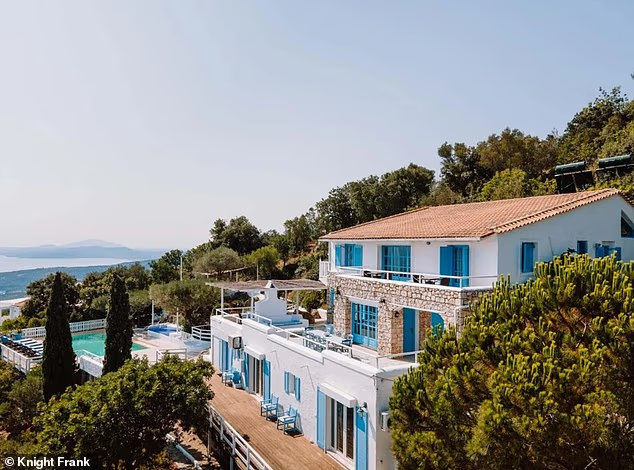
Three-bed villa, Meganisi, €2,400,000
Set in an elevated and secluded position above the entrance to Vathi Bay, this three-bed villa has three bathrooms and two living rooms.
It is on sale via Knight Frank for €2,400,000. It has a large library and study room which could be converted into a fourth bedroom.
The property has an infinity pool and large shaded terraces with panoramic views.

The dream? Villa Onerio in on sale via Knight Frank for €2,400,000

Fabulous: The three-bed villa in Meganisi has an infinity pool and outstanding views

Quite a few: The villa has multiple outdoor terraces and dining spaces
2. Three-bed villa, Kefalonia, €980,000
This three-bed stone house is on sale for €980,000 via Knight Frank and is located in a hamlet called Antipata.
It has panoramic views over the meadows and the Ionian Sea.
The property’s kitchen tap supplies purified and enhanced drinking water, Knight Frank said. Outside, the house has a freshwater swimming pool.

A home in Greece: This three-bed villa in Kefalonia is on sale for €980,000 via Knight Frank

Unique: The property has a freshwater swimming pool and panormic views
3. Seven-bed villa, Zakynthos, €1,200,000
This seven-bed villa in Agios Nikolaos, Zakynthos, is perched on the top of a hill above olive groves.
The villa is set in mature gardens and there is a large swimming pool surrounded by a terrace with ample space for sunbeds and parasols.
The villa currently serves as both a much-loved family holiday home and, when not in use by the family, a successful rental property.

Spacious: This seven-bed villa in Agios Nikolaos, Zakynthos, is on sale via Knight Frank for €1,200,000

Views: The property has views of the Ionian Sea and St Nicholas Island

Space for all: The villa is a family home, and when not in use, a rental property
New development: The Ellinikon
To the south of Athens, Europe’s largest urban regeneration project is under way – The Ellinikon.
It is being built on the site of the former Athens International Airport and is billed as a 15-minute city.
Located on the coast, it will ‘integrate modern residences, commercial and leisure hubs, luxury hotels, cultural venues, sports, education, healthcare, business district and recreation facilities, all designed around the core principles of sustainability and innovation’.
Architects include Foster + Partners and the site is around 6.2 million square metres, or roughly three times the size of Monaco.

South of Athens: The site of the new development, on the former Athens International Airport

Beach living: Located on the coast, it aims to blend city living with the beach

Standing tall: The Riviera Tower will become Greece’s tallest building when it is completed
It says almost half of The Ellinikon’s residential buyers come from outside the domestic Greek market, including a significant Greek diaspora and international contingent.
British buyers are also among the project’s strongest sources of international demand, accounting for 9 per cent of registered overseas interest – second only to the US.
Prices start from €500,000 and rise to €4million. It says 87 per cent of homes in one of the districts – called Little Athens – have been sold or reserved since they launched on 31 May.
It will also contain the Riviera Tower, which is 200 metres tall, Greece’s tallest tower. It is estimated 20-25,000 people will live in the area once all construction is complete in the middle of next decade, 70-85,000 people will work there and it forecasts 1 million tourist visits.
Are you a Briton who has upped sticks and moved to Greece? Let us know your experience: editor@thisismoney.co.uk


















































You must be logged in to post a comment Login