Connect with us

NewsBeat

Tyler Robinson to stand trial in Charlie Kirk murder case with suspect facing potential death penalty

Published

on

Tyler Robinson, 23, will go to trial for the assassination of conservative activist Charlie Kirk, a judge has ruled

A Utah judge ruled that alleged Charlie Kirk killer Tyler Robinson will face trial and prosecutors could potentially seek the death penalty in the high-profile case. 

Robinson, 23, is accused of firing a single shot into Kirk’s neck, killing the 31-year-old father-of-two during a Turning Point USA event at Utah Valley University nearly a year ago.

He faced a high-stakes moment Tuesday as a judge decided Utah County prosecutors had presented enough evidence to support an aggravated murder charge and send him to trial. 

‘Viewed in the light most favorable to the prosecution, this evidence is sufficient at this stage to support a reasonable belief that the defendant is the individual who shot and killed Charlie Kirk,’ Judge Tony Graf ruled from the bench.

Advertisement

‘Accordingly, the state has demonstrated probable cause as to identity and homicide elements of count one.’ 

The judge also found that the state established probable cause for the victim-targeting allegation, enabling prosecutors to seek the death penalty against Robinson.

But Graf emphasized that whether prosecutors can ultimately prove the aggravating circumstance beyond a reasonable doubt ‘remains for trial.’ 

Kirk’s parents, Robert and Kathryn, arrived at the courthouse arm-in-arm, their faces grim. 

Advertisement

Inside, his widow, Erika Kirk, sat beside them, briefly burying her face in her hands as the judge considered whether still frames from the shooting would be shown. 

Tyler Robinson, 23, will go to trial for the assassination of conservative activist Charlie Kirk, a judge has ruled

Robinson faced a high-stakes hearing Tuesday as the judge heard final arguments on whether prosecutors had enough evidence to send him to trial

Robinson faced a high-stakes hearing Tuesday as the judge heard final arguments on whether prosecutors had enough evidence to send him to trial

Advertisement
Robinson is accused of firing a single shot into Kirk's neck, killing the 31-year-old father-of-two during a Turning Point USA event at Utah Valley University nearly a year ago

Robinson is accused of firing a single shot into Kirk’s neck, killing the 31-year-old father-of-two during a Turning Point USA event at Utah Valley University nearly a year ago

Kirk's parents were seen arriving at the courthouse arm-in-arm, their faces grim as they awaited the decision

Kirk’s parents were seen arriving at the courthouse arm-in-arm, their faces grim as they awaited the decision

The key question in charging Robinson with aggravated murder was whether he endangered others when he allegedly opened fire on Kirk in a crowded area.

Prosecutors argued Robinson knowingly put more than 3,000 people in danger by allegedly firing into the crowd, creating the ‘great risk of death’ they say is required to keep execution in play.

Advertisement

His lawyers countered that the state had failed to meet the legal threshold, arguing he had a specific target and a plan to hit him – not put the crowd in the crosshairs. 

District Judge Tony Graf gave both sides up to two hours each for closing arguments, followed by a one-hour break before announcing his decision from the bench.

The sealed proceeding finally brought months of fiery courtroom battles – and an unusually long preliminary hearing – to an end. 

As closing arguments got underway, with cameras allowed in the courtroom by the judge, Deputy Utah County Attorney Ryan McBride told the court the evidence points directly to Robinson as the gunman who shot Kirk dead last September. 

Advertisement

He declared that ‘it’s not difficult to understand motive here,’ alleging he pulled the trigger because he opposed Kirk’s conservative views, including his stances on Catholicism and ‘traditional’ marriage. 

The key question in charging Robinson with aggravated murder was whether he endangered others when he allegedly opened fire on Kirk in a crowded area

The key question in charging Robinson with aggravated murder was whether he endangered others when he allegedly opened fire on Kirk in a crowded area

Robinson turned himself in just one day after the killing and now faces a single charge of aggravated murder - an offense punishable by death by firing squad

Robinson turned himself in just one day after the killing and now faces a single charge of aggravated murder – an offense punishable by death by firing squad

The pivotal development comes after prosecutors spent five days in July laying out what they called ‘overwhelming’ evidence showing that Robinson was the assassin

The pivotal development comes after prosecutors spent five days in July laying out what they called ‘overwhelming’ evidence showing that Robinson was the assassin 

Advertisement

Kirk’s positions on same-sex marriage and transgender surgeries were sharply at odds with those of Robinson, who was reportedly in a romantic relationship with his roommate, Lance Twiggs, the state argued. 

McBride told the judge Robinson returned to the UVU campus ‘dressed to kill’ after scouting vantage points, allegedly changing into a black shirt and long pants to conceal the rifle he had hidden down his pants. 

Cameras allegedly caught him studying the area earlier that day before he returned armed with a rifle, McBride said.

He allegedly used a screwdriver he had left behind to reassemble part of the weapon before climbing onto the roof. 

Advertisement
Video shown to the court allegedly showed Robinson on a rooftop overlooking the amphitheater where Kirk was speaking
After the shot rang out, Robinson allegedly sprinted across the roof, jumped to ground level and fled on foot

Video shown to the court allegedly showed Robinson on a rooftop overlooking the amphitheater where Kirk was speaking and later fleeing on foot after the shot was fired

‘There, he lay down in a prone position, and he would have seen this mass of people of 3,000 plus people there for the event, took aim, put his crosshairs on Charlie Kirk, and fired,’ McBride said.

McBride then got into the aggravating factors, rejecting the defense’s claim that one shot and no second victim meant the charge could not apply, arguing that interpretation twisted the law.

‘You can’t shoot a rifle into a crowd of 3,000 people without knowing that you create a great risk of death to all those around your target,’ he said.

Advertisement

McBride said testimony showed Robinson fired from just a football field away, arguing it was a matter of ‘millimeters’ between the bullet hitting Kirk and striking someone else. 

‘He came on a mission to kill Charlie Kirk, and if he missed, so be it. He was prepared to take other shots and let the casualties be what they may,’ he said.

McBride pointed to the Trump rally shooting in Pennsylvania as a chilling reminder of the danger of firing into a crowded public event.

He said the president narrowly escaped death when he turned his head, sending the bullet through his ear, while errant rounds struck three other people, killing one. 

Advertisement

‘Not only is there common sense, but there’s recent precedent,’ the prosecutor said.

In a recent 19-page court filing, Robinson's lawyers argued that the shooter ‘hit the intended target’ with a single bullet and did not put other people in the crowd at risk

In a recent 19-page court filing, Robinson’s lawyers argued that the shooter ‘hit the intended target’ with a single bullet and did not put other people in the crowd at risk

In July, former State Bureau of Investigation agent David Hull testified that Robinson arrived at the university hours before the shooting, purchased Chick-fil-A and spoke with Turning Point USA representatives

In July, former State Bureau of Investigation agent David Hull testified that Robinson arrived at the university hours before the shooting, purchased Chick-fil-A and spoke with Turning Point USA representatives 

Prosecutors said a bullet allegedly found in the suspected murder weapon was inscribed with ‘Hey Fascist! CATCH!’ - evidence, they said, that Kirk was targeted because of his politics

Prosecutors said a bullet allegedly found in the suspected murder weapon was inscribed with ‘Hey Fascist! CATCH!’ – evidence, they said, that Kirk was targeted because of his politics 

Advertisement
Before his death, Kirk and the conservative organization he co-founded, Turning Point USA, helped galvanize young voters and mobilize support for President Donald Trump

Before his death, Kirk and the conservative organization he co-founded, Turning Point USA, helped galvanize young voters and mobilize support for President Donald Trump

‘You shoot at someone in a public assassination attempt, you have a great risk of killing someone else,’ he added. 

Robinson, he argued, knew his aim was not perfect – as shown by his target-practice records – yet still carried extra rounds to the event. 

McBride wrapped up his argument by insisting that the 23-year-old killed Kirk simply because ‘he disagreed with him.’ 

Advertisement

‘He did it by firing a high-powered rifle into a group of thousands who surrounded Charlie Kirk literally on all sides,’ he said.

The attorney asked the judge to find probable cause that Robinson knowingly put others at grave risk of death – the aggravating factor that could keep execution on the table.

He also pressed for additional charges alleging Robinson hid the rifle, ditched clothing and told his partner Twiggs to delete messages and keep silent.

Defense attorney Staci Visser then took the floor, arguing that prosecutors had failed to present evidence showing Robinson knowingly created the ‘risk of death.’

Advertisement

She said previous cases lay out three factors for establishing the circumstance: the link between the killing and the danger to others, how close those people were to the victim and how seriously they were threatened. 

The weapon allegedly used in the killing was found wrapped in a towel in a nearby wooded area and allegedly contained DNA from both Robinson and his former romantic partner, Lance Twiggs

The weapon allegedly used in the killing was found wrapped in a towel in a nearby wooded area and allegedly contained DNA from both Robinson and his former romantic partner, Lance Twiggs

Prosecutors cited a text message Robinson allegedly wrote about Kirk: 'I had enough of his hatred. Some hate can't be negotiated out'

Prosecutors cited a text message Robinson allegedly wrote about Kirk: ‘I had enough of his hatred. Some hate can’t be negotiated out’

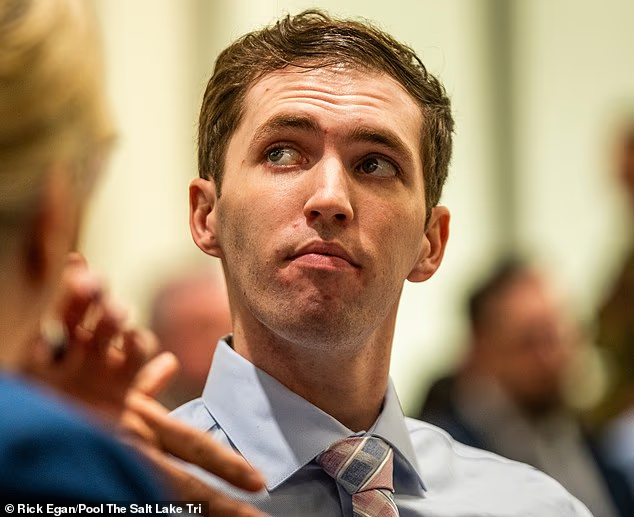
Twiggs (pictured) said Robinson never spoke about Kirk before the shooting and rarely discussed gender issues or LGBTQ+ rights

Twiggs (pictured) said Robinson never spoke about Kirk before the shooting and rarely discussed gender issues or LGBTQ+ rights

Advertisement
Robinson also faces six additional serious charges, including witness tampering

Robinson also faces six additional serious charges, including witness tampering

‘There were no actual threats by the assailant to the third party. There was no evidence that would suggest that anyone else was threatened,’ Visser said.

She tore into the state’s case, accusing prosecutors of building key parts of their argument on speculation and pointing to the screwdriver found on the roof as one example. 

Prosecutors said the screwdriver that was allegedly used to disassemble and reassemble the rifle contained DNA similar to Robinson’s. Visser acknowledged the state was likely using it to place him on the roof. 

Advertisement

‘The state goes on to ask this court to infer that the rifle was taken apart and put back together with the screwdriver. The state didn’t show actually how that would happen with the screwdriver,’ she told the court. ‘This is just speculation.’

Prosecutors also presented shooting targets riddled with ‘perforations’ that were found in the closet of Robinson’s shared apartment, she said.

In July, the state argued that Robinson ‘loaded his rifle with four cartridges’ and had previously practiced shooting, where he ‘seldom hit the bullseye and sometimes missed the target completely.’ 

Because he knew he could have missed, the state argued that numerous people were ‘within a zone of danger.’ 

Advertisement

‘They didn’t say what kind of gun. We don’t know when those were shot. We don’t know who shot them, and we don’t know the conditions under which those were shot at. They are just targets,’ Visser told the court on Tuesday.

Robinson turned himself in just one day after the killing and now faces a single charge of aggravated murder – an offense punishable by death by firing squad. He also faces six additional serious charges, including witness tampering.

The landmark decision after prosecutors spent five days in July laying out what they called ‘overwhelming’ evidence against Robinson, much of which they reiterated during Tuesday’s hearing.

At the time, the state unveiled a trove of new evidence, including photographs of the rifle allegedly used in the killing. 

Advertisement

They also presented recorded testimony from Robinson’s former partner, images of their text messages and surveillance footage from UVU, shown in court for the first time

Former State Bureau of Investigation agent David Hull walked through the 23-year-old’s alleged movements before and after the shooting, starting with Robinson’s arrival at the university hours earlier. 

He testified that Robinson grabbed a meal from a campus Chick-fil-A before speaking with Turning Point USA representatives. 

Robinson then allegedly changed clothes before taking up a rooftop position overlooking the amphitheater where Kirk was speaking. 

Advertisement

Video shown to the court captured him crouching on the rooftop in the seconds before the killing, Hull testified. After the shot rang out, he allegedly sprinted across the roof, jumped to ground level and fled on foot. 

The poor-aim argument was one of two key planks in the state’s bid to keep the death penalty on the table. The other was an engraved bullet that prosecutors say offered evidence of Robinson’s alleged political motive. 

A bullet allegedly found in the suspected murder weapon was inscribed with ‘Hey Fascist! CATCH!’ – evidence prosecutors said showed that the right-wing influencer was targeted over his political views.

They also cited a text message Robinson allegedly wrote about Kirk: ‘I had enough of his hatred. Some hate can’t be negotiated out.’

Advertisement

Before his death, Kirk and the conservative organization he co-founded, Turning Point USA, helped galvanize young voters and mobilize support for President Donald Trump’s successful bid for a second term. 

Robinson’s roommate, Lance Twiggs, told investigators that Robinson had been considering a gender transition around the time of Kirk’s killing.

Prosecutors revealed a handwritten note Robinson allegedly left for Twiggs that read in part: ‘I had the opportunity to take out Charlie Kirk, and I took it.’ 

DNA evidence also emerged linking Robinson, investigators said, to the suspected murder weapon – a bolt-action rifle with one spent round – and a tool allegedly used to engrave the bullet cartridges. 

Advertisement

The weapon was found wrapped in a towel in a nearby wooded area and contained DNA from both Robinson and Twiggs, Sgt Jennifer Faumuina of the Utah Department of Public Safety testified in July. 

In a recorded interview, Twiggs said Robinson never spoke about Kirk before the shooting and rarely discussed gender issues or LGBTQ+ rights. He did, however, sometimes talk about politics, including Trump. 

Twiggs later told police that Robinson allegedly confessed to killing Kirk and admitted he ‘wished he hadn’t done it.’ 

Throughout the proceedings, Robinson’s attorneys have repeatedly challenged the reliability of DNA tests and other evidence presented by prosecutors.

Advertisement

Even with the case now moving forward, Utah-based attorney Lazaro warned that the legal sparring could continue for months before Robinson ever faces a jury, he told Fox News. 

‘I do think we’re going to see a lot more litigation come down the road in terms of 1102 and expert-witness designations, forensic testimony on the ballistics and things like that,’ she told the outlet.

Source link

Advertisement
Continue Reading
Click to comment

You must be logged in to post a comment Login

Leave a Reply

NewsBeat

Germany says Russia behind Leipzig airport drone attack

Published

on

Close-up of orangutan's eyes

Germany has said Russia was responsible for last month’s drone attack at Leipzig’s airport.

A drone carrying an explosive device was discovered at Leipzig/Halle Airport in eastern Germany, close to Ukrainian cargo planes, on 4 August.

It failed to explode as the detonator was apparently faulty, and investigators suspect a second drone collided with a cargo aircraft nearby. A third drone was reportedly found near the airport 10 days later.

Interior Minister Alexander Dobrindt said the Leipzig airport attack followed the “well-established pattern of Russian hybrid operations in Europe” and the assumption was that Germany would be targeted again.

Advertisement

Russian President Vladimir Putin on Tuesday accused Germany of planting evidence to blame Moscow for the attempted drone attack at Leipzig airport.

Putin did not provide evidence for the accusation.

Meanwhile, the Russian embassy in Berlin said the allegation that Russia was responsible was “absurd”.

Dobrindt said examination of the equipment used along with intelligence findings proved Russian involvement in the attack.

Advertisement

German Foreign Minister Johann Wadephul, who was standing beside Dobrindt at a press conference in Berlin, said he would order the closure of the Russian consulate in Bonn, and the contract for the Russian House in Berlin will also be terminated – which many observers have said has been used for espionage and to spread Russian propaganda.

He also announced tighter entry controls for Russian nationals and vowed to increase pressure on Moscow’s shadow fleet – old tankers used by Russia to circumvent Western sanctions following its invasion of Ukraine in 2022.

Wadephul said he had summoned Russia’s ambassador to Germany, Sergei Nechayev. He was seen arriving at the foreign ministry shortly after the announcement.

Maria Zakharova, spokesperson for Russia’s foreign ministry, said Moscow would respond in a “mirror-image” fashion to Germany’s measures while the Russian embassy described the measures as an “unprecedented escalation in Russian-German relations”.

Advertisement

“Berlin is sponsoring terrorism”, Zakharova told the German Press Agency in reference to its military and economic support provided to Ukraine.

There have been previous suggestions that the Goethe-Institut in Moscow would have to cease operations if the Germans went through with closing Russian House.

Security experts had speculated that Russia may have been responsible, however Russia has always rejected claims of involvement.

Leipzig/Halle Airport in the east of the country is used by Germany’s military and Nato allies for the transport of military goods and also serves as a base for Ukraine’s Antonov Airlines – which carries most of the country’s aerial cargo.

Advertisement

The head of Nato, Mark Rutte, said the organisation “stands in full solidarity with Germany”.

“The evidence is clear. And I welcome the measures announced by Germany in response,” he wrote on X.

EU Commission President Ursula von der Leyen wrote on X: “We are united in our resolve to stand against Russian aggression. We will deter anyone who seeks to undermine our freedom and security.”

She added that the EU was preparing additional sanctions against Russia.

Advertisement

Polish Prime Minister Donald Tusk said Russia was “escalating tension across the whole region”. Polish prosecutors are investigating whether foreign intelligence services were involved in a fire at a factory making drone components on Monday.

Meanwhile, British Prime Minister Andy Burnham said: “Russian attempts to undermine our united resolve and our willingness to support Ukraine are futile and doomed to fail.”

Germany is one of several Nato member states to have reported drone sightings at airports, military and industrial sites over the last year.

Berlin has until now been tight-lipped about who may have been behind the Leipzig attack, except to say “foreign powers” may have been involved.

Advertisement

US media had already reported that American officials had linked the incident to Russia.

Berlin has warned that the country is the “daily target” of hybrid warfare, and Chancellor Friedrich Merz warned last week that those who carried out hostile acts against Germany would “pay a price”.

The government is looking to boost the powers of its intelligence services, which have long been criticised as relatively toothless, to counter such threats.

Germany is a key backer of Ukraine with Merz forthright in his support for Kyiv.

Advertisement

However an MP in Merz’s Christian Democrats (CDU) party said the measures so far taken against Russia “fall far short of what is required” and Moscow “just laughs” when its ambassador is summoned.

“From a self-proclaimed leading nation, I expect courage and resolve, not self-deterrence and appeasement,” said Roderich Kiesewetter.

It is not hard to imagine why Ukrainian cargo planes at a key German logistics hub might be in Moscow’s sights.

But this announcement comes at a delicate moment for Merz’s government.

Advertisement

A key state election in the eastern state of Saxony-Anhalt could propel the far-right Alternative für Deutschland (AfD) into power at a state-level for the first time.

The AfD, which is Germany’s biggest opposition party, wants to stop sending support to Ukraine and reopen ties with Russia.

In a separate development, German police said they were investigating the discovery of improvised explosive and incendiary devices at a power substation in the eastern state of Brandenburg on Tuesday.

A power line was damaged, which caused a temporary outage. It is not known who planted the devices.

Advertisement

Source link

Continue Reading

NewsBeat

Headache for Burnham as Starmer performs final ‘U-turn’ and stands down as MP with Green leader poised to challenge for seat

Published

on

Andy Burnham was dealt an underhand blow on Tuesday as his predecessor Keir Starmer resigned as an MP

Advertisement

Andy Burnham was dealt an underhand blow on Tuesday as his predecessor Keir Starmer resigned as an MP.

In a move that left Westminster reeling, Sir Keir tendered his resignation as Labour‘s MP for Holborn and St Pancras on the day Parliament resumed after the summer break.

And in a further headache for Mr Burnham, Sir Keir’s shock resignation saw Green leader Zack Polanski poised to challenge Labour in the resulting by-election.

The ousted former PM had previously said he would remain on Labour’s backbenches until the next election, but in a final parliamentary U-turn said on Tuesday that now was ‘the right time’ to resign.

Advertisement

Sir Keir issued a statement saying he would now focus on ‘international affairs including defence, security, trade and technology in a fast-changing world’.

This came as the new Prime Minister returned to Westminster on Tuesday to face the scrutiny of MPs after a summer spent courting voters.

Andy Burnham was dealt an underhand blow on Tuesday as his predecessor Keir Starmer resigned as an MP

Advertisement
Sir Keir tendered his resignation as Labour ¿s MP for Holborn and St Pancras on the day Parliament resumed after the summer break

Sir Keir tendered his resignation as Labour ‘s MP for Holborn and St Pancras on the day Parliament resumed after the summer break

The Greens on Tuesday suggested Mr Polanski would now run for the London constituency after months of speculation about his designs on becoming an MP

The Greens on Tuesday suggested Mr Polanski would now run for the London constituency after months of speculation about his designs on becoming an MP

But Sir Keir’s resignation wrested attention away from Mr Burnham as he tried to win over MPs after the parliamentary break.

And he now faces a tough contest to hold Holborn and St Pancras against an emboldened Green Party – which made record gains in May’s local elections in London thanks to Labour’s vote crumbling.

Advertisement

The Greens on Tuesday suggested Mr Polanski would now run for the London constituency after months of speculation about his designs on becoming an MP.

When asked about the Green leader’s intentions, a Green Party spokesperson said: ‘Zack has always made it clear he would like to be a London MP. London has been his home for over 20 years.’

This followed Mr Polanski saying in April he would ‘almost certainly’ run in a future by-election in the capital – and even eyeing up Sir Keir’s seat.

In an interview with la Repubblica, he said: ‘If there’s a by-election in London, I’ll almost certainly be running depending on where it is.

Advertisement

He added this could include Holborn and St Pancras ‘if Keir Starmer is going anywhere’.

Mr Polanski in June suggested he would be willing to co-operate or form a coalition with a Labour government led by Mr Burnham.

Commenting on the chances of a Green win in North London, director of polling firm More in Common Luke Tryl said: ‘For Labour, this will be a real test of whether Burnham can actually unite the left in a real election and save their urban strongholds.

‘For the Greens, it’s a test of whether or not Polanski can recover from recent stumbles and recapture his momentum of early spring.’

Advertisement

Politics professor at the University of Manchester Robert Ford wrote on X: ‘The seat has exceptionally high shares of non-white voters (66 per cent), graduates (51 per cent) and young ppl (47 per cent aged 16-39) – all groups that have swung Lab to Green in recent years.

‘This could be a humdinger of a by-election.’

This comes as Andrew Feinstein, an independent who came closest to beating Sir Keir in Holborn and St Pancras in the last general election, suggested on Tuesday he would do a deal with the Greens to deny Labour victory.

He wrote on X: ‘We must ensure that all progressive forces in Holborn & St. Pancras unite in order to deliver an MP who represents us & will work for us.

Advertisement

‘An MP who is the antithesis of everything that Starmer stands for.’

Both Nigel Farage and Rupert Lowe on Tuesday confirmed they would stand candidates for the upcoming by-election for Reform and Restore Britain respectively.

Advertisement

Source link

Advertisement
Continue Reading

NewsBeat

The full brutal details of the vicious Below Deck assault that saw reality TV star flee Australia to dodge justice – after attacking his co-star lover so savagely, she could have died

Published

on

The police facts of the brutal assault Nathan Gallagher made on his former Below Deck co-star Gael Cameron make for sobering reading and include him trying to asphyxiate her

The disturbing full details of Below Deck star Nathan Gallagher’s sustained and brutal attack on his co-star and girlfriend expose just how close he came to killing her.

The Daily Mail yesterday revealed the 28-year-old Irish reality TV personality has fled the country to avoid facing justice before the Australian courts.

When his assault was finally revealed only last week – after being kept secret for nine months since his arrest – Gallagher insisted he’d been unfairly shamed.

In a self-pitying statement to Rolling Stone magazine, he told the world no-one should judge him because they hadn’t ‘heard the full story surrounding what happened’.

Advertisement

Well, here it is.

Police facts reveal the real grim truth about how he tried to strangle and suffocate her, aggressively asphyxiating her while he straddled and blocked her from breaking free.

And he did it to the mother of his son – as the child lay on the bed alongside her.

Gallagher, 27, and Gael Cameron, 29, were in her apartment in Melrose Park, 12km north-west of Sydney CBD, on Boxing Day night last year.

Advertisement

The police facts of the brutal assault Nathan Gallagher made on his former Below Deck co-star Gael Cameron make for sobering reading and include him trying to asphyxiate her 

The facts say that Gael Cameron (pictured)  'tried to pull away and [Gallagher] persisted continuing to cover her mouth so that the victim was unable to breathe'

The facts say that Gael Cameron (pictured)  ‘tried to pull away and [Gallagher] persisted continuing to cover her mouth so that the victim was unable to breathe’

Gael Cameron (centre) arrived at Sydney's Burwood Local Court on Tuesday to give evidence against her former partner and Below Deck co-star Nathan Gallagher

Gael Cameron (centre) arrived at Sydney’s Burwood Local Court on Tuesday to give evidence against her former partner and Below Deck co-star Nathan Gallagher

Advertisement

The couple had drunk about a bottle of wine and were in a relationship described by NSW Police as being ‘on-again, off-again’.

The Australian met Gallagher, a lad from an Irish fishing village who loved boats, in mid-2024 when they were hired as deckhands on season nine of the reality TV show, Below Deck Mediterranean.

They would feature in the following two seasons which charted ‘their reconciliation, transition into parenthood and Nathan’s yachting career’ versus his relationship with his partner and child, the Bravo show notes say.

As midnight rolled over that Boxing Day, the couple ‘engaged in a verbal argument’, police alleged.

Advertisement

Ms Cameron went into the bedroom and asked Gallagher to sleep in the other room, but he ignored her, ‘entered the bedroom, the argument renewed and he became violent,’ according to police.

Court documents reveal how the sustained assault unfolded between 3am and 7am, mostly in the bedroom of Ms Cameron’s unit. 

Referring to Ms Cameron as the ‘victim’, the police facts state what happened next is that Gallagher ‘used one hand to cover the mouth and nose of the victim’.

‘The victim tried to pull away and [Gallagher] persisted, continuing to cover her mouth so that the victim was unable to breathe at certain points,’ the court documents state.

Advertisement
Police facts describe how Nathan Gallagher strangled and tried to asphyxiate Gael Cameron (pictured together) in her Sydney apartment as their six-month-old son lay next to her

Police facts describe how Nathan Gallagher strangled and tried to asphyxiate Gael Cameron (pictured together) in her Sydney apartment as their six-month-old son lay next to her

Gael Cameron (pictured at court on Tuesday with two supporters) was held down and choked by her former partner and Below Deck co-star Nathan Gallagher

Gael Cameron (pictured at court on Tuesday with two supporters) was held down and choked by her former partner and Below Deck co-star Nathan Gallagher

During the sustained assault, Gael Cameron (pictured) tried to scream and tell Gallagher that she could not breathe but he became 'increasingly aggressive'

During the sustained assault, Gael Cameron (pictured) tried to scream and tell Gallagher that she could not breathe but he became ‘increasingly aggressive’

Ms Cameron then tried to scream and tell Gallagher that she could not breathe but he became ‘increasingly aggressive’. 

Advertisement

‘During the struggle, the victim has fallen to the floor of the bedroom between the bed and the wardrobe trying to break free from [Gallagher]… while trying to hold on to the edge of the bed where their six-month-old son was lying,’ the facts add.

‘[Gallagher] continued to restrict the victim’s breathing by holding both hands over the victim’s mouth. 

‘Ms Cameron began screaming and she believes Gallagher did not want her to be heard by the neighbours. 

‘While preventing the victim from breathing and making noise, [he] held the victim down on the bedroom floor, wrapping his legs around the victim to better control her.’

Advertisement

During the struggle, she used her left elbow to strike Gallagher in the mouth in an attempt to get him off her, ‘however this only angered him further’.

‘[He] placed both of his hands around the victim’s neck applying enough pressure which made her unable to breathe,’ the court documents add. 

‘The victim used her legs to try and kick him off her and scream for help. Gallagher used an open right palm and struck her on the left side of the jaw. 

Nathan Gallagher was a no show at court, but police facts reveal that he 'placed both of his hands around the victim’s neck applying enough pressure which made her unable to breathe'

Nathan Gallagher was a no show at court, but police facts reveal that he ‘placed both of his hands around the victim’s neck applying enough pressure which made her unable to breathe’

Advertisement
Ms Cameron and Gallagher had an on-again, off-again relationship which finally ended after he brutally assaulted, choked and restricted her breathing during an attack in her home

Ms Cameron and Gallagher had an on-again, off-again relationship which finally ended after he brutally assaulted, choked and restricted her breathing during an attack in her home

‘This caused pain and swelling.’ 

Ms Cameron tried to break free and grabbed her son to run out of the room, but Gallagher blocked her trying to leave. 

She then ran to the bathroom where Gallagher cornered her and ‘used both hands to grip the neck of the victim and whilst applying force lifted her up. 

Advertisement

‘(Ms Cameron) was unable to breathe during this time,’ police told the court.

‘After some time, he has held the victim from behind, holding her wrists and wrapping his arms and legs around the victim, holding her down on the bed.’

When Ms Cameron woke up the following morning, Gallagher continued the argument, and blamed her for causing it. She then picked up her son and fled the apartment to go to her brother’s home. 

Police were called and found her ‘highly distressed and emotional’. They saw ‘bruising along her legs, arm, left side of her face, swelling to the face and a laceration inside of her lip consistent with a blow to the face’. 

Advertisement

Gallagher was arrested and police told the court he admitted holding Ms Cameron down, wrapping his arms around her, and that during a struggle, she fell to the floor.

Gael Cameron, 30, suffered bruising and lacerations in the assault by her now ex-partner and former Below Deck co-star Nathan Gallagher

Gael Cameron, 30, suffered bruising and lacerations in the assault by her now ex-partner and former Below Deck co-star Nathan Gallagher

Nathan Gallagher, 27, and Gael Cameron, 29, were in her apartment in Melrose Park (pictured), 12km north-west of Sydney CBD, on Boxing Day night last year

Nathan Gallagher, 27, and Gael Cameron, 29, were in her apartment in Melrose Park (pictured), 12km north-west of Sydney CBD, on Boxing Day night last year

He ‘categorically denied choking the victim or covering her mouth in any way, or punching her’. 

Advertisement

‘He admitted holding her down and wrapping her up, but claimed it was to calm her down,’ the court documents stated.

Ms Cameron turned up to give evidence at court on Tuesday, looking sombre and supported by two companions, believed to be family members, but there was no sign of Gallagher.

His no-show for the scheduled hearing came despite telling Rolling Stone he had ‘contemporaneous video footage from the night in question’.

He also claimed he had ‘messages and other records, which I believe provide important context and show events that have not been publicly reported,’ he told the magazine.

Advertisement

He also said there were ‘other matters surrounding the relationship that I have never discussed publicly, including circumstances surrounding the breakdown of our relationship’.

Gallagher claimed it involved ‘financial matters relating to the purchase of an apartment in Sydney’.

‘I don’t believe it is fair for one version of events to be presented publicly as though it is the complete story,’ he added.

Nathan Gallagher has previous form for not showing up at court on violence charges. There are now two police warrants for his arrest, in NSW and in Ireland

Nathan Gallagher has previous form for not showing up at court on violence charges. There are now two police warrants for his arrest, in NSW and in Ireland

Advertisement

By failing to appear as legally required, the judge convicted him in his absence without ‘his side of the story’ being aired, and a warrant for his arrest was issued.

The now-convicted woman-basher has now lost his opportunity to present whatever  mitigating factors he might have claimed existed for his violent outburst.

It was also revealed there is another warrant for his arrest in Ireland, issued in April last year.

Just like in Sydney, he had failed to appear in court there to face a charge of assaulting a man and causing him harm. 

Advertisement

Source link

Continue Reading

NewsBeat

India’s power demand is surging, but some solar energy is going to waste

Published

on

India’s power demand is surging, but some solar energy is going to waste

When India’s power demand surged at the height of summer, the country struggled to meet evening needs as air conditioners ran longer amid hotter nights. Despite this demand, some renewable energy providers were told to limit their output because the country had more clean electricity available than its grid could safely handle.

In the last 15 months, India curtailed nearly 11 terawatt-hours of solar generation — enough electricity to power about 10 million homes, according to government data and research by energy think tank Ember. That solar power went unused even as extreme heat and poor monsoon rains drove up demand for power in India for cooling and pumping groundwater for agriculture.

India, the world’s most populous country and one of the largest emitters of climate-polluting gases, is rapidly adding clean energy, especially solar, to its power mix. However, it can’t use all the clean power it could generate because of insufficient transmission and storage capacity and the technical difficulty of shifting between fossil power and renewables.

Energy experts say that contradiction points to the next big challenge for India’s energy transition. Building solar and wind farms is no longer enough. India also needs more transmission lines to move electricity across the country, batteries to store renewable power until it is needed and a more flexible power system that can quickly adjust as wind and solar output rises or falls.

Advertisement

“We’re in a stage where some of the biggest hurdles in renewables are starting to hit us,” said Neshwin Rodrigues, an energy analyst at Ember.

Clean power gets switched off despite record demand

India has more than 300 gigawatts of clean power capacity, more than half its total installed electricity capacity. But coal still produces most of the country’s electricity.

Experts said the main reason for this is curtailment — when a wind or solar plant could produce electricity but is ordered to reduce or stop generation as the grid cannot take the power.

Advertisement

Rodrigues said that when solar generation surges in the afternoon, it’s difficult for coal units to reduce their output because they are relatively inflexible and cannot ramp down quickly without compromising efficiency, increasing costs or risking operational problems.

Trying to make thermal power plants flexible and adapt to increasing supply from clean energy sources “is like asking an elephant to dance,” said Vinay Pabba, CEO of Hyderabad-based renewable energy company Vibrant Energy.

Pabba said curtailment results in losses for clean power developers. “We get paid only for what we put on the grid,” he said.

The high concentration of renewable generation in western India has also meant that transmission lines in that part of the country get congested quickly. The western states of Gujarat and Rajasthan account for nearly 50% of India’s solar power capacity.

Advertisement

“When solar peaks, usually in the afternoon, there is a limited pipe to evacuate it,” said Pabba.

Another risk of not building storage quickly is that dirty fuels get used more. “Without enough storage, India risks keeping coal plants running even when cheap renewable power is available,” said Vibhuti Garg, South Asia director at the Institute for Energy Economics and Financial Analysis.

While a solar or wind farm can sometimes be completed within two years, building new power lines can take a minimum of three years, according to energy experts.

India has achieved only about 80% of its annual transmission construction targets over the past five years, research by Ember has found.

Advertisement

Spreading more renewable development across other parts of the country, while adding more wind and smaller local solar projects, could reduce pressure on crowded transmission corridors and make the electricity supply more balanced throughout the day, said Disha Agarwal, an energy analyst at the New Delhi-based Council on Energy, Environment and Water.

Agarwal said the challenge is likely to become more difficult as renewable capacity keeps rising.

India is aiming for 500 gigawatts of clean electricity capacity by 2030. Also, Indian policymakers expect nearly 70% of India’s installed power capacity to come from nonfossil sources by 2036.

Batteries could help save power for when it is needed

Advertisement

A study released earlier this month by the India Energy and Climate Center at the University of California, Berkeley, found that renewable power backed by batteries can provide electricity with reliability approaching that of conventional power plants at a price researchers said is lower than the price of power from new coal-fired plants.

Batteries make it possible to store solar electricity when it is abundant in the afternoon and discharge it after sunset, when demand remains high.

But India’s storage sector remains far smaller than what planners said will eventually be required.

“If we try to increase the solar installations without solving for energy storage, it is only going to lead to curtailment,” said Ankit Mittal, CEO of battery storage company Ingro Energy.

Advertisement

Mittal said India is trying to transform several parts of its electricity system simultaneously as power demand rises. “Things that were supposed to happen over decades” are now happening at once, he said.

The government said in July that it had about 3 gigawatts of battery storage and 7.4 gigawatts of operational pumped-storage capacity. It expects India’s storage needs to reach about 74 gigawatts by 2032.

“If high quality energy storage projects are not built, we could be adding an additional layer of risk to grid operations while also decelerating our nation’s ability to achieve our energy transition targets,” said Avinash Rao, CEO of Mahindra Susten, a leading renewable energy company in India.

Rodrigues, the energy analyst, said batteries can be built much more quickly than major transmission infrastructure, making them one of the fastest options for easing some immediate constraints.

Advertisement

Industry stakeholders said that few, if any, foresaw the incredible increase in demand happening as the country’s transportation and other major sectors electrify and data centers are built.

“None of us saw it coming. If we had seen it coming, we would have probably planned our way around it,” said Pabba of Vibrant Energy.

___

Sibi Arasu can be followed on X at @sibi123. Reach him at sarasu@ap.org.

Advertisement

___

The Associated Press’ climate and environmental coverage receives financial support from multiple private foundations. AP is solely responsible for all content. Find AP’s standards for working with philanthropies, a list of supporters and funded coverage areas at AP.org.

Source link

Advertisement
Continue Reading

NewsBeat

Apple becomes latest tech giant to cave to Trump over Lake Ontario name change

Published

on

Apple becomes latest tech giant to cave to Trump over Lake Ontario name change

Apple has become the latest tech giant to cave to President Donald Trump’s demand to change the name of Lake Ontario to Lake America.

Trump signed an executive order in late August to rename the body of water bounded by the Canadian province of Ontario and New York as the trade war between the U.S. and its northern neighbor escalated.

Google quickly agreed to change Lake Ontario to Lake America for U.S. users, and Apple did the same Tuesday, after Trump spoke directly with the company.

“I know that the president reached out to Apple directly, so I’m sure that we may be seeing that change coming up soon to Lake America,” Interior Secretary Doug Burgum told host Cheryl Casone, standing in for Maria Bartiromo on Fox Business’ Mornings with Maria Monday.

Advertisement

Google and Apple also changed the Gulf of Mexico on their Maps apps to the Gulf of America following an executive order Trump signed earlier in his second term. The Independent has reached out to Apple for comment on the Lake Ontario name change.

Apple has become the latest tech giant to cave to President Donald Trump’s demand to change Lake Ontario to Lake America
Apple has become the latest tech giant to cave to President Donald Trump’s demand to change Lake Ontario to Lake America (Getty Images)

Democratic social media influencer Harry Sisson bashed Apple for the move, writing on X, “Apple Maps has changed Lake Ontario to Lake America after Trump pressured them to do so. It’s just so pathetic. Why go along with this stupidity??”

Google was also criticized for changing Lake Ontario to Lake America, with progressive media company MeidasTouch writing on X Sunday, “Google Maps has now capitulated to Donald Trump.”

MapQuest has refused to relabel Lake Ontario, writing on X, “We’re not changing it,” when Trump signed the executive order Thursday.

After defying Trump, MapQuest surged in App Store rankings, becoming the No. 1 navigation app and No. 8 overall free app on Sunday night — the highest chart position since the brand launched in 1996.

Advertisement

“We took the same approach we did with the Gulf of Mexico: be part of the conversation, and give people an app that keeps the names they’re familiar with,” Doug Berger, general manager of MapQuest, said in a Monday press release.

“Hundreds of thousands of people signaled to us this weekend that we got it right, by downloading our app.”

Source link

Advertisement
Continue Reading

NewsBeat

Bank of America VP killed by knife-wielding woman in Times Square was new mom who just returned from maternity leave

Published

on

Erin Piacenti, 32, of Chester, New Jersey, was fatally stabbed in Times Square on her way home from work on Monday

The Bank of America executive who was fatally stabbed by a knife-wielding woman in Times Square was a new mother who had just returned from maternity leave.

Erin Piacenti, 32, of Chester, New Jersey, was heading home from work on Monday when she stopped briefly in front of a vendor selling sunglasses and baseball hats on the street, according to The New York Times.

It was during that brief stop that she was fatally slashed in the stomach by Pamela Cisneros Lopez, 49, who also left a 68-year-old man seriously injured in the moments before she was gunned down by police.

According to her LinkedIn profile, Piacenti worked as Bank of America’s vice president of business selection and conflicts. 

Advertisement

But she had just started her first week back on the job after returning from maternity leave when she was killed, the Times reports.

She had just given birth five months ago, according to a woman who identified herself to the Times as Piacenti’s grandmother-in-law and described the young executive as a ‘beautiful, beautiful girl.’

Piacenti posted a photo of herself on social media holding her newborn daughter and standing next to her husband, Frank, just four days before her death.

She had also written about how grateful she was to have spent the past five months on maternity leave, and shared that her daughter was baptized as she and Frank celebrated their second wedding anniversary.

Advertisement

Erin Piacenti, 32, of Chester, New Jersey, was fatally stabbed in Times Square on her way home from work on Monday

Piancenti had recently celebrated her second wedding anniversary with her husband, Frank

Piancenti had recently celebrated her second wedding anniversary with her husband, Frank

The two had graduated from Fordham Law School in 2021, and were married in August 2024.

Advertisement

The Chester community is now grappling with the young mother’s sudden loss.

‘This definitely shakes us up,’ said resident Megan O’Hara. 

‘It’s gotten scarier to go into the city because of things happening like this,’ she continued, noting that many of the borough’s residents commute to New York City for work.

‘This feels close to home,’ O’Hara said. ‘It’s like a family member passed away.’ 

Advertisement

Terrifying footage from the scene showed officers firing a Taser at Lopez, from Queens, as she waved two kitchen knives at them.

Police then shot the woman, and she immediately fell to the ground where she was handcuffed and given first aid. 

Pamela Cisneros Lopez, 49, was fatally gunned down after running at officers with the two kitchen knives

Pamela Cisneros Lopez, 49, was fatally gunned down after running at officers with the two kitchen knives

Footage showed officers hitting Lopez with a Taser as she waved the blades at them, but it was not enough to stop her running at them

Footage showed officers hitting Lopez with a Taser as she waved the blades at them, but it was not enough to stop her running at them

Advertisement

In the moments prior to the video, Lopez pulled two knives from a shopping bag and stabbed Kam, who was waiting to cross the street with his wife, police said. 

Lopez is then said to have stabbed Piacenti in the abdomen, who died from her injuries.

At a press conference alongside Mayor Zohran Mamdani, Police Commissioner Jessica Tisch said Lopez had told officers during a brief standoff: ‘I’m not dropping anything, I would rather kill both of you.’

Tisch told reporters: ‘This was an extraordinarily dangerous situation unfolding in the heart of Times Square, the crossroads of the world.

Advertisement

‘At any given moment, there are thousands of New Yorkers, commuters, tourists, families, workers moving through these streets.’ 

She added that Lopez has a ‘documented mental health history’ with the department which included two incidents in 2018 and 2019 but she was never arrested. 

Both Tisch and Mayor Mamdani praised the officers, saying more people could have been hurt or killed if not for their actions. 

Piancenti was stabbed in the abdomen and was pronounced dead at a local hospital

Piancenti was stabbed in the abdomen and was pronounced dead at a local hospital

Advertisement
Officers are seen here investigating the scene on Monday night in the middle of Times Square

Officers are seen here investigating the scene on Monday night in the middle of Times Square

The incident had initially been reported as a knifepoint robbery, but officers believe the emotionally disturbed woman had no clear motive for the attack, ABC 7 reports.

A witness recorded the moment with his smart glasses and described Lopez as being armed with two knives. They told PIX11: ‘She ran down, the cops went by, they surrounded her, talked to her for like five minutes.’

Witness Linda Ruiz also shared what she saw in the moments before police arrived on scene.

Advertisement

‘I saw a guy bleeding profusely from his right leg,’ she told the Daily News. ‘He was gushing blood, saying “I need help. Help me.”‘ 

‘I went to get a cop on the corner and there was another lady on the floor,’ Ruiz continued. ‘She was stabbed in the back or in the chest, I couldn’t tell.’

‘There was a lot of blood,’ Ruiz noted. ‘She wasn’t conscious. The police were trying to resuscitate her, but she wasn’t moving. It was horrible.’ 

Hassan Abdallah, who works at a fruit cart stand on 41st Street and Seventh Avenue, two blocks away, said he watched as a woman tended to the male stabbing victim, who appeared to be her husband. 

Advertisement

‘I heard a lady screaming and then people were running like crazy,’ he recounted. ‘I went outside [the cart]. I saw an old guy, like 60, Asian. He was standing, holding his back. He got stabbed.

‘His wife was trying to stop the bleeding. She was using a book or some paper, then someone gave her a scarf. I gave him a paper towel. His wife told him to lay on the floor.’

Police are investigating. Tisch said there was no evidence suggesting it was a terrorist attack.

Source link

Advertisement
Continue Reading

NewsBeat

Two released on bail amid Cleveland Police crack down

Published

on

Two released on bail amid Cleveland Police crack down

Two men, aged 19 and 24, were arrested in Middlesbrough on August 31, on suspicion of possession of a firearm with intent to cause fear of violence, after a vehicle rammed another on Derwentwater Road, shortly after 11pm on Sunday (August 30).

The 24-year-old was arrested shortly before 11.30pm in Burns Road, while the 19-year-old was arrested at a property on the same road at around 12.20am as armed officers carried out checks in the area.

Both remained in custody on Bank Holiday Monday while enquiries continued and have since been released on conditional bail today (September 1).

It takes the number of arrests to 27 since officers began investigating a series of incidents in the early hours of Saturday, August 22.

Advertisement

ACC Wayne Fox previously stated: “We have said previously Cleveland Police will not stop pursuing those involved in serious and organised crime, and I hope these arrests further demonstrate that.

“Our commitment to tackling criminal gangs whose intent is to harm people in our communities is, and will continue to be, a persistent focus for us.

“These latest developments now take the total number of arrests since we started investigating the incidents in the early hours of Saturday, August 22, to 27 and I can assure the public that they will not be the last.  

“We are investigating around the clock and we thank the public, not only for their support and patience while we conduct numerous enquiries, but also for the information we are receiving.

Advertisement

“We will always act on this information in our unwavering commitment to dismantle serious and organised crime in our area”.

The large-scale operation began after the head-on crash on the A66 at South Bank in the early hours of Saturday, August 22.

Pc Matthew Blades, 37, and Pc Tom Clough, 38, were killed alongside five people travelling in a Volkswagen Passat, Cole Worthy, 17, Theo Rae, 17, Makai Saddington, 18, Michael Cahill, 23, and Jakub Matusiak, 23.

Pc Matthew Blades, 37, and Pc Tom Clough, 38 (Image: CLEVELAND POLICE)

Police later said they were investigating criminal activity which took place before the collision, including reports of vehicles being driven dangerously in Middlesbrough.

Advertisement

A separate murder investigation was launched after a devastating house fire on Birchington Avenue, Grangetown, which killed Natalie McDonald, 34, and seven-year-old Valentina Foster.

Police have stressed that the fatal fire is not being linked to the A66 crash.

Two men were arrested on suspicion of murder as part of that investigation, with one since released and one charged.

From left to right: Makai Saddington, 18, Theo Rae, 17, Cole Robert Worthy, 17, Jakub Matusiak, 23, Michael Robert Cahill, 23 (Image: SOCIAL MEDIA)

There was also disorder at a memorial gathering in Haswell, County Durham, for A66 crash victim Michael Cahill, where five vehicles were set on fire as a crowd gathered to release balloons, flares and fireworks.

Advertisement

Durham Constabulary described the behaviour as “completely unacceptable”.

Hundreds of additional officers have been drafted in to support Cleveland Police during the wider operation.

Source link

Advertisement
Continue Reading

NewsBeat

Popular sugar substitute linked to increased heart attack and stroke risk among Brits

Published

on

Daily Mirror

A 30-year-long study of 17,000 people, including some from Norfolk, found major cardiovascular event risk was up to 57 percent higher, researchers announced this week

Eating or drinking a popular artificial sweetener could put you at a greater risk of heart attacks or strokes, a new study among Brits suggests.

Advertisement

Researchers found people who consumed xylitol – an artificial sweetener found in diet foods, drinks, chewing gum, pet food and toothpaste – were up to 57 percent more likely to suffer ‘cardiovascular events’. The 30-year study featured more than 17,000 participants in Canada and the UK.

Scientists presented their findings this week, which said ‘the risk of a major adverse cardiovascular event was 57 percent higher in those with the highest levels vs. the lowest levels’ of xylitol in the Canadian study group. In the UK, the ‘risk of major adverse cardiovascular events was 18 percent higher in those with the highest levels vs. the lowest levels’.

It’s led experts to conclude the higher the xylitol blood levels, the higher the cardiovascular event rate.

“Artificial sweeteners are consumed by people who think they are healthier than sugar and they are generally regarded as safe by regulatory agencies,” said Dr Marco Witkowski, from the Charité University Hospital in Berlin.

Advertisement

Xylitol was first discovered in 1891, and entered mass production in the 1960s. It has remained popular ever since because it is a sugar alcohol — which means it tastes sweet, but doesn’t have the same calories as normal sugar, making it a popular choice for diet foods.

Despite its widespread use, its long-term effects on cardiovascular health had not been studied.

Dr Witkowski added: “Our long-term findings in the general population highlight how little we know about the cardiovascular safety of xylitol and indicate that further studies are warranted, especially as the amount of xylitol in products continues to increase.”

Advertisement

Prof Dan Atar agreed more work needs to be done to understand the impacts of the sweeteners. He said: “Artificial sweeteners are widely embraced by modern society, and the safety ratings had been good and granted by regulatory authorities.

“In this observational work, however, it appears that xylitol has a negative long-term effect on cardiovascular events in the general population. As with all observational studies, causalities are difficult to infer, but this work shows that further studies are mandated into this societally important topic.”

Source link

Advertisement
Continue Reading

NewsBeat

Ariana Grande breaks down in tears as she steps away from public life after mammoth tour

Published

on

Daily Mirror

The pop star performed the 41st and final show of her Eternal Sunshine at the O2 in London on Tuesday, having already announced she will take a step back from the spotlight

Ariana Grande broke down in tears as she thanked her fans for being “by her side” as she stepped back from public life by completing the last show of her world tour.

Advertisement

The American pop star performed the final night of a 10-night sold out residency at the O2 in London on Tuesday night (September 1). The show was the 41st and final show of her Eternal Sunshine tour which began in the US on June 6.

Grande waited until an hour-and-a-half into the two-hour show before speaking to the crowd, telling them: “This has been such an extraordinary experience. Thank you for 10 beautiful London shows and for 41 incredible Eternal Sunshine tour shows.

“This has been one of the most beautiful, extraordinary experiences of my life and I just want to express my gratitude. I’ll cherish this experience always – I have the best fans in the entire world and I always have. Thank you for being by my side.”

Advertisement

She later became emotional again as she thanked all the people who work on the show, including dancers, security, make-up and runners.

The 33-year-old wore her signature ponytail for much of the show but did not wear her usual high heels – opting instead for flat black, and later white, above-the-knee boots after suffering a “deep cut” to her foot. But the injury did not seem to affect her choreography which remained energetic as she danced across the stage, which covered half the length of the arena.

Grande announced last month, just days after the release of her new album Petal, that she would be taking a break from public life amid what her representative called “endless, ongoing public scrutiny”.

A music video for the new album’s title track had prompted renewed speculation about the singer’s health. She dropped out of the upcoming London revival of the Stephen Sondheim musical Sunday In The Park With George, in which she was due to appear opposite Wicked co-star Jonathan Bailey.

Earlier on Tuesday, Bailey announced he would also withdraw from the play, saying: “Ari is one of my dearest friends, and my support for her is unwavering.”

While performing her hit Thank You, Next at the O2, Grande changed a lyric about ex-boyfriend Ricky Alvarez, a dancer and photographer – who she appeared to confirm a rekindled romance with on Instagram earlier this week. The lyric change from “wrote some songs about Ricky, now I listen and laugh” to “wrote some songs about Ricky, I’m tryna make him my last” drew loud screams from fans.

Grande became emotional as she sang new track Nowhere, Nobody live for the first time – her voice breaking as she sang the opening lyric “I don’t believe in a perfect ending – but that’s alright.”

Advertisement

The singer appeared to be soaking in the atmosphere of the final show and was seen sharing smiles with her band and dancers and blowing kisses to her fans. She seemed unfazed when fans at the final show continued screaming and failed her viral “mute challenge” where she asks the entire crowd to go silent as the lights dim.

The concert ended poignantly as some fans sobbed and waved goodbye to the singer as she ascended to the sky on wires while singing the final song, Supernatural.

Despite withdrawing from public appearances Grande is still due to appear in a new film, Focker-In-Law, in November – also starring Ben Stiller and Robert De Niro. The audience at the O2 was shown a trailer for the film just before the concert began.

Grande has won three Grammy awards during her successful music career, which took off in 2013 after the release of her debut album, Yours Truly. She was nominated for an Oscar for her role as Glinda in the big screen adaptation of Wicked.

Advertisement

Source link

Continue Reading

NewsBeat

Grantchester icon ‘terrifying’ in Channel 5 role away from ITV hit

Published

on

Cambridgeshire Live

The second season of the gripping psychological thriller has landed on Channel 5

Robson Green has been called “terrifying” in his role of serial killer Patrick Harbottle.

The Grantchester icon will reprise the character opposite Jason Watkins in The Game when season two launches on Channel 5 on Tuesday, September 1.

Advertisement

The first season aired last year and proved hugely popular with audiences as it followed former detective Huw as he continued to chase down serial killer Patrick.

The cat-and-mouse thriller will pick up one year later in season two, with Patrick in prison for his crimes. Huw believes he has broken free of Patrick’s psychological control and is trying to move on from the events in the first season.

However, he soon realises that Patrick is not finished. From his prison cell, he initiates a fresh game, one that penetrates deep into Huw’s family, undermining the former detective’s moral foundation and pushing him towards an impossible decision, as ending Patrick’s reign for good may well demand a devastating personal sacrifice, reports The Mirror.

Advertisement

Speaking about working alongside Rob again, Jason, known for McDonald and Dodds, The Lost Honour of Christopher Jefferies, and The Crown, admitted the pair are very different actors, but that’s what makes their dynamic work.

Calling Robson “terrifying” in his role as Patrick, he said: “You are denied that meeting for the whole of the first episode. It’s very clever structuring. The audience got to know these characters through the whole of the first series so when they do finally meet again, wow, you’re in.

“Robson is terrifying and very consistent as Patrick while Huw is a bit more of a butterfly. We dance around each other very well. We are different as actors and the characters are very different. It’s a very good fit. It’s great to have those scenes. Huw develops a bit of steel about him, which we haven’t seen before.”

Robson also commented on the characters, revealing audiences will be left wondering who is one step ahead throughout the second series.

Teasing what’s to come, Robson, who is best known for playing detective inspector Geordie Keating in ITV’s longstanding hit Grantchester, said: “There is this wonderful dramatic curveball that hits the series which really gives it energy to push it forward to the end. It’s a very shocking, surprising turn of events. I gasped. You think you’ve worked it out, but you haven’t.”

The actor also reflected on his time working with Jason, admitting it was one of the reasons he returned for a second season of The Game.

He explained: “One of the reasons I was so happy to do series two was because I would be working alongside Jason again, who gives another masterclass in truth. Those scenes were filmed at the university in San Sebastian, which is partly deserted. The design team did a brilliant job of turning it into a prison. It’s fantastic.”

Advertisement

The Game season two returns to Channel 5 at 9pm on Tuesday, September 1.

Source link

Continue Reading

Trending

Copyright © 2025