Employers are being urged to implement clear policies on staff time off, sickness absence, and flexible working as the World Cup approaches.
The conciliation service Acas has advised businesses to consider a more adaptable approach to allowing employees time off during the football tournament, which is set to kick off next Thursday.
Acas head of workplace advice Susan McGuigan said: “The World Cup is an exciting event for many football fans but staff should avoid getting a red card for unreasonable demands or behaviour in the workplace during this period.
“Many organisations need to maintain a certain staffing level to operate effectively. Bosses should have a set of simple workplace agreements in place before kick-off to help ensure their businesses remain productive whilst keeping staff on side too.”
Advertisement
The World Cup takes place in Canada, Mexico and the USA between 11 June and 19 July.
Due to the time difference, match kick-offs in the UK will vary between 5pm and 5am, and Acas said workers may also be keen to watch or listen to the pre-match build-up.
The World Cup takes place in Canada, Mexico and the USA between 11 June and 19 JulY (Local Library)
Acas said employers may want to remind staff their sickness and attendance policies still apply during the World Cup.
Any unauthorised absence, patterns of absence or late attendance are likely to be investigated and could result in formal proceedings.
One option is to have a more flexible working day, Acas said, allowing employees to start later or finish earlier and agree to make up the time.
Customers have reacted to the announcement saying they are ‘absolutely gutted’ to see it close
A “fabulous” high street bar and restaurant has announced that it is going to close. Three Lions Sports Bar and Restaurant, in March, will officially close at the end of July 2026.
Advertisement
Black Rock Grill and Smokehouse is the restaurant part of Three Lions Sports Bar and Restaurant, which is also closing. Three Lions said that the closure follows “several issues beyond [their] control” alongside “rising costs” that left them with “no other choice” but to close.
The restaurant and bar has a large beer garden with outdoor seating as well as two children’s play areas. It offers a range of smokehouse dishes including barbeque pork ribs and ‘the smokehouse burger’.
In a statement, Three Lions Sports Bar and Restaurant said: “Today we have some sad news. We are closing for good at the end of July.

“Due to several issues beyond our control and rising costs we have no other choice. Please come and see us before we close. Lastly, we just want to say thank you to all our amazing and loyal customers, we will never forget you.”
Advertisement
Since the announcement, the restaurant and bar have received more than 50 comments in response. One person wrote that they are “absolutely gutted” to hear of the news, saying they “love dining” at the restaurant.
Another customer wrote: “Devastated isn’t the word. Can’t believe we’re going to lose our favourite place to eat.”
The restaurant, Black Rock Grill and Smokehouse, has built a strong reputation during its time, with an average 4.8 stars out of five on Google. One customer wrote: “Absolutely brilliant, lovely service and being able to cook your steak exactly how you want it yourself on a red hot slab was great.”
Another guest described the food as “fabulous” adding that the staff are “friendly”. Additionally, someone else said they were “extremely pleased” with their experience, adding: “The food was excellent, the service we received was above and beyond. The servers were excellent, beyond expectation.”
Maura Higgins, who rose to fame on ITV2’s Love Island, will front a Disney+ reboot of the beloved series, which originally aired on ITV from 1985 to 2003.
The show was originally hosted by the late Cilla Black, and it was later revived by Channel 5 in 2017, with Paul O’Grady as presenter.
Blind Date to return to screens with Maura Higgins as host
A source told The Sun’s TV Biz: “Discussions are at an advanced stage, with the show’s producers convinced Maura’s the perfect choice for the job.”
The source highlighted Higgins’ background in dating entertainment and her growing international profile.
Advertisement
They said: “Not only did she shoot to fame on a TV dating contest, she is now an internationally famous face which is what a global service like Disney need for one of their shows.
“Maura also has an unquestionable glamour combined with cheeky charm which has echoes of Blind Date’s most famous host.”
News of the Disney+ reboot follows earlier reports that Higgins was in talks with the streaming giant about a presenting role.
A source previously told The Sun: “Maura is keeping her cards close to her chest but she couldn’t help but tell pals she’s reading scripts for Disney.
Advertisement
“Everyone – including Maura – is stunned at how well her career in the US is going. This is just the beginning.”
There has also been speculation that Higgins could appear as the next lead on The Bachelorette, after ABC reportedly put another contestant’s season on hold following legal concerns.
Despite her growing success, Higgins has spoken recently about wanting to move beyond her reality TV origins.
She told Cosmopolitan: “Obviously, I’ll always love Love Island because that’s where it all started. I wouldn’t be where I am without it.
Advertisement
“But I think it’s nice to venture away from that. I’ve been classed as an Islander for the last seven years.
Recommended Reading
“You work so hard to try and get out of that box that you’re put in.
“It’s really difficult, and it takes a lot of work and perseverance.
Advertisement
“Now that I’m finally only just starting to distance myself, I’m like, Oh my god, it was all worth it.
“I feel like starting on Love Island is why everyone’s so invested in my love life and wants to know whether I’m single or dating.”
Would you like to see Blind Date return to screens? Let us know in the comments.
PM to host Zelensky and leaders of France and Germany for No 10 talks
Sir Keir Starmer will host Volodymyr Zelensky, Emmanuel Macron and Friedrich Merz in No 10 to discuss ongoing support for Ukraine.
The Ukrainian leader will visit the UK with the French president and German chancellor on Sunday, Downing Street said.
It comes after a large-scale Ukrainian drone attack targeted St Petersburg, Russia’s second-largest city, on Saturday, underscoring Kyiv’s growing ability to hit deep inside Russia.
Advertisement
No casualties were immediately reported.
Germany’s chancellor Friedrich Merz, Ukraine’s president Volodymyr Zelensky, France’s president Emmanuel Macron, US Special Envoy Steve Witkoff, Britain’s prime minister Keir Starmer and US businessman Jared Kushner speak after a press conference upon the signing of the declaration on deploying post-ceasefire force in Ukraine (AFP/Getty)
In Ukraine, one person was killed and three wounded overnight into Saturday in the Dnipropetrovsk region, as Russian forces struck three districts nearly 30 times with drones and artillery, regional head Oleksandr Hanzha said.
Vladimir Putin on Friday rejected a proposal by Mr Zelensky for face-to-face talks on the four-year-old war, claiming he saw “no point” in a meeting.
The so-called E3 group of nations meeting the Ukrainian leader are some of Kyiv’s staunchest allies, with the UK and France leading the so-called “coalition of the willing” initiative to provide security guarantees for Ukraine as part of a peace process.
Russian forces have attacked two civilian search and rescue vessels in Ukrainian waters, causing injuries, Ukrainian deputy prime minister Oleksiy Kuleba said yesterday.
(Reuters)
The Zaporizhzhia plant, Europe’s largest with six reactors, was seized by Russian troops in the early weeks of Moscow’s invasion of Ukraine. Each side has since accused the other of undertaking military actions to compromise nuclear safety. The plant generates no electricity, but needs external power to ensure that nuclear fuel at the site does not overheat.
The latest ceasefire was the sixth negotiated since late last year to carry out repairs to the power lines.
Advertisement
Namita Singh7 June 2026 07:30
Russian anti-aircraft units intercepted 339 Ukrainian drones over 13-hour period, says defence ministry
Russia’s anti-aircraft units intercepted and destroyed 339 Ukrainian drones over a 13-hour period in various Russian regions, including Moscow, claimed its defence ministry.
The ministry, posting on Telegram, listed 13 regions where the interceptions took place, plus areas over the Black Sea, between 7am and 8pm.
Advertisement
Medical workers and volunteers evacuate wounded residents from the site of an apartment building destroyed by a Russian drone strike, amid Russia’s attack on Ukraine, in Zaporizhzhia, Ukraine, 4 June 2026 (Reuters)
Several regions in central Russia were included in the defence ministry list of affected areas, which also extended to Leningrad and Pskov regions in the northwest.
Moscow mayor Sergei Sobyanin issued a series of announcements on Telegram outlining anti-aircraft action against drones. An unofficial count showed that 14 had been downed throughout the day.
Russia’s civil aviation authority periodically announced the suspension of flights to different airports. Russian news agencies said four suspension orders had been issued at different times of the day for the Black Sea city of Sochi.
Namita Singh7 June 2026 07:00
Advertisement
Russia claims to have captured Shevchenko in Ukraine’s Kharkiv region
The Russian defence ministry said on Saturday that it had captured the settlement of Shevchenko in Ukraine’s Kharkiv region, Russian state news agency RIA Novosti reported. Reuters could not immediately verify the battlefield report.
Namita Singh7 June 2026 06:40
Turkish-flagged fishing boat is attacked in the Black Sea, leaving a sailor dead
A Turkish-flagged fishing boat was attacked and sank off the northern Black Sea coast, leaving one sailor dead and four others wounded, the Turkish Coast Guard said late on Friday.
Advertisement
The Duru 67 was attacked west of Sevastopol in Crimea earlier in the day, according to a Coast Guard Command statement. The peninsula was illegally seized from Ukraine by Russia and annexed in March 2014. The statement did not provide further details of the attack.
Five injured sailors were rescued by another trawler, the Burak Kaya, but one died on the way back to Turkey.
A resident stands at a site of a Russian drone and missile strike in Kyiv, Ukraine June 2 (Reuters)
A Coast Guard vessel carrying a medical team reached the Burak Kaya 115 nautical miles north of Turkey’s Inebolu port and the casualties were placed on board.
After a 15-hour return voyage, the injured were transferred to a hospital in the provincial capital Kastamonu, state-run Anadolu news agency reported. Provincial health director Fevzi Yavuzyılmaz said they were suffering shrapnel wounds and one had undergone minor surgery aboard the Coast Guard ship.
“Two of our patients have relatively minor injuries and two have slightly more serious injuries,” he said.
Advertisement
There was no immediate claim of responsibility for the attack. The waters off Ukraine have seen regular attacks on shipping since Russia launched a war on Ukraine in February 2022.
In November, the Turkish government condemned Ukrainian drone attacks on two oil tankers in the Black Sea as posing “serious risks to navigation, life, property and environmental safety in the region.”
Namita Singh7 June 2026 06:20
Advertisement
Ukraine’s military says it hit oil depot and oil terminal in Russia’s Leningrad region
Ukraine’s military said on Saturday it had hit an oil depot and an oil terminal in Russia’s Leningrad region overnight.
Ukrainian president Volodymyr Zelensky yesterday said the military had also hit another Russian oil deport in Krasnodar region.
Namita Singh7 June 2026 06:00
Advertisement
Cycling-UCI lifts Belarus ban, eases restrictions for junior Russian riders
Cycling’s world governing body (UCI) has lifted its blanket ban on Belarus and relaxed some restrictions on Russian junior riders, amending regulations it first adopted in response to Russia’s invasion of Ukraine in 2022.
The UCI said the changes follow updated recommendations from the International Olympic Committee (IOC), which lifted all restrictions on Belarusian athletes.
Belarusian national teams and athletes may enter UCI events, including UCI World Cups and UCI World Championships, with all restrictions on protocol matters, symbols and emblems lifted.
Russian player compete with a Japanese player during UCI Track Cycling World Championships in Berlin (Getty)
Russian junior riders and their support staff are now exempt from the requirement to apply for Individual Neutral Athlete (AIN) status to enter UCI International Calendar events.
Any reference to Russia is still prohibited on start lists, results sheets and television graphics. Russian national emblems and symbols on jerseys and equipment continue to be prohibited. Riders holding AIN status are now authorised to compete together in team events whose format requires collective participation.
Advertisement
Namita Singh7 June 2026 05:40
Fire at oil refinery in Russia’s Tyumen region extinguished, RIA reports
A fire that broke out at the Antipinsky oil refinery, Russia’s largest independent oil-processing plant, in Tyumen region has been extinguished, the Russian state news agency RIA Novosti reported on Saturday, citing the emergency ministry.
Namita Singh7 June 2026 05:20
Advertisement
Ukraine targets St Petersburg again after Putin rejects Zelensky’s offer for direct talks
Residents of St Petersburg were told not to leave their homes after a large-scale Ukrainian drone attack targeted Russia’s second-largest city yesterday morning, underscoring Kyiv’s growing ability to hit deep inside Russia.
The attack came a day after Russian president Vladimir Putin refused an offer to meet his Ukrainian counterpart.
St Petersburg governor Alexander Beglov said three people sustained minor injuries in the attack. He advised residents not to go outside and warned of possible disruptions to mobile internet service, while regional governor Alexander Drozdenko said 141 drones were shot down over the surrounding Leningrad region in what he called an “unprecedented attack”.
Advertisement
(Reuters)
Russia’s defence ministry said its air defences shot down 376 Ukrainian drones.
“Last night, our drones covered a distance of about 1,000 kilometers to the St. Petersburg region – to the enemy navy’s arsenals and a base in Kronstadt,” Ukrainian president Volodymyr Zelensky wrote on X, adding that drones also hit an oil depot in Russia’s southern Krasnodar region.
The renewed attack on St Petersburg is the latest embarrassing blow to Putin’s efforts to cast the conflict as a distant event that doesn’t affect Russian daily life.
A Ukrainian drone strike set ablaze an oil terminal in the city and hit a nearby naval base on Wednesday, hours before the opening of the St Petersburg International Economic Forum, Putin’s annual showcase for investment.
Namita Singh7 June 2026 05:00
Advertisement
Russian-run Zaporizhzhia nuclear plant says power supply has been restored
The Russian-installed management of Ukraine’s Zaporizhzhia nuclear power plant said on Saturday that it had restored the Ferrosplavnaya-1 power line, which supplies electricity to the plant.”All systems and equipment at the ZNPP are operating normally,” the management said via its Telegram channel.
A temporary local ceasefire, brokered by the UN’s nuclear watchdog, the International Atomic Energy Agency (IAEA), was declared on Friday to allow repairs to the power line.
A few hours after the incident was reported, the Russian state nuclear energy corporation Rosatom accused Ukraine of deliberately violating the ceasefire through a drone attack that left at least three people injured.
Advertisement
A view shows Zaporizhzhia Nuclear Power Plant from the bank of Kakhovka Reservoir near the town of Nikopol after the Nova Kakhovka dam breached, amid Russia’s attack on Ukraine, in Dnipropetrovsk region, Ukraine 16 June 2023 (Reuters)
The Zaporizhzhia plant, Europe’s largest with six reactors, was seized by Russian troops in the early weeks of Moscow’s invasion of Ukraine. Each side has since accused the other of undertaking military actions to compromise nuclear safety. The plant generates no electricity, but needs external power to ensure that nuclear fuel at the site does not overheat.
The latest ceasefire was the sixth negotiated since late last year to carry out repairs to the power lines.
According to event organisers, accessing the location would require a 12-mile detour due to the road closure
A road closure has forced the cancellation of a community music event in a village just outside of Cambridgeshire. Ashdon Windmill’s ‘Music at the Mill’ event was scheduled for Sunday, June 14, to raise money for the historic community building.
Advertisement
Organisers of the event have since announced that it will no longer go ahead due to a road closure cutting off direct access to the windmill from the village. The event was scheduled to host a day of music at the windmill with artists performing throughout.
Organisers said: “We are deeply disappointed to cancel this event and apologise to everyone who was planning to join us. However, we are already working on alternative plans to bring the community together.”
With the road closure in force, accessing the windmill now requires a 12-mile detour through Saffron Walden, Little Walden, Hadstock, and Bartlow – adding a 30-minute round trip for visitors, according to the organisers. This has made it difficult for organisers, performers, and attendees to access the venue easily.
A spokesperson for Affinity Water said: “We’re sorry to hear that the Music at the Mill event has been cancelled. The works taking place in Ashdon are part of an essential programme to replace ageing water mains in the village. This will help improve the reliability of the water supply and reduce the likelihood of bursts and leaks in the future.
Advertisement
“Our current works on Churchill are scheduled to be completed by 2nd of July 2026. However, due to challenging ground conditions, our delivery partner has advised that a short extension may be required, potentially into early August. We will continue to closely monitor progress and share updates with the community should timings change.”
Despite the delays, organisers are planning to reschedule the music event to July. They also plan to combine it with another local event called the annual summer craft fair.
A trustee for the event said that the cancellation has been “very disappointing” as they will “lose out on some much needed funds”. The Ashdon Windmill was built in 1757 by William Haylock, a carpenter of Ashdon. Nowadays, the mill is owned by Ashdon Windmill Trust, a registered charity.
This National Trust site is considered to be one of the most romantic to visit
This article contains affiliate links, we will receive a commission on any sales we generate from it. Learn more
Advertisement
National Trust estates are some of the most beautiful places to visit. They are steeped in history, but they are also picturesque places to walk around.
Just over an hour’s drive from Cambridge is a National Trust site considered one of the most romantic in the UK. This is the Oxburgh Estate in Norfolk.
This brick manor house is surrounded by a tranquil moat, making it “hard not to fall in love” with the estate, according to the National Trust website. By those who visited, the estate has been described as a “fairytale” location.
Built by the Bedingfield family in 1482, the family experienced some dramatic times. Oxburgh’s past is a story of survival, as it fought through religious persecution, a Civil War, near-dereliction, and also threatened demolition.
Advertisement
There is much to discover on the estate, including the grand Oxburgh Hall. This medieval manor house is decorated with a Victorian gothic interior that reflects the romanticism of the hall.
Keeping with the Victorian theme, visitors can also explore the Victorian garden which includes a kitchen garden and orchard. There is also extensive parkland to wander around with wildflower meadows and a rare chalk river.
After a lengthy walk around the gorgeous parklands and historic manors, it may build up an appetite. No need to worry, as visitors can enjoy a bite to eat and something to drink at the Servants’ Hall tea room or Pantry Café.
People can also stop by the shop that sells garden essentials, food and drink, and homeware. For anyone wanting to visit Oxburgh, it costs £14 for adults over 18 and £7 for children aged between five and 18.
Advertisement
For a family ticket (two adults and up to three children) it costs £35, and for one adult and three children it costs £21. Under fives can enter for free.
Step inside and you’ll find yourself immersed in a world of cacti, tropical plants and koi carp
In the heart of Wythenshawe Park are a collection of greenhouses which appear rather unassuming from the outside. Yet pass through the doorway and you’ll find yourself transported to different worlds, from desert landscapes to the middle of the jungle.
Advertisement
This is Wythenshawe Horticultural Centre. Located only a few minutes’ walk away from the park’s car park, the centre is made up of a series of connected greenhouses which are home to a diverse range of plants, an aviary and fish ponds.
Outside there are a series of gardens, a small orchard and fruit and vegetable patches. The centre is completely free to visit and is managed by Manchester Council and Blossom, a volunteer group which provides food-growing workshops and opportunities.
Click here for the latest on Manchester’s food & drink scene, gigs and more in our CityLife newsletter
Greenhouses aren’t that unusual in Greater Manchester parks and gardens, but it’s the size of Wythenshawe Horticultural Centre which really sets it apart. There are numerous rooms to explore, each one focusing on different plants with carefully designed paths taking visitors through the displays.
Advertisement
In one room it feels like you’re walking through the desert – complete with the heat to match with spikey cactuses reaching up to the ceiling and tiny succulents emerging from the gravel. Various pots hang from the ceiling, long green tendrils dangling from them.
In another room, visitors are transported to the heart of the jungle, surrounded by lush palms and tropical blooms, including bright orange bush lilies and glowing white canna lilies. There are small bridges which lead you over ornamental water features, allowing you to be immersed in a different world.
But the plants are not alone. In one of the greenhouses a large pond is home to numerous gold fish and majestic koi carp, swimming along with their mouths gaping at the water. A small aviary adds to the tropical feel.
Advertisement
There’s even a section which transports you back to a different age when dinosaurs roamed our plant. In the ancient plant areas you’ll find ‘living fossils’, such as Encephalartos natalensis, a giant cycad which dates back over 250 million years.
The centre feels like Kew Gardens in miniature. Granted, it doesn’t match the scale of the London attraction yet it offers you the same opportunity to reconnect with nature and marvel at the wonderful – and sometimes weird – plants we have on earth. All for free.
There is a tenuous connection between the centre and Kew Gardens. The centre is home to the Darrah Cactus Collection. Born in Manchester in 1844, Charles Darrah was a lead manufacturer with a passion for plants and built a five-room glasshouse at his home in Heaton Mersey.
This became home to “one of the finest cactus and succulent collections in Britain, second only to Kew Gardens.” After his death in 1903, the collection was offered to Manchester City Council, and although reluctant at first, they were persuaded by a professor to keep it and a glasshouse was built in Alexandra Park, which opened in 1906.
It was a popular spot and accepted plant exchanges from across Europe, but it was damaged in a suffragette bombing in 1913. Luckily most of the plants were saved and a police guard was even deployed to guard it.
As Manchester’s air quality declined and the glass house was no longer fit for purpose, the collection was moved to Wythenshawe Park where it remains to this day. The centre itself originally began life to provide plants for use by the council throughout the city, but when production stopped the greenhouses were converted into display houses, providing an educational and recreational opportunity for the people of Manchester.
Today the Horticultural Centre forms a small part of what Wythenshawe Park has to offer and it’s certainly one worth checking out.
In an interview with CNN, Lebanese President Joseph Aoun said the Lebanese people were “fed up” with the war between Israel and Hezbollah. He blamed Iran for the situation in his country – a remark that prompted Iran’s foreign minister to say, “save Lebanon from your real foe, Mr. President” – an apparent reference to Israel.
When the US and Israel launched their strikes on Iran on February 28 and Iran retaliated by targeting the Gulf Arab states, I was closely monitoring social media accounts from the region. I research Middle East politics, with a focus on the Gulf, and the social media platforms I use are full of people living in the region – including western migrants, or as they tend to style themselves, expats. To my surprise, from many of them I saw the same message: “It is safe and normal here.”
This was not a trivial claim – these messages were sent as the countries they live in came under attack. But the attitudes they exhibited reflect a broad strategy long cultivated by Gulf Arab regimes. This aims to instil in the people that opt to live there a sense of security, as well as aspiration for the lifestyle on offer and loyalty towards the country for making that lifestyle available.
More importantly, the expats’ reactions exposed the role that foreign residents and influencers have played in advancing a particular understanding of “normality”. Not only do they accept authoritarian rule in the Gulf, they have been pushing out messages about insecurity elsewhere.
To be clear, a lot of foreign workers did leave the Gulf, reportedly in the tens of thousands, when the conflict began. But even so, many of the initial reactions on social media, whether people stayed or opted to leave, projected this sense of security.
Advertisement
Part of the US security hub
These regimes have developed an image designed to attract global connectivity, foreign capital and flows of people and goods. The UAE, especially Dubai, has become a symbol of tax-free residency and luxury tourism. Qatar has established itself as reliable gas exporter and world-class mediator. Saudi Arabia has launched a sweeping reform project recasting national identity and the kingdom’s global role in championing “moderate Islam”, while Bahrain has worked early since independence to become a regional banking hub.
These state-building processes thrived under the security umbrella of US and other western military bases across the Middle East. Firmly embedded in the US sphere of influence, Gulf monarchies have benefited from precious diplomatic cover and access to global markets. Other regional regimes, meanwhile – notably Iran – were excluded. This was more often due to their hostility towards the US than for their brutal repression and disastrous governance at home.
By directing global attention to threats such as Iran, Gulf regimes forged a strong sense of domestic normality. But in recent years, a less reliable US regional policy has made the security arrangement increasingly uncertain, prompting Gulf regimes to explore alternatives. Without renouncing deeper engagement with the US, they welcomed cooperation with other powers outside the region, like China, as well as the possibility of closer relations with Israel and even a modus vivendi with Iran.
Despite ongoing rivalries, including within the regional forum, the Gulf Cooperation Council (GCC), regional conflict de-escalation and management appeared to be the preferred means to continue insulating the Gulf normality. Yet the ongoing destruction in Gaza, closer US-Israeli alignment in the latter’s pursuit of regional dominance, and the ensuing pressure on Iran’s network of proxies has undermined this delicate balance.
The attack on Iran exposed foreign residents’ role in sustaining the image of “normality”. Until then, expats and influencers embodied this normality by displaying safe, privileged and apolitical lives.
I saw posts attempting to divert attention from the threat of war in the Gulf by people claiming to feel safer under missile attacks in Dubai and Doha than “after 9pm” in London or Manchester. Other posts preferred the prospect of missile attacks to being “bombed by 50% taxes”.
These sorts of comments tend to mimic narratives pushed by far-right movements in the west around crime, taxation and immigration.
A viral trend concentrated in the UAE but replicated across other Gulf countries featured influencers responding to the question “Aren’t you scared?” with imagery of members of the ruling families and messages such as: “No, because I know who protects us.” The UAE president’s much-publicised walk in Dubai Mall followed this paternalistic framing of security.
Advertisement
After the initial shock, many influencers returned to the old form of messaging, not posting about the war and focusing on showing their privileged “everyday” lives.
Controlling the message
It’s important to remember that Gulf Arab regimes possess robust censorship apparatuses and broad national security and anti-cybercrime laws that penalise content deemed to “cause panic” or “disturb public order”.
Authorities in Saudi Arabia were swift to remind residents that “photography serves the enemy”, banning unofficial sharing of damage caused by the war, while the UAE threatened severe sentences for people posting negative messages. There have been reports of people detained for posting the wrong content – more than 300 in Qatar alone. Heightened security concerns exposed western expats to coercive practices typically reserved to political dissidents.
Having invested efforts in insulating their domestic projects from external threats through seeking political accommodation with neighbours, including Iran, Gulf leaders may now pursue a different strategy. In fact, we’re already seeing some different approaches as various Gulf countries work out their own best approach to the changing situation in their region. Some, like Bahrain, remain hostile to Iran. Others, including Saudi Arabia, are more nuanced in their approach, looking overall to ensure security in the region.
Advertisement
But for regimes and expats alike, this is a time of reckoning for the parameters sustaining “normality” in the Gulf. Most certainly, the region will never be the same.
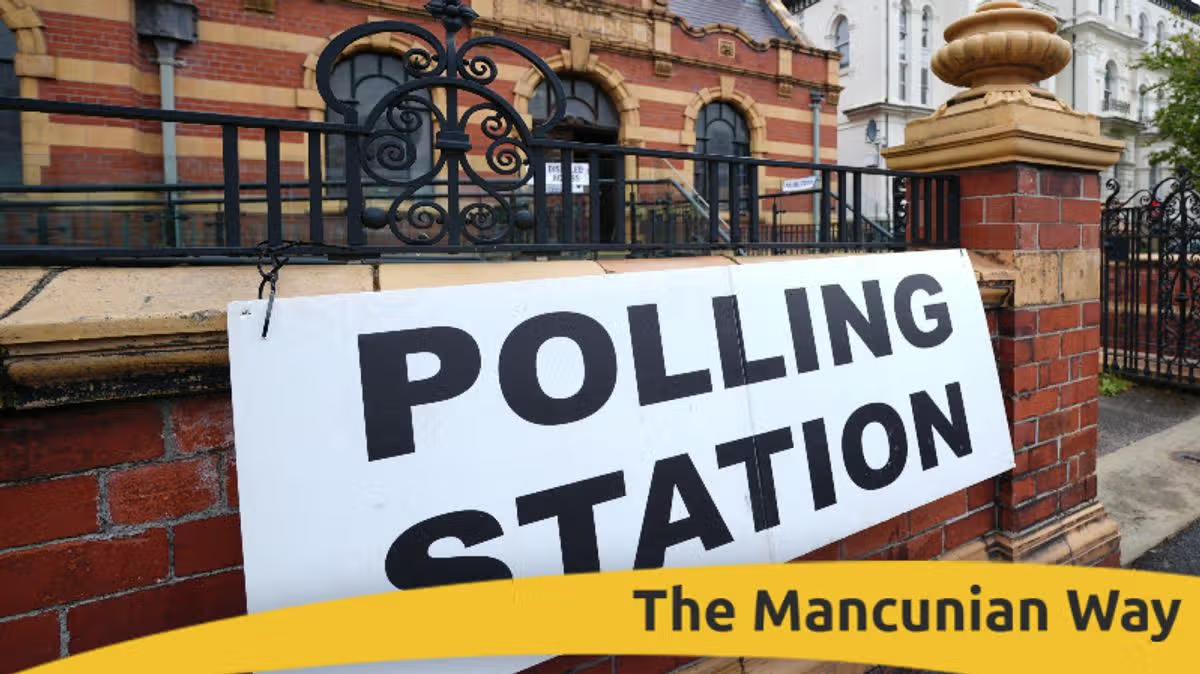
The application, submitted for the property on New Court Drive, sought permission to build a rear extension measuring approximately 2.8 metres in depth and 4.1 metres in width.
Planning officers recommended approval, concluding that the proposal would be in keeping with both the character of the existing property and the surrounding area.
A report prepared by the council noted that the extension would be constructed using materials matching the existing dwelling and would remain subordinate in scale and appearance.
Advertisement
Officers also highlighted that a number of similar extensions already exist in the neighbourhood.
The council assessed the impact on neighbouring properties and found the proposal would comply with guidance set out in its House Extensions Supplementary Planning Document.
It was determined that the development would not result in unacceptable overlooking, overshadowing or loss of outlook for nearby residents.
One representation was received during the consultation process, raising concerns about potential subsidence and the effect of the roof height on light reaching a neighbouring garden.
Advertisement
Planning officers said building control regulations would address construction matters and concluded that the extension would not cause undue overshadowing.
Permission was granted subject to standard conditions, including a requirement that external materials match the existing property.
Tuchel has to take his own share of responsibility for this situation, having made some experimental selections leading up to these final preparations, including in the friendlies against Uruguay and Japan at Wembley in March.
Manchester City’s Phil Foden played up front against Japan. In the Uruguay game, Tuchel fielded Foden, Everton’s James Garner and Spurs striker Dominic Solanke. None of those made his World Cup squad.
Ivan Toney came on for the second half in Tampa after spending a year in the England wilderness, following a three-minute appearance in the friendly defeat against Senegal at the City Ground, Nottingham.
This, in effect, makes it even more important that Tuchel puts a line-up on the pitch against Costa Rica that is as close as possible to the one that will face Croatia. It will be an opportunity to find rhythm and momentum and build combinations before that tournament opener.
Advertisement
Tuchel did, at least, report no injuries from this first warm-up game, while he added: “The better the opponent gets, the better we will get.”
Kane’s goal came just before half-time, which heralded the mass changes, but Tuchel said: “I was happier with the second half. I thought we had more hunger and more desire. We played better but did not score.
“We didn’t play according to our plan in the first half. It slowed the game down, but it was better in the second half.
“We will acclimatise to the humidity and the sun while we are here. Tomorrow will be recovery day, then we have two days to prepare for Costa Rica. Then a chunk of players will get more minutes. The Arsenal players are in now, which is good because it gives us energy and quality, and then we have another one and a half days off.
You must be logged in to post a comment Login