The judge wanted everyone in the courtroom to know that when he’d signed a war orphan over to an American Marine he thought it was an emergency — that the child injured on the battlefield in Afghanistan was on death’s door, with neither a family nor a country to claim her.
A lawyer for the federal government stood up.
“That is not what happened,” she told the judge: almost everything he’d believed about the baby was untrue.
Advertisement
Kathryn Wyer, a Justice Department lawyer representing the federal government, corrected Fluvanna County Circuit Court Judge Richard Moore at a hearing on Nov. 11, 2022. The judge, who allowed an American Marine to adopt an Afghan orphan, had believed Afghanistan gave up finding her family, but the country was still searching, and eventually united the girl with relatives.
This group had gathered 15 times by then, in secret proceedings in this small-town Virginia courtroom to try to fix what had become an international incident. Fluvanna County Circuit Judge Richard Moore had granted an adoption of the orphan to U.S. Marine Joshua Mast and his wife, Stephanie, while the baby was in Afghanistan, 7,000 miles away.
Advertisement
Now the U.S. government insisted the baby’s fate had never been the judge’s to decide; officials in President Donald Trump’s first administration had chosen to unite her with relatives months before Moore gave her away, according to once-secret transcripts of the November 2022 hearing.
Thousands of pages of those transcripts and court documents were recently released as a result of The Associated Press’ three-year fight for access after a 2022 AP report about the adoption raised alarms at the highest levels of government, from the Taliban to the White House. The newly released records reveal how America’s fractured bureaucracy allowed the Masts to adopt the child who was halfway around the globe, being raised by a couple the Afghan government at that time decided were her family, in a country that does not allow non-Muslims to take custody of its children. The documents show the judge skipped critical safeguards and legal requirements.
Mast, who cited a judge’s orders not to speak publicly about the case in declining requests to comment, has said he believed — and still does — the story he told Moore about the girl, and insists he acted nobly and in the best interest of a child stuck in a war zone with an uncertain future.
Along the way, high-ranking military and government officials took extraordinary steps to help him, seemingly unaware that others in their own agencies were trying to stop him.
Advertisement
“The left hand of the United States is doing one thing,” another judge later said, describing the dysfunction, “and the right hand of the United States is doing something else.”
“I’ll probably think about this the rest of my life whether I should have said, sorry, that child is in Afghanistan. We’re just going to stand down,” Moore said at the hearing three years ago. “I don’t know whether that’s what I should have done.”
Advertisement
AP Illustration/Nat Castaneda
A remarkably quick adoption
The baby was orphaned in September 2019 when U.S. Army Rangers, along with Afghan forces, raided a rural compound. The baby’s parents were killed. She was found in the rubble, about two months old, burned and with a fractured skull and broken leg. U.S. troops scooped her up and took her to the hospital at Bagram Air Base in Kabul.
Advertisement
Children stand in front of a home destroyed during a Sept. 5, 2019, night raid by U.S. forces in a village in a remote region of Afghanistan, on Friday, Feb. 24, 2023. (AP Photo/Ebrahim Noroozi, File)
Advertisement
Children stand in front of a home destroyed during a Sept. 5, 2019, night raid by U.S. forces in a village in a remote region of Afghanistan, on Friday, Feb. 24, 2023. (AP Photo/Ebrahim Noroozi, File)
Advertisement
Advertisement
American servicemembers fell in love with her there, as she recovered. She was a symbol of hope in a long, grinding war.
The raid that killed the baby’s parents targeted transient terrorists who came into Afghanistan from a neighboring country, the records show. Some soldiers believed she might not be Afghan and tried to make a case for bringing her to the U.S.
Advertisement
The State Department attempted to make its position clear: The embassy convened a meeting that October with members of the military and the Afghan government to explain that under international law the U.S. was obligated to reunite her with her family, according to documents. State Department officials wrote that Mast, a military lawyer on a short assignment in Afghanistan, attended that meeting.
He’d met the baby for the first time days before and remained determined the child should go to the U.S., according to emails filed as exhibits.
Mast called home, where his wife was with their three sons.
“With us having children of our own, we see how vulnerable and precious children are,” Stephanie Mast testified. “And we wanted to help in whatever way we could.”
Advertisement
Marine Maj. Joshua Mast and his wife, Stephanie, arrive at Circuit Court, Thursday, March 30, 2023 in Charlottesville, Va. (AP Photo/Cliff Owen, File)
Advertisement
Marine Maj. Joshua Mast and his wife, Stephanie, arrive at Circuit Court, Thursday, March 30, 2023 in Charlottesville, Va. (AP Photo/Cliff Owen, File)
Advertisement
Advertisement
Advertisement
The Masts, Evangelical Christians, decided to try to bring her to their home in Palmyra, Virginia.
Advertisement
Mast’s brother, Richard Mast, a lawyer with the conservative Christian law firm Liberty Counsel, filed a petition for custody in early November, and a Fluvanna County Juvenile and Domestic Relations Court judge quickly approved it. The judge declared that the child was “stateless,” echoing Mast’s assertion that her parents were nomadic terrorists, and the Afghan government would issue a waiver of jurisdiction over her within days.
Afghanistan never waived jurisdiction.
Still the Masts decided custody wasn’t enough. Several days later, Moore, the Fluvanna County Circuit Court judge, got an unusual weekend call from his clerk’s office about a request for an emergency adoption, according to comments the judge made on the bench and records obtained from the Virginia Attorney General’s Office. Custody orders like the one the Masts were granted are temporary, but adoption grants a child an entirely new birth certificate, assigning them new legal parents. Moore said he was told that the girl desperately needed medical care and adoption would help get her on a plane to America.
Though the baby was being cared for by the Defense Department, the federal government insisted it received no notice of Mast’s bid for adoption, the recently released records show. Had it been notified, government lawyers said, they would have told the judge that the child was not stateless, the government was at that time searching for her family and would soon decide she was Afghan and not the child of foreigners. She was also not in a medical crisis: A month before, exhibits show, her doctor described her as “a healthy healing infant who needs normal infant care.”
Advertisement
The Masts have said in court records that they did not mislead the court; they believed that the girl was the stateless daughter of transient terrorists and Afghanistan was neither interested nor capable of caring for her.
Moore did not respond to requests for comment.
On Sunday, Nov. 10, 2019, Moore granted the Masts a temporary adoption. Moore ordered the Virginia Department of Vital Statistics to issue a new birth certificate, making her the Masts’ daughter.
Adoption cases usually creep through the court system. Moore granted the Masts the temporary adoption in a weekend.
Advertisement
“Attempting to interfere inappropriately”
Two days later, an email arrived overnight at the U.S. Embassy in Kabul from State Department headquarters. The office had heard that Mast had been granted custody of the orphan, and wanted to know if that was true, the documents show.
Officials who had been working on uniting the girl with her family seemed stunned by the email. An Army colonel later wrote in a declaration that he believed Mast was “attempting to interfere inappropriately.”
Army Col. Joseph Fairfield wrote in a legal declaration submitted in court by the federal government that by late 2019, some military officers were worried that Mast’s efforts “had diverged” from the official U.S. position about what should become of the baby, and he was “attempting to interfere inappropriately.”
Advertisement
Around that time, U.S. officials learned that a man came forward to claim the baby, records show. He told authorities he was the child’s uncle. He said the girl’s father was a local farmer, not a terrorist. His wife and five of their children were also killed. He said it was his family’s duty to take her in.
The Afghan government vetted his story. U.S. officials signed off.
Advertisement
Meanwhile, Mast’s tour ended. He returned home to Virginia, and set up a crib for the baby he was certain would soon be theirs, according to court testimony. The couple quickly found an ally in an aide for Republican Sen. Ted Cruz of Texas. The aide pressed Assistant Secretary of Defense Derek Maurer to ask immigration officials to rush documents the child needed to get to the U.S. An attached memo written by another military official pointed to proof of Mast’s claim to the baby: Mast had enrolled her in the military’s health care system as his dependent.
On the application for those benefits, Mast claimed the girl had lived with him in Virginia since Sept. 4, 2019, but she had never been on American soil, a government official wrote in a declaration. Mast also wrote that her injures were a result of child abuse.
The situation worked its way to Secretary of State Mike Pompeo. He signed a cable, dated Feb. 25, 2020, records show, dismissing the Fluvanna custody orders as “flawed.”
The cable said that any further delay in transferring the child could be perceived as the “U.S. government holding an Afghan child against the will of her extended family and the Afghan government.”
Advertisement
The next day, Mast filed a federal lawsuit to stop the reunification. The judge rejected his claims.
The U.S. put her on a plane to meet her relatives. They wept when they saw her, bundled in pink. The child’s uncle decided his son should raise the baby with his new wife and they quickly came to love this girl like their own daughter, they testified.
The Masts have insisted that this family is not biologically related to the baby and have questioned the process through which the Afghan government vetted them. The Afghan couple had celebrated the first step in a traditional Afghan marriage, a religious bond, but had not yet had a wedding reception, and the Masts argue they were unmarried at the time the child was given to them.
The AP agreed not to name the Afghan couple because they fear their families in Afghanistan might face retaliation from the Taliban. The court issued a protective order shielding their identities.
Advertisement
The Taliban, which now controls Afghanistan, was not in power when that country was making decisions about the child. Since taking over, the Taliban has been critical of what happened to the girl, calling it “worrying, far from human dignity and an inhumane act,” and urged the U.S. to return her to her relatives.
The Afghan couple testified they had no idea that on the other side of the globe an American judge still believed the girl was available for adoption.
Mast told Moore the child was given to an unmarried girl whose relationship to her was unclear. He testified that he maintained the child was the daughter of foreign fighters and suspected the family had ties to terrorism.
Moore said he did not learn that a federal judge had already rejected Mast’s claims to the baby. He would later say he vaguely remembered hearing that something happened in federal court but it didn’t register as important.
Advertisement
“I guess I assumed it was an administrative thing,” Moore said.
Mast continued to ask Moore to grant a final, permanent adoption.
Lawyers representing the government, the Afghan family and the child would note many defects in these proceedings; the attorney representing the child described the flaws as “glaring.” There is no Virginia law that allows a judge to adopt out a foreign child without her home country’s consent. A child must be put up for adoption by a parent or agency, and this child had never been. The court waived the requirement that the child be present when social services visited the adoptive parents’ home, that someone investigate her history, that whoever had custody be told this was happening.
In December of 2020, Moore granted a final adoption, deeming the Masts the baby’s permanent parents.
Advertisement
“She is an undocumented, orphan, stateless minor,” he wrote, “subject to this court’s jurisdiction.”
‘Is it even lawful for us to take her?’
In Afghanistan, the couple raising the girl received calls from strangers. Mast was working with Kimberley Motley, an American lawyer based in Afghanistan. Motley told the couple that a family wanted to help the girl get medical care in the U.S. But the couple refused to send the girl alone. Motley kept in touch with them for months, according to messages entered as court exhibits. Motley, through her attorney, declined to comment.
In the summer of 2021, the American military withdrew from Afghanistan and the Taliban took over. Mast contacted the couple directly, enlisting the help of a translator named Ahmad Osmani, an Afghan Christian who’d moved to the U.S. Osmani considered it his Christian duty to help the Masts, testifying that he believed it would be “a great picture to see a terrorist’s daughter become a believer and glorify God’s name.”
Mast and Osmani told the couple that they could get all three out of Afghanistan.
Advertisement
At the time, servicemembers were frantically evacuating Afghans, mostly those who helped the U.S. and would likely be targeted by the Taliban.
Amid the confusion, Mast asked colleagues in the Marines to add a baby and her caretakers to an evacuation list, the records show, claiming the State Department had sent her to an orphanage. She was living with the Afghan couple, and had never been to an orphanage.
A lieutenant colonel emailed other military officials to start the process of getting the family on a flight out. He didn’t learn that the military had worked to keep Mast away from this baby.
“Is it even lawful for us to take her?” asked a major in the Marines, according to a copy of the email.
Advertisement
Mast, who was copied on the chain, replied: “To clarify, she is completely clear on the Afghan side,” he wrote. “I am very familiar with the requirements after the last 18 months working the legal issues.”
Marine Joshua Mast emailed military colleagues requesting the girl and her caregivers be added to the list of evacuees from Afghanistan during the chaotic U.S. withdrawal in summer 2021. One questioned whether it was legal to take the girl out of the country, and Mast assured them it was.
Advertisement
Military officials asked no further questions, and soon the family was on a plane to Germany, where the Masts met them for the first time. The Afghans testified they had no idea the Masts planned to take her. The Masts have said they had tried to explain that they would.
Stephanie Mast testified that when she and her husband arrived in Germany, they “knew we had to speak to them and just tell them the truth.” She tried to explain “sacrificial love.” If the baby came with them, she told the Afghan woman, “she can have the best life possible.”
The Afghan man ripped off the wristband refugees wore and threatened to return to Afghanistan if the Americans tried to take the child.
Advertisement
The Afghan woman later said they convinced her that she’d misunderstood and persuaded them to continue to the U.S., and keep the baby with them.
The Afghans boarded a plane bound for Dulles International Airport, then a bus to Fort Pickett, a military base in Virginia turned makeshift refugee center. Meanwhile, the records show, Mast asked a State Department official he’d met in Germany to help connect him with other government contacts so he could track the family’s arrival.
Emails show employees with multiple government agencies sprung into action, including the State Department. The federal government would later say that these employees, like the military officials who evacuated the family, didn’t know that the very agency they worked for had tried to prevent Mast from taking the girl.
‘It’s like you are kidnapping her’
Rhonda Slusher, a State Department official, answered the phone at Fort Pickett. On the line was Joshua Mast.
Advertisement
He said he was going to come pick up his adoptive daughter, according to a declaration Slusher submitted in court. Slusher said she was told “there was no U.S. jurisdiction to hold the child,” and she should be given to Mast “at the earliest point possible.” Her supervisor instructed her to assist with “the transfer of the child,” she wrote in the declaration.
Mast told Slusher he was concerned the family she was being taken from “were going to be sad,” she wrote.
On Sept. 3, 2021, uniformed officers drove the Afghan family to a nondescript building near the camp’s front gate.
Slusher picked the baby up out of the car seat and insisted she hold her as the family went inside.
Advertisement
There, the Afghan woman later testified, another official, this one from the Department of Health and Human Services, told them: “you are not the parents of this child.”
“It’s like you are kidnapping her,” the Afghan man said.
The Afghan woman came toward Slusher.
“Please give me my daughter,” she said “She is my daughter.”
Advertisement
The Afghan woman testified at a hearing on May 24, 2022, describing how she begged government officials not to take the child away from her. The officials handed the girl to the Mast family, and the Afghans have not seen her since.
Advertisement
The baby cried and squirmed to get back to her, but Slusher wouldn’t let her go. The woman tried to grab the child, but Slusher pulled her hands away. The woman “crumpled to the floor crying.” She lay there for at least five minutes.
Slusher wrote in a declaration that she carried the baby outside, where Stephanie Mast was waiting in the car. Stephanie Mast fed the girl Goldfish crackers before they drove away with her husband.
“It is worth reiterating that this prolonged tragedy was entirely avoidable. The Trump administration blocked an attempt to unlawfully seize the child from her Afghan family in early 2020,” the Afghan couple’s attorneys wrote in a statement, adding that the Masts were able to take the child only because of America’s messy exit from Afghanistan. “The child and her relatives are victims of a crime and a tragedy no family should ever endure — a stark reminder that this withdrawal continues to have far-reaching and devastating consequences.”
‘A possibly errant adoption’
More than a year after the Masts took the baby home, her fate was before Judge Richard Moore again.
Advertisement
The Afghan couple found a team of lawyers willing to represent them for free, and filed a petition in Moore’s court to challenge the adoption he’d granted. Moore could undo the adoption and give the child back to the Afghan family, or uphold it, and leave her with the Masts.
“I’ve never had a case where I was so uncomfortable with either decision,” he said at the November 2022 hearing, which would be his last hearing in the case before retiring.
The judge listened for five hours as the lawyers for the Afghan couple and the government said that the adoption he’d granted was so riddled with errors it shouldn’t be called an adoption at all.
Moore blamed the federal government — it had known as early as 2020 that the Masts were trying to get the girl and a court in Fluvanna County was involved, and they did not try to stop him from issuing a “possibly errant adoption,” he said.
Advertisement
“Clearly, there were procedural irregularities and deficiencies in this case. There’s no question about that,” the judge said from the bench.
Yet for a year, in hearing after hearing, the primary question became whether the Afghan couple had a right to challenge that adoption at all; whether they were truly her family and if the Afghan government’s decision to give her to them was valid once they arrived in the U.S.
The judge and the Masts’ attorneys questioned them about their origin and upbringing, their relationship to each other and to the child.
Moore repeatedly said he did not believe they were related to the girl, nor was he inclined to consider them parents. He said no court in Afghanistan was involved in determining who should get custody of the child there. The Afghan couple’s lawyers had resisted DNA testing, saying it couldn’t conclusively find a relationship between opposite-gender half-cousins. It was also irrelevant, they argued: After the Afghan government gave the child to them, an American court should not relitigate that choice.
Advertisement
At the last hearing he held in November 2022, Moore said there were many things he wished Mast had told him before he signed the adoption. But he still trusted the Marine.
“There’s no question in my mind. Their total involvement was to save this child,” Moore said.
A week later, Moore published his thoughts on the case in a written document, and reiterated his opinion that “anything they did improper grew” out of the Masts’ desire to help the child.
He was less sympathetic to the Afghans. The Afghan woman testified that she had two Afghan government identifications, one that included her real age and a second she obtained intentionally making herself younger to enable her to enroll in school. They “misrepresented certain facts and lied … for their own purposes,” Moore wrote.
Advertisement
The Masts, too, have described the Afghans as untrustworthy, even threatening. They submitted court records alleging the Afghan man was flagged in a database of suspected terrorists upon entry to the U.S., which they reported to law enforcement. Attorneys for the Afghans responded that the government said in a sealed letter to the court that the man was not the subject of the database entry. The man remains in the U.S. and frequently flies from Texas to Virginia for court hearings.
With Moore’s retirement, the Masts and the Afghans found themselves before a new judge, Claude Worrell.
Advertisement
This courtroom sketch depicts Marine Maj. Joshua Mast and his wife, Stephanie, during a Circuit Court hearing before Judge Claude V. Worrell Jr., Thursday, March 30, 2023, in Charlottesville, Va. (Dana Verkouteren via AP)
This courtroom sketch depicts Marine Maj. Joshua Mast and his wife, Stephanie, during a Circuit Court hearing before Judge Claude V. Worrell Jr., Thursday, March 30, 2023, in Charlottesville, Va. (Dana Verkouteren via AP)
Advertisement
Advertisement
Advertisement
Worrell rebuked the federal government for its “inconsistent” approach, noting it was arguing the baby should be immediately returned to the Afghans, while its own employees had repeatedly assisted the Masts along the way.
It did not take Worrell long to come to a wholly different conclusion than Moore. Worrell wasn’t concerned about biological relationships. What mattered, he said, was Afghanistan claimed her as its citizen, so got to decide her fate.
The Afghan couple went outside to a patch of grass in the parking lot and prayed. They thought they would soon bring the baby to their home in Texas, where they’ve kept a bedroom ready for her, decorated with butterfly decals.
The Virginia Court of Appeals has since upheld Worrell’s decision voiding the adoption, and the case went before the Virginia Supreme Court in February 2025. It has yet to issue a ruling. As the years dragged on, the child remained with the Marine and his family.
The Marine Corps held an administrative hearing in October 2024 to determine whether Mast violated military rules. A three-member panel found that he acted in a way that was “unbecoming” of an officer, but that didn’t warrant suspension or other formal punishment.
The federal government has indicated in court in recent months that it is reconsidering its role in the case, and Trump’s second administration could reverse his first administration’s opinion that Mast had no right to the child. The Justice Department did not respond to repeated requests to clarify its current position on the child’s fate.
Advertisement
It has been four years since the Afghan couple has seen her.
In July, she turned 6.
___
AP data journalist Angeliki Kastanis contributed to this report
Independent operators John Tate and John Hewitt have submitted plans to create a three-screen cinema in the site of the Original Factory Shop in Fishergate.
If approved by North Yorkshire Council, it would be Ripon’s first cinema in since the closure of the Curzon Cinema in North Street nearly three years ago.
Mr Tate and Mr Hewitt are both members of the Executive Board of the UK Cinema Association, and run cinemas in Ilkley and Wetherby.
The factory shop, which has traded in the city for around 40 years, is due to close on Sunday, if not before.
The closure of the 10,000 sq ft three-storey retail outlet was announced in February.
Mr Tate told Tim Flanagan of the Rejoicing in Ripon blog; “Ripon is one of the few places of its size in the north of England that is without a cinema and we have been looking for an opportunity there for six years, as we believe that it is a city on the up and with great potential.
“By strange coincidence, I discovered during my research on Ripon that my grandfather and namesake, John Henry Tate, was born at a house on North Street in October 1883 and I take this as a lucky omen
Advertisement
“We are delighted to have signed a lease, subject to planning, for a change of use from retail unit to cinema on 14–16 Fishergate and hope to secure the necessary permission to proceed as soon as possible.”
The site of the former Curzon Cinema (Image: Northern Echo)
Mr Tate added: “We will be showing a wide range of films, including the latest blockbusters 🍿 and current releases, alongside Event Cinema, National Theatre Live, Royal Opera House productions, cinema stage musicals, documentaries and independent foreign-language films.
“We will also have schemes for the over 60s, families with babies, and film-lovers of all ages will be able to enjoy food and drink in the comfortable lounge area or in the auditorium while watching a film or performance.”
Ripon BID, who broke the story of the planned cinema, has offered its strong support for the scheme.
Advertisement
Ripon BID Manager Lilla Bathurst said: “We will do everything within our power to support the application, which will add substantially to the city’s retail and leisure offering.”
“This is phenomenal news for Ripon and is a further sign of the confidence that investors have in the historic Cathedral City of the Dales 🕍
“Our post‑covid recovery puts us high on the list of UK locations where independent businesses want to be — and importantly, places where people want to visit.”
Lilla added: “I believe that this £1.25 million investment will be the catalyst for further inward investment in our thriving city.”
Advertisement
Robert Sterne, director of Sterne Properties Ltd, which owns the former Curzon site in North Street told Ripon BID that it was too late to get Curzon to re-open on the site.
He also told Ripon BID he welcomed the proposed cinema use on Fishergate and his company remained “fully committed” to returning the Curzon premises to use as a family leisure facility.
Personal Independence Payment claimants must report travel abroad for over four weeks or risk losing benefits
Linda Howard Money and Consumer Writer and Ashlea Hickin Content editor
20:52, 26 Mar 2026
There are several changes in circumstances that individuals receiving Personal Independence Payments (PIP) must inform the Department for Work and Pensions (DWP) about, or they risk losing their benefit entitlement and having regular payments paused or stopped.
It’s crucial to note that changing your name, doctor, health professional or address do not need to be reported to the DWP and will have no impact on your payments – but it is worthwhile ensuring the details DWP holds on file for you is up to date.
However, leaving the country or planning to leave the country for a period of more than four weeks – even just for a holiday – may affect entitlement.
Advertisement
Guidance on GOV.UK for people planning to leave the country for more than four weeks, states: “This change may affect the claimant’s entitlement to PIP. We will need to know the date the claimant is leaving the country, how long they are planning to be out of the country, which country they are going to and why they are going abroad.”
If you are planning to travel abroad this year, or are in the process of booking a holiday for more than four weeks, make sure you contact the DWP with the details they have asked for as soon as possible, reports the Daily Record.
How to report a change of circumstances to DWP
Contact the PIP enquiry line on 0800 121 4433 to report a change of circumstances – lines are open from 9am to 5pm, Monday to Friday.
Here is a comprehensive guide to all the changes in circumstances and whether you need to contact the DWP about them.
Advertisement
Alterations to daily living or mobility requirements
You should inform the DWP if, for instance, you require more or less assistance or support, or if your condition will persist for a longer or shorter duration than you previously informed the DWP.
Such a change could impact your eligibility for PIP, as well as the amount and duration of the PIP award.
Departing the country or intending to leave the country for more than four weeks – even if it’s for a holiday
This alteration could affect the claimant’s eligibility for PIP. The DWP needs to be informed of the date the claimant is leaving the country, the length of their intended stay abroad, the country they are visiting, and the reason for their trip.
Hospital stays or similar institutionalisation
According to DWP guidelines, both components of PIP cease to be payable 28 days after the claimant is admitted to an NHS hospital.
Advertisement
Patients funded privately are not subject to these rules and can continue to receive either component of PIP.
If a claimant is in hospital or a similar institution at the date entitlement to PIP begins, PIP is not payable until they are discharged.
Care homes
The daily living component of PIP ceases to be payable after 28 days of residency in a care home where the costs of the accommodation are met from public or local funds. The PIP mobility component can continue to be paid.
Those who fully self-fund their care home placement are not impacted by these regulations. If a claimant is in a care home at the date of entitlement, the PIP daily living component is not payable until they depart.
Advertisement
Linked stays in hospital and a care home
Hospital stays are linked if the interval between them is no more than 28 days. The daily living component for stays in a care home is also linked if the gap between them is no more than 28 days.
There is no link for the mobility component as payment is not affected when in a care home. Both components of PIP will cease to be paid after a total of 28 days in hospital. The daily living component of PIP will stop being paid after a total of 28 days in a care home.
If a claimant transitions between a hospital and care home, or vice versa, these periods will also link.
Imprisonment or claimant held in legal custody
This alteration may impact the amount of PIP that can be paid to the claimant.
Advertisement
The DWP needs to be informed of the date the claimant was taken into prison or legal custody and the expected duration of their stay, if known.
Detained in legal custody
PIP stops being payable after 28 days where someone is being detained in legal custody. This applies whether the offence is civil or criminal and whether they have been convicted or are on remand.
Suspended payments of benefit are not refunded regardless of the outcome of proceedings against the individual. Two or more separate periods in legal custody link if they are within one year of each other.
Change of name
This change will not affect payment or eligibility for PIP, but it is important the DWP has the most up-to-date details for the claimant.
Advertisement
This change needs to be reported in writing – if the claimant phones to give these details, the DWP will ask for these details to be put in writing. The written notification must contain:
• Full details of their previous name
• Their new name
• Details of any changes made to the bank or building society account into which PIP is paid, such as the name of the account or the account number
Advertisement
• Their signature on the letter
Change of account PIP is paid into
The DWP needs full details of the name and address of the new bank or building society along with details of the new account including the name of the account, the account number and the sort code or roll number.
Change of person acting for the claimant
This refers to an appointee or someone with power of attorney for the claimant.
This change is important so the DWP can make payments to the right person at the right time. They need the full name, address and contact details of the new person who is acting for the claimant.
Advertisement
If the person acting for the claimant has moved or has different contact details, the DWP just needs the new details.
Change of address
This alteration, unless it involves a hospital or nursing home, will not impact the eligibility or payment of PIP. It’s crucial that the DWP has the most current details for the claimant.
They require comprehensive information about the new address to which the claimant has relocated, including the postcode and the date of the move.
Change of doctor or healthcare professional
This change will not affect the payment or eligibility for PIP and is not obligatory once a decision on the PIP claim has been reached.
Advertisement
However, if the change occurs during the claiming process, it’s vital that the DWP have the most recent information. This ensures that the assessment provider has the correct contact details to collect any additional details they may need.
The DWP requires the full name, address, and contact details of the new doctor or healthcare professional.
Complete details about changes of circumstance if you are receiving PIP can be found on GOV.UK.
Theo has been abusing Todd since the beginning of their relationship last year, but so far the only person to learn the full extent of it has been Billy Mayhew.
After Todd confided in the vicar, Theo left him to die in the Corriedale pile-up to silence him and keep Todd trapped in their relationship.
Things have continued to escalate since then, until Theo unexpectedly called things off after threatening Todd with a knife.
Following the ceremony, George was put out about not having been invited, and suggested to Summer Spellman (Harriet Bibby) that perhaps Todd hadn’t had much of a say in organising the event.
Theo has been abusing Todd Grimshaw (Picture: ITV)
Tonight, his fears were confirmed when he paid Todd a visit, only for Theo to arrive home while Todd had nipped out.
Having been for a run to cool off after Todd turned him down for sex, Theo’s mood clearly hadn’t improved by the time he got back.
Believing that it was Todd in the bathroom, Theo continued to make vile comments about Todd’s weight and his refusal to have sex again that morning.
Advertisement
However, when Todd returned home and George emerged from the bathroom, Theo played it all off as a joke.
George made a vow to get Todd away from Theo (Picture: ITV)
George relayed the experience to Summer, sharing his concerns that Todd hadn’t been himself for months.
Don’t miss a Soaps scoop! Add us as a Preferred Source
As a loyal Metro Soaps reader, we want to make sure you never miss our articles when searching for stories. We have all the latest soaps news, spoilers, videos, and interviews, with a vibrant community of highly engaged readers.
Click the button below and tick Metro.co.uk to ensure you see stories from us first in Google Search.
Two second half goals undid all the good work but Northern Ireland were missing a number of key players
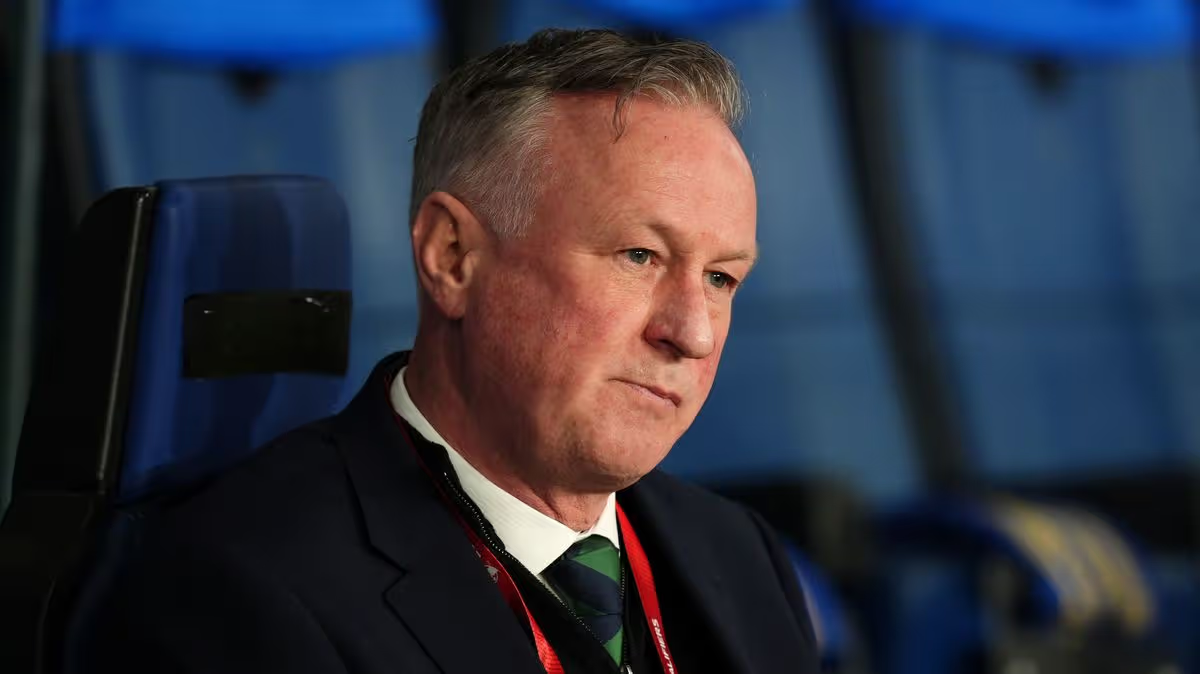
Michael O’Neill believes his young Northern Ireland side will only be better for the experience after a 2-0 defeat to Italy in their World Cup semi-final play-off in Bergamo.
Advertisement
O’Neill had stated that the squad is further on in their development than he’d expected at this stage and there was certainly no shame in losing to an Azzurri side that they kept at bay in a tense first half at the New Balance Arena.
“I couldn’t ask any more from the players, I thought our game plan in the first half was excellent,” said the 56-year-old, who was without the likes of Conor Bradley and Daniel Ballard for the crunch game..
“We limited Italy to very few chances in the first half.
“Ultimately in the second half we caused our own problems.
Advertisement
“We had a couple of nervous moments before the first goal. We were out of shape, it’s not a great header and it lands to the wrong man in Sandro Tonali, who strikes a great ball.
“Once you’re behind in the game it’s difficult.
“But I thought our attitude throughout was terrific.
“It’s a very young team, I think the average age is 22 years of age, so it is incredibly positive for us to come here, against a team like Italy, and take them to the 90th minute before they feel they’re safe.
Advertisement
“We only had one player out there over the age of 24 and that says a lot.
“We showed great character. I thought all the younger players were terrific in the game.
“Regardless of the result, we took a step forward in terms of the progress of the team.
“It’s very difficult to come away here to Italy, especially with the players we had missing.
A Los Angeles jury has delivered a landmark verdict: Meta and YouTube were negligent in the design and operation of their platforms, causing a young woman known in court documents as Kaley, or KGM, to become addicted to social media.
The tech giants must now pay her a total of US$6 million in damages – $3 million compensatory and $3 million punitive.
She claimed the platforms’ design features got her addicted to the technology and exacerbated her depression, anxiety, body dysmorphia and suicidal thoughts.
The jury found that Meta bore 70% of the responsibility and YouTube 30%, meaning Meta will pay $4.2 million and Google’s YouTube $1.8 million. Both companies have said they will appeal.
Advertisement
The verdict came a day after a separate New Mexico jury ordered Meta to pay US$375 million for failing to protect children from predators on Instagram and Facebook.
Kaley filed her lawsuit in 2023, when she was 17. She claimed that she began using social media as a young child and alleged that features such as infinite scroll, autoplay, algorithmically timed notifications and beauty filters were addictive.
TikTok and Snap were originally named as defendants but settled before the trial began for undisclosed sums. Meta and YouTube proceeded to a seven-week trial in Los Angeles Superior Court.
The case is the first of three bellwether trials scheduled in the California state proceedings – test cases selected to gauge how juries respond to the core legal arguments – drawn from a pool of more than 1,600 plaintiffs, including over 350 families and 250 school districts.
Advertisement
The outcome of this first trial was always likely to have consequences far beyond one young woman’s case.
Bypassing big tech’s legal shield
The legal strategy that made this trial possible was a deliberate departure from previous attempts to sue social media companies. Historically, platforms have been shielded by Section 230 of the 1996 Communications Decency Act, which protects internet companies from liability for content posted by their users.
The plaintiff’s lawyers sidestepped this entirely by arguing that the harm arose not from what users posted, but from how the platforms were engineered – treating Instagram and YouTube as defective products rather than neutral publishers.
The jury heard internal Meta documents that proved damaging. One memo read: “If we wanna win big with teens, we must bring them in as tweens.” Another showed that 11-year-olds were four times as likely to keep returning to Instagram compared with competing apps, despite the platform’s own minimum age requirement of 13.
Advertisement
Mark Lanier, attorney for Kaley, addressed the media after the jury reached their verdict. TED SOQUI
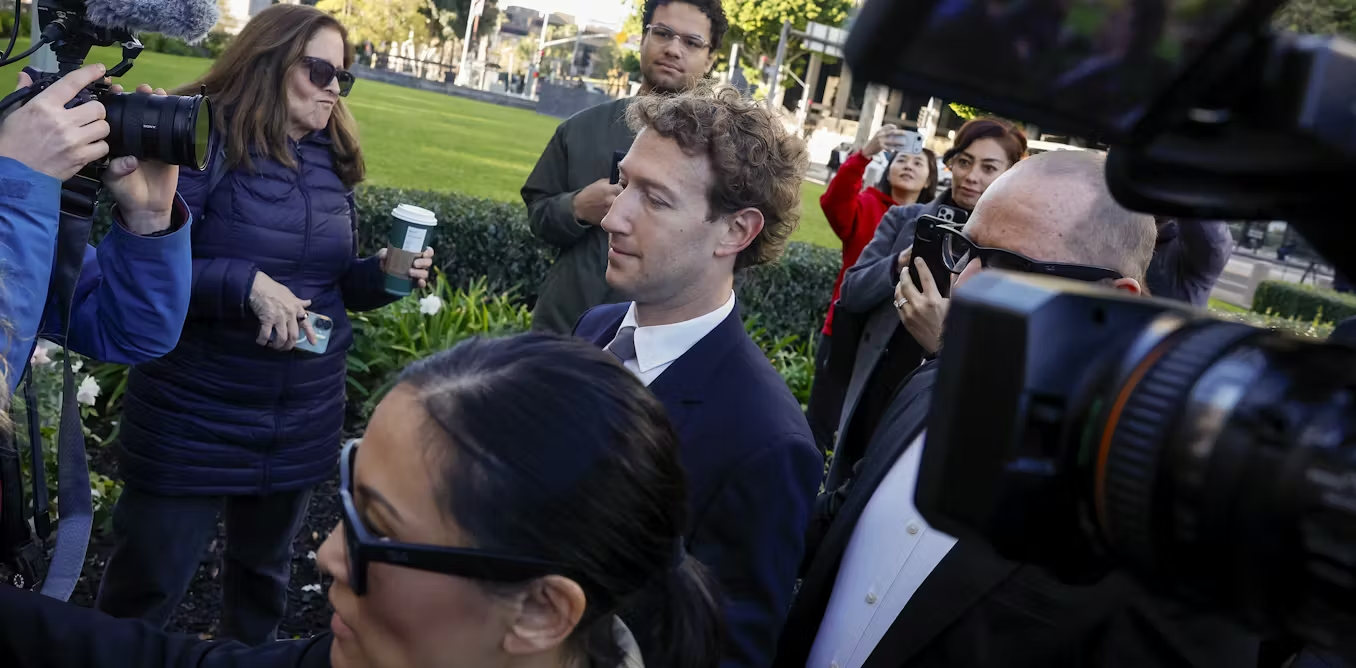
A former Meta engineering director turned whistleblower, Arturo Béjar, testified about how features like infinite scroll exploit the brain’s reward system. Meta CEO Mark Zuckerberg himself took the stand – his first jury testimony on child safety – and was questioned about his decision to retain beauty filters despite internal research flagging their impact on young girls’ body image.
The jury rejected the companies’ central defence: that Kaley’s struggles were primarily the result of a difficult home life and pre-existing conditions rather than platform design.
In finding that the companies had acted with “malice, oppression or fraud”, they opened the door to the additional punitive damages that brought the total to US$6 million.
Both companies will appeal, and the process could take years. In the meantime, a second important trial is scheduled for this summer, and a separate federal case in Oakland involving school districts is also advancing. The pressure on platforms to settle the thousands of remaining cases will grow considerably.
Advertisement
Long-term impact?
For users, the immediate practical picture is less clear. Meta and YouTube are unlikely to make significant changes to their platforms while the appeals process plays out. Any redesign – if it comes – is likely to be incremental and carefully managed to minimise disruption to the engagement model that drives their revenues.
But there is a harder question the verdict does not answer: will it actually change anything? Meta and YouTube are companies worth hundreds of billions of dollars. A US$6 million damages award is not going to restructure the attention- and surveillance-driven economy.
My research on digital overuse – based on in-depth interviews with digital users and studies of online communities discussing digital overuse and detox – shows that even people who are fully aware of the problem and genuinely want to reduce their screen time find it extraordinarily difficult to do so.
This is not because they lack willpower, but because the features driving compulsive use are not bugs in the system. They are the system, built to maximise engagement and advertising revenue.
Advertisement
For years, big tech has placed the burden of managing screen time squarely on individuals and parents – encouraging screen time limits, digital detoxes, and parental controls while continuing to engineer products specifically designed to defeat exactly that kind of self-regulation.
The jury has pushed back against that logic. Whether courts, regulators, and legislators will push hard enough to force genuine structural redesign remains to be seen. However, the European Commission has already made the preliminary finding that TikTok’s addictive design features are in breach of the EU’s Digital Services Act.
What this verdict does, at minimum, is shift the ground. For the first time, a jury has confirmed what researchers have argued for years: this is not a story of weak willpower or bad parenting. It is, at least in part, a story of deliberate product design. That matters – even if the real fight is still to come.
Mickeleate, close to its junction with North Street, has been temporarily closed by City of York Council.
Recommended reading:
Confirming this in a statement, a spokesperson said: “This morning our teams were inspecting Micklegate as part of our routine highways maintenance and discovered a void under the road.
“We’ve had to temporarily close the bottom of Micklegate to vehicles while we investigate, before the issue is fixed.
Advertisement
“Thanks for everyone’s patience while we urgently investigate.”
Pedestrians and cyclists will still be able to use the road, City of York Council has confirmed (Image: City of York Council)
Businesses along the road, the council said, will open as usual tomorrow, with pavements open to pedestrians and mobility aid users.
Cyclists will also be able to use the route, following signed diversions set up today.
There are mixed emotions ahead as a huge Emmerdale favourite heads off for a new life.
Tracy Shankley (Amy Walsh) gears up to whisk daughter Frankie away for a fresh start when an opportunity presents itself.
Actress Amy Walsh has left the soap to head off and have a baby, which means Tracy has to disappear, at least for a bit. And there comes the fresh start.
Lately, Tracy has been behaving hecking suspiciously in having weird and secretive phone calls – ditching her post in the shop to take a call with a friend, and completely ignoring Nicola King (Nicola Wheeler) in the pub while furiously typing on her phone. There’s something afoot.
Advertisement
Vanessa Woodfield (Michelle Hardwick) gets wind of this impending change and confronts Tracy when she learns that she plans to move house.
Tracy is looking for a fresh start (Picture: ITV)
After the year she’s had, it’s no wonder Tracy wants a fresh start. Husband Nate seemed to disappear of the face of the Earth in 2024 when he took up a job in Shetland and cut contact.
That’s a lot for anyone to process in the space of a year or so.
Tracy has had to navigate life a single, grieving mum who for a time was even estranged from daughter Frankie’s family and any kind of support. So now things are coming back around and she’s focusing back on herself. Good for her, sad for us.
Amy has now given birth to her little girl (Picture: Shutterstock/Amy Walsh/Instagram)
She’s packing up her and Frankie’s lives and heading out of the village, but with everything going on with Cain Dingle (Jeff Hordley), it looks like he might miss his granddaughter’s farewell. Will cancer-suffering Cain be dealt yet another blow by missing their final goodbye?
Don’t miss a Soaps scoop! Add us as a Preferred Source
As a loyal Metro Soaps reader, we want to make sure you never miss our articles when searching for stories. We have all the latest soaps news, spoilers, videos, and interviews, with a vibrant community of highly engaged readers.
Click the button below and tick Metro.co.uk to ensure you see stories from us first in Google Search.
The adorable picture she shared on her Instagram is of the little baby’s feet. In the caption, Amy announced to her followers that her daughter was actually born last week.
Advertisement
She wrote: ‘This time last week I was heading into established labour.
‘We’ve been in the most magical bubble ever since.’
After an encouraging first half, Michael O’Neill’s men ran out of steam and Sandro Tonali and Moise Kean scored to book their place in a play-off final next Tuesday
It was a disappointing night for Northern Ireland in Bergamo as two second half goals killed off their chances of reaching the World Cup.
Advertisement
After an encouraging first half, Michael O’Neill’s men ran out of steam and Sandro Tonali and Moise Kean scored to book their place in a play-off final next Tuesday.
Here is how the Nothern Ireland players rated in Bergamo:
Pierce Charles 7 – Made a series of fine saves but was powerless to keep out Tonali’s hammer blow.
Trai Hume 8 – A rugged and clever performance from the Northern Ireland captain on the night.
Advertisement
Paddy McNair 7 – As assured as always, using his experience to rally his younger colleagues throughout.
Ruairi McConville 6 – Big night for the 20-year-old and he mostly stood his ground, only to get done for the second goal.
Terry Devlin 5 – Had a tough time up against Dimarco. Will have better nights in a Northern Ireland shirt.
Shea Charles 7 – Played some tidy stuff when he could, dug in with a lot of heart when he couldn’t.
Advertisement
Ethan Galbraith 6 – His normally reliable radar was off, coughing up possession a little too easily at times.
Justin Devenney 6 – Did the hard yards all night and used his left foot to effect when the situation allowed.
Brodie Spencer 6 – Safe and secure as he mostly shut down the left side of the pitch.
Isaac Price 4 – Struggled to get into the game. Did little with whatever ball came his way.
Advertisement
Jamie Donley 6- A thankless task as he hared around trying to unsettle the Italian defence with limited service.
Subs: Paul Smyth 6 (68) for Devlin, Jamie Reid 6 (79) for Spencer, Josh Magennis 6 (79) for Donley,
G Donnarumma 7, R Calafiori 7, N Bastoni 6 (F Gatti 7, 63), G Mancini 7, F Dimarco 7, S Tonali 7, M Locatelli 7, N Barella 7, M Politano 6 (M Palestra 6, 83), M Retegui 5 P Esposito 7, M Kean 8 (Raspadori 6, 88)
Former Formula 1 champion Max Verstappen kicked a reporter out of a press conference ahead of Sunday’s Japanese Grand Prix.
The Red Bull driver, 28, refused to speak to journalists at the media session until The Guardian’s Giles Richards left the room.
Verstappen said: “One second, I’m not speaking before he’s leaving.”
The four-time world champion’s refusal dates back to a question he was asked following the 2025 F1 season finale in Abu Dhabi.
Advertisement
Back then, Mr Richards had asked the Dutchman about a collision with Mercedes driver George Russell at the Spanish Grand Prix on 1 June last year.
Gulf F1 races cancelled
Advertisement
The collision led to a 10-second penalty that knocked Verstappen down five places, costing him points.
Hitting back at the question at the time, Verstappen said: “You forget all the other stuff that happened in my season.
“The only thing you mention is Barcelona. I knew that [question] would come. You’re giving me a stupid grin now.
“I don’t know. Yeah, it’s part of racing at the end. You live and learn. The championship is one of 24 rounds. I’ve also had a lot of early Christmas presents given to me in the second half, so you can also question that.”
Advertisement
Image: Verstappen is a four-time world champion. Pic: Reuters
In Suzuka, Japan, on Thursday, after Verstappen asked him to leave, Mr Richards replied “seriously?”.
Verstappen replied: “Yeah.”
Mr Richards then asked: “Because of the question last year?”
Verstappen then answered “yeah”, before Mr Richards walked towards the driver’s table to collect his dictaphone.
Mr Richards then said: “It’s because of the question I asked you in Abu Dhabi?”
Advertisement
After a further exchange, Mr Richards asked: “You’re really, really upset about it?”
Verstappen said: “Get out, get out! Now we can start.”
What the reporter said about ‘smiling’ Verstappen
Writing about the exchange in The Guardian, Mr Richards said: “In the course of a brief 30-second exchange, he told me to ‘get out’, twice. I have never been asked to leave a press conference.”
He added: “Marching orders received, I duly departed. Verstappen had been smiling throughout the exchange. The day carried on; there are far more serious issues in the world than an F1 driver being cross with you.”
Colleagues were “universally shocked” by the incident, he added.
Recent reports have suggested that Sandro Tonali would be expected to leave Newcastle United if they failed to qualify for European football
Newcastle United’s rivals may have been put on alert after an update on Sandro Tonali, with reports suggesting the Italian could be allowed to leave Tyneside if the club fail to qualify for Europe. However, those claims have now been dismissed by Chronicle Live, who report that club officials insist any suggestion of such an agreement is ‘totally untrue.’
Advertisement
Tonali’s future has been the subject of speculation ahead of the summer, with reports linking him with moves to Manchester United and Arsenal. Fresh claims suggest United are preparing a bid, though Tonali remains under contract until 2028, meaning Newcastle are in a strong position to demand whatever fee they like.
It’s understood, however, that Tonali has no release clauses or agreements in his current deal with the club. Comments from his agent, Giuseppe Riso about his client’s prospects fuelled speculation.
Earlier this month, Riso said: “Tthat was the goal from the moment he went to England – to try to make him a star player.
Advertisement
“I think he’s the Italian footballer with one of the highest values in the world.
“If he shines at the World Cup, will Man City or Arsenal be hot on his heels? I don’t know, but it’s very likely.
“Everyone is waiting for the World Cup; then a thousand scenarios will unfold, but it all kicks off after the World Cup.”
Meanwhile, Newcastle boss Eddie Howe shot the rumour down last week, saying: “The person that matters the most is Sandro. All I’ve ever seen from him is someone who is totally committed.
“Very selfless at times, he’s here for the team, not for himself. Forget the noise around him, he’s just fully committed.”
Elsewhere, Tonali’s teammate Bruno Guimaraes has also attracted interest from United, with Howe describing claims that the Brazilian is in ‘advanced talks’ with the club as ‘disrespectful.’
England and Nike have launched the new home, away and goalkeeper kits to be worn at this summer’s FIFA World Cup. You can get free delivery on all orders with the code: ENGFREEDEL

























































You must be logged in to post a comment Login