The judge wanted everyone in the courtroom to know that when he’d signed a war orphan over to an American Marine he thought it was an emergency — that the child injured on the battlefield in Afghanistan was on death’s door, with neither a family nor a country to claim her.
A lawyer for the federal government stood up.
“That is not what happened,” she told the judge: almost everything he’d believed about the baby was untrue.
Advertisement
Kathryn Wyer, a Justice Department lawyer representing the federal government, corrected Fluvanna County Circuit Court Judge Richard Moore at a hearing on Nov. 11, 2022. The judge, who allowed an American Marine to adopt an Afghan orphan, had believed Afghanistan gave up finding her family, but the country was still searching, and eventually united the girl with relatives.
This group had gathered 15 times by then, in secret proceedings in this small-town Virginia courtroom to try to fix what had become an international incident. Fluvanna County Circuit Judge Richard Moore had granted an adoption of the orphan to U.S. Marine Joshua Mast and his wife, Stephanie, while the baby was in Afghanistan, 7,000 miles away.
Advertisement
Now the U.S. government insisted the baby’s fate had never been the judge’s to decide; officials in President Donald Trump’s first administration had chosen to unite her with relatives months before Moore gave her away, according to once-secret transcripts of the November 2022 hearing.
Thousands of pages of those transcripts and court documents were recently released as a result of The Associated Press’ three-year fight for access after a 2022 AP report about the adoption raised alarms at the highest levels of government, from the Taliban to the White House. The newly released records reveal how America’s fractured bureaucracy allowed the Masts to adopt the child who was halfway around the globe, being raised by a couple the Afghan government at that time decided were her family, in a country that does not allow non-Muslims to take custody of its children. The documents show the judge skipped critical safeguards and legal requirements.
Mast, who cited a judge’s orders not to speak publicly about the case in declining requests to comment, has said he believed — and still does — the story he told Moore about the girl, and insists he acted nobly and in the best interest of a child stuck in a war zone with an uncertain future.
Along the way, high-ranking military and government officials took extraordinary steps to help him, seemingly unaware that others in their own agencies were trying to stop him.
Advertisement
“The left hand of the United States is doing one thing,” another judge later said, describing the dysfunction, “and the right hand of the United States is doing something else.”
“I’ll probably think about this the rest of my life whether I should have said, sorry, that child is in Afghanistan. We’re just going to stand down,” Moore said at the hearing three years ago. “I don’t know whether that’s what I should have done.”
Advertisement
AP Illustration/Nat Castaneda
A remarkably quick adoption
The baby was orphaned in September 2019 when U.S. Army Rangers, along with Afghan forces, raided a rural compound. The baby’s parents were killed. She was found in the rubble, about two months old, burned and with a fractured skull and broken leg. U.S. troops scooped her up and took her to the hospital at Bagram Air Base in Kabul.
Advertisement
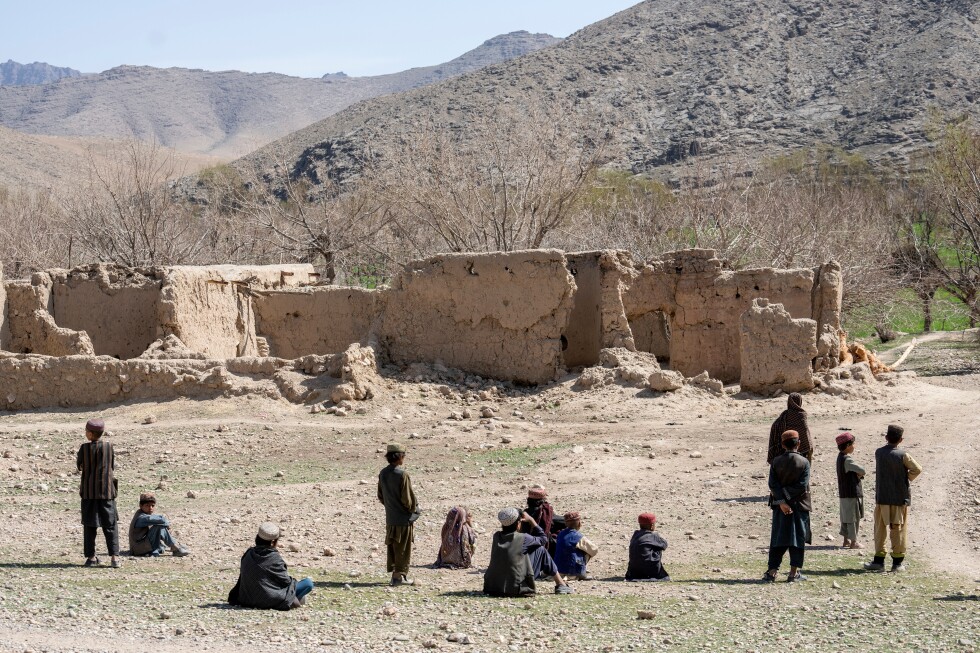
Children stand in front of a home destroyed during a Sept. 5, 2019, night raid by U.S. forces in a village in a remote region of Afghanistan, on Friday, Feb. 24, 2023. (AP Photo/Ebrahim Noroozi, File)
Advertisement
Children stand in front of a home destroyed during a Sept. 5, 2019, night raid by U.S. forces in a village in a remote region of Afghanistan, on Friday, Feb. 24, 2023. (AP Photo/Ebrahim Noroozi, File)
Advertisement
Advertisement
American servicemembers fell in love with her there, as she recovered. She was a symbol of hope in a long, grinding war.
The raid that killed the baby’s parents targeted transient terrorists who came into Afghanistan from a neighboring country, the records show. Some soldiers believed she might not be Afghan and tried to make a case for bringing her to the U.S.
Advertisement
The State Department attempted to make its position clear: The embassy convened a meeting that October with members of the military and the Afghan government to explain that under international law the U.S. was obligated to reunite her with her family, according to documents. State Department officials wrote that Mast, a military lawyer on a short assignment in Afghanistan, attended that meeting.
He’d met the baby for the first time days before and remained determined the child should go to the U.S., according to emails filed as exhibits.
Mast called home, where his wife was with their three sons.
“With us having children of our own, we see how vulnerable and precious children are,” Stephanie Mast testified. “And we wanted to help in whatever way we could.”
Advertisement
Marine Maj. Joshua Mast and his wife, Stephanie, arrive at Circuit Court, Thursday, March 30, 2023 in Charlottesville, Va. (AP Photo/Cliff Owen, File)
Advertisement
Marine Maj. Joshua Mast and his wife, Stephanie, arrive at Circuit Court, Thursday, March 30, 2023 in Charlottesville, Va. (AP Photo/Cliff Owen, File)
Advertisement
Advertisement
Advertisement
The Masts, Evangelical Christians, decided to try to bring her to their home in Palmyra, Virginia.
Advertisement
Mast’s brother, Richard Mast, a lawyer with the conservative Christian law firm Liberty Counsel, filed a petition for custody in early November, and a Fluvanna County Juvenile and Domestic Relations Court judge quickly approved it. The judge declared that the child was “stateless,” echoing Mast’s assertion that her parents were nomadic terrorists, and the Afghan government would issue a waiver of jurisdiction over her within days.
Afghanistan never waived jurisdiction.
Still the Masts decided custody wasn’t enough. Several days later, Moore, the Fluvanna County Circuit Court judge, got an unusual weekend call from his clerk’s office about a request for an emergency adoption, according to comments the judge made on the bench and records obtained from the Virginia Attorney General’s Office. Custody orders like the one the Masts were granted are temporary, but adoption grants a child an entirely new birth certificate, assigning them new legal parents. Moore said he was told that the girl desperately needed medical care and adoption would help get her on a plane to America.
Though the baby was being cared for by the Defense Department, the federal government insisted it received no notice of Mast’s bid for adoption, the recently released records show. Had it been notified, government lawyers said, they would have told the judge that the child was not stateless, the government was at that time searching for her family and would soon decide she was Afghan and not the child of foreigners. She was also not in a medical crisis: A month before, exhibits show, her doctor described her as “a healthy healing infant who needs normal infant care.”
Advertisement
The Masts have said in court records that they did not mislead the court; they believed that the girl was the stateless daughter of transient terrorists and Afghanistan was neither interested nor capable of caring for her.
Moore did not respond to requests for comment.
On Sunday, Nov. 10, 2019, Moore granted the Masts a temporary adoption. Moore ordered the Virginia Department of Vital Statistics to issue a new birth certificate, making her the Masts’ daughter.
Adoption cases usually creep through the court system. Moore granted the Masts the temporary adoption in a weekend.
Advertisement
“Attempting to interfere inappropriately”
Two days later, an email arrived overnight at the U.S. Embassy in Kabul from State Department headquarters. The office had heard that Mast had been granted custody of the orphan, and wanted to know if that was true, the documents show.
Officials who had been working on uniting the girl with her family seemed stunned by the email. An Army colonel later wrote in a declaration that he believed Mast was “attempting to interfere inappropriately.”
Army Col. Joseph Fairfield wrote in a legal declaration submitted in court by the federal government that by late 2019, some military officers were worried that Mast’s efforts “had diverged” from the official U.S. position about what should become of the baby, and he was “attempting to interfere inappropriately.”
Advertisement
Around that time, U.S. officials learned that a man came forward to claim the baby, records show. He told authorities he was the child’s uncle. He said the girl’s father was a local farmer, not a terrorist. His wife and five of their children were also killed. He said it was his family’s duty to take her in.
The Afghan government vetted his story. U.S. officials signed off.
Advertisement
Meanwhile, Mast’s tour ended. He returned home to Virginia, and set up a crib for the baby he was certain would soon be theirs, according to court testimony. The couple quickly found an ally in an aide for Republican Sen. Ted Cruz of Texas. The aide pressed Assistant Secretary of Defense Derek Maurer to ask immigration officials to rush documents the child needed to get to the U.S. An attached memo written by another military official pointed to proof of Mast’s claim to the baby: Mast had enrolled her in the military’s health care system as his dependent.
On the application for those benefits, Mast claimed the girl had lived with him in Virginia since Sept. 4, 2019, but she had never been on American soil, a government official wrote in a declaration. Mast also wrote that her injures were a result of child abuse.
The situation worked its way to Secretary of State Mike Pompeo. He signed a cable, dated Feb. 25, 2020, records show, dismissing the Fluvanna custody orders as “flawed.”
The cable said that any further delay in transferring the child could be perceived as the “U.S. government holding an Afghan child against the will of her extended family and the Afghan government.”
Advertisement
The next day, Mast filed a federal lawsuit to stop the reunification. The judge rejected his claims.
The U.S. put her on a plane to meet her relatives. They wept when they saw her, bundled in pink. The child’s uncle decided his son should raise the baby with his new wife and they quickly came to love this girl like their own daughter, they testified.
The Masts have insisted that this family is not biologically related to the baby and have questioned the process through which the Afghan government vetted them. The Afghan couple had celebrated the first step in a traditional Afghan marriage, a religious bond, but had not yet had a wedding reception, and the Masts argue they were unmarried at the time the child was given to them.
The AP agreed not to name the Afghan couple because they fear their families in Afghanistan might face retaliation from the Taliban. The court issued a protective order shielding their identities.
Advertisement
The Taliban, which now controls Afghanistan, was not in power when that country was making decisions about the child. Since taking over, the Taliban has been critical of what happened to the girl, calling it “worrying, far from human dignity and an inhumane act,” and urged the U.S. to return her to her relatives.
The Afghan couple testified they had no idea that on the other side of the globe an American judge still believed the girl was available for adoption.
Mast told Moore the child was given to an unmarried girl whose relationship to her was unclear. He testified that he maintained the child was the daughter of foreign fighters and suspected the family had ties to terrorism.
Moore said he did not learn that a federal judge had already rejected Mast’s claims to the baby. He would later say he vaguely remembered hearing that something happened in federal court but it didn’t register as important.
Advertisement
“I guess I assumed it was an administrative thing,” Moore said.
Mast continued to ask Moore to grant a final, permanent adoption.
Lawyers representing the government, the Afghan family and the child would note many defects in these proceedings; the attorney representing the child described the flaws as “glaring.” There is no Virginia law that allows a judge to adopt out a foreign child without her home country’s consent. A child must be put up for adoption by a parent or agency, and this child had never been. The court waived the requirement that the child be present when social services visited the adoptive parents’ home, that someone investigate her history, that whoever had custody be told this was happening.
In December of 2020, Moore granted a final adoption, deeming the Masts the baby’s permanent parents.
Advertisement
“She is an undocumented, orphan, stateless minor,” he wrote, “subject to this court’s jurisdiction.”
‘Is it even lawful for us to take her?’
In Afghanistan, the couple raising the girl received calls from strangers. Mast was working with Kimberley Motley, an American lawyer based in Afghanistan. Motley told the couple that a family wanted to help the girl get medical care in the U.S. But the couple refused to send the girl alone. Motley kept in touch with them for months, according to messages entered as court exhibits. Motley, through her attorney, declined to comment.
In the summer of 2021, the American military withdrew from Afghanistan and the Taliban took over. Mast contacted the couple directly, enlisting the help of a translator named Ahmad Osmani, an Afghan Christian who’d moved to the U.S. Osmani considered it his Christian duty to help the Masts, testifying that he believed it would be “a great picture to see a terrorist’s daughter become a believer and glorify God’s name.”
Mast and Osmani told the couple that they could get all three out of Afghanistan.
Advertisement
At the time, servicemembers were frantically evacuating Afghans, mostly those who helped the U.S. and would likely be targeted by the Taliban.
Amid the confusion, Mast asked colleagues in the Marines to add a baby and her caretakers to an evacuation list, the records show, claiming the State Department had sent her to an orphanage. She was living with the Afghan couple, and had never been to an orphanage.
A lieutenant colonel emailed other military officials to start the process of getting the family on a flight out. He didn’t learn that the military had worked to keep Mast away from this baby.
“Is it even lawful for us to take her?” asked a major in the Marines, according to a copy of the email.
Advertisement
Mast, who was copied on the chain, replied: “To clarify, she is completely clear on the Afghan side,” he wrote. “I am very familiar with the requirements after the last 18 months working the legal issues.”
Marine Joshua Mast emailed military colleagues requesting the girl and her caregivers be added to the list of evacuees from Afghanistan during the chaotic U.S. withdrawal in summer 2021. One questioned whether it was legal to take the girl out of the country, and Mast assured them it was.
Advertisement
Military officials asked no further questions, and soon the family was on a plane to Germany, where the Masts met them for the first time. The Afghans testified they had no idea the Masts planned to take her. The Masts have said they had tried to explain that they would.
Stephanie Mast testified that when she and her husband arrived in Germany, they “knew we had to speak to them and just tell them the truth.” She tried to explain “sacrificial love.” If the baby came with them, she told the Afghan woman, “she can have the best life possible.”
The Afghan man ripped off the wristband refugees wore and threatened to return to Afghanistan if the Americans tried to take the child.
Advertisement
The Afghan woman later said they convinced her that she’d misunderstood and persuaded them to continue to the U.S., and keep the baby with them.
The Afghans boarded a plane bound for Dulles International Airport, then a bus to Fort Pickett, a military base in Virginia turned makeshift refugee center. Meanwhile, the records show, Mast asked a State Department official he’d met in Germany to help connect him with other government contacts so he could track the family’s arrival.
Emails show employees with multiple government agencies sprung into action, including the State Department. The federal government would later say that these employees, like the military officials who evacuated the family, didn’t know that the very agency they worked for had tried to prevent Mast from taking the girl.
‘It’s like you are kidnapping her’
Rhonda Slusher, a State Department official, answered the phone at Fort Pickett. On the line was Joshua Mast.
Advertisement
He said he was going to come pick up his adoptive daughter, according to a declaration Slusher submitted in court. Slusher said she was told “there was no U.S. jurisdiction to hold the child,” and she should be given to Mast “at the earliest point possible.” Her supervisor instructed her to assist with “the transfer of the child,” she wrote in the declaration.
Mast told Slusher he was concerned the family she was being taken from “were going to be sad,” she wrote.
On Sept. 3, 2021, uniformed officers drove the Afghan family to a nondescript building near the camp’s front gate.
Slusher picked the baby up out of the car seat and insisted she hold her as the family went inside.
Advertisement
There, the Afghan woman later testified, another official, this one from the Department of Health and Human Services, told them: “you are not the parents of this child.”
“It’s like you are kidnapping her,” the Afghan man said.
The Afghan woman came toward Slusher.
“Please give me my daughter,” she said “She is my daughter.”
Advertisement
The Afghan woman testified at a hearing on May 24, 2022, describing how she begged government officials not to take the child away from her. The officials handed the girl to the Mast family, and the Afghans have not seen her since.
Advertisement
The baby cried and squirmed to get back to her, but Slusher wouldn’t let her go. The woman tried to grab the child, but Slusher pulled her hands away. The woman “crumpled to the floor crying.” She lay there for at least five minutes.
Slusher wrote in a declaration that she carried the baby outside, where Stephanie Mast was waiting in the car. Stephanie Mast fed the girl Goldfish crackers before they drove away with her husband.
“It is worth reiterating that this prolonged tragedy was entirely avoidable. The Trump administration blocked an attempt to unlawfully seize the child from her Afghan family in early 2020,” the Afghan couple’s attorneys wrote in a statement, adding that the Masts were able to take the child only because of America’s messy exit from Afghanistan. “The child and her relatives are victims of a crime and a tragedy no family should ever endure — a stark reminder that this withdrawal continues to have far-reaching and devastating consequences.”
‘A possibly errant adoption’
More than a year after the Masts took the baby home, her fate was before Judge Richard Moore again.
Advertisement
The Afghan couple found a team of lawyers willing to represent them for free, and filed a petition in Moore’s court to challenge the adoption he’d granted. Moore could undo the adoption and give the child back to the Afghan family, or uphold it, and leave her with the Masts.
“I’ve never had a case where I was so uncomfortable with either decision,” he said at the November 2022 hearing, which would be his last hearing in the case before retiring.
The judge listened for five hours as the lawyers for the Afghan couple and the government said that the adoption he’d granted was so riddled with errors it shouldn’t be called an adoption at all.
Moore blamed the federal government — it had known as early as 2020 that the Masts were trying to get the girl and a court in Fluvanna County was involved, and they did not try to stop him from issuing a “possibly errant adoption,” he said.
Advertisement
“Clearly, there were procedural irregularities and deficiencies in this case. There’s no question about that,” the judge said from the bench.
Yet for a year, in hearing after hearing, the primary question became whether the Afghan couple had a right to challenge that adoption at all; whether they were truly her family and if the Afghan government’s decision to give her to them was valid once they arrived in the U.S.
The judge and the Masts’ attorneys questioned them about their origin and upbringing, their relationship to each other and to the child.
Moore repeatedly said he did not believe they were related to the girl, nor was he inclined to consider them parents. He said no court in Afghanistan was involved in determining who should get custody of the child there. The Afghan couple’s lawyers had resisted DNA testing, saying it couldn’t conclusively find a relationship between opposite-gender half-cousins. It was also irrelevant, they argued: After the Afghan government gave the child to them, an American court should not relitigate that choice.
Advertisement
At the last hearing he held in November 2022, Moore said there were many things he wished Mast had told him before he signed the adoption. But he still trusted the Marine.
“There’s no question in my mind. Their total involvement was to save this child,” Moore said.
A week later, Moore published his thoughts on the case in a written document, and reiterated his opinion that “anything they did improper grew” out of the Masts’ desire to help the child.
He was less sympathetic to the Afghans. The Afghan woman testified that she had two Afghan government identifications, one that included her real age and a second she obtained intentionally making herself younger to enable her to enroll in school. They “misrepresented certain facts and lied … for their own purposes,” Moore wrote.
Advertisement
The Masts, too, have described the Afghans as untrustworthy, even threatening. They submitted court records alleging the Afghan man was flagged in a database of suspected terrorists upon entry to the U.S., which they reported to law enforcement. Attorneys for the Afghans responded that the government said in a sealed letter to the court that the man was not the subject of the database entry. The man remains in the U.S. and frequently flies from Texas to Virginia for court hearings.
With Moore’s retirement, the Masts and the Afghans found themselves before a new judge, Claude Worrell.
Advertisement
This courtroom sketch depicts Marine Maj. Joshua Mast and his wife, Stephanie, during a Circuit Court hearing before Judge Claude V. Worrell Jr., Thursday, March 30, 2023, in Charlottesville, Va. (Dana Verkouteren via AP)
This courtroom sketch depicts Marine Maj. Joshua Mast and his wife, Stephanie, during a Circuit Court hearing before Judge Claude V. Worrell Jr., Thursday, March 30, 2023, in Charlottesville, Va. (Dana Verkouteren via AP)
Advertisement
Advertisement
Advertisement
Worrell rebuked the federal government for its “inconsistent” approach, noting it was arguing the baby should be immediately returned to the Afghans, while its own employees had repeatedly assisted the Masts along the way.
It did not take Worrell long to come to a wholly different conclusion than Moore. Worrell wasn’t concerned about biological relationships. What mattered, he said, was Afghanistan claimed her as its citizen, so got to decide her fate.
The Afghan couple went outside to a patch of grass in the parking lot and prayed. They thought they would soon bring the baby to their home in Texas, where they’ve kept a bedroom ready for her, decorated with butterfly decals.
The Virginia Court of Appeals has since upheld Worrell’s decision voiding the adoption, and the case went before the Virginia Supreme Court in February 2025. It has yet to issue a ruling. As the years dragged on, the child remained with the Marine and his family.
The Marine Corps held an administrative hearing in October 2024 to determine whether Mast violated military rules. A three-member panel found that he acted in a way that was “unbecoming” of an officer, but that didn’t warrant suspension or other formal punishment.
The federal government has indicated in court in recent months that it is reconsidering its role in the case, and Trump’s second administration could reverse his first administration’s opinion that Mast had no right to the child. The Justice Department did not respond to repeated requests to clarify its current position on the child’s fate.
Advertisement
It has been four years since the Afghan couple has seen her.
In July, she turned 6.
___
AP data journalist Angeliki Kastanis contributed to this report
The United Nations’ Security Council will hold a closed-door meeting Friday to discuss US-Israeli attacks on civilian infrastructure in Iran, two UN diplomats told the Associated Press.
Rachel Dobkin27 March 2026 02:17
Advertisement
Trump claimed Biden’s secretary of state supported his attacks on Iran. Antony Blinken says that didn’t happen
“I’ve heard that today Blinken made a statement that he should have done it. Thanks a lot Blinken, I appreciate it”, Trump said. “But he came out with the statement that they should have done it, they made a mistake”.
Blinken took to X Thursday, writing that Trump “cited me as supporting his attack on Iran and expressing regret we didn’t do it during the Biden Administration. Except I didn’t”.
Rachel Dobkin27 March 2026 02:00
Advertisement
No press conference with Pete Hegseth scheduled this week
There will be no press conference with US Defense Secretary Pete Hegseth and General Dan Caine, the chairman of the Joint Chiefs of Staff, this week, the Pentagon said, per The New York Times.
Admiral Brad Cooper, the leader of U.S. Central Command, did give a video update Wednesday, in which he said American forces have hit more than 10,000 military targets since the Iran war began more than three weeks ago.
Rachel Dobkin27 March 2026 01:45
Advertisement
In pictures: A woman holds a portrait of Iran’s late Supreme Leader during a protest outside Iran’s embassy in Beirut, Lebanon
In pictures: A woman holds a portrait of Iran’s late Supreme Leader during a protest outside Iran’s embassy in Beirut, Lebanon
Protesters outside Iran’s embassy in Beirut, Lebanon (AP)
Bryony Gooch27 March 2026 01:30
‘It’s Orwellian’: The information war being waged to keep the ‘Dubai dream’ alive
It was the influencer capital of the world, a photogenic playground for the young, glamorous and wealthy. But as Iranian missiles fall on Dubai, the largest and most ostentatiously luxe city in the United Arab Emirates, the facade seems about to crack.
Advertisement
The city once touted as one of the safest places in the world is no longer a peaceful haven. And the UAE government has rushed to try and control the narrative, prompting a huge crackdown on anyone sharing photos of missile attacks and their aftermath. Instead, content creators have been posting uncannily similar photos and videos full of praise, parroting buzzwords about the city’s strong, stable leaders.
How can influencers continue to portray the “Dubai dream” online, when the whole world knows that the city has been mired in conflict? And what about the ordinary people who are being detained for sharing photos and videos that go against the official line?
Katie Rosseinsky has the story…
Bryony Gooch27 March 2026 01:00
Advertisement
Trump considers sending another 10,000 troops to Middle East: report
US President Donald Trump is considering sending another 10,000 troops to the Middle East amid the Iran war, The Wall Street Journal reported Thursday night local time, citing US defense officials.
The potential deployment would probably include infantry and armored vehicles, according to the publication.
The Independent has reached out to the Pentagon for comment.
Advertisement
The US has already sent thousands of Marines and paratroopers to the region to help with the war effort.
Rachel Dobkin27 March 2026 00:45
JD Vance meeting with Qatar’s prime minister: report
US Vice President JD Vance is currently meeting with Qatar’s Prime Minister Sheikh Mohammed bin Abdulrahman Al Thani, NewsNation White House Correspondent Libbey Dean has reported, citing an unnamed source.
Advertisement
“A range of foreign policy issues are expected to come up, including Iran and Gaza — with talks focused on defense cooperation, protecting energy infrastructure, and collaborating on freedom of navigation, per source”, Dean wrote on X Thursday night.
Rachel Dobkin27 March 2026 00:30
UK faces biggest hit to growth from Iran war of all major economies, OECD warns as inflation set to surge
Bryony Gooch27 March 2026 00:00
Advertisement
Pentagon prepares for massive ‘final blow’ of Iran war
The Pentagon is developing military options for a “final blow” in Iran that could include the use of ground forces and a massive bombing campaign, two US officials and two sources with knowledge told Axios.
The news outlet reported four potential “final blow” options Trump could choose from:
Invading or blockading Kharg Island, Iran’s main oil export hub.
Invading Larak, an island that helps Iran solidify its control of the Strait of Hormuz. The strategic outpost hosts Iranian bunkers, attack craft that can blow up cargo ships and radars that monitor movements in the strait.
Seizing the strategic island of Abu Musa and two smaller islands, which lie near the western entrance to the strait and are controlled by Iran but also claimed by the UAE.
Blocking or seizing ships that are exporting Iranian oil on the eastern side of the Hormuz Strait.
Bryony Gooch26 March 2026 23:01
Advertisement
Trump lashes out at Nato again and claims alliance has done ‘absolutely nothing’ to help in Iran
Despite reports of negotiations between the US and the Iranian regime, the Strait of Hormuz remains effectively closed to most oil tankers, with only a small number of vessels being allowed to pass. The result is a loss of roughly 11 million barrels per day (mbd) of oil and petroleum liquids to the global market. This represents just over 10% of global supply.
At first glance, a 10% disruption may not sound catastrophic. But in oil markets, even a 10% imbalance between supply and demand can have very large economic effects.
To understand the scale of the disruption, it is useful to compare it with the height of the COVID pandemic in 2020. During global lockdowns, empty roads, grounded aircraft and deserted bus and railway stations became normal as travel and economic activity collapsed. At that time, global oil demand fell by about 8mbd, the largest demand shock in history.
Today’s situation is the opposite. Instead of a collapse in demand, the world is experiencing a large supply shock. But the impact on everyday life could end up looking similar: reduced travel, higher transport costs, slower economic activity and pressure on household budgets.
Advertisement
The reason is that both oil supply and oil demand are very inflexible in the short term. People still need to drive to work, goods still need to be transported and aircraft still need fuel. When supply falls suddenly, prices must rise significantly to force demand down.
For now, the release of emergency oil stocks is helping to cushion the initial impact, particularly in developed economies. Members of the International Energy Agency (IEA) are required to hold emergency stocks equivalent to at least 90 days of oil consumption, and several countries also maintain strategic petroleum reserves.
Countries such as the US, China and Japan can therefore offset supply disruptions for a limited period. However, these reserves are not a long-term solution. If the conflict continues for months rather than weeks, stockpiles will be depleted.
Advertisement
The situation is much more serious for developing countries. Many countries in Asia, Africa and South America hold very limited commercial reserves and are much more vulnerable to supply disruptions and price spikes. For these economies, elevated oil prices quickly translate into higher food prices, inflation and economic instability.
The first shortages would probably appear not in petrol, but in diesel and jet fuel. Gulf oil producers are major exporters of middle distillates, and their crude oil grades produce large quantities of diesel and jet fuel when refined.
Jet fuel could be one of the first commodities to be hit. Benjamin_Barbe/Shutterstock
Diesel is particularly important because it fuels trucks, ships, construction equipment and agricultural machinery. So a diesel shortage affects food supply, construction, mining and global trade – not just transport. Petrol shortages would follow as crude oil supply tightens further, and eventually shortages would spread across all petroleum products.
Advertisement
Oil is not just used for transport fuel. It is also a key input into petrochemicals for the production of plastics, fertilisers, chemicals, synthetic materials and many industrial processes. This means the effects of a major oil supply disruption spread across the entire economy.
Shortages or price increases could affect everything from food production and packaging to electronics, construction materials and clothing. The economic effects of an oil shock are therefore much broader than simply higher petrol prices.
Protectionism could make everything worse
One of the biggest risks during a supply crisis is export restrictions and protectionism. Governments often try to protect domestic consumers by freezing prices and banning exports of fuel or crude oil, but this usually makes the global shortage worse.
Government price freezes only discourage production and supply, and encourage consumers to keep burning fuel. Protectionism is even worse. There are already signs of this happening – some countries (China, for example) are restricting exports of petroleum products such as diesel and jet fuel. When countries hoard fuel, global markets become tighter and prices rise even further.
Advertisement
The biggest risk would be if the US restricted oil exports in order to protect domestic consumers. The US is now the world’s largest oil producer, producing more than 20mbd of oil and petroleum liquids. But it is also one of the world’s largest consumers. However, it still exports significant volumes, particularly to Europe.
The US has banned oil exports before. In 1975, following the Arab oil embargo (when in 1973 Arab states refused to supply oil to countries, including the US, that had supported Israel in the Yom Kippur war), the US banned exports of crude oil. The ban was lifted only in 2015. If such a ban were introduced today, it would be likely to cause major supply shortages and price increases, especially in Europe.
If the Strait of Hormuz remains closed for a prolonged period, or if the conflict escalates further, global losses of exports from the Persian Gulf could approach the 20mbd of oil and petroleum products.
Under these circumstances, the economic and social effects could be severe. Transport could become more expensive and less frequent, air travel would be severely curtailed, inflation would rise and economic growth would slow significantly. In extreme scenarios, the disruption to daily economic life could resemble the COVID period (and probably worse). But this time it would be caused by a shortage of energy.
Advertisement
For now, markets are relying on emergency stock releases and hopes of a geopolitical de-escalation. But if not, the world economy could face an unprecedented energy shock, with far-reaching and unpredictable consequences.
The British heavyweight phenom steps up for what should be the toughest test of his professional career to date as he continues on his rapid ascent to boxing superstardom.
Now fully recovered from a bicep tear suffered while sparring, the big-hitting southpaw, 21, is ready to deliver another emphatic statement in what he has called the “final piece of the puzzle” before eyeing huge fights and world title opportunities.
He ruthlessly dispatched of Mike Balogun in two rounds in Glasgow before that as part of a nine-fight streak of early stoppages that also included vanquishing the likes of Demsey McKean and Mariusz Wach.
Itauma is expected to face a trickier challenge against Franklin, the tough and durable American heavyweight who has never previously been stopped in his 26-fight career.
Advertisement
The 32-year-old is 24-2 overall, with his only losses to date coming in consecutive outings in London in 2023.
Moses Itauma stopped Dillian Whyte inside the first round in his last fight
Getty Images
He has only fought three times since then, outpointing Isaac Munoz Gutierrez and two-time Olympic bronze medalist Ivan Dychko, either side of stopping Devin Vargas.
Advertisement
Itauma vs Franklin fight date and venue
Moses Itauma vs Jermaine Franklin takes place on Saturday March 28, 2026 at the Co-op Live arena in Manchester, England.
Itauma vs Franklin fight time and ring walks
Saturday’s undercard begins at 5pm GMT (1pm ET and 10am PT), with the main event expected to get underway around 11pm (7pm ET and 4pm PT).
Advertisement
How to watch Itauma vs Franklin
TV channel and live stream: The Magnificent 7 show is being broadcast live and exclusive in the UK via DAZN.
It is part of the regular DAZN subscription and not through their pay-per-view service.
Live blog: Follow the action as it happens with Standard Sport’s live blog on fight night.
Advertisement
Itauma vs Franklin undercard
Moses Itauma vs Jermaine Franklin
Nathan Heaney vs Gerome Warburton
Ezra Taylor vs Willy Hutchinson
Advertisement
Shakiel Thompson vs Brad Pauls
Liam Davies vs Francesco Grandelli
Alex Murphy vs Josh Holmes
Michael Gomez Jr vs Jordan Flynn
Advertisement
Nelson Birchall vs Ryan Griffiths
John Joe Carrigan vs Danny Costello
Billy Deniz vs Grant Dennis
Aadam Hamed vs Michael Mooney
Advertisement
Itauma vs Franklin prediction
On paper at least, this should be the most difficult night of Itauma’s explosive career so far.
However, that is certainly not saying much. Aside from early dominant six-round points wins over Kostiantyn Dovbyshchenko and Kevin Nicolas Espindola, he has delivered devastatingly swift knockouts of every opponent he has faced to date.
There is a reason why the likes of the returning Fury want nothing whatsoever to do with fighting Itauma, who has racked up only 26 rounds in 13 pro bouts.
Advertisement
Anthony Joshua was made to work hard by Jermaine Franklin back in 2023
Getty Images
He has only gone past the second round twice, the last of those was nine fights ago in 2023.
Franklin is a tough and durable customer who has never been stopped and acquitted himself well against both Whyte and Joshua, but is about to face a very different prospect altogether.
He might be make to work slightly harder for it, but we’re still anticipating another formidable stoppage from Itauma comfortably in the first half of the fight.
Advertisement
Having said that, some crucial rounds under the belt would be no bad thing if it was to go on longer.
Itauma to win by knockout.
Itauma vs Franklin latest odds
Itauma to win on points or by decision: 10/3
Advertisement
Itauma to win by knockout, technical knockout or disqualification: 3/10
Franklin to win on points or by decision: 25/1
Franklin to win by knockout, technical knockout or disqualification: 14/1
The rider of the e-bike, a 31-year-old man from Cambridge, suffered life-threatening injuries and was taken to Addenbrooke’s Hospital. He remains there in a critical condition.
The man’s passenger, a 34-year-old woman from Cambridge, suffered serious injuries and was taken to the same hospital. She is in a serious, but stable condition.
The driver of the Seat Leon failed to stop at the scene. A police spokesperson said: “However, at just before 2am, three people were arrested on suspicion of perverting the course of justice – a 19-year-old man from Luton and two 21-year-old men from High Wycombe, Buckinghamshire – and are in custody at Parkside Police Station in Cambridge.
“An investigation has been launched and officers are keen to hear from anyone who may have witnessed either vehicle before the collision, anyone with relevant dash cam footage, or anyone with any information.”
Advertisement
Anyone with information should call police on 101 and quote Operation Azazel or incident 7 of March 26.
The conflict in Iran and the disruption to the strait of Hormuz are already starting to affect UK farmers. The closure of this vital shipping route threatens supplies of two essential agricultural necessities: fuel and fertiliser.
The immediate impact on farmers has been a sharp increase in the cost of red diesel – the rebated fuel widely used in agriculture – which has already risen by approximately 60%, far outpacing increases seen at retail fuel pumps for car owners.
Concerns for farmers include the cost of fertiliser, particularly nitrogen. As the key nutrient driving growth in two key crop groups grown extensively in the UK, cereals and oilseeds, nitrogen is essential for achieving high yields. A wheat crop may require over 200kg per hectare during the growing season, depending on soil conditions, weather, and yield expectations.
The UK imports around 60% of its nitrogen fertiliser. Although much of this supply does not originate directly from the Middle East, global market dynamics mean prices are highly sensitive to disruptions. Around one-third of the global fertiliser trade passes through the strait of Hormuz, contributing to price increases of approximately £50 per tonne, compared to early 2025, and is expected to rise more if the conflict continues.
Advertisement
UK fertiliser traders are finding prices are changing so fast that they can’t update their daily lists. The NFU president Tom Bradshaw has raised concerns about farmers not being given a confirmed price until stocks are delivered.
While most farmers buy fertiliser in bulk ahead of the growing season, the longer-term outlook is already a concern.
Much will depend on the duration of Middle Eastern tensions and whether the strait reopens in time for fertiliser purchasing decisions this autumn, ready for next year’s crops.
Unlike the 2022 fuel price shock following the invasion of Ukraine – which was partially offset by higher commodity prices – current market conditions offer little expectation of improved crop prices.
Advertisement
Difficult calculations
Farmers are, therefore, being forced into difficult calculations: weighing the cost of nitrogen against likely crop prices, reassessing how to balance the crop’s agrochemical inputs, including fertiliser, and awaiting clarity on the future of Environmental Land Management Schemes (Elms). Elms are government schemes in England aimed at supporting farmers to make environmentally beneficial changes to their land.
Even before the current conflict started, industry bodies such as the National Farmers’ Union had raised concerns about the viability of arable farming under sustained cost pressures.
The government has also acknowledged these challenges, commissioning the Competition and Markets Authority (CMA) to investigate supply issues affecting fertiliser and agricultural fuel. The CMA has said it will monitor price rises caused by the current international conditions. In response to the crisis, the UK government has just announced proposals to support more varied types of fertiliser.
Advertisement
All these factors raise broader concerns for the UK, where food self-sufficiency stands at around 62% – a potentially precarious position in an increasingly uncertain global landscape.
Farming landscape
UK crops are currently looking generally robust, after a strong autumn with ideal conditions for sowing winter crops and a favourable start to spring. Early signs point to a promising 2026 harvest.
But optimism is tempered by ongoing economic pressure. Farm gate prices (the price if a customer bought direct from a farmer) remain stubbornly low, as UK farmers compete with imports produced under lower environmental and regulatory standards
Simultaneously, the transition away from legacy EU support payments has left a significant income gap. Replacement schemes under the Environmental Land Management Schemes were paused in 2025 and are only expected to resume later this year, creating further uncertainty.
Advertisement
The Department for Environment, Food and Rural Affairs (Defra) latest figures forecast average arable farm income fell to £17,000 in the year to February 2026 – the lowest level since 2004–05. The drop reflects a mix of difficult seasonal conditions and global oversupply in key crops such as cereals and oilseeds. Dairy farm income was much higher at £224,000 for the same period.
Fertiliser shortages are set to hit farmers around the world.
The industry is rapidly embracing innovation and the government is backing farmers with measures to strengthen fertiliser supply resilience. Together with rising costs, these shifts have helped drive a 50% reduction in nitrogen use over the past four decades.
Precision agriculture (which uses technology to refine decisions) has boosted efficiency further, enabling farmers to tailor fertiliser use to the needs of specific fields.
Advertisement
There are other potential innovations that could help. Tesco for example, is working with farmers and manufacturers to develop lower-carbon fertilisers made from food waste, algae, poultry manure, and industrial by-products.
Global fertiliser markets may be volatile, but in the short term shoppers are unlikely to see that uncertainty reflected in everyday food prices. A 2022 Sustain report, found that farmers often receive less than 1% of the profit from supermarket sales, meaning their tiny share leaves little room for fertiliser costs to influence the final price on the shelf. For now, any rise or fall in the price of bread, flour, cakes or biscuits is far more likely to come from supermarket pricing tactics or broader supply‑chain pressures than from shifts in global fertiliser markets.
That’s not to say fertiliser costs never filter through – a prolonged conflict could still nudge prices up for shoppers. Crops respond dramatically to fertiliser levels, so even modest reductions in nitrogen use can produce disproportionately large declines in yield. All that could translate into thousands of tonnes of lost crops, which would make food more expensive in the future.
A man was arrested after assaulting a woman during a concert (Picture: Getty Images/iStockphoto)
A 26-year-old man has been arrested after allegedly sexually assaulting a woman in the middle of the crowd during a show at London’s O2 Arena.
The woman, whose identity is being protected, was with friends in the standing area of rapper Gunna’s concert on Wednesday, March 25.
In a video posted on social media, a man can be seen approaching her from behind as she sang along, seemingly unaware of him.
She said her ‘whole experience’ at the show had been ‘ruined’, sharing she spent the whole day crying because she keeps ‘reliving’ the incident.
Advertisement
Security and officers at the major music venue were alerted to the assault and took a man into custody at the scene.
A spokesperson for the Metropolitan Police told Metro: ‘A man has been arrested following a sexual assault in south London.
The incident was reported during Gunna’s O2 Arena gig on Wednesday (Picture: Simone Joyner/Getty Images for ABA)
‘At around 20:20hrs Wednesday, 25 March, police were called to the O2 Arena in Greenwich by venue management. A woman, aged in her 20s, was approached from behind by a man, who sexually assaulted her.
‘Officers were already at the venue, and swiftly arrested a 26-year-old man who had been apprehended by venue staff. He was taken into custody, suspect has not yet been bailed.’
The spokesperson added that the woman was ‘receiving support from specially-trained officers’.
Advertisement
‘The Met is prioritising the safety of women and girls across London,’ they said. ‘Officers continue to work closely with venues to provide awareness training for staff, and we have expanded specialist teams across domestic abuse, stalking and sexual violence to ensure a dedicated response.’
Meanwhile, the O2 Arena told us this was an ‘isolated incident’, which had been ‘promptly’ attended by the venue security and police.
Gunna will play one more show in London later this month (Picture: Simone Joyner/Getty Images for ABA)
In a statement, the venue added: ‘The matter is now being handled by the Metropolitan Police. Our priority is always the safety and wellbeing of our guests and we are assisting with their enquiries.’
Gunna has not addressed the incident publicly, with his tour continuing in Manchester tonight before heading to Amsterdam for two shows.
He’ll return to the O2 Arena for one final concert on March 31, marking the end of his Wun World Tour.
Advertisement
The rapper rose to fame in 2018 with his mixtape Drip Season 3, releasing his debut studio album the following year.
In 2020, Gunna was nominated for best rap or sung performance at the Grammys and released his latest album The Last Wun in August 2025.
Metro has reached out to Gunna’s team for comment.
Got a story?
Advertisement
If you’ve got a celebrity story, video or pictures get in touch with the Metro.co.uk entertainment team by emailing us celebtips@metro.co.uk, calling 020 3615 2145 or by visiting our Submit Stuff page – we’d love to hear from you.
It’s hoped public toilets would make the city centre more appealing and accessible for people
Public toilets are set to make a return to the city centre – but they may not be on Cathedral Square. The long-standing issue of access to public conveniences was raised at Peterborough City Council’s monthly Cabinet meeting on March 24 by Councillor Mohammed Jamil.
Advertisement
The Cabinet Member for Finance & Corporate Governance asked to seek reassurance around toilet provision following Cllr Mohammed Farooq’s presentation outlining plans to establish a Peterborough City Centre Growth Board.
Cllr Jamil said: “One of the things we’re often criticised for is that the previous administration took away all the public toilets [in the city centre]. Can you just reassure me that there are plans to bring those back because people need these facilities?”
Adrian Chapman, Executive Director for Place and Economy said: “Cllr Farooq mentioned the Pride of Place impact fund… and one of the biggest impacts we think needs to be made is in toilet provision.”
Mr Chapman suggested new public toilets would join enhancements to Cathedral Square and the Guildhall in helping to make the city centre a more appealing place for both residents and visitors to enjoy.
Advertisement
“I’m not suggesting toilets will sit on Cathedral Square,” he added, “but I think we can combine all of that into one single project.”
Cabinet Member for Housing and Regulatory Services, Cllr Christian Hogg said: “How long do you think it will be before we see something happening with… toilet facilities in our town centre?”
Adrian Davey, the council’s Interim Service Director of Regeneration & Growth said: “The Pride of Place [fund]… is a quick, immediate programme to make differences now.”
Cllr Hogg pressed Mr Davey on the actual length of time it will take to see new toilet provision made available, voicing concerns that some other local development projects are likely to take a decade or more to complete.
Advertisement
He asked: “Are we having to wait 15 years for a toilet? Do we have to keep our legs crossed for that long?”
Adrian Chapman reassured cabinet members that more detailed information about city centre regeneration will be made available in the coming days.
Ferryhill Town Council recruited the new councillors following a recent campaign and invited all three to a special council meeting on March 11.
At the meeting, they each gave a five-minute presentation about their background, experience and reasons for wanting to serve on the council.
Councillor Keith Lloyd (Image: Supplied)
Cllr Anthony Hewitt said: “I have met some really wonderful people since moving to Ferryhill.
“How welcoming and kind they have been and how many people work so hard to help the community.
Advertisement
“So I decided it was time that I stood up and did my part in trying to make Ferryhill a better place to live for all its residents.”
Cllr Keith Lloyd said: “I am very happy to join the Ferryhill Town Council as a Councillor for the Broom ward.
“I have lived in Ferryhill for 72 years, and think it is time to give something back to this community.”
The third new member, Cllr Liam Fellows, was not available to have his photograph taken; however, he shared his reasons for returning to the council.
Advertisement
Cllr Fellows said: “I was really sad to see so many vacancies on the Town Council following the local elections last May and that they hadn’t managed to be filled since.
“I really enjoyed my time on Ferryhill Town Council previously so thought I’d once again offer my service.”
He said he is committed to improving council facilities, services for residents and communication with the public.
Cllr Fellows said: “I’m passionate about improving the Councils facilities, what it provides for residents in the town and how the council communicates with the community.
Advertisement
“Hopefully working with the rest of the council and officers, we can strive to make these improvements.”
Anyone interested in learning more about becoming a town councillor can contact Leeanne Owens, the Town Clerk, for further information.
The ex-wife of Andrew Mountbatten-Windsor was stripped of the title during a City of York Council meeting on Thursday evening with members of the public telling councillors, ‘it is the absolute minimum you should be doing’.
The prestigious title was gifted to the then Duke and Duchess of York on their wedding day in 1987.
But councillors voted unanimously for the removal following fresh revelations about the former duchess’s shockingly personal emails to Epstein.
Advertisement
Speaking during the debate, Liberal Democrat councillor Darryl Smalley said: ‘We now know, following the release of thousands of documents, that Sarah Ferguson too had a close friendship with Epstein, which continued well beyond his conviction.
Sign up for all of the latest stories
Start your day informed with Metro’s News Updates newsletter or get Breaking Newsalerts the moment it happens.
Advertisement
‘We don’t expect recipients of York’s highest honour to be saints. We simply do not want them to be best friends of convicted paedophiles.
‘We stand with victims. We stand for the rule of the rule of law. We stand for decency.’
He added: ‘York will have hopefully have etched out our city’s connections to both Andrew and Sarah.
‘We must wipe the slate clean, draw a line. Remember our duty to victims of sexual abuse, and move forward with our highest honour reserved for those that truly deserve the privilege. I urge all councillors to vote for the motion.’
Advertisement
Andrew was arrested last week by Thames Valley Police (Picture: Reuters)
Labour councillor Anna Baxter said: ‘We are not living in 1987, and it is right that the honours associated with our city reflect the values of York today.
‘It is reserved for those considered to be people of distinction, but those who have rendered eminent service, and it reflects the values we wish our city to be associated with.’
Gwen Swinburn, a member of the public, addressed councillors during the debate. She said: ‘The decision before you tonight is whether to remove the freedom of the city from Ms Ferguson.
‘It should not be a difficult one. It is the absolute minimum you should be doing.’
Councillor Claire Douglas, leader of the Labour group on the local authority, added: ‘As the people of York would expect, holding this status requires upholding the values and behaviours consistent with such an honour.
Advertisement
‘Those who continued to associate with Jeffrey Epstein after his crimes became widely known fall well short of these expectations.
‘Sarah Ferguson falls into this category as the Epstein files have shown. I therefore call on council to support the motion as presented.’
The honorary freedom of the city is given to residents who demonstrate notable service, to distinguished people and to royalty, the council has said previously.
Emails disclosed as part of millions of published files showed that Ms Ferguson had asked Epstein for financial support while the paedophile remained under house arrest.
Advertisement
Sarah Ferguson reportedly spent several weeks at a £13,000 a day wellness clinic in Switzerland while details emerged about her close relationship with Epstein emerged.
She also wrote to the financier thanking him for being a ‘supreme friend’ and took her children, Princess Beatrice and Princess Eugenie for lunch with him less than a week after he walked free from jail.
In another embarrassing email, the former duchess appeared to ask Epstein to ‘just marry me’.
Many of her exchanges were conducted after Epstein was arrested for soliciting prostitution from a minor in 2008.
Advertisement
In another shocking email, she said the Royal family would discredit her ‘to obliteration’.
‘… No woman has ever left the Royal family with her head, and they cannot behead me, therefore they will discredit me,’ she wrote in July 2010.
‘I am totally on my own now. This is beyond scandalous, and nobody can do anything,’ she added.
‘I cannot believe what this is all coming to.’
Advertisement
Andrew Mountbatten Windsor and Sarah Ferguson adopted the late Queen’s corgis after her death (Picture: Instagram)
Six companies linked to the former duchess started winding down in the wake of the publication of the Epstein files, according to Companies House documents.
Sarah’s Trust, a charity she founded, also announced it would close ‘for the foreseeable future’.

























































You must be logged in to post a comment Login