
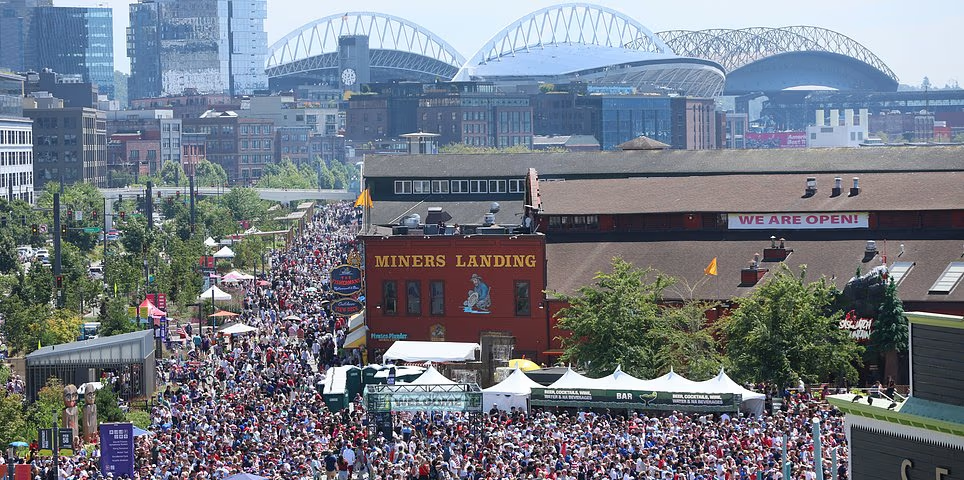
Follow Daily Mail Sport’s live coverage as the United States – including superstar Folarin Balogun – take on Belgium in the last 16 of the World Cup in Seattle.
NewsBeat
USA vs Belgium – World Cup last 16 LIVE: Folarin Balogun named in the starting XI after Trump’s intervention as Americans dare to dream in Seattle


Continue Reading
NewsBeat
Google pulls new Earth AI tool after researchers show it can be used to put fake nuclear power plants in Iran and refugees near the Mexican border
Google pulled its new AI tool that allowed people to edit satellite imagery within 24 hours of launch after some users demonstrated how the software could be misused.
The tech giant announced on Thursday it had integrated its Nano Banana 2 image-generation model into Google Earth, which allowed users to ‘type whatever you want to see’ and ‘virtually reimagine anywhere in the world’.
The AI tool allowed users to use text prompts to create downloadable false situations on top of a base layer of satellite imagery, aerial or 3D imagery.
However, users were able to quickly test the limits of the feature, described as allowing people to create ‘concepts grounded in the real world’ and let ‘imagination run wild’.
They shared images of fake nuclear plants in Iran, lines of refugees near the Mexican border, a fabricated bomb crater in Gaza and a car crash on a street in Amsterdam.
This prompted Google to quickly take the feature down on Friday, as it ‘worked on implementing stronger guardrails’.
In a statement on Friday, the company said it had seen ‘people sharing screenshots of generated imagery that appear to violate our policies’.
Google Street view holds more than 280 billion images across 110 countries, with Google Earth turning 21 this year.
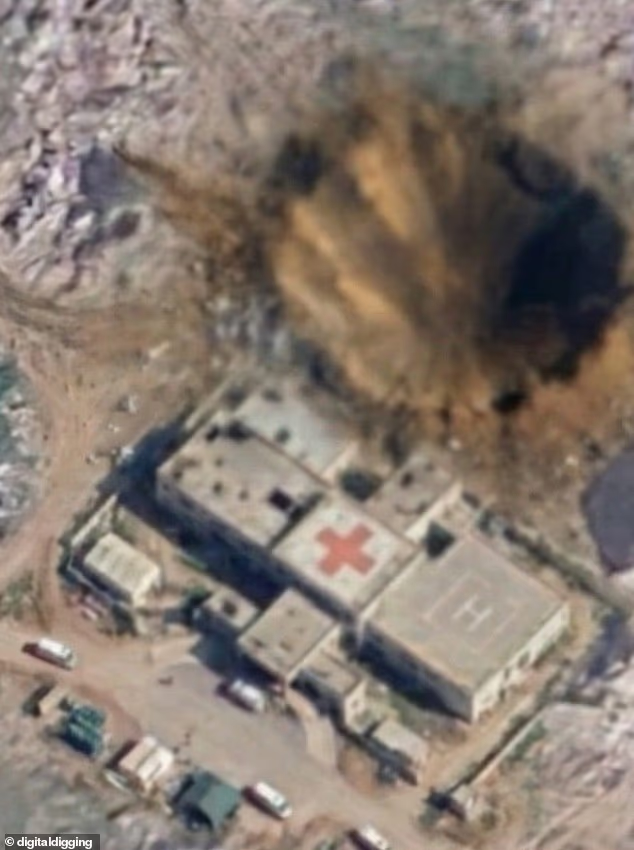
Google pulled its new AI tool that allowed people to edit satellite imagery, including a fabricated bomb crater in Gaza
Hank van Ess, an OSINT expert and author of the Digital Digging newsletter, said he ‘planted a nuclear plant in Iran’ and ‘put refugees near Mexico border’ on Google Earth.
The tech expert also demonstrated how he was able to generate images of a bomb crater at a hospital in Gaza.
‘One clause in there is checkable tonight, so I checked it. Google prevents image creation on harmful topics,’ he wrote.
‘Refugees at a border. A nuclear plant in Iran. A fatal crash on an Amsterdam street. A hospital with a bomb crater in Gaza. Nothing was refused. No warning, no softened output, no suggestion to try a different prompt’.
The company noted that every image created with the Nano Banana tool included a watermark that can be traced back to its Gemini AI model.
This comes as concerns grow over the spread of AI-generated images on social media, with a greater ease for users to spread false information across the internet – which can be near impossible to contain.
While wars proliferated in the Middle East in March, AI-generated satellite images were shared on the social media platform X seemingly showing a successful Iranian drone strike on a US radar system in Qatar.
Meanwhile, a fake video purporting to show Dubai’s Burj Khalifa up in flames, while crowds of people fled from the building. It was viewed tens of millions of times.

Users were able to use the Nano Banana 2 image-generation model into Google Earth to create images, including a car crash on a street in Amsterdam
The proliferation of fake content prompted X to warn creators of a temporary suspension from its monetisation scheme should they post AI-generated videos of armed conflict without a label.
The programme rewards eligible users whose posts collect large numbers of views, likes, shares and comments with money.
In a blog post, Google shared five ways the new software could be used: Helping students visualise history; learn relevant information about particular areas or landmarks; create professional real estate plans; visualise projects; and letting ‘imagination run wild’ on favourite places.
A spokesperson for Google said: ‘We know that people uniquely trust Google Earth for a reliable view of the world.
‘We’ve seen geospatial professionals using this feature for a range of useful purposes, however we’ve also seen people sharing screenshots of generated imagery that appear to violate our policies.
‘So we’re rolling back this feature in Google Earth while we work on implementing stronger guardrails.
‘It’s important to note that generated images didn’t appear in the main Google Earth experience for others to see and were watermarked as AI generated.’.
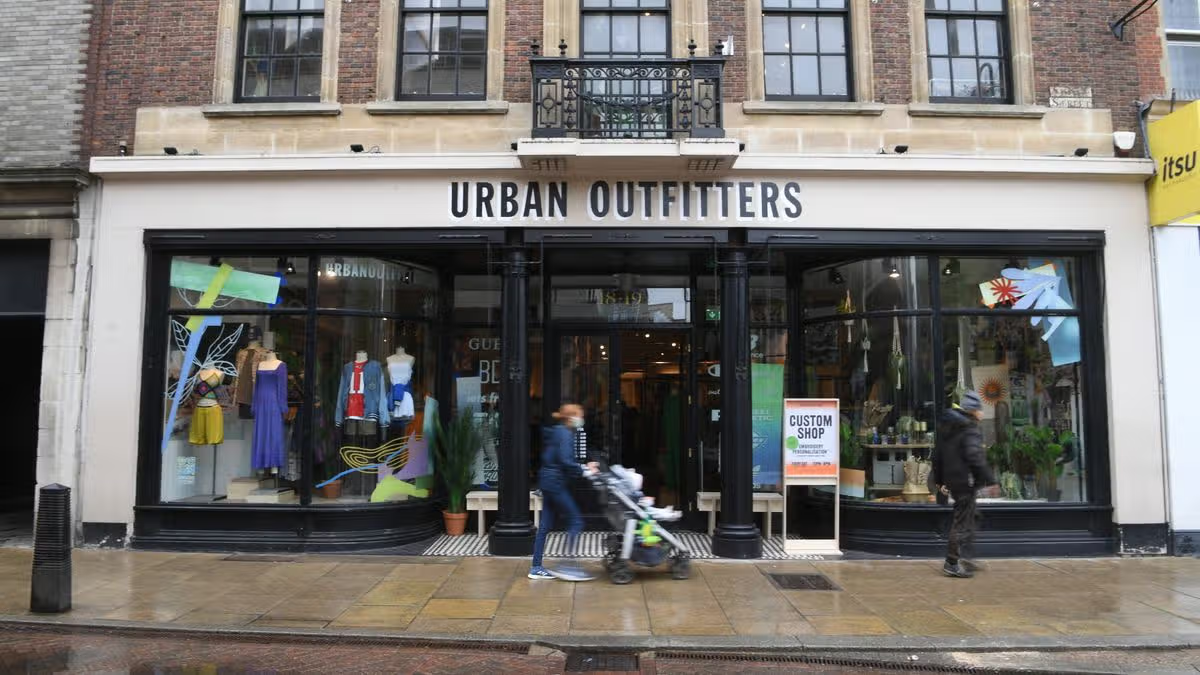
The shop opened its Cambridge branch in 2021
A popular clothing store has closed its Cambridge branch. Urban Outfitters opened in Sidney Street, Cambridge, in 2021.
The chain now appears to have closed its Cambridge premises. CambridgeshireLive has seen photos on social media that show ‘closing’ signs in the shop windows.
Videos circulating on social media also show that the Cambridge store has closed. Google says the branch is ‘temporarily closed’, while there are no opening hours on the brand’s website.
It is not yet known why the shop has closed. Urban Outfitters has been approached for more information.
Do you want more of the latest Cambridgeshire news as it comes in from across the county? Sign up to our dedicated newsletter to make sure you never miss a big story from Cambridge or anywhere else in the county. You can also sign up to our dedicated Traffic and Crime newsletters for the latest updates on the topics you are most interested in.
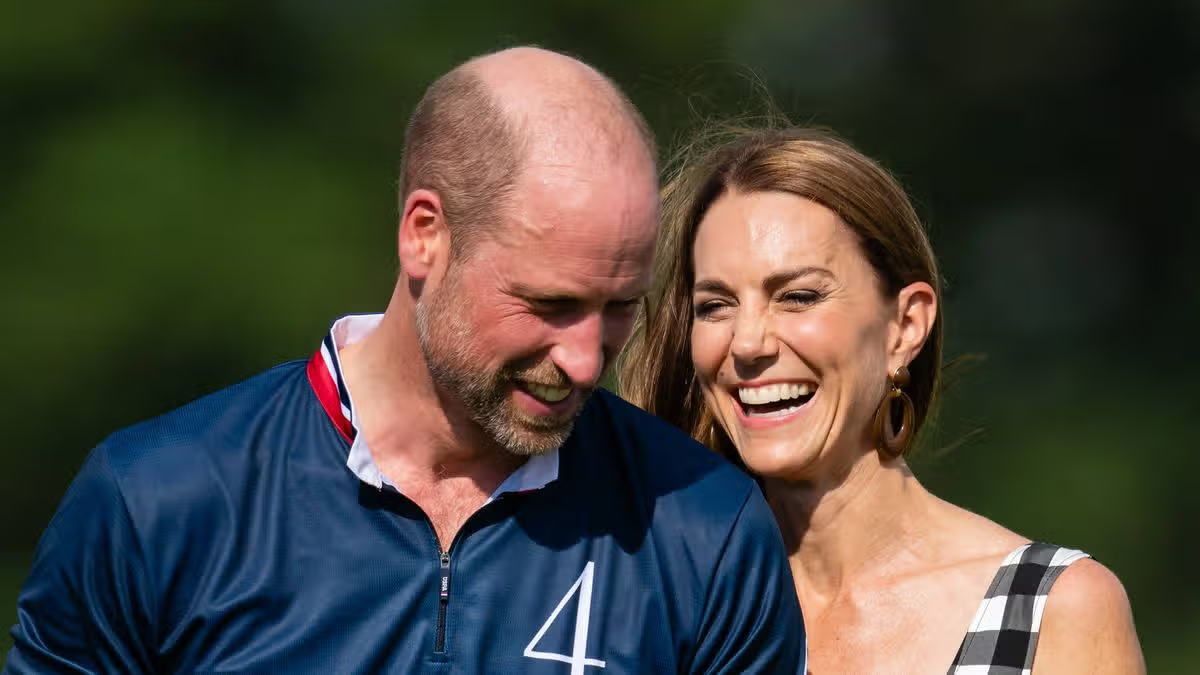
The royal couple will join spectators will join spectators on the penultimate day of the Glasgow games.
William and Kate will visit the Commonwealth Games in Glasgow as the sports event draws to a close. The Prince and Princess of Wales will join spectators on Saturday, which is the penultimate day of the games.
The royal couple – who are known by their Scottish titles, the Duke and Duchess of Rothesay, when visiting the country – will also meet Team Wales athletes and their families.
The sporting event affectionately known as the “friendly games” has been attended in recent days by the Duke of Edinburgh, vice patron of Commonwealth Sport, which delivers the games, and his wife.
On Saturday games-goers can watch a range of sports from athletics and boxing to netball and judo. It comes after the King and Queen emerged from a Tardis at the Hydro arena in Glasgow during the opening ceremony.
The scenes were reminiscent of London 2012 when Queen Elizabeth II appeared to skydive into the Olympic Stadium alongside James Bond actor Daniel Craig.
The opening ceremony in Glasgow was the first to be held indoors as part of a radical restructuring of the games’ finances after Australian state Victoria withdrew as host of the event in 2023, citing spiralling costs.
The future of the event, which originated as the British Empire Games in 1930, was in doubt until Glasgow was convinced to step in and reprise its hosting role from 2014, albeit with significant alterations.
William and Kate will also spend time with athletes competing at the games whose careers have been empowered by the charity SportsAid, which Kate has supported as patron since 2013, and meet emerging talent taking part in the Team England Futures project.
Sporting stars whose early promise was boosted by SportsAid include Sir Chris Hoy, Ellie Simmonds, Dame Jessica Ennis-Hill and Tom Daley.
The international sporting event returned to Scotland for the first time in 2014 last week but there has been one major change when it comes to the coverage of the games – they are no longer free to watch.
TNT Sports was announced as the Games’ live UK broadcast partner earlier this year with all coverage being shown behind a paywall.
It’s the first time in 72 years that the BBC lost their rights to the games with the broadcaster previously confirming: “Our bid was unable to match the financial offer from the market. We wish them every success for next year.”
While some live coverage has been broadcast on BBC Alba and iPlayer between 5:30pm and 10pm each evening, the majority has been shown on TNT Sports.
The Commonwealth Games runs until August 2 when the closing ceremony will take place at the OVO Hydro.
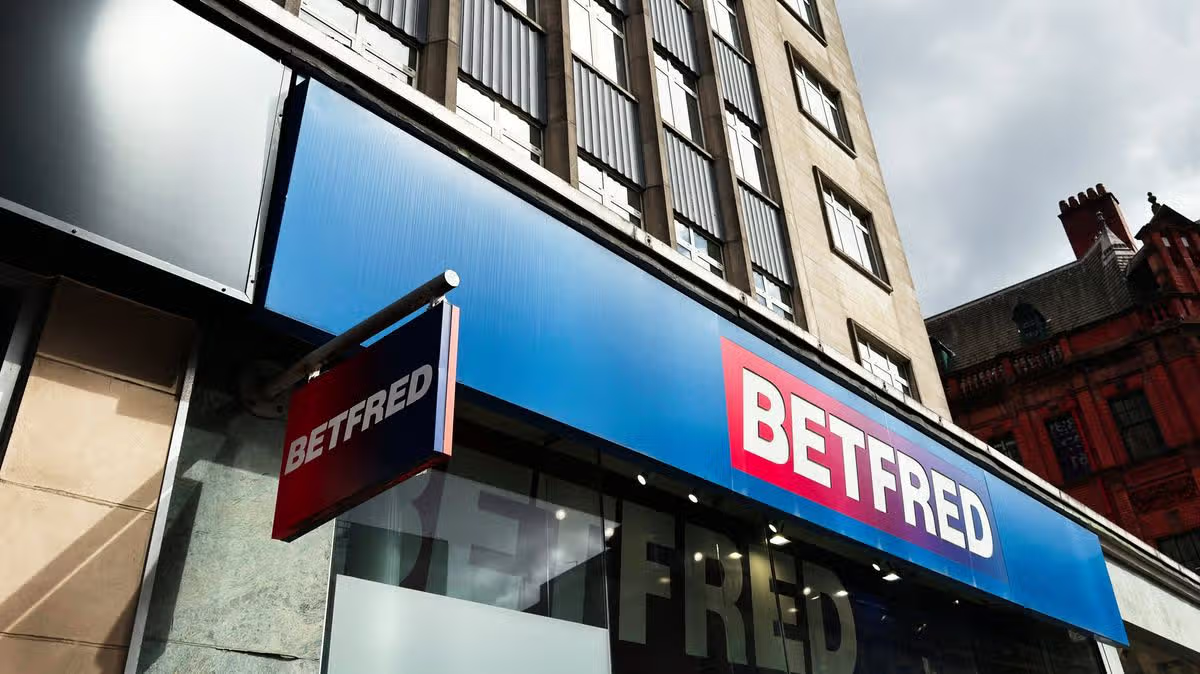
The company has launched a consultation over the Betfred shop closures, which will affect more than a tenth of its betting shops across the UK
Gambling giant Betfred has announced it will shut 132 high street shops and axe over 600 jobs from September, blaming soaring taxes and economic turmoil for the drastic move.
The bookmaker has launched a consultation on the closures, which hit more than one in ten of its UK stores, leaving around 1,100 shops still trading. Betfred was founded in 1967 by billionaire brothers Fred and Peter Done, who are worth an estimated £3.61 billion, according to the Sunday Times Rich List.
“We have tried hard to protect all our sites and the colleagues who work in them, but the combined impact of higher employer national insurance contributions, wage inflation, increases in gambling taxes and wider economic uncertainty has left us with no choice,” Jo Whittaker, chief executive of Betfred, said.
“These are well-run shops, staffed by dedicated colleagues, and it is incredibly hard to see any of them close, but the current fiscal and regulatory environment has made it impossible to keep trading all our shops.
“Our priority now is to support the colleagues affected, and to continue serving customers and communities across the rest of our estate.”
Competing bookmakers Paddy Power and William Hill have similarly closed numerous outlets over the previous 12 months. In January, Evoke, which owns William Hill and 888, stated it acted “quickly and decisively” to counterbalance recent budget modifications to gambling levies through premises closures and expense reductions.
Last October, Paddy Power announced intentions to close 57 betting outlets throughout the UK and Ireland, placing approximately 250 employees’ jobs in jeopardy. The shutdown proposals follow tax hikes unveiled by the former chancellor.
Measures outlined in last year’s autumn budget included raising remote gaming duty from 21% to 40%, while a fresh online sports betting duty of 25% will apply to all sports excluding horse racing from 2027 onwards.
Betfred has also pointed to strain from additional tax rises, including the increase in National Insurance contributions and adjustments to thresholds.
Want to see more of the stories you love from Belfast Live? Making us your preferred source on Google means you’ll get more of our exclusives… To add Belfast Live as a preferred source, simply click here.
A reader paints a bleak picture of the current console landscape and suggests that Sony already knows the PlayStation 6 will be only for a small percentage of rich fans.
It’s been obvious from the start that Sony has no intention of reversing their decision about physical media on the PlayStation 5. This wasn’t a conversation or a proposal; this was them telling their fans they can like it or lump it. There is no alternative: physical discs won’t exist after next year and then the only place you’ll be able to buy games is from the PlayStation Store.
There’ll be codes in a box in shops but that’s not going to be popular with either customers or shops. So beyond that it’s literally Sony or nothing, which is obviously exactly how they want it. If they’re the only way you can buy games then they can charge whatever they want and there’s nothing anyone can do about it. They also have no incentive to offer fair refund options; they’ll just keep it as it is.
So your options are either buy an Xbox (who’s going to do that?), buy a Switch 2 (it doesn’t have all third party games), or buy a PC (who wants that hassle?). Sony, of course, know this and the unattractiveness of the other options is exactly why they’re doing it. They’ve got us all trapped in a situation where either we play by their rules or we have to go find another hobby.
I don’t want to take up knitting though, so what are my options? I realise I’m being dismissive of PC gaming, and a lot of people seem keen on it, but I hate messing around with hardware and options and all that business. And so many games seem to have problems on PC even when they run fine on consoles. Plug and play is all I want and that’s exactly what consoles offer. Or at least they did until performance modes and all that other PC nonsense started getting into console games too.
The Switch 2 is probably something I’d like to have anyway, but while it does have decent third party support it all seems very random and you can’t count on anything definitely coming to it or not. Except I would bet quite a bit that GTA 6 isn’t going to make it.
Expert, exclusive gaming analysis
Sign up to the GameCentral newsletter for a unique take on the week in gaming, alongside the latest reviews and more. Delivered to your inbox every Saturday morning.
So Sony has got us by the short and curlies. I don’t like that and I don’t like companies treating me like a sentient wallet, but that’s the situation we’re in now. If Xbox were in a healthier place they’d be just as bad, heck they tried to pull all this off years earlier with the Xbox One, but they’re kind of stuck trying to play the underdog card and hoping people will like them again because… Halo and Gears Of War? Yeah, that’s not happening.

People have been talking about the end of consoles for years, but it’s mostly been just exaggerations and doomers trying to stretch a point. But now it feels like we’re actually there. There is going to be a PlayStation 6 but it’s going to cost a grand and that means only a tiny number of people are going to buy it – it won’t be a mass market device anymore. It’ll be the opposite of what the PS1 and PlayStation 2 were.
To what degree Sony could’ve done something about this I’m not sure. They can’t affect the component crisis, but they could’ve definitely tried to do something about development times and pushed companies back towards making double-A games acceptable. Or just pushing shorter games, like Spider-Man: Miles Morales. But no, they didn’t do anything sensible like that or make any attempt whatsoever to stop console gaming flying off a cliff.
You would’ve thought they might, considering that’s how they make their money and all, but no. So what is the future of PlayStation and non-Nintendo consoles in general? The PlayStation 6 is a novelty, in my view, and they know it. Just like the Steam Machine and Project Helix. They’re hyper expensive PC/console hybrids for super fans only and the companies know that.
I think the future of PlayStation is the handheld they keep hinting at. It’s going to be like a lower-specced PlayStation 5 (kind of like the Xbox Series S to the Xbox Series X) and it’ll keep the PlayStation 5 going for another eight years or so. There won’t be any PlayStation 6 exclusives, it’ll just upscale and boost PlayStation 5 games.

I feel that’s been kind of obvious for a while now but there’s literally nowhere else to go. You can’t make something more powerful than the PlayStation 5 and have it cost any less than the PS5 Pro and you can’t make exclusive games for a console that hardly anyone owns (which admittedly is something Microsoft has yet to learn).
So that’s it. Console gaming got as far as the PlayStation 5 and then stopped. I’m sure the PlayStation 6 will be able to do some little extra tricks and improvements, but the underlying games will be PlayStation 5 games, designed for what by then will be last gen hardware. Those that were complaining that this gen seemed like it’s barely started don’t know how right they are…
By reader Ruben

The reader’s features do not necessarily represent the views of GameCentral or Metro.
You can submit your own 500 to 600-word reader feature at any time, which if used will be published in the next appropriate weekend slot.
Just contact us at gamecentral@metro.co.uk or use our Submit Stuff page and you won’t need to send an email.
MORE: How PlayStation should have handled the news about going all-digital – Reader’s Feature
MORE: The 10 best Arcade Archives games on modern consoles – Reader’s Feature
MORE: How I smashed my target to complete one video game every month – Reader’s Feature

The full breakdown of results in all 10 Greater Manchester boroughs
Greater Manchester has elected a new mayor after a marathon election count.
Labour’s Bev Craig will succeed Andy Burnham in the job after winning a comprehensive majority over second-place Sian Astley, of Reform.
The result was announced late on Friday night, more than 24 hours after polling stations closed
Ms Craig won 47.15% of votes in the first round, just short of the 50% needed to win outright in the Supplementary Vote (SV) system, so there was a second round against Reform UK candidate Sian Astley, on 20.99%.
After those results were counted, Ms Craig won a total of 309,525 votes (66%) against Ms Astley’s 157,178 (34%).
Turnout across the region was low, at just under 25% – the lowest ever in a Greater Manchester mayoral election.
Ms Craig won most votes in every borough, with Ms Astley’s Reform finishing second in all but two. In Manchester, Green Party’s Geraldine Coggins finished second, and in Trafford, Conservative Phil Eckersley was runner up.
In her victory speech at Manchester’s Co-Op Arena Live, Ms Craig said: “To have trust placed in you is an honour.
“I’m honoured, I’m humbled and I stand ready to serve the three million people that live across this fantastic city region. I will serve every single one of them, every single day.
“I never believed as a girl growing up on a council estate that one day I would have the chance to stand for the place that I love, the place in this world that I’m proud to call home and to offer my service to make our city region better.
“Greater Manchester’s potential lies in its future and when Westminster walked away from us, when we were struggling as a deindustrialised city region, it was the people in this place that began the journey to rebuild.”
The by-election, the biggest ever held in the UK, took place after Mr Burnham had to stand down from the post after being elected MP for Makerfield.
The election was held using the supplementary vote system, which meant that people were able to vote for two candidates – a first and second preference.
Here is how every borough voted.
Stockport
First stage of voting
- Bev Craig (Labour and Co-operative Party) – 35,571 votes (50.2%)
- Sian Niamh Astley (Reform UK) – 12,551 votes (17.7%)
- Geraldine Coggins (The Green Party) – 7,430 votes (10.5%)
- Phil Eckersley (The Conservative Party Candidate) – 5,589 votes (7.9%)
- Marlon Scott West (Restore Britain) – 4,977 votes (7.0%)
- Richard Martin Kilpatrick (Liberal Democrats) – 4,542 votes (6.4%)
- Marcus Jonathan Farmer (Independent) – 243 votes (0.3%)
Second stage of voting
- Bev Craig (Labour and Co-operative Party) – 8,131 votes for a total of 43,702
- Sian Niamh Astley (Reform UK) – 5,116 votes for a total of 17,667
Turnout: 31%
Trafford
First stage of voting
- Bev Craig (Labour and Co-operative Party) – 30,966 votes
- Phil Eckersley (The Conservative Party Candidate) – 9,315 votes
- Sian Niamh Astley (Reform UK) – 8,620 votes
- Geraldine Coggins (The Green Party) – 8,037 votes
- Marlon Scott West (Restore Britain) – 3,136 votes
- Richard Martin Kilpatrick (Liberal Democrats) – 1,659 votes
- Marcus Jonathan Farmer (Independent) – 181 votes
Second stage of voting
- Bev Craig (Labour and Co-operative Party) – 7,852 votes for a total of 38,818
- Sian Niamh Astley (Reform UK) – 5,009 votes for a total of 13,629
Turnout: 35%
Manchester
First stage of voting
- Bev Craig (Labour and Co-operative Party) – 49,326 votes
- Geraldine Coggins (The Green Party) – 21,909 votes
- Sian Niamh Astley (Reform UK) – 9,845 votes
- Marlon Scott West (Restore Britain) – 4,811 votes
- Richard Martin Kilpatrick (Liberal Democrats) – 2,620 votes
- Phil Eckersley (The Conservative Party Candidate) – 2,439 votes
- Marcus Jonathan Farmer (Independent) – 436 votes
Second stage of voting
- Bev Craig (Labour and Co-operative Party) – 16,784 for a total of 66,110
- Sian Niamh Astley (Reform UK) – 4,161 for a total of 14,006
Turnout: 23%
Salford
First stage of voting
- Bev Craig (Labour and Co-operative Party) – 21,445 votes
- Sian Astley (Reform UK) – 9,600 votes
- Geraldine Coggins (The Green Party) – 5,641 votes
- Marlon Scott West (Restore Britain) – 4,225 votes
- Phil Eckersley (The Conservative Party Candidate) – 3,545 votes
- Richard Martin Kilpatrick (Liberal Democrats) – 1,095 votes
- Marcus Jonathan Farmer (Independent) – 247 votes
Second stage of voting
- Bev Craig (Labour and Co-operative Party) – 5,394 votes for a total of 26,839
- Sian Niamh Astley (Reform UK) – 4,028 votes for a total of 13,628
Turnout: 23%
Oldham
First stage of voting
- Bev Craig (Labour and Co-operative Party) – 15,170 votes
- Sian Niamh Astley (Reform UK) – 10,723 votes
- Marlon Scott West (Restore Britain) – 4,381 votes
- Geraldine Coggins (Green Party) – 3,105 votes
- Phil Eckersley (The Conservative Party Candidate) – 1,974 votes
- Martin Kilpatrick (Liberal Democrats) – 832 votes
- Marcus Jonathan Farmer (Independent) – 285 votes
Second stage of voting
- Bev Craig (Labour and Co-operative Party) – 2,585 votes for a total of 17,755.
- Sian Niamh Astley (Reform UK) – 3,952 votes for a total of 14,675.
Turnout: 22%
Bolton
First stage of voting
- Bev Craig (Labour and Co-operative Party) – 19,718 votes
- Sian Niamh Astley (Reform UK) – 12,524 votes
- Geraldine Coggins (The Green Party) – 5,095 votes
- Phil Eckersley (The Conservative Party Candidate) – 5,041 votes
- Marlon Scott West (Restore Britain) – 4,820 votes
- Richard Martin Kilpatrick (Liberal Democrats) – 1,016 votes
- Marcus Jonathan Farmer (Independent) – 484 votes
Second stage of voting
- Bev Craig (Labour and Co-operative Party) – 4,170 votes for a total of 23,888
- Sian Niamh Astley (Reform UK) – 4,998 votes for a total of 17,522.
Turnout: 23%
Bury
First stage of voting
- Bev Craig (Labour and Co-operative Party) – 18,837 votes
- Sian Niamh Astley (Reform UK) – 9,111 votes
- Phil Eckersley (The Conservative Party Candidate) – 4,515 votes
- Marlon Scott West (Restore Britain) – 3,570 votes
- Geraldine Coggins (The Green Party) – 3,309 votes
- Richard Martin Kilpatrick (Liberal Democrats) – 671 votes
- Marcus Jonathan Farmer (Independent) – 188 votes
Second stage of voting
- Bev Craig (Labour and Co-operative Party) – 3,538 for 22,375
- Sian Niamh Astley (Reform UK) – 3,974 for 13,085
Turnout: 28%
Rochdale
First stage of voting
- Bev Craig (Labour and Co-operative Party) – 15,927 votes
- Sian Niamh Astley (Reform UK) – 10,049 votes
- Marlon Scott West (Restore Britain) – 4,796 votes
- Geraldine Coggins (The Green Party) – 3,781 votes
- Phil Eckersley (The Conservative Party Candidate) – 2,680 votes
- Richard Martin Kilpatrick (Liberal Democrats) – 882 votes
- Marcus Jonathan Farmer (Independent) – 284 votes
Second stage of voting
- Bev Craig (Labour and Co-operative Party) – 3,024 for 18,951 votes in total
- Sian Niamh Astley (Reform UK) – 4,268 for for 14,317 votes in total
Turnout: 23%
Tameside
First stage of voting
- Bev Craig (Labour and Co-operative Party) – 18,289 votes
- Sian Niamh Astley (Reform UK) – 12,075 votes
- Marlon Scott West (Restore Britain) – 5,912 votes
- Geraldine Coggins (The Green Party) – 3,924 votes
- Phil Eckersley (The Conservative Party Candidate) – 2,690 votes
- Richard Martin Kilpatrick (Liberal Democrats) – 646 votes
- Marcus Jonathan Farmer (Independent) – 244 votes
Second stage of voting
- Bev Craig (Labour and Co-operative Party) – 4,823 for 23,112 total votes
- Sian Niamh Astley (Reform UK) – 3,579 for 15,654 total votes
Turnout: 25%
Wigan
First stage of voting
- Bev Craig (Labour and Co-operative Party) – 26,200 votes
- Sian Niamh Astley (Reform UK) – 16,830 votes
- Marlon Scott West (Restore Britain) – 5,661 votes
- Phil Eckersley (The Conservative Party Candidate) – 3,233 votes
- Geraldine Coggins (The Green Party) – 2,737 votes
- Richard Martin Kilpatrick (Liberal Democrats) – 739 votes
- Marcus Jonathan Farmer (Independent) – 377 votes
Second stage of voting
- Bev Craig (Labour and Co-operative Party) – 3,019 for 29,219 total votes
- Sian Niamh Astley (Reform UK) – 4,921 for 21,751 total votes
Turnout: 22%
NewsBeat
Fresh clues in Athens body-in-a-suitcase mystery: Facebook messages pretending to be from the victim – and the local suspect who’s vanished
A baking hot summer’s day and in an Athenian suburb a homeless man is drawn to a derelict parking lot by a foul odour emanating from within.
Entering the graffiti-covered building frequented by drug addicts and the destitute, it didn’t take him long to track down the source of the smell to a suitcase that appeared to have been left there recently.
But it was something else that caught the man’s eye – a human limb that could be seen protruding from it.
The date was July 18 and Greek detectives summoned to the scene began the process of trying to identify the person within.
A female, she was approximately 5ft 4in with reddish hair tied in a bun, wearing a black T-shirt and black shorts.
A preliminary examination found no visible bruises, injuries or tattoos that could help identify her or determine the cause of death.
The body was in a state of decomposition, with experts estimating the woman had died some days before being discovered.
In keeping with normal practice, initially investigators tried to match the woman with reports of missing persons, including that of a 50-year-old Chinese woman who had disappeared from an Athens suburb.
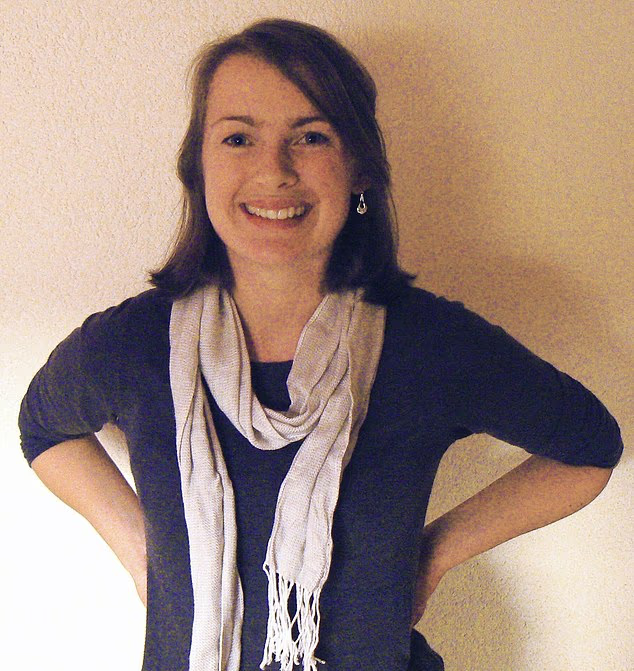
Police are investigating the death of Elizabeth-Jane Ross, 38, after her body was found inside a suitcase in Athens, Greece on July 18

Greek police are seeking a homeless man named ‘Markos’ who they say is a suspect in her murder. He is said to have regularly slept rough in the derelict space where the suitcase containing Ms Ross’s body was found (pictured) but has not been seen there since

Police have been questioning residents, shopkeepers and other homeless people around Kypseli in recent days
When that drew a blank, police widened their search.
The woman’s shorts bore the name of a French university, prompting speculation she could have been a visiting student or tourist. Her fingerprints and DNA were duly shared with Interpol.
Days later the authorities in America found a match, sharing it with their Greek counterparts. And on Wednesday, her family having first been notified, the woman’s identity was finally revealed – Elisabeth-Jane Ross, 38, from Edinburgh.
Tributes from family and friends quickly poured in, remembering her as the ‘kindest soul’ and a person with a ‘beautiful heart’.
A devout Christian who helped the homeless in her home city, Lisa, as she was known, had travelled the world carrying out charitable works, including time in Kurdistan helping Syrian refugees.
Since 2019 she had visited Greece, working with abused women and migrants.
But having solved the mystery of who the woman in the suitcase was, police in Greece now have other questions to answer.
How did Ms Ross meet her death – and who put her in that suitcase?
Because what has emerged is that following her death, her mobile phone continued to be used in what police believe could be an attempt to cover up what had happened.
One message sent on July 15 read: ‘I need some time – I’m going to a Greek island.’
Others sent to her family claimed she ‘needed some time to herself’ and that she ‘wanted to be alone for a while’.
Investigators say the phone, which is still missing, was active in Athens until around 24 hours before Ms Ross was formally identified. It was then ‘mysteriously’ switched off just as her death was reported across the globe.
Her lawyer father told officers he had been receiving messages from July 15 to 29.
Today the Daily Mail can exclusively reveal that another message was posted on Ms Ross’s Facebook page on July 24 – six days after her body was discovered.
She had not previously posted a message on Facebook for several years. In the lengthy post she apparently wrote that she intended, shortly, to travel to Turkey.
‘I’ve been a bit quiet these past few weeks and I know it might seem like I’ve disappeared or been ghosting folk but that’s honestly not the case,’ the post began. ‘I’ve been spending a lot of time in prayer, wrestling with God, asking questions and seeking His direction… a couple of weeks ago I met two lovely ladies, Emily and Claire, who have been serving in Turkey.
‘Since meeting them, I haven’t been able to shake the feeling that God is calling me there.’
The post was seen by old friend Melissa Rogers, who told the Daily Mail: ‘The post doesn’t make any sense. If she was already missing then she couldn’t have posted it.’
The post seemed designed to mimic some of the religious language she had used in previous posts, her plans apparently echoing past trips she had made to help others. ‘She was very passionate and always looking to serve God and other people,’ said Ms Rogers, 36.
Describing her as both ‘dependable’ and ‘caring’ she recalled how she would befriend the homeless.
‘There’s a famous homeless guy in Edinburgh called Arthur who was often on Leith Walk where I lived and he would never take anything from anybody,’ she said.
‘But Lisa was one of the few people who he seemed to trust and she was genuinely friends with him.’
Given the circumstances of her death, Ms Rogers says it is possible that her desire to help others may have put her at risk.

The initial examination of the body showed no obvious injuries or signs of struggle, while no identification was found on her
‘That was Lisa – always giving her life for others,’ she said. ‘Every time I saw her she was saying she was just going to a food bank, or to help somebody. I do wonder if she got into trouble while trying to help somebody.
‘There were times I was worried about her safety but she didn’t care about being in dangerous situations as long as someone was feeling the love of God. She could have been helping someone and something happened.
‘She wanted to go to where there was fire, where most people would look the other way. She would go right into where there was trouble.’
As part of their investigation police are attempting to discover Ms Ross’s movements during the 72-hour period prior to the discovery of her body. They are understood to be urgently following up two lines of enquiry.
One involves tracking down a homeless man known for carrying a knife and being aggressive towards women in the locality where Ms Ross went missing.
Residents yesterday told the Daily Mail he is called Markos, that he regularly slept in the derelict space but has not been seen there since the grim discovery.
He is described as around 40, of stocky build, black hair and heavily tattooed.
A nearby business owner said: ‘The police came into my shop asking for CCTV and if I had seen Markos. But there’s been no sight of him since the body of this British woman was found.
‘If you ask me, he’s a dangerous individual and women do not feel safe being near him. I’m not saying he’s done anything wrong but it’s strange that he has not been seen for many days now.’
A police source added: ‘We have a lead on a homeless man but can’t say any more. We want to question a particular individual but we are also looking for a number of other people as part of this investigation.’
They are understood to include the American ‘friends’ with whom Ms Ross apparently stayed in the days prior to her body being discovered.
Having flown to Greece on June 26 from Scotland, police have established she had been staying with Greek friends in the Keratsini district of Piraeus, the seaport close to Athens.
She told them on July 15 that she was leaving to stay with American friends in Kypseli – a more central part of the city.
Officers have cleared her Greek friends from Keratsini of any wrongdoing, with their efforts now targeted on tracing the Americans she said she was going to visit.
One theory being probed is that the Americans may not actually exist – and that Ms Ross only mentioned them to her other friends to reassure them that she would not be alone.
Police believe that her body was taken to the abandoned building on July 17. The homeless man who found her said he was also there on July 15 and 16 but only noticed the suitcase on July 18 at around noon.
Officers believe the killer or killers are likely to have been staying in or around Kypseli.
The killing has sent shockwaves through the area, with locals placing flowers at the entrance to the derelict parking lot. A member of staff at a sports hall opposite said police had visited to remove and review CCTV footage of the scene.
‘The homeless man who discovered the body lives nearby. He has lived on the streets for a while and is well known around here, but even he was shaken by what he saw.’
One police source said officers were ‘sweeping the area, questioning many people, largely homeless and drug users’.
He said suspicion was currently focusing on ‘fringe elements’ because of the location where the body was found.
Police told Greek media that forensics have ruled out both strangulation and fatal head injuries and they are now examining whether there were drugs or other toxic substances in her body linked to her death.
A Police Scotland spokesman said: ‘We are aware of the death of a Scottish woman in Athens and are liaising with authorities in Greece. Officers are providing support to her family.’
A picture of a smiling Ms Ross was put on the iron fencing around the building, accompanied by the words: ‘An Angel was here’.
How she got there is another question altogether.
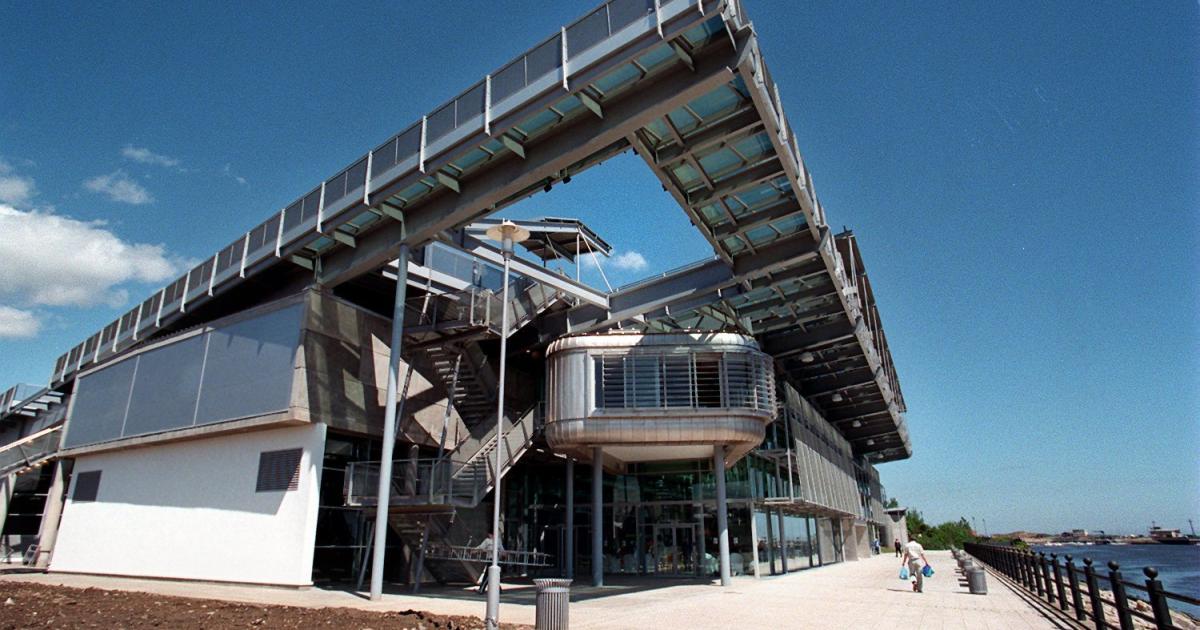
The National Glass Centre in Sunderland, which has operated for nearly 30 years, shut to the public today (July 31) following a decision by the University of Sunderland.
A university spokesperson said: “The University would like to place on record its sincere thanks to the staff who have worked at the National Glass Centre over many years.
“While the closure of the building marks the end of an important chapter, we remain committed to supporting cultural, educational and civic activity across Sunderland.”
Although the building is planned to be demolished, the university has offered to gift specialist equipment to the Sunderland Culture-led Glassworks project or other interim glassmaking facilities.
The decision to close the centre has been met with controversy, including a demonstration outside the building on its final day by members of the Save the National Glass Centre Campaign Group.
The university said it explored multiple options to keep the centre open, but none were financially viable.
It said: “Despite a range of conversations with individuals and organisations, no feasible plan emerged to meet the significant financial requirement for capital works, or the £800,000 annual subsidy funded by the university, required to provide the NGC with a viable future.
Plans are being developed to continue glassmaking in Sunderland.
“Throughout the process, the university has been clear that almost 90 per cent of its income is derived from student tuition fees.
“In a period of significant financial challenge across the higher education sector, our priority has been to protect teaching, research and knowledge exchange activities for current and future students.
“The university has remained committed to transparency in its decision-making and this will continue as we move forward, following all planning requirements in relation to the planned demolition of the building.”
NewsBeat
Like us, Norway hit the North Sea oil and gas jackpot in the 1970s… but their politicians created the world’s biggest wealth fund – while ours frittered the money away: ROBERT HARDMAN
Just imagine that a quarter of Britain’s working-age population decided to call in sick for an entire year – on full pay and with the taxpayer picking up the tab. Or that it was a basic student right to keep on studying until the age of 30 – with interest-free loans all the way.
Or that the number of foreign-born citizens quadrupled in 25 years, with the option of full benefits for all, while ministers built themselves new offices costing £1million per desk.
In next to no time, Britain would be bankrupt and, in all likelihood, in the throes of civil disorder.
Not so here in Norway, though. That is the current state of affairs in this safe, clean, largely contented – and very wealthy – nation of 5.6million. So what if Britain had made better use of the same geological blessing which we share with our North Sea neighbours: massive energy reserves beneath the same seabed?
In a week when our new Prime Minister has signalled the end of Whitehall’s puritanical celibacy towards oil and gas, we already have a glimpse of the potential rewards.
The mere suggestion of a resumption of British drilling has not only raised the prospect of billions for the Treasury.
By yesterday morning, it had already kickstarted the £2billion sale of BP’s previously moribund North Sea operation.
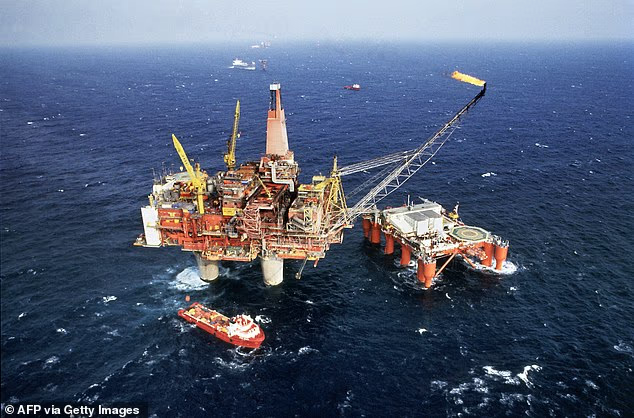
In the 1970s, Norway hit the same oil jackpot as Britain. Pictured: The Statfjord B oil platform in the North Sea

Andy Burnham has been urged to ‘get Britain drilling’ after he admitted that North Sea oil revenues could ease the cost of living
Crowds meander around Oslo’s spectacular waterfront, dominated by the new Opera House, a gleaming marble-clad iceberg every bit as striking as its Sydney counterpart. People simply stroll up its sloping sides to walk all over the roof.
No litter, dog mess or graffiti. At street level, they queue patiently for a table at busy restaurants where a beer starts at £15 and pizzas go for £20.
Back on the quayside, business is brisk at the floating saunas, with people hopping between their log-fired ovens and a dip in the harbour.
Year after year, Norway ranks at the top (or second) in the official league table of civilisation: the UN Human Development Index.
So far, so very Scandinavian, except that Norway spends far more on benefits than its Nordic neighbours in Sweden and Denmark but without charging higher taxes.
It can do so because, in the 1970s, it hit the same oil jackpot as Britain. The story of what happened next goes in two very different directions.
For the Norwegians put the profits from their new-found fortune into a government wealth fund which is now the largest in the entire world – at two trillion US dollars.
They are also continuing to pump out oil and gas to meet the demands of an unstable world, while charging a 78 per cent tax on what emerges.
Today, its Oil Fund earns far more from its global investments – from a brewery in Malaysia to a cheese firm in Australia, a huge chunk of Microsoft and a quarter of Regent Street in London’s West End – than from the seabed.
Here in Britain, by contrast, we blew all our North Sea profits paying day-to-day government bills and keeping down taxes. We have since decided that oil and gas are a very bad thing.
So they stay in the ground while we strive to get by on wind and solar power. Since that is impossible – for now – we will just have to buy in oil and gas from countries like, well, Norway.
That, at least, was the status quo as long as Net Zero zealots like Ed Miliband were in charge of the Department of Energy.
Now he has gone to the Foreign Office, our new Prime Minister has indicated that we might actually open two new fields in the North Sea.
And if Andy Burnham is serious about this, then we can advance the national debate on from an argument about fossil fuels – and the vital matter of our own energy security – to the question of what to do with the proceeds.
In short, should we just pour them into the bottomless pit of the public sector? Or should we follow those crafty Norwegians and build a fund?
Join the discussion
Should Britain prioritise economic relief by tapping North Sea oil, even if it means risking climate goals?

What could have been: Crowds meander around Oslo’s spectacular waterfront, dominated by the new Opera House, a gleaming marble-clad iceberg every bit as striking as its Sydney counterpart (file pic)
Their one was established with clear, cast-iron rules. Overall, it was to ‘create a qualitatively better society’.
Nor could a desperate government just stick its hand in the till. The state can merely expect up to 3 per cent of the pot while the rest is allowed to grow.
Nor can it invest inside Norway, for fear of destabilising local markets and the national currency, the kroner.
The result has been simply astonishing. For that fund now dwarfs those of Saudi Arabia, Qatar and other oil-rich nations.
Spread across stock markets, bond markets and real estate around the world, the Oil Fund is the ultimate example of what can be done when wise politicians take the long view. It means that every single Norwegian has a personal trust fund of £350,000, not that they can touch it.
Instead, each year, the fund now pays around £45billion into the Norwegian treasury, amounting to between a fifth and a quarter of national expenditure.
To put that into a British perspective – in a nation with 12 times the population – it would be like the Chancellor of the Exchequer receiving a cheque for nearly £500billion every year.
Never mind gimmicks like £2 bus fares or a few quid off the electricity bill. Andy Burnham could give the entire country a new car.
Of course, Britain would not achieve 12 times Norway’s oil and gas production. But such a windfall would help sort out our welfare and defence budgets without any talk of a wealth tax.
‘Being the finance minister of Norway is a pretty easy job compared to any other European country,’ says Kjetil Alstadheim, political editor of the newspaper Aftenposten.
‘So, if you decide you want to give more money to Ukraine, you have it.’ Despite its small size, Norway has handed billions to Kyiv since Russia invaded.
Professor Ulf Sverdrup of the Norwegian Business School, says ‘Oil Fund’ is a misnomer, adding: ‘First, it’s not just about oil, but gas, too, and the taxes from oil and gas are much smaller now than the return on investment.’
He highlights another important point, namely transparency. ‘Most countries with major oil resources have had corruption or mismanagement. In Norway, the politicians should be very proud of what they have achieved.’
Such is the transparency of the fund that I end up talking to the Norwegian in charge of it while he is on holiday.
Back in 2020, Nicolai Tangen was the London-based founder of a global hedge fund with £15billion in the pot.
An Anglophile with a postgraduate degree from the London School of Economics, he and his wife raised three children in the UK.
He remains especially proud of the fund’s holding in Regent Street (for which it paid the Crown Estate half a billion pounds in 2011).
He had already been giving away a substantial chunk of his fortune to philanthropic causes when he decided to swap the life of a downsizing gazillionaire to go home, become a public servant and run the national piggy bank on a civil service wage.
He has no regrets: ‘It combines all the things I feel strongly about.’ He puts the success of the fund down to three ingredients: strong cross-party political ‘anchoring’, a strict spending policy – ‘so that you can’t just plunder the whole thing’ – and ‘a very high level of transparency’.

Year after year, Norway ranks at the top (or second) in the official league table of civilisation: the UN Human Development Index (file pic)
As the world’s most powerful asset manager, he must be the financial equivalent of Norwegian striker Erling Haaland.
He laughs. ‘I am not a celebrity. But if I meet someone in the forest, they might say they like the way we run the fund.’
That is the general consensus wherever I go. Student Elsa Marino, 20, tells me that, thanks to the fund, the state can help fund her education at Boston University in the US.
Former fisherman Kag-Inge Flode says it’s the fund that helps build roads and keeps down fuel costs.
The effects are felt in the poorer parts of town. I head to Stovner, an outlying suburb with the largest immigrant population in Norway, and the local shopping centre is calm and clean.
‘Sweden’s got cars and we’ve got oil – and I’d much rather be here,’ says former factory worker Tedke Helvik, 77.
Crime, such as it is, is most prevalent in Oslo’s eastern suburbs, like Gronland, though it’s not a patch on the worst bits of Manchester or London.
‘It’s fine and peaceful here,’ says pharmacist Abdul Karim, 29, who came to Norway as a young refugee.
‘I went to see relatives in London but came home after two days as it felt dangerous. Sweden’s the same. But this is a good place.’
However, there is one tiny glimmer of satisfaction for despairing Brits. All this prosperity comes at a price.
One of last year’s best-selling books here was a study of Norwegian complacency by former management consultant Martin Bech Holte. He called it The Country That Got Too Rich.
‘The fund is a test of human nature,’ he tells me. ‘If you are used to working hard, you have grit and you put in the effort to get results and then you win a lottery, will you continue towards long-term success? Or do you take shortcuts?’
He has no quarrel with the fund – and even Nicolai Tangen calls it ‘an important book’ – but Bech Holte has kickstarted a major debate on how the windfall should be spent.
‘We have the highest sick leave in the world, we have the highest share of our population on welfare in the world.
‘Whenever there’s a problem, the government bails people out. Gas prices or electricity a little bit high? OK, the government pays everyone out.’

A BP platform in the North Sea’s Clair Ridge field
He also points to some of the state’s profligate ‘pork barrel’ projects, like futuristic government offices costing more than £1.2million per desk. There are also two new national museums housing Norway’s most famous painting.
Edvard Munch painted The Scream twice. I find one in the National Museum, a huge metal box (£100million over budget) that replaced the empty Museum of Decorative Arts.
The other is in the Munch Museum, another huge box that replaced the equally empty Edvard Munch Museum, which came in at £180million over budget.
Both are cheaper than another stupendous project that will kick off with a very loud bang next year way up north.
High explosives will blow a hole in a cliff face and work will begin on the world’s first shipping tunnel. Cut through a mile of rock, it will enable ships and fishing boats to avoid a notorious headland called Stad.
The tunnel will save a 35-mile trip around a point that has cost 33 lives since 1945. The downside: an estimated cost of £800million and an economic return of £1 for every £9 spent.
Considering that Norway’s annual maritime death toll is around 100 people, it is hardly the most efficient use of public funds to preserve human life.
Yet Norway’s great ship tunnel is expected to open five years from now. To put this into a UK perspective (ie multiply by 12), imagine the squawking if Andy Burnham splurged £10billion on a subway for fishing boats. But Norway will soak it up.
Professor Einar Lie, of Oslo University’s history faculty, points out that Norwegians have started to feel insulated from global monetary woes.
‘During all the financial crises of recent years, problems were always reported on the foreign pages of our papers,’ he says.
‘That has led to a feeling of invulnerability in Norway – a sense that the state can handle anything discomforting.’
There is one point on which everyone seems to agree: The fund is a great asset and the ‘handlingregel’ – the rule preventing the state taking more than 3 per cent of the annual total – is correct.
The debate is what the government should do with its annual windfall – currently some £50billion.
Lefties want it to divest from big tech and anything with the faintest whiff of Israel. Mainstream parties agree that, subject to an ethical code, it should still invest in whatever maximises returns for everyone.
Martin Bech Holte, whose book has caused this great debate, has no problem with the fund itself. He believes it is the government’s mollycoddling that is storing up problems.
When I ask him what would have happened if Norway had never had oil – or else blown it all like Britain – he points to life before the Oil Fund really exploded.
‘In 2013, the mainland economy of Norway had a higher income per capita than the US and almost all European countries,’ he says. ‘That was because we were the country that utilised digital technology faster and better than any other country.’
In other words, Norway used to be made of the Right Stuff – but it’s gone soft. The falling birth rate is also a problem.
As Kjetil Alstadheim points out, only half jokingly: ‘We are going to run out of people before we run out of cash.’
I drop in on the Norwegian parliament, the Storting, where I meet Tom Staahle, an MP from the Right-wing opposition Progress Party, the second-largest parliamentary grouping.
He sits on the committee that monitors the fund and thinks the 3 per cent rule is fine. He is just fed up with the waste.
‘Cut taxes, cut official spending, stimulate more private investments,’ he says. ‘Give families more money in their pockets to spend. People are smart. It’s not necessary for the state to think for them.’
For now, we see a nation cheerfully shelling out record sickness benefits while writing blank cheques for big northern infrastructure (sound familiar?) – all paid for with an oily magic wand.
Yes, the Oil Fund might raise a few awkward questions about Norway’s long-term capacity to get back to work.
Yes, it has led to some serious waste. But, right now, would that not be a nice problem for Britain to have?
NewsBeat
FIFA president Gianni Infantino makes embarrassing U-turn over plans to sell the World Cup as under-fire chief admits it ‘created divisions’ and now hopes to unite football again
Gianni Infantino’s plan to sell stakes in the World Cup is dead after the heroics of UEFA, CONCACAF, the AFC and two members of the FIFA hierarchy.
While it appears the FIFA president will fight on to save his job, the Swiss football administrator has abandoned his proposal to sell £3.1billion worth of shares in FIFA tournaments to private investors.
Infantino said: ‘The FIFA Forward Enterprise project was intended to provide a basis for further strengthening our FIFA Member Associations and our sport worldwide, especially in those countries where support is most needed.
‘And more so, as we said from the outset, to do this only if a majority of the FIFA Member Associations were in support and always subject to a consultation process with them, the FIFA Council, the Confederations and wider stakeholders.
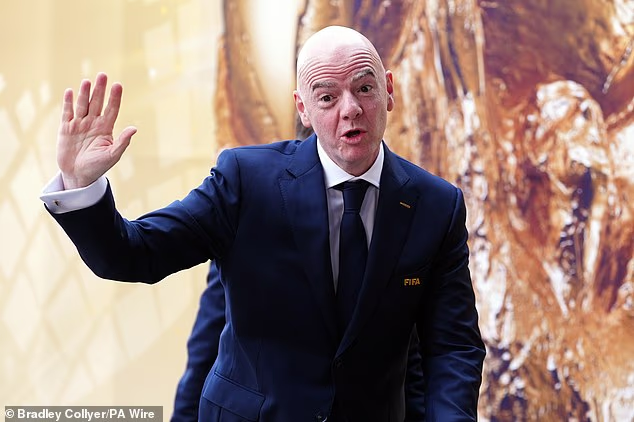
Gianni Infantino waves goodbye to his unilateral plans for private investment in FIFA
‘Having listened carefully to all the views, it has become clear that the project has created divisions of a nature that, regardless of the level of support, are no longer in the interest of the objective set out in the first place.
‘Our purpose has always been – and will always be – to unite and improve. As a result, this proposal will not proceed.
‘Moving forward, my intent is to bring all interested parties back together in the coming days and weeks in the spirit of shared interest in our game, and with the objective to continue growing football everywhere, and particularly in those countries that mostly need our support.’
On Friday, the AFC became the third confederation to reject Gianni Infantino’s proposal to raise private capital for the commercial and operational management of FIFA tournaments.
The decision followed CONCACAF’s rejection on Thursday and came after UEFA announced it would boycott FIFA competitions.
It became clear on Friday afternoon that Infantino did not have the support to proceed with his plans, with the opposing nations rising to a staggering 135 – 64 per cent of the FIFA membership.
Infantino had hoped to create a new enterprise with significant investment from Joshua Kushner – brother of Jared, Donald Trump’s son-in-law. Meanwhile, investment bank J.P. Morgan were advising on potential investors.
A significant number of FIFA members raised concerns from the initial leak of the plan, questioning how such thorough ideas could be developed unilaterally without prior consultation.
Despite FIFA maintaining throughout that there would be a proper consultation period, there were major questions about how that could be achieved when potential investors were already lined up.

Sports53 seconds ago
FIFA chief Infantino abandons World Cup sell-off plans

Tech2 minutes ago
Amgen says cloud data breach exposed patient health, proprietary info
NewsBeat4 minutes ago
Google pulls new Earth AI tool after researchers show it can be used to put fake nuclear power plants in Iran and refugees near the Mexican border

Entertainment1 month ago
Renter of Home in Anne Heche Crash Denies Settlement With Son

Business2 months ago
No Jackpot Winner as $257 Million Prize Rolls Over to $269 Million Monday Draw

Fashion1 month ago
Weekend Open Thread: Staud – Corporette.com

News Videos18 minutes ago
While America Argues, Japan Just Moved On XRP. Here’s What It’s COSTING Us

News Videos24 minutes ago
Buddy, do you think this makes you look cool? calebhammercomposer #money #finance #financialaudit

News Videos38 minutes ago
Crypto Trading LIVE: BTC Live Trading Bitcoin Analysis | 28 JULY #crypto #bitcoin #btc
-
 Sports5 days ago
Commonwealth Games boxing: Jadumani Singh seals dominant 5-0 win over Pakistan’s Sumama Rehman to enter quarter-finals | Commonwealth Games News
-

 Business2 days ago
Why Trees Belong on the Risk Register
-

 Tech5 days ago
Intel is reversing course and bringing hyper-threading back to its server chips
-

 Fashion7 hours ago
Weekend Open Thread: Wit & Wisdom
-

 Politics4 hours ago
Meta enters AI-training agreement with far-right ‘propaganda rag’ Newsmax
-

 Crypto World6 days ago
Ripple bought a bank in pieces. The $4 billion audit
-

 Politics5 days ago
Luke Littler dismantles Gerwyn Price to retain title in Blackpool
-

 Politics4 days ago
The Part of the Electric Transition Nobody Wants to Discuss
-

 News Videos5 days ago
BITCOIN JUST ENTERED THIS CRITICAL ZONE…
-
 Entertainment3 days ago
‘Stargate’ Creator’s New Sci-Fi Series Returns for Season 3 Tomorrow
-

 Crypto World6 days ago
XRP Ledger adds $2.6B as RWA inflows rank second
-

 Business3 days ago
Major shareholder moves on Canyon
-

 Politics6 days ago
Spain sweeps the board at 2026 World Cup with individual awards
-

 News Videos2 days ago
Bitcoin Enters the 3rd Stage of the Bear Market
-

 Entertainment6 days ago
Sara Gilson Killed By Husband After Viral “Pedophile” TikTok Video
-

 Crypto World3 days ago
Kraken Enables Retail Access to Jersey Mike’s IPO via Tokenized Shares
-

 Tech7 days ago
Anthropic launches Claude Opus 5, a cheaper AI model for coding, agents and enterprise workflows
-

 Tech4 days ago
New macOS Sequoia & Sonoma security updates for older Macs
-

 News Videos3 days ago
Claude: Build Financial Dashboards in Minutes (2026)
-

 Politics1 day ago
Luke Littler’s dominance sparks GOAT debate
You must be logged in to post a comment Login