
Connect with us
DAPA Banner
DAPA Coin
DAPA
COIN PAYMENT ASSET
PRIVACY · BLOCKDAG · HOMOMORPHIC ENCRYPTION · RUST
ElGamal Encrypted MINE DAPA
🚫 GENESIS SOLD OUT
DAPAPAY COMING

NewsBeat

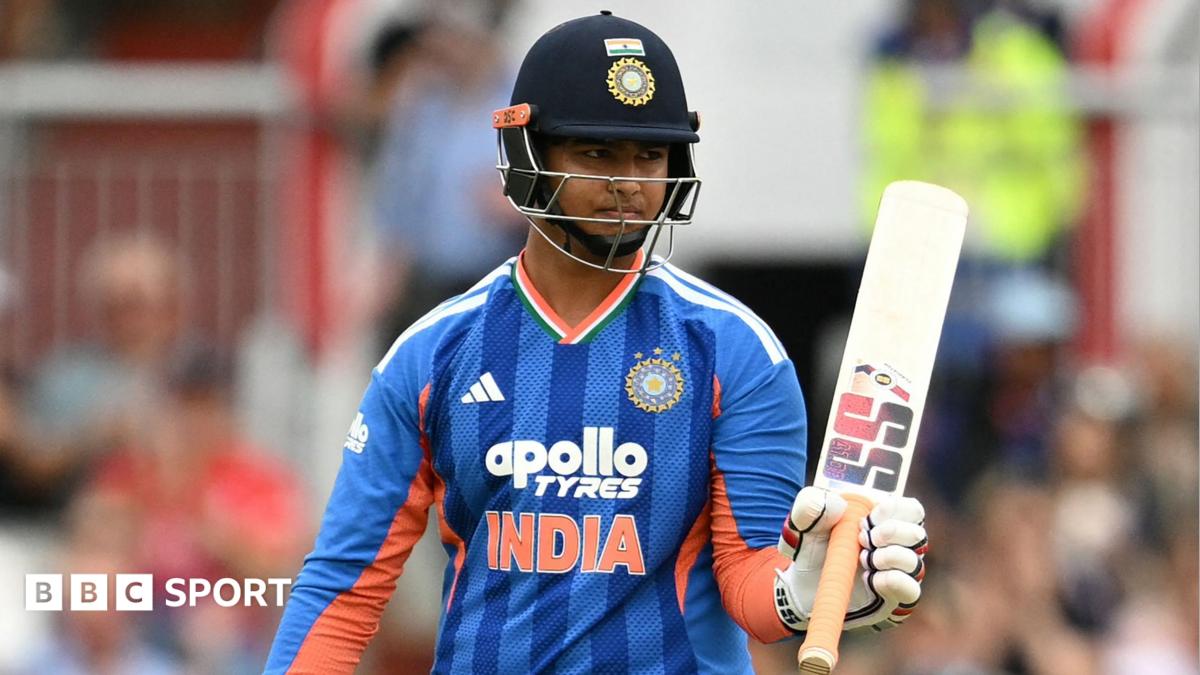
Vaibhav Sooryavanshi makes debut in India loss to England in second T20

Published

on

BBC Sport microphone and phone

Second Twenty20 international, Emirates Old Trafford

India 190-7 (20 overs): Kishan 49 (40), Sharma 43 (24), Iyer 37 (22); Curran 3-33

England 191-6 (19 overs): Bethell 76* (46), Brook 39 (15), Banton 39 (32), Arshdeep 3-40

England won by four wickets, lead five-match series 1-0

Advertisement

Scorecard

Teenage sensation Vaibhav Sooryavanshi became the youngest man to play for India in England’s thrilling four-wicket win in the second T20 at Old Trafford.

At 15 years and 99 days old, the opener broke the record set by the great Sachin Tendulkar when he played a Test against Pakistan aged 16 years and 205 days in 1989.

Although Sooryavanshi sparkled for 14 off 10 balls in India’s 190-7, it was England’s own protege, Jacob Bethell, who led them to victory with an over to spare.

Advertisement

Bethell crunched a breathtaking unbeaten 76 from 46 balls to give the home side a 1-0 lead in the five-match series.

Sooryavanshi’s inclusion sent a frisson of excitement around Old Trafford, giving a boisterous and partisan crowd further reason to make noise.

And the left-hander gave a brief glimpse of the thrilling strokeplay that has enthralled the cricketing world.

From the fourth delivery he faced, and first from England fast bowler Jofra Archer, Sooryavanshi audaciously whipped over his shoulder for six. In the next over, Josh Tongue was larruped over cow corner for six.

Advertisement

In the fifth over, Sooryavanshi looked primed to attack the off-spin of Will Jacks, only to run past a flatter one and be stumped.

Ishan Kishan made 49, Abhishek Sharma 43 and Shreyas Iyer 37, but India were stifled by tight bowling from Jacks and Sam Curran, the latter claiming 3-33. The tourists took 23 off the last seven balls, yet their total felt no better than par.

From 1-2 after the first over, England were kickstarted by captain Harry Brook’s 39 from 15 balls, followed by a stand of 67 between Bethell and Tom Banton.

England needed 49 off the final four, when Bethell climbed into the leg-spin of Ravi Bishnoi, hammering three sixes for a total of 29 off the 17th over.

Advertisement

And Archer calmly clipped the winning runs from the final ball of the 19th over to put England ahead going into the third match of the series at Trent Bridge on Tuesday.

Source link

Continue Reading
Click to comment

You must be logged in to post a comment Login

Leave a Reply

NewsBeat

World Cup 2026: Why England players won’t fear Mexico or the Azteca – Alan Shearer

Published

on

Alan Shearer's BBC Sport column

I’ve heard a lot of talk about the difficult conditions England will face at the Azteca Stadium – but I don’t think the players will be worried about any of that.

Instead of having any fear about the different tests they face, they will just be thinking ‘bring it on’. I know I would be.

All the talk stops when they run out anyway, and if they play the game rather than the occasion then I think they will win.

Yes, it’s going to be tough, because of the altitude and the atmosphere and everything else. Co-hosts Mexico are at home and the crowd could be as much as 80% of their fans, which is very different to anything England have faced at this tournament so far.

Advertisement

But as a player, these are the kind of games and moments you train and work so hard for all your life because to be going to such an iconic stadium and playing in a World Cup in front of a TV audience of millions, with a place in the quarter-finals as the prize, is what you dream of as a boy.

I’ve wanted to go to the Azteca since I watched the 1986 World Cup on TV as a teenager and this is the first time England have been back since losing that epic quarter-final tie to Argentina. It’s going to be an amazing spectacle as well as a unique test.

I have followed England around the United States at this World Cup, and we have had the majority of fans at all four matches so far.

Against DR Congo in Atlanta, around 75% of the crowd were supporting England, but this is going to feel very different and is another reason why it’s such an incredible game to look forward to.

Advertisement

I’ll be there, co-commentating with Guy Mowbray, and am excited about it as much as the fans are. I bet the players are excited too.

Yes, it’s a challenge but I would say to them to embrace it and enjoy it – be positive and show us all what you can do.

Source link

Advertisement
Continue Reading

NewsBeat

York city centre bridge to close for streetlight work

Published

on

York city centre bridge to close for streetlight work

City of York Council said it is closing Bishopgate in York from the Tower Street roundabout to its junction with Clementhorpe from 8pm on Monday, July 6 to 6am on Tuesday July 7.

The stretch of road includes Skeldergate Bridge and is one of the principal routes for traffic across York which avoids the city centre.


Recommended reading:

Advertisement

The council said the closure is to ensure the works can be carried out safely.

The alternative route will be signed taking road traffic over Lendal Bridge via Fishergate, Paragon Street, Foss Islands Road, Jewbury, St Maurices Road, Lord Mayors Walk, Gillygate, St Leonards Place, Museum Street, Station Road, Queen Street and Nunnery Lane.

The council confirmed an earlier opening of Bishopgate Street if works finish sooner.

Advertisement

Source link

Continue Reading

NewsBeat

X Factor winner James Arthur returns to Scarborough stage

Published

on

X Factor winner James Arthur returns to Scarborough stage

James Arthur, who won the ITV talent show in 2012 performed at the Scarborough Open Air Theatre last night (Friday, July 3).

The multi-platinum singer-songwriter, who last performed at the Scarborough Open Air Theatre in 2018, told organisers he took to the stage despite being advised not to by doctors.


Recommended reading:


FANS READY FOR JAMES ARTHUR'S HEADLINE SHOW AT TK MAXX PRESENTS SCARBOROUGH OPEN AIR THEATRE (3)Excited fans lined up ready for James Arthur’s headline Scarborough show (Image: Supplied)

James Arthur said: “It means a lot to me, playing in this part of the world.

Advertisement

“My family and friends are here; I wouldn’t have missed it for the world.”

Organisers said he opened the show with Water and his global anthem Impossible, adding that delivering a set packed with crowd-pleasers.

The Middlesbrough-born star also performed Rewrite the Stars from The Greatest Showman soundtrack, along with Car’s Outside and A Thousand Years, before ending the night with Say You Won’t Let Go.

Jerub was a special guest of James Arthur and was among the artists opening the show in ScarboroughJerub was a special guest of James Arthur and was among the artists opening the show (Image: Supplied)

The concert began with a performance by newcomer Ruby Poole, followed by sets from Ben Ellis and JERUB.

Advertisement

The singer-songwriter from Middlesbrough who rose to national prominence after winning the ninth series of ITV’s The X Factor in 2012.

Growing up he played in local bands and performed solo in pubs and bars across his home county.

JAMES ARTHUR HEADLINES TK MAXX PRESENTS SCARBOROUGH OPEN AIR THEATREThe performance from James Arthur comes in the middle of a season of live music at Scarborough Open Air Theatre (Image: Supplied)

His X Factor winner’s single, a cover of Shontelle’s “Impossible,” went straight to number one in the UK and went on to sell around 2.5 million copies worldwide, making it one of the show’s most successful winner’s singles.

Last night’s show was part of the TK Maxx presents Scarborough Open Air Theatre 2026 series, which features a record 26 headline shows this season.

Advertisement

The concert series continues with upcoming performances by David Gray, Alanis Morissette, and Michael Bublé.

Source link

Advertisement
Continue Reading

NewsBeat

Snow Patrol become first recipients of new Official Charts Hall of Fame Award

Published

on

Belfast Live

“I love this record, it means so much to me. It gave us access to the world”

Snow Patrol have been honoured as the first recipients of the brand-new Official Charts Hall of Fame Award.

The new accolade from the Official Charts Company will, going forward, be presented annually to the UK’s official biggest single and album of the year.

The award is part of celebrations marking 70 years of the Official Albums Chart and the Co Down band were selected as the inaugural recipients of the award to coincide with the 20th anniversary of Eyes Open.

Advertisement

The album gave Snow Patrol their first Number 1 on the Official Albums Chart and became the UK’s Official biggest album of 2006, which “propelled Snow Patrol from alternative-rock favourites to one of the defining bands of the decade”.

Speaking to the Official Charts as he accepted the award, frontman Gary Lightbody said: “Thank you very much, this is great! My mum will be delighted!

“I love this record, it means so much to me. It gave us access to the world – a world which we never thought we would occupy.

“We started in 1994 and didn’t have a hit until 2004. We had 10 years of no success, and then Final Straw was very successful. Then Eyes Open was extremely successful. It was very new to us, that type of success; playing the bigger shows, getting on the radio. Being in the charts was very exciting to us.

“It’s an album that still seems to live and breathe, and also change and shift. The album is an artifact that’ll never change, but the songs change, shift and evolve over time with the way we play them.”

According to Official Charts Company data, Eyes Open has gone on to shift more than 2.6 million units in the UK to date, including 2.4 million pure sales.

For all the latest news, visit the Belfast Live homepage here and sign up to our What’s On newsletter.

Source link

Advertisement
Continue Reading

NewsBeat

Old photos offer snapshot of York’s forgotten past

Published

on

Old photos offer snapshot of York's forgotten past

Decades earlier, those grounds on Acomb Road in York echoed with very different sounds as children played under the watchful eye of nurses in the gardens of what was then the Godfrey Walker Home.

It isn’t easy to mentally swap that scene of pints, replica shirts and nervous glances at the scoreboard for prams, toys and nursery games. But our old photo highlights the history of the Victorian villa that was originally built for the Russell family, according to the York Historic Environment Record.

Children at play under the eye of nurses in the grounds of the Godfrey Walker Home (now the Carlton Tavern pub) in 1948 .Old photo reveals forgotten past of popular York pub – pictured, children at play under the eye of nurses in the grounds of the Godfrey Walker Home (now the Carlton Tavern pub) in 1948 . (Image: Newsquest)

The Waifs and Strays Society moved its Godfrey Walker children’s home here in 1946, turning it into a nursery in 1947 for babies and toddlers up to five. Records show it continued as the Godfrey Walker Children’s Home until about 1970, before becoming a hotel and, in the 1990s, the Carlton Tavern pub under Marston’s.

1962 – The Glass Bridge in Grosvenor Terrace, Clifton, is replaced with a new footbridge. (Image: Newsquest)

The photo is one of several that we’ve uncovered in our archives to a offer snapshot of everyday life in York – from the Cross Keys pub in 1968, standing watch over the busy Tadcaster Road junction, to the Crystal Palace on Holgate Road in 1961, a well-known stopping point for locals.

Advertisement

1968 – The Cross Keys and the junction of Tadcaster Road and St Helen’s Road. (Image: Newsquest)

Shops, too, tell the story of a changing city. Older readers may remember when Newbould’s Fisheries in Huntington reopened in 1967 after a £3,000 refurbishment, while the street scene of Hull Road and Matmer House hints at the mix of homes and businesses lining York’s expanding suburbs.

Matmer House in Hull Road in 1968. (Image: Newsquest)

Other photos feature once-familiar scenes from carnival crowds in Wigginton, school days at Robert Wilkinson, and Clifton’s old Glass Bridge giving way to the new.

Wigginton Carnival on Midgley’s Fields (now Windsor Drive) in 1962. (Image: Newsquest)

We hope you enjoy this trip down memory lane. If you love delving into York’s past and seeing photos from yesteryear, and reading stories about them, then please join our online nostalgia group on Facebook, Why We Love York – Memories. It is free to join and you will find us at www.facebook.com/groups/yorknostalgia.

22 July 1966 – The old Robert Wilkinson Primary School, which was built in 1857 and was replaced by new premises in 1972. (Image: Newsquest)

It would be great to see your old photos of York – and they don’t have to be from centuries ago.

Advertisement

We all love seeing old photos from our own past, and some of our more popular stories date from the 70s, 80s and 90s – and even into the noughties.

If you have a nostalgia story for us, you can also contact us on email – write to nadia.jeffersonbrown@newsquest.co.uk.

Source link

Advertisement
Continue Reading

NewsBeat

NHS hospital care across Teesside, Durham and Yorkshire to change

Published

on

NHS hospital care across Teesside, Durham and Yorkshire to change

North Yorkshire Council’s scrutiny of health committee heard how North Tees and Hartlepool NHS Foundation Trust and South Tees Hospitals NHS Foundation Trust were now working in partnership on the plans as University Hospitals Tees.

Councillors were told “radical changes” were needed to ensure hospital services remained sustainable in the future.

The changes are set to include a shift to providing more care in the community and people’s own homes, and a focus on prevention through education.

Advertisement

The ‘hospital at home’ service could be expanded with the equivalent of 500 extra beds created, while hospital at home services for children and young people could be added.

The strategy proposes increasing activity in the two surgical hubs at the Friarage Hospital in Northallerton and the University Hospital of Hartlepool.

Specialist services would then be consolidated at either James Cook in Middlesbrough or the University Hospital of North Tees in Stockton, while both hospitals would maintain an emergency department.

Under the plans, James Cook Hospital would focus on areas such as urology, spinal services, non-ambulatory trauma and paediatrics.

Advertisement

The Stockton hospital would specialise in general medicine, gastroenterology, endocrinology and diabetes, respiratory (chest) medicine and elderly care medicine, alongside general surgery.

Children’s and young people’s services could also be consolidated to create a specialist children’s hospital on one site.

An overhaul of outpatient services is also planned.

Councillors were told that doing nothing was not an option, with an extra 112 beds needed within the next 15 years under the current model.

Advertisement

Matt Neligan, chief strategy officer at University Hospitals Tees, said: “We’ve got a number of services that are duplicated across Teesside; we’ve got James Cook University Hospital and we’ve got University Hospital North Tees, which are six miles apart as the crow flies and haven’t worked closely together over the last few decades.

“That is a big issue that causes us to think about what our ambition might need to be. We’ve got a number of workforce and performance pressures, and increasingly the financial pressures create pressure on our service.

“That’s exacerbated by the growth in the population so we know that if we stand still the demand on inpatient emergency care is going to grow by about 40 per cent over the next 15 years.”

“That requires us to think differently about the model of care that we provide.”

Advertisement

The meeting was told that the University Hospital North Tees had a current maintenance backlog of £126m, while James Cook Hospital’s private finance initiative contract costs £83m a year.

A significant rise in demand for hospital services is also forecast, driven by a rapidly ageing population and increasing levels of frailty and long-term illness.

Projections show that the proportion of people aged over 70 is expected to grow at a faster rate than other UK regions. This demographic shift is set to place considerable pressure on urgent and emergency care services over the coming years.

Between 2023 and 2040, A&E attendances among over-70s are predicted to rise by 39 per cent, while inpatient hospital spells for the same age group are expected to increase by 36.3 per cent.

Advertisement

NHS chiefs are currently setting out their case for change, with more detailed plans and public consultations expected in the coming months.

Source link

Advertisement
Continue Reading

NewsBeat

Arthur Fery flies British flag at Wimbledon with epic five-set victory

Published

on

Arthur Fery flies British flag at Wimbledon with epic five-set victory

Arthur Fery defied persistent nosebleeds to win a five-set roller coaster against Zizou Bergs and reach the fourth round of Wimbledon for the first time.

The 23-year-old wild card needed treatment three times for the issue, which has dogged him throughout the tournament, while he was 4-1 down in both the fourth and fifth sets.

But Fery showed huge courage and belief to fight back both times before claiming a 2-6 7-5 2-6 7-6 (3) 7-6 (10/5) victory after four hours and 38 minutes.

Arthur Fery fought back from 4-1 down in the fourth and fifth sets (Ben Whitley/PA)
Arthur Fery fought back from 4-1 down in the fourth and fifth sets (Ben Whitley/PA) (PA Wire)

It was the first five-set win of Fery’s career and comfortably the longest match of his life, while he is only the second British wild card to reach the last 16 at a grand slam after Andrew Foster here in 1993.

And his victory on a raucous Court 18 took him into the top 100 of the rankings for the first time.

Advertisement

Carrying the hopes of the home country as the only singles player to make the last 32, Fery kept his cool impressively throughout, although the nosebleed-related breaks were tough on Bergs, especially one during the 10th game of the deciding set.

Arthur Fery receives medical treatment for a nosebleed (Andrew Matthews/PA)
Arthur Fery receives medical treatment for a nosebleed (Andrew Matthews/PA) (PA Wire)

Usually players are only allowed to take one medical timeout for a single condition, but blood is an exception that requires immediate intervention.

Fery will seek medical treatment after the tournament that it is hoped will cure the problem, which has become an increasing issue during the grass-court season, for good.

Speaking in an on-court interview, Fery said: “It’s unreal. Four hours 40 with that support, it’s unbelievable. I requested to play on this court because it’s awesome. I had a great time on it in the second round and this trumps it but I got so much support, it’s awesome.”

Eyebrows were raised initially when the match was scheduled on the relatively small Court 18, where Fery defeated Otto Virtanen in round two, and long queues snaked around the outside with fans eager for a glimpse.

Advertisement
Fans crammed in to watch Arthur Fery (Ben Whitley/PA)
Fans crammed in to watch Arthur Fery (Ben Whitley/PA) (PA Wire)

Fery was born in France and has French parents but grew up only 10 minutes from the All England Club.

He would have settled for an unseeded opponent in his first grand slam third round but Bergs, named after French footballer Zinedine Zidane, was certainly not to be underestimated having just won his first ATP Tour title at Eastbourne to climb to a career-high ranking of 37.

Bergs dominated the opening set, with Fery’s first nosebleed occurring after only four games, but the young British player turned things around in the second set, helped by some ill-timed double faults from his opponent.

Fery appeared to have the momentum going into the crucial third but Bergs stepped up again with a run of five games in a row, sealing the set with a Pete Sampras-style slam dunk smash, and seemed in complete control leading 4-1 in the third with a double break.

Arthur Fery fell to the floor in celebration (Andrew Matthews/PA)
Arthur Fery fell to the floor in celebration (Andrew Matthews/PA) (PA Wire)

Fery looked to be tiring but, spurred on by the home crowd, back he came, and he turned on the style in the tie-break, whipping a forehand winner down the line on the run and then making a backhand volley at full stretch as he kept the dream alive.

Fery’s second nosebleed came during a hugely unsatisfactory break of more than 15 minutes, with both players heading off court to change their clothes, while Bergs also took a timeout for blister treatment.

Advertisement

Fery struggled to regain his physical intensity and Bergs once again moved to the brink of victory only to stumble.

It was clear heading into the tie-break that Fery, roared on by the home crowd, was the player who believed this was his moment, and so it proved.

Source link

Advertisement
Continue Reading

NewsBeat

Thousands march in Pride parade as activists warn LGBT+ rights under threat

Published

on

Thousands march in Pride parade as activists warn LGBT+ rights under threat

Speaking at the march, Mr Tatchell told the Press Association: “We’re marching in London Pride today to highlight the fact that at the World Cup, which is ongoing right now, 11 countries ban gay footballers from their team – that’s against Fifa rules, but Fifa is doing nothing.”

Source link

Continue Reading

NewsBeat

Canada vs Morocco – World Cup last 16 LIVE: Shaky African champions suffer huge blow in opening 20 minutes with star striker forced off – as co-hosts look to stun rivals with opening goal in Houston

Published

on

Canada vs Morocco - World Cup last 16 LIVE: Shaky African champions suffer huge blow in opening 20 minutes with star striker forced off - as co-hosts look to stun rivals with opening goal in Houston

Advertisement

Follow Daily Mail Sport’s live coverage as Morocco take on Jesse Marsch‘s Canada in Houston. 

Advertisement

Advertisement

Source link

Continue Reading

NewsBeat

why every mother deserves the right to choose

Published

on

why every mother deserves the right to choose

In many cultures, the placenta is more than tissue left over after birth. It may be understood as spiritually linked to the baby, treated as a companion or sibling, and buried to protect the child or connect them to family and land.

Yet in many maternity settings, what happens to the placenta after birth may receive little discussion unless a woman already knows she can ask to take it home.

For my doctoral research on migrant Nigerian mothers’ experiences of antenatal care in the UK, one mother described wanting to keep her placenta for burial after birth.

This was something she had done after the births of her other children. But while navigating maternity care in a new country, other questions took priority, and she did not feel able to raise it with her midwife.

Advertisement

Her placenta was disposed of with no discussion. She later said: “They are supposed to ask me about these things, if they had asked I would have explained.” She felt a sense of loss and grieved for the placenta.

Her experience shows why placenta disposal should be discussed during pregnancy, rather than left until after birth.

Special meaning

The placenta is a temporary organ that develops in the uterus during pregnancy. It links to the baby through the umbilical cord and supports pregnancy by transferring nutrients, oxygen and hormones, while removing waste products such as carbon dioxide.

During pregnancy, the placenta is treated as vital. It is monitored because it helps sustain the baby. But after birth, it can quickly become treated as a disposal issue rather than something a woman may have feelings, beliefs or plans about.

Advertisement

A review of placenta disposal practices among indigenous groups globally found that rituals surrounding the placenta often carry special meaning for women and families. In Niger, for example, the placenta has been described as a “travelling companion” that accompanies the baby from one world to the next.

In many cultures, the placenta is buried. The burial site may be chosen carefully, sometimes in the family home or on ancestral land. The ritual may be linked to the baby’s protection, the mother’s future fertility or the child’s long-term wellbeing.

Some people consume the placenta after birth, for example in capsules or smoothies, in the belief that it may support energy, mood, milk supply or postnatal recovery. If a woman is considering eating the placenta, she can be given evidence-based information about infection risks.

In UK maternity care, practice varies. Some NHS organisations provide patient information explaining that women may be able to take the placenta home, provided safety requirements are met. Royal Berkshire NHS Foundation Trust, for example, tells patients that the placenta may be stored for 48 hours in case testing is needed, then either disposed of by the hospital or taken home. The trust explains that, if the placenta is disposed of by the hospital, it will be treated as clinical waste and incinerated.

Advertisement

Other NHS guidance gives practical advice on taking a placenta home, including safe storage, burial on private land and avoiding public spaces. These details are important because a placenta can deteriorate quickly after birth and may carry infection risks. If there has been an infection, or if the mother is carrying a blood-borne virus, the hospital may need to retain the placenta for safe disposal.

There are also clinical reasons why a placenta may need to be examined or tested, for example after pregnancy complications, suspected infection, preterm birth or foetal growth restriction.

These clinical needs are important – but they do not remove the need for respectful discussion with the mother.

The problem is that women may not know they have options unless someone tells them. In my study on migrant Nigerian mothers’ experiences of antenatal care, mothers described how cultural practices were often not discussed during routine care. Some women concealed cultural practices because they were unsure how they would be received. Others were focused on understanding a new healthcare system and did not feel confident raising issues that were important to them.

Advertisement

Respectful discussion

During pregnancy, midwives could ask: “Have you thought about what you would like to happen to your placenta after birth?” This discussion could sit naturally within the birth plan, alongside conversations about how the placenta will be delivered after birth. Birth plans already include preferences about labour, pain relief, feeding and immediate care after birth. Adding placenta disposal would be a small change with practical and cultural benefits.

It would also support safer care. If women tell their midwife in advance that they want to take the placenta home, staff can explain when this is possible, when it may not be possible, and how to store, transport or bury it safely. If a placenta needs to be retained for clinical testing, that can be explained clearly.

Good placenta etiquette is simple: ask, explain the clinical and safety issues, and respect the woman’s choice wherever possible.

For some families, the placenta is part of the story of birth. Treating it as an afterthought can cause avoidable distress.

Advertisement

The placenta receives close medical attention throughout pregnancy because it sustains the baby. After birth, it deserves careful handling too.

Source link

Advertisement
Continue Reading

Trending

Copyright © 2025