Connect with us

NewsBeat

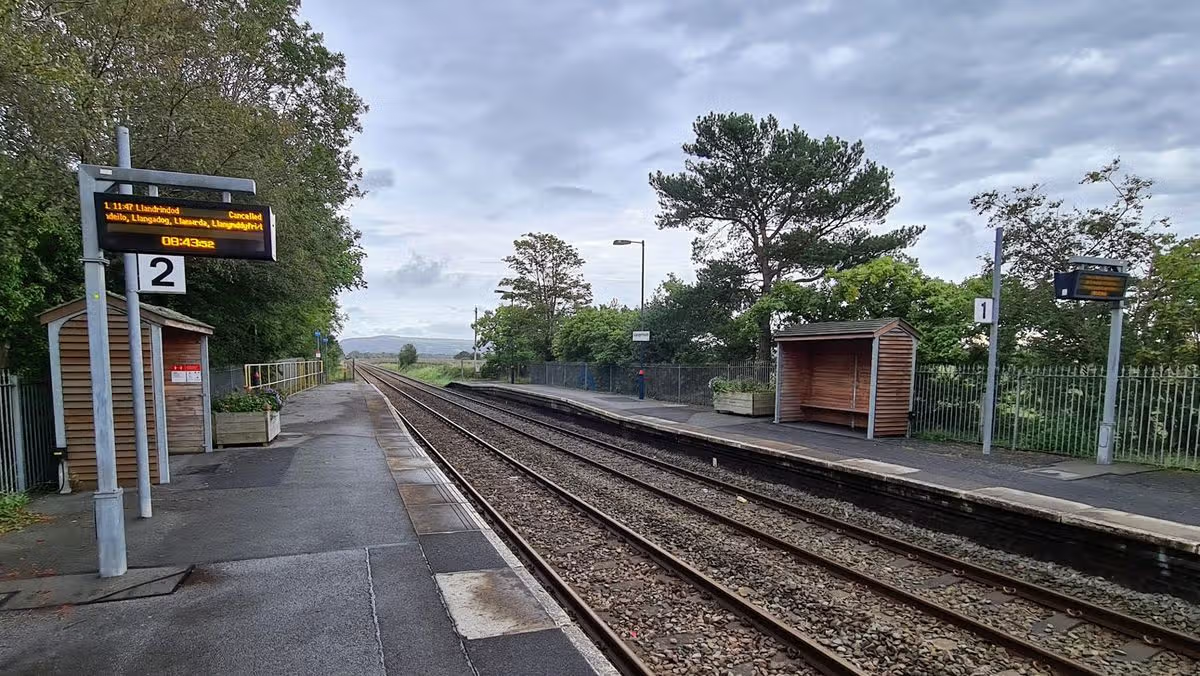
‘Wales needs more railway stations, they do enormous good to society’

Published

on

Wales Online

Professor Stuart Cole finds powerful arguments for more railway stations in Wales in a new report

Advertisement

We usually think of railways and railway stations as places to catch trains. And so they are. They provide us in parts of Wales with an alternative to the motor car particularly for longer journeys; and within the UK where air travel options are few.

Train travel has of course to be accessible, convenient and at an acceptable price to play a more socioeconomic role. It can support inward investment in jobs, our tourism industry (vitally important to Wales) and support housing in relation to work and leisure.

This role of railway stations is set out in a recent report by Development Economics: Growing Places – Railway Stations: Engines of Economic Growth. It illustrates the impact of Great Western main line stations including Carmarthen, a medium size station in terms of passenger numbers handling nearly half-a-million entries and exits annually.

Carmarthen is a historic town with a wide catchment area with a growing rail passenger market (21.5% up on pre-Covid levels).

Advertisement

Also relevant to the south Wales context and considered in the report are Moreton-in-Marsh and Okehampton railway stations which are not dissimilar to Llandrindod or Llandovery on the Heart of Wales Line (HoWL).

Bristol Parkway, parallels proposals for a new station at Felindre on the Swansea District Line (SDL) north of Swansea at M4 junction 46.

The six new stations on the main line between Cardiff and Newport proposed in the Burns Report for south Wales commuter services also fall into the type of stations suggested in the Development Economics report.

This report highlights the expected future developments, in housing or offices, near stations particularly where land is available, as at Felindre.

Advertisement

High frequency reliable train services at Bristol Parkway have attracted over 4,000 houses to date and a further 12,000 expected over the next 10 years.

Employment generated at the 12 stations analysed in the report has reached 3,600 over the past five years and estimates of 20,000 by 2040.

Moreton-in-Marsh in the Cotswolds has features not dissimilar to those of Carmarthen and Llandrindod with historic origins and mid-nineteenth century railway stations.

They all have tourism and agriculture as their economic core.

Advertisement

Good train services and modernised comfortable railway stations will make stations on the HoWL and those west of Swansea more attractive to longer distance visitors from Manchester, London and south-east Wales.

The development of 4,000 houses at Newquay is being significantly enhanced by the Mid-Cornwall Metro (based on heavy rail) and an upgraded Newquay station.

“Strengthening rail connections will open up new opportunities for residents and businesses, attract investment and re-enforce Cornwall’s position as a well-connected and vibrant place to live and work.

Developments such as the Newquay suburban site will support local business, encourage sustainable travel and create a thriving local economy” is the view of the Duchy of Cornwall who are behind the scheme.

Advertisement

This column has often identified the contribution of good transport connections to inward investment. If enhanced rail services are seen as essential in providing greener, more reliable travel choices and stronger links to jobs, education and leisure across south west England then surely this also applies to Wales.

While the scale at Felindre and the six stations in south-east Wales may not quite match the 2.25 million passengers at Bristol Parkway, the principles are the same. There are therefore parallels to be drawn with railway station developments in south Wales.

Railway stations can provide faster home/business to business movements in particular to city centres.

Bristol Parkway provides a parallel to the proposed (SDL) West Wales/Swansea North Parkway station at Felindre as an access point from Swansea and west Wales into the Cardiff jobs market avoiding the congested M4 to the capital.

Advertisement

Adjacent government-owned land on the old Felindre tinplate works site can provide for housing (and a source of commuters) with local economic benefits though household expenditure and employment.

Felindre Parkway and the enhanced SDL route as the Swansea Metro (using heavy rail) will provide a more efficient means of reaching tourism centres in Carmarthenshire and Pembrokeshire saving up to 22 minutes in rail journey times.

The arguments made in the Development Economics report show the importance of railways services and stations in economic development and consequently increased jobs and wealth.

These arguments have been put forward in my Wales in Motion column many times particularly in relation to rural, less densely inhabited parts of Wales and the electrification of the north Wales and south Wales main lines.

Advertisement
  • Professor Stuart Cole CBE is Emeritus Professor of Transport (Economics and Policy), University of South Wales.

Source link

Continue Reading
Click to comment

You must be logged in to post a comment Login

Leave a Reply

NewsBeat

How thousands of firms, from car washes to vape shops and kebab takeaways, have imported migrants on ‘skilled worker’ visas – and why our bloated welfare system is adding to the scandal

Published

on

The Kalar Car Wash is one of more than 140,000 firms in Britain with a Home Office licence to sponsor visas intended to bring in ¿skilled workers¿ from overseas

The men work dutifully, jet-washing cars and vans, soaping them up and drying them off again with a tatty chamois leather.

For just £7, it’s a thorough treatment, paused only momentarily when the team of six share a joke in their native language over bonnets and wheel arches.

As fine a job the boys at Kalar Car Wash do on this industrial estate close to Huddersfield town centre in West Yorkshire, one would be hard-pressed to describe their work as skilled labour.

Yet the car wash is one of more than 140,000 firms in Britain with a Home Office licence to sponsor visas intended to bring in ‘skilled workers’ from overseas.

Advertisement

Hundreds of kebab houses, chippies, chicken shops, vape shops, off-licences, barbers and a handful of hand car washes such as Kalar have successfully applied to become visa sponsors.

They pay just £611 for the privilege, which, in theory, allows them to hire ‘skilled workers’ from far-flung countries who are then given a visa to stay in Britain for up to five years.

After that, they can apply to remain here permanently.

The list of eligible occupations is lengthy but many are obviously designed to plug skills shortages in the country: engineers, doctors, biochemists (these vocations are rightly deemed ‘higher skilled’).

Advertisement

The Kalar Car Wash is one of more than 140,000 firms in Britain with a Home Office licence to sponsor visas intended to bring in ‘skilled workers’ from overseas

Hundreds of kebab houses, chippies, chicken shops, vape shops, off-licences and barbers also successfully applied to become visa sponsors

Hundreds of kebab houses, chippies, chicken shops, vape shops, off-licences and barbers also successfully applied to become visa sponsors

A brief glance at the list of ‘medium skilled’ occupations eligible for visas, however, shows some surprisingly humble roles.

Advertisement

Newsagents, ‘sales supervisors’, and the somewhat vague position of ‘shopkeeper’ are all medium-skilled jobs, according to the Government, making them very attractive propositions for those from abroad who would like to make a new life in Britain.

And who could blame them? Under the current guidelines, those arriving in the country on skilled worker visas must be paid a minimum salary, which is currently set at a rather comfortable £41,700 per year (the average UK salary is £39,000), or the ‘going rate’ for the job, whichever is higher. Sales directors, for instance, must be paid at least £60,000 per year, according to the Home Office.

Dozens of mosques and Hindu temples are also eligible to sponsor staff from overseas under similar ‘religious worker’ visas, which cost applicants just £340 and, if they are successful, allow them to stay in Britain for two years.

One such body, The Islamic Centre of England, in Maida Vale, west London, has a licence to sponsor skilled worker visas and was certainly doing so until as recently as 2022. It remains on the official register of visa sponsors, but it is currently the subject of an ongoing Charity Commission investigation for alleged close ties to the hardline Iranian regime.

Advertisement

Among the small print in the application process is one particular caveat – those applying for the visas must also have a solid grasp of English.

Which takes us back to Kalar Car Wash. When the Daily Mail visited last month to ask about the firm’s sponsorship of visas, none of the men could speak English other than to tell our reporter that ‘the boss’ was ‘on holiday’.

They were also unable to tell us whether they themselves had taken advantage of Britain’s generous visa system.

But with the business currently licensed to sponsor workers, with bosses having gone to the trouble of completing the application process, one may question which other skilled roles might be on offer.

Advertisement

Conservative MP Neil O’Brien told the Daily Mail that bringing in overseas workers for jobs in vape shops and car washes was ‘farcical’, adding the visa scheme was ‘yet another back door in our broken immigration system’.

MP Neil O¿Brien said bringing in workers for jobs in vape shops and car washes was ¿farcical¿, adding the visa scheme was ¿yet another back door in our broken immigration system¿

MP Neil O’Brien said bringing in workers for jobs in vape shops and car washes was ‘farcical’, adding the visa scheme was ‘yet another back door in our broken immigration system’

The Home Office claims that since tightening up the skilled worker scheme last summer to focus on graduate-level professions – and increasing the minimum salary requirements – refusal rates have increased and businesses such as kebab shops are now unlikely to be eligible to sponsor workers.

Be that as it may, last month, the Daily Mail travelled across the country to investigate the skilled worker visa for ourselves and to ascertain whether it seems that its generous terms are being exploited.

Advertisement

The results would suggest that, despite the Labour government’s attempted crackdown, it remains a well-trodden route to Britain and highlights a largely overlooked crossroads where seemingly lax immigration rules meet our infamously bloated welfare state.

Leaning on the glass counter towards the rear of his Middlesbrough shop, surrounded by thousands of vapes of every size, colour and shape imaginable, Shehzad Iqbal, 41, is frank about his willingness to use the skilled worker visa.

His firm, Swift Mobiles and Vapes, has been eligible to sponsor workers for a number of years and currently has one employee on the scheme, who arrived in Britain two years ago from Mr Iqbal’s native Pakistan.

But, according to the shopkeeper – who has lived in the north-east town for 13 years – he is not averse to employing local people.

Advertisement

‘The people in the local area don’t want to work, honestly,’ he claims. ‘I advertised for staff on Facebook, I spoke to a few people and asked them to come in but they didn’t show up.’

He added that, in contrast, those employed from abroad ‘know they have to come and know they have to work’ to maintain their visa status.

‘It’s a good scheme,’ he said. ‘People who are coming, they are working perfectly. If there were people who wanted to work from here [Middlesbrough] I would be happy to get them.

‘But the problem is they don’t come, they just p***-take.’

Advertisement
Shopkeeper Shazad Iqbal has been eligible to sponsor workers for a number of years and currently has one employee on the scheme, who arrived in Britain two years ago from Pakistan

Shopkeeper Shazad Iqbal has been eligible to sponsor workers for a number of years and currently has one employee on the scheme, who arrived in Britain two years ago from Pakistan 

He admitted the basic salary might seem high for the work involved, which predominately involves fixing mobile phones and laptops as well as serving customers purchasing vapes, but added: ‘If you want to work, you can earn good money.

‘A lot of people want to chill out, want to stay on benefits. The Government has to stop benefits and then people would work.’

He said he is not currently looking to bring in more workers from overseas but ‘if we need to, we can do it’.

Advertisement

Perhaps somewhat more controversially, the skilled worker visa also allows the applicant’s partner and children to join them in Britain as ‘dependants’. The visa holder must show they have been working continually in a ‘medium- skilled’ role since at least July last year – and then their immediate family can join them.

Brothers Irfan and Irslan Rabani are genial company. Stripping boxes from pallets outside their Premier convenience store in Stockton-on-Tees, County Durham, they are happy to discuss their route to Britain.

Irslan, 30, and Irfan, 28, successfully applied for skilled worker visas to work at the shop, which is owned by their brother, Adnan, 32. All three came to Britain from Pakistan.

When the Daily Mail visited last month, Home Office officials had just arrived and were discussing the business with the oldest brother.

Advertisement

Asked for their job titles, Irslan and Irfan describe themselves as ‘retail managers’. Handily, such an occupation is classed as ‘medium skilled’ by the Government and therefore eligible for the skilled worker visa scheme.

The title is vague enough to allow plenty of room for manoeuvre: the brothers describe how they stack shelves, serve customers and organise the rota for other employees.

Irslan and Irfan (pictured) applied for skilled worker visas to work at this Stockton Premier shop, which is owned by their older brother, Adnan. All three came to Britain from Pakistan

Irslan and Irfan (pictured) applied for skilled worker visas to work at this Stockton Premier shop, which is owned by their older brother, Adnan. All three came to Britain from Pakistan

Stonegate's shopkeeper claims she uses the scheme because she can't employ staff locally, with prospective workers ¿coming in for a week, then they don¿t return for the next¿

Stonegate’s shopkeeper claims she uses the scheme because she can’t employ staff locally, with prospective workers ‘coming in for a week, then they don’t return for the next’

Advertisement

Irslan says he earns around £26,500, which was the salary requirement until March 2024 and is far from the current minimum. There is no suggestion they have done anything wrong, as they were eligible to extend their visas under the old requirements.

Irfan first came to the UK to study at Coventry University in 2018 on a student visa, later switching to a skilled worker visa at his brother’s shop, he says.

Asked why the firm needs to hire from abroad rather than look to the local area, his response echoes Mr Iqbal’s from a few miles away in Middlesbrough.

‘I’ve been here for eight years and we haven’t had a single person, a local person, come and ask for a job,’ he says.

Advertisement

‘Not one. If no one comes to ask for a job I can’t go and knock on their door and say, “Come, please, work here.” So we have to hire from outside. It doesn’t make any sense.’

The criticisms may be a reflection of the benefits boom in Britain, with a record four million people claiming Personal Independence Payment (PIP) for disabilities in England and Wales as of April this year – 83 per cent of those are of working age.

Disability benefits, which can total up to £200 per week per person, are being paid out to a record number of people. This is largely due to an increasing number of claimants arguing that their ADHD or depression renders them unable to work.

The Bargain Stonegate off-licence on the outskirts of Leeds is a typical corner shop. Any jobs on offer are relatively rudimentary. But this business has also taken advantage of the skilled worker scheme – bringing in one shop assistant from India.

Advertisement

Again, the shopkeeper, also from India, claims the reason for doing this is because she can’t employ staff locally, with prospective workers ‘coming in for a week, then they don’t return for the next’.

Her employee also earns far less than the current minimum salary as she was hired before changes to the Home Office rules.

In Harrow, north London, another business – Sam’s Chicken – arranged to bring in 12 migrants on skilled worker visas to work at the chicken shop over a four-year period, GB News reported.

Mr O’Brien, a critic of the scheme, said: ‘The scale of abuse in the skilled worker visa system is becoming impossible to ignore.’

Advertisement

He criticised the possibility of ‘workers from abroad being brought in to work in vape shops and car washes while over a million young Britons are out of work and out of education’.

‘These are plainly not skilled jobs,’ he added. ‘And there are Brits here just as qualified to do them. This is yet another back door in our broken immigration system which the Government must act urgently to shut.’

It would appear the Government has two pressing issues.

Stopping Britain appearing as the land of milk and honey to those who want to come from overseas – while convincing the British that plugging gaps in the jobs market is a better option than relying on our notoriously generous benefits scheme.

Advertisement

To do that, some extraordinarily tough – and ruthless – decisions must be made.

A Home Office spokesman said: ‘Thanks to our decisive action to raise the skilled salary threshold, these kinds of businesses are incredibly unlikely to get a licence approved.

‘Companies must apply for the appropriate sponsor licence. The holding of a licence does not guarantee that it is in use nor that any sponsored visa application will be approved by the Home Office following a rigorous assessment process.

‘Holding a sponsorship licence is no guarantee of a visa and all licences are determined on a case-by-case basis.

Advertisement

‘To further protect the system from abuse, more than 100 occupations have been cut from overseas recruitment access.

‘Meanwhile, skilled sponsor revocations went up by 950 per cent in 2025 compared to 2023.’

Source link

Advertisement
Continue Reading

NewsBeat

Why diners rate Mumbai among Hartlepool’s best Indian’s

Published

on

Why diners rate Mumbai among Hartlepool’s best Indian's

Set beneath the historic Grand Hotel on Swainson Street, it is the kind of place that turns a straightforward curry night into a proper evening out.

The restaurant is based inside the Best Western Grand Hotel, it has an impressive 4.5 out of 5 rating from 383 reviews and is listed as the number one Indian restaurant in Hartlepool on Tripadvisor’s dining listings.

@leaheaston7 Hands down the best Indian restaurant in hartlepool wowza #indianfood Mumbai 😍 @Mumbaiatthegrandhotel ♬ original sound – Leah easton

One reviewer called it “probably the best Indian meal I have ever eaten”, praising the “authentic and delicious” food, large portions and reasonable food and wine prices.

Advertisement

The restaurant is independent of the hotel but operates from its basement dining space, giving it a slightly unexpected setting for one of the town’s most highly regarded Indian meals.

Rather than a standard hotel dining room, Mumbai has built its own following for Indian cooking.

A meal here can be as familiar or as adventurous as you want it to be, with a mix of classic dishes, including masala, korma, pathia and vindaloo, alongside lesser-known options and house specials.

For a restaurant that is tucked beneath a hotel on a central Hartlepool street, it has managed to become a destination in its own right.

Advertisement

The Grand Hotel setting means it is also a useful choice for visitors staying in Hartlepool, with the restaurant located at the same address as the hotel and just a short distance from the town’s main amenities.

With its strong review record, central location and menu that spans old favourites and more unusual Indian dishes, Mumbai at The Grand is one of those places in Hartlepool that feels worth knowing about before the next time somebody asks where to go for a really good curry.

Source link

Advertisement
Continue Reading

NewsBeat

BBC Weather in crisis: Longtime presenters Tomasz Schafernaker and Louise Lear are ‘considering quitting the channel’ after bosses announced huge cuts

Published

on

BBC Weather's longtime presenters including Tomasz Schafernaker and Louise Lear (pictured) are reportedly considering leaving the channel over plans for huge cuts by bosses

Advertisement

BBC Weather’s longtime presenters including Tomasz Schafernaker and Louise Lear are reportedly considering leaving the channel over plans for huge cuts by bosses.

As part of a focus on digital content, sources claim that bosses are planning to downsize their national weather team, leaving some of its most dedicated stars eyeing an exit.

It’s thought that Tomasz, Louise and Darren Bett are considering voluntary redundancy over changes to BBC Weather that were announced last week. None of them have taken up the offer yet.

Bosses shared last week that they plan to ‘make more of their much-loved local weather presenters,’ meaning a reduction in the number of forecasts delivered by national presenters.

Advertisement

These new plans will reportedly include cuts to the number of national weather presenter roles from 11 to 4.5.

An insider claimed that the changes come as the traditional weather forecast has become ‘less relevant,’ with a focus on digital content coming from a ‘need for more reporting than presenting.’  

BBC Weather’s longtime presenters including Tomasz Schafernaker and Louise Lear (pictured) are reportedly considering leaving the channel over plans for huge cuts by bosses

Advertisement

A source said: ‘It’s the end of an era for our weather presenting. The audience wants a bit of digital and TV – including a good old fashioned forecast.’

A weather presenter also told The Times that their team should be protected from the wider cuts that have impacted the BBC.

They said: ‘The team is already very lean and punched above its weight for many years producing a huge amount of output across all platforms 24 hours a day. It isn’t fair to compare it to the behemoth that is the rest of BBC News.’

Tomasz has been working at the BBC since 2000, while Louise has hosted bulletins for TV and radio for nearly 30 years.

Advertisement

Darren was chosen as one of the original launching team members for BBC News 24 in 1997 having previously spent three years working for local Look North.  

The BBC shared that local presenters will play a key role in future TV weather broadcasts at lunchtimes and weekends.

The Today programme, BBC Breakfast, and the weekday editions of the News at Six will feature separate national forecasts from network weather presenters, as will the News at Ten for a trial period. 

It's thought that Tomasz (pictured), Louise and Darren Bett are considering voluntary redundancy after learning of plans to downsize the national weather team

It’s thought that Tomasz (pictured), Louise and Darren Bett are considering voluntary redundancy after learning of plans to downsize the national weather team

Advertisement

The half-hourly updates on the news channel are being scrapped in favour of automated forecast graphics. Radio forecasts will be read by programme presenters and announcers. 

Jonathan Munro, Interim CEO of BBC News, said: ‘As this summer’s heatwaves have proved, up-to-the minute and accurate weather information has never been more important. 

‘I’m looking forward to our partnership with the Met Office – this is a very apt time for our two trusted national institutions to be reunited.’

The moves come as part of BBC’s plans to cut costs by £500 million over the course of two years, which will result in a loss of up to 2,000 jobs.

Advertisement

Viewers have already seen this through the axing of several much-loved shows, including Live At The Apollo, Celebrity Mastermind and Blankety Blank.

BBC Breakfast has also been put on the chopping block and will no longer be shown on Sundays from September.

Meanwhile, the production teams making Sunday with Laura Kuenssberg and Newsnight will merge, while Radio 4’s The World Tonight has also been axed.

Other plans in the announcement include TV production at weekends being shared across the News Channel and BBC One bulletins.

Advertisement

Broadcast TV channels and the radio network portfolio will also be reviewed as audiences move online.

The corporation will also review its chief news presenter roles.

Those roles include Clive Myrie, Ben Brown, Sally Bundock and Geeta Guru-Murthy.

Victoria Derbyshire and Faisal Islam are also chief presenters on Newsnight, while Jon Kay and Sally Nugent are chief presenters on BBC Breakfast.

Advertisement

Around 100 to 150 hours of originated programmes across all commissioning genres will be reduced by the end of the 2027 to 2028 financial year.

Advertisement

Source link

Advertisement
Continue Reading

NewsBeat

Red Honda quad bike stolen from farm on Yorkshire coast

Published

on

Red Honda quad bike stolen from farm on Yorkshire coast

North Yorkshire Police is appealing for information about the theft in Lebberston, near Scarborough, overnight on Saturday, June 27

The force on Sunday (August 9) issued a photograph of the red Honda Foreman 400 that was stolen, urging anyone who sees it to get in touch.

“If you can help our appeal, please email steven.holloway@northyorkshire.police.uk,” a police spokesperson said.

Advertisement

“If you wish to remain anonymous, you can pass information to Crimestoppers on 0800 555 111.

“Please quote reference 12260144570 when passing on information.”

Source link

Advertisement
Continue Reading

NewsBeat

I’ve stayed in some of the most expensive places in the world… for free. Here’s how I did it and the money-saving hacks you need to use

Published

on

I have been lucky enough to stay in some of the world¿s most glamorous hotels ¿ some are worth every penny, others not so much, writes former luxury travel editor Susan Ward Davies

Advertisement

I was the Travel and Lifestyle Editor at ELLE for more than 30 years, so I know a thing or two about globetrotting in style.

The life of a travel writer may sound glamorous but you still have to keep costs down. When reviewing a remote five-star hotel, for example, your meals might not be included, and you could find yourself living off the welcome bowl of fruit.

Luckily, I did a lot of backpacking before becoming a travel editor, and being resourceful kicks in like muscle memory. I still take a high-low approach to holidays, and I strongly believe in spending on things that make a difference, and not on things that don’t – read on for my tips on how to luxe-up your holiday for less.

LUXEMAXXING

I have been lucky enough to stay in some of the world’s most glamorous hotels – some are worth every penny, others not so much. 

Advertisement

If you are going to splurge a good chunk of your pay packet on a night or two, you want to be sure you make the most of every minute. One tip is to stay in an Airbnb for the first few days before switching to somewhere more luxurious for the final day or two.

To really make the most of it, check in early – it doesn’t matter if your room’s not ready, simply ask them to store your bags and head to the pool, beach or spa.

On departure day, see how late you can push the checkout, then ask the front desk to look after your bags till the evening. That way, you get two days for the price of one.

Advertisement

I have been lucky enough to stay in some of the world’s most glamorous hotels – some are worth every penny, others not so much, writes former luxury travel editor Susan Ward Davies

If you are going to splurge a good chunk of your pay packet on a night or two, you want to be sure you make the most of every minute. One tip is to stay in an Airbnb for the first few days

If you are going to splurge a good chunk of your pay packet on a night or two, you want to be sure you make the most of every minute. One tip is to stay in an Airbnb for the first few days 

LOCATION, LOCATION

Skip the pricey hotel restaurant and shop around for a more authentic experience.

One of the best apps is Too Good to Go which lists discounted food from local stores, restaurants and supermarkets in 21 countries, not only saving money but giving you an idea of where to shop and eat.

Advertisement

On Google maps use local language terms such as épicerie (France), alimentacion (Spain), una gastronomia (Italy) to find independent stores rather than supermarket chains.

When looking for local restaurants, be specific on social media: ‘where to eat truffles in Istria’, or ‘best pinxtos in San Sebastian’.

To get into town, resort hotels often run free shuttle services but if not, check taxi fares on taxi-calculator.com or bettertaxi.com to make sure you don’t pay over the odds.

BAR CULTURE

In Italy, Spain, France and Portugal it is cheaper, and more authentic, to have your coffee, pastries, tapas and sometimes alcohol at the bar (al banco, a la barra, au comptoir and ao balcão respectively) rather than at a table.

Advertisement

So skip an expensive, sit-down, multi-course dinner and instead, perch on a stool and order a few tapas with a crisp wine spritzer. The different pricing tiers should be listed on menus.

In Italy, Spain, France and Portugal it is cheaper, and more authentic, to have your coffee, pastries, tapas and alcohol at the bar rather than at a table, writes Susan Ward Davies

In Italy, Spain, France and Portugal it is cheaper, and more authentic, to have your coffee, pastries, tapas and alcohol at the bar rather than at a table, writes Susan Ward Davies

Advertisement

Source link

Advertisement
Continue Reading

NewsBeat

Innocent father arrested, thrown in police cell for 16 hours and unable to drive for four months after DVLA error meant he was handed SOMEONE ELSE’S driving ban

Published

on

Andrew Lees, 47, who was wrongly accused of driving while disqualified after a clerical error saw someone else's crime added to his driving licence record

An innocent father spent 16 hours in a police cell and four months unable to drive after a devastating clerical error wrongly branded him a disqualified driver.

IT consultant Andrew Lees, aged 47, feared he could go to jail after being arrested while driving his wife’s Kia Sportage near their home – when police checks incorrectly showed he had been banned from the roads.

But the driving offences that triggered the disqualification did not belong to him and had been mistakenly copied onto his DVLA record.

Before his arrest, Mr Lees had repeatedly tried to resolve the issue himself, contacting the Single Justice Service after discovering the error via a DVLA letter in November 2025.

Advertisement

The letter told him he was banned from driving at Carlisle Magistrates’ Court after receiving 19 penalty points.

The ban had been imposed under the controversial Single Justice Procedure which sees magistrates convict drivers for minor motoring offences behind closed doors in fast-track hearings without them being represented.

The case was heard in Carlisle because it is a centre for handling Single Justice Procedure cases but the offences are understood to have been committed by another driver in Greater Manchester. 

Mr Lees, who had never appeared before the courts before, went to ‘considerable lengths’ to get to the truth of how he was falsely implicated.

Advertisement

But he was unable to obtain a response or even identify the court file responsible for the incorrect record.

Andrew Lees, 47, who was wrongly accused of driving while disqualified after a clerical error saw someone else’s crime added to his driving licence record

Mr Lees, who lives with his family in the leafy suburb of Sale, Greater Manchester, said: ‘I absolutely knew those points were not mine. I thought it was just an admin error that would be easily cleared up.

Advertisement

‘But, after repeated emails, letters and calls to the DVLA, to the Cumbrian Magistrate’s Court and to the Single Justice Service, I had no resolution.

‘It was clearly a mistake, so I genuinely thought it would be ok to drive.’

However, worse was to come for Andrew three months later.

His ordeal came to a head in February when he was stopped by police while driving. Because official records wrongly showed he was disqualified, officers arrested him and held him in custody for 16 hours.

Advertisement

Andrew said: ‘They pulled me over, breathalysed me twice and then said ‘let’s just get in the back of the van and we can sort this out’. Suddenly I’m arrested and heading to the cells.

‘It was terrifying. The officers just wouldn’t listen to what I was telling them. I was locked up eight miles from home for something I hadn’t done and facing a court case which could lead to jail.

‘I tried to stay strong in the cells, but inside I was crying my eyes out.’

Mr Lees said the mistake had a huge impact on his family life and prevented him from carrying out everyday tasks, including the school run

Mr Lees said the mistake had a huge impact on his family life and prevented him from carrying out everyday tasks, including the school run

Advertisement

While in the cells, he said the only food was ‘pot noodles for breakfast, lunch and dinner’. 

After being released on bail and given a June court date, Andrew was then facing four months being unable to drive.

Mr Lees said the mistake had a huge impact on family life, preventing him from carrying out everyday tasks, including the school run and taking his daughters, aged nine and five, to extracurricular activities or birthday parties.

The family instructed criminal defence specialists Olliers Solicitors, which now added the expense of hiring a top legal firm to their other challenges.

Advertisement

After examining the records, Olliers specialist motoring solicitor Austin Anderson-Brettell discovered that offences committed by another defendant had been incorrectly assigned to Mr Lees’ driving licence number.

Despite informing the Crown Prosecution Service of this fact, they didn’t immediately drop the case.

Mr Anderson-Brettell said: ‘It beggars belief that the case got this far. It should not have needed a legal professional to make it right. This could have been rectified so easily.

‘There were so many steps that could have been taken by the court, the police and the prosecution to have avoided Mr Lees going through this awful ordeal and wasting so much taxpayers’ money.’

Advertisement

Following representations made by Olliers, the Crown Prosecution Service finally dropped the case – the day before it was due to be heard in court.

Mr Lees said: ‘The relief when I got the call from Austin was amazing.

‘I immediately took two days off work and just drove. I drove to Wales and Scotland and enjoyed the freedom to finally get behind the wheel again.’

His lawyer has called for reform of the Single Justice Procedure.

Advertisement

Mr Anderson-Brettell said: ‘The system has significant flaws that cannot be ignored. The main flaw is the lack of transparency.

‘Justice must not only be done, but must be seen to be done. 

‘By allowing cases to be determined behind closed doors, the Single Justice Procedure at times risks undermining public confidence.

‘There are also concerns that the process increases the risk of convictions being secured without meaningful engagement from defendants. 

Advertisement

‘In some cases, important mitigation is not properly considered, vulnerable individuals do not receive the attention and consideration they require and questions about whether a prosecution is truly in the public interest goes unscrutinised.

‘Unless these concerns are addressed, there is a real risk that the system will continue to produce avoidable mistakes and injustices (such as this one), eroding confidence in the justice process it was designed to improve.’

Despite his eventual success in halting the court action, Mr Lees’ wife’s car remains still impounded by Greater Manchester Police, despite attempts to reclaim it.

The CPS said the accusations against Mr Lees were of a category where police can authorise charges without consulting them.

Advertisement

It was not until the case was reviewed by a Crown Prosecutor, the day before it was due to come to court, that the prosecution ‘immediately decided the matter should be discontinued’.

A Greater Manchester Police spokesperson said: ‘Officers acting on good faith with incorrect information from a clerical error made the arrest of a man in relation to a driving offence.

‘Once this error was rectified, the matter was discontinued and the crime closed. The car has since been passed back to a third party pending final release.’

Source link

Advertisement
Continue Reading

NewsBeat

Sadiq Khan demands sweeping changes to West End licensing rules in furious row with Westminster Tories

Published

on

Sadiq Khan demands sweeping changes to West End licensing rules in furious row with Westminster Tories

He added: “Westminster’s proposed approach would, if adopted, undermine City Hall’s efforts, supported by London businesses and others, including UK Hospitality, the Night Time Industries Association and Music Venue Trust, to make London’s nightlife the best in the world.“

Source link

Continue Reading

NewsBeat

Spy cameras on Navy drones used by Britain’s elite special forces ‘secretly sent data to China’

Published

on

The K3 Scout drones, operated by Royal Marines, were found to be transmitting so-called 'heartbeat' communications to an IP address in China

Royal Navy surveillance drones used by Britain’s elite special forces were fitted with cameras containing Chinese-made components that were secretly sending data to an address in China.

The K3 Scout drones, operated by Royal Marines, were found to be transmitting so-called ‘heartbeat’ communications to an IP address in China.

The signals were designed to tell a remote device that the cameras were online and operating normally.

The discovery has triggered national security concerns and forced the Ministry of Defence to strip the cameras of their internet connectivity.

Advertisement

Officials insist there is no evidence that sensitive military information or Ministry of Defence systems were accessed or transmitted overseas.

But the revelation has raised fresh questions about the security of Britain’s military supply chains – and whether Chinese technology has found its way into highly sensitive areas used by special forces.

The £12million fleet has been in use since March and was supplied by British defence contractor Kraken Technology Group.

Kraken had sourced the cameras from a third-party supplier which had provided assurances over their security.

Advertisement

The K3 Scout drones, operated by Royal Marines, were found to be transmitting so-called ‘heartbeat’ communications to an IP address in China

Defence Secretary Wes Streeting poses with outgoing Chief of Joint Operations, Lieutenant General Nicholas Perry (left), and incoming Chief of Joint Operations, Air Marshal Allan Marshall (right)

Defence Secretary Wes Streeting poses with outgoing Chief of Joint Operations, Lieutenant General Nicholas Perry (left), and incoming Chief of Joint Operations, Air Marshal Allan Marshall (right)

An investigation subsequently discovered that the cameras contained components manufactured in China and were communicating with an IP address in the country.

Advertisement

The incident was considered serious enough to prompt concerns over the potential exposure of personnel at the Special Boat Service headquarters in Poole, Dorset.

There are also fears that the cameras may have been operating in the vicinity of sensitive meetings involving senior special forces personnel.

Particular concern has been raised over reports that the cameras could remain active even when the drones themselves had been switched off.

A defence source familiar with the matter told the Telegraph the drones had been used during preparations for a potential British defence package designed to help protect freedom of navigation through the Strait of Hormuz.

Advertisement

The source described the discovery as a serious procurement failure, saying confidence in the platform had been lost.

The incident is a major blow to Project Beehive, the Royal Navy programme aimed at integrating unmanned vessels with conventional warships.

The K3 Scouts form part of the Navy’s surface flotilla and are operated by the Coastal Forces Squadron and 47 Commando Royal Marines.

The unmanned vessels are intended to give British forces greater surveillance and war-fighting capabilities while reducing the risks to personnel.

Advertisement

The K3 Scout is capable of carrying a payload of up to 600kg and can operate continuously for as long as 30 days.

The system has also been acquired by US Special Operations Command and has taken part in Nato exercises and trials in the Baltic.

The discovery comes as Britain faces growing warnings over the potential security risks posed by China’s dominance of global technology and manufacturing supply chains.

Alicia Kearns, the shadow security minister, called for urgent scrutiny of military equipment containing components sourced from China

Alicia Kearns, the shadow security minister, called for urgent scrutiny of military equipment containing components sourced from China

Join the discussion

Advertisement

How should Britain protect its military from hidden foreign tech threats in our supply chains?

Alicia Kearns, the shadow security minister, said: ‘If we cannot say with confidence what is inside our own military equipment, we cannot say it is ours, or that we are sovereign.’ 

She called for urgent scrutiny of military equipment containing components sourced from China, warning that the incident demonstrated the risks posed by hidden vulnerabilities within apparently British systems.

The concerns come amid a wider series of warnings over Chinese technology.

Advertisement

Last year, MI5 warned MPs that Chinese intelligence services were making persistent efforts to interfere with and influence Parliament, including through professional networking platforms used to gather information.

The warning followed the collapse of a case involving two men accused of spying for China, after prosecutors faced difficulties in establishing the required legal classification of Beijing as an enemy state.

Britain has previously taken action against Chinese technology on national security grounds.

In 2020, the then Conservative government ordered the removal of Huawei equipment from the UK’s 5G network after security concerns were raised over the company’s links to China and the potential risks posed by Beijing’s national security laws.

Advertisement

More recently, vulnerabilities in military supply chains have led the MoD to remove Chinese-made hardware and cameras from sensitive locations.

The Labour Government has pursued a diplomatic reset with Beijing, including high-level visits aimed at improving relations and securing new trade opportunities.

Earlier this year, ministers approved plans for a controversial Chinese super-embassy at Royal Mint Court in London, despite concerns over the site’s proximity to sensitive communications infrastructure.

The case also comes shortly after British citizen and Hong Kong pro-democracy media tycoon Jimmy Lai was sentenced to 20 years in prison under the territory’s national security laws.

Advertisement

The MoD said the vulnerability was identified during a routine cyber security assessment.

It said investigators found no evidence that MoD information or systems had been accessed, compromised or transmitted outside approved channels.

An MoD spokesman said: ‘Our assurance and testing processes are designed to identify and address potential vulnerabilities early, and we continue to undertake routine security activity across our systems and equipment.’

Kraken Technology Group said it was aware that some of the cameras used in its systems contained a small number of components originating outside Britain.

Advertisement

The company said it had carried out a full audit alongside the Royal Navy and was satisfied that no sensitive information had been shared outside authorised channels, adding that any potential vulnerabilities had been identified and closed.

The cameras had been described as NDAA-compliant, a US defence procurement designation intended to ensure equipment does not contain components from prohibited manufacturers.

Source link

Advertisement
Continue Reading

NewsBeat

Bananas won’t turn brown if stored with 1 kitchen item that keeps them fresher for longer

Published

on

Wales Online

There’s an easy way to stop bananas from going brown and mushy quickly

Their wonderfully sweet flavour and minimal calorie content make bananas a perfect snack, but they do come with the drawback of having a relatively short shelf life.

If you purchase an entire bunch at the supermarket, you’ll frequently discover that several have gone brown and soft before you’ve had the chance to eat them, often resulting in unnecessary waste. When kept at room temperature, bananas typically last anywhere between two and six days, though this can differ depending on how ripe they are at the point of purchase.

Advertisement

Once fully ripe, they begin to turn brown rather rapidly, but will generally hold out for a few days before their texture and flavour become compromised. Unfortunately, bananas ripen more quickly in warmer conditions, and with summer well under way, you may notice your bananas are browning at an even faster rate.

Fortunately, it is possible to slow down the ripening process and preserve bananas for longer with a clever storage technique, which simply involves wrapping the stems in tin foil.

Tin foil works by trapping ethylene gas, a naturally occurring plant hormone that triggers and speeds up the ripening process, causing bananas to ripen and soften, reports the Express.

Advertisement

The gas prompts starches to convert into sugars and breaks down cell walls, which is what brings about a change in colour and texture in the fruit, turning green bananas yellow and sweeter, while yellow bananas will gradually begin to turn brown. Ethylene gas is mainly released from banana stems, so containing it with tin foil can help delay ripening and stop the fruit from browning too rapidly, thus prolonging its shelf life and maintaining its freshness for longer.

In its online guidance on preventing bananas from ripening too swiftly, Food Republic said: “Compared to other fruits and veggies, bananas are one of the biggest producers of ethylene gas, a natural chemical compound that promotes ripening.

“The majority of this gas is released through the exposed stem of the fruit, which allows a bunch of bananas to continue ripening even after it’s picked from the tree.

“Wrapping the top of your bunch with aluminium helps to trap in some of the ethylene, so it won’t escape into the atmosphere and touch the body of the bananas (or other produce you have sitting nearby, for that matter). This slows down browning and gives you more time to enjoy your bunch.”

Advertisement

If you haven’t got any tin foil available, then cling film should perform equally well, and both usually cost under £2 at most leading supermarkets.

It’s also advisable to keep your bananas separate from other fruit once you’ve covered the stems, as the ethylene gas can prompt neighbouring fruits to ripen more rapidly, meaning they will deteriorate sooner.

Numerous fruits react to the ethylene gas emitted by bananas, including apples, pears, and passion fruit, but citrus fruits like oranges and lemons remain unaffected. To prevent damaging other fruits, specialists advise hanging your bananas on a banana hook as this not only maintains separation but also avoids bruising that can occur from resting bananas against the kitchen counter.

Source link

Advertisement
Continue Reading

NewsBeat

Enchanting ‘hideaway under the stars’ in Scottish Highlands comes with private fairy pools

Published

on

Daily Record

Those who dream of staying in an enchanting Airbnb which feels like stepping into a ‘fairytale world’ can book this magical hideaway home in the Scottish Highlands.

Earthen Home situated in rural Moray, is described as a multiple award-winning hideaway ‘under the stars’ at the foothills of Ben Rinnes with spectacular views from every window.

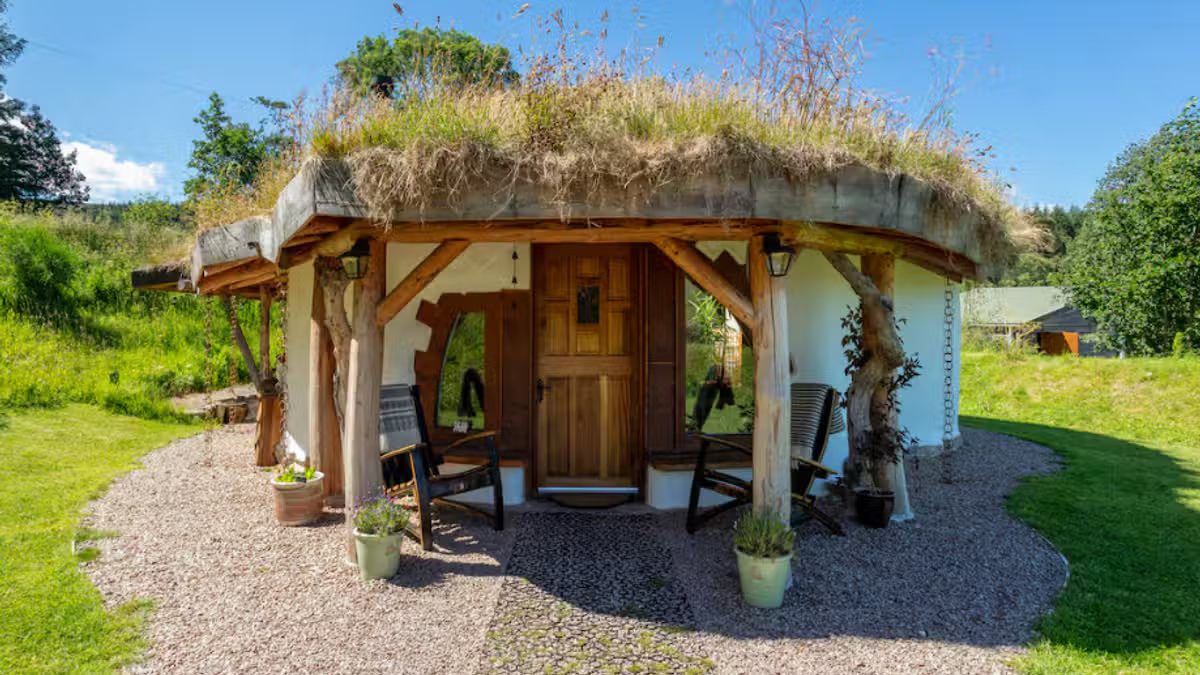
This whimsical little Hobbit hut-style property, which is surrounded by nature and wildlife, sleeps four guests with two bathrooms and even comes with its own private fairy glen and pools that guests can enjoy a dip in.

On the outside, this natural home resembles something out of a fantasy film with an earthy moss-covered roof and large irregular tree trunk branches forming a covered porch at the entrance.

Advertisement

The property, which caters to three nights minimum stays, is surrounded by lush green grass in the open countryside at the foothills of Moray’s highest mountain with its rural setting making it the perfect peaceful escape.

Inside, the Earthen Home is open plan but is also deceptively spacious with room to comfortably accommodate four people in two quirky bunks and a double bedroom.

Advertisement

To add to the cosy feel, there is a wood-burning fire beside a cob sofa in the living area. There is also a spacious shower room with additional storage, instant hot water, and a flushing toilet.

The Airbnb listing states that guests are provided with firewood, towels, cruelty-free soaps & cleaning products, cooking essentials, and a variety of Fairtrade beverages. Dogs are also welcome to stay at the home and are provided with a treat, 2 bowls, and a towel.

Despite being so remote, the earthen home comes with unlimited wifi and a Bluetooth speaker. However, there also more traditional forms of entertainment inside such as books, games, jigsaw puzzles and giant Jenga.

Advertisement

In addition to this, the property comes with a private garden kitted out with a fire pit, BBQ, various seating areas and outdoor games.

Guests have full access to the child-friendly wider garden too which includes wide-open spaces to run and play, including a play den and a quirky seesaw.

There, you can pick your own fresh and seasonal produce for dinner in the property’s Garden of Eat’n, and learn about our permaculture garden and natural builds if it’s of interest.

Advertisement

Chickens and Indian Runner ducks also live on the grounds and visitors are welcome to meet the animals and enjoy some fresh eggs when in season.

The listing adds: “You are surrounded by wildlife, a multitude of birds, and you may spot a few passing deer, or on a rare occasion, an otter swimming down the stream. Be prepared to be amazed!”

That’s not all as down the bottom of the garden guests will also find an enchanting Fairy Glen with a witch’s hut, magic cauldron witches kitchen, bubbling brook, mini waterfalls, hidden fairies, and fairy pools for a refreshing dip.

Advertisement

At night guests can soak up the total lack of air, noise, and light pollution and a spot of stargazing with a Dobsonian telescope.

The closest village to the property is Aberlour, which is a 5-minute drive or a 45-minute walk away while Elgin is the closest city about a 40 minute drive away.

Earthen Home receives excellent reviews on Airbnb and is recognised in the top one per cent of highest ranked homes on the website based on ratings.

One impressed guest gushed: “Hideaway under the stars is a must stay! Magical is the best word to describe this place.

Advertisement

“The amount of effort that has been put into the place is phenomenal. The attention to detail is unmatched! Theres something for everyone here.

“The peace and quiet was amazing, so nice to block out the rest of the world and reconnect with nature and your family. Honestly hands down the best place we have stayed. Highly recommend.”

Another added: “I’m not sure I have enough words to review Kim as a host and her property. Incredible. Simply incredible. The place is so earth centered and nature focused, but with every detail and amenity thoughtfully addressed.”

Advertisement

More details on the Earthen Home listing can be found here.

Source link

Continue Reading

Trending

Copyright © 2025