It was, in the words of one insider, ‘the day the King’s patience snapped’.
After weeks of dithering and flip-flopping, not to mention the repeated leaks and briefings by Team Sussex, His Majesty was pushed to breaking point. Enough was enough.
What prompted him to slap down his younger son wasn’t the embarrassment it was causing him personally to see their family difficulties being played out in such a public arena.
It was, as one source described to me yesterday, the ‘disruption and disrespect’ to his staff.
Buckingham Palace, you see, isn’t quite ready for visitors at the moment, let alone ones as high-profile as the boss’s son.
It’s still largely a building site (and will be until next year) and unsuitable for guests.
Nevertheless the royal household was still willing to prepare rooms for Prince Harry when he was due to arrive in the UK last night and to change existing staffing arrangements to have a team on standby to cater to his every whim.
But the constant to-ing and fro-ing had left the King’s patience worn extremely thin.
Having stood the staff team down again on Saturday morning after receiving yet another rejection from his son, His Majesty was astonished to receive a request just hours later to ask ‘Pa’ if he could have the rooms after all.
And the answer – which I understand was given directly to Harry – was a firm, ‘No. Sorry but you are too late.’ Certainly not at just 48 hours’ notice.
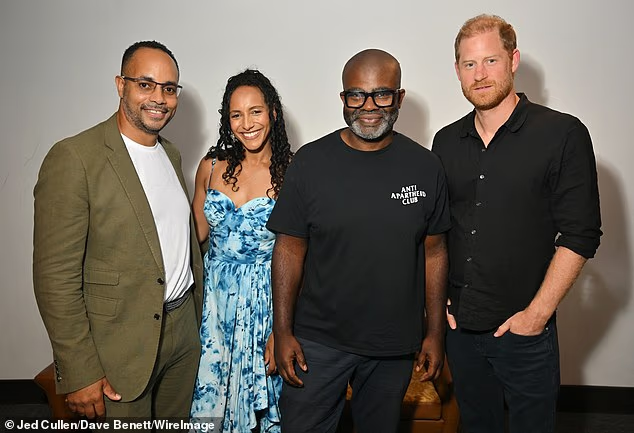
(L to R) Andy Mundy-Castle, Afua Hirsch, Misan Harriman and Prince Harry, Duke of Sussex attend the UK Premiere of ‘Shoot The People’ at Picturehouse Central in London on Monday
It was, as one source described yesterday, the ‘disruption and disrespect’ to his staff that prompted the King to slap down his younger son
Harry with his children Lilibet and Archie, who he hopes to bring to the UK for a visit
The Palace has highlighted another element in the situation. It was by no means the deciding factor but did add a ‘further degree of complexity’ to things and, it was apparently felt, could have compromised the King’s constitutional position.
Today, judgment will be handed down in the claim at the High Court by the Duke of Sussex against Associated Newspapers, publishers of the Daily Mail, of alleged unlawful information gathering. This has been strongly denied and contested by the Mail.
So why, do you ask, did Harry’s team suddenly issue a dramatic statement yesterday morning announcing he had accepted his father’s offer?
Those in royal circles say there are only two possible theories. First, that Harry hadn’t clearly communicated his father’s response back down to his staff (unlikely given that he was due to arrive in the UK only hours later, surely?). Or second, that it was a clear attempt to try to ‘bounce’ his father into reversing his decision.
But perhaps, there is a third possibility. That the furious prince simply doesn’t care any more and wants to cause his family maximum embarrassment.
Either way, Harry’s arrival last night was once again mired in the same smorgasbord of chaos, confusion, claim and counter-claim that has characterised all of his dealings with Buckingham Palace in recent years.
Hopes among courtiers that the Duke of Sussex could, for once, enjoy a low-key and ‘peaceful’ reconciliation with his father – perhaps with his two beautiful children in tow – are now as much of a pipe dream as ever.
And there are many – even those in royal circles who openly acknowledge the institution hasn’t always handled the ‘Sussex issue’ perfectly – who firmly believe it is a mess entirely of Harry’s own making.
Team Sussex argue that because the duke was thrown an 11th hour curve ball by the Home Office security committee RAVEC, which has declined to reinstate his full-time security while he and his family are in Britain, he has been busy trying to put his own plans in place.
A spokesman said it was ‘disappointing that the offer has been withdrawn . . . at the last moment’.
But it’s also worth noting that the prince’s trip this week to his country of birth has been more than a year in the planning, with a week of official engagements built around a major event in the Midlands on Friday to mark the 12-month countdown to his admirable Invictus Games for injured service personnel.
His team began organising the visit knowing full well that he had conclusively lost a High Court battle against His Majesty’s Government over the Home Office’s decision to strip him of his round-the-clock taxpayer-funded police protection when he chose to leave the UK and relinquish his royal duties.
A decision, it should be noted, that he railed against, accusing the courts, who administer justice in his father’s name, of colluding in an ‘Establishment stitch-up’ and claiming they had made it impossible for him to envisage a time he could ever bring his wife and children back safely.
It simply doesn’t make sense, his critics argue.
My understanding is that Buckingham Palace’s offer of royal lodgings was a genuine one.
However, despite repeated requests for clarity, no formal response to the offer of accommodation at a royal residence to Harry and his family had been received by the ‘necessary deadline’ at the end of last week.
While every effort had been made to facilitate his stay, as a courtesy to staff and others involved, the household does require a minimum level of notice to ensure he could be ‘hosted appropriately’ at a royal residence.
Since this offer was first made, every indication from the duke and his senior team remained that the accommodation was deemed ‘unsuitable’ – despite it being one of the most heavily guarded buildings in the country with men brandishing machine guns on every corner.
There comes a point, sources say, that Charles simply can’t indulge the ‘constant chaos’ that comes hand-in-hand with his younger son
This was a concern which was repeated as late as Saturday morning, in which the prince formally declined the King’s offer once again. A ‘belated request’ was subsequently received later in the day to accept the accommodation offered for Tuesday evening, but by then the appropriate hospitality and staffing provision was no longer available.
Following consultation with the King personally, the decision to turn this down was communicated to Harry ‘through the appropriate channels’.
Asked whether there could be any doubt in Harry’s mind of this decision, a source said they couldn’t comment on the details but that they ‘could confirm the duke was aware’.
Which certainly accounts for the frustration emanating from the Palace yesterday following the unexpected announcement by Team Sussex that the Duke of Sussex would be staying at his father’s official London residence after all.
The Palace’s own pithy rejoinder – with definite shades of ‘recollections may vary’ – came just minutes later, a sign if ever needed of their immense displeasure.
It was clear that the King’s patience had been piqued. There comes a point, sources say, that Charles simply can’t indulge the ‘constant chaos’ that comes hand-in-hand with his younger son.
While some commentators suggested yesterday that the decision was a sign of bad faith – and bad parenting – by the King, who has hundreds of rooms at his disposal, this is a gross misrepresentation and misunderstanding of how both he and the royal household work. The King – who let us not forget is a man still receiving treatment for cancer and has worked throughout his diagnosis – is the last person who wants to pour petrol on the flames of a very fragile familial relationship.
Indeed, I would go so far to as suggest he appears somewhat saddened, although perhaps not surprised, by recent events. But what’s done, is done. So where does all this leave father and son?
Well, I am told that His Majesty still hasn’t ruled out seeing his son at some point over the next few days despite recent provocation, although clearly yesterday’s events have made that all the more difficult.
King Charles has an extremely busy working week with a heavy load of engagements each and every day.
As for meeting the grandchildren, he has barely seen since they were born – and who haven’t even been in the country for four years – that looks more tricky since Harry apparently hasn’t decided yet whether it ‘safe’ to bring them over from their holiday home in Europe.
The prince has, however, made clear that he still wishes to find a way to bring them to Britain towards the end of the week, when his work takes him to the Midlands and beyond.
As far as Buckingham Palace is concerned, it can only be hoped that the next few days go more smoothly than the last, and that such a meeting could be possible.
However, in the words of one insider yesterday: ‘Experience doesn’t lend itself to great confidence in this regard.’

























































You must be logged in to post a comment Login