Connect with us

NewsBeat

Welsh rugby legend Sir Billy Boston dies aged 92

Published

on

Wales Online

The rugby league icon has passed away just weeks after the death of his beloved wife, Lady Joan

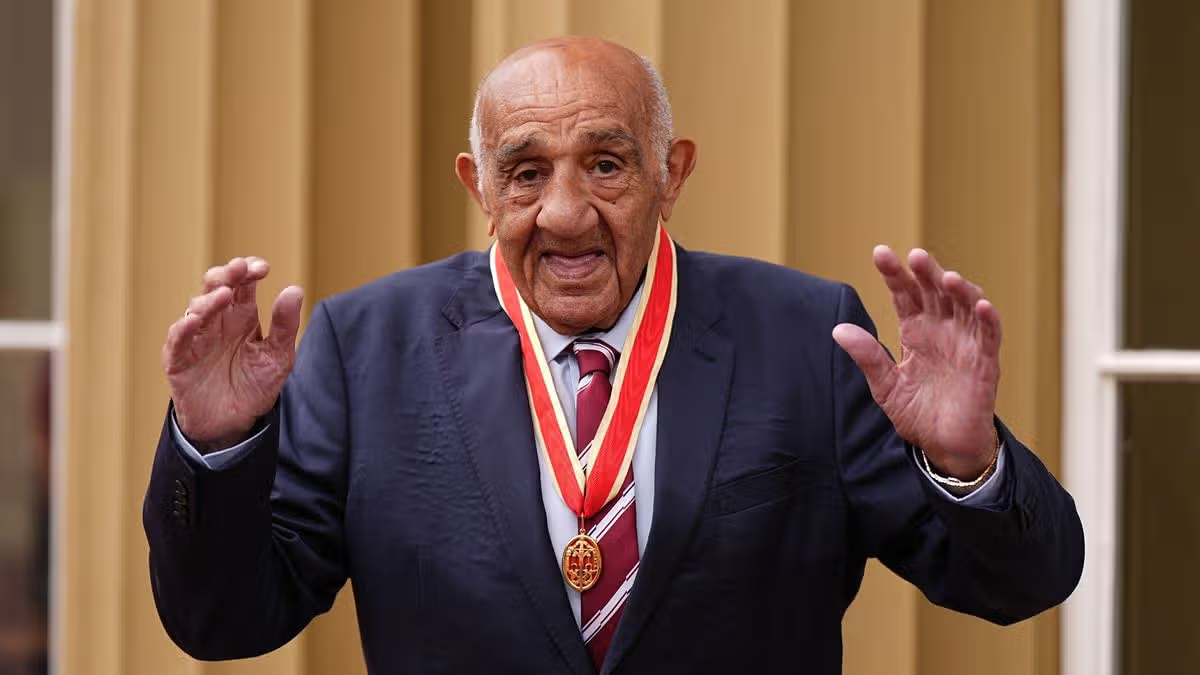
Sir Billy Boston, the Welsh rugby player who went on to become one of the greatest try-scorers in the history of British rugby, has died at the age of 92.

Advertisement

The Cardiff-born rugby league icon passed away overnight, just weeks after the death of his wife, Lady Joan. Boston had become a hero in the rugby league heartland, with supporters building a statue for the man who plundered 478 tries for his adopted home, Wigan.

Altogether, he touched down a remarkable 571 times in 562 first-class matches – winning the World Cup with Great Britain in 1960, as well as three Challenge Cups.

He was also a trailblazer for black sports stars and, for all of his many achievements, he would become one of Welsh sport’s most iconic and beloved figures.

The Welsh Rugby Union confirmed the news of Boston’s death on Tuesday, writing: “Sir Billy Boston, one of the best loved and most iconic figures in the history of Welsh sport, has passed away peacefully at the age of 92.

Advertisement

“The most famous son of Tiger Bay, he died overnight in hospital in his adopted home for the past 74 years, Wigan. His death came only four days after the funeral of his wife, Lady Joan, to whom he had been married for 70 years.”

Just last year, Boston became the first player from rugby league to be knighted. At the time, former Wales rugby league international Jim Mills said that Boston “is rugby league” in the north of England. He had previously been made an MBE in 1986 for his services to the 13-a-side code.

Born in Butetown in 1934, Boston had initially dreamed of playing for Cardiff – and ultimately Wales – at the Arms Park in rugby union.

His time in the 15-a-side code was relatively brief. He played for Cardiff Schools, winning the Dewar Shield in 1949, while he held became the first black player to play representative rugby union for Wales – turning out for the Boys Clubs of Wales and the Wales Youth teams in 1952.

Advertisement

For the former, he captained them against England in Neath – scoring a hat-trick of tries in a 32-0 win.

At senior level, he played for Neath and Pontypridd before heading North to do his National Service. It was then that Wigan swooped in to sign professional terms.

Having initially turned down their offers of £1,000 and then £1,500, Boston’s mother, Nellie, told him she would get rid of the club by asking for the ridiculous sum of £3,000. They agreed, with Boston admitting years later that he cried that night, with his dream of playing for Cardiff and Wales gone.

However, union’s loss would ultimately be league’s gain – with Boston becoming a tremendous success in that code. And Wigan would go on to become his home for the past 74 years.

Advertisement

Making his debut for Wigan at the age of 19, he would score the first of his 478 tries for Wigan against Barrow in November 1953. By the summer of 1954, he was chosen to tour Australia by the Great Britain selectors.

He would play in all five Tests and ended up scoring a staggering 36 tries in 18 matches – including seven hat-tricks and six against North Coast. He also equalled the record for the most tries in a Test match, having scored four against New Zealand in Auckland.

With Wigan, he would win the Challenge Cup in 1958, 1958 and 1965 as well as running in two tries in the 1960 Championship final to earn the club their first title in eight years.

Boston would also win two Lancashire Leagues and one Lancashire Cup. His record of 478 tries for the club, surpassing Johnny Ring’s tally of 368, still stands to this day.

Advertisement

Having twice equalled the record for most tries in a game for the club – scoring seven on two separate occasions – only Wigan legends Martin Offiah and Shaun Edwards have bettered that particular record.

For Great Britain, he would win 31 Test caps – scoring 24 times. He would also play one match for Wales against France B, while he won the 1956 European Rugby League Championship – representing Other Nationalities.

Towards the end of his career, Boston would enjoy a short spell with Blackpool Borough. His 571 tries is bettered only by Australian Brian Bevan when it comes to rugby league’s most prolific scorers.

Following his retirement, Boston became a publican in Wigan. He received the freedom of Wigan in 2000.

Advertisement

As well as the statue in his adopted home, there’s another at Wembley – the venue where he lifted three Challenge Cups. In recent years, another statue of Boston, along with fellow league legends Clive Sullivan and Gus Risman, was unveiled in Cardiff.

Boston was diagnosed with vascular dementia in 2016 at the age of 82.

Last month, Boston’s wife of 70 years, Lady Joan, passed away at the age of 90. Her funeral took place in Wigan on Friday.

Follow all of our channels to ensure you stay up to date with the latest Welsh rugby news. Sign up to our free daily newsletter here and our WhatsApp channel here for all the breaking news.

Advertisement

Source link

Continue Reading
Click to comment

You must be logged in to post a comment Login

Leave a Reply

NewsBeat

Live updates as police close Co Down road after collision

Published

on

Belfast Live

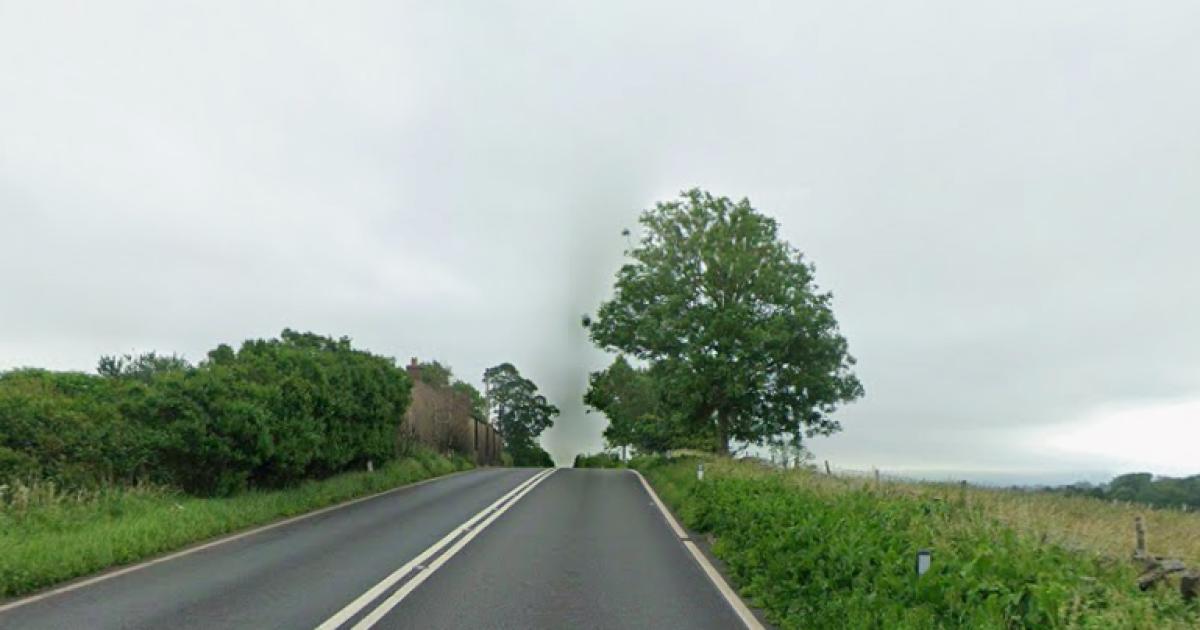
Police have closed a Co Down road following a crash on Tuesday morning.

The Leode Road, in Hilltown, is currently closed following the single vehicle collision in the area. Police say closures are in place at Newry Road and the junction of Carmeen Road.

Emergency services are in attendance at the scene and police are asking motorists to avoid the area until the road reopens.

Advertisement

A PSNI spokesperson said: “Road users are advised that there are closures in place on the Leode Road, Hilltown, due to an ongoing one vehicle road traffic collision in the area. Closures are in place at the main Newry Road and at the junction of the Carmeen Road, and emergency services are in attendance.”

Please follow our live blog below for further updates.

Source link

Advertisement
Continue Reading

NewsBeat

Married NHS paramedic planned to target young girls by grooming their mothers online – whilst he tended to patients in his ambulance

Published

on

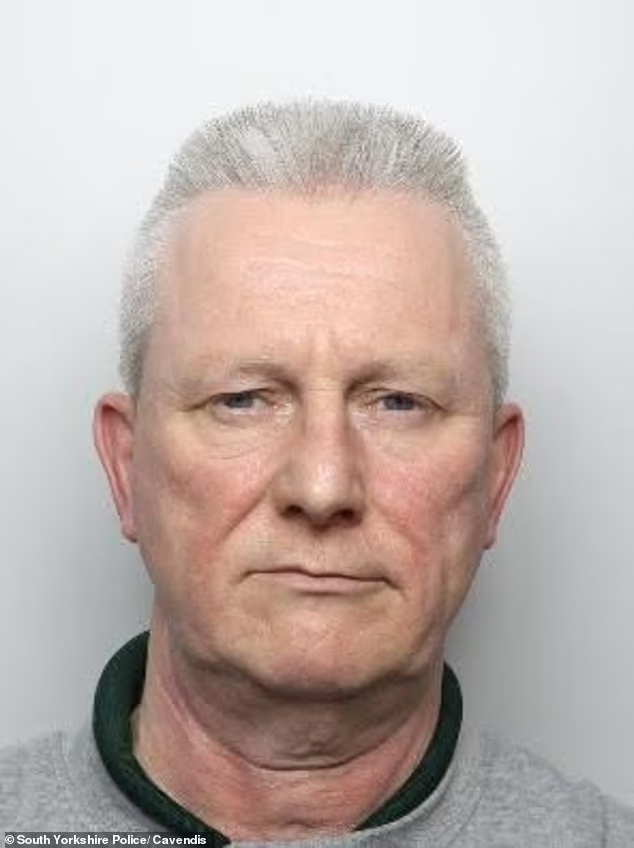
Gary Hutton, 59, was given a 10-year jail sentence last November at Sheffield Crown Court

Advertisement

A predatory NHS paramedic planned to target young girls by grooming their mothers online – whilst he tended to patients in the back of his ambulance.

Gary Hutton, 59, trawled a swinger’s dating site for women during 999 callouts, a disciplinary hearing was told.

Married Hutton made contact with at least two women and, to gain their trust, sent them selfies showing him wearing his paramedics’ uniform and tending to the injured in his vehicle.

He then initiated twisted conversations by asking them what their ‘kinks’ were, and if they were interested in breaking ‘taboos’.

Advertisement

When one of the mums said she had an 18-month-old baby and sent Hutton a picture of the infant, he replied ‘very nice’.

He claimed he had previously been asked to ‘educate’ the 13-year-old daughter of another couple he had been messaging online.

Hutton, from Doncaster, South Yorks, was eventually caught in an undercover operation launched by police to catch online predators.

During a sick exchange he sent obscene pictures to a policewoman posing as a mother to a six-year-old girl – before suggesting she and the child meet him for sex.

Advertisement

Gary Hutton, 59, was given a 10-year jail sentence last November at Sheffield Crown Court

As a result, detectives quickly detained him at work and seized three mobile phones, two tablets, a laptop and a computer.

Analysis of one device uncovered near identical conversations with the other women who had children aged between seven and 12, in which he discussed engaging in the sexual abuse and ‘education’ of the youngsters.

Advertisement

It was not disclosed whether the other women he messaged were traced.

Details emerged at a hearing of the Healthcare Practitioners Tribunal Service (HCPTS), where Hutton was struck off.

Last November, he was jailed for 10 years after he admitted attempting to arrange or facilitate the commission of a child sex offence.

The disciplinary hearing was told Hutton was employed at Yorkshire Ambulance Service since 1998, initially in the control room before qualifying as a paramedic in 2013.

Advertisement

He was arrested at an ambulance training centre in February 2025 after he unwittingly became involved in a chat on an unnamed dating site with an undercover policewoman working for a Regional Organised Crime Unit.

The hearing was told Hutton began communicating with the officer ‘decoy’ when he was at work and with patients.

He sent images of himself in his uniform in the ambulance and began chatting about having sexual activity with adults as well as children and suggested meeting up to ‘educate’ them.

During the exchanges Hutton sent indecent images of his private parts and asked about meeting up on his day off – saying he did not want his wife or his work to ‘find out’.

Advertisement

When quizzed by police Hutton gave no comment – but later claimed the conversations were ‘just fantasies’.

He was subsequently branded a ‘dangerous offender’ by a judge.

In its determination the HCPTS panel said of Hutton: ‘Whilst no actual harm had been caused, his actions had the potential to place service users at risk of harm as he was messaging females whilst at work, taking his attention away from those he was required to care for.

‘This conduct was directed towards children as young as six and who are by their nature vulnerable. The people who were meant to be protecting them were engaging with (Hutton) and exposing the children to a risk of grave harm.

Advertisement

‘It was predatory behaviour in grooming mothers with a view to engaging in the sexual abuse of children.’

Hutton, who is being held at Doncaster Prison, did not attend the hearing.

Following his release from jail he will be on licence until 2040 under the terms of an extended sentence. He is currently the subject of a 15-year Sexual Harm Prevention Order.

Advertisement

Advertisement

Source link

Continue Reading

NewsBeat

Organised crime arrests as police investigate A66 crash that killed seven

Published

on

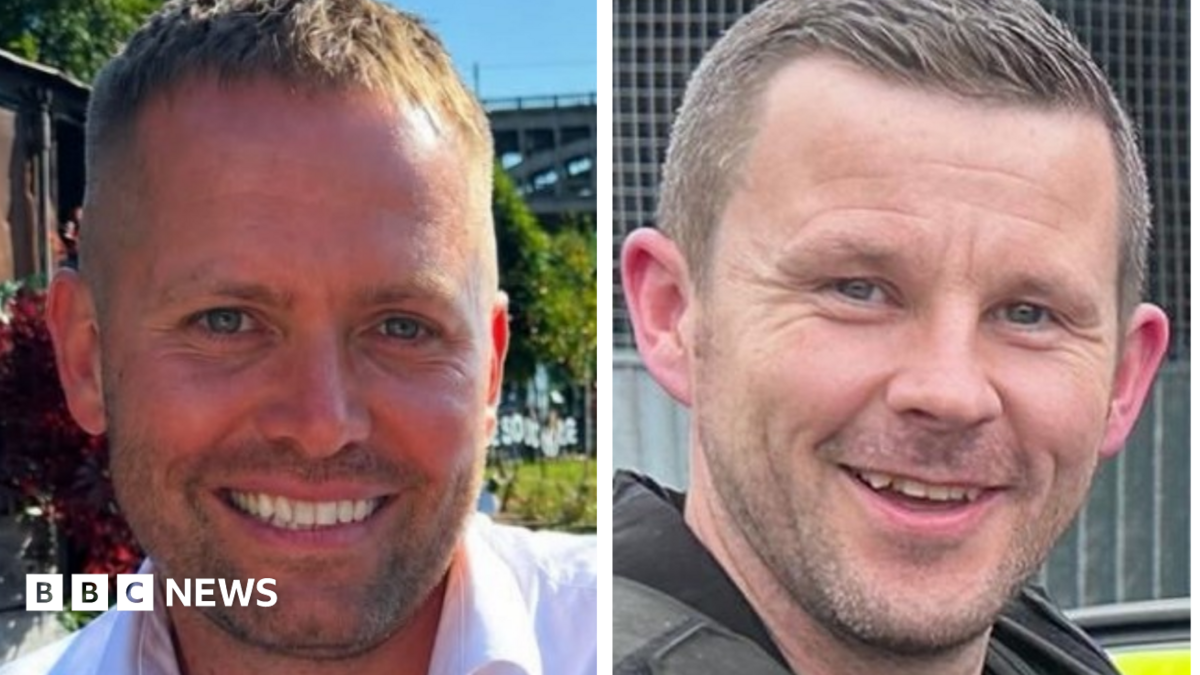
Pictures of the two officers. Both are smiling. PC Blades has smart stubble and short fair hair. PC Clough also has stubble and short dark hair.

Twelve people have been arrested as part of the investigation into the A66 crash that killed seven people, including two police officers.

Nine men and three women, aged between 19 and 61, have been arrested across Teesside on suspicion of a range of offences including possession of a firearm and being part of an organised crime group. One has since been charged.

In the early hours of Saturday, a Volkswagen Passat that had been pursued by police travelled the wrong way down the A66 near Middlesbrough and crashed into an oncoming police car – two PCs and all five Passat occupants died.

Cleveland Police said it was investigating “serious criminal activity that resulted in this fatal incident”.

Advertisement

PC Tom Clough, 38, and PC Matthew Blades, 37, died in the crash, as did Michael Robert Cahill, 23, Jacob Matusiak, 23, Makai Saddington, 18, Theo Rae, 17, and 17-year-old Cole Robert Worthy.

Earlier, Cleveland Police released more details of its investigation into the lead-up to the crash and information about the 12 people it had arrested.

The force said:

  • It received several reports of two vehicles “being driven dangerously” on Saturday morning

  • The first vehicle, believed to be a Volvo XC60, was seen “ramming properties” in the Middlesbrough area

  • The second vehicle, a Passat, is believed to have been associated with this activity

  • Both vehicles were operating with cloned number plates but were picked up by automated number plate recognition technology

  • The Volvo has been recovered in Middlesbrough

  • Four of the five people in the Passat had previous convictions

Assistant Chief Constable Wayne Fox said the investigation had been “fast moving and complex”.

Advertisement

He said: “The events of that tragic night will have a lasting and profound impact on the Cleveland area and the communities we seek to protect.

“We have a duty to respond to, and thoroughly investigate, the serious criminal activity that resulted in this fatal incident and to bring all those responsible to justice.”

Source link

Advertisement
Continue Reading

NewsBeat

Police slam ‘absolutely unacceptable’ motorway drivers going wrong way after crash

Published

on

Daily Record

Lancashire Police have issued a stern warning after drivers were seen driving in the wrong direction on the M6 motorway near Junction 34, following a collision on the northbound lane

Police have issued a stark warning over what they described as ‘absolutely unacceptable’ behaviour by motorists spotted driving the wrong way on the M6 motorway.

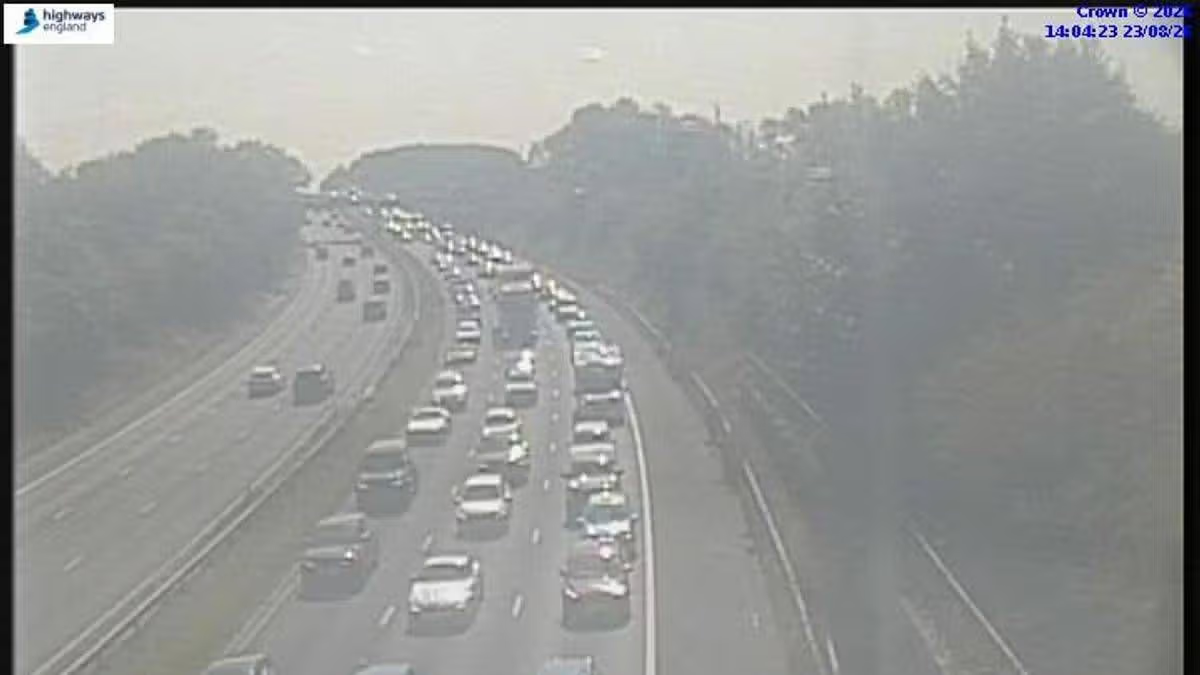
Drivers were caught reversing their vehicles and travelling the wrong way up an exit ramp on Sunday afternoon (August 23), during a collision on the M6 northbound carriageway near junction 34. Although nobody was hurt, officers stressed that the situation ‘could have easily been so different’.

Lancashire Police have identified a number of the vehicles involved and vowed to take ‘appropriate action’ against those behind the wheel. Officers are now appealing to anyone who captured footage on a dash cam or mobile phone of other drivers travelling in the wrong direction to come forward.

Advertisement

They cautioned that such reckless behaviour ‘can have utterly devastating consequences’, pointing to two fatal wrong-way collisions near Middlesbrough and in Ireland as stark examples.

Two police officers and five other individuals lost their lives in a crash in Teeside in the early hours of Saturday, after a Volkswagen Passat – which had been pursued by police – was driven the wrong way along a dual carriageway, reports the Daily Star.

The vehicle then collided with a marked police armed response vehicle. PC Matthew Blades, 37, and PC Tom Clough, 38, were among those tragically killed.

Advertisement

Cole Robert Worthy, 17, Theo Rae, 17, Makai Saddington, 18, and 23-year-olds Michael Robert Cahill and Jacob Matusiak were also declared dead at the scene. In the wake of the incident, TikTok footage has emerged showing one of the deceased men recording himself driving dangerously in the months prior to the deadly smash.

This heartbreaking event came hot on the heels of a separate crash in which five teenagers were killed on the M9 in Co Kildare after their BMW careered into oncoming traffic while attempting to flee from police.

Three women and a seven year old boy travelling in the other vehicle involved in the head-on collision sustained serious injuries and were taken to hospital.

The full statement released by Lancashire Police concerning the M6 incident, published on Monday afternoon, read: “We need to tell you about something that happened on the motorway this weekend, that is absolutely unacceptable.

Shortly before 1:45pm yesterday, we received a report of a collision on the M6 northbound near to junction 34, and as a result, there were people turning around and driving the wrong way back up the slip road to avoid joining the motorway.

“Thankfully nobody was seriously hurt, either in the collision or due to this incident, but as we have seen in other parts of the country this weekend, these actions can have utterly devastating consequences. We have identified a number of those vehicles and drivers involved in the incident and will take the appropriate action against them.

“We know that there will have been a lot of people on the motorway or making their way the correct direction down the slip road at that time, who will have been lawfully going about their journeys. We need to ask for your help. If you have dashcam that covers the junction 34 slip road, and shows any of these drivers, or took mobile phone footage, it is really important that you get in touch, so we can see it.

Advertisement

“Being stuck in standstill or slow-moving traffic can be frustrating, we get it, but it is never an excuse to put the lives of those around you, and your own life at risk. Nobody got hurt yesterday, but that outcome could have so easily been different.

“We will not tolerate driving that endangers lives. If you have information or footage that can help us, please call 101 quoting log 0689 of 23rd August.”

Ensure our latest stories always appear at the top of your Google Search by making us a Preferred Source. Click here to activate or add us as your Preferred Source in your Google search settings.

Source link

Advertisement
Continue Reading

NewsBeat

Russia threatens to attack British factories in ‘semi-military’ response to UK support for Ukraine – as Putin warns ‘Pandora’s box has been opened’

Published

on

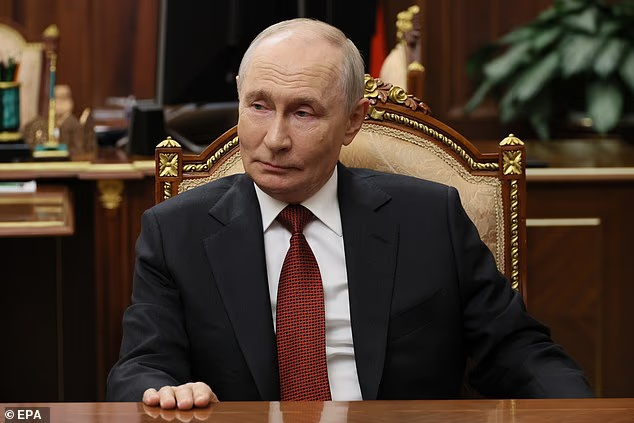
Russian president Vladimir Putin warned that a 'Pandora's box has been opened'

Russia has threatened to target British factories in a ‘semi-military’ response to the UK’s support for Ukraine, as Vladimir Putin warned that a ‘Pandora’s box has been opened’.

On Monday, Moscow accused the UK of ‘participating in this war’ after Prime Minister Andy Burnham arrived in Kyiv for his first foreign visit.

Mr Burnham had announced that European defence firm MBDA had been given permission to share information on UK components for the long-range Scalp missile, meaning Ukraine could start manufacturing the projectiles locally.

The move sparked a furious reaction from the Kremlin, with a senior Putin adviser now warning of a more aggressive response and claiming Russia views the UK as ‘evil number one.’

Advertisement

Yesterday on BBC Newsnight, former Russian deputy foreign minister Andrei Fedorov said Russia’s response to Mr Burnham’s announcement had been ‘very negative’, with Putin warning a ‘Pandora’s box’ was being opened.

Asked about the threat, Mr Fedorov said: ‘There’s a very serious political and public pressure on President Putin today, to undertake certain measures against UK, because he is considering UK as part of the war in Ukraine, and assistance from the UK is considered as a direct involvement of UK in this war.’

The official warned a new stage of escalation would see a ‘not only verbal but maybe some visible reaction’ from Russia towards the UK.

Expanding on what this would look like, Mr Fedorov said: ‘It might be so-called technical reaction, maybe some hackers attack from unknown source – not from official level, of course.

Advertisement

‘There might be different political steps. And I cannot exclude 100 per cent that there might be some semi-military, for example.

Russian president Vladimir Putin warned that a ‘Pandora’s box has been opened’

Volodymyr Zelensky welcomed Prime Minister Andy Burnham to Horodetskyi House in Kyiv with a warm handshake on Monday

Volodymyr Zelensky welcomed Prime Minister Andy Burnham to Horodetskyi House in Kyiv with a warm handshake on Monday

Advertisement

He clarified British factories producing drones for Ukraine could be targeted in such a move by ‘unknown sources’.

Hackers would also target what he described as ‘concrete enterprises’ linked to the production of drones or components for Storm Shadow (the British version of Scalp) missiles.

Mr Fedorov explained that by Mr Burnham handing over blueprints for the manufacturing of missiles in Ukraine, Britain has become ‘much more involved’ in the war.

‘Moscow is considering steps by UK prime minister as direct military involvement into this conflict,’ he added.

Advertisement

Fedorov’s comment come after Kremlin spokesman Dmitry Peskov claimed earlier on Monday that ‘Britain is participating in this war’ on the side of Ukraine.

‘Britain methodically and regularly pours fuel on the fire and methodically and regularly plots to prevent any progress in the peace process.’

He added Russian armed forces were intent on identifying ‘the production sites of such missiles’ and ‘the production sites of other military equipment’ in order to destroy them.

But Mr Burnham insisted there would be no let-up in the UK’s support for Ukraine against Vladimir Putin’s aggression, branding Russia’s threats to the UK ‘outrageous’.

Advertisement

‘Who started the fire? That’s the question, isn’t it,’ he said.

It emerged over the weekend that the Russian ambassador has been withdrawn from London as relations deteriorate even further.

The UK’s decision means the ‘deep-precision’ Scalp – which is built using both British and French technology – could now be produced in Ukraine.

The weapons are critical for long-range strikes reaching targets deep inside Russia.

Advertisement

Giving a speech in front of St Sophia cathedral in Kyiv to mark the 35th anniversary of Ukraine’s independence, Mr Burnham compared the country’s resistance to the fight against Nazi Germany.

‘My nation kept the flame of European freedom alive in the 20th century, you hold that flame in the 21st,’ he said.

‘Despite Russia’s outrageous threats to my country, we will continue our support for Ukraine.’

In his first major speech on the international stage, Mr Burnham praised the ‘sheer strength’ of the Ukrainian people as ‘truly awesome’, and said that ‘this is the moment to keep up the pressure on Russia, the moment to squeeze their ability to fund this illegal war’.

Advertisement

‘Ukraine has been Europe’s protector, not a drain on our security but the front line in keeping Europe safe,’ he added.

‘The Ukrainian people deserve not just our continued support, but our gratitude and respect,’ he said, thanking Ukrainians for ‘the incredible stand’ they have taken.

Mr Burnham also chaired his first meeting of the ‘coalition of the willing’ on Monday afternoon – the group of nations providing strengthened support for Ukraine.

Britain will keep providing defence aid to Ukraine despite Russia's threats. Pictured: Burnham and Zelensky

Britain will keep providing defence aid to Ukraine despite Russia’s threats. Pictured: Burnham and Zelensky 

Advertisement
The Prime Minister also observed destroyed Russian vehicles displayed at Mykhailivska Square as part of his visit

The Prime Minister also observed destroyed Russian vehicles displayed at Mykhailivska Square as part of his visit

In an apparent message to Donald Trump, he told the coalition that Ukraine needed more Patriot interceptor missiles immediately to ‘help to protect its people’.

He also called on the US Congress to ‘ratchet up’ economic pressure on Russia.

Mr Burnham said Russia’s economy was struggling with a record budget deficit and declining oil revenues as he backed a sanctions bill proposed by the late Republican senator Lindsey Graham.

Advertisement

The Kremlin has previously warned of ‘consequences’ over UK drones being used by Ukraine to strike far into Russia.

Moscow said last week that the deeper Britain became involved, ‘the higher price it will pay’.

Mr Burnham said: ‘On Ukraine’s 35th anniversary of independence, its people should be in no doubt: The UK is behind you.

‘In the fight and the rebuilding to come, we stand with Ukraine. Russia should be in no doubt of our resolve. We will not back down till there is a lasting peace.’

Advertisement

But Russia said relations with Britain are at ‘an unprecedentedly low level’ as it ordered its ambassador Andrey Kelin back to Moscow after seven years in post.

Mr Kelin has accused the UK of choosing ‘a path of confrontation’ with Russia.

Mr Burnham said: ‘Russia should be in no doubt of our resolve. We will not back down until there is a just and lasting peace.’

Source link

Advertisement
Continue Reading

NewsBeat

Person taken to hospital after late-night A66 crash at Bowes

Published

on

Person taken to hospital after late-night A66 crash at Bowes

The crash happened just before midnight on Monday (August 24) at Bowes.

Police and paramedics from the North East Ambulance Service (NEAS) both attended the collision. It is not yet known how many vehicles were involved.

A NEAS spokesperson said: “We were called to a road traffic incident on the A66 at Bowes shortly before midnight on August 24.

Advertisement

“We dispatched one double crewed ambulance and one patient was taken to Darlington Memorial Hospital.”

Durham Police has been contacted for a comment.

Source link

Advertisement
Continue Reading

NewsBeat

Brit holiday hell in Catalonia after tourists issued ‘stay indoors’ thunderstorm warning

Published

on

Daily Record

A major thunderstorm has hit a Spanish tourist hotspot but so far no injuries are reported

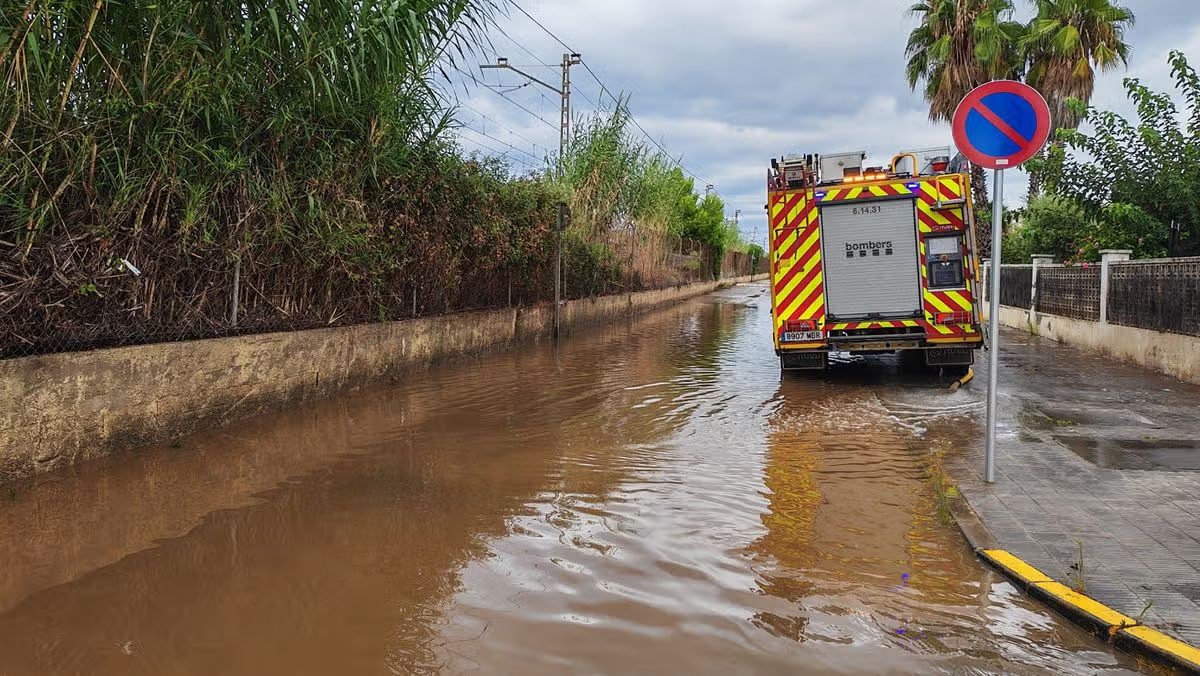
An extreme thunderstorm has hit a tourist hotspot in Spain. The extreme weather has hit the Catalonia region of Spain, with Camp de Tarragona suffering serious disruption on Monday.

Express reports public transport is heavily affected with bus cancellations. Strong hail and winds alongside the heavy downpours saw areas of the streets and plaza’s flooding.

Advertisement

Affected spots include Carrer Joan Baptista Plana, Imperial Tàrraco, Carrer Vidal i Barraquer, Carrer d’Apodaca, and Avinguda Prat de la Riba. Firefighters responded to 129 calls, 107 of which were in the Tarragona region, over just an hour and a half as branches of trees fell and electrical cables faced issues.

Despite blocked roads and significant material damage, Sonia Orts, the Councillor for Civil Protection and Mobility said: “Fortunately, there are no reports of personal injuries”.

Tarragona City Council are working to remove dangerous trees and have closed local parks. The public have been warned to stay indoors and avoid unnecessary travel, according to reports.

The Meteorological Service of Catalonia has issued a six out of six violent weather alert warning, with the risk of hailstones larger than two centimeters in diameter. The heavy rainfall also caused the death of many pigeons who can be seen in videos struck on the floor among the high levels of water.

The storm has also impacted several other areas in the northeast, before it reached Tarragona. Several municipalities in Segrià such as Almenar, Corbins, Albatàrrec, and Lleida city were already victim to the huge hailstones, impacting local crop.

The weather comes just days after hurricane-force winds tore through the Balearic Islands overnight, with winds peaking at 121 kilometres per hour in the early hours of Friday. Tourists and residents woke to scenes of scattered debris, flooded roads and battered coastal areas across the archipelago that includes Mallorca, Menorca, Ibiza and Formentera.

Ensure our latest stories always appear at the top of your Google Search by making us a Preferred Source. Click here to activate or add us as your Preferred Source in your Google search settings.

Advertisement

Source link

Continue Reading

NewsBeat

Should taxpayer cash fund any of the Sussexes’ security? Nearly three-quarters say NO ahead of Harry and Meghan’s shock return

Published

on

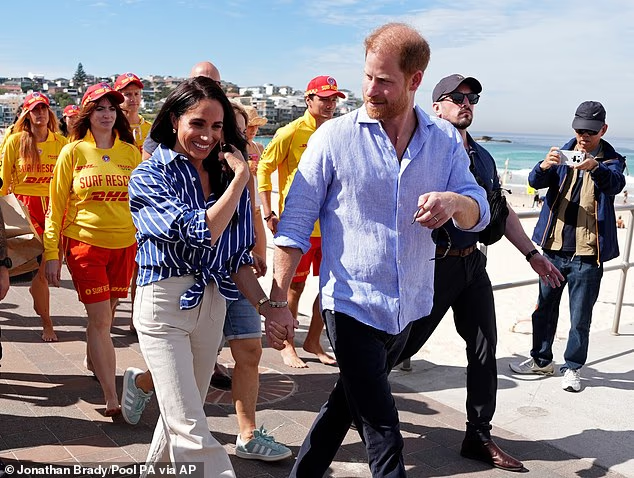
Meghan and Harry are seen here at Bondi Beach during their visit to Australia in April this year - the couple are returning to live in the UK, with questions over how their security will be funded

A significant majority of Britons do not want taxpayers to fund the security for Prince Harry and Meghan on their return to the UK, a poll has shown.

It was announced last week the Duke and Duchess of Sussex would be moving back after six years in the US as their children prepare to start at new schools in the UK.

Concerns have been raised over who would fund the protection Harry and his family want – after he previously battled the Home Office over the fees. 

Seven out of ten people, or 71 per cent of those questioned in a new survey, have said Harry’s family security charges should not be paid by the Government.

Advertisement

Some 87 per cent said the Sussexes’ private funds should fund all or at least a majority of the security costs, according to the poll of 2,128 British adults.

And 52 per cent suggested the King’s private funds should fund all, a majority or some of the fees.

Disputes over whether taxpayers should fund security for the Duke and Duchess of Sussex have been dragging on, amid claims a review by the risk management board of the Royal and VIP Executive Committee (Ravec) was completed last month.

Harry and Meghan’s children Archie, seven, and five-year-old Lilibet have been enrolled at British schools and will start classes in September.

Advertisement

Meghan and Harry are seen here at Bondi Beach during their visit to Australia in April this year – the couple are returning to live in the UK, with questions over how their security will be funded

It is thought they will live at a private, non-royal residence outside London – with suggestions they could be moving to the Cotswolds.

Since leaving for the US they have been living in Montecito, California, while also owning a holiday home in Portugal. 

Advertisement

The King was said to have been taken aback by learning of the homecoming plans only days before it was made public – having not been told when Harry and Meghan met him on their visit to Britain last month.

On their imminent return to the UK, the Sussexes’ status will remain the same, with the couple not being offered a ‘half in, half out’ option when it comes to their roles.

Other non-working royals such as Harry’s cousins Peter Phillips, Zara Tindall and Princesses Beatrice and Eugenie do not receive police protection. 

Andy Burnham last week refused to be drawn on the matter, with the Prime Minister saying the Duke and Duchess’s security – which could cost £5million a year – was a ‘private matter’. 

Advertisement

A previous YouGov poll last week found fewer than a quarter of Britons believe Harry, 41, and 45-year-old Meghan should move back to the UK.

Harry and ex-Suits star Meghan, who were married at St George’s Chapel in Windsor in May 2018, were once dubbed part of the ‘Fab Four’ with the then-Duke and Duchess of Cambridge – now the Prince and Princess of Wales.

But in March 2019, Buckingham Palace announced Harry and Meghan would set up their own household, breaking from the joint operation they had with William and Kate amid reports of rifts between the two couples.

Advertisement

In January 2020, the Duke and Duchess announced they intended to step back as ‘senior’ members of the Royal Family, become financially independent and split their time between the UK and North America.

Advertisement

By March that year they had set up a permanent home in California, officially stepped down as senior royals and stopped using their HRH titles.

The fallout worsened after accusations Harry publicly levelled at members of the Royal Family, including his brother, in his memoir Spare and his Netflix documentary. 

In his autobiography Spare, released just months after Queen Elizabeth II’s death, Harry accused William of physically attacking him and pushing him into a dog bowl in a row over Meghan. 

He also alleged it was William and Kate who encouraged him to wear a Nazi uniform to a fancy dress party in 2005 and ‘howled’ with laughter when they saw it.

Advertisement

In their Netflix series three months after the Queen’s death, the Sussexes said Kensington Palace lied to protect William when it issued a statement denying a story he had bullied Harry out of the Royal Family

Harry also wrote of how Charles pleaded with his sons during a tense meeting at Windsor just after the funeral of Prince Philip, saying: ‘Please, boys. Don’t make my final years a misery.’ 

The new YouGov poll for The Times suggests 32 per cent of people want William and Harry to reconcile and think it is possible, while 26 per cent desire so but think it unlikely.

When asked to whom they felt favourable, 76 per cent went for William, 74 per cent Catherine, 31 per cent Harry and 22 per cent Meghan.

Advertisement

The Duchess of Sussex was able to travel to the UK in July with Archie and Lilibet to join Harry when he came to the end of a week-long series of events promoting next year’s Invictus Games.

During the visit, the Duke and Duchess took their children to see the King for the first time in four years at his Highgrove home.

Source link

Advertisement
Continue Reading

NewsBeat

Art attack: five habits to help you get (back) into art

Published

on

Art attack: five habits to help you get (back) into art

Advertisement


Art attack: five habits to help you get (back) into art – Positive News


Advertisement


Advertisement


Struggling to make time for creativity? Here are five simple ways to reconnect with your artistic side and make art a part of your everyday life

Advertisement

Struggling to make time for creativity? Here are five simple ways to reconnect with your artistic side and make art a part of your everyday life

Advertisement
1. Commit to little and often

Like many skills, art benefits from regular practice. Even if you feel overwhelmed by the demands of work and family, give yourself five, 10 or 15 minutes each day for art. Crochet on your morning commute, make a sketch that captures your mood, or make a tiny clay sculpture. Art is habit-forming, and small gestures add up. Imagine how impressive three months’ worth of tiny, daily, clay sculptures will look.

Image: Kaizen Ngyu

Advertisement
2. Step into a gallery

Once you’ve (re)engaged with making work yourself, you’ll start to see the art displayed in galleries and museums very differently. Through close looking, you might recognise how an artist achieved a specific effect, or what makes a certain composition so powerful. We know artists of the past learnt a great deal from studying and puzzling over works they admired. So can you.

Image: Robin Schreiner

Advertisement
3. Skill up

Even if you’ve been through art school, you will benefit from a refresher or even new skills. Technical advantages aside, it will boost your confidence. Adult education institutions offer great short courses in everything from drawing to film-making to ceramics. And there are a host of alternative art schools offering in-person and online courses that are far less costly than a formal MA.

Advertisement

Image: Sebastien Monroy

Advertisement
Solutions every Saturday
Uplift your inbox with our weekly newsletter. Positive News editors select the week’s top stories of progress, bringing you the essential briefing about what’s going right.
Sign up
4. Be playful and experiment

If a certain technique or habit is working for you, it can be tempting to stick with it. This is fine if your goal is to achieve predictable results, but if you want to push yourself and develop your work, then it’s important to force yourself into less comfortable territory. Try a new medium and allow yourself to be playful, focusing on the process. The results might surprise you.

Image: Nick B

Advertisement
5. Take yourself seriously even if your art isn’t

If you’re a newcomer, it can feel hard to justify the time and space you need to make art. Give yourself the permission to take yourself seriously and acknowledge that what you are doing is important. In practical terms, this might mean providing yourself with the space you need, applying for open-call exhibitions and signing your work. Your art doesn’t need to be serious, but it’s OK for you to feel serious about it.

Image: Frankie Cordoba

Advertisement

Main image: Caroline Veronez

How to Enter the Art World by Hettie Judah is out now on Hoxton Mini Press

Advertisement

Source link

Advertisement
Continue Reading

NewsBeat

Empty North Sea oil fields could store enough green hydrogen to power the country for seven years

Published

on

Empty North Sea oil fields could store enough green hydrogen to power the country for seven years

Every time Britain has a still, grey week in winter, something invisible happens behind our plug sockets: gas power stations fire up to keep the lights on. That gas is often imported, with prices set by volatile global markets. This is one reason why energy bills surged during the cost-of-living crisis, despite the low cost of available renewable energy.

On very windy days, we have a different problem. The grid can’t always use all the electricity our wind farms generate, so we pay them to switch off. In effect, we throw away clean energy because we have nowhere to store it.

Our latest research, published in the journal Applied Energy, points to a solution hiding under the North Sea. The depleted oil and gas fields that powered Britain for half a century could be refilled, this time with hydrogen made from our surplus wind and solar power.

We found that suitable depleted North Sea fields could provide 3,659 terawatt-hours of hydrogen storage capacity, equivalent to more than seven years of projected UK electricity demand in 2040. Using them could also take conventional gas power stations off the grid altogether by 2040.

Advertisement

What is green hydrogen?

Hydrogen is the simplest and most abundant element in the universe, and can be used to produce energy without releasing carbon dioxide. Most hydrogen produced is “grey”: stripped out of natural gas in a process that releases carbon dioxide. “Blue” hydrogen is made the same way, but with some of that carbon captured and stored. “Green” hydrogen is different: it’s made by passing renewable electricity through water by electrolysis, splitting it into hydrogen and oxygen. If the electricity comes from wind or solar, the hydrogen is genuinely zero carbon.

Green hydrogen production is, in effect, a way of bottling renewable energy. When the wind blows harder than we need, that surplus electricity can be used to make hydrogen. When the wind drops, stored hydrogen can be turned back into electricity in a power station – doing the job gas does today, but without the emissions or the imports.

Green hydrogen can be particularly useful in winter when energy demand is highest, but where there can be little sun or wind to power renewables. For enough green hydrogen to get us through the winter months, we need seasonal storage – somewhere to bank huge amounts of summer and autumn surplus and draw it down through winter. For that, you need the help of geology.

The potential of underground storage

Natural gas has been stored underground for millions of years. It collects in porous rocks capped by an impermeable layer that traps it below the surface. When a gas field is depleted, that underground storage space does not disappear. The rock formations remain, and many fields are still connected to pipelines and offshore facilities. This raises the possibility of using them to store hydrogen instead.

Advertisement

When a gas field is depleted, that underground storage space does not disappear.
Wirestock Creators/Shutterstock

These depleted fields are not considered in current UK plans for hydrogen storage. Instead, the focus is almost entirely on salt caverns. These are artificial voids dissolved out of thick underground salt layers, mainly in Cheshire and East Yorkshire. Salt caverns are excellent stores, but Britain simply doesn’t have enough of them to meet long-term hydrogen storage needs. Only one North Sea field, Rough, is currently being developed for hydrogen. That leaves an enormous resource untouched.

Our research assessed depleted fields across the North Sea and identified the best candidates for hydrogen storage based on their geology. We drew on previous academic and industry research to understand the quality of the cap rock and how little hydrogen would seep away in storage.

Modelling future energy needs

Working with colleagues, including PhD researchers Zongtai Zhang and Joseph Brown, we built a digital twin of Britain’s future electricity system and geological storage. Rather than using annual averages, we modelled supply and demand in half-hourly detail, capturing real weather patterns and the coming growth of electric vehicles, heat pumps and data centres.

Advertisement

We then tested different futures. With more renewables but without more hydrogen, the grid still leaned on gas during windless winter weeks. In a low-storage scenario using only planned storage sites, hydrogen stores quickly filled to capacity, preventing additional surplus renewable electricity from being converted into hydrogen during summer months.

Only the high-storage scenario, adding depleted North Sea fields, eliminated the need to use conventional gas power stations entirely by 2040. Across all scenarios, gas fell to just 1% of generation by 2030.

More than electricity

The prize goes well beyond keeping the lights on. Hydrogen at this scale is important to supply industries that are challenging to electrify or rely on international supply chains. That includes the production of fertiliser, steel, cement and glass. All of these need intense, high-temperature heat. Burning hydrogen produces a very high-temperature flame that can deliver concentrated heat directly to industrial processes helping to replace coal or natural gas in furnaces, kilns and blast furnaces, significantly reducing industrial emissions.

Local economies could also benefit. Because the hydrogen would be made close to where offshore wind lands, and stored in fields served by existing infrastructure, it could bring skilled jobs to the very coastal communities affected by the decline of North Sea oil and gas, employing similar skills and expertise.

Advertisement

Green hydrogen would also make Britain’s economy genuinely more home-grown: less imported fuel and reduced reliance on overseas supply chains for critical minerals. With our exceptional wind resource and significant hydrogen storage potential across the North and Irish seas, the UK has the potential to become a hydrogen exporter to Europe.

None of this will happen by accident. The challenge is no longer generating renewable electricity – it’s storing enough of it to get us through the winter when demand is high. Relying on salt caverns will not give us the capacity we need. The infrastructure decisions that determine whether our depleted North Sea fields are repurposed for hydrogen storage (or decommissioned and lost) are being made now. If Britain wants secure, affordable, clean energy in 2040, the planning has to start today.

Source link

Advertisement
Continue Reading

Trending

Copyright © 2025