

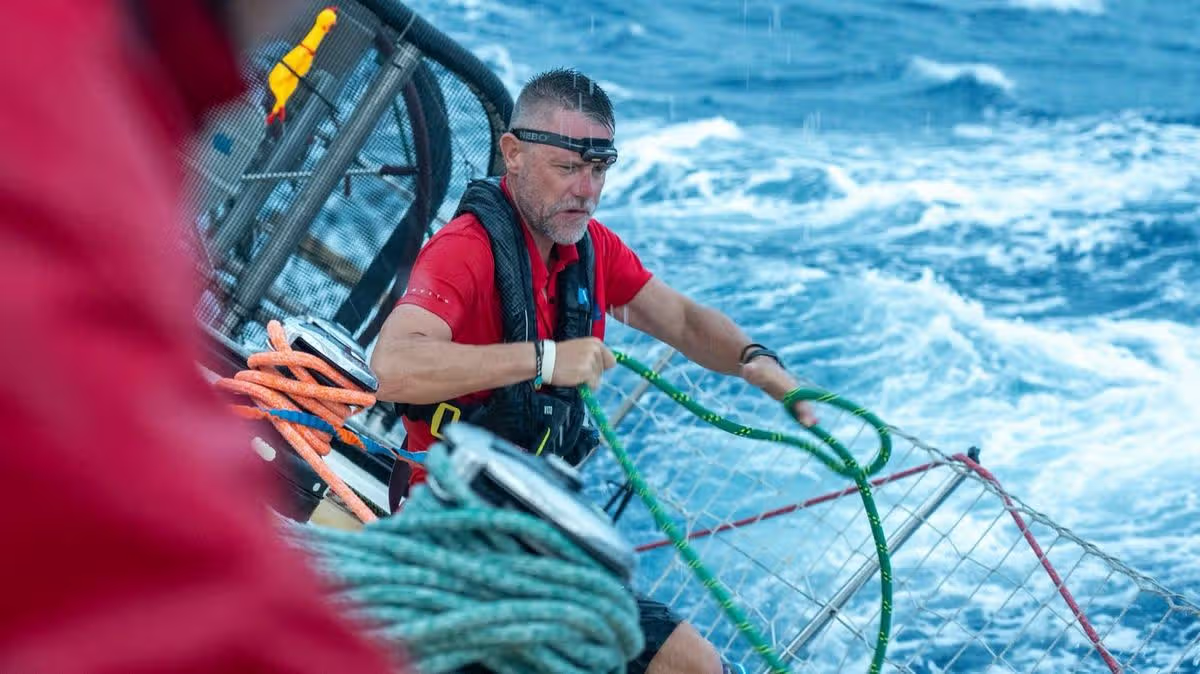
Skipper Gav Rees and his crew came second in an 11-month round-the-world Clipper race
A Welsh sailor is back from the voyage of a lifetime after 11-months at sea braving 70mph winds, 15 metre waves, sharks and medical emergencies navigating the globe.
Gav Rees, from Abergavenny, was skipper for a crew which changed along the route for The Clipper Round the World Yacht Race and included some who had never sailed before ranging in age from 18 to 75.
Racing on the the 70ft yacht, The London Business School, they took second place in the legendary Clipper race, the only round the world race which admits people who have never sailed before. Sign up for our free daily briefing on the biggest issues facing the nation sign up to the Wales Matters newsletter here.
Gav, a father-of-two, skippered the boat, competing against nine other identical racers. He was also acting chief medical officer and engineer – all on no more than four hours sleep a night and no showers for the entirety of the near year-long voyage.
“I was acting doctor, engineer, meteorologist and skipper,” says Gav, who left his job with a pharmaceutical company to take part in the race, sometimes dubbed the toughest endurance challenge of its kind.
The crew crossed oceans from Europe, to Africa, Australia, Asia and America, skirting the Southern Ocean near Antarctica and in near tropical conditions around the Philippines.
Covering 45,000 nautical miles, equivalent to more than 50,000 land miles, they faced down raging storms, waves the height of houses, broken sails and a first mate with a broken leg.
Magical moments included pods of whales filling the Southern Ocean near Antarctica at sunset, a flock of 10 booby birds joining the vessel for a stretch and seeing dolphins and albatross as they headed through some of the most remote waters on the planet.
Christmas dinner on the waves was cooked on a four ring hob in a galley kitchen the size of a phone box but was complete with turkey, ham, roasties and gravy.
It was harder for Gav to keep track of the Welsh rugby and World Cup football scores with satellite Wi-Fi covering just one email and phone for the vessel.
The Clipper Round the World yacht Race is the only event of its kind that trains everyday people to sail around the world on 10 identical racing yachts. The race is split into eight legs, with race crew choosing to take on one, multiple or all eight of the legs.
Lou Boorman, from Haverfordwest, who now lives in Malta, skippered for rival Team Tongyeong in the race.
For most of the challenge Gav and his crew fed on easy-to-store dried food like pasta while in cold conditions it was safe to keep nets of fruit and veg bought on the brief stops as they raced on.
The vessel, built for speed not comfort, only had enough bunks for the crew to take turns sleeping and a bucket and sponge did for washing. Swimming was banned as it could slow them and be risky while the boat sped on.
There was just one toilet, without a seat, for all 16. Staying on the toilet as the yacht surfed over house-high waves and lurched from side to side was not always easy, so the crew had to pick their moments for comfort breaks.
“Sleep is a privilege rather than a right and the toilet, flushed through with sea water by pump, can be an adventurous place to be on a boat being thrown around,” said Gav.
“We take the seat off because it could be dangerous. There was no shower, just a bucket and sponge and wet wipes.”
The unique sights as they crossed the Atlantic, the Southern Ocean and the Pacific made it all worthwhile, says the former officer cadet in the Royal Regiment of Wales, now the Royal Welsh Fusiliers.
Gav’s crew was made up 16 at a time from a 55-person squad, some of whom were on-board for the whole 11-months and some for as little as a week. The longest leg at sea was five weeks before they hit land.
All this was only possible with the strong bonding, daily crew meeting and joint ambition to have the experience of their lives whilst staying safe, says Gav.
Staying safe was at times easier than others, he admits.
The worst moment came when his first mate Zoe Longley broke her leg in several places a week’s voyage from Cape Town a few months into the race when a sail fell on her in October 2025.
“There’s no real text book for these things,” admits Gav as he describes how the main sail had then swung to one side in strong winds making the boat go backwards instead of forwards. For an hour there was a huge task righting the boat all whilst getting Zoe to safety.
Gav has high level first aid training and a vet was also on board and they made the decision to keep Zoe comfortable while they made it to a hospital in Cape Town, rather than have her helicoptered off.
While other boats could be contacted none nearby had any better kit to help.
“We set up sleeping bags on the floor next to her bunk, immobilised her and gave her pain relief. She had dislocated her ankle and her tibia and fibia were fractured in three places but she only had paracetamol and ibuprofen.
“It was significant and not pleasant and the boat was precarious as the sails were on the wrong side leaning the wrong way,” recalls Gav.
Less than four months later Zoe was out of hospital and re-joined the boat as it neared the Philippines in January 2026.
To get to this point the crew had to sail through “huge breaking waves” going from Cape Town to Australia near Antarctica.
“The Southern Sea is cold and grey but a very special place,” says Gav. “The wildlife was incredible with huge pods of whales. One evening there was a flat sea and pilot whales everywhere surfacing and blowing. It was magical.
“We also saw albatross, which are only unlucky if you kill or injure them, and lots of dolphins on the race.
“We saw sharks and turtles and in the Pacific booby birds took up residence on the boat. We didn’t feed them and I don’t know why they stayed, maybe for a rest. They weren’t bothered by us, they were just remarkably comfortable with 10 on one night.”
The race, which started in August 2025 in Portsmouth, took a route via Spain to Uruguay, South Africa, Australia, Indonesia, the Philippines, China, Japan and South Korea.
It went through the Caribbean to the USA and out through the Panama Canal. From there the route went across the Atlantic to Oban in Scotland and back to Portsmouth where the race ended and Gav and his crew came in second on July 25.
Back on dry land Gav is now wondering what to do next.
“People were selfless when conditions were awful and I was proud we had a really strong bond,” he says. “We enjoyed each other’s company and there was unity.
“These boats are designed for racing and surf up and down the waves which can be quite fun. Our top speed was 30 knots.”
It is the first time that Gav, a lifelong sailor, has done the Clipper Race, let alone skippered for it.
“It is a lot of responsibility and I wanted to bring everyone back safe. I have always had a passion for team work since being an officer cadet in the Royal Regiment of Wales.”
This week Gav is glad to be back home with wife Vicky and daughters Mollie, 16 and Bethan, 10 and plans to take it easy before planning his next adventure.
“I am taking a lie down in a darkened room for now,” he jokes.
Get daily breaking news updates on your phone by joining our WhatsApp community here. We occasionally treat members to special offers, promotions and ads from us and our partners. See our Privacy Notice.





























































You must be logged in to post a comment Login