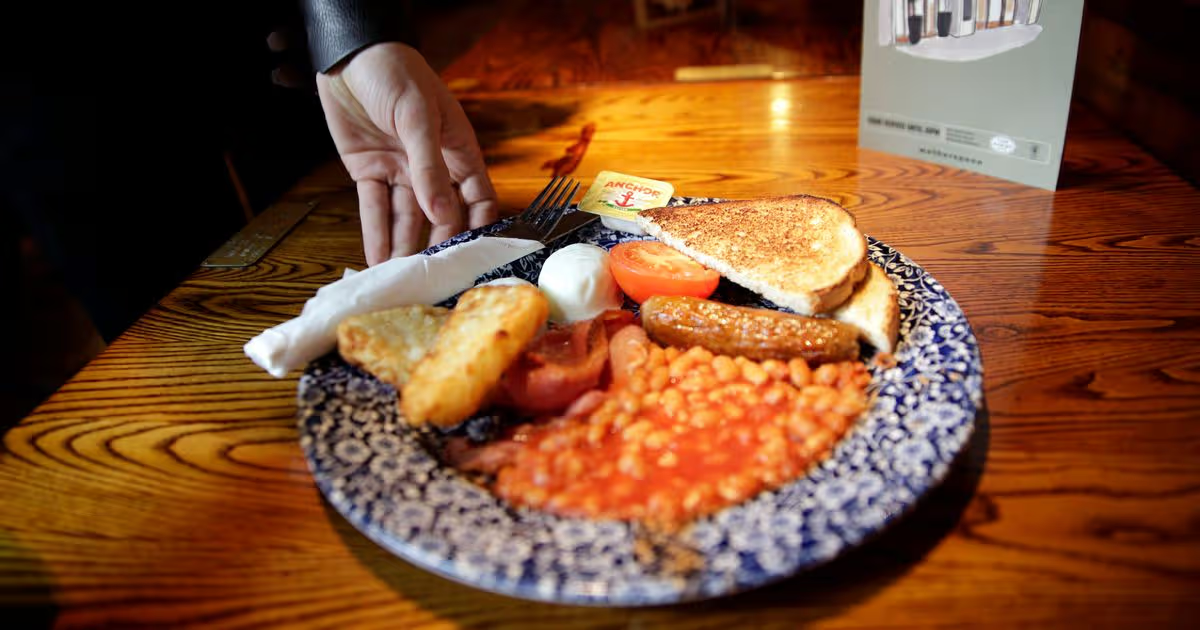
A Wetherspoons customer baffled people after sharing the cooked breakfast they ordered with an unlikely additional item that some said had no place on the plate
We Brits love a fry up, but we all have our own ideas for what should and shouldn’t go on the plate.
Advertisement
Some of us love loading up on sausages, some of us think beans shouldn’t go anywhere near the plate, and there’s often a difference of opinion when it comes to additions like black pudding.
No matter what you consider to be the perfect cooked breakfast, many cafes and restaurants that serve the morning meal will let you customise your dish to your liking.
That’s what one Wetherspoons customer did recently at their local pub in Ramsgate, Kent. But when they posted their customised breakfast on social media, people were baffled by one addition.
On Reddit‘s fry up forum, one person said they had ordered the “Freedom Breakfast” from their local Wetherspoons. This comes with two rashers of bacon, two hash browns, two eggs, two servings of mushrooms, two grilled tomatoes, and baked beans.
Advertisement
They then said they added a sausage, two pieces of black pudding, and the controversial addition – haggis.
They said: “I added a sausage, two black pudding and haggis (seems to be a new addition to the menu here). The pint of Guinness went down very well with it. Just over a tenner all in, including the pint. Overall very satisfying, especially for the price, and haggis was a great addition.”
The addition of haggis to the cooked breakfast split opinions in the comments section. Some believed haggis makes the “perfect side to any meal”, while others said it had no place on a fry up.
One person said: “Haggis and Guinness are a guaranteed winner.” Another added: “Solid breakfast! You can’t beat the helping of haggis and black pud!”
Advertisement
However, someone else was less convinced, stating: “Haggis looks like sheep [poo] infested with maggots.”
Several other commenters simply couldn’t believe the Wetherspoons patron had managed to get a breakfast and a pint of Guinness for around £10, describing it as a “bargain” no matter what food items were on their plate.
There were also people who were surprised that a Wetherspoons in Kent was serving haggis as a side dish – as it’s usually only available in Scotland.
It is sometimes available in wider parts of the UK around Burns Night on 25th January, but it would normally be gone from menus again by the middle of February.
Advertisement
When one person said they were surprised to see haggis available outside of Scotland, someone replied: “I think they sell it everywhere around Burns Night. Didn’t know they’re still selling it outside Scotland, though.”
But someone else theorised: “This will have been farmed, doesn’t taste the same. You only get proper wild-caught Haggis in Scotland these days.”
Dorothy Dinsdale, who lives at Cedar Court Residential and Nursing Home, in Seaham, is one of the contributors featured in Sanctuary Care’s cookbook, A Lifetime of Flavours: Celebrating Food, Family and the Lives Behind Beloved Recipes.
The cookbook includes 42 recipes from care home residents across the UK, all aged between 70 and 105.
Miss Dinsdale’s dish, Gran’s Mince Pot, is a layered meal of mince, onion, red Leicester cheese, chopped tomatoes, and thinly sliced potato.
Advertisement
She said: “At the age of 93, I didn’t expect anything like this to happen to me.
“I’m so glad this has happened, it has been such a good experience.”
She fondly remembers making it for her late husband Stanley, as well as for her daughter Anne and son-in-law Gordon when they returned home from hospital with their newborn, Sophie.
Louise Palmer, director of operations at Sanctuary Care, said: “Moving into a care home isn’t about leaving your old life behind, but continuing the things that bring you joy.
Advertisement
“Whether it’s recreating a childhood recipe or baking with friends, our chefs work closely with residents to make every mealtime meaningful, and A Lifetime of Flavours is a celebration of that love of food, family, and the lives behind it.”
The cookbook is part of Sanctuary Care’s Enriching Lives Framework, which focuses on maintaining identity, purpose, and joy in later life.
To order with a donation to Mental Health UK click here.
The book celebrates ‘continuity,’ one of the six senses of the framework, by showing how residents can carry on lifelong passions and traditions, such as cooking, even after moving into a care home.
Advertisement
Sanctuary Care is a not-for-profit care provider with 109 homes across the UK.
The cookbook raises funds for Mental Health UK and has already generated more than £4,700.
It is available to download for free or can be ordered in print for a donation, with all proceeds supporting the charity.
The book also features a foreword by 2023 Great British Bake Off winner Matty Edgell, who shares how food shaped his own family memories.
Lincoln Pawlak, a centre-back from Yarm, and Alex Pavan, a winger from Northallerton, are juggling a football apprenticeship at League One side Doncaster Rovers with a full-time academic programme at Hartlepool College of Further Education.
The students, both 17 years old, are working towards a Level 3 Extended Diploma in Sports Coaching, equivalent to three A-levels, alongside daily training sessions at Doncaster’s Cantley Park.
Alex Pavan looks on as Lincoln Pawlak does push ups (Image: HCFE)
Their progress on and off the pitch has already led to success, with Lincoln recently earning a two-year professional contract with Doncaster.
Lincoln said: “The college has been great – the course is really engaging as it aligns with what we’re doing in the apprenticeship, and both aspects of work mix together well.
Advertisement
“I’ve been able to take the learning from the academic course and apply it to the apprenticeship and vice versa.
“I’m looking forward to having a good qualification to fall back on if needed.
Lincoln Pawlak with Hartlepool College’s former Doncaster winger Ian Clark (Image: HCFE)
“I’m excited to move on in life and have that safety net no matter what happens.”
Lincoln is on loan at Ossett Town.
Advertisement
Alex, who is on loan at Hebburn, said: “The college course is very enjoyable and the teachers are supportive.
“We learn about lots of aspects of sport that support our football training, for example, content around diet and nutrition.
“At Doncaster Rovers the training is high quality, but I know my education and qualifications will always be there.”
Ian Clark, head of performance at Hartlepool College and a former Doncaster Rovers winger, said: “After teaching Lincoln and Alex last year, both lads had the opportunity at the start of the 25/26 season to move to League One side Doncaster Rovers.
Advertisement
“We were then approached by Doncaster and the players to continue and complete their full 12-unit Extended Diploma.
“The lads come in around their training schedule and work very hard and diligently to complete work.
“Their attitude and application is outstanding.
“More fantastic news was the fact Lincoln was given a two-year professional contract in October and both players often train with the first team.
Advertisement
“We as a college are proud of their achievements.”
Stuart Swift, head of academy at Doncaster Rovers, said: “Both Lincoln and Alex have applied themselves really well in our building since joining the club.
“They have both contributed to the U18 achievements so far and are developing individually.
“They have a good work ethic which you can see from the work they are doing at Hartlepool College and engage with analysis and the wider multi-disciplinary team programme.
Advertisement
“Both lads are now gaining experience on loan in non-league which is imperative to their individual journeys and gaining an understanding of senior men’s football.”
Tommy Lee Jones’ daughter Victoria’s cause of death confirmed after hotel tragedy – The Mirror
Need to know
Victoria Jones was found dead at the Fairmont Hotel in San Francisco on New Year’s Day, with the Medical Examiner now confirming her death was accidental
14:26, 18 Feb 2026Updated 14:26, 18 Feb 2026
Tommy Lee Jones’ daughter Victoria’s cause of death confirmed(Image: AFP via Getty Images)
Tommy Lee Jones’ Daughter Victoria Dies of Cocaine Overdose – Need to Know
The cause of death for Victoria Jones, the daughter of Hollywood actor Tommy Lee Jones, has been confirmed as an accidental cocaine overdose.
The 34-year-old was found dead at the luxury Fairmont Hotel in San Francisco on New Year’s Day. Emergency services were called at 2:05am after hotel staff discovered her on the floor, initially believing she had been drinking.
The Office of the Chief Medical Examiner ruled Victoria’s death was due to “toxic effects of cocaine” after an initial investigation found no signs of foul play. Emergency workers responded to reports of an overdose with “colour change,” indicating dangerously low oxygen levels.
Victoria had struggled with drug issues in the months before her death, facing multiple arrests for cocaine possession and domestic violence charges. Her husband had reported her drug use to the police during a stay at his family’s winery in Napa.
The family issued a statement saying: “We appreciate all of the kind words, thoughts, and prayers. Please respect our privacy during this difficult time.”
Victoria began acting as a child, appearing in her father’s films, including Men in Black II and The Three Burials of Melquiades Estrada.
Many people assume that medicines sold over the counter are inherently safe. After all, if you can buy something in a supermarket or high street pharmacy, how dangerous can it really be?
The reality is more complicated. Several commonly used over-the-counter medicines carry a real risk of dependence, misuse or harm when taken in higher than recommended doses, for longer than needed, or for the wrong reasons. Here are five medicines it is worth knowing about.
1. Codeine-based painkillers
Codeine is an opioid medicine used to treat mild to moderate pain and, in some formulations, to suppress coughing. Over the counter, it is usually combined with either ibuprofen or paracetamol. Once swallowed, the body converts codeine into morphine, which produces its pain-relieving effects.
Common side effects include drowsiness, constipation, nausea and dizziness. At higher doses, codeine can slow breathing and impair coordination. Some people are particularly vulnerable. Ultra-rapid metabolisers carry a genetic variant that causes them to convert codeine into morphine much faster than usual. This trait is more common in people of North African, Middle Eastern and Oceanian backgrounds and can lead to dangerous side effects even at standard doses.
Advertisement
With repeated use, the body can also become tolerant to codeine, meaning the same dose no longer provides the same relief. This process, known as tolerance, occurs as the brain’s opioid receptors adapt to the drug. People may then increase their dose, raising the risk of physical dependence. Stopping suddenly can cause withdrawal symptoms such as anxiety, restlessness, sweating and sleep problems.
To reduce these risks, codeine should be used for the shortest time possible. In the UK, the Medicines and Healthcare products Regulatory Agency limits pack sizes to 32 tablets and advises non-prescription products should be used for no more than three days.
2. Decongestants
Decongestants are available as tablets containing pseudoephedrine or as nasal sprays and drops such as xylometazoline and oxymetazoline. Both work by narrowing blood vessels in the nasal passages, reducing swelling and mucus.
Advertisement
Overusing nasal sprays can lead to rebound congestion, known medically as rhinitis medicamentosa. Over time, the medication becomes less effective, a phenomenon called tachyphylaxis. This can trap people in a cycle of increasing use, worsening congestion and dependence.
Pseudoephedrine also has mild stimulant effects. Although evidence for improved athletic performance is mixed, its stimulant properties mean it appears on the list of substances banned in competition. It is also used illicitly to make methamphetamine, which is why strict sales controls remain in place following a 2016 review.
3. Sleeping tablets
Promethazine and diphenhydramine are sedating antihistamines sold as short-term sleep aids. Recent research has linked sedating antihistamines to rising numbers of deaths, prompting calls for a review of how they are supplied.
Advertisement
Promethazine can quickly lead to tolerance, meaning higher doses are needed to achieve the same effect. Some long-term users report severe rebound insomnia when they try to stop.
It is also used recreationally in “purple drank”, a mixture of cough syrup that contains promethazine and soft drinks. This combination can cause extreme sedation, slowed breathing and serious harm.
4. Cough syrups
Dextromethorphan (DXM) is a common cough suppressant. A 2021 review found it was the most frequently misused over-the-counter medicine studied. At high doses, it blocks NMDA receptors in the brain, which can cause dissociative effects similar to ketamine. While safe at recommended doses, its psychoactive effects have raised concerns about misuse.
Advertisement
5. Laxatives
Stimulant laxatives trigger the gut muscles to move stool along. They are often misused by people with eating disorders, athletes in weight-restricted sports, or those who believe daily bowel movements are essential. In reality, constipation is usually defined as fewer than three bowel movements a week.
Research shows stimulant laxatives do not prevent calorie absorption, despite common myths. Instead, misuse can cause dehydration, electrolyte imbalance and long-term damage to the gut, with serious effects on the heart and kidneys in severe cases. In 2020, the MHRA introduced new rules on pack sizes and warnings.
The common thread linking these medicines is not that they are inherently dangerous, but that their risks are often underestimated. Over-the-counter availability can create a false sense of security, particularly when medicines are bought online without professional advice. While regulators have taken steps, research suggests misuse persists. Over the counter does not always mean risk free, and better awareness could help keep these medicines useful rather than harmful.
Car parks, toilets, derelict schools, a town hall and a former library are all to be sold by cash-strapped Trafford council in a bid to generate money.
But these measures are still not enough to solve the problem. Some £17 million of savings are lined up for the coming years, while Trafford is also looking to sell off land and buildings to bring in some more cash.
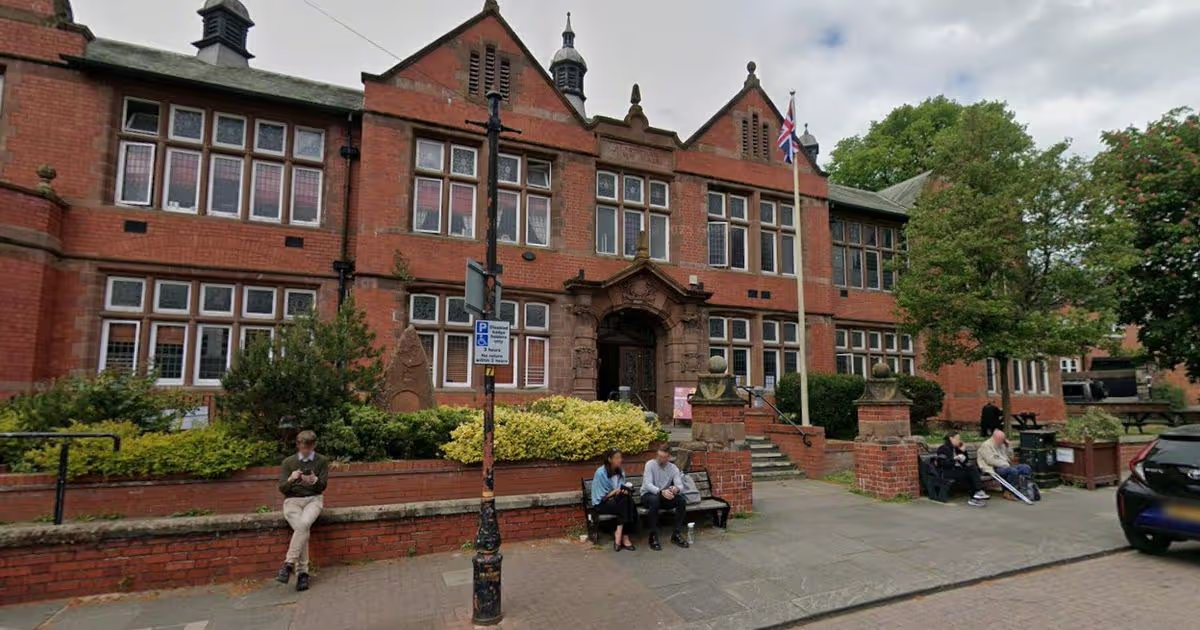
Among the assets expected to be disposed of are Altrincham Town Hall and the former Altrincham Library, documents reveal. Two disused schools, the former Moss View Primary School site, in Partington, and the former Trafford High School site, in Flixton, also feature on the list.
Advertisement
A number of car parks, a block of toilets, the former Davyhulme Youth Centre and the Jubilee Centre – a community centre in Bowdon – are also proposed for disposal. Trafford has said it needs to generate around £10 million through land and property sales to fund its capital programme over the coming years.
Capital funds are money set aside for projects, as opposed to day-to-day operational costs. A full list of the sites planned to be sold can be found below.
All of the sites listed have been labelled “surplus” by the authority, which said getting rid of them would reduce its costs and its maintenance backlog while also creating regeneration opportunities.
Advertisement
The authority has also identified a number of areas it wants to redevelop itself, either alone or as a joint venture, to increase the potential for profit generation from them in future years. These include the former Sale Magistrates site, in Altrincham, and land in Lacy Street, Stretford, where the former probation office once stood.
Sites to be sold
Former RBS Bank, Central Road, Partington
Stamford Quarter and Stretford Mall
Former Altrincham Library, Stamford New Road, Altrincham (1st Floor and ground floor)
The Jubilee Centre, St Marys Road, Bowdon
Wharf Road Garages, Altrincham
Altrincham Town Hall
Land at Balmoral Road, Altrincham
Land at Central Way, Altrincham
Brown Street Car Park, Hale
Land at Irlam Road, Flixton
Land at Lime Road, Stretford
Land in Davenport Green
Land at Seymour Grove, Old Trafford
Former Primary School, Moss View, Partington
Former Trafford High School
Redundant Cemetery Chapels – subject to operational review
Land at Keswick Rd, Moss Road, Old Trafford
Land off City Road, Old Trafford, M15 4FA
Car Park Eleventh Street, Trafford Park, M17 1JF
Toilets, Third Avenue, Trafford Park
Former Davyhulme Youth Centre, Davyhulme
Priory Road, Bowdon
Land at Firsway, Sale – New Access to site
Car Park Empress Street, Old Trafford, M16 9EN
Sites to be redeveloped
Partington Town Centre Site (land to the rear of Partington Shopping Centre)
Former Sale Magistrates Site
Stokoe Avenue, Altrincham
Former Tamworth Court Site, Old Trafford
Chapel Road, Sale
K Site, Stretford
Lacy Street Land Assembly, Former Sorting Office, Probation Service Building, Lacy Street Car Park
John Swinney is on course to remain as First Minister despite the Nationalists facing a “clear sense of voter disillusionment after nearly two decades in office”.
The SNP is close to winning a majority of MSPs at the Holyrood election in May despite “voter disillusionment” with the party’s 20 years in power, a new poll has found.
Advertisement
A survey out today by More in Common puts support for the Nationalists at 33 per cent on the constituency vote and 31 per cent on the list. If such a result was replicated on polling day it could hand John Swinney 64 MSPs – one short of an overall majority.
The SNP leader has argued that if his party hits the magic number of 65 it should act as a mandate to begin negotiations with the UK Government to stage a second referendum on independence.
Labour and Reform UK are currently fighting it out for second place, with Anas Sarwar’s party on 19 per cent in the constituency vote – just one point ahead Nigel Farage’s outfit. The two parties are tied at 16 per cent on the list.
That could leave Labour with just 16 MSPs, while Reform could end up with 17.
Advertisement
The survey is especially bad for the Scottish Conservatives who stand to lose more than half of their MSPs, ending up with just 12 elected members.
Luke Tryl of More in Common said the SNP could win big at the election thanks to the “highly fragmented” nature of the Scottish electorate – with no opposition party providing a clear alternative to the Nationalists.
The pollster said: “Despite a big fall in support since 2021 and a clear sense of voter disillusionment after nearly two decades in office, our latest modelling suggests the SNP could emerge from the next Holyrood election within touching distance of an outright majority.
Advertisement
“At a time when incumbent governments across the UK and beyond are facing a powerful anti-incumbent mood, Scotland might prove something of an exception.
“Because of the first-past-the-post system for the constituency vote, the SNP could receive a significant boost from a highly fragmented Scottish electorate. Additionally, much of the disillusionment among Scottish voters is directed at Westminster as well as Holyrood, limiting Labour’s ability to position itself as a clear anti-incumbent alternative to the SNP.
“In this context, we’re likely to see a Reform UK breakthrough on the horizon. On their current level of support, it’s possible that Reform could be competing with Labour for second place in Holyrood.”
Advertisement
Keith Brown, SNP depute leader, said: “This poll shows Scottish voters are putting their faith in John Swinney’s strong leadership which is firmly on Scotland’s side amid chaos from Westminster.
“As the Westminster parties tear themselves apart over scandals, John Swinney’s relentless focus has been on Scotland’s NHS, the cost of living crisis and offering people hope through a fresh start with independence.”
A spokesperson for Reform UK said: “It is clear from the poll that the SNP has run out of steam and ideas. After two decades of managed decline the people are ready for reform.
“The SNP has made everything is worse from the public services to town centres. The tax burden is weighing heavily on Scottish people and we will change that.
Advertisement
“They are fed up and this poll only further confirms what Reform has said all along. This is a two-horse race. We are going head-to-head with SNP.”
To sign up to the Daily Record Politics newsletter, click here
American star Mikaela Shiffrin cemented her status as the greatest alpine skier of all time as she won Olympic slalom gold in emphatic fashion.
Twelve years on from winning the title in Sochi aged 18, Shiffrin stormed to victory with an overall time of 1:39:10, a significant 1.50 seconds ahead of second place to become a three-time Olympic champion.
The 30-year-old put herself in pole position with a time of 47.13 seconds in the first run, a gap of 0.82 seconds to second-place Lena Duerr.
The German was the only skier to finish within one second of Shiffrin but she straddled the first gate on her second run to put herself out of medal contention.
Advertisement
That left Shiffrin with what was ultimately an exhibition run to take gold and she completed the run in 51.97 seconds.
Switzerland’s Camille Rast won silver while Sweden’s Anna Swenn Larsson took bronze.
The case of Seamus Culleton – who was detained by US immigration agents in Boston in September 2025 – is proving a diplomatic headache for the Irish government ahead of a visit to the White House on St Patrick’s Day.
Culleton arrived in the US in 2009, overstaying his visa. He married a US citizen last year and obtained a valid work permit, and was in the process of applying for permanent residency when he was apprehended by Immigration and Customs Enforcement (ICE) officers and detained. He has remained in detention in Texas since. A US court has now issued a temporary order staying his deportation.
Culleton’s case shines a rare light on the “undocumented” Irish in the US, a group that is rarely mentioned in US discussions around illegal immigration. The very idea of being undocumented in the US is associated with people from Mexico and Central and South America, not white people of European descent.
That perception reflects the racial exceptionalism that has long shadowed the Irish push for immigration reform in the US.
Advertisement
This history largely began in 1965, when the Immigration Reform and Nationality Act, also known as the Hart-Celler Act, radically changed conditions of immigration into the US. One effect was to reduce the numbers of Irish able to legally settle in the US.
Since the late 1960s, there have been efforts by successive groups to push for immigration reform that would advantage Irish immigration. While this work led to some successes, there was ultimate failure to secure comprehensive immigration reform.
Since the 1980s, advocacy has been primarily driven by Irish-born immigrants. At that time, the US saw an influx of immigrants leaving an economically impoverished Ireland. Many overstayed their tourist or student visas, and became undocumented – having no legal status in the US. It is estimated that there are 10,000 undocumented Irish living in the US today.
During research I was involved with in Chicago in 2017, a number of undocumented Irish consented to be interviewed anonymously. They were notably uneasy due to the recent election of President Trump and his avowedly anti-immigrant stance, expressing a sense of increased fear and uncertainty.
Advertisement
Equally, they were conscious that their race made them less visible to the authorities than the large numbers of undocumented people of Hispanic heritage. One interviewee commented: “People don’t think that we would be undocumented. I’m white, I can speak English, I’m Irish … that is not what the Americans are thinking of.”
The majority of our interviewees and survey respondents favoured immigration reform for undocumented Irish. But several observed that there can be opposition to such reform within the Irish community. A first generation Irish priest who had close relations with Irish communities, including the undocumented, commented: “Those who have legal status in the Irish community are not supportive, and sometimes opposed to the undocumented Irish. There’s pushback more so than in the Latino community … the Irish are quite divided.”
This schism between settled and sojourner Irish in the US is rarely mentioned, yet significant. The undocumented Irish take on a symbolic resonance, disrupting the common success narrative of how the Irish “made it” in the US.
In the past, the law was applied leniently to overstays who were building a life in the US, giving them opportunity to regularise their status. But in the second Trump administration, as ICE more rigidly and aggressively apprehends people who are deportable, the unease of undocumented Irish is even more heightened.
Advertisement
A St. Patrick’s Day dilemma
Irish Taoiseach Micheál Martin is in a difficult position as his visit to Washington approaches. According to a statement by Martin, there are “five to six” cases of Irish citizens currently detained by ICE. There is little clarity on how many have already been deported or how many have elected to quietly return to Ireland.
Irish opposition politicians and others in Ireland have taken up Culleton’s case to berate Martin for not doing enough to stand up to Trump. Some have demanded he pull out of the visit, which would be diplomatically awkward – Martin does not want to pull out of the scheduled meeting with Trump and all it entails for Ireland-US relations.
This is a volatile period in those relations. Trump is deeply unpopular in Ireland. Underneath this is a growing Irish disconnect with the US, including a notably conservative Irish America.
Immigration and customs enforcement agents have targeted undocumented immigrants as well as many US citizens. Copyright Lawrey/Shutterstock
Martin can’t admit any of that, of course. His job is to steer a safe and prosperous course, making his visit to the White House without causing headlines. On the Culleton case, he is adamant that a softly-softly diplomatic approach is best, saying: “Let’s not do anything that could make that even more difficult. This cannot be resolved in the public domain.”
Advertisement
That approach appears to have been made more challenging by Culleton’s decision to speak out about his case and about conditions in the Texas detention centre. He described it to national Irish broadcaster RTE as “a modern-day concentration camp” and said he feared for his life.
The discovery that Culleton was facing drug charges in Ireland at the time he moved to the US may further complicate the story, perhaps diminishing popular Irish support. It is also likely to harden the determination of US homeland security officials to deport him.
The story also has resonance due to the fact that Culleton is white. The last year has seen much debate about whether ICE’s actions have been targeting people of colour. Some conservative commentators are pressing for Culleton’s deportation to signify that ICE is colour-blind – “Yes, Even White, Irish Illegal Immigrants Must Be Deported” runs the headline of a Fox News opinion piece.
Whatever the outcome of Culleton’s case, it has already turned a spotlight on the fraught racial politics around being Irish and undocumented in America.
Stephen Colbert isn’t backing down in an extraordinary public dispute with his bosses at CBS over what he can air on his late-night talk show.
On “The Late Show” Tuesday, Colbert said he was surprised by a statement from CBS denying that its lawyers told him he couldn’t show an interview with Democratic Texas Senate candidate James Talarico — which the host said had happened the night before.
He then took a copy of the network statement, wrapped it in a dog poop bag, and tossed it away.
Colbert had instead shown his Talarico interview on YouTube, but told viewers why he couldn’t show it on CBS. The network was concerned about FCC Chairman Brendan Carr trying to enforce a rule that required broadcasters to give “equal time” to opposing candidates when an interview was broadcast with one of them.
Advertisement
“We looked and we can’t find one example of this rule being enforced for any talk show interview, not only for my entire late-night career, but for anyone’s late-night career going back to the 1960s,” Colbert said.
Although Carr said in January he was thinking about getting rid of the exemption for late-night talk shows, he hadn’t done it yet. “But CBS generously did it for him,” Colbert said.
Not only had CBS been aware Monday night that Colbert was going to talk about this issue publicly, its lawyers had even approved it in his script, he said. That’s why he was surprised by the statement, which said that Colbert had been provided “legal guidance” that broadcasting the interview could trigger the equal time rule.
“I don’t know what this is about,” Colbert said. “For the record, I’m not even mad. I really don’t want an adversarial relationship with the network. I’ve never had one.”
Advertisement
He said he was “just so surprised that this giant global corporation would not stand up to these bullies.” CBS is owned by Paramount Global.
Colbert is a short-timer now at CBS. The network announced last summer that Colbert’s show, where President Donald Trump is a frequent target of biting jokes, would end in May. The network said it was for economic reasons but others — including Colbert — have expressed skepticism that Trump’s repeated criticism of the show had nothing to do with it.
This week’s dispute with Colbert also recalls last fall, when ABC took late-night host Jimmy Kimmel off the air for a remark made about the killing of conservative activist founder Charlie Kirk, only to reinstate him following a backlash by viewers.
As of Wednesday morning, Colbert’s YouTube interview with Talarico had been viewed more than five million times, or roughly double what the comic’s CBS program draws each night. The Texas Democrat also reported that he had raised $2.5 million in campaign donations in the 24 hours after the interview.
Wintry showers are set to fall from 5pm as sleet before snow falls throughout the night, turning to sleet into the early hours and during the rush hour.
Temperatures will reach a high of five degrees and lows of two degrees.
Wintry showers are set to move in, with snow expected to continue throughout tonight, February 17, and into the early hours of Thursday, February 19, until approximately 8am.
Advertisement
The Met Office has cautioned that there’s a slight possibility of delays on roads, potentially resulting in some vehicles and passengers being stranded.
Both rail and air services may also encounter delays or cancellations.
Snowfall could also isolate some rural communities.
Possible power cuts and disruptions to services, including mobile signals, have also been predicted.
Advertisement
Snow showers are expected in Bolton on Wednesday afternoon.
By Thursday morning, sleet showers are set to begin, with an 80 per cent chance of precipitation at 6am.
Temperatures are forecast to peak at around 5C.
Conditions are expected to turn drier during the afternoon.
Advertisement
However, spells of rain, sleet and snow will push northwards through the evening.
Tonight, rain, sleet and hill snow will continue to move northwards, turning lighter and more patchy towards the end of the night as winds begin to ease.