


Even advanced technology can struggle when the real world becomes unpredictable. In April 2026, a Waymo robotaxi in San Antonio, Texas, drove into a flooded lane during severe weather, prompting the company to recall about 3,800 vehicles for a software fix.
No one was injured, but the incident exposed a deeper challenge: intelligence is not just about processing data. It is about knowing where to look, what to notice, when to act and how to use previous experience when conditions change.
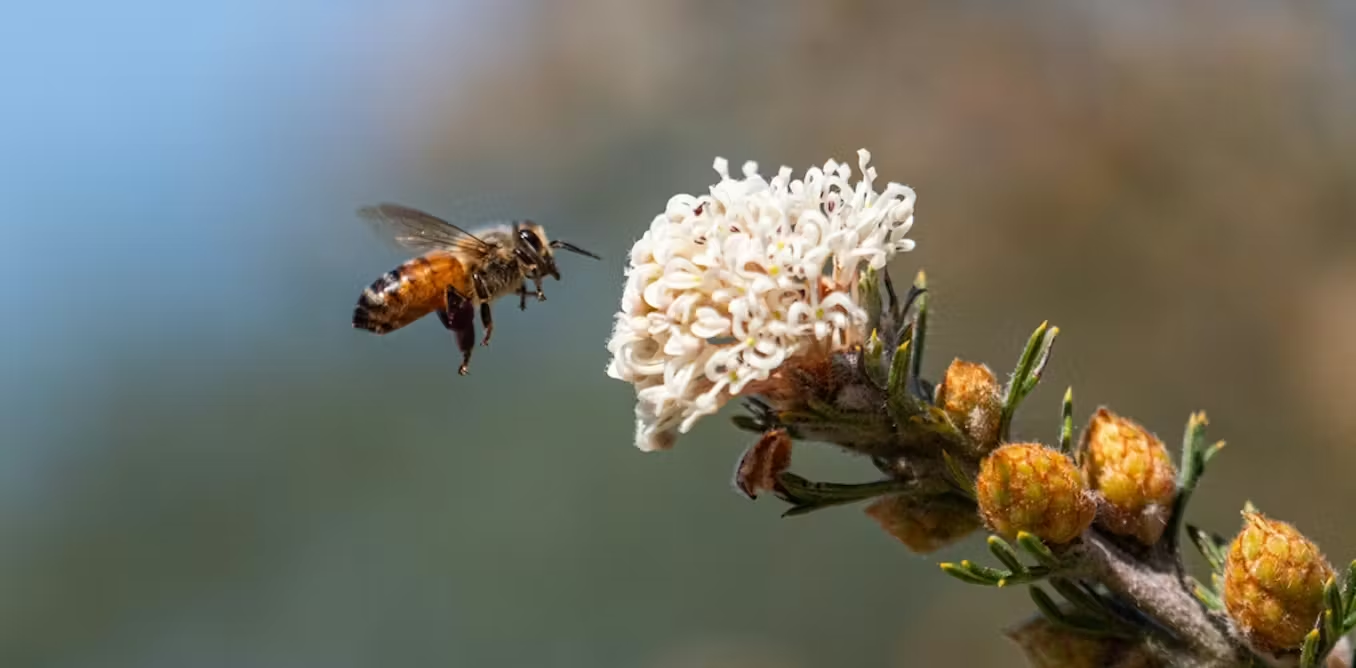
AI researchers are now looking at bees and other insects to help them design machines and robots that can make better decisions.
My research explores how bees learn, from identifying simple visual patterns to mastering high-level concepts, and how they adapt their behaviour when conditions change.
By combining behavioural experiments, neural recording (for example, measuring signals from the brain) and neuromorphic computing (an approach to computing inspired by the animal brain), my goal is to uncover the biological code that allows tiny brains to navigate a complex world and make efficient decisions. I have also worked in industry to translate these biological discoveries into robotic applications – bringing the intelligence of the hive to machine intelligence.
Research on honeybee decision making has shown that bees make rapid and accurate choices about whether to accept or reject flowers. They do not need perfect information. Instead, they combine sensory evidence, past experience and the likely value of a reward (for example, how much nectar they might gather).
À lire aussi :
Queen bumblebees can breathe underwater — for days. We discovered how
Many autonomous systems need to be able to do this. A robot exploring a greenhouse, warehouse or disaster zone cannot wait for perfect data. Bees offer a model based on flexible decisions and useful shortcuts rather than huge computation.
Bob Daemmrich /Alamy
With brains smaller than a sesame seed, bees navigate long distances, move through cluttered landscapes, identify rewarding flowers, avoid danger, communicate with nestmates and make rapid decisions. They achieve this with a tiny fraction of the energy used by modern computers, and can learn after only a few experiences that a new colour, scent or pattern predicts food.
This makes the bee an unlikely blueprint for low-power, robust AI and autonomous systems that can cope with the real world.
Bees can multitask
Many AI systems are designed to do one task well, such as recognising an image, following a route or detecting an object. Robotics has a harder ambition: compact machines that handle many tasks in unpredictable environments while using little power.
Bees offer a working example. During one foraging trip, a bee must find food, stay orientated, avoid danger and update its choices from experience, all with a brain containing around one million neurons. They do this by combining vision, smell, touch, vibration and airflow. Rather than processing every detail, they fuse information streams and extract what matters for survival.
Bees are valuable for robotics because they show how a small system can coordinate many tasks without huge computing power. That principle could guide low-power autonomous systems for agriculture, search and rescue, environmental monitoring and planetary exploration.
Bees also show that intelligence depends not only on what an animal senses, but also on how it moves to gather and shape information. This idea, known as active sensing, could transform robotics. When a bee approaches a flower, it does not take a still image like a camera. It moves its head and body; changes angle and creates patterns of visual motion across its eyes. These movements help useful information stand out, allowing the bee to ignore irrelevant details. This is why bees do not need to remember a flower as a detailed image. They only need to learn the key cues that help them recognise it again. Movement becomes part of sensing.
That is different from many machine-vision systems, which passively analyse images. A small robot using the bee’s strategy would not need to process every pixel. It could move to make the scene easier to understand, shifting position to judge distance, turning to improve contrast or using motion to detect obstacles.
The lesson is simple: intelligence is less about processing everything and more about using the right strategy to find the right information at the right time.
For a foraging bee, a bad decision can be costly. Visiting the wrong flower after a long journey wastes time and energy. Taking too long can mean losing an opportunity or being exposed to danger. To solve this, bees use relatively simple neural circuits to make rapid, accurate and risk-aware decisions. They do not need a huge brain or vast computing power. Instead, this minimal circuit helps them quickly decide whether to reject a flower or land on it safely.
Navigation without a map
Navigation is another area where bees inspire engineers. Bees can travel several kilometres from the hive to food sources and return home using visual landmarks, distance estimates and memory. New research inspired by honeybee flights has shown how tiny drones could navigate using very small neural networks. In the study, a bee-inspired system called Bee-Nav allowed small robots to travel away from home and return using only a compact neural memory. Therefore, future drones may not need GPS, detailed maps or large onboard computers.
Instead, they may use compact memories of important views and simple movement rules. Such systems could be useful where GPS is unreliable, such as in forests, tunnels, greenhouses or collapsed buildings.
Many future machines, from small drones to farm robots and environmental sensors, will need to act without heavy batteries or constant cloud computing. Like bees, they will need simple navigation strategies that work with limited energy, memory and information.
The real lesson is broader: intelligence does not always require scale. As AI becomes more common in daily life, the bee offers an elegant answer to rising energy demands. For decades, the ambition of AI was to build systems that match the human mind, but the bee shows that smart does not have to mean big.
By mimicking the bee’s ability to learn fast, navigate without maps and integrate multiple sources of information, we may build technology that is more efficient, flexible and resilient.





















































You must be logged in to post a comment Login