Murugan Anandarajan and Cuneyt Gozu of Drexel University explore the characteristics that make a job applicant more attractive in 2026.
If you spend a few minutes talking with college students about their career prospects, one topic is at the top of their minds: Will their jobs be displaced by a bot?
But what if employers are changing their candidate criteria just as quickly?
Advertisement
As scholars who research how technology is changing the workplace, we have long asked what employers value when hiring new talent. The question grew out of our conversations with both employers and students about internship experiences.
Year after year, employers emphasise communication, professionalism and other workplace skills as the areas where interns most need to improve. Students tend to focus on building their technical skills instead.
To determine whether this disconnect extended beyond internships, we surveyed more than 600 employers across a range of industries and organisation sizes. We asked them which skills and qualities matter most when hiring recent graduates and early-career professionals.
Their answer might surprise you – they consistently ranked ‘soft skills’ over technical know-how when evaluating applications.
Advertisement
Learning to grow with the job
We had expected employers to place AI and technical skills at the top of their list. Instead, our survey told a more nuanced story. Employers clearly valued those skills, but they consistently ranked even higher qualities such as interpersonal skills and willingness to learn.
No matter the size of the organisation, the results were similar. The rankings showed what employers valued, and their comments explained their reasoning. One theme surfaced repeatedly – employers want to hire people who they believe will grow with their organisations.
This doesn’t mean technical abilities are unimportant. Rather, those were seen as job-specific skills that could be taught on the job – which is much more easily done when new hires already have soft skills like dependability, professionalism and a willingness to learn.
A human resources manager at a mid-size healthcare employer captured this idea well: “Computer skills, excellent customer service and dependability are of utmost importance. The rest, we can train.”
Advertisement
A small medical device company made a similar point: While technical positions require a base level of competence, attitude and adaptability also matter because employees often need to take on varied responsibilities rather than staying in ‘one lane’.
Another respondent, from a small nonprofit, emphasised curiosity, adaptability and the ability to learn new skills quickly. In a small organisation, the employer explained, employees need to be willing to grow along with the organisation.
Together, these comments suggest that employers aren’t choosing between technical abilities and workplace qualities. Candidates may still need a technical foundation, but employers also want evidence that they can learn, adjust and apply what they know in changing circumstances.
Can we talk?
Communication was another recurring concern.
Advertisement
A hiring manager at a large manufacturer described the challenge of finding candidates who were comfortable with face-to-face and telephone conversations. Similarly, an executive from a small professional services firm said poor writing was a recurring reason for rejecting applications, and he cited communication with clients and colleagues as a growing challenge.
While our survey doesn’t show whether communication skills have declined over time, the consistency of these comments suggests that employers see this as a persistent challenge when hiring recent graduates. One respondent shared that many young graduates were “not equipped with great communication skills” and had trouble following through on commitments.
These comments suggest that employers see communication as more than just speaking and writing. They also associate it with professionalism and reliability.
The comments also helped explain why internships and training programmes remain valuable to employers. A respondent from a small professional services firm said they primarily hired former trainees, adding: “We know their skills, motivation and how they fit within our firm.”
Advertisement
These experiences allow employers to observe more than a candidate’s academic record or list of skills. As part of our ongoing conversations with employers, one supervisor described an intern who completed several complex projects ahead of schedule while adapting quickly to a new corporate environment. The supervisor was especially impressed by the student’s communication skills and eagerness to learn.
As for AI, the message from employers was clear: Knowing how to use a technology matters, but so does knowing when and how to use it responsibly.
As one respondent wrote: “If AI is used well in application materials, it’s fine. Most of the time, we only notice because it’s being used so poorly, which is unacceptable.”
We encountered a similar issue while serving on a recent search committee. Several applicants appeared to have used generative AI to prepare their cover letters, but they left out references to other institutions or positions. Instead of strengthening their applications, these errors called into question the applicants’ judgement, attention to detail and the accuracy of their materials.
Advertisement
The hiring process through an employer’s eyes
Reading these comments changed the way we thought about hiring. We saw how students and employers often approach the hiring process from different perspectives.
Students, understandably, focus on getting the job. They build strong résumés, prepare for interviews and learn how to use AI. Those efforts matter because employers expect graduates to arrive ready to contribute.
Employers, however, are asking a different question: Is this someone who will succeed here?
Every interaction helps them answer that question. An email can show how clearly and professionally a candidate communicates. An interview may reveal how someone listens and responds to an unfamiliar question. An internship or training programme demonstrates whether a student follows through, works well with others and responds to feedback.
Advertisement
Viewed this way, the survey results become easier to understand. Employers aren’t simply evaluating what candidates already know. They’re looking for signs of how candidates will perform, learn and develop after joining the organisation.
Lessons for students and universities
For students, the message isn’t that they must choose between technical and workplace capabilities. They need both.
Learning to use AI and other workplace technologies remains important, but students also need to prove they can communicate clearly, work effectively with others, exercise judgement and follow through on their commitments.
This means universities need to do more than add AI-themed courses and majors to their curricula. They should give students repeated opportunities to demonstrate how they apply their knowledge, respond to feedback and contribute to a team. Internships, traineeships and client projects allow students to refine these qualities before entering the workforce.
Advertisement
Career advising can reinforce this strategy by helping students explain not only which skills they possess, but where and how they have used them.
We began with a simple question: Has AI changed what employers value when hiring recent graduates?
The answer was more nuanced than we expected. AI is changing how work gets done, but it hasn’t fundamentally changed what employers look for in the people they hire. They still want graduates who can use technology effectively while demonstrating the judgement, professionalism and adaptability needed to grow with the organisation.
After all, AI may be changing the workplace, but employers are still hiring people, not algorithms.
Dr Murugan Anandarajan is a professor of decision sciences and management information systems at Drexel University. His research focuses on cybercrime, unstructured data analysis, business analytics and the strategic management of information systems. He teaches courses in text mining, qualitative research methods and disruptive technologies.
Cuneyt Gozu is an associate clinical professor of organisational behaviour at Drexel University’s LeBow College of Business and serves as academic director of the LeBow Career Readiness Center. He teaches undergraduate and graduate courses in leadership, organisational behaviour, change management and career development. His research and applied work focus on college hiring trends, career readiness, leadership development, the future of work, and issues of power, influence, and emotional intelligence in organisational settings.
Don’t miss out on the knowledge you need to succeed. Sign up for the Daily Brief, Silicon Republic’s digest of need-to-know sci-tech news.
Gravis Robotics, an ETH Zurich spinout, fits autonomy kits to excavators. A tie-up would extend Masayoshi Son’s robotics buying spree from the factory floor to the building site.
SoftBank is weighing a deal for Gravis Robotics, a Swiss startup that fits excavators and diggers with the sensors and software to run themselves, according to Bloomberg.
The report did not spell out the shape of any transaction, and the size, structure, and valuation were not disclosed. The discussions appear to be at an early stage, and there is no guarantee they lead anywhere.
The latest rumblings from the EU tech scene, a story from our wise ol’ founder Boris, and some questionable AI art. It’s free, every week, in your inbox. Sign up now!
Gravis Robotics spun out of ETH Zurich in 2022, from the Swiss university’s Robotic Systems Lab. Rather than build a robot from scratch, it retrofits standard heavy equipment, attaching a kit that fuses LiDAR, cameras, GNSS positioning, and hydraulic sensors so an ordinary excavator can trench, grade soil, and manage stockpiles on its own.
The company says the approach can lift site output by roughly 30%.
Advertisement
The kit has a name, or two. The hardware, Gravis calls Rack; the operator controls it through a tablet interface named Slate that switches between autonomous and manual modes.
The pitch is that a machine can be taught to feel the soil through its hydraulics rather than follow a fixed programme.
It is run by chief executive Ryan Luke Johns, an architect turned roboticist, alongside chief technology officer Dominic Jud and co-founder Marco Hutter, an ETH robotics professor.
Johns and Jud hold a Guinness World Record together for the largest robot-built dry-stone wall, which tells you something about the company’s temperament.
Advertisement
In November 2025 the startup raised $23mn in a round co-led by IQ Capital and Zacua Ventures, with Pear VC, Sunna Ventures, and cement group Holcim among the backers.
By its own account, Gravis now has machines working on active sites across seven countries. Its customer list, per the company’s own announcements, includes contractor Taylor Woodrow, which used the technology at Manchester Airport, plant-hire firm Flannery, and Holcim, which runs it in quarries. Those claims come from Gravis and have not been independently audited.
For SoftBank, construction is a logical extension of a much larger thesis. The group agreed last October to buy ABB’s robotics division for $5.4bn, and a four-bank syndicate only finished putting together the roughly $1.75bn loan behind that purchase this week.
It is also selling its remaining stake in Boston Dynamics to Hyundai, tidying up an older robotics bet even as it places newer ones.
Advertisement
The Gravis talks, if real, would join a run of similar moves. SoftBank led Agile Robots’ 2021 financing, the round that made the Munich firm Germany’s first robotics unicorn, and is now said to be anchoring a fresh $800mn raise there.
Earlier in 2025 it put $500mn into Skild AI, a startup building a general-purpose model to control robots. The common thread is machines that do physical work, and software good enough to run them.
Son’s pitch is that artificial intelligence has matured in software and the next frontier is giving it a body. SoftBank is reportedly preparing a US-based AI and robotics vehicle, provisionally called Roze, that it hopes to float at a $100bn valuation.
The wider market has moved with him, with global robotics investment more than doubling to $27.6bn in 2025, the year of record rounds for firms such as NEURA Robotics.
Advertisement
A digger that drives itself is a less photogenic proposition than a walking humanoid, but it may be a more immediately useful one. Construction faces a persistent shortage of skilled machine operators, and earthmoving is repetitive, dangerous, and expensive to staff.
Whether SoftBank ends up buying into Gravis, or simply kicking the tyres, the direction of travel is clear enough. The company that once bet on a chatty humanoid named Pepper now wants the machines that move actual earth.
More suction, improved (and very good) obstacle avoidance and brilliant mopping with the track mop make the Narwal Flow 2 a great choice for those with hard floors. Improved suction power makes short work on carpet, but as the mop can only lift by 10mm, those with deeper pile carpets may prefer a model that can drop its pads or that close off their rollers.
Excellet mopping
Very powerful vacuuming
Moves around obstacles with ease
Can’t leave its mop behind for vacuum only mode
Key Features
Advertisement
Track mop
Wide mopping cloth polishes stains off easily.
Advertisement
Powerful suction
30,000Pa suction power makes short work of fine dust.
Introduction
With its unique mopping system, the original Narwal Flow proved to be the best robot at removing stains that I’d tested, but it wasn’t quite up there when it came to overall flexibility. With the Narwal Flow 2, the company is back to sort that.
Advertisement
There’s the same clever track mop system, but a lot more suction power and a redesigned docking station. Is it all enough to make the Flow 2 the best robot vacuum cleaner, or is more work required? Read my full review to find out.
Design and Features
Self-empty, self-clean dock
Track mop
Powerful obstacle avoidance
Advertisement
You can buy the Narwal Flow 2 in black or white, a choice that covers both the robot and its docking station. Aside from the way the robot looks, there’s no difference between the colour variants in terms of performance or features.
Narwal has completely redesigned its docking station for the Flow 2. The new one looks more like something that Roborock would ship, rather than continuing the more curved design of the original.
One change is that the new dock now has a front ramp that needs to be attached to the front, sticking out slightly. The old dock didn’t need this and contained the robot fully inside.
Advertisement
There’s also a status light bar on the new dock that glows to give a visual indicator of the robot and whether or not it’s ready to go or has any issues. That’s fine, but I’m actually a fan of fewer lights, and only having them when there’s an issue.
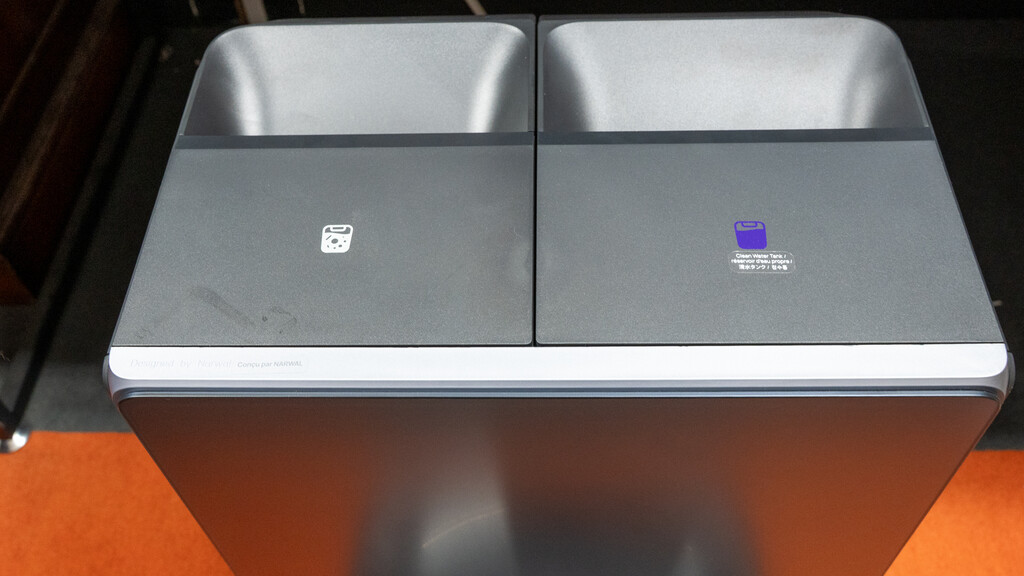
On top are the two water tanks. There’s a 4.5-litre tank for clean water, and a slightly smaller 4-litre tank for dirty water. Given that some water ends up on the floor after use, when the dirty tank needs emptying, the clean one will need filling.
Image Credit (Trusted Reviews)
Advertisement
This docking station can use 100°C water for mop washing, plus it can use detergent, automatically mixing it. Narwal keeps the detergent holder underneath the water tanks. There’s a sample of the company’s own hard floor cleaner in the box, but the design means you can use your own cleaner if you prefer.
Image Credit (Trusted Reviews)
Also under the tanks is the 2.5-litre disposable dust bag, which Narwal says can hold 120 days’ worth of dirt.
Image Credit (Trusted Reviews)
Pulling the main robot out, it’s quite similar to its predecessor in looks. With no LiDAR dome on top, the 95mm tall robot can slip under a lot of furniture without trouble.
Image Credit (Trusted Reviews)
Advertisement
At the front are the Dual RGB Cameras and Side Structured Light, which let the robot spot and avoid obstacles. Narwal says that this robot has unlimited obstacle detection, with Free FlowMove effectively allowing it to move around any issue and keep cleaning.
Advertisement
Image Credit (Trusted Reviews)
There’s a small dust bin that can be removed to be cleaned out, which also contains the Flow 2’s filter.
Image Credit (Trusted Reviews)
On the underside is the FlowWash Mopping system. This shares some similarities with a roller, but the track mop system means there’s more surface contact with the floor. A cloth is dosed with clean water, and then pulled along the floor with 12N of pressure to remove dirt.
Image Credit (Trusted Reviews)
Advertisement
In addition, the robot can use its cameras for stain detection, focusing on areas that need to be cleaned more.
When carpet is detected, the FlowWash system can be lifted 10mm off the ground to avoid soaking carpets. That works well enough on short pile carpet, but for more varied flooring you might prefer a robot that can either block off its roller or one that can drop its mopping pads off at the dock.
In addition, the Flow 2 can climb double thresholds of up to 4cm or single thresholds of up to 3cm, so it should be able to navigate most basic obstacles.
Control of the robot is via the Narwal app. It’s quick to get the robot connected to Wi-Fi, and then the initial mapping run. At the end of mapping, the app suggests the room layout, but I could merge or split to get the layout that I wanted.
Advertisement
Image Credit (Trusted Reviews)
Alongside the regular options, such as no-go zones, there are advanced options. Set the Room Character, for example, and you get to choose to say that a room is High-soil or Low-noise, which helps the robot adjust its cleaning strategy for that area.
Advertisement
Furniture can be added to the map, and then selected as a zone for quick cleaning, which is handy, say, for cleaning up after eating a meal. Otherwise, cleaning options including rooms of your choice or zones that you draw on the map.
Image Credit (Trusted Reviews)
There’s a choice to vacuum and mop, vacuum then mop, vacuum, or mop. For each choice, you can use the Freo Min option, which cleans automatically based on the environment and detected dirt level, or you can override and choose your settings.
For vacuuming, there’s a choice of four power modes, and two coverage choices (depending on how thorough you want the robot to be), plus up to three passes. Mopping has the same basic coverage settings but three choices of mop humidity.
Image Credit (Trusted Reviews)
I like that with the vacuum-then-mop setting that I could pick different numbers of passes for vacuuming (one or two) to mopping (up to three). This makes it much easier to customise how the clean works.
Advertisement
Advertisement
Performance
Excellent vacuuming power
Removes most stains fast
Brilliant navigation
I put the Narwal Flow 2 through its paces around the Trusted Reviews Home Technology Lab. Starting with the carpet test, I added a teaspoon of flour to the test carpet. With 30,000Pa of suction, this robot is one of the most powerful and it shows. After two passes, the carpet is back to its original state.
I had the same result on the hard floor with dust in the middle. This was all gone after vacuuming only.
My edge test proved tough in the vacuum-only test, with the side brushes not quite enough to tease out all of the dust.
Advertisement
Things get a lot better when mopping is added, and the Flow 2 managed to run along my kitchen plinth mopping up that mess, leaving only a fine trace of dust behind. That’s as good as I’ve seen from any robot vacuum cleaner.
Advertisement
I then moved to the mopping tests, starting with the dried-on coffee stain. I had set the robot to three passes, but it only needed one to quickly wipe this up.
Similarly, the dried-on red wine stain was removed with just that single pass, leaving a streak-free finish.
Advertisement
My mud stain was first vacuumed, removing the loose debris, and then completely cleaned after two mopping passes.
Advertisement
My ketchup stain is the hardest to remove, and this did prove tricky, especially as the abnormally hot weather had really dried the stain out. After three passes, the stain had been hugely reduced, but was still visible.
Given how hard the stain had set, I gave it a quick spray with kitchen cleaner, left it for five minutes, and then let the Flow 2 go about its work. This time, it picked up everything: the mopping system really is impressive.
Image Credit (Trusted Reviews)
Advertisement
I put some human hair down on the carpet, and then let the Narwal Flow 2 collect the mess. Turning the robot over, there was one loose strand of hair, but nothing wrapped tightly around the roller.
Object detection and avoidance is very good, too. I didn’t have any issue with the robot running into fake pet mess, shoes or cables that I left out, neatly navigating around them while still cleaning.
Advertisement
Sound is good, too. I measured the robot at just 50.5dB, which makes it very quiet.
Battery life is as good as you’d expect, too. Even with three passes set, the Narwal Flow 2 could easily manage to clean the entire Lab with a single charge.
Advertisement
Should you buy it?
Advertisement
You want clever navigation and great mopping
The track mop quickly wipes up tough stains, while the new AI obstacle avoidance is a winner for cluttered homes.
Advertisement
You need more flexibility for carpets
If you’ve got deeper pile carpets, a robot that can drop its pads or close off its roller may be a better choice.
Advertisement
Final Thoughts
Its ability to move through cluttered areas with ease, combined with the powerful mopping performance, makes the Narwal Flow 2 a star on hard floors. Improved suction power makes for better carpet cleaning, too. The main downsides of this model are that it can’t drop its track mop or cover it when dealing with deeper-pile carpet, which may make it unsuitable for some homes, in which case an alternative from the list of best robot vacuum cleaners may be better.
How We Test
We test every robot vacuum cleaner we review thoroughly over an extended period of time. We use industry standard tests to compare features properly. We’ll always tell you what we find. We never, ever, accept money to review a product.
Find out more about how we test in our ethics policy.
Advertisement
Used as our main robot vacuum cleaner for the review period
We test for at least a week
Tested with real-world dirt in real-world situations for fair comparisons with other vacuum cleaners
FAQs
How does the Narwal Flow 2 deal with carpets?
When it detects carpet, the robot can lift its mop off the ground to pass; you can also set the app so that the robot avoids carpet.
WTF?! As movie adaptations of video games have turned from mostly box-office bombs into commercial hits, it seems studios are now trawling the entire history of gaming for ideas. In what sounds like a particularly bewildering move, Atari has signed a deal with Universal Pictures to give 10 of the company’s classic games the movie treatment, including Pong and Centipede.
Atari’s retro games aren’t the first that come to mind when you think of titles that would be great on the big screen. The full list consists of Asteroids, Adventure, Berzerk, Breakout, Centipede, Crystal Castles, Millipede, Missile Command, Pong and Yars’ Revenge.
Deadline writes that Universal has already bought the first project based on an Atari IP, though it never revealed which one. It will be produced by Entertainment 360’s Guymon Casady from a screenplay by Matt Reilly and Carl Hampe.
“The best Atari games dropped you into a world and let your imagination do the rest,” Casady said. “Carl and Matt saw an opportunity to take that same spirit and build an original, large-scale adventure around it. From the moment we read the screenplay, we believed there was a great movie here.”
Advertisement
It’s certainly difficult to imagine how some of these games will translate into movies, but one expects there will be plenty of artistic interpretation. Perhaps Pong will be a Marty Supreme-style tale of becoming a table tennis champion. Missile Command could be a Cold War action thriller. Centipede might become a horror movie (nothing like The Human Centipede, presumably ). And Breakout could be a Shawshank Redemption-like prison-break tale.
The idea is to use the Atari IP to create large-scale action adventures, apparently. Hopefully, they’ll be better than that other “how could this be turned into a movie?” debacle, 2012’s Battleship.
Check out the latest Resident Evil trailer, a video game adaptation that appears to do the source material justice
Advertisement
Universal had previously secured the rights for an adaptation of Asteroids in 2019, but it still hasn’t been made into a movie. One assumes this would be an intergalactic adventure with aliens and a lot of threatening rock/metallic/icy space bodies.
Atari’s retro titles aren’t the only old games Hollywood is plundering for big-screen adaptations. Point-and-click classic Broken Sword, which first arrived in the mid-1990s, will also get a movie version, and it’s being made by the studio behind the live-action Sonic the Hedgehog movies.
Video game movies have come a long way since the days of Super Mario Bros in 1993 and the painfully awful Alone in the Dark. There are still a few stinkers, but when A Minecraft Movie made almost $1 billion, it’s easy to see why studios are desperate to make more.
Samsung has expanded its Galaxy lineup with the launch of five new devices at its Galaxy Unpacked 2026 event in London. Three foldable handsets were unveiled, along with the Galaxy Watch 9 and Galaxy Watch Ultra 2, in addition to the Galaxy Z Fold 8 and Galaxy Z Fold 8 Ultra. The newest additions feature improved technology, slimmer form factors, Galaxy AI, and health monitoring capabilities. Preorders for the new products have already been opened in various markets, and they will be available starting from early August.
Samsung Galaxy Z Fold 8
The new Samsung Galaxy Z Fold 8 is built with people who prefer a larger foldable device in mind. For that reason, it comes with a passport-like design, which makes the device relatively shorter but gives a wider cover screen. This type of device enables easy completion of daily activities without unfolding it. The device has a 5.5-inch cover screen and a 7.6-inch foldable OLED screen. Both displays support an adaptive refresh rate from 1Hz to 120Hz.
The company uses a new Flex Titanium display structure to strengthen the folding screen. Samsung has redesigned the hinge for better performance and a less noticeable crease. It is powered by the Snapdragon 8 Elite Gen 5 chip. The device features up to 16 GB of RAM and 1 TB of internal memory. It includes a 50 MP primary sensor, a 50 MP ultra-wide lens, and a pair of 10 MP selfie shooters.
A 4,800mAh silicon-carbon battery keeps the phone running and supports 45W fast charging. The Galaxy Z Fold 8 ships with Android 17 and One UI 9. It also includes Galaxy AI tools such as Now Nudge, Gemini Intelligence, and Gemini Notebook. Buyers also get six months of Google AI Pro at no extra cost. The phone starts at $1,899.99 and is available in Lavender, Cream, Graphite, and an online-only Pistachio finish.
Samsung Galaxy Z Fold 8 Ultra
The latest addition to the line-up of the company’s top-selling foldable model is the Galaxy Z Fold 8 Ultra. The new smartphone replaces the Galaxy Z Fold 7 and offers a slimmer form factor. Its thickness measures 4.1 mm when unfolded, and 8.9 mm when folded. Samsung has also introduced a toughened Flex Titanium frame along with the improved hinge, which increases the strength of the display and minimizes the crease effect. The Fold 8 Ultra has a 6.5-inch outer screen and an 8-inch folding screen with a 120Hz adaptive refresh rate.
The Galaxy Z Fold 8 Ultra runs on the Snapdragon 8 Elite Gen 5 processor. It comes with up to 16GB of RAM and up to 1TB of storage. Samsung also upgrades the camera system. The phone includes a 200MP main camera, a 50MP ultra-wide camera, and a 10MP telephoto camera. It also has two 10MP selfie cameras, one on each display.
Advertisement
The Fold 8 Ultra includes a 5,000mAh silicon-carbon battery with 45W wired charging support. It runs Android 17 with One UI 9 and includes Galaxy AI features like Now Nudge, Gemini Intelligence, and Gemini Notebook. Samsung offers the phone in Violet Shadow, Cream, Graphite, and an online-only Green Shadow color. The device starts at $2,099.99, while preorder buyers can take advantage of Samsung credit and trade-in deals.
Samsung Galaxy Z Flip 8
The Galaxy Z Flip 8 is the latest folding clamshell from Samsung. The company retains its classic design, but now makes the device slimmer and even more advanced. The features of the new Galaxy Z Flip 8 include the 6.9-inch foldable display and the 4.1-inch FlexWindow cover display.
Galaxy Z Flip 8 comes with the Snapdragon 8 Elite Gen 5 processor in America. Overseas versions have the Samsung Exynos 2600 chipset. This model features 12GB RAM along with up to 512GB of internal memory. It has a camera system that comprises 50MP main, 12MP ultra-wide, and 10MP selfie cameras.
The phone runs Android 17 with One UI 9. Samsung includes Galaxy AI features that work directly on the FlexWindow display. Personalized Now Brief updates and Gemini Intelligence help users complete tasks more quickly. The Galaxy Z Flip 8 also packs a 4,300mAh battery with 25W wired charging. It is available in Pink, Cream, Graphite, and an online-only Mint finish. It starts at $1,199.99, and preorder buyers can take advantage of Samsung credit and trade-in deals.
Samsung Galaxy Watch Ultra 2
The Galaxy Watch Ultra 2 is Samsung’s newest premium smartwatch. The watch features LTE connectivity as standard across all models. Samsung also redesigned the titanium body to make it thinner than before. The wearable includes a 47mm display with a peak brightness of 5,000 nits. It is powered by the Snapdragon Wear Elite platform and includes 2GB RAM and 64GB storage. Samsung equips the watch with a larger 800mAh battery. The company says it can deliver up to 60 hours of battery life with the Always-On Display enabled.
Samsung adds several new health and fitness features to the watch. These include Heart Health Score, Daily Cardio Load, Trail Run mode, and Nutrition Alert. The watch also provides hydration guidance during workouts. Samsung plans to release a Diving app later this year. The Galaxy Watch Ultra 2 has an IP69K rating and comes in Titanium Gray and Titanium Silver. It starts at $699.99, while preorder buyers can receive Samsung credit and trade-in savings.
Advertisement
Samsung Galaxy Watch 9
Samsung has launched the Galaxy Watch 9 as its more affordable smartwatch. The watch comes in 40mm and 44mm sizes. Buyers can choose between Bluetooth and LTE models. The 40mm version is available in Cream and Graphite, and the 44mm model comes in Silver and Graphite. Samsung powers the watch with the Snapdragon Wear Elite processor. It includes 2GB RAM and 32GB storage. The display offers up to 3,000 nits of peak brightness. The 40mm model packs a 390mAh battery, while the 44mm version includes a 445mAh battery. Samsung claims up to 30 hours of battery life with the Always-On Display turned on.
The Galaxy Watch 9 introduces new health and fitness features. Users get Heart Health Score, Daily Cardio Load, Sleep Apnea detection, and Vitals tracking during sleep. The watch also warns users about unsafe environmental noise levels. Samsung gives the smartwatch MIL-STD-810H and IP68 ratings for durability. Pricing starts at $379.99, with LTE models priced $50 higher. Samsung also offers a 60-day Strava trial and a two-month iFIT membership for new buyers.
We spent a few years pointing out the ridiculousness of the whole “TikTok ban” moral panic, and the fact that all of the “concerns” magically melted away after Trump became president and then effectively gifted a controlling stake to some of his friends should raise some pretty big questions. However, most people seem to have accepted the new arrangement without much fuss — even though ByteDance still retains a 19.9% stake in the company, and users at no point needed to switch to a brand new app, continuing instead to use the very app we were told was a security nightmare. All of which suggests the entire moral panic was absolute bullshit.
Either way, prior to the full “ban” that forced further ownership into the hands of Trump’s friends, there was a separate law from Senator Josh Hawley which simply banned TikTok on government devices. That law is still in effect. It’s pretty clear that it applies to “the social networking service TikTok or any successor application or service developed or provided by ByteDance Limited or an entity owned by ByteDance Limited.” It’s also clear that such an application is not allowed on any government devices, with exceptions only “for law enforcement activities, national security interests and activities, and security researchers.”
Now, a plain reading of the law would suggest that the current app is still banned. The law is still in place. ByteDance still owns a significant stake in the new “US joint venture” and the app is absolutely a “successor app” since users never needed to download a new app after the joint venture was established.
But, the Trump administration apparently would like to use TikTok on their devices. So, they’ve had the Office of Legal Counsel put out a decision claiming that, you know, ownership doesn’t really mean ownership and that the Trump administration can ignore the law and start using TikTok on their devices again. First things first, we discover that because Josh Hawley wrote a stupidly drafted law that directly called out “TikTok,” the OLC has to first tap dance around the fact that the law’s clearly named “TikTok” apparently doesn’t mean this TikTok, even though that’s exactly what the statute says:
Advertisement
Blackletter statutory-interpretation principles illuminate which particular “TikTok” Congress sought to prohibit. It is old wisdom that “a general phrase can be given a more focused meaning by the terms linked to it.” Fischer v. United States, 144 S. Ct. 2176, 2184 (2024). Namely, “the canon of noscitur a sociis teaches that a word is ‘given more precise content by the neighboring words with which it is associated.’” Id. at 2183 (quoting United States v. Williams, 553 U.S. 285, 294 (2008)). We apply this rule to “avoid ascribing to one word a meaning so broad that it is inconsistent with its accompanying words, thus giving ‘unintended breadth to the Acts of Congress.’” Gustafson v. Alloyd Co., 513 U.S. 561, 575 (1995) (quoting Jarecki v. G.D. Searle & Co., 367 U.S. 303, 307 (1961)). And precisely that kind of unexpected breadth would ensue here, were the Government Ban understood to apply to any future social networking platform based on its name alone.
[….]
We have considered the counterargument that, under the Dictionary Act, “words importing the singular include and apply to several . . . things,” 1 U.S.C. § 1—thus indicating that the Government Ban’s use of the phrase “the social networking service TikTok” could denote multiple unrelated variations or iterations of social media companies named TikTok. But the Dictionary Act itself provides that its general prescriptions do not apply when “context indicates otherwise,” id., and context does so in this case. “In context[,] the phrase ‘[the social networking service TikTok]’ should not be interpreted to mean literally ‘any [social networking service called TikTok],’ but must be understood against the background of what Congress was attempting to accomplish in enacting the [Government Ban].” Gustafson, 513 U.S. at 575 (cleaned up) (quoting Reves v. Ernst & Young, 494 U.S. 56, 63 (1990)). Here, the plain text of the Government Ban indicates Congress was attempting to address a particular national security threat posed by the presence on federal government devices of software “developed or provided by ByteDance Limited or an entity owned by ByteDance Limited.” Government Ban § 102(a)(1), 136 Stat. at 5258. TikTok USDS thus is covered by the ban only if it, like the version of TikTok operative when the ban was passed, falls into that category of software.
Call me pedantic, but if Congress didn’t want to ban an app “based on its name alone” maybe they shouldn’t have drafted and then passed a law that banned an app based on its name alone. And if Congress thinks that the new TikTok is somehow safer, they should repeal the original, poorly drafted law. Instead, the OLC has to start asking “what is ownership, really, other than a concept”?
For three reasons, we conclude that “ownership” in the context of the Government Ban is best understood as referring to a controlling stake, such that TikTok USDS falls outside the prohibition’s scope.
First, the “control” sense of the word “own” is most “consistent with the way that an appropriately informed speaker of the language would understand [that term’s] meaning” in the specific context of corporate structure. Van Buren v. United States, 141 S. Ct. 1648, 1657 (2021) (quotation marks omitted). The United States is home to “large numbers of firms with widely dispersed share ownership.” Henry Hansmann & Reinier Kraakman, The End of History for Corporate Law, 89 Geo. L.J. 439, 443 (2001). But it would be unusual for someone to say that a person or even an institutional investor “owns,” for example, Meta, simply because the investor holds some of its stock. Cf., e.g., Van Buren, 141 S. Ct. at 1657 (“In the computing context, ‘access’ references the act of entering a computer ‘system itself[.]’”). Instead, in the corporate context, we generally recognize Mark Zuckerburg as the “owner” of Meta because he retains control of the company through so-called “super-voting” shares. See Nathan Reiff, Top Facebook (Meta) Shareholders, Investopedia (Mar. 21, 2026), https://perma.cc/XQ6V-ZNTT; Gregory H. Shill, The Social Costs (and Benefits) of Dual-Class Stock, 75 Ala. L. Rev. 221, 224 & n.6 (2023).
Advertisement
So, hear me out, if Josh Hawley and Congress meant for the law to only apply if ByteDance “controlled” the company, then it could have (and arguably should have) written that into the law. But they did not. They said ownership. And that mattered because, technically before the “divestiture” and new US “joint venture” Western investors already owned about 60% of ByteDance, with employees and ByteDance’s founder holding most of the rest. The goal of the various laws to ban TikTok was to get ByteDance out of owning any of the company.
And that didn’t work. But we all have to pretend this “fixed” things, so the OLC just says “eh, because US entities now control it, we can ignore the law and pretend it said “control” rather than “own.”
Our textual interpretation is confirmed by the facts on the ground, which indicate that the TikTok USDS joint venture is wholly controlled by American interests as a functional as well as a formal matter—and thus exhibits none of the concerning security features that initially motivated the Government Ban. As our prior advice to you highlighted, if facts did not bear out that conclusion, then our understanding of “ownership” as used in the Government Ban could be called into question. But where, as here, the facts demonstrate that ByteDance Limited’s status as a minority shareholder in the joint venture has no impact on the exercise of control over the venture by United States investors, the inference runs the opposite way. Congress had no need to target minority ownership by ByteDance Limited in the Government Ban because that state of affairs is wholly compatible with the joint venture “operat[ing] [TikTok USDS] under defined safeguards that protect national security.”
Of course, all this really does is confirm Calvinball rules: the definitions change exactly as often as it takes to get the outcome someone in power wants. When “ownership” needed to mean any ByteDance stake to justify a ban, it meant that. Now that the administration wants TikTok back on its phones, “ownership” apparently means “controlling stake,” and 19.9% doesn’t count.
The real lesson here appears to be that the earlier concerns were exaggerated. Josh Hawley and Congress wanted to get headlines about how they were “taking on China” and “big tech” more than they wanted to write a clear law. They had a moral panic about one specific app, dressed up in national security language, and now that the political winds have shifted, the Office of Legal Counsel is left doing contortions to make the text say what the moment requires.
Two weeks after debuting its more naturalistic GPT-Live audio AI model with full-duplex capabilities (listening and speaking at the same time), OpenAI is bringing it directly into developer workflows.
The company announced that GPT-Live now powers the ChatGPT desktop application on macOS and Windows, integrating directly with agentic systems like Codex and ChatGPT Work (which are separate experiences available in the ChatGPT desktop app).
When OpenAI initially launched GPT-Live on July 8, 2026, it introduced a continuous audio model capable of listening and speaking simultaneously—eliminating rigid turn-taking while delegating complex reasoning to background models like GPT-5.5.
Today’s release expands that conversational layer to technical tasks, enabling software engineers to orchestrate multi-threaded coding jobs, review pull requests, and debug applications using natural voice commands.
Advertisement
As such, it could usher in a new era of “hands free” software development and even live, in-person group coding parties for the more than 10 million weekly active users across Codex and ChatGPT Work. Codex, of course, is the name given to OpenAI’s models and harness focused on coding, but which the company has this year expanded into a more general productivity platform. An OpenAI spokesperson told VentureBeat this is the first time voice activation
OpenAI posted a promotional video showing some of its employees, Codex developer experience engineer Jason Liu and Codex technical staffer Guinness Chen, speaking to the same ChatGPT desktop app session in the same room, each issuing different instructions and conversing with the same model.
New capabilities unlocked
At its core, this integration relies on decoupling the real-time voice layer from the underlying execution engines.
Advertisement
While GPT-Live maintains fluid conversation—inserting natural verbal acknowledgments like “got it” without interrupting the user—it passes heavy computational workloads to background reasoning models.
On macOS, the desktop application incorporates “Appshots” and screen context features, allowing ChatGPT Voice to analyze the frontmost window alongside local files, codebase structures, and active plugins.
This architecture creates a pair-programming dynamic where developers talk through problems conversationally while agents execute tasks asynchronously.
Rather than manually stopping coding sessions to type detailed instructions or switch windows, developers direct the system hands-free.
Advertisement
The full-duplex engine dynamically decides when to speak, pause, or invoke tools, maintaining conversational state even as background agents process complex code modifications.
Directing coding and complex builds with your voice alone
The central operational capability in this update centers on multi-task execution across Codex and ChatGPT Work environments.
Software engineers can initiate multiple concurrent task threads from a single spoken prompt. For instance, a developer preparing to ship a feature can instruct the system to investigate an open authentication bug, review a pending API migration pull request, and generate missing unit tests simultaneously.
The desktop application coordinates these actions across disparate contexts, tracing issues through Slack conversations, GitHub repositories, and local codebases.
Advertisement
Developers can also verbally convert design mockups into working code, splitting tasks across frontend, backend, and testing layers.
With support for multi-folder projects (build 26.715) and remote execution via iOS, engineers can check task progress, answer agent prompts, and redirect active jobs without switching applications or managing individual processes line by line.
Proprietary license
OpenAI’s voice-enabled desktop release operates under a proprietary, commercial enterprise model. Access is restricted to paid subscribers across Plus, Pro, Business, Enterprise, and Education plans.
For individual developers and corporate engineering departments, this commercial structure means the model weights, voice processing pipelines, and agent state architectures remain fully closed.
Advertisement
Organizations cannot modify or self-host the underlying systems. Furthermore, tasks initiated via ChatGPT Voice consume standard usage allocations directly from existing Codex and ChatGPT Work plan quotas, treating voice-triggered actions identically to standard agentic workloads.
Community reactions
Developer communities immediately noted the implications of bringing continuous full-duplex voice to autonomous coding workflows.
Reacting to the build 26.715 release announcement—which details voice integration and multi-folder project support—AI Insider journalist @ChrisGPT noted on X: “Today OpenAI will release voice and remote guidance for codex ! One step closer to personal AGI”.
Early technical feedback highlights widespread enthusiasm for orchestrating complex agentic tasks hands-free, particularly when stepping away from the workstation or managing build pipelines remotely.
Fresh off a $2 billion fundraising and $900 million line of credit, London-based data center startup Nscale is planning a big expansion at a new engineering office in Bellevue, Wash.
Nscale, one of the fastest-growing companies building AI computing infrastructure, recently inked a deal for nearly 24,000 square feet of space at The Eight office tower in downtown Bellevue.
The office is slated to open in January 2027. It will serve as Nscale’s primary engineering hub in the United States, a company spokesperson said. The company currently employs about 50 people in the Seattle area, and the new office will be able to accommodate up to 250 people.
The company earlier this year hired Nidhi Chappell, the former Microsoft corporate vice president who led Azure AI and high-performance computing infrastructure, including the supercomputers that power ChatGPT. As Nscale’s new president of AI infrastructure, based in the Seattle area, Chappell will oversee the company’s global engineering and data center operations.
“I’ve had a front-row seat to some of the biggest moments in AI over the past several years, but one thing has always stood out: the world remembers the breakthroughs, but it’s the people building the infrastructure behind the scenes who make them possible,” Chappell wrote in a LinkedIn post last week announcing the company’s first “onboarding” event in Seattle.
Advertisement
Nscale, which is also preparing to open an office in New York, said it selected Bellevue because of the Seattle region’s concentration of AI infrastructure talent and its proximity to major customers.
Microsoft is one example. Earlier this year, the companies announced an expanded collaboration to deploy Microsoft’s next-generation AI infrastructure across Europe, including large-scale installations of NVIDIA Vera Rubin GPUs in Norway, Portugal and other locations. Nscale said it would be among the first providers outside of Microsoft to deploy the Vera Rubin platform, supporting Microsoft’s growing AI cloud infrastructure.
The new office is the latest sign of Bellevue’s growing role in the AI economy. The Eastside has become a magnet for companies building AI applications and infrastructure, with xAI, OpenAI, Databricks, CoreWeave, Armada, Anduril and others establishing and expanding offices.
AI companies have been giving a boost to the regional office market overall. Claude maker Anthropic, for example, recently announced an expansion of its offices in Dexter Yard in Seattle.
Nscale was founded in 2024. Its $2 billion funding round earlier this year valued the company at $14.6 billion, believed to be the largest Series C financing ever raised by a European technology company. The capital is being used to expand Nscale’s AI cloud platform, GPU infrastructure and data center footprint across North America and Europe.
Its backers include Astra Capital Management, Citadel, Dell, Jane Street, Lenovo, Linden Advisors, Nokia, NVIDIA and Point72.
Advertisement
News of the Nscale office in Bellevue was first reported by the Puget Sound Business Journal.
The official story trailer for Marvel’s Wolverine has been released
The trailer features Jean Grey, Team X, and a multitude of villains
It looks like The Last of Us actor Troy Baker will also star in the game
Insomniac Games has revealed brand new story details for Marvel’s Wolverine alongside an official story trailer, featuring bloody battles, mutants, and a ton of villains.
Revealed at San Diego Comic-Con, the trailer kicks off with Logan, aka Wolverine, confronting Jean Grey in what looks to be the aftermath of a battle. The pair clearly share a lot of history in this story, and Jean can be shown accompanying Logan on missions as they rescue mutants and investigate threats as part of Team X.
“New allies and formidable adversaries emerge in the clash for mutant survival,” the new story description reads. “As Wolverine, unite with Jean Grey to protect those most vulnerable. Fight alongside Team X to confront the world’s deadliest villains in the caliber of Bolivar Trask, Omega Red, and Deathstrike, and stand against oppressive forces like The Reavers and The Hand.”
Latest Videos From
We also get a look at more members of Team X – the X-Men don’t exist in this story – which includes Sabretooth, Mystique, and Sunfire. At one point, we also see a quick glimpse of another unnamed character, who appears to be played by The Last of Us actor Troy Baker.
Marvel’s Wolverine – Story Trailer | PS5 Games – YouTube
There are plenty of shots of Logan in different cities around the world as he takes on enemies like Deathstrike and, notably, The Hand, which you might be familiar with because they’re one of the major villainous organizations of the Daredevil TV series and the upcoming movie, Spider-Man: Brand New Day.
Insomniac also dropped some brand new artwork for the game as well, showing Logan taking on The Hand, and it looks awesome.
In addition to a new story trailer, the studio also announced a collaboration with Arc System Works to bring Wolverine’s suit from Marvel Tōkon: Fighting Souls to Marvel’s Wolverine, as well as revealed a digital prequel comic book that takes place before the game.
Sign up for breaking news, reviews, opinion, top tech deals, and more.
It was also confirmed that award-winning composer David Fleming crafted the music behind Marvel’s Wolverine, which will be released on August 28, but fans can listen to the first track, “Logan,” on available platforms like Spotify, Apple, YouTube, and Amazon.
Advertisement
Marvel’s Wolverine launches exclusively on PlayStation 5 on September 15.
The lossy compression algorithm used by JPEG was useful for those on the early Internet not only because it enabled pictures to be shared easier, but because it allows a low-resolution version of the image to load first. This meant that users could make out the gist of an image before it finished downloading. This was a great feature for those on slow connections, but it hides some other capabilities of this image format as well.
Rather than effectively splitting up the image into chunks, each with successive amounts of detail, [maurycyz]’s project shows that this can be exploited to load more than one picture. The first is loaded into this lower-resolution area, with a second unrelated picture showing up once the higher-resolution information is available. Essentially this makes a one-way .gif of sorts. Though this method is only capable of loading about nine frames, which is not enough for much animation. Further limiting things is that there’s no way to encode timing data, so on fast computers with fast connections the animation could load faster than a user could see.
Still, it’s an interesting quirk of this older image standard, one which still is in widespread use today. And it’s also true that it’s hard to say in what ways various technologies will be used in the future. JPEG images have also been the subject of some artistic projects that might not have been possible without the JPEG standard itself, and even as other formats have tried to supplant it, it still maintains its firm grip on the images on the Internet. More JPEG, please!
Frank Ssekamwa says the United States presented his country with an impossible choice. If it accepted the terms of a new health agreement, Uganda would have to give the U.S. access to the data of millions of his fellow citizens — a decision he worries would make their personal information more vulnerable to breaches and possible exploitation.
But if it refused, the East African nation would likely lose out on more than a billion dollars to address HIV, malaria, tuberculosis and other illnesses, even as its people face ongoing threats from Ebola and other deadly infectious diseases.
Advertisement
So, on Dec. 10, it agreed.
“If you take the deal, you’re going to be exploited. If you don’t take it, you’re going to die,” said Ssekamwa, an attorney and digital rights expert in Uganda. “It’s the essence of digital colonialism.”
Across Africa, countries have faced similar dilemmas as the U.S. has held a series of closed-door negotiations in which lifesaving aid has been conditioned on access to citizens’ health data. The negotiations come in the wake of the dismantling of the U.S. Agency for International Development, which — in contrast with the new contracts — provided billions of dollars in aid with few strings attached. Officials in Zambia, Zimbabwe and Ghana have been so outraged by the demands that they rejected the initial deals.
The demand to access health data is central to the Trump administration’s new America First Global Health Strategy, an openly transactional approach that seeks to leverage the desperate need for medical treatments abroad. Aid will now be given “in a way that directly benefits the American people and directly promotes our national interest,” Secretary of State Marco Rubio stated in September.
Advertisement
The State Department declined to publicly release global aid and data-sharing agreements it has signed with more than 30 countries as part of its new approach. But a ProPublica analysis of nine of the deals offers a window into the extensive U.S. demands for access to data — and the potential risks and vulnerabilities for the citizens of countries that have signed them. ProPublica also reviewed a data-sharing agreement struck with Uganda, which has not previously been reported; a data agreement with Kenya; six agreements over the sharing of pathogens that can cause pandemics that were made public by the State Department this week; generic templates of deals for sharing both data and pathogens that can cause pandemics; and an analysis of the documents the advocacy group Public Citizen shared exclusively with ProPublica.
ProPublica also consulted more than a dozen experts in data privacy and global health, including several with direct knowledge of U.S. policy who said that the insistent demands for data access and other resources as a condition of aid are unprecedented. Without seeing the full suite of agreements, they could not identify all vulnerabilities. But they spotted some red flags: The terms of the deals are vague and lack language standard in most data-sharing agreements that adequately limits what data is collected and how it can be used. That increases the risk that individuals’ personal data could be exposed, misused or commercialized without their consent.
In the Ugandan data deal, the U.S. will get direct, real-time access to nine of the nation’s health data systems for seven years, including the central repository that stores all of its health information, lab data, data collected by community health workers and, critically, its system for managing individuals’ electronic medical records.The agreement calls for the sharing of aggregated data with all personally identifiable information removed. It also says the data should be used for delivering and auditing healthcare services.
But lawyers and digital privacy experts argue that the deal raises questions about who will have access to the massive cache of health data and whether it could be inappropriately accessed and exploited.
Advertisement
Some expressed concern that, because it is possible to reverse-engineer data that has been anonymized, people with HIV, tuberculosis and other diseases could have their records exposed.
Stephanie Psaki, who served as the U.S. coordinator for global health security under President Joe Biden, described the Trump administration’s approach as a “blunt instrument of ‘just give me the login to your data systems.’”
“The U.S. would never agree to that,” she said, if the deal were offered in reverse.
In Uganda, the U.S. will provide up to $1.7 billion over five years for global health security and the treatment and prevention of deadly conditions such as malaria, tuberculosis, HIV and polio.In the past, the U.S. gave this aid without asking for direct benefits in return, saving an estimated 170,000 Ugandan lives per year.
Advertisement
While a significant investment, it is less than the U.S. previously spent in Uganda and will decrease every year of the agreement. By 2030, the African nation will receive 45% less global health funding than when Trump retook office, according to an analysis by Vincent Lin of Partners in Health, which provides healthcare in poor countries.
Several experts said there is broad support for some of the goals of the new plan for aid, including reducing African countries’ dependence on the U.S. for healthcare needs. But they worry the transactional nature of the approach could backfire by undermining trust or, in some cases, driving nations to reject deals altogether.
After withdrawing from the World Health Organization and losing access to its global network that tracks and combats disease outbreaks, the U.S. is attempting to obtain the information necessary to address potential pandemics through a patchwork of deals with individual countries. Each of the agreements ProPublica reviewed includes a section on responding to outbreaks. And some countries have signed separate pathogen-sharing agreements, which state that countries must “initiate sharing specimen(s) and related data” within five days of a U.S. request. The Trump administration is also planning unprecedented involvement of private companies to manage and process data.
The State Department told ProPublica that it needs access to the data to improve health outcomes in recipient countries and keep Americans safe. The new approach also requires countries to invest more in their own health systems in exchange for the aid, a promise many countries will likely struggle to fulfill. And, in some cases, including the deal with Uganda, it aims to boost local manufacturing through partnerships with American companies.
Advertisement
The State Department said it took multiple factors into account to ensure the required investments from other countries were “realistic and achievable.”
“The United States is investing billions of dollars in other countries’ health systems to fight infectious disease. In return, we expect governments to increase their own spending on health, so programs are sustainable and under genuine national ownership, not permanently financed by U.S. taxpayers. For the first time, both sides are putting skin in the game to ensure lasting impact,” a State Department spokesperson said in response to questions about the agreements.
In response to follow-up questions from ProPublica, spokesperson Tommy Pigott said the agreements “share only the same kinds of aggregated, de-identified data that has been shared and used for years in the fight against HIV/AIDS, malaria, tuberculosis, and other diseases. All data sharing is consistent with each country’s laws and approvals. No personally identifiable information is being received or shared by the United States government.”
Uganda’s Ministry of Health, Ministry of Foreign Affairs, Personal Data Protection Office and embassy in Washington, D.C., did not respond to questions for this article.
Advertisement
In the age of artificial intelligence, large health data sets have become so valuable they’ve been referred to as the new gold. The precise value of the health data of an entire nation is unclear, but it could be extremely valuable to AI-driven companies for training models.The industry of buying and selling such information troves is worth billions. And countries around the world have come to regard their citizens’ health records as national assets that deserve special protections and can confer economic and strategic advantages.
Yet the agreements, which are part of a strategy the State Department openly states is intended to make America “more prosperous” and “promote American health innovations,” provide no guarantee that Africans subject to them will have a say in what happens with their data or receive a fair share of its benefits. “Once companies get this data, the value is being accrued. But there’s no way for the [African] population to know how companies will use it,” said Jane Munga of the Carnegie Endowment for Intenational Peace, who has argued that the agreements may violate African privacy laws.
Africans have also expressed concern that they will not be able to access and benefit from medicines and vaccines developed from pathogen samples shared with the U.S. Five of the six specimen-sharing agreements reviewed by ProPublica state that, in the event that a medical product is developed primarily from a specimen from the country, the U.S. government “shall prioritize” a request from that government behind the needs of the U.S. Only one of the agreements, with Nigeria, commits the U.S. to facilitating “priority access” to — and the donation of — any medical products developed using the specimens.
The phenomenon of extracting information and samples from less-resourced populations and failing to credit and compensate them for their contributions to medical developments is well known enough to have several names, including “parachute science.” Just a few years ago, countries, including some in Africa, hosted COVID-19 vaccine trials, only to later struggle to access the shots they helped to develop.
Advertisement
Each agreement includes “benefit-sharing provisions,” the State Department said in response to questions.
After the Trump administration dismantled USAID, the world’s largest provider of humanitarian assistance, it also drastically reduced funding for international health work done by the Centers for Disease Control and Prevention and severely scaled back the President’s Emergency Plan for AIDS Relief, which combats HIV globally. In addition to withdrawing from the WHO, the U.S. removed itself from international negotiations over a pandemic agreement intended to affirm countries’ sovereign rights to their biological resources and ensure equitable access to medical interventions.
Brad Smith, an entrepreneur who served in the first Trump administration, is now in charge of creating the system that would rise from the ashes. Before joining this administration, Smith founded three companies with business models that rest in part on using data to reduce healthcare costs, including CareBridge, a home care provider that sold for a reported $2.7 billion in 2024. During the presidential transition that year, Smith led the government efficiency panel that would become Elon Musk’s Department of Government Efficiency. After Trump took office, he presided over some $67 billion in sweeping cuts to the Department of Health and Human Services before being brought on as an adviser to the State Department.
Although the humanitarian aid system had been largely dismantled, Congress required the executive branch to continue providing aid. So Smith and his team had to find new ways to get the funding to countries, ensure that it was being spent wisely and address potential pandemics — all without most of the international partners and staff the government had previously relied on to carry out this complex work.
Advertisement
A Rhodes scholar known for his intense work ethic, Smith threw himself into the effort. State Department staff fielded calls from him at all hours of the night to explain budget items on spreadsheets. Through his personal lawyer, Smith referred questions to the State Department.
One of the greatest challenges lay in the handling of health data. In the past, PEPFAR, the HIV program, built its own systems to handle anonymized data, separate from government health records — a setup that Trump administration officials and others have criticized as inefficient.
The America First plan proposed standardizing data collection and processing within countries. The Ugandan data agreement requires the country to provide the U.S. — and its contractors — with logins “or other secure access mechanisms” to directly enter the country’s data systems. The new approach, U.S. officials say, will enable the U.S. to continue auditing programs and track outbreaks.
The agreements ProPublica reviewed include statements about the U.S. government’s intent to ensure data security and say that the data is being accessed for the purposes of addressing diseases and auditing that work, but they leave open the possibility that sensitive information could be revealed, according to the data privacy experts ProPublica consulted.
Advertisement
At particular risk are countries that don’t have national data privacy laws, such as Liberia, whose memorandum of understanding requires “interlinked and interoperable” data systems for “surveillance, laboratory, response, health, environment, agriculture.” That country’s main health agreement doesn’t require the U.S. to limit the amount of data it takes to the least needed, a standard clause in U.S. contracts, according to Abdoul Jalil Djiberou Mahamadou, a recent postdoctoral fellow focusing on bioethics at Stanford University. (Neither Liberia nor the State Department has released the supplemental data-sharing agreement.) “Once data is breached, it’s nearly impossible to get it back,” Mahamadou added.
The Liberian government did not respond to a request for comment.
The Ugandan data-sharing agreement says it will comply with the laws of both nations and permits the sharing of “sensitive personal data” if the consent of individuals whose data is shared is obtained, there is a compelling public health emergency of international concern and it is the only way information can be provided in a “timely and accurate format.”
Ssekamwa, the digital rights expert who also founded and runs the African Centre for Digital Justice, said there are important questions that haven’t been answered by the Ugandan government.
Advertisement
“Does the U.S. have appropriate data protections? Can the systems provide anonymized data? Are they really up to that standard?” said Ssekamwa. “If I’m someone who has had health issues, can you deny me a visa because of the health issues I’m having?”
Psaki, the former global health security coordinator, worried about the haste with which the changes to data access are happening. “Even in the best of circumstances, you can’t go from having parallel data systems that were established over 20-plus years to finding some way to integrate those data systems in six months.”
Speed has been a hallmark of the America First global health effort. In September, just a month after Smith joined the State Department, it launched the strategy at an event co-sponsored by the U.S. Chamber of Commerce and five large pharmaceutical companies. By November, Smith was crisscrossing the African continent with a small team of negotiators, trying to persuade dignitaries to agree to deals.
The State Department said the deals were “negotiated in a thoughtful and strategic way over many months.”
Advertisement
On Dec. 4, Kenya became the first country to sign, during a triumphant celebration with Rubio and President William Ruto in Washington. Outcry over the agreement had already begun two days earlier, when a Kenyan activist named Nelson Amenya announced on the social platform X that he had seen a sample of the specimen-sharing agreement as well as a legal analysis that showed it would violate Kenyan law.
As a condition for receiving $1.6 billion in aid, the Kenyan government agreed to provide access to seven years’ worth of health records — two years longer than the U.S. would provide financial support.
Although the Kenyan data-sharing agreement states that the U.S. will take “all reasonable measures to protect the confidentiality of information” and abide by American and Kenyan laws, Amenya worried that wouldn’t be enough. “Every HIV test, TB diagnosis, malaria case – accessible to US officials,” he wrote in the post, which now has one million views. “Your medical records, your children’s health data – all exposed.”
A few days later, a Kenyan senator named Okiya Omtatah sued members of the Kenyan government over the agreement, arguing that it poses a threat to citizens’ constitutional right to privacy by “allowing broad foreign access to sensitive data.” A Kenyan nonprofit also sued, and more than 50 groups weighed in on their side, describing the document as giving the U.S. “excessive access” to African data and raising the possibility of serious human rights violations.
Advertisement
In court filings, the Kenyan government argued that it is obligated to achieve the “highest attainable standard of health” and that it is unable to do that on its own. After blocking the deal for months, in May, the Kenyan court temporarily allowed implementation of the agreement to proceed while it considers the case.
Since outrage bubbled up in Kenya, some other countries have negotiated shorter terms for sharing data and pandemic specimens, and have inserted additional protections, according to the Public Citizen analysis.
Revealing whether someone has had an abortion, mental health condition, substance use treatment or sexually transmitted disease can be devastating anywhere. In Africa, research has shown it can lead to discrimination and violence. And even when personal information has been removed, individuals in “anonymized” data can be reidentified using AI and other tools.
Advertisement
The Ugandan data-sharing agreement calls for the U.S. government to “promptly notify the Government of Uganda of any unauthorized access” in such cases and requires the parties to conduct a joint breach assessment and remediation plan afterward. But by that point, it may be too late, Ssekamwa fears. “Once the data gets out of Uganda, we are skeptical that the government of Uganda will actually have any power to control it,” he said.
The secrecy around both the negotiations and the agreements has raised further suspicions. The State Department has declined to share the agreements, telling ProPublica the agency will release them when negotiations with all partner governments are complete and describing its actions as “protecting sensitive negotiations—not ‘secrecy.’” In response to a public records request filed by ProPublica, the State Department said it planned to provide the documents in September 2027. The advocacy group Public Citizen recently filed suit against the federal government in an effort to obtain the documents.
“Why are they hiding the agreement if they think the terms are OK?” asked Bernard Okpi, a Nigerian lawyer who sued his government in March, alleging that the deal violates the country’s constitutional right to privacy and promotes religious discrimination by prioritizing funding for Christian faith-based health facilities. That suit is pending, and the Nigerian government did not respond to questions from ProPublica.
The State Department said that the agreement with Nigeria “was negotiated in connection with reforms the Nigerian government has made to prioritize protecting Christian populations from violence.”
Advertisement
The Trump administration says that its new global health strategy is designed to save lives and keep the U.S. — and the world — safe from disease outbreaks. But ultimately its hard-driving and secretive negotiations may work against those goals.
While the administration aspired to strike agreements with 50 nations, including the three countries that walked away from negotiations in part over concerns about data sharing, it has fallen far short of that number. (In Zambia, officials also balked at U.S. demands for critical minerals.) The loss of aid in those countries is already proving tobe devastating.
Despite the Trump administration’s stated goal of putting “America first,” the U.S. may feel the consequences of those failed negotiations, too, as mistrust compounds the loss of long-standing systems that provided care and responded to disease outbreaks.
“It’s in everyone’s interest to have a comprehensive approach to respond to an outbreak early,” said Psaki, who pointed to the quickly escalating number of Ebola cases in the Democratic Republic of Congo as evidence. While that country struck a healthcare deal with the U.S., five of the nine countries bordering it have not. “We need to get data and samples from all nine countries to collaborate effectively on that outbreak, and now we don’t have that.”
Advertisement
The State Department said the U.S. has responded swiftly to the outbreak and has provided over $270 million to the global fight against Ebola.
In Uganda, where people have also fallen sick and died from Ebola, Ssekamwa said that his country needs all the help that the healthcare deal can bring, including improved protection from outbreaks, but there needs to be more robust protection of people’s personal data.
“We are happy to benefit from the technological advancement and the fruits of big data,” he said. Instead, he said, “the U.S. has left so many gaps within the agreement, which can be exploited in their favor.”


























































You must be logged in to post a comment Login