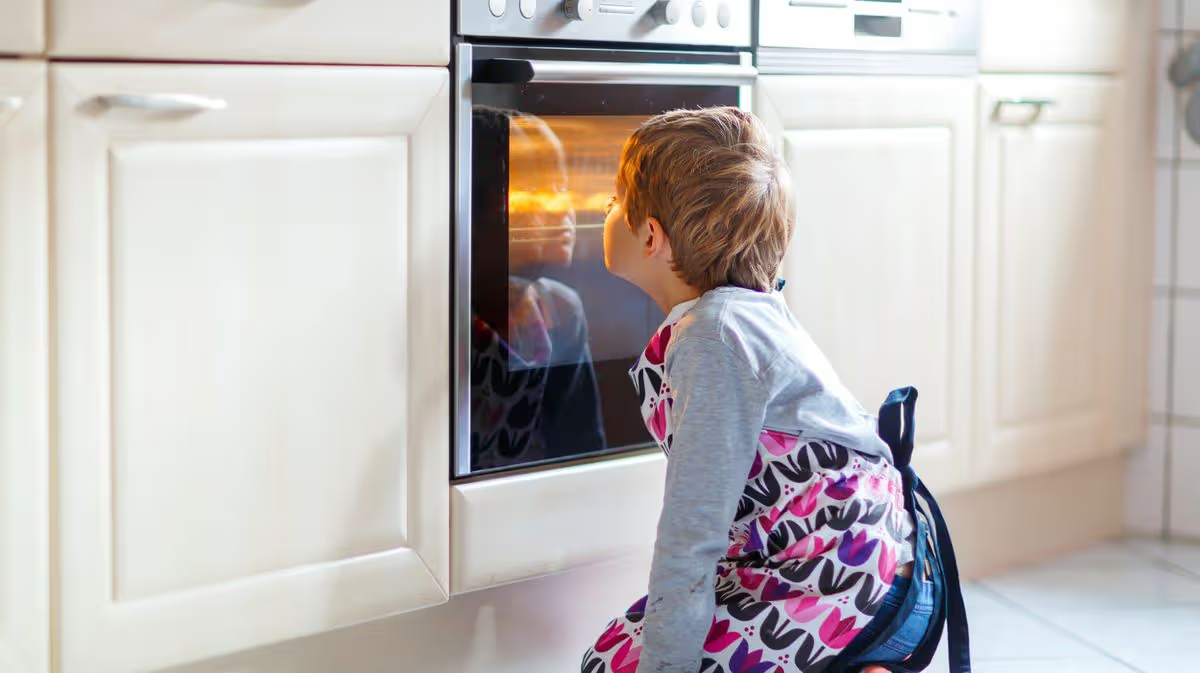
The NSPCC made more than 200 referrals to the authorities last year after calls reporting children being left home alone
The issue of when a child can safely be left at home by themselves is a divisive one.
There’s also no clear legal standpoint on it with the issue of when a young person is ready to be left at home unaccompanied ultimately being a judgement call for individual parents and their kids.
While UK law doesn’t actually stipulate a specific age when you can leave a child unattended it does make clear that it constitutes an offence to leave a child alone “if it places them at risk”. For the biggest stories in Wales first sign up to our daily newsletter.
Advertisement
Now the NSPCC has said it made 202 referrals to Welsh agencies, including the police and children’s services, following contacts to its helpline about children being left home alone or unsupervised last year.
Such referrals are made if charity staff believe additional support or intervnetion is needed.
The NSPCC suggests children under 12 are “rarely mature enough” to be left unaccompanied for extended periods and states children under 16 shouldn’t be left alone overnight.
The charity emphasises that babies, toddlers, and very young children should “never” be left unattended.
Advertisement
A charity spokesman said: “There is no legal age limit for leaving children but the NSPCC recommends not leaving a child aged under 12 years old at home alone. Also, if a child has expressed worries about being left without a parent or carer, those should be taken seriously and respected.”
Bearing this in mind parents and guardians are encouraged to exercise their finest judgement when determining whether their child is sufficiently mature to be left unaccompanied, for instance at home or in the vehicle, and to avoid leaving them alone until they’re entirely confident their child is prepared for such independence – particularly if they’ll be looking after other children or animals while their parent or guardian is absent.
While the UK Government doesn’t stipulate a specific age or criteria for when a child can be left unattended it does provide legal guidance and endorses NSPCC recommendations.
The UK Government website notes: “Parents can be prosecuted if they leave a child unsupervised ‘in a manner likely to cause unnecessary suffering or injury to health’.”
Advertisement
The NSPCC stresses a ‘one-size fits all’ approach doesn’t work for the matter of children being left home unaccompanied as every child develops differently.
The NSPCC advice states: “Learning to be independent is an important part of growing up.
“Between work, appointments, and other family commitments every parent may need to leave their child home alone at some point so it’s good to have a plan in place.
“You might wonder what age your child should be before they can be left alone at home. But there’s no ‘one-size-fits all’ answer.
Advertisement
“Every child is different so build up their independence at their pace – and check in with them to make sure they feel safe.”
Their guidance continues: “A child who isn’t old enough or who doesn’t feel comfortable should never be left home alone. If this is the case it’s best to look into childcare options that might work for your family.”
The NSPCC goes on to specify that young children should never be left alone – even if their parent or guardian is just popping out briefly.
“Infants and young children aged nought to three years old should never be left alone – even for 15 minutes while you pop down the road. This applies not just to leaving them home alone but also in your car while you run into the shops,” the NSPCC says.
Advertisement
“While every child is different we wouldn’t recommend leaving a child under 12 years old home alone, particularly for longer periods of time.
“Children in primary school aged six to 12 are usually too young to walk home from school alone, babysit, or cook for themselves without adult supervision.
“If you need to leave them home it’s worth considering leaving them at a friend’s house, with family, or finding some suitable childcare.”
Providing advice to parents of secondary school-aged youngsters the NSPCC adds: “Once your child reaches this age you could talk to them about how they’d feel if they were left alone at home.
Advertisement
“Whether they’re 12 years old or almost 18 years old there might be reasons that they don’t feel safe in the house alone.
“Just because your child is older doesn’t necessarily mean they’re ready to look after themselves or know what to do in an emergency.
“It can help to go over the ground rules and remind them how to stay safe at home.
“Remember – you should never leave a child home alone if they don’t feel ready or if you don’t feel they’re ready.
Advertisement
“Sometimes it’s just better to leave them with someone – particularly if they’re nervous or have complex needs.”
Police made the arrest after attending a quarterly Partners and Communities Together (PACT) meeting, where residents reported suspected drug activity on Old Road.
Officers later searched a man on Eden Street, located off Old Road, and arrested him on suspicion of possession with intent to supply class A drugs.
Eden Street is usually a more quiet street, home to residential flats for pensioners and Astley Bridge Cemetery.
Advertisement
The man remains in police custody for questioning.
A spokesman for Bolton GMP said: “Yesterday evening, the Bolton North Neighbourhood Team held the quarterly Partners and Communities Together (PACT) meeting.
“The PACT meeting is an opportunity for the community to raise concerns about crime in their area with the police, local councillors and the council.
“One concern raised by the community was around people supplying drugs on the street in the Old Road area of Astley Bridge.
Advertisement
“After the meeting, officers from the Bolton North Neighbourhood Team searched a man on Eden Street (off Old Road) suspected to be involved in supplying drugs in the area.”
The expanded World Cup 2026 format means the introduction of a round of 32 and for some third-placed teams a chance at knockout glory.
Teams who finish fourth in their groups are eliminated immediately, but eight of the 12 third-placed teams will live to fight another day. And the battle is close.
Scotland currently sit ninth in the third-place table after playing their three group games, which leaves their last-32 hopes hanging by a thread.
Advertisement
If Scotland do qualify in third, their reward will be a last 32 clash against a group winner and as things currently stand, that could be against either tournament co-hosts Mexico or Germany.
Pos.
Team
P
Advertisement
W
D
L
GD
Advertisement
Pts
1
Sweden
3
Advertisement
1
1
1
0
Advertisement
4
2
Ecuador
3
Advertisement
1
1
1
0
Advertisement
4
3
Bosnia & Herzegovina
3
Advertisement
1
1
1
-1
Advertisement
4
4
Paraguay
3
Advertisement
1
1
1
-2
Advertisement
4
5
Senegal
3
Advertisement
1
0
2
2
Advertisement
3
6
Croatia
2
Advertisement
1
0
1
-1
Advertisement
3
7
South Korea
3
Advertisement
1
0
2
-1
Advertisement
3
8
Algeria
2
Advertisement
1
0
1
-2
Advertisement
3
9
Scotland
3
Advertisement
1
0
2
-3
Advertisement
3
10
Cape Verde
2
Advertisement
0
2
0
0
Advertisement
2
11
Belgium
2
Advertisement
0
2
0
0
Advertisement
2
12
DR Congo
2
Advertisement
0
1
1
-1
Advertisement
1
How are the eight best third-placed teams decided?
The eight best third-placed teams are ranked based on several criteria.
First, teams are compared by the total number of points they obtained in all group matches. If teams are still level, their goal difference across all group matches is considered. If a tie remains, the total number of goals scored in all group matches is used.
Advertisement
If teams cannot be separated using these criteria, the Fair Play ranking is applied, taking into account the number of yellow and red cards received during all group matches. As a final tiebreaker, the FIFA World Ranking is used.
You wake with a restless edge that refuses to be ignored. Something in your life needs movement, and today you choose action over excuses. A bold decision sets off a chain reaction that quickly proves you were right to trust your instincts.
Taurus (April 21st – May 21st)
Advertisement
A practical matter finally starts behaving the way you hoped it would. You notice momentum building around money and work, and it restores your sense of security. Slow growth still counts as growth. Don’t be afraid to slow your pace and enjoy the view, or what point was and is the hard work?
Gemini (May 22nd – June 21st)
The Sun in Cancer nudges you to think about what and who truly makes you feel safe and valued. You realise one habit quietly drains you, and you decide to change it. Self-respect shows up in daily choices. A good day to kick a bad habit for good this time.
Cancer (June 22nd – July 23rd)
Advertisement
With the Sun in your sign, you step into a stronger version of yourself. People respond differently because you carry yourself differently. Confidence becomes contagious. When you honour who you are, others follow suit.
Leo (July 24th – August 23rd)
Someone reaches out with warmth and interest, and it lifts your mood instantly. You remember how magnetic you can be without trying. Energy flows where attention goes. A day to remember who you are and what you really want, Leo.
Virgo (August 24th – September 23rd)
Advertisement
You spot a small problem before it becomes a big one. Your foresight saves time, money, or stress. Quiet wisdom often speaks first. Focus on what you want to happen in your life next and not what others are trying to force you into.
Libra (September 24th – October 23rd)
The Moon in Sagittarius pushes you to speak honestly instead of politely. You say what you really mean, and the air clears. Truth creates freedom. Business ideas you share with others this weekend soon become a tangible and practical plan.
Scorpio (October 24th – November 22nd)
Advertisement
You sense an opportunity beneath the surface of an ordinary moment today. Acting on what you feel puts you one step ahead of the competition. It also ensures there’s no more confusion over feelings and intentions. Luck favours the observant.
Sagittarius (November 23rd – December 21st)
With the Moon in your sign, your optimism returns in a rush. You feel lighter, braver, and ready to try again. A fresh perspective changes everything. Beware throwing good money after bad for a deal you’d feel better for getting out of. A time to speak only from the heart.
Capricorn (December 22nd – January 20th)
Advertisement
A responsibility becomes easier once you stop carrying it alone. You realise support exists if you ask. Strong doesn’t mean solo. You know who you owe an apology to and why. Effort you put into relationships today promises to pay back tenfold.
Aquarius (January 21st – February 19th)
The Sun in Cancer highlights the importance of emotional boundaries. You decide who deserves access to your time and energy. You also realise who you’ve given too many chances to and cut ties with those who will never change, because they don’t want to. Protect your peace.
Pisces (February 20th – March 20th)
Advertisement
You pick up on unspoken feelings and respond with compassion. Honest talks are your new best friend today. Your sensitivity becomes a gift instead of a burden. Beware taking advice from third parties whose lives you wouldn’t want for your own.
Aries 0904 470 1141 (65p per minute)*
Taurus 0904 470 1142 (65p per minute)*
Gemini 0904 470 1143 (65p per minute)*
Advertisement
Cancer 0904 470 1144 (65p per minute)*
Leo 0904 470 1145 (65p per minute)*
Virgo 0904 470 1146 (65p per minute)*
Libra 0904 470 1147 (65p per minute)*
Advertisement
Scorpio 0904 470 1148 (65p per minute)*
Sagittarius 0904 470 1149 (65p per minute)*
Capricorn 0904 470 1150 (65p per minute)*
Aquarius 0904 470 1151 (65p per minute)*
Advertisement
Pisces 0904 470 1152 (65p per minute)*
*Astro line horoscopes are updated every Thursday. Calls cost 65p per minute plus your telephone company’s network access charge and will last approximately five minutes. You must be over 18 and have the bill payer’s permission. Service provided by Spoke. Customer service: 0333 202 3390
Manchester United plan to sign a third midfielder during the transfer window, as long as they can find a buyer for Manuel Ugarte.
United are working on a deal for a second midfielder at the moment, at which point the focus is expected to turn to other positions, with the need to sign a left-sided player high on the agenda.
But United are willing to listen to offers for Ugarte this summer and if strong enough interest emerges to sanction a deal for the Uruguayan, they will turn to the market again.
One potential stumbling block is that Ugarte still has a book value of around £30million, as he is just two years into a five-year contract after he signed from Paris Saint-Germain for £50.5million. United would have to take a loss on the 25-year-old.
Ugarte has had a difficult World Cup and hasn’t used the tournament as an audition, but there are clubs in Europe who still rate the former Sporting and PSG holding midfielder.
If he were to leave, United are likely to focus on a squad player. They had Championship duo Shea Charles and Hayden Hackney on a list of more low-key targets, although both look set to move elsewhere.
Sander Berge is another who features on United’s midfield shortlist and could be an option if Ugarte does depart.
Advertisement
Fernandes move imminent
By the end of this weekend, we could have a good idea of which club Mateus Fernandes will be joining during this summer transfer window. It might not be a surprise that talks have accelerated in the final week of June, given West Ham’s financial situation.
There is confidence that Tottenham can do a deal for the 21-year-old and suggestions they are willing to meet West Ham’s £80million demands, but there isn’t yet a sense United are giving up and moving on to other targets.
If West Ham do want to sell before June 30, then movement is expected this weekend. Both Tottenham and United have explored the terms of a deal, without putting the cash on the table.
Advertisement
That could change in the next few days and United might soon know if they have managed to land the player who is currently their top target in midfield.
Casemiro’s tears
Casemiro will officially leave United on Wednesday. At that point, the club will have to go through the process of detailing the 34-year-old’s profile on the official website and officially severing ties with him after what has been a long goodbye.
He only played 160 times for United, but packed a lot into it and his affection for the club was reciprocated by supporters. In difficult times, his energy and passion stood out.
Advertisement
Even in his final week of employment, United were still milking the Casemiro effect, releasing the Farewell Casemiro film, which showed the midfielder and his wife shedding tears at the idea of saying goodbye to the club.
Sesko links
There was bemusement at United this week when Barcelona were linked with a move for Benjamin Sesko. Relations between the two clubs are hardly on a firm footing after the Marcus Rashford affair.
There is still a feeling in Catalonia that Barca might yet return late in the window to try and lowball United into either selling Rashford on the cheap or sanctioning another loan. Old Trafford sources are adamant that it won’t happen.
Advertisement
So the idea of being willing to listen to offers for their No.9 after one good season is pie in the sky. The story actually surfaced in Marca, which is a Madrid daily, rather than one of the Catalan papers, which might have raised more than one eyebrow.
Dispatch from Carrington
United have been linked with an awful lot of players this summer and the majority have some substance to them. The club now rely on a more data-led approach to recruitment and that means the list of potential targets is longer than it used to be.
Notebook has been told the list for potential additions that fit the brief for a second-choice goalkeeper and third-choice midfield are lengthy once the numbers have been crunched.
Advertisement
That’s why plenty of players feature as possible targets this summer. United won’t sign them all. But interestingly, those in charge of recruitment at the club are far more relaxed about those names creeping out into the media.
While former football director John Murtough used to hate seeing transfer targets’ names in print, especially if there was little substance to it or they weren’t likely to happen, the current executives at the club have less of an issue with it and are instead focused on getting on with business and getting those deals lined up.
Quote of the week
“If Ruben was still the manager now Kobbie would have probably shifted on and be looking for a new club. It would have been a mistake, he’s a Manchester lad, he’s come through the academy, we want those players at our club to drive the club forward for the next 10 years. Hopefully, he’s at the club for the next 10 years because he has the ability to do so.”
Advertisement
Harry Maguire becomes the first United player to consider the nightmare scenario of Kobbie Mainoo leaving Old Trafford, had Ruben Amorim not been sacked. Maguire has been great value on The Rest is Football over in New York and on Mainoo, he was bang on.
What to look out for next week
That June 30 accounting deadline is the key date. Will West Ham need to sell before then? If so, what sort of offer do they take for Fernandes?
Several clubs will be trying to get the books balanced by then, including Hull City, who will need to sell before looking to strengthen in the summer. They could look to take Toby Collyer back to Humberside and have reportedly got an interest in Radek Vitek.
Leeds United look to take the next step in their progression in the summer transfer window with one Champions League star a key target for the Premier League side
Brandt is widely expected to be one of the standout players available on a free transfer this summer window – handing Leeds the opportunity to snap him up at no cost. The Premier League outfit have already looked into the possibility of a deal, and securing his signature could prove to be a remarkable piece of business for the club.
Landing a player of Brandt’s calibre and pedigree would undoubtedly represent a stunning coup for Leeds. The attacking midfielder rounds off a campaign in which he helped Dortmund finish second, contributing seven goals and four assists in 29 league appearances.
Although it wasn’t sufficient to earn him a place in Germany’s 2026 World Cup squad, the 43-cap international’s quality and versatility would significantly bolster Farke’s attacking options.
Predominantly a number 10, Brandt has featured in over 200 matches across both flanks – with the majority of those coming on the left – yet operated exclusively behind Dortmund striker Serhou Guirassy throughout the past season. A creative midfielder has been high on Leeds’ wishlist, having already secured their long-pursued right-wing target Harry Wilson on Wednesday, according to The Athletic.
Advertisement
Wilson, 29, and the potential signing of Brandt, 30, would represent a shift in transfer approach for Leeds, who last season focused on bringing in players approaching their prime – rather than those who may have already reached it.
Nevertheless, landing a player with 82 Champions League appearances and two World Cup campaigns to his name would be a remarkable piece of business and one that could propel Leeds to the next level. That said, such an impressive list of achievements means Brandt will have no shortage of admirers.
The likes of Roma, Lazio and Galatasaray have already been credited with an interest in his signature, but the prospect of linking up with fellow German Farke and experiencing English football for the first time could prove decisive in the battle to secure Brandt.
Advertisement
The Whites manager has made no secret of his desire for another versatile number 10 alongside Brenden Aaronson since last year. Farke said last August: “There’s always room for more quality. Wingers who can work hard and are good against the ball, disciplined, wingers who are quick and good one vs one, wingers who can play like a 10. This (latter option) would be a good solution for us.”
The American now has 12 months remaining on his deal and Farke’s demands have grown more urgent as the new campaign draws closer. Leeds’ transfer activity last summer focused on strengthening the squad with 10 first-team additions, whereas this summer involves a smaller pool of targets that would likely prove more exciting to supporters.
A league-high 92.8% of the club’s squad last season fell between the ages of 23 and 29, and while overlooking that for the acquisitions of Brandt and Wilson – with the latter turning 30 next March – it could prove a move that propels Leeds beyond 14th in the standings.
With Brandt poised to become a free agent and Farke requiring quality in his position, he could represent the ideal summer capture.
Thousands of fans upgraded their Premier League matchday last season. This is how they did it.
This article contains affiliate links, we will receive a commission on any sales we generate from it. Learn more
Official premium experiences available now for the 26/27 Premier League season. Make it easier than ever to turn a regular fixture into something genuinely unforgettable.
Wales’ new Deputy First Minister is responsible for many of the policy areas that Nigel Farage’s party has attacked in the early days of the new Plaid government
04:31, 27 Jun 2026
Advertisement
It is still only a matter of weeks since the ballot boxes were tipped onto tables at leisure centres and venues across Wales and Plaid Cymru knew the threshold it had set itself had been crossed to form a minority government led by Rhun ap Iorwerth.
His second in command is Sioned Williams. The 54-year-old is a former BBC journalist who previously worked for the party in communications. In both of those roles she crossed paths with her party’s now-leader but the pair go further back than that having met when she was 17 at the Cwrs ddrama Urdd.
“I’ve known him as long as my husband,” she laughs, as we meet in the Senedd. Yet she says she never expected he would appoint her as Deputy First Minister.
“Our paths have crossed many times and we’ve known each other a long time so we’ve got a very good relationship and it was the honour of my life to be asked and I’m absolutely delighted to be able to support him,” she says.
Advertisement
Her chance to get to take that role came as a result of a historic win for the party she has been a member of since she was a student.
Plaid Cymru won 43 of the available 96 seats.
“There was a long preparation period for us running up to this election,” she says.
“We were working extremely hard on policy development knowing that it was going to be a four-year term, knowing that finances were going to be constrained [and] we weren’t going to able to do everything that we’ve been talking about for the last 100 years so getting that really tight focus on what we thought really mattered what was important,” she says.
Advertisement
“We also knew that this was going to be an election like no other for all kinds of reasons so we fought the campaign of our lives.”
The result was, she admits, at the “top end” of the party’s expectations and she was personally thrilled it would not only mean they had representation all across Wales but there was a good gap between them and the second-placed party, and official opposition, Reform UK.
Equality, community cohesion, and Wales in Africa are all things that fall under her brief and she is already hearing concerns about the topics and tone being used in this seventh Senedd. Is she surprised?
Advertisement
“I’m not surprised that Reform are latching onto things that they know will be inflammatory, things which I think that they’re misrepresenting, policies they’re misrepresenting, expenditure that they are misrepresenting, and missing the wider point of the effect of some of the rhetoric,” she says.
Aside from those two issues Reform UK did scrutinise the new government’s flagship childcare bill, which is “absolutely their job as opposition”, although she says “it did feel rather strange that they’d pick that when they hadn’t even mentioned childcare in their manifesto”.
There is, she says, “much that needs to be done” to help people in their everyday lives. “To be choosing those issues for debate I would say is rather missing the point of an effective opposition,” she says – but adds the party will stick to its own values.
Advertisement
“The decisions we make, the policies that we’ll enact, will show those values and those are the values that have been supported by the majority of people in Wales who elected us as their government.
“That’s how we will demonstrate where we sit on those issues. I understand, having said that, the strength of feeling [that led to the walkout].
“It is shocking to many members, especially perhaps newer members, but to all of us the level and the language and the rhetoric that has been used.
“I hope that the Llywydd will be able to make sure that we don’t see a continuation of the type of language.
Advertisement
“I personally was accused of something which is completely untrue, my position completely misrepresented. This has real-life impact obviously for us as politicians, especially as female politicians online, but also more broadly about people who are minoritised, who are marginalised, and who are impacted. Their lives and their safety is impacted by this type of rhetoric.
“As the First Minister said we are all about uniting our communities, strengthening our communities, celebrating the diversity in our communities – that’s the Wales we want to see. So we will demonstrate that through our actions but also, yes, I think we have to make sure that we don’t see a type of rhetoric allowed to become normalised in our national parliament.”
The things she wants to talk about are the things that drive her to be a politician. In the last Senedd regular viewers would regularly see her passionate contributions to debates about children and poverty and holding onto the brief she had when she was in opposition was non-negotiable.
“This is really the reason I’m in politics,” she says.
Advertisement
Elected for the first time aged 49 she had been a member of Plaid Cymru since she was a student. Her political journey came via her community council before being chair of her local Cylch Meithrin, then chair of school governors, and campaigning on local issues.
“I wasn’t really active in the party until Leanne Wood became leader 14 years ago because I saw a passion in her and coming from the South Wales Valleys as I do that’s where my politics comes from,” she said.
Both her grandparents were miners while one grandmother died at 50 from asthma, likely from the conditions she lived in, and the other was an uncertified teacher.
She and her sister were the first in their family to go to university.
Advertisement
“So I understand the impact that poverty can have in and just closing off those opportunities. That’s where my politics comes from so this portfolio is really why I’m here. Without these issues to fight on I don’t know if I would be here in elected politics.
“It’s a huge honour and that’s why I am absolutely determined to achieve what I can for those people in Wales who, through no fault of their own, don’t have the same opportunities as everybody else,” she says.
Since the election there have been murmurings that Plaid was backing down on its flagship policy and then there was a very public row after an attempt to force them to release their costings backfired in the Senedd.
So I ask her to spell out what is the government’s position on childcare. By the end of this four-year term, in 2030, what is her aim? “I want 20 hours for every child offended from the age of nine months to four years,” she states simply.
“I am absolutely thrilled to be talking about childcare.
“I have been wanting to talk about childcare – as a feminist, as a female politician, as someone who believes in social justice and equality and also believes that the children are the future of our nation and we need to be supporting them and condemning them to high levels of child poverty in Wales – for years and years and years.
“We understand that this is an intervention that is fully in the power of the Welsh Government to make.
Advertisement
“It more than pays for itself. It is a complex policy because of the system we’ve inherited, which committee report after committee report, anti-poverty organisations, equality organisations have demonstrated in report after report, isn’t currently working for children and families in Wales.
“What I want to do, and we have to do this in a phased way because it’s so complex, is make sure that we have a uniform, universal offer funded for all families between nine months and four years,” she says.
She would have said that before the election, I put it to her, so now she is in office and has spoken to officials, has seen the books, is it still realistic? “It is realistic,” she says, pointing to a recent announcement about extending childcare. But surely that was that something that would have happened anyway?
“This was a programme that was initiated, first of all, under the cooperation agreement [with the last Labour government] because we put that first and foremost as one of our policies, along with free school meals.
“It was initiated in the last government. It wasn’t completed. It didn’t have adequate focus or funding. So what we saw [is] it wasn’t achieved so the first step that we wanted to do was make sure that that was achieved because the local authorities already have plans in place for that. They just haven’t been given the direction or funding that they needed in order to be able to complete it,” she says.
She references one of the key questions, aside from finding the money, which is finding a workforce.
“This is one of the work streams that we have obviously. We absolutely know that the workforce are key to this expansion,” she says.
Advertisement
“But there’s also other things that we can do. We know that at the moment people have to move settings, for instance, in order to be able to access their entitlement under the two years so what we want to do is look at the whole system. I’m not just talking about adding hours here and there – I want to transform this system so it is one system and that it is in the best interest of the children and families who need to access that system.”
“I couldn’t just announce funding and say: ‘There will be more hours’. We absolutely recognise that. It is about working in partnership with local authorities. We’ve got a skills audit happening.
“My colleague Cefin Campbell is looking at post-16 education making sure that we are preparing the pipeline. But we also know that it is about giving assurance to providers and to local authorities – all the partners that are key and fundamental in this, the education sector – bringing people in who currently their qualifications aren’t recognised for instance,” she says. For our free daily briefing on the biggest issues facing the nation, sign up to the Wales Matters newsletter here
She adds there is nothing she has learnt since getting into office that makes her think she will deliver a policy different to what was spelled out in the manifesto.
Advertisement
The new government has been criticised for ordering data, reports, and audits. “I think it’s about doing things sustainably and responsibly and there is a lot of data gaps.
“We’ve got a certain focus on our key priority areas as a party and in order to make progress on those we need to have an absolutely comprehensive view of what we’re dealing with.
“We need to work to better understand what some of those data gaps are,” she says.
“We have made it very clear we want to work on the basis of evidence. We also want to work transparently and we need to work responsibility, ground all our policies in the reality that is in front of us, not make empty promises”.
Advertisement
The childcare policy will, she says, make a difference. “This can help all children get the best start in life and get the best start towards their education journey.
“We know that’s not a level playing field. It can also help families who are currently in poverty to be able to increase their income, that’s economic inequality, and then we know of course gender inequality.
“This mainly impacts women and I’ve had experience of this myself. I was earning more than my husband when we had children. I didn’t catch up until I was 49 and I had my first when I was 30. So we know that this impacts women mainly and I’m really clear about the effect that it can have on our society broadly and especially obviously our children, the difference that this policy can make.”
Advertisement
She has already spoken in the Senedd chamber about Cynnal, a Welsh child payment, providing £10 a week for children aged from birth to six in households claiming universal credit. “Evidence has shown that this is one of the key interventions that can be made.
“Scotland has shown the way on this – it’s undeniable evidence. So we want to show the difference that a policy like this can make. Because of the fact that we don’t have the same powers as Scotland currently over the benefits system and welfare payments we have to do this as a pilot but I think that we can demonstrate the impact this can have and it’s about reaching those children who are in the deepest poverty,” she says.
She hopes it will help 15,000 children across different backgrounds and areas of Wales. For some families it will mean being able to go to a cinema or theatre, to have swimming lessons, to be able to say yes instead of no to a birthday party because you can’t afford to buy a present.
“Those everyday childhood experiences that every child should have this hopefully could just make an impact around that and we know it’s those direct cash payments that make the difference,” she says.
For most people, a hot summer’s day is uncomfortable. For someone with scarred lungs, it can become a medical risk.
People living with interstitial lung disease (ILD) are especially vulnerable during extreme heat. As climate change drives more frequent and intense heatwaves, people with ILD will need better protection from hot weather and related health risks.
ILD is an umbrella term for more than 200 lung conditions. These conditions cause inflammation, the body’s immune response to injury or irritation, and fibrosis, which means lung scarring. As scar tissue builds up, the lungs become stiffer and less able to transfer oxygen into the bloodstream, making breathing harder.
Many ILDs, particularly idiopathic pulmonary fibrosis (IPF) – a form of lung scarring that develops without a clear known cause – affect people over 65. Older adults with ILD often also live with other long-term conditions, such as heart disease, diabetes, high blood pressure or chronic kidney disease. These can reduce the body’s ability to cope with stresses such as extreme heat.
Advertisement
Hot weather forces the body to work harder to stay cool. The heart pumps more blood towards the skin, breathing can become more difficult, and oxygen demand may increase. For people with ILD, whose lungs already struggle to supply enough oxygen, this can lead to worsening breathlessness, fatigue and reduced exercise tolerance.
Dehydration, which is common during heatwaves, can cause weakness, dizziness or low blood pressure. This can be a particular problem for older adults taking medicines such as diuretics, often known as water tablets, which help the body get rid of excess fluid.
Heatwaves can also bring environmental hazards. Higher levels of ground-level ozone, a harmful air pollutant formed when sunlight reacts with emissions from vehicles and industry, can irritate the lungs. Wildfire smoke and airborne particles, meaning tiny pieces of pollution in the air, can also worsen breathing symptoms. A 2026 review concluded that these exposures may trigger flare-ups and could contribute to disease progression by increasing inflammation and biological processes linked to lung fibrosis.
Risk reduction
There are practical steps that can reduce the risks.
Advertisement
People with ILD should check local weather forecasts and heat-health alerts during hot weather. It can also help to make a simple plan: who to contact if symptoms worsen, where to go if the home becomes too hot, what to do during a power cut if using oxygen equipment, and how to get medical advice.
During extreme heat, people with ILD should avoid being outdoors during the hottest part of the day. For people with moderate to severe ILD, fatigue is often already a limiting factor. Essential activities are best planned for the early morning or evening, when temperatures are lower.
Keeping indoor spaces cool is equally important. Closing curtains or blinds during the day, improving ventilation during cooler evenings, and using air conditioning where available can help maintain a safer indoor temperature. Fans may also help some people manage breathlessness. A small pilot study of handheld fans in people with ILD found that some patients considered them useful for breathlessness relief, although they should not replace medical care. Where air conditioning is unavailable, public buildings such as libraries, community centres or shopping centres may provide a cooler refuge.
Staying hydrated is another important measure. Drinking water regularly helps replace fluid lost through sweating, although people with heart failure or kidney disease should follow advice from their healthcare team if they have fluid restrictions.
Advertisement
People with ILD should continue taking prescribed medications exactly as directed. Antifibrotic medicines, which are drugs used to slow lung scarring in some types of ILD, remain important during hot weather and should be stored according to the manufacturer’s recommendations.
Those using home oxygen should ensure they have an adequate supply. People who use an oxygen concentrator, a machine that takes oxygen from room air and delivers it through tubing, should know what to do during power cuts. Oxygen equipment should also be kept away from heat sources.
Some people with ILD use home spirometry to monitor lung function between clinic visits. Spirometry is a breathing test that measures how much air a person can blow out and how quickly. While home spirometry can provide useful information, it should not be interpreted in isolation, especially during a heatwave. Qualitative research has shown that patients value home spirometry but can find fluctuating results difficult to interpret without support. Heat, dehydration, fatigue or difficulty blowing out the fullest possible breath may also affect readings.
Advertisement
Instead of focusing on spirometry alone, people should pay attention to the bigger picture. Increasing breathlessness, needing more oxygen than usual, walking shorter distances, worsening cough, unusual fatigue or finding everyday activities more difficult may all be signs that the body is struggling with the heat. These changes should prompt discussion with a GP, specialist nurse or ILD team.
Because many people with ILD are older and may live alone, support from family members, neighbours and carers becomes important during heatwaves. A simple phone call or visit to check that someone is staying cool, drinking enough fluids and coping with symptoms can make a significant difference.
People should also know when to seek medical advice. Worsening breathlessness, increasing oxygen requirements, chest pain, confusion, fainting, fever or symptoms that do not improve with rest should never be ignored. Early assessment can help identify an exacerbation, also called a flare-up, which is a sudden worsening of the condition. Prompt treatment may help limit serious complications.
As the climate continues to warm, healthcare will need to adapt to protect people who are especially vulnerable to heat. Helping people understand environmental risks, prepare for extreme weather and recognise changes in symptoms will become an essential part of living well with ILD.
It is to warn motorists and residents about the conditions that may be up ahead, especially going towards Rivington.
Advertisement
The hilly area going towards Egerton on Egerton Road, and upwards towards the top of the village, can cause danger if not paid attention to by motorists in cold weather.
Scotland’s wait to find out their World Cup fate will drag on longer, despite Senegal’s victory over Iraq dropping them into the bottom four third-place teams.
The latter of those results left them on the brink of elimination, but their third-place finish in Group C meant their fate would be decided by others.
Senegal’s victory over Iraq today, during which Ismaila Sarr and Iliman Ndiaye scored in a 5-0 drubbing, was damaging to their chances, but is not quite a hammer blow.
Why have Scotland not been eliminated from the World Cup tonight?
Advertisement
That leaves Scotland as one of the worst four third-placed finishers, but their wait to discover whether they will progress to the round of 32 will continue.
They are joined in the proverbial drop zone by Belgium, DR Congo, and Cape Verde, all of whom have yet to play their final group stage fixture and could still finish beneath the Scots.
Above Scotland in the standings are Algeria and Croatia, who could also end up below Scotland in the standings should they lose their final matches against Austria and Ghana, respectively, by a heavy scoreline.
Scotland’s chances of moving on remain minimal, but there is at least some glimmer of hope heading into the final day of group stage football that they could scrape a round of 32 berth.
Manchester United are aiming to build a squad capable of dealing with Champions League football on top of the Premier League and Bruno Fernandes’ future could be key to that
It has already been a busy transfer window for Manchester United, but the Red Devils are far from done. A number of senior stars have confirmed transfer exits, and there could be more on the way.
Last summer brought plenty of headlines about Marcus Rashford and Bruno Fernandes, and it’s more of the same right now. Rashford’s Barcelona loan didn’t bring a permanent deal, leaving his future up in the air, but we could soon have a resolution regarding captain Fernandes after he opted against a Saudi Pro League switch in 2025.
We’ve also got more on another of United’s midfield targets as the rebuild begins following Casemiro’s exit. Here are our latest lines from around Old Trafford.
Bruno Fernandes has told his Manchester United team-mates he plans to stay, according to talkSPORT. A final decision on the captain’s future isn’t expected until after the World Cup but there is not thought to be any fear that he might leave.
Fernandes was targeted by several Saudi clubs last summer but decided to stay put. There are reports of renewed interest from clubs in the gulf this year, especially Al Nassr, who could have Portugal boss Roberto Martinez in the dugout next term, but the midfielder’s decision to stay put is believed to be family-related and therefore unlikely to change.
The 31-year-old has started both of Portugal’s first two World Cup group games, grabbing an assist in the 5-0 victory over Uzbekistan. Martinez’s team need a win in their final group game against Colombia to top their group but are still guaranteed to progress as runners-up if they draw.
Nmecha asking price set
Germany star Felix Nmecha is among the midfielders linked with United as they look to restock their midfield after Casemiro’s exit and a potential departure for Manuel Ugarte. However, they’re unlikely to get the 25-year-old on the cheap.
Nmecha, who spent time with Manchester City as a youngster and played for England at youth level, would qualify as a homegrown player. According to Kicker, though, he is valued at £86million by his club Borussia Dortmund and doesn’t have a release clause in his deal.
The 25-year-old didn’t start any of his country’s World Cup qualifiers but has been a mainstay for Julian Nagelsmann at the tournament proper. He started all three group games, scoring on his major tournament debut as Nagelsmann’s team beat Curacao 7-1.
Join our new MAN UTD WhatsApp community and receive your daily dose of Manchester United content from MirrorFootball. We also treat our community members to special offers, promotions, and adverts from us and our partners. If you don’t like our community, you can check out any time you like. If you’re curious, you can read our Privacy Notice.
Advertisement
FOR LIVERPOOL STORIES
Join our LFC WhatsApp community and get all the latest LFC news, views, transfer gossip and more, as it happens We also treat our community members to special offers, promotions, and adverts from us and our partners. If you don’t like our community, you can check out any time you like. If you’re curious, you can read our Privacy Notice.
Get Man United’s new 2026/27 home kit
This article contains affiliate links, we will receive a commission on any sales we generate from it. Learn more
Manchester United have launched their new home kit for the 2026/27 season, inspired by the club’s heritage and featuring a classic polo collar with iconic adidas details.
You must be logged in to post a comment Login