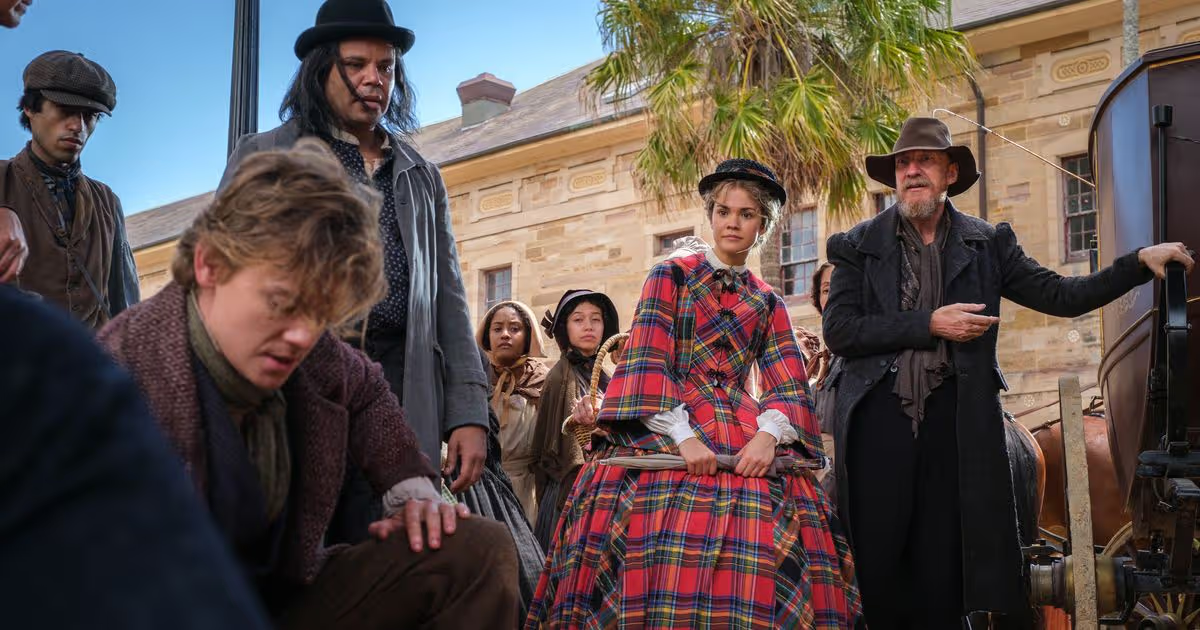
The Artful Dodger originally released on Disney Plus back in 2023. Fans were forced to wait three years but all episodes of its second season are finally available now on the streaming platform.
It is actually inspired by one of the most well known classic pieces of literature written by a celebrated author. The title of the series would probably give it away to most that it involves characters taken from Oliver Twist, which was written by Charles Dickens.
However, not only that but the second season introduces another iconic character from a different but equally well known book. But where and when do the events of The Artful Dodger take place compared to the original stories? Here’s all you need to know.
Advertisement
When is The Artful Dodger set?
At the end of the book Oliver Twist, Jack Dawkins who is also known as the Artful Dodger, is arrested for stealing a silver snuff box. He is sentenced to be transported to a penal colony in Australia for life.
Therefore the series imagines what happens to Jack some years following his conviction. In fact, in the first season we find out that his surrogate father and mentor Norbert Fagin, refused to stage a breakout for Jack, claiming there was too much heat and fearing that he would be caught and put to death himself, he ultimately leaves him to his fate.
Advertisement
The original book finished publishing as a serial in 1839. We actually find out in Season One’s premiere episode exactly when the action picks up.
A shot of a diary confirms the date of October 27, 1855. So if we take that the original tale happened in the same time it was published, then at least 16 years has passed since we last dealt with these characters.
While Fagin failed to help Jack, he did manage to escape himself. He was eventually seconded to the Royal Navy where his skilled fingers allowed him to go from picking pockets to assisting surgeons. He would become one himself, serving as a medic in the Crimean War, which actually took place between 1853 and 1856.
Advertisement
Afterwards, he was recommended to serve in the colony. This means he still arrived in Australia but as a respected doctor as oppose to a convicted criminal. The British penal system transported convicts from Great Britain and Ireland to various penal colonies in Australia until 1868.
Season Two picks up around six months where the first ended as The Artful Dodger remains in deep trouble. According to its synopsis, he’s got an appointment with the noose, he’s being hunted by new lawman, Inspector Boxer, and if he sees the woman he loves, Lady Belle, he’ll be hanged.
The Artful Dodger is streaming on Disney+.
For the latest showbiz, TV, movie and streaming news, go to the new **Everything Gossip** website.

Erling Haaland was substituted at half-time during Manchester City’s 3-0 win against Fulham, leaving fans concerned that he’d suffered an injury ahead a crucial period
Pep Guardiola will wait to discover the extent of Erling Haaland’s ‘problems’ after taking the Manchester City star off at half-time against Fulham. Haaland, 25, scored to help City race into a 3-0 lead on Wednesday, meaning that the contest was largely done and dusted by the break.
Advertisement
When the Norwegian returned to the dressing room, he informed City staff that he felt ‘uncomfortable’. Guardiola didn’t want to take a risk on Haaland and replaced him with Omar Marmoush for the second half.
“The reason why? Many games. (Marc) Cucurella is injured, right? For Chelsea, he’s injured. You know the reason why, right? I didn’t speak with the doctors.
“I don’t know exactly what he has. He was just struggling, fatigue or something, I don’t know. He said he didn’t feel comfortable, it was 3-0. Common sense.”
Guardiola was delighted with City’s display, as they extended their winning run in home games against Fulham to 20 games. “A really good performance; one of the best of this season,” Guardiola hailed. “After important, emotional games like Anfield, the next one is always tricky.”
Fulham boss Marco Silva bemoaned his team’s display, saying: “We know normally in these types of games we have to be clinical. It was too easy for them to score the goals. At 1-0, we had a big chance and to equalise probably a different game. We have to be at our best level in these types of games and we weren’t and that is why we lost the game.”
Both teams’ focus will turn to the FA Cup fourth round. On Saturday, City host League Two side Salford before Fulham travel to Championship outfit Stoke on Sunday.
Advertisement
They’ll then return to Premier League action. City will host Newcastle while Fulham, who’ve now lost four of their last five games, make the journey to Sunderland.
Join our new WhatsApp community and receive your daily dose of Mirror Football content. We also treat our community members to special offers, promotions, and adverts from us – and our partners. If you don’t like our community, you can check out any time you like. If you’re curious, you can read our Privacy Notice.Content cannot be displayed without consent
Linfield are still a whopping 14 points off leaders Larne and look to have relinquished their grip on the title, but Healy was delighted to see a reaction
Linfield are still a whopping 14 points off leaders Larne and look to have relinquished their grip on the title, but Healy was delighted to see some resilience.
Advertisement
“It was a difficult, difficult week. There was a lot of anger, lot of frustration and I understand that,” said Healy. “Nobody wants to win more than I do and I want the team and the players to go and perform.
“I did say that sometimes a night like that is humbling, frustrating, disappointing. You need to react and respond, you need to show a little bit of resilience, and that’s what’s important going forward.
“You puff your chest out when you play for this football club. Everything’s a challenge, even when you win it can be a challenge.”
Advertisement
The reigning league champions lost key men like Chris Shields, Robbie McDaid and Kieran Offord to long term injuries this year, and that has proven costly.
“We’ve lost a bit of experience in the dressing room, not only through injuries. We’ve lost key players, people have got a bit older, people have moved on. So it’s about nurturing a lot of the dressing room into Linfield players, what it means,” insisted Healy.
“The fightback has to start, maybe a night like the other night, we have to be ready for the challenge. Linfield have proven, Roy Coyle, David Jeffrey, the most successful managers this country has ever seen. Not everything is smooth sailing.
“It’s about digging in, staying calm. I get people want to bash you at times when it’s down, I get that. But I’ve always prided myself on a bit of resilience.”
Ferguson has kept a low profile, spending time in the French Alps and the UAE with her daughter Eugenie
Bradley Jolly and Ambarish Awale Trainee Trends, Showbiz and Lifestyle Writer
22:47, 11 Feb 2026
Defiant Sarah Ferguson is reportedly planning a remarkable return to public life, amid scrutiny following the release of the Jeffrey Epstein files. The former duchess, 66, has told friends: “I need to get back to work. I need money,” as she plots a reinvention away from her former husband, Andrew Mountbatten-Windsor.
Sources say Ferguson has been keeping a low profile while “getting her head together,” spending time with friends in the French Alps before travelling to the United Arab Emirates. She has also been in the region with her youngest daughter, Princess Eugenie, who was attending an art fair in Doha, Qatar, for her work with art dealer Hauser and Wirth.
Until recently, Ferguson had been living with Andrew Mountbatten-Windsor, whom she divorced in 1996. He left Royal Lodge last week, formalising their long-awaited separation, Mirror reports. Ferguson is now reportedly planning to distance herself from him.
Advertisement
She told a friend: “When I come back I am going to have to put some distance between myself and Andrew.” Despite her intentions, Ferguson faces obstacles in mounting a comeback.
According to the Daily Mail, she intends to remain “in the Windsor area,” either buying or renting a new home, but critics question her prospects. One source said: “I don’t know whether Sarah is just deluded or desperate.
“She is 66 and has no home and no discernible income. The public is disgusted by what they have read. And how would she pay a new PR team to rescue her reputation?”
Advertisement
The former duchess’s financial troubles are intertwined with her association with Epstein. Emails revealed in the recent files show Ferguson repeatedly seeking his help to pay debts and manage practical matters over an extended period. Reports suggest she remained in contact with Epstein even after his release from prison for sex offences against children, taking her daughters, Princess Beatrice and Eugenie, to lunch with him just five days after he was freed.
Ferguson also privately apologised to Epstein for publicly denouncing him, claiming she had done so to protect her career as a children’s author. In her correspondence, she described him as a “steadfast, generous and supreme friend.”
Once a regular presence on television, including appearances on This Morning and Loose Women, Ferguson is now said to be scouting for a new PR team to manage her return. Sources indicate she is keen to rebuild a public profile independent of her former husband.
Her plans come amid ongoing public scrutiny over her ties to Epstein and her financial instability. Friends and observers have noted the difficulty of attracting new opportunities given her recent notoriety and lack of a permanent residence.
Advertisement
Ferguson’s attempts to re-establish herself in the public eye appear to balance personal reinvention with the challenges of repairing a reputation tarnished by scandal.
Sunderland are a danger, a threat and they have maintained their early season momentum, especially in front of a home crowd that bays for blood on nights like these.
The first time Liverpool tried to play out from the back, Andrew Robertson’s clearance was blocked, the roar from the stands was louder than some celebrate a goal.
Sunderland would look to be direct and they try to exploit set pieces in the final third. A simple enough approach that has served them so well.
Advertisement
In Brian Brobbey they have a battering ram of a centre-forward, strong, quick and with rugby player’s love of contact in open field. There is finesse in this Sunderland side, but he is the power up top, chasing every long ball, holding it up and holding off whichever centre back came with him.
Liverpool had to be resolute. They could not allow themselves to be bullied; kicked and knocked out of their stride. They had to earn the right to play their own game by containing Sunderland playing theirs.
It led to a game of few chances in the first half, Wirtz forcing the first save of the match after half hour, a shot from the edge of the area tipped away for a corner by Robin Roefs.
Liverpool though looked composed and began to take control with their quick, short passing stretching Sunderland’s defence and creating little pockets of space. Wirtz was really unlucky to see a shot, set up by a superb first touch to create the angle, hit the post before Roefs made an excellent save to prevent his header looping into the net.
Officials said Jesse Van Rootselaar killed her 39-year-old mother and 11-year-old stepbrother at their home before opening fire at the high school. Five students, aged 12 to 13, and one 39-year-old female educator were killed.
Police said the suspect was born biologically male but had been transitioning to female over the past six years. She was not a student at the school but it was not immediately clear if she had previously studied at Tumbler Ridge Secondary.
A motive for the shooting is unclear, but police said they had made multiple visits to the suspect’s home over the last several years for concerns about mental health issues.
Advertisement
At least seven of the victims were fatally shot at Tumbler Ridge Secondary School (Facebook/Tumbler RidgeLines)
What do we know about the shooter?
The shooter was a resident of Tumbler Ridge who was not currently enrolled in school, Dwayne McDonald, deputy commissioner for the Royal Canadian Mounted Police in British Columbia, told reporters in a press conference Wednesday.
McDonald said the suspect dropped out of school roughly four years ago and was not related to any of the victims killed at the school. When asked if the shooter faced “bullying” by students, McDonald said there was no indication of such.
Advertisement
However, it’s unclear if any of the suspect’s family had any connection to the high school.
While exact details about the suspect’s life were not made immediately clear, McDonald said the suspect was born biologically male but had begun transitioning to female approximately six years ago. McDonald said authorities would identify the suspect by her preferred pronouns, which were she/her.
Police in the area knew the suspect, in part because Tumbler Ridge is a close-knit town, but also because of the suspect’s mental health history.
Advertisement
The suspected shooter did not attend Tumbler Ridge Secondary School, authorities said (REUTERS)
Over the last several years, authorities visited the suspect’s home “on multiple occasions” due to concerns. On different occasions, police apprehended the suspect for a mental health evaluation. In at least one instance, authorities removed firearms from the home.
McDonald added: “I can say that, on different occasions, the suspect was apprehended for assessment and follow-up.”
The suspect held a gun license that expired in 2024 and did not have any firearms registered to her.
What happened during the shooting at Tumbler Ridge?
Advertisement
Police said the suspect first fatally shot her mother and younger sibling at her home before going to the school; however, authorities received calls about the two in the opposite order.
Officers from the Royal Canadian Mounted Police received a report about an active shooter at the school at around 1:20 p.m. local time. Within two minutes, authorities arrived, David Eby, the Premier of British Columbia, said.
The principal of Tumbler Ridge Secondary School ran through the halls of the school, warning students and faculty to lock their doors. Darian Quist, a 12th-grade student at the school, told CBC News, that he and a dozen other students barricaded themselves in a classroom.
Advertisement
At least 25 other people were injured in the deadly shooting, some suffering significant gunshot wounds (Facebook/Tumbler RidgeLines)
“For a while, I didn’t think anything was going on,” Quist said, until reports on his phone about the shooting began to come through. “We got tables and barricaded the doors, and I believe we sat in there for two hours, two hours and thirty minutes, until members of the RCMP and I believe SWAT came through the door and escorted us at the high school.”
Authorities said most of the people killed at the high school were fatally shot in the school library.
Around 2:47 p.m., authorities received a call to the private residence where the suspect’s mother and stepbrother were found. A young female who lived in the home went to a neighbor’s to call police, McDonald said.
RCMP officers lifted the community-wide alert around 5:45 p.m., stating there were no “outstanding suspects or threats to the public.”
Advertisement
Initially, authorities believed 10 people were killed, but later corrected the record to say nine were killed, including the shooter.
Residents of Tumbler Ridge have left flowers and toys in memory of the eight victims who were fatally shot (REUTERS)
Where is Tumbler Ridge Secondary School?
Tumbler Ridge Secondary School is located in the southern portion of Tumbler Ridge, a remote town in the province of British Columbia, Canada
Advertisement
One resident told the newspaper that cellphone service cuts out just 30 seconds after leaving town because of its isolated location.
However, the town is located in the foothills of the Rocky Mountains and is surrounded by an expansive UNESCO-recognized geological park.
Tumbler Ridge was once a major hub for mining, but its two major mines closed permanently in 2000 and 2003.
Advertisement
With a population of just 2,400, the town is a tight-knit community, meaning many of the victims of the shooting are known to most of the town.
“I will know every victim. I’ve been here 19 years, and we’re a small community,” the town’s mayor, Darryl Krakowka, said, according to the BBC. “I don’t call them residents. I call them family.”
King Charles III echoed the sentiment in a statement released Wednesday morning, saying, “In such a closely connected town, every child’s name will be known and every family will be a neighbour.”
British Columbia, where Tumbler Ridge is located, has the highest rates of gun ownership of any area in Canada. According to the Canadian government, around 16 percent of people surveyed in the area reported owning a firearm.
A sequel to Tracy Beaker Returns, and the third instalment in the much-loved Tracy Beaker franchise, The Dumping Ground first aired in 2013 and remains one of CBBC’s most successful and longest-running shows.
The series focuses on the lives of children living in care, tackling themes such as friendship, family, mental health, identity, racism and LGBT parenting.
The Dumping Ground (Image: CBBC)
For over 12 years, the production has maintained a strong presence in the region.
Its current base is the former Hexham Middle School Fellside Building in Northumberland, which has doubled as the fictional Porter’s Lodge home since series 11.
Advertisement
Recent episodes, including series 13, have also featured recognisable landmarks such as Hexham Abbey, the town’s local bowling alley and Tyne Green park.
Before the move to Hexham, the show filmed extensively in Rowlands Gill, Gateshead, between series two and ten. Hookergate School in High Spen was used for interior scenes, while a nearby children’s respite care home, Kites Rise, served as the exterior of the fictional Ashdene Ridge.
Residential streets in Rowlands Gill and Consett also appeared regularly, standing in for the show’s fictional setting of Pottiswood.
The earliest series of The Dumping Ground, as well as Tracy Beaker Returns, were filmed at the former La Sagesse convent school in Jesmond, Newcastle.
However, plans by developers to convert the site into housing forced production to relocate, prompting the show’s gradual move further into Northumberland.
Advertisement
Other North East locations have included Consett and Morpeth, with interior scenes for later series filmed at the former Loansdean Fire Station before production returned briefly to Hookergate School.
Filming for the show in Consett (Image: NORTHERN ECHO)
A dramatic storyline at the end of series 10, which saw Ashdene Ridge destroyed by fire, neatly coincided with the real-world move to Hexham and the introduction of a new care home setting.
In 2024, the eleventh series marked a major creative refresh for the programme, introducing a new house, updated title sequence and logo, and removing the animated segments seen in earlier series.
A fourteenth series began airing on CBBC in January 2026.
Advertisement
The production has worked closely with North East Screen, helping to support regional talent through paid traineeships and shadow director roles.
Former lead actor Dani Harmer, who played Tracy Beaker, has returned to the franchise in recent years both on and off screen.
For most young people, learning about social and political issues doesn’t start with a textbook. It starts with a phone.
While debates intensify about whether to impose a social media ban on under-16s in the UK, it’s important to consider how social media can be a route for learning as well as potential harm.
Young people aged 14-15 are at a crucial stage in terms of their developing awareness of and engagement with political issues. Our research with more than 3,000 young people in year ten (ages 14 and 15) in schools across England found that 75% said they learned most about social and political issues online, including on social media.
This is far more than the 47% who (also) said they learned most about this at school. At the same time, though, only 21% said they were comfortable sharing their views on such issues online: 60% don’t share their views online.
Advertisement
Learning about race and faith equality doesn’t just mean learning about anti-racist movements like Black Lives Matter, for example. It also refers to the ways that young people, including those from diasporic and global majority backgrounds, develop their identities and values as citizens of the UK and the world.
Young people in our study described various ways they used online spaces to engage around race and faith issues. These included looking things up on established news sources like the BBC, and using news alerts on their phone. Apps like Instagram and TikTok were useful to some for updates from their extended family abroad, or to get direct information. This could include information from Gaza, for instance, where outside journalists have not been allowed in.
Some were wary of getting information from apps such as TikTok and YouTube, because they were regarded as potentially spreading false information and stereotypes about particular migrant communities, or presenting extremes. This wariness led them to crosscheck what they had seen on social media with news journalism that verifies its sources.
Further analysis of the survey – to be published in our forthcoming book – showed that most were cautious about sharing their views on social issues online. Statistically speaking, girls were also less comfortable than boys, and young people with Black, African and Caribbean backgrounds were less comfortable than their white peers sharing their views online.
Advertisement
But social media could also act as a sounding board for critically reflecting on, and emotionally processing events. For instance, a south-Asian Muslim girl felt that hearing other people’s opinions on an experience of discrimination can allow one to have multiple perspectives on what happened.
Learning from social media
Arguably, the fact that young people are often sceptical about what they see online is a positive outcome of their secondary online and media literacy education. But our research suggests that young people go online because they can’t get the information they need at school. Young people in rural areas, as well as those with Black, African and Caribbean backgrounds, raised particular concerns about school as a place to discuss race and faith issues. Those in lower-income areas also showed lower expectations that such issues would be discussed at school.
Government policy has for many years made it hard for schools to teach about race and faith equality in particular. One reason for this is that exam pressure in years ten and eleven (aged 14-16) leads schools to consign direct teaching about equality issues to years seven to nine.
But more fundamentally, the content of the curriculum, including history, is heavily geared towards a white British and European worldview. Citizenship education has been neglected in favour of traditional academic subjects, and so equality issues are addressed in occasional Personal, Social and Health Education (PSHE) lessons.
Advertisement
Teens are wary of sharing their views on race and faith both online and at school. Rido/Shutterstock
More problematically, schools have had to walk a delicate line when it comes to talking about political issues. In recent years, schools have been warned that teaching white privilege as a fact in schools is unlawful, and that they must ensure they teach topics relating to Israel and Palestine neutrally.
We found education stakeholders including local authority advisers, teacher unions and community organisations are concerned about the lack of support for teachers to engage these and other issues accurately. This concern is something current policymaking, including the curriculum and assessment review, has not meaningfully addressed.
It’s not surprising, then, that only 38% of young people felt comfortable sharing their views at school. While this is a higher proportion than shared their views online, we would expect a much higher result from school if obstacles to sharing views there were removed. Such obstacles include concern about peer judgement, being disciplined, or because they felt they had to sideline their feelings, have a “thick skin” and focus on their studies to – paradoxically – get ready for “the real world”.
We need to carefully consider and balance young people’s rights both to protection and to information in school and online. Our recommendations call for much greater support for schools to negotiate race and faith issues, as taking away under-16s’ access to social media without greater school-based support could be more counterproductive than protective.
Tin Man Financial Services’ application proposes constructing two end-to-end outdoor padel tennis courts at Cayton Playing Fields in Cayton, Scarborough.
“The proposal aims to enhance the sporting facilities available to the local community by introducing a fast-growing, inclusive sport that complements the existing recreational offer provided at the playing fields,” a plan states.
If the scheme is approved, the floodlit courts would be built on a “currently disused, derelict and inaccessible area of the existing site” and would create an additional revenue stream for Cayton Playing Fields Association, which owns and maintains the facility.
Advertisement
Players would be able to book their sessions via an online app, and this “autonomous operation would allow access to the courts between proposed operating hours of 7am to 10pm”.
The applicant said there is currently no padel court provision for the southern side of Scarborough, noting that with recent and planned residential development in and around Cayton, the area “lacks sufficient recreational facilities for its growing population”.
The development has been designed in accordance with Lawn Tennis Association (LTA) guidance on padel court design, layout, and lighting standards, in order to ensure high-quality and safe facilities that are suitable for both casual and competitive use.
Padel tennis is the “fastest growing sport in the UK”, and according to the LTA, more than 230,000 people play it on an annual basis.
Advertisement
“The racket sport, which combines elements of tennis and squash, has seen a significant increase in popularity due to its social, inclusive and easy-to-learn nature.”
The courts would include energy-efficient LED floodlights, mounted on columns up to 6m high, with four lights per court.
The floodlights would be used when it is dark and “only when courts are booked and paid for through the booking app”.
North Yorkshire Council has not set a date for deciding on the application which is open to representations.
The paper that contributed to the resignation of President Nixon over Watergate and the Vietnam war is now having to rethink its future. The Washington Post’s owner – Amazon boss Jeff Bezos – has announced mass layoffs at the newspaper, which will fundamentally change how it covers the news.
When Bezos bought the paper in 2013, he reassured staff about a “new golden era for the Washington Post”, and later adopted a new slogan for the Washington Post “Democracy Dies in Darkness”.
Justin and Anthony discuss why the cuts have happened and what the wider impact may be on US media. With Bezos defending the cuts as “the data tells us what is valuable and where to focus”, we look at whether the role of money, influence, and closeness to President Trump could also be at play?
Advertisement
HOSTS:
• Justin Webb, Radio 4 presenter
• Anthony Zurcher, North America Correspondent
GET IN TOUCH:
• Join our online community: https://discord.gg/qSrxqNcmRB
• Send us a message or voice note via WhatsApp to +44 330 123 9480
• Email Americast@bbc.co.uk
• Or use #Americast
This episode was made by Rufus Gray, Grace Reeve and Kris Jalowiecki. The technical producer was Mike Regaard. The series producer is Purvee Pattni. The senior news editor is Sam Bonham.
If you want to be notified every time we publish a new episode, please subscribe to us on BBC Sounds by hitting the subscribe button on the app.
Advertisement
You can now listen to Americast on a smart speaker. If you want to listen, just say “Ask BBC Sounds to play Americast”. It works on most smart speakers.
US Election Unspun: Sign up for Anthony’s BBC newsletter: https://www.bbc.co.uk/news/world-us-canada-68093155
Americast is part of the BBC News Podcasts family of podcasts. The team that makes Americast also makes lots of other podcasts, including Newscast. If you enjoy Americast (and if you’re reading this then you hopefully do), then we think that you will enjoy some of our other pods too. See links below.
Newscast: https://www.bbc.co.uk/sounds/series/p05299nl
Radical: https://www.bbc.co.uk/sounds/brand/p0gg4k6r
The Global Story: https://www.bbc.co.uk/sounds/brand/w13xtvsd
YaleUniversity announced that a prominent computer science professor will no longer teach classes while the university reviews his conduct. This follows the release of documents showing he emailed Jeffrey Epstein describing an undergraduate as a “good-looking blonde” while recommending her for a job.
The communication between David Gelernter, who gained national attention in 1993 after being injured by a mail bomb sent by “Unabomber” Theodore Kaczynski, and the late, disgraced financier was part of the Epstein-related documents released by the U.S. Justice Department at the end of last month. The documents reveal that Gelernter and Epstein exchanged messages on a range of topics, from business to art.
In one email to Epstein in October 2011, years after Epstein pleaded guilty to soliciting prostitution from an underage girl, Gelernter wrote that he had an “editoress” in mind for a job, a Yale senior whom he described as a “v small good-looking blonde.”
Gelernter defended the email last week in a message to Jeffrey Brock, dean of Yale’s School of Engineering & Applied Science, according to the Yale Daily News. The professor also reportedly forwarded the email to the student newspaper.
Advertisement
The documents reveal that Gelernter and Epstein exchanged messages on a range of topics, from business to art. (AP Photo/Jon Elswick)
He noted that Epstein was “obsessed with girls” — “like every other unmarried billionaire in Manhattan; in fact, like every other heterosex male” — and he was keeping “the potential boss’s habits in mind.”
“So long as I said nothing that dishonored her in any conceivable way, I’d have told him more or less what he wanted,” Gelernter wrote to Brock, the paper reported. “She was smart, charming & gorgeous. Ought I to have suppressed that info? Never!”
He added: “I’m very glad I wrote the note.”
Students in Gelernter’s computer science class were notified that he would not be teaching on Tuesday.
“The university does not condone the action taken by the professor or his described manner of providing recommendations for his students,” Yale said in a statement. “The professor’s conduct is under review. Until the review is completed, the professor will not teach his class.”
Advertisement
Gelernter, 70, did not immediately respond to emails and a message left at a phone listing for him in public records. A message to Brock was returned by Yale’s Office of Public Affairs & Communications, which provided the statement by the university and a letter to students by Brock. Yale declined to provide a copy of Gelernter’s email to Brock.
Gelernter joins a list of people in the U.S. and Europe, including prominent politicians, facing scrutiny because of the Epstein files.
In a message to students on Tuesday, Gelernter again defended his emails to Epstein and said they were the reason he was suspended from teaching the class. The message, sent on Yale’s course management system, was first reported by Hearst Connecticut Media Group.
In the message, Gelernter discussed his 2011 email to Epstein about the undergraduate student, saying he was recommending the student for a job with Epstein’s private bank and the student wanted the recommendation, Hearst Connecticut Media Group reported. He said he and the student did not know at the time that Epstein was a convicted sex offender.
Advertisement
“The university’s Smoking Gun is a personal, private email, dug out of the dump of Epstein files,” Gelernter wrote, according to Hearst. “(If someone handed you a stack of other people’s private correspondence, would you dive in and read them? Of course not. Gentlemen and ladies don’t read each other’s mail. (Courtesy 101.)”
In 2008 and 2009, Epstein served jail time in Florida after pleading guilty to state charges of soliciting prostitution from someone under the age of 18. He died by suicide in a jail cell in 2019, while awaiting trial in New York on U.S. federal charges accusing him of sexually abusing dozens of girls.
On the Yale faculty since 1982, Gelernter is known for his work in parallel computation — the use of multiple computer processes to solve complex problems — and for helping develop the Linda computer programing system, beginning when he was a doctoral candidate in the late 1970s. His 1991 book “Mirror Worlds” foreshadowed the World Wide Web and inspired the Java programming language, according to his biography on the Yale website.

On June 24, 1993, he suffered extensive wounds to his abdomen, chest, face and hands when he opened a package that exploded in his Yale office. Authorities later determined the package was mailed by Kaczynski, who ran a 17-year bombing campaign that killed three people and injured 23 others.