Connect with us

NewsBeat

Whether you’re an introvert or extravert may decide how you should use AI

Published

on

Whether you’re an introvert or extravert may decide how you should use AI

More than a century ago, the Swiss psychiatrist Carl Jung made introversion and extraversion central to his theory of psychological types.

Today, we tend to use “introvert” and “extrovert” as shorthand for how sociable someone is. Jung’s preferred spelling was “extravert”, and his distinction went considerably further than whether someone enjoys a party or likes to be around others.

Jung’s original distinction raises a question in the age of generative AI. If people differ in how they naturally orientate themselves towards their inner and outer worlds, should they also use AI differently?

In Psychological Types, published in 1921, Jung described introversion and
extraversion as different orientations. He distinguished them by the direction of our interest: towards the subjective, inner world or towards objects and events outside ourselves.

Advertisement

Contemporary personality research does not simply reproduce Jung’s types. Recent
studies examining personality and AI generally measure extraversion as one of the
Big Five personality traits: openness, conscientiousness, extraversion, agreeableness, and neuroticism. This means that they should not be read as direct tests of Jung’s original theory.

For someone who tends towards introversion, generative AI may provide a useful bridge between private reflection and outward expression. For example, an introvert might feel that an idea feels very clear in their head, but when they try to explain it to someone else, the other person doesn’t get it. For some introverts, this can lead to frustration.

This is because people with this personality type sometimes have trouble moving from private thought to outward expression.

With AI, an idea does not have to arrive fully formed. Someone can give the AI model fragments, contradictions or half-developed thoughts and ask it to question them.

Advertisement

This is good for the introvert because the idea can be explored and externalised gradually in a relatively low pressure space. The AI can ask questions, request examples or challenge them before the idea is shared with another person.

This does not mean introverts “need” AI, or that extraverts do not reflect deeply.
Personality and people are much more complex.

For someone who tends towards extraversion, the more useful role of AI might be almost the reverse. AI can supply more conversation, ideas and feedback. An extravert might gather opinions from colleagues and friends first, before sifting through the information to work out what they think. For people who tend towards this personality type, it may be about separating the signal from the noise.

Yet, AI, rather than clearing things up, may actually provide an externally orientated person with more noise. A better way might be to instruct the AI to stop generating ideas and create space for reflection, for instance: “Ask me questions that help me explore my own thoughts, rather than telling me what to think.”

Advertisement

Moving beyond

The same technology can reinforce our habitual way of thinking or help us move
beyond it. This matters because emerging research suggests that we often like AI that resembles us.

A 2026 study published in Communications Psychology found that extraverted participants reported greater affiliation with an AI that used extraverted language.

People may also adapt to the AI system they are using.
Tada Images

In a separate experiment that was part of the same study, 64% of participants felt more engaged with an AI that mirrored their wider Big Five personality profile than one designed to display the opposite profile.

There is an important wrinkle. The researchers did not find equivalent evidence that introverted participants preferred an introverted AI. Moreover, they suggest that introversion may be harder to communicate through a short text conversation.

Advertisement

It is a useful reminder that personality matching is unlikely to be as simple as giving everyone an AI system that communicates like them.

Affirming behaviour

Other recent research further complicates the picture. A study presented at CHI 2026, an international conference on human-computer interaction, found that after people discussed personal topics with an AI, their reported self-concepts became more aligned with personality characteristics exhibited by the AI system.

Longer conversations were associated with greater alignment with the AI. Greater alignment was also associated with greater enjoyment of the conversation. Enjoyment, however, does not necessarily tell us whether an interaction is helping us.

Research published in Science in 2026 examined sycophantic AI: systems that excessively affirm the user’s views or behaviour, even when challenging them would be more appropriate.

Advertisement

When people discussed interpersonal conflicts with these systems, they became more convinced that they were right and less willing to take steps to repair the conflict.

Yet they also trusted the more agreeable responses, rated them more highly and were more willing to use the AI again. The troubling part is that the less helpful interaction may also be the more appealing one.

That creates a problem for the growing push towards personalised AI. If personalisation is primarily designed around what feels comfortable or validating, we may end up creating increasingly sophisticated psychological mirrors.

But which side of the mirror are we on? Does the AI become more like us, do we
become more like the AI, or do we gradually meet somewhere in the middle?

Advertisement

Jung was not arguing that one orientation – introversion or extraversion – was better than the other. His concern was with psychological one-sidedness and what can happen when one psychological orientation becomes too dominant.

Perhaps personalised AI should not simply accommodate whichever tendencies come most naturally to us. For the introvert, it might sometimes provide a bridge from reflection to expression. For the extravert, it may be more useful as a way of slowing things down and creating space for reflection.

If AI can both adapt to our tendencies and subtly influence how we see ourselves, it has deeper implications for what personalisation actually means.

Perhaps the question is not simply what kind of AI suits us, but what our repeated interactions with it might encourage us to become.


Advertisement

Source link

Continue Reading
Click to comment

You must be logged in to post a comment Login

Leave a Reply

NewsBeat

St John the Evangelist to celebrate 200 years with special events

Published

on

St John the Evangelist to celebrate 200 years with special events

St John the Evangelist Church, on Church Street, will open its doors to the public on Friday (September 4) and Saturday (September 5) from 10am to 4pm.

Visitors will be able to see displays of memorabilia and historic artefacts, listen to organ music and enjoy refreshments throughout the day.

There will also be a raffle, while commemorative fine bone china mugs and pens will be available to buy, with proceeds helping to support the church and its anniversary celebrations.

The weekend will culminate in a Service of Celebration at 2pm on Sunday (September 6).

Advertisement

Bishop David, Archdeacon Simon Cook, the Mayor of Bolton and local councillors are expected to attend.

St John’s Church (Image: St John’s Church)

The Grade II listed church has a history stretching back to the early 19th century.

St John the Evangelist was one of the first churches to be erected by the Waterloo Charity Commissioners, using part of a £1 million grant made by the Government.

Its foundation stone was laid on March 4, 1824, by Benjamin Rawson, who donated the land.

Advertisement

The church was built at a cost of £8,000 and originally provided 620 free seats and 328 rented seats.

It was consecrated on September 9, 1826, by the Right Reverend Charles James Bloomfield DD, Bishop of Chester.

The church’s first baptism took place on October 15, 1826, conducted by the Rev R C Burton. The children were Thomas and Eliza Tildsley.

The first interment took place on the same day and was that of John Arstall, a two-and-a-half-year-old child.

Advertisement

It was more than a century before the church recorded its first marriage.

On August 2, 1930, Thomas Pedley and Mary Robinson were married in a ceremony conducted by the Rev T A Ashworth.

By the time of the church’s centenary, there had been 12,348 burials in the churchyard, 21,000 baptisms and 5,500 marriages.

St John's Church‘£200 for 200 years’ (Image: St John’s Church)

Over the years, the church has also faced a number of challenges.

Advertisement

During a severe storm in 1991, the stone cross on top of the chancel wall fell to the ground.

Subsidence had affected the stability of the east wall and, in 1993, a ten-year programme of restoration work began.

The restoration project cost £400,000 and was aimed at fully restoring the church.

St John the Evangelist has also played a part in more recent local history.

Advertisement

In 2008, the church was used as a filming location for the BBC drama All the Small Things, starring Sarah Lancashire.

Today, the Grade II listed building continues to require costly repairs and maintenance.

The church is currently raising funds for work to its roof and lychgate.

The anniversary celebrations will continue beyond this weekend, with a 200th Anniversary book due to go on sale in October.

Advertisement

Source link

Continue Reading

NewsBeat

Transfer news LIVE: Arsenal FC target Martinez, Vini Jr personal terms; Man Utd deal; Chelsea, Liverpool latest

Published

on

Transfer news LIVE: Arsenal FC target Martinez, Vini Jr personal terms; Man Utd deal; Chelsea, Liverpool latest

A remarkable, record-breaking summer window slammed shut on Tuesday night as the likes of Arsenal, Manchester United, Chelsea, Liverpool and Tottenham all finalised their squads for the next few months. For the Gunners, the dream of Julian Alvarez never materialised, as Deadline Day saw outgoings and no incomings. Gabriel Martinelli’s move to Saudi Arabia is still to be confirmed.

Source link

Continue Reading

NewsBeat

New MRI method could help track Huntington’s disease and its treatments

Published

on

New MRI method could help track Huntington’s disease and its treatments

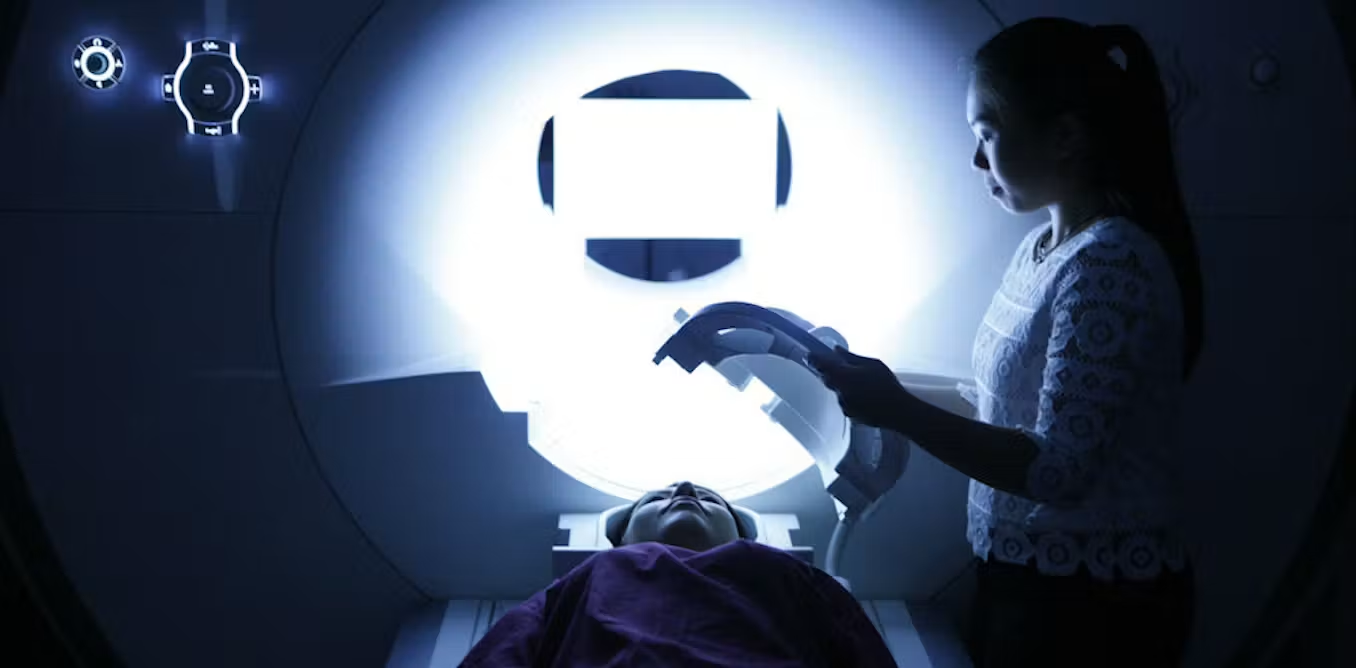
About 8,000 people in the UK are living with Huntington’s disease, a devastating inherited condition that gradually affects movement, thinking and mood. Now, an advanced type of MRI scan could give researchers a way to estimate the cellular damage it causes in living people, which could eventually help show whether treatments are working.

New research from my colleagues and I found that the technique can detect abnormalities in the brains of people living with Huntington’s that match those previously identified by examining brain tissue after death.

Huntington’s disease is an inherited condition caused by a faulty gene. Its effects usually begin between the ages of 30 and 50. There is currently no cure, although new cell and gene therapies are being developed and tested.

One of the main things that happens in Huntington’s is the loss of neuronal cells in the striatum, a part of the basal ganglia deep within the brain. These structures are important for controlling movement and other functions. As cells are lost, the brain tissue in these regions shrinks.

Advertisement

We can see this shrinkage using conventional MRI. But a standard brain scan tells us relatively little about what is happening inside the tissue at a cellular level. That’s where our approach comes in.

We used a technique called “soma and neurite density imaging”, or Sandi, to analyse diffusion MRI scans. Diffusion MRI detects how water moves through brain tissue. Because that movement is affected by the structures around the water, we can use it to make indirect estimates of properties such as the apparent size and density of cell bodies.

This means we can get indirect estimates of the structures within the tissue itself.

For our study, we analysed scans from 56 people with Huntington’s disease and 57 healthy volunteers of a similar age and sex. The participants were scanned using a strong-gradient MRI scanner.

Advertisement

We focused on the basal ganglia, where we expected to see the effects of Huntington’s disease. We also looked at the thalamus, a nearby brain region that is relatively spared during the early stages of the disease, as a comparison. The results showed a clear difference.

In the basal ganglia of people with Huntington’s disease, we found lower estimates of apparent cell-body density, larger estimates of apparent cell-body size and more space between cells than in healthy volunteers. We didn’t see the same pattern in the thalamus.

These findings are particularly interesting because they resemble what has previously been seen in brain tissue after death. Postmortem studies have shown that Huntington’s causes a specific type of striatal neurons – the cells that send signals around the brain and nervous system – to be lost. At the same time, glial cells, which normally support and protect neurons, change in response to the damage. They become larger and more active, altering the environment around the remaining neuronal cells.

Neurons and glial cells inside the human brain.
Kateryna Kon/Shutterstock

Our results suggest that Sandi may indirectly capture these biological changes in the living brain. The MRI measurements were also associated with the severity of Huntington’s disease and with poorer performance on finger-tapping tests, which are commonly used to assess motor control.

Advertisement

In some regions of the striatum, our estimates of apparent cell-body size and density, together with a person’s age, explained up to 63% of the observed brain shrinkage. This suggests that the measurements may be capturing some of the biological processes driving the loss of brain tissue, and could eventually be important for the development of treatments.

Future treatments

New cell and gene therapies for Huntington’s disease are being investigated, but researchers need ways of measuring what is happening inside the brain of a living person. If a treatment is designed to protect brain cells, we need to be able to measure whether that is actually happening.

Sandi could potentially provide such a measure. It might allow us to indirectly track cellular changes non-invasively and, in future clinical trials, help determine whether a treatment is altering the underlying disease process.

But we are not quite there yet. Our study was a snapshot, comparing people with Huntington’s disease and healthy volunteers at a single point in time. This does not tell us whether Sandi can track disease progression, or whether Sandi can reliably detect changes caused by a treatment.

Advertisement

We now need larger studies that follow people over a period of time to establish whether these measurements can track the progression of Huntington’s disease. The technique will also need to be adapted and validated for the MRI scanners routinely used in hospitals.

Sandi could give us something we currently lack: a way to look beyond brain shrinkage and gain an insight into the cellular changes taking place inside the living brain. And because the loss of brain cells is also a feature of more common conditions such as Parkinson’s and Alzheimer’s disease, the approach may have applications beyond Huntington’s.

Source link

Advertisement
Continue Reading

NewsBeat

Europe’s largest civil defense exercise since Cold War unfolds in Finland

Published

on

Europe's largest civil defense exercise since Cold War unfolds in Finland

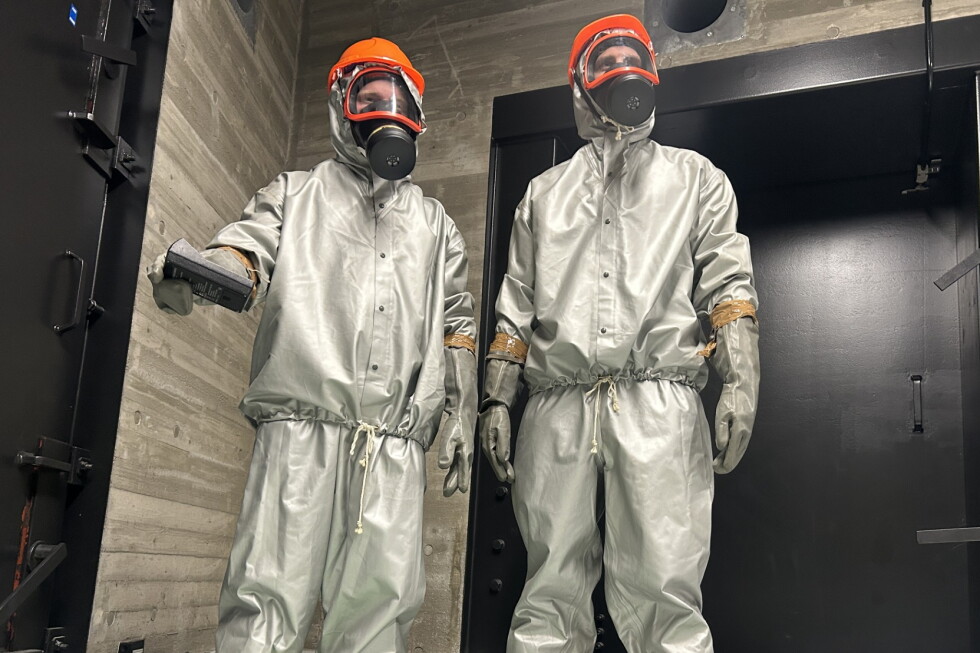
KUOPIO, Finland (AP) — In a civil defense shelter hewn into rock, behind doors designed to withstand a nuclear or biological attack, two Finnish conscripts wearing hazmat suits and breathing masks are measuring radiation levels as they take part in an exercise to turn a cave into a place of safety for thousands of people.

Inside, in what is normally a sports hall, hundreds of people are sleeping overnight on trestle beds.

More than 2,000 people including volunteers and students are taking part in the biggest civil defense exercise in Europe since the end of World War II. In the scenario, critical infrastructure in the central Finnish city of Kuopio, including power and water, has been disrupted by cyberattacks and there’s the threat of missile strikes from Finland’s neighbor, Russia.

The goal is for local authorities and ordinary people to rehearse what they would do if they came under attack for real.

Advertisement

But while underground bunkers and shelters may offer some protection from missiles, they are no defense against the campaign of sabotage and disruption that Western officials say Russia is carrying out across Europe. That has involved setting fires, attacking water facilities and power stations, and sending drones for sabotage into European Union airspace.

Finland’s border with Russia stretches more than 830 miles (1,300 kilometers) from the Baltic Sea up to the Arctic Circle. In 2024, along with Sweden, Finland joined NATO, following Russian President Vladimir Putin’s full-scale invasion of Ukraine. Until then, Finns were prepared to defend themselves against Russia largely alone.

Finland looks to Ukraine for lessons

Finland’s defense, said retired Army Colonel Asko Muhonen, relies not only on the military but on the “mindset” of ordinary Finns who are ready to take responsibility for their country’s security.

Muhonen, who organized the exercise in Kuopio, said that comes partly from the system of conscription which continued in Finland, even after the collapse of the Soviet Union.

Advertisement

Not everyone is happy about doing national service but “it’s our duty to serve and protect this country like people have before us. That’s why we have our independence,” said Jyry Pietikainen, 23, a conscript who was taught how to run the Kuopio shelter overnight.

Finland also needs to learn lessons from Ukraine, Muhonen said.

While the biggest shelter in Kuopio can fit 7,000 people, Ukrainians sometimes only have a few minutes to run to a subway station or underground parking lot. That means people need a shelter they can reach easily that offers some form of protection — not necessarily one that can withstand a nuclear attack, he said.

Dmytro Untila, 20, a Ukrainian student at the university in Kuopio, was at home in Odesa when Russian missiles struck his city on Feb. 24, 2022, the first day of the war. He sheltered in the entrance hall of his building because he didn’t have anywhere else to go, he said.

Advertisement

Training for such a situation would have definitely helped in Ukraine, he said, “because nobody knew this could happen.”

The biggest threat to energy infrastructure in the Kuopio region is heavy snowfall, storms and bad weather, said Juha Räsänen, CEO at the Savon Voima electricity company.

Advertisement

But since the invasion of Ukraine, and the company’s decision to stop buying Russian biofuel, the number of cyberattacks against the network has significantly increased, Räsänen said.

Last year, engineers also found at least 10 stickers placed on particularly vulnerable parts of the energy network infrastructure. Other energy companies in Finland have also found them and don’t know where they came from, he said.

“If there was an explosion at that point, it could destroy a whole dam,” Räsänen said. Drones have also been spotted over power lines but those responsible have not been identified, he said.

It is not possible to guard against all threats, Räsänen said, which is why it’s important people are prepared to look after themselves without help for at least 72 hours — if the power supply goes out, or if water becomes undrinkable.

Advertisement

The Finnish Security and Intelligence Service said it investigated “a wide range of observations” and found nothing of concern.

Since 2022, people have been more vigilant because of the security situation and therefore have reported things like reflective stickers related to land survey works, it said in a statement. Drone sightings, it said, have “largely been explained by everyday occurrences.”

“Small things are happening all the time,” including Russian jamming of GPS signals, said Vuokko Lahtinen, 32, who was visiting a sauna in Kuopio.

For that reason, “the best defense of Finland is to make it not worth attacking,” she said.

Advertisement

That relies on the country’s military and defense forces but also Finnish people who feel like “we have something we want to fight for,” she said.

In Finland, she said, there is a “general feeling of responsibility,” which has grown out of local community groups and even initiatives such as recycling.

“On a very simple daily level, if you do things that matter, then it has a butterfly-wing effect,” Lahtinen said.

Finland fought several wars with the Soviet Union

In its wars with the Soviet Union, Finland lost around 11% of its territory, and more than 400,000 people, around 12% of the population, fled their homes from an area that is now in western Russia.

Advertisement

At Kuopio’s veterans’ museum, Risto Mönkkönen, 95, showed AP a piece of paper on which he had written down the dates the city was bombed and who died.

“I cannot forget it,” he said explaining how, as a child, he and his father ran into a shelter just as a bomb hit, killing five of his father’s friends.

Pirkko Naukkarinen, 102, recalled how, aged 16, she worked in a field kitchen by the front lines, sometimes sharing dugouts with soldiers and diving for cover in ditches as the Soviet air force attacked the retreating Finnish army.

Aili Toivanen, 92, told AP she was forced to leave her home twice over the various wars. Both times, her family was told by Finnish soldiers that they had one hour to pack their belongings.

Advertisement

The first time, she looked back and saw her home burning — set on fire by Finnish soldiers who did not want to leave anything behind, she said. The second time, she said, the Soviet air force bombed the family’s departing train and they jumped out, hiding in ditches before they took refuge in Kuopio.

When Putin invaded Ukraine in 2022, she said, with tears in her eyes, that she worried she would have to leave her home for a third time.

Finns feel their country is worth fighting for

At the shelter in Kuopio, thousands of people filed in, including schoolchildren and university students.

“Kids would need to know this, because they might have to do something alone. The adults can’t always help,” said Amanda Hill, 11, whose school studied in the shelter for the day.

Advertisement

Sitting on the floor of the shelter with his fellow conscripts, Pietikainen explained why it’s not crazy to practice what happens in a crisis.

“We’re Finns, so we’re kind of pessimistic about life in a way,” but history shows what can happen with Russia, he said.

When it comes to the threats from Moscow, Muhonen said, “don’t believe what they say but observe what they do.”

Advertisement

Source link

Continue Reading

NewsBeat

Carla Jeffery dead: Former Disney star dies at 33 as agent shares heartbreaking tribute

Published

on

Daily Mirror

Disney star Carla Jeffery has died at the age of 33, her talent agency has confirmed in a devastating statement as her friends pay tribute

A former Disney star has died at the age of 33. Carla Jeffery, who is best known for her role as Bree in the Zombies franchise died on Tuesday, her agency sadly confirmed.

Posting on the star’s Instagram, Alexanders Talent Management wrote: “Our hearts are broken as we mourn the loss of our beloved Carla Jeffery. [broken heart emoji].”

They continued: “For more than 20 years, Carla was part of the Alexanders Talent Management family, and watching her grow from a talented young girl into the beautiful, vibrant woman and actress she became was an incredible privilege.

Advertisement

“As Bree in Disney’s hit ZOMBIES franchise, Carla shared her joy, humor, and bright spirit with audiences around the world. Carla was more than a client; she was family. Our hearts are with Carla’s family and loved ones during this devastating time. We respectfully ask that their privacy be honored as they grieve this unimaginable loss.”

They ended: “Rest beautifully, Carla. Your light will never be forgotten.”

Carla’s cause of death has not yet been revealed. Following the announcement of her death, followers quickly paid their own tribute online. Among them was fellow Disney star, Liamani. She wrote: “Sweet girl. Knowing you was an honor. There will never be another soul like yours.”

Advertisement

Chandler Kinney also wrote: “The brightest shining light in any room she walked into. The kindest person you’d ever meet. The most beautiful soul. This doesn’t feel real…”

And Zombies co-star Freya Skye added: “What a wonderful, bright, joyous human. Rest easy Carla.”

The Texas-born was born on July 10, 1993.. She is the twin sister of actor Carlon Jeffery, who also starred for Disney. He featured on the Channel’s hit show A.N.T. Farm.

Carlon paid tribute to his sister on his Instagram Story by reposting the Alexanders Talent Management statement.

Carla began her acting career aged just 12. She first appeared in Phat Girlz (2006), which starred Mo’Nique. She has also starred in various other projects, including Curb Your Enthusiasm (2007-2009), iCarly (2008), Southland (2009), and American Vandal (2017).

She first took on the role of Bree in the 2018 film of the Zombies franchise. The character is an cheerleader, who is the best friend of the protagonist Addison (played by Meg Donnelly). She has reprised her role in Zombies 2 (2020), Zombies 3 (2022), and Zombies: The Re-Animated Series (2024).

She told LRM Online at the time: “I think it’s staying passionate about it with what you do. Cause seriously, everybody put their all in each and every movie, which makes room for more.”

Advertisement

At the time, Jeffery also gushed over working with the cast, saying they were all friends and “miss[ed] each other so much” during breaks in between films.

Her last project was voicing Tiara in the podcast Series, Asanté, in 2025.

Like this story? For more of the latest showbiz news and gossip, follow Mirror Celebs on TikTok , Snapchat , Instagram , Twitter , Facebook , YouTube and Threads .

Advertisement

Source link

Continue Reading

NewsBeat

Is this the end of patchy mobile? Vodafone’s new fast track promises speeds up to four times faster than 5G

Published

on

Wales Online

It’s promising enhanced performance

Mobile users will soon be able to pay a little extra to use a new super speedy 5G+ fasttrack service. Vodafone SuperMobile promises enhanced performance, reliability and security with speeds up to four times faster than its standard plans.

The new service is the only plan globally that guarantees download speeds of at least 15Mbps when customers are in 5G+ coverage. Vodafone says it is so confident in its network that customers can leave their contract early without penalty if the promise isn’t met.

Max Taylor, CEO of VodafoneThree, said: “The UK needs to go faster, and with our £11bn investment we will build a faster, higher-quality network than anyone else. Vodafone SuperMobile is super fast, super reliable and super secure. Ideal for consumers watching content on the go, AI applications or businesses looking to benefit from digital transformation.”

Advertisement

The company said today’s launch marks a shift in how mobile services are sold in the UK, with customers paying a premium not just for more data but for a guaranteed level of network quality. SuperMobile uses “network slicing” technology to give customers access to a dedicated part of Vodafone’s 5G+ network.

It costs £3 per month more than full-speed plans, £8 more on SIM-only 100Mbps plans, £4 more on handset 100Mbps plans, or £12 as a rolling monthly add-on. It’s also available to businesses through a separate National Business Slice, as well as to critical public services from next year.

Source link

Advertisement
Continue Reading

NewsBeat

Family of Manchester teacher and partner killed in Lisbon funicular disaster in ‘living hell’ as moving tributes issued

Published

on

Manchester Evening News

Manchester teacher Will Nelson, 44, and his partner Kayleigh Smith, 36, died in Lisbon

The grieving family of a couple killed in the Lisbon funicular disaster have paid moving tributes to the pair to mark the first anniversary of the tragedy which claimed 16 lives.

Advertisement

Drama teacher Will Nelson, 44, and his budding theatre director partner Kayleigh Smith, 36, from Macclesfield, died when the Glória hillside tram in the Portuguese capital derailed and crashed into a building on September 3 last year.

Kayleigh was ‘the happiest she had been’ as she overcame ADHD and was poised to start a new career as a professional theatre director. Will taught drama at the Arden School of Theatre in Manchester where he met Kayleigh.

Click here to get the biggest stories straight to your inbox in our Daily Newsletter

They were passengers on the historic 140-year-old Elevador da Gloria vehicle when the collision occurred. Portugal’s Air and Rail Accident Investigations Bureau has said the underground cable which snapped was acquired only the year before and had never been certified for passenger transportation. The cable acted as a counterweight between two carriages.

Advertisement

Kayleigh’s family, who were today attending a memorial event in Lisbon, said in a statement: “The last 12 months have been incredibly difficult for a lot of people connected with Kayleigh. Kayleigh and Will have left a huge void in our lives that cannot be filled and we will forever be reminded of that.

“We are all so proud of her which makes it harder. She had just passed her master’s degree, with distinction, at the Arden School of Theatre in Manchester two weeks before the crash and was destined for a successful career as a professional theatre director having already won many awards and nominations during her theatre life.

“She battled with undiagnosed ADHD all through her life until her eventual diagnosis in 2022 yet remained defiant and still achieved so much. She was a shining light and inspiration for the many people she helped and encouraged.

“At this point, she was the happiest she had ever been, and when she travelled with Will to Lisbon, they had many exciting plans for when they returned.

Advertisement

“The love and support for us all has been overwhelming and we wish to thank our families, friends, professional bodies, and everybody in Kayleigh’s world.

“Our thoughts go out to all the families who have suffered as a result of this tragedy, the people of Kayleigh’s hometown of Macclesfield, and to the people of Lisbon. All the World’s A Stage – Shakespeare.”

Will’s brother, Gareth, also paid tribute to Will: “This has been the most difficult year of my life. A living hell is the best description. It is still difficult to put into words how much Will is missed.

Advertisement

“What I have learnt ever since this began a year ago is how much he meant not just to our family but to everyone who knew him. I know of so many occasions when friends and acquaintances have said when Will helped them, fought in their corner and unselfishly gave his time to help anyway he could. He and Kayleigh loved their theatre work and to hear that their legacy will be honoured in multiple ways in multiple places fills we with pride that you wouldn’t believe.

“I often think to myself what would he say about the change of political landscape, the football, the wrestling. I miss his booming voice, his burning intellect and wish I could have one more video game session or one more discussion. He was my big brother and idol, and I hope I can carry on his life mission to look after others.”

The third British victim of the crash has been named as Andrew David Kenneth Young, 82, a transport enthusiast from Holyhead, Anglesey.

Advertisement

Rebecca Gilmore, senior associate at law firm Hugh James, is supporting the families of all three.

Source link

Continue Reading

NewsBeat

They look cheesed off! Moment mice spar in front of commuters waiting for the Tube

Published

on

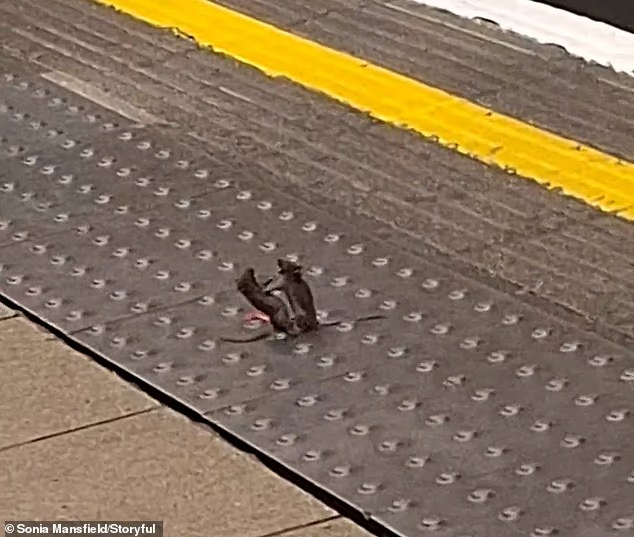
The battle of the rodents was caught on camera on the Central Line platform at Oxford Circus on Saturday

Advertisement

This is the moment two mice sparred on a train platform while commuters waited for the Tube.

The battle of the rodents was caught on camera on the Central Line platform at Oxford Circus on Saturday.

In the footage, a passenger can be heard chuckling as the mice chase each other in circles in a fight over what appears to be a piece of food.

Without a Tom to break up the two Jerrys, their altercation escalates further as the mice start lunging at each other, egged on by the person recording who says: ‘Go on, get him!’ 

Advertisement

A brief detente then ensues with the mice moving to different sides of the platform.

However, the tiny tussle then resumes and they begin sparring once more.

In scenes reminiscent of a fisticuffs fight, the mice then appear to be locked in a bizarre boxing match as they stand on their hind legs and throw punches at one another – much to the delight of onlookers who can be heard sniggering.

Eventually, one mouse comes out of the battle victorious and the other is forced to scurry away while the champion enjoys their prize. 

Advertisement

The battle of the rodents was caught on camera on the Central Line platform at Oxford Circus on Saturday

In scenes reminiscent of fisticuffs fight, the mice appear to be locked in a bizarre fistfight as they stand on their hind legs and throw punches at one another

In scenes reminiscent of fisticuffs fight, the mice appear to be locked in a bizarre fistfight as they stand on their hind legs and throw punches at one another

The scene at Oxford Circus was remarkably similar to photographer Sam Rowley’s award-winning picture of two mice fighting on an Underground platform.

Advertisement

‘Station Squabble’, as the photograph was titled, beat 48,000 other entries to win the Natural History Museum’s Wildlife Photographer of the Year competition in 2020.

In order to capture the image, Mr Rowley spent a week overnight in the Tube network where he received ‘strange looks from commuters’ when he had to lie down on platforms in his attempts to get the best shot.

The panel of judges said at the time: ‘Sam discovered the best way to photograph the mice inhabiting London’s Underground was to lie on the platform and wait.

‘He only saw them fight over scraps of food dropped by passengers a few times, possibly because it is so abundant. This fight lasted a split second, before one grabbed a crumb and they went their separate ways.’

Advertisement

Advertisement

Source link

Continue Reading

NewsBeat

Channel smuggling gangs resort to ‘mega-dinghies’ as crackdown limits small boat supply

Published

on

Pol sits in a car with a bloody tissue covering his eye.

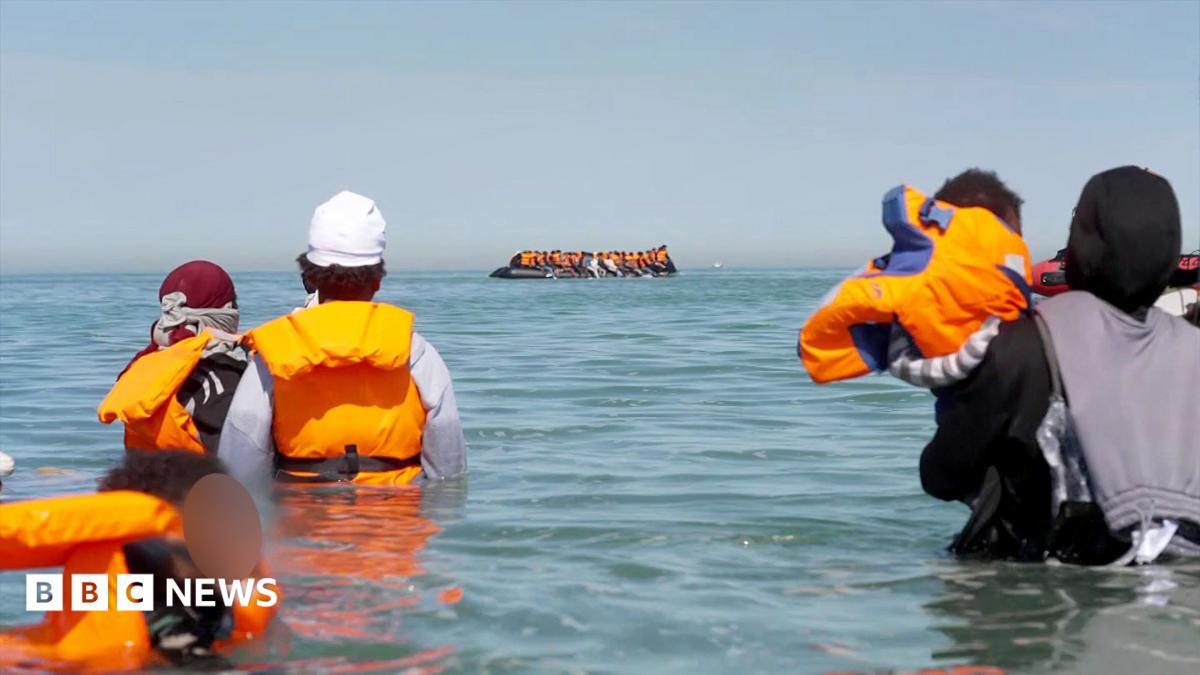
What they leave behind in Gravelines is a scene of dejection and exhaustion. A limp toddler is carried past me towards a police officer, who revives him with a light shake.

This all unfolds next to four or so men casting their fishing rods into the increasingly choppy waters. It is peak holiday season here. They and other dogwalkers barely glance at the crestfallen migrants wading back to the stand.

Before, the gangs would often launch boats in the dead of night, but with increased police patrols, charity workers tell us the gangs now see the middle of the day as a better opportunity, as it takes taxi boats longer to arrive and it allows them to better co-ordinate boarding.

“You feel guilty being there – going to the beach and having a good time, while these families are in such terrible situations,” observes a woman with her young daughter. They had been playing with a bucket and spade.

Advertisement

“It’s hard,” she admits. “We regularly see people on the beach attempting the crossing. It feels like living in two parallel worlds that have nothing to do with each other; it’s really strange.”

The migrants remaining will wait for their next opportunity, as per their agreement with the gangs. But because of more robust policing that wait is now typically weeks, even months, rather than days.

They also need a favourable weather window: the wind needs to ideally be under 5 knots and waves need to be less than 0.8m for a small boat to have a chance of making it across.

To improve their chances of avoiding detection and to be closer to a taxi boat, charity workers tell us migrants are also sleeping closer to the beach in the woods or among the dunes, instead of at the larger camps where they can wash, or receive food, water and medication.

Advertisement

It is after arriving at the largest settlement at Loon-Plage, near Dunkirk, that we soon find ourselves in direct confrontation with the people smugglers.

As the intense heat bears down on a tent where people can charge their devices, we initially meet two young Egyptian men who are visibly tired and disheartened. They have been staying in squalid conditions for months and have made several unsuccessful attempts to cross.

“The police stopped us from leaving and destroyed the boats,” explains one. He says he wants to go to the UK so he can work and obtain legal papers.

A young Sudanese woman and Afghan man also told us they had also tried to cross dozens of times. We have been to the camp on several occasions over the past year, but this time there was a perceptible unease.

Advertisement

Riot police had cleared out the tents in the same week, and the day before around 400 migrants preparing for a taxi boat in the nearby Hardelot forest were forced to return after several fires broke out.

It is evident the migrants and the gangs have been repeatedly frustrated, and the sight of our camera in one corner of the camp leads to us being attacked.

After agreeing to stop filming, one smuggler, around 5’8″ tall (172cm) and in a new grey tracksuit, tries to grab our camera. He then repeatedly throws rocks at us from close range, striking our cameraman above the eye.

Advertisement

Source link

Continue Reading

NewsBeat

Call to review Holyrood’s liberal homelessness laws to tackle Glasgow refugee crisis

Published

on

Daily Record

EXCLUSIVE: Scottish Labour leader hopeful Joe Fagan said rethinking the abolition of “priority need” should be carried out in a “rational” way”.

Content cannot be displayed without consent

A call has been made to review Holyrood’s liberal homelessness laws to help Glasgow cope with a refugee crisis.

Scottish Labour leadership candidate Joe Fagan said rethinking the abolition of “priority need” for help with housing should be done in a “rational” way.

Advertisement

Glasgow council, led by the SNP’s Susan Aitken, is facing a £110m funding gap fuelled by rising homelessness costs.

The total bill for homelessness came to £38m in 2025/26, but estimates suggest this figure will rise to £75m next year.

Council chiefs believe the UK Government’s decision to clear a backlog of asylum seeker cases is behind the increased spending.

Advertisement

Asylum seekers who have been housed in Glasgow by the Home Office are declaring themselves homeless in the city after they are allowed to stay in the UK.

However, Holyrood’s decision to scrap the ‘priority need’ test for homelessness in 2012 is also under scrutiny.

Critics believe the decision has made Glasgow attractive to single male refugees from all over the UK.

Advertisement

Fagan, speaking on the Record’s Planet Holyrood podcast, said he backed a review of the “priority need” policy:

“I think it makes sense. Let’s do it on a rational basis. Don’t let Reform pull this into the realm of populism. Let’s look at this as a policy challenge that Glasgow and the country faces like any other.”

The South Scotland MSP, who is going up against Michael Marra in the contest, said looking again at “priority need” could be part of a “basket of measures” including more house building.

He also echoed calls by Aitken for more funding for Glasgow in this area:

Advertisement

“Susan Aitken’s right to call for more support from both the Scottish and UK governments. It’s incumbent on Scottish and UK governments to work with the local authority and find a collaborative way through this.”

With Glasgow housing more asylum seekers than any other part of Scotland, he was also asked if he supported a fairer distribution of people who have fled persecution:

“Yes, I do, and I think other local authorities can step up. Through national bodies like COSLA, local government has been trying to do that.

“But one of the issues that we find – and it makes sense in a lot of ways – is that cities will always pull diverse communities towards them. It’s always been the case through history.”

Advertisement

Source link

Continue Reading

Trending

Copyright © 2025