Connect with us

NewsBeat

Why Sigmund Freud is making a comeback in the age of authoritarianism and AI

Published

on

Why Sigmund Freud is making a comeback in the age of authoritarianism and AI

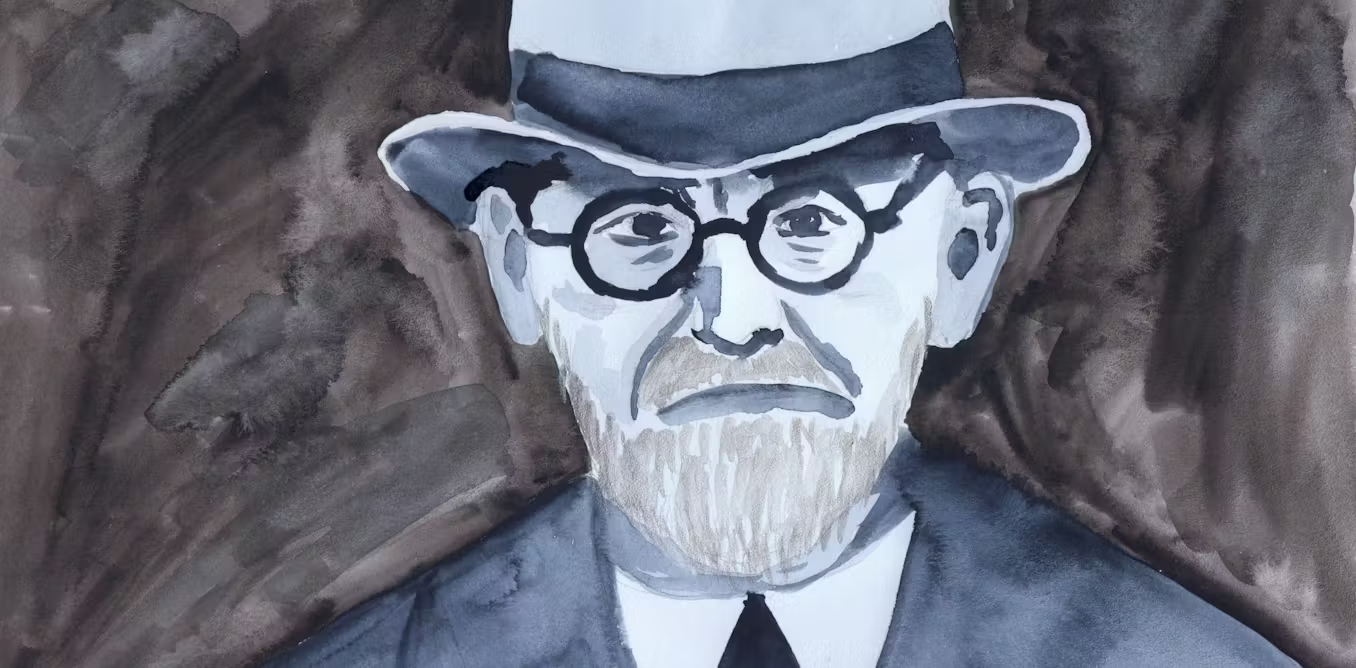
Psychoanalysis is having a moment. Instagram accounts dedicated to Freudian theory have amassed nearly 1.5 million followers. Television shows like Orna Guralnik’s Couples Therapy have become compulsive viewing. Think pieces in The New York Times, The London Review of Books, Harper’s, New Statesman, the Guardian and Vulture are declaring psychoanalysis’s resurrection. As Joseph Bernstein of the New York Times put it: “Sigmund Freud is enjoying something of a comeback.”

For many, this revival comes as a surprise. Over the past half century, psychoanalysis – the intellectual movement and therapeutic practice founded by Sigmund Freud in 1900 Vienna – has been shunned and belittled in many scientific circles. Particularly in the English-speaking world, the rise of behavioural psychology and a ballooning pharmaceutical industry pushed long-form talking therapies like psychoanalysis to the margins.

But there’s a more complex global story to tell. In Freud’s own lifetime (1856-1939), 15 psychoanalytic institutes were established worldwide, including in Norway, Palestine, South Africa and Japan. And around the world – from Paris to Buenos Aires, from São Paulo to Tel Aviv – psychoanalysis often flourished throughout the 20th century.

Across South America, psychoanalysis continues to wield huge clinical and cultural influence. It remains so popular in Argentina that people joke you can’t board a flight to Buenos Aires without having at least one analyst on board.

Advertisement

There are several reasons why psychoanalysis became popular in some countries but not others. One relates to the 20th-century history of Jewish diaspora. As the Third Reich expanded, many Jewish psychoanalysts and intellectuals fled central Europe before the Holocaust. Cities like London, which received Freud and his entire family, were culturally reshaped by this refugee crisis.

But another, perhaps less obvious reason concerns the rise of authoritarianism. Psychoanalysis may have been created and spread in the crucibles of wartime Europe, but its popularity has often surged alongside political crisis.

Take Argentina. As left-wing authoritarian Peronism gave way to a US-sponsored “dirty war”, paramilitary death squads abducted, killed or otherwise “disappeared” roughly 30,000 activists, journalists, union organisers and political dissidents. Loss, silence and fear enveloped the emotional worlds of many.

Yet at the same time, psychoanalysis – with its interest in trauma, repression, mourning and unconscious truth – became a meaningful way of grappling with this oppression. Therapeutic environments for talking about trauma and loss became a technique for responding to, and perhaps even resisting, this political disaster. In a culture of state lies and enforced silence, simply speaking truth was a radical exercise.

Advertisement

Many of Freud’s original followers used psychoanalysis in a similar way. Surrounded by the inexplicable horrors of European fascism, figures like Wilhelm Reich, Otto Fenichel, Theodor Adorno and Erich Fromm saw psychoanalysis, typically combined with classical Marxism, as an essential tool for understanding how we develop and desire authoritarian personalities.

Frantz Fanon relied on psychoanalysis to critique French colonial oppression.
GL Archive/Alamy

Half a world away in Algeria, the psychiatrist and anti-colonial activist Frantz Fanon relied heavily on psychoanalysis to protest the oppressive racial regimes of French colonialism. For all these doctors and philosophers, psychoanalysis was essential to political resistance.

Something similar appears to be happening today. As new forms of multinational autocracy rise, as immigrants are demonised and detained, and genocide is live-streamed, psychoanalysis is thriving once more.

A tool for making sense of the senseless

For some, neuropsychoanalysts like Mark Solms have provided the necessary links to take psychoanalysis up again. In his new book, The Only Cure: Freud and the Neuroscience of Mental Healing, Solms uses neuroscientific expertise – specifically his work on dreaming – to argue that Freud’s theory of the unconscious was right all along.

Advertisement

According to Solms, while drugs may be temporarily effective, they offer only short-term solutions. Only psychoanalytic treatments, he argues, provide any long-term curative effect.

But Solms is just one among many such resurgent figures – a growing cadre of clinician-intellectuals whose work has returned psychoanalysis to cultural esteem. Where Solms veers towards neurology, others including Jamieson Webster, Patricia Gherovici, Avgi Saketopoulou and Lara Sheehi return us to psychoanalysis’s political urgency.

Their work shows how psychoanalysis’s core concepts – the unconscious, the “death drive”, universal bisexuality, narcissism, the ego and repression – help make sense of our contemporary moment where other theories fall short.

Advertisement
Freud explained.

In a world of increasing commodification, psychoanalysis resists commercialised definitions of value. It emphasises deep time in a climate of shortening attention spans and insists on the value of human creativity and connection in a landscape of artificial intelligence overwhelm. It challenges conventional conceptions of gender and sexual identity, and prioritises individual experiences of suffering and desire.

The reasons for psychoanalysis’s contemporary resurgence mirror those that drove its earlier waves of popularity. In times of political upheaval, state-sponsored violence and collective trauma, psychoanalysis offers tools for making sense of the seemingly senseless. It provides a framework for understanding how authoritarian impulses take root in individual psyches and spread through societies.

More still, in an era where quick fixes and pharmaceutical interventions dominate mental health care, psychoanalysis insists on the value of sustained attention to human complexity. It refuses to reduce psychological distress to chemical imbalances in the brain or symptoms to be managed. Instead, it treats each person’s inner world as worthy of deep exploration.

The collective resurgence of interest in psychoanalysis is also challenging the field itself to transform. Old assumptions – like the idea that therapists should be neutral or that heterosexuality is the norm – are being challenged. And psychoanalytic practice is being reimagined alongside many social justice and solidarity movements. This is a moment in which many are coming together to reimagine what psychoanalysis can be.

Advertisement

Whether this renaissance will endure remains to be seen. But for now, as political crises mount and traditional therapeutic approaches seem insufficient, Freud’s insights into the human psyche are finding new audiences eager to understand the darkness of our times.

Source link

Advertisement
Continue Reading
Click to comment

Leave a Reply

Your email address will not be published. Required fields are marked *

NewsBeat

Trump insists Iran talks must continue, but military action is not off the table

Published

on

Trump insists Iran talks must continue, but military action is not off the table

Israeli prime minister Benjamin Netanyahu’s trip to Washington on February 11 appears not to have achieved what many observers saw as its central purpose: to persuade Donald Trump to harden his demands on Iran to the point that negotiations between the countries fail. According to reports, Trump told Netanyahu he wanted talks with Iran to continue.

What will be concerning Netanyahu is that while he can probably rely on Trump to take a hard line on limiting Iran’s nuclear programme, it is less clear where his unpredictable ally stands on limiting Iran’s ballistic missile capabilities and ending its support for regional armed groups.

Trump had previously indicated that any deal with Iran had to include missiles. But more recently, he has suggested the US may be open to dropping this demand. On February 10, when asked by a reporter if an agreement with Iran would be acceptable if it only covers nuclear issues, Trump said: “Yeah, that would be acceptable, but the one thing and right up front, no nuclear weapons.”

This, as well as positive statements by US and Iranian officials about their brief indirect talks in Oman days earlier, will have spooked Israeli officials. Both Iran and Israel understand that it is missiles, not nuclear enrichment or even Iranian regional proxies, that underpin Iran’s increasingly shaky deterrence.

Advertisement
Veiled Iranian women walk next to missiles in Tehran during celebrations for the 47th anniversary of the Islamic Revolution on February 11.
Abedin Taherkenareh / EPA

For the moment, Trump seems to think that a deal limited to the nuclear issue may be preferable to going to war to tackle everything else. Yet opponents of US military action, which include all of Washington’s Middle Eastern allies except Israel, should still be worried.

It is far from clear whether Iran will offer the kind of nuclear deal Trump would find acceptable, and Trump himself does not seem to know what else to do other than double down on military threats. That alone may scupper the talks.

Netanyahu is also a seasoned political operator who showed how adept he is at manoeuvring Trump into supporting military action in 2025, when the US joined Israel in striking Iranian nuclear facilities. And the current US military build-up in the Persian Gulf has now reached a point where that option is on the table.

Trump’s Iran policy

The uncertainty over whether Trump will strike Iran underscores how shallow his Iran policy is. He does not have a conventional, institutionalised policy apparatus of the kind the Obama administration relied upon to negotiate a deal to limit Iran’s nuclear programme in 2015.

Advertisement

Instead, Trump is pursuing indirect talks with Iran that are being overseen by two officials with no prior diplomatic experience. These two officials, Steve Witkoff and Jared Kushner, have simultaneously been tasked by Trump with ending the war between Russia and Ukraine.

Trump also seems undecided about whether any deal should focus narrowly on the nuclear issue or whether he should pursue something resembling a grand bargain. Nor has he articulated what he is prepared to offer Iran as part of a deal or how he would justify incentives such as sanctions relief for a regime that has just murdered thousands of its citizens in a brutal protest crackdown.

His approach to Iran is so ad hoc that it allows different groups with access to him, Netanyahu on one side and increasingly assertive regional states such as Saudi Arabia, Qatar and Turkey on the other, to influence key decisions. It was this latter group of Middle Eastern states that intervened recently to press Trump to proceed with talks when they threatened to collapse over Iran’s refusal to discuss issues beyond the nuclear file.

These states are cautioning Trump that US strikes might precipitate the collapse of the Iranian regime. However desirable that might seem, experience in Iraq, Libya and Syria suggests that state fragmentation, mass displacement, violence and regional destabilisation would be more likely than any orderly democratic transition.

Advertisement

And if strikes fall short of toppling the regime, even a weakened Iran could inflict serious economic and strategic damage on Gulf oil shipping and infrastructure.

Obama attends a press conference in 2015.
Trump has repeatedly described Obama’s Iran deal as a ‘disaster’.
Jim Lo Scalzo / EPA

Trump’s ad-hoc approach to diplomacy is in stark contrast to the Obama administration’s negotiations in 2015. Then, the International Atomic Energy Agency provided compliance verification and technical expertise, and the EU chaired the joint commission that oversaw the deal’s implementation.

The UN security council formalised the agreement under international law and established a mechanism for reimposing sanctions in the event of noncompliance. There was also a clear, if largely unfulfilled, strategic rationale related to Obama’s desire to reduce the US’s regional footprint and pivot towards Asia.

Trump’s approach is radically different. He withdrew the US from the nuclear deal in 2018 without a clear plan for what would replace it beyond something he could describe as better and attach his name to. He has no interest in brokering a multilateral agreement and does not appear to have a coherent set of demands or strategic aims that could anchor one.

A thin deal without substance, institutional anchoring and clear mechanisms for handling the inevitable disputes over sanctions relief and compliance is unlikely to endure, even if Trump can push the Iranians into signing it.

Advertisement

Source link

Continue Reading

NewsBeat

Summerville spares West Ham blushes with extra-time winner against Burton Albion

Published

on

Summerville spares West Ham blushes with extra-time winner against Burton Albion

Burton Albion: Collins, Lofthouse, Godwin-Malifé, Vancooten, Armer, Revan, McKiernan, Evans, Krubally, Shade, Beesley
Subs: Dudek (GK), Chauke, Sibbick, Tavares, Moon, Sraha, Larsson, Adom, Cannon

West Ham United: Areola, Walker-Peters, Mavropanos, Kilman, Mayers, Scarles, Magassa, Kanté, Lamadrid, Adama, Wilson
Subs: Herrick (GK), Wan-Bissaka, Diouf, Disasi, Potts, Orford, Summerville, Taty, Ajala

Source link

Advertisement
Continue Reading

NewsBeat

Space station is back to full strength after medical evacuation

Published

on

Space station is back to full strength after medical evacuation

CAPE CANAVERAL, Fla. (AP) — The International Space Station returned to full strength with Saturday’s arrival of four new astronauts to replace colleagues who bailed early because of health concerns.

SpaceX delivered the U.S., French and Russian astronauts a day after launching them from Cape Canaveral.

Last month’s medical evacuation was NASA’s first in 65 years of human spaceflight. One of four astronauts launched by SpaceX last summer suffered what officials described as a serious health issue, prompting their hasty return. That left only three crew members to keep the place running — one American and two Russians — prompting NASA to pause spacewalks and trim research.

Moving in for eight to nine months are NASA’s Jessica Meir and Jack Hathaway, France’s Sophie Adenot and Russia’s Andrei Fedyaev. Meir, a marine biologist, and Fedyaev, a former military pilot, have lived up there before. During her first station visit in 2019, Meir took part in the first all-female spacewalk.

Advertisement

Adenot, a military helicopter pilot, is only the second French woman to fly in space. Hathaway is a captain in the U.S. Navy.

“Bonjour!” Adenot called out once the capsule docked to the space station 277 miles (446 kilometers) up.

A couple of hours later, the hatches swung open and the seven space travelers hugged and exchanged exuberant high-fives. “Let’s get rolling,” Meir said.

NASA has refused to divulge the identity of the astronaut who fell ill in orbit on Jan. 7 or explain what happened, citing medical privacy. The ailing astronaut and three others returned to Earth more than a month sooner than planned. They spent their first night back on Earth at the hospital before returning to Houston.

Advertisement

The space agency said it did not alter its preflight medical checks for their replacements.

___

The Associated Press Health and Science Department receives support from the Howard Hughes Medical Institute’s Department of Science Education and the Robert Wood Johnson Foundation. The AP is solely responsible for all content.

Advertisement

Source link

Continue Reading

NewsBeat

‘Best’ adaptation of iconic Shakespeare play with ‘great cast’ now streaming

Published

on

Manchester Evening News

The beloved William Shakespeare film adaptation starring Kate Winslet and Kenneth Branagh has received rave reviews

Viewers seeking a compelling period drama need look no further, after one adaptation of a William Shakespeare play streaming on Prime Video and Apple TV+ has garnered outstanding praise on IMDb. This follows others enjoying a historical series likened to HBO’s gripping Chernobyl and an “excellent” period drama adaptation, reports the Express.

The film has attracted glowing reviews on IMDb, with one viewer posting a 10/10 critique titled: “The Bard would be proud”. The reviewer continued: “What I really liked about this film is that you don’t have to be a Shakespeare scholar to enjoy it. This is a must see for anyone and everyone. It may be four hours long, but it’s definitely worth it.”

Advertisement

A second viewer wrote in their top-rated review: “This is the only film of “Hamlet” that contains the full four hours of William Shakespeare’s masterpiece and gives a unique feel to the whole story.” Echoing the first review, they concluded: “This is a must see for everyone who enjoy’s good story telling, brilliant acting, and incredible direction. All of these part of William Shakespeares greatest triumph.”

A third viewer praised the production as a “masterpiece” in their 8/10 review and noted: “I’m pleased to tell you that this adaptation is every bit as good as the intense and dramatic play.” Another viewer commented in their 9/10 review that this film was amongst the “best” Shakespeare adaptations that actor and director Kenneth Branagh had created and described it as a “masterpiece”.

They elaborated: “The cast is great too. No weak link in the acting, and everyone holds their own.” The reviewer added in their piece: “The Cinematography shows off the world well and fits most scenes, same with the music [sic].” Branagh’s 1996 adaptation of The Tragedy of Hamlet, Prince of Denmark, or simply Hamlet, delivered an epic and devastating story to cinema audiences.

Advertisement

The Belfast and Wallander star penned and helmed the film, whilst also portraying the titular character in Hamlet. This interpretation of Hamlet was remarkable for being the first complete film version of William Shakespeare’s tragedy and its lengthy running time clocked in at four hours. Hamlet chronicled the story of the Prince of Denmark following his devastation over his father’s passing, with his uncle Claudius (Derek Jacobi) rapidly wedding his mother Gertrude (Julie Christie) to claim the throne.

Following an apparition of his deceased father, the prince set out to exact retribution for his father’s killing at the hands of his uncle.

Hamlet feigned insanity whilst investigating his father’s death, though this ultimately resulted in further losses, including Ophelia (played by Kate Winslet).

Advertisement

Yet, whilst pretending to lose his mind, it appeared Hamlet genuinely descended into madness as he contemplated existence and mortality.

As with all of Shakespeare’s tragedies, numerous other fatalities occurred in Hamlet as the prince pursued his vengeance. Hamlet boasted a star-studded ensemble, which also included Richard Briers from The Good Life, Nicholas Farrell from The Crown, Michael Maloney of The Trial of Christine Keeler, and Rufus Sewell from ITV’s Victoria.

There were also some big names that took on minor roles in Hamlet, including the late Robin Williams, Gérard Depardieu, Timothy Spall, Jack Lemmon, Ray Fearon, Brian Blessed, Billy Crystal, Simon Russell Beale, Don Warrington from Death in Paradise, Charlton Heston, Richard Attenborough, John Gielgud, and Judi Dench.

Hamlet went on to garner a host of award nominations, including four Oscars and two BAFTA Film Awards.

Advertisement

Hamlet (1996) is available to watch on Prime Video and Apple TV+ for a fee

Source link

Continue Reading

NewsBeat

Four new astronauts arrive at the International Space Station to replace evacuated crew | Science, Climate & Tech News

Published

on

Andrei Fedyaev, Jack Hathaway, Jessica Meir and France's Sophie Adenot (left to right front row), with Sergey Kud-Sverchkov, Christopher Will and and Sergei Mikayev behind. Pic: NASA/AP

Four new astronauts have arrived at the International Space Station to replace their colleagues who pulled out early over health concerns.

SpaceX delivered the US, French and Russian astronauts to the orbital research laboratory 277 miles (446km) up in space, a day after they launched from Cape Canaveral.

The new crew members include NASA‘s Jessica Meir and Jack Hathaway, France’s Sophie Adenot and Russia’s Andrey Fedyaev.

The last group of astronauts were forced to evacuate after one of them suffered what officials described as a serious health issue.

Advertisement
Image:
The SpaceX Dragon capsule carrying the astronauts approaches the International Space Station. Pic: NASA/AP

The withdrawal left only three crew members on board the space station – one American and two Russians – prompting Nasa to pause space walks and reduce research output.

Ms Meir, a marine biologist, and Mr Fedyaev, a former military pilot, have previously lived on the space station.

The new astronauts dressed in blue greet the crew members already on the space station. Pic: NASA/AP
Image:
The new astronauts dressed in blue greet the crew members already on the space station. Pic: NASA/AP

On her first mission to the station in 2019, Ms Meir took part in the first all-female spacewalk.

Ms Adenot, a military helicopter pilot, is only the second French woman to fly in space.

Mr Hathaway is a captain in the US Navy.

Advertisement

Advertisement

Moment new astronauts blast off to International Space Station

Video of the crew’s arrival shared by NASA shows the four newcomers floating through the hatch from the SpaceX Dragon spacecraft into the space station.

“Bonjour,” Ms Adenot said.

Read more from Sky News:
‘Tipping point’ reached in creation of brain chips for people with paralysis
How Trump’s White House is helping Big Tech fight child safety campaigners

The seven space explorers hugged and exchanged exuberant high-fives in the zero-gravity environment before posing for photos.

“Let’s get rolling,” Ms Meir said.

Advertisement

The crew will spend eight to nine months on board the International Space Station.

The SpaceX Falcon 9 rocket taking off on Friday. Pic: NASA/AP
Image:
The SpaceX Falcon 9 rocket taking off on Friday. Pic: NASA/AP

Last month’s medical evacuation was NASA’s first in 65 years of space exploration.

NASA has declined to divulge the identity of the astronaut who fell ill in orbit on 7 January or provide details of what happened, citing privacy concerns.

Advertisement

The ailing astronaut and three others returned to Earth more than a month sooner than planned.

They spent their first night back in a hospital before returning to Houston.

Source link

Advertisement
Continue Reading

NewsBeat

A Game About Digging A Hole reader review – Reader’s Feature

Published

on

A Game About Digging A Hole reader review - Reader's Feature
A Game About Digging A Hole – not a misleading title (rokaplay select)

With the game now available on consoles, a reader gives their verdict on indie hit A Game About Digging A Hole, which does exactly what it says on the tin.

You’re on a sunny, suburban street. A van draws up. An unidentified someone jumps out of the van and nails a notice to a public noticeboard. The van and the unidentified someone drive off. Close in on the noticeboard and the newly attached notice. It’s a brightly coloured advert. The advert reads:

House For Sale. Only 10,000 $. With Gold Treasure In the Garden! Buy Now & Get Rich!

This is how A Game About Digging A Hole begins. Played in first person view, what you see first is the back garden of the house that you’ve bought and a box containing a Super Mega Digger 3000 Ultimate 2.0 Detector Set. This battery powered tool is the primary component of a game that’s played out in two locations. Your back garden and your garage. Unfortunately, you can’t enter the main part of the house that’s now yours, or at least I never managed to.

Advertisement

Go into the garage and you’ll find a workbench and a computer. The computer allows you to sell the ore/items that you obtain and by selling ore you accumulate funds. The workbench is where you spend the funds that you’ve accumulated. The workbench offers upgrades for your shovel, the aforementioned Super Mega Digger 3000.

Upgrades are also available for your inventory, battery and you can buy a jetpack which will become an essential item later on. Charge can be bought for your battery on the workbench screen and you can replenish your personal health there too. Dynamite and lamps are useful extras for when you want to take your digging to new depths.

Expert, exclusive gaming analysis

Sign up to the GameCentral newsletter for a unique take on the week in gaming, alongside the latest reviews and more. Delivered to your inbox every Saturday morning.

Advertisement

Exit the garage, stroll into your sunlit back garden and you’ll see an X on the grass. X marks the spot, or so they say. In actuality you can begin your treasure hunt anywhere, so long as it’s on the back lawn.

On the PlayStation 5, digging involves pulling the right trigger of the joypad. Do this and your battery powered shovel takes a single bite out of the ground. While your back lawn steadily gets taken away chunk by chunk, various ores are uncovered. At first, you’ll find stones and coal. When you uncover these items they’re sucked straight into your inventory, which quickly fills up because at the start of the game your inventory is small.

Advertisement

Once your inventory is full you can keep digging but any ores that you uncover will be destroyed, so it’s best to turn those unearthed items into money so that you can buy upgrades and recharge your shovel battery. Without an upgrade the shovel battery’s charge soon runs out.

Initially this game seems repetitive. Do a bit of digging. Fill up your small inventory with stones, coal, iron, etc. Nip back into the garage. Sell what you’ve extracted from the ground on the computer. Spend your earnings on upgrading your equipment if you’ve earnt enough, then go back outside and carry on digging.

However, the steps that I’ve just described become compulsive, or at least they did for me, due to pressing questions inside my head. How deep can I actually go? How powerful are those $100 sticks of dynamite? Where did the previous owners of this house put that buried treasure?

Your current depth is shown on the left side of the screen. Anticipation serves as a magnet, drawing you downwards. What will you uncover next and how much cash are you going to receive for selling it?

Advertisement
A Game About Digging A Hole screenshot of digging a hole in a garden
Look up! (rokaplay select)

When I earned $100 I bought some dynamite and put it to good use. The ground dropped further. I dug, and I dug, and then I dug some more. I got so involved with digging, with the race to earn money and to reach new depths, that I virtually ignored changes around me. That cheery birdsong had gone, replaced by eerie low notes that unsettled and brought no comfort at all. Before I knew what I’d done I’d placed myself in…darkness.

Turning around I saw only more darkness. I tried looking up. Darkness. Where was that nice blue sky? Who stole away the heavens when I wasn’t looking? Sensible miners stock up on $25 lamps before they get trigger-happy with their battery powered shovels. When you’re disorientated and many metres below the ground a light source can really alleviate attacks of panic and claustrophobia.

I won’t spoil what happens when you keep on digging. I will say that at depth minerals become more precious. Your Super Mega Digger 3000 has extra sensors that appear when you’re close to certain objects of interest. Subterranean structures wait to be discovered, and near the end of the game you realise that you’re not alone in the pit of your own making. A bestial grunt sent a shiver of fear through me. Time to make use of that jetpack and escape back up to the surface.

A Game About Digging a Hole is short and probably doesn’t have much replay value once you’ve learnt its secrets. But for the money, about the same price as a film rental, A Game About Digging A Hole is well worth a few hours of your time. Just remember, however deep you dig your hole, make sure you can get out of it again.

By reader Michael Veal (@msv858)

Advertisement
A Game About Digging A Hole screenshot of digging a hole in a garden
A very deep game (rokaplay select)

The reader’s features do not necessarily represent the views of GameCentral or Metro.

You can submit your own 500 to 600-word reader feature at any time, which if used will be published in the next appropriate weekend slot.

Just contact us at gamecentral@metro.co.uk or use our Submit Stuff page and you won’t need to send an email.

Advertisement

Source link

Continue Reading

NewsBeat

Keir Starmer ‘will lead Labour into next election’ but admits Mandelson appointment was ‘mistake’

Published

on

Daily Record

The Prime Minister insists he will lead Labour into the next election after another turbulent week in office.

Sir Keir Starmer has insisted he will lead Labour into the next general election but admitted that appointing Lord Peter Mandelson as US ambassador was a “mistake”.

The Prime Minister has endured a turbulent few weeks amid controversy surrounding the appointments of Lord Mandelson and Lord Matthew Doyle despite their association with sex offenders, three departures from Downing Street, and a call from Anas Sarwar to resign.

Speaking to the Sun on Sunday at the Munich Security Conference, Sir Keir came out fighting against suggestions he should resign, and reports of plots within Labour to oust him.

Advertisement

He told the newspaper: “I won the leadership of the Labour Party when people said I wouldn’t. I changed the Labour Party when people said I couldn’t. I won an election when people said we wouldn’t.

“And now I intend to change the country – whatever other people say.” Sir Keir then insisted he would “absolutely” lead the Labour Party into the next election.

Elsewhere in the interview, the Prime Minister was asked if appointing Lord Mandelson as US ambassador was his biggest mistake since he took office. He replied: “I’m not going to list mistakes in rank order. It was a mistake.”

Advertisement

Sir Keir previously said at the conference that he had “ended the week much stronger” than he started it after a period of political turbulence.

Asked in a panel discussion after his speech whether the turmoil left him vulnerable to challenges from Reform UK and the Tories, the Labour leader replied: “No, I reject that. I ended the week much stronger than I started it.

“And that’s a very good place to be, and my party and my government is completely united on the question of Ukraine and defence and security and the need for stronger relations with Europe on defence, on security and on economy as well. And so I think that there is real strength in the position I’ve now set out.”

Attacking Nigel Farage’s “pro-Putin” Reform UK party, Sir Keir suggested it was the only faction in the House of Commons not behind the UK’s support for Ukraine.

Advertisement

He said: “Imagine if they were in government in the United Kingdom. The Coalition of the Willing could not exist without UK participation in it. We would not be seen as a leader on the European or international stage.

“We would be seen as a country that people couldn’t do business with. So it’s not universal across our Parliament, but there’s a very strong feeling amongst right-minded politicians that we stick together on Ukraine.”

Anas Sarwar said on Monday that Sir Keir should quit in the wake of the scandal around the appointment of Lord Mandelson as British ambassador to Washington despite his links to paedophile Jeffrey Epstein.

Advertisement

But the attempt to oust Sir Keir failed, with members of the Cabinet publicly backing the Prime Minister in the hours after Mr Sarwar’s statement.

Further questions about Sir Keir’s judgment were thrown up later in the week in a row over the appointment of his former spin doctor Lord Doyle to the House of Lords after the aide campaigned for a paedophile councillor.

The departure of the head of the Civil Service Sir Chris Wormald prompted criticism of negative briefings in Government, while senior Labour women suggested the string of scandals had exposed a “boys’ club” within Downing Street.

Sir Chris was the third senior figure to quit the Government in the past week, following Sir Keir’s chief of staff Morgan McSweeney and communications director Tim Allan.

Advertisement

Get more Daily Record exclusives by signing up for free to Google’s preferred sources. Click HERE.

Source link

Continue Reading

NewsBeat

North Yorkshire aid workers to visit Ukraine for fourth time

Published

on

North Yorkshire aid workers to visit Ukraine for fourth time

In March, Mark Farrow, a computer expert from Scorton, and Stephen White, an administrator from Richmond, will drive 1,318 miles over three days across Europe to deliver the vehicle to Ukraine, where it will be donated for work on the Ukrainian frontlines.

Mark and Steve are joining the Driving Ukraine team for their fourth mission to deliver a vehicle, but they still need help in the way of donations for the mission.

Mark Farrow (right) with Stephen White (left) (Image: MARK FARROW)

So far, people have helped to raise more than £30,000 for the missions that Mark and Stephen have embarked on.

“While the news channels may not talk about Ukraine as much these days, their need for our help is greater than ever,” Mark said.

Advertisement

We haven’t forgotten our Ukrainian friends, and each vehicle we can provide for them saves lives, bringing Ukrainian men and women safely home to their families.

Mark Farrow (centre) with Stephen White (right) (Image: MARK FARROW)

“This will be our fourth trip, and with your help, the fourth evacuation vehicle we take them.

“Thanks to everyone who has donated to us in the past (an incredible almost £30,000 so far!), as we couldn’t do any of this without you, it really is a team effort.

“Having met some of the Ukrainians whose lives have been changed by your and our help, I can say for sure this is the most worthwhile thing I have ever been part of.”

Advertisement

The route that the pair will take (Image: MARK FARROW)

Driving Ukraine vehicles, 4×4 pickup trucks and ambulances, are purchased in the UK and modified by dedicated volunteers, before being placed with essential teams in Ukraine, including: ambulance crews, 4×4 evacuation teams, first-aid responders, international volunteer medics, air defence teams, humanitarian bomb disposal units, and hospitals, among others.

The current fundraiser from the pair aims to collect £7000 worth of donations, with the current total just below £4,000.

If Mark and Stephen get more than £7,000, it will go towards upgrading the vehicle with a Чуйка 3.0 (Chuyka) drone signal detector.

Two of the aid vehicles donated to Ukraine (Image: MARK FARROW)

This is a tool that allows teams on the front line to stay one step ahead of Russian drones.

Advertisement

Mark added: “The urgent need for international support in Ukraine is undeniable, particularly today, even as some sort of peace is discussed.

Mark and Stephen with other aid workers (Image: MARK FARROW)

“The longer this invasion persists, the more challenging it becomes for Ukraine. The war is now in its fourth year.


“The future of Ukraine’s survival hangs in the balance with new international leaders in power.

“The Ukrainians need more vehicles, aid, and international support from volunteers than ever before.

Advertisement

“The toll of this conflict is staggering, with tens of thousands of civilians killed, countless more injured, and hundreds of billions of dollars in infrastructure damage.

“4,000,000 Ukrainians have lost their homes, 10,000 missiles have been launched at the country, and over 1,000 medical facilities have been destroyed.”

Source link

Advertisement
Continue Reading

NewsBeat

Queen Elizabeth’s Coronation Chicken recipe and how it’s faced ‘vile’ changes

Published

on

Cambridgeshire Live

Tom Parker Bowles’ book features more than 100 recipes spanning from Queen Victoria’s reign to King Charles III

Tom Parker Bowles has revealed a simple recipe that Queen Elizabeth savoured during her Coronation 72 years ago, while also lamenting how it’s been butchered over time. Despite acknowledging the ‘vile’ alterations to the dish over the years, Tom chose to focus on the original version crafted by Constance Spry and Rosemary Hume.

“I know, I know it really wouldn’t be a royal cookbook without this so-called regal ‘classic’,” he wrote in his 2024 book, Cooking & The Crown. “…Now the original version, as below, is perfectly civilised, but as the years went on, all manner of base and vile things were done to this perfectly innocent recipe, adding almonds and sultanas, lashings of turmeric and God knows what else, until it became a banana-hued, sickly-sweet aberration, the abject filling for a thousand sorry service station fillings.”

Advertisement

The dish in focus is Poulet Reine Elizabeth, or as we know it, Coronation Chicken sandwiches. While Spry and Hume are credited with its creation, the exact source of their inspiration remains a mystery.

Back in 1935, George V was served Jubilee Chicken, a concoction of mayonnaise, chicken, and curry powder. This has led some to speculate that it might have influenced the creation of Coronation Chicken, although concrete evidence is scant.

Queen Elizabeth II’s coronation took place at Westminster Abbey in 1953, just a year shy of rationing’s end after 14 years of post-war austerity. Chicken wasn’t exactly an everyday staple back then, which made the Coronation dish quite the indulgence.

Advertisement

For anyone fancying a taste of Royal history, Tom’s book lays out the uncomplicated recipe. Whilst boiling and shredding chicken is standard fare, nailing the sauce might take a bit more finesse.

You may be surprised to learn that the original filling contains more than just chicken, mayonnaise, and curry powder. It also includes tomato paste and red wine, amongst other components.

Bay leaves, lemon juice, and the usual salt and pepper seasoning are added for additional flavour before the mixture is served on brown bread. Tom explained the crusts must be cut off to enjoy sandwiches the Royal way.

Advertisement

“Remove the crusts and cut each sandwich into three fat fingers,” he added, according to a previous OK! article. Tom’s book Cooking & The Crown provides a more detailed step-by-step recipe and ingredient guide to creating the Coronation classic.

Beyond Poulet Reine Elizabeth, it features more than 100 recipes spanning from Queen Victoria’s reign to King Charles III. Whilst many of these seem rather lavish, including ‘Pommes Elizabeth’ and ‘Pudding au Pain et aux Cerises’, there are numerous simpler recipes to attempt at home.

More information can be found here.

Source link

Advertisement
Continue Reading

NewsBeat

When is A Knight of the Seven Kingdoms episode 5 coming out?

Published

on

Manchester Evening News

The penultimate episode of the Game of Thrones spin-off series is coming to HBO and Sky Atlantic very soon – here’s the lowdown

A Knight of the Seven Kingdoms episode five trailer

A Knight of the Seven Kingdoms is nearly reaching its conclusion now, with only two episodes remaining in the six-part series. This week signals the penultimate episode of the popular HBO programme, which is set prior to Game of Thrones, and is broadcasting on Sky Atlantic in the UK, and is titled In the Name of the Mother. Here’s everything you need to know about when the upcoming instalment of the Game of Thrones spin-off series will be released following a recent scheduling adjustment, reports the Mirror.

Advertisement

When is A Knight of the Seven Kingdoms episode 5 coming out?

In the UK, A Knight of the Seven Kingdoms episode five will be released on Monday, February 16 on Sky Atlantic and streaming platform NOW at 3am GMT. The episode will then be repeated on Sky Atlantic at 9pm for those who didn’t stay up to catch the instalment during the simulcast.

The episode marks a return to the standard time slot after the fourth instalment was moved earlier to prevent clashing with the Super Bowl, which aired last week. Meanwhile, in the USA, episode five will be screened on HBO and HBO Max on Sunday, February 15 from 10pm Eastern Standard Time. Consequently, the programme will be simulcast on both sides of the Atlantic simultaneously and means British fans won’t be missing out.

What will happen in A Knight of the Seven Kingdoms episode 5?

HBO released a brief preview earlier this week from the forthcoming episode, along with a summary of the instalment, which read: “Before Ser Duncan the Tall can learn the fate of his future, he must relive his past.” The teaser then revealed flashbacks to Ser Duncan ‘Dunk’ the Tall’s (played by Peter Claffey) childhood and his friendship with a young girl, long before he harboured dreams of becoming a noble knight of the realm.

The young Dunk is portrayed as a frightened boy and his friend urges him not to lose his nerve in following the path that lies ahead for them. The trailer then jumps to Dunk in the present day as he prepares to fight in the Trial by seven and prove his honour against Prince Aerion Targaryen (Finn Bennett).

A speaker declares shortly before the trial: “May the Seven bear witness to our solemn and bloody offering. May they reveal the guilty in their falseness and find the truth. May the Warrior grant victory to the innocent.” Baelor Targaryen (Bertie Carvel), who has joined Dunk’s side, tells the knight and the others: “Be vigilant and don’t die.”

However, it’s all too much for Dunk, who gags and vomits in fear of the brutal fight that’s about to unfold.

The preview concludes with a striking shot from inside the knight’s helmet as he takes on Aerion and his allies, promising an impressive fight sequence.

Many rushed to the comments section on YouTube beneath the trailer to share their thoughts on the preview as one person posted: “Egg (the little squire) is the most fascinating actor I have seen in years.

“when he is on screen you cant take your eyes off him. plus he and Dunk have a legit chemistry! He will be a huge star! ! ! [sic].”

Advertisement

A second individual posted: “Anyone else thinking that Angry Dunc is gonna be a beast on the battlefield?”

Another person remarked: “Dunk is essentially a chosen one. Imagine several dragons dreaming of you and you’re just a tall peasant who was lucky enough to be chosen as a squire for an old hedge knight. It helps that dude is a good, loyal person. God knows Targaryens need them.”

A Knight of the Seven Kingdoms airs on HBO and HBO Max on Sundays in the USA and on Sky Atlantic and NOW on Mondays in the UK

Source link

Advertisement
Continue Reading

Trending

Copyright © 2025