Your normal cooling solution might not cut the mustard during this heatwave
Trying to get a good night of sleep this week can feel near impossible for many households, with an extreme heatwave bringing soaring night-time temperatures to much of the country.
Advertisement
The nocturnal discomfort can push people towards quick fixes like electric fans. But the government has now warned that one of the most common heatwave sleep habits may not be as harmless as it seems.
Click here to get the biggest stories straight to your inbox in our Daily Newsletter
As part of its guidance, the UKHSA warns that using mechanical electric fans to cool down can actually be dangerous once indoor temperatures reach 35°C (95°F) or higher.
Advertisement
While switching on a fan is an automatic response for many during a heatwave, health, education, and consumer authorities warn that doing so in extreme heat can accelerate dehydration, exacerbate respiratory issues, and fail to prevent severe heat-related illnesses.
The primary reason for the 35°C threshold comes down to basic human biology and physics. Electric fans do not actually cool the air in a room, they simply move it around.
When the ambient room temperature is lower than your body temperature, the moving air helps sweat evaporate from your skin, which cools you down. However, when the surrounding air temperature reaches 35°C – approaching the human body’s natural core temperature – the fan ceases to cool.
Instead, it begins blowing air that is hotter than or equal to your skin temperature directly at you.
Advertisement
Rather than relieving heat, this creates a “convection oven” effect, rapidly heating the body and accelerating the risk of severe dehydration. Home climate experts note that sitting directly in front of a fan in these conditions is equivalent to being blasted by a hair dryer, forcing the body to sweat at an unsustainable rate without providing any actual cooling benefit.
The dangers of using fans during a 35°C heatwave extend into the night, where many households rely on them to get through stifling sleep conditions.
Medical experts warn that leaving an electric fan running throughout the night can also introduce separate health risks, particularly for those with respiratory sensitivities, Wales Online reports. The constant airflow from a fan acts like an invisible broom, disturbing settled dust, pollen, and pet dander, and circulating these airborne particles around an enclosed bedroom.
Advertisement
For allergy and hay fever sufferers, this can significantly aggravate irritation in the eyes, throat, and nasal passages. Furthermore, the continuous flow of moving air creates a severe drying effect, which can dehydrate the skin, throat, and nasal linings overnight, compounding the overall fluid loss caused by the heat.
The Department for Education (DfE) explicitly highlighted these physical limitations in its heatwave guidance for schools and early years settings, instructing staff on the exact limits of mechanical cooling.
“Mechanical fans can be used to increase air movement if temperatures are below 35°C – at temperatures above 35°C fans may not prevent heat-related illness and could worsen dehydration.”
In high-heat scenarios, authorities emphasise that standard fan usage must be halted, and alternative cooling methods must be prioritised to keep indoor spaces safe.
Customers who spend £60 or more in-store will receive a coupon for 5 per cent off fuel, which could mean a saving of up to 8p per litre.
The coupon can be used at Tesco petrol stations across the UK on petrol or diesel, and the offer is valid until Sunday, August 23.
The promotion is valid for in-store purchases made until Sunday, August 16.
Advertisement
5 Tips to make your fuel last longer
A Tesco spokesperson said: “Tesco operates more than 500 filling stations across the UK and offering a discount on the price of fuel is just one way in which Tesco is helping its customers this summer.
“The supermarket recently launched Freebie Thursdays, giving away millions of coupons for free products to Clubcard members, alongside extending its Kids Eat Free offer at The Café at Tesco.”
To redeem the offer, customers must present a printed coupon at the kiosk.
It cannot be used at pay at pump locations, unmanned stations, Tesco Express sites that sell Esso fuel, or in Northern Ireland and the Isle of Man.
Advertisement
A minimum of £1 must be spent on fuel to use the coupon, with a maximum discount of £10.
The offer comes alongside other summer promotions, including Freebie Thursdays, which gives Clubcard members free product coupons, and extending its Kids Eat Free offer at The Café at Tesco.
Earlier this year, Tesco expanded its Aldi Price Match to more than 2,000 Tesco Express stores.
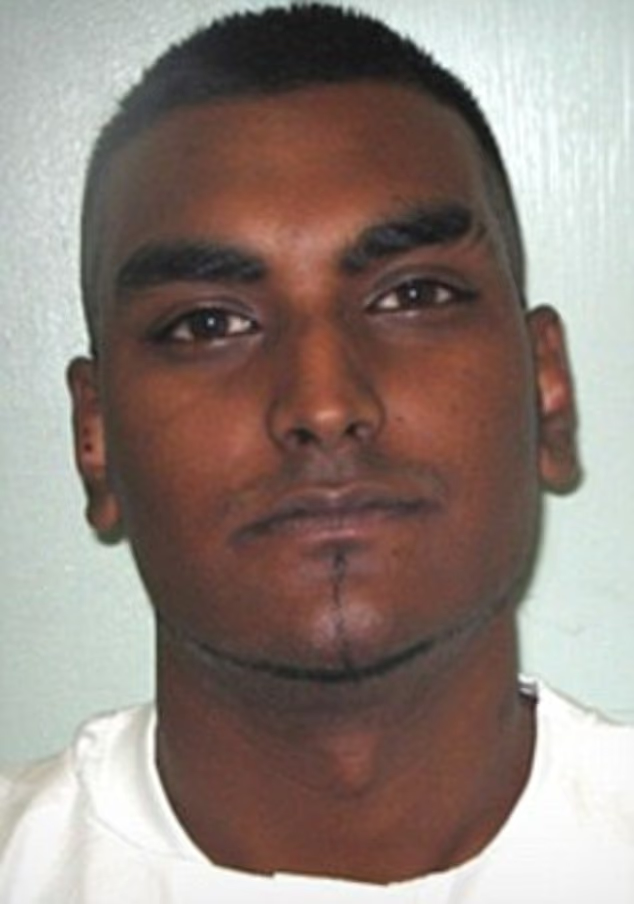
A man who raped women and a teenage girl to ‘teach them a lesson’ for being out late at night could be freed from prison next month.
Sunny Islam, who told the jury he was a practising Muslim, was handed an indefinite prison sentence for attacking three women and the teenager in a three-month reign of terror in 2010.
But he could now be released in September pending the decision of a parole hearing – which, despite an application from one of his victims, will not be held in public because the thought of it had given him ‘anxiety’.
Islam dragged his victims, which included a 15-year-old girl, off the street at knifepoint, then bound and assaulted them. Police fear he may have attacked many more who have not come forward.
Advertisement
New parole board documents show one of his victims applied for his upcoming hearing to be held in public.
The application was denied, with one of the reasons given as Islam’s claims he had become unwell after hearing of the possibility of facing the public.
His solicitor said: ‘Since learning that an application has been made for the oral hearing to be held in public, the prisoner has reported a dramatic increase in his anxiety, including sleep disturbance. This could be a potentially de-stabilising effect.
‘He is in the process of seeking medical advice in relation to those difficulties.’
Advertisement
Sunny Islam was handed an indefinite prison sentence for attacking four women in a three-month reign of terror in 2010
No medical documentation was provided to support this and Islam claimed, via his solicitor, that his current health problems could impact his ability to give ‘best evidence’ if the hearing was not in private.
In denying the victim’s application, His Honour Jeremy Roberts KC, on behalf of the Chair of the Parole Board, said: ‘His offences are of a particularly repugnant type and the atmosphere in a public hearing is likely to be hostile.
Advertisement
‘Although there is no medical evidence I can see no reason to doubt the prisoner’s statement to his legal representative of a significant increase in his anxiety when he learned that an application had been made for a public hearing.’
He added that discussions about the sensitive nature of the offences in public may be ‘very difficult for the prisoner’.
Islam, who grew up in a strict Muslim family, was sentenced in 2012 to a minimum of 11 years in prison. With time already served, this minimum term expired in 2021.
He had been traced through the number plate of his girlfriend’s car after he kidnapped and raped the 15-year-old in September 2010.
Advertisement
Islam had grabbed her from behind as she walked home with a friend and bundled her into the car at knifepoint before driving to a secluded spot where he raped her twice – despite her claiming she was only 11 years old.
Judge Patricia Lees said at the time: ‘You told her you were going to “teach her a lesson”, and similar things were said to the other women.
‘Those words are a chilling indictment of your very troubling attitude towards all of these victims.
‘You seem to observe women out at night as not deserving respect or protection.
Advertisement
‘I have no doubt that you were out that night looking for a victim, as you were on each of these occasions.’
After his arrest, Islam’s DNA was linked with three other attacks near his home in Barking, east London.
Woolwich Crown Court heard that on July 8, 2010 he subjected a 20-year-old sex worker to ‘his trademark double rape’.
During her ordeal he tied her up and when she fought back he repeatedly punched her in the face and stole her wallet.
Advertisement
She said: ‘He treated me like an animal and made me feel worthless – I thought I was going to die.’
A week later he struck again in Forest Gate, this time dragging a 28-year-old woman into his car and forcing her to commit a sex act.
She managed to kick out the back window of his car and tried to flag down a passing vehicle as Islam strangled her. The woman eventually managed to escape and rejoin friends, who phoned the police.
His fourth victim, also attacked in September, did not come forward until police found the 31-year-old’s blood in the back of the car along with a knife he used to threaten his victims and plastic ties he bound them with.
Advertisement
She was repeatedly punched in the face until she was bleeding and then tied up and raped twice.
Islam, who was 21 at the time of the attacks, was convicted of seven charges of rape, one of sexual assault and one of kidnap.
At the time of his sentencing, his teenage victim said in a statement: ‘No one will ever understand the flashbacks – they are so real. At night, I lay in my bed and it is like I am there.
‘It is like a screen in my mind forcing me to relive that night again and again.
Advertisement
‘People will say time will heal, but I think time has helped me accept the truth – that I will never escape what has happened to me.’
Judge Lees said at the time: ‘The harm you have done to your victims is incalculable.
‘The nature and extent of these offences drives me to the conclusion that you represent an extreme and continuing danger to women, particularly those out at night.’
The newly released parole board documents show that one of his victims wanted the hearing to take place in public because Islam had ‘hurt other members of the public (all women or children from different backgrounds) to teach them a lesson’.
Advertisement
She added: ‘He took advantage of them on the street and he could hurt other women or children.
‘I think it is in the public’s interest and right to know how the justice system has dealt with this and how they will continue to deal with this case and other cases in the future’.
As well as his concerns about Islam’s supposed anxiety, Judge Roberts decided the hearing should be held in private because of the distress a public hearing could cause to the three victims, whose views on the process were unknown.
He added in his conclusion: ‘This decision will obviously disappoint the applicant but it will be open to her, if she now wishes, to apply to the Panel Chair for permission to attend a private hearing and/or to apply to see a summary of the panel’s decision.’
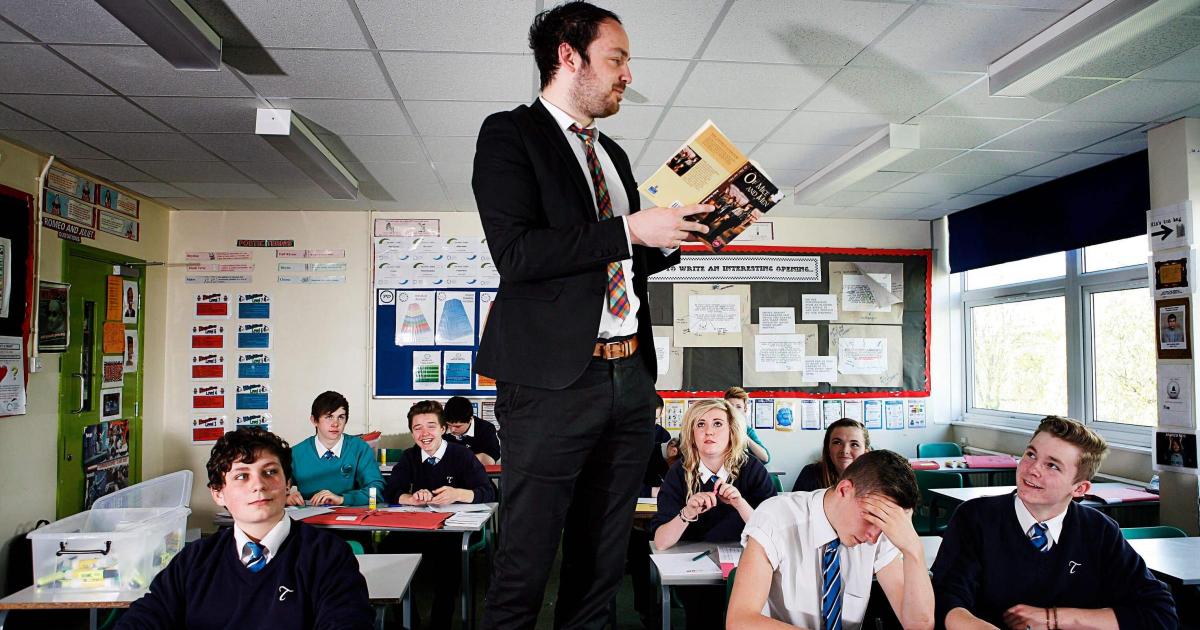
Channel 4 has confirmed the return of Educating Yorkshire with a new eight-part series set once again at Thornhill Community Academy.
The series first aired in 2013 and was a huge hit, before a second series was aired last year.
Produced by Twofour, the documentary will continue to follow students and staff as they navigate the challenges of school life.
Advertisement
Channel 4 confirms new series of Educating Yorkshire
Channel 4 first aired the Educating… British documentary reality television series in 2011, beginning with Educating Essex.
Educating Yorkshire was the second to air two years later, with Cardiff and Manchester also featured.
The show uses a fly-on-the-wall format to show the everyday lives of the staff and pupils of secondary schools.
Educating Yorkshire’s first series was watched by millions, with its most famous scenes showing English teacher Mr Burton helping year 11 student Musharaf overcome his stammer.
On Educating Yorkshire returning for a third series, Matthew Burton, headteacher at Thornhill Community Academy, said: “I’m really pleased to welcome Twofour back to Thornhill, to highlight more of the important work that goes on in schools up and down the country, day in, day out.
Advertisement
“As many people will have seen last year, our students and staff are so inspiring, and to have the chance, again, to show the extent of the quiet, life-changing work that happens day by day is a real privilege.
“Our priority at TCA will always be sharply focusing on the safety, wellbeing and education of our students.
“We look forward to working hard and being nice with Twofour and Channel 4 to develop an important series over the next year.”
Educating Yorkshire reached 8.7 million viewers across linear and streaming last year and was Bafta-nominated in 2026.
Advertisement
Rita Daniels, commissioning editor at Channel 4, said: “Last year’s return to Thornhill Community Academy was both insightful and emotional, providing the perfect snapshot of today’s high school experience.
“The Thornhill kids were brave and brilliant when opening up about the modern challenges of teenage life.
“We know that there will be kids across the country dealing with similar issues and we hope they will continue to see themselves in a new series of this exceptional show.”
What is your favourite series of Educating…? Let us know in the comments.
The National Glass Centre, Sunderland, by Northern Perspectives
Glass was introduced to this country in 674AD when Benedict Biscop, a Northumbrian abbot, returned from a pilgrimage to Rome and began building St Peter’s Monastery at Monkwearmouth, using stonemasons and glaziers from Gaul and Rome. This was the first time glass had been seen in Britain, and the foreigners passed on the tricks of the trade to the locals.
As an industry, glassmaking really took off in the 18th Century. Sunderland had access to cheap coal, from the North East coalfield, and sand aplenty from the beaches – Seaham sand, with a high silica content, was found to be especially good. However, as Durham coal was sold further afield, the colliers, rather than return empty, came back with foreign sand for ballast, with high quality Baltic sand being popular among the glassmakers.
The National Glass Centre, Sunderland, when it opened in 1998, by Ian Weir
The National Glass Centre, built on the site of one of Sunderland’s last shipyards as that industry died, was officially opened in 1998 by Prince Charles. It was intended to celebrate this history and to keep the artistic skills alive – the 158-piece Londonderry Glass Table Service of engraved and cut glass, made in 1823-24 by the Wear Flint Glass Works for the marquess in Seaham Hall, is regarded as one of the finest ever made.
HRH The Prince Of Wales tries his hands at glass blowing at the National Glass Centre in Sunderland today (Friday) under the supervision of Barry Clark, Studio Manager. Photo by Owen Humphreys/EDI WPA POOL/PA
However, yesterday all that came to an end as the university controversially shut the glass centre, citing huge maintenance bills, with the intention of demolishing it.
Advertisement
As the last glassmaking factory in Sunderland closed in 2007, when the parent company of Pyrex withdrew to the continent, it does represent the end of the line.
Northern Perspectives
So Northern Perspectives has recorded it. He is a Durham-based photographer who uses the latest drone-based technology to cast new light on our beautiful and historic landscapes. To see more of his prolific output, including his aerial videos, search “Northern Perspectives” on Facebook.
Charles Dickens would “heartily approve” of this much-loved BBC period drama adaptation.
Hayley Anderson Screen Time TV Reporter
07:34, 01 Aug 2026
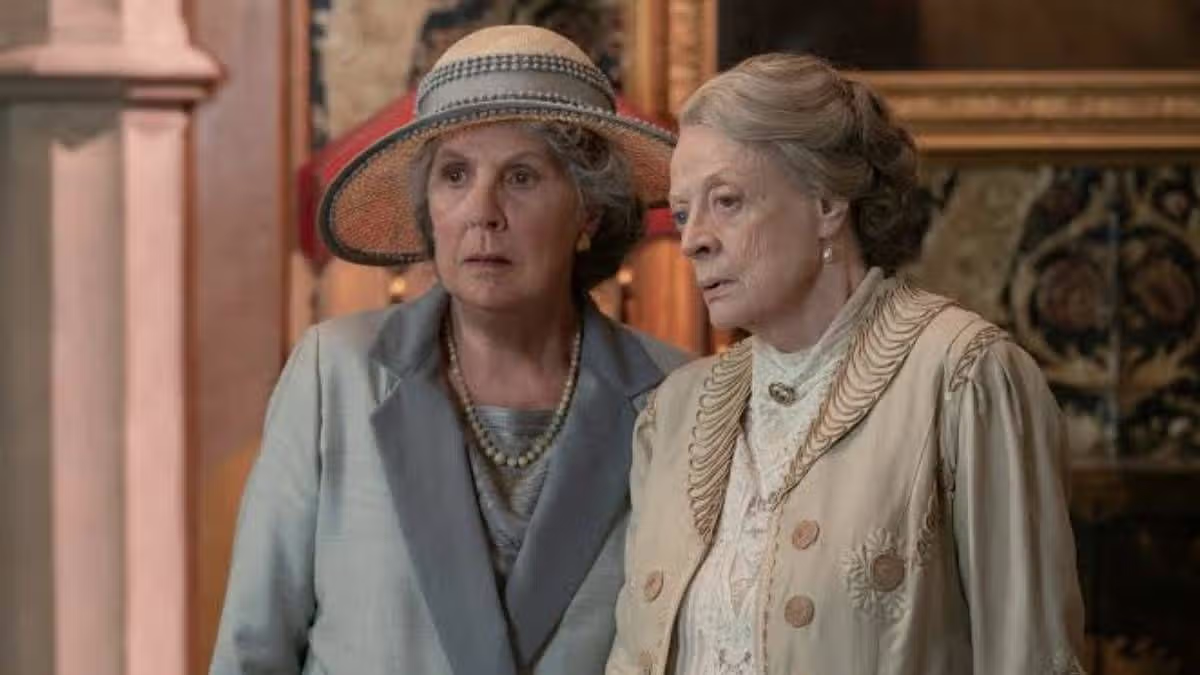
Downton Abbey fans are urged to watch this “extraordinary” BBC period drama that’s been hailed the “best film ever”.
Charles Dickens is famed for writing some of the greatest stories in history from Great Expectations and Oliver Twist to A Christmas Carol.
Advertisement
Some that viewers may not be as familiar with though is Bleak House, a Victorian bestseller about a lifelong lawsuit, a hidden family secret and an orphan girl.
The 19th Century novel has been adapted for the small screen on a few occasions but it’s the 2005 version that’s often brought up by Downton Abbey fans as an alternative watch. And what’s even better is that the “excellent” 15-part period drama Bleak House is ready to stream for free on BBCiPlayer.
While a multi-generational inheritance case continues to drag on, orphan Esther Summerson and wards Ada Clare and Richard Carstone, go to live with their generous cousin John Jarndyce at his home, Bleak House.
Advertisement
Elsewhere, aristocrat Lady Dedlock raises suspicions with a lawyer as she suddenly shows an anxious interest in a court document from years ago.
What makes Bleak House stand out even more though is its star-studded cast, led by Motherland and Line of Duty star Anna Maxwell Martin as Esther Summerson.
She is joined by The Fall and Sex Education actress Gillian Anderson as Lady Dedlock, Netflix’s Beef actress Carey Mulligan and The Crown icon Charles Dance as Mr Tulkinghorn.
“This multi-hour TV drama is a masterpiece from beginning to end”, someone praised on IMdB. Another said: “I can’t think of a greater Dickens film adaptation. This version of ‘Bleak House’ is simply one of the best films ever made.”
Someone else hailed it the “best film I’ve ever seen”, with a fourth writing: “It took me totally by surprise.
“I recommend that any lover of great literature and British period pieces make this a must see.”
As a further fan stated: “I rather think that Charles Dickens if he were still around would heartily approve.”
EXCLUSIVE: The Duchess of Sussex travelled to Britain with her children for a reunion with King Charles, and while the meeting is believed to be a success, her public image in the UK leaves a lot to be desired
But despite the visit to Britain with Prince Harry and her children seemingly going off without a hitch once they arrived in the country, it appears she is still not popular among the public. A new poll shows that she is still hugely unpopular with Brits, having only a 22 per cent approval rating – with only Andrew Mountbatten-Windsor’s being lower.
And even though the UK visit last month saw her finally reunited with the King and Queen at Charles’ country retreat and Harry reportedly expressing his desire for his children to know more about their royal heritage in the UK, former BBC royal correspondent Jennie Bond believes that for Meghan, the negative approval ratings will have an effect on any future plans.
The former BBC royal correspondent told the Mirror : “Meghan is an intelligent woman. I’m sure she is perfectly aware of her extremely low popularity in the UK. I should imagine she now views it as a lost cause and, in any case, she seems to be far happier with her sunshine life in California.
Advertisement
“I think Meghan can be credited with encouraging Harry to stop sulking about the past and concentrate on the future. But I’m not sure she has any further role to play in mending the rift between Harry and his family.
“I think her eyes are firmly set on their lives in California, their children and her business ventures. She seems to be perfectly reconciled to a permanent estrangement from her own father, so she probably doesn’t see any particular problems in Harry remaining estranged from his brother and having only a fragile relationship with his father.”
Despite this, the royal expert believes it was important that the Duchess of Sussex was present for the long overdue meeting at Highgrove, as Harry continues to mend the rift between his father, as Archie and Lilibet may have sensed the tension within the family if she wasn’t included.
“It’s a good thing that she was part of the family reunion at Highgrove a few weeks ago,” Jennie explained. “The children deserve to see some family harmony: it would have been damaging to have to explain that their mother wasn’t invited.
“And even though it must all have been rather awkward – after the accusations Harry and Meghan have made about the Royals – I’m sure everyone was on their very best behaviour.”
And while the Highgrove meeting may have brought up complicated feelings for both the Sussexes and the monarch, Jennie believes that Meghan may still feel a sense of loyalty to her in-laws, given their relationship to her husband and children.
Advertisement
She said: “Understandably, I think Meghan remains very proud of her royal connections. She does seem to like to use her title at the drop of a hat and she and Harry clearly want their children to be aware of their heritage and know that they are a Prince and Princess. And there’s nothing wrong with that, even though Harry appears to feel that being royal has been the hardest cross to bear.”
With Meghan’s 45th birthday just days away, the royal expert said that it is unlikely that the Firm will mark the special day, as they do with other senior royals on social media, but that doesn’t mean the occasion isn’t marked privately.
“I doubt if there will be any formal birthday wishes posted for Meghan, but if the King really is in fairly regular contact – as has been suggested – then perhaps there will be a phone call or birthday card,” Jennie said.
Advertisement
And while it is believed that the meeting at Highgrove was a success, Jennie said that Meghan seems content with her life in America, where she can focus solely on her family and business without thinking about her past royal duties and reputation in the UK.
“I haven’t seen the verified figures for her businesses and projects – but it looks to me as if they are quite reasonably successful. You certainly can’t accuse her of being lazy or not trying to earn her living. So I think we should all wish her good luck. And a very happy birthday.”
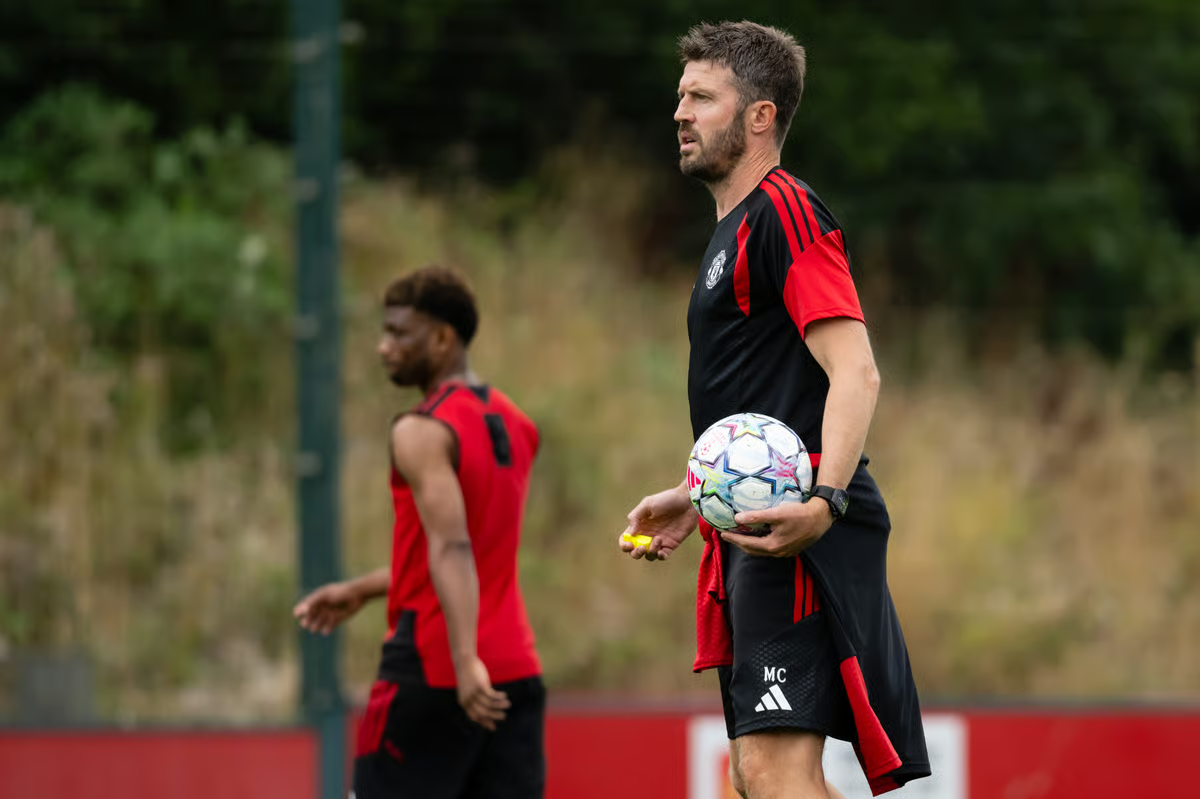
Michael Carrick’s side are looking to make it two wins from three in their build-up to the Premier League campaign, having thrashed Rosenborg 5-0 in Trondheim, Norway last time out.
The Red Devils’ young stars shone in Scandinavia, outperforming the first-team regulars, who are building up their minutes ahead of the new season.
United are slowly starting to welcome back their World Cup participants, but summer signing Youri Tielemans will not feature here after his £35million move.
The Belgian has remained at Carrington alongside his fellow returner and compatriot, first-choice goalkeeper Senne Lammens as they pick up their sharpness before joining up with the travelling cohort for the next match against Paris Saint-Germain for their next friendly encounter.
Advertisement
Atletico, meanwhile, have made a positive start to their pre-season, beating Getafe 4-1 as their players returned to action.
Diego Simeone will be hoping for a similar level of performance this time around in Stockholm.
How to watch Man Utd vs Atletico Madrid
TV channel and live stream: In the UK, the game will be televised live on MUTV, Manchester United’s in-house video streaming service.
Advertisement
All of United’s pre-season fixtures will be broadcast via MUTV, which requires a membership. A subscription costs £29.99 per year or £7.99 per month.
Live blog: You can follow all the action on matchday via Standard Sport’s live blog.
This coming month, Netflix has plenty of new original movies that are sure to get people talking.
Robert De Niro is teaming up with Adam Scott in the mystery thriller The Whisper Man, Greta Lee and Wagner Moura are gearing up to trigger our claustrophobia in The Last House and there’s a coming-of-age musical dramedy that is going to be the talk of every theatre on the planet.
But it’s not just about the feature-length offerings on Netflix this month.
Users also have some new TV to look forward to, including the returns of action-adventure Outer Banks and your favourite trashy reality shows – plus yet another of the authorised documentaries the streaming giant is becoming synonymous with.
Advertisement
Here are just 11 of our top picks to stream in the coming weeks…
Big Chicken: A Fast Food Conspiracy (5 August)
Tell me more: Comedian Mo Gilligan is adding another string to his bow with this new investigative documentary for Netflix.
Advertisement
Billed as a 28-day experiment, Big Chicken sees the Masked Singer judge replacing all of his meals with fried chicken for almost an entire month.
He also promises to dive into what Netflix describes as the “global fried chicken obsession” with surprisingly profound results as he examines the dish’s cultural, economic and environmental impact.
Netflix says: “A self-proclaimed lover of the food, Mo puts his body to the test in a bold experiment by eating fried chicken three times a day for 28 days straight.
“Over the course of the month, he embarks on an eye-opening journey from South London to the United States to reveal the historical origins of fried chicken and the social, economic and industrial forces driving our mass consumption of it – from fast-food chains to large-scale farming – and the impact on our health, our planet and the way we eat.
Advertisement
“As a Black British comedian, Mo also seeks to reframe perceptions of the dish by confronting negative stereotypes associated with it, examining how it’s been culturally appropriated and advertised in today’s market.”
Let’s Marry Harry (5 August)
Tell me more: Already a notorious reality TV star Down Under, Harry Jowsey became an international name when he was cast on the infamous dating series Too Hot To Handle.
Advertisement
Since then he’s been a reality fixture, competing on everything from The Amazing Race and Dancing With The Stars – and now, Netflix is giving him his own series.
In another dating format, Let’s Marry Harry sees the titular lothario vowing to put his badboy days behind him, as his loved ones help him find love from a group of young hopefuls.
Netflix says: “Heartthrob Harry Jowsey is done playing the field. This time, he’s handing the reins of his love life to those who know him best. After years of dating in the spotlight – and getting it wrong – his closest confidants are stepping in to make the tough calls.
“From a carefully selected pool of potential matches, they’ll decide who stays and who goes, guiding Harry toward what he truly wants: authentic love and marriage.”
Advertisement
One Hundred Years Of Solitude (Part 2) (5 August)
Tell me more: When adapting Colombian author Gabriel García Márquez’s beloved multi-generational novel One Hundred Years Of Solitude, Netflix, perhaps wisely, made the decision to split it into two separate seasons.
In his lifetime, García Márquez had always been reluctant to grant production companies the rights to adapt his works, believing a feature film would not be sufficient to tell the story fully, with this TV adaptation being made in collaboration with his surviving family members on the condition it was shot entirely on location in Colombia, featuring Spanish-speaking actors.
Advertisement
Almost two years after the success and acclaim of season one, the second half of the series is finally almost here, resuming the story at a time of more political unrest and personal drama for the central family.
Netflix says: “After the armistice and signing of the treaty of Neerlandia, peace still does not reach Macondo. The Conservatives, fearful of Colonel Aureliano Buendía’s threats, plot an attack that – by a twist of fate – brings Fernanda del Carpio from Bogotá to the town. When she marries Aureliano Segundo, one of the bastard Arcadio’s untamable twin sons, she gives Úrsula Iguarán her first legitimate heirs.
“Meanwhile, the other twin, José Arcardo Segundo, absorbed in José Arcadio Buendía’s manuscripts accomplishes the patriarch’s wild dreams of connecting Macondo with the world. The railroad’s arrival opens the doors to the banana company, which unleashes the town’s downfall and ultimately fulfills Úrsula Iguarán’s curse: for the races condemned to one hundred years of solitude were not granted a second opportunity on earth.”
My Life With The Walter Boys (6 August)
Advertisement
Tell me more: Coming-of-age teen drama My Life With The Walter Boys premiered in 2023, introducing us to our heroine Jackie Howard, who moves from Manhattan, New York after the deaths of her parents to live with a sprawling new family in rural Colorado.
Since then, the story has moved on quite considerably, with several characters in the young cast now grappling with the highs and lows of their first loves.
In the new run of episodes, Jackie once again finds herself torn, not just between two boys, but also her old and new life, when a familiar face from her past arrives in Silver Falls unexpectedly.
Advertisement
Netflix says: “The path of true love never runs smooth, especially in Silver Falls. The last time we saw the Walters, Jackie and Cole finally confessed their love for each other, only for Jackie’s boyfriend – and Cole’s brother – Alex to overhear. But their conversation was interrupted when Walter patriarch George was rushed to the hospital.
“Season three sees the Walters realise what’s important in the fallout from this – and discover that it’s okay to go after what you want. With their love lives still hanging in the balance, Alex turns to his new rodeo riding team, and Cole gets back in the driver’s seat of his life, literally, when a race car driver sees potential in him.
“Meanwhile, Jackie pours her heart into developing the town’s community space. But when a childhood friend arrives from New York, the life she left behind proves harder to forget than she expected.”
The Last House (7 August)
Advertisement
Tell me more: Oscar nominee Wagner Moura and Greta Lee take the lead in this unsettling new thriller as Jason and Riley, the heads of a small family who suddenly find themselves being held captive in their home by a mysterious malevolent force.
Louis Leterrier takes on directing duties in this claustrophobic psychological horror, having previously enjoyed success with Now You See Me and films in the Marvel Cinematic Universe and Fast & Furious franchise.
Netflix says: “A family of four are suddenly sealed inside their home with no way out, and must work together to survive against both their dwindling resources and the mysterious, looming threat that is keeping them trapped.”
Advertisement
Ricky Gervais’ Alley Cats (7 August)
Tell me more: Given what a vocal animal lover he is, we’re surprised it’s taken Ricky Gervais this long to come up with a show like Alley Cats, an adult animation series about a group of street cats.
As well as Ricky himself, the comedy features voice work from Kerry Godliman, Diane Morgan and EastEnders icon Natalie Cassidy, among others.
Advertisement
Netflix says: “Alley Cats is an adult animated sitcom created by and starring the multi award-winning Ricky Gervais.
“The series follows the trials and tribulations of a group of feral British cats from all walks of society, who seek companionship while ruminating on everyday life. From the funny to the absurd, the series is packed with Gervais’ signature style of heart and social commentary that audiences have come to expect.”
Mourinho (11 August)
Advertisement
Tell me more: Still on a high from the World Cup? Well, Netflix has got something you might be interested in.
If you enjoyed Netflix’s sports documentaries about the likes of David Beckham, Rafael Nadal and Jamie Vardy, you’re going to love this three-part series, which chronicles the rise of José Mourinho, the former footballer who went on to became one of the game’s most revered managers.
Mourinho himself allowed Netflix access to his life over a two-year period, with those who’ve known and worked with him also contributing interviews to bring his story to the screen.
Netflix says: “Filmed over two years, Mourinho tells the story of the man who revolutionised what it meant to be a football manager, charting his rise into one of football’s most trophy-laden and outspoken figures – winning league titles in four different countries and lifting the Champions League twice.
Advertisement
“With exclusive access to Mourinho himself, alongside candid interviews with Sir Alex Ferguson, John Terry, Iker Casillas, Zlatan Ibrahimović, Didier Drogba, Marcelo, Samuel Eto’o, Javier Zanetti, Frank Lampard, Petr Čech and more of football’s greatest names – this three-part documentary goes beyond the headlines and the touchline theatrics to get under the skin of the ‘Special One’.”
Don’t Say Good Luck (14 August)
Tell me more: A must-watch for theatre kids past and present, this dramedy introduces us to high school student Sophie Birenbaum as she prepares to try out for her high school’s annual musical production while grappling with regular teen life.
Advertisement
However, she finds it all difficult to juggle alone when her family life is unexpectedly turned upside down.
You Are So Not Invited To My Bat Mitzvah’s Sunny Sandler (yes, the daughter of Adam Sandler) leads a cast that includes everyone from New Girl’s Max Greenfield and Emmy winner Steve Buscemi to Encanto’s Stephanie Beatriz and Avatar’s Jack Champion.
Netflix says: “In this coming-of-age dramedy, Sophie Birenbaum is ready for the spotlight as the lead in her high school musical – until suddenly she’s living with even more drama at home than on the stage.”
Love Is Blind UK (19 August)
Advertisement
Matt and Emma Willis on the set of Love Is Blind UK
Tell me more: You know the drill by now – a group of singles embark on an experiment try and find lasting love, by dating in “pods”, where their partners are kept completely separate from them until the moment they declare they’re ready to get married.
From there, they quickly move in together and try to fit into one another’s lives as they prepare for their big days, before deciding whether or not to commit to one another forever by saying “I do”.
An international reality TV fave since 2020, the UK version of Love Is Blind is now into its third season, with Emma and Matt Willis back on presenting duties.
Netflix says: “UK and Ireland-based singles who want to be loved for who they are have signed up for a less-conventional approach to modern dating, and will choose someone to marry without ever meeting them.
Advertisement
“Over several weeks, the newly engaged couples will move in together, plan their wedding and find out if their physical connection matches their strong emotional bond developed in the Pods. When their wedding day arrives, will real-world realities and external factors push them apart, or will they marry the person they fell blindly in love with?
“Hosted by Emma and Matt Willis, this series will uncover whether looks, race or age do matter, or if love really is blind.”
Outer Banks (20 August)
Advertisement
Tell me more: Six years on from its debut, it’s almost time for Outer Banks’ final curtain – but not before one last adventure.
Netflix’s action-packed teen drama returns after a critically-acclaimed fourth season, with its two rival gangs, the “Kooks” and “Pogues” both pushed to their limits after the tragic events of last year.
Madison Bailey’s Kiara, Jonathan Daviss’ Pope, Carlacia Grant’s Cleo and Drew Starkey’s Rafe are all present and correct in the new episodes, in which J. Anthony Crane’s murderous Chandler Groff is also still at large.
Netflix says: “Season five finds the Pogues at their absolute breaking point following the tragic loss of JJ in Morocco. Stranded far from home and mourning the heart of their crew, they’ve lost the Blue Crown and continue to face a gauntlet of familiar threats.
Advertisement
“With Chandler Groff still at large, Dalia and the Corsairs closing in, and the Kooks ensuring the Pogues have no home to return to, John B, Sarah, Kiara, Pope, and Cleo must rely on their scrappy instincts – and an uneasy alliance with Rafe – to keep from falling apart for good.
“Their mission is now a desperate race to reclaim their future and finally win the freedom they’ve been chasing since the beginning. It’s the Pogues against the world as they seek to avenge their best friend and bring it on home… one final time.”
The Whisper Man (28 August)
Advertisement
Tell me more: If you’ve been hooked on Netflix’s past mystery thrillers, you’re definitely going to want to get comfortable for this feature-length offering.
Featuring an all-star cast led by Robert De Niro and Emmy winner Adam Scott, The Whisper Man blends elements of crime drama, psychological thriller and detective mystery as a crime writer takes it upon himself to investigate the disappearance of his eight-year-old son alongside his retired detective father.
Netflix says: “When his eight-year-old son is abducted, a widowed crime writer looks to his estranged father, a retired former police detective, for help, only to discover a connection with the decades-old case of a convicted serial killer known as ‘The Whisper Man’.”
FIFA has abandoned controversial plans to sell stakes in the World Cup and its other tournaments to private investors following a fierce backlash from football’s governing bodies. The news leaves president Gianni Infantino publicly humiliated and facing serious doubts over his future.
The governing body confirmed on Saturday that the proposal, known as FIFA Forward Enterprise (FFE), “will not proceed” after three continental confederations rejected the plans, with UEFA warning that its member nations would boycott FIFA competitions if they went ahead.
FIFA president Gianni Infantino said the proposal had been designed to generate more investment for member associations around the world, particularly in developing football nations, but admitted it had become too divisive.
In a statement, Infantino said: “The FIFA Forward Enterprise project was intended to provide a basis for further strengthening our FIFA Member Associations and our sport worldwide, especially in those countries where support is most needed.
Advertisement
“And more so, as we said from the outset, to do this only if a majority of the FIFA Member Associations were in support and always subject to a consultation process with them, the FIFA Council, the Confederations and wider stakeholders.
“Having listened carefully to all the views, it has become clear that the project has created divisions of a nature that, regardless of the level of support, are no longer in the interest of the objective set out in the first place.
“Our purpose has always been – and will always be – to unite and improve.
“As a result, this proposal will not proceed.
Advertisement
“Moving forward, my intent is to bring all interested parties back together in the coming days and weeks in the spirit of shared interest in our game, and with the objective to continue growing football everywhere, particularly in those countries that mostly need our support.”
The proposal centred on the creation of FIFA Forward Enterprise to manage the commercial and operational aspects of FIFA competitions, including the men’s and women’s World Cups. The most contentious element was a plan to sell a 20 per cent stake in the company to private investors.
Advertisement
Thrive Eternal, a company founded by Joshua Kushner, the brother of United States President Donald Trump’s son-in-law Jared Kushner, had been identified as the leading investor, although the firm declined to comment on the proposals.
The plans sparked widespread criticism across world football and led to the resignation of Infantino’s senior adviser Carlos Cordeiro. FIFA chief operating officer Kevin Lamour also distanced himself from the proposal, telling the Associated Press it was “a project of one person”.
Political figures also joined the criticism, with Prime Minister Andy Burnham branding the proposal “an outrageous suggestion”.
“The idea that it could even be brought forward shows that, in my view, (Infantino) is the wrong man to lead the organisation,” Burnham said.
Advertisement
The Asian Football Confederation welcomed FIFA’s decision to withdraw the plans, with president Shaikh Salman bin Ebrahim Al Khalifa saying any major reforms must be based on “proper consultation, collective dialogue and respect for the established governance structures of our game”.
He added: “The AFC stands ready to support any initiative that strengthens the unity of the football family, contributes to the continued growth of the game globally and delivers meaningful benefits to all stakeholders.”
Alongside UEFA’s threat of a boycott, the proposals had also been rejected by CONCACAF, while the AFC called for an urgent review of FIFA’s governance and decision-making processes. South American governing body CONMEBOL had also sought further information and clarification before FIFA ultimately withdrew the plans.
The Netflix period drama has viewers calling it the perfect Bridgerton alternative, combining period drama with dark comedy
If you’ve reached the end of Bridgerton and find yourself searching for something to fill that period drama void, this series is the ideal place to begin – and you won’t even need to switch streaming platforms.
Advertisement
Netflix subscribers have been heaping praise on this dark comedy series set in 14th-century Italy. What many are unaware of, however, is that its entertaining storyline is drawn from a collection of 100 tales penned by an Italian writer, dating back to that very same period.
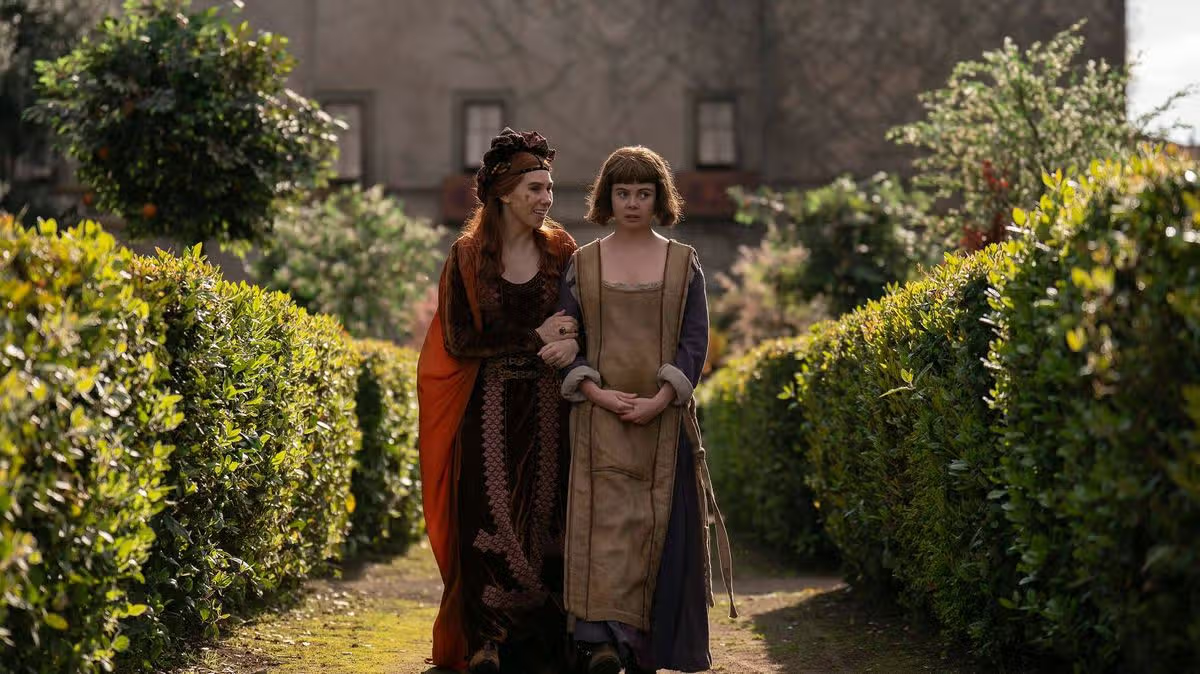
The Decameron is a mini-series inspired by the work of the same name, which unfolds during the devastating Black Death pandemic. Its narrative revolves around a wealthy family as they go to extraordinary lengths to survive the outbreak, all handled with an abundance of humour.
It carries a 15 rating, as The Decameron boldly incorporates sexual content, strong language, violence, and graphic details within its darkly comedic narrative. These elements are precisely what set it apart from the rest and earn it a wealth of five-star reviews.
One viewer wrote on Rotten Tomatoes: “A strange and amusing limited series. Characters that once seemed irredeemable are likeable, if not lovable by the final episode. Absurd and enjoyable, the series manages to stay light while investigating the dark underbelly of humanity.”, reports Wales Online.
Advertisement
Another shared their thoughts on the show in relation to the original text, writing: “While the show is loosely based on a 700 year old book, I found The Decameron fresh and engaging.
“The plot and characters felt like it was faithful to the 1300s without being stodgy. The characters are absolutely absurd, but that is part of their charm.”
Viewers are whisked away on a journey, beginning in 1348 in a fictionalised retelling of events, as the Black Death tightens its grip on Florence. In response, a group of nobles and their servants retreat to a countryside villa in Tuscany, riding out further outbreaks while indulging in their luxuries and lavish lifestyle.
Advertisement
It isn’t long before the disease reaches the tranquil hills and they are left with little option but to battle for their survival.
Bringing these characters to life are Tanya Reynolds from Sex Education, alongside Zosia Mamet, best known for her role in Girls. Also appearing on screen are Lou Gala, Leila Farzard, Jessica Plummer and Amar Chadha-Patel.
The cast have garnered considerable praise amongst critics, with one saying that they delivered “enjoyable performances”. Their review reads: “A period historical series that throws all the comedy and romance tropes out of the window is escalated by the enjoyable performances of a diverse cast untangled from any political narrative.
Advertisement
“This series is proof that even a story with unpredictable direction and story arcs makes for a hilariously entertaining one.”
Others simply ssaid that it was “well acted”, while one viewer said that the script and actors had them “laughing out loud” throughout. The period drama encompasses a great deal in its concise eight episodes and was regrettably never commissioned for a second series following its release in 2024, making it the perfect binge-watch.

















































You must be logged in to post a comment Login