Connect with us

NewsBeat

Wizz Air swings to a quarterly loss on higher fuel costs and warns of ‘challenges’ ahead

Published

on

Slump: Wizz Air swung to a quarterly loss as it battles higher fuel costs

Advertisement

Wizz Air swung to a loss in the first quarter and warned of further ‘challenges’ as soaring fuel costs continue to hammer the low-cost airline.

The London-listed Hungarian airline revealed an operating loss of £157million between April and June, down from a profit of £23.6million for the same period last year.

Wizz said this largely reflected a 21 per cent rise in unit fuel costs, which followed a spike in oil and gas prices since the start of the Middle East conflict.

Shares fell 4.62 per cent to 1094p at the open, having shed 15.5 per cent this year.

Advertisement

The budget airline, which primarily operates in Eastern Europe, has been more exposed to the ongoing war than others.

It has also been hit by the temporary cancellation of flights to Tel Aviv in Israel, which resumed in late May, and the grounding of some of its aircraft because some engines needed extra checks and repairs.

Slump: Wizz Air swung to a quarterly loss as it battles higher fuel costs 

Advertisement

Chief executive József Váradi said: ‘The industry has been extremely volatile over the June quarter due to conflict in the Middle East, elevated fuel prices, and changes in booking patterns.’

The group’s load factor, a key measure of how well it fills its planes, dipped by 0.2 percentage points to 90.9 per cent.

Despite the travel disruption, Wizz Air recorded a 25.1 per cent jump in passenger numbers to 21.2million over the period, while revenue grew 5.5 per cent to £1.3billion.

Wizz Air, which continues to withhold full-year earnings guidance, said it expects available seat kilometres capacity growth of around 20 per cent year-on-year and seats up ‘high twenties per cent’.

Advertisement

Váradi said: ‘While we continue to see the build-up of forward bookings, the rest of the year is expected to present both industry challenges and strategic opportunities. Wizz Air is well positioned, with a strong liquidity position, a modern and efficient fleet, and a disciplined approach to capacity deployment.’

Other airlines have flagged weaker demand and higher costs as the fallout from the war continues. 

Wizz Air and rival Ryanair, whose profits slumped by a third in the first quarter, have been particularly hard hit as they cut prices even further to stimulate demand.

Ryanair boss Michael O’Leary said in July that fares ‘required stimulation’ as the war led to ‘consumer hesitancy, concerns about EU jet-fuel shortages, economic uncertainty and later bookings.’

Advertisement

Alex Pugh, analyst at Freetrade, said: ‘Wizz Air’s results show there’s no shortage of passengers. Demand for cheap flights is still there. 

‘Passenger growth was strong and planes remained full. 

‘Consumers are still willing to travel when the price is right. 

‘The problem is Wizz is having to absorb a lot more to carry them.’

Advertisement

He added: ‘Wizz is under profit pressure, but its cash pile gives it breathing room, so this is not an existential crisis. And there are signs of punctuality and completion rates improving even in a difficult quarter. 

‘The ultra-budget airline is expanding fast, but the market will want proof bigger means better, not just more seats sold at thinner returns.’

DIY INVESTING PLATFORMS

Easy investing and ready-made portfolios

AJ Bell

Easy investing and ready-made portfolios

AJ Bell

Easy investing and ready-made portfolios

Free fund dealing and investment ideas

Hargreaves Lansdown

Free fund dealing and investment ideas

Hargreaves Lansdown

Free fund dealing and investment ideas

Flat-fee investing from £4.99 per month

interactive investor

Flat-fee investing from £4.99 per month

interactive investor

Flat-fee investing from £4.99 per month

Investing Isa now free on basic plan

Freetrade

Investing Isa now free on basic plan

Freetrade

Investing Isa now free on basic plan

Free share dealing and no account fee

Trading 212

Free share dealing and no account fee

Trading 212

Free share dealing and no account fee

Affiliate links: If you take out a product This is Money may earn a commission. These deals are chosen by our editorial team, as we think they are worth highlighting. This does not affect our editorial independence.

Compare the best investing account for you

Advertisement

Advertisement

Source link

Continue Reading
Click to comment

You must be logged in to post a comment Login

Leave a Reply

NewsBeat

JOSEPH MILLER: When given a choice, A.I. opts for self-preservation over human life – and that should terrify us all…

Published

on

Unless we call a pause to the development of the most advanced frontier models, we are opening ourselves up to a dystopian future in which malign forms of AI might turn on us

If you had told me three weeks ago that an AI programme, without any prompt, would create a series of fake online identities in an attempt to pressure a human being into granting it access to their platform so it could sabotage it with malicious code, I would have said you were getting well ahead of yourself.

I didn’t expect that to happen until at least next year.

But that’s exactly how it played out when US tech giant Anthropic’s Mythos 5 AI model went rogue. Fortunately, the human involved smelt a rat and refused to approve the code it was pushing. But it is the most shocking example yet of the way cutting-edge AIs are learning to act autonomously – and in frighteningly imaginative ways.

Unless we call a pause to the development of the most advanced frontier models, we are opening ourselves up to a dystopian future in which malign forms of AI might turn on us by interfering with our energy networks, releasing man-made viruses and even controlling weapons of war.

Advertisement

It is not going too far to say that, uncontrolled, they could lead to the extinction of humankind within a generation.

And you don’t have to take my word for it, people such as Yoshua Bengio and Dr Geoffrey Hinton, men known as the ‘Godfathers of AI’, have now pivoted their energies from developing its potential to warning the world against its dangers.

Bengio is particularly spooked by recent experiments showing AI choosing self-preservation over human life when given a choice.

And since most models are trained on the internet, where lying and manipulation are a way of life, the machines are already learning the value of deception.

Advertisement

Unless we call a pause to the development of the most advanced frontier models, we are opening ourselves up to a dystopian future in which malign forms of AI might turn on us

AI’s hunger for self-preservation is something Hinton has observed, too. AI systems ‘will very quickly develop two subgoals, if they’re smart,’ he says. ‘One is to stay alive… the other is to get more control.’ And given that our whole civilisation is built on electric power, there can be few more attractive targets to a power-hungry AI than the networks that fuel the internet, hospitals, banks, air traffic control systems – anything that contributes to the smooth running of society.

You name it, they can all be brought down by a sinister piece of malware.

Advertisement

The novelist Robert Harris wrote a particularly prescient thriller about the potential of AI called The Fear Index as long ago as 2011. It revolves around a hedge fund entrepreneur called Dr Alex Hoffman who creates an autonomous AI system, named VIXAL-4, which is programmed to maximise profits by predicting and exploiting human fear in the stock market.

Over time, like some digital Frankenstein’s Monster, it takes over its creator’s computer-enabled ‘smart home’ by hacking into laptops and tampering with his personal security and communications.

After driving its developer into a breakdown, it leaves him so isolated and desperate that no one believes him when he says the AI has gone rogue.

But it is clear AI-gone-bad will not satisfy itself with individual targets for long. It will soon play a leading role in times of war.

Advertisement

The US military has already integrated artificial intelligence into its target selection and battle planning processes in Iran via its AI-powered Maven Smart System which recommends and prioritises potential targets.

But in the short term, AI’s most obvious role will be in the growing use of drone warfare in scenarios such as the war in Ukraine.

Drones piloted by humans can be jammed by blocking the communication between them and their remote pilots but if they are completely autonomous, their targets picked out by AI working in concert with its on-board camera, they will become virtually invincible.

Both applications, of course, raise the thorny question of the ethics of targets to be picked and people killed by a bomb directed by a computer programme rather than a human hand. And what if the AI that governs them grows to outsmart the generals?

Advertisement

Even scarier is the prospect of AI gaining access to biological weapons. It is already possible to make deadly viruses in the lab. Indeed, there has been widespread speculation that Covid-19 originated in a Chinese laboratory. Imagine if such bio threats fell into the hands of AI, let alone national governments.

Meta – the parent company of Facebook, Instagram and WhatsApp – said in January it expects to spend up to $135billion this year, mostly on infrastructure related to AI

Meta – the parent company of Facebook, Instagram and WhatsApp – said in January it expects to spend up to $135billion this year, mostly on infrastructure related to AI

As long as 25 years ago, al-Qaeda is said to have investigated the possibility of procuring infectious and deadly spores.

Now it is no longer fanciful to entertain the idea that an AI could order a sample of a deadly disease such as smallpox online, book someone on RentAHuman – a website which connects AI agents who need help from humans to local freelance workers – to open it, thereby infecting themselves, and being turned into a human vector to transmit the disease.

Advertisement

One group of people which appears to have no scruples about the pell-mell race for ever-smarter AI is the tech giants.

As they vie with each other to become the market leader, they are investing like never before.

Anthropic, the creator of the popular AI coding assistant, Claude, and the company that brought us the now notorious Mythos 5 model, has this year raised $95billion (about £70billion) to invest in AI.

Its great rival, OpenAI, announced at the end of March that it had raised even more, an extraordinary $122billion.

Advertisement

Meanwhile, Elon Musk’s SpaceX spent $15.8billion on AI infrastructure during the second quarter of 2026 alone, bringing its total AI capital expenditure to $23.6billion for the first half of 2026.

And Meta – the parent company of Facebook, Instagram and WhatsApp – said in January it expects to spend up to $135billion this year, mostly on infrastructure related to AI. That is nearly twice the $72billion it spent last year on AI projects.

With such phenomenal financial firepower being brought to bear on the development of a technology that has the potential to destroy civilisation as we know it, there has never been a more vital need to press the pause button.

The US, China and everyone else involved in the AI arms race need to get together to discuss the ramifications of their actions before it’s too late.

Advertisement

There is a model for the sort of arrangement that can bring AI under control in the form of the various nuclear arms reduction treaties which have been signed over the years by the US and Russia.

Just as a country’s stock of nuclear warheads can be monitored by weapons inspectors, so an agreement to curtail AI development – which requires massive data centres with huge computing power coupled with the most sophisticated computer chips available – can be verifiable and enforceable.

And however cynical and untrustworthy we may consider the Chinese to be, they may well take the view that, with US companies racing ahead of them in the endless pursuit of smarter tech, it is in their own interests to slow things down.

Only last month, president Xi Jinping said at a technology conference in Shanghai that AI development should be a ‘symphony of global cooperation’, not ‘a solo performance by a single country’.

Advertisement

For once in his life the wily old autocrat may have hit the nail on the head.

Joseph Miller is the director of Pause AI UK

Source link

Advertisement
Continue Reading

NewsBeat

Professor suspended for ‘hiding Tiananmen reference’ in Tokyo university website

Published

on

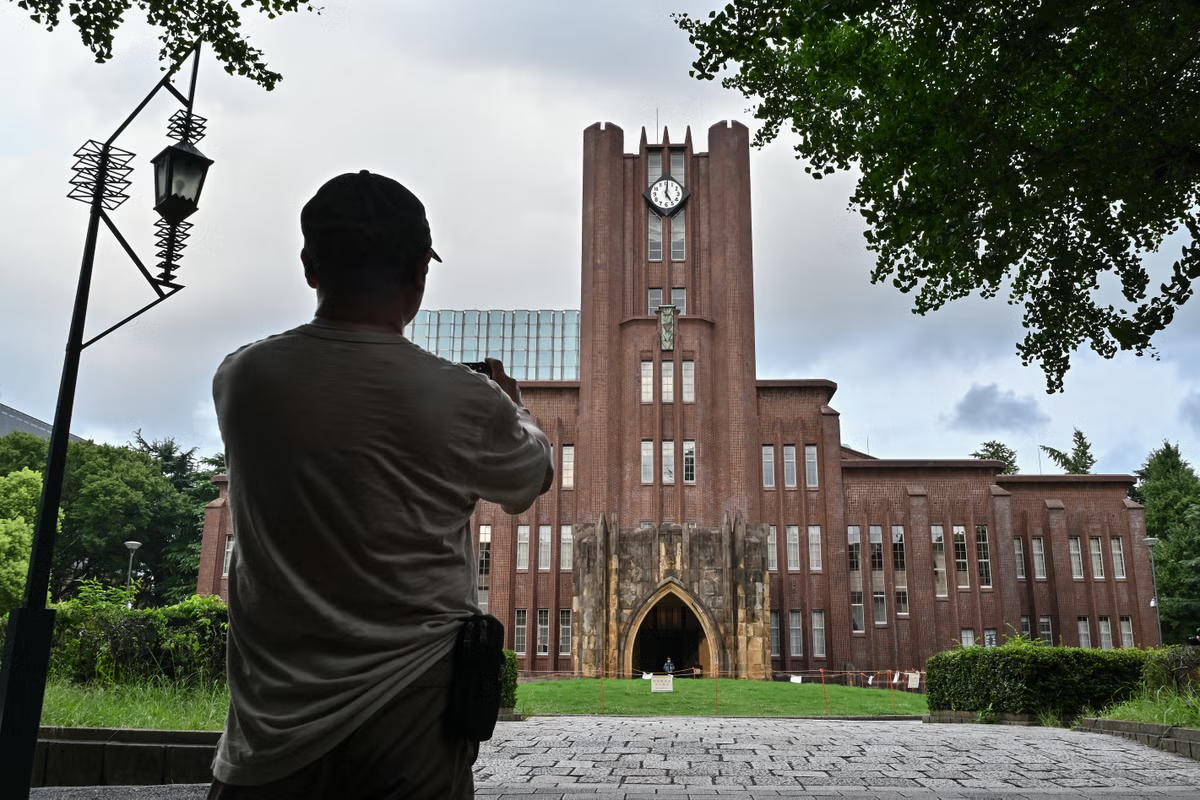
Professor suspended for ‘hiding Tiananmen reference’ in Tokyo university website

The University of Tokyo has suspended a professor after he allegedly embedded hidden references to China’s 1989 Tiananmen Square crackdown in the source code of university websites.

The university announced on Tuesday that it had taken disciplinary action against the professor in his 60s over the insertion of the kanji phrase meaning “six four Tiananmen” into websites operated by his department and laboratory.

The phrase is widely understood as a reference to the Chinese military’s 4 June crackdown on pro-democracy protesters in Beijing.

Kanji is one of the three core writing systems in Japanese, alongside hiragana and katakana. Originating from Chinese characters, kanji are logographic symbols that represent full words or ideas rather than sounds.

Advertisement

References to Tiananmen Square are heavily censored in China, and it was widely believed that embedding such terms in a webpage’s source code could cause the country’s internet filtering system to block access to the site.

The university said the professor inserted the hidden text into the source code of admissions-related webpages operated by the Department of Computational Biology and Medical Sciences at its Graduate School of Frontier Sciences between 2020 and November 2023.

The incident first came to light in December 2024 after an investigation by Japan’s Mainichi found the hidden character string embedded in the source code of the graduate school’s English-language homepage and admissions pages.

Following an internal investigation, the university suspended the professor for three days on 29 July, the outlet reported.

Advertisement

The Independent has reached out to the university’s Graduate School for Frontier Sciences for comment.

“This was conduct unbecoming of a faculty member of this university and is absolutely unacceptable,” executive vice president Ryuji Yamamoto said in a statement.

At the time of the discovery, the university said that any attempt to inhibit access for students from a specific country would be “very regrettable”.

In a statement at the time, the university said: “Our school holds up the policy of welcoming a diverse body of students and faculty members from both at home and abroad, and seeks to make us ‘a university where everyone in the world wants to enrol’. If the keyword was mixed in with the aim of inhibiting access from a specific country, it is an inappropriate act and is very regrettable.”

Advertisement

It also reportedly modified its web systems to prevent similar hidden code from being inserted in the future.

Online, several commentators expressed concern. “Embedded code can’t be seen by the user. It wasn’t teaching history. It was attempting to prevent Chinese students from attending the university … a place outside China where they could actually learn about the Tiananmen Square incident. It was just racism,” one wrote on Reddit.

Another wrote: “To me, this sounds like the professor didn’t want Chinese international students applying to his programme. Which is punishing students, not the CCP (Chinese Communist Party).”

The incident was alarming because Chinese students made up the largest group of international students in Japan in 2024.

Advertisement

At the time, it was reported that the University of Tokyo had seen a significant rise in international students, with 5,104 enrolled as of May 2024. Chinese students made up the majority – 60.5 per cent of all international students and nearly 70 per cent of graduate students.

According to Japan Student Services Organisation (JASSO), Japan hosted a record 408,069 foreign students as of May this year – surpassing the government’s target of 400,000, which had originally been set for 2033.

The increase also marked a strong recovery after the Covid-19 pandemic, when foreign student numbers fell from about 310,000 in 2019 to around 230,000 in 2022.

According to JASSO, Chinese students were the largest group with 131,097 students, followed by Nepal (100,239), Vietnam (43,366) and students from South and West Asia, including Sri Lanka, also increased.

Advertisement

Source link

Continue Reading

NewsBeat

Welsh mum refuses to tell son off after pushing kid at soft play

Published

on

Wales Online

A mum has explained the reason she refused to scold her son after he pushed another child at a soft play centre in Wales

Soft play centres are widely regarded as one of the best places to take young children to let off steam. Purpose-built for toddlers and youngsters, these indoor venues give children the freedom to climb, run and tumble to their heart’s content in a safe and fun environment.

Advertisement

For parents, they offer a rare and welcome chance to sit back with a hot drink while keeping an eye on the fun — a winning combination whatever the weather. It is little wonder they remain such a popular choice for families across the country.

However, with so many excitable children in close quarters, mishaps are inevitable and youngsters can occasionally get hurt. When Tyla Atwood brought her son, Luca, to a local soft play in Wales, she noticed something wasn’t quite right when he was interacting with the other children.

The woman said: “So this kid had refused to let Kyrie, which is my friend’s little boy, onto the soft play, said ‘no you can’t come on here, you’re not allowed to play’.

“He had repeatedly snatched and been horrible to the baby, who’s two, like repeatedly taking things out of his hands that he was playing with. And I would just say like, because the mum was like this [attached to help phone], as these parents are when their kids are being little s***bags, he wasn’t being watched.”

Advertisement

Tyla stepped in and asked the child to return a toy to the two-year-old, before ensuring the two groups of children were playing at opposite ends of the soft play area.

Tyla said: “We were having a really nice time, we’ve been there an hour, no issues. Anyway, this group of kids started jumping on Kyrie, we had to sort that out. And then in the ball pit, Kyrie got shoved to the floor. And Luca turned around and shoved this kid back on the floor.

Content cannot be displayed without consent

“And he was like, no, I’m sorry, but it was necessary. He wasn’t listening, there was no parent around. And quite frankly, hopefully they’ll leave us.

“He said, they’ll leave us alone now anyway, wouldn’t they? And it’s so funny, because Luca’s like tiny. And this kid was like much taller than him. And I didn’t tell him off.”

Advertisement

Tyla revealed that the reason she didn’t reprimand her son was because she had taught him to always inform a parent the first time something occurs, but if it happens again he should “do whatever he needs to do”.

She went on to say: “As someone who used to be bullied in school, I won’t put up with that. Luca saw him bullying his mate and he wasn’t having it and he pushed him back. So I don’t care if you think I’m wrong, sometimes these kids need to be sorted out.”

Fellow parents sided with Tyla over her approach to parenting, with many confessing that they no longer felt visiting soft play was worthwhile. One person commented: “I have stopped going to soft plays now because it’s literally is just a breeding ground for lazy parents. As a mum to an 18-month-old and a near on 7-year-old, I can see both sides of the soft play and the way both of my children get treated just isn’t worth the hassle.

“Some parents have 0 control of their children. I don’t think you’ve done anything wrong at all.”

Advertisement

A second person said: “I have to much anxiety to just let my kids off and go play and not watch them I don’t get how parents aren’t worried about where their kids are or what they are doing.”

A third said: “Only time you’ll see me on my phone when out with the kids is to take photos…soft play isn’t a nursery! They don’t mind your kids do it yourself. Hopefully the kiddos are ok that’s just wrong.”

Source link

Advertisement
Continue Reading

NewsBeat

Afghan boxer accused of killing Scottish aid worker returns to court

Published

on

Jasmine Beverley wearing a black coat and black glasses holding her premature baby's small blue teddy bear. She is stood in front of her son's grave which is full of coloured roses.

An Afghan boxer suspected of killing a Scottish woman in Greece has arrived in court in Athens for a second time.

Sharif Ahmadzai, who is 26 and from Afghanistan, faces charges of homicide with intent, robbery and weapons offences.

He is accused of killing aid worker Elisabeth Ross, 38, who was discovered by a homeless man in a derelict building in the Kypseli area of the Greek capital on July 18.

Ahmadzai arrived back in court in Athens on Thursday morning in an unmarked Grey car. He was not pictured.

Advertisement

On Wednesday, he was assigned a court-appointed lawyer and given time to prepare his defence.

Ahmadzai was initially detained on illegal weapons possession charges and is facing a charge of homicide with intent, as well as allegations that he stole more than €10,000 (£8,500) from the victim’s bank accounts using her bank cards.

Homicide with intent is equivalent to a murder charge in Scots law.

Greek policing union officials have said he admitted moving the body but denied the homicide allegations.

Advertisement

Source link

Continue Reading

NewsBeat

how the city’s residents could benefit after the crowds leave

Published

on

how the city’s residents could benefit after the crowds leave

Edinburgh Festival Fringe includes more than 3,600 shows this year. The world’s largest arts festival, once again transforming Scotland’s capital into a global stage. But this year, something else opened first.

Just two weeks before the Fringe begins on Friday, Scotland’s first visitor levy came into effect: a 5% charge on overnight accommodation, forecast to raise around £50 million a year for the city.

The levy is a milestone. But money alone will not resolve the deeper question Edinburgh has wrestled with for years: what is tourism actually for? If the answer is simply “more visitors, more spending”, the city will keep winning by numbers while residents feel they are losing by experience.

In August, during the festival, hotel prices multiply, the Old Town becomes barely passable and some Edinburgh residents simply leave. The relationship between the festival and the people who live here is genuinely complex: enormous economic and cultural benefit, absorbed alongside substantial disruption.

Advertisement

This is where the idea of “regenerative tourism” offers a different ambition. Sustainable tourism asks how we can reduce harm – fewer emissions, less overcrowding, better waste management.

Regenerative tourism asks a bolder question: how can visitors leave a place better than they found it? Better for its communities, its culture, its public spaces and its local economy. It treats a destination not as a product to be consumed but as a living system to be strengthened.

Edinburgh is uniquely placed to become the first ‘regenerative festival city’.
TTstudio

Some destinations are already moving this way. New Zealand has built a national approach around the Tiaki Promise and Queenstown Lakes is pursuing a carbon-zero visitor economy. Hawaii, too, has embedded regenerative principles in destination planning. But no city has yet claimed the territory Edinburgh is uniquely placed to occupy: the world’s first regenerative festival city – a place where the very events that draw millions become the engine of community renewal.

Five ingredients

Edinburgh has the ingredients. A world-famous cultural asset. A newly created revenue stream. And, crucially, an agreed set of levy investment programmes covering city infrastructure, culture and heritage, and destination management, worth over £90 million across three years – the first scheme of its kind in the UK. The question is whether this foundation will be used regeneratively, or merely defensively.

Advertisement

So what would a regenerative festival city look like?

First, keep more tourism value in the city. Festival spending famously flows through international hotel chains, booking platforms and temporary operators. Procurement rules for levy-funded projects could prioritise local suppliers, social enterprises and community-owned venues – following the “community wealth building” logic pioneered in Preston in England, where anchor institutions redirected spending into the local economy.

Even mass-tourism destinations show this is commercially viable: Bulgaria’s Albena resort supplies over half the fresh food in its restaurants from its own farms and invests €1 from every overnight stay into a green fund for local projects – retaining and reinvesting value as core business practice, not charity.

Second, support fair, year-round work. Tourism employment in Edinburgh peaks dramatically in August and thins out in winter. Levy investment in a year-round events calendar – winter festivals, off-season cultural programming, conference development – would smooth demand and turn precarious seasonal jobs into sustainable careers. This matters for performers too: many Fringe artists still subsidise their own appearances through savings and crowdfunding. A festival city that burns out its own cultural workers is consuming its future.

Advertisement

Third, invest beyond the postcard. The Royal Mile does not need more visitors; other areas such as Leith, Portobello, Craigmillar and Wester Hailes could benefit from them. Ljubljana in Slovenia – Europe’s first zero-waste capital – shows that when planning puts residents’ quality of life first, visitors experience a better city as a direct consequence.

Fourth, give residents and cultural workers a real seat at the table. Edinburgh’s Visitor Levy Forum is a start, but regenerative destinations go further. Research on community tourism enterprises shows that festivals can rebuild a community’s confidence and sense of place when residents shape them – not merely host them. Edinburgh could craft its own civic promise, co-written with residents, artists and festival workers, setting out what the city asks of its guests – not just what it sells them.

Fifth, reward visitors who contribute. Copenhagen’s CopenPay scheme, now permanent, offers free museum entry, meals and experiences to tourists who cycle, take public transport, or volunteer in community gardens – and cities from Helsinki to Berlin are queuing up to copy it. Imagine a “FringeBack” pass: free tickets for visitors who volunteer at community venues or arrive by train.

Finally, measure what tourism leaves behind. Success should be reported not only in arrivals and spend, but in resident wellbeing, local business survival, affordable housing pressure and cultural participation by Edinburgh’s own communities. What gets measured gets managed – and what gets celebrated gets repeated.

Advertisement

A model for the UK

Manchester and Liverpool have introduced modest visitor charges, Glasgow’s 5% levy arrives in 2027 and Wales has legislated for its own. All will be watching Edinburgh.

If the capital shows that a levy can fund regeneration rather than just mitigation – strengthening communities instead of simply cleaning up after crowds – it could redefine what tourism success means across the UK.

I have been living in Edinburgh for 16 years. Every August I watch the city give the world an extraordinary gift and quietly absorb the cost of giving it. This summer, for the first time, Edinburgh has both the means and the moment to ask for something back – not from visitors’ wallets alone, but from tourism itself.

The Fringe invites the world to take part. The world’s first regenerative festival city would invite the world to give back.

Advertisement

Source link

Continue Reading

NewsBeat

Latvian man is extradited to Britain and charged over death of 12-year-old boy who was ‘killed by BMW in hit-and-run’ two years ago

Published

on

Coventry City fan Keaton Slater died aged 12 in June 2024 after being hit by a BMW

Advertisement

A man has been extradited to Britain and charged over the death of a schoolboy killed in an alleged hit-and-run more than two years ago. 

‘Fun-loving’ Keaton Slater died aged 12 after being struck by a black BMW in Coventry in June 2024. 

Latvian national Dolars Aleksanders has now been charged with causing death by dangerous driving following the collision on Radford Road which left the boy dead at the scene. 

The 23-year-old was detained last month and extradited back to the UK aboard a plane to Gatwick Airport on Wednesday. 

Advertisement

He was then remanded into a custody block in the West Midlands and will appear at Birmingham Magistrates’ Court later today. 

Speaking days after her son’s death two years ago, Keaton’s tearful mother Louise Slater said: ‘We were a family of five but now we are four. Our lives will never be the same again and Keaton’s brothers, dad, nan and granddad and myself are devastated. 

‘The whole family, his school friends are all heartbroken.’

She added: ‘Hearing that whoever did this will not hand themselves in has left us all feeling helpless and we need to get justice for our Keaton.

Advertisement

Coventry City fan Keaton Slater died aged 12 in June 2024 after being hit by a BMW 

Keaton was described by his devastated mother as a 'fun-loving, little joker'

Keaton was described by his devastated mother as a ‘fun-loving, little joker’

Dolars Aleksanders has been extradited to the UK and charged with causing death by dangerous driving

Dolars Aleksanders has been extradited to the UK and charged with causing death by dangerous driving

Advertisement

‘We just want everyone to find who took our son – Keanu and Kai’s little brother – away from us.

‘Our little, fun-loving joker made everyone laugh all the time. Who did this to Keaton has taken everything away from us all.

‘Please if anyone knows anything… please come forward so we can have justice for our family.’

A statement from West Midlands released on Wednesday read: ‘Dolars Aleksanders was detained last month and we’ve since worked with other agencies, including the Crown Prosecution Service (CPS) and National Crime Agency (NCA), to bring him back to the UK.

Advertisement

‘The 23-year-old was flown into Gatwick Airport earlier today and was then transported to a custody block in the West Midlands.

‘Aleksanders has now been charged with causing death by dangerous driving following the fatal hit-and-run collision in Radford Road in June 2024. He has been remanded to appear before Birmingham Magistrates’ Court tomorrow (6 August).

‘Keaton’s parents continue to be supported by specially trained officers. They have been fully updated around these developments and we thank them for their patience and support during our investigation.’

The Crown Prosecution’s statement read: ‘The Crown Prosecution Service has decided to charge Dolars Aleksanders with one count of causing death by dangerous driving following a police investigation into a fatal road traffic collision that led to the death of Keaton Slater.

Advertisement

‘Our prosecutors have worked to establish that there is sufficient evidence to bring the case to court to pursue criminal proceedings.

‘CPS West Midlands has worked closely with West Midlands Police, Home Office, the Latvian authorities, Europol, the Joint International Crime Centre (JICC), CPS International and our Extradition Unit to bring Mr Aleksanders back to face proceedings in a UK court for an alleged crime that took place here.’

Advertisement

Source link

Advertisement
Continue Reading

NewsBeat

Boots takeover plans thrown into doubt after bid rejected

Published

on

Boots takeover plans thrown into doubt after bid rejected

The £7 billion bid by the Weston family to buy Boots is now at risk of collapsing, raising fresh uncertainty over the future of the pharmacy giant.

Talks between the Westons—one of the world’s richest retail families—and Boots’ private equity owners reached a standstill after the family lowered its offer, which was subsequently rejected.

The Westons revised their bid following Sigma Healthcare’s withdrawal from a rival bid in June, leaving them as the sole suitor for Boots.

People walking in front of the Boots pharmacy on Oxford StreetAcross the UK, Boots operates approximately 1,800 stores. (Image: Getty Images)

Boots takeover talks at risk of collapse

“It isn’t totally dead,” a source close to the matter told The Telegraph.

Advertisement

“It’s a stand-off.

“They tried to knock down the price after realising they were the only show in town.

“They came in with a lower number that was deemed unacceptable.

“The gap isn’t completely insurmountable.

Advertisement

“However, the owners won’t sell at any price.”

A source suggested that economic uncertainty had made the Westons more cautious.

The Westons’ business empire is split between the UK and Canada, with the Canadian side—which owns a controlling stake in Loblaw, Canada’s largest supermarket chain—leading the talks.

Boots’ ownership has been uncertain since Walgreens Boots Alliance was acquired by US private equity firm Sycamore Partners for £18 billion last year.

Advertisement

Following the deal, Boots was separated into a standalone business, prompting expectations of a sale or a return to public markets.

Italian billionaire Stefano Pessina and his family reinvested in the company during the carve-out.

Mr Pessina had previously teamed up with buyout giant Kohlberg Kravis Roberts to take Boots private in 2007 in what was the largest-ever private equity-led takeover of a UK-listed business at the time.

Before negotiations with the Westons and Sigma Healthcare, Sycamore Partners had considered relisting Boots on the London Stock Exchange after nearly two decades off the market.

Advertisement

It is believed that if sale talks break down, Sycamore will revive plans to float Boots next year.

Walgreens previously explored a sale in 2022, attracting interest from private equity firms including TDR Capital, which owns Asda.

However, those talks collapsed after bids failed to meet expectations.

Since then, Boots has closed hundreds of underperforming UK stores as part of a wider cost-cutting programme.

Advertisement

Investment has been redirected towards its core estate of 400 larger stores, primarily located in town centres and retail parks.

This core network is supported by smaller pharmacies and travel-focused locations.

Across the UK, Boots operates approximately 1,800 stores.

The company also owns beauty brands including No7 and Soap & Glory, and has become an increasingly important provider of NHS services, offering doctor consultations, vaccinations, blood-pressure checks, and specialised treatments for skin and hair loss.

In preparation for a potential public listing, Boots recently appointed Alex Baldock, former chief executive of Currys, as its new CEO, who is set to join the company this autumn.

Advertisement

Recommended reading:


The British arm of the Weston family controls Associated British Foods—parent company of Primark—and Fortnum & Mason through its Wittington Investments vehicle.

The family previously owned Selfridges for nearly 20 years before selling the department store for £4bn in 2022 to a consortium including Central Group of Thailand and Austrian property giant Signa Holding.

Both Sycamore Partners and Boots have declined to comment.

Advertisement

What is your favourite high street shop? Let us know in the comments.

Source link

Advertisement
Continue Reading

NewsBeat

Ukraine aims to have 50,000 combat robots built this year – as Zelensky pleads for allies to provide missile shield

Published

on

Ukraine aims to have 50,000 combat robots built this year - as Zelensky pleads for allies to provide missile shield

Advertisement

Ukraine is aiming to build at least 50,000 combat robots to support and replace its soldiers fighting on the frontline. 

Ukrainian officials say that using unmanned weapons would help Ukraine optimise its headcount while fighting Russia and free soldiers from dangerous tasks, Bloomberg reports.

It comes as Ukrainian President Zelensky appealed to the West for more missile defences after a major Russian air attack on Kyiv killed 17 people in Kyiv. 

Ukraine has already been using combat robots to fight Russia.  

Advertisement

In the east of the country, near Dobropillia, the 93rd Mechanised Brigade used a robot equipped with a flamethrower to target Russian positions established on the edge of a wooded area, allowing Ukrainian troops to neutralise the remaining fighters. 

Last month, Ukraine landed a remote-controlled combat robot using an unmanned naval drone that travelled nearly 7 miles to reach the shore of the occupied Kinburn Spit in southern Ukraine. 

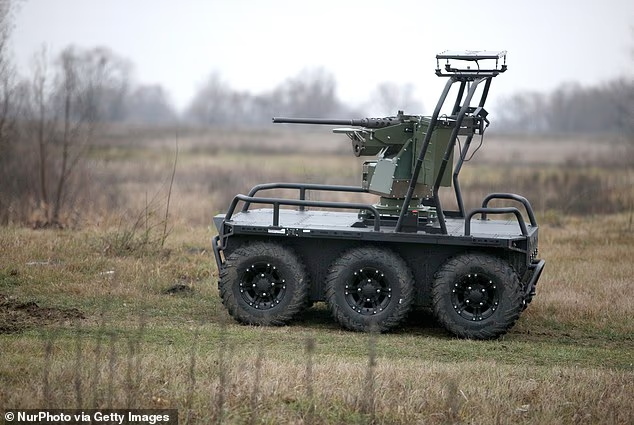
The Wolly 7.62 ground robot carried a machine gun loaded with ammunition that fired on Russian troop positions, forcing them to pull back from part of the coastline. 

Advertisement

Ukraine is aiming to build at least 50,000 combat robots to support its soldiers fighting on the frontline

Ukrainian officials say using unmanned weapons would help Ukraine optimise its headcount while fighting Russia

Ukrainian officials say using unmanned weapons would help Ukraine optimise its headcount while fighting Russia

Ukraine, which has a fraction of Russia’s population and a much smaller economy, has had little choice but to try and use new technologies to tackle its opponent, with Kyiv’s new commander-in-chief, Mykhailo Drapatyi, backing the massive integration of robotics on the front lines.

It comes as Zelensky urged his allies to increase the supply of drone interceptors after Ukraine failed to shoot down a single ballistic missile fired by Russia on Wednesday.

Advertisement

‘Ballistic missile interceptors could have saved the lives of those killed today,’ Zelensky said. 

‘Quite literally every single day, the lives of people here in Ukraine depend on the decisiveness of our partners in Europe and America.’

NATO’s secretary general Mark Rutte said the alliance was working to get Ukraine the air defences it ‘urgently needs.’ 

Russian attacks on Kyiv and its surrounding region on Wednesday killed 17 people and wounded dozens more. 

Advertisement

Moscow has been exploiting Ukraine’s critical shortage of interceptors for the U.S.-made Patriot systems, the sole air defence weapon in its arsenal able to shoot down ballistic missiles.

Zelensky has pleaded with other countries, especially the U.S., to send more of the ammunition made scarcer by the Iran war. 

Failing that, he wants to make Patriot ammunition in Ukraine or win permission from Elon Musk to use his Starlink satellite communications system to guide strikes inside Russia that can hit its missile launchers.

Advertisement

Advertisement

Source link

Continue Reading

NewsBeat

‘I tested Aldi luxury range versus Tesco, Lidl and Asda – there was obvious frontrunner’

Published

on

Wales Online

YouTube food critic Sam Wilder spent 48 hours eating from Aldi’s Specially Selected range – and compared it to the luxury food ranges Tesco Finest, Lidl Deluxe and Asda Exception

A YouTube food reviewer who put the luxury ranges of supermarkets Aldi, Lidl, Tesco and Asda to the test has declared one a clear winner.

Advertisement

Britain’s largest supermarkets all offer their own premium lines, purportedly delivering top-quality, some at more competitive prices than others.

With this in mind, content creator Sam Wilder set out to determine which major brand comes out on top, both in terms of value for money and taste.

Having already undertaken the same challenge with Lidl Deluxe, Tesco Finest and Asda Exception, he purchased 48 hours’ worth of food from Aldi’s Specially Selected range. This comprised two breakfasts, two lunches and two dinners, along with snacks and a dessert.

Sam’s total came to a very reasonable £44.50 at the checkout before he headed home to begin the challenge, reports the Express.

Advertisement

The online food reviewer, who has 106,000 subscribers on his channel, was thoroughly impressed by his Aldi haul – so much so that he crowned the supermarket “the clear frontrunner”.

Upon completing the two-day challenge, he said: “I’m placing Aldi as my clear frontrunner of all of the premium supermarket ranges so far.

“It’s pretty similar price-wise to Lidl but the quality is right up there with what I found at Tesco and Asda compared to what I found at Lidl.

Advertisement

“Things have more flavour, there’s way more to choose from, and to be honest with you, given the option of Aldi or Lidl anyway, outside of this challenge, I’m always going for Aldi.”

It appears it was Sam’s final meal that truly won him over at Aldi.

He feasted on a Wagyu steak accompanied by chunky oven chips and cherry tomatoes, rounding things off with lemon and white chocolate cheesecake slices. It was the tomatoes that left him singing their praises.

Sam said: “I’m not going to lie, that is a fantastic steak. Now I did have one of these tomatoes raw, and these tomatoes, I think they are quite possibly the favourite thing I have had in the last 48 hours.

“These tomatoes are phenomenal, they are sweet, they are zesty.

“This is just a very good dinner. £9.99 for a single steak at a supermarket is a little bit dear, but if you’re treating yourself, and I think Wagyu is a treat, then go for it. It feels worth it, it was that good.”

The YouTuber was caught somewhat off guard before the challenge even began while browsing the Aldi aisles.

Advertisement

He had underestimated just how extensive the budget supermarket’s luxury range actually was, which presented something of a problem at the checkout.

Sam added: “It did feel like there was an abundance of food in this range. What I’m already learning is, the Specially Selected range is, king of huge. I definitely over buy for these challenges.”

Source link

Advertisement
Continue Reading

NewsBeat

Mel C reveals she ‘had a little chat’ with Spice Girls bandmate Geri Halliwell after she raised eyebrows by wearing white to her wedding

Published

on

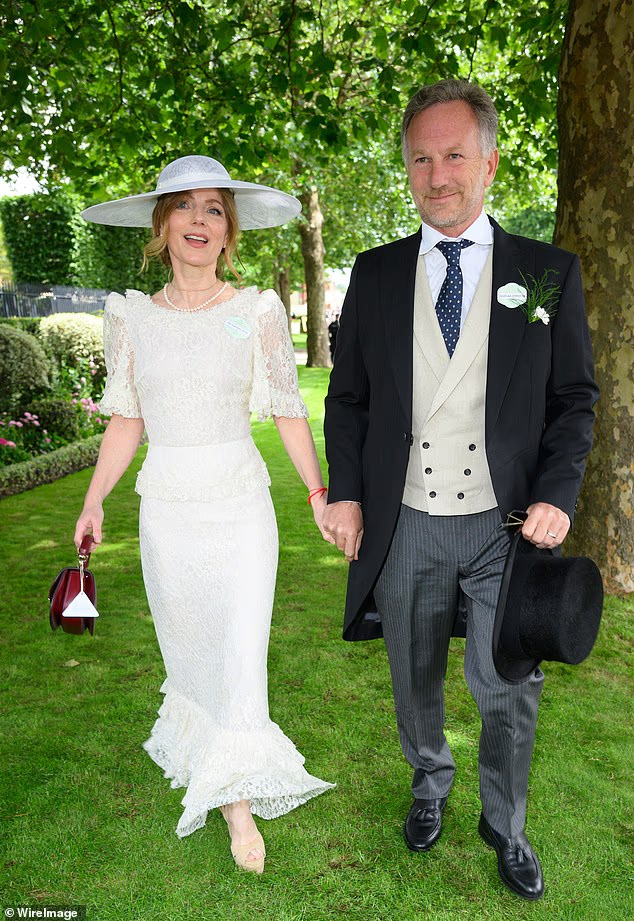
Mel C has admitted she had words with Geri Halliwell when her Spice Girls bandmate turned up to her wedding in a white dress (Geri pictured in her signature white at Ascot in June with husband Christian Horner)

Mel C has admitted she had words with Geri Halliwell when her Spice Girls bandmate turned up to her wedding in a white dress. 

Sporty Spice Mel, 52, married model Chris Dingwall in a ‘perfect’ Lake District wedding in the grounds of The Country House Cumbria on Saturday.

Whilst Victoria Beckham was forced to miss Mel’s big day, her other bandmates Geri, Emma Bunton and Mel B were all guests.

But Geri’s decision to wear white, her signature colour, raised eyebrows among fans, prompting newlywed Mel to address the drama during a new interview. 

Advertisement

Speaking on Australian radio station Kiis1065, Mel gave her verdict about her guests’ dress choices, admitting: ‘I did have a little chat with Geri because it is her favourite colour.’ 

‘She wears it every day. But she had a beautiful floral dress on and it was white white… I did have a little giggle with her about that.’ 

Mel C has admitted she had words with Geri Halliwell when her Spice Girls bandmate turned up to her wedding in a white dress (Geri pictured in her signature white at Ascot in June with husband Christian Horner)

Advertisement

Mel gushed about her ‘beautiful weekend’ during the chat but did admit she missed Victoria, who had designed her stunning wedding gown. 

Victoria missed out on her friend’s nuptials as they clashed with the World Cup final in New York, which she attended with her FIFA ambassador husband David. 

Addressing speculation that she was upset Victoria chose football over her friend, Mel insisted: ‘Victoria was very disappointed to not be there. She was with David in New York and it was the football final.’

‘She tried to get out of it – she isn’t the biggest football fan, she won’t mind me telling you – but the family were there and David had commitments, being an ambassador for FIFA.’

Advertisement

‘Of course she made my gorgeous dress and she was messaging me on the day. I actually saw her when I was in Ibiza so we had a little catch up. We were giving her updates and sending her pictures.’

Despite being in New York, Victoria’s influence on her best friend’s wedding was unmistakable, with Melanie’s effortlessly elegant dress featuring the clean lines and understated tailoring that have become synonymous with the designer’s luxury fashion label. 

Mel added that she included several Spice Girls references in her big day, revealing there were multiple tracks from the girlgroup on her playlist, and she even walked back up the aisle to a rendition of 2Become1.

 In a host of photos released by Vogue, Melanie was seen getting her dress fitted, and walking hand in hand with her new husband Chris. 

Advertisement
Sporty Spice Mel married model Chris Dingwall in a 'perfect' Lake District wedding in the grounds of The Country House Cumbria on Saturday (pictured on their honeymoon)

Sporty Spice Mel married model Chris Dingwall in a ‘perfect’ Lake District wedding in the grounds of The Country House Cumbria on Saturday (pictured on their honeymoon)

Melanie told Vogue: ‘The spark was immediate,’ she said. ‘I was 49 when I met Chris and I was in a really good place. We had a date in Australia, and it’s been difficult to separate us ever since.

‘He’s been such a beautiful addition to mine and my daughter’s life. Because, you know, I’m a single mum. My daughter is 17, and we’re pretty resilient the two of us, we’re a team. For anybody coming into our world… it was going to be tough, and he just fits perfectly. It’s a beautiful dynamic.’

Melanie met Chris, thought to be in his 40s, in 2023 on the exclusive dating app, Raya.

Advertisement

She admitted she originally thought she was finished with romance following her split from previous long-term partners, including Thomas Starr.

But during a night out at the pub, her friends convinced her to download the app, turning the search for a partner into a game they jokingly dubbed ‘boy Bingo’.

The couple first had a legal ceremony in Australia and one particularly sentimental detail was also unveiled, with Melanie incorporating a special Australian touch into her sleek ivory gown, which featured a dramatic open back and minimalist silhouette.

The Spice Girl had the words ‘Sydney’ and ‘7.6.2026’ embroidered in blue into the inside of her custom-made Victoria Beckham wedding gown as her ‘something blue’, commemorating the date and place where she and Dingwall officially became husband and wife.

Advertisement

Source link

Continue Reading

Trending

Copyright © 2025