

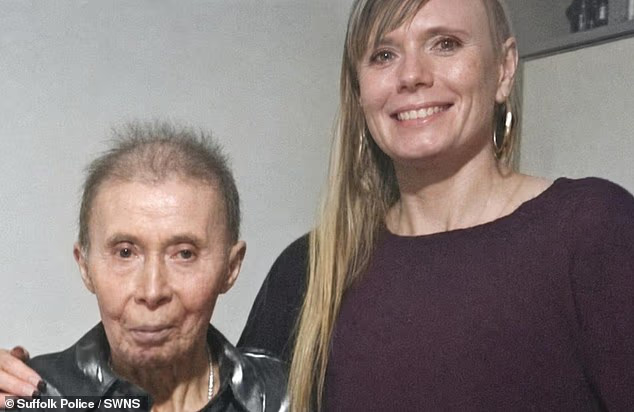
A woman accused of murdering her chronically-ill mother has claimed she ordered pills to end her life ‘so she could go out with dignity’.
Emma Nightingale, 36, was charged with murder after her 70-year-old mother, Lorna, died from a drug overdose at a hotel in Walthamstow, London, on December 11.
Ms Nightingale, from Lowestoft, Suffolk, claimed her mother ‘begged’ her to get the tablets because she could no longer bear the pain and wanted to die.
She was said to be suffering from chronic kidney disease, severe dental problems and cataracts in both eyes.
After being held in custody for five months, Ms Nightingale pleaded not guilty to murder at The Old Bailey, just one month before her trial was set to begin.
But she walked free after prosecutors dropped the case on the same day because there was ‘no longer a realistic prospect of conviction’.
The self-employed business administrator has now spoken out about her involvement in her mother’s death as she waits to see if the Crown Prosecution Service will charge her with encouraging or assisting suicide.
‘It was the hardest decision I’ve ever had to make. It was the humane thing to do,’ Ms Nightingale said.
Emma Nightingale, 36, from Lowestoft, Suffolk, was charged with the murder of her 70-year-old mother, Lorna
‘There was no way I was going to let the person closest to me in the world, my mum, who was my best friend, go through that sort of pain and suffering.
‘I’d do anything for her. I’d sacrifice my life for her if I had to because that’s how much I loved her.’
Ms Nightingale left a 13-year relationship and was acting as a full-time carer for her mother when she died.
As her health deteriorated, the pair found her mother’s property, which had stairs and damp, was unsuitable for her needs.
The pair decided to relocate to a ground-floor bedsit at the Trinity House hotel in east London last summer, so her mother could fulfill her dream of experiencing the capital city.
But a family member – unaware of the move – reported them missing to the police, sparking an investigation into their disappearance.
The relative said they last saw Ms Nightingale in Colchester in June and her mother in Lowestoft in February.
Specialist units from Suffolk Police and partner agencies including the British Transport Police launched a search on August 24 and made a public appeal for information.
It was not until October when police found the pair ‘safe and well’ in the Walthamstow bedsit.
At this time, the mother was bedbound and they could not leave the hotel, but Ms Nightingale said her mother knew she would die in a bedsit.
‘From the moment we arrived, she loved the bedsit and told me she wanted to spend her remaining days there,’ she said.

Specialist units from Suffolk Police and partner agencies such as British Transport Police launched a search for the mother and daughter
‘In the time we had left together, I ensured she was as comfortable and happy as she could possibly be.
‘She gave me the honour of waiting on her 24/7, making her tea and all her favourite foods – soft mashed potatoes, Yorkshire puddings with gravy, crumpets and soft desserts.’
During this time, the pair discussed her mother’s desire to end her life before the pain became unbearable.
Despite being a committed Christian who struggled with the ethics of assisted suicide, Ms Nightingale’s mother ‘begged’ her to purchase tablets and to help her end her life.
She continued: ‘We did a lot of online research into the most peaceful dying pills. I got in contact with a doctor in Switzerland, as they sell the pills legally there.
‘Mum never would have made the journey, and it was her wish to pass away at home in her own country.’
Ms Nightingale did not disclose where she got the pills fearing that the doctor who supplied them could face scrutiny.
She added: ‘She’d had enough and wanted to go with dignity.
‘She begged me to get her tablets as she couldn’t physically get them herself due to being bedbound at that point.
‘If I hadn’t helped her by getting the tablets when I did, her pain would have become unbearable.’
Ms Nightingale said she was by her mother’s side when she took the tablets on December 11. She then called the ambulance service after her mother passed away.
When police arrived at the bedsit, she gave an account of the events and was arrested on suspicion of murder.
Following police interviews she was remanded in custody and charged with murdering her own mother.
Officers also seized her phone, which contains almost all of her photos of her late mother, and it remains in police possession.
Ms Nightingale has been living in Dover since her release from prison and is waiting to learn if she will be charged with encouraging or assisting suicide under the Suicide Act 1961.
The offence carries a maximum sentence of 14 years and the CPS has not said when she will learn her fate.
Ms Nightingale’s case comes at a time of great debate around the assisted dying Bill.
Politicians are toiling over whether legislation should be introduced to help terminally ill adults end their lives.
The bill was reintroduced in July by Labour MP Lauren Edwards after it ran out of time during the last Parliamentary session.
Although former prime minister Sir Keir Starmer was a long-time supporter of the bill, Andy Burnham’s government is expected to take a neutral stance on the issue.
Supporters of the bill argue that the current ban causes unnecessary pain and forces people into distressing alternatives.
While critics say the proposals lack sufficient safeguards and poses a risk to vulnerable people.
Ms Nightingale reportedly told her solicitor that she is in favour of the assisted dying Bill.
‘I agree with assisted suicide if the pain and suffering becomes unbearable and it is on the grounds of compassion and the person is mentally competent.
‘It’s now legal in some countries, and it should be legal in the UK, and I believe it will be.’
– For confidential support, call Samaritans on 116 123, visit samaritans.org or visit www.thecalmzone.net/get-support

























































You must be logged in to post a comment Login