
Connect with us
DAPA Banner
DAPA Coin
DAPA
COIN PAYMENT ASSET
PRIVACY · BLOCKDAG · HOMOMORPHIC ENCRYPTION · RUST
ElGamal Encrypted MINE DAPA
🚫 GENESIS SOLD OUT
DAPAPAY COMING

NewsBeat

Woman fighting for life after being hit by car in North Tyneside

Published

on

One taken to hospital after crash in North Tyneside

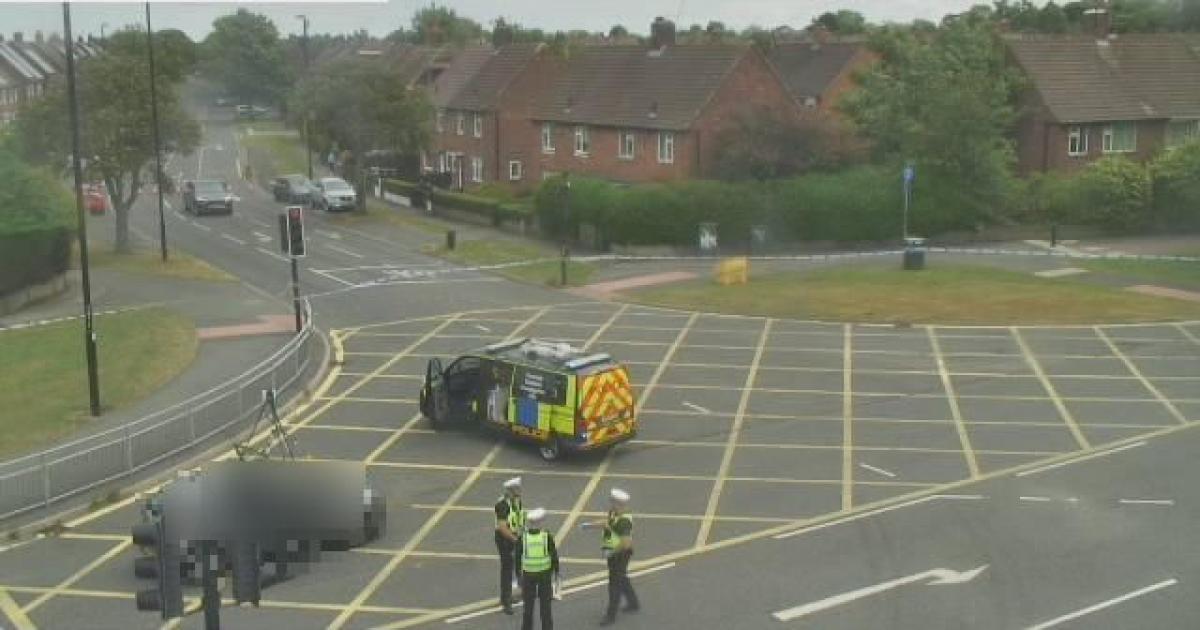
The incident happened on around 9.15am on Sunday (July 5) on Benton Road in Longbenton.

The woman, in her 60s, was hit by a grey Renault Clio and taken to hospital with serious injuries. She remains in a critical condition and her next of kin have been informed.

The driver of the Clio involved remained at the scene and is assisting officers with enquiries, Northumbria Police said.

A cordon was put in place around the junction, but the road has since reopened.

Advertisement

Officers investigating the incident have appealed for witnesses to come forward, including those with CCTV or dashcam footage of the incident or the moments leading up to it.

Police were at the scene with a large taped cordon in place (Image: PROVIDED)

Anyone with information or footage is asked to contact Northumbria Police, quoting reference number NP-20260705-0316.

Police were at the scene with a large taped cordon in place (Image: NE TRAFFIC CAMERAS)

A spokesperson for the North East Ambulance Service said: “We received a call at 9.26am on Sunday 5 July to reports of a road traffic incident on the junction of Benton Road and Goathland Avenue in Newcastle.

“We dispatched an ambulance crew and specialist paramedic to the scene, and requested support from our colleagues at the Great North Air Ambulance Service who attended by air.

Advertisement

“One patient was taken to the RVI by road for further treatment.”


A Great North Air Ambulance Service spokesperson added: “Our critical care team was activated at 9.44am to reports of a road traffic collision in the Benton area of North Tyneside.

“We had two paramedics and a doctor on board our aircraft and they arrived on scene at 10.01am.

“Our team worked alongside the North East Ambulance Service to assess and treat a patient and they were taken to hospital by a road ambulance.”

Advertisement

Source link

Continue Reading
Click to comment

You must be logged in to post a comment Login

Leave a Reply

NewsBeat

DR MAX PEMBERTON: Tired? Aching limbs? Here’s why Lyme Disease is on the rise – and my fear that patients are not being told the truth

Published

on

Last year, Justin Timberlake said he was diagnosed with Lyme Disease and suffered from pain on stage. Other celebrities, including Bella Hadid and Shania Twain, have also had the illness

Last month a young woman sat in front of me in my consulting room and told me she was convinced she had Lyme Disease after reading about all the possible symptoms.

She wasn’t the first patient I’ve seen to say this and I’m sure she won’t be the last. Why? Because as diseases go, this one has rather a high profile.

Last summer, Justin Timberlake told his fans that he’d been diagnosed with Lyme Disease. He revealed that he’d been performing with a great deal of nerve pain, had felt worn out and unwell and had a diagnosis for what was troubling him.

He’s just one of a long line of famous faces, including model Bella Hadid, singer Shania Twain and comic Miranda Hart, who’ve all spoken about the same illness.

Advertisement

It seems hardly a week goes by without another article, another celebrity, another warning.

Of course, that’s going to trickle down to the rest of us, including the patients that come through my door.

What the coverage almost never makes clear is that, a good deal of the time, the illness being discussed isn’t ‘Lyme Disease’ at all. It’s something called ‘Chronic Lyme Disease’. And the two are not the same thing.

Advertisement

Last year, Justin Timberlake said he was diagnosed with Lyme Disease and suffered from pain on stage. Other celebrities, including Bella Hadid and Shania Twain, have also had the illness

To be clear, there is an infection, spread by the bite of a tick and caused by a bacterium called Borrelia. That is Lyme Disease. The first sign is often a spreading rash, sometimes in the shape of a bullseye, though fewer than half of patients ever develop one.

Flu-like aches and tiredness can follow. Left untreated, it can do serious damage: a drooping of the face, inflammation of the heart and painful swollen joints that surface months or even years later.

So this isn’t an illness to shrug off and I’ve nothing but sympathy for anyone who has been dismissed by a doctor who never thought to ask about a tick bite.

Advertisement

Caught early, though, it’s treated much like any other bacterial infection, with a short course of antibiotics, usually doxycycline. For the vast majority of people that clears it, and that’s the end of the matter.

Recorded cases are creeping up. In England last year there were about 1,170 confirmed, against 959 the year before.

Warmer, longer summers certainly give ticks more time to feed, yet much of the increase can be attributed to the fact we’re all more alert to Lyme now, more likely to spot the signs and get tested. None of that adds up to an epidemic.

However, the word ‘Lyme’ has become stretched to cover something quite different and this is what’s muddying the waters.

Advertisement

Chronic Lyme Disease is the claim that a whole raft of vague, persistent symptoms: headaches, exhaustion, aching muscles, the fog that settles over your thinking, are all the work of a hidden Borrelia infection.

The trouble is that there’s often no clear history of an infection in the first place. The standard tests come back negative.

Rather than accept that, sufferers frequently become convinced the tests themselves must be wrong. Some go as far as sending blood samples to private laboratories abroad, which run their own unregulated tests, with no evidence behind them, that will then hand back a positive result.

It’s easy to see why this happens. A label, any label, is easier to carry than being told nobody knows what’s wrong with you.

Advertisement
Lyme Disease is an infection spread by the bite of a tick and caused by a bacterium called Borrelia. But, Dr Max Pemberton explains, this is easily treatable if caught early

Lyme Disease is an infection spread by the bite of a tick and caused by a bacterium called Borrelia. But, Dr Max Pemberton explains, this is easily treatable if caught early

And it’s nothing new. In 2007, a landmark paper in the New England Journal of Medicine looked hard at Chronic Lyme Disease and found no convincing evidence the symptoms had anything to do with Borrelia.

Study after study has since failed to turn up any evidence that symptoms are due to a lingering infection.

As for treatments, patient groups press for long courses of antibiotics, sometimes running to many months. Yet controlled trials show they work no better than a placebo, while carrying serious risks of their own.

Advertisement

That hasn’t stopped a handful of doctors, some aligned with campaign groups, insisting the guidelines are too timid and that patients need ever-longer treatment. Other evidence gets wheeled out too but it rarely stands up to scrutiny. A pilot study this year, for example, hailed in some reports as a breakthrough, gave psilocybin, the active ingredient in magic mushrooms, to people with lasting Lyme symptoms who reported big improvements in their condition.

Impressive, until you read the detail. Only 20 people took part in the trial, there was no comparison group and everyone knew exactly what they’d taken. That’s not proof of anything.

I want to tread carefully here, because the distress these patients feel is not in question. They are unwell, and they deserve to be taken seriously. Only that isn’t the same as signing up to a diagnosis that doesn’t hold.

If the symptoms aren’t caused by an infection, more antibiotics won’t help.

Advertisement

The kindest thing we can do for these patients isn’t to nod along, it’s to tell them the truth and look at the whole picture. And that, very often, means considering causes that have nothing to do with a tick.

Picture of Kate says so much

What a lovely photograph of the Princess of Wales at the summit of Snowdon. 

She had taken on the National Three Peaks Challenge, climbing the highest mountains in Scotland, England and Wales in 24 hours… in the rain.

The resilient Princess of Wales, seen with a fellow climber on the summit of Mount Snowdon, serves as a reminder of how important it is to care for one's mind after recovery

The resilient Princess of Wales, seen with a fellow climber on the summit of Mount Snowdon, serves as a reminder of how important it is to care for one’s mind after recovery

Advertisement

She did it in aid of the Royal Marsden, the hospital that treated her cancer, and also to raise awareness of ‘life beyond diagnosis’. That phrase really resonated with me. 

Health services are generally great at the sharp end of illness: the scans, the surgery, the drugs. What comes after can be another matter. So many people who’ve come through something frightening are left with an anxiety that won’t switch off. 

What Catherine seems to grasp is that recovery is about the whole person, not just the disease. Being outdoors, moving, setting yourself a hard physical target and reaching it, can do things for the mind that no prescription manages.

Good news for coffee lovers. People drinking five or more cups a day were found to be 47 per cent less likely to develop liver cancer and a third less likely to develop cirrhosis, a study of more than 355,000 adults shows. Decaf drinkers saw similar benefits. Not that I’m urging anyone to start downing five cups a day. If you want to look after your liver, go easy on alcohol, keep your weight in check and stay active. Still, that morning cup may quietly be doing you a good turn. 

Advertisement

Dr Max prescribes… 

The Happiness Lab

We think we know what will make us happy. A pay rise, bigger house, expensive holiday. We’re usually wrong. 

In this warm and waffle-free podcast, the Yale psychologist Dr Laurie Santos, pictured, takes the science of wellbeing, drawn from the most popular course her university has ever run, and turns it into something you can use. 

Well worth a listen and guaranteed to get you rethinking what true happiness really is. 

Advertisement

Source link

Advertisement
Continue Reading

NewsBeat

Exclusive beach club brand loved by Leonardo DiCaprio and Gigi Hadid forced to close Turkish location due to dispute with local provider

Published

on

Scorpios in Bodrum on the Turkish Riviera has been forced to close temporarily due to an ongoing dispute with a local business partner

A star-studded holiday destination in Bodrum, Turkey, has been forced to shut its doors following a dispute with a local business partner.

The beachside experience and club on the Turkish Riviera is a hotspot for wellbeing fanatics, and boasts Eastern Mediterranean cuisine with subtle Mexican influences.

With another location in Mykonos, Greece, the brand is a favourite with many celebrities, including Lindsay Lohan and Rita Ora.

With 12 bungalows complete with private pools and expansive decks perfect for entertaining, it is a truly elite destination where you can stay overnight, too.

Advertisement

Situated on the Aegean coast, other fans of Scorpios include Gigi Hadid and Leonardo DiCaprio.

Today, Bodrum boasts ultra-luxury brands including Mandarin Oriental, EDITION and Maxx Royal, while Mykonos favourite Scorpios has chosen the peninsula for only its second permanent outpost. 

However, a string of measures imposed by a local business partner have meant it has been forced to shut down temporarily.

Advertisement

Scorpios in Bodrum on the Turkish Riviera has been forced to close temporarily due to an ongoing dispute with a local business partner

Celebrity guests to Scorpios include Lindsay Lohan (pictured) as well as supermodel Gigi Hadid

Celebrity guests to Scorpios include Lindsay Lohan (pictured) as well as supermodel Gigi Hadid

It closed just weeks into the 2026 summer season for a handful of reasons, including operational problems that have significantly impacted the venue.

According to a source close to Scorpios, there are restrictions preventing Scorpios’ onsite ambulance and doctors from accessing the property, placing a limit on safety.

Advertisement

Additionally, there are restrictions on bringing ice onto the property, creating food safety and hygiene concerns.

Delivery windows have also been reduced to a one-hour period.

Meanwhile, the overnight demolition of the guest gatehouse and removal of the parking area mean guests would have to park on a public road and walk to the entrance.

There has also reportedly been a reduction in licensed operating hours.

Advertisement

A statement from Scorpios posted on Instagram over the weekend read: ‘We regret to inform you that Scorpios Bodrum will temporarily cease business operations as of today and until further notice due to differences with our local business partner that could not be resolved so far.’

‘Under the current circumstances being imposed on us, we are no longer able to operate in a way that meets the standards, values and responsibilities we hold ourselves to.’

‘At Scorpios, we have always been committed to delivering the best possible experience while ensuring the wellbeing and safety of our guests, employees, artists and suppliers.’

The resort is one of a string of luxury properties in Turkey's Bodrum

The resort is one of a string of luxury properties in Turkey’s Bodrum

Advertisement

‘We sincerely hope that the current issues can be resolved and that we will be able to welcome our community back to Scorpios Bodrum in the near future.’

Fans were understandably disappointed, with one commenting: ‘Sad. One of the most beautiful places in the world.’

Another chimed in: ‘Come back stronger. Scorpios is one of Bodrum’s iconic symbols.’

A third wrote: ‘It takes real integrity to walk away when the conditions no longer align with your values. The Scorpios family has always stood for excellence, transparency, and genuine care for its community. 

Advertisement

‘Scorpios Bodrum is a beautiful project, but no location is worth compromising the principles that built the brand. Looking forward to seeing Scorpios thrive again under the right circumstances and in the right location.’

A fourth added: ‘Turkey lost again. Scorpios was the biggest entertainment brand that ever came to Turkey.’ 

Source link

Advertisement
Continue Reading

NewsBeat

NATO unveils military projects to boost defense spending

Published

on

NATO unveils military projects to boost defense spending

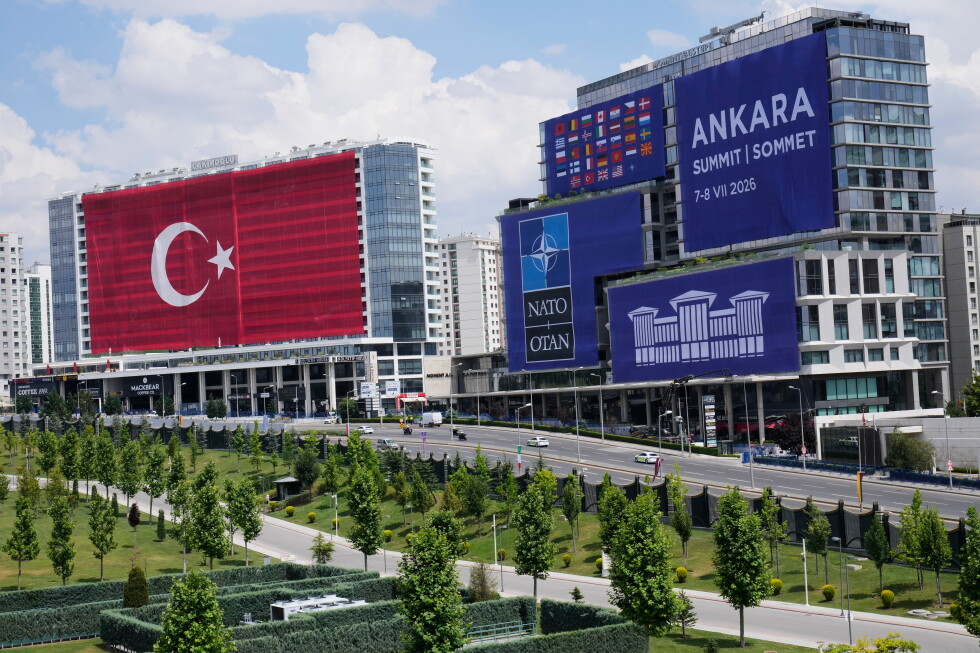
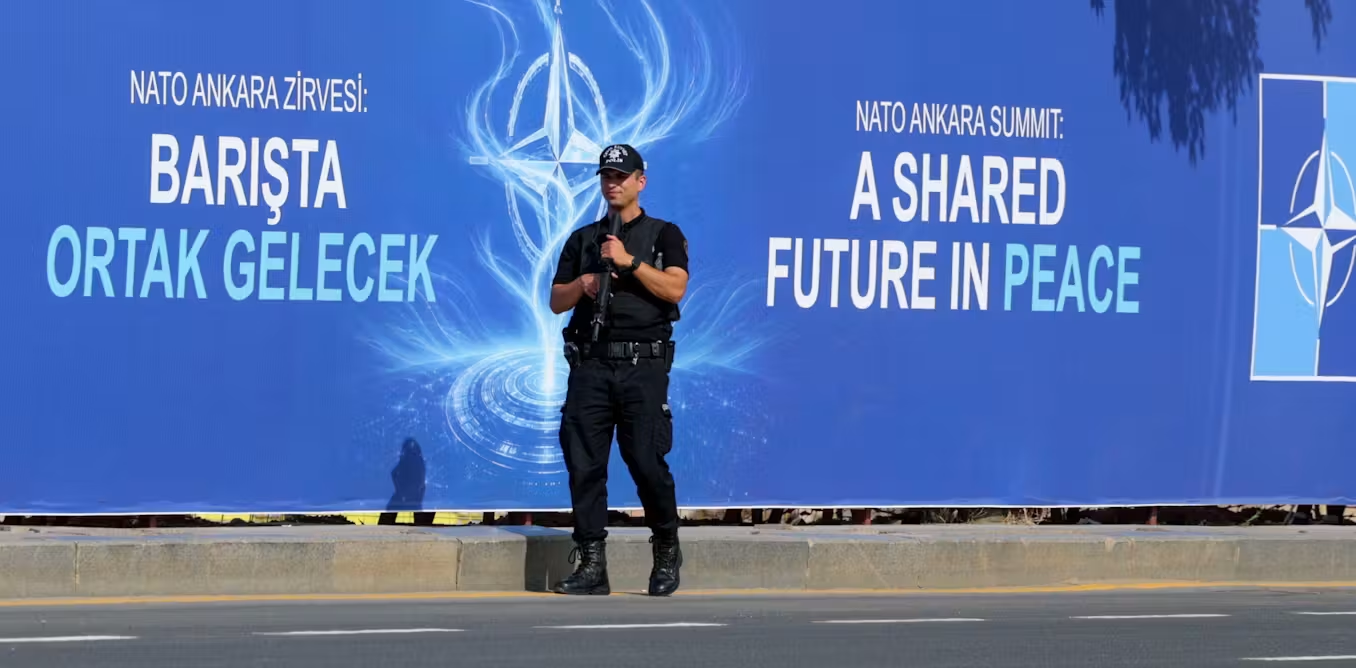
ANKARA, Turkey (AP) — NATO on Tuesday will showcase a series of new military projects worth billions of dollars in an attempt to convince U.S. President Donald Trump that the allies are stepping up defense spending and converting investment into real firepower.

At an event dubbed the “big reveal,” several leaders are due to announce new deals with defense companies, plenty of them in the United States. Trump has branded NATO a “paper tiger” that would cease to function without American arms and leadership.

“We will announce tens of billions in new contracts that will provide the crucial kit we need to deter and defend,” NATO Secretary-General Mark Rutte told reporters on the eve of the military alliance’s two-day summit in Turkey.

The defense industry splash comes a few weeks after Rutte tried to ease U.S. concerns about military spending at NATO with a new pitch using a chart labeled the “The Trump Trillion” — showing $1.2 trillion in spending by European allies and Canada since 2017.

Advertisement

Far from being impressed, Trump appeared unmoved, saying he was still disappointed at some NATO allies’ refusal to join the Iran war, which he had launched alongside Israel without consulting them.

“We don’t need their money — we don’t need anything,” Trump said. “I just want loyalty.”

NATO surveillance planes up for renewal

Among the contracts to be unveiled, many of them drawn up and some signed long before the summit, is expected to be one to replace NATO’s aging fleet of surveillance planes.

NATO as an organization does not own any weaponry — these are the property of the 32 member countries — but it does have a fleet of AWACs aircraft that are about 50 years old and some newer surveillance drones.

Advertisement

Some of the other projects will notably be paid for with funds from a system of cheap loans for defense purposes set up by the European Union, comprising up to $170 billion raised on capital markets.

“We need to ensure that we are translating our economic might into military capabilities, putting the cash to work from defense plans to drones, from money to missiles and interceptors,” Rutte said.

The summit is being held in President Recep Tayyip Erdogan’s sprawling palace compound in Ankara and Trump has suggested he would come bearing gifts for the Turkish leader.

Netanyahu opposes jet sales to Turkey

But speaking Monday on the morning show “Fox & Friends,” Israeli Prime Minister Benjamin Netanyahu urged the U.S. not to sell F-35 fighter jets to Turkey, saying that Erdogan “calls openly for the annihilation of Israel.” Turkey and Israel have acrimonious relations. Erdogan frequently accuses Israel of committing genocide in its war in Gaza, triggered by the deadly Oct. 7, 2023 Hamas-led attack on southern Israel.

Advertisement

Turkey was barred from the F-35 program in 2019, after it purchased Russian-made S-400 missile defense systems. However, Trump, who has warm relations with Erdogan, has hinted ahead of his planned visit to Ankara for the NATO summit that the sales could soon resume.

Netanyahu said selling Turkey F-35s would “upset the power balance in the Middle East, which is ultimately guaranteed by Israeli air superiority and also, I think, by America’s posture in the Middle East.”

Israel’s Air Force depends on hundreds of U.S. fighter jets, including F-35s, F-16s and F-15s.

Seeking a stronger Europe for a stronger NATO

The focus of the summit is a stronger Europe for a stronger NATO. The Trump administration has warned the allies that they must handle Europe’s security alone as the United States focuses on China and the Indo-Pacific region.

The Pentagon wants a reboot and is promoting what it calls “NATO 3.0,” a vision of the alliance in which Europe assumes greater responsibility for its own defense, freeing the U.S. to concentrate on other priorities.

But hiking defense spending means increasing taxes or diverting resources from other priorities. U.K. Defense Secretary John Healey unexpectedly quit last month, saying the government was not willing to spend at a time of rising threats.

Advertisement

Concern is mounting among some northern and central eastern countries that Russia might be preparing a hybrid attack — a combination of conventional warfare with tactics like cyberattacks — on the continent as Russian President Vladimir Putin struggles to secure victory in Ukraine.

Keir Starmer’s office said the British leader will be “focused on building a stronger and more European NATO” on what is likely to be his last foreign trip as prime minister.

Starmer, who announced his resignation June 22, has faced criticism from military leaders, opposition politicians and some in his center-left party for the slow rate of increase in U.K. military spending.

His government has committed to reach the NATO budget target of spending 3.5% of gross domestic product on defense by 2035 but does not have a concrete plan to get there. Its current spending plan will see that spending hit 2.7% of GDP by 2029.

Advertisement

___

Associated Press writer Jill Lawless in London contributed to this report.

Advertisement

Source link

Continue Reading

NewsBeat

Nato summit will reveal how alliance plans to manage European security as US cuts back its support

Published

on

Nato summit will reveal how alliance plans to manage European security as US cuts back its support

Two massive Russian attacks on Kyiv in less than a week, renewed Iranian threats in the Strait of Hormuz, and a security crackdown in Turkey are just three of the immediate issues shaping the context of the Nato summit in Ankara on July 7-8.

While Ukraine and Iran will be on Nato’s agenda, the authoritarian drift of its host, Turkish president Recep Tayyip Erdoğan, will be politely overlooked. But as ever, the summit outcome will be determined by the position of the United States.

At last year’s Hague summit, the Nato-sceptical US president, Donald Trump, was placated by the allies’ commitment to spend 5% of their GDP annually on defence by 2035. The challenge this year will be to demonstrate sufficient progress towards that goal, while also addressing Trump’s vision of “Nato 3.0” – involving, according to his secretary of war, Pete Hegseth, “a balanced alliance with Europe in the lead for its own defence”.

Progress towards defence spending appears reasonably on track. In 2025 alone, the Atlantic Council notes: “European allies and Canada increased defence spending by 20% from the previous calendar year.” Six Nato allies (the three Baltic states plus Denmark, Poland and Norway)
spent more on defence as a share of GDP than the US. Germany, not among that group in 2025, nonetheless has big ambitions. In absolute terms, it is now Nato’s second biggest defence spender.

Advertisement

The allies have also made strenuous efforts to wean themselves off American-sourced defence systems. But bumps in the road remain. Whereas in 2025, all the Nato allies (bar Iceland, which has no armed forces) met Nato’s 2024 standard of spending 2% of GDP on defence, this will not be repeated in 2026. The Czech government and Hungary are likely to dip below the target. And many spending commitments still need to translate into concrete capabilities. Europe’s defence industries are working flat out, but are at the limits of how fast they can absorb new investment.

The success of the summit may just be down to luck and the volatile mood of the US president. Trump seems unable to accept that the Nato allies have made genuine progress in defence. He claimed just days before departing for Ankara it was “ridiculous” that the US continues to support a “one-sided” Nato. That grievance appears to be one reason the meeting may withdraw its endorsement of Albania – a low-spending Nato member – as the 2027 summit venue.

Things could also prove tricky on another of Trump’s pet complaints – the lack of Nato support for the US-Israeli war with Iran. The Nato secretary general, Mark Rutte (who chairs the summit), seems determined to avoid getting too deeply into discussion of the situation.

But if it does intrude, safety will likely be found in the formulation recently agreed by the G7 – welcoming the US-Iran deal, condemning Iran’s nuclear ambitions and supporting a Franco-British led maritime operation in the Strait of Hormuz. Don’t expect a Nato coordinating role in any operation, however. On that, there is no allied consensus.

Advertisement

United approach on Ukraine war

There will be greater scope at the summit for dealing with Russia’s war against Ukraine and the broader threat to European security that emanates from the Kremlin. The Trump administration has grown increasingly distrusting of Putin and, in parallel, more impressed with the Ukrainian war effort.

This has translated into some positives for Ukraine: the country’s president, Volodymyr Zelensky, will be at the summit, attending the Nato-Ukraine Council and the Ukraine Defence Contact (Ramstein) Group meetings, which coordinate western support for Ukraine.

He will be hoping for more concrete commitments similar to British and German defence packages for Ukraine. Nato’s Prioritised Ukraine Requirements List (Purl) initiative, launched last summer, has also already been a big success in keeping arms and other military aid flowing to Ukraine.

Much discussion will focus on the need to help Ukraine defend itself against heacy Russian bombardments like the ones recently experienced in Kyiv and other cities.
EPA/Sergey Dolzhenko

That initiative will be reaffirmed at Ankara, signalling a clear commitment to Ukraine-Europe defence links. But the allies still lack a consensus on offering Nato membership to Ukraine. The US is adamantly against it. So a pathway to accession will not be spelled out at the summit.

Advertisement

Where’s China?

Other items missing from the agenda at Ankara will also reflect the Trump administration’s priorities. It’s no surprise that climate change and Women Peace and Security – a UN-led initiative which recognises and fosters women’s contribution to peacekeeping – have fallen out of favour. Both issues figured in Nato communiques during the Biden period – both disappeared from last year’s Hague summit declaration. Don’t expect a mention at Ankara.

More curious, though, is the lowered priority given to China. Nato’s 2019 London declaration contained Nato’s first ever summit-level statement on China, recognising that the nation’s growing influence brought challenges as well as opportunities – a move engineered by the first Trump administration. Then, Nato’s relevance to the US was judged by how it was positioned in the emerging era of “strategic competition”.

Under Biden a similar logic applied, reinforced by the 2024 Washington summit’s description of China as the “decisive enabler of Russia’s war against Ukraine”. And yet China disappeared from the 2025 Hague declaration. It was not discussed at Nato’s recent foreign and defence ministerials. Neither is it expected to figure at Ankara.

Why not? The Trump administration’s recent efforts at accommodation with China are part of the answer. Other allies too are happy to see China sidelined from Nato’s business. France, easily perturbed by a globalist Nato, had always been a sceptic when it comes to including China in Nato’s agenda. Many east European allies, meanwhile, see a China focus as distracting Nato from Russia. And big exporters like Germany need to keep Beijing sweet, given the shrinkage of their Russian market.

Advertisement

The summit declaration will again be short to avoid controversy. But like an iceberg, much lies below the surface. The detailed work of moving to “Nato 3.0” was already agreed at the Nato defence ministerial in mid June. Most of the gaps in Nato’s European defence plans occasioned by recent US force announcements have already been plugged.

The summit will give rise to much noise, but Nato’s ongoing adaptation to the new reality engendered by shifting US priorities suggests a high degree of underlying resilience.

Source link

Advertisement
Continue Reading

NewsBeat

Woman ‘exploited vulnerable prostitutes’ in Cambridge brothel

Published

on

Cambridgeshire Live

Evidence showed that the woman had deposits of more than £55k into her bank from running the brothel

A woman who ran a brothel in Cambridge has been sentenced. Sio Cheok, 58, first came to Cambridgeshire Police’s attention following reports of anti-social behaviour and frequent visitors to a property in Histon Road in 2025.

Advertisement

Officers attended the address on May 20, 2025, and found Cheok and a suspected sex worker inside. They also discovered a massage bed and sex-related paraphernalia, including condoms and lubricants.

Two mobile phones were seized. These contained evidence of Cheok arranging appointments and communicating with both clients and workers.

Cheok was arrested and released on bail with conditions. However, further enquiries and welfare checks carried out in December revealed she breached the conditions.

Further investigation showed more than £55,000 had been paid into her bank accounts through cash deposits and third-party payments over a 12-month period.

Advertisement

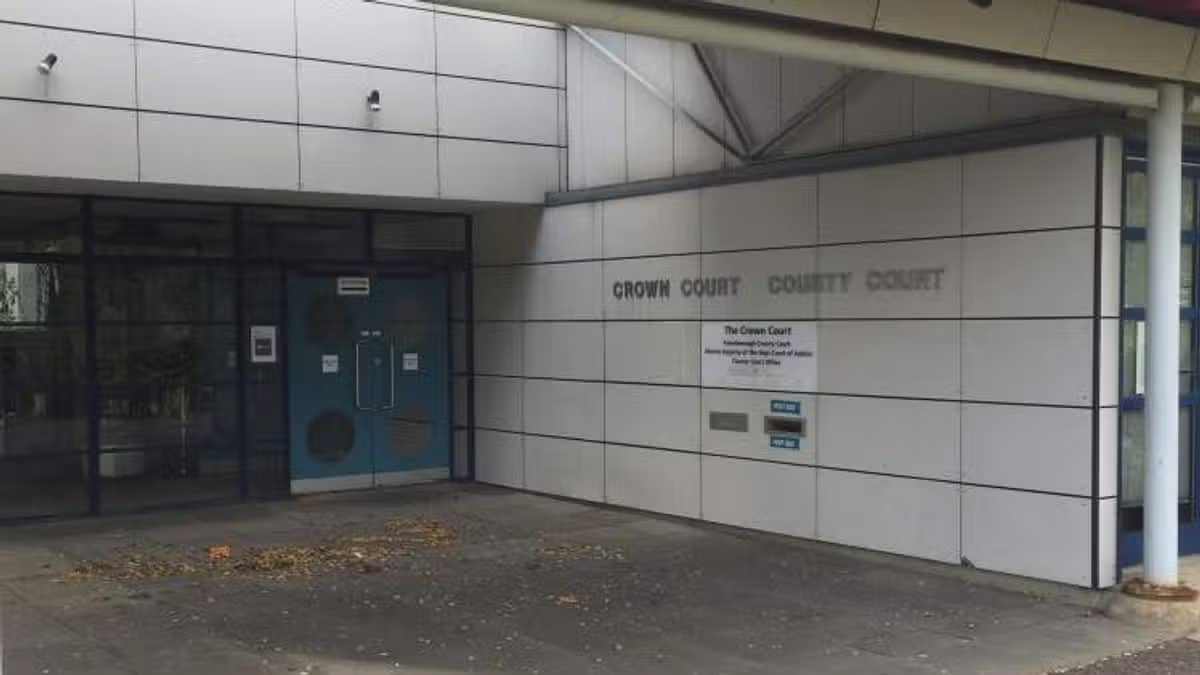
At Peterborough Crown Court on Friday (July 3), Cheok, of Chesterton Road, Cambridge, was sentenced to 16 months in prison, suspended for two years. She previously pleaded guilty to controlling prostitution for gain between June 2024 and December 2025. She must also carry out 120 hours of unpaid work.

Detective Constable Steph Barnes-Dunlop, who investigated, said: “Cheok was motivated by financial gain and exploited vulnerable women for her own benefit. Through a thorough investigation, we were able to build a strong body of evidence which demonstrated her role in controlling prostitution activity from the property.

“We work closely with partner agencies to safeguard those involved in sex work and identify anyone who may be at risk of exploitation. I hope this sends a clear message that we will not tolerate those who seek to profit from the exploitation of others.

“If you are being exploited in any way then I urge you to contact us, or Crimestoppers, so we can help you turn your life around.”

Advertisement

Officers are now taking steps under the Proceeds of Crime Act to ensure she does not benefit financially from her criminality.

Source link

Continue Reading

NewsBeat

New HMRC August 2026 deadline warning for UK workers

Published

on

Wales Online

HMRC is pushing ahead with its tax overhaul

Sole traders and landlords are confronting a crucial deadline as HMRC presses forward with its contentious transformation of the tax system.

Advertisement

The tax authority is urgently attempting to dispel “myths” surrounding its Making Tax Digital (MTD) scheme following evidence that vast numbers of those impacted have still not registered – mere weeks before their initial submission falls due. In a message posted on social media, HMRC delivered a stark reminder to the self-employed emphasising that every three months they must use compatible software to submit digital records of income and expenditure.

The statement continued by clarifying who is impacted. Crucially, anyone enrolled in MTD must send an update for each income source, including self-employment and property income.

Millions dragged into ‘digital’ net

The reform impacts sole traders and landlords with a combined turnover exceeding £50,000 annually – with HMRC calculating that 864,000 people would be caught in this opening phase, all obliged to submit their first quarterly update via HMRC-approved software by August 7.

Advertisement

However, early indications suggest many are being taken by surprise. Statistics reveal that just one week after the system launched, only 250,000 people had registered – and the overwhelming majority of those, almost 170,000, had enrolled through tax agents and accountancy practices rather than registering personally.

Campaigners worry the actual number of those yet to sign up could reach hundreds of thousands. Perhaps anticipating difficulties, the Chancellor acted last year to ease the impact, confirming that no penalties would be imposed for late quarterly submissions during the 2026/27 tax year — a concession viewed by detractors as an implicit acknowledgement that the system’s implementation has been disorganised.

A long and troubled road

Making Tax Digital is not a recent initiative. The scheme was originally subject to consultation back in 2016, forming part of HMRC’s ambition to modernise its handling of taxpayer information.

Certain aspects of the programme, including MTD for VAT, have been operational for years, yet the income tax component has been continually delayed following numerous postponements owing to its intricacy.

Advertisement

Under the regulations finally coming into force this year, the era of the shoebox stuffed with crumpled receipts is drawing to a close. Taxpayers brought within the regime must abandon pen-and-paper bookkeeping and instead record every transaction electronically, submitting running totals to HMRC four times a year rather than completing a single annual return.

Officials maintain the reform is intended to provide taxpayers with a clearer, more current understanding of their liabilities. According to HMRC’s own guidance, once a quarterly update has been filed, users will be able to see an estimate of their tax bill for their self-employment and property income in their software or in their HMRC online services account.

Content cannot be displayed without consent

The key dates

The first cohort – those already trading with income above £50,000 – must have started keeping digital records from 6 April 2026.

The critical dates that follow are:

Advertisement
  • August 7, 2026 – deadline for the first quarterly update
  • November 7, 2026 – second quarterly update
  • January 31, 2027 – last “old style” Self Assessment return, covering 2025/26
  • February 7, 2027 – third quarterly update
  • May 27, 027 – fourth quarterly update
  • January 31, 2028 – first year-end declaration filed directly through MTD software, covering 2026/27

A second wave of taxpayers, with lower turnover thresholds, will be dragged into the system in the following two years.

Penalties on the horizon

Although there is a grace period for late quarterly submissions this year, taxpayers have been cautioned against becoming complacent. From next year, a new points-based penalty system comes into effect, similar to driving licence endorsements – accumulate too many points for missed deadlines, and a fixed financial penalty will follow.

Accountants have urged their clients not to leave matters until the eleventh hour, cautioning that mistakes made in the first submission can carry through every subsequent filing, as each quarterly update builds cumulatively upon the last rather than being treated as a standalone return.

For the time being, HMRC’s message to those affected is straightforward: get registered, ensure your software is in order, and don’t let August 7 catch you off guard.

Source link

Advertisement
Continue Reading

NewsBeat

ALEX BRUMMER: Andy Burnham thinks he has all the answers… but this is why the all-powerful Treasury will fight his plans

Published

on

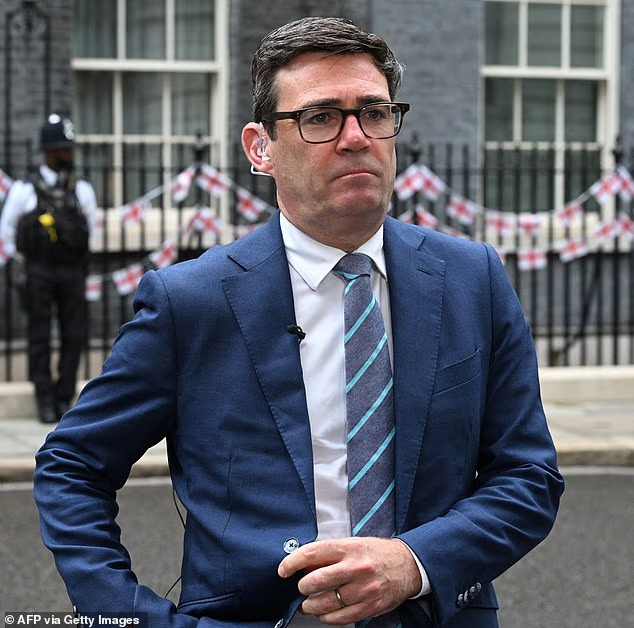
Andy Burnham is plotting his own escape from the dead hand of the Treasury by shifting some of his executive power from London to Manchester

It’s been described as the most famous front door in the country. But the glistening black entrance of No 10 Downing Street is not a portal to the wellspring of power in modern Britain.

That honour lies with the front door of a much grander building round the corner on Horse Guards Road: the HM Treasury headquarters.

Power-hungry prime ministers through the ages have attempted to break the Treasury’s stranglehold over decision-making.

Now, Andy Burnham is plotting his own escape from the dead hand of its mandarins by shifting some of his executive power from London to Manchester, with the creation of a ‘national growth unit’ that he has christened ‘No 10 North’.

Advertisement

When he becomes PM later this month, it is said Burnham will spend one or two days a week in his northern fastness, with one report suggesting that – depending on parliamentary calls on his time – he might base himself there on Mondays and Thursdays, while presumably spending the weekend at his gated home in the town of Golborne, 14 miles west of Manchester.

This move, coupled with his plan to devolve certain powers to elected mayors and local authorities, is calculated to discombobulate the Treasury.

But wresting authority from its Sir Humphreys could prove to be easier said than done, as Keir Starmer and so many of his predecessors can testify.

The level of administrative support and bureaucratic heft surrounding the Prime Minister is no match for the might of the money men in His Majesty’s Treasury, with its serried ranks of number-crunchers and veto power over any legislation that may spook the markets.

Advertisement

Andy Burnham is plotting his own escape from the dead hand of the Treasury by shifting some of his executive power from London to Manchester

The current Chancellor, Rachel Reeves, has proved particularly ill-equipped to counter the influence of her civil servants, writes Alex Brummer

The current Chancellor, Rachel Reeves, has proved particularly ill-equipped to counter the influence of her civil servants, writes Alex Brummer 

It is a measure of the imbalance between the two government offices that while 300 civil servants and special advisers work at No 10, there are more than 1,600 in the Edwardian Baroque Revival building that houses Britain’s finance ministry.

Advertisement

A senior Treasury mandarin once explained to me that nothing goes on in Whitehall, the Cabinet or No 10 that escapes Treasury scrutiny.

Every decision which requires taxpayers’ money, from authorising a review to making a change to the pension and welfare system, passes through the Treasury.

Gordon Brown was so suspicious of Treasury snooping during his ten years as Chancellor that he and his top aide, Ed Balls, would retreat to a box room in a quiet corridor to avoid being overheard by civil servants.

Their thinking was that if anyone was going to leak details of future government policy it was going to be them, not some Machiavellian permanent secretary.

Advertisement

Indeed, when he attended financial gatherings overseas, Brown refused to stay in the local British embassy for fear of intrusive civil servants.

And it would appear that not much has changed since. Two years ago, a study by the Institute of Government found that the Treasury demonstrates ‘a worrying imbalance of power in government that leads to bad outcomes in spending’.

This, it argued, ‘egregiously’ leads to a lopsided centre of power, meaning the PM ‘lacks the firepower, intellectual support or control of the levers to set and drive strategy, leaving the Treasury to fill the resulting vacuum’.

The current Chancellor, Rachel Reeves, has proved particularly ill-equipped to counter the influence of her civil servants, who regularly use blood-curdling warnings of a run on the pound or spiralling bond yields to keep their ministers in line.

Advertisement

The fingerprints of officials in thrall to the Treasury’s tin-eared economic orthodoxy have been all over her decision-making. It is no accident that Ms Reeves made the biggest political error of her tenure when she sought to address an alleged £20billion black hole in the government finances in July 2024 by cancelling – without consultation – winter fuel payments for ten million elderly people, a decision which provoked such a furious reaction that it had to be reversed 11 months later.

This was a prelude to the imposition of a disastrous succession of taxes on business which have crushed investment, employment and consumer confidence.

As power switches from one big spending socialist to another, the market for British government bonds – the financial instruments used to fund borrowing – has rarely been more jumpy.

The merest hint that the budget to fund Burnham municipal ambitions is in danger of spiralling out of Treasury control would be highly dangerous.

Advertisement

Britain, along with other members of the G7 group of the world’s wealthiest nations, is still counting the cost of the Great Financial Crisis of 2008, the Covid-19 pandemic and Russia’s invasion of Ukraine. Even finding the cash for Burnham’s presumably splendid ‘No 10 North’ will be a street fight.

One thing that Burnham does have in his favour, however, is the Treasury’s growing lack of intellectual firepower.

It has long considered itself primus inter pares among government departments, thanks to a long tradition of recruiting only the most brilliant minds from the finest universities.

But I am hearing more and more complaints from veteran mandarins that there has been a qualitative decline in Treasury recruitment, with a knock-on effect on decision-making.

Advertisement

The problem, they say, is the insidious rise of political correctness. A recent Freedom of Information request made by The Spectator magazine found that the Treasury had stopped using numerical reasoning tests in its recruitment process – tests once considered vital in assessing applicants’ ability to understand often complex financial and economic policies – because too many ethnic minority candidates were failing them. Or, as the Treasury put it in its response to The Spectator, it was dropped ‘due to evidence of the test having adverse impact on candidate diversity.’

Prime ministers more robust than Burnham is ever likely to be, have been defeated by the obstinacy and obstruction of the people on Horse Guards Road, says Brummer

Prime ministers more robust than Burnham is ever likely to be, have been defeated by the obstinacy and obstruction of the people on Horse Guards Road, says Brummer

To make matters worse, the Treasury’s board has since removed verbal reasoning tests, too.

The lowering of standards around numeracy and reasoning inevitably has a detrimental impact on the standard of financial analysis provided by its recruits

Advertisement

It also puts the Treasury at an intellectual disadvantage when it comes to dealing with high-flying employees of blue-chip banks such as Goldman Sachs.

Recruits in the private sector are expected to have advanced mathematical skills or a qualification from a top business school, where candidates are required to pass lengthy mathematical and reasoning tests, before they are granted the privilege of an interview.

Andy Burnham may think he has the answers to the nation’s problems with his decade-long strategic plan, as well as the political nous to pull it off by undermining the Treasury.

But prime ministers more robust than Burnham is ever likely to be, have been defeated by the obstinacy and obstruction of the people on Horse Guards Road.

Advertisement

Take the fate of Harold Wilson’s reforms, the PM who made perhaps the boldest efforts to subvert Treasury power. In 1964 he created two powerful new government departments: the Ministry of Economic Affairs, which – like Burnham’s ‘No 10 North’ – was charged with bolstering growth; and the Ministry of Technology, which had a brief to embrace the ‘white heat’ of the ‘scientific revolution’.

Within six years, both had been abolished and the Treasury’s hegemony was more unquestioned than ever.

Source link

Advertisement
Continue Reading

NewsBeat

Care home service told to improve after putting people ‘at risk of harm’

Published

on

Cambridgeshire Live

An inspection identified that “not all people had always received safe care and support”

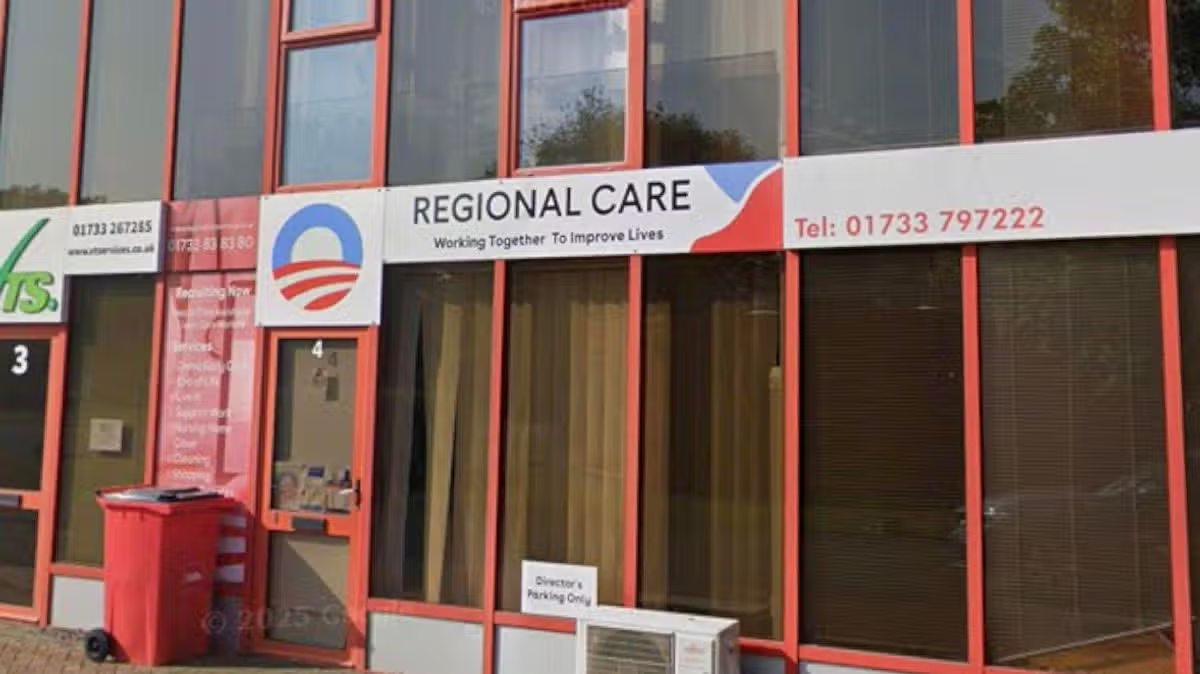
A Cambridgeshire homecare service with concerns that had put people “at risk of potential harm”, has been rated as ‘requires improvement’. The Care Quality Commission (CQC) carried out an inspection at Regional Care Peterborough in Bakewell Road between March 9, 2026 to May 12, 2026.

Advertisement

Inspectors followed up on previous breaches of regulation in relation to governance and safe care. After the inspection, CQC inspectors said “improvements were not found” and the provider “remained in breach of these regulations”.

The inspection identified that “not all people had always received safe care and support”. It identified issues with medicines management, risk assessment and quality assurance.

While CQC inspectors found no evidence that anyone had come to harm, issues were identified that “had put some people at risk of potential harm”.

Murphy Cole, the owner and director for Regional Care said: “Regional Care Peterborough welcomes the publication of the latest CQC inspection report and is pleased to see the significant progress recognised since the previous inspection.

Advertisement

“Our last inspection identified five areas requiring improvement. Through the hard work and dedication of our management team and staff, this has now been reduced to three areas being rated as Good, demonstrating the substantial improvements made across the service.

“We are particularly pleased that the rapid response of our team in addressing issues was acknowledged and praised by both local authority partners and CQC inspectors.”

People’s care records reviewed were said to either not fully assess or clearly plan for how to mitigate risks. The assessment found there were “multiple areas” where key risk assessments or detailed guidance in people’s care plans were missing or incomplete, including for skin integrity risks and risks associated with people’s health conditions.

CQC claimed the provider had not always taken sufficient timely action to drive improvement in all areas of the service. Governance arrangements remained inconsistent and had not been fully effective in identifying or addressing ongoing risks.

Advertisement

As a result, the manager updated the governance systems but CQC recognised there had not been time for the new system to be embedded during the assessment.

The provider was previously in breach of the legal regulation in relation to people being treated with dignity and responding to complaints. Improvements were found at this assessment, and the provider was no longer in breach of these regulations.

Mr Cole added: “While we are encouraged by the positive progress reflected in this report, we fully recognise that there are still areas where further improvements are required.

“The safety, wellbeing and quality of care provided to our clients remains our absolute priority, and we are committed to continuous improvement in every aspect of our service.”

Advertisement

The report said: “People and relatives told us they felt safe with staff. People and relatives said they were involved in developing care plans and that staff responded when people’s needs changed, including contacting GPs or district nurses when required.”

People said they are “very pleased with the carers” and they “are generally on time”. Another told CQC they “always [treat them] with dignity and respect”, however, they have “to tell them every time what to do”.

Overall, the home service was rated as ‘requires improvement’ in the safe and well-led categories. Other categories were rated as ‘good’.

Regional Care offers services and specialises in personal care, caring for adults over 65 and under 65, dementia, learning disabilities, mental health conditions and physical disabilities.

Advertisement

The spokesperson added: “Since the inspection, we have continued to work closely with local authorities and other partner agencies to strengthen our service. A comprehensive three-month service improvement programme is already underway, and we have proactively invited the CQC to revisit the service to review the progress being made.

“It is important to note that we raised concerns regarding the way in which the inspection was conducted. We also raised concerns that vital information submitted during the inspection process had been lost by the CQC.

“As a result, a formal complaint has been submitted, and we are currently awaiting their response. While this process is ongoing, we remain focused on delivering high-quality care and working constructively with all regulatory and partner organisations.

“We are proud of the progress our staff have achieved and thank them for their continued professionalism, dedication and commitment to improving outcomes for the people we support.

Advertisement

“We will continue to build on this progress and remain committed to providing safe, compassionate and person-centred care.”

Source link

Continue Reading

NewsBeat

Why the King’s patience finally snapped after Harry’s endless flip-flopping on Palace stay: REBECCA ENGLISH reveals how Charles was pushed to breaking point by ‘chaos, disruption and disrespect’

Published

on

(L to R) Andy Mundy-Castle, Afua Hirsch, Misan Harriman and Prince Harry, Duke of Sussex attend the UK Premiere of 'Shoot The People' at Picturehouse Central in London on Monday

It was, in the words of one insider, ‘the day the King’s patience snapped’.

After weeks of dithering and flip-flopping, not to mention the repeated leaks and briefings by Team Sussex, His Majesty was pushed to breaking point. Enough was enough.

What prompted him to slap down his younger son wasn’t the embarrassment it was causing him personally to see their family difficulties being played out in such a public arena.

It was, as one source described to me yesterday, the ‘disruption and disrespect’ to his staff.

Advertisement

Buckingham Palace, you see, isn’t quite ready for visitors at the moment, let alone ones as high-profile as the boss’s son.

It’s still largely a building site (and will be until next year) and unsuitable for guests.

Nevertheless the royal household was still willing to prepare rooms for Prince Harry when he was due to arrive in the UK last night and to change existing staffing arrangements to have a team on standby to cater to his every whim.

But the constant to-ing and fro-ing had left the King’s patience worn extremely thin.

Advertisement

Having stood the staff team down again on Saturday morning after receiving yet another rejection from his son, His Majesty was astonished to receive a request just hours later to ask ‘Pa’ if he could have the rooms after all.

And the answer – which I understand was given directly to Harry – was a firm, ‘No. Sorry but you are too late.’ Certainly not at just 48 hours’ notice.

(L to R) Andy Mundy-Castle, Afua Hirsch, Misan Harriman and Prince Harry, Duke of Sussex attend the UK Premiere of ‘Shoot The People’ at Picturehouse Central in London on Monday

Advertisement
It was, as one source described yesterday, the ¿disruption and disrespect¿ to his staff that prompted the King to slap down his younger son

It was, as one source described yesterday, the ‘disruption and disrespect’ to his staff that prompted the King to slap down his younger son

Harry with his children Lilibet and Archie, who he hopes to bring to the UK for a visit

Harry with his children Lilibet and Archie, who he hopes to bring to the UK for a visit

The Palace has highlighted another element in the situation. It was by no means the deciding factor but did add a ‘further degree of complexity’ to things and, it was apparently felt, could have compromised the King’s constitutional position.

Today, judgment will be handed down in the claim at the High Court by the Duke of Sussex against Associated Newspapers, publishers of the Daily Mail, of alleged unlawful information gathering. This has been strongly denied and contested by the Mail.

Advertisement

So why, do you ask, did Harry’s team suddenly issue a dramatic statement yesterday morning announcing he had accepted his father’s offer?

Those in royal circles say there are only two possible theories. First, that Harry hadn’t clearly communicated his father’s response back down to his staff (unlikely given that he was due to arrive in the UK only hours later, surely?). Or second, that it was a clear attempt to try to ‘bounce’ his father into reversing his decision.

But perhaps, there is a third possibility. That the furious prince simply doesn’t care any more and wants to cause his family maximum embarrassment.

Either way, Harry’s arrival last night was once again mired in the same smorgasbord of chaos, confusion, claim and counter-claim that has characterised all of his dealings with Buckingham Palace in recent years.

Advertisement

Hopes among courtiers that the Duke of Sussex could, for once, enjoy a low-key and ‘peaceful’ reconciliation with his father – perhaps with his two beautiful children in tow – are now as much of a pipe dream as ever.

And there are many – even those in royal circles who openly acknowledge the institution hasn’t always handled the ‘Sussex issue’ perfectly – who firmly believe it is a mess entirely of Harry’s own making.

Team Sussex argue that because the duke was thrown an 11th hour curve ball by the Home Office security committee RAVEC, which has declined to reinstate his full-time security while he and his family are in Britain, he has been busy trying to put his own plans in place.

A spokesman said it was ‘disappointing that the offer has been withdrawn . . . at the last moment’.

Advertisement

But it’s also worth noting that the prince’s trip this week to his country of birth has been more than a year in the planning, with a week of official engagements built around a major event in the Midlands on Friday to mark the 12-month countdown to his admirable Invictus Games for injured service personnel.

His team began organising the visit knowing full well that he had conclusively lost a High Court battle against His Majesty’s Government over the Home Office’s decision to strip him of his round-the-clock taxpayer-funded police protection when he chose to leave the UK and relinquish his royal duties.

A decision, it should be noted, that he railed against, accusing the courts, who administer justice in his father’s name, of colluding in an ‘Establishment stitch-up’ and claiming they had made it impossible for him to envisage a time he could ever bring his wife and children back safely.

It simply doesn’t make sense, his critics argue.

Advertisement

My understanding is that Buckingham Palace’s offer of royal lodgings was a genuine one.

However, despite repeated requests for clarity, no formal response to the offer of accommodation at a royal residence to Harry and his family had been received by the ‘necessary deadline’ at the end of last week.

While every effort had been made to facilitate his stay, as a courtesy to staff and others involved, the household does require a minimum level of notice to ensure he could be ‘hosted appropriately’ at a royal residence.

Since this offer was first made, every indication from the duke and his senior team remained that the accommodation was deemed ‘unsuitable’ – despite it being one of the most heavily guarded buildings in the country with men brandishing machine guns on every corner.

Advertisement
There comes a point, sources say, that Charles simply can¿t indulge the ¿constant chaos¿ that comes hand-in-hand with his younger son

There comes a point, sources say, that Charles simply can’t indulge the ‘constant chaos’ that comes hand-in-hand with his younger son

This was a concern which was repeated as late as Saturday morning, in which the prince formally declined the King’s offer once again. A ‘belated request’ was subsequently received later in the day to accept the accommodation offered for Tuesday evening, but by then the appropriate hospitality and staffing provision was no longer available.

Following consultation with the King personally, the decision to turn this down was communicated to Harry ‘through the appropriate channels’.

Asked whether there could be any doubt in Harry’s mind of this decision, a source said they couldn’t comment on the details but that they ‘could confirm the duke was aware’.

Advertisement

Which certainly accounts for the frustration emanating from the Palace yesterday following the unexpected announcement by Team Sussex that the Duke of Sussex would be staying at his father’s official London residence after all.

The Palace’s own pithy rejoinder – with definite shades of ‘recollections may vary’ – came just minutes later, a sign if ever needed of their immense displeasure.

It was clear that the King’s patience had been piqued. There comes a point, sources say, that Charles simply can’t indulge the ‘constant chaos’ that comes hand-in-hand with his younger son.

While some commentators suggested yesterday that the decision was a sign of bad faith – and bad parenting – by the King, who has hundreds of rooms at his disposal, this is a gross misrepresentation and misunderstanding of how both he and the royal household work. The King – who let us not forget is a man still receiving treatment for cancer and has worked throughout his diagnosis – is the last person who wants to pour petrol on the flames of a very fragile familial relationship.

Advertisement

Indeed, I would go so far to as suggest he appears somewhat saddened, although perhaps not surprised, by recent events. But what’s done, is done. So where does all this leave father and son?

Well, I am told that His Majesty still hasn’t ruled out seeing his son at some point over the next few days despite recent provocation, although clearly yesterday’s events have made that all the more difficult.

King Charles has an extremely busy working week with a heavy load of engagements each and every day.

As for meeting the grandchildren, he has barely seen since they were born – and who haven’t even been in the country for four years – that looks more tricky since Harry apparently hasn’t decided yet whether it ‘safe’ to bring them over from their holiday home in Europe.

Advertisement

The prince has, however, made clear that he still wishes to find a way to bring them to Britain towards the end of the week, when his work takes him to the Midlands and beyond.

As far as Buckingham Palace is concerned, it can only be hoped that the next few days go more smoothly than the last, and that such a meeting could be possible.

However, in the words of one insider yesterday: ‘Experience doesn’t lend itself to great confidence in this regard.’

Source link

Advertisement
Continue Reading

NewsBeat

‘Adele was so hurt. The comments really left a mark’: Friends tell OLIVIA KEMP what’s behind ‘unrecognisable’ star’s return to UK

Published

on

Adele made an appearance in the paddock during the Formula One British Grand Prix at Silverstone Circuit in Northampton

It is hard to believe that a woman who has sold more than 120 million records – and boasts 16 Grammys and an Oscar to her name – might still be troubled by a few unkind words spoken more than a decade ago.

Yet, according to friends, one particularly cutting verdict on Adele’s music has never entirely faded from her mind.

The singer has spent the past month quietly slipping back into Britain, making a series of under-the-radar appearances that, at first glance, seem entirely unconnected – but which, I shall explain, are linked by one key theme.

An evening at Lola Young’s concert in Brixton was followed by a euphoric night at Bad Bunny’s London stadium show, then a surprise visit to McLaren’s Formula One headquarters ahead of the British Grand Prix.

Advertisement

Now sources close to the star have explained to the Daily Mail what’s behind it all.

After a long spell out of the spotlight and almost two years into her self-imposed musical hiatus, Adele is, I’m told, rediscovering the things that first made her fall in love with music – and trying to find the confidence to record it again.

The mission, say those close to her, has been fuelled in no small part by one man: Noel Gallagher.

The former Oasis star has spent the better part of a decade dismissing Adele’s work in the crudest terms, suggesting it’s ‘music for f***ing grannies’ and ‘bland’. His withering verdict, say those close to the singer, stung far more than many realised.

Advertisement

Adele made an appearance in the paddock during the Formula One British Grand Prix at Silverstone Circuit in Northampton

After Lola Young's concert in Brixton, Adele was pictured with the young singer-songwriter

After Lola Young’s concert in Brixton, Adele was pictured with the young singer-songwriter

‘Adele was so hurt by Noel’s comments,’ one friend tells me. ‘They really left a mark on her. She is going back to her young Tottenham roots and has been immersing herself in “young, trendy” music. She’s going back to her own youth to write something that she hopes people will love.’

Advertisement

All of which might explain why the notoriously private singer has quietly been popping up at gigs all over London – seemingly happy to be spotted there.

Brixton’s O2 Academy has long been a proving ground for the capital’s most exciting new talent – so it was telling that Adele chose to go there first to support local star Lola Young.

At Bad Bunny’s sold-out concert, meanwhile, she appeared to have abandoned her usual anonymity by wearing an England football shirt and a straw pava hat. The star was filmed throwing her hands in the air and singing along with the crowd – while alongside her was Rob Stringer, 63, the chairman of Sony Music Group and one of the most influential executives in the business.

Their choice to attend together inevitably reignited speculation that new music from the star may finally be on the horizon.

Advertisement

Adele’s fiancé, the sports agent Rich Paul, 45, has also been by her side during the trip, with the couple making one of their rare appearances together in Britain.

Friends of the singer tell me that these sightings are about more than Adele simply enjoying a few nights out.

Instead, they’re part of her attempt to reconnect with music after years of privately being wounded by Noel’s brutal verdict.

The Oasis rocker first turned his sights on Adele in 2015, declaring: ‘If someone wants to know what I think of Adele, I’ll f***ing tell them… I just don’t see what all the fuss is about. I don’t like her music. I think it’s music for f***ing grannies.’

Advertisement

Asked whether he enjoyed listening to the London songstress, he branded her music as a ‘sea of cheese’ and lamented that industry had ‘nosedived into f***ing blandness’.

Eight years later, he was still at it. Asked by the podcaster Matt Morgan in 2023 whether he liked any of Adele’s songs, Noel replied: ‘F**k off, f****ng hell. Name one.’

He later revealed that his irritation had been sparked by Adele asking to meet him – but sending an intermediary to make the introduction rather than doing it herself.

‘She sent someone over to f***ing ask, “Did I want to meet her?” That’s what riled me,’ Gallagher told Morgan. ‘I’m not one for causing a scene, I just stick it in the vault and just think revenge is a dish best served cold.’

Advertisement

If those comments did indeed hurt, then Adele’s quiet return to Britain’s music scene suddenly feels all the more significant.

Noel Gallagher has spent the better part of a decade dismissing Adele¿s work in the crudest terms, suggesting it¿s ¿music for f***ing grannies¿ and ¿bland¿

Noel Gallagher has spent the better part of a decade dismissing Adele’s work in the crudest terms, suggesting it’s ‘music for f***ing grannies’ and ‘bland’

Since stepping away from music, Adele has devoted herself to life with her fiancé, the sports agent Rich Paul, and her 13-year-old son, Angelo

Since stepping away from music, Adele has devoted herself to life with her fiancé, the sports agent Rich Paul, and her 13-year-old son, Angelo

The Hello singer famously said goodbye at the end of her Las Vegas residency in 2024, telling her audience through tears: ‘I have spent the last seven years building a new life for myself and I want to live it now. I want to live my life that I’ve been building and I will miss you terribly.’

Advertisement

She warned fans that they would not see her again for ‘an incredibly long time’.

Since stepping away from music, Adele has devoted herself to life with Rich and her 13-year-old son, Angelo, whom she shares with former husband Simon Konecki.

But there are signs that the creative itch is beginning to return.

In April, reports emerged that the singer had quietly returned to the recording studio, almost five years after the release of her last album, 30.

Advertisement

And over the weekend, Adele – looking almost unrecognisable from the fresh-faced singer who burst onto the charts with 19 almost two decades ago – offered another glimpse into the life she has built away from the stage as she made a surprise appearance at Silverstone.

Dressed in a T-shirt paying tribute to Formula One world champion Lando Norris and wearing a necklace spelling out ‘Mummy,’ she spoke candidly about the unlikely obsession that now dominates her household.

‘My son is really into karting,’ she revealed.

‘I don’t know many teenagers who have a passion so I’m really trying to encourage it. He’s obsessed but I’m also obsessed.’

Advertisement

It was a rare candid moment from a woman who has spent much of her adult life wrestling with the burden of fame.

Asked by 2025 F1 World Champion Lando whether she still enjoyed singing, she replied: ‘I don’t sing very often any more’ and later opened up about her ‘struggles with fame’.

Now, friends say, she is stepping into the limelight again – listening to new music, revisiting old influences and reconnecting with the London that shaped her.

Whether that process ultimately leads to a new album remains to be seen.

Advertisement

But after two long years, it seems Adele, however hurt she remains by Gallagher’s unkind comments, may be prepared to sing again – and fans will be thrilled that her self-imposed exile from the music industry may soon be over.

Source link

Continue Reading

Trending

Copyright © 2025