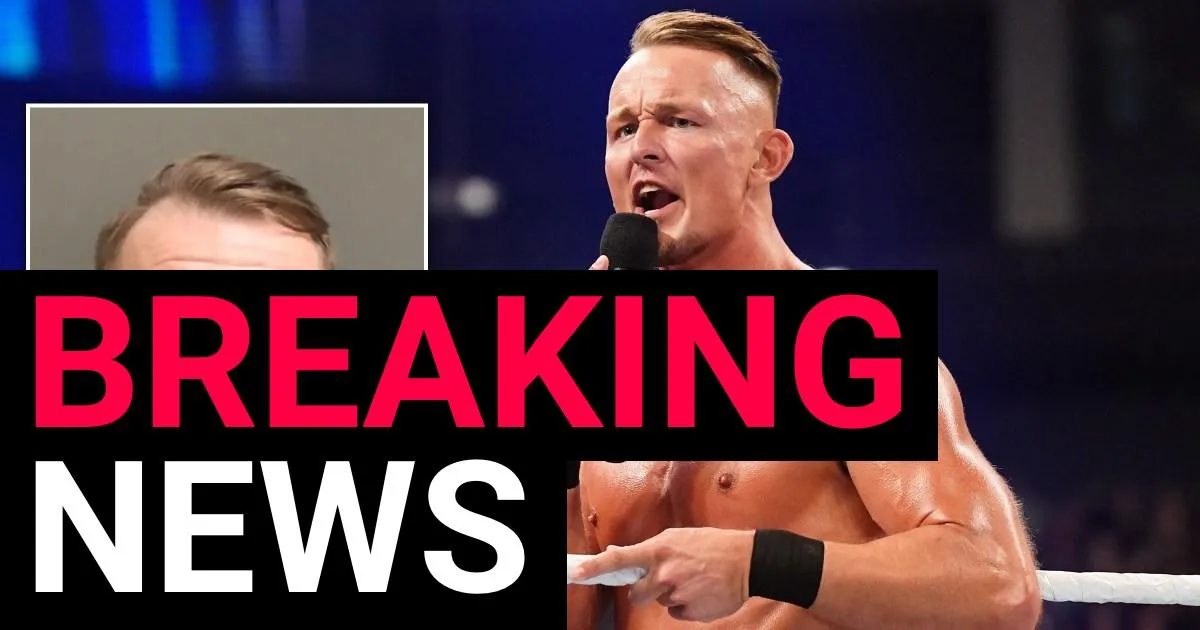
The wrestler Ludwig Kaiser has pleaded not guilty (Picture: Orange County Corrections Dept/Getty)
Wrestling star Ludwig Kaiser has reportedly been arrested days before one of WWE’s most anticipated matches.
The 35-year-old wrestler, whose real name is Marcel Barthel, has been portraying El Grande Americano on TV since June 2025 and is due to face Original El Grande Americano (Chad Gable) at AAA Noche de los Grande on May 30.
However, on May 20, Barthel was arrested and charged with misdemeanour battery, casting doubt over the Mask versus Mask bout.
According to an Affidavit for Arrest Warrant seen by Metro on the Orange County Clerk’s office website, Barthel, who has pleaded not guilty, has been accused of battery by another male resident in his Orlando apartment block.
Advertisement
In the documents, it’s alleged that in April 2026, the man had asked Barthel and his partner to ‘please have some manners’ after they started ‘acting in an “uncontrollably intimate” manner, which he described as aggressively kissing’.
It’s alleged that immediately after his comment, he was punched by ‘multiple times’ and pushed to the ground, before the defendant ‘made threats of additional violence toward him’.
In further court documents, Barthel’s attorney has confirmed his client’s ‘intent to participate in discovery’ regarding the allegation, and has ‘requested a trial of the said charges’.
Wrestling star Ludwig Kaiser, real name Marcel Barthel, has pleaded not guilty (Picture: WWE/Getty Images)
In a motion filed on May 21, Barthel entered a request to be allowed to travel ‘throughout the United States and around the world’. In the motion, it’s noted that Barthel ‘became aware of a warrant for his arrest’ on May 19, while he was ‘in Mexico for work purposes’.
It’s said he returned to Orlando on May 20 and ‘turned himself in to the Orange County Jail’, and was released ‘after posting a $1,000 bond’. The motion notes that he has ‘no prior criminal history anywhere in the world and is not a danger to others’, while he ‘maintains his innocence and has retained undersigned counsel to assist him in this matter’.
Advertisement
In light of that, he has filed a motion to be allowed to continue to work, which would include his upcoming match for AAA.
Neither WWE nor the wrestler have made a public statement on the arrest or charges.
As El Grande Americano, the German star has become a fan favourite in Mexico as part of WWE’s Lucha Libre AAA brand, which is run by Hall of Famer The Undertaker.
He has been portraying El Grande Americano on TV since June 2025 (Picture: Georgina Dallas/WWE via Getty Images)
He took over the Americano mask and character after Chad Gable suffered a torn rotator cuff injury in last summer, and over the past few months the pair have been locked in an intense storyline rivalry.
The feud has also spilled over to Monday Night Raw with the Creed Brothers and Los Americanos (Rayo and Bravo) getting involved. On May 30, both El Grande Americanos are due to face off in a bitter grudge match, with the loser being forced to unmask, which is seen as a mark of disrespect in lucha libre culture.
Advertisement
Back in 2024, Barthel opened up about his influences as a wrestling fan his his teens, and how he was drawn to ‘larger than life characters’ despite spending much of his career adopting a more serious persona.
‘I think Randy Orton is one of the best to ever do it. I loved The Rock back in the day, I loved Kurt Angle back in the day, Triple H, Shawn Michaels,’ he exclusively told Metro.
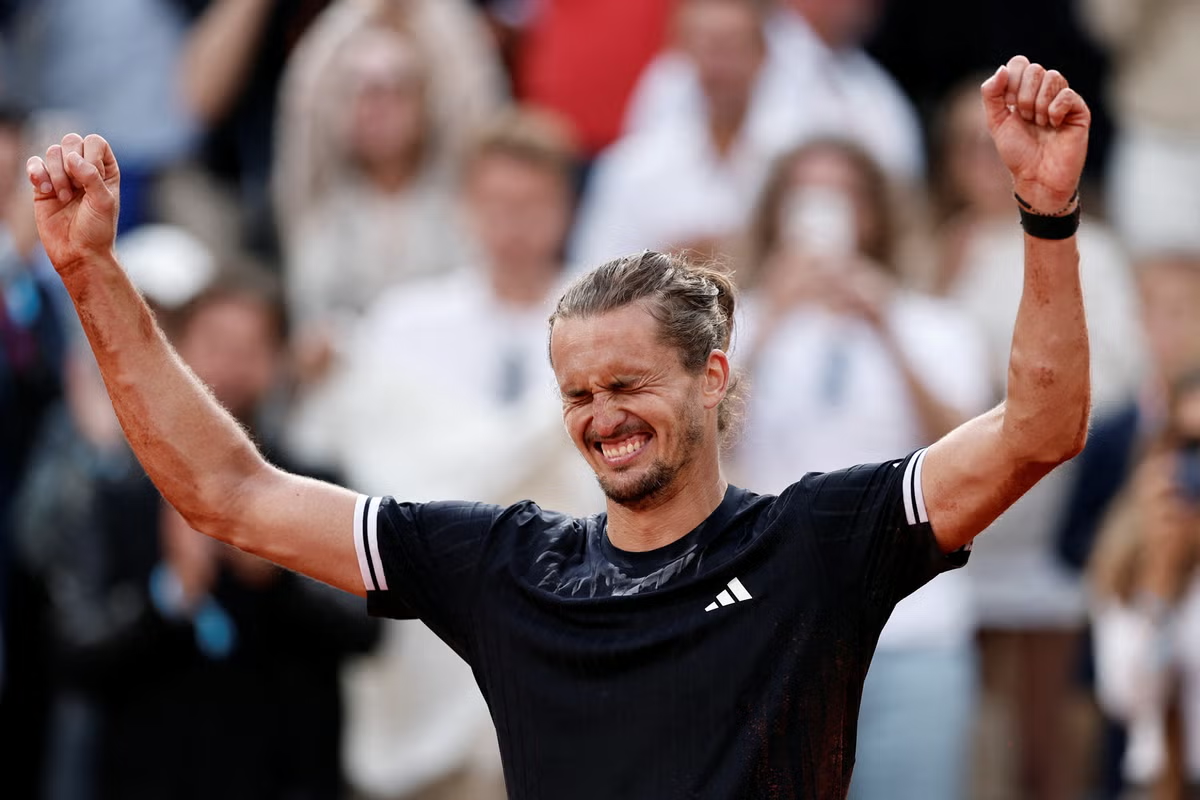
‘Obviously when you watch them as a teenager that does something with you, right? I can’t really pinpoint it to “I took this from from [Triple H], and I took this from Kurt Angle”, but definitely that shapes you one way or the other…
‘Those guys were definitely influences when it comes to wrestling in general.’
Advertisement
Metro has contacted WWE and the Orlando Police Department for comment.

Got a story?
If you’ve got a celebrity story, video or pictures get in touch with the Metro.co.uk entertainment team by emailing us celebtips@metro.co.uk, calling 020 3615 2145 or by visiting our Submit Stuff page – we’d love to hear from you.
“Be one of the first through the door — we can’t wait to welcome you!”
To mark the opening, Motor Fuel Group Starbeck Morrisons has also ran a raffle with a £100 (coupon) first prize, with a £50 coupon for the second prize.
The opening comes as the venue has also opened a new jetwash.
Advertisement
As previously reported, the opening adds to others nationally from the Motor Fuels Group.
In December a branch of Greggs opened at the Morrisons service station on the edge of Boroughbridge.
The supermarket is inviting the public to suggest locations as part of its UK-wide expansion plans.
Jonathan Neale, managing director of national real estate at Aldi UK, said: “We know how important it is for people to have access to affordable, high-quality food close to where they live, which is why we’re asking our shoppers to help us identify the communities that would benefit most from a new Aldi store.
Aldi asks for County Durham store suggestions (Image: Aldi)
“Opening new stores in these areas means we can bring great value to more customers, while also creating jobs and offering industry-leading pay.”
Aldi is investing more than £370 million in new stores this year as it works towards a long-term goal of reaching 1,500 locations across the UK.
Advertisement
This latest call for nominations follows last year’s campaign, which identified priority areas in London, Merseyside, and Oxfordshire.
Since then, Aldi has made progress on stores near Pendle Drive in Liverpool and in Hanworth and Willesden in London.
Members of the public can submit their suggestions by emailing NextNewStore@aldi.co.uk and stating the town they would like to put forward in the subject line.
The deadline for submissions is June 18.
Advertisement
Aldi expects to announce its latest list of priority locations later in the year.
In February, the chain tested its Beverage Buckets, designed with a unique lid and straw, in several Massachusetts and New Hampshire stores. At the time, customers could receive a coffee bucket starting at $8.99, or a refresher for $9.49.
Now, Dunkin’ plans to bring its largest drink size back to kick off Memorial Day Weekend, the coffee chain has confirmed to The Independent. When customers order an iced coffee or refresher May 22, they can have it served in the 48-ounce bucket for $12.99
Participating stores will only have 25 buckets each. Dunkin’ fans can customize their orders with a choice of dairy, swirls and flavor shots.
Advertisement
Once purchased, the collectible containers cannot be refilled at Dunkin’ locations.
Dunkin’ is releasing iced beverage buckets nationwide this Friday (Dunkin’)
Many Dunkin’ customers shared their excitement over the news, with one writing on Instagram: “YESSS YES YESSSSSS I WAS WAITING FOR THIS!!!!!!”
“I can’t wait to show up to my therapy session with this,” another quipped, while a third added: “This is incredible, looking forward to trying this.”
“Sign me up for an iced coffee bucket anxiety attack,” a fourth joked.
When the buckets rolled out in New England in February, some customers were overjoyed at the idea of the potentially monstrous caffeine intake. However, other Dunkin’ fans were frustrated by the limited release.
Advertisement
Dunkin’ Donuts is reportedly releasing its viral 48-ounce bucket May 22 (Getty Images)
The massive bucket isn’t the only new offer at Dunkin’. As part of its summer menu release last month, the retailer hopped onto the dirty soda trend by launching the Dunkin’ Dirty Soda, which combines Pepsi, coffee milk and sweet cold foam.
For the summer season, Dunkin’ also introduced a line of Black Cherry refreshers and an Oreo-themed line-up of espresso, matcha and frozen drinks.
In January, the brand joined in on the viral protein craze and launched its first Protein Milk, which provides “a simple way to add protein to the drinks they already love,” according to a press release at the time. Packed with 15 grams of protein per medium-sized beverage, the special milk aims to offer a “creamy, familiar taste without a chalky texture or aftertaste.”
Dunkin’ also announced a line-up of protein-packed drinks, including a Strawberry Protein Refresher, Caramel Chocolate Iced Protein Latte, Almond Iced Protein Matcha Latte and Iced Protein Latte with Sugar-Free Vanilla.
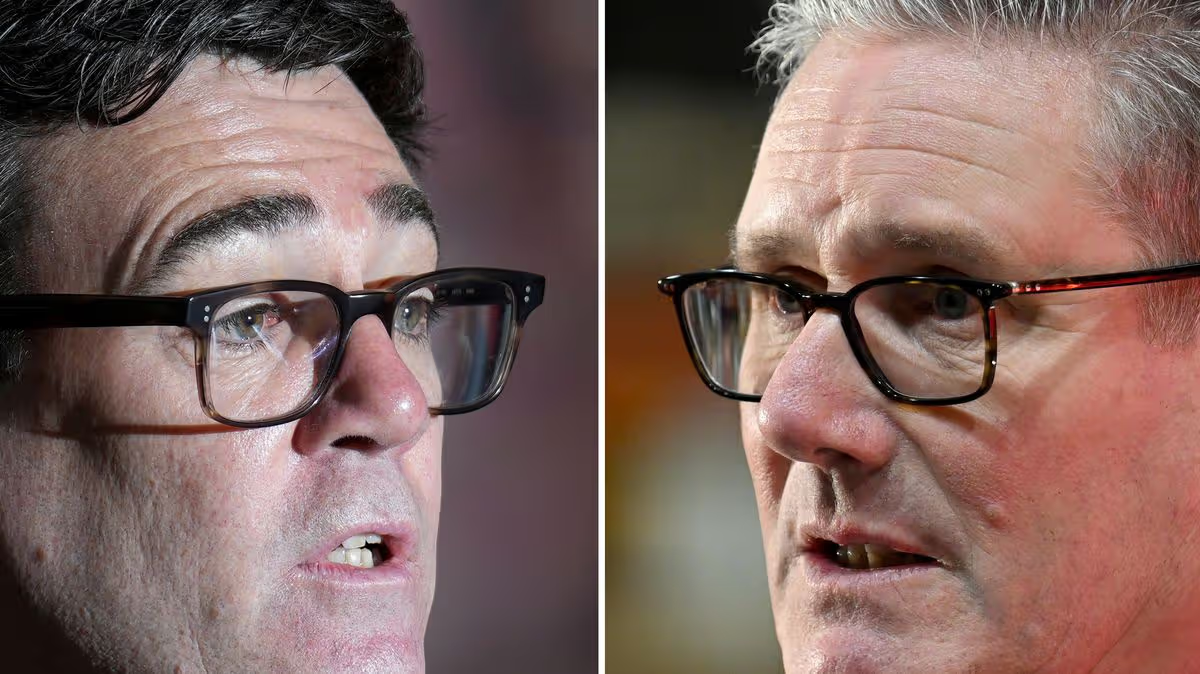
Rachel Reeves has announced a cut in the rate of VAT on tickets for theme parks, zoos and museums from 20% to 5% over the summer holidays.
The Chancellor set out the measure as part of a package aimed at easing the impact on the cost of living from the Iran war.
Sir Keir Starmer said the support would give families concerned about the months ahead “a bit of breathing room” to “enjoy moments that matter without the same level of financial strain”.
Ms Reeves told the Commons in a statement on Thursday: “This will apply to ticket prices for both adults and children, covering attractions such as fairs, theme parks, zoos and museums.
Advertisement
“It will include children’s tickets for cinemas, concerts, soft play, and the theatre, and it will cut the cost of children’s meals in restaurants and cafes from 20% VAT to 5% as well.”
She said the changes will apply across England, Wales, Scotland and Northern Ireland from June 25 until September 1.
The Government expects businesses to pass on VAT savings to customers.
Her “Great British Summer Savings” scheme, which the Treasury estimated would cost around £300 million, also includes free bus travel for children aged between five and 15 in England during the school holidays in August.
Advertisement
Other measures announced by Ms Reeves include a 10p per mile increase in tax-free mileage rates backdated to April, a £350 million critical chemicals resilience fund and a £120 million fund to help the ceramics sector, and the cutting of import tariffs on more than 100 types of food products.
The full package of measures comes at an estimated cost of £1.8 billion over six years, while the Treasury expects to raise hundreds of millions in revenue by changing the way oil and gas companies with overseas operations are taxed.
This would put an end to the practice of some firms structuring their tax affairs “in a way which ensures they pay little or no corporation tax on their UK energy trading profits” and “raise hundreds of millions of pounds a year”, Ms Reeves said.
As expected, Ms Reeves did not announce immediate help with energy bills driven up by Donald Trump’s war in the Middle East.
Advertisement
The household energy price cap is predicted to rise by £209 a year from July after the closure of the Strait of Hormuz pushed up global oil and gas prices.
Ms Reeves told MPs: “Because of the decision that I made at the budget last year to cut £150 from energy bills, we have lessened the impact of rising prices and current external forecasts suggest that the cap from July will be at a similar level to the cap in April last year.
“We stand ready to act if market conditions worsen significantly later this year and I have been leading cross-Government contingency work on design of potential future targeted and temporary support for businesses.”
Final costings for all the measures will be detailed at the next budget following scoring from the Office for Budget Responsibility, according to the Treasury.
Advertisement
Prime Minister Sir Keir Starmer said the Government is making it more affordable for families to enjoy themselves this summer (Stefan Rousseau/PA) (PA Wire)
Sir Keir, who was seeking to regain control of the political agenda with the announcements after his premiership came under pressure, said it was “not right” that “for too many families those things – a trip to the seaside, a visit to the zoo, a bus ride into town for a day out, even a simple treat at the end of the week – are starting to feel out of reach”.
The Government was providing “a serious response” to the “concerns people have about the months ahead” due to global instability, the Prime Minister wrote on Substack.
“This summer, we are making it easier and more affordable for families to get out, spend time together, and make memories they will cherish for life.”
Theme parks and cinemas welcomed the the slashing of VAT, with British Association of Leisure Parks, Piers and Attractions chief executive Paul Kelly saying it was “a very welcome and timely boost for the UK’s visitor attraction sector”.
“Our members stand ready to pass on this benefit and deliver brilliant, memorable experiences for visitors of all ages.”
Advertisement
UK Hospitality chairwoman Kate Nicholls said a lower rate of VAT for hospitality was “the quickest and simplest way to lower prices and boost consumer confidence”.
Both the carrier and the plane maker were convicted of corporate manslaughter in connection with the tragedy. The aircraft, Air France flight 447, was en route from Rio de Janeiro in Brazil to Paris when it plunged into the Atlantic Ocean.
Within five days of the disaster, the Brazilian Navy retrieved the first two victims’ remains along with debris from the aircraft. It is believed the passenger jet went into a stall during a storm, resulting in the loss of everyone on board.
Among the deceased were three young Irish women. Jane Deasy, Eithne Walls, and Aisling Butler from Ireland were all passengers on the flight. The women, all medical professionals, were returning home following a holiday in Brazil.
Family members of some of those who perished, including French, Brazilian and German citizens, assembled as the appeals court ruling was delivered on Wednesday, reports Belfast Live.
Advertisement
Air France chief executive Anne Rigail had previously stated the tragedy is “forever engraved in our memories”, while Airbus chief executive Guillaume Faury informed judges that “any accident is a failure”.
Both corporations have been instructed to pay the maximum penalty of €225,000 ($261,720; £194,500) each. Nevertheless, certain families of the victims described the sum as a symbolic sanction.
The ruling marks the latest development in a 17-year legal battle between two of France’s most prominent companies, with the case leaving an indelible mark on the aviation industry.
In its wake, regulations governing airspeed sensors and pilot training procedures were overhauled. An official inquiry concluded that a combination of factors contributed to the catastrophic crash.
Ice had rendered the aircraft’s pitot tubes inoperable, cutting off vital speed and altitude data. With the autopilot disengaged, the crew assumed manual control, but were working with faulty navigational information, according to The Mirror.
This caused the aircraft to enter an aerodynamic stall, its nose tilting upwards before it plummeted into the ocean. The wreckage and the flight’s black box recorders, lying at depths exceeding 13,000 feet (approximately 4,000 metres) beneath the ocean’s surface, took nearly two years to locate.
Ensure our latest news and sport headlines always appear at the top of your Google Search by making us a Preferred Source. Click here to activate or add us as Preferred Source.
The teenagers, now aged 15, carried out the attack in an underpass in Fordingbridge, Hampshire
14:23, 21 May 2026Updated 14:36, 21 May 2026
Two teenagers have avoided prison sentences after being found guilty of raping a girl in a horror 90-minute ordeal during which she was forced into a “threesome”.
A trial at Southampton Crown Court heard that two girls were raped in two separate incidents in Fordingbridge, Hampshire, with the first attack taking place on November 26, 2024, and the second on January 17, 2025.
A 15-year-old boy was sentenced to a youth rehabilitation order (YRO) for three years with 180 days of intensive supervision and surveillance (ISS) for the rape of each of the two girls and two indecent images charges. The court heard that he had been diagnosed with ADHD as well as “long-standing anxiety”.
Advertisement
A second 15-year-old was given the same sentence for three charges of rape against each of the two victims and four counts of taking indecent images in relation to filming of the incidents.
The court was told that he had an IQ of the “bottom 1% of his contemporaries” and had been diagnosed with ADHD. A third boy, aged 14, was given a YRO for 18 months for two charges of rape in the January incident by encouraging the second defendant and an offence of indecent images. He was described as having “mild cognitive impairment”.
The court previously heard that the victim of the November attack, who was 15 at the time, met one of the defendants on Snapchat. The girl then travelled from her home to visit him, and after he bought her a bottle of Lucozade they had been chatting in the park.
Advertisement
She agreed to go to an underpass where she agreed to perform sex acts on the boy, who was then 14, until they were disturbed by passers-by, the court heard.
Jodie Mittel KC, prosecuting,said the girl was “nervous” but “comfortable” when alone with the boy because she was feeling “some love towards” him. But she became “scared and anxious” when a second defendant, who was 14 at the time, and a third boy who is not the third defendant, arrived and began “pressuring her and they recorded her” and they were “laughing”.
She told jurors the boys suggested they had a “threesome” which the girl “felt disgusted” by but went along with because she felt it was “the three boys against just her”. The prosecutor said: “The word she used to describe how she was feeling was petrified. (She) says she did agree but only because she didn’t know what would happen if she didn’t say yes.”
Ms Mittel said the boys and the girl went back to the underpass where the girl said she felt “cornered and trapped” as the two defendants raped her and the second defendant filmed. Ms Mittel said the girl described how she felt “numb” and added: “She says she was shaking and saying the boys were just laughing and recording what happened.” The incident lasted around 90 minutes, she added
Advertisement
Judge Nicholas Rowland told the defendants: “I have to remember that you are not small adults. I have to think how likely you are to do serious things again and I need to make sure you do not do serious things again in the future.”
Explaining his sentence, he added: “I should avoid criminalising these children unnecessarily and understand the effects of their behaviour and support their reintegration into society.”
He added that “peer pressure played a large part in what went on”.
The victim of the first incident came to the court for the sentencing hearing and, screened from the view of the boys, read her victim impact statement as well as a poem she had written directed towards her attackers.
Advertisement
She described how her mental health had deteriorated since the incident leading her to isolate herself from her friends.
She said: “I was caught off-guard, I never want that to happen again, I will never get that innocence back again.”
The poem included the line: “All I want to do is die, I no longer have fear for when that comes.”
She added: “No one deserves the trauma of being raped.”
Advertisement
In a statement read on behalf of the second victim, she said her school attendance had suffered and added: “I often feel overwhelmed, anxious and emotionally exhausted to the point where sitting in a classroom becomes unbearable.
She described suffering nightmares and struggling to sleep and added: “I feel ashamed, insecure and uncomfortable in my own body.”
She added: “The person I was before the incident has completely gone and sometimes I feel like I am grieving the person I used to be.”
The judge praised the bravery of the two girls for providing their statements and giving evidence and said to the first victim: “I hope when you look back on today’s date you will take some comfort from the fact you have shown that courage in coming along to court.
Advertisement
“You and (the second girl) have shown great courage in coming along to the trial and speaking as you did.”
He added: “The sentence I am going to pass cannot possibly undo what happened to you.”
The boys were also made subject to a three-month curfew and given a restraining order for 10 years not to contact their victims.
The complainant in the January incident, who was 14 at the time, was raped in a field near to Fordingbridge recreation ground while the incident was also filmed.
The tours conclude in the sitting room where the late Queen would work, reviewing the papers and documents presented in the Government red dispatch boxes, as well as using the room for private audiences or resting between engagements, often while watching horseracing on television.
Stephen Ashes, 44, has links to York and North Yorkshire Police believe he may still be in the area.
He is described as white man, who is bald with a beard.
Recommended reading:
Advertisement
Ashes was last seen wearing a green t-shirt and black jeans.
A force spokesperson said: “Extensive enquiries are ongoing to locate Ashes and we are now appealing for your help to find him.
“If you have an immediate sighting of Ashes, please call 999. If you have information about his current whereabouts, please call North Yorkshire Police on 101.
“Alternatively, you can pass on information anonymously through the independent charity Crimestoppers by calling 0800 555 111 or via their website.
Advertisement
“Please quote reference number 12260091300 when passing on any information.”
What might a sixth-century monastic rulebook have to say about how we live today? Living by the Rule: Contemporary Meets Medieval, the centrepiece of this summer’s exhibitions at the Sainsbury Centre in Norwich, takes up that question. As curators, we bring present-day habits and assumptions into dialogue with a seemingly distant counterpoint: medieval monasticism, and in particular the Rule of St Benedict, written in sixth-century Italy.
Benedict was born into a noble Roman family around 480, shortly after the fall of the Roman empire. It was a period in which the political and economic certainties that had structured society for centuries were rapidly unravelling.
As a young man, he abandoned his studies and set out to live differently. He experimented with forms of withdrawal from society, including years of living as a cave-dwelling hermit, before eventually founding a large religious community at Monte Cassino, halfway between Rome and Naples.
The Rule was written towards the end of his life, a direct product of his reflections and experiences. It offered a framework for a radically different kind of life, explicitly set apart from the social hierarchies and economic imperatives of the wider world. Benedict imagined a life of stability, community and measure; one devoted to the care for souls and, ultimately, to spiritual salvation.
Many of Benedict’s rules were pragmatic rather than ideological: who should be served their dinner first, how to make sure everyone wakes up on time for night prayers, when to schedule toilet breaks. His Rule is preoccupied with all the gritty detail of creaturely routines, because these habitual concerns were fundamental to the smooth running of a community. Benedict believed that if a community functioned well, it made space for its members to engage with the meaning of life beyond the everyday.
Living by the Rule
Curating Living by the Rule: Contemporary Meets Medieval, we were aware that the idea of “living by the rule” might sound off-putting to some visitors – too close to simply doing what you’re told. It also sits uneasily with the individualism of our age, in which meaning is often framed in terms of personal fulfilment or even “optimisation”. Rules, by contrast, point to our dependence on others and the obligations that come with it.
Advertisement
It is important, though, not to confuse Benedict’s “Rule” with modern laws or regulations. The term comes from the Greek kanon, via the Latin regula, meaning a pattern, model or yardstick: something to guide judgment rather than dictate behaviour. Unlike modern faith in impersonal rules, Benedict’s approach is strikingly flexible. Nothing is so fixed that it cannot be adapted, or even set aside, in light of different people and circumstances.
Translating these ideas into an exhibition was far from straightforward.
At the heart of our work was the conviction that something fascinating emerges when medieval objects are brought into dialogue with contemporary artworks. Rather than organising the exhibition around a single theme or subject, we were interested in something more fundamental: art’s relationship to lived experience and how it shapes, and is shaped by, the forms of life around it.
This also required taking the radical break between the medieval and the modern seriously. There are, of course, points of deep resonance between monastic life and today’s world – in the shaping of institutions, for example, or in how we structure time. Yet the rise of modern mass societies also introduced conditions that make any straightforward translation of Benedict’s Rule into contemporary social life far from simple.
Importantly, the monks were experimenting with a different way of living – and of living together. As Benedict puts it, this way has to differ from the world’s way.
Modern artists, too, have often tried to operate at a distance from the world – its priorities, habits and ways of seeing. For a long time, art has not been tied to any clearly shared social function or agreed purpose. Instead, it has come to exist at a remove from everyday life, a shift that brings both losses (in stable purpose and patronage) and gains (in new creative and entrepreneurial freedoms). Modern art, in this sense, becomes an experiment in another way of doing things – though one that remains entangled with the very world it seems to resist.
So what happens when the medieval monastery meets contemporary art? The sections of the exhibition and its accompanying book explore principles that are both attractive and repulsive to us now.
British Benedictine monk Dom Sylvester Houédard. Dom Sylvester Houédard Archive/John Rylands Research Institute and Library/University of Manchester/Prinknash Abbey Trustees
These include stabilitas – the expectation that monks remain within their monastery for life; obedience, expressed in submission to the authority of the abbot; the renunciation of private property in favour of shared ownership based on use and need; and a life oriented above all towards prayer. Together, these demanding and remarkably enduring principles offer a striking way to view the present, unsettling some of our basic assumptions about how life is organised and what it is for.
We invite visitors to leap from the medieval to contemporary and back again, without knowing exactly what they will find. We hope the results are vivid and unexpected, throwing up questions and offering plenty of food for thought – unfamiliar ideas and experiences to be chewed over and digested.
The rules we live by today – whether chosen or inherited – are the product of historical forces. Art reminds us that life is never fixed, and that it can always be organised differently.
The mother of a teenage boy who was stabbed to death in the street hit out at knife crime, telling his killers that the ‘death of my son should not just be another statistic’.
Mohanad Goobe, 15, was set upon, dragged to the floor and kicked before being stabbed through the heart in Moss Side last September. Three boys have today (May 21) been sentenced at Bolton Crown Court in connection with his death.
Boy A, 16, who stabbed Mohanad, and Boy B, 15, who sourced the combat knife used in the killing, were found guilty of murder. Boy C, 14, who ‘lent active support’, was found not guilty of murder, but guilty of manslaughter.
Click here to hear the latest from Manchester’s courts in our newsletter
Advertisement
Boy A and Boy B were both handed the youth equivalent of a life sentence, and ordered to serve 19 years and 18 years respectively. Boy C was handed a determinate six year sentence. The defendants cannot be named for legal reasons.
Mohanad’s mother, Amaley Ahmed, told of her and her family’s devastation at their loss. She said: “Why has it become the norm for our youths of today to think it is cool to carry knives?
“While this is becoming acceptable, all our child’s lives are at risk, and as a family, we are living with the consequences. I want people hearing this statement to understand that Mohanad was taken from us without a thought for the consequences, and his death should never have happened.
“Knife crime, sadly, is becoming prevalent among our children, but the death of my son should not just be another statistic. Mohanad was a living, breathing, larger than life, lovable, sometimes cheeky, 15-year-old boy, whose life ended when another child made a choice to take a knife out with them, and chose to use that knife on my son.
Advertisement
“A choice that killed my son, and ended our lives as we knew it. I feel many emotions, including anger, for the boys responsible for my son’s death, but I also feel pity, for they too will have to live with the consequences of what they have done and I hope they see Mohanad’s face for the rest of their lives.”
She added: “Our lives will never be the same again and we will never come to terms with what has happened and the senselessness of it all. Mohanad was the centre of our family, a typical teenager, who loved hanging out with his friends and spending far too long on his gaming station.
Advertisement
“He wasn’t in a gang, and he had never been in trouble with the police. A fall out between a group of boys resulted in Mohanad losing his life.”
‘You took it to another level, and murdered him in the street’
The court heard that Mohanad’s murder, on September 15 last year, followed a series of street fights in the weeks prior.
Sentencing, Mr Justice Griffiths said: “He [Mohanad] had got into arranged fights which were sometimes shared with boys from several schools on social media. No weapons were used.
“There were no serious injuries. This was jockeying between schoolboys for status and bragging rights, the winners and the losers changing places from fight to fight, and not much damage done except injured pride.
Advertisement
“But you, [Boy A] and [Boy B}, took it to another level, got a combat knife, and murdered Mohanad in the street. You, [Boy C], lent active support to the joint attack, guilty of manslaughter.”
The fights were discussed on social media, including on TikTok and Instagram. Following one fight in Alexandra Park about two weeks prior, Boy A had been left ‘humiliated’ after it appeared he had lost. Mohanad had been present in support of Boy A’s rival.
The judge said that Boy A then ‘decided to raise the stakes and start fighting dirty by introducing ambush tactics and knives’. Despite being only 15, the judge said Boy B had begun ‘dealing in knives for money’. In the intervening period, there was ‘feverish chatting and speculation’ about what would happen next, until September 13 when Boy A and Boy B began plotting a ‘group, surprise attack, with knives’.
They suggested to Mohanad and his friends that it would actually be a ‘fair fight between one or two on each side without weapons’. Boy C said he did not expect it to be a knife fight.
Advertisement
Boy A and Boy B ‘did not let on to the rest of the group the full extent of their real plan’, the judge said. They arranged to meet after school on Monday, September 15 in Whitworth Park. Mohanad had been pressured to agree to a ‘fair, arranged fight against his better judgment so as not to lose face’. The two groups came together for about an hour, without any fighting taking place.
“[Boy A] and [Boy B] did not want a fair fight,” the judge said. “The boy who was expected to fight on their side had not been brought with them. If there had been a fair fight, their side might have lost again, and they weren’t going to risk that.”
As Mohanad and two of his friends began to leave, they were followed by a group of boys with the other side, and Boys A, B and C led the charge. Boy B threw Mohanad to the floor, Boy C kicked him ‘as hard as he could’ as he lay prone. Mohanad got back up and threw some punches in self-defence, before Boy A stabbed him with ‘deliberate, lethal force’.
Mohanad was able to get up, but seconds later he collapsed. He died in the street. Speaking before sentencing was passed on her son’s killers, Mohanad’s mum said: “Mohanad brought out something special in everyone he met, such was his way. I will be forever grateful for the time I had with him.
Advertisement
“I, on behalf of my family, can only request that the persons responsible are given a sentence that reflects the devastating effect this has had on our family, and will continue to do so. Whatever sentence they are given, the sentence we will live, without Mohanad, will far outweigh it.”
You must be logged in to post a comment Login