It’s been named the best place in the East of England according to Zoopla
Freddie Lynne and Vicky Shaw Press Association Personal Finance Correspondent
17:00, 14 Feb 2026
Rising incomes and recent falls in mortgage rates may make getting on the property ladder easier for some people who are buying on their own, according to a property website. Zoopla analysed prices for smaller homes with one or two bedrooms, and compared this with average incomes for single earners to pinpoint cities where single home buyers may have a particularly good chance of getting on the property ladder.
The website said that single buyers account for around two-fifths (39%) of first-time purchases, with affordability constraints often working against single earners and making it harder to “go it alone”.
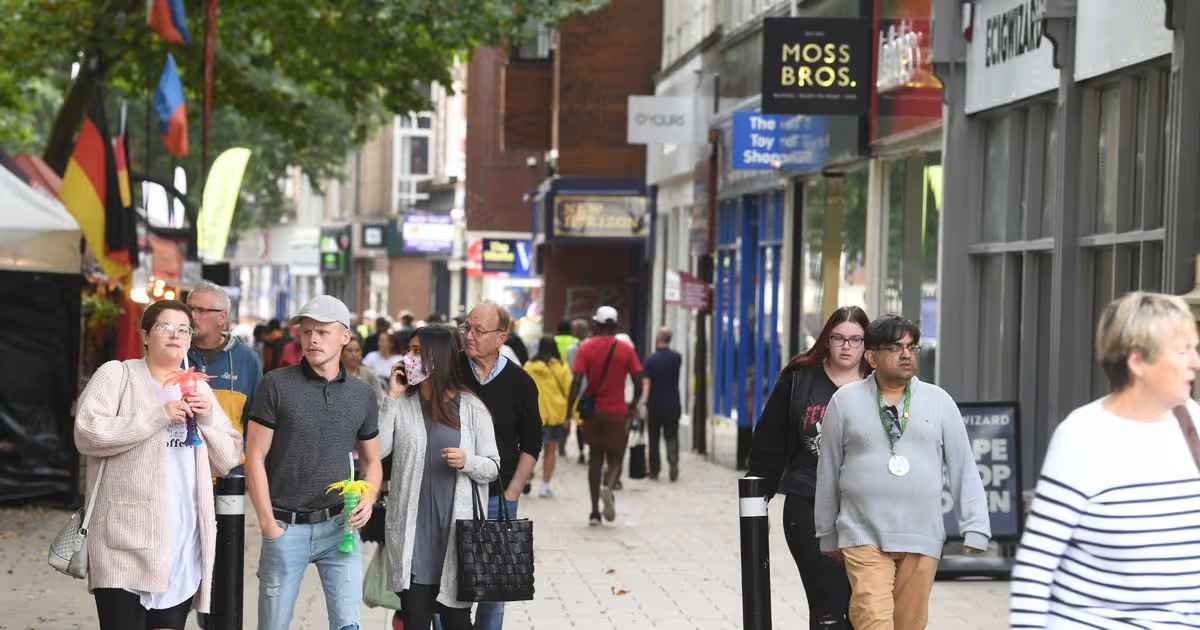
Zoopla found that in Peterborough was the most affordable city for single buyers in the East of England, with a typical first-time buyer home there costing around six times their average earnings. The average home price in the city is around £183,200, while the average buyer’s income is £30,500.
Advertisement
Richard Donnell, executive director at Zoopla, said: “Buying a home can feel out of reach for many singles who have to rely on just one income to cover mortgage and other costs of home ownership. Rising incomes and lower mortgage rates mean that owning a home by yourself is increasingly possible.
“For many, that means buying a smaller-sized home where property prices have risen more slowly than for larger, family-sized homes in recent years. It’s important to do your research, digging into mortgage affordability and products aimed at singles while considering alternative locations and selecting the right area for you.”
Kesha Foss-Smith, regional director at John D Wood & Co, said: “Single buyers are becoming far more strategic about where and what they buy. Many are prioritising affordability over postcode prestige and choosing areas that still offer good transport links, local amenities and long-term value.
“The combination of stabilising house prices and improved mortgage rates has opened doors again, and we’re seeing renewed confidence in the market, particularly for one and two-bed homes. With more choice coming on to the market and sellers being more open to negotiation, this is one of the more favourable windows we’ve seen for single buyers in recent years.”
This extremely toxic, nicotine-like compound originates from the Epipedobates genus of poison dart frogs, found exclusively in northern South America. Crucially, these amphibians are not indigenous to Russia.
Species such as the brightly coloured Anthony’s poison arrow frog and the Phantasmal poison frog secrete this substance onto their skin. Researchers theorise that the frogs acquire the toxin through their diet, as captive-bred animals lack it, and wild populations exhibit varying levels depending on their habitat.
Yulia Navalnaya, human rights activist and wife of Alexei Navalny, gives a press statement on the death and circumstances of her husband’s death. (Kay Nietfeld/dpa via APAP)
Epibatidine has been investigated as a pain killer and for relief from painful inflammatory conditions of the lung such as asthma and pulmonary fibrosis.
However, it is about a hundred times more potent than morphine and because of its toxicity is not used clinically.
Advertisement
Professor Alastair Hay said Epibatidine acts to inhibit nerve action by blocking nicotinic receptors in the central and peripheral nervous systems.
The Professor (Emeritus) of Environmental Toxicology at the University of Leeds added: “The effect of blocking these receptors is muscle paralysis and paralysis of the respiratory system.
“So, breathing is blocked, and any person poisoned dies from suffocation.”
Professor Hay said the presence of the toxin in a person’s blood “suggests deliberate administration”.
Advertisement
He added: “Epibatidine toxicity can even be increased by co-administration of certain other drugs and these combinations have been researched.
“If epibatidine, a toxin, was indeed used to poison Alexei Navalny, this is in violation of the 1972 Biological and Toxin Weapons Convention (BTWC) and the 1993 Chemical Weapons Convention (CWC).
“The Soviet Union was a co-sponsor of the BTWC. Russia is a signatory of both the BTWC and CWC.
“If Russia used Epibatidine to poison Mr Navalny it has violated two treaties it has sworn to uphold.”
Advertisement
Epibatidine can be detected using a combination of gas chromatography and mass spectrometry.
Gas chromatography helps separate out compounds of interest and mass spectrometry breaks up chemicals into particular fragments to create a unique fingerprint of the substance which can then be identified.
England saw Henry Arundell sin-binned for not releasing after a tackle during a tumultuous opening period, with the Bath winger receiving a second yellow card and 20-minute red for taking out Kyle Steyn in the air before the break, having got England off the mark with his fourth try in two matches after returning from a first caution.
Arsenal have the opportunity to book their place in the fifth round of the FA Cup this weekend as they face Wigan Athletic.
The Gunners are in need of a confidence boost as their Premier League title charge seems to be faltering, with a midweek draw at Brentford trimming their advantage to just four points.
Plenty of opportunities remain for them to win silverware this season, with FA Cup, Champions League and Carabao Cup campaigns all very much alive, and Mikel Arteta’s side can take another step closer to booking tickets to Wembley as they face the Latics.
Wigan are in the midst of a challenging season. They sit 22nd in League One, only one point adrift of safety, but relieved manager Ryan Lowe of his duties last week. Glenn Whelan will take to the dugout at the Emirates, then.
Advertisement
The Latics are on a miserable run, too, taking five losses and one draw from their last six outings. Their most recent win came in the cup, though, as they edged past north-west rivals Preston North End 1-0.
Arsenal have not faced Wigan since knocking them out in the semi-finals of this tournament in 2014, when Mikel Arteta scored from the spot in a penalty shootout.
Noni Madueke scored Arsenal’s only goal as they drew 1-1 with Brentford on Wednesday night
Arsenal FC via Getty Images
Date, kick-off time and venue
Advertisement
Arsenal vs Wigan is scheduled for a 4.30pm GMT kick-off on Sunday, February 15, 2026.
The match will take place at the Emirates Stadium in north London.
Where to watch Arsenal vs Wigan
TV channel: In the UK, the game will be televised live on TNT Sports 1, with coverage starting at 4pm ahead of a 4.30pm kick-off.
Advertisement
Live stream: TNT Sports subscribers can also catch the contest live online via the Discovery+ app and website.
Live blog: You can follow all the action on matchday via Standard Sport’s live blog, with expert analysis from Matt Verri at the ground.
Arsenal vs Wigan team news
Havertz is expected to remain sidelined through the end of the month, though it is not yet clear when Saliba could be back in the fold. In any case, Arteta may opt to rest him in a match he will expect to win without his first-choice starters.
Advertisement
Martin Odegaard seemed to take a knock to his knee in the Brentford draw, and may also be rested against Wigan.
Absent: Mikel Merino is sidelined after undergoing foot surgery
Getty Images
Arsenal are expected to rotate for the match, though, with the likes of Myles Lewis-Skelly, Ben White and Eberechi Eze in line for an opportunity to impress.
Wigan, meanwhile, may be without James Carragher, son of Liverpool legend Jamie, as he has now missed back-to-back matches with a knock.
Advertisement
Harry McHugh is also sidelined, though Baba Adeeko and Luke Robinson are both expected to come back into the side after their lay-offs.
Arsenal vs Wigan prediction
Everybody loves a fairytale, and who would not want to see a managerless League One side knock out the Premier League title hopefuls?
Unfortunately for the football romantics, such a storyline does not seem likely to materialise. The Gunners have remarkable strength in depth, despite their various midfield injuries, and should fully expect to progress without much issue.
Advertisement
Head to head (h2h) history and results
This will be the first meeting between these sides since the Gunners knocked Wigan out of the FA Cup semi-final on penalties in 2014, with Mikel Arteta among those who scored in the 5-3 shootout win.
Mikel Arteta scored from the spot when Arsenal last played Wigan
Adebola Adeshina says the restaurant provides guests with a “calmness” that is “away from everything”
If you are looking for a beautiful restaurant to enjoy an evening meal or to escape from daily life at lunchtime, you might want to take a trip to the Chubby Castor. Found in the quaint village of Castor, the restaurant is inside a Grade II list building and is run by Adebola Adeshina, who has worked under many famous chefs.
Advertisement
Mr Adeshina decided to open the Chubby Castor at the Fitzwilliam Arms after falling in love with the historic building. He said: “I’ve always been looking for the right place to come up. Then my agent called me up and said there’s a new site in Peterborough. I thought I’m not interested in Peterborough but they convinced me to have a look.
“I met the landlords and they really wanted somebody in there and I just kind of fell for it. The building is beautiful and had so much potential. The landlords gave us their backing and have been supporting us all of the way.”
Mr Adeshina started his career by training at Westminster Kingsway College and went on to work under a range of top chefs including the Galvin Brothers and Gordon Ramsey in Michelin Star restaurants. At a young age, Mr Adeshina opened his own restaurant with a business partner based in Tottenham that closed after five years because they were “ahead of their time”.
After learning more about running a business while working at the Petersham Hotel in Richmond, Mr Adeshina decided he wanted to try opening his own spot again and ended up with the Chubby Castor. The restaurant has a seasonal menu that has recently switched from being a set menu to individually priced dishes.
Mr Adeshina said: “We realise not everybody wants a three course meal so we thought, let’s just take everything back to basics. If somebody just wants to come for a main course or even just a dessert, we let them. That has been going really well.”
The restaurant serves a range of dishes from lobster and scallops to monkfish and coq au vin. When asked about his favourite dishes from the Chubby Castor, Mr Adeshina had a couple of recommendations for first-time visitors.
He said: “I think one of my favourites is the tomato tart with the yogurt sorbet. We grow our own tomatoes at the back and that’s what we use. For things coming onto the menu, we’ve got the salmon mosaic served with horseradish sauce. That has been one of my favourites that has been on since we’ve opened.
Advertisement
“The beef fillet is always on there but changes depending on the season. Sometimes we serve it with foie gras in the winter. At the moment, it comes with braised ox cheek, bone marrow, and truffle. That’s one of the dishes that people love when they come in. On top of that we do the tasting menu, which includes starters, mains, and desserts.”
Mr Adeshina believes the ambience, service, and food helps the Chubby Castor to stand out. The restaurant’s location means guests are “away from everything” and can enjoy the “calmness” of the area.
The Chubby Castor gets “a lot of support” from regular customers. The restaurant works hard to “cater to them” and will often offer “something special” if they are looking for something different to try.
Advertisement
Mr Adeshina added: “I think for our customers, the most important thing is to keep them engaged, keep them excited, and just give them the service they want. We don’t want to be in their face too much but also give them excellent service.”
In the restaurant’s garden, you can also find the Yard, which is a seasonal food spot and described as being “more relaxed and less expensive”. The Yard provides visitors with a “real countryside environment” where they can birdwatch and see squirrels while enjoying a wood fired pizza.
The Chubby Castor can be found in the Fitzwilliam Arms at 34 Peterborough Road. The restaurant is open for lunch from 12.30pm to 2.30pm and for dinner from 5.30pm to 9.30pm from Wednesday to Saturday and from 12pm to 3pm on Sundays.
BBC Sport pundits Wayne Rooney and Alan Shearer believe referees are “petrified” of making decisions without the “safety net of VAR”, after the officials award a free-kick instead of a penalty despite Aston Villa’s Lucas Digne handling the ball in the box.
Psychoanalysis is having a moment. Instagram accounts dedicated to Freudian theory have amassed nearly 1.5 million followers. Television shows like Orna Guralnik’s Couples Therapy have become compulsive viewing. Think pieces in The New York Times, The London Review of Books, Harper’s, New Statesman, the Guardian and Vulture are declaring psychoanalysis’s resurrection. As Joseph Bernstein of the New York Times put it: “Sigmund Freud is enjoying something of a comeback.”
For many, this revival comes as a surprise. Over the past half century, psychoanalysis – the intellectual movement and therapeutic practice founded by Sigmund Freud in 1900 Vienna – has been shunned and belittled in many scientific circles. Particularly in the English-speaking world, the rise of behavioural psychology and a ballooning pharmaceutical industry pushed long-form talking therapies like psychoanalysis to the margins.
But there’s a more complex global story to tell. In Freud’s own lifetime (1856-1939), 15 psychoanalytic institutes were established worldwide, including in Norway, Palestine, South Africa and Japan. And around the world – from Paris to Buenos Aires, from São Paulo to Tel Aviv – psychoanalysis often flourished throughout the 20th century.
Across South America, psychoanalysis continues to wield huge clinical and cultural influence. It remains so popular in Argentina that people joke you can’t board a flight to Buenos Aires without having at least one analyst on board.
Advertisement
There are several reasons why psychoanalysis became popular in some countries but not others. One relates to the 20th-century history of Jewish diaspora. As the Third Reich expanded, many Jewish psychoanalysts and intellectuals fled central Europe before the Holocaust. Cities like London, which received Freud and his entire family, were culturally reshaped by this refugee crisis.
But another, perhaps less obvious reason concerns the rise of authoritarianism. Psychoanalysis may have been created and spread in the crucibles of wartime Europe, but its popularity has often surged alongside political crisis.
Take Argentina. As left-wing authoritarian Peronism gave way to a US-sponsored “dirty war”, paramilitary death squads abducted, killed or otherwise “disappeared” roughly 30,000 activists, journalists, union organisers and political dissidents. Loss, silence and fear enveloped the emotional worlds of many.
Yet at the same time, psychoanalysis – with its interest in trauma, repression, mourning and unconscious truth – became a meaningful way of grappling with this oppression. Therapeutic environments for talking about trauma and loss became a technique for responding to, and perhaps even resisting, this political disaster. In a culture of state lies and enforced silence, simply speaking truth was a radical exercise.
Advertisement
Many of Freud’s original followers used psychoanalysis in a similar way. Surrounded by the inexplicable horrors of European fascism, figures like Wilhelm Reich, Otto Fenichel, Theodor Adorno and Erich Fromm saw psychoanalysis, typically combined with classical Marxism, as an essential tool for understanding how we develop and desire authoritarian personalities.
Frantz Fanon relied on psychoanalysis to critique French colonial oppression. GL Archive/Alamy
Half a world away in Algeria, the psychiatrist and anti-colonial activist Frantz Fanon relied heavily on psychoanalysis to protest the oppressive racial regimes of French colonialism. For all these doctors and philosophers, psychoanalysis was essential to political resistance.
Something similar appears to be happening today. As new forms of multinational autocracy rise, as immigrants are demonised and detained, and genocide is live-streamed, psychoanalysis is thriving once more.
A tool for making sense of the senseless
For some, neuropsychoanalysts like Mark Solms have provided the necessary links to take psychoanalysis up again. In his new book, The Only Cure: Freud and the Neuroscience of Mental Healing, Solms uses neuroscientific expertise – specifically his work on dreaming – to argue that Freud’s theory of the unconscious was right all along.
Advertisement
According to Solms, while drugs may be temporarily effective, they offer only short-term solutions. Only psychoanalytic treatments, he argues, provide any long-term curative effect.
But Solms is just one among many such resurgent figures – a growing cadre of clinician-intellectuals whose work has returned psychoanalysis to cultural esteem. Where Solms veers towards neurology, others including Jamieson Webster, Patricia Gherovici, Avgi Saketopoulou and Lara Sheehi return us to psychoanalysis’s political urgency.
Their work shows how psychoanalysis’s core concepts – the unconscious, the “death drive”, universal bisexuality, narcissism, the ego and repression – help make sense of our contemporary moment where other theories fall short.
Advertisement
Freud explained.
In a world of increasing commodification, psychoanalysis resists commercialised definitions of value. It emphasises deep time in a climate of shortening attention spans and insists on the value of human creativity and connection in a landscape of artificial intelligence overwhelm. It challenges conventional conceptions of gender and sexual identity, and prioritises individual experiences of suffering and desire.
The reasons for psychoanalysis’s contemporary resurgence mirror those that drove its earlier waves of popularity. In times of political upheaval, state-sponsored violence and collective trauma, psychoanalysis offers tools for making sense of the seemingly senseless. It provides a framework for understanding how authoritarian impulses take root in individual psyches and spread through societies.
More still, in an era where quick fixes and pharmaceutical interventions dominate mental health care, psychoanalysis insists on the value of sustained attention to human complexity. It refuses to reduce psychological distress to chemical imbalances in the brain or symptoms to be managed. Instead, it treats each person’s inner world as worthy of deep exploration.
The collective resurgence of interest in psychoanalysis is also challenging the field itself to transform. Old assumptions – like the idea that therapists should be neutral or that heterosexuality is the norm – are being challenged. And psychoanalytic practice is being reimagined alongside many social justice and solidarity movements. This is a moment in which many are coming together to reimagine what psychoanalysis can be.
Advertisement
Whether this renaissance will endure remains to be seen. But for now, as political crises mount and traditional therapeutic approaches seem insufficient, Freud’s insights into the human psyche are finding new audiences eager to understand the darkness of our times.
Entrepreneur Richard Branson was among the elite roped into Epstein’s web of contacts (Picture: US Department of Justice)
The Epstein files have painted a chilling picture of how the convicted paedophile billionaire built up an unparalleled network of influence by trading access to the rich, famous and powerful.
Among high profile figures caught up his social Ponzi scheme was Thorbjørn Jagland, the head of the Nobel Prize committee from 2009 to 2015.
Jagland, who is mentioned hundreds of times in the latest tranche of documents, was Epstein’s key to reeling in countless members of the global elite, from Richard Branson to Donald Trump.
An investigation prompted by the release of the files has seen the former Norwegian Nobel Committee chief charged with ‘aggravated corruption’.
Advertisement
The crime unit of the Norwegian police force, Økokrim, is probing whether loans or gifts were exchanged through Jagland’s influence.
Authorities have searched Jagland’s homes in Oslo, southern coastal town Risør and Rauland in the west.
None of the documents released so far contain evidence of explicit lobbying for the coveted Nobel Peace Prize.
Lawyers on behalf of Jagland say he denies charges against him and confirmed he had been questioned by police on Thursday.
Advertisement
Epstein met Jagland through the Norwegian diplomat Terje Rød Larsen, one of the main architects of the Oslo Peace Accords between Israel and Palestine.
Epstein used Nobel Prize committee chief Thorbjørn Jagland (pictured) to further his sphere of influence (Picture: AP)
Larsen and his wife are also being investigated due to their connection with Epstein.
Jagland’s presence at Epstein’s homes in Paris and New York was much played up by the convicted financier.
Trump has long aspired to win the world’s premier trophy for peacemakers, publicly blasting the Nobel committee after it selected Venezuelan opposition leader Maria Machado last year rather than himself.
Advertisement
And in another snapshot of Epstein peddling his contacts, the sex offender wrote to MAGA figure Steve Bannon in 2018 suggesting the president’s head would ‘explode’ if he connected Bannon with Jagland.
His email read: ‘Donalds head would explode if he knew you were now buds with the guy who on monday will decide the nobel peace prize.
‘I told him next year it should be you when we settle china.’
In 2013, Epstein wrote to Virgin founder Richard Branson to tell him Jagland would be staying with him, inviting the British entrepreneur to join them, saying the Nobel committee head would be ‘interesting’ to get to know.
Advertisement
Two years later Epstein invited Kathy Ruemmler, White House counsel to Barack Obama, to meet Jagland.
Bill Gates pictured in the Epstein files with an unidentified woman (Picture: House Oversight Committee)
The sex offender also offered the same to Larry Summers, the former president of Harvard university in 2012, according to the emails released by the US justice department
Epstein told Summers that while Jagland was ‘not bright’ , he was someone with a ‘unique perspective’.
The paedophile also discussed Jagland with Microsoft co-founder Bill Gates in 2014, explaining the Nobel chief had been re-elected as head of the Council of Europe.
Gates replied that was ‘good’, adding: ‘I guess his peace prize committee job is also up in the air?’
The liquid collagen contains marine collagen, hyaluronic acid, biotin, vitamin C, and zinc
This article contains affiliate links, we will receive a commission on any sales we generate from it. Learn more
Advertisement
As the years advance, our skin, hair and nails age, with fine lines emerging and locks becoming thinner. Ageing is a natural process, but there are methods consumers can use to prevent or even lessen its signs.
Collagen – the body’s most plentiful protein, which acts as a ‘framework that upholds our skin, bones and even internal organs’ – slows down in production. This decline compromises our complexion, resulting in more pronounced wrinkles and sparser hair.
Whilst targeted moisturisers and serums have shown promise in addressing these concerns, their effectiveness has its limits – which is where oral supplements step in. Brand Reverse Life has earned acclaim from customers for its capacity to not only ‘support skin elasticity during menopause ‘ but also alleviate joint discomfort, reports the Express.
Reverse Life’s Marine Collagen is a liquid supplement – rather than tablets, allowing for superior and swifter absorption. Its formulation contains 10,000mg of marine collagen, hyaluronic acid, biotin, vitamin C, and zinc, all working together to create a ‘potent, age-defying formula that operates from within’.
Advertisement
Research conducted by Reverse Life reveals that 93% of participants experienced noticeably more moisturised skin, while 88% reported firmer, more supple skin. The formula has recently been awarded the M-Tick by GenM, an innovative company that recognises menopause-friendly products, and utilises 10,000mg of hydrolysed marine collagen to enhance skin luminosity and hydration.
Shoppers can get 15% off Reverse Life’s Marine Collagen when applying the discount code LINKBY15 at checkout. The Reverse Life liquid collagen formula is easy to digest, highly bioavailable and readily absorbed.
Advertisement
The inclusion of vitamins C, D, zinc, and biotin also helps bolster immunity and improve joint health. Unlike conventional collagen capsules, which often require two daily doses, users only need to take one capful a day of this product, such as Swallow’s Marine Collagen Peptide capsules, £30 for a month’s supply.
Reverse Life says its Marine Collagen is particularly beneficial for dealing with perimenopause and menopause, stating: “Collagen combined with Hyaluronic acid and Biotin (as it is in the Reverse Life formula) can also help peri and menopausal women combat a range of common issues including joint pain, loss of skin hydration, dryness and itching as well as thinning hair and brittle nails.”

Its formulation also includes protein, which helps address hormonal challenges during this phase. Currently, one bottle (20 servings) is discounted to £29, from its original price of £40.
Reverse Life also offers a subscription service for further savings. For instance, its three-bottle supply is now £59, down from £120, effectively working out at 99p per day.
It is also extending a 15% discount to customers who use the code LINKBY15 at checkout. This brings a single bottle down to £24.65, whilst a three-month subscription drops to £50.15 (working out at 83p daily).
For those who’d prefer mixing a powder into their morning smoothie, Free Soul’s CreaGlow: Creatine + Collagen Powder is available on subscription for £27.99. It’s described as a ‘strength and beauty blend, formulated with Creatine, CreaDrateTM and Naticol® Marine Collagen for strength, recovery and radiance’.
However, Reverse Life’s collagen offering, which is a mixed berry flavour, has earned praise from shoppers, with one saying: “This is great collagen. Pleasant taste and no need to add to drinks. Since taking this, my hair and nails have grown a lot, and sciatica has hardly been noticeable, which is an unexpected bonus. My face appears smoother and more radiant.”
Advertisement
Another reviewer said: “It’s the best stuff, my hair is the best ever and helps nails too, but I find my hair is where I’ve really noticed the difference. Love it.”
A third customer added: “I have been using this for almost two years, it definitely has helped my skin elasticity with menopause. I get comments all the time on having barely any lines or wrinkles at age 57, almost 58.”
Another user described it as ‘liquid gold’, adding: “I’m still in love with Reverse Life because that’s what it is doing for me reversing my wrinkles etc, love it.”
Advertisement
Whilst the majority of feedback suggests impressive outcomes, backing up its solid 4.4-star rating on TrustPilot, a handful of users weren’t entirely convinced. One buyer commenting: “Taste is great. I’ve tried it before for six months. Didn’t seem to change anything.”
A final consumer commented: “Noticed a huge improvement in my skin, hair, nails and joints. I have no wrinkles at all and people comment asking if I’ve had Botox!”
It comes after the men’s team ended their winning streak earlier this week
The Manchester United women’s team have poked fun at their male counterparts in a recent goal celebration following their sixth consecutive win. The Red Devils are now on a run of six consecutive victories in all competitions, and players marked the achievement by cheekily pretending to cut their hair.
Advertisement
It is understood to be a reference to viral Manchester United fan Frank Ilett, known as The United Strand online, who is waiting for the men’s team to win five games in a row to cut his hair. This week, he was hoping that his 493-day challenge would finally come to an end after Michael Carrick’s men won four straight games against Manchester City, Arsenal, Fulham and Tottenham.
But Ilett was forced to wait after the men’s team failed to beat West Ham United on Tuesday night.
Following a goalless first-half, Tomas Soucek crushed the hopes and dreams of the social media star 50 minutes into the match, putting West Ham 1-0 up on home soil. Two days later, on February 12, the women’s team beat Atlético by three goals UEFA Women’s Champion’s League – marking their six consecutive victory in all competitions.
Advertisement
Forward Elisabeth Terland celebrated scoring the game’s opener, along with women’s captain and defender Maya Le Tissier, by pretending to cut their hair – poking fun at the men’s team’s loss two days earlier.
Content cannot be displayed without consent
Fans were quick to take to social media after noticing the jibe – with some calling it ‘hilarious’ and others even calling it ‘a big slap to the face’s of the men’s team’. It comes after Wayne Rooney has vented his frustration with The United Strand as he continues to claim fame from Manchester United’s demise.
While appearing on Sam Allardyce’s No Tippy Tappy Football podcast, the former United hero was asked if he would cut the fan’s hair if requested. Rooney was clear as he said: “I’d put him to the other side of the country, he’s doing my head in.
“We’re talking about Carrick and United trying to win their fifth game in a row and the whole thing is about this guy getting his haircut. I bet he’d be devastated if United win the fifth game because all of a sudden he’s irrelevant.
Advertisement
“That’s where social media’s taken this now – it’s all about a guy getting his haircut if Man United win a game of football.”
Scotland took on England in the Six Nations on Saturday afternoon, with the hosts running out 31-20 winners at Murrayfield to clinch the Calcutta Cup on home turf
Aaron Morris Senior Sports Reporter and Isaac Seelochan Senior Sports Journalist
20:35, 14 Feb 2026
Commentator Nick Mullins was compelled to apologise for any offensive language captured on ITV’s coverage of Scotland versus England in the Six Nations, as an enthusiastic Murrayfield Stadium celebrated an impressive home display.
Gregor Townsend’s side started strongly against the Red Roses, whose challenge was significantly hindered approximately 25 minutes in following Henry Arundell’s dismissal.
Advertisement
Having established a 31-13 advantage over Steve Borthwick’s side, Flower of Scotland rang out from a capacity home support, with ITV’s microphones seemingly capturing one supporter shouting: “I f***ing love this.”
Responding swiftly, Mullins was then heard apologising for any language picked up. He said: “Apologies for the language in the middle of all that, no apologies for the general noise around Murrayfield right now.”
A 20-minute reduction to 14 players proved the least of England’s concerns when Arundell received a second yellow card during the opening period, given the Red Roses were already trailing 24-10 following a blistering Scottish start.
Advertisement
Having previously been sin-binned within nine minutes for failing to release the ball, the Bath winger collected a second caution and consequently a red for a reckless tackle on Kyle Steyn.
Scott Hastings appeared stunned by the incident, remarking during his commentary duties: “Wow, wow, wow. That is a real turning point in this game. It was reckless, he wasn’t challenging for the ball.
“And he is absolutely right. I was very impressed with Sione Tuipulotu, the way he spoke to the referee. The right decision was made in that case, a 20-minute red card. This game has drama written all over it.”
Advertisement
**Ensure our latest sport headlines always appear at the top of your Google Search by making us a Preferred Source. **Click here to activate or add us as Preferred Source in your Google search settings
Meanwhile, David Flatman remarked: “I don’t think you can argue that call. I quite like what you said about Tuipulotu. I quite like how he handled it because just before he said, ‘I’ll take the lads away’, he said, ‘That is dangerous, that is dangerous.’
“No argument there. Scotland were quite good against 14 a few minutes ago, weren’t they?”
Whilst not a decisive moment in determining the match’s outcome, Arundell’s absence certainly benefited Scotland, who emerged as 31-20 victors over England to secure the Calcutta Cup on home soil.
Advertisement
The victory also puts Scotland top of the Six Nations table on six points, having picked up two bonus points from their two matches.
Sky Sports discounted Premier League and EFL package
This article contains affiliate links, we will receive a commission on any sales we generate from it. Learn more
Sky has slashed the price of its Essential TV and Sky Sports bundle for the 2025/26 season, saving members £336 and offering more than 1,400 live matches across the Premier League, EFL and more.
Sky will show at least 215 live Premier League games this season, an increase of up to 100 more.