

Politics
Andy Serkis Addresses Lack Of Diversity In Lord Of The Rings


Andy Serkis has responded to the discourse surrounding the lack of diversity in the Lord Of The Rings movies.
The British actor famously provided the voice and motion-capture performance for Gollum in the Lord Of The Rings films, before reprising the role in the Hobbit trilogy.
He is also directing a new film in the franchise, The Hunt For Gollum, set between the events of The Hobbit and The Lord Of The Rings: The Fellowship Of The Ring.
During a new interview with BBC News, it was pointed out to him just how predominantly white the casts of the previous Lord Of The Rings films have been, while his own Middle Earth film’s confirmed cast so far includes only white actors.

New Line/Kobal/Shutterstock
Asked why he thinks Lord Of The Rings hasn’t embraced a more diverse approach to casting, Andy claimed: “Tolkien himself was influenced a lot by Norse mythology, there’s a lot of that feeling.”
“The Shire feels very, very much like a very, a very white, you know…” he continued, before trailing off.
He noted that the film’s central characters are “not very concerned about what goes on beyond the borders of The Shire, but they know they don’t want people coming in”.
Acknowledging past “criticisms” of this, Andy added: “This particular film is somewhat acknowledging that.
“But we don’t think we will be doing a politically correct just-casting-for-the sake-of-casting-and-ticking-boxes version of the film. So, it’s only where relevant basically.”

One Lord Of The Rings adaptation that has been more diverse in its casting is the Amazon Prime Video prequel series The Rings Of Power.
Cast member Sir Lenny Henry told The Times in 2022: “That’s to do with it being the 21st century; people want to see themselves.”
He stated: “Of course, if you go back, there’s going to be that thing that prevails because the books don’t say… although some of the characters are described as hard-skinned and darker in complexion… but that was then, this is now and we’re telling the story now.”


A noisy protest erupted outside the Biodiversity + Business Live conference at the Royal College of Physicians in Edinburgh. Campaigners were challenging NatureScot over its role in licensing the controversial guga hunt.
From 8am on 15 July, protesters gathered with placards and megaphones outside the conference, which NatureScot is co-hosting. They accused Scotland’s nature agency of undermining its own biodiversity commitments by licensing the annual killing of gannet chicks.
Delegates arriving for the conference, including Scottish government ministers and UK business leaders, faced protesters chanting:
NatureScot, shame, shame! Gannets killed in your name!
Protect the Wild, one of the groups involved, said the vast majority of delegates responded positively to the demonstration. Many smiled, gave a thumbs-up or expressed support as they entered the conference. However, at least one attendee reacted angrily, confronting protesters as they demonstrated outside the venue.
NatureScot holds future of guga hunt in its hands
The guga hunt involves hunters travelling to the remote island of Sula Sgeir, around 40 miles north of the Isle of Lewis. There they take young gannets from their nests and kill them for a traditional delicacy.
This year, 2026, the guga hunters have requested to kill up to 2,000 gannet chicks. It has become the most controversial licence application in the hunt’s history. Following mounting scientific evidence, animal welfare concerns and unprecedented public opposition, NatureScot’s Board will decide on 3 August whether to grant the 2026 licence. This is the first time the decision has escalated to NatureScot’s senior leadership.
Today’s protest comes just weeks before that decision, with campaigners urging NatureScot to refuse the licence. Protect the Wild said the Board’s decision on 3 August will be a defining test of whether NatureScot’s commitment to protecting Scotland’s biodiversity is meaningful, or merely “words on paper.”
Speaking at the protest, Devon Docherty, Scottish campaigns manager at Protect the Wild, said:
It’s hard to imagine a more striking contradiction than a nature agency co-hosting a biodiversity conference while facilitating the mass-slaughter of protected native seabirds.
NatureScot’s job is to protect nature and wildlife, not outdated cultural traditions that harm them. It’s baffling that we’re even having to be here reminding them of that.
On 3 August, NatureScot has a choice: keep defending a cruel hunt that robs Gannets of their only chick, or show that their commitment to biodiversity is more than just words on paper.
Protect the Wild argues that the licensing landscape has fundamentally changed. It cites the “devastating” impacts of avian influenza on gannet populations, disturbance of other nesting seabirds, and recent evidence that the killing is inhumane.
The Scottish Animal Welfare Commission is the Scottish government’s official advisor on animal welfare. It recently concluded there is no feasible way to carry out the guga hunt humanely. Its report found that the hunt risks causing unnecessary suffering to gannet chicks, which are taken from their nests using noose-ended poles before being killed by repeated blows to the head with a wooden club.
Protect the Wild says the Commission’s findings should be “the nail in the coffin” for the guga hunt.
Featured image via Protect the Wild
By The Canary

Pat McFadden, the leader of the Department for Work and Pensions (DWP) is already working to set the media agenda ahead of the full publication of two flagship reports in the autumn. Inevitably, he’s bleating about ‘supporting’ people with health conditions to get into work.
In a 15 July interview with the Guardian, McFadden stated that his department had already begun its work in advance of the final reports:
Even before they’ve reported, I’m already speaking to the Department for Education [and] the Department for Health. We’re going to have to respond to this as a government.
It’s my job to put together a plan, a proposal, [that] changes the question of the welfare state from simply asking, ‘what benefits are you entitled to?’, to asking, ‘how can we help you live the fullest life?’
Well that’s just lovely, isn’t it? The problem, of course, is that we live in a capitalist society, and frequently ‘having money’ is a necessary component of being alive.
The Milburn and Timms Reviews
First, a note on the findings of those two major reports so far. The Milburn Review on youth unemployment published its interim report back in May. The preliminary findings mentioned increasing levels of disability, a lack of support in schools, and growing up in poverty.
However, the interjection of review leader MP Alan Milburn’s hostility to mental health conditions and neurodivergence. Meanwhile, back in reality, DWP benefits are often harder for neurodivergent individuals – like those with ADHD – to obtain.
Likewise, in July, social security minister Stephen Timms published his interim report on the state of the Personal Independence Payment (PIP) system. He found that the payments were vitally necessary for disabled recipients. However, the system was “not fit for purpose”, and assessments were often “degrading” and “dehumanising”.
The problem with DWP ‘support’
So, what has McFadden’s take-away from the interim reports been so far? The DWP boss said:
I don’t believe government fulfils its responsibilities simply by writing a cheque. I think we owe people more than that.
Of course, for people who can never work, the system must always be there for them, and it always should be. But for those who could work, or could change their situation, then we’ve got to help them do that.
That’s a lot of words for not much at all, isn’t it?
Of course, there’s no problem with trying to provide extra support for people who are trying to get into work. As the interim Timms report acknowledged, the vast majority of people on health and disability benefits are open to the idea of work. However, they’re often constrained by their health or a lack of support in work.
However, there’s a distinct undercurrent to what McFadden is saying: it looks an awful lot like he’s suggesting ‘support’ instead of vital benefits, rather than as well as benefits. Or, at the very least, he’s failing to rule that out.
In fact, McFadden has previously acknowledged that the Timms Review is forbidden from stating that more money needs to put into the system. However, it’s of course permitted to recommend cuts.
Those strictures are at odds with the actual findings of the interim report, which acknowledges the benefit as necessary but frequently monetarily inadequate.
The welfare ‘reform’ agenda
With the now seemingly-inevitable takeover of Andy Burnham and the next PM, welfare reform is once again at the top of the agenda. Inevitably, the compliant mainsteam media is trotting out the narrative that benefits spending is ‘out of control’ right on cue.
In reality, however, benefits spending from the DWP has actually fallen as a percentage of GDP compared to 2012-13 levels. This is significant because 2013 represents the peak of welfare spending following the global financial crisis. However, even compared to the pre-crisis figures of 2007-8, it’s only risen by 0.8%.
However, the UK government has ever been a follower of the dominant narrative, rather than fact. As such, McFadden has been scrabbling to find room for welfare cuts.
In the recent Guardian interview, regarding potential avenues for welfare reform, he stated that:
You have to invest in the support. In the past, people have been signed off [on benefits] and written off. That has – as we’ve heard from this morning’s group – often led to people feeling isolated, depressed, their condition becoming worse, not better.
McFadden had met with work coaches and the disabled individuals they worked with at a job centre in Kennington. The Guardian reported that the pensions secretary saw such work-support schemes as showing how Labour needs to approach welfare reform.
Again, and for emphasis, supporting people as they get into work is a good thing. However, the DWP has demonstrated time and time again that it can’t be trusted to determine who can and cannot work.
Likewise, as Timms has already found, benefits like PIP are already too low to achieve their stated purpose. Any additional support for work must work alongside benefits rather than replacing them. Burnham’s government, whether or not it features McFadden, must not use ‘reform’ as a byword for gutting welfare even further.
Featured image via the Canary
By Grace


Toy Story 5 PIXAR/Alamy
4 min read
When Pixar want to frighten us, they do not reach for monsters. In the new Toy Story 5, the villain is something familiar to many a family: a frog-shaped tablet called Lilypad, given to eight-year-old Bonnie by well-meaning parents who hope it will help her make friends.
It does the opposite. Bonnie becomes hooked. Her toys are abandoned in a drawer. The ‘friends’ the tablet introduces turn on her in a group chat. The film’s director, Andrew Stanton, put it bluntly: ‘When tech comes in, it wins. It happens to adults and kids. It just wins.’
Any parent watching will feel the recognition land like a stone. Government has seen this too – the impact of screens on mental health, sleep, and school achievement – and it has acted. Our Australian style ban on under-16s accessing social media is expected to reach Parliament before Christmas and it will have my full support.
A vast majority of parents support it too, and as a dad with two young boys, I understand why. It is a wild-west online with inappropriate and often dangerous content rife across the platforms children spend hours on each day. Since being elected, I have received well over a thousand emails from parents on these issues. Their desire for action is unanimous, and I am pleased the Government has listened.
But there are no quick fixes here, and we do families a disservice if we expect a ban to work on its own. Children are ingenious, workarounds are everywhere, and a child will one day turn sixteen and step onto these platforms with no more preparation than the day the ban came in. A ban does not build the one thing that actually protects children in the long run: a confident parent who knows how to have difficult conversations about content, models their own relationship with their phone, and provides boundaries and rules that stick. Restriction without guidance simply moves the problem to another day.
A social media ban won’t save childhood. A parenting programme for every parent might.
The solution to this can also be modelled on Australia too – where a digital programme providing advice, strategies and tips has been available for the last four years. Thankfully, we have pledged to roll out a similar digital programme for every parent – yet the rollout has been paused at a vital time. This would make guidance available to parents at their fingertips, at the moment they need it, wherever they live. That commitment is written into the Best Start for Life strategy in black and white – and I hope the value of this support programme for parents won’t be lost at a moment of political transition.
Finishing the job on the online parenting programme will cost a fraction of the effort that a ban will take, and the benefits will be vast. We know this because in Australia, the Triple P parenting programme has reached almost 700,000 families. Deloitte assessed the initiative to deliver up to $20 in benefits for every $1 invested over 20 years. Few policies in government offer that.
Australia did not choose between regulating platforms and equipping parents. They did both. Too often, parents who admit they are struggling are met with judgment rather than an outstretched hand. Modern problems require modern solutions, and the solution here is not to shame parents into fighting the tide alone, nor to imagine that a ban will do the parenting for them.
So, sure, banning access to the apps is an important part of this solution. But the new PM will also need to give parents a tool to work through this major change to family life. In the film, Bonnie eventually found a way to build friendships, re-discover joy, and allow herself to be ‘childish’ and play. We can, and should, do this for young people in real life, too.
Connor Rand, is Labour MP for Altrincham and Sale West.

Andreas Kirsch is a research scientist at Google’s AI DeepMind project. Well, he is right now, anyway. When his bosses read what he’s been saying, they might be having a conversation:
I work at Google DeepMind. This won't make me popular. But it's all public reporting:
2014: DeepMind reportedly sold to Google on conditions: no military use, independent oversight
2026: a Pentagon contract for "any lawful government purpose" Not one safeguard survived intact pic.twitter.com/bdPBqbGvu6
— Andreas Kirsch
 (@BlackHC) July 14, 2026
Google: intimate relationship with the Pentagon
Kirsch has taken issue with a new contract between Google and the Pentagon. He says that 600 of his colleagues:
signed an open letter asking Sundar Pichai not to put our AI models on classified networks.
The deal was signed anyway. I learned about it from the press.
Large Language Model (LLM) research company DeepMind was originally independent before Google bought it. Kirsch showed the timeline of how DeepMind got to where it is today:
None of this is new. DeepMind’s governance record:
2014: independent ethics board — reportedly a condition of the sale
2015: one informal meeting; then effectively abandoned
2018: AI Principles exclude weapons & surveillance
2025: exclusions dropped
2026: Pentagon contract pic.twitter.com/ZBaZrUG8Ls— Andreas Kirsch
As Kirsch highlighted, some of the wording in the contract is designed to give the impression that safety protocols exist. The reality is the US military will be able to use AI as it likes.
Weapons of war
To be clear: I’m not categorically against military AI. I wrote in 2018 that autonomous weapons are inevitable, and I haven’t changed my mind. Ukraine has reinforced that.
The US and its allies can’t afford a capability asymmetry with adversaries eager to militarize AI.
Whether you agree with this or not, it is the case that people have always objected to new weapons of war; whether they were talking about the musket, the machine gun, or the autonomous drone. It’s a stronger position to oppose war full stop than it is to oppose the means of war, because once you accept war is needed, it obviously follows that you should use the most advanced technology at your disposal.
This isn’t to say it’s always wrong to oppose the use of certain weapons, obviously, but it can be a distraction from the underlying problem.
Explaining his opposition, Kirsch said:
today’s LLMs are not robust enough to make life-and-death decisions on their own. They hallucinate. They fail in surprising, banal ways. They should not be used for targeting decisions or as part of autonomous weapons.
And the bigger problem isn’t military use at all.
The reported contract does not exclude mass surveillance, and it keeps paths open that could extend to autonomous policing.
These don’t defend us against foreign adversaries. They shift power from citizens toward the state, in ways that are very hard to reverse.
Agentic frontier models are a step change for surveillance. They can fuse data streams, track individuals, and reason about people’s motivations to predict their behavior. Autonomously, and at scale.
And governments rarely surrender new capabilities once they have them.
The fact that this tech is prone to mistakes makes it even more terrifying. Especially as we’ve already seen what this looks like in action, as the BBC reported in March:
A police force has paused the use of live facial recognition (LFR) cameras after a study found it was statistically more likely to identify black people than other ethnic groups.
Essex Police has used the technology since summer 2024, but the study identified “a potential bias in the positive identification rate” of black people over white people on its watchlist.
The force said that following updates to its algorithm and software, it was confident that LFR cameras could be deployed again.
But campaign group Big Brother Watch said the technology was “authoritarian, inaccurate and ineffective in equal measure”.
Solutions
Speaking on what he wants from Google, Kirsch said:
What should happen now?
Google should publish the terms, or enough of them to show whether enforceable safeguards exist and what visibility remains in classified deployments. And it should tell employees what was signed.
We need laws, not policy memos.
It’s predictable that a monopoly like Google would bend to the whims of the US government. Google relies on state support to maintain its monopoly just as America relies on Google to give it the tech infrastructure needed to maintain the surveillance state.
This is just one more reason why no company should be as big or powerful as Google is today.
Featured image via the Canary
By Willem Moore

Former senior UN human rights chief, Craig Mokhiber, has written a fierce opinion piece in Mondoweiss denying Israel’s right to exist.
In the essay, he calls for the dismantling of the Israeli regime, which is on trial for genocide at the ICJ, charges that the court has found plausible enough to issue a series of preliminary orders — all of which the regime has ignored.
Mokhiber calls for Israel to be replaced by a free Palestine with equal rights for all, which is not only a legal requirement but an “existential imperative for all of humanity”.
My latest: No, Israel does not have ‘a right to exist.’ Quite the contrary, actually. https://t.co/AeqS7e9YGp
— Craig Mokhiber (@CraigMokhiber) July 14, 2026
In the article, Mokhiber deploys both decolonial theory and international jurisprudence to argue that Israel, like the apartheid and colonial regimes of the past, possesses no legitimate “right to exist” and indeed should be dismantled.
He writes:
Clearly, no one would today argue that Nazi Germany, or Apartheid South Africa, or Vichy France, or Khmer Rouge Kampuchea had a “right to exist.” Nor would we entertain claims for eternal colonial regimes in Algeria, India, Namibia, or Kenya. For the same reasons, no legal (or moral) argument could justify a right to exist for Zionist Israel.
There is no “right to exist” for states under international law. Thus, Israel cannot claim such a right.
Craig Mokhiber highlights Namibia and Rhodesia
Mokhiber draws particular attention to the legal precedents set by the international community’s treatment of apartheid Namibia and white-minority-ruled Rhodesia. Cases that he argues establish binding obligations for how the world must respond to Israel today.
He says:
To the contrary, international law requires that, where breaches of peremptory norms of international law are integral to the creation, expansion, and sustaining of a state (as was the case in apartheid Namibia and Rhodesia), such entities should not be recognized or accepted as legitimate states and should in no way be assisted.
Mokhiber noted that, like the two, Israel was founded on the breach of two peremptory (jus cogens) norms of international law.
Israel’s record is clear. It was founded on the breach of two peremptory (jus cogens) norms: the right to self-determination of the people of the land, and the rule on the non-acquisition of territory by force, as well as on the two highest crimes in international law: genocide and aggression.
Israel: A rogue regime
Scathingly, he lists Israel’s crimes:
- The Israeli regime has held the distinction of being in breach of the highest number of UN resolutions and ICJ decisions of any country on the planet.
- The regime is unlawfully occupying Palestine, Lebanon, and Syria, attacking Lebanon, Syria, Iran, Yemen, and beyond, and perpetrating genocide in Palestine.
- The regime has carried out assassinations across the region and has admitted to (indeed, bragged about) transnational terrorist attacks with booby-trapped pagers in Lebanon.
- The regime has declared policies mandating the mass murder of civilians (the Dahiya Doctrine), the killing of its own citizens (the Hannibal Directive), and the potential nuclear destruction of the world (the Samson Option).
- The regime has spies active in countries around the globe, and its proxies are actively engaged in corrupting governments and institutions across the West.
For Mokhiber, the question is not whether Israel has a right to exist, a concept he calls “nonsense, unrooted as it is in either law or fact”.
Rather, it is whether the international community dares to apply the same legal and moral standards to Israel that it applied to the colonial and apartheid regimes of the past.
Featured image via Democracy Now
By The Canary

Lebanon — On the road to Tebnine we passed through the village of al-Mashouk. On one side of the road, which fell sharply into the valley below, was the empty shell of a modern building that had contained four stories — now above and below the carriageway. The bomb, which had destroyed it, had been powerful enough to set fire to homes and businesses on the other side of the street. Also writing off a Civil Defence fire appliance parked nearby.
South Lebanon health sector
This area — south of the southern city of Tyre — is sparsely populated with many remote low-income farming communities. It is the kind of rural area that has been hit particularly hard by the ongoing financial crisis that has crippled Lebanon since 2019. So, the people here rely on humanitarian organizations to fill the gaps in primary health care.
This building had been home to several specialist clinics and numerous offices. It had been a hub for mobile healthcare where ambulances and mobile clinics, often staffed by volunteers, were coordinated to serve the locality. A place where programs for mental and physical health education were formulated along with vaccinations, maternity care, dentistry and other specialist services. It was also run by the Hezbollah-affiliated Islamic Health Authority, which had sealed its fate.

This organisation was established in 1984 during Lebanon’s nightmarish civil war. It has a charitable status recognised nationally and internationally. It runs an estimated ninety-five clinics across the south and Bekaa Valley — and is seen as a key component of the social work that cements the popularity of Hezbollah in poorer areas.
The Israelis claim that such projects, and their associated buildings and ambulances, are being secretly used by Hezbollah to transport and store weapons — making them a military target. As with similar accusations made against hospitals in Gaza, no evidence has been produced. There was certainly no sign of any military equipment among the furniture and patient records strewn among the rubble of this particular bomb site.
South Lebanon — central war-zone
Twenty kilometres along the road we reached our destination. The town of Tebnine sits in the centre of South Lebanon. Just one kilometre away, across the valley, the Israelis occupy the hilltops. Post-ceasefire, the town shakes several times a day as the occupiers demolish villages on their side of the yellow line with hundreds of tons of explosives.
The Tebnine Governmental Hospital serves the Bint Jbeil district, which saw the fiercest fighting right up until the recent ceasefire. Its staff, who continued their life-saving work through one hundred and ten days of intense bombardment, are the stuff of local legend.
The visibly damaged hospital stood amid the rubble of multiple airstrikes. The security guard’s booth — by the entrance — was burnt out along with a vehicle used for delivering blood and documents. The outside walls were peppered with the shrapnel of multiple blasts, and the solar panels lay smashed upon the roof. Most people here agree that the presence of international Red Cross staff was possibly what prevented it from being targeted for direct hits.

Inside, administrator Mohammad Awarke showed us around destroyed offices scattered with glass from their smashed windows. Rooms and corridors had temporary perspex walls constructed to replace the demolished concrete. He explained how a dedicated team of builders had operated twenty-four hours a day during the onslaught. Replacing walls and windows with plastic to keep out the clouds of smoke and dust that billowed all around the building during the war.
The damage inside had extended way past the waiting areas into the emergency departments, ICU, operating theatres and MRI unit. Outside, multiple ambulances had been damaged beyond repair by the strikes.
The countdown to war
Mohammad explained that intense preparations had been made in the run-up to the war restarting on March 1st:
For about fifteen months between 2024 and 2026 the atmosphere pointed towards another war coming — daily attacks, daily strikes, daily targeting, drones, and so on. During those fifteen months, we were already working with the consequences of war: the wounded arriving from the attacks and the bombardments. So, we prepared stores for this next phase.
We also had support from the International Committee of the Red Cross. They were helping us and were present with us in the hospital. Their team was here, assisting us. The Ministry of Health was also helping.
It is hard to imagine the exhaustion endured by the staff as the three months of carnage commenced and intensified with no end in sight. All the nearest medical facilities were either damaged or evacuated, leaving this one alone to face wave after wave of casualties. He continued:
From the very beginning of the war on the first of March, our position was clear. We knew that we were staying in the hospital, standing firm to serve our people and our community in this area. During those hundred and ten days, we received around two thousand people. Between martyrs and the wounded, around one thousand four hundred and fifty were wounded, and the rest were martyrs.
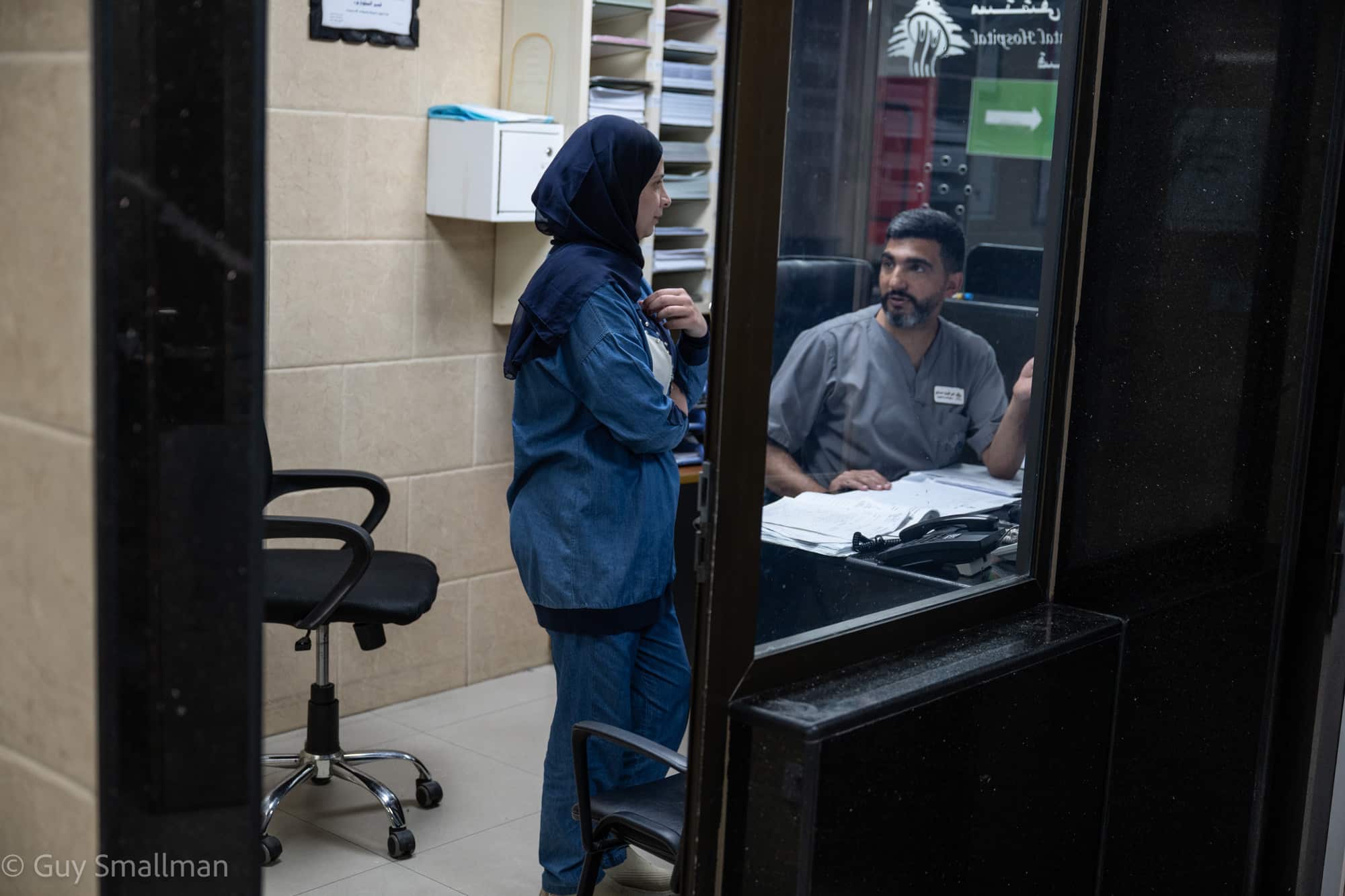
As the war had rolled on the hospital had started to run low on essentials of every description. Mohammad explained:
In terms of supplies. Medical supplies, food and so on. We had some stock. But a hundred and ten days is a long period. The Red Cross helped us with some medical items, also with diesel for the generator. The Lebanese Army was providing us with water because we had a problem with that. We usually get it from the state. But that supply was cut off. So the army brought us water every day. The South Council also brought us food and other supplies. These were the people and organisations who stood by our side.
Doctors and nurses targeted
On the relentless explosions endured by the staff and patients he said:
There was around fourteen airstrikes next to the hospital, all within a hundred metres. It sustained a lot of damage, but we kept going. The strikes were heavy and extremely close. If you walk around the hospital, you can see the destruction. Equipment destroyed, ceilings collapsed, glass shattered.
During the closest strikes we had over thirty injuries among the medical staff. The nurses and doctors. Some of those injuries happening four or five at a time, mostly from flying glass. Thankfully all those injuries were minor. But one young man from the Red Cross was martyred.

Volunteer paramedic Hasan Badawi had been with the Lebanese Red Cross since 2012. On April 13th he had been answering an emergency call with a colleague at the village of Beit Yahoun. Their ambulance was clearly marked. They were both in uniform. There is no way that they could have been mistaken for anything other than civilian first responders doing their duty.
As Hasan had been taking a stretcher from the back of the vehicle a drone had attacked. He was killed and his colleague seriously injured. He was the eighty-ninth humanitarian worker killed since the war had restarted in March. His colleague was also badly injured.
Hasan had two children with another on the way. He had called his pregnant wife the day before he was killed, saying that the bombing was everywhere but he would not leave his colleagues and patients.
The Israelis have offered no explanation for this atrocity. Outcry from the International Red Cross and the government in Lebanon has received the usual response that the incident is “under investigation”.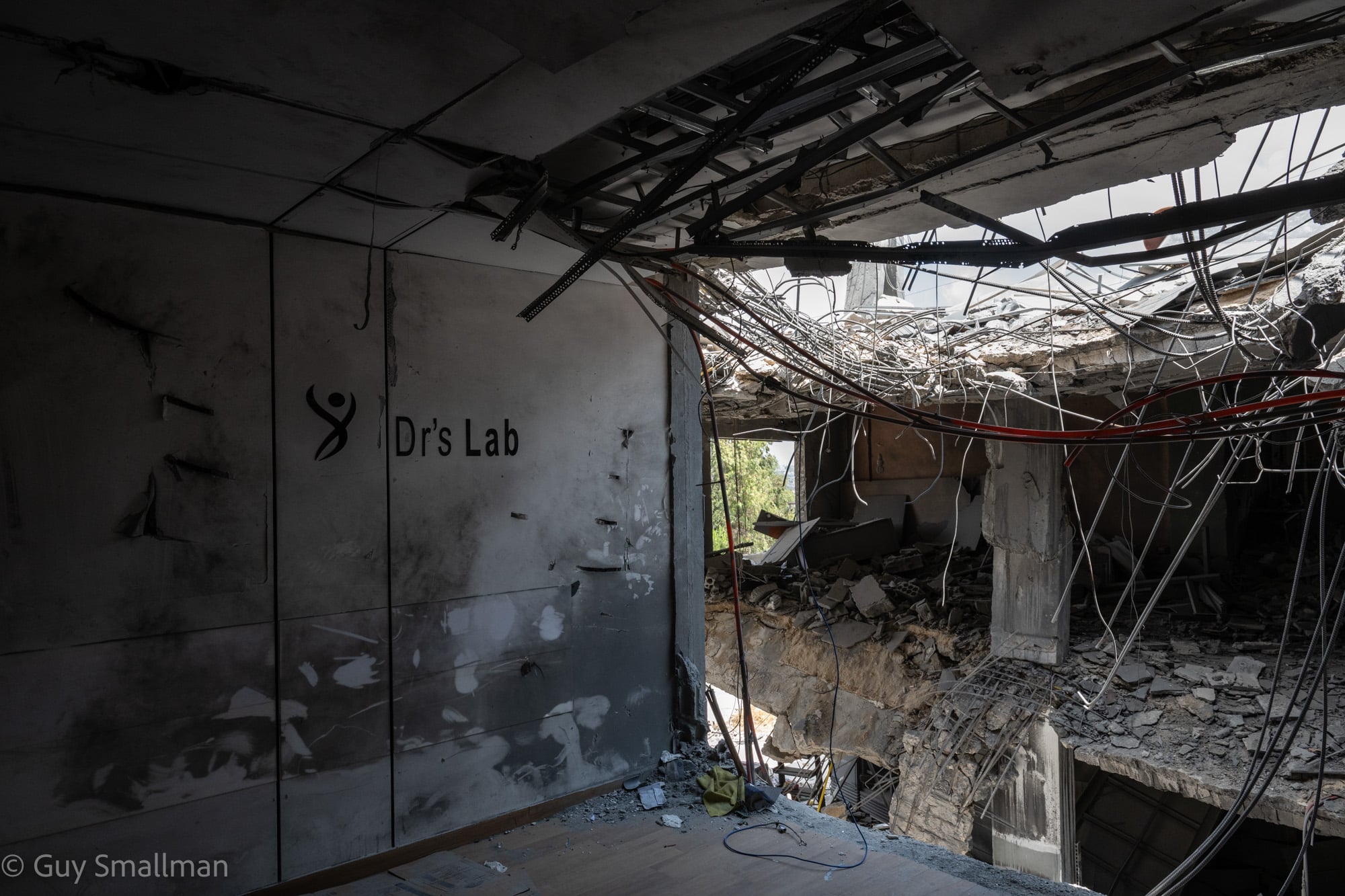
Warcrime after warcrime
Before leaving Tebnine, we visited the scene of yet another destroyed health centre just yards from the hospital. Across the street and around a hundred yards up the hill stood what was left of the ‘Dr’s Lab for medical analysis’ building. A large three-story facility which had contained a number of laboratories dedicated to the task of processing medical samples. It had clearly taken a direct hit from a bomb which had penetrated the roof and exploded in the rooms of the basement floor destroying everything above.
Yet another war crime against civilian medical infrastructure. Funded and facilitated by hypocritical Western democracies that supply the weapons while looking away from the consequences.
Images supplied by Guy Smallman
Video supplied by Tebnine Government Hospital
By Guy Smallman

Beware a prime minister in search of a legacy. Fresh off imposing a social-media ban on British teenagers, Keir Starmer appears determined to inflict another dreadful parting gift on the nation.
This week, the Labour government announced plans to end ‘pay discrimination’ by ensuring all work that is of ‘equal value’ receives equal pay. On the surface, this might sound harmless or even progressive. In practice, it is anything but.
Listening to equalities minister Seema Malhotra announcing the reforms, you might get the impression that workplace discrimination in 21st-century Britain is on a par with segregation in 19th-century Mississippi. Apparently, racist employers – both in the public and private sectors – are paying some people less, purely on the basis of their skin colour or because they have a disability.
If you’d not heard before that such evil practices were happening in the UK, that’s because they are not. Indeed, it has long been illegal to pay people differently on the basis of race, sex, disability or any other protected characteristic. Certainly, any major employer would risk catastrophic fines and penalties if it were found guilty of racial discrimination. Nevertheless, to combat this allegedly rampant unfairness, the government has floated the idea of creating an Equal Pay Regulation and Enforcement Unit and expanding ‘equal pay’ rules that currently apply to sex to cover ‘race and disability’, too.
A clue as to what this really means is buried in a consultation document, published on Tuesday. New legislation, it says, will ‘enable claims for pay discrimination where work is not materially similar but is “rated as equivalent” or of “equal value”, for race and disability’. The jargon can’t disguise what is very bad news indeed.
We need only look at the unhappy state of affairs at Birmingham City Council to see how damaging the equal-pay regime has already been when applied only to sex. In 2012, 175 workers – predominantly women – took the council to court over claims that they were being paid less than male employees. The basis of this claim was that female-dominated jobs, like cleaners, were paid less than male-dominated jobs, like refuse workers. They didn’t argue the work was actually the same, only that it was of ‘equal value’, and that they had therefore been subjected to sex-based discrimination. The Supreme Court, citing the Equality Act 2010, agreed with the claimants. This landed Birmingham with a £750million bill.
Finally, unable to cover the costs of the payouts, Birmingham declared bankruptcy in 2023. One of the most notorious consequences of this was the rolling bin strikes, which began last year and are still ongoing. For months on end, hundreds of tonnes of rubbish were left uncollected to rot on the streets of the UK’s second city.
The concept of ‘equivalent work’ could soon do to Brighton and Coventry what it has done to Birmingham. As of December 2025, the GMB union claimed it had won over £1 billion on behalf of its members from settling equal-pay cases with six local councils, including Glasgow, Leeds and Sheffield.
The private sector is not immune, either. Leigh Day, the same law firm that successfully bankrupted Birmingham, was also partly successful in suing Asda and is now taking legal action against Tesco. In both cases, the supermarket giants stood accused of illegally paying warehouse workers (mainly men) more than workers stacking shelves or working at checkouts (mainly women). Asda could be forced to pay £1.2 billion should the equal-pay claims succeed fully, while Tesco could be on the hook for as much as £4 billion.
It ought to go without saying that neither Birmingham nor Tesco is alleged to have paid men more than women for performing the same work. What they have done is pay higher wages for certain jobs that are less desirable and more demanding. Refuse work and warehouse work both require employees to work unsociable hours – often very early in the morning or through the night – and are more physically intensive. The fact that more men have taken up these posts than women is not a sign of sexism or discrimination. It merely reflects those employees’ choices and personal circumstances.
You might now be thinking, why should I shed a tear for Tesco or Asda, or for Birmingham’s bureaucrats? But it shouldn’t surprise you to learn that these equal-pay claims quickly rebound on workers. Birmingham’s refuse workers, for instance, were forced to take a pay cut, partly to ‘equalise’ their pay with female staff and to cover the staggering costs of the backpay from the successful equal-pay claims. This then prompted them to go on strike, causing the entire city to suffer. The refuse workers clearly felt their reduced pay package no longer reflected the value of their work.
Expanding these equal-pay provisions to race and disability would undoubtedly lead to an explosion in employment-tribunal claims. Worse, it could set off a bomb under the economy, as firms go bust and councils declare themselves bankrupt. And it could even prove damaging to race relations, encouraging employees to view themselves as members of competing identity blocs, rather than as workers with shared interests.
Keir Starmer, whether he cares or not, is playing with fire with this parting equal-pay shot. It marks yet another contribution to the disastrous legacy of this most useless of prime ministers.
Hugo Timms is a staff writer at spiked.

On 7 July, Nigel Farage stepped down as the MP for Clacton. Skipping forwards, Farage is now running to reclaim the seat he just gave up, and his only real opponent is a man who pretends to be an intergalactic dustbin.
As you’d expect, the rest of the world is now obsessed with this story:
I love this Japanese TV News report about Count Binface taking on Nigel Farage in the Clacton by-election: Farage has managed to make himself look bad globally. — Wokerati Marty (@WokeratiMarty) July 14, 2026

 pic.twitter.com/xubtDfTzVP
Farage big in Japan
The clip above features the following subtitles:
This is Face, whose trademark is a trash can mask and a cape. The number of people hoping for his election is greater than that for Man Farage.
As we reported, this is true when you look at the national polling, in which “Man Farage” trails behind “White Lord Binface”:
I just like the fact that 13% of the people polled can't decide. pic.twitter.com/ghxVShMUqh
— Jonathan Pie (@JonathanPieNews) July 11, 2026
We do think the Greens should have run in this by-election. It would have given them weeks of national attention, and allowed them to further prove that they’re the true anti-establishment party (something the public largely already believes). At the same time, though, the above situation is very funny.
Farage clearly hoped this by-election would reaffirm the idea that he’s the prime minister in waiting. Instead, he’s proven that the public prefer Binface to him.
Binface is making waves beyond Japan too. In the following video, Turkish-American streamer Hasan Piker silently watches Binface’s ITV interview:
Following the video’s conclusion, a stony-faced Piker says he’s now glad the UK banned him from entry. Which is fair enough, honestly.
As we reported, Piker believes he was barred from the UK due to his opposition to Israel’s genocide. So the UK isn’t just an international laughing stock; it’s also the forerunner of Western authoritarianism.
Other international coverage of the Farage VS Binface bin fight includes:
- The Australian – “Farage v Count Binface: the clash that perfectly sums up British politics“.
- Wall Street Journal – “Nigel Farage Wanted a Political Showdown. Now He’s Fighting a Trash Can“.
- France 24 – “Farage vs Count Binface: hard-right leader’s UK poll gambit“.
- South China Morning Post – “Farage vs Count Binface: how UK hard-right leader’s poll gambit could backfire“.
The list goes on and on, because Farage has made himself an international joke. We’ve potentially got weeks of this left too; i.e. things could get even funnier.
Victory conditions
If Farage wins in Clacton, all he’ll have proven is that he can beat a bin an election. This should have been a given. And as such, it won’t do anything to diminish the humiliation he’s heaped upon himself.
Featured image via the Canary
By Willem Moore
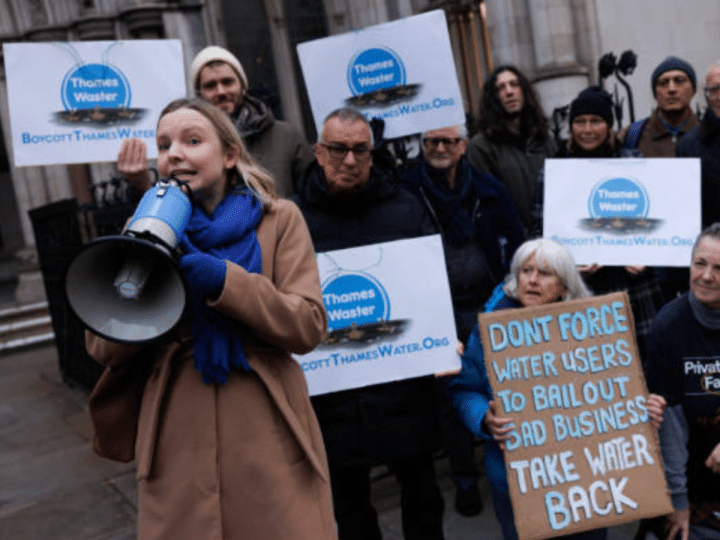
Thames Water’s shareholders are panicking as the prospect of public ownership threatens to bring their gravy train to an end.
The company is now sitting on £18.5 billion of debt, up from £16.8 billion a year ago. Instead of accepting responsibility for years of failure, the profiteers at the top are desperately trying to recapitalise the business to retain their cash cow.
Thames Water is the UK’s biggest water company, charging 16 million customers for access to water whilst failing to invest in crumbling infrastructure which has resulted in sewage leaks polluting rivers and waterways.
Signalling just how much money these greedy shareholders are reluctant to part with, the company increased its underlying profits by £191 million in a single year.
However, the company’s mountain of debt and years of underinvestment show exactly how badly British consumers have been short-changed. It only strengthens the case for nationalisation, and Thames Water is where that process should begin.
BREAKING: Thames Water is due to run out of money by the end of the year, as it remains in discussions with creditors, regulators and government to recapitalise the business.
Its annual results revealed it's £18.5bn in debt pic.twitter.com/pjq8J5No5E
— Sky News (@SkyNews) July 15, 2026
Thames Water and privatisation
The private ownership of the country’s water companies has meant higher bills for consumers, with profits going to shareholders rather than being reinvested into maintaining pipes and infrastructure to ensure people get good quality water.
Moreover, Thames Water’s flagrant breaches of sewage regulations have polluted our waterways, rivers and even oceans with sewage.
This has led to resounding calls to take it back into public ownership, with Thames Water being a prime example of how badly the privatised model has failed.
However, now it is getting closer to nationalisation being a sure thing, those who have been reaping the profits are doing whatever they can to keep their hands on the purse strings.
Windsor MP Jack Rankin says when companies fail, investors & creditors should lose their money.
That's what should happen with Thames Water. But Ofwat is still locked in negotiations with them.
Keep the pressure on. Write to Ofwat and tell them to reject the creditors:… pic.twitter.com/UIKGs0dQUE — We Own It (@We_OwnIt) July 15, 2026
For instance, it was only in recent weeks that Environment Secretary, Emma Reynolds, rejected a plea from 100 investors to Ofwat for a £10 billion bailout to rescue the failing company. Had it been granted, the bailout would once again have forced taxpayers and consumers — who are, in large part, the same people — to foot the bill.
You can’t polish a turd, as they say
Those who have been making pretty decent money despite its abysmal management insist that Thames Water’s performance is improving. They point to an 18% reduction in pollution compared to a year prior and a 17% improvement in meeting Ofwat’s common performance commitment targets.
However, the company still hits just 55% of the targets it should meet, proving these improvements remain nowhere near good enough.
The future where targets are finally met becomes far more achievable when an essential service serves the public, not shareholders chasing profits.
Bath MP Wera Hobhouse says Thames Water customers have been let down 'time and again' by the failing firm.
Its creditors want permission to pollute outside the rules until 2030. Ofwat's Board is still deciding whether or not to agree. Can you take 2 mins to email the Board,… pic.twitter.com/Tb5iSNbWPA
— We Own It (@We_OwnIt) July 14, 2026
Thames Water claims to be doing better
Thames Water’s chief executive, Chris Weston, has insisted that these improvements show the company is “turning around”.
He told the Guardian:
While we have a lot more to achieve, the progress we have made in turning the company around has meant we are now performing better and are in a strong position to accelerate the delivery of the biggest upgrade of our infrastructure in 150 years.
This upgrade will, over time, address asset resilience issues and translate into sustained improvements in the services we provide for our customers and impact on the environment.
But fixing problems of its own making doesn’t prove Thames Water has turned a corner. It is only starting to address a failure to meet even half of its responsibilities.
After all, it is hardly like there has been any public show of humility or public apology. Instead, the company treats these problems like they were inevitable. (But hey, look at how its leadership is making it better.)
Like they say, you cannot polish a turd. It remains, no matter what you do to make it look more appealing. The same is true for the privatisation of our water companies.
Privatisation has hurt ordinary people and reduced our access to clean water. These environmental and health issues will only grow worse with water-hungry AI data centers cropping up across the UK.
After his recent victory in Makerfield, Andy Burnham has talked about “greater public control”. But as long as private shareholders remain, the ultra-wealthy will continue to rip us off.
Years of chronic neglect and corporate mismanagement have already done enormous damage. The government should take the industry into public hands now, before things get even worse.
Set an example of Thames Water
Thames Water is not the only offending privatised water company. They are all guilty of failing in their responsibilities to consumers and in maintaining the critical infrastructure.
If the state brings Thames Water into public ownership, it will do more than hold the biggest player to account. It would send a message to every other water company: deliver value for money or risk losing your monopoly.
If they wish to continue being work-shy, then they lose out, which is fair enough, frankly. Shareholders do not have a permanent claim over these lucrative monopolies. The state can and should step in and take them back.
At least then, those astronomical profits could benefit everyone, rather than the handful of people who have had their hands in our pockets for far too long.
Featured image via the Canary
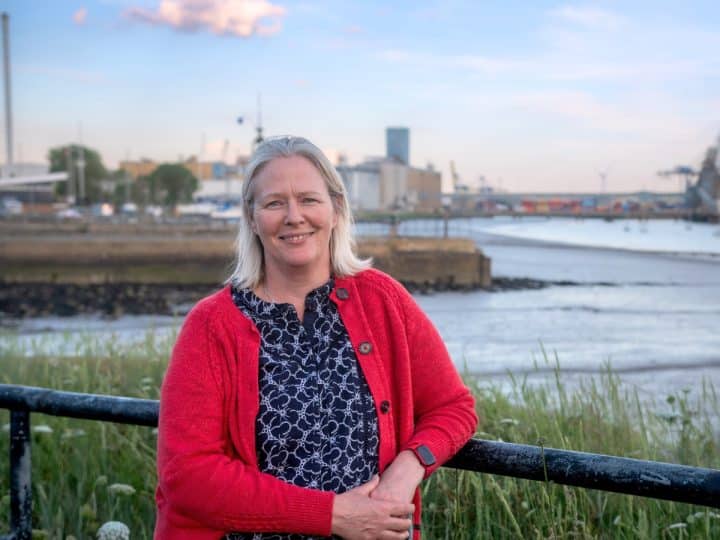
The Green Party candidate for the upcoming Grays Riverside by-election, Pauline Weir, has made her priority clear: securing a seat on the Corporate Oversight and Scrutiny Committee to hold the current administration accountable.
Weir stated:
If I am elected, I shall insist that this mandate from the Riverside electorate means I replace one of the Reform UK councillors on the Corporate Oversight and Scrutiny Committee.
When Reform UK took control of the council in May, it took the chair and control of all of Thurrock’s Oversight and Scrutiny committees. But as Weir points out, given the history of Thurrock, the one that concerns her most is the Corporate Scrutiny committee:
This committee has nine Reform UK councillors, and the only two Conservatives on the council. How is this scrutiny?
Since 2025, the Serious Fraud Office has been investigating a scheme by which the Conservative-led Thurrock Council invested millions into solar farms between 2016 and 2020. It used a bond scheme sold by the UK-based Rockfire Investment Finance Plc.
Says Weir:
The residents are still paying the price. The council voted to increase council tax by 9.99% in 2023, after the reckless gambling of the council with our residents’ money.
Council Tax has continued to rise since, with external auditors unwilling to sign off the council’s books.
The by-election in Grays Riverside on 23 July resulted from the resignation of a Reform Councillor elected in May this year. Weir says:
We got within 17 votes of taking a seat in Riverside in May. We are the only party that stands a realistic chance of providing at least some scrutiny for the residents of this ward.
Featured image via South West Essex Green Party
By The Canary

Motorola leads $125M round for Brinc, fueling 911 drone expansion amid U.S. import crackdown

XRP IT’S HAPPENING ON MONDAY!!!! MAJOR BREAKTHROUGH!?! (WATCH BEFORE MONDAY)
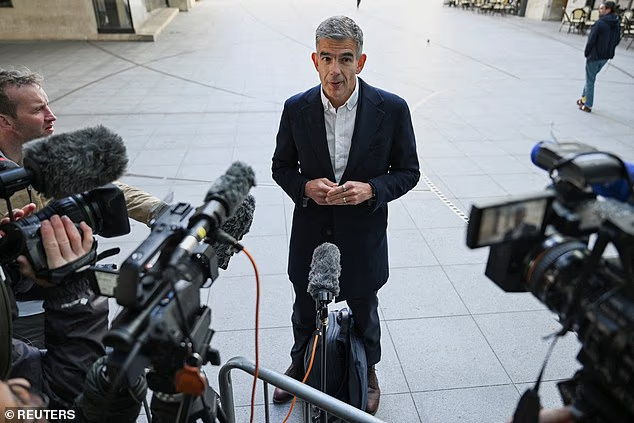
New BBC boss pushes for new universal ‘household levy’ to replace licence fee – which all would have to play whether they watch channels or not


-

 Fashion6 days ago
Loro Piana Fall 2026 Enters Houston’s Art Scene
-

 Fashion5 days ago
Weekend Open Thread: Nutriplenish Leave-In Conditioner
-
 Sports6 days ago
2026 Genesis Scottish Open Thursday TV coverage: Round 1
-

 Sports5 days ago
Super Eagles star Moses Simon opens up on Liverpool transfer regret
-

 Tech6 days ago
Character.AI enters the microdrama arena with its own productions, but there’s a twist
-

 Politics3 hours ago
Young campaigners urge incoming PM to act on outdoor junk food ads
-

 News Videos19 hours ago
XRP BOMBSHELL… XRP OMBOARDED FOR TRANSACTIONS!!!
-

 Tech1 day ago
Get Your ESP32 Sunny Side Up With This Solar Dev Board
-

 Tech19 hours ago
Dark Secrets Emerge When Jailbreaking LLMs
-

 News Videos7 days ago
Crypto Just Entered Its Most Important 6-Month Candle (Could Decide Everything!)
-
 NewsBeat6 days ago
Major update after Huntingdon train attack as man enters plea
-

 Tech6 days ago
Level Infinite Launches Gangstar Mirage City in India with Pre-Registrations
-

 News Videos2 days ago
how to make coin bank box with cardboard #scienceproject #money #diy #shorts
-
 Tech2 days ago
Cloudflare Precursor Watches Your Mouse and Keyboard To Decide If You Are Human
-

 Tech7 days ago
Entra passkey enrollment vishing targets Microsoft 365 users
-

 Crypto World7 days ago
DeFi Dashboard Zapper to Shut Down After 7 Years
-

 Crypto World6 days ago
Mark Cuban-Backed DeFi Dashboard Zapper Shuts Down After 7 Years
-
 Tech6 days ago
Claude’s New Reflect Dashboard Wants To Help You Log Off Of Claude
-

 Crypto World7 days ago
Fed minutes June 2026: officials split on rates
-
 Entertainment2 days ago
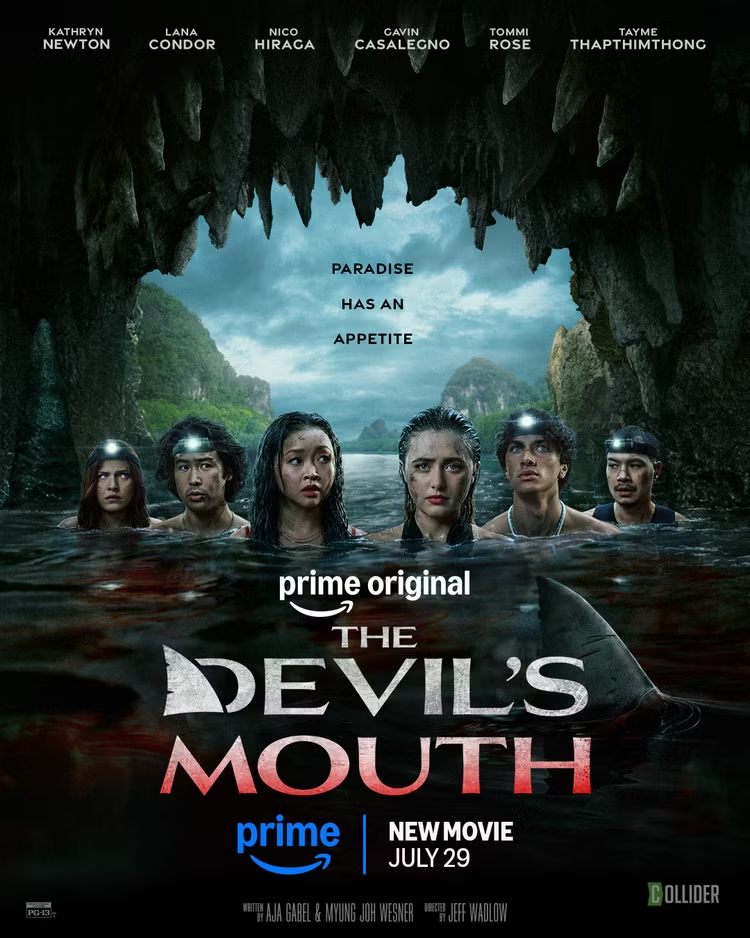
Kathryn Newton and Lana Condor Are Caught in the Maw of Prime Video’s Chilling Survival Thriller in New Look [Exclusive]
You must be logged in to post a comment Login