

Politics
Can The Bon Charge LED Blanket Improve Your Wellness? I Tried It To Find Out

We hope you love the products we recommend! All of them were independently selected by our editors. Just so you know, HuffPost UK may collect a share of sales or other compensation from the links on this page if you decide to shop from them. Oh, and FYI — prices are accurate and items in stock as of time of publication.
I don’t not consider myself not a woo woo person. As a shopping writer, I’m not exactly immune to trying the latest wellness fads and figuring out how to optimise my health.
I’ve tried sleep headbands, greens powders, and fitness trackers. So when BON CHARGE launched its new method, a guided wellness experience designed to help integrate recovery and biohacking into your daily life, I was desperate to try it out.
The method, led by ‘personal trainer to the stars’ Flik Swan, is intended to complement the brand’s offering of red light therapy and PEMF (pulsed electromagnetic field, FYI) devices.
Hosted on YouTube, Swan leads users through an immersive wellness routine that correlates with their product of choice, blending functional strength training with breathwork, relaxation techniques, and recovery.
To give you a taste of what that actually means, if you’re already the proud owner of a BON CHARGE PEMF mat, Swan will guide you through a sound bath meditation, or if you’re inclined to a red light therapy panel, you’ll do a 360 sculpt workout while it shines on you.
Personally, I was curious about the brand’s red light therapy blanket and face mask.


My review of BON CHARGE Red Light Therapy Blanket and Face Mask
First impressions
When they first arrived at my house, my first thought was: holy fuck, what have I got myself into?
The blanket alone arrived in a huge box, which was propped up ominously in my room during the heatwave until I had the strength to unbox it.
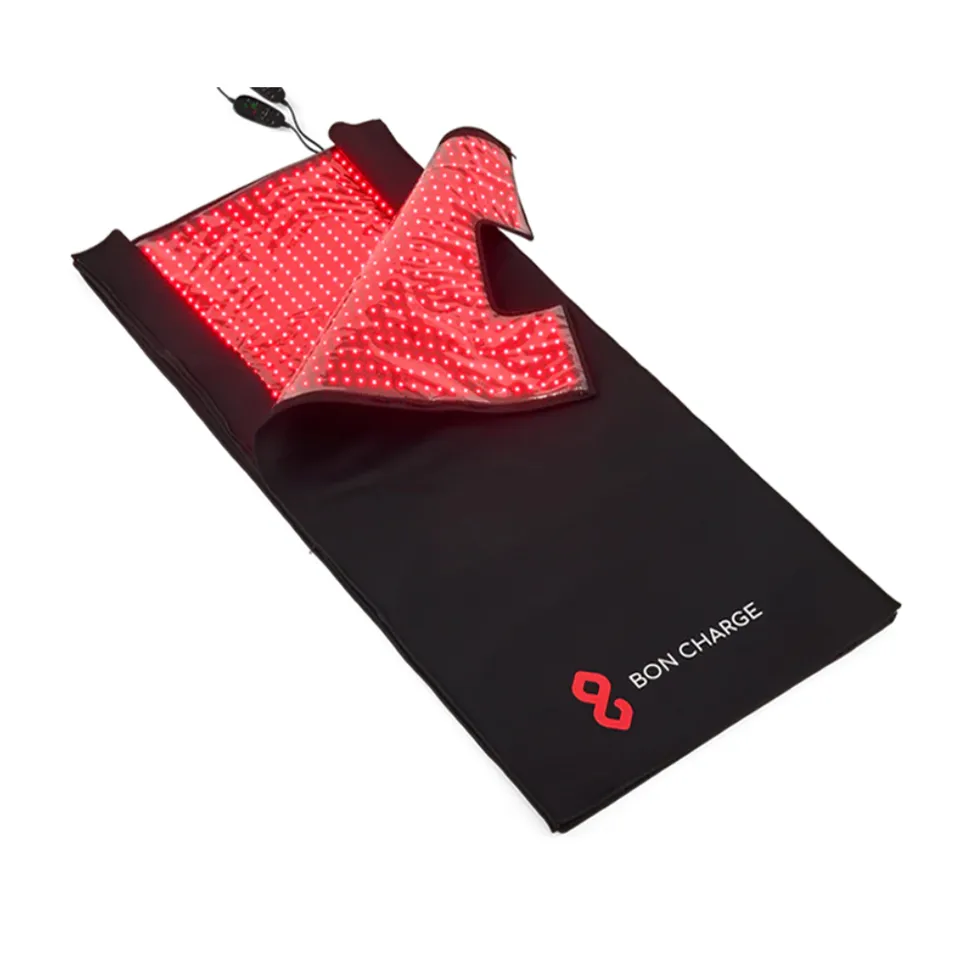
The BON CHARGE website promises that the blanket delivers lab-grade infrared and near-infrared light across your body, which is supposed to help support muscle recovery, healthier looking skin, better sleep, and relaxation when used as a sleeping bag.
But, after finally lugging the blanket (which weighs a cool 10kg, BTW) up the stairs, I knew I had to start with Swan’s sculpt and stretch routine before getting snug.
Created for time-poor professionals, this 20-minute routine aims to support flexibility, mobility and daily performance rituals by delivering the red light around your whole body as you stretch and flex.
Trying the BON CHARGE method
After lying the blanket flat on the floor and connecting all the different wires, the blanket can be easily unzipped to create a red light therapy mat.
I’d just been to the gym that morning, so it felt like the right time to test whether the blanket could help improve my recovery and avoid the next-day stiffness I so often experience after doing strength training.
Swan instructs you to turn the red light up to intensity level five, before she talks you through a series of toe taps, leg raises, lunges and stretches.
The instruction manual (which you have to search online; there isn’t one included) encourages you to wear the goggles included while using the blanket.
However, Swan doesn’t mention this during the video or wear them herself, so I decided to just go without so I could actually see what I was doing during the routine.
And thank god I did. I don’t know if I set the mat up right, but it kept slipping and sliding around on my wooden floors, making it feel quite unsafe while I was lunging in a variety of uncompromising positions.
Although 20 minutes on the mat felt extremely ‘active’, as the brand warned me it might, I wish the video had gone on for longer, as Swan only holds each pose for a matter of seconds.
That meant that not only was I trying to balance on an unstable surface, but I barely had time to settle into the pose before being moved on to the next one.
Add to that the fact I was trying to avoid looking at the light, and it was over before I knew it. I’ll spare you photos of myself doing it, because no one needs to see that.
Now, I was hoping the method would help me stretch after a session at the gym. But instead, I felt like I’d done another workout, which is something to be aware of it you’re after a more relaxing experience.
To balance out the lack of relaxation, I then decided to try the BON CHARGE method for the red light face mask.
Instead of having to move around, this routine combines red light therapy with lymphatic drainage massage and a manifestation ritual.
As an avid user of skincare devices, I love the ritual of sculpting and massaging my face.
And, let’s be real, I love lying down, so this method was a much more enjoyable routine for me, and one I could see myself coming back to.
It also adds an interesting mindful elements into using a skincare device that I’ve not seen done elsewhere.
While usually I’ll pop on a face mask while watching Real Housewives and call it a night (or a 10 minutes) this requires you to focus on your breath, think about your body, and integrate your skin with your overall wellness routine.
Naturally, I felt much more grounded after the method, and my face even felt less puffy thanks to the neck and head movements Swan recommended.
Trying the red light therapy blanket
After not noticing much of a difference the day after doing the BON CHARGE method with my blanket, I decided to try it the OG way: by lying in it like a sleeping bag.
The reviews on the website claim that it helped with better sleep, improved their recovery, and skin.
Here’s where I have to admit I was a little sceptical. Immediately, the set up of it all pissed me off because it was decidedly not relaxing trying to figure out how to plug in the multiple cables while also having a heavy ass blanket in my bed (not to mention the time I spent putting it away again).
But once I was all tucked up in my blanket, with a book, and had it set to the second intensity, I was immediately eating my words.
Within seconds, I could feel my body relaxing. A pain in my foot started throbbing and then afterwards seemingly disappeared. My eyes were beginning to droop, and after the storing debacle I had one of the best sleeps of my life.
My sore muscles from pilates also dissipated overnight.
Final verdict
- Helps integrate wellness into your every day life
- The red light helps with relaxation and muscle recovery (a little too well)
- The face mask is easy to set up
- I like that you can use the blanket as an exercise mat, but you might need to put an actual mat underneath
- The BON CHARGE method is clear and a new take on wellness
- It’s extremely expensive
- The blanket is heavy
- Instructions aren’t always clear
- I don’t know how you’d store the blanket
Over the last couple of years, our obsession with skin health (not just on the face) and longevity has boomed.
Wellness is now, thankfully, much more holistic, and the BON CHARGE method has done a good job of blending fitness with relaxation and mindfulness.
My second experience with the red light blanket changed my mind almost entirely about what red light was capable of. It certainly helped me to relax, and with my recovery as a whole, just as the website suggested.
Of course, sites like BON CHARGE are focused on longevity, and building rituals over time, so it’s unlikely you’ll see instant results. But, the idea of integrating devices into your training and recovery to make it more active and considered is something people are already on board with.
My main problem with the method was the lack of clear instructions about set up. It would have been helpful to put a mat underneath the blanket to stop it from sliding, but this wasn’t mentioned.
Plus, although the manual claims you should not use red light on tattooed skin, it was almost unavoidable to have my tattooed arms touching the mat during the sculpt and stretch method; I had to keep my arms out of the blanket like a t-rex when I was lying in it the second time.
I also have absolutely no idea how to store this. The blanket is fairly bulky (and did I mention heavy?) which, for me, detracted from the relaxing element of it all when I was huffing and puffing trying to fold it up and fit it back into a small space.
But maybe people who have a spare £1.5k lying around to spend on a red light device have more storage space than I do. The cost might be astronomical; but at least it’s for good reason. This is a serious piece of tech, and one that could change your wellbeing for the better.
Whether it takes one use or years to find out its benefits is yet to be seen, but for me, a good night’s sleep is priceless.
If you’re serious about longevity, and can afford it, it’s worth a try to have your own recovery device at home.


The Association of Former Members of Parliament has published the latest edition of its official journal Order! Order!


Alex Sobel, Labour Co-op MP for Leeds Central and Headingley, at employee-owned social care provider Be Caring in Leeds

4 min read
When we arrive at Be Caring in Leeds, the young women who work there are shy about speaking to the camera.
The Co-op Party team is there to film as part of a video series shining a light on communities, businesses and public services doing things differently across the country. We’ve been brought to Be Caring by local MP Alex Sobel, who is clearly incredibly proud of the company and wants to highlight what they do. When we ask founder Sharon and her staff, many of them still in carer’s uniform having just come back from their morning rounds, to talk about their work, they completely come to life.
Be Caring is the UK’s largest employee-owned social care provider. Employee ownership means it is structured in a fundamentally different way to the vast majority of social care companies. Its employees are also owners, so they have a stake in the company’s success and a formal voice in how it is run. Any profit made is either reinvested into the service, often paying for things like regular uniform upgrades, or paid back to staff in bonus payments. This is the classic co-operative model – ownership, decision-making and profit shared.
It’s a model which stands in stark opposition to the rest of the social care sector, one increasingly defined by crisis and scandal. Adult social care faces persistent staffing problems, rooted in poor pay and working conditions, local authority funding crises, regional inequalities in accessing high-quality care and an ageing population steadily raising demand. The staff at Be Caring understand this, many of them having previously worked in privately-owned care companies. The difference, they say, is a service run in the interests of the people who rely on it most – staff and care recipients – rather than distant shareholders.
The Co-operative Party has today released a report on co-operative care, making the case for this model and its transformative potential in helping to fix an increasingly broken system. Most fundamentally, the report calls for the removal of private profit from adult social care and an end to the pervasive domination of private equity in the system.
We believe that the fight to fix adult social care can’t just be about finding more money, but must also be about the kind of social care system we want to build. Since responsibility for funding and commissioning of social care shifted from national to local government in the early 1980s, private provision has become the norm, and today 80 per cent of the largest care home providers in the UK are owned or backed by private equity firms. With private equity domination comes profit extraction. An estimated £1.5bn is now extracted as profit from the social care system every year. This degree of profit leakage inevitably leads to lower wages, less reinvestment in care quality and worse outcomes for care recipients.
We have the opportunity to change this. Last year, the Welsh government legislated to remove private profit from children’s homes, fostering and secure accommodation. It means that all providers must now operate not-for-profit, ensuring that every penny spent on care goes directly towards supporting vulnerable children. This approach can be replicated for adult social care. Co-operatives and other not-for-private-profit models already exist and thrive within the care sector, but they do so in spite of government policy, not because of it. Government could set a clear intention to incentivise this kind of care and phase out the private equity firms that have had such a poisonous impact.
Andy Burnham will soon be the first ever Labour and Co-operative Prime Minister. We believe that with this milestone comes the most significant opportunity our movement has ever had to fundamentally rewire our economy, our public services and our politics as a whole. We can transform the state from one of hoarding power to sharing it, but it’s a principle that we will need to apply everywhere, a lens through which we analyse all of the major problems our country faces. It’s why Burnham was right, in his first major intervention this week, to point to the Rochdale Pioneers, the founders of the modern co-operative movement who looked at a broken economic system and decided to do something to change it. We have done these things before and we can do them again.
Caitlin Prowle is Co-operative Party assistant general secretary

I don’t have hay fever, but based on how I react to walking outside on a hot day, I’d forgive you for believing I do.
For some reason, getting off the train into the sun, opening my door onto a ray-soaked street, and even leaving a tree’s shadow into a bright spot triggers a huge, eye-watering sneeze – and until now, I had no idea why.
But it turns out it might be my genes, per the Cleveland Clinic.
It sounds like I’m experiencing a “photic sneeze reflex,” also known as “autosomal dominant compelling helio-ophthalmic outburst syndrome” (ACHOO syndrome – teehee).
What is a “photic sneeze reflex” or ACHOO syndrome?
An extract from Medical Genetics Summaries says that “Affected individuals report a ‘prickling sensation’ or sneezing in response to a bright light.”
It’s elicited by going from a darker area to an area of brighter light (like stepping into sunlight from indoors), or simply having a bright light shown to you.
This can be “uncontrollable.”
How common is it to sneeze at bright lights?
“About one in four individuals who already have a prickling sensation in their nose will sneeze in response to sunlight, but ‘pure’ photic sneezing is far less common,” Medical Genetics Summaries shared.
If one parent has the condition, their child has a 50% chance of developing it.
But the Cleveland Clinic says we don’t know exactly how many people have the condition.
On average, they add, it seems to be about 15-30% of us: white people, especially white women, may be more likely to have the trait.
What causes sneezing on exposure to bright lights?
It’s a genetic issue, but we don’t know yet which genes are responsible.
It happens because of a misfiring in a facial nerve that goes from your eyes to your nose. The constriction of your pupils as your eyes adjust to the light triggers the sneeze.
Is sneezing at bright lights dangerous?
It can be if you’re operating heavy machinery or driving: “for example, exiting a road tunnel on a bright day.”
Pilots might need to be more cautious, too.
How can I stop sneezing at bright lights?
There’s no cure for ACHOO syndrome, but you can make the journey from darker spots into lighter areas easier on the eyes.
Shielding your eyes with a hat or sunglasses might help.
And the Cleveland Clinic recommends we “Use the ‘transverse philtral pressure technique,’ which involves applying pressure to the area between your nose and your lips.
“If you’re doing it right, it should look like you’re giving yourself a moustache with your finger,” they said. This may interrupt the sneezing signal.
I’m learning so much more about myself than I expected today…

We hope you love the products we recommend! All of them were independently selected by our editors. Just so you know, HuffPost UK may collect a share of sales or other compensation from the links on this page if you decide to shop from them. Oh, and FYI — prices are accurate and items in stock as of time of publication.
I’ve said it before, I’ll say it again: having to decide what to eat three times a day is an impossible task.
It’s really indicative of us being in late stage capitalism (sorry Marx, you would’ve hated 2026) that even thinking about our meals is an exhausting endeavour, but unfortunately that’s not something we can cure.
What we can solve, though, is the effort required to simply make dinner at the end of the day.
Whether you’re a parent, living with a partner, or simply need to be able to get home and not worry that you’re going to get your intake of protein and fibre at the end of the day, I’ve made it my job to find the very best recipe boxes and meal kits on the market.
How we tested recipe boxes and meal kits
Until now, I’ve been quite fundamentally opposed to having someone else tell me how to cook. Call me a control freak, but I really do think I know better than a recipe what I will like.
So I’ve had high standards going in to this, and I’ve tested each box in the list to make sure I find the best options for people at each cooking level.
For each recipe box, I’ve considered how clear the included recipe cards were, the number and range of options, the packaging and storage, how easy they were to cook, the quality of the ingredients, the flavour of the end result, and who I thought each box would be best suited for.
Keep reading for a round up of my favourites.
Best meal kits and recipe boxes in 2026
Grubby: Best plant-based recipe box

- Packaging is recyclable
- Healthy and protein-heavy
- Plant-based
- Donates a meal to a child in need every time a box is ordered
- Easy to follow instructions
- Plant-based isn’t for everyone
When people hear the term ‘plant-based’ they immediately jump to the conclusion that it won’t be good.
Proving that you can make restaurant-quality plant-based food at home (and we mean the same quality as a regular restaurant, not a vegan one, before you shut off!) Grubby has created a recipe box that’s healthy and easy to follow.
You can choose a box for two or four people, and the options all state how much protein and fibre they include, making it easy to stay healthy.
What I loved most about this box is that everything about the packaging is great quality, not just because the paper is thicker than other flimsier recipe cards, but because most of it is recyclable and there’s minimal plastic.
As for the ingredients, you can tell they work with seasonal suppliers; that’s what makes Grubby a B-corp!
While the recipes were easy to follow, they might be for slightly more advanced chefs than other recipe boxes in this list – as in, one recipe called for making your own hummus in a blender. Personally, I enjoyed that, because I don’t like being treated like I don’t know how to boil a kettle.
And I have to say, every time, the overall end result was more delicious than any of the other boxes I tried. It was consistent, and even my meat-loving girlfriend enjoyed everything I made.
Grubby also makes ready meals, which are equally as tasty and can. be kept in your freezer for a rainy day.
Green Chef: Best for healthy meals with a range of diet options


Honey Jane Wyatt/ HuffPost
- Recipes are easy to follow, and you can double if you’re making a recipe for four
- Specialised diet options
- Ingredients are fresh
- The finished result is tasty
- Uses lots of little plastic packages
Unlike Grubby, Green Chef has options for every kind of dietary requirement. You can choose from keto, high-protein, calorie conscious, vegetarian, vegan, lower carb, pescatarian, or flexitarian meals, and the menu is updated every week.
It arrives neatly packaged so it’s easy to store in the fridge, however there were some random ingredients loosely packaged so I wasn’t sure which meal they correlated to.
As I’m pescatarian, I chose meals with a combination of fish and vegetables, and most of the recipes I chose had a lot of fibre.
Each recipe card includes photos, which makes it straightforward to follow, and although I was suspicious of the fact they use random ingredients I wouldn’t normally use, the overall flavour was very good.
You can also choose add-ons like mozzarella or soups to keep you going throughout the week, and I appreciated that the meals often take no more than half an hour to make – perfect for a mid-week dinner.
Hello Chef: Best for beginner cooks


- Recipes are beginner-friendly
- They have an option for meal boxes for one
- Very family-friendly recipe options
- Again uses lots of different plastic sachets etc
- Uses creme fraiche in everything (why?!)
Whether you find cooking a drag or you’ve been told you’re not very good at it (kids and partners are cruel, I’m sorry) Hello Fresh creates a recipe box that takes all the thinking out of cooking and really leads you through it step by step.
There are plenty of recipe options for meat eaters and vegetarians, and it’s the only recipe box I know of that has an option for one. As someone who mostly cooks for herself, I really appreciated this detail – it also cuts down on waste!
However, Hello Fresh was the box I liked the least. Maybe I ordered the wrong recipes, but every single meal I made included creme fraiche, and by the end of the week my stomach was paying the price.
Plus, the taste just wasn’t as good as other recipes. I don’t know if it’s because it’s trying to be family friendly and include options kids and fussy eaters would approve of, but some of the recipes use creme fraiche and other ingredients seemingly for no reason.
Some of the instructions seemed anti-intuitive and unclear, and I’m not entirely convinced this will make you a better home cook.
There are also fewer options for dietary requirements, and less information about the nutritional value of each recipe than other boxes.
I’d say this is really best for absolute beginners or completely time-crunched families, as it leads you through things at a granular level and doesn’t require much thought.
COOK: Best for families or new parents

- Lots of dietary options available
- Can be kept in the freezer or fridge
- No need to chop or fry anything
- Tasty
- It offers seasonal menus
- Great employer
- You gotta turn the oven on
Sometimes you want to come home and not have to think about anything other than turning the oven on, and maybe boiling a few peas.
If there’s one thing that will save you trouble of an evening, it’s COOK.
These ready meals come in a whole smorgasbord of different cuisines, and there are options for all the family, from fish pie to tikka masala, and even canapés for a dinner party.
On the whole, the quality is really excellent, and I love that they have desserts.
However, whoever they work with for their delivery needs to figure it out because they often leave things at the wrong address – our deputy editor’s neighbour is well-fed, she reports.
If you’re ever looking for a gift for new parents, COOK is the one. They’ll be able to keep it in the freezer, and it even has a new parents bundle.
And, on a side note, COOK is an excellent employer – it has a RAW Talent scheme that employs people struggling to find work for various reasons. Big up COOK!
The benefits and drawbacks of using a recipe box or meal kit
Pros
We all lead busy lives, and whether you’re a Michelin-grade cook or complete newbie, deciding what to eat at the end of the day is a lot.
One thing I’ve loved about having recipe boxes is never having to go to the supermarket. Often, I find myself buying ingredients with lofty ideals of making a specific meal, only for it to expire before I have time to use it.
You’ll also never have to decide what you feel like eating, or figure out if you’re consuming a balanced diet because most boxes tell you about the nutritional value of each recipe.
Recipe boxes can also be a great way to learn new recipes, or at the very least get inspiration from.
Cons
However, you might not always want the meals you have in your fridge. Some recipe boxes come with tiny sachets of ingredients that somehow never get used, so they end up hanging around your fridge forever.
This might also mean more waste than if you went to the supermarket, because things can go off pretty quickly.
Final verdict
Overall, recipe boxes and meal kits can be a great way to save time, money, and energy.
Lots of the ones on this list have offers for first time buyers. The best one I tried was Grubby, as it’s healthy and plant-based. But, if you’re staunch about having some meat or protein in your diet, I’d go for Green Chef, as it has a ton of dietary options and the final result was consistently great.

Yesterday, parts of London’s Underground network reached a sweltering 33°C, The Standard reported.
That’s three degrees above the government’s upper limit for the safe transport of cattle.
According to Bloomberg UK, the network of underground trains can be 5°C hotter than the high temperature on the street.
To be honest, I hadn’t put much thought into why that might be. Hot day, little air con, and tonnes of people – a recipe for a sauna-level carriage, I reckoned.
But it turns out that a good chunk of that notorious heat comes from an unexpected source, which has nothing to do with either the air temperature or the mass of people.
Braking heats tube carriages up by more than you think
In 2007, a Rail Engineering report found that a lot of the heat comes from braking.
That’s because the friction created during the process is very intense, creating a lot of kinetic energy that gets converted into heat energy.
Forbes says braking is responsible for about half of the higher heat, while passengers account for 2% of the warmth. Rail magazine puts the combined effects of braking and train motion at 80% of heat input.
Then, there’s the ground into which the tube network was built.
It’s largely clay and chalk, both of which hold onto heat. This is particularly troublesome for deeper tube lines, which have less access to air.
This heat builds up – per Rail Magazine, the average tube temperature in 1900 was 14°C, compared to today’s 20-25°C.
Not all tube stations have adequate ventilation, either, meaning hot air has nowhere to escape. The heat simply builds and builds, and because extracted hot air often has nowhere to go, not even air conditioning will provide an adequate solution.
What can we do to make the tube cooler?
It’s no easy feat. London Underground’s Programme Director for Infrastructure, George McInulty, told Rail magazine: “We can increase the capacity of shafts, and we did this during the upgrade of the Victoria Line in 2011/12.
“But we were lucky that it was only built in the 1960s, with half an eye to improving ventilation at a later date and introducing a service of over 30 trains per hour. Elsewhere we’ve been less lucky, and have had to look at retrofitting stuff where we can.”
Air conditioning is simply not an option for tunnels that can’t let hot air out; it’ll simply heat some older, hotter lines up more.
Some solutions, like turning a lift in St Paul’s into a fan, have helped. In Victoria Station, water from a nearby river is circulated in pipes around the tunnels to keep them cool.
But these clever workarounds are not universally available.
McInulty said: “We can make gains from deceleration, and we are buying trains with regenerative braking, which produces electrical energy from braking rather than all that heat from friction.
“And there are other things that go unseen by the public that make a difference – we have put a thin film on the windows of Central Line trains, so they absorb less energy on the outside parts of the line which is then dumped underground. We’ve also made massive steps in using LED lights which give out less heat.”
Still, it’s hard to see how the tube will cool down significantly any time soon.

Eurovision bosses have announced that Canada will be taking part in the competition for the first time in 2027.
Back in November 2025, it was first reported that the Canadian government was looking to “explore participation” in the Eurovision Song Contest through its national broadcasters, CBC and Radio Canada.
On Wednesday afternoon, it was revealed that these plans had moved forward considerably, with Canada set to make its Eurovision debut next year, when the contest will be held in Bulgaria, following Dara’s win with Bangaranga back in May.
Eurovision director Martin Green enthused: “We are absolutely delighted to welcome CBC/Radio-Canada to the Eurovision Song Contest family – a further sign that, while born in Europe, the Contest continues to welcome the world.”
He also pointed out that Canada has a “proud and memorable connection to the Contest, with Canadian artists”, most notably former winner Céline Dion, “having taken to our stage many times leaving a lasting mark on audiences around the world”.

Céline represented Switzerland back in 1988 with her winning song Ne Partez Pas Sans Moi.
Despite its name, countries do not need to be part of Europe to compete at the Eurovision Song Contest, but must simply have a broadcaster as a member of the European Broadcasting Union, which Canada officially joined last week.
Australia has been part of the contest for more than a decade now, while Israel has been involved since the late 1970s, and has won four times in the past, most recently in 2018.
The latter’s continued presence at Eurovision has become a contentious issue in recent years, due to the ongoing conflict in the Middle East.
Last year, five competing countries announced that they were withdrawing from Eurovision in solidarity with Palestine due to Israel’s participation, with a sixth having also indicated that they’d be doing the same ahead of next year’s event.

Following the recent (and upcoming) UK heatwaves, you might have considered buying an air conditioning unit. But if you live in a flatshare, that decision can be a little fraught.
According to shared accommodation site SpareRoom, “almost half” of those who share a flat earn less than £30,000, while 16% make £50,000 or more a year.
That imbalance can mean decisions like buying air conditioning – which involves not just a hefty upfront cost, but also higher electricity bills – can become a bit of a minefield.
How big is the flatmate wealth gap?
It really depends on the flatmates. That said, SpareRoom’s research found that around 20% of respondents think the gap between their highest and lowest-earning flatmates is at least £20,000.
And 9% reckon the chasm is even bigger, at more than £30,000. These results come from a survey of 826 flat-sharers across the UK.
The site’s research found that “flatmate wealth gaps” cause friction for 43% of UK flatmates.
The top issues include energy and heating usage (77%); the amount each flatmate contributes to bills (52%) and communal items, like loo roll (48%); the fairest rent split (39%); and whether or not to get a cleaner (35%).
“My flatmate’s dad is extremely rich… they are completely oblivious to real life”
A renter, who did not wish to be named, said their flatmate’s experience of living in their shared accommodation is very different to their own.
Their flatmate’s dad is very wealthy, they told us, adding that their flatmate, who is currently living in another country, “is completely oblivious to real life”.
Meanwhile, another unnamed tenant said their wealthier former flatmate led them to lose their deposit due to permanent decorative changes they hadn’t been consulted on.
“They saw our deposit as a ‘decor tax,’” the renter shared.
Renting on a higher salary is becoming more common
SpareRoom’s director, Matt Hutchinson, said: “It used to be the case that a good salary would get you onto the housing ladder, or else renting alone or with a partner. But the cost of renting and living is now so high, sharing makes sense for people on higher incomes too.
“Sadly, it’s become much less viable to rent on a lower salary. We know from our analysis of SpareRoom users by age that younger adults, who generally earn less, are being priced out of the rental market altogether…
“But as our survey shows, wage gaps in flatshares can also be the root cause of household arguments if outgoings aren’t sensitively managed,” he added.
Hutchinson suggested sitting down as a household to discuss the fairest way to split rent, bills, and shared expenses, so that most of you are happy with the split. Communication, as ever, is key.

Well, it turns out that filming the show’s second iteration was no walk in the park, either.
During a new interview with The Independent, White Lotus star Adam DiMarco – who played the hopeless romantic Albie Di Grasso in season two – opened up about his intense experience of shooting the Emmy-winning drama in Sicily.
“That show’s crazy because there’s no escape,” he recalled. “You go out to dinner [together], you can’t just like sneak off. Sometimes you just wanna like not talk to anyone for a day.”
As a result, Adam claimed that he’d often find himself disappearing to one particular hotel suite that boasted a conversation pit that allowed himself to stay hidden during his downtime.
“At lunch, I would just sleep in there and I would lock the doors and I was like, ‘This is my room now’,” he said with a laugh.
“Sometimes shoots can get to be a bit like Survivor or something… It’s like OK, ‘We have our alliance and then this is our like sub alliance or whatever’.”

Images created by artificial intelligence (AI) have long been associated with certain “tells”, including anatomically impossible hands and a “glossy”, soft-focus finish.
Still, enough of us are fooled by them that multiple fake pictures have gone viral. These include a made-up mugshot of US President Donald Trump, a Prince William and Harry reunion that never happened, and AI-generated images of Dua Lipa and Callum Turner’s wedding that multiple publications shared.
Tom Holland even claimed he had to debunk deepfakes of his nuptials to his own family.
Worse, AI detection tools, which are designed to tell real text and images from those made by machines, are seen by experts as ineffective and inaccurate. So how are we meant to spot the real from the fake?
Well, a study published in the Proceedings of the National Academy of Sciences says us humans can use six tools – none of which are machine-based.
How does it work?
Researchers from the Australian National University (ANU) Emotions and Faces Lab trained people to spot AI-generated images of faces from real ones.
“Training on visual artifacts, like looking for a sixth finger or odd earrings, has had limited success, partly because the AI is getting too good, and fraudsters may avoid using pictures with obvious flaws anyway,” lead researcher Associate Professor Amy Dawel said.
“Our training directs people’s attention to global qualities that differ between AI and human faces. AI faces tend to be more symmetrical, proportional and attractive, but without training we often think these are markers of being human.”
By the end of the training, all people were better at spotting AI faces. And those who were already good at it became “near perfect”.
The scientists trained participants by asking them to focus on six factors:
- distinctiveness,
- memorability,
- proportionality,
- symmetry,
- attractiveness, and
- expressiveness.
Speaking to HuffPost UK, Associate Professor Dawel explained: “AI faces tend to be more symmetrical, proportional and attractive but less distinctive, memorable and expressive than human faces”.
Even short training sessions were linked to better AI image detection
Student Tanya George, who helped to train the participants, said: “We found that even relatively short training sessions helped participants improve their accuracy in detecting AI-generated faces, highlighting the potential for practical education tools in this area.”
She added, “AI image-generation technology is improving extremely quickly, and many people underestimate how convincing these faces can be. Research like this can help people navigate increasingly complex online environments.”
By the way, if the topic takes your interest, the Australian National University has said their Emotions and Faces Lab are interested in hearing from people who might want to undertake training or participate in related studies.
You can register to participate here.

Graham Norton has spoken candidly about his experiences of interviewing Madonna.
Over the years, Graham has crossed paths with the Queen of Pop multiple times, most recently for a pre-recorded BBC special to promote her upcoming Confessions II album, which aired last week.
In the lead-up to the special, the Bafta winner made an appearance on Gary Davies’ Radio 2 show, where the host asked if it was “scary” to interview the Like A Prayer singer.
“Yes,” Graham responded bluntly, before clarifying that it hasn’t got any less scary with each meeting.
“She’s one of those people, she does not suffer fools, and so she’s quite intimidating,” the talk show host continued. “And you know, if she [tells you], ‘I’m not enjoying this line of questioning’ or ‘I don’t want to talk to you anymore’… it’s over.”
He added: “She won’t play the game, I don’t think. I don’t know [from experience] – I’ve never pushed it! I’ve never got to that point. Thank god!”
Graham has been a vocal Madonna fan throughout his time in the public eye, but also admitted back in 2024 that the Grammy winner “doesn’t make it easy” in an interview setting.
Madonna has been a guest on Graham’s show twice before, first in 2012 while promoting her film and W.E., and later in 2019, ahead of the release of her Madame X album.
He was also a surprise guest when Madonna’s Rebel Heart tour came to London’s O2 Arena in 2015, where she brought the Drag Race UK judge on stage with her for an impromptu dance.
“I went to one of her concerts and somebody came and tapped me on the shoulder beforehand [and told me], ‘there’s a part in the show where Madonna brings someone up on stage to dance. Would you do it?’,” Graham recalled to Radio 2.
“And, of course, everything in me was saying ‘no, no, do not do this, it’ll be so humiliating’. But my 21-year-old self would have punched me in the face if I didn’t say yes. So I had to say yes. And then I had to commit. So, it was some epic dad dancing.”
While promoting the Madonna & Graham special, he noted: “As a lifelong fan it is always a thrill to interview Madonna, but to meet her on the dance floor where she first performed in London over 30 years ago felt incredibly special.
“She remains a legendary pop icon who is still doing what she does best – getting people up to dance!”
Madonna & Graham is available to stream now on BBC iPlayer. Madonna’s 15th album Confessions II is released on Friday 3 July.

Update on sinkhole that closed major Cambridge road

Intel Stock Slides 7% Today as Profit-Taking Hits One of 2026’s Most Remarkable Chip Stock Turnarounds

Goliath Ventures CEO pleads guilty in $400 million crypto Ponzi case





-

 Fashion5 days ago
Weekend Open Thread: Staud – Corporette.com
-

 Politics5 days ago
The House | Manchesterism won’t survive the painful trade-offs unless it gets citizens on board
-

 Crypto World2 days ago
Strategy authorizes up to $1.25B in Bitcoin sales under new capital plan
-

 Politics6 days ago
Potential 2028er World Cup attendee leaderboard
-

 Business5 days ago
Asia stock markets slide as tech shares slump
-

 News Videos3 days ago
MAJOR BITCOIN & MARKET UPDATE!!!! (MUST WATCH ASAP!!!)
-

 Tech6 days ago
A Look At A Gaggle Of Transputer Boards
-
 Crypto World6 days ago
Dell (DELL) Shares Tumble Over 5% Following Analyst Downgrade to Hold
-

 Crypto World4 days ago
Coinbase, Circle Deepen Crypto Stock Losses Despite Resilient S&P 500
-

 Business2 days ago
Australia treasurer says alleged access of prime minister’s bank data ’incredibly concerning’
-

 Crypto World4 days ago
Kraken's xStocks Opens Bending Spoons IPO Registration to EEA Retail
-

 Sports5 days ago
FIH Pro League: India defeat Pakistan 7-1, register biggest win of campaign | Other Sports News
-

 Crypto World6 days ago
Bitcoin Sparks $600M Hourly Liquidations With $65,000 Set To Become Resistance
-

 Tech4 days ago
Bluekit phishing kit adopts browser-in-the-middle for login theft
-

 Tech4 days ago
Russian hackers now target Signal backup recovery keys
-
 Crypto World5 days ago
Hyperliquid Named on Singapore MAS Investor Alert Register
-

 Crypto World5 days ago
RTX holders must register wallets before token distribution begins
-

 Crypto World6 days ago
Ripple and SBI launch RLUSD in Japan after JFSA approval
-

 Tech2 days ago
Anonymous researcher drops 0-day ‘exploitarium’ repo
-

 Sports3 hours ago
Broncos roster: OL Ben Powers (No. 74) entering final year of contract
You must be logged in to post a comment Login