

Politics
Christopher Nolan Admits Hardest Part Of Living Without A Smartphone

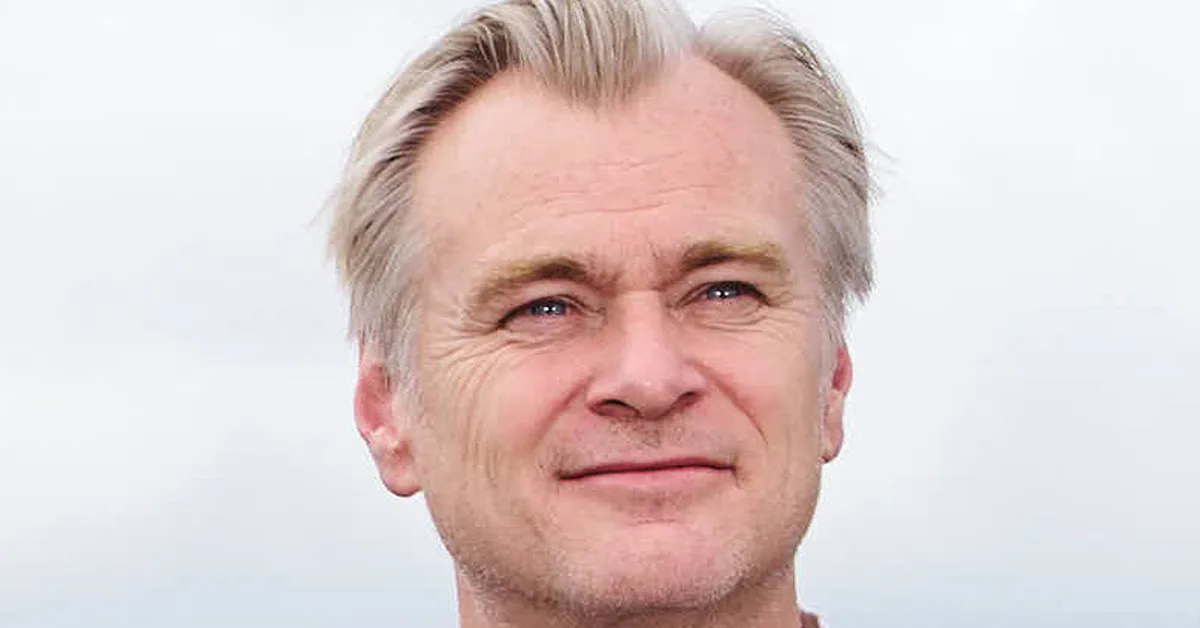
Christopher Nolan has claimed that he’s closer to reconsidering his stance on smartphones than ever before.
The Oscar-winning filmmaker has previously declared that he’s never owned a smartphone or been a user of email, which he spoke about in a recent interview with The Telegraph.
“I know I’d become horribly addicted to them if I had one,” the director of The Odyssey said. “I’d spend all my time looking things up.
“And I find I’m only able to advance my thinking on projects in those pockets of time where everybody usually jumps on their phone – waiting for a train, or in an airport, or sitting in a restaurant waiting for somebody to turn up for dinner. Those are the moments I work out whatever it is I need to do next.”
However, Nolan confessed: “I worry the world is eventually going to wear me down.”
“The return of the QR code since Covid has been particularly tricky for me,” he then admitted.
Nolan made a similar admission during a recent appearance on the US interview series 60 Minutes.
“The QR code had sort of gone away, but Covid brought it back,” he explained. “Now it’s kind of everywhere, and if you don’t have a smartphone, you can’t do much with a QR code. “
Pointing out that he carries “a flip phone” to stay in touch when he’s travelling, he claimed: “I’m just living the same way that we all used to. To me, it’s just life as normal.
“Most people do [envy me] which says something about where this has all gone, which is not good. I feel very fortunate to not be wearing the digital shackles.”
Nolan is now celebrating the release of his new movie, an adaptation of the epic Ancient Greek poem The Odyssey, which is in cinemas now.


You probably already know that exercise can help with healthier ageing, and that hanging out with your friends has even been linked to greater longevity.
But sometimes, the realities of adult life – be they injuries, sore joints, or just a busy schedule – can feel like a major hurdle to hitting those goals (no pun intended).
Enter: walking football, a modified exercise researchers think could be a “promising candidate for inclusion in public health initiatives targeting healthy ageing”.
What is walking football?
Play is quite different from that of “normal” football. It’s a no-contact sport, there’s an above-head-height restriction on the ball, and you can’t do “headers”, among other rules.
Games are usually six-a-side. And, of course, teams walk instead of running.
This is all designed to make the sport as low-impact as possible for players. Speaking to Arthritis UK, 85-year-old walking footballer John, who has knee osteoarthritis, said: “The rules really limit injuries.
“The chances of being injured are really quite low. There is no running or physical contact, and we play three-touch football which gives a more level playing field for players of varying abilities.”
Though it’s often associated with over-50s, the Walking Football Association (WFA) points out that players of all ages can take part.
It might be especially useful for “players in their late 40s with health issues, younger players returning from injury, or [who have] referrals from [their] Health Care Provider,” they explained.
Why might walking football help with ageing?
A narrative review of the benefits and risks of walking football, published in the journal BMJ Open Sport & Exercise Medicine, said that the sport’s “slower pace and reduced physical contact make it accessible and safe for individuals with various chronic conditions”.
Additionally, some research showed it led to “modest improvements” in players’ heart health and body composition.
The game was also associated with a range of mental health benefits, including better social connections and a greater sense of purpose (both of which have been linked to better ageing and even a lower risk of dementia).
Then, there’s the player-friendliness of the game to consider: “Walking football appeals to middle-aged and older adults, including those with chronic health conditions, due to its rule modifications that promote accessibility and inclusivity”.
Walking football can help to beat loneliness among an “often-isolated” older group, and may carry the usual benefits of exercise and walking, including lower type 2 diabetes risk, decreased blood pressure, and stronger bones, the WFA added.
Researchers think that more data is needed on how walking football might affect injury risk. But overall, the review reads, it “shows promise as a safe strategy to promote physical and mental health among diverse populations,” older people very much included.
You can find your nearest walking football club through the WFA’s site.
Politics
The House | Another genocidal massacre is about to happen in Sudan. Andy Burnham can’t say he wasn’t warned


5 min read
Our incoming prime minister says the global picture is darkening. He’s right. But nowhere is that picture as dark as the humanitarian crisis that is Sudan.
Right now, the UN and other agencies are warning that the besieged city of El Obeid could be the next crime scene.
Britain is not a bystander. As penholder on Sudan at the UN Security Council, we are supposed to lead the international response. What Britain does next on Sudan will tell us fast whether Andy Burnham’s promise of a principled, resilient Britain means anything at all.
Like Gaza, Sudan is experiencing innocent suffering on an enormous scale, yet too much of the media and public look away. When the RSF captured the city of El Fasher last October after an 18-month siege, at least 60,000 civilians are estimated to have been killed, in a massacre a UN investigation has now concluded amounted to genocide. Repeating that failure now, in El Obeid, would be a choice, not an accident.
So, it’s worth being clear about who is funding and fuelling this conflict. Sudan’s army has been fighting a paramilitary force called the Rapid Support Forces, and the RSF’s chief backer is the United Arab Emirates, a close British ally and trading partner.
The UAE denies arming the RSF. But last month Nathaniel Raymond of Yale’s Humanitarian Research Lab, the group whose satellite imagery documented the massacre, told Parliament that his team had traced the weapons pipeline, tracking phones moving between Addis Ababa, RSF territory and addresses in the Emirates linked to the RSF’s leadership. Human Rights Watch, the New York Times and UN experts have gathered evidence pointing the same way.
Raymond testified that Foreign Office officials told him “significant private pressure” from the UAE meant Britain would not publish what it knew about who was arming the RSF. Instead, officials suggested that his lab, a university research team, release the evidence itself, because doing so “could help neutralise” the Emirati pressure the British government would not confront directly.
Our Foreign Office was seemingly so under the thumb that it asked American academics to do what British diplomacy could not, while prioritising its economic and diplomatic relationship with the UAE over preventing the slaughter of tens of thousands of people.
Burnham has stated that his first priority will be national security, because ordinary lives are impacted by global events. No one could disagree. But national security does not just mean preparing for war. It means preventing conflict, tackling the instability that reaches British citizens, and defending the international rules that keep us all safe. Burnham was right to say our foreign policy must be guided by our values. You cannot say that and then retreat into a protectionist agenda.
Keir Starmer cut the aid budget to fund defence, taking it to its lowest level in cash terms since 2012. Sudan’s aid was ring-fenced. The government has protected £146 million in humanitarian funding for this year and doubled support to local Sudanese responders. That matters, and I welcome it. But ring-fencing a budget does not make it enough. Bilateral aid to Sudan actually fell last year, to £120 million, and the government’s own aid watchdog concluded that Sudan remains one of the world’s most under-resourced crises. £146 million for 30 million people facing starvation and genocide is a drop in the ocean.
Sufficient aid would allow Sudanese communities to get healthy again and create some ingenuity of their own. When a prime minister signals that aid is expendable, the average person on the street won’t stop to give a charitable donation, and charities begin to feel Sudan is too difficult a cause to take on.
I live in Manchester, and I’ve watched Andy Burnham up close. He’s decent, and Manchester is a city with a historic solidarity with people in the global south. His whole brand is about looking past the hazy world of politics to lead our country with a principled programme.
He has found his voice on Gaza, apologising for Labour’s failures and promising pressure on Israel. Sudan needs the same treatment: calling out the UAE’s role and putting genuine pressure on Abu Dhabi to stop, whatever the diplomatic cost.
Britain should impose network sanctions on those profiting from the illicit gold and finance fuelling this war, targeting the Emirati refiners and traders who handle Sudanese gold, as the European Parliament has just demanded. Raymond put it in terms every Mancunian understands: “If people in Manchester were burning Emirates jerseys we would be having a very different conversation,” he told MPs, referring to Manchester City’s Abu Dhabi ownership. The forthcoming illicit finance summit is the ideal opportunity to crack down.
We should also energise the atrocity prevention coalition on Sudan that the UK itself created: monitoring, early warning, accountability, and serious discussion of a civilian protection force.
Burnham has publicly lauded the Hillsborough law and the families who fought for it. The idea that when the state fails people, it owes them the truth, accountability and proof that lessons will be learnt to prevent it from happening again.
So apply that standard here, and stand alongside the thousands of Mancunians with families in Sudan.
After the revelations about the government’s response to El Fasher, the question Burnham should be asking is the one his own politics demands: how many warnings, and how many deaths, before there’s a proper inquiry into why the Foreign Office failed so badly? If he looks away, he proves his critics right that these principles are just branding. If he engages, he proves them wrong.
Mohannad Taha is an activist and chair of Manchester for Sudan
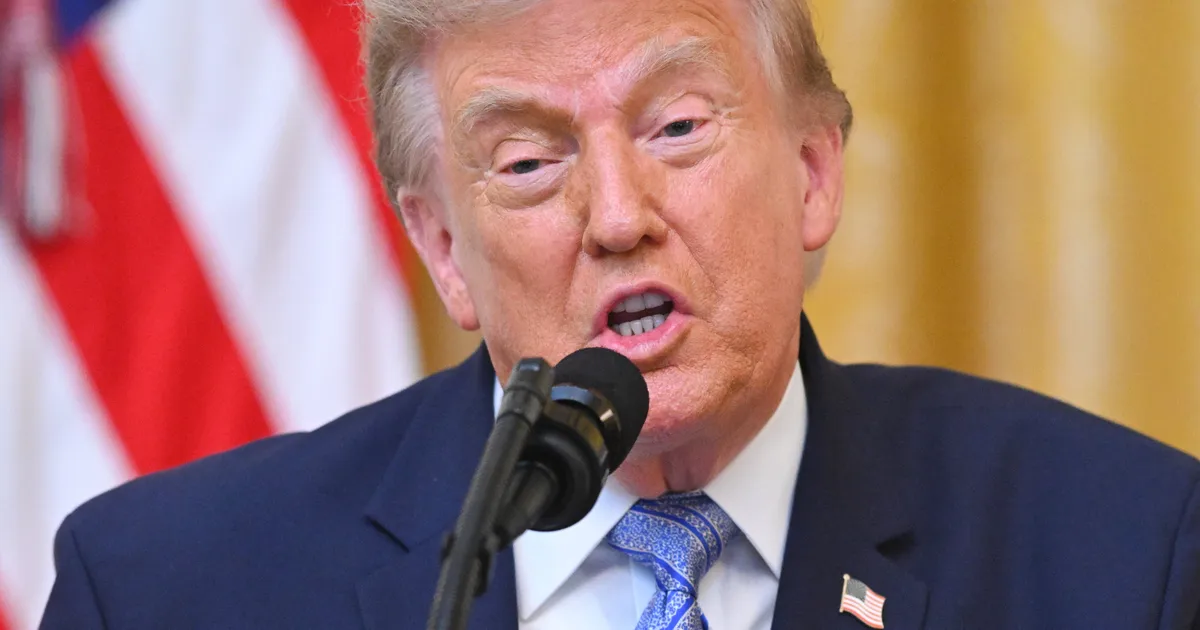
Donald Trump’s latest attempts to sow doubt into US voters’ minds about the American electoral system will be “quickly forgotten”, according to a BBC expert.
The US president claimed there are “shocking vulnerabilities” in the US election security in a dramatic speech on Thursday, three months before he faces the midterms.
In a primetime address, Trump accused China of interfering in the 2020 election – which he lost to Joe Biden – and made a series of unsubstantiated claims about voter fraud and foreign meddling.
He claimed he had declassified intelligence files which showed Beijing was trying to stop him from winning – but did not present clear evidence.
Previous US intelligence assessments also reported that it had “high confidence” China did not interfere with the 2020 result.
According to the BBC’s North America editor Sarah Smith, this “very dramatic” moment ended up “falling rather flat”.
“He was trying to lay out a picture of China attempting to influence the 2020 election,” she told BBC Radio 4’s Today programme. “But he didn’t really have any evidence that they had done.
“For instance, he was claiming China had obtained details of millions of voters, the kind of information that you would need to register to vote.
“The implication being that somehow that might be used in a fraudulent way. That’s information which is easily available online.”
She said Trump was “hoping people would draw the conclusion that fraud had been committed”.
However, Smith added: “[China] is probably not surprised that Donald Trump is talking about this now, especially since we are now only weeks away from crucial mid-term elections.
“He wants Congress to pass legislation changing the way people vote, insisting for instance that they prove they’re US citizens before they have the right to vote.”
Trump also claimed the “deep state is conspiring to keep this information [about China] from the American people”.
But Smith noted there is a “gap between what [the White House is] producing and claiming as evidence and the allegations the president was making in his speech”.
Trump also alleged the media wanted to continue “this plot” after several networks refused to air his speech amid concerns over his unsubstantiated claims.
Smith said: “Along with American enemies, the CIA and establishment figures, the media were also being pegged as people who were complicit in the cover-up of electoral fraud in America.”
Pointing to a new Washington Post-Ipsos survey which put his approval rating on 37%, Smith said Trump’s “poll ratings are not great” right now, either.
She continued: “This isn’t going to move the dial very much because I don’t think it’s going to be huge news, to be perfectly honest.
“More unsubstantiated claims about electoral fraud from Donald Trump are not anything new.
“If voters are not paying much attention to that, that’s probably to Donald Trump’s benefit. They would much rather hear him talk about affordability, the cost of living, what he’s trying to do to bring down prices, what he’s trying to do to end the war in Iran.
“It was billed as a very, very dramatic moment, but it’s one that fell rather flat – and I think will probably be quickly forgotten.”
Listen to Commons People, the podcast that makes politics easy. Every week, Kevin Schofield and Kate Nicholson unpack the week’s biggest stories to keep you informed. Join us for straightforward analysis of what’s going on at Westminster.

Critics are a little split over the final chapter in the Heartstopper story, which debuted on Friday morning.
Rather than a fourth season of the popular teen drama, Heartstopper Forever takes the form of a feature-length film, marking one last outing for Kit Connor and Joe Locke as boyfriends Nick and Charlie.
While critics are pretty much in agreement that those who’ve been loyal followers of Heartstopper’s first three seasons will find the movie to be a satisfying end, most have lamented that its focus on Nick and Charlie’s relationship means the wider cast has been sidelined.
Meanwhile, there’s some contention over whether or not the film allows its characters to mature convincingly, with some suggesting that the “wholesome” nature of the central couple’s relationship holds Heartstopper Forever back.
Here’s a selection of what critics have had to say about Heartstopper Forever so far…
“Heartstopper’s 90-minute finale of nice kids being (mostly) nice to each other could have had me reaching for my phone. Instead, I settled back like a proud parent to enjoy the cast navigate their final year of school and their evolving relationships […] LGBTQ+ children and their families need a little hope and happiness right now. Heartstopper delivers that with pretty, pastel bows on.”
“From the off, [author Alice Oseman] signposts that Charlie and Nick are in a different stage of life to when we last saw them […] Up until now, the show has rarely interrogated the stability of their romance, but these confrontations are also a showcase of how Locke and Connor have matured as performers […] Alas, the shorter length versus a full eight-episode season means that there are fewer scenes to share out among Heartstopper’s swelling ensemble.”

“Heartstopper Forever is a profoundly romantic, emotionally enlightened and essential viewing experience for anyone who has wept over the sweet simplicity of Nick and Charlie’s story before.”
“This last chapter is very much the story of Charlie and Nick […] There are a few joyous moments, of course, but it isn’t focused on falling in love or trying to navigate sex and intimacy for the first time. It’s about the work required to maintain a connection across different chapters of life.”
“As a stand-alone film, yes, Hearstopper Forever is far from perfect. But for those who’ve followed Nick and Charlie’s journey these past few years, the movie feels like a fitting farewell to the characters we’ve grown to know and love.”
“Part of Nick and Charlie’s glow comes from the extended cast that Heartstopper Forever mainly ignores. The film isn’t without its aww-inspiring moments, but the odd pacing, relentless Easter eggs and montages often leave it feeling like its own fan cam edit as it attempts to put the neatest possible bow on the couple’s puppy love. Nick and Charlie are supposed to be all grown up, but Heartstopper Forever treats them with kid gloves.”

“Fans were relieved that this beloved show would at least be getting a proper farewell. Sadly, it’s a pretty patchy one […] For long stretches, Heartstopper’s supporting characters barely get a look-in. […] Thankfully, Heartstopper‘s prevailing sweetness carries it to the finish.”
“All the focus on them does mean that Heartstopper Forever is a little too busy to focus on Charlie and Nick’s pals. It’s a drawback from season three, because those eight episodes meaningfully crafted their lovely queer community, emphasising the value of having people to lean on at a young age, especially if the rest of the world doesn’t understand who they are just yet […] Yet none of this detracts from Heartstopper Forever being a satisfying conclusion to this story, of two boys whose illuminating journey of self-discovery feels rare and valuable on screen, even if there’s a certain cringe factor to it.”
“If CBeebies made queer teen drama, it might be something like this. Heartstopper Forever arrives with the gentle air of an especially placid episode of Hey Duggee, but mixed with a break-up, a handful of sex scenes and a vigorous plea for trans rights.”
Heartstopper Forever is now streaming on Netflix. Read HuffPost UK’s review of the film in full here.
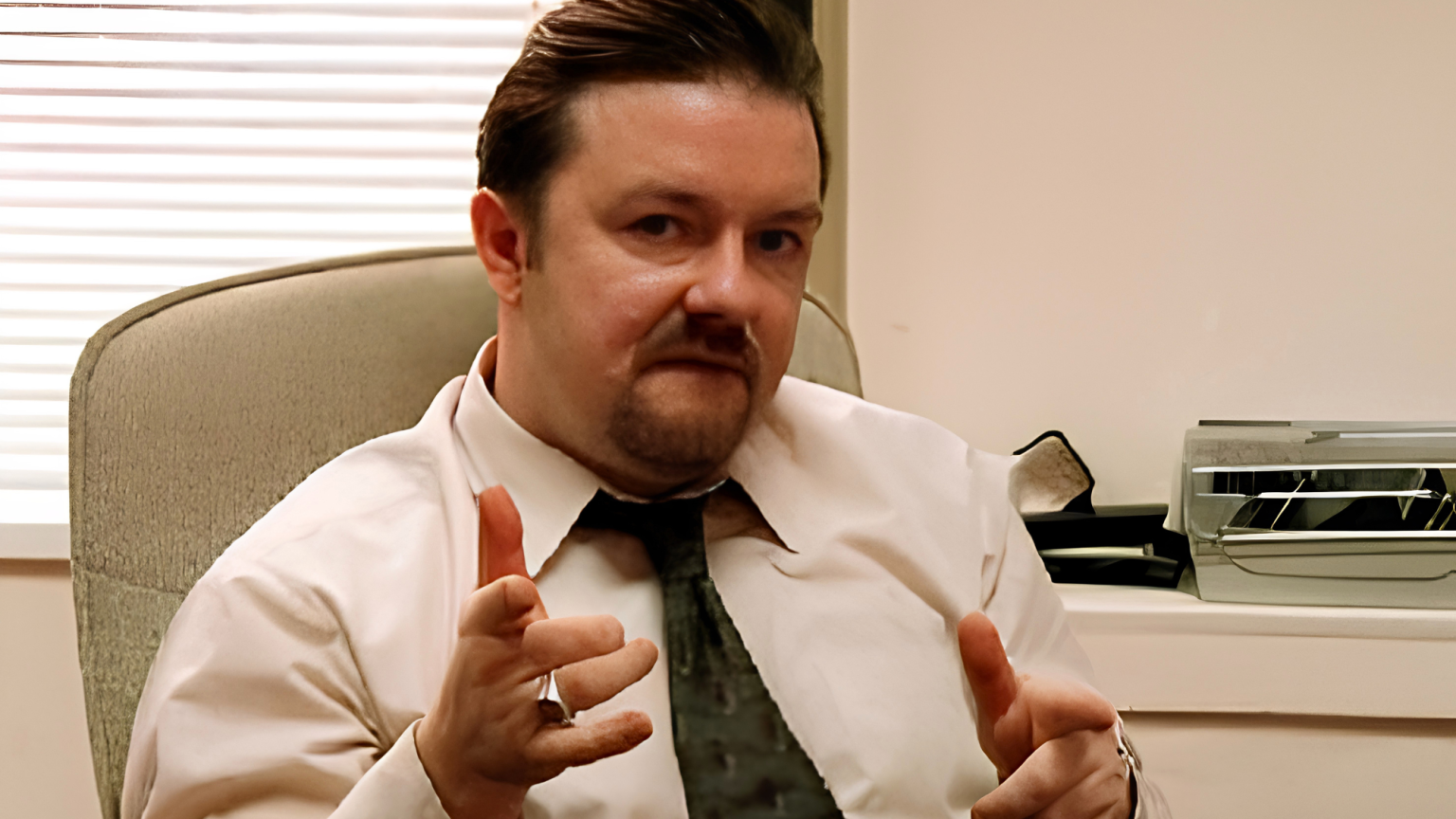
The occasion this month of the mockumentary The Office celebrating the 25th anniversary of its first appearance on television, an anniversary marked by a couple of actual documentaries, will have prompted some to revisit the comedy, or watch it for the first time.
Many who have done so will have inevitably asked themselves the same question: why did television comedy used to be so funny, and why is that not the case anymore? It’s not a conclusion that will be confined to us old timers: it’s said that there is vogue for all things turn-of-the-millennium among generations Y and Z.
They might be drawn to that era for the same reason my generation looks upon it wistfully. The Office was symbolic of a freer age, when we were mostly allowed to say what we thought and laugh at what we liked. This was before the censorious, safety-first, puritanical cult of hyperliberalism ruined everything, with television comedy being one of its greatest casualties.
The Office worked precisely because it was unsafe and made us feel uneasy. It wasn’t just the pervasive themes of disappointment and failed ambition, but the social transgressions made by the maladroit but redeemable David Brent, the creepy Gareth Keenen and the genuinely horrible Finchey.
Their jokes and observations regarding race, sex, homosexuality and the disabled would be impossible to broadcast today on two counts. First, because it’s unacceptable to even laugh at fictional characters who say awful things in public. Woke fundamentalism dictates that some words are inherently evil, unsayable in any context.
Secondly, society now doesn’t do forgiveness or understand redemption. David Brent’s transgressions would forever be held against him in our cancel culture. In real life, no scriptwriter would dare submit a comedy with such content. No commissioner would go near it – the industry has seen what happened to Graham Linehan.
This is why people of all ages return to or discover not only The Office, but Brass Eye, I’m Alan Partridge, Da Ali G Show, Peep Show, Little Britain, The League of Gentlemen, The Inbetweeners and even Top Gear with Jeremy Clarkson and co – all offensive in their own way, and all still being or repeated or watched on demand.
Television comedy has been a wasteland since the end of the noughties. In America, the glory days of Frasier, Friends and Seinfeld are a distant memory. And what have we in Britain produced since The IT Crowd? Mrs Brown’s Boys, Derry Girls, This Country, Peter Kay’s Car Share and Fleabag. A few of these tepid shows may have raised a smile, but none will be celebrated in 25 years. Or even remembered at all.
The public have bigger concerns than Farage’s mates
If much of the broadcast media and many of the newspapers are to be believed, Nigel Farage made a terrible misjudgement in standing down as MP for Clacton to prompt a by-election there. It was an ‘own goal’, we are constantly reminded.
I’m not so sure. Farage has behaved with impropriety, and the whole episode is sordid, but this is not a game changer. Most Reform UK voters or sympathisers are unmoved by the accusations and care even less about parliamentary procedure.
That Farage’s main opponent is now Count Binface, a comedian who has written scripts for Have I Got News for You (a show which epitomises everything smug and superior about the liberal-left clerisy), has only given more weight to the narrative that the ruling classes (neither Labour nor the Conservatives are standing at Clacton next month) are determined to suppress him and dismiss the people he stands for.
Reform is only the latest manifestation of a tide of discontent, a multifaceted swell comprising classic conservatives, working-class types of a conservative disposition, and old-school liberals, which made its voice known in 2016, and which remains unbowed today. Many have supported Reform because of Farage, many in spite of him.
This wave will prevail unless whoever is in power address the issues the governing parties have consistently failed to address for years: unsustainable levels of immigration that are destroying the fabric of this nation; excessive government spending, especially on those who don’t deserve it, which will bankrupt it soon; and the breakdown of the social contract manifest in the epidemic of shoplifting, anti-social behaviour and the disintegration of our once much-vaunted multicultural society.
For good or bad, most people don’t care what Nigel Farage has done. He is likely to win because many believe that this country is on the precipice. They fear that any scandal today is, from the longer view of this country’s very survival, a trivial distraction.
VAR sucks the life out of football
This year’s World Cup has once more reminded us of the inherent drawbacks with VAR.
The debate over the use of the video assistant referee in football may strike outsiders as a niche, esoteric matter, but whether we defer to this technology is a matter of significance. It reminds us that there are two types of people in the world.
On the one hand we have the idealists and perfectionists. They believe it is always possible to make objective and definitive judgements about human behaviour, that we should and can eliminate error and attain pure truthfulness. On the other hand we have realists, those who accept that we must live in an imperfect world, and that idealism can have unintended negative outcomes.
Introduced by perfectionists, VAR only introduces more doubt, more uncertainty and less respect for authority. Now more fouls must be re-considered, more decisions made by the referee called into question. The flow of play is interrupted with more appeals to the camera and interminable deliberation. Football as a fluid spectator sport has been much diminished since its introduction.
Yet human relations only function if we proceed with the understanding that justice is imperfect, perspectival and contingent. We have accepted this principle in common law for centuries, where judgements are dependent on multiple witnesses and many perspectives. We accept verdicts ‘being beyond reasonable doubt’. We have double jeopardy because we know that we can’t go on indefinitely raking over previous decisions. We acknowledge human subjectivity, in that some judges will be harsher and others more lenient. In football, we similarly know that some referees will be draconian, others indulgent.
Idealism can beget procrastination, inertia and paralysis. Or as Voltaire once counselled: the perfect is the enemy of the good.
Patrick West is a columnist for spiked and author of Get Over Yourself: Nietzsche For Our Times (Societas, 2017). Follow him on X: @patrickxwest.

Abdul El-Sayed on AIPAC spending, ‘Defund the Police’ and why he’s not a socialist
 lead image
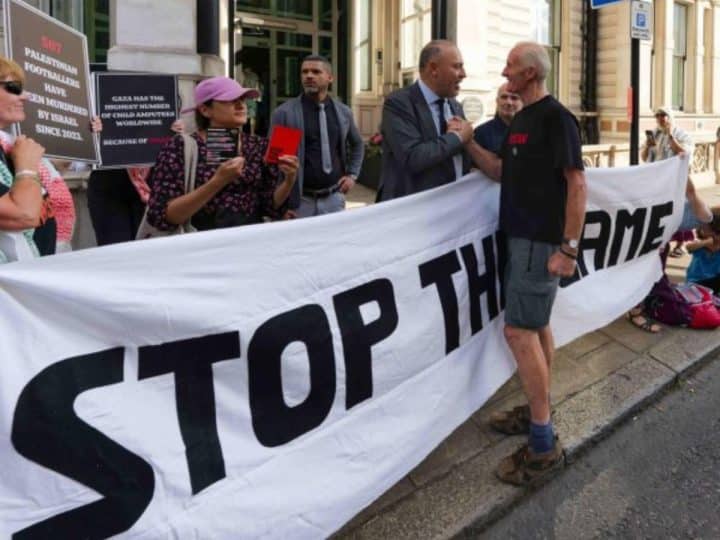
Yesterday, 15 July 2026, the London Irish Brigade held a protest outside Ireland’s embassy against the planned Ireland-Israel matches in the UEFA Nations League. The October 2026 fixtures will be held, after the Irish FA voted this month in favour of proceeding, in Hungary and, behind closed doors, in Serbia.
Irish football fans, outraged at the idea of playing sport against a genocidal apartheid colony, have been protesting against the fixtures for months. And last night, Irish people living in London took the ‘Stop the Game’ protest loudly to their own embassy:
Organiser Frank Glynn explained some of the background:
The protesters were congratulated by Palestinian ambassador Husam Zomlot:
The raucous but peaceful demonstration waved Palestinian flags and a “Stop the Game” banner, while activists handed out flyers to those who went past:
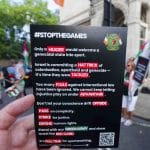









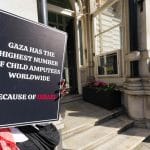
Protesters reminded passersby of the huge numbers of children and other innocent victims murdered or maimed by Israel:




Israel should be as isolated, in sport and in every other way, as apartheid South Africa ever was. Shame on the cowardly officials and bodies who are refusing to do it.
Featured image via author
By Skwawkbox

A Moroccan intelligence insider has helped expose the scale and reach of the country’s use of Pegasus spyware. The advanced Israeli-made technology hacks into smartphones allowing spies to eavesdrop on and manipulate the devices.
The former agent said Pegasus was used to spy on journalists, activists and foreign officials from Spain and France.
As the Guardian has it:
Pegasus, which is manufactured by the Israel-based NSO Group, allows its operator to access everything on a target’s mobile phone, including emails, text messages and photographs.
It can also activate the phone’s recorder and camera, turning it into a listening device.
Morocco claims it uses the technology, arguing:
that reporters who have investigated NSO Group were “incapable of proving [the country had] any relationship” with the company.
Inside the secret world of Pegasus
The whistleblower, known as Safir, has offered key insights into the work of the Direction Générale de la Surveillance du Territoire (DGST), Morocco’s internal security agency. Safir, who spent a decade in the agency, claims:
the country’s internal security services began using Pegasus in 2017 and went on to deploy it against domestic and foreign targets over the course of four years.
The result is a multi-year investigation across several news outlets as well as Amnesty International’s Security Lab. Le Monde, Haaretz, El Confidencial, Die Zeit and the Guardian all worked on the investigation.
The project’s coordinator, media NGO Forbidden Stories:
analysed material detailing Morocco’s surveillance practices, from leaked emails to targeting records relating to Pegasus and other spyware, and from victims’ testimony to internal training material.
The Guardian reported:
Two other former Moroccan intelligence agents also provided information and corroborated facts. Safir’s testimony is corroborated by leaked material, including the Pegasus project dataset, which has been forensically analysed by Amnesty International’s Security Lab.
Spying on dissenters and officials with Israeli tech
The investigation found DGST officials met figures from the Israeli tech firm in a swanky Morrocan villa in 2017. NSO officials demonstrated the spyware. Morocco later adopted it.
The spyware was used to target Spanish police officials and Moroccan and French human rights advocates.
Investigators say further evidence of Morocco’s use of Pegasus emerged when WhatsApp sued NSO in 2025:
Further evidence that Morocco used Pegasus emerged last year after WhatsApp’s parent company, Meta, took NSO Group to court in the US for exploiting its messaging platform to target people.
Israel allegedly barred exports of Pegasus to Morocco after a 2021 ban. The Biden administration imposed the ban on NSO for acting:
contrary to the foreign policy and national security interests of the US.
Authoritarianism is on the rise globally. Pegasus spyware is a terrifying threat. The Morocco leaks hint the scale and scope of danger this powerful Israeli hacking software poses to states and citizens alike.
Featured image via EuroMed
By Joe Glenton
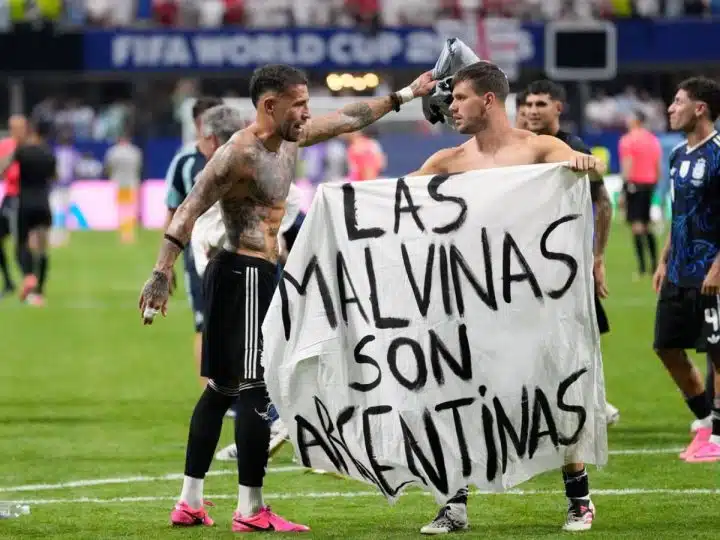
Argentina’s players have been criticised after displaying a banner referencing the Falkland Islands in the aftermath of their 2-1 World Cup semifinal win over England. The banner, held aloft on Wednesday night, translated as: “The Falkland Islands are Argentinian,” prompting immediate political reaction and renewed scrutiny over FIFA’s rules on political messaging.
The Falkland Islands remain a UK overseas territory, with islanders voting overwhelmingly in 2013 to retain that status. The islands have long been a point of tension between the two nations, most notably during the 1982 conflict, when Argentinian forces invaded before being forced to surrender two months later.
Argentina have previously been sanctioned for similar displays. FIFA fined the federation after players held up a banner with the same slogan following a 2014 friendly against Slovenia. Under Article 34.3 of the tournament regulations, political messages or slogans are prohibited before, during or after matches.
Business Secretary Peter Kyle told BBC Breakfast that the gesture crossed a clear line. “My reaction is that it was entirely inappropriate,” he said:
Politics needs to be separate from football. In fact, the World Cup has one of its central tenets that politics is separate from football. That is now a matter for FIFA. I expect FIFA to do its investigation thoroughly.
Kyle added that an investigation was inevitable given the nature of the breach:
We expect FIFA to undertake an investigation into this. I think it was certain to happen because it was such an egregious violation of the rules of not having political activity as part of the football.
The political reaction drew comparisons with a recent UEFA case. Spain players Rodri and Álvaro Morata were banned for one match each after singing about Spain’s claim to Gibraltar following their Euro 2024 triumph. Citing those sanctions, Liberal Democrat leader Ed Davey called for the Argentina players involved in Wednesday’s banner display to be suspended for Sunday’s final against Spain.
England’s exit sets backdrop for controversy
The banner emerged in the immediate aftermath of England’s elimination. Anthony Gordon had given England a first‑half lead, but Argentina overturned the deficit with two late goals from Enzo Fernández and Lautaro Martínez, both created by Lionel Messi, who once again shaped the decisive moments of a major tournament.
England’s performance was statistically stark, with five shots, 12% possession, and long spells spent chasing Argentina’s movement and tempo. Messi’s influence, as ever, proved pivotal, threading passes that unlocked England’s defensive structure and swung the semifinal decisively.
Argentina’s victory booked their place in Sunday’s final against Spain, who beat France in the other semifinal. The win also extended Messi’s remarkable run of decisive contributions deep into major tournaments, with his creativity again proving the difference.
Argentina — FIFA expected to review incident
FIFA has yet to comment publicly, though the governing body is expected to review the incident under its regulations on political messaging. The organisation has historically taken a strict stance on such matters, and the precedent from 2014, when Argentina was fined for the same slogan, adds weight to expectations of formal action.
The banner’s appearance also revived long‑standing sensitivities around the Falklands, a subject that has periodically surfaced in football contexts despite FIFA’s attempts to keep political issues separate from the sport. The governing body’s rules are designed to prevent precisely these moments, where geopolitical disputes spill into the global spotlight of a major tournament.
Wider context
The incident sits within a broader pattern of political expressions in football being met with disciplinary measures. UEFA’s sanctions against Rodri and Morata last year underscored the governing bodies’ insistence on neutrality, particularly during major competitions where global attention is heightened.
Football’s reach often makes it a stage for political symbolism, intentional or otherwise. Governing bodies have repeatedly emphasised that the sport’s global appeal depends on maintaining separation from political disputes, even when players or fans feel compelled to express national sentiment.
In this case, the banner’s message touched on a decades‑long territorial dispute that remains deeply sensitive. The Falklands conflict, though more than 40 years old, continues to shape political identity and national narratives in both countries. The World Cup’s scale ensured that the gesture would draw immediate and widespread reaction.
England left to reflect on familiar shortcomings
Away from the political fallout, England’s exit prompted renewed scrutiny of their tournament shortcomings. The semifinal defeat followed a pattern familiar to recent campaigns. There was early promise, moments of control, but ultimately undone by lapses and the brilliance of elite opponents.
Anthony Gordon’s opener had given England a foothold, but Argentina’s late surge driven by Messi’s vision and the clinical finishing of Fernández and Martínez, clearly exposed England’s vulnerabilities. The Three Lions struggled to retain possession, failed to impose their rhythm, and were repeatedly forced into reactive defending.
Player ratings reflected the gulf in influence. Messi earned a 9/10 for his decisive contributions, while England’s key figures were unable to match Argentina’s tempo or creativity. The defeat extended England’s wait for a major tournament final and added another chapter to their catalogue of near‑misses.
Argentina moves on, England head home
Argentina now prepare for a final against Spain, a matchup shaped by contrasting styles and the presence of generational talents on both sides. Spain’s controlled possession game and Argentina’s incisive transitions promise a compelling contest, with Messi once again central to Argentina’s hopes.
England, meanwhile, depart with frustration and familiar questions. Their semifinal exit, combined with the controversy surrounding Argentina’s banner, ensured a dramatic and politically charged end to their campaign.
Nothing will come of FIFA’s investigation, which is expected to unfold in the coming days, but for now, Argentina’s focus shifts to Sunday, and the chance to lift another World Cup trophy.
Featured image via the Canary
By Faz Ali
Politics
Oppressed Sahrawi filmmakers call for boycott of The Odyssey as Nolan chose to film in occupied territory
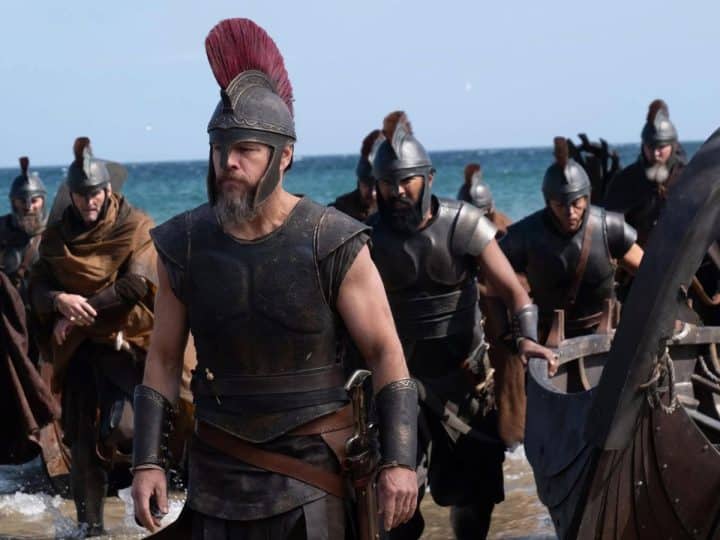
Boycott calls are growing as Sahrawis slam Christopher Nolan’s decision to film The Odyssey in occupied territory. All while doing nothing to acknowledge the occupation or the Sahrawis who continue to resist Morocco’s ethnic cleansing campaign to force them from their land.
Nolan chose Dakhla as the location for the film, set for release on Friday 17 July, despite the fact that the land has been occupied by Morocco for 50 years. In turn, critics have pointed out that this can only work to normalise the oppression and forced displacement of Sahrawis.
Sahrawi filmmakers and journalists have condemned this deplorable lack of empathy for the people of Western Sahara and a failure to uphold any sense of “ethical responsibility”. As a result, they now argue that boycotting the film is essential to push back against military occupation, dispossession and injustice.
One of those making this call is Sahrawi journalist and filmmaker Mamine Hachimi who powerfully stated to Middle East Eye:
It is deeply disturbing that while Sahrawi journalists are imprisoned for exposing abuses, an international film production can use our homeland as a cinematic backdrop without addressing the reality of the occupation.
Sahrawi campaigners and filmmakers are calling for a boycott of The Odyssey by Christopher Nolan over his decision to shoot the film in Morocco-occupied Western Saharahttps://t.co/yA77f8mpV3
— Middle East Eye (@MiddleEastEye) July 15, 2026
Imprisoned for life after documenting human rights violations
Imagine a major Hollywood production choosing to film in the occupied West Bank while ignoring Zionist Israel’s occupation and its settler-colonial violence, terrorism and crimes against humanity. The Odyssey was filmed on occupied and dispossessed land.
Like in Palestine, resistance is a crime in itself for people in Western Sahara. Those who dare to document the crimes of the Moroccan oppressor face arbitrary punishments, Some have been imprisoned for life simply for documenting ongoing violations against the human rights of Sahrawis.
Hachimi co-directed a short documentary, ‘Three Stolen Cameras.’ The film spotlights the challenges facing Sahrawi media organisation Equipe Media as it tries to capture evidence of the crimes perpetrated by Morocco against the people of Western Sahara. However, its premiere in Beirut back in 2017 was shut down as a result of undue pressure by the Moroccan government. One of the many attempts by Morocco to make the film disappear.
Those working within the media organisation have faced arrest and harassment from the occupying authorities. This reminds us of Israel — one of only 2 countries, along with the US, that recognise Moroccan sovereignty over Western Sahara — and the way in which it is murdering journalists en masse in Palestine and Lebanon. Moreover, the lawfare used by Zionists and pro-Israel groups across the West to shut down the ability of the wider public to learn the truth about Palestinians also mirrors the struggle of those brave journalists and filmmakers like Hachimi.
Speaking to Middle East Eye, Hachimi added:
This is not a campaign against cinema or artistic freedom – it is a call for ethical responsibility.
Two of my colleagues, Abdallah Lhafaouni, who is serving a life sentence, and Bachir Khadda, who is serving a 20-year sentence, are political prisoners simply because they documented human rights violations in occupied Western Sahara.
The Odyssey — No solidarity
The fact that Nolan has refused to comment on this choice and carried on filming — despite seeing visible protests in Dakhla making clear the anger and frustrations of local people — exposes a complete lack of solidarity between Western filmmakers and filmmakers from the Global South.
The same silence echoes across much of the Western mainstream media. Journalists have shown little urgency — let alone outrage — over the relentless targeting of journalists in Palestine and Lebanon.
The contrast couldn’t be more jarring. Nolan travelled to occupied territory to film his next blockbuster, while other filmmakers risk punishment, sanctions and even criminalisation simply for documenting what life under occupation actually looks like.
This only serves to benefit the Moroccan government, whose minister of culture — Mohamed Mehdi Bensaid — took selfies with Nolan, saying that the film would:
give visibility to Dakhla as a film location and not just a tourist destination.
This becomes all the more offensive to those who have suffered under this oppressive occupation when we learn that Nolan made use of security services provided by the same military that is hurting, injuring and silencing Sahrawis resisting Morocco just a mere few kilometres away.
Sahrawi campaigners say The Odyssey serves to whitewash the long-running and ongoing exploitation of their own territory by Morocco. In turn, this normalises occupation by powerful states, which only leaves ordinary civilians vulnerable to these acts of dominance and aggression.
Colonialist abuses in the global south have long been ignored — receiving nowhere near enough criticism or scrutiny — an issue this film could have avoided:
View this post on Instagram
Missed opportunity to challenge today’s oppressors
The Odyssey looks set to dominate the summer box office. With a reported $250 million budget, it’s one of the year’s biggest releases, and audiences around the world are counting down to Friday. Packed with mythology, epic battles, gods and sorcery, it’s also poised to make its creators and investors a fortune.
But in chasing an ancient story, the film missed the chance — whether by choice or not — to shine a light on a very real struggle unfolding today, and on the remarkable resistance that has endured through five decades of Moroccan occupation.
Sahrawi filmmaker Abidin Mohamed Hamudi argues that, instead of standing with those fighting for freedom, human rights and self-determination, the team behind The Odyssey has made itself “complicit” in the abuses taking place in Western Sahara.
Speaking to MEE, Hamudi argued that Hollywood’s silence reflects the priorities of capitalism and the corrosive logic of Western economic interests. He concluded:
Shame on them – history will put everyone in the place they deserve, and they will be in the dustbin of history, remembered as nothing but cultural parasites.
With #TheOdyssey about to be released, it's more important than ever to know the truth behind #ChristopherNolan's film and to hear directly from its victims. Thank you, @MiddleEastEye, for giving a voice to those silenced by #Morocco and its accomplices — FiSahara (@FiSahara) July 16, 2026
 https://t.co/bKfcKv2iCD pic.twitter.com/GqCMADpxxH
Nolan’s past comments regarding criticisms were that “they’re always irrelevant”, giving little hope he will right his wrong in this instance:
Christopher Nolan says the online backlash to ‘THE ODYSSEY’ comes with the territory.
“These conversations that happen before people see the film – they’re always irrelevant. Because no one having them knows what the film actually is yet.”
(Source: https://t.co/J378r5GWMy) pic.twitter.com/fUfthbUeyV
— DiscussingFilm (@DiscussingFilm) July 10, 2026
The Odyssey — More backlash but for all the wrong reasons
Nevertheless, Nolan may be in for some financial woes. Alongside the boycott calls from activists, the film is also facing backlash from far-right bigots targeting its casting of a Black woman as Helen of Troy and trans man actor Elliot Page as Sinon.
That double-sided controversy could end up hitting The Odyssey where it hurts most: at the box office.
BOYCOTT THE ODYSSEY MOVIE pic.twitter.com/lmSo4gFZEV
— GORGO (@GORGO4547) July 11, 2026
Elites failing ordinary people, yet again
Therefore, it seems that an opportunity was there for successful Western filmmakers to use their celebrity status and their privilege to help those made voiceless — which would be a true act of a genuine filmmaker.
Others, including Javier Bardem, Greta Thunberg, and Pedro Almodóvar, have urged Christopher Nolan to cut any scenes his team filmed in the occupied lands of Dakhla. So far, Nolan, his production company Syncopy Inc., and Universal Pictures have stayed silent.
That silence risks turning Nolan’s latest film into yet another reminder of Western indifference to — and complicity in — the crimes against humanity and historical breaches of international law still taking place today.
Featured image via IMDb

Pakistan cricketer banned after testing positive for cannabis-related substance

4 Mini Chainsaws On Amazon With Deep Discounts In July 2026

Heartstopper Forever Review: Netflix Film Is A Fitting Farewell


-

 Fashion6 days ago
Weekend Open Thread: Nutriplenish Leave-In Conditioner
-
 NewsBeat18 hours ago
London Mayor Sadiq Khan handed a peerage by Keir Starmer alongside 15 other Labour figures… just days before the PM leaves No10
-

 Crypto World1 day ago
CFTC blocks Kalshi from unwinding Michigan trades after court order
-

 Business1 day ago
Nvidia Stock Slips After Big Tuesday Rally as Huang Confirms Vera Rubin Chip Is Now in Production Today
-

 Politics2 days ago
Young campaigners urge incoming PM to act on outdoor junk food ads
-
 Entertainment2 days ago
Disney’s Most Ambitious Failed Star Wars Attraction Is Coming to SDCC
-

 News Videos3 days ago
XRP BOMBSHELL… XRP OMBOARDED FOR TRANSACTIONS!!!
-

 Tech3 days ago
Get Your ESP32 Sunny Side Up With This Solar Dev Board
-

 Crypto World13 hours ago
Injective Submits SEC Transfer-Agent Registration to Onchain Ownership Records
-

 Tech3 days ago
Dark Secrets Emerge When Jailbreaking LLMs
-

 News Videos3 hours ago
Money | Class 12 Economics | CBSE Board Exam 2026-27
-
 Sports2 days ago
New Cornerback Enters Vikings Trade Rumor Mill
-

 Business1 day ago
Palantir Shares Rise After Expanded Nvidia Partnership and Fresh Analyst Upgrades Ahead of Earnings Day
-

 Business8 hours ago
Banco Bilbao Vizcaya Argentaria, S.A. (BBVA) Discusses Global Macro Environment and Economic Outlook for Core Markets Transcript
-
 Tech4 days ago
Cloudflare Precursor Watches Your Mouse and Keyboard To Decide If You Are Human
-

 News Videos4 days ago
how to make coin bank box with cardboard #scienceproject #money #diy #shorts
-
 Entertainment2 days ago
Vicki Gunvalson Defends Discussing Heather Dubrow’s Money
-
Crypto World3 days ago
Ripple, Coinbase, Circle Join Linux x402 Foundation to Help Shape AI Payments
-
Business9 hours ago
Nephros, Inc. (NEPH) Discusses Evolving Water Safety Strategies and Expansion Beyond Filtration Transcript
-
 Crypto World11 hours ago
Claude Fable 5 Slips to Second in AI Coding Leaderboard
You must be logged in to post a comment Login