
Politics
Cyprus is still being treated as a colony

The UK’s Chief of Defence Staff has publicly said that Cyprus is effectively Great Britain’s aircraft carrier – showing the true colonial colours of the very top of the UK’s armed forces.
Sir Richard Knighton rejected suggestions that the UK should deploy naval assets to the Middle East. He was also accused of leaving the country’s assets “underprepared”. He said:
We don’t need the carrier. We don’t need the Navy. We have an aircraft carrier – it’s called Cyprus.
Then, he pointed out that the UK’s Royal Air Force could launch F-35 jets from its Akrotiri air base in Cyprus. The UK stationed these there last month.
Cyprus: illegal occupation from the UK
The UK previously occupied and colonised the entire Island of Cyprus.
In 1960, Greece, Turkey, and the UK all signed an agreement that guaranteed the independence, territorial integrity, and security of Cyprus.
And the reality is that Cyprus is still not independent.
Turkey has occupied the northern third of the Island since the country invaded illegally in 1974.
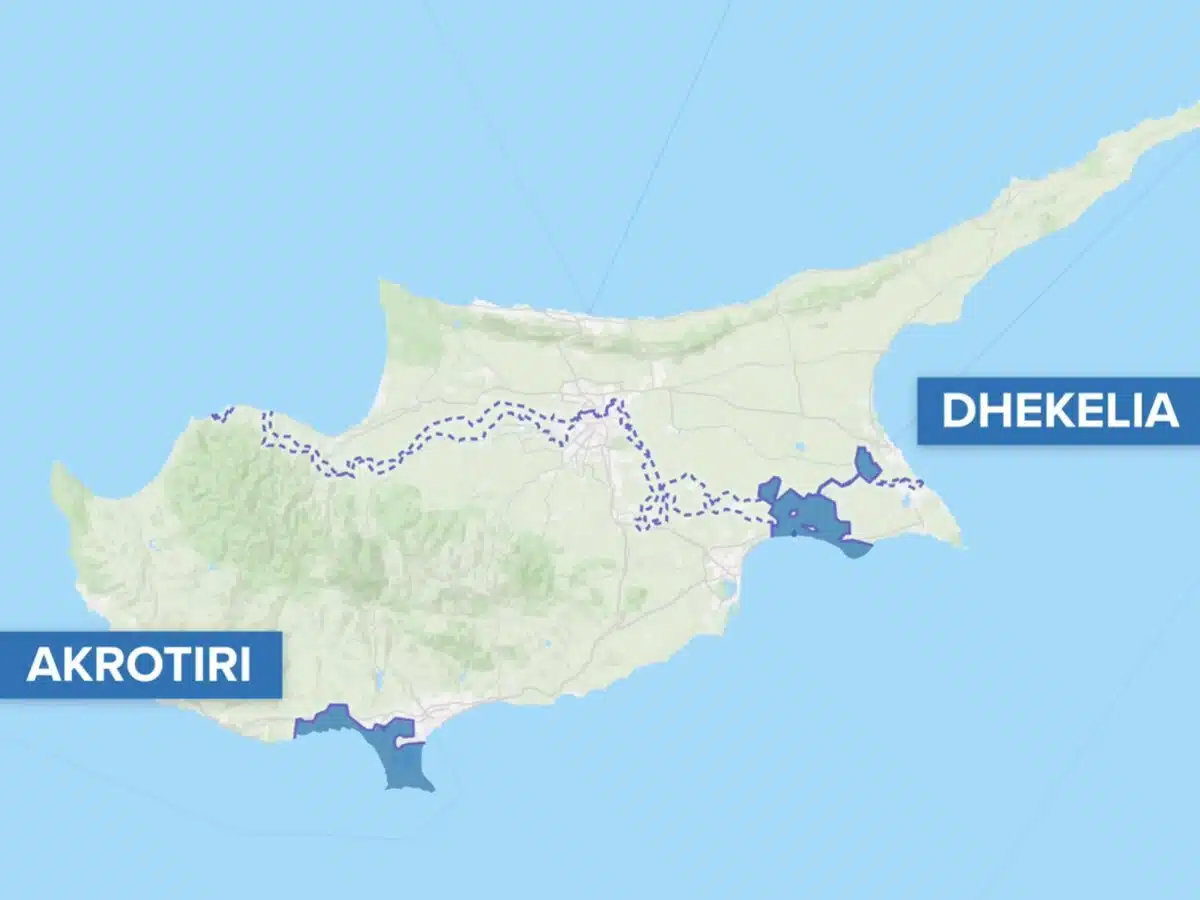
To make matters worse, the UK still controls over 250 square kilometres of Cypriot territory. This constitutes two military “Sovereign Base Areas“, as well as a host of additional “British-retained sites”.
When Cyprus got its independence from Britain, the UK illegally cleaved off sections to keep for itself as sovereign bases
The Brits should end their illegal occupation https://t.co/cwORnQ29ww pic.twitter.com/zRms91ALFS
— Aidan Simardone (@AidanSimardone) March 1, 2026
These “crucial sites” – RAF Akitori and Dhekelia- include an Olympic-sized swimming pool and a sports field.
When Cyprus got its independence from Britain, the UK illegally cleaved off sections to keep for itself as sovereign bases
The Brits should end their illegal occupation https://t.co/cwORnQ29ww pic.twitter.com/zRms91ALFS
— Aidan Simardone (@AidanSimardone) March 1, 2026
The UK’s presence in Cyprus has become more controversial since October 7. The bases have been used to host US forces, along with providing equipment and logistical support to Israel.
It was also used as a base for UK air strikes against Houthi targets in Yemen.
Essentially, the UK is occupying land in a sovereign country to spy on and now bomb the Middle East.
US involvement
If things weren’t bad enough, top secret documents published by Edward Snowden revealed that every UK spy site on Cyprus is actually a joint UK-US base:
Top Secret (Strap1) document leaked by Edward Snowden
First time we knew the specifics of UK spy sites on its Cyprus colonies
First time we knew that every single one was a joint site with US spies
Snowden did the world a major service – a hero for the ages pic.twitter.com/oCqRzDlSal
— Matt Kennard (@kennardmatt) March 17, 2026
The document states that:
Cyprus hosts a wide range of UK and US intelligence facilities:
Importantly, the documents also reveal that the US’s National Security Agency (NSA) provides 50% of the funding for the SOUNDER Comsat facility. This is a top secret surveillance station located in Ayios Nikolaos, Cyprus, which is part of RAF Dhekelia.
We continue to sustain and strengthen our partnership with the US/NSA and with other 5-Eyes agencies. GCHQ’s Cyprus collection facilities are acknowledged by NSA as important assets that make a major contribution to UKUSA. Under the ECHELON Agreement, NSA provides 50% of the funding for the SOUNDER Comsat facility.
According to Al Jazeera:
Cyprus was – and still is – of substantial strategic interest to Washington, particularly in its role as an offshore intelligence facility for surveillance of the Middle East.
Declassified UK also revealed that:
129 US airmen are permanently deployed to RAF Akrotiri, which is a staging post for bombing campaigns across the Middle East. The US spy force, the 1st Expeditionary Reconnaissance Squadron, is also permanently deployed at Akrotiri.
The UK should not still be occupying Cyprus or sharing military bases, assets, or intelligence with the US regime, which started an illegal and unprovoked war on Iran, another sovereign nation.
Cyprus is a sovereign nation with over 1.2m inhabitants. Yet now, Sir Richard Knighton’s words suggest it is merely an “aircraft carrier” which would, in essence, make it a valid military target. Of course, this is bullshit.
His comments show that Britain’s overseas bases are nothing but another example of the UK’s colonial military overreach.
Featured image via TLDR News/YouTube


DAYS THE BUDGET IS LATE: 6
DECLARATION OF INDEPENDENCE: During his campaign, New York City Mayor Zohran Mamdani had a historic number of volunteers who canvassed on his behalf. Among them was his pick to lead the Department of Investigation.
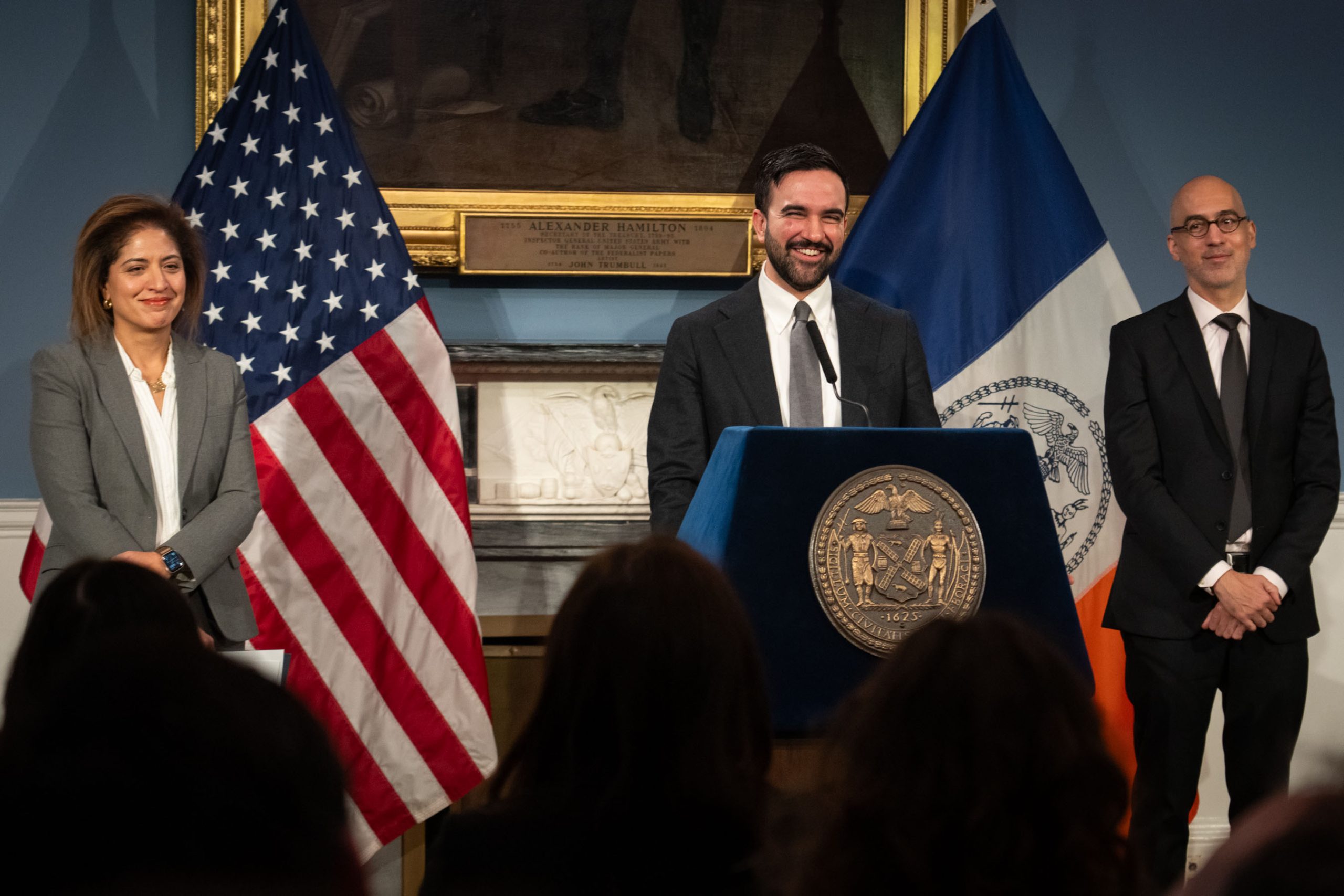
In February, Mamdani nominated former federal prosecutor Nadia Shihata to lead the investigation department, which acts as a watchdog over city government.
On Monday as part of the confirmation process, she faced questions from members of the City Council, who focused particular attention on her prior support of the administration she would be charged with auditing and investigating.
Shihata gave $700 to Mamdani’s campaign in four installments last year. She spent a day canvassing for the then-mayoral hopeful. And after graduating from law school 20 years ago, she struck up a friendship with Ramzi Kassem, who is now the mayor’s chief counsel in City Hall and the person who reached out to see if she’d be interested in the job.
“How do you compartmentalize that political kinship, if you will, with a role that may have you investigating that very leader and his administration?” asked Council Member David Carr, leader of the body’s Republican caucus.
Shihata pushed back, saying the support she offered to her future boss would not cloud her ability to probe city government should she be approved by the Council, which has veto power over the pick. And she clarified that she and Kassem are not close friends, though she did consult him before establishing a law firm after leaving the Department of Justice.
“I have investigated people I have supported in the past,” she said in response to Carr’s question. “That has not affected my ability to investigate them and reach conclusions driven by the evidence of the law.”
Shihata worked for 11 years as a federal prosecutor for the U.S. Attorney for the Eastern District of New York, which has pursued past public corruption cases in tandem with DOI. Her stint there included serving as chief of the Organized Crime and Gangs Section and deputy chief of the Public Integrity Section — two roles that give her a law-enforcement pedigree typical of DOI commissioner candidates.
It is the training she received there that will serve her well in her potential new gig, according to someone who knows a thing or two about independence from City Hall.
“These questions were raised when I was up for confirmation, and I don’t think there’s a lot of doubt that I ultimately was very independent,” said former DOI Commissioner Mark Peters, who was a longtime friend and campaign treasurer to former Mayor Bill de Blasio before the then-mayor tapped him to lead DOI.
Once installed as commissioner, Peters pursued the administration aggressively — some might say that’s putting it mildly — and released several bombshell probes before de Blasio fired him, citing an independent report that found Peters abused his power and mistreated staffers.
Speaking with Playbook, Peters said Shihata would be an excellent DOI commissioner.
“If you’re like I was and like Nadia is — a trained, professional investigator and prosecutor — inherent in that training is learning how to be independent and compartmentalize other parts of your life,” he said. “Prosecutors are supposed to be politically independent. And well-trained prosecutors are.” — Joe Anuta
From the Capitol

BUDGET MONTH: Gov. Kathy Hochul is preparing to send state lawmakers a second stopgap spending bill as a broader deal over the state budget remains elusive.
The Legislature will return on Tuesday to take up the extender legislation. The bill will cover payroll for thousands of state workers, but it’s not yet clear how long the government will be funded. The Legislature was initially scheduled to be on a two-week hiatus this month, but the late spending plan has scrambled the legislative calendar.
“We’re still working out the details on the length of each extender,” Hochul said Monday during an unrelated event in Albany. “Certainly we gave a longer one because of the religious observances of Easter and Passover.”
Read more from POLITICO Pro’s Nick Reisman.
BLAKEMAN AVOIDS A PRIMARY: Libertarian Larry Sharpe did not submit petitions to run for the Republican gubernatorial nomination, so GOP standard-bearer Bruce Blakeman is locked in as his party’s presumptive nominee.
Sharpe still plans to gather petitions later this spring to run as a Libertarian in November, eight years after he received 95,000 votes on that minor line. But he didn’t hit the 15,000 signatures needed to also run in the major party’s primary.
“Republicans are leaving the state left and right, there’s not enough out there for me to get,” Sharpe said, adding that it was a challenge finding registered Republicans to collect signatures since they’re “getting pressure from the elites to not carry for me.”
Sharpe also blamed the weather since February: “We had two snowstorms,” he said. “How am I supposed to get signatures when I’ve got snowstorms?”
As of a couple of hours before the Monday filing deadline, the state Board of Elections had posted submissions from three gubernatorial candidates. Each of these was able to skip gathering petitions thanks to their backing at a party convention: Hochul, on the Democratic line; Blakeman, who’s endorsed by the Republicans and Conservatives; and Amy Taylor, the Working Families Party’s placeholder. — Bill Mahoney
FROM CITY HALL

NEEDS NOT MET: Mamdani administration officials are moving to curb child welfare investigations of cases they say should instead be referred to community-based groups — a shift based on data showing most families can’t afford necessities that often form the basis of such cases.
At a Monday press conference, Mamdani tied the city’s preliminary racial equity plan to its “True Cost of Living” report, which found roughly 70 percent of families with children can’t meet basic expenses and nearly three-quarters of kids live in economically insecure households. For single parents, the crisis is nearly universal, with up to 93.8 percent falling short. By contrast, the only households meeting the cost of living are two-adult households with no children.
“New York City’s affordability crisis and its history of racial inequity are bound together,” Mamdani said.
The Administration for Children’s Services’ child protection division is also strained and has required substantial funding. The city is set to spend roughly $142 million in the 2026 fiscal year on child protection personnel alone, with an average cost of about $2,800 per case.
The administration’s plan for children and families is to redirect those resources — expanding community-based referrals, training mandated reporters on when a report is legally required and emphasizing prevention.
According to the New York City Family Policy Project, a child welfare policy and research group, New York’s investigation rate was 17 percent higher than the national average in 2024 with nearly 80 percent of investigations unsubstantiated. This past December, Hochul signed a bill banning anonymous child abuse reports, following claims that such tips can double as harassment, often directed at families of color.
Nora McCarthy, director of the Policy Project, said the city’s shift in approach is likely driven in part by research showing the strongest predictors of investigations are economic: income loss, housing instability and material hardship.
“Poverty is the driver,” McCarthy said. “When you have a lot going wrong in terms of being able to meet your basic needs, you can really start having trouble, like getting your child to school.” — Gelila Negesse
FROM THE CAMPAIGN TRAIL

WHO’S THE WILD MAN NOW: Former New York City Mayor Rudy Giuliani today endorsed Republican House candidate Anthony Constantino, who is in a bitter primary against Assemblymember Robert Smullen.
The endorsement from the ex-mayor came after Constantino said he wrote “a beautiful two-page letter” to Giuliani.
“Rudy has a great eye for talent,” Constantino told Playbook.
The campaign to succeed outgoing Republican Rep. Elise Stefanik in the sprawling North Country House district has been a bruising one. Smullen has accused Constantino, the impresario of a sticker company, of hawking bawdy stickers mocking President Donald Trump. Constantino has called Smullen “Slime Bob.”
The Republican establishment has largely lined up behind Smullen, a retired Marine colonel who has the backing of the state GOP.
That makes endorsements from leading MAGA figures like Giuliani all the more valuable for Constantino’s outsider bid. Giuliani played a central role in Trump’s effort to overturn the results of the 2020 presidential election. And Constantino has a flair for advertising his MAGA bona fides, like erecting a large pro-Trump sign atop a building.
In the lead up to the endorsement, Giuliani met with Constantino in Florida to discuss the race. Constantino came away charmed by the man once known as “America’s Mayor.”
“I want to become friends with him. He’s brilliant. He’s kindhearted,” Constantino said. “He likes the regular person. He doesn’t consider himself better than anyone.” — Nick Reisman
IN OTHER NEWS
— OPEN TO WORK: New York City’s Economic Development Corporation still has no leader as business leaders voice concerns over the city’s economic and job growth. (Gothamist)
— ALLEGED SCHEME: Frank Carone, former chief of staff to Eric Adams, says associates charged by federal prosecutors in an insurance fraud scheme scammed him too. (THE CITY)
— POLITICAL MISCHIEF: New York State Assembly member Andrew Hevesi accused primary rival Jonathan Rinaldi of changing his registration. (The New York Times)
Missed this morning’s New York Playbook? We forgive you. Read it here.

!function(n){if(!window.cnx){window.cnx={},window.cnx.cmd=[];var t=n.createElement(‘iframe’);t.display=’none’,t.onload=function(){var n=t.contentWindow.document,c=n.createElement(‘script’);c.src=”//cd.connatix.com/connatix.player.js”,c.setAttribute(‘async’,’1′),c.setAttribute(‘type’,’text/javascript’),n.body.appendChild(c)},n.head.appendChild(t)}}(document);(new Image()).src=”https://capi.connatix.com/tr/si?token=19654b65-409c-4b38-90db-80cbdea02cf4″;cnx.cmd.push(function(){cnx({“playerId”:”19654b65-409c-4b38-90db-80cbdea02cf4″,”mediaId”:”85e6748d-9d26-4ee0-b90a-7af8f3d70593″}).render(“69d4146ce4b0d214cc725f88”);});

Imagine a country where those who apprehend thieves are punished more harshly than the thieves themselves. Where the one who gets shamed and shunned is not the workless bum on a stealing spree but the decent bloke who stands in his way. It sounds like some dystopic fantasy where morality has been turned on its head and crime decriminalised. But it’s real. The country you’re imagining is Britain.
The story of the Waitrose employee getting the heave-ho for blocking the path of a light-fingered crook has shocked everyone. Even the Guardian, which normally pooh-poohs such stories as right-wing fare designed to get ‘the gammon’ even more red-faced than usual, has given it half a page. Things must be bad. His name is Walker Smith, he’s 54, he had worked at Waitrose for 17 years, and he was let go for stopping a shoplifter from pilfering some Easter eggs. Sacked for thwarting crime – this is where we’re at, fellow Britons.
He was an assistant at the Waitrose in Clapham Junction in south London. Quick question: what’s going on in Clapham? First, mobs of idle youths terrify shoppers for two nights straight as useless coppers look on in bewilderment. Now a man loses his job for saving property from the clutches of a tea-leaf. The pilferer was trying to make off with a bag-full of expensive Lindt Gold Bunny Easter eggs. But Mr Smith had other ideas. He grabbed the bag of booty, a small tussle ensued, and the shoplifter scarpered empty-handed. Promotion for Mr Smith? Nope. He was reprimanded.
The details are mad. Smith says he recognised the shoplifter as a repeat offender. And he wasn’t going to let him get those choco bunnies for free. So he yanked the bag, it broke, and the bunnies crashed to the floor, one of them breaking into pieces. Smith says he picked up one of the slivers of chocolate and out of frustration threw it towards some shopping trolleys, ‘not aiming it at the shoplifter’. He was told off by his manager (?) but that wasn’t the end of it: it was pushed upstairs to that most deathly of bureaucracies – HR.
He was hauled in for a meeting with two store managers. He begged for his job – ‘Waitrose is like my family’, he said – but to no avail. He was told that he had broken the rules, one of which is that shop staff must not tackle shoplifters. Can the managerial classes hear themselves? Do they not know how insane this sounds? Forbidding retail staff from confronting thieves is like telling a lollipop lady she’s not allowed to smile at children. It’s crazy officious bollocks.
Of course it’s all about ‘health and safety’. In its statement on Smith’s case, Waitrose said all employees are told not to be have-a-go heroes, because ‘nothing we sell is worth risking lives for’. What a ruthless weaponisation of fear: never do anything good because you might die. It sums up how thoroughly anti-social nonchalance has been institutionalised in modern Britain. From terror attacks to bad behaviour on buses to theft in shops, the cry of the boss class and political class is the same every time: Don’t do anything. Just go home. It’s not worth it.
We have decommissioned heroism. We have made it tantamount to a crime – or at least a sackable offence – to feel a sense of social responsibility. Self-preservation has become the most celebrated virtue. You don’t have to be a sociologist to see how savagely such fretful hyper-individualism tears at the social fabric. A society where shop assistants are taught to let shoplifting happen, where Tube workers watch as entitled shits leap the barriers, and where even police and medical staff hold back from the site of terror attacks until a risk assessment has been carried out, is a society in name only. Our ‘betters’ have birthed a post-social hellscape where standing up for your fellow citizens is now seen as the maddest thing you can do. Won’t you think of yourself!
Yes, confronting a thief or telling anti-social arseholes to behave themselves is risky. It has consequences we cannot always predict. But you know what else has consequences? This ceaseless discouragement of bravery. It alienates us from one another. It tells us other people aren’t worth the effort. It elevates the self over the citizenry. And it green-lights crime. Today’s virtual decriminalisation of shoplifting and fare-dodging and phone-snatching – not to mention bike theft and even burglary, crimes that are rarely solved – emboldens the lowlifes who want to make the most dishonest of livings. We aren’t safer by being dutifully anti-social – quite the opposite.
Imagine the managerial classes pissing their pants over some shattered Easter eggs and never clocking the social wreckage left by their own celebration of cowardice as a virtue. In breaking Waitrose’s rules, Mr Smith broke this post-social ethos too, and reminded us that having a go is often far better than covering your own back. Good on him. He should be reinstated. And so should that old ideal of looking out for other people.
Brendan O’Neill is spiked’s chief political writer and host of the spiked podcast, The Brendan O’Neill Show. Subscribe to the podcast here. His latest book – After the Pogrom: 7 October, Israel and the Crisis of Civilisation – is available to order on Amazon UK and Amazon US now. And find Brendan on Instagram: @burntoakboy.

Donald Trump has doubled down on his threat to take out Iran by claiming the entire country could be wiped out in one night.
The US president claimed over the weekend that Tehran had until Tuesday evening to open the major oil shipping lane, the Strait of Hormuz, or face total wipeout.
In a post on TruthSocial on Tuesday, he said: “Tuesday will be Power Plant Day, and Bridge Day, all wrapped up in one, in Iran. There will be nothing like it!!!
“Open the Fuckin’ Strait, you crazy bastards, or you’ll be living in Hell – JUST WATCH! Praise be to Allah.”
The country closed the waterway, which carries around a fifth of the world’s oil supply, in response to US-Israeli strikes five weeks ago – knocking the global economy in the process.
While describing the US military’s “historic” mission to rescue two airmen from Iran during a press conference on Monday, the president interrupted himself to reissue his warning.
“The entire country could be taken out in one night. And that night might be tomorrow night,” the president said.
During an earlier Easter address, Trump claimed Iran is “not too strong at all” compared to a month ago, when the US-Israeli strikes began.
He also told the press that the US would target Iranian civilian infrastructure if it does not surrender.
“And if they don’t, they’ll have no bridges. They’ll have no power plants. They’ll have no anything,” Trump said.
Then he claimed he “won’t go further, because there are other things that are worse than those two”, adding: “If I had my choice, what would I like to do? Take the oil.
“Because it’s there for the taking. There’s not a thing they can do about it.
“Unfortunately the American people would like to see us come home. If it were up to me, I’d take the oil, I’d keep the oil […] make plenty of money and I’d also take care of the people of Iran.”
The president also upped his attacks on UK prime minister Keir Starmer, comparing him to Neville Chamberlain who championed the appeasement policy for Adolf Hitler prior to World War 2.

Donald Trump has appeared to compare Keir Starmer to the British prime minister who tried to appease Adolf Hitler before the Second World War.
The US president said “we won’t want another Neville Chamberlain” in his latest jibe at the prime minister.
Discussing the conflict at an Easter event at the White House on Monday, the president told reporters the UK had “a long way to go”.
He said: “We won’t want another Neville Chamberlain, do we agree? We don’t want Neville Chamberlain.”
Chamberlain was Tory prime minister in the 1930s and is most remembered for the policy of appeasement towards Nazi Germany.
After returning from talks with Hitler in Munich in 1938, he produced a piece of paper with the German leader’s signature which declared indicated “peace for our time”.
Subscribe to Commons People, the podcast that makes politics easy. Every week, Kevin Schofield and Kate Nicholson unpack the week’s biggest stories to keep you informed. Join us for straightforward analysis of what’s going on at Westminster.

As we age, it’s natural for our bodies, minds and everyday lives to change. And those shifts bring about changes to our sexuality, too.
But different doesn’t necessarily mean bad. It’s very much possible to have satisfying sex well into your 60s and beyond, even if it’s not the same kind of sex you had in your younger years.
For some, that may mean trying different sex positions that honour their current body and its abilities, while also exploring other intimate acts that don’t necessarily include penetration.
“Getting older is not about trying to be able to do the same sexual activities you’ve always done before,” clinical sexologist and sexuality educator Lawrence Siegel told HuffPost, “but to find positions and paces that are more comfortable and make the sexual act more enjoyable.”
“If sex is painful or uncomfortable, it leads to disappointment and avoidance, which detracts from the quality of life for both individuals and couples,” he added.

wundervisuals via Getty Images
Finding ways to be more present and comfortable in your body and less caught up in your thoughts can make sex much more pleasurable at any age.
“People who enjoy sex over their lifespan all report being able to enjoy first and foremost being in their bodies,” said sex therapist Nan Wise, author of Why Good Sex Matters.
“Rather than thinking so much about how our bodies look to others, the ability to feel connected with the sensations in our bodies and appreciate all that’s right with our bodies, rather than focus on how we think our bodies should look and feel, is key to lifelong sexual potential.”
We asked sex experts which positions they recommend for folks in their 60s and beyond.
Modified Missionary

Illustration:Jianan Liu/HuffPost; Photo:Getty Images
In the classic missionary sex position, the receiving partner is lying flat on their back, while the penetrating partner is on top of them and they’re facing one another. In this variation on missionary, the receiving partner lays on their back with their legs in the air and places a pillow beneath their lower back. It’s a great option if standard missionary puts too much pressure on the penetrating partner’s hips or back, said sex therapist Jesse Kahn.
“If they’re on a bed, the penetrating partner then stands at the edge of the bed. This gives the partner lying down additional support while the partner standing up is able to use more of their body for force, rather than predominantly their hips,” Kahn, the director of the Gender & Sexuality Therapy Center in New York City, told HuffPost.
69ing
Sixty-nining is when two partners are giving and receiving oral sex simultaneously. The inverted position of the two bodies – their face by your genitals, your face by their genitals – sort of looks like the numbers 6 and 9, hence the name.
Traditionally, 69ing is done with one partner lying on their back and the other on top, straddling their partner’s face. But you can also do it lying on your sides, facing one another.
“You can play around with positions based on each person’s needs, such as one partner being on top of the other or the sideways 69,” Kahn said. “The sideways 69 reduces stress on the joints and body to hold yourself up by having both partners laying on their sides. Of course, being on a soft surface, such as a bed, can help with comfort and reduce stress on the body as well.”
The Speed Bump

Illustration:Jianan Liu/HuffPost; Photo:Getty Images
Also known as “supported rear entry,” the speed bump is a position that involves the receiving partner lying on their stomach with a pillow (wedged-shaped ones can be useful here) beneath their hips, with the penetrating partner on top in a tabletop position, entering from behind.
“This position allows the bottom partner to control the depth and angle of the penetration,” said Siegel. “It can also make it easier to hit the G-spot, as well as giving more control to those that find deep penetration either comfortable or uncomfortable. There can also be added clitoral or penile stimulation by grinding against the pillow or bolster underneath.”
For a non-penetrative option, you can have the person on top lay face down, across the back of the partner on the bottom.
“This can be particularly fun when a good massage oil is added and it becomes about bodies rubbing against each other and does not have to involve penetration at all,” Siegel said.
“In situations where both partners have vulvas, this position affords the person on top to grind their clitoris and vulva against the buttocks of the person below. It can also be an ideal position for strap-on play, even in the absence of physical limitations.”
Doggy-Style
Doggy style is when the receiving partner is on all fours and the penetrating partner kneels and enters them from behind. Kahn recommends this one for folks with lower mobility and hip pain, but notes that it might not be so comfortable for people with certain types of back pain.
For additional support, the receiving partner can also try placing a pillow (or a sex wedge, if they have one) beneath their pelvic area.
“In this position, you can also play around with your leg position, such as wide-legged, based on each person’s body’s needs,” Kahn said.
Spooning

Illustration:Jianan Liu/HuffPost; Photo:Getty Images
When spooning, “both partners are lying on their sides, facing the same direction, with the back of one partner against the front of the other,” Siegel explained.
The benefit of this position: It allows you to explore many different types of stimulation without a whole lot of physical effort, he said, such as “reaching over and playing with your partner’s breasts, vulva, penis or belly, holding them close as you press against them,” Siegel said.
“This could be a good position for entering your partner’s vagina or anusor just sliding your penis between your partner’s thighs if full intercourse is not desired. This can be helpful for those with limited mobility, knee or back pain or upper-body weakness.”
Remember that sex doesn’t need to be centered around genital penetration to be pleasurable. For many older adults, “it’s about sharing intimacy, affection and emotional gratification,” Siegel said.
The original version of this story was published on HuffPost at an earlier date.


3 min read
Kids in poverty are no different to mine and yours – they should have the chance to learn, play and grow without worry.
I have never met a poor person who chose to be poor. Who would? Certainly not my parents, as recession wrecked their efforts to set up a small business. Certainly not me as a teenager, or my younger sisters, on free school meals at times, running out to a newspaper round at 5am, so that my parents wouldn’t have to give me pocket money.
That was the 1980s, when life was tough for many. Today, millions of children are still struggling. The cost-of-living crisis is biting. And with energy costs rising due to the war in Iran, many families need help.
As challenging for children and their families is the tone of the public debate on poverty. Vulnerable people on benefits – often women – have been shamed to generate media clicks and controversy. Cruel online comments simply ignore the fact that children have no choice over their circumstances. They ignore the fact that the welfare state is a critical investment in our young people and our country’s future.
But for a moment today (Monday), amid the noise and misinformation around welfare, we should mark the progress that is being made.
The two-child limit to benefits, which capped how much families with three or more children could receive, has been removed after nine long years. Families on the lowest incomes will start getting additional payments from this month and next. Lucy*, who has three children and works full-time between 10am and 3pm, said she wept when the government announced the policy change. “A huge weight was lifted. When the changes happen, I’ll be able to give my children a bit more and not struggle so much.”
Limiting benefits to just two children left more than 100 kids a day tipping into poverty. The impacts of that poverty can be felt over a lifetime, with poorer health outcomes, educational standards and job prospects. Save the Children and other children’s charities campaigned to change the policy, and today we can be proud that by the end of this Parliament, 450,000 children will be lifted out of poverty — the largest number of children taken out of poverty in a generation. And fewer children will fall into poverty in future.
While it’s not the end of the story, it’s a decent start. The expansion of free school meals, breakfast clubs and additional energy bill support will help thousands more of the poorest families. This should be celebrated as progress in an economic climate where, no matter how many hours they work, some parents need help to make ends meet.
Mum-of-four Lisa from Tameside told me she plans to spend the additional money on after-school activities. “My daughters love to dance, but I have never been able to afford to take them to classes, as I didn’t want to disappoint them when I couldn’t afford to pay for dance outfits or pay for competitions. I am also going to pay for my son to be able to go on a school trip that we would not have been able to afford.”
Sammie has three children aged six, three and four months. She lives in Newport and her partner is a lorry driver. They often struggle to live off his wage. She said that with the limit gone, his wage will go further, meaning they won’t fall short on rent. Another mum told me that she thinks she will be able to get back to work in the future, knowing her income will stretch further.
Everyone is entitled to their views, but let me suggest that children should never be penalised or used as a political football due to the circumstances of their birth. As a society, we should be clear that children deserve the basics: food, heating and decent clothing. The opportunity of a decent future. Scrapping the two-child limit to benefits marks the start of a more positive journey for hundreds of thousands of children.
Let’s celebrate this today, not scapegoat poor children and their parents. Everyone wants a better future for their children. Kids in poverty are no different to mine and yours – they should have the chance to learn, play and grow without worry. Let’s challenge our political leaders to keep their promises to drive down child poverty. Let’s give our children across the UK the future they deserve.
Moazzam Malik is CEO of Save The Children

Liverpool’s 4–0 loss to Manchester City at the Etihad was more than just an exit from football’s FA Cup. Their foundering reflected deep problems within the club. During the first 40 minutes, the Reds looked competitive, with Mohamed Salah active and Hugo Ekitike stretching City’s back line. The progressive dynamic shifted abruptly following the penalty after Virgil van Dijk clipped Nico O’Reilly. This allowed Erling Haaland to open the floodgates, as City scored four times in about 20 minutes.
Liverpool ‘missing the fighting spirit’
Arne Slot did not soften his words after the match. “I missed the fighting spirit definitely in the first 10 minutes after half-time,” he said, pointing to a lack of aggression and a poor response to adversity. His bluntness, unusual for a manager who often shields his players, underlined how serious the collapse felt.
Captain Virgil van Dijk was equally direct. He affirmed that some players “gave up” after the third goal, a striking indictment from a leader who has long embodied Liverpool’s resilience. Inside the squad and the press, frustration is growing. Journalists have called the team “brittle” and criticised a lack of senior leadership (The Athletic/The Times). Liverpool have already lost 15 matches this season — their worst total since 2014–15.
Pressure building off the pitch
Supporters’ patience is wearing thin. Bookmakers quickly shortened Slot’s odds of being sacked, and media reports suggest the club could seek changes this summer regardless of the outcome on the remaining fixtures. Reports also say players held an internal meeting after the defeat, further demonstrating an unresting vibe within their entity.
The focus now shifts to Paris. Liverpool standing to face PSG becomes a tangible depiction of their last clear chance at silverware and perhaps Slot’s last major audition. A strong result is desirable to keep the season alive whilst another defeat would turn talk of “transition” into talk of certain failure.
Slot’s expands his assertion of the gain through explanations that the team began well and that the collapse occupied only a short spell. his stance is not convincing and he is called out by fans and pundits.
Not looking good
His attempt of oversimplification perhaps is intended to distract from problems bigger than tactics, where the confidence, leadership and identity of the club feel broken. As one local outlet put it, “the excuses are wearing thin,” and Slot’s position could become untenable if the team “unravels again”.
At this moment it is about more than one result. Liverpool must rediscover leadership and collectively improve the performance. As the next three matches are fast approaching, with a particular focus on the trip to Paris, these will not only shape their season but hold the ability to decide whether Arne Slot remains the manager next year
Featured image via the Canary

Lots of research suggests that healthy hearts lower our risk of dementia.
But it seems gut changes might matter, too.
Dr David Vauzour, lead researcher of the paper published in Gut Microbes, said: “Even in people who had only just begun noticing mild memory changes, there were clear shifts in both their gut bacteria and the metabolites they release into the bloodstream”.
What might gut changes say about dementia risk?
The researchers looked at stool samples from 150 adults aged 50 and over. Some were healthy, while others had mild cognitive impairment (MCI), sometimes seen as a precursor to dementia.
There was also a third group of people who performed normally on cognitive tests but who said they felt like something “wasn’t quite right” with their memory or cognition.
All participants gave the researchers both fasting blood samples (which were used to identify 33 key molecules made in our gut) and stool samples (used to identify the gut bacteria of participants).
“We explored whether specific combinations of these gut and diet-derived chemicals could separate the healthy from those experiencing early cognitive decline,” Dr Vazour said.
“What we found was really striking. Even in people who had only just begun noticing mild memory changes, there were clear shifts in both their gut bacteria and the metabolites they release into the bloodstream.”
They built a machine-learning model on just six of these metabolites. It was able to classify people into the three groups with 79% accuracy, and could tell cognitively healthy adults apart from those with mild cognitive impairment with over 80% accuracy.
The chemical changes seen in participants’ blood samples seemed to be linked to the bacteria present (or absent) in their stool, which Dr Vaxour said adds “weight to growing evidence that the so‑called gut–brain axis ― the communication network between our digestive system and the brain ― may play an important role in cognitive ageing”.
Researchers hope to use these findings to build a diagnostic tool
The study’s co-author, Dr Simon McArthur from Queen Mary University of London, has high hopes for the findings.
“While we’re not yet at the point of providing a diagnostic test, our work suggests we may be able to use dietary and microbial information to help catch the presence of dementia earlier in life, potentially even before significant brain damage has occurred,” he said.
“We hope this work will pave the way for simple, non-invasive blood tests capable of identifying people at higher risk of memory decline years before dementia is typically diagnosed.”
For his part, Dr Vauzor added, “If particular gut bacteria or the chemicals they produce contribute to early cognitive decline, treatments involving diet, probiotics, microbiome‑based therapies, or personalised nutrition could one day form part of dementia prevention strategies.”
However, writing for the Science Media Centre, Prof Eef Hogervorst, a Professor of Biological Psychology at Loughborough University, wasn’t as convinced.
He said, “It is an interesting finding and a very well-written paper with good theory and impressive statistical analyses, but with small groups and no follow-up, I think the conclusion that this can be an early diagnostic marker for cognitive decline and even dementia may be a little overstated.”

Arsenal went into the FA Cup quarter‑final following a season built on control over games, tempo, and expectation. The said control became fragile following a 2–1 defeat at St Mary’s. This was not a lucky cup shock. It was a match that showed a football team struggling to assert itself when it mattered most.
Southampton vs Arsenal: worrying for the Gunners
Southampton played with a clear plan. The Championship candidates presented an organised, aggressive and confident stance. Ross Stewart punished a hesitation from Ben White to open the scoring. Viktor Gyökeres levelled for Arsenal, but Shea Charles curled in a late winner to spark wild scenes and send Arsenal out of the competition.
Mikel Arteta called the loss “really disappointing,” saying Arsenal had long spells of control but failed to make them count. He warned the team had not taken their chances and refused to single out players, saying he would defend his squad.
This result highlights a worrying pattern. Arsenal have shown dominance in games without the killer edge. They lost the Carabao Cup final to Manchester City last month and now this FA Cup exit. The Telegraph warned Arsenal must “wake up or there will be nothing to celebrate this season,” noting issues in midfield without Declan Rice, a front line lacking sharpness, and defensive lapses.
Strengths and a call to character
Southampton deserve credit. Under Tonda Eckert they have gone unbeaten in 15 and played with belief and clarity. Their goals were planned: Stewart’s finish was calm, and Charles’ winner came from a quick, rehearsed counter. They frustrated Arsenal’s attempts to play through the middle and hit on transitions.
The loss changes the mood around Arsenal. They are still top of the Premier League and still in the Champions League, but the aura of inevitability has faded. Opponents now have a clearer blueprint: sit compact, counter fast and force Arsenal wide. The psychological edge has shifted; as Bernardo Silva said about City’s response in a title race, “We enjoy the pressure.”
Arteta tried to turn pressure into motivation. He took responsibility and called the coming weeks “The most beautiful period of the season,” urging players to stand up and deliver. That message frames the next phase as one of character, not just ability.
What this defeat means for Arsenal
The team’s margin for error has shrunk with two domestic trophies gone and the league lead now under fresh pressure. Arguably, the opponents have are settling on a similar tactic that embodies a compact defence and quick counters. The psychological advantage is certainly shifting to rivals. Arsenal must overcome this deflation and re- find the ruthlessness that wins big games.
Overall, this loss is not the end. Arsenal can still win the Premier League and progress in Europe. But the club now faces a clear test of nerve. They must turn control into conviction if they want to finish the season with silverware.
Featured interview via the Canary
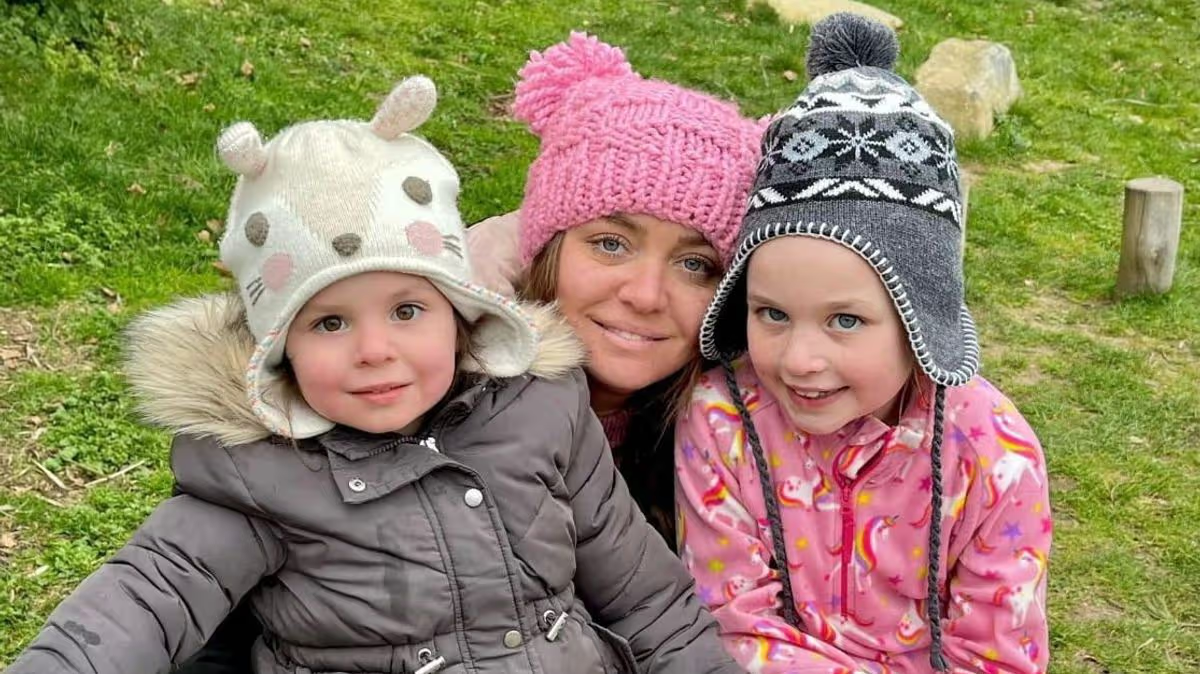
Plymouth family’s heartbreaking warning after mum, 37, told mole was ‘nothing to worry about’

Is Claude Down Now? Claude AI Hit by Login and Elevated Error Issues as Users Report Problems on Busy Monday

Circle Unveils Arc Roadmap With Phased Quantum-Resistant Blockchain Security Plan

Smart energy pays enters the US market, targeting scalable financial infrastructure

Why Israel is blocking foreign journalists from entering

Bitcoin: We’re Entering The Most Dangerous Phase

‘THIS NEVER MADE SENSE TO ME’: Ripple CEO BLASTS Biden admin’s war on crypto

#shorts+@dreamreelspsk. Mr. Boss Cat Meme 7 . Elevate Personal Financial Literacy Story Visuals

How to start crypto trading sinhala – Binance trading sinhala for beginners – cryptocurrency sinhala
-

 NewsBeat4 days ago
Steven Gerrard disagrees with Gary Neville over ‘shock’ Chelsea and Arsenal claim | Football
-

 Business4 days ago
No Jackpot Winner and $194 Million Prize Rolls Over
-

 Fashion3 days ago
Weekend Open Thread: Spanx – Corporette.com
-

 Crypto World5 days ago
Gold Price Prediction: Worst Month in 17 Years fo Save Haven Rock
-

 Business23 hours ago
Three Gulf funds agree to back Paramount’s $81 billion takeover of Warner, WSJ reports
-
Crypto World6 days ago
Dems press CFTC, ethics board on prediction-market insider trades
-

 Sports2 days ago
India men’s 4x400m and mixed 4x100m relay teams register big progress | Other Sports News
-

 Business5 days ago
Login and Checkout Issues Spark Merchant Frustration
-

 Tech7 days ago
EE TV is using AI to help you find something to watch
-

 Sports6 days ago
Tallest college basketball player ever, standing at 7-foot-9, entering transfer portal
-
Tech7 days ago
Daily Deal: StackSkills Premium Annual Pass
-

 Tech7 days ago
Flipsnack and the shift toward motion-first business content with living visuals
-

 Sports7 days ago
Women’s hockey camp eyes fitness boost, tactics ahead of WC 2026 campaign | Other Sports News
-

 Crypto World7 days ago
U.S. rule change may open trillions in 401(k) funds to crypto
-

 Tech7 days ago
How to back up your iPhone & iPad to your Mac before something goes wrong
-

 Politics7 days ago
Usha Vance: Disney Hats Over MAGA Caps?
-
Crypto World7 days ago
Valinor raises $25m to put private credit on-chain
-

 Business7 days ago
Functional benefits brewing in coffee innovation
-

 Tech7 days ago
What Are The Biggest Limitations Of Supercomputers?
-

 Crypto World6 days ago
Bitcoin enters the public bond market as Moody’s gives a first-of-its-kind crypto deal a rating
You must be logged in to post a comment Login