
Politics
David Gauke: Welcome to the new world of multi party politics – whose entrance was via Gorton

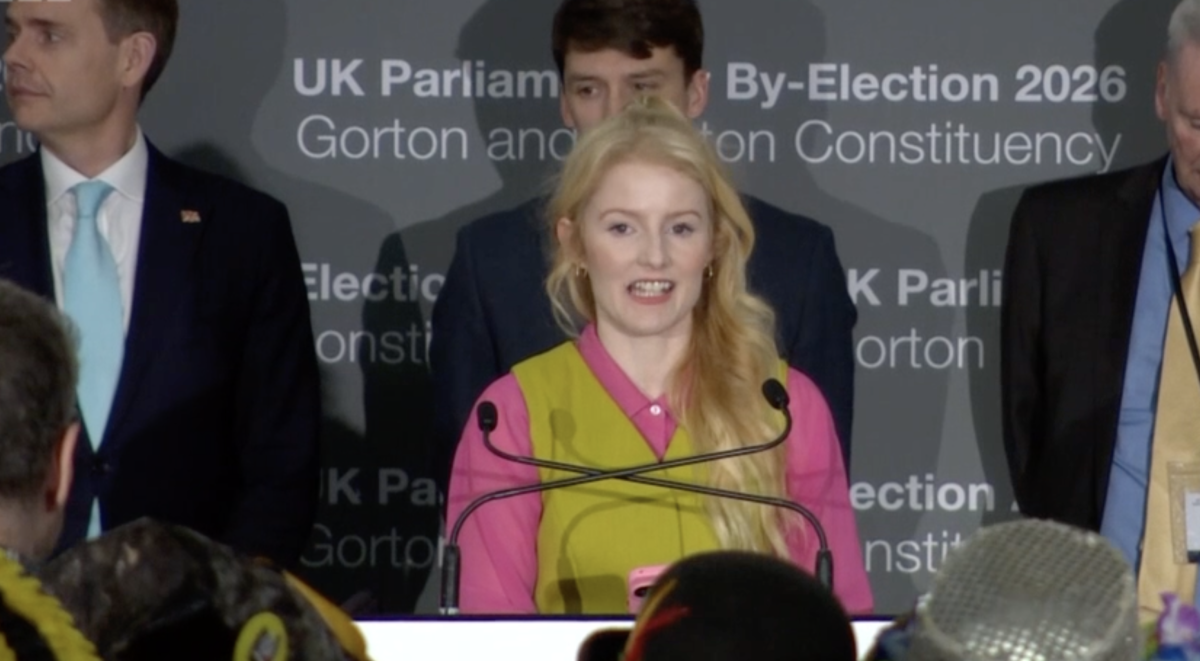
David Gauke is a former Justice Secretary and was an independent candidate in South-West Hertfordshire at the 2019 general election.
Most by-elections do not really matter but Gorton and Denton feels like a by-election of significance – even if the news quickly moved on.
Yes, there are some familiar attributes to the result – Governments do badly; a small party often does well; and, in seats with a large Muslim vote, the most vehemently anti-Israel candidate often wins. At least we were spared George Galloway returning to Parliament.
We know that the Labour government – and Keir Starmer – are unpopular, and that was reflected in their dismal vote. We know that Muslim communities often vote as a block, a tendency that was once very helpful to Labour and now is not.
We also know that tactical voting means that if you are party that does not have a chance of winning, your vote will be squeezed very tightly. Neither the Conservatives nor the Liberal Democrats reached 2 per cent, which is tighter than ever but – where there are three plausible options for a victorious candidate rather than the usual two – not altogether surprising.
Not much will be said about the Liberal Democrats in the context of Gorton and Denton because their low showing was expected, but it is a reminder of the changed political geography compared to a generation ago.
There are some similarities with the Brent East by-election of 2003. Here was an urban, multicultural seat where the Liberal Democrats had little historic presence (I was the Conservative candidate in 2001 and there was next to no Lib Dem activity in the seat in that election) but stormed to victory two years’ later at a time when the Tories were at a very low ebb, and the Government was unpopular with Muslims and younger progressives because of the Iraq war. At that point, the Liberal Democrats were emerging as a real threat to Labour in urban seats and went on to win Manchester Withington (part of which is now in Gorton and Denton) in 2005. The Greens are now the party of protest for urban progressive graduates and Muslims.
This sets the Greens up for a very good set of results in the London local authority elections in May and a realistic challenger in a swathe of urban Labour Parliamentary seats at the next General Election. However awkward this might be for Labour, this is not something Conservatives should celebrate. The Greens’ influence on our politics – whether directly as a Parliamentary force or indirectly by dragging Labour in its direction – will be detrimental to our economic wellbeing, national security, and, on the evidence of their by-election campaign, community cohesion. If there is any consolation in their victory, it will come in the form of greater scrutiny of a party whose policy agenda could, at best, be described as flaky.
The Tories might also be tempted to take some pleasure from the failure of Reform UK to win Gorton and Denton. That is certainly grounds for relief but no more than that. Reform UK must have done well in the white working class areas of Denton and look well-placed to capture the Red Wall but should be kicking themselves for not having done better. Matt Goodwin was an unlikeable candidate who attracted some unsavoury supporters; Nigel Farage spent the weekend before the by-election on a jaunt trying to reach the Chagos Islands which was hardly a priority issue in Manchester.
It was all rather self-indulgent.
A more substantial worry for Reform UK is that it is very effective in motivating people to turn out and vote for whoever is best placed to defeat them. There have now been three by-elections where Reform UK was well-fancied where the result was something of a disappointment. In Runcorn & Helsby, they won but by a whisker as Conservative voters in Helsby voted tactically for Labour. In the Senedd seat of Caerphilly, Plaid Cymru beat them comfortably. Now the Greens have done so in Gorton and Denton. The combination of tactical voting and a high turnout from anti-Farage voters is frustrating their progress.
This is the one crumb of comfort for Labour. It was a terrible result but they can argue that Gorton and Denton is an unusual constituency and that at the next election there will be many seats where it will be a straightforward fight between the Labour incumbent and the Reform challenger. Mid-term by-elections are inevitably a referendum on the Government, rather than a choice between alternative options. In that context, Reform UK should not be viewed as unbeatable.
This, however, is very much looking on the bright side for Labour. They are losing votes in all directions and it is currently hard to see which part of the electorate they can completely rely upon. The decision to block Andy Burnham is once again being questioned. He would have won last week, but a by-election for the Greater Manchester Mayoralty would have been difficult. In any event, Starmer would not have lasted long as leader with Burnham in his Parliamentary party. As it is, the Prime Minister has to hope that falling immigration and an improving economy (assuming both happen) ease his political woes but he will be lucky to survive the aftermath of the May elections.
For the Conservatives, the Gorton and Denton by-election was something of a non-event, notwithstanding the record low share of the vote. The rise of the Greens, as I argued above, is no cause of celebration but it does offer opportunities in that the left’s vote is split and there is scope to define the Tories against them as the pro-enterprise party. A breakthrough for Reform would have been difficult, and a Labour government that drifts leftwards – assuming that is what it does – leaves behind plenty of space to be exploited. There is nothing in these results to support the narrative that the Tories are bouncing back, but there is reason enough to believe that the potential is there.
There is a final point to be made.
This was a by-election that demonstrated that political support is fragmenting. Neither of the two big traditional parties finished in the top two; not unprecedented but very rare. The Greens got over 40 per cent of the vote, which is not particularly low for a winning candidate, but we are in a world where MPs will win with a vote share of just a third or even lower. Majorities become lower at the same time that voters become more volatile, resulting in greater MP churn and a focus on short term thinking. Candidates focus more on winning the tactical voting battle than articulating their policies, leaving the electorate to guess how the rest of the constituency is going to cast their vote before deciding who is best placed to defeat the candidate they least want. At the very least, this raises questions about the viability of the First Past The Post electoral system if this fragmentation is to be maintained.
This takes us back to the significance of this by-election.
It raises questions about our electoral system; it sees a breakthrough for the Greens and (one would hope) more scrutiny for them; it further destabilises the Prime Minister and will provoke a debate about Labour’s future that will likely see them moving leftwards; it highlights that Reform UK is a powerful electoral force, but also exposes its self-indulgence; is a reminder that by-elections in seats like this were once a Liberal Democrat speciality but not anymore. As for the Conservatives, this is not where the recovery was ever going to begin.
The question for the Tories is where exactly that place will be.


Expert comment provided by Prof Adam Hart, professor of conservation ecology at the University of Gloucestershire.
In the UK, hospitalisations from false widow spiders reached 100 in 2025.
That’s significantly higher than the figure from a decade before (47 hospitalisations in 2015).
Some have called the false widow spider the UK’s most “dangerous,” though speaking to HuffPost UK, Prof Adam Hart, professor and entomologist, said “serious reactions are rare”.
We asked him why these numbers are rising, how to spot false widow spiders, and what to do if we see them.
Why are more people getting hospitalised by false widow bites?
False widows are so called because they look like the more dangerous black widow spiders. They were probably introduced to the UK in the 1800s from the Canary Islands.
But their population has been growing here since the 80s, which the expert told us might be why we’re hearing a lot more about their bite.
“Reports of rising hospitalisations from false widow bites perhaps need a bit of context,” he explained.
“The noble false widow has spread widely across the UK in recent decades, so people are encountering them more often. At the same time, media coverage has raised awareness, meaning more people notice them and are more likely to seek medical advice. That could make the issue seem bigger than it really is.”
Additionally, they stay relatively close to humans: “They tend to live around buildings, in sheds, window frames, and sheltered outdoor spaces.”
That makes contact likelier as their numbers grow.
Though noble false widow spiders do bite, Prof Hart clarified that this is very rare and, in most cases, relatively harmless.
“Most bites, where they happen at all, are mild, causing local pain and swelling similar to a wasp sting. It’s also worth remembering that, often, suspected ‘spider bites’ turn out to be something else, such as skin infections or insect bites”.
How can I tell if a spider is a false widow?
“False widows are glossy, dark spiders with a rounded abdomen and long legs, often with pale cream markings on the back,” said Prof Hart.
They are usually 7-14mm in length, and the females are generally bigger than the males.
The Natural History Museum describes the pattern on their bodies as “skull-shaped”.
What do I do if I see a false widow spider?
“If you see one, the best advice is simple: leave it alone. If needed, they can be moved with a glass and card,” Prof Hart told us.
“If someone is bitten, basic first aid is usually enough: clean the area, apply a cold compress, and keep an eye on it. Seek medical advice if symptoms worsen or don’t improve.”
And remember, if you can, that while false widows are “now a familiar part of UK wildlife… they really pose a very low risk to most people.”

A paper published in the Journal of Intelligence has found that people who listen to music with less emotionally positive lyrics appear to have slightly higher levels of projected intelligence.
Scientists tracked the smartphone activity of 185 participants over five months, creating a custom app to check the kinds of music they listened to.
The researchers also asked the people involved to take a test, which measured their fluid reasoning, vocabulary comprehension, and math knowledge. Combined, these gave the study authors a way to measure their cognitive ability.
By the end of the analysis, which involved advanced machine learning tasked with finding links between participants’ music taste and their cognitive test scores, they found “small but reliable associations”.
Lyrics seemed to matter most
The participants listened to 58,247 songs overall.
Speaking to PsyPost, study author Larissa Susst said: “When we looked more closely at how our prediction models worked and which aspects of music listening were most informative, one finding surprised us.
“The lyrics of the songs people listened to were more useful for predicting cognitive ability than the musical features… In other words, the themes and language used in the lyrics seemed to matter more than aspects like tempo or musical key.”
She added that this finding went against previous research, which suggested genre might be a better predictor of predicted intelligence.
While the difference wasn’t huge, lyrics with a “less positive emotional tone” were more strongly linked to higher intelligence in this study. The study authors point out that other papers have linked this to introspection and self-reflection.
And songs whose lyrics focused on the present, those which seemed honest, and those which related to home were also associated with higher cognitive ability.
Those who liked lyrics with more social words and less certain language were likelier to have lower cognitive scores, meanwhile.
Bear in mind, though, that the paper said their “predictive performance was modest”, and that the variance in predicted intelligence was relatively small.
Live vs studio-recorded music may matter too
Another surprising finding was that those who listened to studio-recorded music tended to have higher cognitive scores than people who listened to live recordings.
Listening to more music, and lyrics not in German (this was a German study), was also associated with higher cognitive scores.
“In our study, patterns in people’s music listening contained small but detectable signals related to their cognitive ability, suggesting that the digital traces we leave behind in daily life could potentially help approximate intelligence,” Sust said.
But the differences were so small that she cautioned, “On their own, these effects are therefore likely not strong enough to be practically useful,” and were more likely to become “meaningful if combined with many other types of behavioural data”.

Undoubtedly the biggest story from this year’s Coachella surrounds Justin Bieber and his polarising performance.
Late on Saturday night, The Biebs took to the stage in the California desert for his first of two headlining slots at the iconic music festival, the second of which is due to take place later this week.
While the first half of his set was mostly devoted to tracks from his 2025 album Swag (and its poppier follow-up, Swag II) with stripped-back staging, echoing his performance at the Grammys earlier in the year, the second part is what has really got people talking.
Much has been made about the fact that this section of Justin’s performance saw the chart-topper sitting down to his laptop and pulling up songs from the early years of his career on YouTube, alongside old clips of himself and an assortment of other random viral videos he’s enjoyed over the years.
Since Saturday, there’s been a lot of debate on social media about whether or not fans got their money’s worth from Justin’s stripped-back show, particularly in light of reports that he’s the highest-paid headliner in Coachella history.
This was the opinion shared in The Guardian’s three-star review, which pointed out that “the double standard for effort for female and male pop headliners is… striking”.
“Depending on your level of fandom, the stripped-down vision, with minimal audience asides, read as either radically vulnerable or disappointingly self-interested from reportedly the highest-paid Coachella headliner of all time,” The Guardian’s reporter opined.

Kevin Mazur via Getty Images for Coachella
Rolling Stone also agreed that while “plenty of Beliebers” will have left the set feeling “satiated”, the star largely “missed the mark” with his efforts at Coachella.
However, it should be pointed out that even as headlines about the controversy over Justin’s Coachella show continue to roll in, plenty of critics were quick to praise the show immediately after it ended, with many claiming that there’s “one key point being missed” by his detractors.
This was the line taken in Mamamia’s review, which read: “Critics were baffled as to why a global icon would spend his set scrolling through YouTube like a bored teenager in a bedroom. But that is the point.
“This wasn’t designed to be a high-gloss, choreographed spectacle. We got that from Sabrina Carpenter the night before. This was something else entirely: a walkthrough of his memories. If you expected Justin to simply return to the stage and perform a greatest hits medley, you don’t know him at all.”
A take from a self-professed Belieber published in Vogue also took this stance, pointing out that playing his hits over YouTube “gave the fans what they wanted, in a way that felt cheeky and unserious, which was simply perfect”.
“This was how all of us original Beliebers first experienced him, surfing YouTube videos in barely 360p,” Vogue’s critic argued. “The concept just worked.”
Mashable’s review was also along these lines, claiming: “Bieber was not just revisiting old clips; he was revisiting the child the internet turned into Justin Bieber.”
It continued: “Many former child stars look back at old footage, and it feels a bit silly or even sad. Here, though, Bieber seemed genuinely at peace with it. He smiled at the videos. He harmonised with his younger self, treating him less like a brand asset and more like someone worth meeting again.”

Kevin Mazur via Getty Images for Coachella
Although USA Today praised Justin for creating an intimate environment in a festival setting that felt akin to “chilling at Bieber’s house with him watching videos on YouTube like so many 30-somethings of his generation used to do with their friends”, a piece in Vulture went as far as comparing the show to “performance art”.
“In keeping it simple, and reflecting on his old hits through the portal where he was discovered, the persona of Justin Bieber was reassessed and deconstructed in real time after years of mythos and controversy,” Vulture’s critic claimed.
They then pointed out that by taking fans back through his time in the spotlight – from “heartthrob to millions” to “the world’s punching bag” – the set represented a “career-spanning victory lap and a big step forward in both artistic vision and the performance of self-mockery”.
Vulture’s piece also claimed: “To call his performance lacking in effort is a shallow read.”
“Seeing a baby-faced Bieber on screen at Coachella was a stark reminder of just how long he’s been famous, and while YouTube karaoke felt low-effort compared to a more involved production, it did make for a compelling visual to see the fully grown Bieber sing these songs as his childhood played in the rear view,” The Hollywood Reporter’s own review also claimed, although it went on to claim that the set “became more confounding than profound” as it went on.
Justin will return to Coachella this coming weekend, alongside fellow headliners Sabrina Carpenter and Karol G.
Back in February, he caused a similar buzz at the Grammys, where he delivered another low-key performance that saw him taking to the stage in just boxers from his own fashion brand.

!function(n){if(!window.cnx){window.cnx={},window.cnx.cmd=[];var t=n.createElement(‘iframe’);t.display=’none’,t.onload=function(){var n=t.contentWindow.document,c=n.createElement(‘script’);c.src=”//cd.connatix.com/connatix.player.js”,c.setAttribute(‘async’,’1′),c.setAttribute(‘type’,’text/javascript’),n.body.appendChild(c)},n.head.appendChild(t)}}(document);(new Image()).src=”https://capi.connatix.com/tr/si?token=19654b65-409c-4b38-90db-80cbdea02cf4″;cnx.cmd.push(function(){cnx({“playerId”:”19654b65-409c-4b38-90db-80cbdea02cf4″,”mediaId”:”d1367440-2011-4389-a28b-bb92f339da2a”}).render(“69dcfa8ce4b00247ba9c31dc”);});

We hope you love the products we recommend! All of them were independently selected by our editors. Just so you know, HuffPost UK may collect a share of sales or other compensation from the links on this page if you decide to shop from them. Oh, and FYI — prices are accurate and items in stock as of time of publication.
You know what it’s like when you’re shopping for furniture. You think you’ve found the best option out there, only to click onto another page and find five more contenders.
Then you click on to Instagram or Pinterest, and lo and behold: another thirty ads showing you another iteration of what you’ve been looking for. Thanks, cookies!
If you’re anything like me, plagued by decision paralysis, it takes months of open tabs, waiting for sales, and constant side-by-side comparison to actually make a purchase.
That’s speaking as someone who does a lot of shopping (it’s kinda in the job description) and even then, if I can do anything to make the process of furniture shopping easier, that is as big a blessing as I can ask for.
Pinterest has been my saving grace up until now: I love making boards of what I want my space to look like and using its shopping feature to find products.
But even that is flawed: often, the pieces I fall for aren’t even available to ship to the UK, or they come from some dodgy website I’m not willing to risk losing my money to.
So when I came across ShopHomeStyles, I was completely smitten.

Instead of having to guess what keywords would best describe the armchair I’m currently looking for in my room (I’m not exactly an interiors expert) the platform allows you to upload your inspo photos.
Sourcing from over 100 furniture and homeware brands like M&S, OKA, and Soho Home, the platform then matches the closest products to your inspo or keyword search in seconds.
So you don’t have to keep millions of tabs open, you can like the products you’re into and organise them into collections, making it easy to come back to them later.
Plus, if you’re not sure what style tickles your fancy, the website has its own inspiration page and breaks furniture and decor into easy to browse categories, so you can browse trends and shop by item, or look at what’s new in at your favourite stores, too.
Basically, if you want anything new for your house and want to save on scrolling through the sometimes hundreds of pages on every furniture site you come by, ShopHomeStyles seriously whittles your options down based on what you like.
The result? Less wasted time scrolling, and a place to curate your own design style for your home.
If I had known about this platform sooner, it could have saved me oodles of time. That armchair I’ve been looking for has been the subject of probably a years’ worth of Pinterest searches.
You see, I’m after a very specific retro Scandi-inspired shape, preferably in pink, red, or baby blue.
At the time of writing this, I have 167 tabs open on Safari on my phone, with various iterations of said chair.
But after simply uploading some Pinterest inspo photos to ShopHomeStyles, there’s one clear contender for my purchase: this Juno armchair from Graham and Green.

Don’t get me wrong, the price tag is definitely something to work towards. But at least now I can live in peace not having to go back and forth between this option and that.
I’m also shopping for a side table and magazine rack, so I’ve started building a separate collection to find the perfect ones.
While I’m sure I’ll spend as much time deliberating about what to go for in the end, at least my final decision will be based off results from 11 pages on ShopHomeStyle, rather than hundreds, or even thousands.
Honestly, all I can say is: phew.

The government has been continuing the Tory, Lib Dem and New Labour agenda of increased NHS privatisation. And after nearly two years in power, private providers of NHS services have made £1.6bn in profit.
The research
The Centre for Health and the Public Interest analysed £12bn worth of contracts, which it emphasised are not all of the NHS’ private provision.
The corporations that received those contracts extracted profit that could have been used for 9,178 doctors or 19,428 nurses over the two year period. Another ten thousand doctors for the NHS would also go some way in addressing the striking resident doctors’ concerns.
The new research takes forward a previous study by We Own It, which found the private sector made an average of £10m a week in profit from 2012-2024.
The Centre for Health and the Public Interest also noted that 131 companies made more than 20% profit from the NHS. Between 8% and 9% are the usual profits for a company.
The study further found that the NHS spent around £2.5bn on companies registered outside the UK or in tax havens.
More and more healthcare privatisation
In January 2025, the prime minister announced he would increase private provision of helath services by 20%. After only his first year in power, NHS privatisation leapt by 10%. If that continues, there will be a 50% increase in privatised NHS services by the end of this parliament.
Some areas have seen much higher increases. In South East London, NHS private provision increased by 71% from July 2024 to July 2025. Other high increases were in Dorset at 51%, along with Cambridgeshire/ Peterborough and Suffolk/ NE Essex at 41% each.
Successive governments know that making people pay outright for NHS services is very unpopular. So they have been gradually turning healthcare into a vehicle for profit through enabling corporations to provide the services with an NHS badge on them. Instead of making people pay at the point of use, it’s through profit from the healthcare budget and public purse.
Featured image via the Canary

We hope you love the products we recommend! All of them were independently selected by our editors. Just so you know, HuffPost UK may collect a share of sales or other compensation from the links on this page if you decide to shop from them. Oh, and FYI — prices are accurate and items in stock as of time of publication.
There are many harsh realities we face as adults: cheese is actually really expensive; the worst person you know is probably being told by their therapist that they’re really reasonable; and that we are doomed to spend the rest of our lives forever trying to find the answer to ‘what’s for dinner?’.
But one I didn’t anticipate is just how difficult it is to buy a sofa.
I’ve spent the last six months renovating a 150 year old flat in Edinburgh and thanks to that being one endless stress, I officially only want to walk the path of least resistance where I can.
Unfortunately the road to getting a sofa is full of potholes. First of all you’ve got the time element. I don’t have it in me to assemble anything after spending all day stripping walls, replastering and wielding a sledgehammer around my 9-5. Spending hours in a showroom testing out sofas? Not so bloody likely.
Then there’s the logistical nightmare of actually getting the sofa into your home once you’ve made a choice. Some companies have lead times of over six months (something I don’t have the emotional bandwidth for) and when you’ve got a twisty turny stairwell leading to your flat, there’s the worry that it won’t ever actually make it INTO THE HOUSE.
But it turns out there is an incredibly straightforward answer to my couch conundrum – enter one of the UK’s fastest-growing online sofa retailers, Sofa Club.
Offering next day delivery (!!!) on the majority of their sofas, Sofa Club sends you your new seating in boxes. Yup, quite literally, they send you a sofa in a box.
The site offers over 400 different sofas to choose from but they’re all split into different shape and size categories – so you can get straight to the point without endless scrolling. Moreover, they all come in strictly neutral tones (think stones, greys, browns and sands), meaning there isn’t a living room out there your sofa won’t suit.
It almost sounds too good to be true, right? Well, the good folks at Sofa Club asked me to try out their service for myself to find out. It’s certainly a brave decision to let a frazzled, renovating-overloaded editor pass judgement on your furniture company, so team HuffPost were immediately impressed.
I opted for The Cloud Left Corner Sofa Bed with Chaise Storage – and it was an easy decision that took less than fifteen minutes. Sofa Club has a super interactive site (I was able to click and see what the sofa bed element looked like folded out, as well as the ottoman) with loads of images of each product and the option ‘to view the sofa in your space’ using your phone’s camera.
However, if you’re worried about what the fabric really looks like in person, you can get up to four free swatches delivered to your door the next day. Off white was a sensible choice as someone who at the time was yet to paint their walls, you can’t really go wrong with a neutral.
Depending on where you are in the UK you can also opt to go to one of Sofa Club’s six showrooms – but I felt completely confident in my choice. Decision fatigue? Gone. Now just to see one, if it really matched the onsite images and two, if the deliverers could actually get it in my home.
Price wise The Cloud is normally £1699 (all three metres of it, she’s a big’un!) – which when you consider the fact that Loaf’s most similar model comes in at £3995, is a fair price point.
True to their word, just 24 hours later my buzzer went, announcing the arrival of my brand new sofa and with a little bit of effort (and impressive pivoting) the two boxes were through the door and plonked in my living room.
Had the room not been covered in a wet undercoat of white paint at the time, the delivery people would have taken the packaging away and assembled it for me.
Now, despite the renovation I’m doing right now, if there’s one thing I’m categorically useless at, it’s assembling furniture. I am in fact so useless at it , IKEA fears me.
Fortunately The Cloud came in just two pieces (one for each box) and all I had to do was unwrap it, clip the two parts together and screw the feet on. If I can do it, anyone can.

Dayna McAlpine/HuffPost UK
The sofa was firm, but writing this three months on from its arrival (and with it having had many, many bottoms upon it), it’s softened into a delicious middle ground – not so soft I’m sinking, not so firm that I can’t lounge.
The sofa bed element has made me popular with all my guests (no sore backs in the morning here) and I love the fact I can whack all the bedding in the storage ottoman section.
The verdict? There couldn’t be an easier option when it comes to sofa buying than Sofa Club’s service – if only the rest of the renovation as straightforward.

The post ‘The West is incapable of defending itself’, with Michael Oren appeared first on spiked.
Politics
Politics Home | Wes Streeting Insists NHS England Abolition Is Still Right Thing To Do Despite “Astonishing” Opposition


Wes Streeting spoke at an event hosted by the IPPR on Monday morning (Alamy)

4 min read
Wes Streeting has defended his decision to abolish NHS England, but admitted he can “understand why so many of my predecessors didn’t bother” given the scale of disruption and opposition.
The Health Secretary insisted the overhaul was necessary to cut duplication and improve accountability in the NHS, despite critics warning that the reorganisation risks being distracted from efforts to improve patient care.
His comments come after the Institute for Public Policy Research (IPPR) think tank published a report which found that transforming the NHS funding model to a European-style insurance system would not improve performance across the healthcare system. The report highlighted the high risks of transitioning from one system to another, which could cost billions and take decades to complete.
Speaking at the report launch on Monday morning, Streeting agreed with the findings, saying that the government’s approach would instead be to “invest in the NHS, to modernise it and transform the way it delivers healthcare”.
However, one of the biggest reforms Streeting has introduced so far has been the abolition of the arms-length body NHS England (NHSE). Prime Minister Keir Starmer announced in March 2025 that NHSE would be abolished and its responsibilities brought into the Department for Health and Social Care over a two-year transition period, as part of a wider bid to make the state more efficient and remove unnecessary red tape.
While Streeting’s allies argue the old structure was dysfunctional, with blurred accountability and internal gridlock frustrating ministers and stalling policy, NHS insiders say the transition has not been totally smooth up to now. At the same time, experts have described the move as risky.
Staff are due to reapply for roles in a merged organisation in early 2027, a timeline many insiders expect to slip, while others warn the upheaval could consume energy better spent on improving services.
Asked by PoliticsHome whether the abolition of NHSE was also proving to be a distraction from improving care for patients, Streeting said: “We’re doing the right thing for the right reason, and in process terms, I don’t see how else we could have gone about this, because there wasn’t a way of engaging with the workforce of that size…”.
“I have to say I can understand why so many of my predecessors didn’t bother and just sat there with a totally unsatisfactory bureaucracy and loads of waste and duplication,” he continued.
“The level of opposition that you get when you try and do things like this is astonishing, and the weight and volume of vested interests is just extraordinary.
“And I’m afraid this is why you do need strong political leadership. I’m not interested as a politician in meddling in clinical decisions.”
He said that he thought it had been the right decision to keep the planning of the NHSE abolition “quite close with NHS leaders” before it was announced.
Streeting acknowledged that the restructure was “hard on people who work in ICBs [Integrated Care Boards], and it’s hard on people who work in NHS England”: “I don’t treat that lightly or carelessly.”
However, he defended the decision and said that the idea that “democratically elected politicians shouldn’t keep an eye on how that money is spent and to make sure it’s used effectively is for the birds”.
“There are so many professional vested interests with a quiet, easy life who will always oppose these big changes, and I think ultimately, we will have done the right thing and the benefit will be to frontline patient services.”
A source close to Streeting previously told The House that the health secretary has found the “invisible barriers” to getting things done in government “harder than most”.
“He has struggled to get his priorities through,” they said. “He’s a very sharp guy. But when he came in, after getting his own way on policy in opposition, he was shocked about needing Treasury sign-off… It was a rude awakening.”
Commenting on the IPPR report findings, head of health at IPPR and report author Sebastian Rees said: “There is no structural silver bullet for the NHS. The idea that simply switching to a European-style insurance model would fix its problems is a pointless distraction and not supported by the evidence.
“The NHS’s challenges are real – but they are the result of a decade of chronic underinvestment and choices on how money is spent, not the funding model itself.
“Policymakers should focus on what actually works: investing in infrastructure, strengthening primary care, and tackling the drivers of poor health.”
The leadership of Your Party Scotland (YPS) has resigned en masse, citing the consistent contempt shown towards members and the organisation north of the border.
All 12 members of the Interim Scottish Executive Committee have unanimously left their roles and pledged to help form a new party.
Your Party’s Interim Scottish Executive Committee (ISEC) was made up of volunteers who have overseen the running of the party – including the party’s Founding Conference in Dundee earlier this year – since December 2025.
But all 12 of the remaining members of the group have now resigned their posts, with their concerns about a dismissive attitude from the party’s UK leadership towards Scotland continuing to be ignored. Niall Christie, the sole Scotland rep on Your Party’s Central Executive Committee (CEC), has also resigned with immediate effect.
Watch a video message on Facebook or on the Your Party Scotland website.
The decision comes after significant work from ISEC to fulfil the decisions taken by members in Dundee, including ensuring Your Party Scotland had candidates for the upcoming Holyrood elections. Attempts to run internal elections to replace the interim group with a democratically-selected SEC were also blocked by those in control of the party.
Your Party Scotland feeling ignored
Decisions taken at the Your Party CEC – now solely controlled by those aligned to the Jeremy Corbyn-led The Many faction – also underline the disdain shown towards Your Party Scotland and its members.
Proposals tabled by Scotland’s one CEC rep – compared to the 16 allocated to English regions – have repeatedly been ignored by the party’s chair. Your Party’s leadership has also ignored repeated requests for support and discussions.
At a CEC meeting held yesterday, a proposal to provide support to YPS to hold meetings and contact its members – which they have been unable to do since the party’s creation last year – was not heard, nor was a motion affirming the party’s commitment to Scottish autonomy and respecting decisions taken in Scotland.
A proposal to remove thousands of party members due to their membership and affiliation with other socialist organisations – which contradicts the rules of Your Party Scotland – also passed at Sunday’s CEC meeting.
As a result, the ISEC has now released a statement outlining its decision, as well as its belief that the party – which has been haemorrhaging members in Scotland in recent weeks – has now collapsed.
However, the ISEC members – made up of former MSPs and prominent left-wing figures, as well as many of whom have never been involved in politics before – also underlined the need for a new party on the left in Scotland and their intention to continue working towards this.
In a statement, the ISEC said:
As a result of this consistent denial of autonomy for Scotland, and a willingness by the UK leadership to sideline an entire nation by withholding funding and mailing lists and refusing to engage, we have, after careful thought and consideration, taken the collective decision to resign our positions on ISEC, having found ourselves completely blocked when we attempted to carry out the clear mandate set for us by members from across Scotland.
No serious attempt to unite the left can be done through purges of socialists or by disregarding entire nations and their representatives. It is clear that these are fatal blows to the Your Party project from which it cannot recover.
Despite this generational fumble of the left in Britain, the need for a new party on the left in Scotland couldn’t be more urgent, and it is our clear intention to continue working towards this. We call on others who share our vision to join us in doing so over the coming weeks and months, as the reality of a rising far-right and its representatives joining our national parliament set in.
Simply put, the best time for change has passed, but the next best time is now. In Scotland, we intend to continue building that change, but to do so outwith the constraints of the deeply flawed and dying Your Party.
The decision comes after a meeting of nearly 200 Your Party Scotland members on 12 April, which showed overwhelming support for working towards a new left project in Scotland.
Scotland representative on Your Party CEC Christie said:
It has become clear the party has run out of road. This is in no small part down to the consistent disrespect shown to Scotland and Scottish members, with decisions about us being made without our input, and on our behalf.
I’ll be continuing the essential work needed to build the party we were all promised in summer 2025, but I will be doing so outside of Your Party. With an election on the horizon, it is time to take stock of the political landscape in Scotland and work to bring the left in Scotland together – truly – and move towards something new in the not-too-distant future.
My own main takeaway having been involved in Your Party is that whatever comes next must be built in Scotland, by Scotland, for Scotland. Anything else is doomed to fail.
Featured image via the Canary

Financial Year 2026-2027 Money Reality: Income Hai Phir Bhi Savings Kyun Nahi? Aditya Kundli

Trump Accounts aim to help families build wealth starting at tax time

Broadcom (AVGO) Stock Surges on Extended Google Partnership and Raised AI Revenue Projections

Why Israel is blocking foreign journalists from entering

Bitcoin: We’re Entering The Most Dangerous Phase

Alan Cumming Brands Baftas Ceremony A ‘Triggering S**tshow’
Financial Year 2026-2027 Money Reality: Income Hai Phir Bhi Savings Kyun Nahi? Aditya Kundli

10K se CROREPATI banne main Kitna TIME lagega?! | Ankur Warikoo #shorts

DIY mini Shagun hamper | money hamper #diy #shagun #money#shorts
-

 Politics3 days ago
US brings back mandatory military draft registration
-

 Fashion3 days ago
Weekend Open Thread: Veronica Beard
-
 Sports3 days ago
Man United discover Nico Schlotterbeck transfer fee as defender reaches Dortmund agreement
-

 Tech6 days ago
How Long Can You Drive With Expired Registration? What Florida Law Says
-

 Politics1 day ago
World Cup exit makes Italy enter crisis mode
-

 Crypto World4 days ago
Canary Capital Files SEC Registration for PEPE ETF
-

 Business3 days ago
Tesla Model Y Tops China Auto Sales in March 2026 With 39,827 Registrations, Beating Cheaper EVs and Gas Cars
-

 Politics3 days ago
Malcolm In The Middle OG Turned Down ‘Buckets Of Money’ To Appear In Reboot
-

 Crypto World5 days ago
Bitcoin recovers as US and Iran Agree a Ceasefire Deal
-

 Fashion6 days ago
Let’s Discuss: DEI in 2026
-
 NewsBeat17 hours ago
Pep Guardiola and Gary Neville agree over Arsenal title problem that benefits Man City
-

 Business3 days ago
OpenAI Halts Stargate UK Data Centre Project Over Energy Costs and Copyright Row
-

 Business2 days ago
Ireland Fuel Protests Enter Day 5 as Blockades Spark Shortages and Government Prepares Support Package
-

 Politics3 days ago
LBC Presenter Mocks Trump Over Iran War Failures
-

 Crypto World3 days ago
Federal judge blocks Arizona from bringing criminal charges against Kalshi
-

 Tech4 days ago
A version of Windows 10 released a decade ago is now eligible for additional security patches
-
 NewsBeat1 day ago
JD Vance announces ‘no agreement’ with Iran over nuclear weapons fear
-
 Entertainment5 days ago
Alfred Hitchcock’s 10 Most Suspenseful Masterpieces, Ranked
-
 Entertainment3 days ago
A ‘Bridgerton’ Star’s New Survival Thriller Is a Must-Watch on Netflix This Weekend
-

 Business3 days ago
IMF retains floor for precautionary balances at SDR 20 billion
You must be logged in to post a comment Login