
Politics
Horror of cattle shot in public view, but humane slaughter is a myth



There has been public outrage over a horrific incident in which authorities gunned down 51 cattle in County Tyrone, in the north of Ireland, doing so in a publicly visible area.
Complaints from politicians have centred on why the brutal measures had to be carried out in an area viewable by locals. However, the obvious question this begs is the following: why would mass murder suddenly become justifiable if it is hidden out of sight?
The details of the incident are unquestionably distressing. According to Sinn Féin councillor, Eugene McConnell, the killing took almost 12 hours to complete. He told the Irish News:
The shooting started at 10:00 in the morning and the last animal was shot at 9:50 that evening.
McConnell also said:
It was like a Wild West scene — there were cars blocking the roads, there were people standing on ditches watching the marksmen shoot the animals dead in the field.
Deborah Erskine, South Tyrone MLA for the Democratic Unionist Party (DUP), said:
Members of the public shouldn’t have seen this. In one case I’m aware of a father and son driving past this field and witnessed this in broad daylight, that shouldn’t have happened.
County Tyrone: Cruel meat industry lacks transparency
Observers said cows fled in a distressed state following initial gunshots and that the gunman killed cattle in front of each other. The animals were part of a mixed breeding herd owned by 59-year-old Martin Beattie. The purpose of such a herd is to produce fresh cattle, most of whom would have been murdered at some point in a slaughterhouse.
These cattle suffered well before that, however, as many were diseased and “highly stressed” due to abandonment. The Irish News reported:
Beattie’s defence solicitor said his client had suffered from mental health issues and that he was isolated, while the judge said he was “overwhelmed” by the job of running the farm. The defence solicitor added the remaining 66 cattle, mainly cows and calves, were in a “reasonable state”.
Beattie had pleaded guilty to 21 offences related to his failure to properly care for the animals. Questions remain as to why the Department of Agriculture, Environment and Rural Affairs (DAERA) let things get to the point where the mass slaughter was necessary.
Only weeks previously, the cows were apparently in a “reasonable state”. Given DAERA carried out “four previous culls”, it’s unclear why they weren’t more attentive to potential deterioration among any remaining cows.
Agriculture Minister, Andrew Muir, was hardly transparent about what occurred on the day of the shooting, saying he was “not at liberty to discuss further” all the details of the incident.
Transparency hasn’t exactly been a strength of farming in the north of Ireland. It is only in the past week that the region has come in line with British laws around CCTV in abattoirs. This might lessen the chances of the most egregious cruelty to animals in these horrific places, but it can’t prevent the brutal truth: there is no humane method of mass murdering animals.
Pigs struggle to survive before throats are slit
Animal Equality thoroughly debunks this myth on their web page. They point out that stunning of animals in the moments before slaughter is ineffective and itself causes pain to those about to be killed. For example, they reveal the horrors suffered by pigs when carbon dioxide gas is used to stun them prior to death:
Carbon dioxide does not cause the pigs to become unconscious immediately and high concentrations of the gas can cause them significant pain and distress. Pigs have been shown in studies to gasp for air, squeal and struggle to escape for up to a minute before losing consciousness.
A UK Government report says: “There are longstanding concerns about the negative welfare impacts of high concentration CO2 stunning systems for pigs.”
After the pigs fall unconscious, a slaughterhouse worker slits their throats and the pigs bleed out until they die.
Meanwhile, abattoirs use electric baths to stun chickens.
[The birds are] painfully hung upside down by their legs and carried towards a bath containing electrified water. When the chicken’s head makes contact with the water, they’re electrocuted and become unconscious. The chickens are then carried towards a metal blade which slits their throats.
Yet they often suffer a painful death, due to cases where they are:
…not shocked strongly enough to render them unconscious.
The cruelty of farming animals for meat starts long before death, due to the brutal practices of factory farming that are still routine across Britain and Ireland.
[Dairy cows are] kept indoors and forced into a life of misery spent walking back and forth to the milking stations where they are attached to milking machines that take the milk intended for their calves.
No justification for brutal mass killing of animals
Animal Equality points out:
Cows are extremely maternal and social animals who can naturally live up to 20 years. However, on dairy farms, a cow is slaughtered when she is around three or four years old and sold for cheap meat or leather products.
Even in an imaginary world where we found a totally humane method of slaughter, we have no business ending the lives of these intelligent creatures so prematurely. In my opinion, it is not necessary to consume meat — a good plant-based diet is a healthier alternative.
The events in Tyrone were unquestionably horrific, and no one should be exposed to brutal violence without consent. However, the horror would still be present were it to take place within the confines of an abattoir. The gunning down of cows in public is simply a reminder of the obvious truism:
If slaughterhouses had glass walls, everyone would be vegetarian.
Featured image via BBC

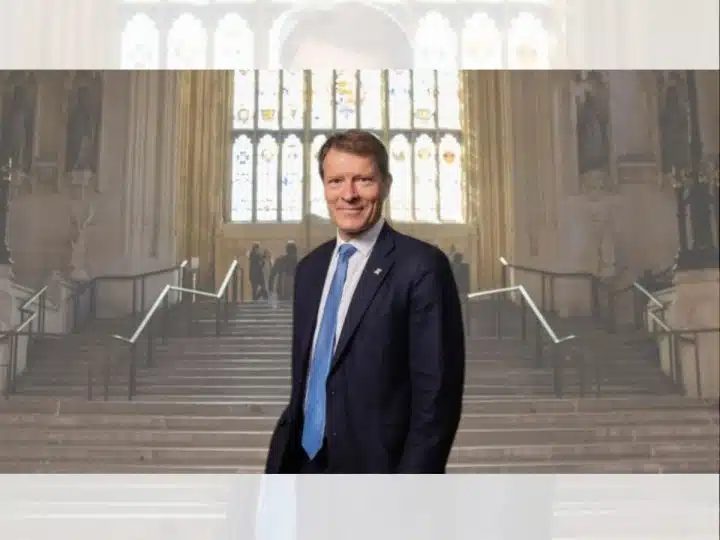

Richard Tice is the deputy of Reform UK, and do you know what really winds him up? The idea that people of faith might want to acknowledge and learn from the horrors of the past.
We’d like to say this is unexpected, but Tice was promoting an alleged human trafficker a few weeks ago, so it really isn’t.
Did you thank Jesus for giving great courage and vision to the British for abolishing the slave trade, spending vast amounts of money and sacrificing brave Royal Naval sailors in the process?
As a Christian, you don’t speak for me, nor millions of other Christians in the UK… https://t.co/21mO5eW5jf — Richard Tice MP
 (@TiceRichard) August 1, 2026
Richard Tice. Nickname: Mr Offended
In full, this is what Sarah Mullally, the Archbishop of Canterbury, said in her post:
Today I visited Cape Coast Castle. Seeing the horrific conditions that thousands of people were kept in, it is impossible not to feel the weight of the immense evil that drove the transatlantic slave trade.
I pray not only in lament for the Church’s involvement in the slave trade, but also for hope – hope that the God of healing can bring justice and reconciliation to all who are still impacted by its legacy.
In the name of Jesus Christ, who came to set people free, I pray that we have the courage to continue our journey of repentance, and to strive for a world in which all of God’s children are treated with dignity.
And this is how Tice responded:
Did you thank Jesus for giving great courage and vision to the British for abolishing the slave trade, spending vast amounts of money and sacrificing brave Royal Naval sailors in the process?
As a Christian, you don’t speak for me, nor millions of other Christians in the UK
Why should we donate to the Church of England for you to waste it on woke virtue signalling?
If you’re confused as to what Tice is so upset about, it’s presumably the idea that anyone should feel repentant about the past.
Guilt can be an unproductive emotion in that it encourages defensiveness, but Mullally clearly isn’t urging her followers to be overwhelmed by the feeling. In her message, she acknowledges the evils of the past, and argues that there’s hope to be taken from the journey society has taken, even though there is more yet to be done.
To some, this is the essence of Jesus’s teachings, in that it encompasses redemption, loving your neighbours, etc. For people like Tice, however, the essence of Christianity is moaning about literally everything, and mistrusting everyone outside your immediate family.
There’s so much hypocrisy in his reply
There’s a couple of other things to note about Tice’s response, starting with this:
Did you thank Jesus for giving great courage and vision to the British for abolishing the slave trade, spending vast amounts of money…
Speaking on how Britain ‘abolished’ the slave trade, Maddison Wheeldon wrote for the Canary:
Conveniently, Braverman makes no mention of what happened when the “abhorrent” slave trade and, later, slavery itself were abolished. It wasn’t the enslaved who were compensated – it was the slave owners. They received such vast sums to cover their supposed financial “losses” that the British government borrowed heavily to fund the payouts.
The debt from that borrowing was paid off by taxpayers for generations, with the final payments only being completed in 2015. Thus, ordinary people effectively spent almost two centuries paying to compensate slave owners, while enslaved people received nothing.
If nothing else, we should be aware of our past to prevent it happening again. Whether you feel guilt about the past is up to you, but if we don’t learn from our mistakes, we will have plenty to regret in the present.
As noted, Tice recently promoted a post from Andrew Tate, who has been charged with three counts of arranging or facilitating trafficking for sexual exploitation, alongside several other charges for unforgivable offences.
To align himself with someone like that suggests that Tice’s objections to the Archbishop stem from a lax attitude towards human rights and not her framing of the matter.
Reform’s downfall
As we’ve reported elsewhere, we’re not particularly optimistic Andy Burnham will change this country’s fortunes. At the same time, it is nice to see Reform sliding down the opinion polls.
Yet another opinion poll this week that puts Reform several points behind https://t.co/YIvAaUjJEg
— dave lawrence

 (@dave43law) August 1, 2026
Partially, this is down to the ‘Burnham bounce’. At the same time, it seems the more people see of Reform, they less they trust the party. And with posts like the above from Tice, it’s not hard to see why.
Featured image via Louise Haywood-Schiefer
By Willem Moore


Nigel Farage and Reform UK are facing multiple police and parliamentary investigations into various donations and benefits they’ve received. When it comes to the notorious £5 million ‘gift’, Farage’s defence has included the claim that he wasn’t involved in politics at the time. Now, a new scoop from the Times has blown Farage’s claim out of the water.
EXCLUSIVE
Nigel Farage struck secret deal for return as Reform leader months before election — challenging claim he wasn't involved in politics so didn't need to report gifts.
In May 24 he showed deal to treasurer, who tonight acknowledged its existence https://t.co/HkD5bKIw5d — Gabriel Pogrund (@Gabriel_Pogrund) August 1, 2026
Farage claimed crypto bro gave him funds
We previously reported the following on his £5m problem:
Farage accepted the £5m gift from Harborne – a crypto billionaire – in 2024. At the time, he’d said he wouldn’t run in the general election, but this changed after he received the £5m. The problem is that after he became an MP, he was supposed to declare any ‘registrable benefits’ from the previous 12 months. Farage did not declare the £5m, and now it looks like he was purposefully trying to hide it.
Since taking the £5 million, Farage has gone on to publicly support crypto, and as Reform Party UK Exposed noted:
Out of nowhere, Farage who previously was stating cash is king and despite claiming he was in to crypto in 2020 had not advocated publicly for it.
His only tweet with an opinion on it was in 2022 where he criticised Biden for taking donations from… a tech entrepreneur (Sam Bankman-Fried, jailed for wire fraud).
Then magically Reform UK produce a Cryptoassets and Digital Finance Bill, with no prior advocacy in May 2025. Reform UK then accepts donations in crypto.
This chain of events demonstrates why MPs are expected to declare money or donations they receive in the run-up to entering Parliament. Farage’s conversion to becoming a crypto-booster looks a lot different when you know about the gift. And now, the meager defence Farage had is being torn to shreds.
Reform leader shifts his stories
Farage previously excused not declaring the gift on the following basis:
At that period of my life, from 2021 to the third of June 2024, I was a broadcaster, I was someone that appeared on celebrity TV programmes, I was somebody that promoted some financial market products, but I was an influencer, I wasn’t in politics.
Now, new revelations published by the Times suggest he had agreed to return to politics by June 2024.
Nigel Farage struck a secret deal to return as leader of Reform UK months before the general election.
Farage negotiated the pact with Richard Tice, then the leader, in March and April 2024. George Cottrell, the convicted fraudster who had been secretly bankrolling Farage, supervised the discussions.
Reform has attempted to excuse the deal by saying it was “drafted for if, not when, Farage became leader”. As the Times has noted, however, Farage signed the agreement, which seems like an odd thing to do if he was undecided. Reform claims doing so “kept his options open”, which again, doesn’t seem to make sense.
The Times also revealed that this agreement saw Reform paying back Richard Tice several hundred thousand pounds. In the process of returning this money, however, the party accidentally sent a lump sum to Tice’s personal account instead of the relevant business account. This means the party gave false information to the Electoral Commission, which could be treated as a criminal offence.
He said he sought to address the erroneous £200k payment to Tice's account, but was blocked.
Reform sources say Tice transferred the money from his account to his company, effectively remedying the matter.
— Gabriel Pogrund (@Gabriel_Pogrund) August 1, 2026
Shot in the foot
While Farage is running the Clacton by-election, the parliamentary investigation into him is paused. This could end up working against him because the longer the pause is, the more investigators may uncover.
Featured image via Andrew Crowley
By Willem Moore
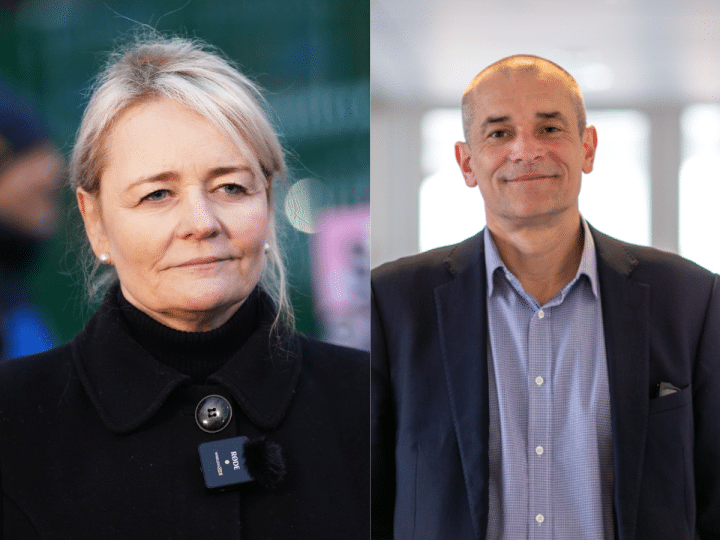

With just nine days remaining in the Unite general secretary contest, union members in Scotland are complaining that the union is failing to deliver their ballots.
Incumbent Sharon Graham typically has little support in Scotland. The complaints come hot on the heels of revelations that Unite has failed to deliver ballots to around 5,000 members in Gibraltar.
Graham has been heavily criticised for her treatment of union staff. Her rival in the election is Simon Dubbins, Unite’s international officer, who took many of the union’s biggest sectors and branches in the nominations phase.
Unite members in Scotland complain
On Saturday, a Scottish Unite member wrote on his Facebook page about “corruption of the highest order”, regarding many Scottish members not receiving ballots when “Sharon Graham has no support in the Scottish region”.

The issue appears to be widespread. Branch secretary Donna Collins responded that many members of her branch have still not received theirs.
She wrote:
I’ve already emailed them as the branch secretary as a lot of my branch members haven’t received their ballot papers. This is not on!!
The union told members in Gibraltar that no alternative arrangements could be made to avoid the need to send in ballots by post:
The current legislation governing this election requires ballot papers to be issued by post and for members to be given the opportunity to vote by post. For that reason, the election arrangements must continue to operate within that statutory postal voting framework.
Unite and Graham’s anti-union record
The election has seen a string of former die-hard Graham supporters call on members to vote her out – including the man who wrote her 2021 manifesto. These defections come on top of Dubbins’s unusually strong performance in the nominations phase, winning many of Unite’s biggest sectors and branches that previously backed Graham.
Despite running Unite, Graham has repeatedly been accused of using appalling, anti-union tactics against workers employed by Unite, leading to several strikes. In many cases, these tactics have been seen as Unite’s attempts to protect her husband, Jack Clarke. Clarke is the target of much of the industrial unrest among Unite staff.
Soon after her accession in 2021, Graham created a new Bargaining and Disputes Support Unit (BDSU). Outside of the union’s usual procedures, Clarke was appointed to run it. The appointment was made despite Clarke being on a final warning for bullying and misogyny. As striking workers picketed against Clarke, Graham’s faction staged counter-demonstrations against them and attacked their reps.
Most recently, Graham’s plan to shut down the union’s popular, 20,000-strong ‘Community’ section has been exposed. And she has been accused of letting odious Labour right-winger Wes Streeting and his team write an attack in her name on potential next chancellor Ed Miliband, to boost Streeting’s prospects under Andy Burnham.
Unite lawyers’ explosive admission
Explosively, Unite’s lawyers admitted to Skwawkbox that the union had destroyed evidence that workers had gathered against him. This did not stop further complaints and strike action from workers in his new fiefdom, with almost all the women working under him quitting and 90% of Unite’s HQ staff backing strike action.
The challenger and the hide-and-seek
Dubbins, by contrast, has spoken out consistently against Israel’s genocide and against Unite’s disengagement from wider politics to suit Graham’s narrow ‘workplace only’ agenda. He was suspended as Unite’s international director after refusing to cancel a pro-Palestine fringe event at a Labour conference.
Graham hid from union branches and declined to debate Dubbins at any hustings event during the nominations phase, angering many, including allies, by sending weak proxies instead. Last week, Dubbins publicly challenged Graham to stop hiding and face him in an open debate in front of members.
Any of these issues could and should be decisive in a union election with a history of low turn-outs. Based on recent history, Graham’s paid organiser team will be working hard to secure support for her — but members need to hear the voices of those who used to be prominent in campaigning for her and now see her as an ongoing disaster.
Unite has approximately 150,000 members in Scotland. General secretary elections are typically decided on a turnout of around 10-12% of Unite’s now sub-1 million members.
Graham won her first tenure in 2021 with the backing of just 4% of the union’s membership at the time on a 10% turnout, so around 40,000. With Scottish members, Unite Community members and overseas members likely to back Dubbins, such a level of support looks decidedly vulnerable.
Assuming members in those sections are allowed to get their votes in before the 11 August deadline.
Featured image via Jacob King/ PA and Nurith Wagner Strauss
By Skwawkbox
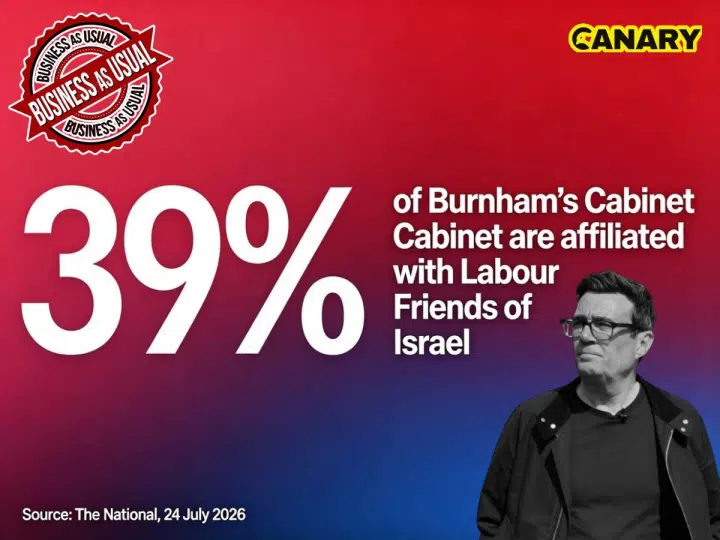

Right then. Let’s not mess about. Andy Burnham has been Prime Minister for two weeks and already the man who promised real change and a break with the past, has filled his top team with so many Labour Friends of Israel (LFI) veterans, pro-Israel donors, and establishment re-treads you’d be forgiven for thinking Starmer never actually left.
Burnham offers just more of the same
We were told it would be different. Burnham said he had heard the anger. He knew people were sick of being ignored and sick of lobbyists calling the shots; sick of foreign governments dictating our foreign policy while our own people go hungry. And then? He turns around and hires the exact same people who’ve been doing exactly that for the last decade.
Let’s run the numbers, because they tell a story even the BBC can’t spin. Almost 40% of Burnham’s cabinet are affiliated with LFI — the lobby group that works hand-in-glove with the Israeli embassy. It doesn’t expose its funders, and LFI’s former director went on to become a spokesperson for the Israeli government.
Not some of them. Not just a few bad apples. Two in every five. And that’s just the ones we can name. The real figure is almost certainly higher. And it’s not his cabinet. It’s the people he’s put in the most powerful jobs around him. The ones who actually write the policy. The ones who decide who gets listened to and who gets shown the door.
Take James Purnell, Burnham’s new chief of staff. The most important job in Downing Street outside of the prime minister himself. And who is Purnell? The former chair of LFI.
Purnell ran the lobby group between 2002 and 2004. A Blairite through and through, and it should go without saying, Purnell voted for the Iraq war. Now, he’s running Burnham’s operation.
The list goes on and on
Then there’s Bridget Phillipson. Burnham’s first big appointment as Labour Party chair was announced in the last few days. She’s been in the role for barely a week and it’s already been reported that she’s received two £40,000 donations from Stuart Roden, a financier whose Tel Aviv-based venture capital firm employs “an array of former Israeli soldiers, many of whom have served in elite intelligence units”.
Roden holds private meetings with the Israeli ambassador.
And it’s not just Phillipson — Lisa Nandy, another top Burnham appointee, also took £40,000 from him. And we’re supposed to believe that doesn’t matter?
But it somehow gets worse because it’s not just money, it’s the policy. Burnham spent months hinting he’d be different on Gaza and has apologised for Starmer’s slow response. But he then, of course, reappointed Ian Austin as UK trade envoy to Israel. Yes, that Ian Austin.
The man who quit Labour over Corbyn, was ennobled by Boris Johnson, has falsely smeared pro-Palestine campaigners as antisemites and Holocaust deniers. He was forced to apologise in court. This is the man who has openly defended Israel’s actions in Gaza even after the UN said it found a plausible risk of genocide and Burnham put him back in the job as if nothing happened.
Poor judgement and poor leadership.
Of course Burnham won’t say the ‘G’ word
Let that sink in. While millions of people in this country are horrified by what’s happening in Gaza — marching, protesting, donating, begging for our government to stop sending arms and start speaking up — Burnham’s response is to promote the lobbyists, reinstall the smeer-merchants, and pack the cabinet with LFI veterans.
It is insulting and frustrating in equal measures. Burnham had a clean slate. He could have done anything. He could have reached for people who’ve actually stood up for Palestine and who’ve actually fought for public services. Those who answer to us and not foreign lobbyists. Instead, Burnham gazed at the list of Starmer’s most loyal pro-Israel ministers, crossed out the ones the papers didn’t like, and put the rest in charge.
Wes Streeting — LFI.
Ed Milliband — LFI.
John Healey — LFI.
Yvette Cooper— LFI.
The list goes on. These aren’t accidental appointments. These are not the best people for the job. This is the establishment’s safety net.
They let Burnham have the job because they, and we knew, they were guaranteed; that when it came to things that actually matter to power, he’d pick the same team.
I’m not claiming any of these people are inherently evil. It’s that there’s no fresh start here. There’s no break with the past. There is no Burnham revolution.
There’s a man who rode public anger into power on the back of a promise to change things. Then, the very first thing he did was hand the keys to the same people who’ve been driving us off a cliff for 20 years.
Did you really expect change?
If your top team is stuffed full of people with deep, documented financial and political ties to a foreign government — and that government is still slaughtering innocent civilians by the thousands — you cannot claim to be putting Britain first. You cannot claim to be different.
We can see the appointments, can see the donors and the lobby groups. Actions speak louder than Northern accents and so far, every single action of Andy Burnham’s since walking into Downing Street screams one thing loud and clear: business as usual.
Burnham hasn’t sailed into a new era. He’s just taken the wheel of the same ship, and the passengers he’s supposed to be carrying aren’t you and me.
They’re the one’s paying for the voyage and we all know who they are.
Featured image via the Canary

We hope you love the products we recommend! All of them were independently selected by our editors. Just so you know, HuffPost UK may collect a share of sales or other compensation from the links on this page if you decide to shop from them. Oh, and FYI — prices are accurate and items in stock as of time of publication.
Kids have a lot to carry. From lugging around sports kit to heavy textbooks, there’s lots going on – and you don’t want to be worrying about sore backs on top of everything else.
Finding a bag that can withstand all that weight, doesn’t break easily, and that your little one actually likes can be a tricky task.
But don’t worry, we’re here to help. Remember, choosing the backpack is only a small part of the equation: it’s all down to how you pack it, too, according to the British Chiropractic Association, which recommends a child’s school bag weigh no more than 10% of their body weight for a single strap bag, or 20% for a backpack.
According to backpack brand Hype, there is more than the design to look for when buying a backpack for school.
So that your child can carry more (they’ll undoubtedly need all the space they can get, let’s be honest) we’ve rounded up the best kids’ backpacks for school to shop now.
With that in mind, we’ve found 13 backpacks that can be adjusted and have pockets.


The fight over data centers has suddenly become a defining battle in the race to run Kansas — on both sides of the aisle.
Gubernatorial hopefuls are trying to leverage the issue to weaken their rivals in the final stretch before Tuesday’s primaries, with attack ads, dark money and accusations of flip-flopping roiling the race. Democratic state Sen. Cindy Holscher and GOP state Sen. Ty Masterson, two of the top contenders in their respective fields, are bearing the brunt of the criticism.
Republican businessman Philip Sarnecki has spent more than $300,000 on ads attacking Masterson for voting for a bill last year to expand data center construction and give 20-year tax breaks to developers, accusing him of being beholden to big tech.
On the Democratic side, Holscher voted for the same bill but has now staked out a populist stance calling for a moratorium on data centers — an appeal to the same grassroots base that has put her in a strong position to win. Her primary opponents are attacking her as a flip-flopper, and social media ads fueled by anonymous backers keep highlighting her past vote in support of data centers. She’s up against state Sen. Ethan Corson, whom Gov. Laura Kelly endorsed, and Overland Park Mayor Kurt Skoog.
The brawl shows just how divisive and complicated the politics of data centers has become, as politicians in both parties struggle to define a clear winning position on the mass hubs amid growing voter backlash. A July POLITICO Poll found that Americans are increasingly souring on data centers, a trend that’s especially evident among Democrats but crosses partisan lines.
Republican and Democratic candidates are harnessing that opposition to gain an edge in crowded primaries, a rare moment of partisan crossover that speaks to its potency.
In Kansas, a state with nearly 40 data centers and many pending proposals, local opposition to the industry has animated city council meetings from Wichita to Kansas City. Several towns, like Topeka, have chosen to pass one-year moratoriums to give leaders more time to study the proposals.
Now, the state’s top race is getting caught in the crossfire, as Democrats look for a way to hold onto the governor’s mansion after eight years under Kelly — and Republicans grow bullish about taking back the seat in a red state that voted for President Donald Trump by 16 points in 2024.
“It’s bleeding across both primaries and it’s blurring traditional party stances,” said Bob Beatty, a political science professor at Washburn University in Topeka, who said the rapidly shifting politics speak to a growing “fear around AI.”
Tuesday’s Kansas primaries will help show the party bases’ appetite for data centers — signaling whether voters are looking for a leader who takes a strong position against new developments or a middle-of-the-road approach aimed at bringing in more tax revenue.
Both Masterson’s and Holscher’s campaigns are dismissive that the attack ads will work.
“It’s a very kind of kitchen sink approach here at the end,” said a Masterson campaign adviser, granted anonymity to speak freely about the race. The aide argued that the attacks have been ineffective against the state Senate president, especially given he’s the Trump-endorsed candidate in a state the president won three times.
Holscher, who said in an interview she regrets her vote, argued her new position reflects where people across the state stand now: “This is a unifying issue in terms of where people are on it, urban and rural as well as young and old,” she said in an interview. “I’m the only Democrat in this race to call for a moratorium on data centers because we have to get these guardrails in place. We are having our people and our resources exploited.”
Data center construction — and hostility towards them — exploded after passage of the 2025 legislation backed by Holscher and Masterson, which saw widestrong bipartisan support and was signed by Kelly, a pro-business Democrat.
Masterson has said that “folks build here on our terms, or they don’t build here,” and that local communities should be in charge of deciding whether they want the infrastructure. He supports a Kansas version of the White House’s position on data centers — a voluntary commitment designed to prevent them from driving up utility bills.
But several of his Republican opponents take a more hardline approach by calling for an outright moratorium, like Sarnecki and Insurance Commissioner Vicki Schmidt, another candidate in the top tier of the field.
The Kansas Comeback PAC, linked to Sarnecki, has challenged Masterson’s vote for the 2025 bill. “After 20 years in politics, Ty Masterson has mastered the game,” the TV ad by Kansas Comeback PAC says. “Thousands from big tech. Rewarded them with tax breaks.”
On the Democratic side, it’s difficult to tell who’s leading the field given limited public polling. Holscher’s supporters have cast the race as a choice between a populist fighter and a safe establishment figure, and they believe she will be boosted by the national tailwinds propelling leftwing candidates in states like Colorado, New York and Michigan. One survey from June, conducted before the candidates began running ads, had Holscher up by 27 points.
Corson is also backed by former Gov. Kathleen Sebelius and Lt. Gov. David Toland, and supporters believe he has the necessary crossparty appeal to win the general election in conservative Kansas. Kelly cut a TV ad on his behalf that started to run in major media markets last week.
While Holscher now wants to pause construction to give time to develop regulations, Corson supports construction moving forward with data center development, with guardrails around energy costs and water usage.
“Cindy seems to think that we should just go along with her flip-flopping and not making up her mind and doing what’s politically convenient for her race, and that’s not what we’re going to do.” said Ty Dragoo, chair of the Working Kansas Alliance, a group of more than 23 unions. Corson has raked in endorsements from trades unions like those represented by Dragoo’s group.
“Our north star is to get jobs, to get high-paying jobs, and to get sustaining jobs, and we’re not going to deviate from that.”
Holscher says her experience holding town halls throughout the state, including in deep red areas, opened her eyes to the depth of the opposition to the developments, which have sparked concerns about human health and environmental harms like water usage.
“She’s been listening, and people just want to be heard,” said Democratic state Rep. Linda Featherston, a Holscher supporter. “You have to be out amongst the people listening to what they have to say and not just brushing them off.”
But Holscher’s push for a moratorium has alienated some county, state and labor leaders who see an opportunity for data centers to boost the state’s economy. Corson is advocating for a local-first approach where communities get to decide whether they want to welcome the industry, while at the same time instituting statewide regulations so that the facilities pay energy costs, minimize water usage and ease the tax burden on residents nearby.
“Ultimately, these decisions should be made by communities, not by politicians in Topeka,” Corson said in a statement. “I believe some communities will look at a potential project and decide to move forward, and when they do, my Department of Commerce will work side-by-side with them to make it as beneficial for the community as possible. But other communities will decide that a data center is not a good fit, and as governor, I will absolutely respect that decision.”
Corson’s war chest also puts him in a good position to face off against likely opponent Masterson, who will bring the force of the national GOP’s deep pockets. The Republican Governors Association has already placed a nearly $7 million TV ad reservation in major Kansas media markets starting immediately after the primary.

Diane Abbott has been criticised after describing the Ukraine war as a “Nato campaign against Russia”.
The left-wing MP was readmitted into the Labour Party on Friday following a year-long suspension.
She lost the whip last year after saying she did not regret past remarks about racism – comments which triggered her first suspension from the party back in 2023.
She argued in a letter to The Observer in April 2023 that Jewish, Irish and Traveller communities experience prejudice rather than racism.
She also made a separate post on social media called the Israel Defence Forces the “Jewish Defence Force”.
In a statement on Friday, Abbott said she had returned to the party after a formal warning over that post, adding: “I am deeply sorry for any hurt caused by that conflation and apologise for any hurt caused by it.”
But her return to Labour sparked backlash on social media after it emerged she described Vladimir Putin’s illegal invasion of Ukraine as a “Nato campaign against Russia” back in June.
Speaking at an anti-war conference, Abbott said: “We meet at a crucial time for all those who are opposed to war and strive for peace.
“Because we are not trying to stop one war, we are having to fight to stop very many wars.”
She continued: “There is a military build-up against China, there is the war and blockade in Iran and, finally, there is one of the biggest wars in Europe since the Second World War – the Nato campaign against Russia.”
The revived video sparked backlash on social media, particularly from those who support the Ukraine war and Conservative MPs.
Abbott also wrote in the Morning Star last weekend: “The reason there is such a hue and cry about military spending now is not because Russian forces are in Ukraine; that happened well over four years ago.
“No, the reason for the outlandish claims about an imminent Russian invasion is simply because Trump demanded more military spending from Nato members…
“None of this is making us any safer. On the contrary. Russia is a major military power, but Nato is engaged in a war which is now striking deep into Russian territory, provoking widespread calls for retaliation against Nato countries.”
Labour declined to comment.
Abbott’s return to the party comes after new prime minister and Labour leader Andy Burnham pledged to end factionalism within the party.
Labour insists her reinstatement was unrelated to the party’s new leadership.
Listen to Commons People, the podcast that makes politics easy. Every week, Kevin Schofield and Kate Nicholson unpack the week’s biggest stories to keep you informed. Join us for straightforward analysis of what’s going on at Westminster.
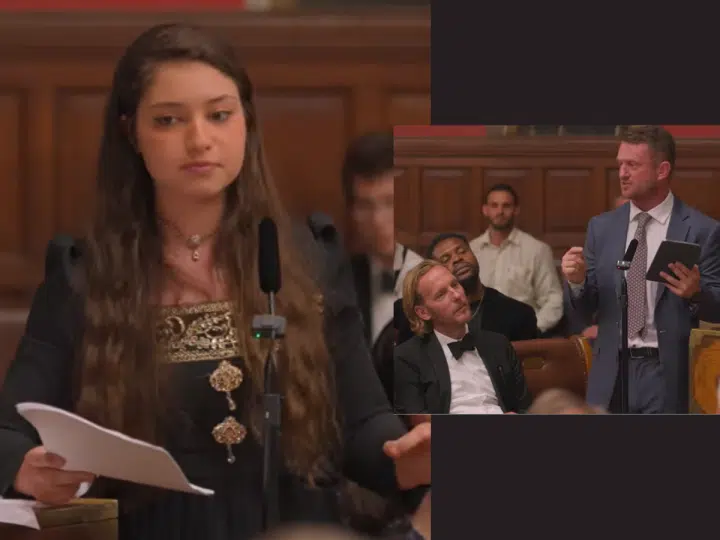

Six weeks after it took place, the Oxford Union has released footage of its debate on Islam, and it’s yet another spectacular humiliation and defeat for bigot, criminal and scam artist Tommy Robinson.
A diverse team, which included the incongruous pairing of Palestinian Oxford Union president Arwa Elrayess, and former Tory MP Jacob Rees-Mogg, easily put down the Islamophobes by a margin of 57 to 41.
Robinson’s team included fellow hatemongers and professional trolls, Lawrence Fox and Jonathan Sacerdoti.
The debate, titled This house believes that the West is right to be suspicious of Islam, was met with large protests back in June. Demonstrators were understandably irate at the Oxford Union offering an audience for Robinson (real name Stephen Yaxley-Lennon).
Alongside that, they argued with some justification that the motion was yet another platform for Islamophobia, when our legacy media grants just that every day of the week.
The counter-argument is that nothing harms charlatans like Robinson quite like exposing his hatred to scrutiny, and that’s exactly what happened as the opposing sides faced off.
Tommy Robinson challenged with facts and stats
Robinson began by attempting to claim that Islam is absolutist in nature, and incapable of finding common ground with others. He obviously is unaware that Muslims, along with Christians and Jews, lived in harmony for many years in places like Palestine. That is, until the creation of Robinson’s favourite exclusivist ethnostate, so-called ‘Israel’.
Likewise, contrary to what the far right would have us believe, there is no mass conflict led by Muslims against others in Britain or Ireland today. In reality, the worst violence that takes place is inflicted by intolerant non-Muslims against Muslims, migrants and people of colour, such as that carried out by loyalist thugs in Belfast.
Indeed, as Elrayess pointed out, Muslims are the most likely to be in favour of inclusive ways of organising society.
She said:
Eighty-five percent of British Muslims back democracy as the best system of government, [versus] the general public’s 71%. Ninety-four percent back equal treatment under the law for all faiths and none, [versus] the general public’s 80%.
Seven in 10 say they feel loyal to the United Kingdom; the general public – one in two. Eight in ten interact with non-Muslims at least weekly.
Nine in 10 say standing against bigotry, including antisemitism, matters to them. Four in ten have served themselves, or through family, in public service. On every single one of those measures, British Muslims are more committed to British values than the British average.
Of course these are universal human values rather than “British values”, but that aside, the stats certainly put Robinson’s divisive shit to rest.
Robinson went on to cite regressive attitudes to homosexuality in Muslim majority countries. He’s obviously forgotten that, in terms of the long stretch of human history, it’s the equivalent of an eye blink since being gay was illegal in most Christian majority countries.
Self-righteousness by a Briton on this topic is a bit like being a raging alcoholic for decades, then berating others for having a drink once you’ve been sober for a day.
Robinson runs down Britain from Spanish hideout
Tommy Robinson’s opponents picked up on his tendency to cite practices he claimed were Islamic, despite having no basis in the Qur’an itself. Though the fact that all religious texts are open to endless interpretation anyway, betrays the somewhat absurd premise of the motion, and much debate on religion. Such discussion is not a remotely scientific exercise, and there is no objective ‘Islam’ that can ever be identified, just as for any other faith.
Luton-based podcaster Michael Doward proceeded to further undermine Robinson. Doward points out that Robinson likes to bolster his street cred with references to his own time in the supposedly Muslim-dominated town, yet does so from the comfort of sunny Spain. There is a pattern of far-right figures who like to pontificate about Britain’s supposed ills from a safe distance several thousand miles away.
The generally odious Jacob Rees-Mogg managed one of his broken clock moments to finish the debate, telling Robinson and co:
I thought I was coming up against the hard men of the right of British politics. The people who have a reputation for being tough and forthright and powerfully patriotic, and it turns out that they are wee, sleekit, cowrin, tim’rous beasties!
Because they have no confidence in the West, in their nation, in the religion [Christianity, according to Mogg] that has made our nation fine and great and strong. Instead they’re sitting there in their homes at night, fretting that we’re suddenly going to be converted to Islam. Well I’m not.
Feeble far right quiver in the corner
Much as we hate to give Rees-Mogg any credit, this is an effective summary of the true nature of the far right. Fundamentally, they are a pathetic lot, characterised by fear more than anything.
Zionists live in a self-created imaginarium in which Jewish people are perpetually on the verge of suffering a new holocaust. Israeli Occupation Forces embark on racist, genocidal violence, in part to try and prevent this fictional outcome.
Loyalists live under a permanent siege mentality, forever terrified of Catholics, Muslims, migrants, people of colour, plus probably the shadows on the wall and creaking floorboards too at this point. The far right generally are constantly panicking about white genocide and Muslim takeovers, despite violence from white people against others being far more of an issue.
That feeble lack of confidence is clearly prompted in part by the paucity of their knowledge and ideas, embodied once again by the ridiculous Robinson on the debating stage.
Featured image via Oxford Union
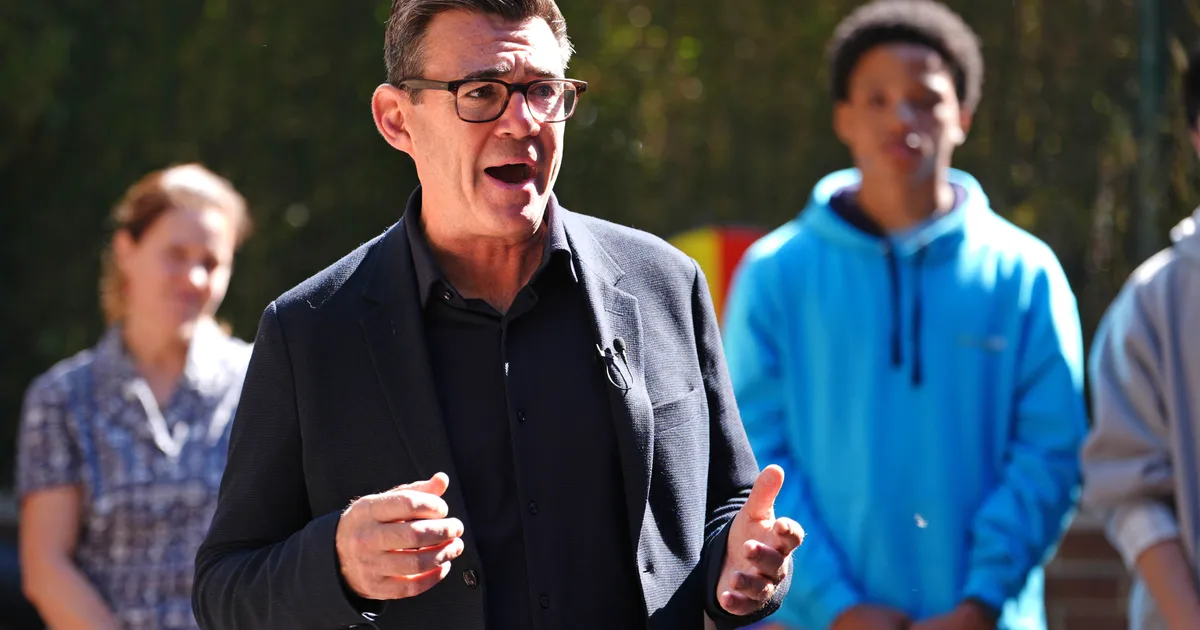
Andy Burnham has claimed his devolution plans strengthen his case for a written constitution for the UK.
The prime minister said the UK’s “antiquated” political system needs reform if equal opportunities are to be effectively shared out across the country.
Britain is one of the only major democracies without a codified arrangement which lays out how the country should be governed.
The UK’s constitution is currently established through history by common law, statutes and conventions.
Burnham has already decided to allow regional mayors to keep a proportion of income tax to spend on their local area by early 2028.
He has also set up No.10 North, an alternative to 10 Downing Street in the north of England, to symbolise his commitment to moving power out of Westminster.
He said his devolution plans “increase the case for a constitution because Britain is changing through this, England is certainly changing through this.”
He claimed the country needs to set up a codified model of devolution which works for Wales, Scotland, Northern Ireland and England.
“In the end, I think it does start to point towards a new constitutional settlement… with that commitment to equivalent living standards,” he said.
He added that his promise to implement “good growth in every postcode” was “more than just a sound bite”.
The prime minister did not outline any time frame for implementing such a historic change.
Countries usually adopt a written constitution following major events like revolution or war, when governments need to signal a departure from previous regimes.
The prime minister first floated the idea in his 2024 book Head North, co-written with Liverpool city region mayor Steve Rotherham.
He said deep inequality had become part of Britain because it had not moved on from the “feudal state” which held power in Westminster.
“Our failure fully to set out the rules for how the country should be run is one of the principal reasons why Britain is one of the most unequal major countries in the world,” he wrote.
“Our unwritten and murky constitutional arrangements have had the effect of hoarding power in a small number of hands – in Whitehall and Westminster and, by extension, in the powerful networks of institutions and vested interests that surround them.”.
Listen to Commons People, the podcast that makes politics easy. Every week, Kevin Schofield and Kate Nicholson unpack the week’s biggest stories to keep you informed. Join us for straightforward analysis of what’s going on at Westminster.
This email actually came in a couple of days ago, but we’ve been too dumbstruck to respond to it until now.

Because, like, wow.
Firstly, let’s take a moment to note the weird font change halfway through that central paragraph, as though someone else entirely butted in. And let’s also note that those 93 words took COPFS 27 days to come up with, which makes it all the more shocking that they haven’t even read the question.
The letter we sent them on 3 July couldn’t have been any more explicit: we WEREN’T asking them about fraud. We acknowledged fraud was hard to prove. We said, with the starkest clarity, that the issue was embezzlement.
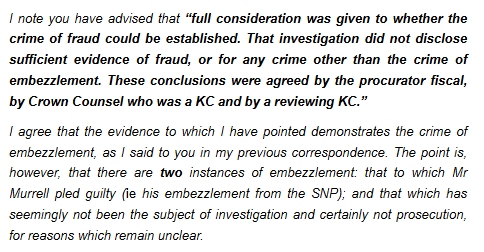


We’re sure they tried really hard to remember that.
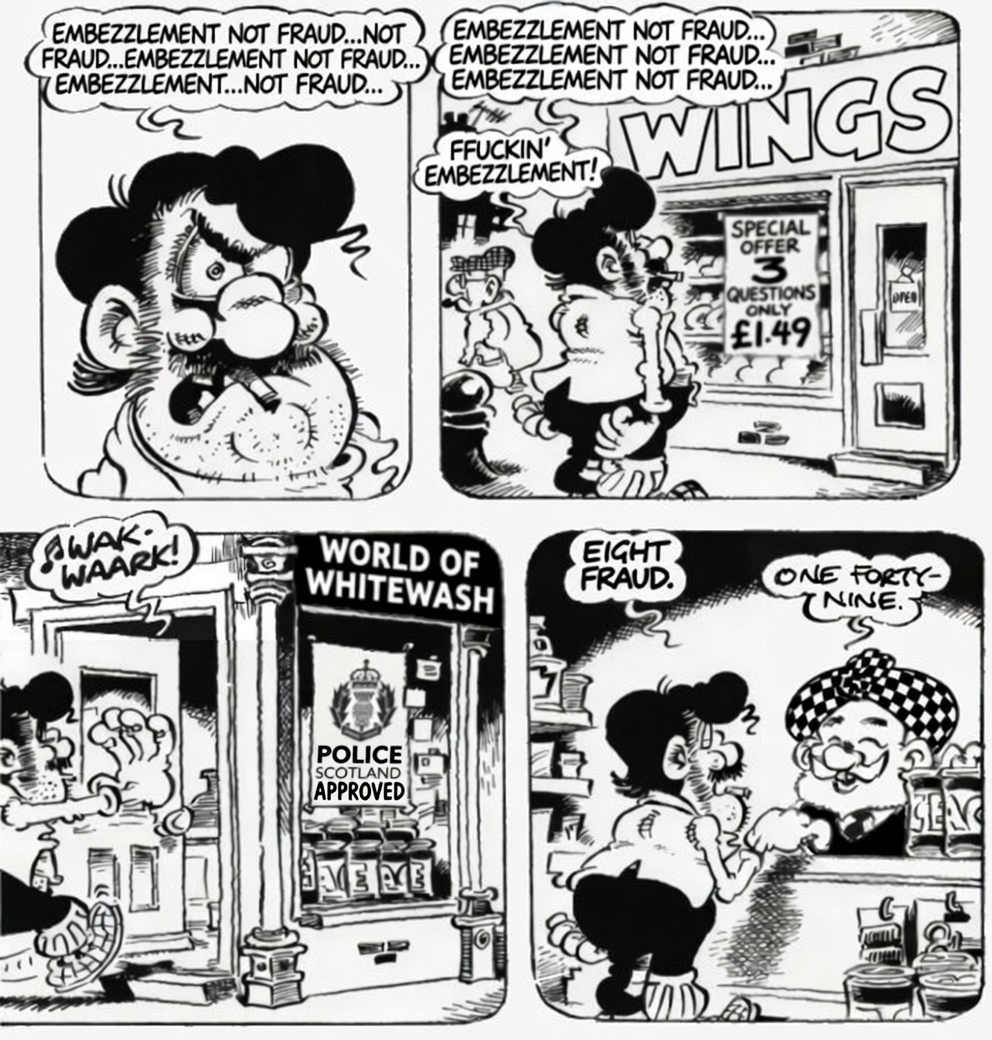
But the eventual response is an insult so crassly contemptuous (and therefore entirely in character for the Crown Office, which is answerable to no-one and can do whatever it likes in Scotland) that it’s hard to know what to do about it. Normally officialdom at least vaguely pretends that it cares about accountability to the people that pay its wages, but to be frank it’d have been less offensively dismissive if COPFS had just sent us a dog turd in a jiffy bag.
We’ll let you know where we go from here when we know ourselves.


What Is Financial Literacy? (Explained in 60 Seconds)

Specialist rescue teams deployed as Fleadh funfair ride stops mid-air

Wall Street Brunch: SpaceX’s Earnings Debut (undefined:SPCX)


-
 Sports7 days ago
Commonwealth Games boxing: Jadumani Singh seals dominant 5-0 win over Pakistan’s Sumama Rehman to enter quarter-finals | Commonwealth Games News
-

 Business4 days ago
Why Trees Belong on the Risk Register
-

 Fashion2 days ago
Weekend Open Thread: Wit & Wisdom
-

 Tech7 days ago
Intel is reversing course and bringing hyper-threading back to its server chips
-

 Politics2 days ago
Meta enters AI-training agreement with far-right ‘propaganda rag’ Newsmax
-

 Politics6 days ago
Luke Littler dismantles Gerwyn Price to retain title in Blackpool
-

 Crypto World1 day ago
MicroStrategy Post-Earnings CLARITY Act Push Could Add New Catalyst for Its Stock
-

 Politics5 days ago
The Part of the Electric Transition Nobody Wants to Discuss
-
 Entertainment5 days ago
‘Stargate’ Creator’s New Sci-Fi Series Returns for Season 3 Tomorrow
-

 News Videos7 days ago
BITCOIN JUST ENTERED THIS CRITICAL ZONE…
-

 Business4 days ago
Major shareholder moves on Canyon
-

 News Videos3 days ago
Bitcoin Enters the 3rd Stage of the Bear Market
-

 Crypto World1 day ago
XRP Ledger v3.3.0 brings five institutional features
-

 Crypto World5 days ago
Kraken Enables Retail Access to Jersey Mike’s IPO via Tokenized Shares
-

 Tech6 days ago
New macOS Sequoia & Sonoma security updates for older Macs
-

 News Videos5 days ago
Claude: Build Financial Dashboards in Minutes (2026)
-

 Politics3 days ago
Luke Littler’s dominance sparks GOAT debate
-

 Sports3 days ago
Seema Kaliramna Wins Discus Throw Bronze, Takes India’s CWG Medals Tally To 17
-

 Business5 days ago
Johnson & Johnson agrees to $5.5B settlement over talc cancer claims
-

 Crypto World7 hours ago
Crypto PAC spending tops $2M in Michigan House race
You must be logged in to post a comment Login