
Politics
Is economic security a missing element of EU-UK cooperation?

Jake Benford and Anton Spisak argue that there is a strong case for the UK and EU to cooperate more closely on questions of ‘economic security’.
When European Commission President Ursula von der Leyen met UK Prime Minister Keir Starmer at Lancaster House in May, they pledged a ‘new chapter’ for EU-UK relations. This included a Security and Defence Partnership (SDP) and a long list of areas for negotiations, including on agrifood (or SPS) standards and energy cooperation. And yet one topic that increasingly shapes how Brussels sees the world barely made the agenda: economic security.
One reason for this might be the lack of a joint definition. To some, it means defending against any kind of risk in the global economy: supply-chain disturbances, technology theft, or overt economic coercion. To others, it entails doing more to secure competitiveness in an increasingly contested environment, using tools that range from subsidies to regulatory standards.
In policymaking, the line between the two is often blurred. The act of reducing vulnerability is also a way of shaping who sets the rules; the act of promoting competitiveness is often justified as a security imperative. Economic security is less a new policy area than a new frame – a recognition that the separation between commerce and strategy belongs to another era.
The EU’s economic security turn began with its 2023 Economic Security Strategy that gave expression to anxieties that had been building since China’s growing assertiveness, the pandemic, and Russia’s invasion of Ukraine. What followed were a suite of new policy ‘tools’, from the Anti-Coercion Instrument to a tighter investment-screening framework. Most recently, the Commission published its communication – or ‘doctrine’ – on economic security. It promised to use its array of regulatory tools ‘more strategically’ to pursue both defensive and offensive objectives.
The UK’s approach, by contrast, has been more cautious. While the 2021 National Security and Investment Act gave ministers new powers to intervene in the economy on national-security grounds, successive governments have largely resisted the broader protective posture that has taken hold in Brussels.
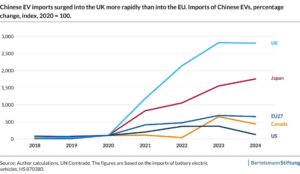
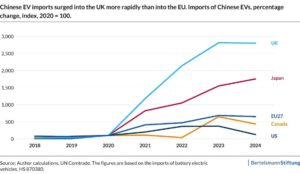
For example, when Brussels imposed protective tariffs on Chinese electric vehicles in 2024, London chose not to follow suit. The paradox is that the UK was more exposed, not less: imports of Chinese EVs grew four times faster into the UK than the EU (figure 1). The decision may reflect different priorities, but it also illustrates how two highly integrated markets can face similar risks with different instincts.
Figure 1
There are, however, signs of change. When the Labour government published its long-awaited Trade Strategy in July, it announced plans for a new trade defence instrument, reforms to the Trade Remedies Authority, and an ‘economic security advisory service’. This suggests a more proactive mindset, even though implementation has been slow.
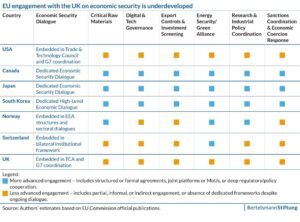
Cooperation with the UK also feels curiously thin when compared with other EU partnerships. The EU has woven a dense network of ‘mini-deals’ with other countries – on digital policy, critical raw materials, and other aspects of economic security (figure 2). These differ in ambition, but they all increase resilience through deeper cooperation between ‘like-minded’ partners. The UK has been mostly absent despite being the EU’s second-largest trading partner after the US.
The SDP commits both sides to ‘explore ways to exchange views on external aspects of their respective economic security policies’. Indeed, informal exchanges are already taking place through diplomatic channels. But the question is whether this is sufficient in a global economic environment of permanent volatility.
Figure 2
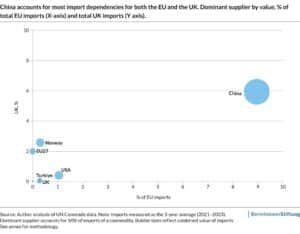
Trade data underlines the rationale for deeper cooperation. Our recent empirical analysis points to a striking overlap in shared vulnerabilities. Both sides are highly exposed to potential supply shocks: nearly a fifth of EU imports and around 15 % of UK imports by value come from ‘dominant suppliers’ – trading partners that account for at least 50% of imports for specific products. In most cases, that supplier is China (figure 3).
For more than 7% of imports by value, the EU and the UK rely on the same ‘dominant supplier’ for the same products. China again features most prominently. These dependencies span everyday consumer goods such as electronics, but also extend – more worryingly – into sensitive areas, from solar panels and lightweight drones to a range of critical minerals.
For policymakers who still see economic security as a fashionable overlay on ordinary trade policy, this is the kind of statistic that should sharpen attention. If both sides are trying to diversify suppliers and prepare for disruptions, they are more likely to succeed where their strategies are aligned. There is little strategic value in two like-minded neighbours scrambling independently for the same alternative suppliers, or duplicating intelligence-gathering on the same risks.
Figure 3
The overlap also extends to ‘offensive’ interests. Consider the Commission’s ambition to develop more ‘structured cooperation’ with the 12-nation Asia-Pacific trade bloc, CPTPP. The UK, as a CPTPP member, could support this and ensure that European and British efforts in the fragmenting global trading system complement each other.
The challenge for the post-Brexit relationship, then, is to turn these shared interests into instances of practical cooperation.
There have already been examples of quiet success. Since Russia’s full-scale invasion of Ukraine, the EU and UK have successfully coordinated their sanctions regimes and closed loopholes. This work has often been technical and discreet. But it shows what is possible when the strategic imperative is clear. The same logic could be extended to other areas: coordinating export-control lists on sensitive ‘dual-use’ items; sharing intelligence that supports FDI screening; or joint monitoring of critical supply chains.
What might enable deeper cooperation is a forum that elevates these topics to a political level. Many conversations already take place between officials – particularly through ‘specialised committees’ under the TCA – but these may not be frequent enough or at the right level. One possibility would be to create a new EU-UK Economic Security Dialogue bringing together the EU trade commissioner and UK business and trade secretary on a regular basis. Its function would be to inject greater political momentum into this shared agenda.
The more immediate opportunity may lie in the talks already underway. Both the SPS and energy negotiations carry questions about shared resilience, security of supply, and dependence on specific third-country inputs. Embedding the economic security dimension in these talks could be a good place to start.
Inevitably, deeper cooperation would require greater political alignment on bigger questions of the day – particularly policy towards Washington and Beijing. But this seems implausible in the short term, not least when Brussels itself struggles to reconcile competing national priorities.
The solution is not to pretend the differences do not exist. Rather, it is to isolate the areas of clear common interest and build trust through practical cooperation, which might in turn make the tougher conversations easier.
Without closer cooperation, one thing is clear: the EU and the UK will keep confronting the same threats with little alignment. That will leave both less resilient and less influential – something neither side can afford.
By Jake Benford, Senior Expert, Bertelsmann Stiftung’s Europe Programme and Anton Spisak, Associate Fellow, Centre for European Reform.

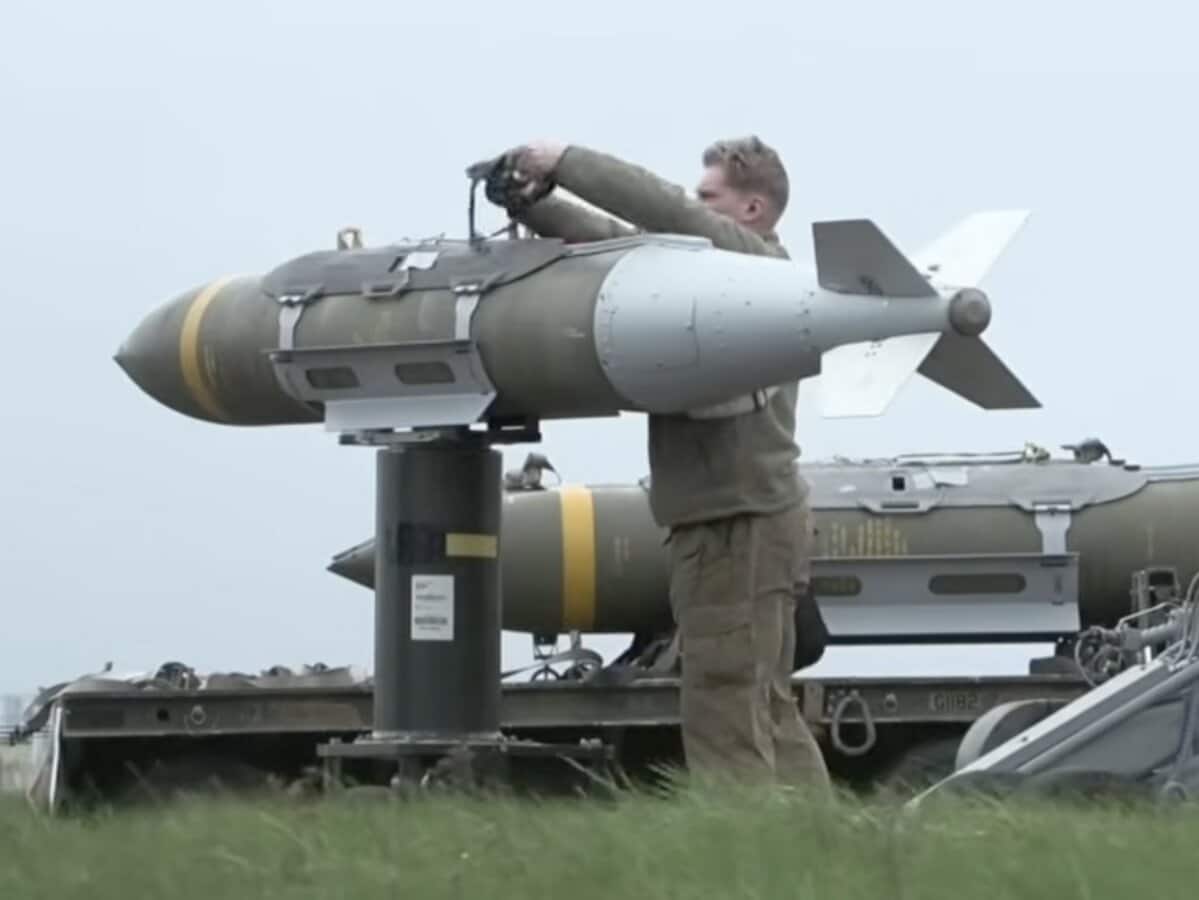
Britain’s defence secretary, John Healey, has said that UK bases have been invaluable to the US military. This raises serious concerns, given that the UK’s involvement is supposedly only for ‘defensive purposes’
From the horse’s mouth: “in this conflict, the basing permission that we in the UK have provided to the US has been invaluable to their military operations.” UK Defence Secretary John Healey blows apart Starmer’s line that “we are not involved”. https://t.co/plAnaAi4dO
— Martin Shaw (@martinshawx) April 11, 2026
UK bases used for ‘Defensive actions’
Already, a retired RAF squadron leader has told Declassified that Starmer’s claim he only let the US use British bases for “defensive” actions against Iran is a “fiction”. Of course, that is clear to anyone paying attention.
He added that it was “glaringly obvious” that US missions from RAF Fairford were conducting offensive strikes.
Whether or not the US bombing of Iran resumes, the UK’s central role in facilitating it, in direct contradiction of Starmer’s claims, will need to be investigated:
‘RAF Fairford has … become the principal forward operating base for US strategic bombers in Europe.’ https://t.co/fULc2ixuRm
— Martin Shaw (@martinshawx) April 10, 2026
Of course, there is nothing ‘limited’ or ‘defensive’ about using UK bases to bomb innocent people.
The UK is literally facilitating war crimes.
Keir Starmer has once again misled the British people over our involvement in Israel’s war crimes
He must be held to account
The leader of Britain should work for us, the British people. Not Israelis. https://t.co/8A67teimdU
— Stop The Bollocks with Mirabel (@MirabelTweets1) April 10, 2026
Now, speaking at a conference in London, Healey said:
Even in this current conflict, the basing permissions that we in the UK have agreed with the US have been invaluable to their military operations.
If we focus on our actions rather than just simply the exchange of words and social media posts, then the fundamentals for me remain.
Being ‘invaluable’ definitely doesn’t sound very ‘limited’ or ‘defensive’ to me. It appears that, despite Starmer’s bullshit facade, the US and Israel are using UK bases to commit multiple genocides.
The US couldn’t have conducted the Iran Epstein Wars without our bases and support.
In it to our necks.
Slaughtering children. Destroying civilian infrastructure.Putting the world in chaos to prop up a failing grasping empire. https://t.co/tdnILYHPWm
— Up_Again ItWasAScam 💙 🍉💙🍉 (@up_again) April 12, 2026
The UK government does not appear to care about the US using UK facilities to carpet-bomb innocent people. Additionally, Starmer is still unwilling to stand up to Trump.
All of this speaks to the continued colonial mindset of the UK government.
Colonialism in action
Earlier this week, the Guardian reported that:
Before the ceasefire announced by Trump late on Tuesday, which Starmer said countries in the region believed was “fragile”, the UK led a call of military planners from 35 nations on ways to secure the strait if there was peace, including the removal of Iranian mines.
The question has to be asked as to why the white Prime Minister of a Western Nation is leading a call which may help decide the fate of Iran — a majority brown country in West Asia? There’s a word for that.
Why is the future of the region in the hands of a white Zionist and not the people who actually live there?
Under the United Nations Convention on the Law of the Sea (UNCLOS):
Every State has the right to establish the breadth of its territorial sea up to a limit not exceeding 12 nautical miles, measured from baselines determined in accordance with this Convention.
The Strait of Hormuz is 21 miles wide at its narrowest point — meaning that Iran and Oman have sovereignty over every mile of that water. Unlike the majority of the West would have you believe, it is not international waters.
Which is why it’s even more fucked up that the UK is trying to exercise so much control over the sovereign territory of a majority brown country. Meanwhile, Starmer continues to claim the UK’s actions are purely ‘defensive’ as if he doesn’t appear to want a direct stake in the control of the Strait of Hormuz.
The most important thing John Healey missed was that UK bases have been invaluable in an act of illegal aggression. Meaning, the UK is just as bad as the US and Israel. Starmer and the British Establishment are actively participating in genocide, war crimes, and ethnic cleansing.
There are not many problems that cannot be traced back to the British Empire — but you might have thought that in 2026, under a Labour Government, there might be a red line or two. Looks more like two blue lines from where we’re looking.
Feature image via AFP News Agency/ YouTube

On 12 April, Wes Streeting appeared on the Sunday interview shows. With the local elections fast approaching, you’d expect him to be on an election footing. As Saul Staniforth noted, however, it seemed like Streeting was actually gearing up to challenge his boss, Keir Starmer:
Words Wes Streeting uses to describe Trumps language and rhetoric: incendiary, outrageous.
Anyone might think there’s a leadership election coming up! pic.twitter.com/Po77FSCo7l
— Saul Staniforth (@SaulStaniforth) April 12, 2026
As if things couldn’t get any worse in this country!
Post-Starmer
As everyone knows, Labour are going to get hammered in the upcoming local elections. And when we say ‘hammered’, we don’t simply mean they’re going to get beaten; we mean they’re going to get smushed into paste:
‼️NEW | Projected seat change in local elections:
➡️ Ref +2,260
🟢 Grn +450
🟠 Lib +200
🔵 Con -1,010
🔴 Lab -1,900(Source: Stephen Fisher / @ElectionsEtc) pic.twitter.com/pkPixJ3Ont
— Stats for Lefties 🍉🏳️⚧️ (@LeftieStats) March 30, 2026
It’s shaping up to be Labour’s greatest defeat since… well, since possibly ever.
The worry for Labour is it won’t stop with one defeat, either, and that the local election loss will translate into a general election wipeout.
Accordingly, heavy losses in the local elections will mean Labour have no choice but to give Starmer the boot. This might not fix things, but it’s clear there can be no fix with him at the helm, so it’s a necessary step if nothing else.
Streeting manoeuvres
In the clip at the top, Streeting criticises Donald Trump for threatening to wipe out the civilisation of Iran. Staniforth identified this as Streeting gearing up for a leadership challenge, and there are two good reasons to think this:
- Trump and his war on Iran are incredibly unpopular in the UK, so it makes sense to attack him.
- Streeting has no personality traits besides political ambition, so he wouldn’t attack Trump unless it benefitted him.
Of course, you could say that Streeting attacking Trump is a sign that he doesn’t want to become PM. After all, as PM, he would have to engage with Trump one-to-one.
The reason why this doesn’t hold up is because Streeting knows what every other politician does – namely that Trump has a cheat code. If a person rolls over and shows Trump their belly, he doesn’t care what they’ve said in the past.
Keir Starmer and Boris Johnson are examples of British politicians who publicly spoke out against Trump only to roll over later on; JD Vance is an example of an American politician:
JD Vance: “Trump is a really bad candidate and frankly, I think, a really bad person.”
pic.twitter.com/GP6HhBq4El— PatriotTakes 🇺🇸 (@patriottakes) April 7, 2026
Staniforth also highlighted the following:
Wes Streeting: “As for Mr Farage, the extent to which that plastic patriot is prepared to fly to Washington on a regular basis to slag off his own country to American audiences, I think is utterly shameful”
Streeting is in campaigning mode (and not for next months elections) pic.twitter.com/Yai3XvtLWd
— Saul Staniforth (@SaulStaniforth) April 12, 2026
Health
As much as Streeting wants to come across as a respectable and righteous politician, he simply cannot get over the disdain he feels for the medical professionals he represents:
Wes Streeting asks the BMA to stop pretending the govt could have solved everything in 2 years
The BMA never said you could. Resident doctors want pay restoration but recognise it can only happen over several years. That’s what they want to negotiate. And you are refusing. pic.twitter.com/bRQVe2ROX8
— Saul Staniforth (@SaulStaniforth) April 12, 2026
It’s no secret why Streeting is opposed to our once-successful public health model either, as James Wright wrote for the Canary:
Labour health secretary Wes Streeting has taken another £55,000 from the ODP Group Ltd—which provides headhunting services to the NHS and private healthcare providers.
The firm’s owner, Peter Hearn, has longstanding links to private healthcare.
Additionally:
This is not the first donation Streeting has accepted from a Hearn-linked company. In 2023, he took £48, 000 from the OPD Group, according to the National (Scotland). in donations from another company Hearn controls. And the Financial Times has reported that, through seemingly shell companies, Hearn previously donated over £1m to Labour and prominent individual MPs like Streeting from between 2014 and 2023.
Streeting — Starmer 2.0?
While some have said Streeting would be Starmer 2.0, we don’t think that’s the case. Streeting is more ideologically driven that Starmer, if only because our current PM isn’t curious enough to hold his own opinions.
The problem is that Streeting’s ideology is the toxic privatisation mindset of Margaret Thatcher and Tony Blair. In other words, we’ll need to hold on to our public institutions if he becomes PM, because he’ll be selling off everything that isn’t nailed down.
Featured image via BBC

The Italian Football Federation has published a detailed report outlining the reasons behind the sharp decline in the standard of the game within the country, alongside a package of proposed solutions to rebuild the system, following the senior team’s failure to qualify for the World Cup finals for the third consecutive time.
Italian fans are in a state of shock and anger after failing to reach the 2026 World Cup, following the defeat to Bosnia and Herzegovina in the final of the first leg of the European play-offs, meaning the four-time world champions will miss the tournament for the third consecutive edition, after Russia 2018 and Qatar 2022.
On the administrative front, Gabriele Gravina announced his resignation as president of the Italian Football Federation on 2 April, under mounting political and media pressure. A new president is to be elected at an extraordinary meeting in the capital, Rome, on 22 June, whilst he will continue to lead the federation on an interim basis until then.
Prolonged structural crises transcends World Cup
The Italian Football Federation confirmed in its report that the country’s football problems are not new, but date back many years, with various indicators showing a worsening trend, noting that the crisis has become “structural” and requires radical solutions.
The report identified four main factors behind the decline of Italian football, as follows:
1- Declining reliance on domestic players
The report highlighted a clear decline in opportunities for Italian players within clubs, noting that:
- The average age of Serie A players is 27, one of the highest in Europe
- Foreign players account for 67.9% of playing minutes
- Only 89 Italian players out of 284 feature regularly
- The proportion of players under 21 does not exceed 1.9%
- Only two academies are among the world’s top 50 (Atalanta and Juventus)
2- Decline in technical quality
The report noted a decline in the technical quality of the Italian league, the most notable aspects of which are:
- A slower pace of play compared to the major leagues
- Lower dribbling rates
- A decline in attacking effectiveness and high pressing
3- A worsening economic crisis
The report revealed the difficult financial situation facing Italian clubs, the most notable features of which are:
- 194 clubs have been relegated since 1986 for financial reasons
- Annual losses exceeding €730 million
- Debts amounting to €5.5 billion
- Agent fees rising to over €300 million
- A large number of professional clubs (97) compared to other European leagues
4- Weak infrastructure
The report acknowledged that Italy remains outside the top 10 European countries in terms of stadium quality, due to weak government investment and a decline in sports facility development projects.
The report also highlighted regulatory and legal obstacles, notably the congested match calendar and European regulations limiting the imposition of specific quotas for domestic players, alongside the federation’s limited ability to impose direct structural reforms on clubs.
Proposed solutions to save Italian football
The Federation put forward a range of solutions, most notably:
- Tax incentives to support investment in youth and infrastructure
- Development of the youth sector and academies
- Reform of the league system
- Improvement of stadium infrastructure
- Reorganisation of the clubs’ financial system
- Reform of the refereeing system
The report concluded by emphasising that saving Italian football requires “radical and comprehensive reform”, based on unity among all parties and governmental and legislative support, placing the public interest above all other considerations.
Featured image via the Canary

The US navy is to blockade the Strait of Hormuz to all ships after talks to end the Iran war collapsed, Donald Trump has announced.
In a post on Truth Social, the US president accused Tehran of “extortion” for charging tolls for oil tankers to use the vital waterway.
Any ships which have paid money to Iran in order to safely sail through the strait will also be hunted down, Trump said.
His comments came after his vice-president JD Vance said that talks between US and Iranian officials in Pakistan had broken down without a peace deal being agreed.
Trump insisted the talks “went well”, but had broken down over Tehran’s refusal to give up its ambitions to build a nuclear bomb.
He said: “Effective immediately, the United States Navy, the Finest in the World, will begin the process of BLOCKADING any and all Ships trying to enter, or leave, the Strait of Hormuz.
“At some point, we will reach an “ALL BEING ALLOWED TO GO IN, ALL BEING ALLOWED TO GO OUT” basis, but Iran has not allowed that to happen by merely saying, “There may be a mine out there somewhere,” that nobody knows about but them.
“THIS IS WORLD EXTORTION, and Leaders of Countries, especially the United States of America, will never be extorted. I have also instructed our Navy to seek and interdict every vessel in International Waters that has paid a toll to Iran. No one who pays an illegal toll will have safe passage on the high seas.”
Trump said the US navy will destroy any mines which have been laid in the strait, and warned that “any Iranian who fires at us, or at peaceful vessels, will be BLOWN TO HELL”.
“As they promised, they better begin the process of getting this INTERNATIONAL WATERWAY OPEN AND FAST,” he added.
In a separate post, he went on: “Iran will not be allowed to profit off this Illegal Act of EXTORTION. They want money and, more importantly, they want Nuclear.
“Additionally and, at an appropriate moment, we are fully “LOCKED AND LOADED,” and our Military will finish up the little that is left of Iran!”
Subscribe to Commons People, the podcast that makes politics easy. Every week, Kevin Schofield and Kate Nicholson unpack the week’s biggest stories to keep you informed. Join us for straightforward analysis of what’s going on at Westminster.
The post The hypocrisy of Britain’s ban on Kanye West appeared first on spiked.

When you have a bad boss keeping you down, your best way to fight back might be to try “malicious compliance,” according to a growing online movement of disgruntled workers.
For them, a maliciously compliant act is a creative form of resistance against their boss’ marching orders. You might fulfill what you’re asked in order to stay employed, but your actions will not be exactly what the person wanted.
Servers say they do it to fight back against entitled customers. If a rude customer asks for extra butter, they’ll bring back a ridiculous amount of butter to the table, for example.
According to the subreddit that documents acts of malicious compliance, it involves any act when people are “conforming to the letter, but not the spirit, of a request.” Popular examples include: If a boss asks you to dress better without specifying what that means, you wear a suit. Or if a boss orders you to be the only team to work in the office on Fourth of July, you expense a barbecue feast costing thousands of dollars.
But if you decide to try this yourself, proceed with caution. Career and legal experts say this can help you survive under a bad boss –– or it can spectacularly backfire.
For micromanagers, malicious compliance can give them a taste of their own medicine.

Yana Iskayeva via Getty Images
Micromanagers can often be insecure, rigid bosses who need constant unwarranted check-ins for reassurance that you’re working.
“Malicious compliance can work well against an insecure manager,” said Ryan Stygar, an employment attorney and author of the upcoming book, Get It in Writing: The Ultimate Guide to Your Rights at Work.
In this case, your malicious compliance is going above and beyond to comply with a micromanager’s demands. If they want a list of your daily tasks, you send long, bulleted emails.
“When you follow their instructions exactly, it exposes how inefficient those instructions really are,” he said. “For example, if they want to approve every email, their inbox quickly becomes a mess. I compare this [as] holding up a mirror to the micromanager. Once they see how burdensome the micromanagement has become, they typically back off.”
It helps to confirm that this is what they wanted. You might reply to a micromanager with, “Thank you for your instructions today. This confirms I will submit every client-facing email to you for approval before sending,” Stygar said. This response works because it “creates a paper trail,” he said. “It also locks in their expectations…It prevents them from ‘moving the goalposts’ and claiming you did not comply with their orders.”
“Now there is no confusion. If work slows down, you have proof showing why its not really your fault. With a reasonable manager, this may get them to back down,” Stygar said. “With a toxic one, it may not. But it will make it much harder for them to twist the facts either way.”
And if timing matters, mention that you sent their request by noon, per their last email, in your malicious compliance. “Now any delay is clearly tied to the process the micromanager imposed on you — not your performance,” Stygar said.
And this kind of strategic resistance might not be so malicious after all. If you do go above and beyond for a micromanager it might actually be “exuberant compliance,” said Mary Abbajay, president of leadership development consultancy Careerstone Group and author of Managing Up: How to Move Up, Win at Work, and Succeed with Any Type of Boss. “Exuberant compliance is when you’re giving them what they want and it’s not reflecting on your work,” she said.
For toxic bosses, it can be a protective response – but it can also have consequences.
Bad bosses can be difficult, but a toxic boss is a dismissive, demeaning boss that is trying to ruin your mental health.
A toxic micromanager, for example, is “trying to control you,” Stygar said. “They’re probably hoping you make a mistake so they can enjoy the power trip of jumping all over you.”
Typically, in these cases, malicious compliance is when you know what you’re doing will lead to a less efficient, more chaotic outcome for your team, but your preferred alternatives got rejected by your boss. If your horrible boss has a new workflow that is doomed to fail, you follow it because you had no choice, for example.
In these cases, your malicious compliance might actually be “protective compliance,” Abbajay said. “All you can do is survive a toxic boss. And if…giving them what they want is going to protect you until you can get yourself out of there, then I’m all for it.”
Ideally, you only do this kind of protective compliance while you actively job hunt for a better opportunity, because if you keep doing this, “you are never going to actually thrive, and you’re never going to get to find out your full potential,” Abbajay said.
But don’t be snarky about it or this defiance will backfire.
People who need to resort to malicious compliance to push back against their boss’ orders are not happy employees. They’re often scared, overworked employees who are just trying to get through each day. But don’t let your negative emotions seep into your malicious compliance. Stygar said that “malicious compliance works best as a defensive measure, not a revenge tactic.”
In his view, the “deadly sins” of malicious compliance are if you’re sarcastic in your response, if you purposefully slow work down, and if you try to embarrass or mock your boss.
“A toxic manager is often looking for ‘insubordination,’” Stygar said. “If you give them that opportunity, even by accident, they will take it.”
Instead, the safer but tedious approach is to maintain a neutral tone and document what nonsense your boss is asking you to do in case you need to prove yourself later.
“Keep copies of these exchanges for yourself. Build a record that shows exactly what they told you to do and how you followed it,” Stygar said.
And don’t do malicious compliance that makes it seem like you’re not good at your job.
“If your malicious compliance is delivering substandard work, then that actually isn’t going to reflect very well on you, because it’s still your work and your name is attached to it,” Abbajay said.

Palestine Action — On Sunday 12 April, Victoria Derbyshire interviewed Tucker Carlson on the BBC. At one point, Carlson suggested it’s a crime to criticise Israel in the UK. While this isn’t strictly true, it’s certainly the case that Keir Starmer’s government have limited the ways in which Britons can oppose Israel’s genocide.
He also made an absolutely brutal point that the BBC couldn’t answer: if not to suppress free speech, why did the government ban Palestine Action?
Carlson: “it is a crime for which you can be arrested.. criticising Israel. You say you’re for Palestine Action, you can be arrested..”
Derbyshire: “That is not true..”
“What is not true about that?”
“Palestine Action is a proscribed group. It is banned”
“Why is it banned?” pic.twitter.com/wHpB1wjXJd
— Saul Staniforth (@SaulStaniforth) April 12, 2026
Suppression
In the clip above, Derbyshire asked Carlson about the US and Israel’s war on Iran:
Do you think Keir Starmer has made the right calls in this war?
Carlson responded:
I don’t think Keir Starmer makes any calls about anything.
It’s a fair point.
Starmer has denied dragging us into the war while simultaneously allowing the US to use our bases. In other words, we’re in Trump’s war, and we’re in it because Starmer was too weak to say no.
Carlson later said:
It is a crime for which you can be arrested in Britain right now – criticizing Israel. If you say you’re for Palestine Action, you can be arrested. A lot of people have been arrested. So in other words, it is not legal in Britain to criticise another country.
Derbyshire responded:
That is not true-
Derbyshire attempted to steer the conversation back to the war, but Carlson said:
I’m sorry, but what is not what is not true about that?
Derbyshire could have acknowledged that the government has indeed clamped down on free speech related to Israel. Instead, she flat out denied what Carlson said. This was a problem, because part of what he said was “if you say you’re for Palestine Action, you can be arrested” – an undeniable fact.
Carlson continued:
Have people not been arrested in Britain for criticising Israel? They certainly have been. There’s a videotape of it
Derbyshire noted that Palestine Action is a proscribed group, to which Carlson asked:
Why is it banned?
Exactly — why is it banned?
Carlson added:
It’s banned because the Israeli government wanted it banned.
How did the Palestine Action ban happen?
While we’re certain that the Israeli government was happy about the Palestine Action ban, we can’t say it happened because Benjamin Netanyahu gave the order.
At the same time, we can say that Israeli arms company Elbit Systems influenced the decision, as Channel 4 reported and Jonathan Cook summarised:
The four main takeaways from Channel 4’s documentary on Palestine Action last night:
1. It reminded us that the Starmer government’s proscription of the group as a terrorist organisation was done at the behest of Elbit Systems – the Israeli arms firm making killer drones used in Gaza targeted by Palestine Action.
Government officials regularly met with Elbit. A 2023 internal Home Office email, two years before proscription, states: “Reassure Elbit Systems UK and the wider sector affected by Palestine Action that the government cares about the harm the group is causing the private sector [arms industries].”
2. A senior official told the film-makers there was widespread belief among Home Office staff that the government was “wrong” to proscribe Palestine Action, and there was “disquiet” that the government was using Palestine Action as a way to curtail rights to protest and speech more generally.
3. The government’s terrorism adviser, Jonathan Hall KC, made clear that there was zero evidence of any links between Palestine Action and Iran – a claim leaked to the press by government officials on the same day Palestine Action was proscribed. Private Eye had already reported in November that the claim was concocted by a PR firm for Elbit Systems.
4. Additionally, Lord Walney, the government’s former “independent” adviser on political violence, who has been at the forefront of demanding even more draconian legislation to ban protest in relation to Israel and its genocide, struggled through his interview.
It was only too clear that his views on the subject had nothing to do with the public good but were shaped by his ties to the arms industries and his role as an Israel lobbyist.
What the programme made clear was that Starmer’s government made the unprecedented decision to declare Palestine Action a terrorist organisation not because the group is a terrorist organisation but because large corporations – arms firms like Elbit – have captured the UK government.
Oh, and for further evidence for how cucked the UK is by the US and Israel:
Surreal moment after the Tucker Carlson interview in which the former head of the UK intelligence services insists that Trump is being a “traditional” US president by “intervening in the Middle East, hanging out with Israel, and doing wars” 🫢 pic.twitter.com/QUPR05f6fI
— Nicholas Guyatt (@NicholasGuyatt) April 12, 2026
Shifting tides
In the US, Democrats and commentators have argued that Carlson is attacking Israel for cynical reasons. We’re sure that Carlson is thinking about his own career first and foremost, but that doesn’t change the fact that many of his criticisms about Israel and its relationship with the US are correct.
The dam of public opinion on Israel has burst at this point. Politicians can deal with that reality and join us on the right side of history, or they can get washed away.
Make no mistake; the proscription of Palestine Action was and always has been an attempt to limit criticism of Israel.
We oppose genocide, and we support all those who are saying the same thing.
Featured image via the BBC
Morgan McSweeney is the man who manoeuvred Keir Starmer into power. At one time, this was something McSweeney could brag about; now it’s like admitting to being the guy who shat in the pool.
Not satisfied with bringing his own party to the point of electoral oblivion, McSweeney is now rumoured to have his sights set on Ukraine:
EXC w/@Gabriel_Pogrund
Morgan McSweeney will attend a security conference in Ukraine this month as he considers his post-Downing Street career
He is understood to be compelled by the question of how AI will affect the next election in Ukraine, which he believes will be one of…
— Lara Spirit (@lara_spirit) April 11, 2026
Haven’t the people of Ukraine suffered enough?
Morgan McSwAIny
The above post finishes:
He is understood to be compelled by the question of how AI will affect the next election in Ukraine, which he believes will be one of the most consequential in recent European history
Friends believe he is interested in helping Zelensky in any future contest
Oh, we’re sure McSweeney is interested in how AI will affect the Ukrainian election. And by that, we mean we’re sure the wretched, little weasel will be the one using AI to affect the Ukrainian election.
McSweeney, 48, is particularly interested in the role AI could play in elections in Ukraine. According to the International Panel on the Information Environment, an independent group of Swiss-based scientists, AI was used in more than 80 per cent of elections in 2024, when a record number of countries held contests.
It’s difficult to understand what this means, because there are multiple technologies we now refer to as ‘AI’. The reality is it’s probably closer to 100%, because Western politicians are inherently lazy and feckless people, which means many of them are using ChatGPT to write emails and respond to constituents.
The Times added:
Russia, along with China and Iran, has a well-documented history of using the technology to disrupt elections, particularly using “deepfake” videos and bogus images, which the average voter may find difficult to identify.
Russia, China, and Iran, is it?
Is there another country which has famously leaned into AI?
— The White House (@WhiteHouse) May 3, 2025

The Trump regime have also used AI to present a false impression of its political enemies:

AI is definitely a problem, but let’s be real; that problem isn’t limited to the countries that the newspaper people tell us to be scared of.
Morgan McSweeney’s History
The Times added:
In 2024 a Russian operation used AI and other tools to mount a disinformation campaign in Romania, leading a court to nullify the results of the first round. A Russian campaign also created fake videos in last year’s presidential elections in Poland that suggested Ukrainian refugees were planning to disrupt voting.
Give McSweeney’s record, do you think he’ll be countering disinformation, or do you think he’ll be generating his own?
If you’re unfamiliar with said record, here’s what Paul Holden wrote in The Fraud:
McSweeney joined Labour in the mid-1990s as a receptionist and then a member of the party’s media operations. During the 2001 election he was given the task of feeding data into Peter Mandelson’s famed Excalibur computer that stored information to be used by the party’s rebuttal unit.
He was storing information to use against political enemies, in other words — using cutting edge technology to enact Mandelson’s ‘dark arts‘.
Is this the guy we want to be experimenting with how to use AI in elections?
Holden also wrote:
McSweeney is a long-time protégé of Peter Mandelson, the architect of New Labour who, in February 2017, publicly bragged that he was “working every day” to bring down Corbyn’s elected leadership. That doesn’t sound very unifying. Mandelson has been quoted saying of McSweeney:
“I don’t know who and how and when he was invented, but whoever it was . . . they will find their place in heaven.”
If Peter Mandelson or Morgan McSweeney make it to heaven, we’re pretty sure that means all known religions are wrong, because clearly righteousness was never the point.
Holden additionally noted:
McSweeney explained that the Labour Together Project had two missions: first, it had to prepare for when Corbyn eventually stepped down, identifying and developing a candidate who could swoop in to take Corbyn’s place. This role would eventually be played by Keir Starmer. …
Second, Labour Together had to “ensure” that Corbyn “lost badly”, according to Maguire and Pogrund. Only Corbyn’s resounding defeat in a general election would remove him from the scene and trigger a new leadership contest.
That’s correct; Labour bigwig McSweeney sought to ensure Labour lost a general election.
How could anyone could trust this rat to help them fight an election campaign?
Featured image via Kremlin (Wikimedia)

Victoria Derbyshire has slapped down Tucker Carlson after he claimed it was “not legal” in the UK to criticise Israel.
The right-wing podcaster made the bizarre allegation as he admitted Britain has “been shafted” by Donald Trump’s administration.
He had earlier accused the US president of being “a slave” to Israel over the Iran war.
Carlson, a former close ally of Trump, made his comments during an appearance on BBC 1′s Sunday with Laura Kuenssberg programme.
He said: “It is illegal, it is a crime for which you can be arrested in Britain right now criticising Israel.
“If you say you’re for Palestine Action you can be arrested, a lot of people have been arrested, so in other words it is not legal in Britain to criticise another country.”
Derbyshire interrupted to tell him: “That is not true.”
Carlson replied: “I’m sorry, what is not true about that? Have people not been arrested in Britain for criticising Israel? They certainly have been. There’s video tape of it.”
But Derbyshire hit back: “Palestine Action is a proscribed group, it is banned.”
Carlson said: “Why is it banned? It is banned because the Israeli government wanted it banned. I often criticise Britain, but I love Britain. I have family there and I don’t think Britons understand just how badly they have been shafted by the United States, and I am ashamed of that.
“I hope that our next president strikes a far more conciliatory tone with Britain and tries to help Britain because there are a lot of problems that will be incredibly obvious by the time of the next presidential election.”
Subscribe to Commons People, the podcast that makes politics easy. Every week, Kevin Schofield and Kate Nicholson unpack the week’s biggest stories to keep you informed. Join us for straightforward analysis of what’s going on at Westminster.
I have to be honest here. I couldn’t ever imagine the possibility of the Green Party leading an opinion poll.
Ever.
I would’ve bet my vital organs on Liz Truss returning to Number 10 in a blaze of glory before a load of sensible tree-huggers topped any UK opinion poll.
But the Green Party has quite clearly changed and it looks far closer to the broad church that Labour once claimed to be.
If the Green Party continues to open its doors to people from across the left, its chances of winning some form of power increase tenfold.
The Green Party surge
Labour is now a fully-fledged centre-right government, and it has narrowed its base considerably. This is why the Green surge is happening.
So, where is the ceiling for the Greens? If we use a national projection of the upcoming local elections, could we get an idea of where and how the Greens can make serious inroads into Labour heartlands?
And where does Your Party fit in to all of this? Or are they still electing a steering group to form a committee to vote on the best method of having a vote on something that needs a committee to vote for?
Don’t fucking ask me. I know nothing.
Just for one moment, take a look at where we are, and I will tell you why I think Britain needs the Green Party.
Back in April, last year, YouGov asked Britons where they would place themselves on the political spectrum.
About 29% identify on the left (including “slightly/fairly/very left-wing”), 26% on the right, 22% in the centre, and the rest, amusingly, don’t actually know. That’s nearly a third of the electorate that claim to be a lefty.
For arguments sake, let’s split that 22% that describe themselves as centrists, straight down the middle. This would take the left vote to around 40% and pretty much in-line with Jeremy Corbyn’s 2017 general election vote share.
Reinvigorating the left
Britain needs the Green Party.
With the painfully slow emergence of new left projects, some on the left have already moved to the Greens under its recent “eco-populist” shift. This really shouldn’t be seen as a problem because this pluralism strengthens the broader movement.
The Greens provide an organised, electorally viable home for eco-conscious socialists who want to fight Labour’s shift to the right and the dark forces of capitalism without waiting for the perfect socialist vehicle.
Importantly, the Greens stop the left from being reduced to a single personality or party, and they demonstrate that left ideas can win, quite comfortably, outside of the Labour brand.
Britain needs the Green Party.
I get why some people might view the Greens as insufficiently class-focused or too liberal on certain issues. I have voiced my own concerns in the past.
But the dominant view today — reflected in calls for tactical co-operation — is that Britain’s dire situation requires every left force pulling in the same direction, particularly where policies overlap.
The Greens are not the main engine of socialist transformation, but they are an essential part of the ecosystem that will make it possible. Without them, the left would be narrower, and considerably easier for centrists and the right to dismiss as outdated or unrealistic.
Humiliating Labour
Britain needs the Green Party.
Keir Starmer’s Labour has purged the left, worshipped fiscal rules, ramped up arms spending, and turned foreign policy into whatever Trump demands, but with added ‘principles’.
The Greens continue to humiliate Labour in councils and by-elections, forcing the centrists to pretend they care about Palestine, poor people, or those who aren’t in focus groups.
Jeremy Corbyn’s given them the nod because he knows without that constant pain in the arse on their left flank, Labour would sprint right so fast they’d overtake the Tories and start privatising the NHS for “efficiency savings”.
Britain needs the Green Party.
Let’s be completely honest here. Some corners of the left treat just transition like that awkward relative at Christmas — mentioned once then ignored.
The Greens have been banging on about fracking, airport expansions, and a world without nukes for decades. And right now, they are the reason we can’t just slap a red rosette on endless growth and call it socialism.
Plus, they do actually win on local stuff — cycle lanes, council housing, community energy — while the rest of us are still arguing about manifestos from 2019 and socialist purity.
The Green Party is like that friend who actually brings reusable carrier bags to the revolution.
They’re certainly not perfect and some of their activists do treat lentils as a personality trait, but they’re well organised, they win seats, and they help keep the broader left ecosystem alive.
We need the Green Party
Britain needs the Green Party.
Love him or not, Mr Polanski has become the necessary voice reminding us that when the sea levels rise, it won’t just be the Tories getting wet — we’ll all be in it together, up to our fucking necks in Thames Water sewage.
I believe we need to have some proper Greens in the mix rather than watch Starmer and Farage try, and fail to negotiate with the tide.
In my humble opinion, Britain needs the Green Party.
Featured image via the Canary

Europe banks pick stablecoin partners as MiCA srives shift

UK bases are ‘invaluable’ to US military

Martinez, De Ligt, Dorgu – Man United injury latest and return dates after Michael Carrick boost

Why Israel is blocking foreign journalists from entering

Bitcoin: We’re Entering The Most Dangerous Phase

Alan Cumming Brands Baftas Ceremony A ‘Triggering S**tshow’

Emotional Blackmail Disguised as Financial Support #estrangementawareness

bitcoin explained in hindi – bitcoin account kaise banaye | bitcoin kaise kharide aur beche | zebpay

Stephen Miller Faces $3.8B Financial Allegation Debate in US | PakCan News
-

 Business7 days ago
Three Gulf funds agree to back Paramount’s $81 billion takeover of Warner, WSJ reports
-

 Politics2 days ago
US brings back mandatory military draft registration
-

 Fashion2 days ago
Weekend Open Thread: Veronica Beard
-

 Tech5 days ago
How Long Can You Drive With Expired Registration? What Florida Law Says
-

 Fashion6 days ago
Massimo Dutti Offers Inspiration for Your Summer Mood Board
-
 Sports2 days ago
Man United discover Nico Schlotterbeck transfer fee as defender reaches Dortmund agreement
-

 Crypto World3 days ago
Canary Capital Files SEC Registration for PEPE ETF
-

 Fashion5 days ago
Let’s Discuss: DEI in 2026
-

 Business2 days ago
Tesla Model Y Tops China Auto Sales in March 2026 With 39,827 Registrations, Beating Cheaper EVs and Gas Cars
-

 Crypto World4 days ago
Bitcoin recovers as US and Iran Agree a Ceasefire Deal
-

 Politics2 days ago
Malcolm In The Middle OG Turned Down ‘Buckets Of Money’ To Appear In Reboot
-

 Business2 days ago
OpenAI Halts Stargate UK Data Centre Project Over Energy Costs and Copyright Row
-

 Business23 hours ago
Ireland Fuel Protests Enter Day 5 as Blockades Spark Shortages and Government Prepares Support Package
-

 Tech6 days ago
Italian court says Netflix must refund customers up to $576 over price hikes
-

 Tech6 days ago
Gamer Restores the Original PlayStation Portal From Two Decades Ago
-

 Tech6 days ago
Haier is betting big that your next TV purchase will be one of these
-

 Tech6 days ago
The Xiaomi 17 Ultra has some impressive add-ons that make snapping photos really fun
-

 Tech6 days ago
Samsung just gave up on its own Messages app
-

 Politics2 days ago
LBC Presenter Mocks Trump Over Iran War Failures
-

 Tech6 days ago
Save $130 on the Samsung Galaxy Watch 8 Classic: rotating bezel, sleep coaching, and running coach for $369
You must be logged in to post a comment Login