
Politics
Labour attack Greens with failed ‘War on Drugs’ propaganda

Keir Starmer’s Labour Party has been a massive failure. As a result, voters have started looking at the Green Party. In response, Labour have decided to knuckle down and offer policies which actually improve people’s —
— no —
— we’re just fucking with you.
They’ve gone with Yank-style attack ads:
Fuck sake so we are getting war on drugs from Labour, I thought they may be a bit more sane on this issue than that.
Harm reduction beats out criminalisation.
Experts on drug policy specifically state that poor underfunded execution of legislation/decriminalisation worsen drug… https://t.co/tFcPZiucgc
— JimmyTheGiant (@jimthegiant) February 21, 2026
Greens Vs the War on Drugs II
Labour is asking you to imagine what it must be like to live in a country where drugs are plentiful and easy to get hold of. The problem is we already live in a country where drugs are plentiful and easy to get hold of.
The War on Drugs was won by drugs.
There’s an obvious parallel to all this, and it’s the Prohibition Era in the United States. During that time, they made it illegal for citizens to drink alcohol. Did that stop people drinking?
No, of course not.
But it did give organised crime access to fast, easy cash, and this is precisely what’s happened here with drugs.
To be clear, the Greens aren’t saying you should be able to buy smack from a vending machine. They’re proposing a system in which drugs are treated seriously, but are available for people to partake of in a controlled fashion. Under Keir Starmer, you can buy crack from a guy called ‘Spez’ and OD under a motorway bridge.
Which sounds more grown up to you?
Oh, and if you think Starmer is the man who can finally end the War on Drugs, we’ve got bad news for you; you’re on drugs right now.
You are literally smoking crack.
You are off your head.
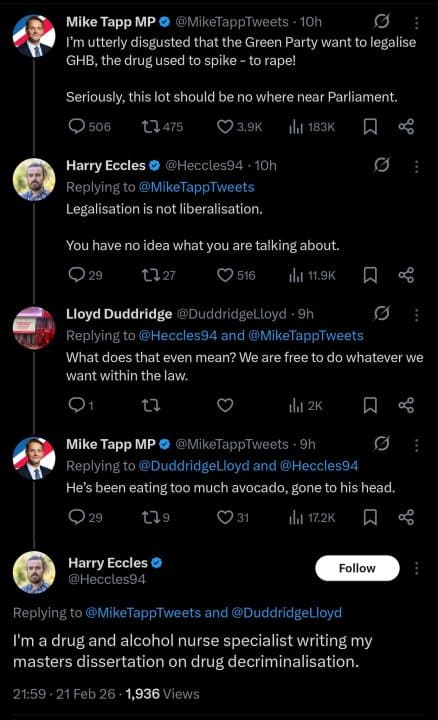
And speaking of people who are off their heads, please take a gander at this exchange involving Labour’s Mike Tapp:

That same conversation devolved into this, by the way:
Don’t think you’re on particularly solid ground here Mike, they are literally calling Labour the Paedo Party on the doorstops https://t.co/DStFbLeRz9
— Matt Zarb-Cousin (@mattzarb) February 22, 2026
Mike Tapp — the great defender of women. Here he is refusing to say a bad word about Epstein associate Donald Trump:
.@MikeTappTweets refuses to say that the US should not attack Denmark and Greenland.
Moments later he declares that sticking to international law is what we stand for as a country. pic.twitter.com/5JsmGSLEfQ
— Saul Staniforth (@SaulStaniforth) January 5, 2026
Oh, and let’s not forget this either:
2 years ago, when people were calling him boring, Keir Starmer impishly implied that he had tried drugs as a young man (“I had a good time”).
In 2020, he said he supported decriminalising cannabis.
But now? He wants police to crack down on smoking weed.
What a joke!
— Ash Sarkar (@AyoCaesar) March 28, 2023
How serious do you think Starmer is about preventing drug use when he’s openly admitted to enjoying drugs?
Bad VS Worse
As bad as Labour’s take is, it’s still not as bad as this:
This is full blown libel.
I hope Zack Polanski sues her. An AI-generated image that could be mistaken as a real image of Zack Polanski advocating for children to snort drugs, this is another level of libel. https://t.co/61HpH7fVYq
— ruva🌼 (@ruviexo) February 22, 2026
Earlier this year, we covered that Samantha Smith spoke out against deepfakes on X/Twitter. We agreed with her then and we still do, but it seems like Smith isn’t against all fakery — just that which impacts her personally.
Be prepared for more of this anyway.
Whether it’s the Labour Party or the reactionary right, there are forces in this country who are zealously opposed to anything getting better.
Featured image via Barold


After years of systematic torture and medical neglect in Israeli occupation prisons, former Palestinian political prisoner, Riyad al-Amour, has died.
Riyad al-Amour — 23 years of torture and abuse in Israeli occupation prisons
56-year-old Riyad al-Amour, from the village of Tuqu’ in Bethlehem, was arrested in 2002 and spent 23 years behind bars, before being released and exiled to Egypt as part of the most recent prisoner exchange during the so-called ceasefire agreement in October 2025.
In a statement, on 3 April, the Palestinian Prisoner’s Society & Commission of Detainees’ Affairs said they “hold occupation authorities fully responsible for his death”. Al Amour endured prolonged interrogations and severe torture while in prison, causing him to lose hearing in one of his ears. He also suffered serious medical neglect, and was denied a new pacemaker by the occupation’s prison services for more than a decade.
His health was critical when he was released so he underwent multiple surgeries in the brief six months he spent outside prison before passing away.

The most violent period in the Palestinian prisoner movement has been since October 2023
Despite the harsh conditions he faced and the torture he endured, al Amour devoted years of his detention to serving fellow sick prisoners in the “Ramla Prison Clinic,” where he spent most of his imprisonment.
The last two years has become the most violent in the history of the Palestinian prisoner movement. Physicians for Human Rights-Israel revealed the details of almost 100 Palestinian prisoners killed while in Israeli occupation detention, since 7 October, 2023. All died from medical neglect, malnutrition, assault or torture.
The United Nations Committee against Torture (CAT) claims that the Israeli occupation’s torture and neglect of Palestinian prisoners is a “deliberate state policy of collective punishment“.
His death comes just days after the Israeli occupation’s approval of a law which legalises the execution of Palestinian political prisoners.
Featured image via author

In a bizarre and violent Easter Sunday message, Donald Trump has praised Allah. While there’s nothing wrong with a man praising a god in any language, it does read a little perversely when he’s simultaneously threatening war crimes against the Muslim nation of Iran:
🚨🇮🇷 NEW: President Trump says “praise be to Allah” as he threatens Iran
“Open the fuckin’ Strait you crazy bastards” pic.twitter.com/e8tbQq1zA7
— Politics Global (@PolitlcsGlobal) April 5, 2026
Trump — War crimes
While the above is shorter than a lot of Trump’s recent rants, there’s still a lot to highlight. Firstly, the opener:
Tuesday will be Power Plant Day, and Bridge Day, all wrapped up in one, in Iran.
Trump is threatening to repeat the attacks on power plants and bridges which the US has already subjected Iran too. As attacking civilian infrastructure is a war crime, this means Trump is openly threatening to commit war crimes.
What the US is doing in Iran is barbaric.
Trump is intentionally targeting civilian infrastructure, and boasting about it.
The US military launched a double-tap strike on a bridge with no military activity, massacring Iranian civilians who were picnicking.
This is terrorism. pic.twitter.com/BWGfd8niST
— Ben Norton (@BenjaminNorton) April 3, 2026
In future generations, people will ask why American politicians didn’t move to remove Trump when he was blatantly threatening to violate international law. Hopefully, said politicians will be answering such questions from their prison cells.
Next, Trump said:
There will be nothing like it!!!
By this, he means ‘nothing like it besides the previously committed war crimes I just admitted to‘.
He continued:
Open the Fuckin’ Strait, you crazy bastards, or you’ll be living in Hell
Not sure you get to call people “crazy” when you’re the one who started this futile war in the first place.
The US and Israel have repeatedly attacked Iran despite peace talks continuing. Arguably, Iran’s response has been incredibly rational.
To avoid any risk of the US provoking a conflict every twelve months, they’ve sought to demonstrate how costly hostilities will be. “Crazy” would be for them to engage with Trump and Benjamin Netanyahu as if they were honest actors.
1) Trump is being driven insane by his inability to defeat Iran.
2) This is a threat to commit unspeakable war crimes.
3) If he does this, Iran will target energy and water desalination infrastructure in the Gulf, triggering a global depression. pic.twitter.com/q4igi5Pk9s
— Owen Jones (@owenjonesjourno) April 5, 2026
As we’ve reported, Trump appears to be counting down towards some sort of extreme event:
BREAKING: President Trump announces he will be having a news conference with the US Military at 1 PM ET tomorrow.
This is just 3 hours after his “48 hour warning” to Iran expires.
He also just declared Tuesday as “power plant and bridge day.”
We will be covering it real-time.
— The Kobeissi Letter (@KobeissiLetter) April 5, 2026
Praise be
Trump ends with what’s presumably sarcasm (we can’t say definitively, because he’s clearly not with it):
Praise be to Allah.
If Trump’s hoping to come out of this looking good, he’s going to need to send praise to more than Allah. Because at this point, nothing less than a miracle is going to clean up his mess.
This is a hell of a message for the American President to put out on Easter, anyway — especially considering he’s the candidate of choice for the American evangelicals.
Featured image via White House

As we’ve reported, Reform UK is having a nightmarish local election campaign. Now, these problems are starting to bear out in polling:
🗳️Reform UK supports plummets in Scotland following chaotic start to Holyrood campaign, @NorstatUKPolls finds.
Constituency:
🟡 SNP 34 (-1 vs Feb)
🔴 Lab 19 (+2)
➡️ Ref 15 (-4)
🔵 Con 11 (+1)
🟠 LibDem 10 (+2)
🟢 Green 8 (=)— Dan Sanderson (@DSanderson_85) April 4, 2026
Anti-campaigning
Diving deeper into the polls, the Times’ Dan Sanderson noted:
Despite the SNP vote largely holding up, Reform’s loss of support is “bad news” for the nationalists, says Sir John Curtice.
His seat projections:
🟡 SNP 57 (-7 vs 2021)
🔴 Lab 20 (-2)
➡️ Ref 16 (+16)
🟢 Green 13 (+5)
🔵 Con 12 (-19)
🟠 LibDem 11 (+7)Write up and analysis ⬇️
— Dan Sanderson (@DSanderson_85) April 4, 2026
As he further reported, Reform’s polling is at its lowest level in over a year. This is a bad situation for Reform considering they’re in the runup to elections. With five weeks left, too, things could still get worse.
Sanderson added:
Lord Offord of Garvel, anointed by Farage as Reform UK’s Scottish leader in January, has made a succession of gaffes and faced intense scrutiny for a racist and homophobic joke he told at a rugby club dinner in 2018. He has since apologised for the joke, saying he “accepts accountability”.
We reported on lord Offal of Garble in December 2025, noting it was Boris Johnson who made him a peer. In other words, he’s yet another one of the Tory rejects Reform has accepted in the past 12 months.
In a piece about Reform UK suspending Scottish candidates, Skwawkbox wrote the following for the Canary on 21 March:
Hilariously, Reform’s Scottish head Malcolm Offord just boasted to the BBC’s Radio Scotland about how much time the party had spent vetting candidates and claimed all they had found was instances of candidates saying “something fruity in the past”.
Reform have lost more Scottish candidates since then too:
5 candidates have quit, the Reform UK Scottish launch was a mess, Tory candidate saturation, the manifesto sums don’t add up, the homophobic joke, the recycled dodgy campaign poster…
Malcolm Offord is a failure.#OffordMustGo pic.twitter.com/YmVQpYj98T
— Reform Party UK Exposed 🇬🇧 (@reformexposed) April 3, 2026
Regarding Reform UK’s local election woes, we’ve additionally reported the following:
Reform UK — Nationwide slide
Earlier today, we reported that the Greens had drawn level with Reform in one national poll. Since then, Stats for Lefties have shown that the Greens were actually slightly ahead:
‼️BREAKING | Greens surge into LEAD (1st!!)
🟢 Grn: 21.4% (+2.1)
➡️ Ref: 20.9% (-1.4)
🔵 Con: 20.5% (+0.2)
🔴 Lab: 17.0% (-0.4)
🟠 Lib: 9.2% (-1.9)Poll: @LordAPolls, 26-30 Mar (+/- vs 19-23 Feb) pic.twitter.com/oDVw4cDaFC
— Stats for Lefties 🍉🏳️⚧️ (@LeftieStats) April 5, 2026
As Novara’s Aaron Bastani highlighted, this is historic:
The first time in British history that the Greens have topped a national poll for Westminster.
Despite whatever talking points you’ll hear in legacy media my sense is they are gently nibbling into people who were considering Reform.
With five weeks left until the local elections, the Greens look increasingly well positioned to upset Reform’s predicted upset:
‼️NEW | Projected seat change in local elections:
➡️ Ref +2,260
🟢 Grn +450
🟠 Lib +200
🔵 Con -1,010
🔴 Lab -1,900(Source: Stephen Fisher / @ElectionsEtc) pic.twitter.com/pkPixJ3Ont
— Stats for Lefties 🍉🏳️⚧️ (@LeftieStats) March 30, 2026
Featured image via Pixabay (via Canva)

Josh Simons is Labour’s ex-minister who was forced to resign from government. The scandal which led to his downfall revolved around Simons having private investigators look into journalists for the crime of doing journalism.
And while that sounds bad, have you considered that Simons may have been a tender, wee boy of just 30 when he did it?
sorry what? pic.twitter.com/hz1572zb97
— ollie cole (@ProducerOllie) April 5, 2026
Making of a scandal
We were reporting on Simons dubious activities back in September 2025. The following came from investigative journalist Paul Holden who wrote The Fraud – an exposé on Keir Starmer and Labour Together:
Paul Holden said he had been “pretty damn scared” when he found out that Labour Together had “set the hounds on me”. McSweeney is a chief architect of the antisemitism scam against Jeremy Corbyn and attempts to destroy the Canary.
Holden also claims that former Labour Together director Josh Simons, now a Cabinet Office Minister, was at the least aware of the group’s decision to set the investigators onto him, telling the Mail that:
“It was all very worrying. I was told these private detectives were looking into me, my family and my colleagues – all at the request of Labour Together.
“I could only assume they were digging dirt to discredit me or my research. The investigators were trying to find out how I was getting all my information – not challenge its accuracy.”
The Labour Together spying story wouldn’t become a national scandal until it was revealed they also spied on mainstream journalists – namely those at the Times.
Reporting on Simons resignation, Skwawkbox wrote the following for the Canary on 28 February:
From 2022 to 2024, Simons ran the sabotage outfit, Labour Togther. He took over after disgraced Morgan McSweeney moved on to become Keir Starmer’s (now former) chief of staff. However, Simons has not resigned his parliamentary seat.
All too typically, the resignation letter is full of self-exoneration and excuses. Instead of taking responsibility, the letter leans on Simons’s supposed vindication by Sir Laurie Magnus. Magnus is the supposedly ‘independent’ adviser on ministerial standards. This is farcical, when Simons’s own leaked WhatsApp messages revealed that Starmer had told Magnus to conduct only a fast (i.e cursory) investigation.
With a complete failure of self-awareness, Simons frames his departure in terms of the public’s justified low trust in politicians. And, like any good Israel apologist, he had to slip in a spurious reference to so-called ‘Labour antisemitism’ to smear the diligent, professional, independent authors, and journalists who exposed Labour Together.
It was far from the only time Simons blamed his mistakes on alleged antisemitism:
Again, this is not the first time Simons has lied about antisemitism being the reason he’s behaved badly. https://t.co/Zwbtb5WXEV pic.twitter.com/0srZhnLAno
— Rivkah Brown (@rivkahbrown) March 30, 2026
Obviously receiving diminishing returns from the antisemitism card, Simons is now blaming his mistakes on his age.
Disgraced Labour minister — A boy of just 30
The post at the top about Simons being a mere 30 years old is from Times Radio producer Ollie Cole. Seemingly, the text hasn’t been published online yet, because a verbatim google search produces no results.
It reads in full:
Former labour minister Josh Simons has told Times Radio that “I was 30 years old, I didn’t read the contract very carefully,” when asked about commissioning a report into the background of two Sunday Times journalists while working for Labour Together.
Ah yes, the famous stereotype about 30-year-olds being unable to read somewhat complicated documents.
A year later – when Simons was 31 – he would be in government and deciding on legislation. Presumably, at some point between 30 and 31, the text-understanding cortex of his brain developed, and he was able to read important documents as needed.
It really is farcical, isn’t it?
Featured image via Amazon
!function(n){if(!window.cnx){window.cnx={},window.cnx.cmd=[];var t=n.createElement(‘iframe’);t.display=’none’,t.onload=function(){var n=t.contentWindow.document,c=n.createElement(‘script’);c.src=”//cd.connatix.com/connatix.player.js”,c.setAttribute(‘async’,’1′),c.setAttribute(‘type’,’text/javascript’),n.body.appendChild(c)},n.head.appendChild(t)}}(document);(new Image()).src=”https://capi.connatix.com/tr/si?token=19654b65-409c-4b38-90db-80cbdea02cf4″;cnx.cmd.push(function(){cnx({“playerId”:”19654b65-409c-4b38-90db-80cbdea02cf4″,”mediaId”:”7afb52c2-e638-43a3-a8c1-62857594765f”}).render(“69ceea80e4b05537a7f0899f”);});

!function(n){if(!window.cnx){window.cnx={},window.cnx.cmd=[];var t=n.createElement(‘iframe’);t.display=’none’,t.onload=function(){var n=t.contentWindow.document,c=n.createElement(‘script’);c.src=”//cd.connatix.com/connatix.player.js”,c.setAttribute(‘async’,’1′),c.setAttribute(‘type’,’text/javascript’),n.body.appendChild(c)},n.head.appendChild(t)}}(document);(new Image()).src=”https://capi.connatix.com/tr/si?token=19654b65-409c-4b38-90db-80cbdea02cf4″;cnx.cmd.push(function(){cnx({“playerId”:”19654b65-409c-4b38-90db-80cbdea02cf4″,”mediaId”:”0a9a01ee-ba07-4479-b1ba-4fddee74cc87″}).render(“69cf06aee4b05537a7f09179”);});

An Easter staple, hot cross buns are believed to date back to 1361.
Some say their precursor, called Alban buns, was invented by a monk called Brother Thomas Rocliffe at St Alban’s Abbey. He is said to have given them to the poor on Good Friday.
They’re slightly different to the ones we know and love today – the cross on top was cut into the bun, rather than placed on top with a flour mixture – but they still contained spices, fruit, and yeasted dough.
Given their possible religious past, then, perhaps it’s not surprising that some think hot cross buns allude to more of the events of Easter than just the obvious cross.
What’s the meaning behind hot cross buns?
The cross on top of the buns may have been placed on buns like Brother Roclliffe’s to allude to Jesus’ crucifix (Good Friday being “the day of the cross”).
But according to historian of food Dr Eleanor Barnett, hot cross buns weren’t really eaten as we know them now until the 18th century.
She also says not everyone agrees that they came from Brother Rocliffe: some think the origins date back to Ancient Greek crossed bread, while others think it has to do with Passover.
Nonetheless, Dr Barnett writes, the traditional ingredients are still “laden” with religious symbolism: “The bread is a nod to the Communion wafer, the spices represent the spices Christ was wrapped in in his tomb, and the cross is of course a reference to his crucifixion”.
Whatever their origin, they’ve proven somewhat divisive in the past. For instance, Queen Elizabeth I tried to tightly control the sale of buns because they looked a little too “Catholic” and “superstitious” for her taste.
“Perhaps they were associated with the blessed and crossed buns distributed by some Catholic churches on Good Friday, which were made from the same dough as the holy Eucharistic bread,” English Heritage shared.
Hot cross buns used to be considered lucky
Later, some believed that crumbling hot cross buns into water could cure them from illness. Victorian people would swap hot cross buns on Good Friday, saying, “Half for you and half for me, between us two good luck shall be”.
Others thought it could calm their stomachs, protect them from evil, keep pests away from grains, and never go mouldy.
Writing for The Conversation, historian Darius von Guttner Sporzynski said: “Ancient Egyptians, Greeks, Poles, Romans, Saxons, medieval monks and 18th-century street sellers all had their versions of spiced, crossed bread. Each group gave the buns its own meaning, from honouring gods to celebrating Christ’s crucifixion and resurrection.”

We often hear the phrase: you can lead a horse to water, but you cannot make it drink. It’s a useful way to think about therapy.
Therapy has enormous value. I believe in it both personally and professionally. It can offer insight, structure, and a safe space to explore difficult feelings, their origins, and what might be possible in the future. I say that as someone who has spent years training and working as a psychotherapist, and as someone who has also sat in the therapy room myself.
But something has been bothering me for some time now.
Therapy asks a great deal of the person in front of us. It asks them to take what is explored in a 50-minute session and carry it into the complexity of everyday life.
To notice thoughts in real time, reflect on feelings, and apply strategies when emotions are already running high. This relies on metacognition – the ability to think about one’s own thinking, to pause, reflect, and respond rather than react.
That is demanding for many adults. And even more so for children. Sometimes extremely hard.
In recent years, therapy – or long waiting lists for therapy – has become a default response to children experiencing anxiety, ADHD, ASD (autism), and emotional regulation difficulties. Yet many families reach the same point after weeks or months of sessions: why is nothing changing?
The answer is rarely that therapy “works” or “doesn’t work”. It is that there is often a mismatch between what therapy requires and what children are developmentally able to do.
Children live in the moment – therapy often asks them to step out of that moment
Children are still learning how to identify and express emotions. They are developing the ability to link cause and effect, to reflect on behaviour, and to pause before reacting. They live in the moment, whereas therapy often asks them to step out of the moment, reflect on it, and apply that understanding later.
This is not resistance. It is development.
Even approaches such as cognitive behavioural therapy (CBT), which can be highly effective, rely on a child being able to notice, question, and shift their own thinking patterns. These are not simple skills – they are still under construction for many young people, and continue developing well into adolescence and early adulthood.
Short-term interventions can add another layer of difficulty. A child may be introduced to helpful ideas or strategies, but then expected to carry and apply them independently in real-life moments. For many children – particularly those with ADHD and autism – that is where the process breaks down.
And so we are left with an important question: are we sometimes placing too much emphasis on the therapy room itself?
When a child is struggling, it is easy for the narrative to centre on what is “wrong” within them. But in many cases, the difficulty sits in the interaction between the child and their environment. A busy classroom. A rushed morning routine. Sensory overload. Expectations that do not match how a child processes the world.
These are not background details, they are that person’s world.
So, rather than asking how to fix the child, we might begin to ask how to better support the environment around them – and how therapeutic ideas might be applied not just in sessions, but in everyday life.
This is where caregivers become central. And it can feel like an uncomfortable shift. Many parents are already stretched beyond capacity, and the idea that they hold so much influence can feel like added pressure. But it is also where the greatest opportunity lies.
Caregivers are present in the moments that matter most: the school run, the transition home, the moments of overwhelm, the recovery after distress. The ordinary, repeated experiences where emotional patterns are shaped and reshaped.
No 50-minute session can replicate that. What children often need is not just insight. They need practice. And not occasional practice, but supported, repeated, calm practice.
One way to understand this is through a “seed planting” approach.

In therapy, a child may be introduced to a strategy – perhaps breathing techniques, emotional labelling, or identifying what is within their control. But understanding a strategy is only the beginning.
For it to become useful, it must be revisited and practised in calm, safe moments. This is when the brain is most able to encode and store new learning. Over time, repetition builds pathways that make those strategies more accessible when stress rises.
Without this, expecting a child to use a strategy in the middle of distress is often unrealistic.
A simple analogy may help. Imagine standing in a large field and being asked to find your way to a specific point. The grass is long, the path unclear, and obstacles are hidden. It feels overwhelming.
Now imagine that same field, but this time a path has been cut through the grass. There are signposts along the way. A map has been drawn. Hazards have been identified and managed.
The destination is the same, but the experience is entirely different. Preparation changes what is possible.
Children need that preparation – not once, not in crisis, but over time, through repetition and relationship. These pathways are not built in a single session. They are built in daily life.
This is where the conversation around therapy becomes more nuanced.
We need to reimagine the role of therapy
It is not that therapy does not work (for areas such as attachment and relational trauma, it can be profoundly important, and I have seen this firsthand in my work in school settings), it is that therapy alone is often not enough.
For many children, particularly those who are neurodivergent, meaningful change happens when therapeutic ideas are woven into everyday life – when they are supported consistently, adapted to developmental stage, and held by the adults who are present day in, day out.
In that sense, the most effective support often happens outside the therapy room.
The challenge is not to abandon therapy, but to reimagine its role. To see it as one part of a wider system of support. And to recognise that the people best placed to bring that system to life are already there: caregivers.
For families navigating neurodiversity, anxiety, and emotional regulation difficulties, this shift can be powerful. It moves the focus away from whether a child is “failing” to engage with therapy, and towards how we can better support them to learn in a way that fits their development, their environment, and their needs.
This is why my practice has changed. I rarely see children directly in clinic now. Instead, I work with parents – equipping them with therapeutic tools that can be planted, practised, and nurtured over time. Tools that help them provide daily scaffolding in both calm and challenging moments.
Because children are not failing to use the tools they are given. More often, they are still learning how.
Psychotherapist Gee Eltringham is the founder of the parental care platform for ADHD families, twigged.
Nicholas Brendon has died.
Nicholas Brendon, dead
Brendon, who played Xander Harris in Buffy the Vampire Slayer from 1997 to 2003, passed away at age 54. His family’s statement said he “passed in his sleep of natural causes.”
His death is the second of a major Buffy cast member in 13 months.
Michelle Trachtenberg, who joined Buffy as Dawn Summers, was 39 when she died in February 2025 from complications of diabetes mellitus.
Nicholas Brendon’s is the sixth death of a major WB cast member since 2024.
James Van Der Beek, who played the titular character in Dawson’s Creek, died in February 2026 age 48, after a battle with colorectal cancer.
Shannen Doherty, who played lead character Prue Halliwell on Charmed, died from breast cancer in July 2024, at 53.
Julian McMahon, who played major character Cole Turner on Charmed, died at age 56 in July 2025, from head and neck metastatic cancer.
Eric Dane, who played recurring character Jason Dean on Charmed, died in February 2026 at age 53 from respiratory failure resulting from ALS.
Counting family of major cast members, Buffy lead Anthony Stewart Head announced the sudden death of his longtime partner Sarah Fisher December 2025 at the age of 61.
The responses on social media mourned these unexpected deaths.
“I’m very concerned why are so many people passing away?!!”
“We lost 2 90’s stars and Mc Steamy in one month! wtf”
“Damn, this has been a brutal year so far for actors from late 90s/early 2000s shows on The WB. James Van Der Beek, Eric Dane, and now Nicholas Brendon” @Adaminhtowntx
“Jesus Christ… how my of my friends are going to die this year?!! Fffuuuccckkk” @sirjeremylondon
The hollowing of the WB generation
These deaths come when there is also a measurable increase in mortality in the age cohort that made up much of Buffy’s original audience, and the WB era generally.
The WB was the predecessor network to The CW, and in the late 90s and early 2000s aired popular teen and young adult dramas during the primetime block of 8 p.m. to 10 p.m. Three genre-defining shows from that era were Buffy the Vampire Slayer, Charmed, and Dawson’s Creek. The audiences for these shows were primarily younger Generation X and Elder Millennials, born between 1972-1988.
People who were teenagers and young adults in the late 1990s and early 2000, the era when these WB series were on the air, are now in their late 30s through early 50s. Since 2020 their mortality rates have been increasing. A 2025 JAMA Network Open study examining U.S. mortality among adults aged 25 to 44 from 1999 through 2023 found that mortality in 2023 was dramatically higher than expected based on pre-2011 trends. It quantified that gap as 71,124 unexpected deaths in 2023 alone.
Research led by the American Cancer Society and published in The Lancet Public Health reported that cancer incidence and mortality has increased in younger generations in 17 of 34 cancer types. For some groups, the gap was stark, with the 1990 birth cohort showing roughly two-to-three times higher incidence than the 1955 cohort for pancreatic, kidney and gastrointestinal cancers. Moreover, mortality increased for colorectal cancers, as well as uterine, gallbladder, testicular, and liver cancer.
Moreover, a March 2026 PNAS analysis reports that people born between 1970 and 1985 are experiencing worse mortality patterns than their predecessors. The trend covers major causes, including cardiovascular diseases and cancer. Particular concern was noted for cancers that have historically been less common for this age group, including colon cancer.
More than 20 million excess deaths since 2020
The increase in mortality for younger Gen X and Millennials is corroborated by an exponential rise in unexpected deaths across all age cohorts.
In demography, the term for unexpected deaths on a population scale is “excess mortality” or “excess deaths.” This measures how many more people have died than would be expected based on prior trends.
Since 2020, the COVID pandemic has officially contributed approximately 7.1 million deaths, according to the World Health Organization (WHO). However, it is becoming increasingly clear that this figure is a significant undercount. Scientific American has just published a piece about how, in the United States alone, COVID killed at least 150,000 more people in its first two years than are reflected in official figures.
And yet, zooming out to global unexpected deaths since 2020, The Economist counts between 20-35 million excess deaths from COVID.
For scale, the First World War killed 17 million people.
If more than 20 million people have died unexpectedly, and only 7 million are accounted for in the official COVID death toll, how have those 13+ million people died?
Part of the answer may be a limited understanding of COVID’s mechanisms and secondary effects, not only by individuals, but by healthcare professionals and institutions.
What SARS-CoV-2 does to the body
When people hear “COVID deaths,” many think of a respiratory virus that kills people in the acute phase of infection.
But SARS-CoV-2 is not a respiratory virus. COVID is a vascular disease.
COVID can have respiratory symptoms because the airway is a common transmission site, but the underlying disease is systemic. The virus infects the body’s blood vessels, specifically the lining which are called endothelium. The vascular system is not just the heart and major blood vessels, but spans the whole body. SARS-CoV-2 uses the endothelium as a superhighway to the body’s systems. Endothelial infection makes vessels form micro-clots, which reduce oxygen delivery, as well as create micro-injuries, inflammation and dysregulated immune responses across multiple organs. The downstream effects can create complications “from head to toe.”
People are perhaps most familiar with the long-term respiratory problems which can result from COVID infections. In 2022, Buffy‘s lead actor Sarah Michelle Gellar reported her first known COVID infection.
“I realize I’ve been really quiet on here. After two and a half years COVID finally got me. Thankfully I’m vaccinated and boosted,” she wrote on an Instagram Story. “But to those out there that say ‘it’s just a cold’ …maybe for some lucky people it is. But for this (relatively) young fit person, who has struggled with asthma and lung issues her entire life, that is not my experience.”
“Even with therapeutics and all my protocols it’s been tough. I know I’m on the road to recovery, but it’s certainly not been an easy road. I’ll be back soon (hopefully with super antibodies…even if just for a bit),” Gellar continued. “To quote a friend of mine – ‘I will wear a mask in my shower if that means I don’t get this again.’”
Another WB star, Alyssa Milano, who played Phoebe Halliwell in Charmed, went public with her Long COVID diagnosis in 2021. Her acute infection in April 2020 began with stomach issues and fatigue. The infection produced sequelae associated with Long COVID, a condition with 200+ possible symptoms.
“I have always had every single symptom imaginable, so every symptom that they list whether it be from acute COVID or long COVID, I have had. Shortness of breath, heart palpitations, brain fog, exhaustion at 4 o’clock in the evening, tingling in my hands and feet and just forgetfulness,”
The number of people experiencing Long COVID which meets diagnostic criteria is estimated to be between 5%-20% of all people. The World Health Organization (WHO) estimates that 1 in 20 people worldwide had Long COVID as of 2023. The CDC estimates that 1 in 5 people develop post-acute COVID sequelae.
The downstream effects of COVID infections can also lead to death.
How COVID causes premature deaths
Population studies have disaggregated excess deaths since 2020 by causes and age groups. A Lancet Regional Health—Europe paper examining post-2020 excess mortality reported that, in middle-aged adults (50–64), deaths involving cardiovascular diseases were 33% higher than expected.
Nicholas Brendon falls into this cohort.
The same study reported that, across all ages, excess deaths from all causes were higher than baseline, including cardiovascular diseases (12%), heart failure (20%), ischaemic heart disease (15%), acute respiratory infections (14%) and diabetes (13%).
The mechanisms underlying acute and post-acute COVID symptoms shed light on how infections can later lead to premature death.
For cardiovascular diseases, SARS-CoV-2 infection injures and inflames the endothelium, leaving arteries less able to deliver oxygen efficiently to heart muscle. In parallel, systemic inflammation can destabilize atherosclerotic plaques making the fibrous “cap” more likely to rupture. When a plaque ruptures, the body’s clotting system can rapidly form a thrombus that blocks a coronary artery and triggers a myocardial infarction (i.e. heart attack).
Nicholas Brendon also had clinical vulnerabilities, including a congenital heart defect and an addiction history. Repeated SARS-CoV-2 infection worsens the trajectory of those vulnerabilities. A Nature Medicine study found that people who survived the acute phase of COVID had a higher one-year risk of a wide range of cardiovascular diseases. With addiction history, a 2023 study reported that patients with alcohol use disorder who had a previous COVID infection had a significantly higher risk of incident cardiovascular diseases within 12 months than AUD patients without a COVID history. COVID presents an additive risk on existing vulnerabilities.
People are perhaps less aware of how COVID can lead to new-onset and aggressive cancers. James Van Der Beek, Shannen Doherty and Julian McMahon all died from cancers between the ages of 48-56.
Under normal conditions, “immune surveillance” means T cells and NK cells constantly identify and remove cells that look abnormal before they can grow into tumors. SARS-CoV-2 can create sustained immune dysregulation which reduces the efficiency of tumor surveillance while simultaneously creating inflammation. This is why cancers might present at a more advanced stage or behave more aggressively.
Michelle Trachtenberg died at the age of 39 from complications from diabetes.
SARS-CoV-2 can push people managing diabetes towards premature death by triggering inflammatory cytokines. These raise blood glucose and make the body’s tissues more insulin-resistant, so the same amount of insulin moves less glucose out of the bloodstream. In parallel, SARS-CoV-2 can also have direct and indirect effects on the pancreas itself, including β-cell dysfunction, which can reduce insulin secretion right when the body needs more. This creates a vicious cycle of higher glucose driving more inflammation and vascular stress.
Finally, Eric Dane died on February 19, 2026, at 53, with his official cause of death reported as respiratory failure and ALS listed as the underlying cause.
COVID has common and well-documented neurological sequelae. The underlying mechanism is that inflammatory signals can activate microglia (i.e. the brain’s immune cells) and disrupt the blood–brain barrier and the gliovascular unit. This increases neuroinflammation and makes neural tissue more vulnerable to secondary injury.
In ALS, progression is shaped by neuroinflammation, oxidative-stress and failures of protein homeostasis. A 2025 study focused on SARS-CoV-2 and TDP-43 found that inflammatory and oxidative signaling following a COVID infection, could push systems already near a threshold, such as vulnerable motor neurons and their supporting glia, toward accelerated degeneration.
Clinicians have documented rapid functional decline after SARS-CoV-2 infection in ALS patients who had previously been slowly progressive. Moreover, National ALS Registry mortality data have reported that motor neuron disease deaths were higher since the beginning of the pandemic than in the preceding years.
The end of COVID-19 reporting
The question is, if the weight of evidence points to an exponential increase in excess deaths since 2020, and the recent deaths of multiple WB stars are consistent with this shifted baseline, how are people not noticing? Or, if they are noticing, why are they shifting to the next topic?
One possible reason is a worldwide failure of government agencies to resource an effective long-term public health response to the ongoing COVID-19 pandemic.
The United States’ federal COVID-19 public health emergency ended on May 11, 2023. Globally, the World Health Organization ended COVID-19’s status as a Public Health Emergency of International Concern on May 5, 2023. And yet the WHO also emphasized that even though COVID no longer met the formal criteria for that emergency category, this did not mean it was no longer a public health threat.
That end of COVID as a public health emergency led to the scaling back of comprehensive testing and reporting. After May 2023, the U.S. moved from comprehensive case and lab reporting to fragmented surveillance systems like wastewater monitoring. In January 2026, a proposed funding cut would reduce CDC support for the national wastewater surveillance system from approximately $125 million to $25 million.
PCR testing has also been reduced, so many infections are not detected in the first place. At-home antigen tests aren’t reported into public systems, and those tests have high false negatives. Caltech found that at-home COVID tests had between 30% to 60% accuracy.
In this environment where monitoring for COVID has been substantially scaled back, one could be forgiven for assuming that COVID no longer presents a significant health risk.
How cognitive biases co-sign institutional silence
The systemic failure to address rising unexpected deaths from the secondary effects of COVID infections can be ratified on the individual level.
When public health agencies fail to address the ongoing COVID pandemic, authority bias can lead people to implicitly treat this silence as evidence that the danger has passed.
Even when increasing deaths are perceived, normalization bias can then turn this elevated harm level into the new normal. In conditions of sustained danger, humans adapt quickly, yet find it difficult to maintain chronic vigilance. For this reason, elevated harm can be perceived as normal because this frame is psychologically stabilizing but physically dangerous.
Once the harm is perceived as normal, motivated reasoning maintains this belief by selectively incorporating information that supports this worldview. People then downgrade, or wholly discount, contrary information to preserve the status quo.
Finally, system justification creates the belief that institutions are basically competent. Accepting that COVID has killed tens of millions more people than reported implies a magnitude of institutional failure that is psychologically costly to internalize. Even when people admit to a legitimacy crisis in other areas of governance, the belief that the system will alert people to health risks often remains.
The effect is circular reasoning. Because public health authorities do not communicate that there is an ongoing crisis of COVID deaths, this means that no crisis can possibly exist.
Let’s talk about how these cognitive biases may be working right now.
COVID’s bereavement crisis
Despite the official excess death figures and high-quality research on COVID’s mechanisms cited in this article, many readers may already have formulated reasons to discount the information.
One likely reason is causation. Because the epidemiological data does not prove that COVID directly caused Nicholas Brendon’s death in particular, the statistics don’t matter. Therefore, the 20+ million unexpected deaths and the settled knowledge about SARS-CoV-2’a multi-system damage can be wholly discounted as relevant to one’s own life.
Proving direct causation in a specific individual is an impossible standard.
The way deaths are recorded in the U.S. is not designed to trace a chain from infection months ago to vascular/inflammatory damage to a cardiovascular event today.” Most deaths are certified through clinical judgment on a death certificate, and what gets recorded is typically the immediate cause (for example, myocardial infarction, stroke, respiratory failure, etc.).
What‘s recorded and counted as a COVID death is a narrow range of cases where a clinician has a documented recent infection and a clinical picture that makes COVID feel obviously relevant to the immediate cause of death. This skews toward respiratory deaths during the acute stage of illness, rather than the deaths that occur later as heart attacks, organ failure, strokes, even pneumonias secondary to COVID infections.
Public health surveillance reinforces this, because they often operationalize COVID deaths within a time window after a confirmed positive test. The Council of State and Territorial Epidemiologists’ guidance, for example, includes COVID deaths among cases where death occurs within 30 days of the specimen collection used to define the case. This means a COVID death is only counted when there is a confirmed positive test and only within 30 days.
Mis-coding according to apparent cause of death led to undercounting in previous pandemics. A CDC study of early AIDS deaths found that in 1983-1986, before HIV/AIDS coding procedures were implemented, it was listed as the underlying cause in only 46% of deaths among people with AIDS. Many others were recorded as pneumonia or other infections.
Finally, even obtaining postmortem forensic proof is rare. A National Vital Statistics Report found the U.S. autopsy rate was only 7.4% in 2020. Even when a death triggers an autopsy, the standard aim is to identify the proximate event, like an arrhythmia, pulmonary embolus, or overdose, not reconstructing the underlying mechanisms. This would entail examining where a past SARS-CoV-2 infection contributed through microscopic endothelial injury, microthrombi, or inflammation.
Another possible reason for discounting the hard data and clinical evidence is clinical vulnerability. According to this logic, Nicholas Brendon had a heart defect and addiction history, so dying at 54 is expected. Even though, as discussed, research points to COVID as an additive risk and probable accelerant for existing vulnerabilities. Clinical vulnerabilities are also more common than many assume. The CDC’s estimates the prevalence at six in ten U.S. adults living with at least one chronic disease. Four in ten live with two or more. So Nicholas Brendon’s clinical vulnerabilities are not rare exceptions, but place him within 40-50% of all people.
Moreover, excess mortality, by definition, counts deaths from all causes minus the deaths expected based on prior trends. So it includes people with and without clinical vulnerabilities and it is not epidemiologically valid to discount deaths because the people who died were not perfectly healthy. Those vulnerabilities are part of the expected death baseline that the model already assumes.
Some may find no easy opening to discount the logic of the data, so instead will dismiss the credibility of whoever presents it. This may take the form of thinking that it’s inappropriate to speculate on a high-profile person’s tragic death, even if reported as epidemiological contextualization and not personal health information. Therefore, because the messenger is perceived as flawed, the hard data can be safely discounted.
First, this should go without saying, but treating discomfort as a proxy for illegitimacy of argument is a moral contamination fallacy. Epidemiological data do not become less true or less relevant because someone finds the conversation unpleasant.
It also helps to separate two things which are often conflated: private medical information and epidemiological context. Publishing a private person’s test results or medical records would be personal health information and therefore both ethically fraught and usually unverifiable. Contextualizing a publicly reported premature death of a public figure within documented population data queries whether that kind of death is becoming more probable in the population and in that age cohort, given what excess mortality and research are showing.
Moreover, the public narrative around a high-profile death is often shaped by what representatives choose to release. If the only acceptable public language is whatever passes through a PR filter, premature deaths that plausibly align with settled knowledge about excess death probabilities will continue to be described as normal.
Finally, and perhaps most insidiously, many people may simply no longer have the capacity or desire to internalize the implications of mass deaths from COVID. Even if it ultimately means their own premature deaths, those of everyone they love, and for that matter the whole cast of the WB’s peak era.
The direct and indirect effects of premature deaths has likely compromised the collective capacity to assimilate new information. There is simply a psychological limit to what people can internalize when loss becomes repeated. Acute grief can cause a sense of unreality, or dissociation, even when people appear to be functioning outwardly. When the loss is sudden, or when multiple losses accumulate, there is risk of prolonged grief disorder.
The conservative estimate of 20 million excess deaths since 2020 means that many more people are experiencing bereavement. A demography study published in PNAS estimated that each COVID-19 death leaves approximately nine close family members, including parents, children, siblings, grandparents. That means 180 million close kin bereavements. If you widen the lens from kin to close relationships, including close friends, Dunbar’s social network model estimates an inner circle of 15 people. This means 300 million people losing someone in their closest circle, or approximately the populations of the U.S.
The next category is the people supporting the bereaved. If those 300 million bereaved people each have an inner support circle of 15, that is 4.5 billion people. Which is about half of the world’s population experiencing some form of caregiving stress.
This may explain why, at population scale, repeated premature deaths can produce a blunting form of disengagement that makes the implications of ongoing mass mortality difficult to integrate.
You may be able to think of someone right now who tragically and unexpectedly died since 2020–and yet feel unsure of how to incorporate this new information.
Seizing the means of vividness bias
Vividness bias is the tendency for a single concrete, emotionally legible example to outweigh data that are more relevant, but difficult to picture.
Vividness bias is often misused by reactionaries to bypass logic, as the Buffy episode “Gingerbread” dramatizes. Buffy’s mom Joyce Summers takes news of the alleged death of two children to attempt to burn her own daughter at the stake.
Vividness bias can also be used intentionally to break through numbness and spur oneself to action.
So let’s imagine structural denial about excess mortality as the unspoken agreement of the adults in the town of Sunnydale, California circa the late-1990s to ignore all the vampires.
Though it was never a monster-of-the-week in Buffy the Vampire Slayer, motivated reasoning arguably enabled far more deaths than any season’s “big bad.”
In “Angel,” after the vampire Darla bites Buffy’s mom Joyce Summers, Joyce returns from the hospital with no memory of the incident saying, “The doctor said it looked like a barbecue fork. We don’t have a barbecue fork.” In “School Hard,” after a literal vampire attack at Sunnydale High, the police chief asks Principal Snyder “So, do you want the usual story? Gang-related? PCP?”
The adults of Sunnydale have practical reasons for their motivated reasoning. They have jobs, mortgages, and social networks tied to the assumption that the town is a normal California suburb—and not a hellmouth where their children are daily being preyed upon by vampires.
There is also a deeper epistemic stake in motivated reasoning, where people are invested not just in their practical interests, but in their worldview. The psychological costs of admitting that their town is overrun by vampires are so intolerable that, rather than shifting their assumptions, many people downgrade the evidence. Or attack the messenger.
Perhaps the most extreme example is in the episode “Normal Again”, when Buffy is first called to be a slayer and her parents involuntarily institutionalize her in inpatient psychiatric. She explains how she got out by recanting: “I was only there a couple of weeks. I stopped talking about it, and they let me go. Eventually… my parents just… forgot.”
As teenagers, we may have been puzzled as to why the adults of Sunnydale were in denial, so why do we find ourselves in a similar position?
Resisting motivated reasoning
If you notice yourself agreeing with the evidence about excess deaths and COVID’s multi-system effects in the abstract, but finding it hard to internalize, Season 3 of Buffy gives two images which can make the data emotionally vivid.
In “The Wish” (Episode 9), we experience an alternate Sunnydale in which Buffy never arrived. The city is overrun with vampires and the people who are left are trying to keep daily life going inside a town that‘s been hollowed out by mass death. The season ends with a counter-model. In “Graduation Day, Part Two” (Episode 22), the Mayor is planning his ascension, where he will become a demon and massacre student body.
At the climax, the students stop finally admit that there is something wrong in the town and unite to defeat the Mayor. As the entire graduating class reveals the weapons hidden under their graduation attire, Xander himself takes command:
“First wave!”
“Bowmen!”
“Everyone! Hand to hand!”
Buffy the COVID Slayer

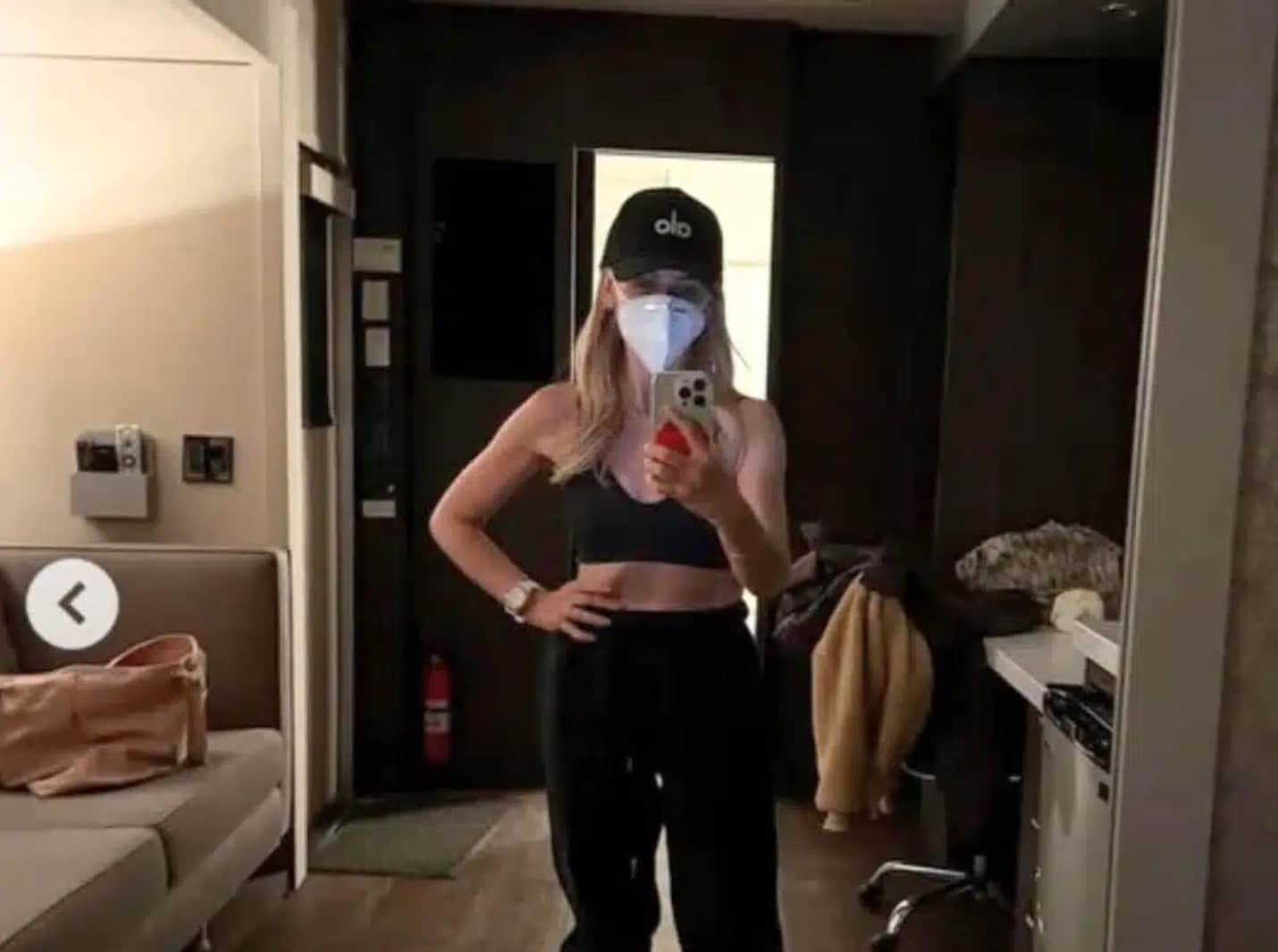
In September 2025, Sarah Michelle Gellar posted behind-the-scenes images from the Buffy reboot. One photo showed her wearing a high-filtration mask.
This took courage.
Mask wearing has become so politicized that even a wealthy celebrity risks serious backlash. In the media industry, mask wearing can be professionally damaging. Formal COVID workplace rules have been rolled back and ongoing infection risk has become a liability issue. The joint Hollywood “Return to Work” COVID safety agreement, negotiated by SAG-AFTRA and other unions, expired on May 11, 2023, aligning with the end of the U.S. federal public health emergency.
As a result, the damage from COVID exposure on sets is currently being litigated. The family of Paul Woodward, a driver who was exposed to COVID while working on American Horror Story, sued for wrongful death. Additionally, actor Blake Lively’s lawsuit against director Justin Baldoni included allegations about on-set COVID exposure affecting her and her infant son. In that context, a high-profile actor wearing a mask on set is a public acknowledgement that COVID risk persists in media, even when the corporations that produce it are failing to protect its employees and resisting liability when harm inevitably occurs.
Nicholas Brendon died amid millions of premature deaths
Perhaps we can find it heartening that someone like Sarah Michelle Gellar is living the values of Buffy the Vampire Slayer, even in this small action of taking care of herself and others and having the courage to visibly refuse to collaborate with mass harm. Maybe the rest of us can take this as an impetus, not to conclude that Nicholas Brendon’s death was sad but unavoidable—as was Michelle Trachtenberg, Shannen Doherty, James Van Der Beek, Julian McMahon and Eric Dane—but instead recognizing that it happened in the context of tens of millions of premature deaths.
If you don’t know where to start with this knowledge, consider following Sarah Michelle Gellar’s lead.
Have the courage and care to wear an N95 mask.
Featured image and additional images via the Canary

While the secret at the centre of Zendaya and Robert Pattinson’s new film The Drama was kept under wraps in the lead-up to the movie’s release, it’s already sparked controversy and backlash from some critics.
The Drama centres around a seemingly happy young couple gearing up for their wedding day, only to wind up questioning everything when an innocent drinking game leads to a revelation that causes them to unravel.
Days before its release, critics began having their say on the film, and true to form, response has been decidedly split right down the middle.
Some more impressed critics have lauded it with five- and four-star reviews, while others have suggested it falls short of expectations laid out by its trailer.
One thing both its fans and detractors and can agree on, though, is that The Drama makes for some seriously “uncomfortable”, “unnerving”, “cringe-out-loud” and, often, “feel-bad” viewing.
Here’s what critics are saying about the film so far…
“The wedding from hell is an enduring rom-com staple and dutifully deployed in everything from The Philadelphia Story to Four Weddings And A Funeral to Bride Wars. Yet a nuptial apocalypse has rarely been explored with such dark intelligence and mordant wit as in this often piercing and cringe-out-loud dramedy starring Robert Pattinson and Zendaya.”
“No other film this year will make you feel as uncomfortable as The Drama. Don’t miss out on it.
“It’s provocative and compulsively watchable – a rom-com that obliterates the very meaning of the word, by thrusting love under the psychoanalyst’s microscope and tearing laughter by force from its viewers’ throats.”

“[The Drama presents] a fascinating conundrum that sets off the fireworks in this darkly funny, yet explosively honest movie that may not be what you expect at all going in, but one that is bound to spark spirited conversation when you are walking out.”
“The drama of The Drama is visible in every uncomfortable stutter, every moment of avoided eye contact, every back turned instead of consolation offered. […] Zendaya and Pattinson both thrive in this environment, relishing the kind of dialogue exchanges you want to watch through your fingers […] As dark as it gets, it is often hilarious in that cruel, keen way that Borgli has proved to be a specialist.”
“The Drama has the spiky, ingenious, tasteless style of [director Kristoffer Borgli’s] previous film Dream Scenario, and both are superior to his unsubtle narcissism comedy Sick Of Myself.
“It offers us a provocation, a jeu d’ésprit of outrage, a psychological meltdown that is more astutely articulated than in many another more solemnly intended film. And it gives us what it promises in the title.”
“[The Drama promises] an edgy, provocative look at how a relationship might weather the intrusion of a distinctly American pathology. In disappointing reality, though, the film is merely a differently dressed rehash of very familiar material.
“It’s a deceptively simple dramedy of cold feet, of pre-wedding jitters, only given the stain of higher-minded, more piercing social inquiry.”

“Robert Pattinson and Zendaya redefine the modern American love story in a rom-com that’s almost as fucked up as America itself […] The Drama is, by design, too unsettled for clarity, let alone social instruction.”
“Borgli is a gifted filmmaker, but in The Drama he never stops jumping around – back in time, and also within scenes, all to hook us into a note of toxic anxiety.
“He succeeds, but the mix of tones is unnerving and, at times, a bit baffling. Are we supposed to be cracking up, or sucking in our breath as the hero’s sanity cracks?”
“The Drama promises bombshell revelations and the wedding from hell, but serves up a cramped, feel-bad, unromantic comedy with characters we don’t care about.”
“[The Drama] actually wants viewers to connect with its two stars. It hopes to humanise them as complex people meant for one another and to demonise those critical of them as self-righteous hypocrites. But what gives this glib, circuitous film the right to persecute the apathetic when it barely understands its own characters?”

Ryan O’Hearn homers and drives in 4 to lift Pirates over Orioles 8-2 for 5th straight win

This Android phone can run Windows games locally, no PC required
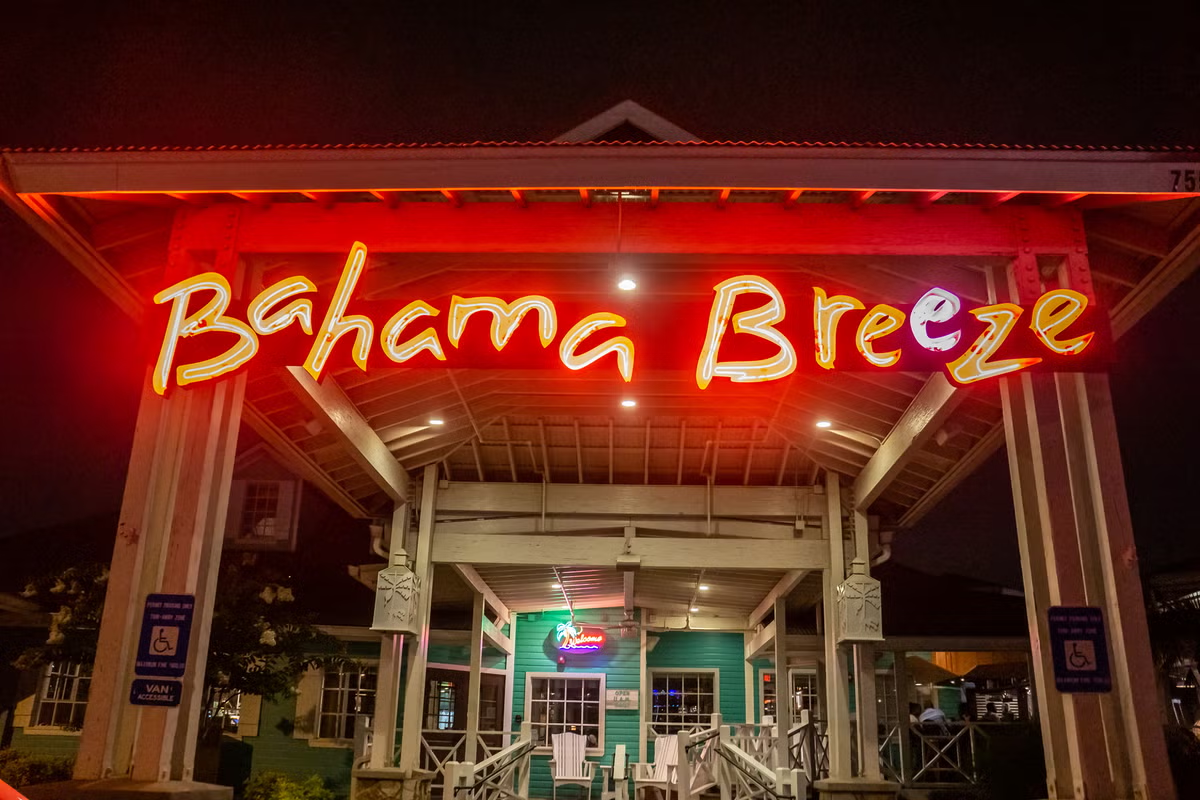
Goodbye, Bahama Breeze: Caribbean-themed restaurant officially closes all locations


-

 NewsBeat3 days ago
Steven Gerrard disagrees with Gary Neville over ‘shock’ Chelsea and Arsenal claim | Football
-

 Business3 days ago
No Jackpot Winner and $194 Million Prize Rolls Over
-

 Fashion2 days ago
Weekend Open Thread: Spanx – Corporette.com
-
Entertainment6 days ago
Fans slam 'heartbreaking' Barbie Dream Fest convention debacle with 'cardboard cutout' experience
-

 Crypto World4 days ago
Gold Price Prediction: Worst Month in 17 Years fo Save Haven Rock
-

 Tech7 days ago
The Pixel 10a doesn’t have a camera bump, and it’s great
-
Crypto World5 days ago
Dems press CFTC, ethics board on prediction-market insider trades
-

 Tech7 days ago
Avatar Legends: The Fighting Game comes out in July and it looks pretty slick
-

 Sports23 hours ago
India men’s 4x400m and mixed 4x100m relay teams register big progress | Other Sports News
-

 Business4 days ago
Login and Checkout Issues Spark Merchant Frustration
-

 Tech6 days ago
Apple will hide your email address from apps and websites, but not cops
-

 Tech5 days ago
EE TV is using AI to help you find something to watch
-

 Sports5 days ago
Tallest college basketball player ever, standing at 7-foot-9, entering transfer portal
-

 Politics6 days ago
Should Trump Be Scared Strait?
-

 Tech6 days ago
Flipsnack and the shift toward motion-first business content with living visuals
-

 Fashion6 days ago
The Best Spring Trends of 2026
-

 Sports6 days ago
Women’s hockey camp eyes fitness boost, tactics ahead of WC 2026 campaign | Other Sports News
-

 Crypto World6 days ago
U.S. rule change may open trillions in 401(k) funds to crypto
-
Tech6 days ago
Daily Deal: StackSkills Premium Annual Pass
-

 Tech5 days ago
How to back up your iPhone & iPad to your Mac before something goes wrong
You must be logged in to post a comment Login