
Crypto World
Odds of a US Invasion of Iran Spike After Trump’s Threat of Escalation

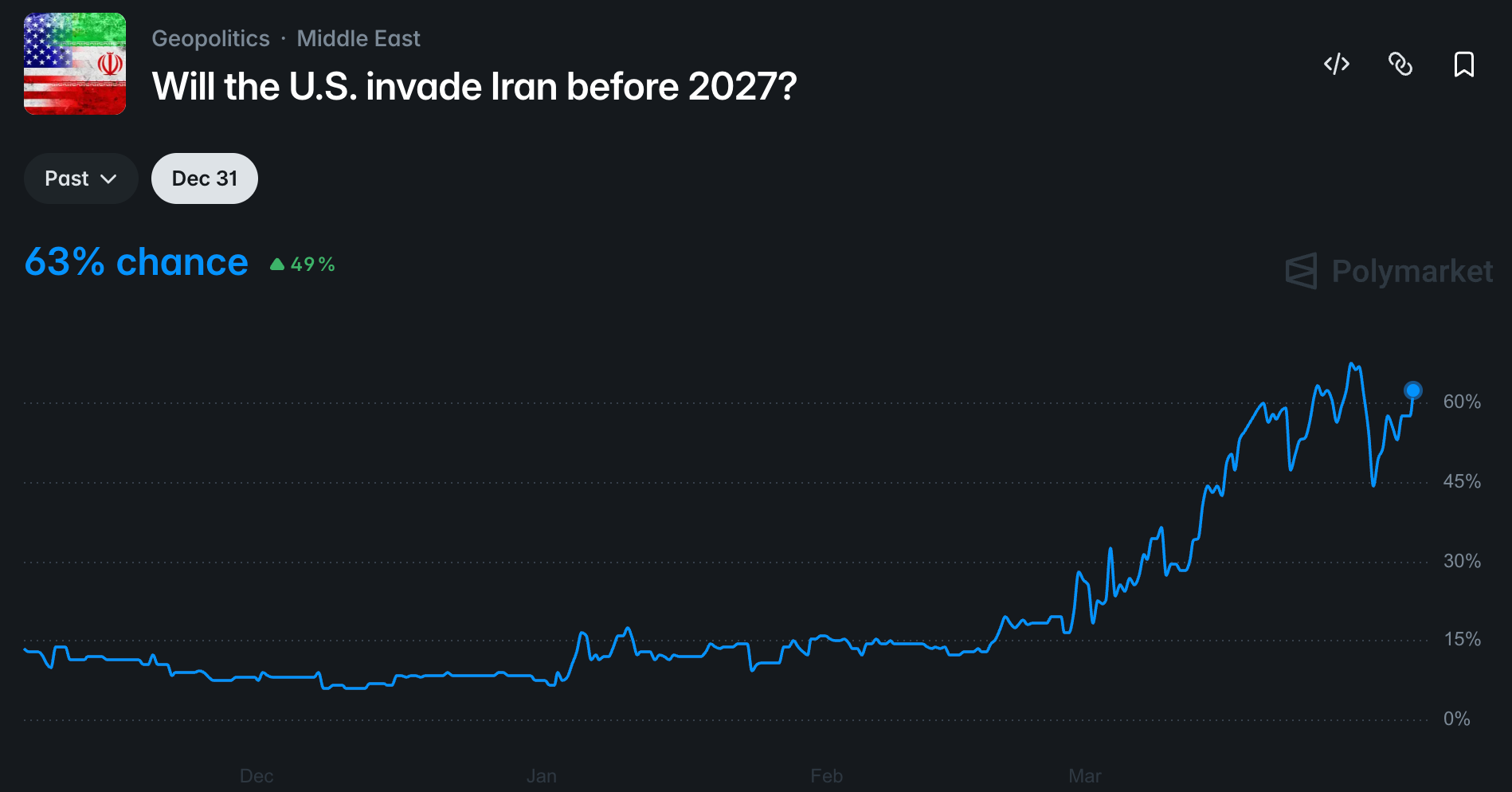
The odds of the United States invading Iran this year surged to 63% on the Polymarket prediction platform on Sunday, following comments made by US President Donald Trump on social media.
Despite the surge, the odds of an invasion before 2027 are still down from the high of 68% on March 29, due to a US troop buildup in the region and comments from the Trump administration that the United States was considering capturing Kharg Island, a major Iranian oil shipping station.
Volume on that prediction was about $3.74 million at the time of publication.

On Tuesday, after Trump signaled that the US might leave Iran in the next two to three weeks, Bitcoin (BTC) jumped by about 2.6% and the S&P 500 index to added about 2.91%. However, Trump reversed course with his latest statement on Sunday. He wrote:
“Tuesday will be power plant day, and bridge day, all wrapped up in one, in Iran. There will be nothing like it! Open the fuckin’ strait, you crazy bastards, or you’ll be living in hell.”
At last look, BTC was little changed, trading up less than 0.1% in the past 24 hours, remaining anchored around the $67,500 level, according to data from TradingView.
The mixed signals from the Trump administration on the war and how long it will last continue to create investor uncertainty and an impact on all risk asset prices, as market analysts, traders and economists attempt to forecast the effects of the war.

Related: Polymarket takes down market on missing US pilot after backlash
Trump’s comments draw a wave of online backlash, but asset prices barely budge
“I wish Trump would stop threatening Iranian civilian infrastructure. It’s a lose-lose for us: backing down hurts his negotiating credibility,” economist Peter Schiff said in response to Trump’s comments.
“Carrying it out escalates the war, damages US standing, generates sympathy for Iran and fuels Iranian hatred for America,” Schiff continued.
“I assumed this was a fake, it isn’t — wild,” podcaster and Bitcoin advocate Peter McCormack said.
Brent crude oil, the most widely used pricing benchmark for the international spot oil market, remains elevated, closing Thursday at more than $109 per barrel. Trading is scheduled to resume on Monday following the Easter holiday weekend.

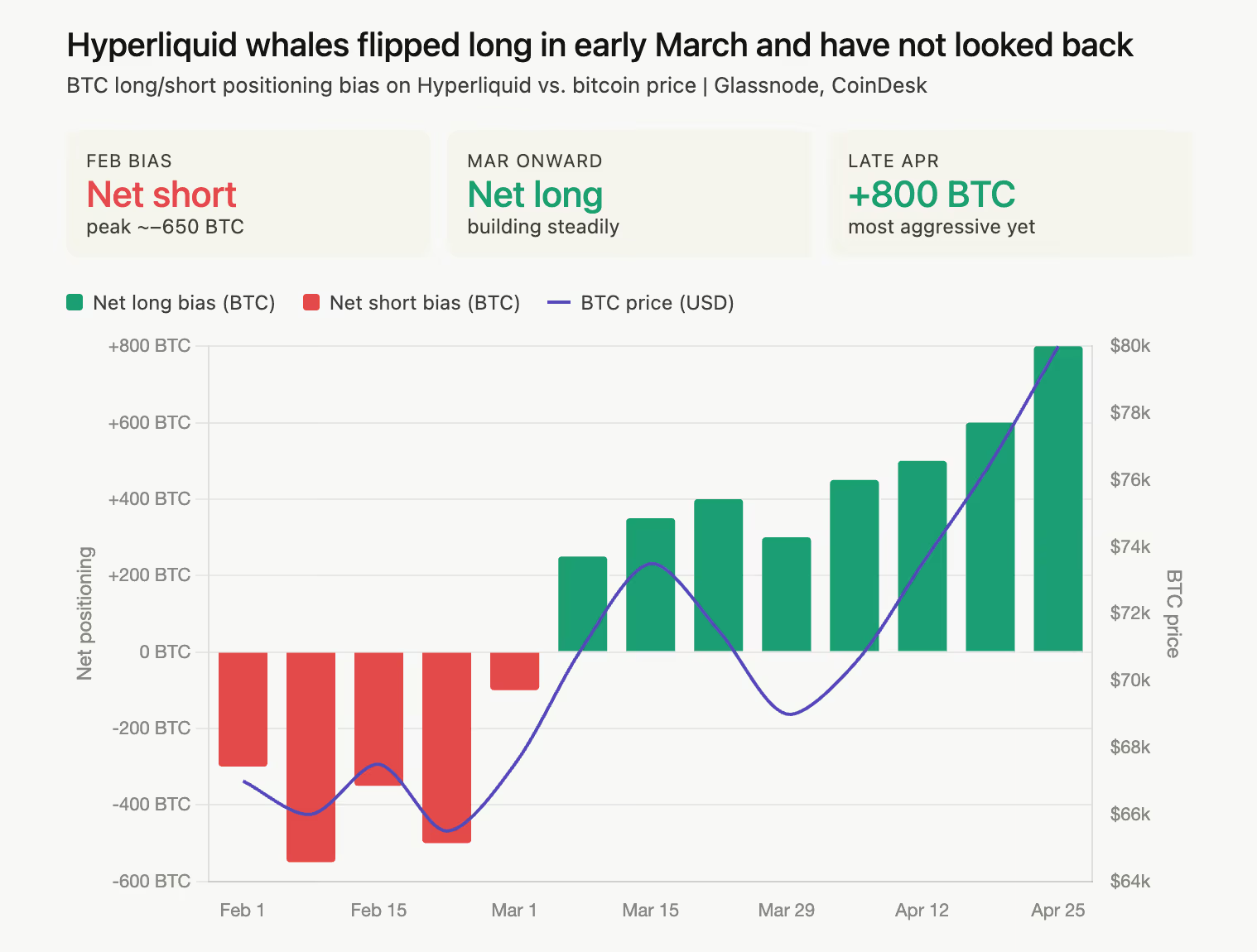
The biggest traders on Hyperliquid have been building a long bitcoin position for two months, and the price chart is starting to break their way.
Glassnode data shows whale positioning on Hyperliquid, the onchain perpetual futures exchange, flipped from net short to net long in early March and has stayed long ever since, with the size of the long bias increasing through April.
The shift coincides with bitcoin grinding higher from the mid-$60,000s in February to a brush near $80,000 earlier this week.
Hyperliquid has, in the past year, become the onchain venue of choice for traders running large positions, and a sustained long bias from that cohort tends to lead spot bitcoin price action by days to weeks rather than follow it.
The flip to net long in early March preceded the recovery from the mid-$60,000s. The positioning is now the most aggressively long it has been across the dataset.

Bitcoin perpetual swap funding across major exchanges sits at -0.13% on a seven-day basis according to Coinglass, meaning shorts are paying longs to keep their positions open.
That negative funding has held for roughly 47 consecutive days, one of the longest stretches of bearish derivatives positioning on record. Sustained negative funding matched with aggressive long positioning from Hyperliquid whales is the technical setup that produces short squeezes when spot prices break higher.
In traditional finance, the S&P 500 closed at a record high on Friday, capping its longest weekly advance since 2024.
In Pakistan, meantime, the weekend’s talks between Iran and the U.S. didn’t take place. President Donald Trump canceled his delegation’s trip to Islamabad after the Iranian foreign minister left the country before the U.S. group even set off.
Treasury yields dropped as the Justice Department closed its probe into Federal Reserve Chair Jerome Powell, potentially clearing the path for Kevin Warsh’s confirmation as the next Fed leader.
Quite where those developments leave the Hyperliquid long positions will become apparent over the coming hours and days.
Crypto World
BTC Exchange Netflow Reveals How the Hormuz Conflict Drained 82,197 BTC From Major Platforms

TLDR:
- Binance, OKX, and Coinbase recorded a combined pre-conflict inflow of 27,741 BTC from Jan 2 to Feb 27.
- The Hormuz conflict triggered a brutal outflow of 82,197 BTC across all three exchanges within just 57 days.
- Binance lost 45,450 BTC in net outflows, representing 55.3% of total exchange drainage during the conflict period.
- Coinbase flipped from inflows to a net outflow of 8,242 BTC, pointing to a clear shift in institutional accumulation behavior.
Bitcoin is trading at $77,502.27 with a 7-day gain of 2.49% amid changing market conditions. On-chain data from Binance, OKX, and Coinbase reveal a sharp reversal in capital flow patterns.
The 57-day period surrounding the Hormuz conflict marks a clear shift from distribution to cold custody accumulation.
This change in BTC exchange netflow data shows how both retail and institutional investors repositioned their holdings.
Distribution Defined the 57 Days Before the Hormuz War
From January 2 to February 27, Bitcoin exchange netflow reflected steady distribution across major platforms. The three exchanges together recorded a combined positive balance of 27,741 BTC.
This data showed that selling pressure was building across both retail and institutional sides of the market. The pre-conflict period set the stage for the dramatic reversal that followed.
Binance led the period with the highest deposit volume, absorbing 13,266 BTC in net inflows. That figure represented 47.8% of the total combined inflow across all three platforms. The trend pointed to concentrated retail activity on the Asian-facing exchange.
OKX followed with net deposits of 6,778 BTC, capturing 24.4% of the aggregate flow. At the same time, Coinbase posted inflows of 7,697 BTC, or 27.8% of the total. These numbers showed a broad distribution posture across both Asian and American markets.
On-chain analyst GugaOnChain described the pre-conflict period as “pure distribution” in a recent market post. The analyst noted that global retail dominated deposits across all three exchanges during this window.
The combined positive balance confirmed that exchange liquidity was building steadily before the geopolitical shock. Retail-heavy flows across all platforms reinforced this reading.
A Violent Supply Shock Followed as the Conflict Began
Once the Hormuz conflict started on February 28, exchange flows reversed course sharply. Over the next 57 days, the three platforms recorded a combined outflow of 82,197 BTC.
This marked a complete regime change from the distribution phase that preceded it. Despite short-term panic, the macro balance reflected a broad flight to cold custody.
Binance lost 45,450 BTC during this period, representing 55.3% of the total outflow. OKX followed with a net drainage of 28,506 BTC, making up 34.7% of the aggregate figure. Together, both exchanges accounted for the bulk of capital leaving centralized platforms.
Coinbase reversed its earlier inflow trend and recorded a net outflow of 8,242 BTC. This represented 10% of the total drainage across all three exchanges during the conflict period. The reversal showed American participants shifting assets away from exchanges and into cold storage.
GugaOnChain’s April 25 update confirmed the trend remained in place. Binance posted a minor retail return, registering a net inflow of 158 BTC, while OKX added 122 BTC.
Coinbase, however, held its outflow posture at -277 BTC for the day. The data reinforced that institutional accumulation continued even as retail flows stabilized.

Crypto World
Freezing dormant BTC would trigger worst single day repricing in bitcoin’s history, says maximalist
Freezing dormant bitcoin would trigger an immediate repricing and mark one of the world’s oldest cryptocurrency’s worst trading days since its 2009 launch, advocates told CoinDesk.
Bitcoin developers and crypto industry participants have debated for weeks whether they should freeze dormant tokens to protect them against the risk of theft through quantum computing, whenever those machines begin going online.
“Freezing any coins, even ‘lost’ ones, tells the market that all (roughly) 19.8 million BTC currently in circulation are conditionally owned,” said Samuel “Chad” Patt, who is also the founder of Op Net. “Institutional risk desks do not care about the reason, they care about the precedent.”
Read more: A simple explainer on what quantum computing actually is, and why it is terrifying for bitcoin
Although Jason Fernandes, a market analyst who describes himself as a pragmatic maximalist, said he agrees with Patt’s repricing thesis, he said he believes that a successful quantum attack would trigger a far more severe repricing.
“Institutions won’t just price precedent, they’ll price whether the system can survive a break in its core assumptions,” added Fernandes, also the co-founder at AdLunam.
Mati Greenspan, also a self-described maximalist and a market analyst, said that if “quantum computers ever crack early Bitcoin wallets, it won’t trigger a rollback or a freeze; it will trigger the largest bug bounty in human history.”
The debate follows weeks of discussion over how to respond to the potential threat quantum computing poses to the bitcoin network, particularly the estimated 5.6 million BTC. These tokens are held in wallets that have been dormant for more than a decade, in addresses that have not been upgraded and, therefore, are the most vulnerable in the event that quantum computing attacks become a reality.
A week ago, Jameson Lopp, a core Bitcoin developer and research analyst, told CoinDesk he would prefer to see the dormant bitcoin, worth roughly $440 billion, frozen by the network than left at risk of being stolen by future quantum hackers. He said he already sees those bitcoin as being lost.
Lopp and a team of other core bitcoin developers released Bitcoin Improvement Proposal 361 (BIP-361) earlier this month. The proposal contemplates phasing out bitcoin’s current cryptographic signatures, potentially freezing assets that fail to migrate.
‘Instant’ repricing
If that were to proceed, Patt said, “bitcoin’s repricing would be instant, not gradual and would be the worst single day in bitcoin’s history, but not because of a hack, but because the network will have proven its core value proposition is negotiable.”
The bitcoin maximalist said all fund managers, “who allocated on the censorship-resistance thesis, would be forced to unwind. Not by choice, but by mandate, because the asset no longer fits the risk profile it was purchased under.”
Read more: To freeze or not to freeze: Satoshi and the $440 billion in bitcoin threatened by quantum computing
Another bitcoin maximalist, Kent Halliburton, CEO and co-founder at SazMining, said he believes the intentions behind BIP-361 are good.
“However, you don’t defend Bitcoin by breaking its core promise of inviolable property rights,” he said. “We operate data centers on four continents, and our clients own every machine. That model only works because Bitcoin guarantees unconditional ownership.”
Halliburton said he believes, as many others do, that the quantum computing threat is real, but that there are better ways to deal with the risks it poses, such as better tooling and voluntary migration, “but not a protocol-level confiscation dressed up as a contingency plan.”
Deeply flawed
Khushboo Khullar, venture partner at Lightning Ventures and a bitcoin maximalist as well, said freezing dormant coins is a deeply flawed approach, despite appearing to be a pragmatic approach against quantum threats.
“It directly undermines Bitcoin’s core principles of immutability, permissionlessness, and no central enforcement. Such a move would require a contentious hard fork, violating the network’s decentralized ethos where no one can unilaterally seize or freeze anyone’s coins,” she said.
However, not all maximalists agree with Patt, Halliburton or Khullar, and instead believe Lopp’s proposal is sensible.
“It’s extremely challenging to build systems that are truly future-proof, and while Bitcoin has come quite close, quantum may pose a threat that requires tradeoffs participants won’t be happy with.” said Ken Kruger, founder and CEO of Moon Technologies.
“So far there’s no solution that doesn’t include compromise: freeze funds or let them be stolen? If solved elegantly, this could be a critical moment Bitcoin proves its resilience as a global monetary system,” he said.
Bitcoin could still evolve
Fernandes said he understands Patt’s and other maximalists’ points on precedent, adding that it is a real concern among the bitcoin community when discussing the network’s censorship-resistance ethos. In fact, he added, “I don’t think there is time; I think quantum will be upon us way faster than anybody thinks.”
“However, framing this as a question of purity misses the bigger issue: quantum risk is an existential threat to the system, not a philosophical debate,” Fernandes said. He believes bitcoin could evolve as it has in the past with SegWit and Taproot, upgrades designed to improve the network’s efficiency, privacy and scalability.
“The protocol isn’t ‘finished,’ it’s just conservative in how it changes,” he said. “But the risk of inaction far outweighs any concern about precedent or philosophical purity.”
Ultimately, Fernandes believes very few people within the community care in the long run, and that the majority of bitcoin holders, whether maximalists or not, are “more interested in preserving capital rather than preserving some vague notion about what bitcoin is ‘supposed to be.’”
Greenspan echoes what many of the maximalists ultimately prefer. “As with many cases in life, and especially with bitcoin, doing nothing is better than doing something.”
He concluded: “The Bitcoin community seems to feel strongly that freezing coins would be antithetical to bitcoin’s quintessential value proposition.”
Read more: How a quantum computer can be used to actually steal your bitcoin in ‘9 minutes’


More than one in three US crypto traders have cut everyday spending due to current market conditions, according to a new CEX.IO survey.
Summary
- CEX.IO found 36% of US crypto traders reduced daily spending due to current market conditions.
- About 37% delayed or cancelled purchases, including homes, cars, and renovation plans amid crypto losses.
- Despite the downturn, 79% of respondents plan to hold or increase crypto positions.
The exchange surveyed 1,100 active US-based users. The survey found that 36% of respondents reduced daily expenses because of the crypto downturn. Another 10% said those cuts involved major sacrifices to keep their crypto positions.
CEX.IO said 37% of respondents delayed or cancelled purchases due to crypto-related losses. The group included 21% who postponed major financial plans, such as buying a home, purchasing a car, or starting renovations.
Bitcoin remains about 40% below its October 2025 high. The decline has left many retail traders holding unrealized losses, even though the current downturn remains less severe than the 2022 bear market.
“The 2025–2026 bear market has not produced the kind of systemic shock seen in past cycles,” CEX.IO wrote.
The exchange added that the pressure now appears in quieter ways at the household level.
Many traders keep losses private
The survey also showed that many crypto traders are managing losses alone. Only 5% said someone else knows the full value and size of their crypto holdings.
Most respondents either share limited details or keep their positions private. This shows that crypto losses may affect household budgets without wider family or social awareness.
Cash flow pressure has also increased for some traders. While 77% said they did not take on debt linked to crypto, 38% reported some financial disruption since October 2025.
Investors still plan to hold crypto
Despite the pressure, most traders have not changed their long-term crypto plans. CEX.IO found that 73% said their income strategy remains unchanged.
Nearly half of the respondents said crypto accounts for more than 30% of their investable assets. Looking ahead, 79% said they plan to hold or increase their crypto positions over the next six months.
A separate Börse Stuttgart Digital survey also showed growing interest in crypto services among European investors. About 35% said they would consider switching banks for better crypto offerings.
The poll covered around 6,000 investors in Germany, Italy, Spain, and France. Nearly one in five said they expect their main bank to offer crypto access within three years.
Crypto World
XRP NEWS: GraniteShares Just Delayed Its 3x XRP ETF for the Fifth Time: Is the SEC Blocking Leveraged Crypto Products?

GraniteShares has pushed its 3x Long and 3x Short XRP ETF launch to May 7, the fifth delay in three weeks, and this is bearish news for XRP.
XRP is feeling the regulatory overhang, with traders watching closely to see whether institutional-grade leverage products ever actually arrive. The delay isn’t just an XRP story. It’s a signal about where the SEC stands on leveraged crypto exposure in 2026.
The effective launch date has shifted from April 2 → April 9 → April 16 → April 23 → now May 7.
The filing was submitted under SEC Rule 485, a mechanism that allows issuers to move effective dates without restarting the full registration process.
JUST IN: GraniteShares 3x leveraged $XRP ETFs delayed until May 07, 2026. pic.twitter.com/3NB41CqrA3
— RippleXity (@RippleXity) April 23, 2026
Critically, all eight leveraged funds in the same filing, 3x Long and 3x Short versions for Bitcoin, Ethereum, Solana, and XRP, were moved simultaneously. Whatever the SEC is working through, it targets the 3x structure itself, not XRP specifically.
Can XRP Price Hold Support as ETF Delays Pile Up?
XRP is sitting at $1.428 on the daily chart, and the most interesting thing happening right now is that the 9 and 21 MA are crossing bullish for the first time since the August peak, with price sitting just above both moving averages after months of trading below them.
Every previous MA cross on this chart played out exactly as expected; the blue dots mark each crossover, and they all led to meaningful moves in the direction of the cross, which makes the current setup worth paying attention to.
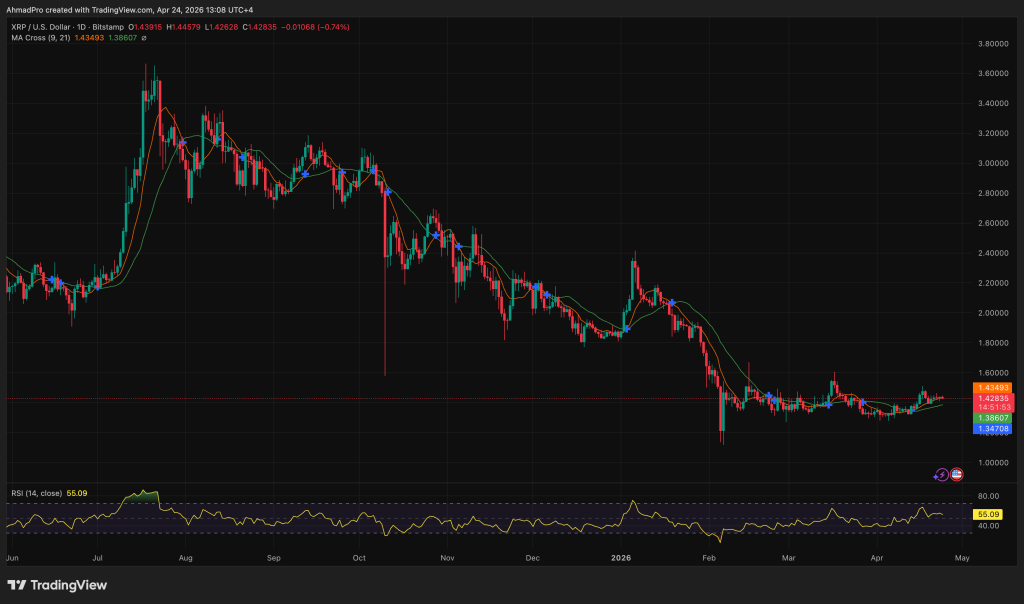
The problem is the broader structure. XRP has been in a downtrend since August, printing lower highs the entire way from $3.40 down to the February low near $1.07, and the current recovery is still well below every significant prior level.
The $1.50 zone is the immediate ceiling that has been capping price for weeks, and above that the $1.90 to $2.00 area is where real resistance starts stacking up from the previous distribution zone.
If the MA cross holds and price can clear $1.50 with conviction, the setup starts to look like a genuine trend reversal attempt rather than just another dead cat bounce in a longer downtrend.
But until $1.50 flips and the MAs stay bullishly crossed, this is still a recovery inside a downtrend, and the burden of proof sits with the bulls.
When XRP News Get Boring, Capital Rotates to New Shiny Things Like Maxi Doge
XRP’s ETF delay pushes the timeline out again, and that matters because a lot of capital was positioned for a quick catalyst.
When that kind of trade disappears, it does not sit idle, it rotates, usually into higher-risk setups with faster potential upside.
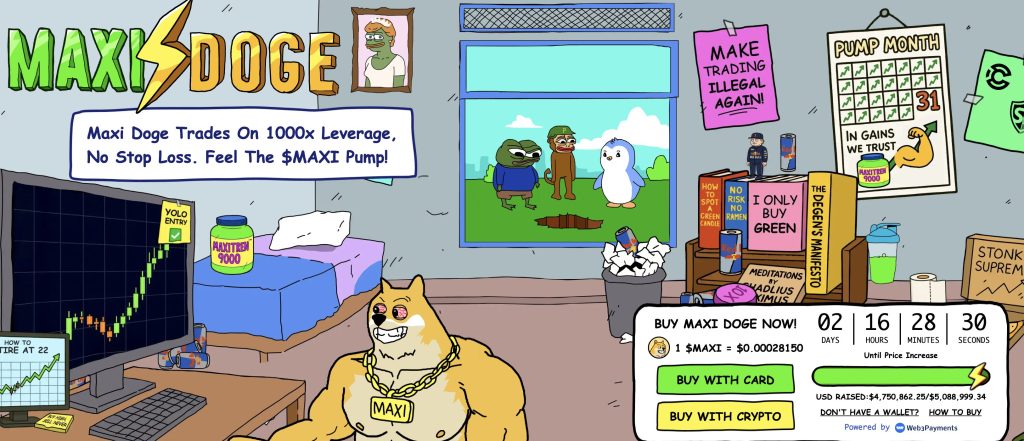
Maxi Doge is leaning directly into that rotation. It is built around the high-leverage trader mindset, targeting the same crowd that chases fast-moving narratives and short-term catalysts. The presale sits around $0.0002815 with roughly $4.75M raised, showing steady inflows rather than a one-time spike.
The setup is designed to keep momentum alive, with staking, trading competitions, and a treasury aimed at fueling liquidity and partnerships. The branding is aggressive and intentional, built to spread quickly in the same circles that react to ETF headlines.
At this stage, the appeal is simple, it is early, it is narrative-driven, and it sits right where capital tends to rotate when larger catalysts get delayed.
The post XRP NEWS: GraniteShares Just Delayed Its 3x XRP ETF for the Fifth Time: Is the SEC Blocking Leveraged Crypto Products? appeared first on Cryptonews.


The Green Beret arrested for betting on a classified U.S. raid looked like a one-off scandal for prediction markets. A new study suggests he may be a more troubling data point: an extreme example of the small group of informed traders who, as the soldier is accused of doing, actually move prices on Polymarket, while the crowd loses money around them.
The study, part of a working paper released this week by Roberto Gómez-Cram, Yunhan Guo, Theis Ingerslev Jensen and Howard Kung of London Business School and Yale, directly tests the industry’s core claim that the markets work owing to the massed knowledge of their participants.
Using every Polymarket trade from 2023 to 2025, the authors conclude that it’s actually a small group of informed traders that moves prices. The researchers analyzed 1.72 million accounts and $13.76 billion in trading volume, and found that just 3% of traders account for most price discovery, meaning they are the ones moving prices toward the correct outcome.
These traders consistently predict outcomes and move prices in the right direction. The remaining 97% mostly do not. They provide liquidity and generate volume, but in aggregate, they are on the losing side of trades against the informed minority, whose profits come directly from those positions.
The hard part is telling skill apart from luck. With more than a million traders on Polymarket, plenty will rack up big winnings by chance alone.
To filter that out, the authors reran each trader’s bets 10,000 times, keeping everything the same except the direction.
Same markets, same moments, same dollar amounts — but a coin flip decided whether to buy or sell. That gave them a benchmark for what each trader’s profits would look like with no real edge. If the actual results consistently beat the coin flip, that’s skill. If not, it’s luck.
The findings show among the biggest winners by raw profit, only 12% beat the benchmark, and many apparent winners didn’t stay that way: Roughly 60% of “lucky winners” become losers when their performance is checked against a separate sample of events.
Their activity improves market accuracy. When skilled participants account for a larger share of trading, prices move closer to the correct outcome, especially in the final stretch before resolution. They are also the first to react when new information hits, shifting positions in response to events like Federal Reserve announcements or corporate earnings, while other traders show little consistent reaction.
The same edge that makes skilled traders valuable to price discovery raises a harder question when that information isn’t public, or isn’t supposed to be.
Both Polymarket and Kalshi have said that trading on non-public information is strictly against their rules.
The paper grounds that risk in a concrete case: The U.S. removal of Nicolás Maduro from power in Venezuela in January. In the days and hours before the operation, three newly created Polymarket accounts piled into a contract asking whether Maduro would be removed. At the time, the market priced the odds at roughly 10%.
The new accounts placed unusually large bets, including orders of tens of thousands of shares, before the price moved. When the raid happened, the accounts collectively made more than $630,000. Two stopped trading entirely soon after, and the third went mostly dormant. There is no evidence of any wrongdoing on these accounts.
Insider trades, when they occur, move prices even more aggressively per dollar, about seven-to-12 times more than typical skilled trades. But they are rare and concentrated in a handful of events, not the day-to-day engine of price discovery. Most of the time, the market’s accuracy still depends on repeat traders who consistently outperform rather than on one-off bets.
The findings challenge the idea that prediction markets work because of crowds. They appear to work because of who is informed.

The latest data from a CEX.IO survey paints a nuanced picture of how a protracted crypto downturn is affecting ordinary households, even as the market has not collapsed the way it did in past cycles. The poll, conducted among 1,100 US-based active CEX.IO users, notes that Bitcoin remains roughly 40% below its October 2025 high, leaving many retail investors sitting on unrealized losses.
While the downturn has not sparked a systemic shock, it is reshaping everyday finances in subtler ways. About 36% of respondents said they cut back on routine spending to protect their crypto positions, with 10% describing those cuts as significant sacrifices. Additionally, 37% delayed or canceled purchases due to crypto losses, and 21% postponed major financial commitments such as buying a home, a car, or undertaking renovations. CEX.IO notes that the bear market of 2025–2026 has not produced systemic shock, but its effects are filtering through households in quieter, imperfect ways.
Key takeaways
- 36% cut everyday spending to sustain crypto positions; 10% describe those cuts as significant sacrifices.
- 37% delayed purchases; 21% postponed major commitments such as housing, a car, or renovations.
- 77% did not take on crypto-related debt; 38% reported some form of financial disruption since October 2025.
- 25% leaned on savings to maintain stability; 12% admitted to missing or delaying payments.
- Nearly half of respondents say crypto accounts for more than 30% of their investable assets; 79% expect to hold or increase positions over the next six months.
Bear market’s quiet toll on households
The survey depicts a bear market that, while not unleashing a crisis, is prompting prudent, risk-aware choices at the household level. The data illustrate a shift from aggressive participation to tighter budgeting as investors navigate unrealized losses. The fact that only a minority took on new crypto debt suggests that many are prioritizing liquidity and cash flow over deeper leverage as prices wander in a broad sideways trend.
Personal finances in flux
Beyond day-to-day budgeting, the figures reveal a layered picture of financial resilience and vulnerability. Although a large majority (77%) reported no crypto-backed debt, 38% still experienced some disruption in their finances since October 2025. A quarter leaned on savings to stay afloat, and 12% acknowledged missing or delaying payments. Taken together, the data underscore how price volatility translates into tangible financial trade-offs for participants who remain active in the market.
Asset allocation and forward outlook
Despite the strain, many traders maintain a stubbornly constructive stance toward crypto as an asset class. Nearly half of respondents indicated that digital assets make up more than 30% of their investable assets. Yet the broader sentiment about income generation remains steady: 73% said their approach to earning income has not changed, and a substantial 79% plan to hold or increase their positions over the next six months. The persistence of this allocation pattern signals a continued belief in crypto’s role within diversified portfolios, even as households manage tighter budgets in the near term.
Crypto offerings shaping banking decisions
Separately, a Börse Stuttgart Digital survey released this week points to growing consumer expectations for traditional banks to provide crypto services. Across Germany, Italy, Spain and France, about 35% of investors would consider switching banks for better crypto offerings, and roughly one in five expects their primary bank to offer crypto access within three years. The rising demand for crypto-enabled banking signals a gradual convergence between traditional finance and digital assets, with banks potentially taking a more active role in on-ramps, custody, and trading. Cointelegraph covered the Börse Stuttgart Digital findings.
Overall, the dual narratives—from US retail traders’ household-level recalibrations to Europe’s evolving banking relationships with crypto—underscore a broader shift: digital assets are moving from niche investment behavior into a more mainstream, asset-management-oriented framework. While the risk profile remains elevated for many participants, the data suggest a patient, long-term posture persists among a sizable share of users.
As markets continue to evolve, observers should watch for shifts in consumer debt, savings rates, and the speed at which banks expand crypto services. The coming months could reveal whether the current household dynamics translate into broader adoption or lead to a recalibration of crypto’s role in personal finance.

Disclosure: This article does not represent investment advice. The content and materials featured on this page are for educational purposes only.
Mobile cloud mining grows in 2026 as users seek easier Bitcoin mining access through Android and iOS apps.
Summary
- BM Blockchain offers a beginner-friendly mobile platform for Bitcoin cloud mining without owning hardware.
- Focused on digital infrastructure, BM Blockchain provides guided onboarding and simple access to computing resources.
- BM Blockchain includes welcome allocations for new users, making cloud mining easier to explore in 2026.
The mobile cloud mining market is still growing, as more people want to try Bitcoin mining without buying hardware or setting up their own rigs. On Android and iOS, “free” cloud mining in 2026 usually means one of three things: the app itself is free to use, a few free activation periods, or there are beginner promos that make it easier to get started.
Instead of sticking to one standard approach, this space now covers everything from infrastructure providers to cloud mining services, mining marketplaces, and mining options tied to exchanges. For those who are new to it, a good place to start is usually a platform that’s easy to use, explains how access works in plain terms, and lets you manage your account from your phone.
Top free cloud mining platforms (2026 comparison)
| Platform | Best For | Mobile Access | Free / Intro Access Model |
| BM Blockchain | Beginner-friendly exploration of platform-based mining access | Mobile-friendly platform access | Industry materials reference onboarding-related allocations valued at up to $108 Daily stable income |
| ECOS | Long-term contract-based cloud mining access | Android / iOS app | Free app access, with cloud mining contracts and hosted services managed in-app |
| StormGain | App-based cloud mining activation | Android app | Free Bitcoin mining cycles inside the app |
| Bitdeer | Infrastructure-backed cloud mining services | Android app | Free app access with cloud mining and mining-management tools |
| NiceHash | Mining management and marketplace monitoring | Android / iOS app | Free app access for wallet, rig, and marketplace management |
| Binance Pool | Exchange-linked mining ecosystem | Mobile ecosystem support | Free access to pool and mining-related services within the Binance ecosystem |
The comparison above is based on current public platform descriptions, app store listings, and publicly referenced industry materials.
1. BM Blockchain — Best for users looking for a low-barrier starting point
BM Blockchain can be described as a beginner-friendly choice for people who want to try Bitcoin cloud mining using a mobile-friendly platform that’s more focused on infrastructure. Public information about the company says it centers on taking part in digital infrastructure, getting access to computing resources, and offering a guided onboarding process.
Those same sources also mention welcome allocations for new users, valued at up to $108, which are presented as participation incentives rather than promised financial results. If someone wants an easier way to get started, BM Blockchain might be attractive to people who prefer using a platform instead of owning mining hardware themselves.
The focus isn’t really on building and maintaining mining machines, but on trying out infrastructure tools and different ways to participate through a simple, accessible interface.

2. ECOS — Best for users exploring structured cloud mining access
ECOS often shows up in 2026 cloud mining roundups because its public app info and platform pages focus on contract-based access to Bitcoin mining, hosted infrastructure, and centralized management features. Its Android and iOS listings describe a cloud mining setup where users can handle contracts, infrastructure services, and related tools all in one place.
So ECOS can work as a good reference point for people who want something more organized, not just an app you tap once a day. It’s easier to think of it as a platform for managing mining services than as a one-click, bonus-focused product.
3. StormGain — Best for free in-app mining cycles
StormGain is still one of the more well-known names among “free mining apps” because its public info specifically talks about free Bitcoin mining cycles inside the app. The app description says that anyone can start mining with one tap, and that they earn Bitcoin daily based on how they use the app and the platform’s rules.
That’s why StormGain tends to stand out for people looking for an easy way to get started on mobile. Still, it’s worth reading the platform terms closely, since mining rewards in an app may not work the same way as a traditional cloud mining contract.
4. Bitdeer — Best for infrastructure-backed cloud mining access
Bitdeer is often mentioned as a company with a wider set of mining services, such as cloud mining, mining hardware, infrastructure management, and some mobile tools. In the description for its public Android app, it describes itself as a provider that covers the full range of Bitcoin mining services.
For people who’d rather use something that feels tied to real mining infrastructure instead of just an app with a gamified layer, Bitdeer is still one of the more recognizable names in this space.
5. NiceHash — Best for mining marketplace and management tools
NiceHash isn’t really a typical “free cloud mining app.” It’s more like a marketplace for mining power, along with a set of tools to manage everything around it. The official mobile app lets users handle their wallet, account settings, and mining rigs while they’re away from their computer, which makes it a better fit for people who want clear visibility and hands-on control instead of a simple, bonus-style setup.
Since NiceHash runs as a hashpower marketplace, it’s particularly helpful for anyone who wants to keep an eye on mining performance and make practical decisions about their mining setup from a phone.
6. Binance Pool — Best for exchange-integrated mining services
Binance Pool stands out mainly because it ties mining services into a broader exchange ecosystem. In Binance’s public materials, they highlight things like seeing their hash rate in real time, having a few different payout options, and being able to access mining-related services from within the wider Binance platform.
This mix makes Binance Pool a good fit for people who already use Binance and want some mining exposure while also using the platform for trading and managing their assets.
How to choose the right free Bitcoin cloud mining app in 2026
For most people, the real question isn’t just which platform claims to be “free,” but what “free” actually means in day-to-day use. In reality, one platform might lure you in with a sign-up bonus, another might give users a few free activation rounds, and another might let them use the app for free while the actual mining service still requires a contract.
A practical evaluation should look at four things:
- what “free” means on the platform
- how clearly the access model is explained
- whether mobile tools are actually useful for management and monitoring
- whether fees, rewards, and participation conditions are disclosed in a way that matches the user’s experience level and risk tolerance
Conclusion
Bitcoin cloud mining apps in 2026 aren’t really built around just one kind of product anymore. The market now covers a range of options, like services that focus on infrastructure, apps where users activate mining through the platform, mining marketplaces, and platforms tied closely to exchanges.
For Android and iOS users, it usually makes sense to start with whatever fits the way a user wants to get in — whether they’re looking for beginner perks, standard cloud mining contracts, tools to manage things from their phone, or something that plugs into a bigger ecosystem. Some platforms also use onboarding offers to make it easier for new users to start.One example people mention publicly is the $108 welcome allocation linked to BM Blockchain.
As usual, users should compare the terms, be clear on what each platform means when it says “free,” and read the platform rules and conditions carefully before getting involved.
Frequently Asked Questions
What do people usually mean by “free Bitcoin cloud mining” in 2026?
Most of the time, “free” means users can use the app for free, activate a short free cycle, try mining for a limited time, or get a sign-up bonus. It usually doesn’t mean they get unlimited mining power forever at no cost. It’s worth checking whether the “free”part is just for creating an account, a one-time bonus, or a short trial.
Can someone actually earn Bitcoin on Android and iOS without buying mining hardware?
Some services allow users to use their phone, letting them try cloud mining without owning any physical machines. That said, they can be very different depending on the platform. Sometimes it’s just a starter cycle or access to tools and infrastructure, not the user personally running dedicated mining hardware.
Are free cloud mining apps safe to use?
It depends on the app. People usually look for clear contract terms, easy-to-understand payout rules, public info about the company or its infrastructure, and withdrawal rules that make sense. Common red flags are “guaranteed”returns that sound too good, no real company details, or fees that aren’texplained clearly.
Can cloud mining give daily Bitcoin payouts?
Some platforms show daily projections, use daily reward systems, or pay out on a recurring schedule, but what users actually receive can depend on the platform’s rules, fees, the market, and what kind of mining setup they’re using. Daily numbers are better seen as estimates, not something automatically guaranteed.
How should beginners pick a cloud mining platform?
For those who are new, the basics usually matter most: whether it’s easy to use, whether the plans are explained clearly, whether it works smoothly on mobile, and how transparent it is about rewards, fees, and withdrawals. A platform often feels more beginner-friendly when the interface is simple, and it clearly explains what users are turning on and what they’re getting.
Why do some platforms offer sign-up incentives like a $108 welcome allocation?
These offers are usually meant to make it easier to start and to let new users try the platform’s tools or beginner-level features. They’re typically framed as a way to participate or explore, rather than a promise of guaranteed profit.
What’s the safest way to start with a free cloud mining app?
A careful way to begin is to stick to free or limited features first, read the rules, try a withdrawal if it can proceed, and make sure users understand how it works before putting in more time or money. People often suggest this step-by-step approach for beginners testing cloud-mining services.
Disclosure: This content is provided by a third party. Neither crypto.news nor the author of this article endorses any product mentioned on this page. Users should conduct their own research before taking any action related to the company.
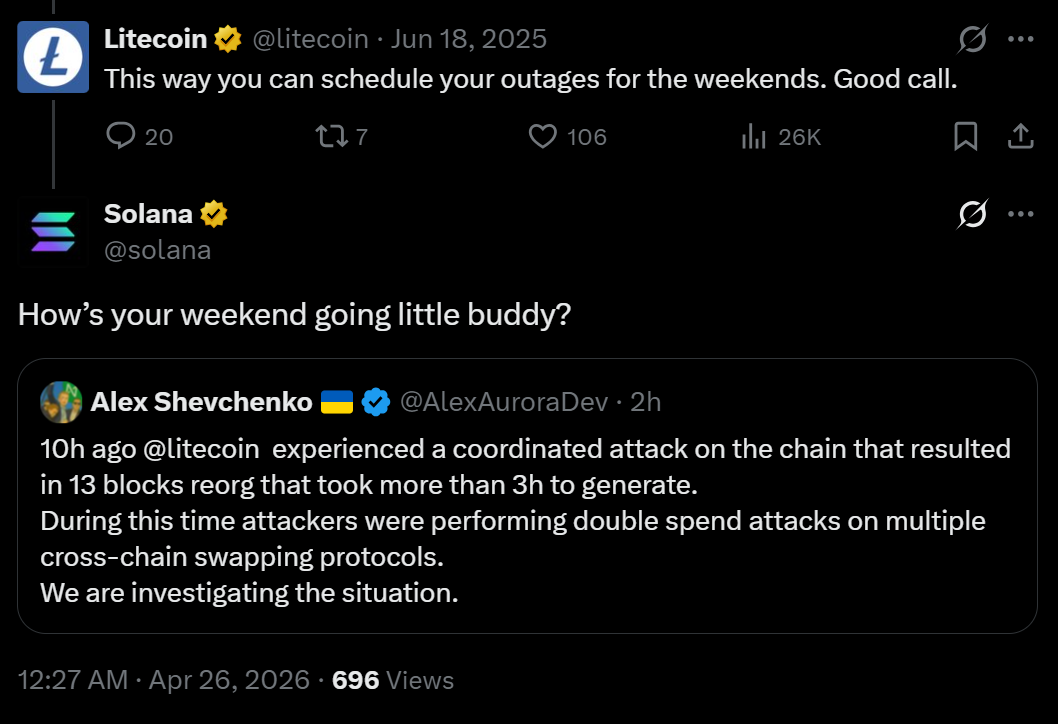
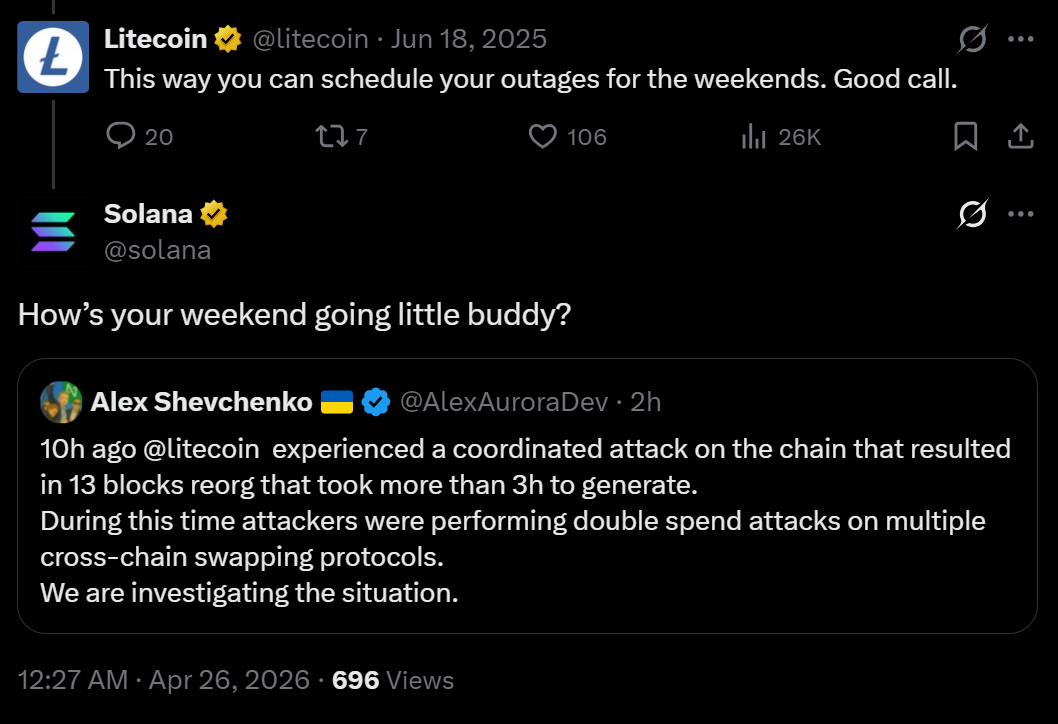
Litecoin’s emergency 13-block reorganization to reverse a zero-day attack has reignited debate about whether transaction finality can be trusted and whether the network is truly secure.
The incident reveals an uncomfortable truth: blockchain immutability is conditional, not absolute.
Transaction Finality Is Not Guaranteed
For years, crypto advocates have marketed blockchains as immutable ledgers where transactions cannot be reversed. Yet the Litecoin network just demonstrated that a coordinated attack, combined with unpatched nodes, can force it to rewrite its history.
While developers justified the reorg because the blocks contained invalid transactions, the question remains unsettling: how many confirmations make a transaction feel secure if a single bug can erase 13 blocks?
Unpatched Litecoin Nodes Created the Vulnerability
The zero-day attack succeeded because many Litecoin nodes ran outdated software that improperly validated MWEB transactions. This created a two-tier network in which different participants operated under distinct consensus rules.
Bitcoin and Litecoin have no mandatory update mechanism. Nodes can run old software indefinitely. While philosophically important, this freedom created the exact vulnerability exploited in the attack.
Miners and exchanges running unpatched software became unintended participants in enabling the exploit.
The zero-day specifically targeted MWEB, Litecoin’s privacy feature. Privacy adds complexity, and complexity creates attack surfaces. MWEB is still young, and this exploit suggests it needs further hardening before users should trust large-value transfers.
Finality Problem for Investors
Litecoin’s smaller hash rate and lower security budget make it more vulnerable to both bugs and future attacks. A 13-block reorg represents roughly 2.5 hours of history. On Bitcoin, reversing such a depth would cost billions and require controlling 51% of the network.
Users should consider how many confirmations they feel safe with, given this reality. Six confirmations may not be sufficient if a buggy client release can trigger a 13-block reorg.
Can Litecoin restore trust?
Technically, Litecoin developers have fixed the issue. But the incident exposes how dependent decentralized networks are on coordinated node updates and careful operator behavior. The network recovered, but it did not emerge unscathed.
For casual transactions, Litecoin likely remains safe. For long-term wealth storage, the incident raises legitimate questions about finality and whether transaction history can be rewritten at scale.
The post Litecoin Chain Rollback Raises Security Questions appeared first on BeInCrypto.


Peter Schiff has warned that Strategy, formerly known as MicroStrategy, could face pressure from its latest funding approach.
Summary
- Peter Schiff warned that Strategy’s preferred shares could increase pressure on its Bitcoin treasury plan.
- Schiff said the 11.5% yield may force Strategy to raise capital or sell Bitcoin.
- Strategy supporters argue Bitcoin gains can cover costs, but Schiff says new issuance changes the math.
The gold advocate and long-time Bitcoin critic focused on the company’s use of high-yield preferred shares. Schiff said the preferred shares carry an 11.5% yield. He argued that this creates a large cost for Strategy as the company continues to raise funds linked to its Bitcoin buying plan.
Strategy supporters argue that Bitcoin needs to rise only 2% each year to help cover the yield on the preferred shares. Schiff challenged that view and said it does not account for more issuance.
“The more STRC MSTR sells, the more BTC must rise to cover the yield,” Schiff wrote.
His comment suggested that each new preferred share sale could raise the pressure on Strategy’s Bitcoin holdings. Schiff also said Strategy lacks normal corporate earnings that can easily fund these payouts. He argued that this could force the company to raise more capital or sell Bitcoin.
Bitcoin sales could pressure Strategy
Schiff warned that a forced Bitcoin sale could create more market pressure. In his view, selling Bitcoin may lower the asset’s price and make Strategy’s balance sheet weaker.
He also said a fall in the preferred shares could push the company to offer higher yields. That could raise funding costs and increase the strain on Strategy’s capital structure.
“The only way to stop the death spiral is for MSTR to cancel the dividend,” Schiff said. He added that such a move could hurt STRC, MSTR, and Bitcoin.
Saylor’s Bitcoin strategy faces scrutiny
Michael Saylor has built Strategy into one of the largest corporate Bitcoin holders. The company has used debt, equity sales, and other instruments to add more BTC over several years.
Schiff said on April 18 that Strategy can no longer rely as easily on selling common shares at a premium. He claimed the company may need to sell more preferred shares, discounted common stock, or Bitcoin to meet its obligations.
The warning adds to the debate around Strategy’s Bitcoin treasury model. Supporters see the approach as a long-term Bitcoin bet, while critics say rising funding costs could create risk if Bitcoin prices weaken.

2 Magnificent Dividends To Buy And Hold Forever
What next as Bitcoin (BTC) whales go long despite bearish bets piling up

Mothin Ali calls out Labour’s new plan to subvert democracy

Manchester United reach agreement with Casemiro over contract clause amid transfer speculation

US brings back mandatory military draft registration

Steven Gerrard disagrees with Gary Neville over ‘shock’ Chelsea and Arsenal claim | Football


-

 Business7 days ago
Powerball Result April 18, 2026: No Jackpot Winner in Powerball Draw: $75 Million Rolls Over
-

 Fashion2 days ago
Weekend Open Thread – Corporette.com
-
Entertainment7 days ago
NBA Analyst Charles Barkley Chimes in on Ice Spice McDonald’s Fiasco
-
Crypto World19 hours ago
Hyperliquid $HYPE Rally Builds Momentum as AI Sector Enters Prove-It Phase
-

 Politics6 days ago
Gary Stevenson delivers timely reminder to register to vote as deadline TODAY
-
Crypto World6 days ago
Bank of Hawai’i (BOH) Q1 2026: Net Income Drops to $57.4M as Net Interest Margin Expands
-

 Politics4 days ago
Making troops accountable for war crimes threatens US alliance, ex-SAS colonel warns
-

 Politics4 days ago
Disabled people challenge government SEND proposals over segregation concerns
-

 Business4 days ago
Rolls-Royce Voted UK’s Most Iconic Trade Mark as IPO Register Hits 150
-

 Politics4 days ago
Zack Polanski responds to home secretary’s taser threat
-

 Politics4 days ago
Starmer handler McSweeney to be dragged from shadows by Foreign Affairs Committee
-
Politics4 days ago
Wings Over Scotland | How To Get Away With Crimes
-
 Sports2 hours ago
IPL 2026: Ruturaj Gaikwad registers slowest fifty of the season, enters all-time unwanted list | Cricket News
-
 Crypto World5 days ago
Five Value Stocks with Recovery Potential in 2026: PayPal (PYPL), Nike (NKE), and More
-

 Crypto World5 days ago
New York sues Coinbase, Gemini over prediction market offerings
-

 Politics4 days ago
‘Iran is still a nuclear threat’
-
 Sports3 days ago
Tim Bradley names the current best in the world: “Better than Inoue and Usyk”
-
 Business4 days ago
HCL Tech share price tank over 9% after weak Q4. JPMorgan, HSBC & 3 others cut target price
-

 NewsBeat6 hours ago
LK Bennett closes all stores after entering administration
-

 Crypto World5 days ago
Crypto’s great hope in Senate’s Clarity Act still has a path to survive tight calendar
You must be logged in to post a comment Login