
Politics
Labour continues to play chicken with resident doctors


The British Medical Association (BMA) is scheduled to begin six days of industrial action on 7 April 2026. The NHS strike was announced after the government attempted to play resident doctors off against their union. This occurred during a strike of their own.
Now, in response to the further strike action, the government has withdrawn part of its offer to resolve its previous dispute with resident doctors. Meanwhile, the NHS will be directly affected by these ongoing negotiations.
Residents without residency
In 2024, the term ‘resident doctors’ replaced the previous designation of ‘junior doctors’. ‘Junior’ was felt to be demeaning and misleading by members of the BMA. For many, including the general public, the term suggested a lack of training or expertise. On the contrary, resident doctors are fully qualified and are either in postgraduate training toward a particular area of specialised expertise. Alternatively, they may be employed in a non-training post within the NHS.
The idea was to choose a new name that better reflected the skills and responsibilities of resident doctors, but as far as the government is concerned, they may as well have kept their old name. Many are left on low pay, without enrollment in training, or without work all together in the NHS system.
The training undertaken by resident doctors is essential as it enables them to further improve the care they are employed to provide. The Canary‘s Alex/Rose Cocker explained:
To be clear, the BMA wants those training positions, but they’re not a bonus or luxury — it’s training for NHS doctors. Starmer is risking jeopardising the NHS for a fucking bargaining chip.
The government had threatened that it would cancel the 1,000 training posts offered to resident doctors unless the BMA cancelled its strike action. It gave the BMA 48 hours to respond. With the BMA unwilling to back down, the government has now made good on its threat.
‘Genuinely disheartening’
Speaking to the BBC, Dr Jack Fletcher, chair of the resident doctors committee, said:
It is genuinely disheartening to be at this point after what had been constructive talks up until a few weeks ago when the government moved the goalposts.
It is simply wrong that the development of the doctors of the future is being used as a pawn like this.
We have consistently maintained that we are willing to postpone industrial action should a genuinely credible offer be provided.
The announcement from the government follows the resolution with separate disputes with pharmaceutical companies and corporations. These groups already have the NHS and its patients over a barrel. The Canary‘s Jack Wright recently highlighted how there is one rule for capital, and another for workers.
pharmaceutical giants have been demanding that the NHS pay them more, or they will withhold investment. Labour agreed to a 25% increase in payments for essential drugs in December 2025.
Meanwhile, resident doctors are asking for real-terms pay restoration to 2008 levels, at 21%. The government is offering a 7.1% increase … However, it isn’t sufficient for a doctor’s pay.
Strike to go ahead as planned
The doctors’ strike is scheduled to go ahead as planned, beginning at 7:00am on 7 April. Patients have been warned that non-emergency appointments and procedures may be disrupted by the industrial action across the NHS.
Featured image via the Canary


One night at dinner, our friend admitted she hadn’t been happy for a long time. She was the breadwinner, the homeowner, the manager of all domestic tasks despite being in a relationship. She’d hoped it would even out, but it hadn’t.
Her boyfriend was desperate for children, but she wasn’t so sure. She would have to carry and look after the baby, hold the majority of the responsibility to keep the child alive, and pay the rent.
What he brought to the relationship didn’t seem like enough in exchange. A few weeks later, they broke up.
Her story is part of a wider trend: among childless 18-34-year-olds who want children (and don’t already have them), there are about 5 million more men than women. But men in this demographic are also struggling to attain economic stability, complete college and build meaningful social connections.
That gender gap in aspirations for parenthood, and what’s driving it, could deepen growing public concern about America’s declining birthrate.

Dimensions via Getty Images
While aspirations for fatherhood are most pronounced among conservative young men, according to the Young Men’s Research Initiative, having children seems to be an important part of how most men see success in their future.
There’s been extensive reporting on Gen Z men and masculinity and on pronatalist movements and declining birthrates. As Gen Z women who research our peers, we unpack where the Gen Z parenthood divide is coming from and how we think it could be bridged.
Spoiler: if having children meant carrying the responsibilities of our dads, we think we’d be on board, too.
Motherhood doesn’t feel ‘cool’ anymore
The “motherhood penalty” remains stubbornly present: in nearly every country, women’s employment fails to return to pre-birth levels within a decade of having children, while men get an employment boost in their first year of fatherhood.
Then there’s everything that follows: the physical risks of pregnancy (especially for Black women) and the mental load and worry labour that fall disproportionately to mothers.
Meanwhile, the opportunity cost of mothering has increased: sure, the cost of child care significantly outpacing inflation has made having kids more expensive, but so has the value of what’s being given up with motherhood.
The trade-off between our earning potential and providing care labour has become more deeply imbalanced. We’ve broken the village model of care – nearby grandparents to provide child care, and children who one day return the favour – and now we buy it back through apps and care homes.
Motherhood seems antithetical to what we’ve learned about bodily autonomy, particularly at a moment when abortion care is being rolled back and women’s rights are retreating worldwide. Encounters with bodily violation have become normalised, from getting IUDs inserted without adequate pain management to the one in three of us globally who have been assaulted.
Against that backdrop, the thought of becoming pregnant in a world that continues to deprioritise women’s health feels like accepting the oldest lie: women are only as essential as their wombs, and inferior, while men control the creation of life.
With renewed examinations of “my body, my choice,” women are asking real questions about what it really means for them to carry a pregnancy and sign up for a lifetime of parenthood.

bymuratdeniz via Getty Images
Despite the progress by millennial fathers, who are participating more actively in their children’s lives than men in previous generations, cultural signals keep pulling men in the other direction. Just this February, one of the masculinity movement’s greatest allies, Scott Galloway, recently argued that fathers don’t need to be there for the first few months of a child’s life.
Hearing this kind of rhetoric can make motherhood seem even more isolating – and as attitudes on gender equality seem to be moving backward, motherhood feels more like a trap.
Many of us have guarded against maternal tendencies as a result. From childhood, girls are judged as to whether they’d make good mothers: are they caring enough? Kind enough to their dolls? Ambitious, but not too ambitious? For many of us, being complimented on our emotional skills or gentleness with a baby feels uncomfortable compared to being complimented on our personality or smarts.
We think: it feels so belittling, like the saying we often hear from older generations about “making someone a very lucky husband one day”. For many Gen Z women, motherhood has come to feel diminishing – offering a fraction of the possibility of who we can be as women.
Watching our mothers “have it all” didn’t inspire us
Our mothers were among the first generation of women who could have both a career and children. But coupling careers with unchanged domestic duties at home meant a “second shift” that still constrained women’s professional freedom. Despite some improvement, women’s lives have never recalibrated fully. And we’re increasingly doubtful an equilibrium will ever be reached.
In heterosexual marriages where the female partner is the breadwinner, she still does more domestic and caregiving work than her male counterpart – at the expense, of course, of her leisure time. And even when the female partner is the only earner, she still spends more time on housework than her male partner.
But that data only accounts for what’s on the surface. It doesn’t capture the cognitive labour taking up someone’s headspace at all times – what economists refer to as the “mental load”. Women still take on a disproportionate amount of the physical and cognitive labour involved in executing almost every domestic task.
These tasks are unremunerated work: knowing every teacher’s name, planning out every detail of child care when travelling for work, or scheduling routine doctor’s appointments. The energy someone exerts cognitively and physically on maintaining a household comes at a cost, diminishing their focus at work or ability to relax properly.
For too long, gender essentialism – the assumption that women simply care more about domestic and caregiving labour, are naturally better at it or have higher standards than men – has provided a convenient cover for men’s weaponised incompetence. It’s telling that 42% of mothers look online for parenting advice monthly, compared to 22% of fathers – with just over half of dads saying they’ve even visited any such sites.
Gen Z women are desperately looking for signs that things will be different for us. But nothing is pointing that way. Millennial mothers are as burned-out as ever. And there are signs we might even have it worse, as young men in our generation are notoriously regressing in their perspectives on women’s roles at home: For example, 31% of Gen Z men believe women should “always obey their husbands”. Mothers are extraordinary, but the narrative that they can “do it all” is broken and unrealistic.

Keith Brofsky via Getty Images
One of the most well-known statistics circulating among young women is that marriage benefits men more than women. Whether or not the data fully bear this out, the perception itself is real and consequential: according to one survey, only 32% of women believe that women who get married and have children live fuller, happier lives, compared to 49% of men who believe the same.
There’s a sense that women are draining themselves to provide for men, and our Gen X mothers are warning us not to end up in the same traps they did. With women in the U.S. outpacing men in college completion rates by over 10 percentage points, women today are in a stronger financial position, leaving them more room to negotiate without compromising on what they want from a partner.
Gen Z women already know what motherhood looks like – men don’t seem to
Some might argue that Gen Z women are already parenting pros: after all, we’ve mothered our ex-boyfriends. Many Gen Z couples got a preview of married life during Covid-19, “playing house” for the first time – when women still found themselves defaulting to cleaning up after their partners.
Then there’s the time we spend encouraging our partners to make plans with friends, stay organised and check in on their families. We call this labour “mothering” or “mankeeping” – language that empowers us to name our frustrations, but leaves us hesitant to commit to a future where actual parenthood enters the equation.
This imbalance might stem from the 16% of Gen Z men who are less likely to have noticed that their mothers did more housework. Boys and girls grow up observing the same households, but seeing them differently. Boys aren’t socialised to notice domestic labour the way girls are. Women observe their female role models carefully, with an implicit awareness: One day I will be a woman, so let me learn how to do this. Boys don’t necessarily apply the same lens to their mothers.
There’s also a breadwinner gap: more women than men recall their mother having paid employment, suggesting daughters are more attuned to the double shift, while sons remained insulated from it. The downstream consequences are enormous. If Gen Z men don’t accurately perceive how unequal their own upbringing was, they have no baseline for what “equal” actually looks like – and we’re all stuck in an entrenched cycle of gender inequity.
This coincides with a moment when men’s economic contributions to households are declining, with more men out of employment than women. We are absorbing the fallout of men’s social and economic dislocation. While young men believe that their financial status is a top characteristic for women considering them as a partner, women value kindness and honesty far more. As young women, we expect to share breadwinner status with our future spouses, and we’re looking for partners who can share the care labour.
In fact, there’s a gross mismatch between what women want from men and what men think women want. Online, men’s perception of what women find attractive is constrained by the male gaze: “looksmaxxing” for each other’s approval. Men’s ideas about what makes them desirable are drifting farther from what women actually want – and yet young men increasingly blame women for punishing them for their looks. In reality, we’d take a therapy session over a hammered jaw any day.
For aspiring fathers, here’s some advice
If men want to be parents as much as the data implies, two things need to happen: we need to close the gap between aspiration and preparation for parenthood – and we need a version of fatherhood that absorbs more of the demands of motherhood.
“What I see from speaking to young men is [that] a lot of their thinking around this is just ideas, not necessarily grounded with real-life examples,” Elliott Rae, founder of Parenting Out Loud, a campaign fighting to improve support around men’s caring responsibilities, told HuffPost. “The ideas come from what young men have been told – mainly online – about what their role in family life looks like.”
Scheduling your child’s yearly check-up, learning how to braid hair, writing a grocery list from scratch and knowing how to sit with your child’s broken heart – these are the acts that constitute parenting in practice.
“In a lot of cultures, men don’t do much [of the household labour] – the expectation is on the oldest daughter to do a lot of the housework,” Rae noted, adding that the solution can’t be found in simply encouraging sons to “chip in”, but in raising all children with an equal understanding of what running a household actually involves.
“We should not just encourage sons to do their domestic duty – cook, clean – but show equal treatment with our sons and daughters,” Rae said.
The “aspiration gap” is closable, but it requires rethinking the social contract around parenthood for heterosexual couples. That starts with rethinking masculinity and broadening what it means to “provide” beyond financial contributions to encompass emotional labour, domestic consistency and genuine presence.

Nikola Stojadinovic via Getty Images
“To close the gap between aspiration and action,” Rae argued, “we need to create more spaces for young men to connect and have mentoring relationships with slightly older men – a village of uncles, coaches – to know what it looks like to care, love, and parent within a family.”
We also need an expanded sense of what it means to “protect” beyond physicality – to instead support creating a true sense of safety. How do you create an environment in your home that encourages your child to open up? After all, most fathers want to feel as connected to their children as moms are. Men are instinctively caring, but are too often socialized to repress their nurturing side by the time they reach adulthood – and yet, young women are most excited by communication and kindness in a partner.
There’s also a structural piece. Paternity leave offers more than just an extra pair of hands; it provides a developmental window to enable both partners to feel confident enough to read the signs of what’s needed of them as parents. “It makes a difference who is seen as capable in parenting, and so can split the load,” Rae said. The United States does not have a federal law guaranteeing paid parental leave, making it the only OECD member country, and one of six countries in the world, with no national paid parental leave policy.
Around the world, countries like China, Hungary and South Korea are striving to incentivise marriage and fertility with financial encouragement, to little avail.
Yes, child care costs are exorbitant and a significant barrier to parenthood. However, the solution to the gender divide in parenting aspirations is not purely financial. It’s also social. And countries like Rwanda, which is on track to become the first country with national fatherhood training, and Senegal, which is setting up Schools for Husbands, are paving the way.
Ultimately, if fatherhood looked like what the best fathers actually do – performing the worry labour and the care work, and not just the fun parts – more women might find themselves willing to say yes to becoming parents with men. While we don’t expect men who have not been conditioned to give care to learn overnight, we do hope that those who want to be fathers take the time to learn what active fatherhood and healthy parenting look like.
However, the Gen Z parenthood divergence isn’t a story of women retreating from family life. It’s a story of women who have watched closely and understood exactly what is being asked of them.
We’d love to be dads. Who wouldn’t? We’re just not willing to be mothers and fathers at the same time.

If you tuned in to Louis Theroux’s Inside The Manosphere, you might’ve been jaw-to-the-floor shocked to hear the influencers’ reductive views of women. (Or maybe, if you’ve come across this content online before, you weren’t.)
You’ll also have picked up on the huge onus placed on wealth and success.
These influencers are selling a ‘dream’ to other young men, encouraging them to follow their formula to become rich and ‘successful’ – to up their value and worth in a society where they are “born without it”. And some boys are taking it all in.
According to Educate Against Hate, boys are drawn to this kind of content because it offers a sense of belonging, simple answers to complex societal problems, and an element of control or empowerment.
We’re now at the point where nearly 70% of boys aged 11-14 years old have been exposed to misogynistic content online, per Ofcom, and most primary and secondary school teachers are “extremely concerned” about the influence of the manosphere – a collection of websites and forums that typically promote masculinity, some of which amplify misogynistic views – on children and young people.
It’s not a new problem either. This tap has been drip, drip, dripping for some time as social media’s popularity has grown. While there will be plenty of boys who shun these narratives, over time this content can – and does – shift perceptions.
Signs kids are being influenced by this content
Mandy Hickson, a former fast jet pilot who is now a motivational speaker, began to notice subtle changes in her two sons, then in their mid-teens, seven years ago. She said not only did their language, tone and the way they spoke about women gradually change, but so too did their views on success and self-worth.
“For example, despite growing up in a home where both my husband and I worked equally and shared parenting responsibilities, they began questioning why I would ‘want’ to work at all,” she told me.
“They began making quite extreme statements about money and status. For example, suggesting that if they reached a certain age and didn’t have significant financial success or material markers like expensive cars, they would see themselves as failures.”
If your child’s attitude towards money and girls seems to have shifted, you might pick up on small changes in their language, too.
Fiona Yassin, a family psychotherapist and founder and clinical director of The Wave Clinic, tells HuffPost UK: “Rather than, ‘Do you think she likes me?’ or ‘Do you think she’s interested in me?’, it becomes more success-orientated to, ‘If I’m more successful, she’s more likely to like me’.”
You might sense a reductionist mindset emerging, where value is assigned to individuals. This framing can then develop into narratives such as “all women want a rich partner” or ideas around them “marrying up” in terms of financial or perceived social status. One mum noted how her teen son had made a comment about women being “gold diggers” – a viewpoint he’d heard online.
There’s also a prevailing ‘winners’ and ‘losers’ mindset. “We’ve seen this come up repeatedly in content shared by various influencers – the idea that to ‘win’ at life, one of the key measures is wealth, alongside being surrounded by women of your choosing,” adds Yassin.
Some kids might become very aware (and borderline obsessed) with social media metrics: post likes, shares, who’s engaging with their posts, etc. You might also notice they’re less empathetic than they used to be – “when someone adopts a very reductionist viewpoint and becomes fixated on certain measures, empathy for others tends to decrease,” the therapist says.
“That goes hand in hand with objectification because you can’t have high empathy while also objectifying others.”
How to talk to your kids about it
Parents should remain curious and non-confrontational when kids mention wealth or seem to offer up differing views around women and relationships that seem, well, off.
Staying non-judgemental and asking open-ended questions, like “What do you like about that content?” or “How did you come across that idea?”, is key.
If they’re discussing relationships with girls specifically, questions you could ask to find out a bit more about what they’re thinking include: What qualities make you want to get to know someone more? What do you find interesting about them? What makes you curious about that person?
“These kinds of questions encourage reflection without confrontation. However, not confronting doesn’t mean ignoring,” notes Yassin.
“It’s important for parents to name what’s happening. For example, acknowledging that there are online spaces where relationships are framed transactionally – where worth is tied to wealth, appearance, or sexual history.”
Parents can show awareness, and therefore signal understanding, without endorsement. You could say something like: “I understand this is something people are talking about right now.”
The therapist also advises educating yourself on the manosphere, as this is no longer fringe subculture, but increasingly visible in everyday online content. “Many parents, if they looked at their child’s social media, would likely see elements of this thinking,” she continues.
“It’s important for parents to understand that not every young person engaging with these ideas is doing so harmfully, but there can be a contagion effect. Naming that gently can help.”
Teaching and encouraging critical thinking is important, so too is reinforcing your family values, particularly around relationships. You can emphasise curiosity about the person they might be interested in, the importance of connection, and how relationships endure over time.
You could also share more about how your own relationship came to be – what drew you to each other and what qualities mattered beyond superficial measures.
“These grounded, real-world examples can help re-anchor conversations about relationships in something more human, relational, and meaningful,” says Yassin.
Looking at wealth within the family system is also important and not something to shy away from. It might be helpful to express that in your family, you value people, connection, and relationships more than things or wealth, she says.
“By bringing in real-world examples, we allow young people to metabolise what they’re hearing into something they can actually feel. Because if we think about this whole movement, it’s largely based on beliefs and thinking, and there’s very little emphasis on feeling. In fact, feeling is often actively discouraged,” says Yassin.
“In a transactional framework, emotion becomes almost unnecessary. So continuing to introduce real-world examples helps shift perspective.”
The therapist says the goal here isn’t to demolish or shame ideas, but to reframe them and reinforce an approach that values people for who they are, rather than what they represent or achieve.
If you do come across this kind of content on your teen’s phone or device, don’t just brush it off – name it and kick off a conversation in an age-appropriate, curious way.
“The reach of this type of content is quite extensive, and many of these reductionist ideologies are interconnected – around looks, status, wealth, and perceived value,” ends Yassin.
“Once young people encounter one, it can often lead into a wider web of related ideas.”

!function(n){if(!window.cnx){window.cnx={},window.cnx.cmd=[];var t=n.createElement(‘iframe’);t.display=’none’,t.onload=function(){var n=t.contentWindow.document,c=n.createElement(‘script’);c.src=”//cd.connatix.com/connatix.player.js”,c.setAttribute(‘async’,’1′),c.setAttribute(‘type’,’text/javascript’),n.body.appendChild(c)},n.head.appendChild(t)}}(document);(new Image()).src=”https://capi.connatix.com/tr/si?token=19654b65-409c-4b38-90db-80cbdea02cf4″;cnx.cmd.push(function(){cnx({“playerId”:”19654b65-409c-4b38-90db-80cbdea02cf4″,”mediaId”:”57d559b1-2488-4e8a-b5bb-a9b17e5f60a8″}).render(“69ed9171e4b08330e41d3124”);});

!function(n){if(!window.cnx){window.cnx={},window.cnx.cmd=[];var t=n.createElement(‘iframe’);t.display=’none’,t.onload=function(){var n=t.contentWindow.document,c=n.createElement(‘script’);c.src=”//cd.connatix.com/connatix.player.js”,c.setAttribute(‘async’,’1′),c.setAttribute(‘type’,’text/javascript’),n.body.appendChild(c)},n.head.appendChild(t)}}(document);(new Image()).src=”https://capi.connatix.com/tr/si?token=19654b65-409c-4b38-90db-80cbdea02cf4″;cnx.cmd.push(function(){cnx({“playerId”:”19654b65-409c-4b38-90db-80cbdea02cf4″,”mediaId”:”bc089a35-8c8f-479c-bcb4-3951c55195bb”}).render(“69ed7544e4b0f3a433cb53e4”);});

!function(n){if(!window.cnx){window.cnx={},window.cnx.cmd=[];var t=n.createElement(‘iframe’);t.display=’none’,t.onload=function(){var n=t.contentWindow.document,c=n.createElement(‘script’);c.src=”//cd.connatix.com/connatix.player.js”,c.setAttribute(‘async’,’1′),c.setAttribute(‘type’,’text/javascript’),n.body.appendChild(c)},n.head.appendChild(t)}}(document);(new Image()).src=”https://capi.connatix.com/tr/si?token=19654b65-409c-4b38-90db-80cbdea02cf4″;cnx.cmd.push(function(){cnx({“playerId”:”19654b65-409c-4b38-90db-80cbdea02cf4″,”mediaId”:”505a056e-761a-497e-9a5e-3a2b7efbf06a”}).render(“69ed5927e4b0f3a433cb4b9f”);});
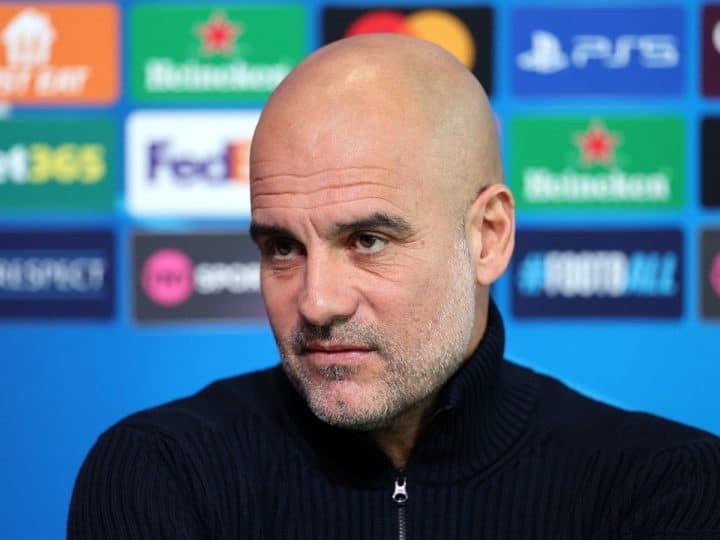

In a fresh development highlighting a growing crisis in modern football, Manchester City manager Pep Guardiola has criticised the sharp rise in ticket prices for the 2026 World Cup, warning of the impact this will have on fans’ ability to attend the world’s biggest football event.
Guardiola’s comments came during a press conference ahead of his side’s FA Cup semi-final, where he addressed the pricing policy adopted by FIFA for the 2026 World Cup, which will be hosted by the United States, Canada and Mexico.
According to the French newspaper L’Équipe, the Spanish manager said that the World Cup “used to be a true celebration of the joy of football, with fans travelling to support their national teams”, adding that the tournament in the modern era “has become extremely expensive” and creates barriers for fans.
Guardiola sent a clear message, stating: “Football is for the fans,” in a direct reference to the need to preserve the game’s popular character and not allow it to be dominated by ever-increasing commercial pressures.
Guardiola — Record prices and mounting criticism
Pep Guardiola’s criticism comes amid a growing wave of controversy over 2026 World Cup ticket prices, with data and media reports revealing that official and resale prices have reached unprecedented levels.
According to press reports, prices for some tickets to major matches start at hundreds of dollars in the group stage, but rise sharply in the knockout rounds, with standard-category tickets for the final ranging from around $4,000 to over $6,000, whilst higher categories exceed $10,000 depending on the venue and seat.
As for FIFA’s official resale market, prices have reached exceptional levels, with some seats for the tournament final at MetLife Stadium in New Jersey being offered at nearly $2.3 million per ticket, an unprecedented figure in World Cup history, according to the Associated Press.
Featured image via the Canary
By Alaa Shamali


Caught between a packed schedule of big matches and the approach of decisive moments, Pep Guardiola is navigating one of the most critical periods of the season with Manchester City, as the stakes of the competitions overlap with questions about the future.
It all begins with the FA Cup, before a series of crucial Premier League fixtures, where the title race with Arsenal is heating up.
Against this backdrop, there is a growing sense that this phase could mark the end of an exceptional era, during which Guardiola has reshaped the club’s identity, transforming it from a project built on potential into a established force in European football.
Guardiola’s possible next destination
In a report that has sparked widespread reaction within European football circles, the newspaper La Gazzetta dello Sport revealed that Spanish manager Pep Guardiola is not ruling out the possibility of coaching the Italian national team in the future, in a move that could represent a remarkable shift in his managerial career.
According to the Italian newspaper, Guardiola views the idea of a national team role positively, seeing it as a different challenge that could offer a respite from the intense daily pressure of club football, which lends credence to the theory that he may move into national team management in the future, rather than joining a new club.
A long-standing connection bolsters the idea
The report noted that Guardiola’s connection with Italian football is not a recent development, as he previously played for Brescia and Roma, an experience that left a positive impression on him and made the idea of returning to Italy — this time as a manager — an option with an emotional dimension as well as a professional one.
The newspaper also quoted the Spanish manager as being open to the idea, as he has not ruled it out on more than one occasion, offering only a terse reply that reflects his flexibility: “Why not?”.
Despite the theoretical appeal of this scenario, La Gazzetta emphasised that the path to realising it is far from smooth, given the significant financial challenges, as Guardiola’s high salary at Manchester City is a major obstacle for the Italian Football Federation.
Featured image via the Canary
By Alaa Shamali


Anfield witnessed a striking protest by Liverpool fans today during the team’s Premier League match against Crystal Palace, as supporters collectively raised yellow cards in the stands in a direct show of opposition to the club’s decision to raise ticket prices for future seasons.
A video documenting the moment the yellow cards were raised in the stands went viral on social media, in a striking scene carrying clear symbolic significance, as the stadium appeared to be covered in yellow during this unified protest, This was also documented in a tweet by the BBC Sport via its official account on platform x.
Liverpool fans chanted angry slogans during the protest, most notably:
You greedy bastards, enough is enough,
You greedy bastards, enough is enough.
This was a direct reference to their rejection of the new pricing policies adopted by the club’s management.
The protest was organised by fan groups, led by the club’s supporters’ associations, with thousands of yellow cards distributed before kick-off to be raised en masse in the 13th minute of the match.
Liverpool — ticket price rise sparked the protest
According to a report published by Liverpool FC on 26 March 2026, the club’s management had approved a new plan to gradually increase ticket prices, starting from next season, including annual increases linked to inflation rates.
The details indicate that the base increase is around 3% per year, with the possibility of rising to a ceiling of approximately 5% in some seasons, as part of a plan spanning several years.
The club’s management justifies this policy by citing rising operating costs at Anfield, alongside increased expenditure on wages and infrastructure in recent years.
Featured image provided via author
By Alaa Shamali

We hope you love the products we recommend! All of them were independently selected by our editors. Just so you know, HuffPost UK may collect a share of sales or other compensation from the links on this page if you decide to shop from them. Oh, and FYI — prices are accurate and items in stock as of time of publication.
Porn really did a number on our concept of lesbian sex.
For decades, there hasn’t been anywhere near enough representation for the women-loving-women (WLW) out there, with buzzwords like scissoring, strap-ons, and tops being thrown around when anyone mentions lesbian sex.
So this might come as a complete surprise, but there’s a hell of a lot more to it than that.
Thanks to famous WLW like Chappell Roan, Kristen Stewart, and Renée Rapp talking more openly about lesbian sex, our idea of what it involves (and who does what to who) has evolved in recent years.
We’re proud to say we’re living in an age of lesbian renaissance, so much so that the number of people identifying as lesbian increased from 2.2% in 2018 to 3.8% in the UK. That might not sound like a lot but, trust us, it shows the tides are turning.
But whether you’re new to lesbian sex, or seasoned in the art of loving vulva owners, there are still plenty of misconceptions about positions and sex toys knocking around (literally).
So, ahead of Lesbian Visibility Day 2026, we asked experts what lesbian sex really looks like, and rounded up some of the best sex toys to enhance your adventure.
Misconceptions about lesbian sex toys
We’ve said it before and we’ll say it again: identifying a lesbian has nothing to do with men.
As much as free internet porn might have convinced you otherwise, wanting penetration during vulva on vulva sex doesn’t equate to wanting to have sex with men – or be one.
This is one of the most common misconceptions about lesbian sex toy use, according to sex educator for Lovehoney, Javay Frye-Nekrasova.
“When people, especially lesbians, choose to use dildos and other insertables, it has nothing to do with wanting to have a penis or trying to ‘be a man’ but is just an avenue for pleasurable exploration and sex that is penetrative,” she says.
When lesbians choose to integrate strap-ons, this also doesn’t mean that the wearer ‘should’ be the more masculine-presenting partner, Frye-Nekrasova explains.
“Toys and activities do not determine someone’s gender identity, and it does not mean that someone is trying to fit a particular role (as dictated by society) in their relationship,” she says.
“Don’t bring society’s expectations or rules into your bedroom or sex life. There is nothing wrong with enjoying particular activities or roles in the bedroom. As long as you and your partner are communicative and have a sex life that you both enjoy and find pleasurable and are open to adjusting as the moment and your relationship desires, that’s all that matters.”
Types of lesbian sex toys
Contrary to popular belief, not all lesbians use strap-ons, nor do they all love scissoring. Okay? Got it?!
In fact, there is a smorgasbord of sex toy options available for WLW folk.
“Pretty much every type of sex toy can be used during lesbian sex if you are creative enough or open to trying new things,” explains Frye-Nekrasova.
“Vibrators are great for all-over use, and insertable toys, like dildos, are great for penetrative play. App-controlled toys are a great choice if you want a little more fun or to engage in discreet public play, while kink and BDSM products can also add some spice to sexy time.”
How I tested the best lesbian sex toys
Wouldn’t you like to know? As a seasoned WLW myself, I’m always on the look out for sex toys that can fit seamlessly into my sex life.
When looking for a lesbian sex toy, I consider how easy it would be to use it during sex with a partner, including the size, ergonomics, and number of settings it comes with.
I’ll also consider material, looking for stainless steel, crystal, borosilicate glass, medical-grade or body-safe silicone and ABS plastic, as these are non-porous and won’t transmit bacteria or STIs.
Depending on whether my partner is into playing in the shower, I’ll also think about whether a toy is waterproof, as well as whether it can be controlled long-distance by an app, or if it has a travel lock (because, duh, lesbians love both those things).
Best lesbian sex toys in 2026

What goes around comes around, and this double ended vibrating dildo will certainly make you both come. You can connect it to the LELO app, which makes things easier when trying to control the separate motors instead of reaching between you when things get slippery.

A good dildo is an essential for lesbian sex, and this one from Biird is pretty much perfect. It comes in at just under six inches, has a strong suction cup so you can stick it to any surface, and it’s not too curvy, making it great for beginners and aficionados alike. Oh, and it comes in a velvet storage pouch to keep it safe and dry (bougie!).

In my experience, it’s rare that both couples like to be penetrated at the same time. If one of you is more into clit stimulation and the other into penetration, this double-ended wand is ideal because, one again, it’s app-controlled, and has 10 patterns and 16 intensities to choose from, so you can find that sweet spot.

Now here’s an idea: one of you wears this dual clit and G-spot stimulator while the other controls it with the remote. That way, one of you can get off while you pleasure your other (I’ll leave it up to you to figure out how). Now who’s the pro?

If you’re looking for something that will definitely get the job done (à la Chappell Roan), this magic wand is loaded with 20 vibration modes and 10 patterns, for direct clit stimulation that will leave you shaking as hard as it does. It’s also the most waterproof toy on the market right now, which means you can take it for a dive wherever you like (we’re thinking hot tub in Hawaii, what about you?).

As a society, we’re really not talking about mutual masturbation enough. Specifically, the joy of seeing your partner get themselves off. This grind pad gives your lover a delightful view of you riding your way to O-town, and they can even take the reins with the remote, too.

It’s no secret lesbians love rings (look, some things are stereotypes for a reason, ok?) but this one from Unbound Babes is extra special. It might look like just a chunky accessory, but really it’s a multi-speed vibrating ring to turn you on at the switch of a button. Chic as hell.

Anyone into kink play will tell you, it’s really hard to find restraints that feel as cute as they look. These cuffs from Bellesa are the exception. Not only are they baby pink, but they’re also super soft and can be tightened or loosened by sliding the ribbon – cute!

Chakrubs
Crystal-loving girlies, this one’s for you. As well as claiming to help facilitate shadow work, thanks to being made from Black Obsidian, the crystal for protection and grounding, this dildo is super curvy, so that bulbous end hits your G-spot just right. The surface also cools down and heats up quickly, making it ideal for exploring temperature play for the first time.

If you’ve ever worn a strap, I won’t have to tell you the struggle of trying to get all the components in the right position, and picking your wedgy out mid-thrust. These open-back briefs are not only designed to combat that, but are actually comfortable. You can insert a dildo or strapless strap-on (your choice, and even connect the straps to your favourite pair of suspenders. Hot.

It can be really hard to tell exactly how much something is vibrating when you’re using a sex toy on someone else, so I love that the remote of this C-shaped toy is filled with haptic squeeze sensors that mirror the vibration intensity of the toy you’re controlling. As well as being just deliciously intuitive, the toy itself (which sends pleasure to your G-spot and C-spot simultaneously) can be used in any position, including when being penetrated with a strap. Did someone say double trouble?

One thing about strapless strap-ons is they’re always way too hard. This one from Ann Summers has completely bendable pony, so the wearer can actually be comfortable (who would’ve thought) and, even better, they can get off thanks to the base being equipped with vibrations, so you can both come at the same time. Now that’s pleasure.
Tips for using lesbian sex toys
If you’re new to sex with vulvas, or simply want to refresh your knowledge, we asked Frye-Nekrasova for her tips on how to integrate sex toys into your intimate moments.
Communicate
“Have a conversation ahead of time about what you both like individually in terms of toys, and then work from there to decide where you would like to start with toys together,” she says.
“It is a good idea to get new toys with new partners rather than using the same toys from previous relationships and partners.”
Positions
“Whatever position feels best for everyone involved should be where you start,” Frye-Nekrasova advises.
“I personally find doggy to be a great position, especially when using the strap, as it can be used to better align the bodies to make penetration easier. If you want to enhance the overall feelings and pleasure, add a sex pillow like the Lovehoney Elevate Sex Position Pillow or Lovehoney Move Sex Position Pillow.”
Scissoring (or tribbing) can be a helpful position if you’re using vibrators or double-ended dildos, she adds.
“A wand does really well for this because the vibrations are felt on the entire head of the toy, so both partners can experience the vibration sensations,” says Frye-Nekrasova. “Palm vibrators can also work well for this.”

Scenes depicting Kat Graham as Diana Ross were apparently cut from the new Michael Jackson biopic on legal grounds.
Back in 2024, it was announced that Kat would be playing the music legend – who was a friend of Michael Jackson’s, and starred alongside him in the screen musical The Wiz – in the new film.
However, on Thursday afternoon, the Vampire Diaries star confirmed that her scenes had been axed.
“I want to share that certain legal considerations affected a few scenes, including the ones I filmed with an incredible cast,” she told her Instagram followers.
“Unfortunately, those moments are no longer part of the final cut, though the team worked hard to preserve as much of the story as possible.”

Ahead of the movie’s release later this week, critics have been weighing in on the film, titled simply Michael, with several outlets giving it scathing one- and two-star reviews.
One major criticism of the movie is the fact that it ends in 1988, meaning many major controversies surrounding the Thriller singer – most notably the several allegations of child sex abuse made against him in her lifetime – were not addressed in the film.
Variety reported earlier this month that one scene was meant to be included, which would have seen police officers searching the Jackson estate, Neverland ranch, after he was accused of child molestation in the early 1990s.
However, the outlet claimed that this sequence was eventually cut due to a legal clause in a settlement between the Grammy winner and one of his accusers, forbidding his name and likeness from ever being used in a film.

Oscar nominee Colman Domingo – who plays Joe Jackson in the film – previously suggested that Michael Jackson’s later life could potentially be explored in a sequel.
Meanwhile, it’s been reported that around three and a half hours of footage was shot for Michael, which was eventually cut down to the two-hour finished product hitting cinemas on Friday.

After Watching Their Mums Fight To ‘Have It All’, Gen Z Women Would Rather Be Dads

Timberwolves’ Donte DiVincenzo (leg), Anthony Edwards (knee) exit early in win over Nuggets

Alexander 3D-Printed a Real Engine That Runs

Manchester United reach agreement with Casemiro over contract clause amid transfer speculation

US brings back mandatory military draft registration

Steven Gerrard disagrees with Gary Neville over ‘shock’ Chelsea and Arsenal claim | Football


-

 Business7 days ago
Powerball Result April 18, 2026: No Jackpot Winner in Powerball Draw: $75 Million Rolls Over
-

 Fashion1 day ago
Weekend Open Thread – Corporette.com
-

 Politics7 days ago
Zack Polanski demands ‘council homes not luxury flats for foreign investors’
-
Entertainment6 days ago
NBA Analyst Charles Barkley Chimes in on Ice Spice McDonald’s Fiasco
-

 Politics5 days ago
Gary Stevenson delivers timely reminder to register to vote as deadline TODAY
-
 Crypto World5 days ago
Bank of Hawai’i (BOH) Q1 2026: Net Income Drops to $57.4M as Net Interest Margin Expands
-
Crypto World10 hours ago
Hyperliquid $HYPE Rally Builds Momentum as AI Sector Enters Prove-It Phase
-

 Politics3 days ago
Making troops accountable for war crimes threatens US alliance, ex-SAS colonel warns
-

 Politics3 days ago
Disabled people challenge government SEND proposals over segregation concerns
-

 Business4 days ago
Rolls-Royce Voted UK’s Most Iconic Trade Mark as IPO Register Hits 150
-

 Politics3 days ago
Zack Polanski responds to home secretary’s taser threat
-

 Politics3 days ago
Starmer handler McSweeney to be dragged from shadows by Foreign Affairs Committee
-
Politics4 days ago
Wings Over Scotland | How To Get Away With Crimes
-
 Crypto World5 days ago
Five Value Stocks with Recovery Potential in 2026: PayPal (PYPL), Nike (NKE), and More
-

 Politics3 days ago
‘Iran is still a nuclear threat’
-

 Crypto World4 days ago
New York sues Coinbase, Gemini over prediction market offerings
-
 Sports3 days ago
Tim Bradley names the current best in the world: “Better than Inoue and Usyk”
-

 Politics7 days ago
Reform investigating candidate who ‘hates’ the NHS
-

 Business4 days ago
The Job Benefits Most Men Don’t Know to Negotiate
-

 Crypto World2 days ago
Michael Saylor says BTC winter is over. Market analyst disagrees, says bitcoin was in a pullback
You must be logged in to post a comment Login