
Politics
New Nasal Spray Appears To Reverse Brain Ageing In ‘Weeks’

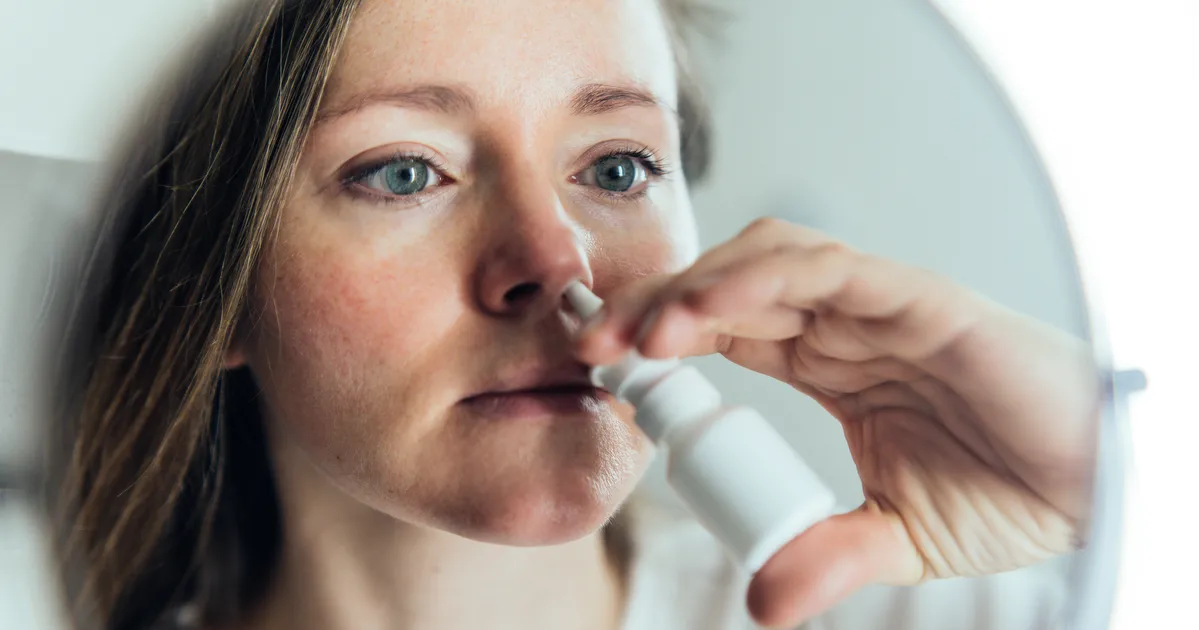
A nasal spray has been found to reverse signs of brain ageing in preclinical trials, according to a new paper published in the Journal of Extracellular Vesicles.
The spray, which tackles a process typical to ageing brains called “neuroinflammaging”, delivered benefits within weeks – and results lasted for months.
“What we’re showing is brain ageing can be reversed, to help people stay mentally sharp, socially engaged and free from age-related decline,” research author Dr Ashok K. Shetty told Texas A&M University.
He added that this may be especially important as “brain age-related diseases like dementia are a major health concern worldwide”.
Two doses of the spray seemed to help
The spray aims to change how carriers of genetic material called extracellular vesicles (EVs) can reach the brain. EVS contain microRNAs.
“MicroRNAs act like master regulators,” nasal spray researcher Dr Madhu Leelavathi Narayana said. “They help modulate and regulate many gene and signalling pathways in the brain.”
The aim of the new nasal spray is to break through the brain’s defences to deliver these useful bundles of genetic information straight to people’s minds.
That way, the brain absorbs more microRNAs, which help to “recharge” the brain cells of those using the spray.
In the study, that led to less brain fog, better ability to process and remember information, and less inflammation (chronic inflammation is linked to increased signs of ageing).
“We are giving neurons their spark back by reducing oxidative stress and reactivating the brain’s mitochondria,” said Dr Naryana.
And Dr Shetty added they saw the “brain’s own repair systems switch on, healing inflammation and restoring itself”.
More research is still needed
These were promising preclinical results, but scientists will need a lot more research to develop this spray.
“This kind of work requires resources and the right people to tackle problems and develop solutions that could change lives,” said Dr Shetty.
But, he said: “As we develop and scale this therapy, a simple, two-dose nasal spray could one day replace invasive, risky procedures or maybe even months of medication.”


spiked is funded by readers like you. Only 0.1% of regular readers currently support us. If just 1% did, we could grow our team and step up the fight for free speech and democracy.
Become a spiked supporter and enjoy unlimited, ad-free access, bonus content and exclusive events – while helping to keep independent journalism alive.

Two things can be true at once. One, that those regular, relentless ‘pro-Palestine’ demos that pose as rallies for peace are hotbeds of Jew hate. Two, that banning the so-called hate marches would do nothing to solve Britain’s anti-Semitism crisis.
The question of what to do about the hate marches has inevitably resurfaced in the wake of the Golders Green atrocity in which two Jewish men were stabbed in a suspected terror attack. Although this was merely one incident in a sustained campaign of terror that has been waged against Britain’s tiny Jewish community since 7 October 2023, pretending there is no problem is no longer sustainable.
Keir Starmer, who once accused critics of the marches of ‘sowing hatred and mistrust’, said last weekend that there may be ‘instances’ where it is appropriate to prevent Palestine marches from taking place. ‘Tougher action’ would also need to be taken, the UK prime minister said, against chants such as ‘globalise the intifada’. Conservative leader Kemi Badenoch, meanwhile, has called for a ‘moratorium’ on the demos, which she says are ‘used as a cover to promote violence and hatred against Jews’.
At this stage, to pretend that these protests and the movement behind them are totally unproblematic is to engage in wilful blindness. This is a movement that embraces chants calling for ‘intifada’ (referencing violent terror attacks against Israeli Jews) and the erasure of the world’s only Jewish state (‘from the river to the sea’). The Arabic war chant ‘Khaybar, Khaybar, ya yahud!’, threatening the slaughter of Jews, is also a staple on these so-called peace marches. On every demo of a certain size, you will see placards proudly displaying overt anti-Semitism, usually branding ‘the Zionist entity’ as demonic, its leaders as the puppeteers of world affairs, and Jews as bloodthirsty baby-killers.
What’s more, the right to protest is not absolute. Not every restriction placed on a protest is an attack on free expression. Central London would struggle to function if police were not able to impose some conditions on the location, frequency and duration of demos, and to ensure protests are not used as thinly veiled forms of intimidation. Nor should the ‘right to protest’ be extended to otherwise illegal activity, whether that’s blocking roads, or engaging in vandalism or violence.
Even with those caveats, though, it is always better to err on the side of free expression – to allow people to express views that society finds offensive or objectionable. Hateful, bigoted and even fascistic speech should not be silenced by the state, either by bans on certain protests or by making arrests for hate speech. Whenever the authorities are empowered to police ‘hate’, there is no telling what it could soon become illegal to say or protest against. In a nation where over 30 people are already arrested every day for ‘grossly offensive’ speech online, the police hardly need any more encouragement to limit people’s expression.
It’s not as if the British authorities aren’t already cracking down on some pro-Palestine protesters. Take the Labour government’s proscription of Palestine Action as a terrorist group, which makes it illegal to say, ‘I support Palestine Action’. There is no doubt that Palestine Action is a genuinely menacing outfit. Four of its activists were found guilty today of criminal damage, one of grievous bodily harm for shattering a police officer’s spine with a sledgehammer. But we must make a sharp distinction between words and violence. And even the threat of arrest and prosecution under the Terrorism Act has not deterred pro-Palestine types from declaring their support for Palestine Action. At least 2,400 arrests had been made as of November 2025 following Palestine Action’s proscription, the main achievement of which has been to make martyrs out of scumbags.
We should, of course, note the outrageous double standards of those who only ever pipe up about free expression when it involves the right to yell for intifada. Green Party leader Zack Polanski, who cheered the state’s persecution of comedy writer Graham Linehan, has accused Starmer of threatening ‘authoritarian restrictions’ on protest. But the flaming hypocrisy of the anti-Israel zealots does not invalidate their right to speak their minds, no matter how hideous the content.
The only way to challenge bigotry is by confronting it head on, by exposing it to sunlight, by defeating it politically. A moratorium on the hate marches may seem like a quick, easy fix, but it doesn’t begin to scratch the sides of the hatred that is now festering in our midst.
The task of challenging the new anti-Semitism is far, far too important to be left to a police crackdown.
Fraser Myers is deputy editor at spiked and host of the spiked podcast. Follow him on X: @FraserMyers.
Politics
The House | The Supported Housing Act is welcome progress, but the government must go further


4 min read
We must not let what could be a landmark piece of legislation be a missed opportunity.
Last month, I spoke at the launch of Emmaus UK’s Rebuilding Lives report – peer-led research carried out with, and by, people who have experienced homelessness and now live in supported housing. Their testimony was powerful and timely: this is a high-stakes moment for supported housing, and one we must get right.
Supported housing is perhaps easy to overlook until you hear about its impact from the people who know best. At the launch, I heard directly from residents about what it means to them: a stable base from which to rebuild, a sense of purpose, community, and belonging. One resident described how the work opportunities and activities at their Emmaus community had transformed their mental health in ways that simply having a roof over their head never could. That is what good supported housing does. It helps people to heal, recover, and rebuild their lives.
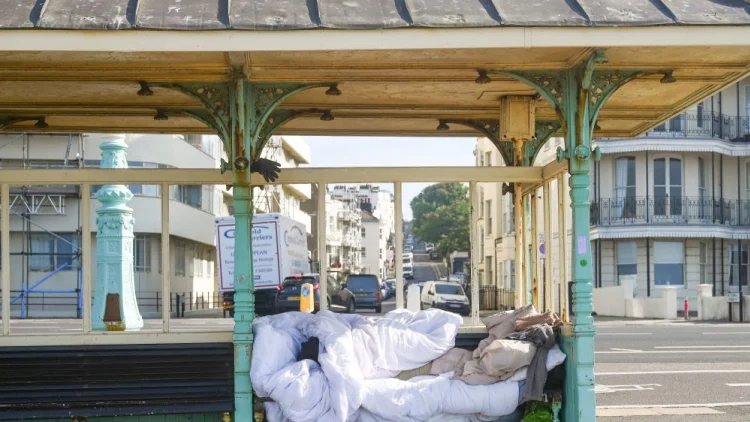
The Supported Housing (Regulatory Oversight) Act is introducing the most significant reform to this sector in a generation – new national standards, a licensing regime, and changes to Housing Benefit. At the same time, rough sleeping is at record levels, one in three supported housing providers closed schemes last year due to funding pressures, and thousands of people are trapped in temporary accommodation with nowhere suitable to move on to.
This is a critical moment for supported housing that has the potential to safeguard the delivery of quality provision for generations to come – but only if we can get implementation right.
There has been welcome progress. The government has just published its long-awaited consultation response on implementing the Act, which shows that some genuinely important concerns have been listened to.
The scheme definition has been amended so that dispersed housing providers won’t face a separate licence application for each postal address. The list of exemptions for providers already regulated elsewhere has been expanded. Local authorities have lost the ability to impose discretionary licensing conditions, preventing a damaging postcode lottery of requirements. And the ‘local need’ standard has been clarified to exclude local connection tests – which, as the Rebuilding Lives report highlights, can actively block access to support for people who need it most.
However, some notable gaps remain, and if left unaddressed, they risk turning a landmark piece of legislation into a missed opportunity. Residents and providers are both clear that good quality supported housing is about much more than just a roof over someone’s head. Yet the national standards still do not fully reflect what drives recovery: purposeful activity, community, and flexibility of stay.
The two-year intended duration for transitional accommodation risks being read as a fixed ceiling rather than a guide. There is still no standardised methodology for local needs assessments, or a nationally set licence fee rate for providers to pay. And cost-cutting motivations could still permeate local licensing decisions, particularly with local authorities facing a continued subsidy loss when reclaiming Housing Benefit from national government for supported housing providers who are non-registered. These areas need addressing to achieve a fair, consistent, and person-centred system.
Another glaring omission is funding. With many supported housing providers already under financial pressure, layering new compliance burdens on a sector with no transitional support is a serious risk. Providers may be forced to divert resources away from frontline support simply to evidence that they are delivering frontline support.
On resident protection, the government has confirmed a three-month improvement period before licence refusal. This is welcome, but only half the six months organisations, including Emmaus UK, called for. Guidance will be issued on re-housing residents where schemes close, but guidance alone does not guarantee outcomes. For people who have experienced homelessness, the statutory rehousing duty may not apply. Without robust safeguards, licence refusal could lead to homelessness, which would be a tragic unintended consequence of the Act.
And none of this works without affordable homes for residents to move on to after supported housing: an average gap of £200 a month between local housing allowance and median private rents traps people in supported housing long after they are ready to leave, while we urgently need to work toward 90,000 social homes built per year.
The message from residents and providers is clear: we know what good quality supported housing looks like. The government has the foundations in place – now it needs to go further.
Paula Barker is the Labour MP for Liverpool Wavertree and Co-Chair of the All-Party Parliamentary Group on Ending Homelessness
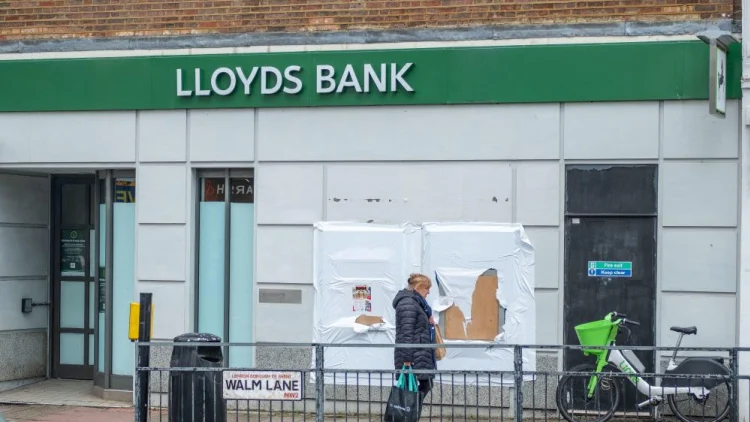

Today, nearly 50 Parliamentary constituencies have no bank branch left (Alamy)

3 min read
Since 2015, more than 6,600 bank branches have closed, with some communities losing over 90 per cent of their network. Today, nearly 50 Parliamentary constituencies have no bank branch left, and more than 90 are down to their last one.
For many people, that is not just an inconvenience. It has meant losing the ability to bank at all. In coastal and rural communities such as Hayling Island or towns like Emsworth in my Havant constituency, the reality is straightforward: if you cannot bank online and cannot easily travel elsewhere, you are effectively cut off.
The last Conservative government took an effective and important step in response. The Financial Services and Markets Act 2023 legally mandated access to cash and supported the rollout of banking hubs, a single shared space where multiple banks operate on a rota basis. That was a good start and is already making a big difference. LINK, the organisation responsible for assessing local provision of hubs, has already carried out more than 1,600 community assessments, leading to 276 banking hubs being recommended and delivered.
But the current framework does not go far enough. It defines the problem too narrowly – solely around access to cash. But this is not the same as access to face-to-face banking.
Being able to withdraw or deposit money is only part of what people need. Banking is also about resolving a blocked card, fixing a failed payment, getting help after fraud, or simply speaking to someone when something has gone wrong. All of these are everyday problems raised by constituents to their MPs from across the House.
In particular, there are now over three million cases of banking and payment fraud each year, and the majority begin online. When something does go wrong, being able to speak to someone face-to-face can make the difference between stopping fraud early and losing life savings.
According to the Financial Conduct Authority’s Financial Lives Survey, 3.3m people in the UK do not use online banking. More broadly, a significant minority still relies on physical services, particularly older people, small business owners, people living in rural, suburban and coastal communities, and those who are less digitally confident.
The current rules do not fully reflect this. Under the existing framework, communities are often judged to have sufficient banking provision (and therefore won’t get a banking hub) if there is access to cash – for example, a Post Office or ATM within one kilometre of the high street – despite no access to wider in-person banking services.
As a result, some communities still fall through the cracks: they have access to cash, but not wider banking services. This is not a failure of the model. Banking hubs are working. Instead, it’s a gap in the design, which now needs to be closed.
That’s why I introduced the In-Person Banking Services Bill before Parliament prorogued. It built on the existing framework by ensuring that access to face-to-face banking services, not just access to cash, were put on a statutory footing for the first time. I hope the government will support my Bill – or its aims – in the new session of Parliament, for example via the next Financial Services Bill.
This is not about reversing progress or resisting digital innovation. Online banking works well for many and will continue to do so. But a modern financial system must work for all its users. That means ensuring that those who need in-person support are not left behind as the system evolves.
Securing access to cash was an important first step – and a Conservative success story. Now we need to ensure that people can access in-person banking – reliably, locally, and when they need it. Because no one should be excluded from managing their own money simply because they cannot do it online.
Alan Mak is Conservative MP for the Havant Constituency and a former Treasury minister
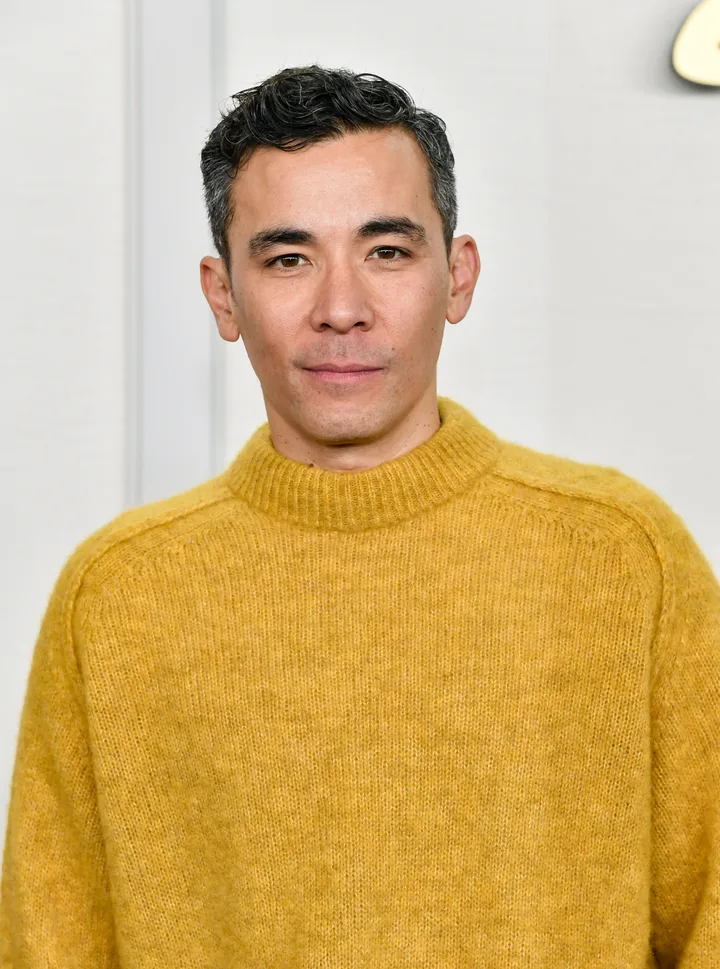
US actor Conrad Ricamora has spoken out after his character in The Devil Wears Prada 2 was completely cut from the final film.
The How To Get Away With Murder star was originally supposed to play the roommate of Anne Hathaway’s Andy in the new sequel, which arrived in cinemas last week.
In the lead-up to the release, Variety reported that all of Conrad’s scenes had been cut, citing “sources” who claimed that test audiences were not sold on his character, or why Andy would have needed a roommate at the stage of her life that she was at.
Conrad later confirmed this to be the case, posting pictures of himself and his Oscar-winning co-star on set on Instagram.

“Just like the rest of you, I can’t wait to see The Devil Wears Prada 2 this weekend,” he enthused.
“Filming The Devil Wears Prada 2 was one of the best working experiences of my life. Getting to work with the icon Anne Hathaway and the genius [Aline Brosh McKenna, the screenwriter of The Devil Wears Prada and its sequel] all the while being directed by the steady hand of David Frankel will forever be on the highlight reel of my life.”
“However, in the end, my character didn’t make sense in the grand scheme of the film (something about me being too sexy and hott and my muscles being too big… story of my life),” he joked.
Though Conrad’s scenes were eventually scrapped, there is a nod to him left in The Devil Wears Prada.
In Andy’s apartment, merchandise for the hit play Oh Mary! can be seen, in which Conrad originating the role of Abraham Lincoln, earning him a Tony nomination.
Meanwhile, an extended scene featuring Euphoria star Sydney Sweeney was also revealed to have been axed in the lead-up to The Devil Wears Prada 2’s release.
The Devil Wears Prada 2 is in cinemas now. Read HuffPost UK’s review of the film here.
!function(n){if(!window.cnx){window.cnx={},window.cnx.cmd=[];var t=n.createElement(‘iframe’);t.display=’none’,t.onload=function(){var n=t.contentWindow.document,c=n.createElement(‘script’);c.src=”//cd.connatix.com/connatix.player.js”,c.setAttribute(‘async’,’1′),c.setAttribute(‘type’,’text/javascript’),n.body.appendChild(c)},n.head.appendChild(t)}}(document);(new Image()).src=”https://capi.connatix.com/tr/si?token=19654b65-409c-4b38-90db-80cbdea02cf4″;cnx.cmd.push(function(){cnx({“playerId”:”19654b65-409c-4b38-90db-80cbdea02cf4″,”mediaId”:”dd823778-08ec-4ae2-97dd-623358fa5856″}).render(“69f9df93e4b055e1a496c76d”);});
Let’s get this out of the way: no, I am not as good at reviewing sticky toffee puddings as STP Reviews. I have neither the expertise nor the drive to assess 60+ of the cakes, and certainly have not refined a marking system so good it’s earned me tens of thousands of fans.
But I do like the dessert, and I’m generally strict about baked goods (woe betide anyone who gets me started on fudgy vs cakey “brownies”). I demand plenty of glossy, rich, buttery sauce, a moist sponge, and a molasses-y mass of dates.
Which might lead some to wonder why I tried a microwave STP recipe last week. All I can say is that it was late, the recipe had hundreds of five-star reviews, and I craved it. Even Nigella has “emergency” baked goods for such urgent cases.
How do you make a microwave sticky toffee pudding?
I followed the New York Times’ recipe. It starts with a mug of melted butter, to which you add brown sugar, salt, and cream before zapping for 30-second increments: that’s your caramel sauce.
Mine took me about a minute. It’s important to really thoroughly stir the sauce between microwave sessions, or else it could become gritty and split.
The recipe asked for dates, butter, cream, and baking soda to be mixed in a bowl next. I microwaved these before mashing them; the dates turn into an earthy-smelling puree remarkably quickly.
(Side note: they make a great caramel if you’re ever in a bind or can’t have dairy).

Then, add flour, cinnamon, sugar, and salt, and microwave the lot for about 45 seconds.
Pour the thickened sauce over the cake, add cream if you like (I do), and you’re done!

The final verdict
I was impressed by how quickly the whole job was done. It took me 10 minutes, as promised. The process is both easy and gloopily satisfying (the dates in particular were fun to make).
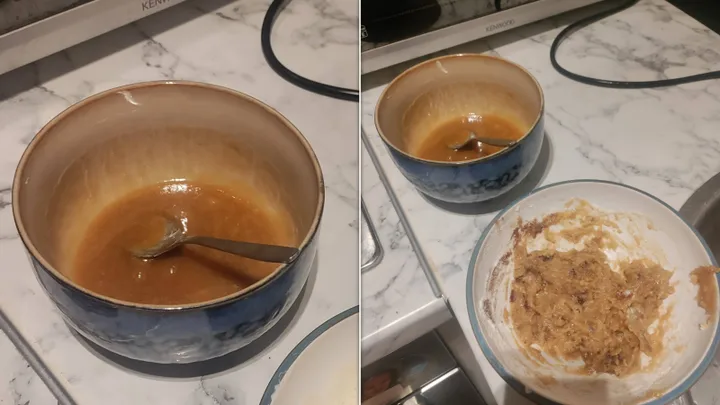
It’s not gorgeous to look at, but come on: who cares? This is a 10 pm, over-the-kitchen-sink eat if ever I saw one.
The standout is the caramel sauce. The recipe authors said it’d thicken as the cake cooked, which it did; by the end, it was velvety, thick and smooth. If you’re ever in a dessert-mergency, I do recommend making that sauce and smothering anything vaguely cake-y in it.
That said, I don’t believe the sponge in an STP should be relegated to the role of sauce carrier, and this one felt that way. The cake was a little rubbery and dry; its crumb was indistinct and far from tender. Still, nobody else said that in the comments, so maybe I left mine in too long.
Regardless, for ten minutes and a microwave, I was pretty wowed. It hit a lot of the marks of a great sticky toffee pudding (luxurious sauce, date-y stickiness, and rich butter flavour), and it more than exceeded my expectations.
It’s not going to score highly on a pro’s account, I reckon. But when you’re in a rush and/or have a craving, its value rockets to at least an 8/10. Reviewers have given it five stars for good reason.

Every year, the Met Gala gathers together some of the most famous faces from across the world of music, cinema, sport and, of course, fashion for a star-studded fundraiser in aid of the Metropolitan Museum Of Art’s Costume Institute.
This year’s event was held on Monday night, and proved to be as A-list as ever.
Co-chaired by Beyoncé, Nicole Kidman, Venus Williams and, as ever, Anna Wintour, the themed dress code of 2026’s Met Ball was “Fashion Is Art” – really allowing the famous guests to think outside the box and let their imaginations run wild when putting together their red carpet looks.
And what do you know – some of them actually did.
On that note, we’ve pieced together some of the must-see looks from this year’s Met Gala, from some of the biggest stars on the planet…
Beyoncé

As one of the organisers of the Met Gala this year, Beyoncé will have known that all eyes were on her on the red carpet.
Leaning into the elaborate theme, the Break My Soul singer sported this glittering, skeletal-inspired look on the red carpet, where she was joined by her husband Jay-Z and eldest daughter Blue Ivy Carter, marking the 14-year-old’s Met Ball debut.
Sam Smith

Sam Smith has become renowned for their dramatic approach to fashion in recent history, and this year’s Met Ball really afforded them the chance to go all out.
Channelling Norma Desmond, the British star gave us old school Hollywood glamour in a floor-length black dress complete with bejeweled adornments, billowing sleeves and a feather headpiece.
Madonna

Madonna’s Met Gala look was a real departure from what we’re used to seeing the Queen of Pop in, opting for something more gothic, dark and, frankly, weird that we’re totally here for.
The Bring Your Love singer’s ensemble was directly inspired by a Leonora Carrington painting, in one of the night’s more literal interpretations of “Fashion Is Art”.
Janelle Monáe
Janelle Monáe brings it every single Met Ball, and a theme like “Fashion Is Art” was always going to be in their wheelhouse.
The 10-time Grammy nominee mixed the old and new with their imaginative look, which incorporated elements of nature and technology, merging moss and butterflies with wires and microchips.
Luke Evans

Dressed in head-to-toe leather, Luke Evans’ look was an obvious nod to Tom Of Finland.
Speaking to Entertainment Tonight on the Met Ball red carpet, the Welsh actor said that “playing such an iconic character on stage” in the current Broadway revival of The Rocky Horror Show made him want to put a “twist” on an “iconic gay artist who has influenced so much”.
Gwendoline Christie

Former Game Of Thrones star Gwnendoline Christie has never been one to shy away from leaning into a Met Gala theme.
On Monday night, her look consisted of a massive feathered hat and a floor-length red dress nodding to faded glamour – but our favourite part of the whole ensemble was the hand-held mirror, adorned with a recreation of her own face.
Katy Perry

John Salangsang/Shutterstock
Perhaps inspired by her own trip to space last year, Katy Perry’s Met Gala look consisted of what appeared to be a fencing mask, with a shiny and opaque face covering on the front.
As she made her way down the red carpet, Katy revealed that the mask also swung open, adding even further to its futuristic elements (and putting us slightly in mind of a Star Wars villain).
Emma Chamberlain

We’re going to be very honest and say that content creator Emma Chamberlain was not exactly the person we thought was going to turn it out the hardest at Monday night’s event – but you can’t argue with this look can you?
In fact, the influencer may have just given us our favourite Met Gala look of 2026, with the dripping paint effect creating an optical illusion that really served the night’s theme.
Chase Infiniti
Fresh from her Oscar nomination and leading performance in the new Handmaid’s Tale spin-off The Testaments, Chase Infiniti’s Met Gala debut was also one of our favourites from this year’s event.
The One Battle After Another star’s colourful dress almost put us in mind of painting-by-numbers (in the best way!), with its graphic design.
Sarah Paulson

On its own, Sarah Paulson’s expansive, red carpet look would have been show-stopping enough, putting us in mind of a presidential ball as much as an event like the Met Gala – but that dollar bill blindfold accessory really gives it something extra.
Sadly, even though Madonna was there too, we didn’t get a recreation of one of our favourite moments in Met Ball history.
Ben Platt

One of the more literal “Fashion Is Art” ensembles came from Ben Platt, wearing a colourful suit inspired by one of Georges Pierre Seurat’s most famous works.
The Seurat painting, of course, was also the basis of the iconic Stephen Sondheim production Sunday In The Park With George, which makes Tony winner Ben wearing it all the more fitting.
SZA

SZA’s Met Gala look consisted of a layered gown in this absolutely gorgeous yellow colour, as well as a floral headpiece and some beaded face jewellery for the evening.
Our favourite part of the whole look, though, was just how much of a blast the Good Days singer was clearly having wearing it.
Lisa

Extra body parts always go down well on the Met Ball red carpet, and Lisa’s look was no exception.
The jury’s out on whether “Fashion Is Art” really came into play here, but we just think the Blackpink and White Lotus star looks really cool, to be honest.
Skepta

Another big name doing the UK proud on the Met Gala red carpet was Brit Award nominee Skepta.
The rapper made a big impression in this matching white co-ord, which he later revealed was adorned with embroidery inspired by his own tattoos, as well as his own song lyrics.
Nicole Kidman

Listen, Nicole Kidman never misses on the red carpet, but given how imaginative some people were with their looks, this feels a little out of place.
We’ve mostly mentioned it in this round-up so we can include her explanation for it.
“Fashion is art and I wanted something red, because I wanted to embrace the way in which red has been used in art through the years,” she apparently claimed.
Kim Kardashian

Kim Kardashian’s latest Met Ball look consisted of a molded bodysuit in an eye-catching shade of orange.
Again, it wasn’t exactly our favourite outfit of the evening, but given just how synonymous with the Met Gala that Kim K has become, we just had to include her, alright.
Heidi Klum

This year, Halloween came early, with Heidi Klum unveiling one of her trademark dramatic transformations six months before her usual spooky season bash.
For the 2026 Met Ball, Heidi transformed herself into a living artpiece, paying homage to 19th century sculpture with the aid of prosthetics and unconventional materials to deliver one of the night’s most talked-about looks.
Bad Bunny

And speaking of prosthetics – Bad Bunny’s look was certainly an unconventional one, too.
The recent Super Bowl headliner walked the red carpet as an older version of itself, which it’s been pointed out was a probable nod to “The Aging Body”, a key element of the Met’s Costume Institute’s exhibit this year.
Rihanna

Rihanna’s position as Queen of the Met Gala is safe for another year.
Her latest Met Ball look was another mix of the old and new – offering an unconventional silhouette and undoubtedly the night’s most intricate adornments.
We absolutely love what she did with her hair, too, with her partner A$AP Rocky also joining her on the red carpet later on, sporting a baby pink overcoat and tuxedo.

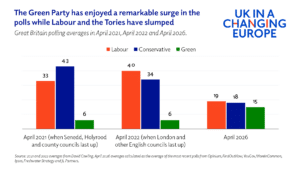
Rob Ford analyses the surge in support for the Green Party ahead of the local and devolved elections on Thursday 7 May.
The remarkable rise of Reform has dominated the political narrative of late. However, a new insurgency has started to make waves. The Greens have enjoyed a remarkable surge in the polls since the election of their charismatic and social media friendly leader Zack Polanski as party leader last September. In February, they proved this was no polling phantom by taking the formerly safe seat of Gorton and Denton from Labour in a by-election.
Source: 2021 and 2022 averages from David Cowling, April 2026 averages calculated as the average of the most recent polls from Opinium, FindOutNow, YouGov, MoreInCommon, Ipsos, Freshwater Strategy and JL Partners
Local and devolved elections this week may offer an opportunity to make bigger gains on a broader front. The political landscape has changed dramatically since these areas were last up for election in either May 2021 or May 2022. Then, Labour and the Conservatives still dominated the polls. Both parties’ support has more than halved since, while Green support has more than doubled, putting Polanski’s insurgents in a statistical tie with both traditional governing parties in the current polling.
The Greens have also advanced in Senedd polling, while the Scottish Greens, though a separate party, seem also to be benefitting from the rising tide. The Greens are polling an average of over 10% in the latest Senedd polling, double their showing last time, and potentially sufficient for them to enter government as a junior partner to the first Plaid Cymru lead administration, in a country where they have never previously won a seat. The Scottish Greens have hit the mid-teens in recent regional list polling, nearly double their 2021 showing and potentially a record result. The Scottish Greens could play a pivotal role after May if the SNP fall short of a majority, as they will be the only other pro-independence party in the Scottish Parliament.
The Greens could thus be about to emerge with power and influence in both devolved assemblies, but it is in the town halls of England that they may make the most dramatic gains. The first past the post electoral system used in English local contests, which has in the past marginalised the Greens, may now accelerate their advance. The rising Green vote has a distinctive demographic profile, with the biggest gains coming among students, young graduate professionals and Muslim voters. These groups all tend to congregate in the same urban areas where universities are based, graduate jobs are found and England’s largest Muslim communities live.
The impact could be greatest in London. The capital was already the Greens’ strongest region in 2024, and London’s 32 boroughs elect all the councillors for multi-seat wards simultaneously in ‘all up’ contests – a system which can magnify the impact of polling shifts. Inner London features several Labour dominated boroughs with exceptionally Green friendly social profiles, including Camden, Islington and Zack Polanski’s home borough of Hackney. The Greens, who have never won control of a London borough before, may take charge in several patches of inner London governed by Labour for generations. This would be a seismic shift, and one which may bring broader political aftershocks, given how many Labour MPs (including the PM and many of his senior colleagues) represent London seats.
While London is the biggest prize, the Greens will hope to seize similar opportunities in England’s other big cities. Birmingham also has “all up” elections and a large Muslim community which swung strongly against Labour in Mayoral and Westminster contests in 2024. Meanwhile, in Greater Manchester the Greens will hope to ride the wave of their recent by-election triumph. There are many other opportunities in big urban boroughs such as Sheffield, Leeds and Newcastle with Green friendly demographics, but also in smaller cities and rural areas such as Norwich, Norfolk and Suffolk where the Greens have built up a strong local presence and now stand to benefit from the collapse of the traditional parties.
Success, if it comes, will bring its own challenges. In England, Green councillors with little or no experience of government could soon be running, or helping to run, large city councils burdened with many responsibilities and strained budgets. In Wales, Greens who have never even made it into the Senedd before may soon have a share in a devolved government with even wider responsibilities. As Reform discovered after taking over county councils last year, populist slogans may prove effective on the campaign trail, but they may equally be impossible to deliver on once in charge of the town hall. Many Green voters backing the party’s promise of radical change may find their high hopes are fast disappointed.
Yet the risk of disappointing voters in power is surely one the Greens will be happy to run after decades sat on the margins of British politics. And a big Green wave will have broader implications. As the Liberal Democrats and the SNP have shown before, local and devolved elections can be a springboard to success at Westminster contests. Big council gains will boost the Greens’ profile and organisation even in areas where they don’t win control outright, with local success helping to demonstrate to voters that the Greens are now a viable local option.
Such electoral credibility could be a vital resource in the next general election, when the stakes will be higher, and many progressive voters who take a chance on the Greens this year will be weighing their options more carefully, worrying in particular about the risk of progressive splits helping Reform. The Greens showed in Gorton and Denton that they could overcome such anxieties and triumph even in a Westminster seat where Labour had long been dominant and Reform were a credible threat. A big advance in local and devolved contests will help convince wavering voters that the Greens are a credible option in a much wider range of seats. The Greens still have a long way to go if they want to challenge Labour as the dominant left of centre party at Westminster. But they may take a big step forward next week.
By Professor Rob Ford, Senior Fellow, UK in a Changing Europe and Professor of Politics, University of Manchester.

Can you walk while successfully doing another activity at the same time?
Known as dual-task gait performance, a 2023 paper found struggling to do this has been linked to a risk of falls and cognitive decline in adults aged 65 and over.
The researchers found that most people begin to struggle with the test in their 60s, and that after that point, participants’ cognitive health seemed to influence their performance most.
Another paper suggested a dual-task gait test could help to predict cognitive impairment better than single-task gait speed measurement.
But what is a dual-task gait test, and why might it matter? Here’s what Dr Donald Grant, a GP and senior clinical advisor at The Independent Pharmacy, told us.
What are dual-task gait tests?
These involve walking while doing another activity at the same time (hence the “dual” task). Often, the second task is distracting, e.g. counting back from 1,000 in sevens.
They might involve maths-based tasks or more physical jobs, like nodding your head or holding a glass of water. The real world is filled with these combined tasks, like accepting a call on a walk, a 2021 paper argued.
What do dual-task gait speeds say about how a person is ageing?
We know that older adults’ gait, or walking style and speed, can say a lot about how they’re ageing.
But when you add a cognitive or physical distraction to that, Dr Grant said, dual task walking tests “can give us a useful insight into how an individual’s brain and body are working together”.
He added: “As we age, our cognitive abilities can be impacted, making these tasks less automatic, requiring more active thinking.
“When people start to struggle with dual-task examinations, it could indicate cognitive ageing, which is perfectly natural as people get older. This means it can become more challenging to divide attention between thinking and movement simultaneously, which may increase people’s risk of falls.”
The doctor said “walking is more than a physical movement” as it requires clear thinking, coordination and strong mobility, “so dual task tests can help identify any early signs of concern”.
Dual-task walking tests are only one way to gauge how an individual is ageing
Despite being a “great functional assessment tool, as they accurately measure how well a person can perform everyday tasks simultaneously,” Dr Grant said dual-task walking tests aren’t the be-all and end-all.
“These walking tests can provide a good snapshot of overall health, but they’re never used to actively diagnose potential health concerns. They can help form part of a larger assessment, allowing medical professionals to better understand an individual’s mobility and cognitive abilities,” he said.
But to measure ageing, GPs tend to look at a combination of factors, such as pre-existing health conditions, physical function and cognitive abilities, he added.
The expert ended: “Simple observations, such as memory tests, plus speed, balance or mobility examinations, can all help build a picture of how someone is functioning day to day.”

Lecture 1, Part II: Introduction of Financial Markets, Financial Terms and Concepts

Donald Trump reignites feud with the Pope with ‘unacceptable’ remarks
BofA raises Pfizer stock price target on first-quarter beat

Manchester United reach agreement with Casemiro over contract clause amid transfer speculation

US brings back mandatory military draft registration

Steven Gerrard disagrees with Gary Neville over ‘shock’ Chelsea and Arsenal claim | Football


-

 Business7 days ago
Most Commercial Energy Audits Miss the Real Losses
-

 NewsBeat2 days ago
Channel 5 – All Creatures Great and Small series 7 new post
-

 Fashion7 days ago
Kylie Jenner’s KHY Enters a New Era with ‘Born in LA’
-
 Tech4 days ago
Trump’s 25% EU auto tariff breaches Turnberry Agreement that also covers semiconductors and digital trade
-
 Sports4 days ago
Paul Scholes issues Marcus Rashford reality check as agreement emerges over Man United star
-

 Business6 days ago
Barclay Brothers Avoid Bankruptcy: HSBC Drops High Court Petitions After IVA Deal
-
 Business6 days ago
Tesla Officially Registers Elon Musk’s Stock: What Investors Need to Know
-

 Entertainment6 days ago
Celebrities Who Are Attending the 2026 Met Gala Event
-

 Tech6 days ago
Texas Instruments made a new flagship graphing calculator: the TI-84 Evo
-

 Business5 days ago
Two Powerball Tickets Split $143 Million Jackpot in Indiana and Kansas
-

 Entertainment4 days ago
Met Gala 2026 Rumored Guest List Is Turning Heads
-

 Entertainment6 days ago
Insider Claims Reason Behind Key & Peele Split
-
Business2 days ago
Winning Numbers Drawn as Jackpot Resets to $20 Million
-

 Crypto World6 days ago
Meta (META) starts stablecoin payout to creators in Circle’s USDC on Polygon, Solana via Stripe
-
 Crypto World5 days ago
CoreWeave (CRWV) Stock Climbs 8% Despite $45M Insider Share Dump
-
 Crypto World6 days ago
Securitize and Computershare Enable Tokenized Equity Issuance for Over 25,000 U.S.-Listed Stocks
-

 Business6 days ago
Strait of Hormuz Remains Heavily Restricted on April 29 Amid Iran Conflict
-

 Entertainment4 days ago
Kylie Jenner Hit With Second Lawsuit From Ex-Housekeeper
-

 Crypto World6 days ago
Gibraltar Proposes Tokenized Funds Regulation to Bolster Compliance
-
 Sports6 days ago
Saudi Arabia set to withdraw LIV Golf funding after 2026 season, per reports
You must be logged in to post a comment Login