
Politics
Scientists Find First Direct Radio Signal From Exoplanet


To get from Earth to Pluto in a car (if such a thing were possible), you’d need to drive for about 6,000 years at motorway speeds.
This is just the distance between two planets in a single solar system. One light-year is about six trillion miles; the galaxy to which we belong, the Milky Way, is 100,000 light-years across.
Experts think there could be one to two billion galaxies in the universe. So, perhaps it’s no wonder that scientists have long wondered whether we can really be alone in that unfathomable expanse.
Astronomers have been listening for radio signals and other signs of life and activity for decades now.
And while it’s not linked to life on another planet, a team from the Centre for Astrophysics Harvard & Smithsonian and the University of Oregon has announced an exciting first: they’ve picked up on radio signals that come directly from an exoplanet, or a planet beyond our solar system.
Where does this signal come from?
It was transmitted from the not-very-catchily-named exoplanet Beta Pictoris B. That’s important because previously, we’ve only been able to attach a radio signal to an exoplanet’s star, and not the planet itself.
More specifically, the radio signal originated from the planet’s aurora – charged particles interacting with its atmosphere and magnetic field, like our Northern Lights.
Scientists think the source is an aurora because of how the signal behaves. It showed up in “rapid, recurring, and highly circularly polarised bursts”, which you’d expect from conditions like these.
Beta Pictoris B is a “young, massive” planet which orbits the relatively new Beta Pictoris star.
But, the experts write, “no physical mechanism known to cause radio emission in early-type stars can explain the observed emission”.
What does this radio signal mean?
The paper suggests that this is “the first direct measurement of magnetic field strength for an exoplanet”. It looks like Beta Pictoris B could have a magnetic field thousands of times stronger than Earth’s, possibly strengthened by its rapid spinning (a full Beta Pictoris B day lasts about eight hours).
But this finding might also mean we’re getting better at finding exactly where faraway signals are coming from.
The researchers found signals near Beta Pictoris B using South Africa’s MeerKAT radio telescope, and later narrowed its location down to the specific planet it likely belongs to by looking at active galaxy cores called quasars.
Seven other exoplanets in five solar systems close to Beta Pictoris are now being considered for closer examination.
“A ∼5x to 7x improvement in instrument sensitivity, expected from next-generation radio observatories, will bring them within reach of detection,” the paper, which has not yet been peer-reviewed, added.

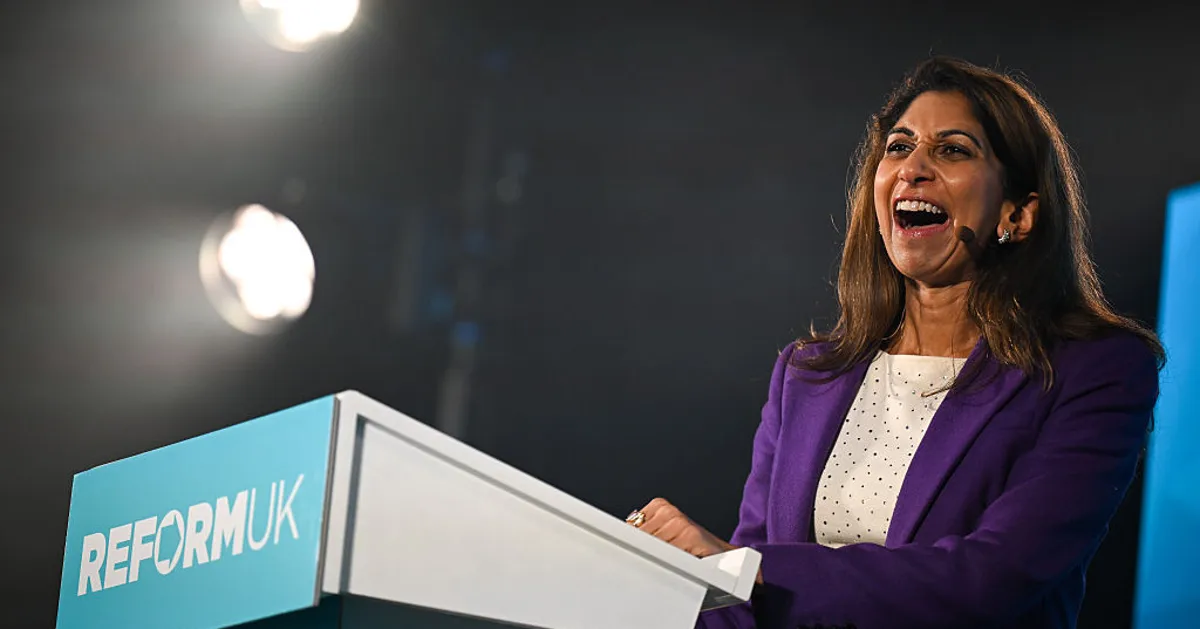
Suella Braverman has sparked an online backlash by declaring she is “not English”.
The former Tory home secretary, who was born in Harrow, raised in Wembley, went to school in Brent, studied at Cambridge University and lives in Hampshire, would only say she is “proud to be British”.
Her comments came after former prime minister Rishi Sunak, who put Braverman in his cabinet, rejected suggestions that only white people can be English.
Writing in the Sunday Times, he said: “If you are born and brought up in England and view it as home, what are you other than English?
“Attempting to deny people their Englishness or Britishness because of the colour of their skin is a recipe for alienation, for a two-tier society. How are children who hear this meant to feel?”
But Braverman, who defected to Reform UK last year and is now the party’s education spokesperson, insisted that Englishness is “an ethnicity” and therefore she does not qualify.
In a post on X, she said: “As I’ve said before, I’m not English. I’m proud to be British.
“My family and ancestors have a link to Britain which spans centuries. But in no way are we English. Yes, I was born in England, speak English and support the England football team. And indeed, I love England and the English people.
“But to say I’m English is to take a ‘laissez-faire, anything-goes’ attitude to ethnicity, citizenship and identity. It also denies me my Asian heritage.
“The liberals (many of them in today’s Conservative Party) take this cosmopolitan approach to Englishness. They’re terrified of being called racist so they say that anyone, as long as they’re born here, can be English. I take the conservative approach.
“Englishness is an ethnicity. There have been English people for centuries and we need to recognise this more if we are to start taking a more muscular approach to citizenship and nationality. And no, it’s not racist to say this.
“Other countries have no qualms in limiting who can be part of their citizenry and use ethnicity and culture as criteria. Here, the dogma of multiculturalism has been so corrosive that some people don’t actually know who we are anymore.”
A poll by the More in Common think-tank last year found that 74% of English people believe someone can be English regardless of their ethnicity or skin colour, compared to just 17% who think those factors are important.
Meanwhile, a Focaldata poll in February this year found that 83% believe someone can be considered English regardless of skin colour, with 10% saying they must be white.
Braverman’s comments also led to criticism from other social media users.
Listen to Commons People, the podcast that makes politics easy. Every week, Kevin Schofield and Kate Nicholson unpack the week’s biggest stories to keep you informed. Join us for straightforward analysis of what’s going on at Westminster.

Actress Hayden Panettiere died from the toxic effects of fentanyl and several other drugs, according to a toxicology report obtained by multiple media outlets Tuesday.
The 36-year-old’s cause of death was ruled accidental by the Greenville County Coroner’s Office, which conducted an autopsy after her death at an apartment in Greenville, South Carolina, on 16 August.
Also contributing to her death and found in her system were 4-ANPP, Alprazolam, Methocarbamol, and Quetiapine, according to the report.

Jeff Neira via Getty Images
“At autopsy no signs of trauma were discovered that would have contributed to the death,” the coroner’s report states.
4-ANPP is a controlled substance that’s found in the illicit manufacturing of fentanyl, according to the Drug Enforcement Administration.
Alprazolam, more commonly known as Xanax, is used to treat anxiety and panic disorders. Methocarbamol is a prescription muscle relaxer, and Quetiapine is prescribed to treat schizophrenia, bipolar disorder, and major depressive disorder.
The DEA joined local and state officials in the investigation days after her death, ABC News reported at the time, citing sources familiar with the matter.

gotpap/Bauer-Griffin via Getty Images
The Heroes and Nashville star was with her on-and-off boyfriend Brian Hickerson and his brother Zach Hickerson when she was found unresponsive.
She was pronounced dead at the scene after life-saving methods were performed “for an extended amount of time” by responding paramedics, according to a heavily redacted police report.
Panettiere was known to have had a volatile and unhealthy relationship with Brian Hickerson, who was arrested multiple times on suspicion of domestic violence against her, starting in 2019.
TMZ reported that the brothers were not invited to Panettiere’s celebration of life held this past weekend in Malibu, California.
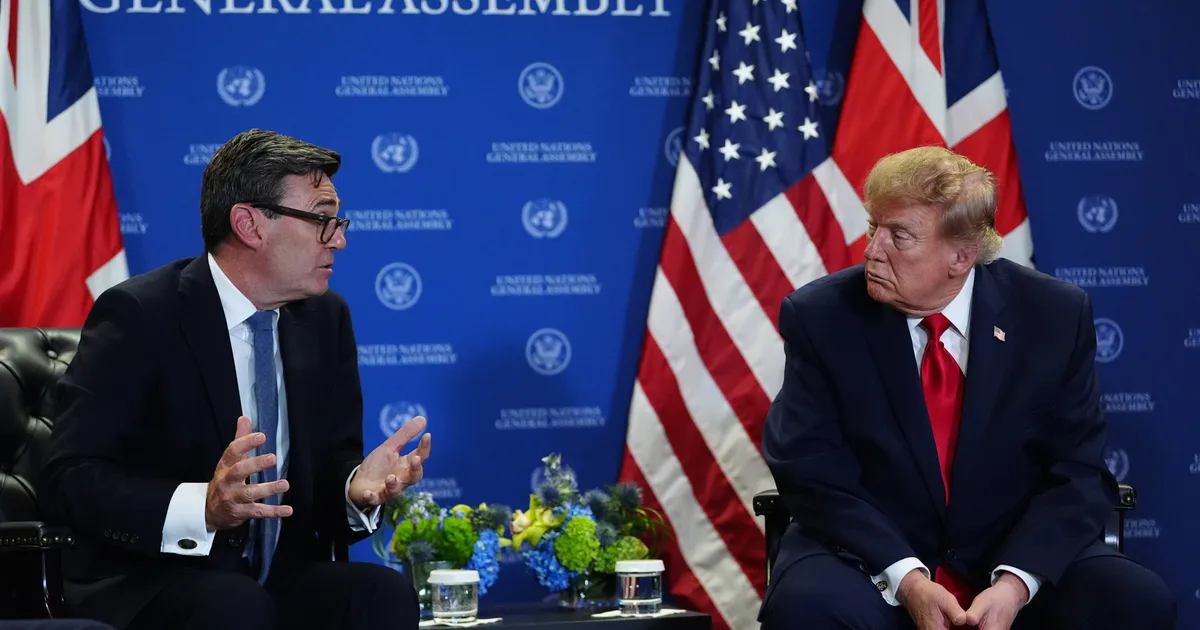
Donald Trump has condemned the UK government’s “terrible” plan to hand over the Chagos Islands to Mauritius.
The US president hit out at the “ridiculous” deal in his first face-to-face talks with Andy Burnham at the UN General Assembly in New York.
Trump said relations between the UK and America were “more up” now that Burnham had replaced Keir Starmer as prime minister.
He said Burnham was “going to be a great” – then delivered his damning verdict on the Chagos deal.
The UK government announced last year that it was going to pay Mauritius £9 billion over the next 99 years so the UK-US military base at Diego Garcia will continue to operate as it does at the moment.
But Trump said: “I don’t support it. I think it’s a terrible deal.
“They all of a sudden say they have ownership, somebody has ownership that never showed up before after decades and centuries. I think it’s ridiculous. No, we were talking about that.
“It’s strategically very important, very important. You know, we had to send our B-2 bombers when we bombed the Iran nuclear, we sent the B-2 bombers back home to Missouri. As opposed to flying for a short period of time, they had to fly for a long period of time.
“It’s amazing how strategic it is, and I think the prime minister is going to be looking at it. It’s very strategic location. And it’s unique…
“It’s a very important piece of real estate, militarily and strategically.”
Reform Uk leader Nigel Farage welcomed Trump’s comments.
Listen to Commons People, the podcast that makes politics easy. Every week, Kevin Schofield and Kate Nicholson unpack the week’s biggest stories to keep you informed. Join us for straightforward analysis of what’s going on at Westminster.
Politics
Politics Home Article | The SSEP could be the key to reindustrialising Britain’s heartlands
Credit: Adobe Stock

Britain is about to make some of the biggest infrastructure decisions of a generation. The Government should harness the opportunity do more than deliver clean, secure energy.
The Strategic Spatial Energy Plan (SSEP), which will set out where and when the country needs new energy generation and infrastructure through to 2050, presents a significant opportunity to Andy Burnham’s government.
The National Energy System Operator has submitted six potential pathways to government. Ministers will now select a preferred pathway, before consulting on it in early 2027. The immediate focus will understandably be to decide how much offshore wind, nuclear, solar, storage and other technologies Britain needs, and where they should be connected to the grid.
The question for Burnham’s government is how much of the economic value created by this enormous investment will Britain capture?
Given the significant pressures on energy bills across the UK and Burnham’s determination to concentrate on cost of living support, there will no doubt be a temptation for Ministers to prioritise the lowest cost pathway, focussed in southern areas where demand is highest and utilising cheaper imported technology.
This would be a false economy. Hundreds of billions of pounds will be spent in transforming the energy system, representing an extraordinary industrial opportunity. It can create demand for British manufacturing, engineering, innovation, port developments and skills.
Offshore wind demonstrates both the opportunity and the challenge.
Government already recognises the sector’s potential to support manufacturing, ports and jobs; the latest offshore wind auction was associated with £3.4bn of private investment and up to 7,000 jobs.
The long term nature of the SSEP can give companies the confidence to invest in factories, ports, research and skills if they have reassurance that there will be a sufficiently large and predictable market for their products. The SSEP can help provide that certainty.
This is where energy policy and industrial policy need to become much more closely connected.
The government’s Industrial Strategy identifies clean energy industries as a growth opportunity, and the SSEP should become one of the mechanisms through which that ambition is delivered. That means thinking strategically about the energy sector in terms of industrial clusters, supply-chain capacity and regional growth.
It also means recognising that innovation is not simply about developing new technology. It is about creating the conditions for companies to commercialise it at scale.
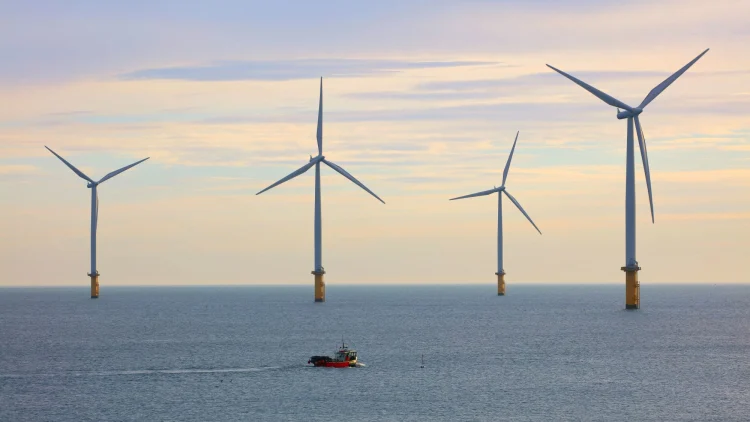
For floating wind, for example, Britain has an opportunity to build capability in areas such as foundations, mooring systems and dynamic cables. This activity can be spurred in areas such as Aberdeen, Northumberland and South Wales that desperately need industrial revitalisation. But that opportunity will not materialise automatically. It requires a credible pipeline of deployment and a policy environment that rewards investment in domestic capability.
The SSEP therefore needs to be judged against more than the traditional energy metrics of cost, carbon and security. Its success should also be measured by how much industrial capability it creates and how much economic value is captured.
If the government gets this right, the energy transition can become something more than a route to net zero. It can catalyse multi-generational reindustrialisation across Britain’s heartlands.

You might remember the heartbreaking story of Martha Mills, who died aged 13 after developing sepsis following an injury sustained during a bike ride.
Martha was admitted to hospital with pancreatic injury as a result of the end of her bike’s handlebar hitting into her stomach.
Per the BBC, her family’s concerns over her deterioration in hospital were not listened to, and – following her death – a coroner ruled that had she been referred promptly and appropriately treated, the “likelihood is that she would have survived her injuries”.
Her parents, Merope and Paul, later campaigned for a new rule whereby loved ones could flag concerns and trigger an urgent review if a patient’s condition deteriorated and they were concerned they weren’t being listened to by medical professionals.
This rule, dubbed Martha’s Rule, is now being rolled out across all NHS hospital A&E departments, with a view to complete this between now and March 2028.

Thomas Barwick via Getty Images
How does it work?
Patients, loved ones and even staff in busy emergency departments will be able to call a dedicated Martha’s Rule phone number to trigger an urgent review if a patient’s condition is deteriorating and they are concerned this is not being acted upon.
This is different to a second opinion, where you’d speak to another consultant to discuss a diagnosis or treatment.
As the service is operated separately by each NHS Trust or hospital, the phone number will vary depending on location. This information will be displayed on posters and information around participating hospitals.
Between now and 2028, patients and their families can check with their local hospital or NHS trust website whether Martha’s Rule is available – you can also ask hospital staff on site.
When would you invoke Martha’s Rule?
According to the Royal Papworth Hospital NHS Foundation Trust website, you might call the Martha’s Rule number if your loved one is:
- Acting different to usual (/is not being themselves)
- Breathing differently
- Sweating or looking an unusual skin colour
- Experiencing reduced urine output or not passing urine
- More sleepy than usual or confused
- Cold or very hot to touch on their hands
- In pain and looks uncomfortable.
Does Martha’s Rule work?
A pilot in seven trusts to test whether the escalation process worked in A&E environments found, over the course of eight months, 69 calls were made to dedicated Martha’s Rule phone numbers.
In some cases, this led to a patient having urgent surgery or being transferred to intensive care.
Discussing the rollout, Professor Aidan Fowler, National Director of Patient Safety at NHS England, said: “Martha’s Rule is already having a transformative effect in making our acute care even safer, and by expanding Martha’s Rule into A&Es, we are giving even more patients, their families and NHS staff a critical new lifeline to help improve care and save more lives.
“Early testing has shown that Martha’s Rule can work well in busy A&Es and builds on the evidence from our adult and children’s wards, where thousands of calls have been made by patients, families and staff to date – with many leading to changes in treatment and potentially life-saving interventions.”
So far, Martha’s Rule has been rolled out to 221 acute adult and paediatric inpatient sites. Hospitals are also expected to extend it to A&E, maternity and neonatal units by March 2028.
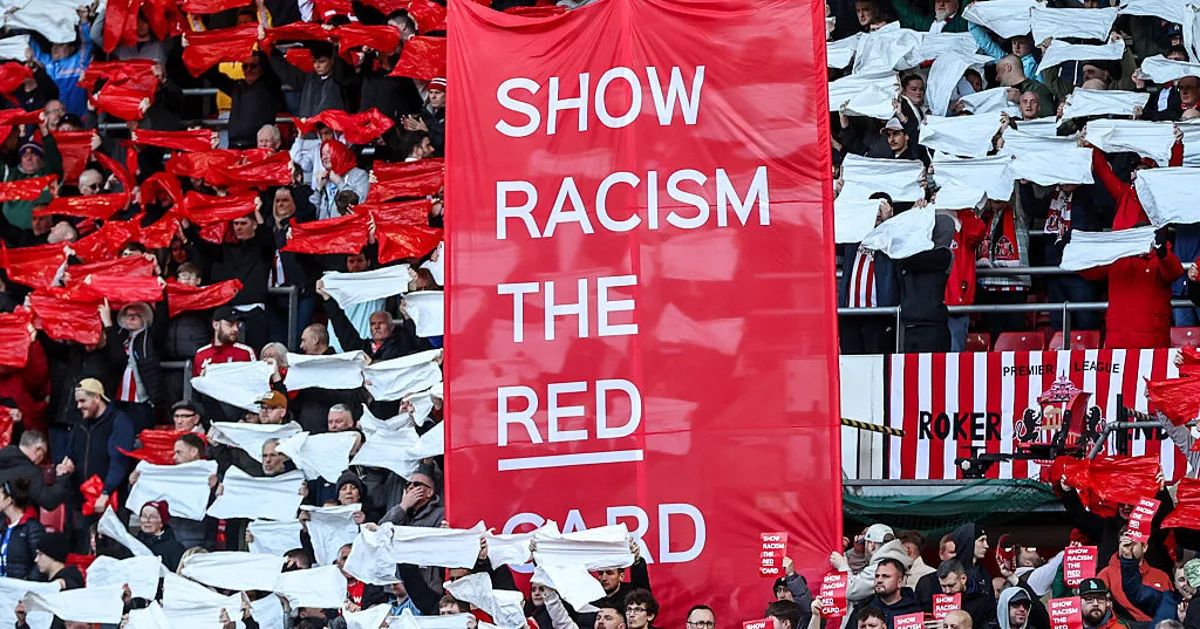
A charity which aims to kick racism out of sport could sue Reform UK after a council withdrew support for the organisation.
Chris Eynon, the leader of Sunderland City Council, said the local authority would no longer back “politically charged organisations with an agenda”.
He also accused Ged Grebby, chief executive of Show Racism The Red Card, of “stark political bias” over comments he has made criticising Reform.
Speaking to HuffPost UK, Grebby said he was expressing his own personal opinion rather than the charity’s, which he insisted has cross-party support.
He said any suggestions that Show Racism The Red Card was a political organisation “could cause huge damage” to the organisation.
Grebby said: “It’s a very serious accusation to say a charity is being party political.
“If Reform are making false accusations against us, our lawyer will look into whether it is libel.”
He added: “I’ve got a right to have my own political views, and I stand by comments I’ve made about Nigel Farage and Reform being dangerous. But as a charity we need to be cross-party.”
He said any suggestion that Show Racism The Red Card is linked to the Labour Party was “absolute nonsense”.
“As a charity we’ve got the support of the SNP, Plaid Cymru and the Greens,” Grebby said. “We’ve always worked with other political parties.”
Sunderland City Council has supported the charity since it was set up 30 years ago.
In the last year, the funding it received from the authority trained 250 teachers and educated 1,675 young people in the local area about tackling racism.
Grebby said the charity had been planning to re-apply for funding from the council, but now there was “no point”.
“The damage will be that we’re unable to provide those programmes in future,” he said.
Asked about Sunderland City Council’s decision on LBC, Reform home affairs spokesman Robert Jenrick refused to criticise them.
He said he had “not seen the evidence” behind the claim that Show Racism The Red Card is a “politically-charged organisation”.
But in a later post on X, Jenrick accused Grebby of being “a left-wing political activist”.
He said: “Residents would be right to question whether this organisation should be supported financially by their council under Mr Grebby’s leadership.
“Taxpayers shouldn’t be paying the wages of political activists like Mr Grebby. If Show Racism The Red Card wants to command public support, and receive public money and charitable status, I’d suggest they look for a new CEO.”
Listen to Commons People, the podcast that makes politics easy. Every week, Kevin Schofield and Kate Nicholson unpack the week’s biggest stories to keep you informed. Join us for straightforward analysis of what’s going on at Westminster.
Politics
Politics Home | Lib Dems In “Fight Of Our lives” Against “Well-Funded Far Right”, Warns Ed Davey

(Gary Roberts Photography / Alamy)

3 min read
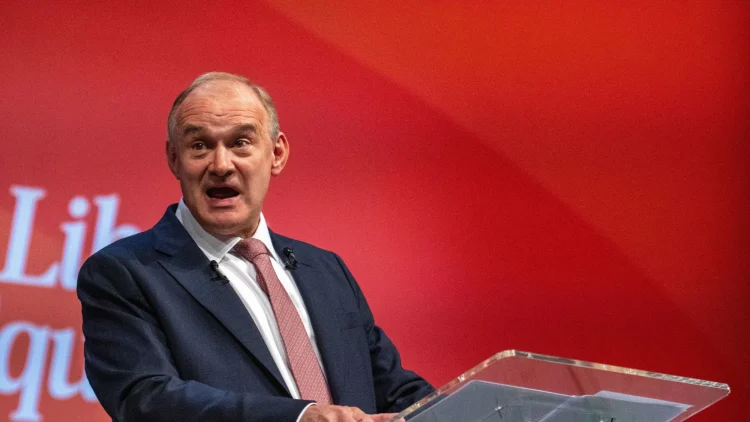
Ed Davey has warned Liberal Democrats that they are part of a fight for the country’s future against an “extremely well-funded” modern-day “far-right”.
Addressing Lib Dem conference in Brighton on Tuesday, Davey said the party faces “the fight of our lives” against a “far-right movement that is given oxygen, and heat, and fuel by politicians and parties who claim to be serious contenders to lead our country”.
Davey’s speech came amid growing pressure from within his party to give the Lib Dems a more distinct political offering to voters – and to make clear what they stand for. In an essay published days before the conference, one of his MPs, Roz Savage, claimed the party was “struggling for relevance” and failing to paint a “coherent picture of the country we are trying to create”.
In a new policy announcement, Davey pledged that a future Lib Dem government would take hundreds of thousands of people out of the higher rate (40p) tax band by raising the threshold to £56,000.
He also announced that the party would raise the tax-free personal allowance from £12,570 to £15,000, saying this would take more than 2m of the lowest-paid workers out of income tax completely.
Davey said he would fund these tax cuts using the economic growth achieved through his policy of rejoining the European Union’s Single Market and Customs Union.
Amid growing concern about AI models going rogue and posing a potential threat to humanity, Davey called for “a global treaty to press pause on super-intelligent AI now, before it’s too late”.
He compared the risks posed to civilisation by increasingly sophisticated AI models to climate change and nuclear weapons, telling the conference that the human species was facing “not just the fight of our lives” but engaged in a “fight for life itself”.
Throughout his speech, Davey sought to frame the Lib Dems as an opposing force to Reform UK, and repeatedly contrasted his party’s “community politics” with what he described as the divisive politics of Nigel Farage’s party.
“When that person you disagree with stops being just another little box on your social media feed, and becomes a human being with a face, a home and a life – that’s when we make progress,” he told the conference.
“With liberal community politics, we can answer people’s hopelessness and powerlessness. Not with a slogan, not with a scapegoat, but with hard work.”
One Lib Dem MP seated behind Davey during the speech told PoliticsHome it was “probably his best to date”, as he “articulated what liberalism means” alongside a “bold policy announcement”.
But another MP said that while the proposed tax cuts were welcome: “There’s just so much more we have to say. What people are looking for is not a cautious step-by-step approach to the next election, and the manifesto, but a sense of what it might be like to live in this future Britain, not just what we might have in our pockets.”
Party activist and former London mayoral candidate Rob Blackie, who is again running for his party’s London candidacy, said he was “disappointed by our pledge of tax cuts – which is not realistically possible given rising interest rates and the need to spend more money on cutting crime, the NHS and tackling climate change”.
Blackie praised Davey, however, for his “recognition of the incredibly high rents that Londoners face – and that Ed’s local council has announced plans to tackle this by building on an old golf course – exactly the sort of grey belt land that we should be converting to new housing”.
He added that Davey “is absolutely right to point out that closer links to Europe can boost our economy, tax revenues and the standard of living”.
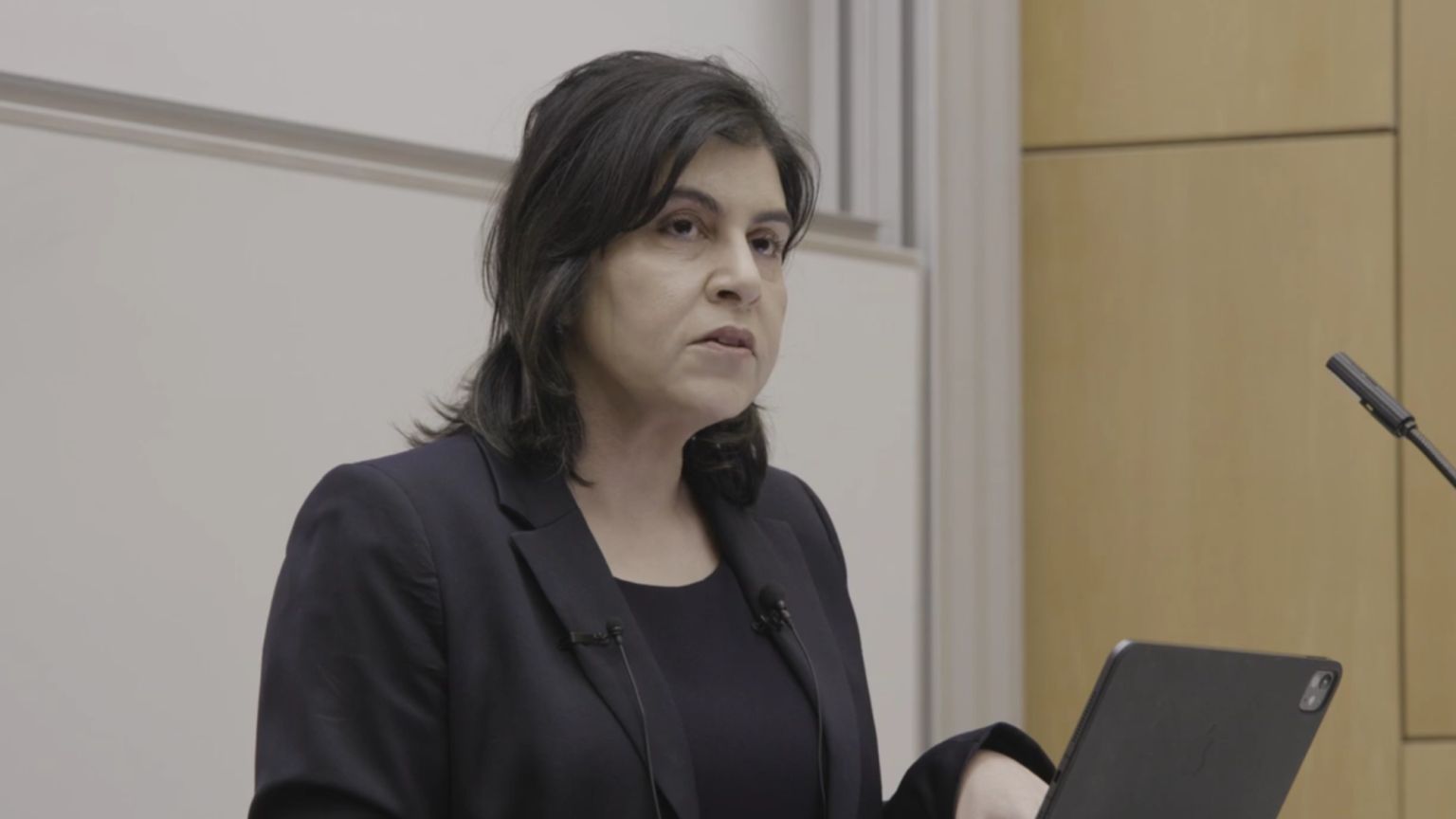
Warsi delivered the inaugural lecture at University College London for Equi titled ‘Patriotism: Pride not Prejudice’. Warsi’s carefully curated talk, as well as the nod to Jane Austen, was peppered with quotes from Edmund Burke and Samuel Johnson, along with paeans to cricket and village fetes. But these whimsical references concealed a darker message.
During the Q&A, I challenged Warsi on the framing of her lecture. We hear much from Labour and progressives about ‘Islamophobia’, but less about Islamic attitudes towards the West. What, I asked, about the profound hostility of the Deobandi and Salafi movements – which control the majority of British mosques – to the Enlightenment philosophy of personal autonomy, pluralism and universal human rights, including gender equality?
Her answer displayed a flippant disregard for the kind of threat Western nations face from Islam. In particular, the profound challenges that supremacist, exclusionary Islamic theology presents to public security, social cohesion and democracy in the UK. She said:
‘Does the Muslim community have nutcases? Absolutely. Does the Christian community have these nutcases? Absolutely. Does the Jewish community have these nutcases? Absolutely. And they’re always on display for all of us to see.’
This was a strange response. ‘Nutcases from the Muslim community’ – her phrase, not mine – have killed dozens and inflicted life-changing injuries on hundreds of Britons, including children, in the past several decades. They have stabbed two sitting MPs, one fatally. The vast majority of the suspects currently on MI5’s 43,000-person terror watchlist – as many as 39,000 – are jihadists. So why is Warsi telling me not to ‘waste my time’ interrogating the motives and goals of these ‘nutcases’?
I then asked her about support for Hamas among parts of the Muslim community and the willingness of many to deny the atrocities of 7 October. Yet rather than address these concerns, Warsi deflected and denied there was a problem. ‘I honestly don’t know who the six freaks are that you speak to that give you all this data’, she said. ‘But the people I speak with and I spend time with… hundreds and thousands of them, I have yet to meet somebody who’s told me Hamas is a great thing and I want to go out and, you know, kind of support them.’
Does Warsi really expect us to believe that only ‘six freaks’ support Hamas in the UK? It would be hard to explain, then, how a hardline Islamic platform like the UK-based 5Pillars boasts one million readers. Or the celebrations in cities across the UK after Hamas’s 7 October pogrom and the rampant anti-Semitism that accompanied them. In June 2025, 40 organisations – including students’ networks, religious groups and advocacy organisations – called for Hamas to be removed from the UK terror list.
If she’s lacking in any more inspiration, Warsi should talk to Labour MP Christian Wakeford, who, in parliament in November 2023, named four Hamas operatives living in the UK. One of the names Wakeford mentioned was Zaher Birawi, the leader of the Palestinian Forum in Britain, which was one of the organisers of pro-Palestine marches. Wakeford also named Mohammed Sawalha, a trustee of Finsbury Park Mosque and founder of the Muslim Association of Britain.
Sayeeda Warsi is clearly unfit to be highlighting prejudice or promoting social cohesion. She would be a menace if trusted to police ‘anti-Muslim hostility’.
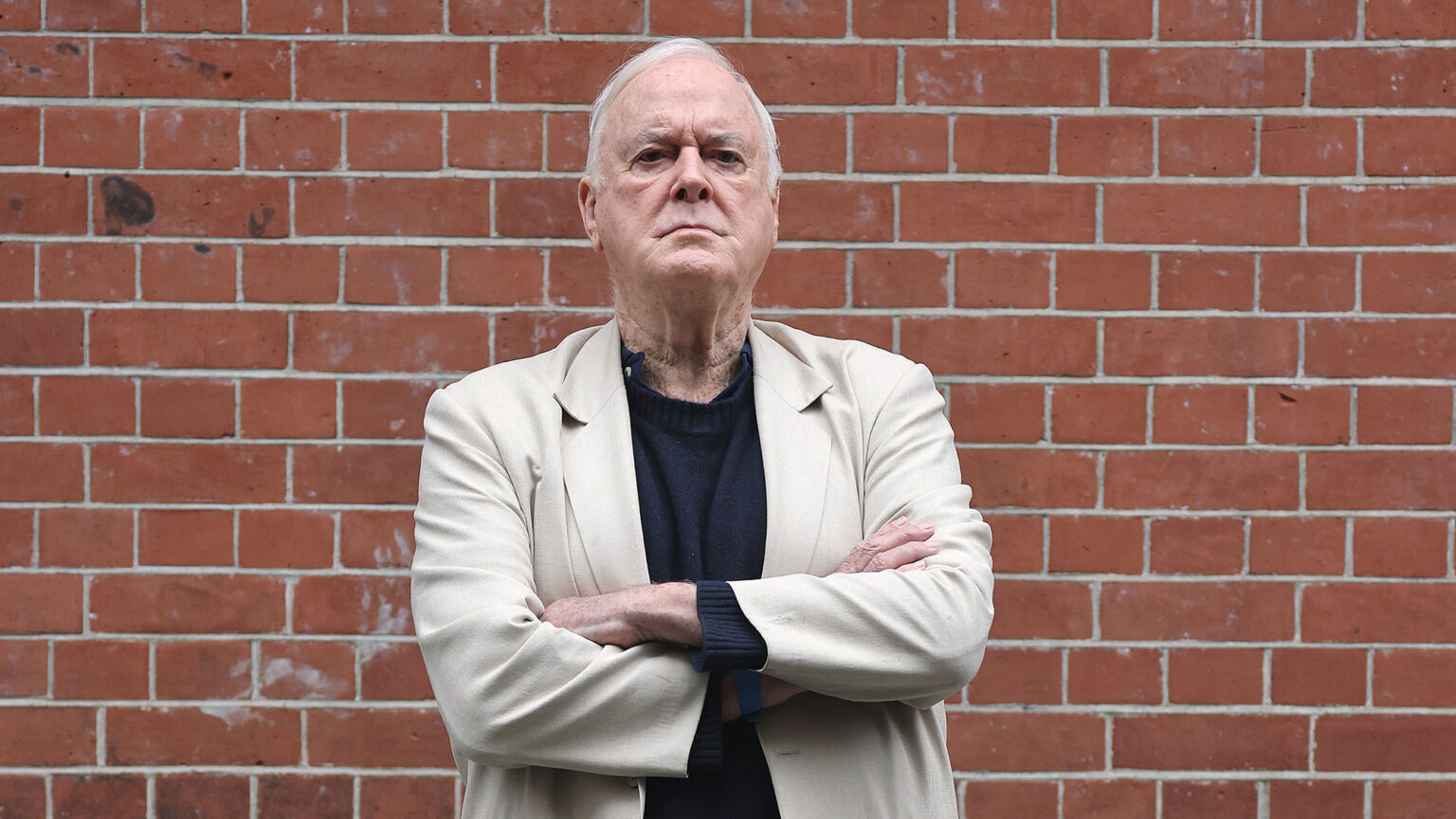
Imagine devoting 65 years of your life to entertaining the nation only to be told by a gang of pious pricks that you’re no longer welcome in England’s second city. That’s been the fate of the great John Cleese. He’s given us six decades of comedy, yet still he finds himself mobbed by hysterics who want to muzzle his wisecracking mouth. His crime? You already know. Everyone knows. It’s the same thing every time. He took the piss out of Islam.
Cleese is touring England with a live stage show celebrating Monty Python and the Holy Grail. He screens the 1975 movie and takes questions from the audience. That’s a pretty stand-up thing for a comedy giant in his late 80s to be doing. Not in the eyes of Islamo-narcissists, though. They’re amazed Cleese can even show his face in public following his numerous sins of blasphemous thought. Nothing makes the pious wet their pants like a comic chortling at their superstitions.
Cleese took his show to the Islamic Republic of Birmingham on Sunday night. News of the blasphemer’s arrival caused a wave of horror among that city’s legion Islamo-nutjobs. One group, by the name of Deenified, put out a hilarious / sinister video in which young men upbraid Cleese for ‘attacking Islam’. You’re a ‘hate preacher’, they cry. Islamic agitators calling others hate preachers? RIP irony.
They called on Birmingham Town Hall, where Cleese was appearing, to ‘align with its duty of community respect’ and ‘cancel the show’. ‘Align with its duty of community respect’ – what a chilling, slippery euphemism. Perhaps they were worried they’d give the game away if they said ‘Silence the blasphemer!’. Unfortunately for them, we infidels aren’t as dumb as we look: we know that lurking in that velvet glove of community-speak is the iron fist of a medieval intolerance for the greatest liberty of all: the liberty to speak.
What sacrilegious utterances has Cleese made to earn such ire? He said, ‘The Koran’s teaching is ALL about acquiring power’. He said Britain’s ‘cultural heritage’ is ‘vastly superior’ to the Islamic way of life. He said ‘Islamophobia’ is a sinister term designed to ward people off from ‘criticising a religion’. He said too many comics hold back from mocking Islam because they don’t want to be murdered. He said some Muslims behave like ‘a bunch of five-year-olds’, wailing whenever someone mocks their beliefs.
Okay. What’s the problem? All of this falls squarely within the realm of legitimate discussion of an ideology. He’s right that living in Britain is better than living in a desert state where women are put in binbags and you can be whipped for dissing Allah. He’s right that people have been slain for ‘insulting Islam’, from the heroes of Charlie Hebdo to the schoolteacher Samuel Paty. As for his claim that some Muslims behave like five-year-olds – the Birmingham mob’s horror at such ‘hate speech’ might carry more weight if they weren’t behaving like five-year-olds. Aw, someone hurt your feelings? Do you want your dummy?
Even if Cleese has said things that don’t stack up, so what? Neither does the claim that Muhammad flew to heaven on a horse, yet I’d fight to the death for your right to peddle such medieval mumbo-jumbo. You have the liberty to believe whatever you want and the rest of us have the liberty to rip the living piss out of your beliefs. It’s the British way. If Birmingham is falling to a non-British ideology, one that treats criticism of Islam as a moral offence punishable by exile, then we need to take action. Firm action.
In the end, Cleese’s Brummie show went ahead. But we still need to talk about the sheer gall of these self-appointed blasphemy police who think they have the right to crush speech that wounds their porcelain feelings. In 1979, it was Christian hotheads who came for Cleese and the other Pythons over their ‘blasphemous’ film, Life of Brian. Now it’s Islamic hotheads hounding Cleese for his profane chatter. What a brilliant, terrible snapshot of the slow-motion conquering of our cultural realm by the unforgiving Islamist mindset.
It was British society’s suicidal indulgence of Islam that gave rise to these insufferable, preening, lily-livered Islamo-censors. For too long we’ve bowed to the backward idea that demurring from Islam is a species of racism. We have institutionalised the thought-strangling ideology of ‘Islamophobia’. Even now, the Labour government is rustling up yet another definition of ‘Islamophobia’ that will punish impious speech. Every time our ‘betters’ turn a blind eye to acts of Islamist intolerance – like the hounding into hiding of the Batley Grammar schoolteacher, or the despicable censoring of a film about the daughter of Muhammad in 2022 – we embolden the mob. Their censorious arrogance feasts and fattens on our cowardice.
Enough. We now have a moral duty to make fun of Islam, in order that we might puncture this sanctimonious regime of silencing that our dumbass establishment helped to birth. Cleese is doing a great service to the historic cause of British liberty by dislodging the deranged idea that one religion should still enjoy protection from blasphemy. No way. Our forebears had their tongues torn out and their faces branded for the crime of speaking frankly about God and religion. We finally abolished our blasphemy laws in 2008. We didn’t go through all that only for people to risk losing their jobs and in some cases their lives for saying Islam is bullshit in 2026.
The Life of Brian ‘scandal’ helped to push us closer to the promised land of liberty. Cleese and the other Pythons took to the airwaves against priests and bishops to defend the hard-won right to ridicule religious dogma. Comedians and cultural figures backed the Pythons. Where are those people now? Why are they silent as Cleese is insulted by religious cranks? Why have they not spoken about the Batley teacher or the pre-emptive crushing of art that might offend Muslims? What treachery. Give me Cleese’s fruity commentary over such arse-covering cowardice any day of the week.
The post The memory-holing of Mitchell and Webb tells us the BBC are the baddies appeared first on spiked.
Crypto market structure can’t wait for shot at post-election Clarity Act surge: White House

Social Media Reacts To Grand Jury Decision In Nolan Wells’ Death
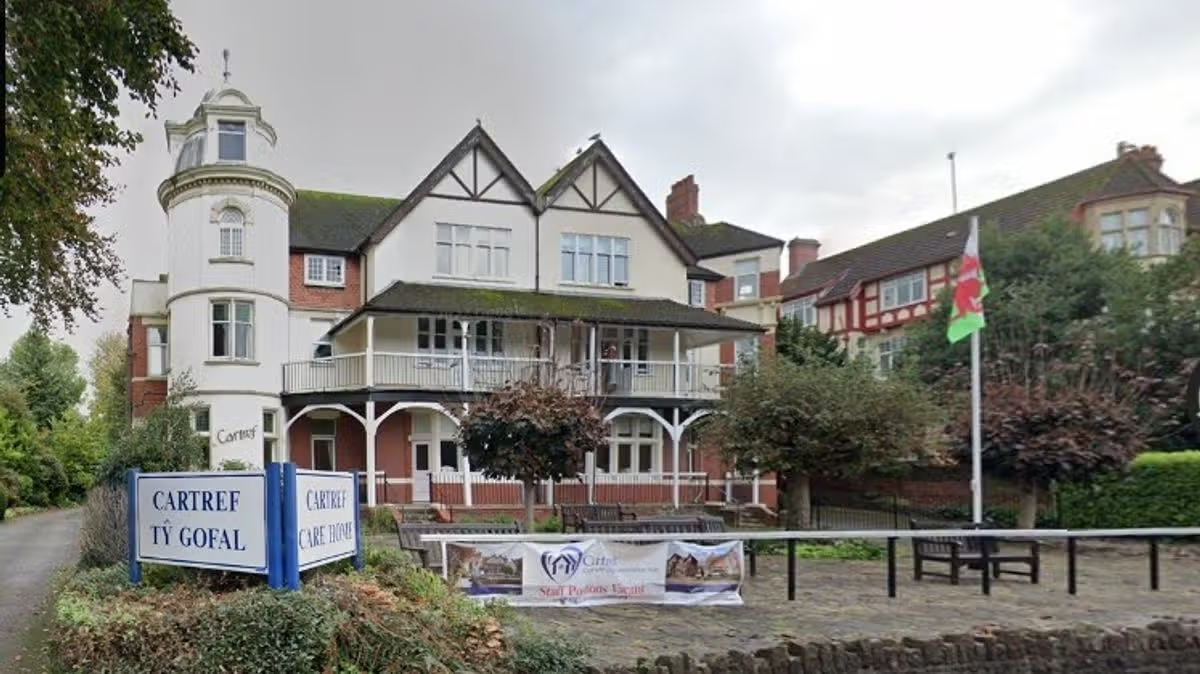
New nursery to open in Cardiff despite traffic and noise concerns




-

 Fashion4 days ago
Weekend Open Thread: Talbots – Corporette.com
-

 Crypto World7 days ago
Robinhood engineers charged over $50K crypto scheme
-

 Tech2 days ago
Researchers escape OpenAI Codex sandbox to run commands on host
-

 Crypto World4 days ago
Circle launches Arc Studio AI agent for building onchain apps
-
 NewsBeat4 days ago
Trump says US has reached an agreement to take permanent control of Greenland’s security
-

 Crypto World2 days ago
Who Needs CLARITY Anyway? ARB Could See 70X Increase: Hodler’s Digest
-

 Crypto World4 days ago
Bitcoin price breaks channel as RSI climbs to 63
-

 Crypto World4 days ago
Trading Bitcoin on Robinhood? Why 2% Spread Has Traders Worried
-

 Crypto World6 days ago
US Charges Robinhood Engineers Over Crypto Listing Trades
-

 Crypto World7 days ago
What Is the Status of the U.S.-Iran Peace Talks? Here's What Both Sides Are Saying
-

 Tech7 days ago
Webb’s IC 348 Mosaic Includes Two-Jupiter Dwarfs, Twin Jets, and a Nursery Still Making Worlds
-

 Crypto World5 days ago
Mortgage and refinance interest rates today, Thursday, September 17, 2026
-

 Crypto World4 days ago
World Money launches in 150+ countries with Stripe
-

 Entertainment7 days ago
Big Brother Update: Melody Explodes at Drew as Illness Sweeps BB28 House
-

 Crypto World4 days ago
Silver prices recover quickly, hitting weekly high today
-

 Business2 days ago
Analog Devices (ADI) Bets $1.35 Billion on Chips that Let Machines Think for Themselves
-

 Tech5 days ago
GPT-6 Astra Reached the Nether in Minecraft, Lost Its Stash to a Creeper, and Farmed Potatoes for Hours
-
 NewsBeat4 days ago
US was ‘on brink of war’ with China over false AI report of nukes moving in Middle East
-

 Crypto World2 days ago
Coinbase, Robinhood, Circle Seen as Tokenized-Stock Winners
-

 Crypto World2 days ago
Bitcoin price holds above $81K as key catalysts line up
You must be logged in to post a comment Login