
Politics
Teyana Taylor Addresses Criticism About Her Behaviour At This Year’s Oscars

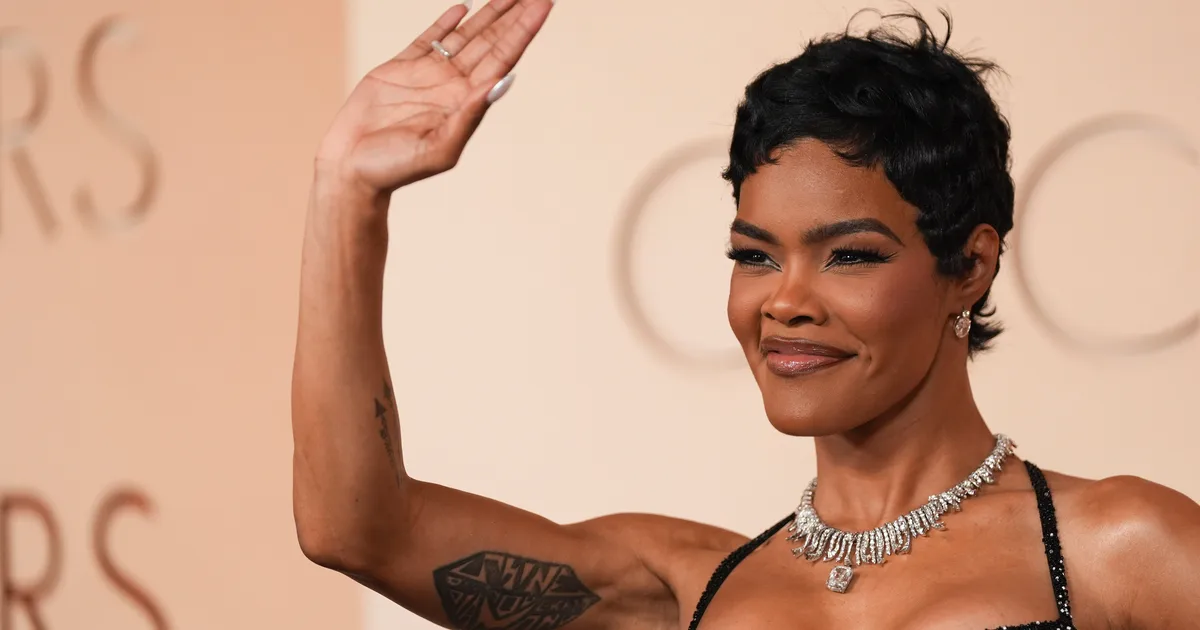
Teyana Taylor has responded to criticism aimed her way following this year’s Oscars.
On Sunday night, the singer and actor attended the Academy Awards, where she had been nominated for the Best Supporting Actress title off the back of her performance in One Battle After Another.
At the beginning of the ceremony, this award was the first to be announced, with Teyana visibly jumping to her feet when the winner was revealed as Weapons star Amy Madigan.
Later in the night, when One Battle After Another was announced as the recipient of the Best Picture prize, Teyana was seen celebrating with director Paul Thomas Anderson, even jokingly putting him in a headlock on their way up to the stage.
Following the ceremony, one critic on X questioned “WTF” was “going on with Teyana”, accusing her of “wildin’ at the Oscars”, while another claimed that they “knew from the first hour something was off” with her.
Teyana reacted on Monday night, lamenting to her X followers: “The world holds so much misery that miserable hearts forget the face of happiness. They grow comfortable being sore losers, so when they see real sportsmanship it unsettles them! Like holy water touching a demon.
“Because clapping for someone else’s victory requires something many people never learned… how to win with grace and pure joy, and how to lose with grace, chin up and dignity.”
Asked about the headlock moment by Variety, Teyana also claimed: “What’s crazy is we kind of took it back to [the] Critics’ Choice [awards] when I told him, ‘listen, if you get that Best Picture, I’m telling you now, we’re going to get you a helmet’. Because I’m such a sports girl, so I’m just like ‘yeeeeeeeah!’.
“It’s our little inside joke – so he already knew the headlock was coming. He knew the headlock was coming.”
Back in January, Teyana won a Golden Globe for her work in One Battle After Another, and was also nominated for a Bafta, an Actor Award (previously known as a SAG Award) and Critics’ Choice Award.
One Battle After Another was the big winner at this year’s Oscars, triumphing in six categories overall, including Best Picture, Best Director, Best Adapted Screenplay and the inaugural Best Casting prize.
Sean Penn also scooped Best Supporting Actor, marking his third Oscar win, but he did not attend the ceremony to accept it.

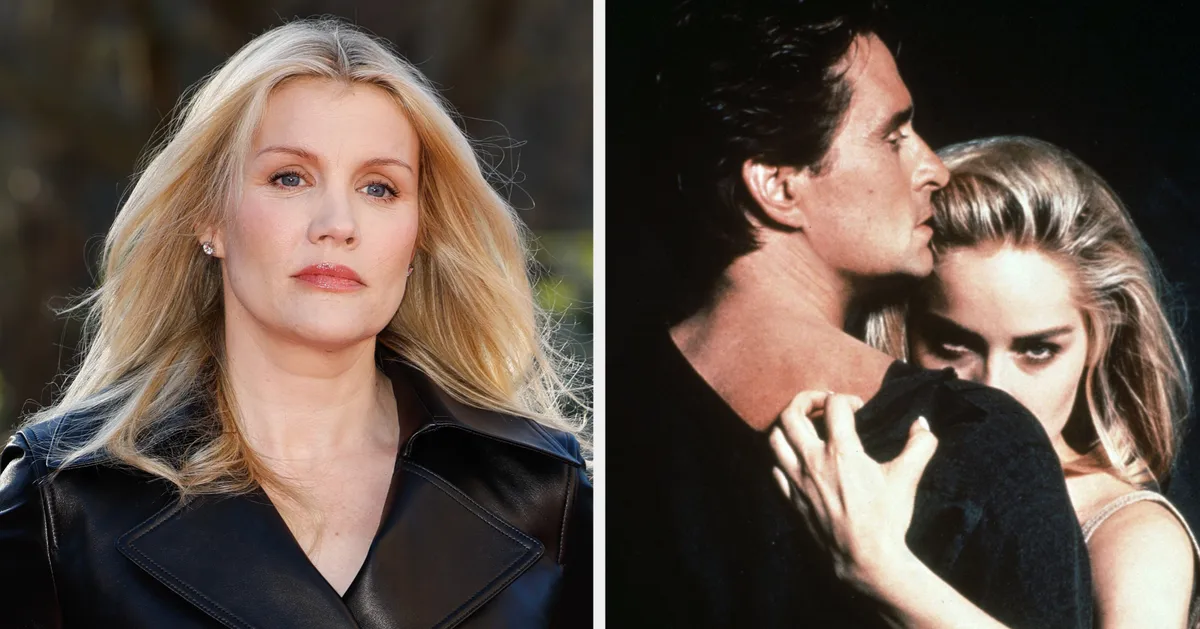
Oscar-winning filmmaker Emerald Fennell has denied reports that she is in talks to direct a new reboot of the erotic thriller Basic Instinct.
Earlier this week, the Saltburn and Wuthering Heights director was said to be in negotiations to helm the new project, following comments made by its screenwriter, Joe Eszterhas.
However, as his claims became more widespread, a spokesperson for Emerald was quick to shoot down the rumours.
In a statement to HuffPost UK, her representative said: “There’s no truth in this. She is not involved in any way.”
Production company Amazon MGM Studios also called the reports “categorically false”.
During an interview with The Guardian published on Tuesday, Joe – who also wrote the scripts for Showgirls and Flashdance – claimed that he was almost done with penning his new version of Basic Instinct.
He alleged: “The producers are negotiating with a really interesting director – a Brit, Emerald Fennell – who did Promising Young Woman and Wuthering Heights.
“Her sensibility is exactly right. She’s someone who is not afraid of controversy and sexuality. So I’m thrilled by that. I hope it works out.”
After starting her career in front of the camera in projects like Call The Midwife and The Crown, Emerald made her feature-length directorial debut in 2020 with Promising Young Woman.
The movie went on to be nominated for five Oscars – including Best Picture, Best Director and Best Actress for Carey Mulligan – and won one in the Best Original Screenplay category.
Her next film, Saltburn, generated even more conversation thanks to its dramatic twists, graphic sex scenes and performances from the likes of Barry Keoghan, Jacob Elordi and Rosamund Pike.
More recently, she put her own spin on the classic gothic romance Wuthering Heights, which proved to be the most divisive film of her career, mostly down to the many deviations she took from Emily Brontë’s original novel and controversy surrounding the casting of Jacob Elordi and Margot Robbie as her Heathcliff and Cathy.

Spain’s prime minister has torn into Donald Trump for unleashing “chaos” with his war in Iran.
The US president agreed a two-week ceasefire with Tehran overnight, following more than a month of conflict.
The news came as a relief considering the president had warned a “civilisation will die” unless the Iranian regime agreed to end the war just 24 hours before.
Trump had told Tehran it had to re-open the Strait of Hormuz, the major shipping lane which transports a fifth of the world’s oil supply, by 1am Wednesday morning (UK time) – or he would attack civilian infrastructure.
Oil prices have already started to fall after the truce was announced but there is no guarantees that the global economy will settle back to normal anytime soon.
Spain’s Pedro Sanchez made it clear he is not willing to forget the mayhem unleashed by the US’s Operation Epic Fury.
According to a translation on X, the Spanish PM tore into the US for the “destruction” it has caused over the last six weeks.
He said: “Ceasefires are always good news.
“Especially if they lead to a just and lasting peace.
“But this momentary relief cannot make us forget the chaos, the destruction, and the lives lost.
“The government of Spain will not applaud those who set the world on fire just because they show up with a bucket. What’s needed now: diplomacy, international legality, and PEACE.”
The Iran war has put a major strain on US relations with European allies.
Trump has repeatedly raged over Nato’s refusal to support him in the conflict, even though the alliance was built for defence – not to attack.
Allies also refused to send warships to the Gulf to force Iran to keep the Strait of Hormuz open, with figureheads like Keir Starmer reminding the public that it is “not our war”.
The prime minister has been particularly berated by Trump because the UK refused to grant American troops access to British military bases for pre-emptive strikes on Iran.
While Starmer permitted the US to use its sites for defensive and limited strikes, Trump has called British ships “old and broken down”, comparing them to “toys”.
On Monday, he even compared Starmer to 1930s Tory PM Neville Chamberlain, who is remembered for pursuing an appeasement policy towards the Nazis before World War 2.
Politics
Callum Murphy and Luke Robert Black: From Canary Wharf and Canning Town – what younger urban voters are really telling Conservatives
Callum Murphy is the Director of Campaigns for the Conservative Friends of the Overseas Territories and is standing as a Conservative candidate in Canary Wharf. Luke Robert Black MBE is the Director of Engagement for the Next Gen Tories and standing as a Conservative candidate in Canning Town.
As Conservative candidates in Canary Wharf and Canning Town respectively, we are campaigning among voters who are often described in fixed terms: younger, diverse, urban – and assumed to be politically out of reach for the Conservative Party.
But on the doorstep, the reality is more fluid – and more promising.
Across East London, we are meeting a generation in their twenties, thirties and forties building careers in a modern, service-driven economy. They are renting at high cost, drowning in service charges, paying significant sums in tax, and trying to establish themselves in one of the most competitive cities in the world.
They are ambitious. They are hard-working. And they want to get on.
These are not voters who reject aspiration – they live and breathe it. The question is whether we are matching that aspiration with a credible Conservative offer.
For too long, we have not done so clearly enough. That has now changed.
Kemi’s New Deal for Young People represents a conscious shift back towards the priorities of this generation: home ownership, rewarding work, and the ability to build a secure future. Not at all departure from Conservative principles, but a sharper application of them to modern urban life.
It’s a genuine four-point plan we can point to on the doorstep – removing fiscal burdens on young people like Rachel Reeves’s graduate tax grab, helping to remove some of the costs of getting onto the ladder and celebrating young people for the vital contribution they make to our economy. That matters, because the pressures these voters face are real – and increasingly shared.
Housing is the clearest example. For a generation doing the right things – studying, working, contributing – the prospect of owning a home still matters, but feels distant for too many. High rents and constrained supply shape everyday decisions, from career moves to starting a family.
We should be honest about that frustration. But we should also be clear about the answer.
A serious Conservative approach means being serious about acknowledging the principles of supply and demand. This means building significantly more homes. It means building them faster, building them more beautifully, building them larger and building them in the places that people want to live.
Densifying gently in areas where there are transport links, job opportunities and cultural interests. Young Londoners want to live near the action. They want to live a reasonable tube ride from All Points East festival, Drumsheds or a good gym. They want to be able to enjoy this city’s restaurants, galleries, parks, theatres, cafes, bars and clubs. They want to enjoy the city they live in. They also want to acquire, accumulate and grow their wealth – don’t we all? So, restoring a property-owning democracy is not simply good policy; it is essential to restoring belief that the system rewards effort and allows people to enjoy their lives.
Alongside housing sits a second pressure: the sense of being overtaxed without getting ahead.
Many younger professionals we speak to are earning well by national standards, but do not feel secure. The combination of high living costs and the tax burden leaves them stretched, even as they do everything that should lead to progress. Plan 2 graduates feel this the most.
They are not asking for handouts. But they do expect fairness – a system where work is rewarded and advancement is possible.
This is where Kemi’s New Deal is politically important. A clearer commitment to growth, to lowering the burden on work, and to making it easier to build a family and a future speaks directly to lived experience – not abstract notions of what young people want.
And when that argument is made with confidence, it lands.
This is made even more salient when Labour’s taxation has catapulted the job prospects of young people into new territory – with the highest rate of unemployment in Europe – and Reform accuses young people of not doing ‘real work’, being lazy and working less hard than the nation’s pensioners. It’s a clear distinction that is becoming clearer every day – as a generation of ambitious, young, thoughtful people look for a party to place their trust in.
One of the most striking features of campaigning in our areas is the response to a pro-growth message. These are voters working in industries that drive Britain forward – finance, technology, construction, logistics. They want a country that is open, competitive and ambitious.
They do not want managed decline. They want opportunity.
That is a Conservative argument – and once again we are willing to make it.
At a local level, the expectations are straightforward: safe streets, clean neighbourhoods, and services that function properly. But beneath that sits something deeper – a demand for competence, seriousness and accountability.
That, too, should play to Conservative strengths.
Encouragingly, we are beginning to see the party respond – not just in policy, but in people. Across London, a new generation of Conservative candidates is stepping forward, rooted in their communities and shaped by the same pressures as the voters they seek to represent. This was shown last month as more than 180 under-35s standing as local Tory council candidates met to kick off their campaign.
That credibility matters. It signals that we are not just talking about these voters, we are starting to reflect them.What we are seeing on the doorstep is not entrenched opposition, but an open question.
Many younger urban voters already share core Conservative instincts: belief in aspiration, support for enterprise, and a desire for a fair link between effort and reward. What has been missing is a clear, modern offer that connects those instincts to their everyday lives. That gap is now beginning to close.
If we continue to do so – serious on housing, serious on growth, serious about helping people get on – then the assumptions that have long defined urban politics will start to shift. There is more to do – but the opening is there for Kemi and our party.
And if we sustain that shift, then areas like Canary Wharf and Canning Town could not just be places where we compete, they could be central to how we win again.

The new TV follow-up to The Handmaid’s Tale is already being hailed by critics as a worthy successor to the Emmy-winning original series.
Adapted from Margaret Attwood’s book of the same name, The Testaments takes place decades after the events of the Handmaid’s Tale finale, but while time has moved on, things are still as bleak as ever in Gilead.
In this new chapter for the franchise, the action is centred around teenagers at a finishing school for girls being primed for marriage – which has led to surprising comparisons to everything from Gossip Girl and High School Musical to Pretty Little Liars, albeit with a nightmarish undercurrent.
Led by Oscar nominee Chase Infiniti, who recently won acclaim for her work in One Battle After Another, and Bafta winner Lucy Halliday, the show has already won a wave of near-unanimously positive responses from critics.
Here’s a selection of what the early reviews for The Testaments have had to say…
“In some ways, it is slightly lighter and brighter than its precursor – a kind of YA reboot. Set a few years after the end of The Handmaid’s Tale, it focuses on the next generation of Gilead women. But it’s a YA version that still encompasses bloody punishments, rotting corpses swinging from gibbets and indoctrination and abuse – with the youth of the protagonists making it even harder to watch. The iconography remains ravishing, though.”
“A story that feels fresh and vital and every bit as compelling as the original […] this is Bridgerton meets Lord Of The Flies; a young adult epic for the ages.”

“The Testaments is a triumph. The ten-part series achieves what few sequels or spin-offs do, to stand as an impressive entry outside of its predecessor and feel disturbingly familiar, while offering something new entirely.”
“A stunning follow-up […] The Testaments is a show about sovereignty and rebellion. It’s about having the courage to pull the rug out from under oneself, even when a soft landing place isn’t guaranteed. It’s a reminder that while the youth may be naive, once their eyes are opened, they can never unsee what they’ve discovered.
“Finally, it’s a stellar examination of the uniqueness of girlhood and how the patriarchy underestimates the power of female connection, often to its peril.”
“Not only does it succeed as a sequel, The Testaments is also a wonderfully defiant adaptation of the source material. The changes that have been introduced keep this story fresh in ways that better suit the medium of television without sacrificing the original tone or message that underlies it.
“This first season is about as perfect as a retelling of The Testaments could be, and it’s the best this franchise has been since The Handmaid’s Tale first peaked with seasons one and two.”
“There’s no case of sequel-itis here. The Testaments feels just as urgent as its predecessor – and just as darkly enjoyable.”

“Dystopian or not, there is always fun to be had watching young people navigate the trials of growing up. Aunt Lydia’s academy may be hell on earth, but it’s also Mean Girls with a dystopian twist.
“You have to admire the sheer chutzpah that the producers have displayed in taking a respected sci-fi text and turning it into a sort of George Orwell version of High School Musical – a potentially disastrous gamble carried off with style and assurance.”
“Plum-cloaked in a YA-leaning, high school drama that owes as much to Pretty Little Liars or Gossip Girl as it does to The Handmaid’s Tale, The Testaments gives us an apocryphal version of the Epstein files.”
“There are terrific performances here, from budding star Chase Infiniti, up-and-comers like Lucy Halliday and Mattea Conforti, and known commodities like Ann Dowd and Amy Seimetz.
“But there’s something creatively suffocated about The Testaments, from the endless references to events featured in The Handmaid’s Tale to the cameos by key Handmaid’s figures to the various recycled archetypes to 10 episodes spent withholding a revelation I’m convinced every single Handmaid’s viewer will have already guessed.”
“On a school trip Lydia’s charges stand before a gibbet of hanged rapists and at a school assembly they scream for violent punishment against a man caught masturbating. But we’ve seen it all before, and it doesn’t feel shocking any more.
“Within the strains and tensions of a teen coming-of-age story there is a compelling sense that while the girls may be victims of male-dominated religious intolerance, they can also be complicit in authoritarian cruelty. But the show feels like another teenage drama set within an all-too-familiar landscape.”
The first two instalments of The Testaments are now streaming on Disney+, with new episodes coming every Wednesday.
Politics
Miriam Cates: Time’s up for the triple lock but there’s little hope of pension reform from the Right
Miriam Cates is a presenter on GBNews and the former MP for Penistone and Stocksbridge.
I never used to understand the appeal of the radical left.
The combination of socialist economics and a rejection of tradition is a recipe for disaster, as has been proven time and again over the last century. But last week, for a brief moment at least, I experienced a pang of revolutionary zeal and saw why the extreme left, currently embodied in Zak Polanski’s Green Party, has become so popular with young people in Britain.
This revelation was delivered to me during a Reform UK press conference, where treasury spokesman Robert Jenrick announced that his party was now committed to keeping the pensions “triple lock.” In doing so, Jenrick slammed the final nail in the coffin for the hope of state pension reform from the political right.
Should the Tories (who still support the triple lock) or Reform, or a coalition of the two win the next General Election, Britain’s young people are now condemned to pay through the nose for the retirement of the wealthiest generation in history, while simultaneously being denied the opportunity for homeownership and parenthood that their parents and grandparents took for granted.
Storming the barricades seems like a perfectly reasonable response in such circumstances.
The triple lock is a relatively new policy, introduced by the Conservative-Lib Dem coalition government in 2011. It guarantees that each year, the state pension will rise by the highest of inflation, wages or 2.5 per cent. It is a mathematical certainty that the annual increase will always exceed the average of these three metrics, and that is why since in the last 15 years, the state pension has increased by 70 per cent, twice as much as wage growth over the same period. By 2030, the triple lock alone – not the cost of the pension itself – will add £15 billion a year to Britain’s benefit bill. And the price tag will continue to rise as the value of the state pension increases and more of Britain’s “baby boomers” reach retirement age.
The pensions triple lock is a policy that everyone in Westminster – politicians, economists, think tankers and journalists – knows is unaffordable.
Since pensions are paid from current taxation and the birth rate has been falling for 50 years, a shrinking group of working age tax payers is taxed more and more each year to fund a growing number of pensioners. The state pension is driving our economy off a cliff, yet no one in the corridors of power dares to admit it in public – though all do so in private – for fear of losing the ‘grey’ vote.
I had hoped that Reform would be different.
In so many policy areas, Nigel Farage has stood bravely against the consensus, holding his ground and winning the argument, forcing the Conservative Party (eventually) into more conservative positions. On Brexit, immigration, the ECHR and Net Zero, Farage steeled himself against establishment opprobrium, and shifted the Overton Window. The Reform leader has even had the courage to ditch some of his own popular but unsound policies – such as raising the income tax threshold to £20 000 – by explaining the need for fiscal responsibility. In recent months, both Farage and Richard Tice have hinted that the triple lock may need a rethink, rolling the pitch – or so I thought – for an honest debate. Farage is often labelled a ‘populist,’ but the British political right has been considerably strengthened by his willingness to risk being unpopular.
That is why last week’s triple lock announcement is so disappointing.
In departing from the Faragist modus operandi, Reform UK has ducked the challenge of using their unique place in British politics to shift the dial on pensions reform and force the Conservatives into a more sensible position. It was noticeable that in the press conference, both Jenrick and Farage reinforced misunderstandings about how Britain’ s state pension is funded, saying that retirees have ‘paid into’ their pension, even though this is untrue. National Insurance payments are not saved for an individual; NI is a tax that is used to cover the cost of current public spending. The average pensioner receives around 25 per cent more from the state than they contributed in tax and NI. This popular myth – that pensioners receive their pensions from a ‘pot’ with their name on it – is one of the major political barriers to reform and politicians ought to take every opportunity to correct rather than perpetuate the misconception.
Reform (and the Conservatives) also claim that the triple lock can be afforded by cutting spending on foreigners and the workless. But our national finances are in such a perilous state that we must do everything at once. State pension expenditure has reached £150 billion a year; annual spending on asylum hotels (which should of course be stopped) sits at just £2 billion. Universal Credit claims by households including at least one foreign national amount to less than £15 billion a year. It is not possible to reduce spending enough without addressing the burgeoning cost of the state pension.
Supporters argue that Reform’s commitment to the triple lock is born of pragmatism, and that the Party must bolster its position among older voters. Pragmatic it may be, courageous it is not. And it is certainly not in the national interest.
Yet judging by the arguments raging online and in the media this week, it is clear that many on the right see the triple lock and the state pension as untouchable foundations of government policy. Three main arguments are being made by so-called conservatives in favour of the status quo, none of which stand up to scrutiny.
Firstly, opponents to pension reform argue that a generous state pension is part of the social contract and so, even though the state pension is technically not a contributory scheme, it would be immoral for the government to change the terms. But healthcare and unemployment benefits are also part of our social contract, and we all recognise that it is up to the government of the day to set the level of NHS spending and welfare eligibility criteria based on what is sensible and affordable. When the current state pension was introduced, life expectancy was 65 and the birth rate was high enough to sustain our native population. In all other areas of policy making we recognise that times have changed; why ring fence the state pension?
Secondly, supporters of the non-means tested state pension claim that those who paid tax throughout their working lives are entitled to this state handout because of their financial contribution. But by that logic, all working age taxpayers should be allowed to claim Universal Credit. The welfare state is based on the understanding that high earners pay a lot of tax and at the same time are not entitled to benefits. It’s unclear why this should only apply to those under the age of 67.
Lastly, it is argued that pensioners deserve a well-earned and comfortable retirement as a reward for their working life. I have no doubt that most of Britain’s current retirees have indeed worked hard. But no generation has ever before – or will again – enjoy such lengthy and wealthy retirements, benefitting as they have from improved healthcare and macroeconomic policies that saw asset prices rocket. Are Boomers more deserving than, say, the silent generation who fought the Second World War, or the Edwardians who endured the Great War, and the Spanish Flu? Of course we shouldn’t begrudge anyone a long and happy retirement, but we must also recognise that the extraordinarily advantageous circumstances of many current retirees owes more to luck than virtue.
It’s as if a form of wilful blindness has taken hold of some on the right, preventing them from seeing the state pension for what it has become – a universal basic income for those over a certain age.
Apparently without embarrassment, some conservatives complain that Britain’s benefit system is increasingly socialist – with growing expenditure on asylum seekers and those who don’t want to work – while being unwilling to contemplate reform to our most socialist benefit of all; the state pension. The same people who argue that disability benefits should only go to those who really need them seem remarkably comfortable with millionaires (one in four of today’s pensioners) and higher rate tax payers (three million retirees by the end of next year) receiving a state pension. Britain’s pension system now functions as a cash transfer from poorer young to wealthier old, in a reverse Robin Hood phenomenon that has become known online as ‘Boomer Communism’.
The delusion is so potent that it has led some to claim that those calling for pension spending restraint are ‘far left’. We really are flying upside down.
Is it any wonder Britain’s young people are so demoralised? My eldest son turns 18 this year and, once he enters the workplace, a large proportion of the tax he pays will fund an income not just for poor pensioners, but for many who don’t need the money and are sitting on unearned asset wealth that he can never hope to acquire. If this is ‘capitalism’ then there are no prizes for guessing why young people might reject it.
In their press conference, the Reform Party pointed to polling that shows young people support the triple lock. But young people also support puppies and kittens; it doesn’t mean it will be a deciding issue for them at an election. And both Farage and Jenrick had some choice words about the apparently work-shy young, which is a bit rich considering they are the people who are being forced to fund a state pension that will be long gone by the time they reach old age.
Campaigning for economic reform should not be the preserve of the radical left.
There is a compelling conservative argument for addressing generational inequality, based on responsibility, opportunity and the virtue of living within our means. It is notable that Britain’s Reform Party is considerably less popular with young voters than their European counterparts. France’s Rassemblement Nationale and Germany’s AfD have attracted the support of around 30 per cent of young people in their respective nations; just 8 per cent of Britain’s youth say they will vote for Farage’s party.
Perhaps this is because Reform has leaned into Brexit and immigration, rather than issues of identity, ethnicity and economic inequality which drive concern among the young. Interestingly the newest entrant on the right – Rupert Lowe’s Restore Party – is deliberately directing its messaging at younger voters and calling on grandparents to make sacrifices for their grandchildren. Time will tell whether Restore can land their arguments with enough voters of all ages to make a difference.
Time is running out.
The welfare bill (of which around one half is the state pension) has now exceeded income tax receipts. Of course the very poor – of all ages – must be protected. But in refusing to address the burgeoning cost of state pensions, we are enriching the old at the expense of the young and condemning our economy to crisis. If that doesn’t radicalise you, nothing will.
Or perhaps you think we can just let the young eat cake.
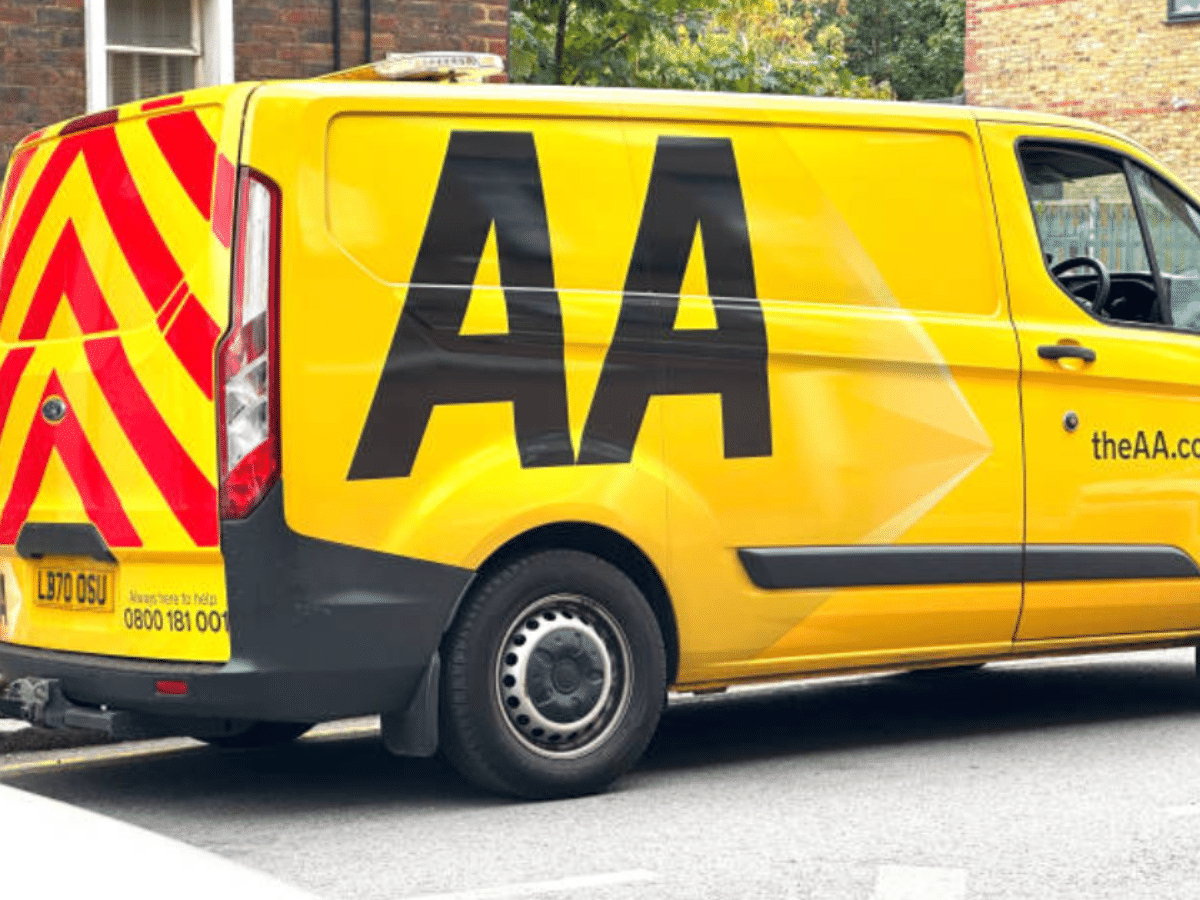
The AA have decided to enter the war on disabled people, for some reason. The president of the car insurance firm, Edmund King, has accused disabled people of ‘misusing’ blue badges. And of course, the mainstream media were frothing at the mouth.
The Sun went with:
Number of blue badge holders hits record high amid calls for crackdown on cheats.
The Mail specifically had to mention disability:
One in TWENTY drivers now have disability blue badge as councils urged to crack down on misuse.
And The Telegraph went with:
Fraud fears as one in 20 holds blue badge.
The AA warns that up to a fifth of the permits are being misused.
The Independent is a funny one because it originally went with:
Call for blue badge misuse crackdown as one in 20 hold ‘lifeline parking permit.
But it changed the headline to:
Call for blue badge crackdown amid fears of fake and stolen permits.
The AA gleefully pile on disabled people
The story itself, is actually nothing to do with ‘benefit cheats” or ‘disability fakers, but why let that get in the way of a good pile on disabled people. It was instead about stats from the Department for Transport showing there are now 3.07 million blue badges in circulation in England. This means just 5% of the population are blue badge holders.
But, despite it being the Easter bank holiday weekend, the media didn’t miss a chance to shit all over disabled people again. The stats were apparently analysed by the Press Association, which is how the story made its way to all the shitrags.
The PA couldn’t just stick to facts, as that wouldn’t make a very clickbaity story. So they had to instead twist how small a portion of the country have a blue badge. Because let’s be honest, 1 in 20 sounds much more significant than just 5%. And it’s much easier to set doubt in people’s minds that 1 in 20 people actually need a blue badge.
To further sow the seeds of doubt the story also points out that in 2019 the eligibility criteria for blue badges changed. Where previously only those with visible disabilities qualified, now it’s open to all disabilities.
What’s missing from this of course though is that you have to also qualify for a disability benefit such as PIP, which requires horrendous amounts of evidence. You can’t just say you have a disability and get a blue badge.
The AA responds, for some reason
But of course it didn’t end there, they had to explicitly state that people were faking, and call in an ‘expert’ to back them up. This being the president of the AA. Even though the AA has got fuck all to do with blue badges or accessible transport.
Edmund King from the AA said:
The blue badge scheme is a mobility lifeline for millions of legitimate users and their families.
Our concern is not the absolute number of badges issued but the estimates that up to one in five badges may be used by someone other than the holder or authorised user. .
The thing is, the Department for Transport stats don’t mention blue badge fraud. And the only actual source for this ‘1 in 5’ figure are all of the articles quoting King on it. The only other reference before him is an Essex County Council blue badge investigations officer, who also doesn’t give a source.
It should be absolutely mindblowing that every single mainstream news outlet published this stat without verifying it, but then that wouldn’t suit the agenda.
As the PA has rightly pointed out, the department which records blue badge fraud doesn’t even exist anymore. The Fraud Authority was shut down in 2011. But that didn’t stop them using the 15 year old stat that blue badge fraud apparently costs £46 million per year.
Blue badge fraud can’t have been that much of a concern to the government though, if they literally closed down the department that investigates it.
Deserving vs undeserving disabled
This is bad enough, but then King makes it all even worse:
We would welcome a crackdown on illegitimate use of badges to safeguard the deserving users.
There it is, that distinction between who really needs support and who’s obviously just faking it.
Because as it always comes down to, who gets to decide which disabled people are ‘deserving’? How are we deciding that? Dunk them in a river and if they float they’re disabled? Drop them and see if they land butter side up?
And why does a president of a car insurance company get to have any say in that?
In the current climate though, it’s not hard to deduce what’s meant by ‘deserving’ though. The very narrow view of disability that almost definitely means you use a wheelchair and need constant care. If you can go out and enjoy your life you’re not disabled enough, despite blue badges being a big reason so many disabled people can get out.
It’s also not a stretch to assume these articles are also part of the recent trend of hating people with neurodivergent and mental health conditions. Which are coincidentally happening whilst the government is tryiing (and failing) to prove these conditions are over diagnosed so they can cut benefits.
The timing is also not a coincidence, as from this week new claimants of Universal Credit who can’t work will have their benefit halved. And Motability just announced that disabled drivers will have their mileage allowance halved.
Let disabled people live their fucking lives
The government can claim it wants to get disabled people into work all it wants, but attempted PIP cuts, Motability reforms and Access to Work being slashed say otherwise. If they truly cared about supporting disabled people the press wouldn’t be being used to demonise us every fucking day.
More than anything, seeing constant stories about disabled fraudsters is fucking exhausting. Disabled people are tired of being used as the scapegoats for failing governments which have allowed billionaires to destroy this country.
We don’t want thousands in taxpayer benefits, ‘motability mercedes,’ or free parking, we just want to fucking lives our lives.
Featured image via the Canary
Sir John, now Lord, Redwood is a former MP for Wokingham and a former Secretary of State for Wales.
Labour think the Prime Minister is having a good war. If only.
For 48 hours he denied the US President use of US bases on UK territory. This angered the President and kept the UK out of the crucial discussions of what if anything to do about Iran and her proxies. Then the PM did a U turn and allowed their use. He awoke to the uncomfortable fact that whilst he might think he could keep us out of harm’s way by distancing us from the US, Iran saw it differently and attacked UK personnel and assets in the Middle East anyway.
The UK had regardless been actively indecisive before the war started.
The governmentdid reinforce the Cyprus base and send more warplanes there, whilst failing to send a destroyer to give the base better air cover. At the same time inexplicably the UK decommissioned its last destroyer in Bahrain and recalled our last minesweeper from the Gulf. Our minesweeper capability had been an important part of allied planning to keep shipping lanes open in a dangerous part of the seas. It was also a defensive, not an aggressive naval presence which should have been to the PM ‘s lawyerly liking.
The PM decided it was popular to disagree with President Trump , but not popular to undermine the US defence relationship to lose US force to help protect us. The PM decided some war to be called defensive was fine, but more war to pre-empt or disable Iran was not fine. He hoped fence sitting would let him control both sides. Instead it impaled him painfully on his own incompetence.
These nuances got blown away as the President took a simple view. You either fully support them as an ally, or you are a problem to be criticised and disadvantaged. The US relationship was already much damaged by the Mandelson appointment. Starmer’s choice of Ambassador took a memory trip to Epstein land into the Oval office whenever he went to meetings there.
The problem the PM faces is what now happens to the UK and the economy.
Seen by Iran, the Houthis and Hezbollah as an enemy our ships and people are at risk despite Starmer’s legalistic positioning. The US is not listening to advice from the UK or EU on the legal and practical limits to bombing. The UK is going to suffer from the stop on Gulf trade and the serious damage to Middle Eastern oil, gas , refined products and chemicals output.
The Prime Minister tries to portray an image of calm, but to many of us it looks like ignorant inaction, fearing the reality of energy and food shortages and higher prices.
If the US, Israel and Iran continue this war, energy, fertiliser, microprocessors and food are going to get scarcer and prices will rise faster. Central Banks may add to the deflationary impact of high energy costs, tipping many countries into recession. They have a habit of responding to supply shock price rises with recession inducing higher interest rates. The Bank of England regularly goes on the hunt to create a downturn. Look at 1974, 1979, 1989, 2008, 2022.
The UK government is driving through policies which are destined to make it more difficult for the UK to avoid one of the worst outcomes, as forecast by the OECD. Its stubborn refusal to extract more of our own oil and gas makes us more dependent on dear and scarce imports. Its high energy costs have closed two of our six refineries already and a big part of our chemical industry. The UK will have to pay penal prices to buy in what is needed through imports and will have to cut back on consumption.
Net zero zealotry means shortages and rationing by price or law beckon.
The idiotic policy of paying farmers grants to wild their land or to convert it to solar farms will reduce our proportion of home grown food just as food gets scarcer and dearer on world markets. Farmers are replacing crops with wild flowers and Chinese solar panels. Banning new petrol car production will lead to nearly new petrol car imports and shortages.
The government this summer will be dragged into bigger subsidies to those on benefits to offset price pressures on energy and food. This will swell borrowing , keeping interest rates and mortgages higher for longer. It may lead to yet higher taxes on those who do have jobs or run businesses, in another bout of unfairness and anti business policy making.
The correct response to a supply collapse from restricted imports must be an urgent expansion of home production. So lift the bans on new oil and gas, on petrol car manufacture, on new building projects. Remove carbon taxes and cut tax on energy. Spend farm grants on promoting more home grown food. Refine more oil, make more fertiliser, produce more chemicals at home.
Why is this government so anti jobs and pro putting more people on benefits? Why does it want to close most high energy using businesses to rely on imports? Why does it think more EU laws and taxes will bring anything other than more misery and slower growth?
Being the Benefits party, not the Labour party is the last thing we need. Meanwhile the PM poses for the cameras and jets around the world burning scarce fuel. He conjures fantasy coalitions of the willing to offer non-existent forces to keep a peace the combatants have not called. The PM wants international courts and the UN to dictate outcomes which usually turn out to be harmful to the UK.
The government’s policy to demand de-escalation of this bad war is completely detached from reality.
The PM says this but is not negotiating with the warring countries and terrorist groups who could bring it about. We all want an end to the war, Prime Minister. We also want an end to terrorist attacks on people and shipping.
The question is what are you going to do to help?
It seems six months really does make a difference. Not huge, but a difference.
At Conservative Party Conference last year the quiet whisperings were that having taken a beating in local elections in 2025, the prospects of another one in 2026 were high. One party insider suggested to me, then, that “the numbers are really awful“. This of course was three days before Kemi Badenoch’s speech which signalled a change in her confidence and perceptions of her determination which those watching surely saw, as did Robert Jenrick for whom May 2026 and the prospect of a bad showing for the Tories held the possibility of a jumping off point for a leadership bid.
We now know it was about this time he started talking privately with Reform UK.
With his sacking and then defection, the threat of an internal coup has drastically reduced – our latest shadow cabinet league table shows how far Badenoch has come since – and she is now by far the least unpopular (to be accurate about how that number works) party leader overall. So this set of elections on May the 7th are less dangerous for her, but still potentially tough for the Conservative Party.
Of course Reform have vowed that they’ll show the Tories to have “ceased to exist as a national party”, all part of their perfectly legitimate but possibly less credible ‘the Conservatives are dead’ strategy. Lord Ashcroft’s latest polling, oft disputed by Reform, suggests the numbers are changing nationally too.
This time last year we asked members to respond on a possible out come of May 2025 local elections and the predictions were accurately dire.
This time, ahead of the May 2026 elections, it’s not quite the same.
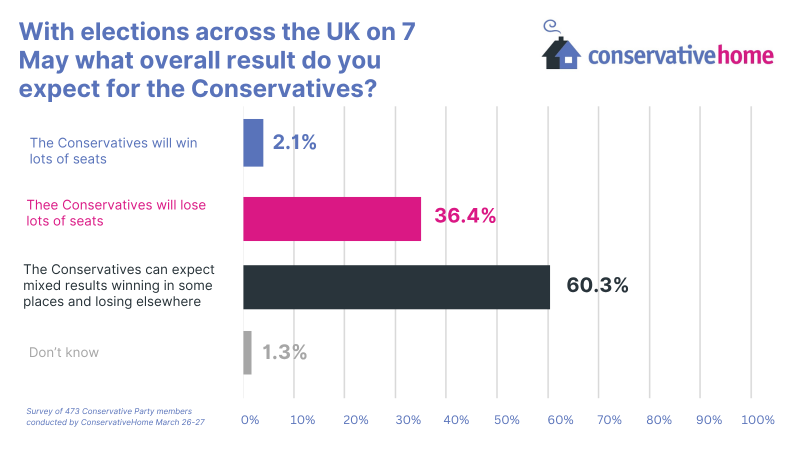
There’s still a not insignificant 36.4 per cent that think the Tories will lose lots of seats, once again damaging the party on the ground but 60.3% think the results will be mixed with loses in some areas but gains in others. No surprise that only 2.1 percent think the Conservatives will win lots of seats. These results are about confounding only the worst predictions, accepting the brand is still difficult to sell less than two years after the huge General Election defeat, but survivable if Labour suffer a noticeable collapse in these elections.
The word from many of the more senior Conservative Party officials campaigning across the country is that in some areas the loses could be pretty bad, but in others – London gets mentioned a lot – there could be brighter news. There is also an anticipation that tactical voting and smaller margins of victory could throw out some unexpected results both good and bad.
Reform remain the biggest threat in the eyes of our survey panel.
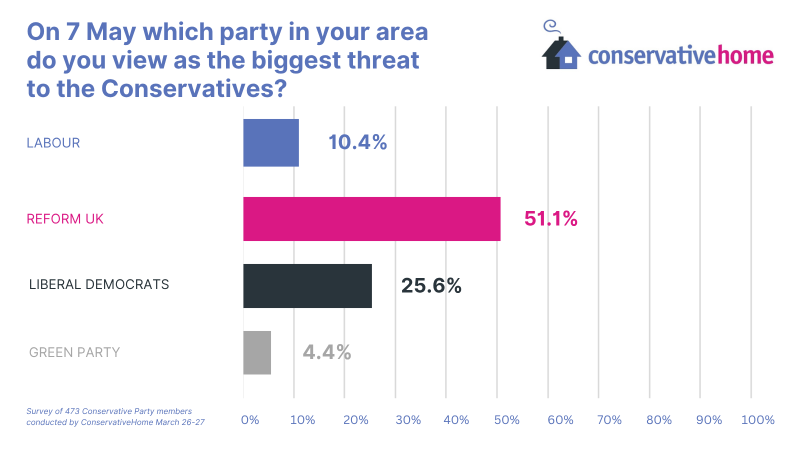
It’s therefore no surprise to see that Reform are seen by over half of responders as the biggest threat. However talking to Conservative campaigners up and down the country, there are places where Reform is not in play, but the threat is the Liberal Democrats, highlighted in that 25.6 per cent figure.
The more observant readers will note there are Welsh Senedd elections and elections to the Scottish Parliament, so both the SNP featured in this question for our survey at 1.3 per cent and Plaid Cymru at 0.6 per cent. Of course in both those elections it is likely that Reform are seen by our responders as the bigger threat to Tories standing, and would be included in the 51.1 per cent figure. However one Scottish newspaper suggests things are not going quite to plan for Reform in Scotland.
5 per cent of responders had no election in their area.
Reform UK will have a decent night in May, there seems little doubt of that, but there are signs it may not be the rout they wanted and have insisted is inevitable.

Rumours that Euphoria will be coming to an end following its third season appear to have been confirmed by the show’s lead, Zendaya.
Earlier this week, the two-time Emmy winner made an appearance on Drew Barrymore’s talk show, where the host began by asking if the upcoming run of episodes would be the last for Euphoria.
“I think so, yeah,” Zendaya responded.
When Drew then asked if fans should go into the new season “enjoying” it as if it will be the last, Zendaya repeated: “I think so. Yeah. Closure is coming!”
Later in the interview, the star of The Drama praised the hard-hitting show, saying: “Euphoria cracked my heart open. Rue taught me so much about life. That crew, also, has seen me grow up, I owe so much to that show.
“Rue taught me so much about empathy and about redemption and… she taught me a lot, and I’m very grateful for all of it.”
Meanwhile, the show’s creator Sam Levinson told Variety at the new season’s premiere that he writes every iteration of Euphoria “like it’s the last”, and has “no plans” to continue it in the future right now.
“I want to finish this as strong as I can,” he noted. “I’m cutting [episodes] seven and eight still. I’m putting some finishing touches. I just want to deliver a fucking slam dunk season.”
The head of drama at US broadcaster HBO, Francesca Orsi, previously hinted to Deadline that Euphoria would end with its third season.
“We’ve talked about it,” she explained. “I don’t think anything is over until it’s over, but it’s been discussed that this is the end.
“I think you will be very satisfied with this season, and how we bring each of the characters’ whole narrative.”
Euphoria launched in 2019, quickly making international household names of cast members like Zendaya, as well as Jacob Elordi, Sydney Sweeney, Hunter Schafer and Colman Domingo.
The wait for its third season has been over four years, with the story picking up with the characters long after they’ve graduated high school.
Watch the latest trailer for Euphoria season three below:
Euphoria returns to Sky, Now and HBO Max in the UK on Monday 13 April.
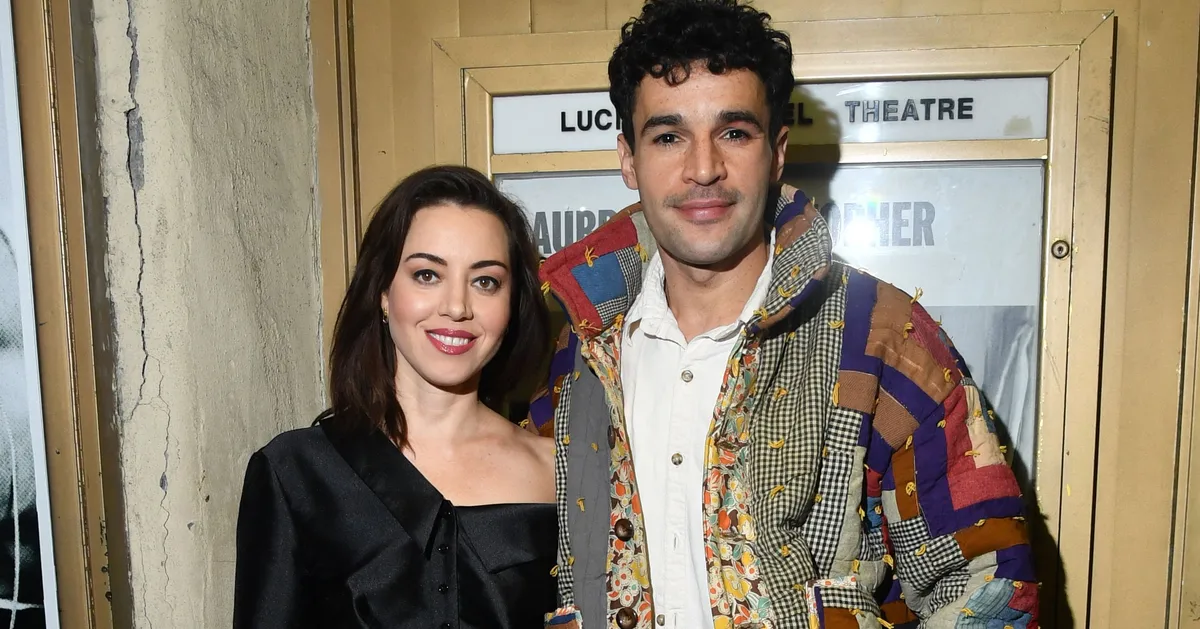
Aubrey Plaza has shared that she is pregnant with her first child.
The White Lotus star’s representatives confirmed to People magazine that Aubrey and her partner, Golden Globe-nominated actor Christopher Abbott, are expecting a child later this year.
People reported that the Parks And Recreation actor is due to give birth in the autumn.
Aubrey and Chris first crossed paths when they worked on the 2020 psychological drama Black Bear, before working together once again three years later in an off-Broadway revival of the play Danny And The Deep Blue Sea.
Following her breakthrough in Parks And Recreation in the late 2000s, Aubrey’s work has included projects as varied as season two of The White Lotus, the Marvel series Agatha All Along, the superhero pastiche Scott Pilgrim vs. The World and the festive rom-com Happiest Season.
Meanwhile, Chris has starred in the comedy Girls, the miniseries Catch-22, the space drama First Man, the Oscar-winning Poor Things and the Amanda Seyfried historical musical The Testament Of Ann Lee.
Aubrey was previously married to the writer and director Jeff Baena, who died by suicide in January of last year.
Speaking to her former Parks And Rec co-star Amy Poehler on the podcast Good Hang seven months after Jeff’s death, Aubrey admitted that her grief was a “daily struggle”, but felt “really grateful to be moving through the world”.
“At all times, there’s like a giant ocean of just awfulness, that’s like right there and I can, like, see it,” she shared, comparing her grief to the film The Gorge.
“Sometimes, I just want to just dive into it and just, like, be in it. And then sometimes, I just look at it. And then sometimes, I just try to get away from it. But it’s always there. It’s just always there.”
Prior to this, Aubrey also paid a subtle tribute to Jeff while presenting a segment as part of Saturday Night Live’s 50th anniversary broadcast, sporting a tie-dye shirt in honour of the outfits they wore on their wedding day.
Aubrey and Jeff married at their home in July 2021, and separated in September 2024.
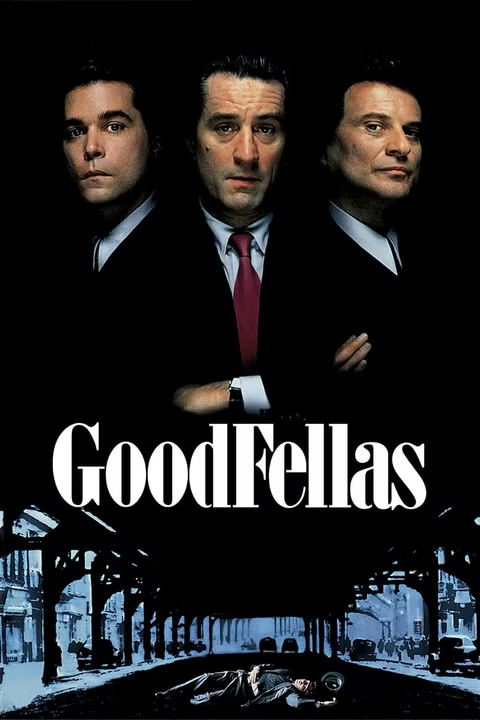
The Greatest Crime Epic of All Time Is a Free Streaming Sensation

The Iran ceasefire is a relief but not a cure for the madness Trump has brought to the world

How Aleksandr Loginov Is Redefining Design in the Age of AI


![*SOLO* GTA ONLINE CAR DUPE MONEY GLITCH! [XBOX/PS/PC]](https://wordupnews.com/wp-content/uploads/2026/04/1775646733_hqdefault-80x80.jpg)

-

 NewsBeat6 days ago
Steven Gerrard disagrees with Gary Neville over ‘shock’ Chelsea and Arsenal claim | Football
-

 Business5 days ago
No Jackpot Winner and $194 Million Prize Rolls Over
-

 Fashion5 days ago
Weekend Open Thread: Spanx – Corporette.com
-

 Crypto World7 days ago
Gold Price Prediction: Worst Month in 17 Years fo Save Haven Rock
-

 Business2 days ago
Three Gulf funds agree to back Paramount’s $81 billion takeover of Warner, WSJ reports
-

 Sports4 days ago
India men’s 4x400m and mixed 4x100m relay teams register big progress | Other Sports News
-

 Business4 days ago
Expert Picks for Every Need
-

 Business6 days ago
Login and Checkout Issues Spark Merchant Frustration
-

 Tech14 hours ago
How Long Can You Drive With Expired Registration? What Florida Law Says
-
Business3 days ago
No Jackpot Winner, Prize to Climb to $231 Million
-

 Tech6 days ago
Commonwealth Fusion Systems leans on magnets for near-term revenue
-

 Crypto World7 days ago
Ripple rolls out enterprise crypto treasury platform for corporates
-

 Fashion2 days ago
Massimo Dutti Offers Inspiration for Your Summer Mood Board
-
 Tech7 days ago
Drawing Tablet Controls Laser In Real-Time
-

 Crypto World7 days ago
Why It’s Partnering, Not Issuing
-
Politics5 days ago
Wings Over Scotland | The quality of mercy
-
 Sports7 days ago
Steal Gary Woodland’s subtle power move for longer drives
-

 Tech7 days ago
Battery Tester Outperforms Cheaper Options
-

 Business3 days ago
Akebia Therapeutics, Inc. (AKBA) Discusses Pipeline Progress and Strategic Focus on Kidney Disease Treatments at R&D Day – Slideshow
-

 Sports7 days ago
Mohsin Naqvi-Led Pakistan Cricket Board Blasted By Younis Khan After 20 Million Rupees Fine On Naseem Shah
You must be logged in to post a comment Login