

Politics
The centrist myth of ‘ungovernable’ Britain


Times columnist Matthew Syed last week bemoaned what he described as the ‘hysteria’ surrounding calls to replace UK prime minister Keir Starmer. According to Syed, Britain has entered an era of permanent leadership speculation in which no prime minister, whether Labour, Conservative or Reform, will ever be secure for long. He concluded with the dire warning that ‘Britain is becoming ungovernable’.
Syed is far from alone in this diagnosis. A growing number of centrist commentators now argue that Britain has entered an age of chronic political instability in which governments can no longer sustain authority or maintain public trust. They have portrayed Britain – and Western democracies more broadly – as increasingly fragmented, volatile and difficult to govern.
Starmer’s trajectory in government has hardly helped this mood of elite despair. He entered Downing Street with a huge majority and the promise that, after years of Tory psychodrama, the ‘adults’ were back in charge. Barely two years later, his popularity has collapsed, and the knives are out in the Labour Party. As of this week, more than 90 of 402 Labour MPs have called on Starmer to resign. A leadership contest appears to be imminent.
Among centrist commentators and their social-media fellow travellers alike, one increasingly hears nostalgia for the supposedly steadier age in which Britain expected two or three prime ministers a decade, not six (and counting). To the centrists, this proves Britain has become impossible to govern – a nation of capricious ingrates forever turning on whoever occupies No10.
But perhaps voters are not so irrational. Perhaps they simply do not wish to be governed in the way that Starmer and his Tory predecessors have been governing. Yet when the public complains about policy and implementation, centrists conclude not that the government has failed, but that the public itself is the problem.
Governing with a reasonable level of public consent need not be this tricky. Governments do not operate in total darkness. Polls, elections and public reactions provide fairly clear signals about what voters want.
A government genuinely interested in democratic legitimacy might try listening. Yet modern governments increasingly campaign on what they think the public wants to hear, only to govern as though the electorate had voted for something else entirely. They then react with bafflement when support collapses.
Immigration is the clearest example. For years, voters have consistently said they want lower levels of immigration. For years, politicians have promised to deliver exactly that. David Cameron promised to bring net migration down. Theresa May promised it, too. Boris Johnson rode to power presenting himself as the man to deliver Brexit and who finally understood the electorate’s desire for border control.
Yet, once in office, all three presided over soaring numbers of legal and illegal immigration. Johnson was the most spectacular case. Having styled himself as the tribune of popular frustration with mass immigration, he went on to oversee an influx of foreigners so unprecedented they now bear his name – the ‘Boriswave’.
Starmer’s own pledge to ‘smash the gangs’ has followed the same pattern. There have been headline-grabbing raids, press conferences and operational announcements, yet the broader picture remains one of record crossings and continued public frustration. All of this has unfolded amid a steady stream of reports about serious sexual crimes committed by illegal migrants, deepening the sense that the government is failing to protect the public.
On this issue and many others, voters are not issuing incomprehensible demands. They want lower immigration, affordable energy, safer streets, functioning services and economic stability. These are hardly exotic requests. Yet successive governments have dismissed demands for them as mere ‘populism’.
The very people complaining that Britain has become ‘ungovernable’ are the same people who have spent decades refusing to govern in accordance with the public’s clearly expressed wishes. Presenting themselves as sober managerial technocrats, they increasingly come across as a caste of haughty administrators unwilling to alter course, no matter how loudly voters object.
Any serious disagreement is treated as evidence that the public has been misled, radicalised or insufficiently educated. Politics ceases to be representative and becomes a series of attempts to impose the correct attitudes on hoi polloi.
The complaint that Britain has become ‘ungovernable’ recalls Bertolt Brecht’s famous satirical line that, rather than changing the government, it might be easier to dissolve the people and elect another. Democracy requires our leaders to adapt themselves to public priorities, not the other way around.
Centrists work from the opposite assumption. The policy framework is treated as settled and largely beyond democratic challenge, while the public is expected to regulate itself accordingly. When voters refuse to comply, their demands are treated not as legitimate democratic claims, but as evidence that democracy itself is malfunctioning.
Britain is not ungovernable. Britons are perfectly willing to support governments they believe are acting in their interests and responding to their concerns. ‘Ungovernable’ is shorthand for the death of the old centrist assumption that politicians can indefinitely ignore public priorities.
When voters reject this arrangement, centrist commentators diagnose a crisis of democracy. In fact, democracy is the one thing the public is still trying to assert.
James Martin Charlton is an English playwright and director. Follow him on X @jmc_fire.

Politics
The House | The rush to build data centres risks saddling our children with unnecessary costs and pollution


Waltham Cross, 2026 Google’s new AI data centre (Amazing Aerial/Alamy)
4 min read
The government has put “mainlining AI” into Britain’s veins at the centre of its growth strategy.
But advancing data centre construction without guaranteed access to clean energy and appropriate protections for local communities could imperil UK climate targets and generate the kind of public backlash already brewing in the United States.
America has been at the forefront of the AI boom, but the massive expansion in data centres has resulted in a slew of environmental and social harms. Electricity demand from data centres is significantly increasing emissions, putting stress on local water supplies, damaging local air quality and increasing noise pollution. It’s also raising household bills: electricity prices near data centre clusters have soared as much as 267 per cent relative to five years ago.
Unsurprisingly, recent polling shows that Americans have a mostly negative view of data centres’ local impact on the environment, home energy costs and people’s quality of life, and 57 per cent believe it will end up being a campaign issue in their area.
American politicians are listening: Maine has paused data centre development entirely while authorities assess the sector’s potential impacts, and at least 11 states are considering similar restrictions or bans. With an eye on the upcoming midterms, some Democratic candidates are even pushing for a nationwide moratorium on data centres.
Ireland, which historically positioned itself to attract large tech headquarters, also put a three-year moratorium on data centre expansion, only lifting the ban recently with new rules requiring large data centres to provide their own electricity generation or storage.
UK policymakers should take note. The total pipeline of data centre projects in the UK amounts to approximately 50 gigawatts (GW) of capacity. Even if only the projects at a mature stage of development end up getting built, back-of-the-envelope calculations suggest that by 2035 the electricity demand could be as much as 50 per cent of the UK’s current annual consumption. For comparison, meeting this demand entirely with new onshore wind could require around 610,000 hectares of land – roughly 2.5 times the size of Luxembourg.
Now is a particularly good time to pause and develop a measured strategy, before the concrete is poured for another historical phase of infrastructure overbuild
Without guaranteed access to clean energy, developers working on the rapid expansion of AI infrastructure will likely turn to fossil fuels – more than 100 data centres in the UK are already planning to burn gas for electricity. In a high-demand scenario, data centre-related emissions in 2035 could be up to 35 per cent of the 2040 carbon budget. Given that we are already in an energy crisis and facing relatively high electricity prices in the UK, the government will be in a difficult position to juggle the demands for affordable, clean energy for households, existing industry and new data centres.
Now is a particularly good time to pause and develop a measured strategy, before the concrete is poured for another historical phase of infrastructure overbuild – a pretty plausible scenario, given the seven-fold difference between the highest and lowest estimates of data centre energy demand. Overbuilding now could create future stranded assets and leave billpayers on the hook for the associated infrastructure costs.
Data centres are tied to the UK government’s AI and quantum computing growth aspirations, and it’s understandable that the government is hoping for a technological solution to grow its way out of the current economic malaise. But while the associated costs are very immediate, the size of the potential benefit to society is still unclear, and could even result in net job losses. The public is increasingly sceptical that they will be seeing the benefits of AI, particularly young people – a voting demographic Labour will need to work to win over. By moving forward with data centre expansion without a sustainable strategy for powering them, the government is risking clear and immediate sunk costs against the hope of future growth, on an unpredictable timeline. It would do well to learn from the political toll that this is already taking in the US.
Sini Matikainen is the Director of economic and fiscal policy at the Centre for Economic Transition Expertise at the LSE

4 min read
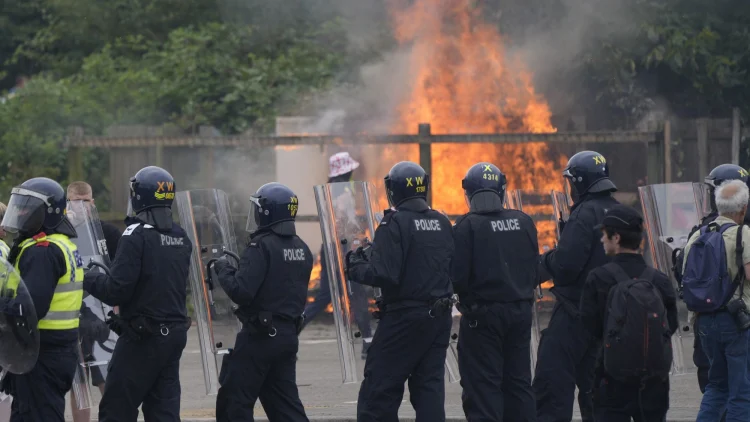
When a major public incident occurs, attention understandably turns to what is happening on the streets.
But another question demands increasingly urgent attention: what information were people seeing online?
The 2024 post-Southport riots and the Covid-19 pandemic showed how quickly false and misleading information can spread during periods of uncertainty and shape public understanding. The public disorder that followed the tragic death of Henry Nowak has prompted renewed debate about how the government, regulators and platforms should respond.
Full Fact first advocated for a cross-sector crisis response framework during the Covid-19 pandemic. Since then momentum has built behind the need to address viral misinformation fuelling public crises. Last week, Ofcom published its response to a consultation on crisis response protocols under the Online Safety Act. Meanwhile, as part of its social cohesion strategy, the government recently announced a review of crisis powers in the Act “to ensure that they are fit for purpose”.
Ofcom’s measures are a step forward, requiring platforms to maintain crisis response protocols, deploy crisis response teams during major incidents, conduct post-crisis reviews, and establish dedicated communication channels with law enforcement. But they can only go so far within the current framework of the Online Safety Act. The Act needs to be updated to require the largest platforms, search engines and AI systems to identify and tackle systemic risks, including risks they pose to the UK’s democratic processes and public safety.
Recent polling commissioned by Full Fact highlights the scale of the challenge. Four in five UK adults are concerned about political misinformation – and 42 per cent of this group say that has negatively affected their confidence that elections are free and fair. Levels of trust were generally low in institutions as sources of reliable information. And 17 per cent of people would not put their greatest trust in any institution they were asked about during a major national emergency, including the police, local authorities or the media.
That creates a practical challenge for crisis communication. Effective response depends on reliable information reaching people through sources they trust, at speed, in order to counter the spread of false and misleading claims.
The UK has established systems for managing other forms of national risks. But as Full Fact’s latest report highlighted, responsibility for major information risks is fragmented across multiple bodies, with opaque systems and laws that have not kept pace with the rapidly evolving information environment.
The information environment is critical democratic and civic infrastructure; yet policy has not focused on the resilience of the wider system. Protecting it requires the government to move beyond piecemeal responses and recognise the scale of the changes driven by new technology. Full Fact’s report includes recommendations to strengthen the UK’s information environment during times of crisis.
First, Ofcom should require the largest platforms, search engines and generative AI systems to maintain more expansive information incident protocols, and crisis communication plans involving other stakeholders. Ofcom’s protocols move in this direction, but stop short of requiring the systematic preparedness major information risks demand.
Second, the government should establish a national information incident response framework. This would provide clear severity thresholds, escalation pathways, communication processes and coordination arrangements across government, regulators, platforms and other institutions.
Third, this framework should be overseen by a new Information Resilience Unit. The unit would provide a single, visible, enduring mechanism for cross-system coordination, preparedness and institutional learning on major information risks.
The government’s social cohesion strategy reflects a simple principle: resilience depends on more than responding after harm has occurred. This is critical in the information environment, where preparation, coordination and learning shape outcomes.
False and misleading information increasingly shapes how crises unfold and are understood. Major information incidents are a serious risk to the health of our democracy. Protecting our democracy from these risks requires laws, institutions and capabilities that can respond effectively.
Phoebe Arnold is Policy Lead at Full Fact and George Havenhand is Policy Manager at Full Fact


(Shotshop GmbH/Alamy)
4 min read
The number of children and young people taking the brave step to seek help with their mental health is at an all-time high.
For anyone reading this article, there is a strong chance that a young person in your life has had issues with their mental health, be they your own child, a niece or nephew, a grandchild or a young family friend.
So much has changed over the last 10 to 15 years to ramp up the pressure on young people. New stresses and strains have entered children’s lives, from harmful online content to the Covid lockdowns, and pressure to pass exams and find work.
Young people’s referrals to mental health services are breaking records. According to analysis by charity YoungMinds, 932,822 people under the age of 18 had an active referral to mental health services in March, which included 134,837 new referrals. Both figures are the highest on record for a single month.
And the data paints another disheartening picture: those who are referred for help can face unacceptably long waits. In 2023-24, one-third of children referred to NHS mental health services waited a year for their next appointment. It goes without saying that a year is a long time in a child’s life, potentially critical to their results at the end of school, college or university.
Despite the dedication of those on the front line, public services haven’t been able to keep up. Youth services, another vital asset, have been stripped back.
How and why we got here has been well-rehearsed already. The select committees we chair – Health and Social Care, and Education – now want to investigate what is happening on the ground, in the lives of children and young people needing support.
As part of our joint inquiry, we want to put on record the experiences of children and young people, their parents and carers, who have tried to get help with their mental health. We want to see what lessons can be learnt and what patterns emerge from their stories.
To do this, the two committees have launched a survey to gather these perspectives – to hear where different services were lacking and how things varied between different pathways.
And we know it won’t be as simple as streamlining one or two processes, because the pathways to mental health support are many and varied, from GPs and NHS inpatient services to university pastoral support and youth clubs.
From our anonymous survey, we want to hear about the experiences of accessing support through all of these pathways – how they worked and what could have been better. Was there an issue with how far you had to travel? Did communication dry up just when you thought you were making progress? Did you have to explain yourself over and over again?
Young people’s referrals to mental health services are breaking records
And what should there have been more of? What was good about your experience? What helped the most?
With enough responses, this research will be invaluable for building up a picture of which areas provide the best outcomes, and which pathways are the most problem-prone and why.
This evidence will be put directly to ministers. Then, at the end of our inquiry, we will produce a report to the education and health departments. We will make recommendations to the government on how to ensure children and young people’s mental health services are more accessible, more equitable and more effective. At that point, ministers will be obliged to answer us and set out what they plan to do.
No child or young person should have to struggle through a system intended to help them through life’s toughest challenges. We can make that journey easier. But first, we must listen.
To visit the survey, go to tinyurl.com/45hbwwsm
Helen Hayes is the Labour MP for Dulwich and West Norwood, and Education Committee chair. Layla Moran is the Lib Dem MP for Oxford West and Abingdon, and Health and Social Care Committee chair


6 min read
Most political campaigns try to bring about major change. Now, two political insiders are trying to make life better by focusing on the small things. Ben Gartside investigates
Ever got cross trying to key in details to a parking app? Nettled by endless cookie approvals? Mildly piqued by that redundant phone box? Quibble is here to help.
Most political campaigns promise sweeping change. This one aims to remove pebbles from shoes, oil squeaky hinges and stop the dripping taps that bedevil service delivery.
Founded by human rights campaigner Jonathan de Leyser and civil servant Abigail Bradshaw, the self-styled ‘nuisance lobbyists’ have both learned the hard way that banking small wins is better than fruitless hunts for big change.
“In Britain and in the international community, progress can be very, very slow, but I think part of the experience of that is that you look for low-hanging fruit where you can,” says de Leyser.
“You look for minor things: you’re not going to get regime change in North Korea, but you might be able to help an individual case for someone being extradited. So, you learn to calibrate your expectations a bit.”
Self-described as “The Ministry of Detail”, Bradshaw and de Leyser are trying to become a two-person campaign to combat Britain’s gripes with the public sector.
Quibble’s desire to “sweat the small stuff” is influenced by Rory Sutherland, the TikTok-famous advertising guru renowned for his rants on consumer issues, from whom they borrowed the phrase.
According to leading pollster Luke Tryl, the pair have identified a gap in the political market.
“The word Britons are most likely to use to describe the country is ‘broken’ – for many, that refers to big issues like the cost of living, migration or the NHS.
“But these macro issues are exaggerated by people’s frustrations with every day frictions, the series of things that just make life harder, more frustrating: forms that don’t work, getting stuck on hold, the 8am GP call. All of these add together to create a sense not just things are bad but that the state is actively making life harder.”
The duo are happy to be part of a new vanguard in British politics battling over the minutiae, alongside the bombastic Looking for Growth campaign or the litany of Doge impersonators which have crossed the Atlantic.
Unlike the other detail-orientated campaigns, Quibble is not planning on adopting a hostile approach. Bradshaw, who has sat in the same hot seat as many of the people she’s now trying to influence, is instinctively supportive of civil servants.
“Not many people go in wanting to do it badly. Part of our role is trying to help people achieve what they already want to achieve.”
The campaign has already been welcomed by MPs on either side of the political divide, with Labour’s Andrew Western and the Conservatives’ Tom Tugendhat celebrating the launch.
Bradshaw and de Leyser are trying to keep a relatively narrow Venn diagram for the issues they take on. Issues must be common, and must be the responsibility of the government or a public body. So far, the pair have identified four initial quibbles.
First has been to cut down the constant cookie permissions on webpages, which the pair say is adding an onerous amount of time for limited data protection.
Another is making small mistakes when keying in details at public car parks, where fines are applied liberally in spite of those paying having acted in good faith, such as errors where keying a zero instead of an “O” could land motorists a hefty fine.
The pair also want to rename the “Tax-Free Childcare” scheme, which adds an extra 20 per cent on top of any funds deposited by parents towards accredited childcare providers. Despite being launched in 2017, less than half of eligible parents are currently using the scheme – Quibble reckons a simple renaming would increase uptake.
Finally, Quibble has set its sights on the UK’s telephone boxes. Despite their iconic design, many find themselves in a decrepit state with no functional purpose. Bradshaw and de Leyser have taken it upon themselves to take a critical look at the boxes, which number approximately 20,000 across the country.
“People are angry about very specific kinds of things in their lives. But nobody is sorting them out”
With an array of campaigns to take on, the pair are now trying to vet the variety of suggestions they’ve received from the general public since launching, attempting to separate one person’s niche pet peeve from a systemic but finicky problem in the public eye.
Complaints to them have ranged from ambulance sirens being too loud, and martial arts swords being too hard to import, to banning Captcha forms from using letters that look too similar.
The pair’s plan to retain sanity is by keeping a pretty tight net on what they consider an actionable campaign.
“It’s been really interesting to hear the range of suggestions,” de Leyser says diplomatically.
“People are angry about very specific kinds of things in their lives. But there’s a lot in which people are feeling like they’re not being heard and that there are things that to them are, and to us, feel like fairly obvious wrongs or fairly minor things. But nobody is sorting them out.”
Unlike much of the political tide in the country, Quibble is not calling for an overhaul in the British polity. In fact, the pair think small tweaks can make a huge amount of difference.
Bradshaw says: “Many years of working in the Civil Service taught me that sometimes that’s true, but sometimes policy just isn’t made in an ideal way and actually, sometimes very small changes to policy and policy design have a huge impact on the way that people experience that policy.”
Bradshaw’s career as a civil servant meant she had sympathy for the civil servants in charge of policy. Now a stay-at-home mother, she says her experience of stepping back from day-to-day news has given her a better understanding of how some things done by the government hadn’t been fully appreciated.
“In the world of policy, you assume that everyone is interested. As the quibbles have been coming through as I’m reading them, I’m thinking, ‘Oh, that’s interesting, I’m pretty sure that the government did something on that last year.’”
As political rhetoric has ramped up, with more radical politics becoming mainstream, Quibble hopes to solve the lesser-spotted exasperations with everyday life and perhaps even bring society back together at the same time.
De Leyser says: “I think that’s the thing about Quibble. People might not agree on the best way to solve them but all of these issues are quite common sense and quite easy for people to understand why they’re a problem. And there’s not that much controversy in saying, why is there an empty phone box that doesn’t even work on the street?”
Politics
John Oxley: ‘Hear that internet curfew bell toll? It tolls for thee, kid, even if we think you can vote’
John Oxley is a consultant, writer, and broadcaster. His SubStack is Joxley Writes.
Imagine it is the spring of 2029, polling day. You are 17.
You have completed a day of training, education or work (still compulsory at your age). You are excited to cast your first vote, exercising a new right. Before, or perhaps after, you have some time to kill. You can’t fill it by going for a pint, as you’re too young. Or having a cigarette, which will never, ever be legal for you. So instead, you pull out your phone. Perhaps go on YouTube to check the parties’ policies. Or on social media, to see if your friends are voting. But, alas, you’ve left it too late. The time says 8.31. The curfew has descended.
It sounds absurd, but this remains the course the current government are plotting. The voting age is coming down, whilst the ages for everything else rise. The plans announced this week extend this to vast sections of the internet, where the state will effectively enforce a national bedtime for the scrolling-minded. While you could have scrolled for hours in the daytime, the internet of the evening apparently poses some special, unique harm. Either that, or this is a government which really struggles to think properly.
I am not convinced that children should have wholly unfettered access to the internet. There are real dangers that lurk online, from the content and the people on it to the deleterious effects of excessive use. While much of that should be left to parents to protect you from, I can see why some want the law to back them up, and why the state has a role when parents can’t or won’t act. More broadly, just as we regulate the content of TV and radio, there are good reasons to regulate online content. Some things need to be illegal and that no one should be exposed to. We also need to be wary of how Britain’s enemies can exploit online channels to harm us.
Regulation, however, should be workable and proportionate. Too much of the government’s approach is predicated on drafting rules now and inventing the technology for it afterwards. Some of it is also likely to expose all of us, not just young people, to creeping surveillance and require us to provide our IDs and faces to use services online. The idea of an internet curfew is even stranger. It barely limits how much time young people can spend online, nor does it limit what they are exposed to. It imposes an arbitrary time cut-off for reasons that remain unclear. It is a bad rule, but it is also part of our muddled thinking of where childhood, adulthood and adolescence now sit.
The general trend in recent decades has been to raise the age at which certain things are allowed. Compulsory education and training have risen to 18. Marriage was abolished for under-18s, even with parental approval, as a step against familial abuse and forced marriage. Elsewhere, the pseudoscientific meme that brains don’t mature until 25 has taken hold and is used to argue for things like lower sentences for those in early adulthood. Campaigners want graduated driving licences, denying younger people the full freedom of the roads. The social media ban, and particularly the curfew, seem to fit this trend, pushing off the point at which people are set to make decisions for themselves.
At the same time, however, lowering the voting age to 16 has extended perhaps one of the most valuable privileges of adulthood. Given that young people are more coddled by the state than before, it’s easy to presume this is about mere electoral advantage. But we also expect young people to make their own lifelong decisions about training and education and to make major financial decisions regarding student loans. It is contradictory and incoherent.
This approach points to a problem we have in conceptualising adulthood. Our political approach is piecemeal, in a series of unconnected policy decisions rather than a philosophy. Often this tends towards safetyism and an obsession with reducing harm to zero. The online curfew is part of this, not trusting young people to make their own decisions or chart their own course. Others, like the marriage ban, are driven by real concerns and societal shifts, while reducing the voting age seems the product of smart campaigning and political advantage. It is a haphazard approach with haphazard results.
Emerging into adulthood shouldn’t be about harm elimination.
It is about encountering the world with gradually loosening supervision, making mistakes while you still have time to remedy them and developing judgment through them. Too much freedom too young will be dangerous, but so is deferring it. After all, we probably all know someone who was coddled until they left home and struggled to adjust to doing their own washing and cooking. People who have been protected from every bad decision they could make are not a success story but a denial of the sort of education that helps us become broadly functioning adults. Where the state intervenes, it should be conscious of this.
If 16 and 17-year-olds are deserving of the franchise and capable of choosing their representatives and the Prime Minister, the state should start from that assumption. In that world, internet curfews for almost adults make little sense. But if being online in the evening imperils them, if their brains are still forming, then say so openly and keep harmonising things around age 18.
Either way, we’d be better with an approach to young people framed by an understanding of adolescence and development that helps coach them towards adulthood than a series of arbitrary, headline-chasing decisions.

The post How BLM ideology captured the cops appeared first on spiked.

Israeli men aged 21 and 22 have been arrested by police in Cyprus for attempted murder. One of the men allegedly stabbed a Cypriot man — as well as two security guards who tried to stop the attack. The attempted murders happened in Ayia Napa, leaving one of the guards in critical condition after emergency surgery.
When police arrived to intervene, the attacker spewed insults at them. Both Israelis had to be subdued, leaving one injured from a blow to the head.
UK news blackout when it concerns Israeli crimes
No UK media or politicians appear to have mentioned the attack. Reports of violent and arrogant behaviour from Israelis in other countries abound — and not just from Israel’s notorious football thugs. Israel’s attempts to buy up land and properties in Cyprus as a bolthole to flee to when Israel’s victims retaliate have also raised tensions.
Regardless of context, there is simply no way UK media and politicians would ignore an attack on Israelis the same way they have this and other attacks by Israelis.
Featured image via the Canary
By Skwawkbox

Senior criminal law barrister Dominic D’Souza acted for one of the Ukrainians accused — and acquitted this week — of setting fire to properties belonging to Keir Starmer. The defendants were allegedly ‘rent boys’ — a factor largely ignored by UK ‘mainstream’ media. And D’Souza says that he was astonished — his word was ‘pickled’ — by how much of what went on was ignored or even buried by prosecution and judge in the case.
Two men were convicted in the case. D’Souza’s client Petro Pochynok was acquitted. But when D’Souza read journalist Crispin Flintoff’s X post about the BBC’s unmerited rush to broadcast a programme claiming Russia was behind the attack, he quickly responded that his head was still “pickled” over how much was kept hidden:
I was leading defence counsel for Pochynok who was acquitted. Having come across your vid I remember seeing you in the public gallery every day! Even as the defence barrister in the trial itself, I still find my head pickled over what real underlying truths were never expposed
— Dominic D’Souza (@dsouzabarrister) June 16, 2026
D’Souza was far from the only one to notice. Former UK ambassador Craig Murray pointed out that the alleged figure behind the attack spoke Ukrainian, but that the media very suspiciously ignored this to focus on him also knowing how to speak Russian:
The BBC report that the man who organised the arson of Starmer related property was “Russian speaking”.
They fail to report the evidence was he also spoke Ukrainian.
Almost every Ukrainian can speak Russian.
Very few Russians can speak Ukrainian.— Craig Murray (@CraigMurrayOrg) June 16, 2026
Starmer — “Wholly irrelevant”?
Grayzone journalists Kit Klarenberg and Max Blumenthal noted that the trial judge had forbidden information on the shadowy, Ukrainian-speaking instigator of the attacks from being entered into evidence:
As expected, the truth behind the Ukrainian rent boy attacks will be withheld from the British public https://t.co/pepep43coc
— Max Blumenthal (@MaxBlumenthal) June 16, 2026
And Russian is almost universally spoken in Ukraine, a former part of the Soviet Union, while the converse is not true:
The ‘Russia’ link is extremely tenuous
EL spoke Russian and Ukrainian
Ukrainian is not a language widely spoken in Russia,
whereas almost every Ukrainian can speak Russian
— Donahue Rogers (@DonahueRogers) June 16, 2026
In the run-up to the trial, Skwawkbox asked why ‘mainstream’ media — with no court restrictions on reporting — were not asking questions about why the attacks were committed. The defendants were not charged under terror laws as would have been expected. That leaves open the question of a personal dimension to the motives for the arson, or some form of organised crime, something with which the nazi-riddled Ukrainian regime is hardly unfamiliar.
Flintoff is right. The BBC’s haste to lay the blame at Russia’s door — based on the most tenuous of connections — raised more questions than it is clearly meant to put to bed.
Featured image via the Canary
By Skwawkbox

One person was killed and two injured in the latest ‘narco’ boat strike in the eastern Pacific on 17 June. While all eyes are on US-Iran peace talks, US president Donald Trump’s administration is still terrorising Latin America.
The US has killed over 200 people in the Caribbean and Pacific under the guise of stopping ‘narco-terrorist’ boats. The US military’s southern command posted on X:
On June 16, at the direction of #SOUTHCOM commander Gen. Francis L. Donovan, Joint Task Force Southern Spear conducted a lethal kinetic strike on a vessel operated by Designated Terrorist Organizations. Intelligence confirmed the vessel was transiting along known… pic.twitter.com/UGBRt9Mbdm
— U.S. Southern Command (@Southcom) June 17, 2026
Trump’s shadow war has been raging throughout 2026. The most aggressive phase was the kidnapping of Venezuelan president Nicolas Maduro on 3 January. Maduro is still being held in New York awaiting trial.
Trump’s strategy for an American empire
French paper Le Monde pointed to Trump’s ambitions for a subservient Latin America as a matter of US policy:
We want a hemisphere whose governments cooperate with us against narco-terrorists, cartels and other transnational criminal organizations (…) we want to ensure our continued access to key strategic locations.
The new drug war, like the old one, is fundamentally a neocolonial project. As US-based Latin America Studies professor Michelle D. Paranzino pointed out on 11 June:
The history of that war on drugs, however, especially during the presidency of Ronald Reagan, shows that the narco-terrorism label has always been politicized.
Then, as now, this collaboration appears to be aimed at the leftist and communist governments in the Western Hemisphere.
In many cases, the drug framing is an explicit rationale for action.
The US has been remarkably aggressive
Bolivia is the latest country to sign up to US ‘anti-drug’ plans. The BBC reported on 17 June:
The foreign ministry said that under the agreement, the US would provide up to $20m (£15m) to train and equip Bolivian forces as part of a joint fight against drug smuggling.
Bolivia recently enlisted Trump’s centrepiece colonialist alliance:
Under a new centrist president, Rodrigo Paz, Bolivia has joined the Shield of the Americas, the US-led security initiative in the Western Hemisphere.
NPR interviewed left-wing historian of the Americas Greg Grandin on Trump’s remaking of the hemisphere. Grandin warned the new US strategy was “remarkable in its aggression”:
It’s remarkable in the sense that it feels no need to legitimate itself in terms of any kind of moral or normative justification. In Latin America and the Western Hemisphere, you have quite a remarkable, cohesive and, I would say, efficient application of all of the different applications of hard power – of U.S. hard power – to Latin America under the rubric of the war on drugs.
I would say that, maybe with the exception of Uruguay, Washington is meddling in Latin American politics to different degrees of intensity in almost every Latin American nation.
Trump seemed poised to push harder against Latin American resistance before he blundered into a war with Iran in February. He lost that war. But with global attention on new peace talks, it is easy to forget that the dirty war in the western hemisphere is still underway.
Featured image via the Canary
By Joe Glenton

The Makerfield by-election has got people around the country talking about Andy Burnham again. And a new poll has shown that, with increasing scrutiny, he’s become a lot less popular. We reckon that’s because he represents the same kind of fence-sitting, corporate politics that gave the UK Keir Starmer.
Unsurprising popularity dive
Voters tend to view most politicians unfavourably, overall. But Andy Burnham was a rare case before the by-election campaign. Because there were actually more people who viewed him favourably. That has quickly changed in recent weeks, though, with YouGov reporting that his:
favourability has declined markedly over the past two months
Even 2024 Labour voters see him more negatively, with an extra 8% feeling this way. But in Makerfield specifically, he’s still more popular than his party is. And that could potentially allow him to win the by-election.
YouGov quotes one voter in the North West as saying:
Andy Burnham typifies modern politicians who put style and personality over belief in what they stand for.
Burnham’s history of corporate funding and U-turns backs that up. And it’s also the story we’ve seen in the Makerfield by-election campaign. Because Burnham has:
- Failed to meet the Green promise to back public ownership of utilities, making some weak half-promises instead.
- Refused to speak out clearly against Israel’s genocide, unlike his Green opponent.
- Made some vague noises about electoral reform but said that any change would first need to “be in a manifesto and endorsed at a general election” (which Labour is unlikely to win outright ever again).
- Pledged to cut welfare and increase defence spending.
- Suggested he will look for private funds to help finish off the highly controversial HS2 rail project.
- Claimed to want “less factionalism” while refusing to entertain the idea of readmitting Jeremy Corbyn into the Labour Party.
Burnham may still win in Makerfield, but there would be little cause for celebration
Makerfield never seemed like prime Green territory. And it seems unlikely that the Green Party candidate will be a real challenger in the election. But voices inside and outside the party calling for unity behind Burnham as an anti-Reform candidate seem to have the dangerously false impression that he’s an antidote to Reform advances.
Challenging Burnham from the left in this by-election is primarily because he has consistently failed to make firm promises. The Greens may possibly have stepped aside if he had clearly committed to electoral reform before the next election, but he didn’t — even though party members back it. As Green leader Zack Polanski said:
Anyone committed to proper democratic renewal in this country must commit to bringing in fair and genuine proportional representation at the earliest possible opportunity… We also need to get big money out of politics, stop disinformation, and scrap the archaic and undemocratic House of Lords. We’ve heard lots of promises and warm words from many Labour figures – but when it comes to it, we see inaction, U-turns and half-measures.
Reform, meanwhile, may have been awful enough by itself to tank its chances of winning. Suggesting it would back notorious child abuser Jimmy Savile, being generally misogynistic, and getting tetchy with others on the far right could all contribute to Reform losing.
Because Andy Burnham has promised little apart from ‘more of the same’, though, a victory for him wouldn’t be cause for celebration. And that’s probably why the increase in scrutiny has reduced his popularity in recent weeks.
Keir Starmer’s government has set a low bar, so Burnham may stretch slightly over that if he becomes Labour leader. But he alone is too much of a corporate lackey to bring any meaningful change to our political system. For that, only consistent organising and pressure from ordinary people will really make a difference.
Featured image via the Canary
By Ed Sykes

BlackRock is Responsible For THIS Bitcoin CRASH – But NOT in The Ways You Think…

More than 1,000 Palestinians killed in Gaza during ceasefire

Diodes Incorporated: My Best Pick For The Semis Rally

Blockchain.com files with SEC for U.S. IPO

Israel says it has killed new Hamas military leader in Gaza City airstrikes

No Jackpot Winner as $257 Million Prize Rolls Over to $269 Million Monday Draw
BlackRock is Responsible For THIS Bitcoin CRASH – But NOT in The Ways You Think…

How to Build Wealth – Financial Expert Reveals his 15 Yrs Journey ft. @pattufreefincal

THIS IS NO JOKE!!?? XRP JUST WENT LIVE WORLD WIDE?! (SWITCH FLIPPED)
-
 Business4 days ago
No Jackpot Winner as $257 Million Prize Rolls Over to $269 Million Monday Draw
-

 Fashion6 days ago
Weekend Open Thread: Tuckernuck – Corporette.com
-

 Crypto World7 days ago
Oppenheimer backs SpaceX as $70 billion retail frenzy builds
-

 Crypto World7 days ago
Markets Rally as SpaceX IPO Looms Amid Iran Tensions and Inflation Surge
-
 Crypto World3 days ago
Zimbabwe Requires Crypto Businesses to Register Annually Under New FIU Regulations
-

 Crypto World5 days ago
Bitget enters Argentina’s regulated crypto market through PSAV registration
-

 Tech5 days ago
NanoClaw integrates JFrog registries to secure AI agent downloads
-

 Tech6 days ago
This Week In Security: Microsoft On Microsoft, Register Your Domains, Linux On ARM, And FreeBSD Joins The File Cache Club
-

 NewsBeat6 days ago
El Nino has formed in the Pacific and could set records, forecasters say
-
 Tech7 days ago
Dutton Ranch star claims they ‘didn’t see any disruption’ on set following Chad Feehan’s exit from Yellowstone spinoff fueled by Taylor Sheridan clash rumors
-

 Politics7 days ago
Politics Home | Healey Resignation Is “Colossal Failure Of Government”, Says Former Labour Defence Secretary
-
 Entertainment7 days ago
Donnie Wahlberg & More Heat Up Las Vegas at Circa’s Barry’s Downtown Prime
-

 Sports7 days ago
First Time Since 1971: Australia Register Historic Low In ODI Cricket
-
 Tech7 days ago
Opendoor Ends India Operations, Fueling a Bigger Conversation About AI and Outsourcing
-

 Politics7 days ago
Belfast burns, while Met chief points finger at Iran and Russia
-

 NewsBeat6 days ago
FBI searches office of Ohio voter registration group
-

 Business7 days ago
AT&T: Verizon's 27% Outperformance Sets Up A Solid Entry Point
-
 Tech6 days ago
Anthropic is spending $150M to embed 1,000 AI fellows inside nonprofits. No degree required.
-

 Politics7 days ago
Modi thanks Trump for wishes as US attacks Indian seafarers
-
 Entertainment6 days ago
‘The Pitt’s Fan-Favorite Doctor Confirms Noah Wyle Gave His Blessing to Return [Exclusive]
You must be logged in to post a comment Login