
Politics
The House Article | How Thousands Of Ukrainian Children In The UK Are Growing Up In Limbo



More than 60,000 Ukrainian children have now spent at least past of their education in the UK since 2022 (Alamy)

8 min read
More than 60,000 Ukrainian children have grown up in the UK since fleeing Russia’s full-scale invasion. Zoe Crowther explores how the absence of a long-term settlement plan is leaving these children and their families in limbo
When Alisa Cooper fled Kharkiv in eastern Ukraine to the UK in 2022, her son Kupriian was five years old. Kupriian is now nine and only speaks English fluently. In the four years since leaving Ukraine, Britain has become the place where he learnt to read, make friends and feel safe.
“He hated me a lot at the very beginning of reception [class], and it was really hard for him – the whole process of adaptation, of learning how to speak, how to read, to do spelling,” Cooper says.
“We struggled a lot, but four years passed, and now English is his primary language. His mindset is different from my Ukrainian peers. British values, how people communicate, politeness… All the DNA of British people comes from school, so he is more deeply into the UK culture.”
Kupriian, who has ADHD, has now finally caught up on the English school curriculum with the support of his mother and teachers. “He’s happy here. He’s settled, perfectly settled here.”
Many Ukrainian children can differentiate between an incoming missile and an outgoing missile
Yet Cooper lives with a persistent anxiety about what comes next. “At first, I planned that it would be a short stay here. But now, I’d like to stay here, and I don’t want to return back, if it’s on my own will,” she says. “How can I take him from his environment, his friends, the curriculum?”
Around 218,600 people have travelled to the UK under Ukraine visa schemes since Russia’s full-scale invasion. Around 28 per cent of arrivals were under 18, meaning that more than 60,000 Ukrainian children have now spent a significant part, and in some cases all, of their education in the UK.
Maria Romanenko, a Ukrainian activist who volunteers with displaced families in Greater Manchester, says every Ukrainian child in the UK lives with some form of trauma.
“Unless they left in the first hours of the full-scale invasion, they would have seen a Russian missile out of the window, or heard a siren or heard an explosion,” she says. “Many Ukrainian children can differentiate between an incoming missile and an outgoing missile.”
Romanenko describes how many of these children also faced bullying after talking about the war at school and trying to share experiences that their peers struggled to understand. Most families who fled to the UK also had to leave the fathers and other close male relatives behind, abruptly transforming family dynamics for thousands of children.
“The family goes from two parents to one parent overnight,” Romanenko says. “And obviously that creates various difficulties and challenges, because the mothers still have to earn some money.”
Inna Hryhorovych is headteacher of St Mary’s Ukrainian school, which is part of a trust that coordinates 15 supplementary schools across the UK and supports more than 2,000 displaced Ukrainian children. It also carries out projects in hundreds of mainstream schools, with the aim of ensuring Ukrainian children retain their Ukrainian language skills, achieve Ukrainian qualifications, and can reintegrate into Ukrainian society once the war is over.
The work of St Mary’s is particularly important for the many Ukrainian children with special educational needs and disabilities, who face barriers to accessing the support they need.
Yet St Mary’s reaches only a fraction – around 12 to 15 per cent – of those affected. “What happens to the rest and how are they going to reintegrate?” Hryhorovych asks. “The danger is that they forget their Ukrainian identity.”
After arriving in the UK, many families tried to ensure their children kept ties to Ukraine by studying in British schools by day while catching up on Ukrainian schooling online in the evening.
“That means that the kids are incredibly overloaded with information, and just study twice as much as English kids normally do,” explains Romanenko.
Many of these children have therefore since given up the Ukrainian elements of their education.

The Ukrainian government has urged the UK to introduce a new GCSE in Ukrainian in order to help solve this problem. The UK children’s commissioner and multiple MPs have joined these calls, and the UK government and exam boards said last May that it was being considered – but it has not yet materialised.
Introducing a Ukrainian GCSE, however, would be far from straightforward. Developing a new qualification typically takes several years, and questions remain over whether the subject would be viable given potentially low national take-up. Ministers would also face pressure to extend GCSE provision to other community languages not currently offered, while examiners would have to grapple with how to assess pupils when many candidates would already be fluent speakers.
The House understands the government is therefore highly unlikely to proceed with a standalone Ukrainian GCSE. However, some exam boards are understood to be exploring alternative ways to incorporate Ukrainian language and cultural learning into the existing British curriculum, aimed at supporting displaced Ukrainian children without creating a new qualification from scratch.
Visa uncertainty is also limiting life chances for Ukrainian teenagers. A University of Birmingham survey in March 2025 found that 25 per cent of respondents who applied for a student loan said it was refused because of their visa status.
Hryhorovych adds that uncertainty around the future makes it very difficult for Ukrainian children to overcome their trauma.
“The healing of trauma and integration starts with hope, and hope is born from some new aspirations and goals,” she says.
“But how can you develop that hope if your aspirations have a time tag? There is a deadline to how far you can dream, how far you can aspire to, because you might be told it’s time now to go back.”
In September 2025, the UK government announced a significant extension to the Ukraine Permission Extension, adding 24 months to the original 18-month period. For some who arrived in early 2022, that adds up to a total stay of up to six and a half years.
The healing of trauma and integration starts with hope, and hope is born from some new aspirations and goals
There is growing evidence to suggest that most Ukrainians no longer see their future in the UK as short-term. According to a survey carried out by University of Birmingham researchers in October 2025, 76 per cent of Ukrainian families with school-aged children believe it will be very difficult for their children to integrate into the Ukrainian education system if they are required to return, with a further 18 per cent believing they will have at least some difficulties.
Only five per cent of all respondents to the survey said they would want to return to Ukraine even if it became safe, citing fears of renewed Russian aggression, destroyed infrastructure and economic instability.
This highlights a potentially huge issue for both Ukraine and the UK further down the line: Kyiv’s official position is that Ukrainians who fled the war will not be forced to return home, but that the government hopes people will come back voluntarily once it is safe. The UK government has meanwhile framed its Ukraine visa schemes as a temporary humanitarian sanctuary, rather than a route to settlement, in part to reflect Ukraine’s desire for the eventual return of its citizens.
Time spent on Ukraine schemes, even for children, does not count towards the 10-year period to gain indefinite leave to remain in the UK, despite the scheme protections having been extended.
Yuliia Ismail, an immigration adviser at the charity Settled, which offers free, accredited, multilingual immigration advice for Ukrainians in the UK, says the system was never designed for this scale or duration of displacement.
“It was built as a temporary solution,” she says. “But we should remember, we do have people who don’t have anywhere to return.”
Many major Ukrainian cities, including Mariupol, Bakhmut, and parts of Kherson, Chernihiv, and Kharkiv, have been mostly destroyed.
While few believe Ukrainians would be forced out of the UK immediately after the war ends, Ismail says “there is no clear plan”.
We should remember, we do have people who don’t have anywhere to return
Dr Irina Kuznetsova, a sociologist at the University of Birmingham, argues that the UK is facing an opportunity to establish a “better practice” around planning for the futures of displaced children who have fled warzones.
“These numbers [of displaced Ukrainian children] are unprecedented,” she says. “After decades, people will be looking and thinking about how we could learn from the situation.”
A report co-authored by Kuznetsova in October 2025 recommends counting time spent on Ukraine visas towards settlement, creating a five-year route to residency, ensuring access to Ukrainian language education, and expanding mental health support for Ukrainian children and adults.
Meanwhile, Cooper continues trying to shield her son from the uncertainty. “I’m trying to prevent him from having any anxiety or uncertainty about the future. That’s my job as a parent,” she says.
Sometimes, they attend a Ukrainian social club in Notting Hill for food, conversation and connection to a country that feels ever more distant from their life in London.
“No one can actually force us to do things we’re not willing to do,” she says. “It’s a really individual decision. We are not property, we can make decisions on our own.”
For policymakers, Ukrainian children in the UK are fast becoming more than a humanitarian issue. They are a test of whether Britain’s immigration, education and integration systems can adapt to support and accommodate a generation who have been shaped by war but now see Britain as their home.



Content Note: this article contains an account of sexual assault
Like others on the far right, Tommy Robinson has tried to depict himself as a great defender of British women. As we’ve reported, Robinson’s credentials on this front don’t hold up to scrutiny. This is especially true now that Robinson is throwing his weight behind Conor McGregor, who was found to have raped Nikita Hand in a civil case:
Tommy Robinson has never cared about protecting women and girls. He uses their trauma to push a racist agenda. He doesn’t truly care about rapists. Otherwise, he wouldn’t support rapist like Conor McGregor.
He was ordered to pay £206,000 plus costs to Nikita Hand. pic.twitter.com/Fkq7WkpLGU — Mukhtar (@I_amMukhtar) April 18, 2026
Grim
The rape that McGregor subjected Hand to was incredibly violent. As the BBC reported:
Ms Hand, a mother-of-one, told the court how McGregor had pinned her to a bed before assaulting her.
She was left with extensive bruises and abrasions over her body, including on her hands and wrists.
There was a bloodied scratch on her breast and tenderness on her neck after she said she was placed in a “chokehold” by McGregor.
He denied causing the bruising, saying it could have happened after she “swan dived” into the bath in the hotel room.
Ms Hand was taken in an ambulance to the Rotunda Hospital in Dublin the next day where she was assessed in the sexual assault treatment unit.
A paramedic who examined Ms Hand told the court that she had not seen “someone so bruised” in a long time.
Dr Daniel Kane, a gynaecologist and forensic examiner, told the court how he had to use forceps to remove a tampon Ms Hand said she had been wearing on the night of the assault, which had been “wedged inside”. A paramedic who examined Ms Hand on the day after the alleged attacks said she had not seen a patient as bruised as Ms Hand was in a long time.
As can be seen in his tweet, Robinson is urging McGregor to “lead” Ireland. This isn’t a random request, as McGregor did launch a failed presidential bid in 2025. It’s certainly grim, however, given McGregor’s past. And it makes it abundantly clear that Robinson has zero respect for women.
This isn’t Robinson’s only ongoing controversy either.
Tommy Robinson — at war with his followers
On 16 May, Robinson is throwing another racism festival in the UK. His ‘Unite the Kingdom’ rally in 2025 saw over 100,000 pissed up gobshites descend on the streets of London. Among the groups speaking were Generation Remigration, who argue that Britain should deport its entire non-white population.
This is the meaning of ‘remigration’, by the way, and it’s something Robinson supports:
He’s 100% correct, the time is now . REMIGRATION https://t.co/jGwMGkz8dF
— Tommy Robinson
 (@TRobinsonNewEra) January 23, 2026
There would be no way to enact remigration without violence. The victims of this policy would oppose it, and so would many white British people — namely the ones who are normal about this stuff.
Given this, you can understand why Robinson’s supporters would think violence is the answer to the problems he’s presenting. Robinson, however, is now falling out with those who are demanding that the movement take the next logical step:
STOP WHAT YOU’RE DOING!
THE FASH BROMANCE OF THE CENTURY IS ON THE ROCKS! Remember I said after Danny ‘Temu Tommy’ Thomas tried to confront me (& ended up confessing to sexual exploitation Well tragically it’s got worse — . (@LouiseRawAuthor) April 18, 2026

 ), he was getting flack for being an embarrassment?
 pic.twitter.com/jIRRB2EmPT
We guess the moral of the story is you shouldn’t talk up violent revolution if you don’t want your revolting supporters to violently revolt.
Summer of scam
If you’re wondering why Tommy Robinson won’t go all the way, it’s because doing so would make it harder for him to constantly rinse his supporters for donations:
Tommy Robinson tells his email list they are "desperately short of funds" for his next event.
A reminder that last time he did this, in the coming weeks his son was bragging on Instagram about flying in private jets and staying in mansions and luxury resorts. pic.twitter.com/ksvQcMMBd0 — Gadget (@Gadget440) April 18, 2026
Robinson has attached himself to more than one scam. The greatest scam of all, however, is the idea that he gives a shit about anyone besides himself.
This is especially true when it comes to women.
Featured image via Russian Presidential Press Office (Wikimedia)
By Willem Moore
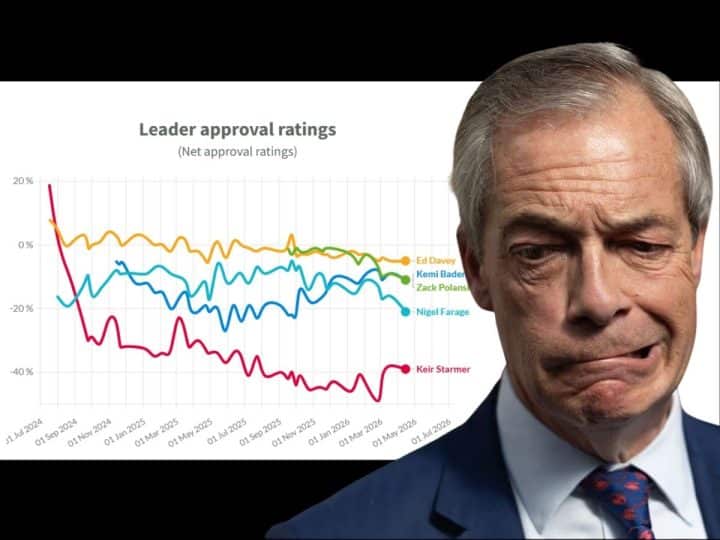

Nigel Farage has been on something of a journey over the past few decades. To begin with, he was widely perceived as a joke — one which the BBC couldn’t stop telling. Even after Farage was successful in pushing the public towards Brexit, he wasn’t able to convert that momentum into electoral success. Since 2024, however, things have changed.
The public now see the Tories and Labour as two sides of the same coin, and they want an alternative. Given the media attention he’s received, many decided that Farage was the alternative in waiting, if only because he was the only outsider politician they were aware of.
Since then, however, Farage has squandered much of that energy by inviting Tories into his party. Now, Farage and Reform’s polling are starting to reflect this:
— Politics UK (@PolitlcsUK) April 18, 2026
 NEW: Nigel Farage has recorded his worst approval rating since becoming an MP pic.twitter.com/Nbm1WwuFKu
Approval
Of course, leader approval ratings aren’t the best indicator of how well a party might do. Voters largely didn’t like Jeremy Corbyn at the beginning of the 2017 election, but when they saw what Labour were offering compared to the Tories, he managed to close the gap. As Ed Sykes reported for the Canary in 2017:
But while his critics talked him down, Corbyn himself was out campaigning. And it turned out, as the table suggests, that the more voters actually got to see him free of the distorting prism of a hostile media, the more they liked him.
In the end, Corbyn’s Labour gained 30 seats, reversed decades of Labour decline, and won the biggest increase in the party’s share of the vote since 1945. And the evidence suggests that Labour did well because of Corbyn – and in spite of his critics. That’s something they would do well to remember whenever the next election is called.
As Sykes notes, the media face increased restrictions during an election. This benefitted Corbyn and Labour in 2017: the question is will it benefit Reform?
Perhaps not, because Reform have struggled to land on a coherent message when it comes to policy and candidates.
They claim to be a party of everyday people, and yet they’re running candidates who want to dismantle the NHS.
They claim to be anti-waste, and yet one Reform council spent tens of thousands of pounds on unnecessary flags.
They began as an alternative to the Tories, and yet they’re stuffed full of — you guessed it — Tories.
Reform are already struggling to answer these questions, and things will only get worse in a general election:
"If the Tories are so bad, why is Reform UK filling themselves full of them?"
Laila Cunningham: I can't answer that. pic.twitter.com/fxdPli1XKY — Mukhtar (@I_amMukhtar) January 10, 2026
As we’ve reported, it’s already getting pretty bad in the local election campaign — especially when it comes to candidate selection:
- Reform activist said ‘Hitler was right’.
- Scottish Reform nosedive following candidate chaos.
- Reform welcomes ‘shoot the p*kis’ scandal ex-Tory.
- Reform UK accused of ‘nil vetting’ as another racist candidate exposed.
- Farage heckled at Reform’s Jimmy Saville-aping London launch.
Farage — Bad to worse
As London Economic have reported, three polls this week showed that Reform have slumped from their 2025 highs of 30%:
Reform drops to 25% in this weeks voting intention their lowest since April 2025. They lead the Tories by 3 & Labour by 4
N = 2,011 | 10-13/4 | Change w/ 8/4 pic.twitter.com/DNZVf9Incv
— Luke Tryl (@LukeTryl) April 15, 2026
 REF UK 25% (-5)
 CON 22% (+3)
 LAB 21% (+1)
 GREEN 13% (+1)
 LIB DEM 12% (nc)
 OTH 3% (nc)
 SNP 2% (nc)
Westminster Voting Intention:
RFM: 26% (-4) Via @tweetfreshwater, 10-12 Apr. — Election Maps UK (@ElectionMapsUK) April 16, 2026
LAB: 22% (+4)
CON: 19% (+1)
GRN: 15% (=)
LDM: 13% (=)
Changes w/ 27 Feb – 1 Mar.
Westminster Voting Intention (Prompts for Restore):
RFM: 21% (-4) Via @FindoutnowUK, 15-16 Apr. — Election Maps UK (@ElectionMapsUK) April 16, 2026
CON: 18% (+2)
GRN: 18% (-1)
LAB: 17% (+1)
LDM: 11% (+1)
RES: 9% (+1)
SNP: 3% (=)
Changes w/ 25 Mar.
Regarding the above, London Economic said:
a poll from Find Out Now also found a four-point drop for Farage’s gang. Whilst this one didn’t show any significant boost for Labour, the kicker here was further down, where Rupert Lowe’s Restore Britain were on 9%. This gives credence to the idea Restore could leech support from Reform, opening the door for Labour, the Tories and the Greens.
This certainly could be how things shake out. The other option would be that Restore Britain stand down for Reform UK like how Farage’s Brexit Party stood down for the Tories in 2019.
It’s hard to tell which might happen, because the politicians drawn to Restore are the ones who are too right-wing and anti-social for Reform. In other words, they may be incapable of backing down, even if doing so would secure an electoral victory for the British far right.
Back to what’s causing Reform’s decline, it doesn’t help that people are becoming increasingly aware of who funds Farage and Reform:
EXCLUSIVE: Reform chief Nigel Farage's half a million pounds from foreign sources since becoming MP
Of Farage’s 28 benefactors, 20 are based abroad – or 71%https://t.co/zvye6Pk8I8
— dave lawrence

 (@dave43law) April 18, 2026
This isn’t a good look for a supposedly patriotic nationalist, is it?
There are also outside forces dragging down Farage’s reputation — among them the unpopularity of Donald Trump and the fall of global allies like Viktor Orban:
A combination of a Badenoch comeback and the Trump impact on Farage
This coupled with people hearing Reform policy and the unfunded chaos based on fantasy data it always is. https://t.co/5wNBANlItL — dave lawrence
(@dave43law) April 18, 2026
What goes up
For a while, it seemed like Reform could have risen to the same 40% highs that Labour and the Tories achieved in the past. Thankfully, it looks like 30% was the ceiling. Even more thankfully, it seems like a sizeable proportion of that 30% simply supported an alternative to the status quo — not Reform specifically.
Given Reform’s many contradictions, it seems like they’ll struggle to do anything besides bleed support at this point. We just hope they lose as much as possible before the local elections to limit how much damage they can cause.
For an idea of what Reform councils look like in practice, please read the following:
- Reform councillor reposts that Labour MP ‘should be shot’.
- Reform councillor dramatically quits over council tax betrayal.
- What a surprise – Reform councillor attends just one meeting and sends two emails in six months.
- Reform councillor fined £40,000 for hiring ‘illegal’ workers.
- Reform councillor would like to see wage cuts to fund his pay rise.
Featured image via Opinium
By Willem Moore
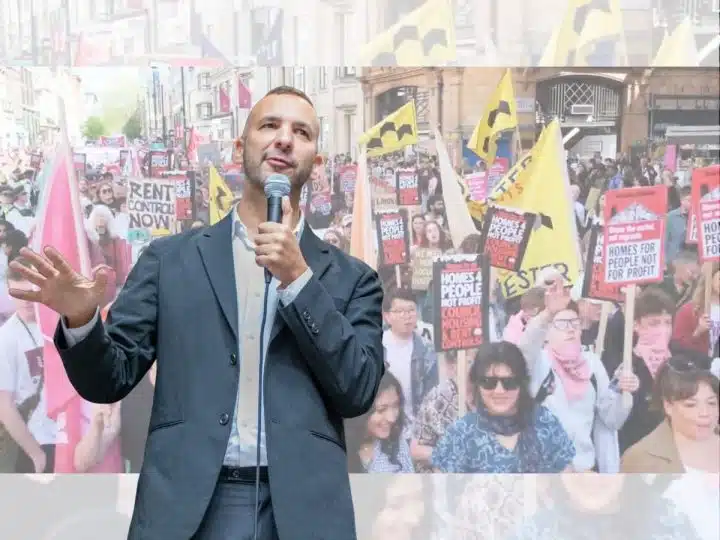

On 18 April, the renters of London took to the streets to fight for their rights. Among their demands were calls for rent controls and council homes. One politicians who agrees with this message is the Green Party’s Zack Polanski:
Yes!
This is exactly it!
Council homes – not the luxury flats sold off to foreign investors. And it's beyond time for rent controls! — Zack Polanski (@ZackPolanski) April 18, 2026

 https://t.co/qiSS2M15nN
Zack Polanski — Get organised
Speaking on the issues capital-dwellers face, the London Renters Union have said:
Is your rent too high? You’re not alone. Londoners face the highest rents in Europe. Many of us live with the threat of eviction or in unsafe housing.
The housing market is stacked in favour of landlords and investors who profit at our expense. Our rigged housing system is making our city more unequal.
Unless we make big changes, many of us will be stuck renting overpriced and poorly maintained housing for the rest of our life.
As we reported, Polanski has spoken out on these issues before. Specifically, he took issue with housing minister Matthew Pennycook siding with landlords over the everyday people they’re lording it over:
Labour's housing minister's opposition to rent controls welcomed by the country's largest private landlord.
Who's side are Labour on? Renters or landlords. The answer is here. pic.twitter.com/olVzEIVTki — Zack Polanski (@ZackPolanski) April 15, 2026
He’s also on message when it comes to the key demands of London’s renters:
Build council homes.
Bring in rent controls.
Time to end Rip off Britain.https://t.co/9SpVlVBrsV
— Zack Polanski (@ZackPolanski) April 10, 2026
Demands
The call for better conditions goes beyond council homes and rent controls, with the London Renters Union listing the following additional demands:
Decent standards in housing
Good standards for all rented properties, with full monitoring of property conditions and redress processes that have the needs of renters at their heart.. …
Indefinite tenancies
Government should implement promised end to no fault (Section 21) evictions immediately, remove end dates from tenancies, place limits on rent rises.Housing justice for people living in temporary accommodation
All temporary accommodation must be safe, secure, within peoples home borough and be part of a quick, clear path to a permanent home. All landlords providing temporary accommodation must be held accountable.No discrimination in access to housing
End DSS discrimination by landlords and letting agents against people receiving benefits and renters with children, stop racist discrimination in housing and any discrimination on grounds of identity.No borders in housing
End right to rent and nationality requirements for social housing, no border checks in licensing or enforcement regimesPublic housing available to all
End right to buy, fund councils to build and renovate good quality housing for their waiting lists, prioritising anyone vulnerable and in needHousing for people not profit
End the politics and culture of property as investment rather than to house people and bring homes into democratic public ownership.
Alternatives
Much like Zack Polanski said, Labour have sided with landlords on the issue of rent controls. Somehow, however, the other parties are worse.
As we reported, a Reform housing spokesperson argued that the UK had introduced too many regulations after the Grenfell disaster. He additionally dismissed what happened to the victims, saying flippantly that “everyone dies”. The Tories, meanwhile, are the ones who oversaw Grenfell and then dithered on taking action.
In the future, then, renters will have a choice between:
- More of the same.
- More of the bad old days.
- More money in their pockets because they’re not being tipped upside down and shaken for change by their landlords.
Featured image via Barold
By Willem Moore
Politics
Politics Home | Muslim Voter Group Holding Hustings For Major Parties Ahead Of Local Elections
3 min read
A pressure group focused on who Muslims should support at the ballot box has held hustings events in Scotland and Wales ahead of nationwide elections on 7 May.
The Muslim Vote, set up in late 2023, endorsed four independent candidates who were elected at the 2024 general election on campaigns centred on the war in Gaza. They were Shockat Adam, Adnan Hussain, Ayoub Khan and Iqbal Mohammed.
The group, which encourages people to vote on religious lines, endorsed the successful Green candidate Hannah Spencer in the Gorton and Denton by-election in February, and is planning to declare support for a host of candidates in the run-up to next month’s elections.
At the time of the writing, the Muslim Vote had held several hustings in Scotland and Wales, which members of the Conservatives, Greens, Liberal Democrats, Plaid Cymru, Scottish National Party and George Galloway’s Workers Party have all attended. Labour and Reform UK have so far not participated, PoliticsHome understands.
“Our broad strategy is to push the needle on the Labour Party and try to get people to vote against them,” the Muslim Vote’s Abubakr Nanabawa Nanabawa told PoliticsHome.
“I really see this as an opportunity to send a message to Labour Party, to reaffirm that message, that they’re not just losing votes to Reform, that they are losing votes to the left and the historic base of ethnic minority voters.”
The group is in the process of compiling a list of specific candidates to endorse across the local elections and devolved parliaments, which will be released in the coming days.
PoliticsHome understands that the majority of endorsements will be for Zack Polanski’s Greens, as well as a host of independent candidates, particularly in east London.
Activists are confident that independent candidates backed by Muslim Vote will win council seats in London areas with significant Muslim populations like Redbridge, where Health Secretary Wes Streeting’s parliamentary constituency is located, and Newham.
At the same time, the Greens, which have surged in the opinion polls since Polanski became leader in September, are expected to make significant gains in the capital at next month’s elections, largely at the expense of Keir Starmer’s Labour.
Next month’s elections, which take place in Scotland, Wales and council areas across England, will be a test of the Muslim Vote group’s ability to organise on a national scale as it prepares for the next general election.
Away from London, cities like Birmingham, Leicester and Bradford are seen as places where independent candidates with campaigns focused on Gaza pose a particular threat to Labour.
Nanabawa said that many Muslim voters have still not forgiven Labour over its response to the war in Gaza, describing the issue as “the straw that broke the camel’s back”.
He told PoliticsHome: “You have to remember that working-class Brits across the whole country have abandoned Labour en masse, not just Muslims. And what you’ll see is predominantly in the areas where the Labour Party have suffered most from disaffected Muslim voters is in these working-class Muslim communities.
“Unlike a lot of the working class communities, which have moved towards Reform, Muslim communities have found their voices within the Green Party or independent movements. They’re just looking for alternatives.”
Politics
‘A trend that can’t be ignored’: Dems have made up ground in nearly every election since Trump took office


In some other year, Analilia Mejia’s 20-point win in New Jersey’s 11th Congressional District might have been a stunning result.
But the progressive organizer’s romp on Thursday elicited little shock, despite the margin in a district former Vice President Kamala Harris had carried by just 8 points.
It was the latest in a long string of Democratic overperformances in elections since President Donald Trump took office last year, and nowhere near the biggest.
A POLITICO analysis of 229 state and federal elections since Trump’s inauguration shows Democratic candidates outperformed Harris in 193 of them. On average, Democratic candidates overperformed Harris by 5 points. In a handful of special elections, they have pulled more than 20 points to the left.
It is a warning sign for Republicans that has continued to flash across the country every few weeks. Consistent overperformances in special elections have been an indicator of midterm shifts in the past, and the trend over the last 15 months is particularly strong. In the two-year cycle of special elections heading into 2018, margins shifted to the left in about two-thirds of special elections, according to The Downballot. In November of that year, Democrats netted 40 seats.
This cycle, Democrats have shifted races left in close to 85 percent of special elections.
“The overperformance across the country in special election after special election is a trend that can’t be ignored and proof that the American people are souring on Republicans’ broken promises,” Democratic Congressional Campaign Committee spokesperson Aidan Johnson said in a statement.
Of course, eye-popping double-digit shifts in some special elections don’t mean every seat that Trump won by 10 points is going to be in play in November. And part of the strong numbers comes from comparing candidates to Harris, who did worse in 2024 than down-ballot Democrats on the same ballot. For example, in New Jersey’s 11st District, then-Rep. Mike Sherrill won by just shy of 15 points while Harris won by 8. Mejia, in the special election, won by 20.
“Outperforming the most unpopular Democratic presidential nominee in history is an abysmally low bar, and touting it as an achievement is embarrassing,” National Republican Senatorial Committee spokesperson Bernadette Breslin said.
And turnout in the special elections is generally much lower than in a midterm or presidential election. National Republicans argue the midterms will be different when turnout is higher.
“Democrats are cherry-picking low-turnout special elections to spin a narrative that falls apart the second you look at the full picture,” National Republican Congressional Committee spokesperson Mike Marinella said in a statement. “Republicans have the money, the message, and the momentum heading into 2026, and we are outpacing Democrats where it counts in the battlegrounds that will decide the majority.”
But Democrats’ improvements compared to 2024 extend across races and districts that are very different from one another, including special elections for the House and state legislative seats, as well as regular gubernatorial and legislative elections in Virginia and New Jersey last year. The consistent progress for Democrats has come across red and blue districts, swing and safe states — and is a signal going into the midterms that the political environment has shifted since 2024.
Morgan Bonwell, an Iowa-based Republican strategist, said Trump’s victory catalyzed Democratic voters to turn out.
“That fired Democrats up. They had a big loss,” she said. “They had an opportunity right there again to come out and turn out.”
The data reveals that Democrats’ improvements are not just a product of partisan voters in deep-blue areas: Most were in districts where Trump beat Harris. The largest gain was in a Trump-won Brooklyn state Senate district where the Democratic candidate improved on Harris’ vote share by 45 percentage points, followed by state legislative races in Rhode Island and Oklahoma that swung 28 and 27 points, respectively.
Republicans’ largest gain was in a February special election for an Alabama state legislative seat, where the GOP candidate ran 13 points ahead of Trump.
Democratic strategist Fred Hicks said he’s encouraged by voters reengaging with the party after an uninspiring 2024 that saw former President Joe Biden drop out from the presidential race and Harris’ abbreviated campaign fail to prevent Trump’s reelection.
“Trump’s decisions and his announcements sobered up Democrats and Democratic-leaning voters right away, so that people realized they didn’t have the luxury of sitting in their feelings,” Hicks said.
Another encouraging sign for Democrats is that some of the state legislative elections have overlapped with congressional battlegrounds. Three state legislative special elections in Iowa, for example, occurred within the bounds of the state’s 1st and 3rd Congressional Districts — top Democratic targets held by GOP Reps. Mariannette Miller-Meeks and Zach Nunn. In each of those special elections, the Democratic candidate outperformed Harris’ 2024 margin by between 12 and 13 percentage points.
Bonwell, the Iowa-based Republican strategist, warned that Miller-Meeks, Nunn and the rest of the GOP slate in Iowa will need to coordinate closely to match Democrats’ turnout in November, especially with strong candidates like Democratic gubernatorial candidate Rob Sand, who she says “has the ability to drive turnout.”
“They need to be a united front, and they need to pool resources, in my opinion, to bring them all up,” she said. “I think it’ll be challenging for sure.”
Other special elections have occurred in some of the biggest Senate battlegrounds. Since last year, there have been six state legislative special elections in Georgia, and all shifted between 2 and 10 points toward Democrats. The congressional special election for former Georgia Republican Rep. Marjorie Taylor Greene’s seat saw a Democrat surpass Harris’ margin in the district by 13 points. Two other special elections were in Maine — one swung 6 points toward Democrats, and the other moved by less than a point toward the GOP.
Democrats’ overperformance comes despite consistently low favorability for the party since 2025. North Carolina-based Democratic strategist Doug Wilson credited that to a focus on kitchen-table issues — the blueprint of the “affordability” playbook used by successful Democratic campaigns over the past year.
“I know that the party’s brand is still not where it once was, but at the same time, I think the Democrats have done a good job of getting back to what I call Democratic roots,” Wilson said. “Remembering what it was like to be that man or that woman that’s keeping themselves up at night worrying about how they’re going to feed their families, how they’re going to put gas in the car, how they’re even going to save for retirement.”
There are still unknown factors that could shape the midterm environment. In the 2022 election cycle, Democrats struggled in special elections until the Dobbs decision brought abortion rights to the forefront, then went on a winning streak, culminating in a midterm that had mixed results for both parties.
But for now, the trend has Democrats raising their expectations for November. Democratic strategist Alex Kellner said they could be heading for a massive wave of victories reminiscent of Republicans’ huge win in the 2010 midterms.
“The ceiling is higher for Democrats than it has been in a long time for a big pickup,” Kellner said.

The post ‘Starmer has sold out Britain’ appeared first on spiked.


Palestinian Prisoners’ Day is marked every year on 17 April. It began in 1974, after the Palestinian National Council chose the date to honour the first Palestinian prisoner exchange, linked to Mahmoud Bakr Hijazi’s release in 1971. Hijazi was the first Palestinian to be captured by Israeli occupation forces (IOF).
The Israeli occupation has now legalised the murder of Palestinian prisoners
Over time, the day became much more than a memorial. For Palestinians, it is now a national day of protest against arrest, prison abuse, and the suffering of families whose loved ones are behind bars.
2026 Palestinian Prisoners’ Day was marked across the occupied territory with rallies, public gatherings, demonstrations and messages of support. But this year, it was not only a demonstration against the occupation’s prison system, and the continuing use of detention as a way to control Palestinian life.
It was also a protest against the prisoner execution law recently approved by the Knesset. This racist and apartheid law makes the death penalty mandatory for Palestinians who kill their occupiers. But it does not apply to the growing number of illegal settlers or the occupation’s military who murder Palestinians. Although the killing of Palestinian prisoners inside Israeli occupation happens daily — through torture, medical neglect and starvation — this prisoners’ execution law has now legalised “Israeli” state killings of Palestinians.
Residents of Hebron talk of the unknown fate of their loved ones locked up inside Israeli occupation prisons
In the city of Hebron, in the southern occupied West Bank, residents not only experience daily raids from Israeli occupation forces (IOF), but also violence from the illegal settlers living amongst the population. Here, families of detainees, former political prisoners, local residents, and activists gathered together at Ibn Rushed Roundabout. They raised photos of loved ones, and held banners which condemned the violence experienced by Palestinian prisoners.


They also demanded the reinstatement of prison visits by the International Committee of the Red Cross (ICRC), which the Israeli occupation has prevented since October 2023.

In a country where one in five Palestinians have been arrested, the day has personal as well as political meaning, as every Palestinian family has suffered in some way.
Some of those attending Hebron’s event spoke with the Canary. Here is what they told us:
Imprisonment is just one of the many forms of control the occupation practices against Palestinians
Imprisonment is not an isolated issue. It is part of the wider system of occupation, where surveillance, checkpoints, movement restrictions, military raids and detention all affect daily life. Families often live with repeated court delays, travel limits, and long periods without knowing what will happen to a son, daughter, father, or mother. This is all part of the Israeli occupation’s system of control over the lives of Palestinians.
Only days before Palestinian Prisoners’ Day, on 14 April, Israeli occupation forces detained Sheikh Hatem al-Bakri, a former Waqf Minister from Hebron, during a raid on the headquarters of the Islamic Charitable Society. Soldiers broke into the building, detained him, and held others inside, including a journalist. This is part of a pattern of ongoing pressure on religious, civic, and public institutions in Hebron.


In late January 2026, Israeli occupation police arrested an imam in Hebron in an overnight raid.
Raids, arrests, and detention are not exceptions in Palestinian life. They are the machinery of control, reaching from prisons into Palestinian homes, mosques, charities, and communities.
More than 9600 Palestinian prisoners, 350 children, 86 women, more than 3530 without charge or trial
According to a new report by the Palestinian Prisoner’s Society, Commission of Detainees’ Affairs, and Addameer Prisoner Support and Human Rights Association, the number of Palestinian and Arab political prisoners in Israeli occupation prisons has exceeded 9,600 people. This is more than an 80 percent increase from the 5,250 prisoners before the Gaza genocide. More than 3530 of these detainees are being held under “administrative detention“, without charge or trial.
350 children are currently detained, 180 without charge or trial, while 86 females are currently behind bars, including two children. 25 of these women are held under administrative detention.
Palestinians arrested from the occupied Gaza Strip, who are held without trial or charge are known as “unlawful combatants”. More than 1250 Palestinians are currently being held under the “Unlawful Combatants Law”. This figure excludes those held in secret military torture camps since 7 October, 2023.
According to the report, the vast majority of prisoners are now sick, either due to existing health conditions becoming worse, or from injuries and diseases from their time behind bars, where denial of medical care is intentional, and abuse and torture is systematic. Unsanitary conditions have also enabled the rapid spread of diseases amongst detainees.
336 Palestinians killed in prison by the occupation since 1967, more than 25 percent of these have died since the start of Israel’s genocide in Gaza
336 Palestinians have died at the hands of the occupation, while in prison. Almost 90 of these killings have occurred since October 2023, although this figure includes only those who have been identified. Dozens remain forcibly disappeared, and unaccounted for in Gaza.
Occupation authorities continue to withhold the bodies of almost 100 martyred Palestinian prisoners. This is compared to the withholding of 11 martyred prisoners’ bodies before the genocide.
The report also states that eight Palestinians detained from before the Oslo Accords, in 1993, remain behind bars. These include Ibrahim Bayadsa and Ahmad Abu Jaber, who have both been detained since 1986.
118 Palestinians are currently serving life sentences, with the longest sentence being Abdullah Barghouti, who has been given 67 life sentences.
Featured image provided by author
By Charlie Jaay


Students of the Open University (OU) have started a series of coordinated digital protests against the OU’s ‘partnerships’ with arms makers and other firms enabling Israel’s genocide. The ‘virtual protests’ are targeting the university’s online recruitment events.
The OU is the UK’s largest distance-learning university and is used by students from across the UK and around the world. Many of them choose online learning because of health conditions or caring responsibilities. But they are not letting this stop them from standing in solidarity with Palestinians facing Israel’s crimes and protesting against their university’s ties with arms companies.
Nancy, an OU student with disabilities who is taking part in the protests, said:
As a disabled student, my ability to take part in activism has often been limited by my health. Being involved in the BAE Systems event was the first time I could meaningfully engage in activism from my own bed. The OU Friends of Palestine group has given me the opportunity to be part of a movement I care deeply about.
In February 2026, BAE Systems hosted its annual online “Capture the Flag” event. This is a two-day careers programme focusing on cybersecurity. But the event did not run smoothly. Over 20 students affiliated with Open University Friends of Palestine (OUFP) registered to take part. They messaged around 170 participants to challenge the presence of BAE Systems and other death merchants at the university:
The students who took part said their actions were driven by the company’s role in supplying weapons to governments accused of human rights abuses, including in conflicts where civilians and infrastructure have been harmed. Colette, a military veteran who was removed from the event after speaking up, wrote about the experience:
I should know enough about this – I experienced PTSD symptoms because of my role in the illegal Iraq war. It is morally incomprehensible that the Open University is facilitating those profiteering from conflict, war, and genocide.
Participants say that event moderators removed those who raised pro-Palestinian or anti-war views, while allowing participants to express support for Israel or make offensive remarks — including a joke about ethnic cleansing using “bath bombs”. Some students have since filed a formal complaint with the university and are calling on members of the public to support them by writing to the institution using an email template they published online.
More Open University protests
On 18 February students also protested an Open University careers event hosted by Cisco, with help from current and former Cisco employees affiliated to the Bridge to Humanity campaign. The OU is described as one of the world’s largest ‘Cisco Networking Academy’ support centres. Students allege that the company provides infrastructure linked to Israel’s occupation of Palestinian territory and maintains operations in areas considered illegal under international law. As with the BAE event, protesters say organisers restricted critical discussion, disabling the chat and Q&A and removing participants who raised inconvenient questions.
Former Cisco employees supporting the protest have said these repressive actions mirror the way their concerns were handled internally by the company. They pointed to an open letter signed by more than 1,700 employees calling on the company to clarify and reconsider some of its contracts related to Israel.
One said:
Seeing Cisco silence Open University students for asking simple and reasonable questions came as no surprise to us Cisco employees. We experienced the same internally when over 1700 of us signed an open letter to our leadership asking for transparency.
OUFP is a student-led group made up of OU students and alumni, and affiliated to the university’s student union (OUSU) and its Palestine Solidarity group. It campaigns on issues related to Palestine and the arms industry and advocates for changes to the university’s partnerships and investment policies. The groups have opposed the Open University’s collaboration with Israel lobby pressure group UK Lawyers for Israel (UKLFI) and are working to push for divestment from companies linked with Israel and the arms trade.
The group is now appealing to the public to write to the university supporting OUFP’s actions, using an online form on its website.
Featured image via the Canary
By Skwawkbox
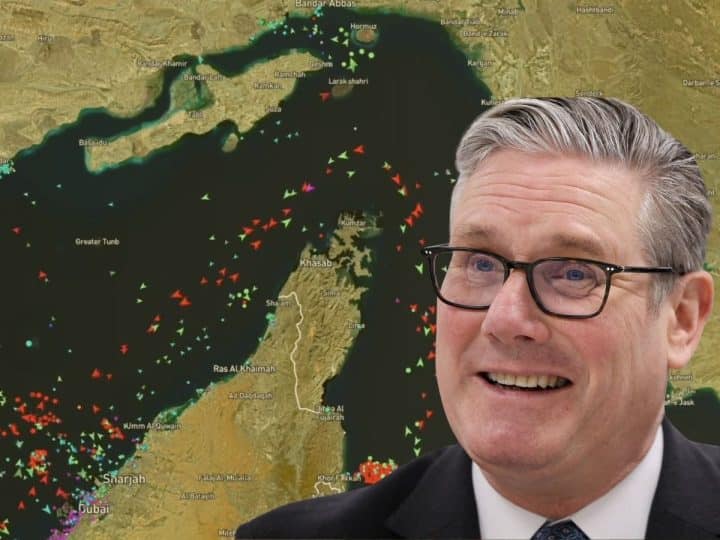

Keir Starmer’s craven X post welcoming the ‘re-opening’ of Iran’s Strait of Hormuz has been massively ratioed — and deservedly so.
A ‘ratio’ refers to the number of responses compared to the number of likes and shares. A post with many more replies than likes or shares is considered a disastrous one and a sign of the unpopularity of the views shared, the poster or both. And Starmer’s is way up there. With, at the time of writing, the more than 27,000 comments towering over the number of positive actions:
It’s good news that the Strait of Hormuz has now reopened.
This must be a long lasting and workable solution, without tolls or restrictions on routes.
Today we announced our joint plan with France and other international partners to protect freedom of navigation.
We need to…
— Keir Starmer (@Keir_Starmer) April 17, 2026
This is even more striking given the long record of ‘dark’ operations trying to pad Starmer’s likes and follower count. And no wonder, given the massive issues with his statement in both content and backbone.
Starmer misleading
First, the Strait of Hormuz has not ‘re-opened’ — Iran is allowing through the ships it chooses and still denying passage to those linked to the US, Israel and their enablers. This is pointed out in a ‘community note’ linking to a statement from the Iranian parliament’s speaker:
The claim the strait is open is simply untrue. The official speaker of the Iranian parliament has stated no ships are allowed through without Iranian authorisation. Keir Starmer is ignoring this. x.com/i/status/20452…
۴- عبور و مرور در تنگهٔ هرمز بر اساس «مسیر تعیین شده» و با «مجوز ایران» انجام خواهد شد.
۵- باز یا بسته بودن تنگه و مقررات حاکم بر آن را میدان مشخص میکند نه شبکههای اجتماعی.— محمدباقر قالیباف | MB Ghalibaf (@mb_ghalibaf) April 17, 2026
Second, Starmer ignores the fact that the US-Israel war of aggression — itself considered the supreme war crime because all other war crimes flow from it — is the cause of the war. It also ignores that neither Israel nor the US have even tried to look like they are honouring the supposed ‘ceasefire’, or are even serious about negotiations. It ignores that when Hormuz did look like it might be opened, Israel escalated its attacks on Lebanon to intentionally collapse the deal, too. All of this makes Starmer’s closing comment that “We need to see a return to peace and stability, and a permanent ceasefire” cowardice and collaboration.
What joint plan?
And his claim that his ‘joint plan’ would ‘protect freedom of navigation’ is a lie. The supposed plan, if it ever happens, is only designed to happen when Iran decides to stop shooting — and that will only happen when the US and Israel stop their attacks on Iran, lift sanctions and put in place meaningful barriers to them simply resuming their attacks. Since that is a long way off — and hard to even imagine what the world’s leading terror states could do to make assurances meaningful — Iran is going to be controlling Hormuz for a long time to come, probably decades.
In reality, the only protection Starmer and his (probably soon) successors can give UK ships to pass Hormuz is to stop being the US and Israel’s arse-noser in chief. And that’s not anywhere on the horizon either.
Ratioed and rightly so. He deserves much more, like a decade or two behind bars in the Hague.
Featured image via the Canary
By Skwawkbox
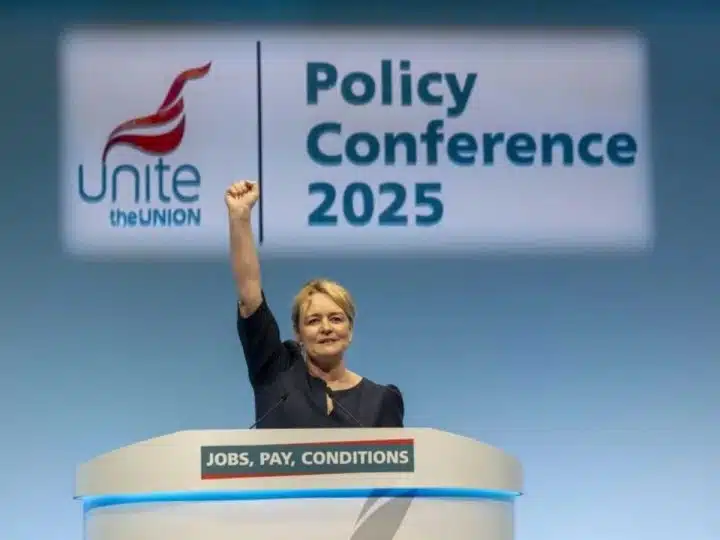

Unite’s anti-worker general secretary Sharon Graham has been slammed by the union’s grassroots activists for ‘betraying workers’ by holding “secret talks” with the far-right Reform UK over the Birmingham bin strike.
The strike, which has dragged on for more than a year, was triggered by another attack by Labour-run Birmingham council on the wages of some of its lowest-earning workers. However, Graham’s tactics have been criticised by union insiders and have failed to win the dispute. The union is also hampered by the collapse of its strike fund since Graham took over the union. She now faces both a personal re-election battle in 2026 and elections for Unite’s ‘exec’, of which her allies are trying to maintain control.
The ‘Reunite the union’ group said Graham’s talks with Reform were “desperate and politically reckless”. It also quoted Birmingham organisers saying they “never see her” and that by cosying with the far-right she has undermined their battle for fair treatment:
Courting Farage is a betrayal of our members already under attack by Reform and the thousands more in the party’s sights. It’s time to reunite, to end Sharon Graham’s appeasement of the far-right, and to stop Reform.
… This is an industrially desperate and politically reckless move. Labour is set to lose control of Birmingham, one of the largest councils in Europe. Latest polling shows that the council is highly likely to be led by Reform.
The union movement has rallied behind the Birmingham bin workers for a year now, including solidarity pickets from other unions. With local elections pending it is legitimate to put demands on parties to expose those who do not support the strikers and to demonstrate that Reform is not the party of workers.
It is politically reckless and industrially naïve to then meet with Reform, gifting them political cover and allowing Nigel Farage to launder himself through Sharon Graham’s tacit endorsement. This sends a dangerous message to our members, suggesting it is ok to vote Reform as a way to end (note “end” not “win”) the dispute.
Importantly, Graham did not bother to ask reps and members in Birmingham about this dangerous stunt. As our reps in Reform-controlled councils know well, if Reform take control of Birmingham they will immediately go on the attack against workers.
“Sharon Graham has no mandate from Birmingham council workers or the bin yards to hold talks with Reform. She hasn’t spoken to us about it at all. That isn’t a surprise as she has only been to all the pickets once in the last year. We never see her.” A Unite rep from Birmingham told Reunite.
“We have to support the dispute, but we also have to prepare for the attacks we’ll all face if Reform take over the council. That has now been totally undermined. It isn’t acceptable.”
For months, Sharon Graham has refused to directly criticise Reform. This is despite Reform’s leadership openly announcing attacks on our members and our union – from repealing new workplace protections, to scrapping protections against discrimination, and plans to create a Trump-style ICE force to attack migrant workers. Now we know why.
In September, Graham claimed she would “talk to the devil himself” when asked by Sky News about potential talks with Nigel Farage. Now she appears to have done just that.
This is an issue far beyond Birmingham. Building resistance to Reform and the far-right is an existential question for the trade union movement. It is outrageous hypocrisy for Sharon Graham to attend the March 28th Together demonstration in London, only to then authorise talks with Reform behind the backs of members. It is scab behaviour to break away from the wider trade union movement and to try and curry a special relationship with Reform.
For our members in Local Authorities.
For our thousands of migrant worker members.
For every member facing attacks from the far-right and Reform.
We must end this appeasement.
Graham’s move might surprise some, but she has a long and awful record in Unite, facing repeated strikes from workers both because of her husband Jack Clarke’s behaviour toward staff and her own attacks on attempts of the union’s workers to organise.
Graham and Clarke vs workers
Clarke was promoted shortly after Graham took over the union in 2021, overseeing the newly-created Bargaining and Disputes Unit (BDSU). Union insiders point out that Unite’s approval procedures for the promotion had not been followed. Prior to his promotion, Clarke was on a final warning from Unite for his behaviour.
BDSU staff were soon in dispute with the union and Clarke over alleged bullying by Clarke and his cronies. However, their complaints were not the first such allegations against Clarke.
In 2018, before Graham became Unite’s general secretary, she asked colleagues to destroy evidence of bullying and misogyny gathered by staff working under him in his previous role. In a stunning December 2024 development, Graham’s lawyers admitted that, following her takeover, the union destroyed the evidence.
Graham and Unite have also spent huge amounts of members’ money on lawyers’ fees, most recently to sue barely-followed and anonymous X accounts on behalf of Clarke.
Unite the anti-union union?
Staff have also accused Graham and her management team of employing intimidation, suspension and anti-union tactics against staff in the dispute. This outraged Unite’s National Industrial Sector Committee (NISC) for the print and graphics sector, and the leaders of two unions representing Unite staff and officers.
So bad has this alleged conduct been that more than 90% of Unite staff working at the union’s Holborn HQ voted for strike action. Three — some say four — of the five women who worked in Clarke’s department since Graham formed it and put him in charge of it have left. Union sources say they also alleged bullying and abuse.
Unite’s staff branch unanimously condemned the union’s abuse of its staff. The influential Officers National Committee (ONC) accused Graham of using Murdoch-style anti-union tactics against workers and officers unionising and taking collective action.
After fighting Graham’s moves to undermine their attempts to organise since the beginning of 2025, Unite’s officer group will soon begin strike action. That and Graham’s “desperate and reckless” cosying with Reform are likely to impact her attempts to get herself and her hangers-on re-elected.
Featured image via MorningStar
By Skwawkbox

One person holds the keys to $200 million of a project’s crypto. His co-founder says that has to end

Tommy Robinson backs violent rapist Conor McGregor

Lookman Scores but Atletico Madrid Lose Copa del Rey Final on Penalties


-
 NewsBeat7 days ago
Pep Guardiola and Gary Neville agree over Arsenal title problem that benefits Man City
-

 Crypto World6 days ago
The SEC Conditionalises DeFi Platforms to Be Avoided for Broker Registration
-

 Fashion2 days ago
Weekend Open Thread: Theodora Dress
-

 Politics7 days ago
World Cup exit makes Italy enter crisis mode
-

 Crypto World6 days ago
SEC Signals Exemption for Crypto Interfaces From Broker Registration
-

 News Videos4 days ago
Secure crypto trading starts with an FIU-registered
-

 Sports2 days ago
NWFL Suspends Two Players Over Post-Match Clash in Ado-Ekiti
-

 Crypto World5 days ago
SEC Proposes Certain Crypto Interfaces Don’t Need to Register as Brokers
-

 NewsBeat5 days ago
Trump and Pope Leo: Behind their disagreement over Iran war
-

 Politics2 days ago
Palestine barred from entering Canada for FIFA Congress
-

 Crypto World2 days ago
Russia Pushes Bill to Criminalize Unregistered Crypto Services
-

 Sports6 days ago
NWFL opens Pathway for new Clubs ahead of 2026 Season
-

 Crypto World6 days ago
Trump whales load up ahead of Mar-a-Lago luncheon.
-
 Business3 days ago
Creo Medical agree sale of its manufacturing operation
-
Business6 days ago
Kering slides after Morgan Stanley downgrade, Gucci woes loom
-
 Crypto World7 days ago
Sei Network Enters Quiet Reset Phase as On-Chain Metrics Signal a Slowdown in 2026
-

 Tech6 days ago
Google adds E2E encryption to Gmail for iOS and Android enterprise users
-
 Entertainment5 days ago
Brand New Day’ Footage Reveals the Devastating Impact of ‘Now Way Home’
-

 Tech6 days ago
Apple glasses won’t go brand shopping like Meta did with Ray-Ban and Oakley
-
 Entertainment5 days ago
Karol G’s ‘Ultra Raunchy’ Coachella Set Gave ‘Satanic Vibes’
You must be logged in to post a comment Login